Search Results: "he"

14 August 2023

Jonathan McDowell: listadmin3: An imperfect replacement for listadmin on Mailman 3

One of the annoyances I had when I upgraded from Buster to Bullseye (yes, I m talking about an upgrade I did at the end of 2021) is that I ended up moving from Mailman 2 to Mailman 3. Which is fine, I guess, but it meant I could no longer use listadmin to deal with messages held for moderation. At the time I looked around, couldn t find anything, shrugged, and became incredibly bad at performing my list moderation duties. Last week I finally accepted what I should have done at least a year ago and wrote some hopefully not too bad Python to web scrape the Mailman 3 admin interface. It then presents a list of subscribers and held messages that might need approved or discarded. It s heavily inspired by listadmin, but not a faithful copy (partly because it s been so long since I used it that I m no longer familiar with its interface). Despite that I ve called it listadmin3. It currently meets the bar of extremely useful to me so I ve tagged v0.1. You can get it on Github. I d be interested in knowing if it actually works for / is useful to anyone else (I suspect it won t be happy with interfaces configured to not be in English, but that should be solvable). Comment here or reply to my Fediverse announcement. Example usage, cribbed directly from the README:
$ listadmin3
fetching data for partypeople@example.org ... 200 messages
(1/200) 5303: omgitsspam@example.org / March 31, 2023, 6:39 a.m.:
  The message is not from a list member: TOP PICK
(a)ccept, (d)iscard, (b)ody, (h)eaders, (s)kip, (q)uit? q
Moving on...
fetching data for admins@example.org ... 1 subscription requests
(1/1) "The New Admin" <newadmin@example.org>
(a)ccept, (d)iscard, (r)eject, (s)kip, (q)uit? a
1 messages
(1/1) 6560: anastyspamer@example.org / Aug. 13, 2023, 3:15 p.m.:
  The message is not from a list member: Buy my stuff!
(a)ccept, (d)iscard, (b)ody, (h)eaders, (s)kip, (q)uit? d
0 to accept, 1 to discard, proceed? (y/n) y
fetching data for announce@example.org ... nothing in queue
$
There s Debian packaging in the repository (dpkg-buildpackage -uc -us -b will spit you out a .deb) but I m holding off on filing an ITP + actually uploading until I know if it s useful enough for others before doing so. You only really need the listadmin3 file and to ensure you have Python3 + MechanicalSoup installed. (Yes, I still run mailing lists. Hell, I still run a Usenet server.)

13 August 2023

Gunnar Wolf: Back to online teaching

Mexico s education sector had one of the longest lockdowns due to COVID: As everybody, we went virtual in March 2020, and it was only by late February 2022 that I went back to teach presentially at the University. But for the semester starting next Tuesday, I m going back to a full-online mode. Why? Because me and my family will be travelling to Argentina for six months, starting this October and until next March. When I went to ask for my teaching to be frozen for two semesters, the Head of Division told me he was actually looking for teachers wanting to do distance-teaching With a student population of >380,000 students, and not being able to grow the physical infrastructure, and with such a big city as Mexico City, where a person can take ove 2hr to commute daily It only makes sense to offer part of the courses online. To be honest, I m a bit nervous about this. The past couple of days, I ve been setting up again the technological parts (i.e. spinning up a Jitsi instance, remembering my usual practices and programs). But Well, I know that being videoconference-bound, my teaching will lose the dynamism that comes from talking face to face with students. I think I will miss it! (but at the same time, I m happy to try this anew: to go virtual, but where students choosing this modality do so by choice rather than because the world forced them to)

Fran ois Marier: Using iptables with systemd-networkd

I used to rely on ifupdown to bring up my iptables firewall automatically using a config like this in /etc/network/interfaces:
allow-hotplug eno1
iface eno1 inet dhcp
    pre-up iptables-restore /etc/network/iptables.up.rules
iface eno1 inet6 dhcp
    pre-up ip6tables-restore /etc/network/ip6tables.up.rules
but I wanted to modernize my network configuration and make use of systemd-networkd after upgrading one of my servers to Debian bookworm. Since I already wrote an iptables dispatcher script for NetworkManager, I decided to follow the same approach for systemd-networkd. I started by installing networkd-dispatcher:
apt install networkd-dispatcher
and then adding a script for the routable state in /etc/networkd-dispatcher/routable.d/iptables:
#!/bin/sh
LOGFILE=/var/log/iptables.log
if [ "$IFACE" = lo ]; then
    echo "$0: ignoring $IFACE for \ $STATE'" >> $LOGFILE
    exit 0
fi
case "$STATE" in
    routable)
        echo "$0: restoring iptables rules for $IFACE" >> $LOGFILE
        /sbin/iptables-restore /etc/network/iptables.up.rules >> $LOGFILE 2>&1
        /sbin/ip6tables-restore /etc/network/ip6tables.up.rules >> $LOGFILE 2>&1
        ;;
    *)
        echo "$0: nothing to do with $IFACE for \ $STATE'" >> $LOGFILE
        ;;
esac
before finally making that script executable (otherwise it won't run):
chmod a+x /etc/NetworkManager/dispatcher.d/pre-up.d/iptables
With this in place, I can put my iptables rules in the usual place (/etc/network/iptables.up.rules and /etc/network/ip6tables.up.rules) and use the handy iptables-apply and ip6tables-apply commands to test any changes to my firewall rules. Looking at /var/log/iptables.log confirms that it is being called correctly for each network interface as they are started.

Jonathan Dowland: Terrain base for 3D castle

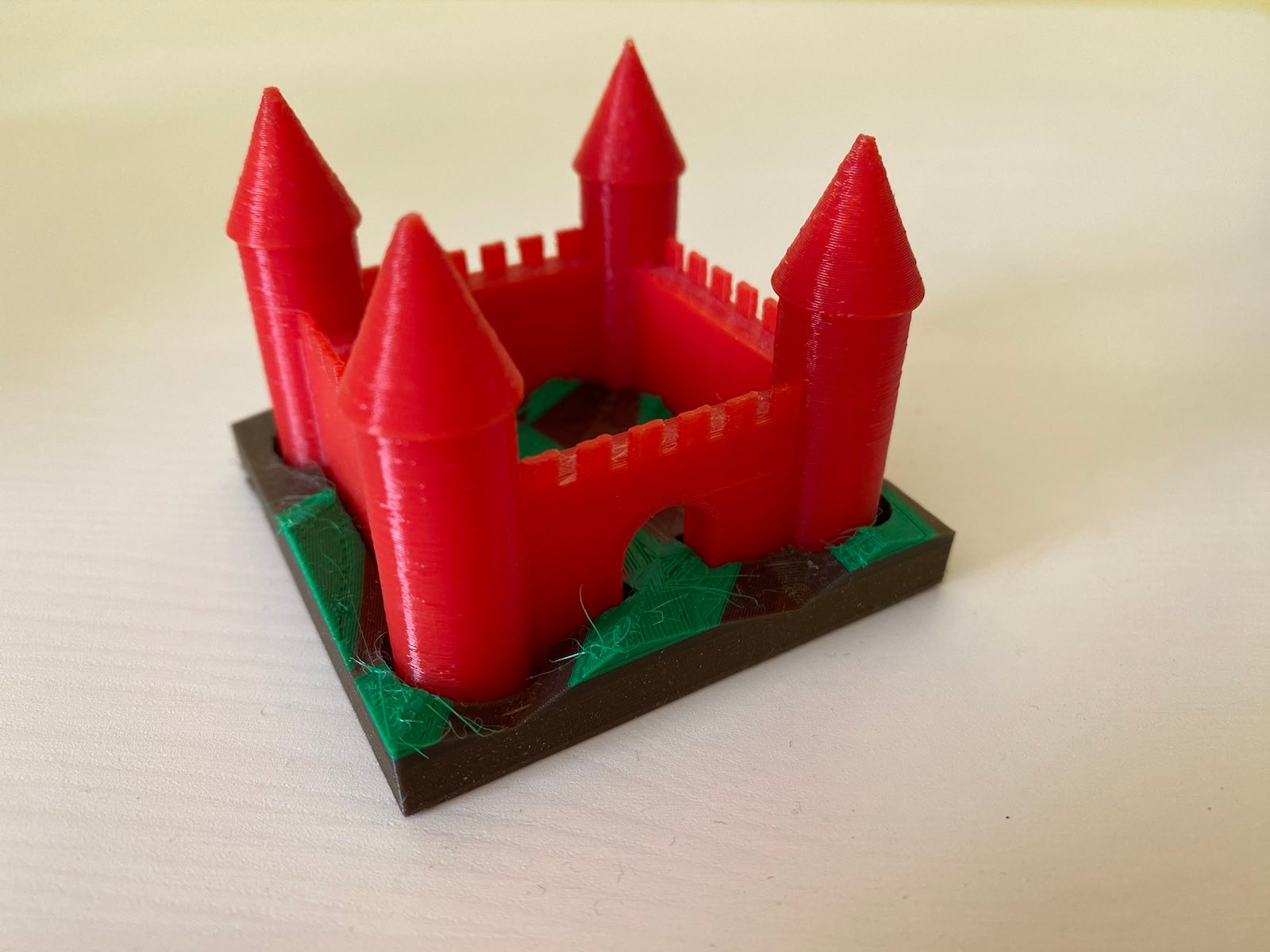
terrain base for the castle
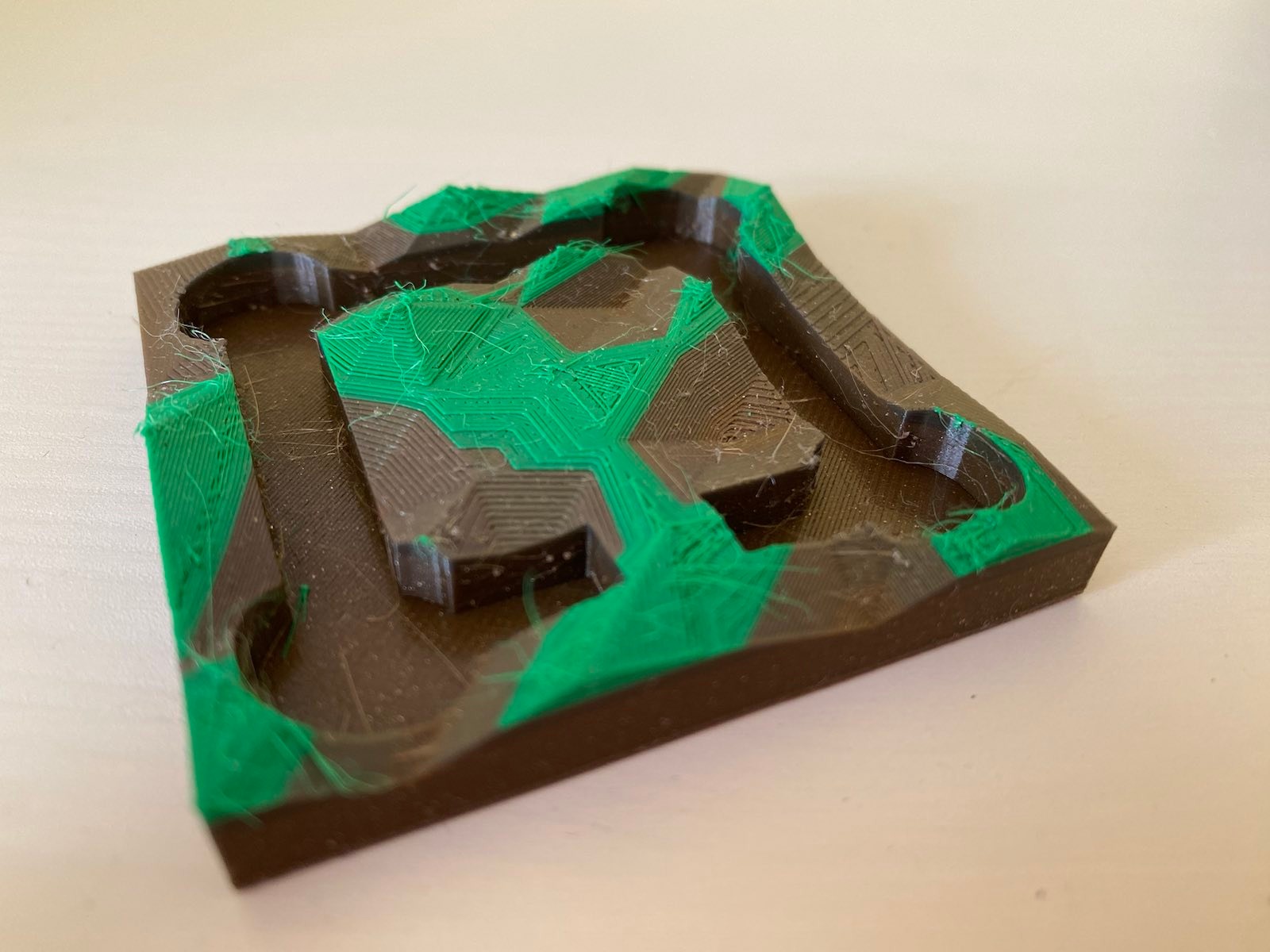
I designed and printed a "terrain" base for my 3D castle in OpenSCAD. The castle was the first thing I designed and printed on our (then new) office 3D printer. I use it as a test bed if I want to try something new, and this time I wanted to try procedurally generating a model. I've released the OpenSCAD source for the terrain generator under the name Zarchscape. mid 90s terrain generation
Lots of mid-90s games had very boxy floors Lots of mid-90s games had very boxy floors
Terrain generation, 90s-style. From [this article](https://web.archive.org/web/19990822085321/http://www.gamedesign.net/tutorials/pavlock/cool-ass-terrain/) Terrain generation, 90s-style. From this article
Back in the 90s I spent some time designing maps/levels/arenas for Quake and its sibling games (like Half-Life), mostly in the tool Worldcraft. A lot of beginner maps (including my own), ended up looking pretty boxy. I once stumbled across an article blog post that taught my a useful trick for making more natural-looking terrain. In brief: tessellate the floor region with triangle polygons, then randomly add some jitter to the z-dimension for their vertices. A really simple technique with fairly dramatic results. OpenSCAD Doing the same in OpenSCAD stretched me, and I think stretched OpenSCAD. It left me with some opinions which I'll try to write up in a future blog post. Final results
multicolour
I've generated and printed the result a couple of times, including an attempt a multicolour print. At home, I have a large spool of brown-coloured recycled PLA, and many small lengths of samples in various colours (that I picked up at Maker Faire Czech Republic last year), including some short lengths of green. My home printer is a Prusa Mini, and I cheaped out and didn't buy the filament runout sensor, which would detect when the current filament ran out and let me handle the situation gracefully. Instead, I added several colour change instructions to the g-code at various heights, hoping that whatever plastic I loaded for each layer was enough to get the print to the next colour change instruction. The results are a little mixed I think. I didn't catch the final layer running out in time (forgetting that the Bowden tube also means I need to catch it running out before the loading gear, a few inches earlier than the nozzle), so the final lush green colour ends prematurely. I've also got a fair bit of stringing to clean up. Finally, all these non-flat planes really show up some of the limitations of regular Slicing. It would be interesting to try this with a non-planar Slicer.

Dirk Eddelbuettel: #41: Using r2u in Codespaces

Welcome to the 41th post in the $R^4 series. This post draws on joint experiments first started by Grant building on the lovely work Eitsupi as part of our Rocker Project. In short, r2u is an ideal match for Codesspaces, a Microsoft/GitHub service to run code locally but in the cloud via browser or Visual Studio Code. This posts co-serves as the README.md in the .devcontainer directory as well as a vignette for r2u. So let us get into it. Starting from the r2u repository, the .devcontainer directory provides a small self-containted file devcontainer.json to launch an executable environment R using r2u. It is based on the example in Grant McDermott s codespaces-r2u repo and reuses its documentation. It is driven by the Rocker Project s Devcontainer Features repo creating a fully functioning R environment for cloud use in a few minutes. And thanks to r2u you can add easily to this environment by installing new R packages in a fast and failsafe way.

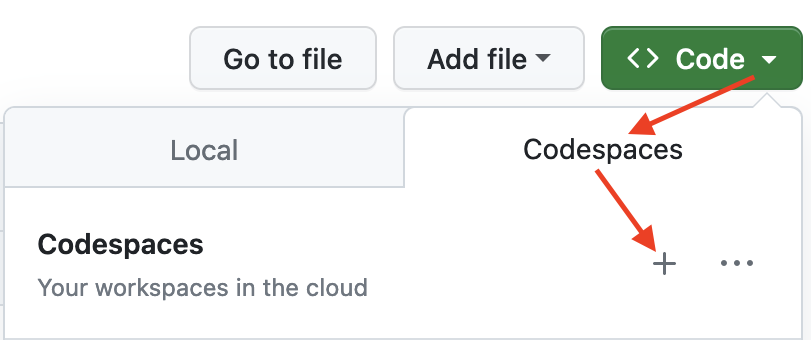
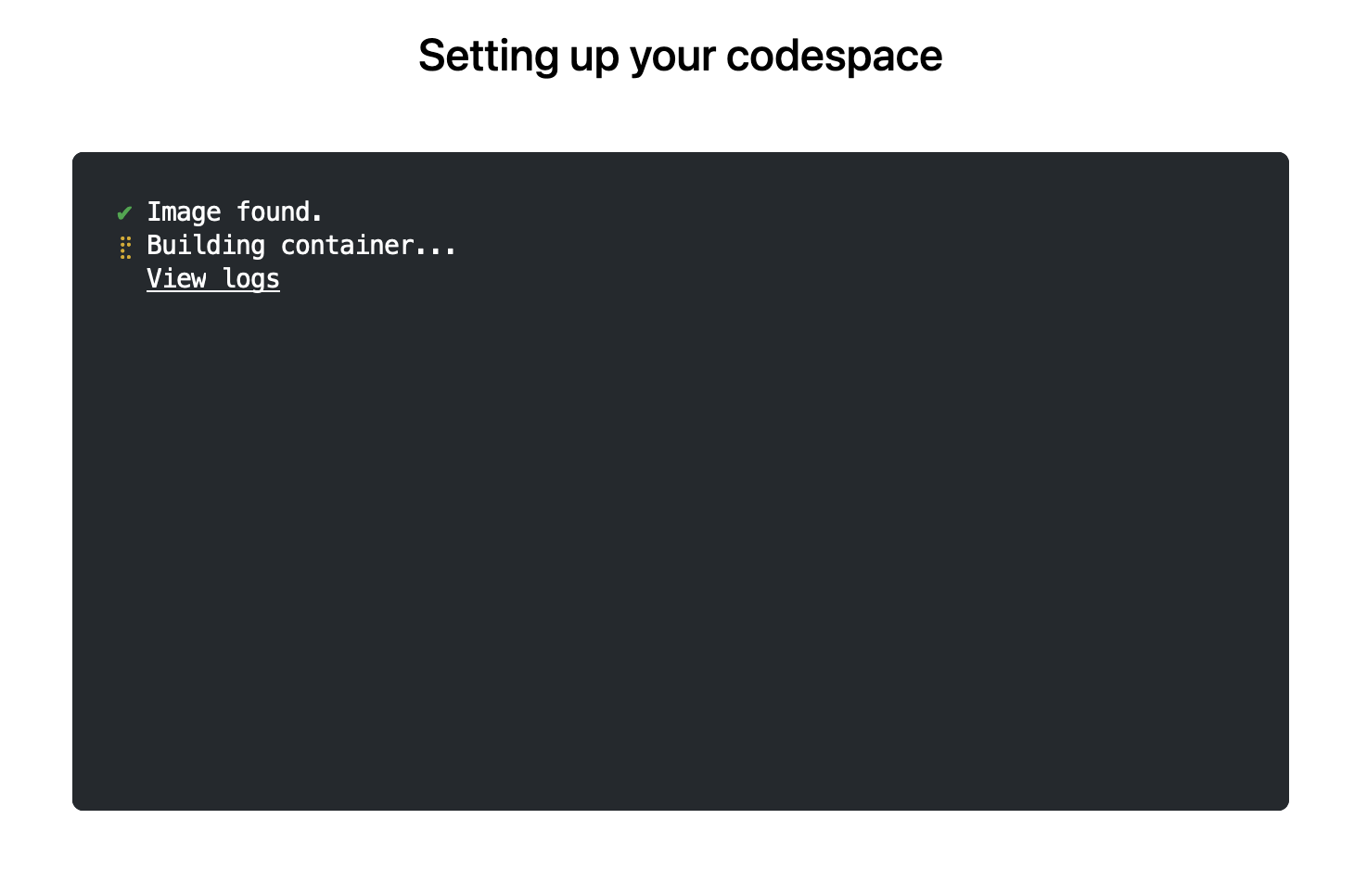
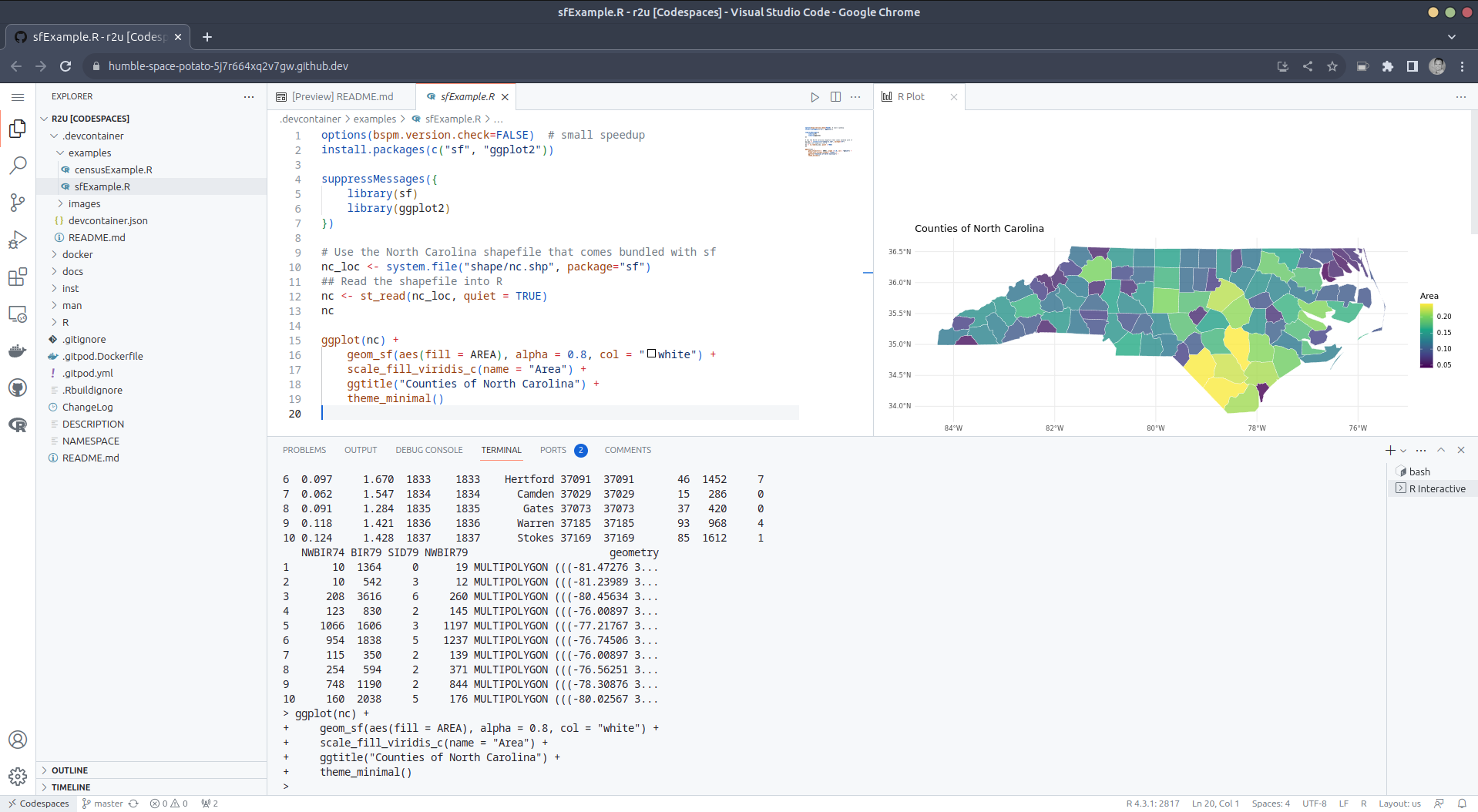
Try it out To get started, simply click on the green Code button at the top right. Then select the Codespaces tab and click the + symbol to start a new Codespace. The first time you do this, it will open up a new browser tab where your Codespace is being instantiated. This first-time instantiation will take a few minutes (feel free to click View logs to see how things are progressing) so please be patient. Once built, your Codespace will deploy almost immediately when you use it again in the future. After the VS Code editor opens up in your browser, feel free to open up the examples/sfExample.R file. It demonstrates how r2u enables us install packages and their system-dependencies with ease, here installing packages sf (including all its geospatial dependencies) and ggplot2 (including all its dependencies). You can run the code easily in the browser environment: Highlight or hover over line(s) and execute them by hitting Cmd+Return (Mac) / Ctrl+Return (Linux / Windows). (Both example screenshots reflect the initial codespaces-r2u repo as well as personal scratchspace one which we started with, both of course work here too.) Do not forget to close your Codespace once you have finished using it. Click the Codespaces tab at the very bottom left of your code editor / browser and select Close Current Codespace in the resulting pop-up box. You can restart it at any time, for example by going to https://github.com/codespaces and clicking on your instance.

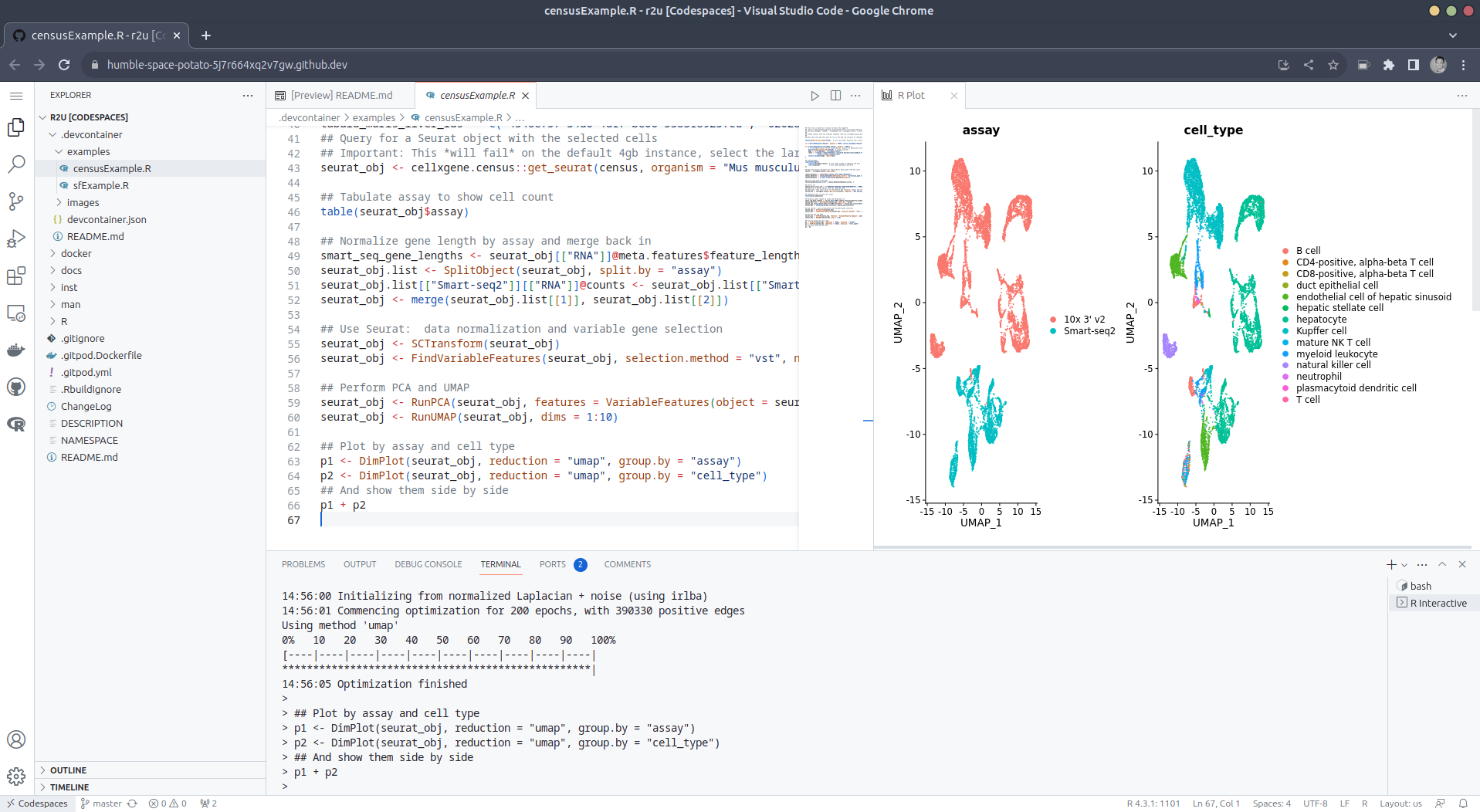
Extend r2u with r-universe r2u offers fast, easy, reliable access to all of CRAN via binaries for Ubuntu focal and jammy. When using the latter (as is the default), it can be combined with r-universe and its Ubuntu jammy binaries. We demontrates this in a second example file examples/censusExample.R which install both the cellxgene-census and tiledbsoma R packages as binaries from r-universe (along with about 100 dependencies), downloads single-cell data from Census and uses Seurat to create PCA and UMAP decomposition plots. Note that in order run this you have to change the Codespaces default instance from small (4gb ram) to large (16gb ram).

Local DevContainer build Codespaces are DevContainers running in the cloud (where DevContainers are themselves just Docker images running with some VS Code sugar on top). This gives you the very powerful ability to edit locally but run remotely in the hosted codespace. To test this setup locally, simply clone the repo and open it up in VS Code. You will need to have Docker installed and running on your system (see here). You will also need the Remote Development extension (you will probably be prompted to install it automatically if you do not have it yet). Select Reopen in Container when prompted. Otherwise, click the >< tab at the very bottom left of your VS Code editor and select this option. To shut down the container, simply click the same button and choose Reopen Folder Locally . You can always search for these commands via the command palette too (Cmd+Shift+p / Ctrl+Shift+p).

Use in Your Repo To add this ability of launching Codespaces in the browser (or editor) to a repo of yours, create a directory .devcontainers in your selected repo, and add the file .devcontainers/devcontainer.json. You can customize it by enabling other feature, or use the postCreateCommand field to install packages (while taking full advantage of r2u).

Acknowledgments There are a few key plumbing pieces that make everything work here. Thanks to:

Colophon More information about r2u is at its site, and we answered some question in issues, and at stackoverflow. More questions are always welcome! If you like this or other open-source work I do, you can now sponsor me at GitHub.

This post by Dirk Eddelbuettel originated on his Thinking inside the box blog. Please report excessive re-aggregation in third-party for-profit settings.

11 August 2023

Ian Jackson: Private posts

I have started to make private posts, accessible only to my Dreamwidth access list. If you re a friend of mine and would like to be on that list, please contact me with your Dreamwidth username (or your OpenID).

comment count unavailable comments

Scarlett Gately Moore: KDE: Post Akademy Snap Wrap Up and Future

Skrooge snapKDE Skrooge snap
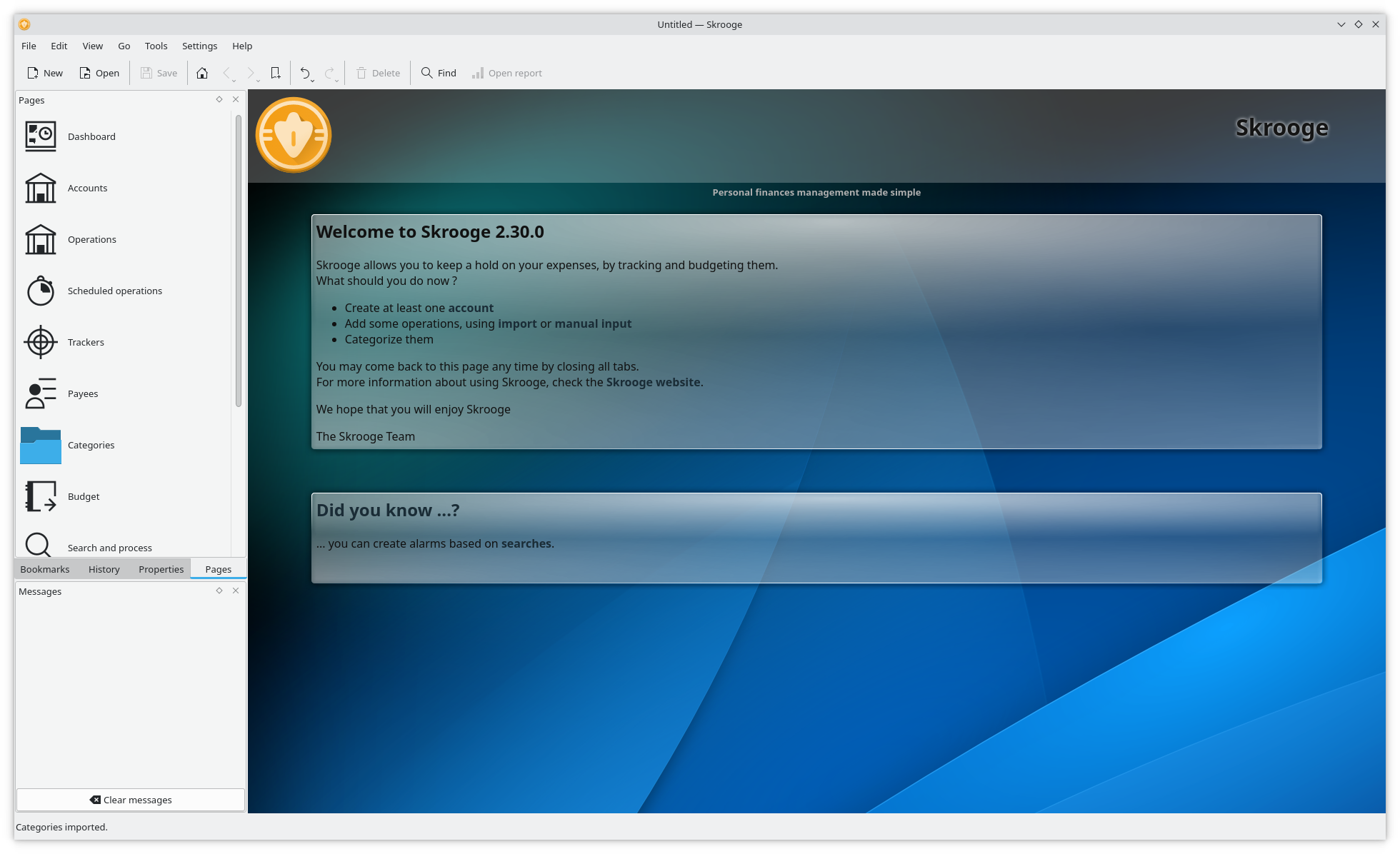
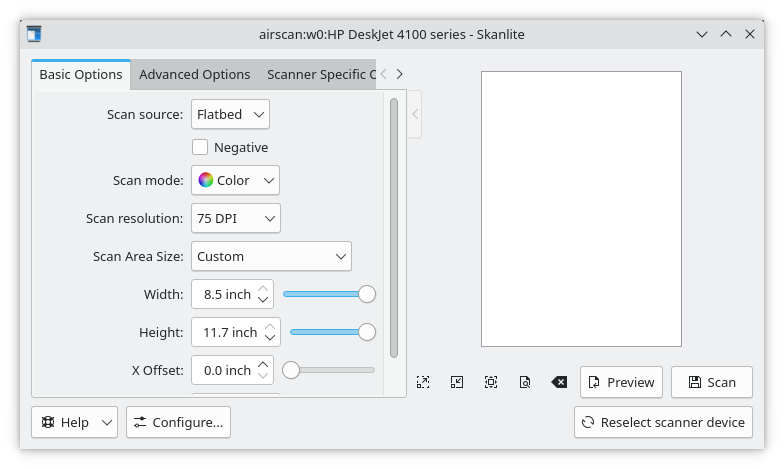
It has been a very busy couple of weeks in the KDE snap world! Here is a rundown of what has been done:
An update to the Very exciting news coming soon : While everything went well, it is not (yet!) happening. I do not have the management experience the stakeholders are looking for to run the project. I understand completely! I have the passion and project experience, just not management in this type of project. So with that said, are you a KDE/C++ developer with a management background and have a history of bringing projects to the finishline? Are you interested in an exciting new project with new technologies? Talk to me! I can be reached via sgmoore on the various chat channels, sgmoore at kde dot org, or connect via linkedin and message: https://www.linkedin.com/in/scarlettgatelymoore If you know anyone that might be interested, please point them here! As this project gets further delayed, it leaves me without an income still. If you or someone you know has any short term contract work let me know. Pesky bills and life expenses don t pay themselves  If you can spare some change ( anything helps ) please consider a donation. https://gofund.me/5d0691bc A big thank you to the community for making my work possible thus far!

Birger Schacht: Another round of rust

A couple of weeks ago I had to undergo surgery, because one of my kidneys malfunctioned. Everything went well and I m on my way to recovery. Luckily the most recent local heat wave was over just shortly after I got home, which made being stuck at home a little easier (not sure yet when I ll be allowed to do sports again, I miss my climbing gym ). At first I did not have that much energy to do computer stuff, but after a week or so I was able to sit in front of the screen for short amounts of time and I started to get into writing Rust code again.

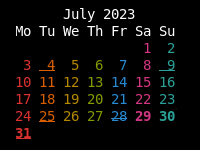
carl The first thing I did was updating carl. I updated all the dependencies and switched the dependency that does coloring from ansi_term, which is unmaintained, to nu-ansi-term. When I then updated the clap dependency to version 4 I realized that clap now depends on the anstyle crate for text styling - so I updated carls coloring code once again so it now uses anstyle, which led to less dependencies overall. Implementing this change I also did some refactoring of the code. carl how also has its own website as well as a subdomain1. I also added a couple of new date properties to carl, namely all weekdays as well as odd and even - this means it is now possible choose a separate color for every weekday and have a rainbow calendar:
screenshot carl
This is included in version 0.1.0 of carl, which I published on crates.io.

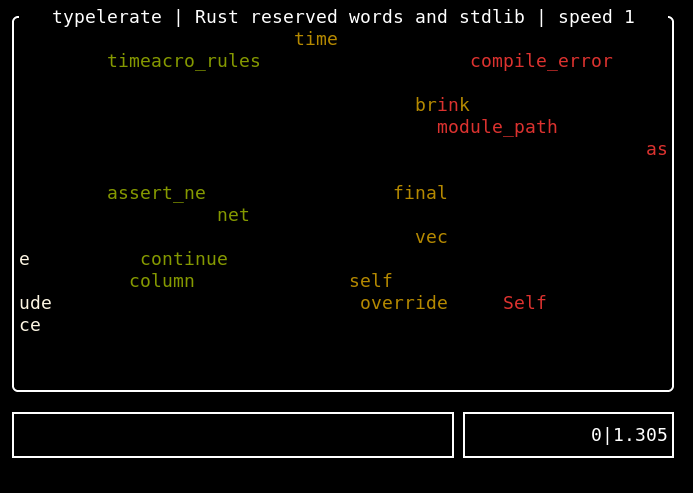
typelerate Then I started writing my first game - typelerate. It is a copy of the great typespeed, without the multiplayer support. To describe the idea behind the game, I quote the typespeed website:
Typespeed s idea is ripped from ztspeed (a DOS game made by Zorlim). The Idea behind the game is rather easy: type words that are flying by from left to right as fast as you can. If you miss 10 or more words, game is over.
Instead of the multiplayer support, typelerate works with UTF-8 strings and it also has another game mode: in typespeed you only type whats scrolling via the screen. In typelerate I added the option to have one or more answer strings. One of those has to be typed instead of the word flying across the screen. This lets you implement kind of an question/answer game. To be backwards compatible with the existing wordfiles from typespeed2, the wordfiles for the question/answer games contain comma separated values. The typelerate repository contains wordfiles with Python and Rust keywords as well as wordfiles where you are shown an Emoji and you have to type the corresponding Github shortcode. I m happy to add additional wordfiles (there could be for example math questions ).
screenshot typelerate

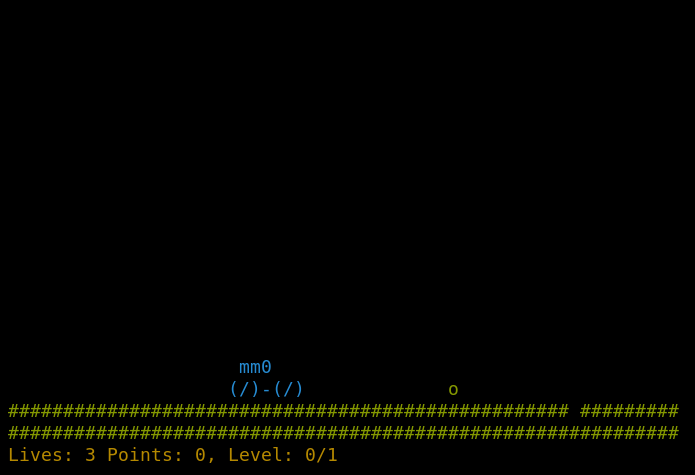
marsrover Another commandline game I really like, because I am fascinated by the animated ASCII graphics, is the venerable moon-buggy. In this game you have to drive a vehicle across the moon s surface and deal with obstacles like craters or aliens. I reimplemented the game in rust and called it marsrover:
screenshot marsrover
I published it on crates.io, you can find the repository on github. The game uses a configuration file in $XDG_CONFIG_HOME/marsrover/config.toml - you can configure the colors of the elements as well as the levels. The game comes with four levels predefined, but you can use the configuration file to override that list of levels with levels with your own properties. The level properties define the probabilities of obstacles occuring on your way on the mars surface and a points setting that defines how many points the user can get in that level (=the game switches to the next level if the user reaches the points).
[[levels]]
prob_ditch_one = 0.2
prob_ditch_two = 0.0
prob_ditch_three = 0.0
prob_alien = 0.5
points = 100
After the last level, the game generates new ones on the fly.

  1. thanks to the service from https://cli.rs.
  2. actually, typelerate is not backwards compatible with the typespeed wordfiles, because those are not UTF-8 encoded

Dirk Eddelbuettel: RcppArmadillo 0.12.6.1.0 on CRAN: New Upstream

armadillo image Armadillo is a powerful and expressive C++ template library for linear algebra and scientific computing. It aims towards a good balance between speed and ease of use, has a syntax deliberately close to Matlab, and is useful for algorithm development directly in C++, or quick conversion of research code into production environments. RcppArmadillo integrates this library with the R environment and language and is widely used by (currently) 1092 other packages on CRAN, downloaded 30.1 million times (per the partial logs from the cloud mirrors of CRAN), and the CSDA paper (preprint / vignette) by Conrad and myself has been cited 545 times according to Google Scholar. This release brings bugfix upstream release 12.6.1. Conrad release 12.6.0 when CRAN went on summer break. I rolled it up ran the full reverse-depenency check against the now more than 1000 packages. And usage from one those revealed a corner-case bug (of not always flattening memory for sparse matrices to zero values) so 12.6.1 followed. This is what was uploaded today. And as I prepared it earlier in the week as CRAN reopened, Conrad released a new 12.6.2. However, its changes are only concerned with settings for Armadillo-internal use of its random number generators (RNGs). And as RcppArmadillo connects Armadillo to the RNGs provided by R, the upgrade does not affect R users at all. However it is available in the github repo, in the Rcpp drap repo and at r-universe. The set of changes for this RcppArmadillo release follows.

Changes in RcppArmadillo version 0.12.6.1.0 (2023-07-26)
  • Upgraded to Armadillo release 12.6.1 (Cortisol Retox)
    • faster multiplication of dense vectors by sparse matrices (and vice versa)
    • faster eigs_sym() and eigs_gen()
    • faster conv() and conv2() when using OpenMP
    • added diags() and spdiags() for generating band matrices from set of vectors

Courtesy of my CRANberries, there is a [diffstat report relative to previous release]. More detailed information is on the RcppArmadillo page. Questions, comments etc should go to the rcpp-devel mailing list off the Rcpp R-Forge page. If you like this or other open-source work I do, you can sponsor me at GitHub.

This post by Dirk Eddelbuettel originated on his Thinking inside the box blog. Please report excessive re-aggregation in third-party for-profit settings.

10 August 2023

Sandro Tosi: Mastodon hook for dput-ng

If you use dput-ng, you may be familiar with the Twitter hook that tweets a message when uploading a package.A similar hook is now available for Mastodon too; if interested, give it a try and comment on the MR

Petter Reinholdtsen: Invidious add-on for Kodi 20

I still enjoy Kodi and LibreELEC as my multimedia center at home. Sadly two of the services I really would like to use from within Kodi are not easily available. The most wanted add-on would be one making The Internet Archive available, and it has not been working for many years. The second most wanted add-on is one using the Invidious privacy enhanced Youtube frontent. A plugin for this has been partly working, but not been kept up to date in the Kodi add-on repository, and its upstream seem to have given it up in April this year, when the git repository was closed. A few days ago I got tired of this sad state of affairs and decided to have a go at improving the Invidious add-on. As Google has already attacked the Invidious concept, so it need all the support if can get. My small contribution here is to improve the service status on Kodi. I added support to the Invidious add-on for automatically picking a working Invidious instance, instead of requiring the user to specify the URL to a specific instance after installation. I also had a look at the set of patches floating around in the various forks on github, and decided to clean up at least some of the features I liked and integrate them into my new release branch. Now the plugin can handle channel and short video items in search results. Earlier it could only handle single video instances in the search response. I also brushed up the set of metadata displayed a bit, but hope I can figure out how to get more relevant metadata displayed. Because I only use Kodi 20 myself, I only test on version 20 and am only motivated to ensure version 20 is working. Because of API changes between version 19 and 20, I suspect it will fail with earlier Kodi versions. I already asked to have the add-on added to the official Kodi 20 repository, and is waiting to heard back from the repo maintainers. As usual, if you use Bitcoin and want to show your support of my activities, please send Bitcoin donations to my address 15oWEoG9dUPovwmUL9KWAnYRtNJEkP1u1b.

Freexian Collaborators: Debian Contributions: PTS tracker, DebConf23 Bursary, and more! (by Utkarsh Gupta)

Contributing to Debian is part of Freexian s mission. This article covers the latest achievements of Freexian and their collaborators. All of this is made possible by organizations subscribing to our Long Term Support contracts and consulting services.

tracker.debian.org work by Rapha l Hertzog Rapha l spent some time during his vacation to update distro-tracker to be fully compatible with Django 3.2 so that the codebase and the whole testsuite can run on Debian 12. There s one exception though with the functional test suite that still needs further work to cope with the latest version of Selenium. By dropping support of Django 2.2, Rapha l could also start to work toward support of Django 4.2 since Django helpfully emits deprecation warnings of things that will break in future versions. All the warnings have been fixed but the codebase still fails its testsuite in Django 4.2 because we have to get rid of the python3-django-jsonfield dependency (that is rightfully dead upstream since Django has native support nowadays). All the JSONField have been converted to use Django s native field, but the migration system still requires that dependency at this point. This will require either some fresh reboot of the migration history, or some other trickery to erase the jsonfield dependency from the history of migrations. If you have experience with that, don t hesitate to share it (mail at hertzog@debian.org, or reach out to buxy on IRC). At this point, tracker.debian.org runs with Django 3.2 on Debian 11 since Debian System Administrators are not yet ready to upgrade debian.org hosts to Debian 12.

DebConf 23 bursary work by Utkarsh Gupta Utkarsh led the bursary team this year. The bursary team got a ton of requests this time. Rolling out the results in 4 batches, the bursary team catered over 165 bursary requests - which is superb! The team managed to address all the requests and answered a bit over 120 emails in the process. With that, the bursaries are officially closed for DebConf 2023. The team also intends to roll out some of the statistics closer to DebConf.

Miscellaneous contributions
  • Stefano implemented meson support in pybuild, the tool for building Python packages in Debian against multiple Python versions.
  • Santiago did some work on Salsa CI to enhance the ARM support on the autopkgtest job and make Josch s branch work. MR to come soon.
  • Helmut sent patches for 6 cross build failures.
  • Stefano has been preparing for DebConf 23: Working on the website, and assisting the local teams.
  • Stefano attended the DebConf Video team sprint in Paris, mostly looking at new hardware and software options for video capture and live-mixing. Full sprint report.

9 August 2023

Antoine Beaupr : OpenPGP key transition

This is a short announcement to say that I have changed my main OpenPGP key. A signed statement is available with the cryptographic details but, in short, the reason is that I stopped using my old YubiKey NEO that I have worn on my keyring since 2015. I now have a YubiKey 5 which supports ED25519 which features much shorter keys and faster decryption. It allowed me to move all my secret subkeys on the key (including encryption keys) while retaining reasonable performance. I have written extensive documentation on how to do that OpenPGP key rotation and also YubiKey OpenPGP operations.

Warning on storing encryption keys on a YubiKey People wishing to move their private encryption keys to such a security token should be very careful as there are special precautions to take for disaster recovery. I am toying with the idea of writing an article specifically about disaster recovery for secrets and backups, dealing specifically with cases of death or disabilities.

Autocrypt changes One nice change is the impact on Autocrypt headers, which are considerably shorter. Before, the header didn't even fit on a single line in an email, it overflowed to five lines:
Autocrypt: addr=anarcat@torproject.org; prefer-encrypt=nopreference;
 keydata=xsFNBEogKJ4BEADHRk8dXcT3VmnEZQQdiAaNw8pmnoRG2QkoAvv42q9Ua+DRVe/yAEUd03EOXbMJl++YKWpVuzSFr7IlZ+/lJHOCqDeSsBD6LKBSx/7uH2EOIDizGwfZNF3u7X+gVBMy2V7rTClDJM1eT9QuLMfMakpZkIe2PpGE4g5zbGZixn9er+wEmzk2mt20RImMeLK3jyd6vPb1/Ph9+bTEuEXi6/WDxJ6+b5peWydKOdY1tSbkWZgdi+Bup72DLUGZATE3+Ju5+rFXtb/1/po5dZirhaSRZjZA6sQhyFM/ZhIj92mUM8JJrhkeAC0iJejn4SW8ps2NoPm0kAfVu6apgVACaNmFb4nBAb2k1KWru+UMQnV+VxDVdxhpV628Tn9+8oDg6c+dO3RCCmw+nUUPjeGU0k19S6fNIbNPRlElS31QGL4H0IazZqnE+kw6ojn4Q44h8u7iOfpeanVumtp0lJs6dE2nRw0EdAlt535iQbxHIOy2x5m9IdJ6q1wWFFQDskG+ybN2Qy7SZMQtjjOqM+CmdeAnQGVwxowSDPbHfFpYeCEb+Wzya337Jy9yJwkfa+V7e7Lkv9/OysEsV4hJrOh8YXu9a4qBWZvZHnIO7zRbz7cqVBKmdrL2iGqpEUv/x5onjNQwpjSVX5S+ZRBZTzah0w186IpXVxsU8dSk0yeQskblrwARAQABzSlBbnRvaW5lIEJlYXVwcsOpIDxhbmFyY2F0QHRvcnByb2plY3Qub3JnPsLBlAQTAQgAPgIbAwULCQgHAwUVCgkICwUWAgMBAAIeAQIXgBYhBI3JAc5kFGwEitUPu3khUlJ7dZIeBQJihnFIBQkacFLiAAoJEHkhUlJ7dZIeXNAP/RsX+27l9K5uGspEaMH6jabAFTQVWD8Ch1om9YvrBgfYtq2k/m4WlkMh9IpT89Ahmlf0eq+V1Vph4wwXBS5McK0dzoFuHXJa1WHThNMaexgHhqJOs
 S60bWyLH4QnGxNaOoQvuAXiCYV4amKl7hSuDVZEn/9etDgm/UhGn2KS3yg0XFsqI7V/3RopHiDT+k7+zpAKd3st2V74w6ht+EFp2Gj0sNTBoCdbmIkRhiLyH9S4B+0Z5dUCUEopGIKKOSbQwyD5jILXEi7VTZhN0CrwIcCuqNo7OXI6e8gJd8McymqK4JrVoCipJbLzyOLxZMxGz8Ki0b9O844/DTzwcYcg9I1qogCsGmZfgVze2XtGxY+9zwSpeCLeef6QOPQ0uxsEYSfVgS+onCesSRCgwAPmppPiva+UlGuIMun87gPpQpV2fqFg/V8zBxRvs6YTGcfcQjfMoBHmZTGb+jk1//QAgnXMO7fGG38YH7iQSSzkmodrH2s27ZKgUTHVxpBL85ptftuRqbR7MzIKXZsKdA88kjIKKXwMmez9L1VbJkM4k+1Kzc5KdVydwi+ujpNegF6ZU8KDNFiN9TbDOlRxK5R+AjwdS8ZOIa4nci77KbNF9OZuO3l/FZwiKp8IFJ1nK7uiKUjmCukL0od/6X2rJtAzJmO5Co93ZVrd5r48oqUvjklzzsBNBFmeC3oBCADEV28RKzbv3dEbOocOsJQWr1R0EHUcbS270CrQZfb9VCZWkFlQ/1ypqFFQSjmmUGbNX2CG5mivVsW6Vgm7gg8HEnVCqzL02BPY4OmylskYMFI5Bra2wRNNQBgjg39L9XU4866q3BQzJp3r0fLRVH8gHM54Jf0FVmTyHotR/Xiw5YavNy2qaQXesqqUv8HBIha0rFblbuYI/cFwOtJ47gu0QmgrU0ytDjlnmDNx4rfsNylwTIHS0Oc7Pezp7MzLmZxnTM9b5VMprAXnQr4rewXCOUKBSto+j4rD5/77DzXw96bbueNruaupb2Iy2OHXNGkB0vKFD3xHsXE2x75NBovtABEBAAHCwqwEGAEIACAWIQSNyQHOZBRsBIrVD7t5IVJSe3WSHgUCWZ4LegIbAgFACRB5IV
 JSe3WSHsB0IAQZAQgAHRYhBHsWQgTQlnI7AZY1qz6h3d2yYdl7BQJZngt6AAoJED6h3d2yYdl7CowH/Rp7GHEoPZTSUK8Ss7crwRmuAIDGBbSPkZbGmm4bOTaNs/gealc2tsVYpoMx7aYgqUW+t+84XciKHT+bjRv8uBnHescKZgDaomDuDKc2JVyx6samGFYuYPcGFReRcdmH0FOoPCn7bMW5mTPztV/wIA80LZD9kPKIXanfUyI3HLP0BPwZG4WTpKzJaalR1BNwu2oF6kEK0ymH3LfDiJ5Sr6emI2jrm4gH+/19ux/x+ST4tvm2PmH3BSQOPzgiqDiFd7RZoAIhmwr3FW4epsK9LtSxsi9gZ2vATBKO1oKtb6olW/keQT6uQCjqPSGojwzGRT2thEANH+5t6Vh0oDPZhrKUXRAAxHMBNHEaoo/M0sjZo+5OF3Ig1rMnI6XbKskLv6hu13cCymW0w/5E4XuYnyQ1cNC3pLvqDQbDx5mAPfBVHuqxJdRLQ3yDM/D2QIsxnkzQwi0FsJuni4vuJzWK/NHHDCvxMCh0YmSgbptUtgW8/niatd2Y6MbfRGxUHoctKtzqzivC8hKMTFrj4AbZhg/e9QVCsh5zSXtpWP0qFDJsxRMx0/432n9d4XUiy4U672r9Q09SsynB3QN6nTaCTWCIxGxjIb+8kJrRqTGwy/PElHX6kF0vQUWZNf2ITV1sd6LK/s/7sH+x4rzgUEHrsKr/qPvY3rUY/dQLd+owXesY83ANOu6oMWhSJnPMksbNa4tIKKbjmw3CFIOfoYHOWf3FtnydHNXoXfj4nBX8oSnkfhLILTJgf6JDFXfw6mTsv/jMzIfDs7PO1LK2oMK0+prSvSoM8bP9dmVEGIurzsTGjhTOBcb0zgyCmYVD3S48vZlTgHszAes1zwaCyt3/tOwrzU5JsRJVns+B/TUYaR/u3oIDMDygvE5ObWxXaFVnCC59r+zl0FazZ0ouyk2AYIR
 zHf+n1n98HCngRO4FRel2yzGDYO2rLPkXRm+NHCRvUA/i4zGkJs2AV0hsKK9/x8uMkBjHAdAheXhY+CsizGzsKjjfwvgqf84LwAzSDdZqLVE2yGTOwU0ESiArJwEQAJhtnC6pScWjzvvQ6rCTGAai6hrRiN6VLVVFLIMaMnlUp92EtgVSNpw6kANtRTpKXUB5fIPZVUrVdfEN06t96/6LE42tgifDAFyFTZY5FdHHri1GG/Cr39MpW2VqCDCtTTPVWHTUlU1ZG631BJ+9NB+ce58TmLr6wBTQrT+W367eRFBC54EsLNb7zQAspCn9pw1xf1XNHOGnrAQ4r9BXhOW5B8CzRd4nLRQwVgtw/c5M/bjemAOoq2WkwN+0mfJe4TSfHwFUozXuN274X+0Gr10fhp8xEDYuQM0qu6W3aDXMBBwIu0jTNudEELsTzhKUbqpsBc9WjwNMCZoCuSw/RTpFBV35mXbqQoQgbcU7uWZslLl9Wvv/C6rjXgd+GeX8SGBjTqq1ZkTv5UXLHTNQzPnbkNEExzqToi/QdSjFMIACnakeOSxc0ckfnsd9pfGv1PUyPyiwrHiqWFzBijzGIZEHxhNGFxAkXwTJR7Pd40a7RDxwbO6p/TSIIum41JtteehLHwTRDdQNMoyfLxuNLEtNYS0uR2jYI1EPQfCNWXCdT2ZK/l6GVP6jyB/olHBIOr+oVXqJh+48ki8cATPczhq3fUr7UivmguGwD67/4omZ4PCKtz1hNndnyYFS9QldEGo+AsB3AoUpVIA0XfQVkxD9IZr+Zu6aJ6nWq4M2bsoxABEBAAHCwXYEGAEIACACGwwWIQSNyQHOZBRsBIrVD7t5IVJSe3WSHgUCWPerZAAKCRB5IVJSe3WSHkIgEACTpxdn/FKrwH0/LDpZDTKWEWm4416l13RjhSt9CUhZ/Gm2GNfXcVTfoF/jKXXgjHcV1DHjfLUPmPVwMdqlf5ACOiFqIUM2ag/OEARh356w
 YG7YEobMjX0CThKe6AV2118XNzRBw/S2IO1LWnL5qaGYPZONUa9Pj0OaErdKIk/V1wge8Zoav2fQPautBcRLW5VA33PH1ggoqKQ4ES1hc9HC6SYKzTCGixu97mu/vjOa8DYgM+33TosLyNy+bCzw62zJkMf89X0tTSdaJSj5Op0SrRvfgjbC2YpJOnXxHr9qaXFbBZQhLjemZi6zRzUNeJ6A3Nzs+gIc4H7s/bYBtcd4ugPEhDeCGffdS3TppH9PnvRXfoa5zj5bsKFgjqjWolCyAmEvd15tXz5yNXtvrpgDhjF5ozPiNp/1EeWX4DxbH2i17drVu4fXwauFZ6lcsAcJxnvCA28RlQlmEQu/gFOx1axVXf6GIuXnQSjQN6qJbByUYrdc/cFCxPO2/lGuUxnufN9Tvb51Qh54laPgGLrlD2huQeSD9Sxa0MNUjNY0qLqaReT99Ygb2LPYGSLoFVx9iZz6sZNt07LqCx9qNgsJwsdmwYsNpMuFbc7nkWjtlEqzsXZHTvYN654p43S+hcAhmmOzQZcew6h71fAJLciiqsPBnCEdgCGFAWhZZdPkMA==
After the change, the entire key fits on a single line, neat!
Autocrypt: addr=anarcat@torproject.org; prefer-encrypt=nopreference;
 keydata=xjMEZHZPzhYJKwYBBAHaRw8BAQdAWdVzOFRW6FYVpeVaDo3sC4aJ2kUW4ukdEZ36UJLAHd7NKUFudG9pbmUgQmVhdXByw6kgPGFuYXJjYXRAdG9ycHJvamVjdC5vcmc+wpUEExYIAD4WIQS7ts1MmNdOE1inUqYCKTpvpOU0cwUCZHZgvwIbAwUJAeEzgAULCQgHAwUVCgkICwUWAgMBAAIeAQIXgAAKCRACKTpvpOU0c47SAPdEqfeHtFDx9UPhElZf7nSM69KyvPWXMocu9Kcu/sw1AQD5QkPzK5oxierims6/KUkIKDHdt8UcNp234V+UdD/ZB844BGR2UM4SCisGAQQBl1UBBQEBB0CYZha2IMY54WFXMG4S9/Smef54Pgon99LJ/hJ885p0ZAMBCAfCdwQYFggAIBYhBLu2zUyY104TWKdSpgIpOm+k5TRzBQJkdlDOAhsMAAoJEAIpOm+k5TRzBg0A+IbcsZhLx6FRIqBJCdfYMo7qovEo+vX0HZsUPRlq4HkBAIctCzmH3WyfOD/aUTeOF3tY+tIGUxxjQLGsNQZeGrQI
Note that I have implemented my own kind of ridiculous Autocrypt support for the Notmuch Emacs email client I use, see this elisp code. To import keys, I pipe the message into this script which is basically just:
sq autocrypt decode   gpg --import
... thanks to Sequoia best-of-class Autocrypt support.

Note on OpenPGP usage While some have claimed OpenPGP's death, I believe those are overstated. Maybe it's just me, but I still use OpenPGP for my password management, to authenticate users and messages, and it's the interface to my YubiKey for authenticating with SSH servers. I understand people feel that OpenPGP is possibly insecure, counter-intuitive and full of problems, but I think most of those problems should instead be attributed to its current flagship implementation, GnuPG. I have tried to work with GnuPG for years, and it keeps surprising me with evilness and oddities. I have high hopes that the Sequoia project can bring some sanity into this space, and I also hope that RFC4880bis can eventually get somewhere so we have a more solid specification with more robust crypto. It's kind of a shame that this has dragged on for so long, but Update: there's a separate draft called openpgp-crypto-refresh that might actually be adopted as the "OpenPGP RFC" soon! And it doesn't keep real work from happening in Sequoia and other implementations. Thunderbird rewrote their OpenPGP implementation with RNP (which was, granted, a bumpy road because it lost compatibility with GnuPG) and Sequoia now has a certificate store with trust management (but still no secret storage), preliminary OpenPGP card support and even a basic GnuPG compatibility layer. I'm also curious to try out the OpenPGP CA capabilities. So maybe it's just because I'm becoming an old fart that doesn't want to change tools, but so far I haven't seen a good incentive in switching away from OpenPGP, and haven't found a good set of tools that completely replace it. Maybe OpenSSH's keys and CA can eventually replace it, but I suspect they will end up rebuilding most of OpenPGP anyway, just more slowly. If they do, let's hope they avoid the mistakes our community has done in the past at least...

Kentaro Hayashi: How to setup DMARC policy for subdomain on debian.net

For setting up subdomain on debian.net, we usually use LDAP Gateway. [1] db.debian.org [1] https://db.debian.org/doc-mail.html With changing dnsZoneEntry, we can set up each subdomain of debian.net. For example, you can customize SPF TXT record for example.debian.net.
example IN TXT v=spf1 a:example.debian.net ~all
But when you setup DMARC policy for dnsZoneEntry, it may cause the trouble. LDAP Gateway returns the following error:
Command is not understood. Halted - no changes committed
This is caused by unsupported v=DMARC1 record by changes@db.debian.org. Even though LDAP Gateway doesn't support v=DMARC1 record, there is a workaround for it. (e.g example.debian.net) TXT record of _dmarc.example.example.org is something like this:
v=DMARC1; p=quarantine; fo=s; aspf=s; rua=dmarc-reports@example.debian.net; ruf=dmarc-reports@example.debian.net
dmarc.example IN CNAME dmarc.example.example.org.
It means that _dmarc.example.debian.net is provided by _dmarc.example.example.org 's txt record. Now you can ready to verify it.

8 August 2023

James Valleroy: FreedomBox backport automatic update issue

When run on Debian stable, FreedomBox has an optional feature called Frequent Feature Updates . If this feature is enabled, it has 2 effects:
  1. The stable-backports repository is added to the system.
  2. Apt pinning is configured so that FreedomBox itself, and a small number of other carefully selected packages, will be kept updated to the latest version available in the backports repository.
However for bookworm-backports, there was a small change in the repository for bookworm-backports, which meant that our approach to apt pinning was no longer correct. The change is a difference between the repository s Suite and Codename . For bullseye-backports, these were the same, but for bookworm-backports, they are now different (stable-backports vs bookworm-backports). The issue is described in [1]. The result is that a FreedomBox on the current Debian stable release, bookworm, will not automatically upgrade to new versions in bookworm-backports, even if the Frequent Feature Updates option is selected. The fix for a issue is a very small change to two configuration files (for apt and unattended-upgrades), so that they refer to the Codename instead of the Suite. (See [2] for details.) So far, the fixed version of the freedombox package, 23.14~bpo12+1, is available in bookworm-backports. For FreedomBox users who would like to get the newer versions right away, you can get the latest package installed by running the following command through SSH or Cockpit s terminal: $ sudo apt install -t bookworm-backports freedombox We are also planning to update the version of FreedomBox in bookworm to have the fix. Once this update is available, then running the above command won t be necessary to receive FreedomBox feature updates. [1] https://salsa.debian.org/freedombox-team/freedombox/-/issues/2368 [2] https://salsa.debian.org/freedombox-team/freedombox/-/merge_requests/2409

Dirk Eddelbuettel: dtts 0.1.1 on CRAN: Enhancements

Leonardo and I are happy to announce the release of a first follow-up release 0.1.1 of our dtts package which got to [CRAN][cran] in its initial upload last year. dtts builds upon our nanotime package as well as the beloved data.table to bring high-performance and high-resolution indexing at the nanosecond level to data frames. dtts aims to bring the time-series indexing versatility of xts (and zoo) to the immense power of data.table while supporting highest nanosecond resolution. This release fixes a bug flagged by valgrind and brings several internal enhancements.

Changes in version 0.1.1 (2023-08-08)
  • A simplifcation was applied to the C++ interface glue code (#9 fixing #8)
  • The package no longer enforces the C++11 compilation standard (#10)
  • An uninitialized memory read has been correct (#11)
  • A new function ops has been added (#12)
  • Function names no longer start with a dot (#13)
  • Arbitrary index columns are now supported (#13)

Courtesy of my CRANberries, there is also a diffstat report for the this release this release. Questions, comments, issue tickets can be brought to the GitHub repo. If you like this or other open-source work I do, you can now sponsor me at GitHub.

This post by Dirk Eddelbuettel originated on his Thinking inside the box blog. Please report excessive re-aggregation in third-party for-profit settings.

Matthew Garrett: Updating Fedora the unsupported way

I dug out a computer running Fedora 28, which was released 2018-04-01 - over 5 years ago. Backing up the data and re-installing seemed tedious, but the current version of Fedora is 38, and while Fedora supports updates from N to N+2 that was still going to be 5 separate upgrades. That seemed tedious, so I figured I'd just try to do an update from 28 directly to 38. This is, obviously, extremely unsupported, but what could possibly go wrong?

Running sudo dnf system-upgrade download --releasever=38 didn't successfully resolve dependencies, but sudo dnf system-upgrade download --releasever=38 --allowerasing passed and dnf started downloading 6GB of packages. And then promptly failed, since I didn't have any of the relevant signing keys. So I downloaded the fedora-gpg-keys package from F38 by hand and tried to install it, and got a signature hdr data: BAD, no. of bytes(88084) out of range error. It turns out that rpm doesn't handle cases where the signature header is larger than a few K, and RPMs from modern versions of Fedora. The obvious fix would be to install a newer version of rpm, but that wouldn't be easy without upgrading the rest of the system as well - or, alternatively, downloading a bunch of build depends and building it. Given that I'm already doing all of this in the worst way possible, let's do something different.

The relevant code in the hdrblobRead function of rpm's lib/header.c is:

int32_t il_max = HEADER_TAGS_MAX;
int32_t dl_max = HEADER_DATA_MAX;

if (regionTag == RPMTAG_HEADERSIGNATURES)
il_max = 32;
dl_max = 8192;


which indicates that if the header in question is RPMTAG_HEADERSIGNATURES, it sets more restrictive limits on the size (no, I don't know why). So I installed rpm-libs-debuginfo, ran gdb against librpm.so.8, loaded the symbol file, and then did disassemble hdrblobRead. The relevant chunk ends up being:

0x000000000001bc81 <+81>: cmp $0x3e,%ebx
0x000000000001bc84 <+84>: mov $0xfffffff,%ecx
0x000000000001bc89 <+89>: mov $0x2000,%eax
0x000000000001bc8e <+94>: mov %r12,%rdi
0x000000000001bc91 <+97>: cmovne %ecx,%eax

which is basically "If ebx is not 0x3e, set eax to 0xffffffff - otherwise, set it to 0x2000". RPMTAG_HEADERSIGNATURES is 62, which is 0x3e, so I just opened librpm.so.8 in hexedit, went to byte 0x1bc81, and replaced 0x3e with 0xfe (an arbitrary invalid value). This has the effect of skipping the if (regionTag == RPMTAG_HEADERSIGNATURES) code and so using the default limits even if the header section in question is the signatures. And with that one byte modification, rpm from F28 would suddenly install the fedora-gpg-keys package from F38. Success!

But short-lived. dnf now believed packages had valid signatures, but sadly there were still issues. A bunch of packages in F38 had files that conflicted with packages in F28. These were largely Python 3 packages that conflicted with Python 2 packages from F28 - jumping this many releases meant that a bunch of explicit replaces and the like no longer existed. The easiest way to solve this was simply to uninstall python 2 before upgrading, and avoiding the entire transition. Another issue was that some data files had moved from libxcrypt-common to libxcrypt, and removing libxcrypt-common would remove libxcrypt and a bunch of important things that depended on it (like, for instance, systemd). So I built a fake empty package that provided libxcrypt-common and removed the actual package. Surely everything would work now?

Ha no. The final obstacle was that several packages depended on rpmlib(CaretInVersions), and building another fake package that provided that didn't work. I shouted into the void and Bill Nottingham answered - rpmlib dependencies are synthesised by rpm itself, indicating that it has the ability to handle extensions that specific packages are making use of. This made things harder, since the list is hard-coded in the binary. But since I'm already committing crimes against humanity with a hex editor, why not go further? Back to editing librpm.so.8 and finding the list of rpmlib() dependencies it provides. There were a bunch, but I couldn't really extend the list. What I could do is overwrite existing entries. I tried this a few times but (unsurprisingly) broke other things since packages depended on the feature I'd overwritten. Finally, I rewrote rpmlib(ExplicitPackageProvide) to rpmlib(CaretInVersions) (adding an extra '\0' at the end of it to deal with it being shorter than the original string) and apparently nothing I wanted to install depended on rpmlib(ExplicitPackageProvide) because dnf finished its transaction checks and prompted me to reboot to perform the update. So, I did.

And about an hour later, it rebooted and gave me a whole bunch of errors due to the fact that dbus never got started. A bit of digging revealed that I had no /etc/systemd/system/dbus.service, a symlink that was presumably introduced at some point between F28 and F38 but which didn't get automatically added in my case because well who knows. That was literally the only thing I needed to fix up after the upgrade, and on the next reboot I was presented with a gdm prompt and had a fully functional F38 machine.

You should not do this. I should not do this. This was a terrible idea. Any situation where you're binary patching your package manager to get it to let you do something is obviously a bad situation. And with hindsight performing 5 independent upgrades might have been faster. But that would have just involved me typing the same thing 5 times, while this way I learned something. And what I learned is "Terrible ideas sometimes work and so you should definitely act upon them rather than doing the sensible thing", so like I said, you should not do this in case you learn the same lesson.

comment count unavailable comments

7 August 2023

Dirk Eddelbuettel: RQuantLib 0.4.19 on CRAN: More Maintenance

A new release 0.4.19 of RQuantLib arrived at CRAN earlier today, and has already been uploaded to Debian too. QuantLib is a rather comprehensice free/open-source library for quantitative finance. RQuantLib connects it to the R environment and language, and has been part of CRAN for more than twenty years (!!) This release of RQuantLib brings a small update to three unit tests as very recent 1.31 release QuantLib brought a subtle change to some fixed income payment schedules and dates. On a sadder note, as CRAN now checks the ratio of user time over elapsed time , excessive threading was inferred for five examples. As we seemingly cannot limit std::thread here, I opted to park these examples behind a \dontrun . Not ideal. Lastly, a few version checks in configure were updated.

Changes in RQuantLib version 0.4.19 (2023-08-07)
  • Three calendaring / schedule tests were adjusted for slightly changed values under QuantLib 1.31
  • Several checks in the configure script have been updated to reflect current versions of packages.
  • Five examples no longer run because, even while extremely short, use of (too many default) threads was seen.

Courtesy of my CRANberries, there is also a diffstat report for the this release 0.4.19. As always, more detailed information is on the RQuantLib page. Questions, comments etc should go to the rquantlib-devel mailing list. Issue tickets can be filed at the GitHub repo. If you like this or other open-source work I do, you can now sponsor me at GitHub.

This post by Dirk Eddelbuettel originated on his Thinking inside the box blog. Please report excessive re-aggregation in third-party for-profit settings.

Thorsten Alteholz: My Debian Activities in July 2023

FTP master This month I accepted 408 and rejected 40 packages. The overall number of packages that got accepted was 412. Debian LTS This was my hundred-ninth month that I did some work for the Debian LTS initiative, started by Raphael Hertzog at Freexian. This month my all in all workload has been 14h. During that time I uploaded: I also continued my work on ring and did some work on security-master. Last but not least I did some days of frontdesk duties and took part in the LTS meeting. Debian ELTS This month was the sixtieth ELTS month. Finally I found the problem with the openssl package. When starting to work on the package, it built fine without my patches. After applying some patches, the built suddenly failed, so I thought I did something wrong with the patches. At some point I found out that it weren t my patches but a certificate, that was used for testing, expired. It was valid for 10 years and just when I worked on the package it expired. Now I just have to find out how to replace it Last but not least I did some days on frontdesk duties. Debian Astro This month I uploaded new upstream version of packages, did a source upload for the transition or uploaded it to fix one or the other issue: Other stuff This month I did uploads of new packages:

6 August 2023

Sam Hartman: AI Tools

I wrote about how I m exploring the role of AI in human connection and intimacy. The first part of that journey has been all about learning the software and tools for approaching large language models. The biggest thing I wish I had known going in was not to focus on the traditional cloud providers. I was struggling until I found runpod.io. I kind of assumed that if you were willing to pay for it and had the money, you could go to Amazon on or google or whatever and get the compute resources you needed. Not so much. Google completely rejected my request to have the maximum number of GPUs I could run raised above a limit of 0. Go talk to your sales representative. And of course no sales representative was willing to waste their time on me. But I did eventually find some of the smaller AI-specific clouds. I intentionally wanted to run software myself. Everyone has various fine-tuning and training APIs as well as APIs for inference. I thought I d gain a much better understanding if I wrote my own code. That definitely ended up being true. I started by understanding PyTorch and the role of optimizers, gradient descent and what a model is. Then I focused on Transformers and that ecosystem, including Accelerate, tokenizers, generation and training. I m really impressed with the Hugging Face ecosystem. A lot of academic software is very purpose built and is hard to reuse and customize. But the hub strikes an amazing balance between providing abstractions for common interfaces like consuming a model or datasets without getting in the way of hacking on models or evolving the models. I had a great time, and after a number of false starts, succeeded in customizing Llama2 to explore some of the questions on my mind. I ll talk about what I accomplished and learned in the next post.

comment count unavailable comments

Next.

Previous.