Search Results: "dom"

20 April 2012

Dominique Dumont: A success story for Config::Model

Hello Here s a mail telling how the Config::Model Perl module was used to refactor existing configuration tools in Perl. Some punctuation and blank lines were added to improve the flow of this text. The full name and mail address of gkr is withheld on his request.
I took over a perl script that was responsible to pull data from several sources and push it after validation and re-packaging including some meta data into one of our production systems. The script was never intended to be used for more then a few month. But as things go, we were still using it after a few years. Only now for a lot more sources. Since all the configuration of sources and meta data were contained as a single hash in this script, it became very unwieldy. Although the configuration seldom changed, once it got added it was not an option to keep it like this especially as we decided to prepare a Debian package for faster installation and version tracking. So I had to re-work it and was looking for some library that was allowing me to define how the configuration has to look like, providing sensible hard coded and computed defaults for some of the values. This was when I found Config::Model on Cpan. It was, after some digging into the documentation, quite simple to define a rough first version of the complete config, including global default values as ini file and very simple to read in and write out. A more advanced version was not working because the Config::Model in Debian squeeze did not provide needed features. Switching to yaml as configuration file format not only increased readability but also worked with the standard Squeeze package. Consistency is checked automatically inside the model so broken configurations are more unlikely in the future. Of course I had some work re-factoring the original source but Config::Model allowed an easy addition of a value-checked and documented configuration file. To access the Config::Model::Instance I added small wrapper packages that allowed an easy access of the config elements by name to make the source easier to understand. The re-factoring needed for creating a Debian package for the Script which is now a set of modules and a small executable was simple once I had Config::Model working, since I was able to add new configuration items effortlessly and remove a lot of hard coded parameters. I don t use the cli tool yet for configuration editing but that s going to be the next step.
Many thanks to gkr for this feedback. Let s hope he will continue to give feedback on his usage of Config::Model. All the best
Tagged: config-model, configuration, debian, Perl

Michal Čihař: Weblate gets experimental support for Android resources

I did sort of commit to at least trying to add support for Android string resource to Weblate on Stack Overflow, now while waiting for bugs to fix in 1.0 release it was right time to look at it. It turned out to be few lines of code but it took me some time to figure them out as translate-toolkit internals are not really god documented. Anyway I've hacked something what works for Weblate (and one random project I've tried) so it might be actually useful. You can find the code for it in pull request, let's see if it will get upstream. To use that, you need patched translate-toolkit (see above) and latest Git checkout from Weblate. As the changes on Weblate side were quite minor and not intrusive, I've decided to put this into 1.0 release, even if I originally did not plan to do so.

Filed under: English Weblate 0 comments Flattr this!

Keith Packard: fireworks

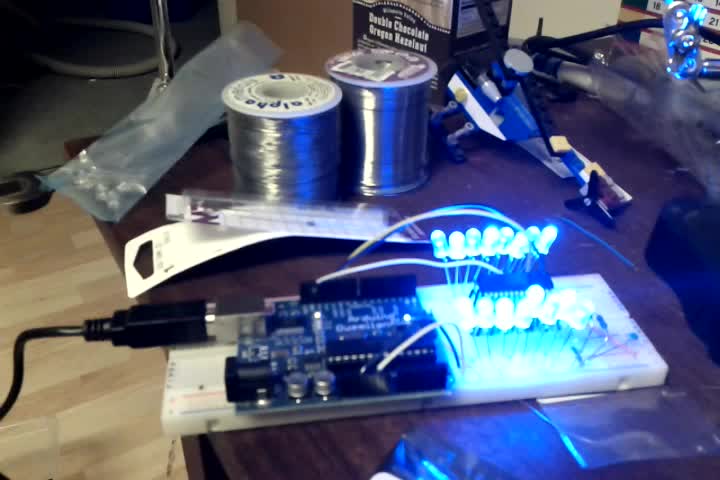
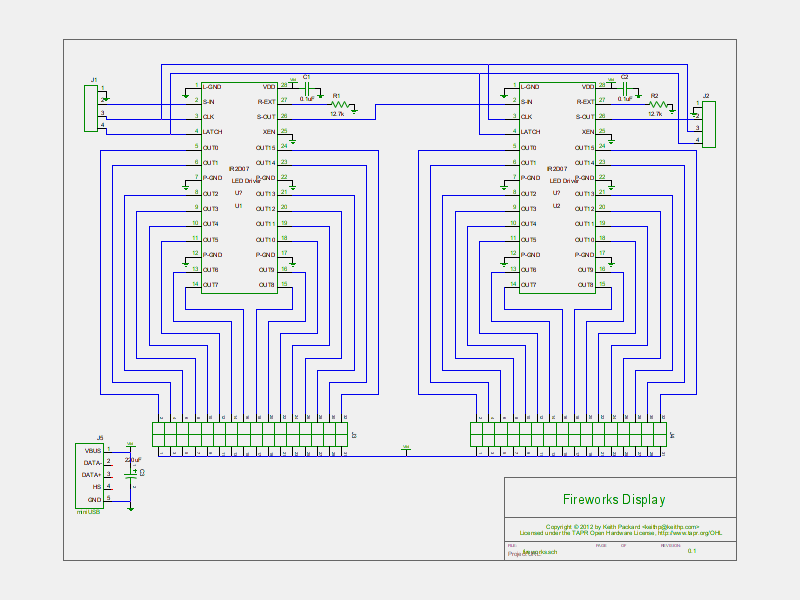
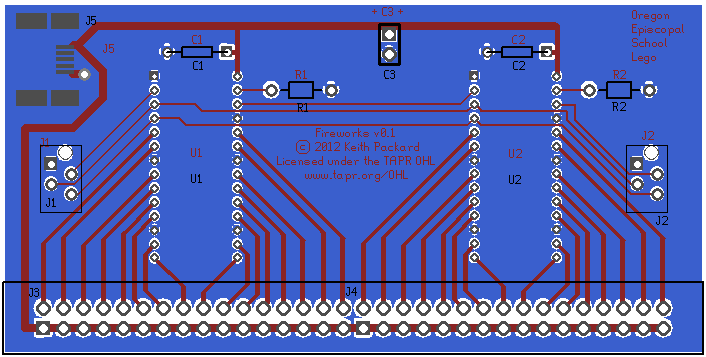
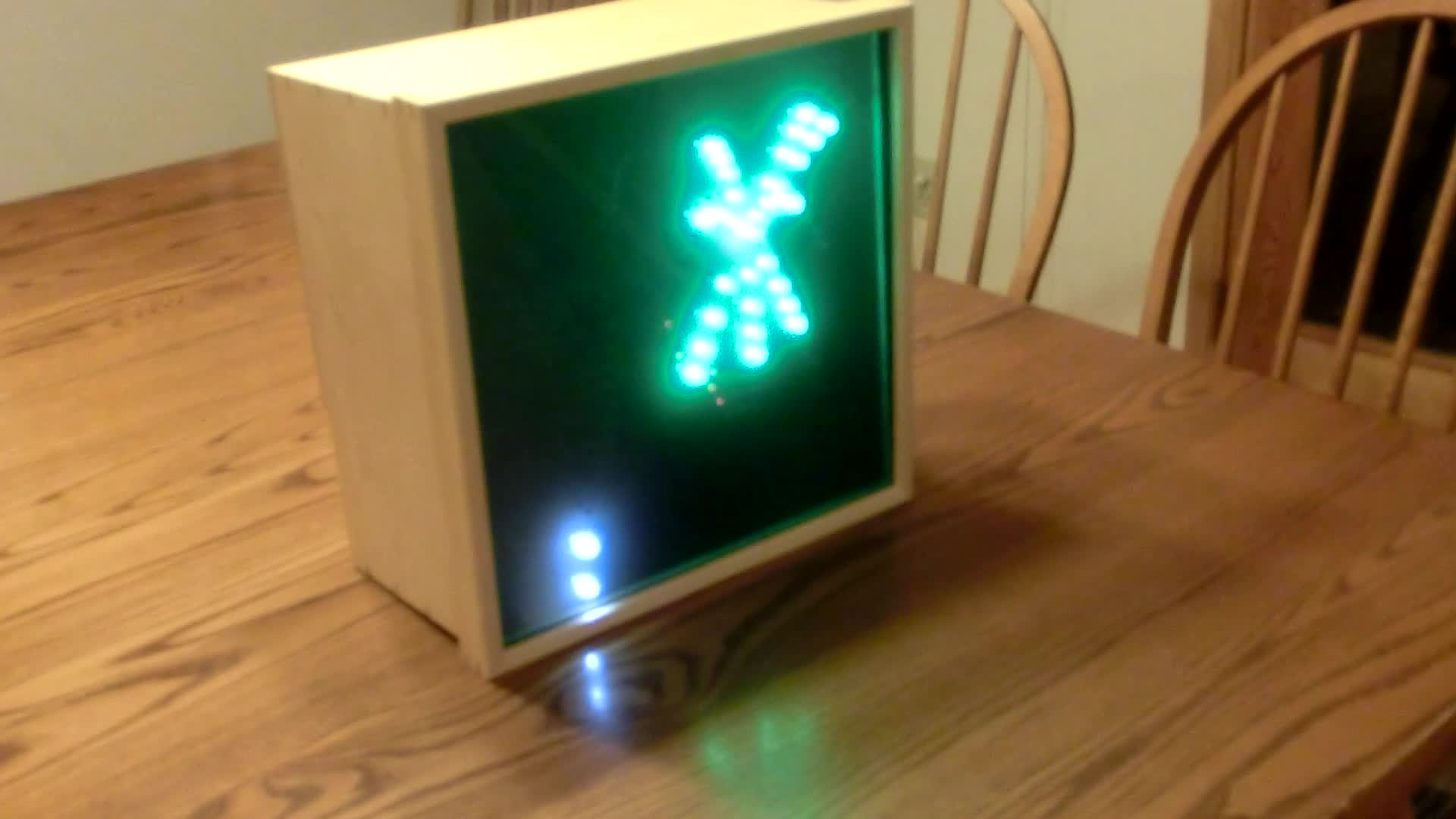
LED Fireworks. Or, parent helpers go overboard My friend, Mike Ward, and I help out at our kids school by teaching 5th and 6th graders programming in conjunction with a Lego class. For several years, I was teaching Logo on ancient Apple II machines. The teacher had a great curriculum and the kids learned a lot, but this year we decided to switch things around and try them out on Arduinos. This spring, the kids are building a Lego display centered around a birthday party theme for the star elephant at the Oregon Zoo (Packy), who turned 50 last weekend. In a moment of fun, I suggested that perhaps we should have some fireworks, along with the presents and birthday cake. How hard could it be to wire up a couple of LEDs to an Arduino to make something that looked like fireworks? Selecting parts. Mike and I sat down to order some parts from Digikey. We found these nice, cheap, LED drivers from Sharp. Then we found a selection of LEDs from Cree along with current-programming resistors (12.7k ) to drive the LEDs at 20mA, and some bypass caps (0.1 F) to keep the parts happy. The LED drivers are simple shift registers, with separate clock and data. They have both input and output pins, so you can daisy chain them and drive as many as you like from a single pair of CPU pins. We figured 160 LEDs would be plenty, so we ordered 10 chips. The LED drivers came in a through-hole, DIP package; it seemed like we d be able to just stuff them into a breadboard and quickly wire things up. Prototyping the design The LED driver chips turn out to use a much finer pitch package than the usual 0.1 spacing. There s no way we could stuff them into a breadboard and quickly wire things up. Obviously, a bit more care while ordering would have uncovered this, but my experience with through-hole parts is limited to parts from the mid 1970s I soldered extension wires onto one chip to test the circuit, and managed to get one chip talking to an Arduino. Here s a short movie of that in action: You can see the LED driver chip sitting on a set of extension leads plugged into the breadboard. It s hooked to the SPI port on the Arduino board, with the clock set as fast as it will go. If you watch the video, you can see that the LEDs actually vary in brightness. They re actually being pulse-width modulated. Clocked at 2MHz, there s enough bandwidth in the SPI bus to drive 160 LEDs with 127 discrete pulse widths at nearly 100Hz (100 * 127 * 160 = 2032000). Is bread boarding practical? With the chip propped up on its extension wires, and the LEDs plugged in, the whole setup was not surprisingly fragile. Getting five of these chips wired up and running for the length of the Lego show (one day at school and two days at the zoo) seemed unlikely. So, we decided to build some custom circuit boards. Using the GEDA tools to make circuit boards My business partner, Bdale Garbee, and I build rocketry electronics through Altus Metrum. He s the hardware guy and I spend my weekends writing firmware for various micro-controllers. Of course, I use free software tools for the firmware, and Bdale uses the free gEDA tools for the hardware. I ve gotten vaguely familiar with those by helping Bdale review circuit diagrams and PC board layout over the years. So I figured I d be able to learn a bit more about them and come up with some designs. I decided to stick two LED drivers on each board. As the chips can drive each LED with up to 50mA of current, each board could potentially consume 1.6A at 5V. Sticking a linear regulator on each board capable of supplying that much current would have required a hefty heat sink. Instead, I decided to stick a mini USB connector on the board and use some cheap USB power supplies. Of course, there wasn t a pre-packaged schematic symbol or footprint for the LED driver, so I first had to construct those. But, with symbols for all of the parts I used available, I drew this circuit: Wiring up 32 LEDs It s really easy to draw wires showing 32 LEDs hooked up to each board. Actually selecting connectors that can be easily hooked up took a bit more time. The idea of crimping individual two-pin connectors for 160 LEDs didn t seem like fun, plus individual connectors were going to cost a small fortune (the best option I found would have cost about $0.40 per LED). Bdale suggested using ribbon cable with a crimp-on connector crimp a connector across the whole cable and then split out two-wire sets for each LED. I d still have to individually solder each LED to the wire, but on the board end, all I d have to do is crimp the connector on to the cable. Designing the circuit boards The gEDA tools separate schematic design and PCB layout into two separate tools; the schematic program, gschem, exports a netlist and set of components which the schematic program, PCB, can import. This sounded a bit clunky to me, as you have to re-export and re-import the schematic data into the PCB each time you make changes, but it seems to work reasonably well in practice. The first time the schematic data is imported to the PCB tool, all of the component footprints are simply stacked on top of one another. With those moved to sensible locations, the tool will show rats for each netlist. Having drawn the schematic with symbols that strongly resembled the actual components, it was pretty easy to work through the rats one at a time by painting copper on the board. I d noticed that all of the signals could easily be routed on one side of the board, so I flooded the back side with a ground plane to keep things quiet. The final circuit board design looks like this: Circuit boards. All Altus Metrum products are manufactured by Advanced Circuits, and we ve been quite happy with them. They offer a cheap and fast prototyping service through their barebonespcb.com site. These boards are two layers with no silk screen or solder mask. I uploaded my design and in a couple of days I got back some shiny circuit boards: The footprint I designed for the LED drivers turned out to have a very small gap between the pads for each pin and the ground plane. This lead to a couple of shorted pins in the five boards, which were pretty easy to diagnose as the LED driven by that pin would be stuck on. Here s another picture with the ribbon cable connected and an LED lit up: Mounting the LEDs I started by writing a small nickle program to simulate the trajectory of a ballistic fireworks shell followed by an explosion at apogee and subsequent ballistic tracks for the resulting pieces. I made the initial conditions of the launch somewhat random, and Mike and I sat and watched that draw things until we saw a couple that looked good . The output from that was a series of X/Y locations spaced uniformly in time. Mike used those to drill holes in a piece of acrylic from TAP plastics. He glued the LEDs into that with some white glue (so that we have a chance of getting them back out): A custom maple box? I spent last weekend visiting my father for his birthday. Meanwhile, Mike was busy back home building a case for the project. I got home and found that he had fabricated a solid maple case. It s beautiful, and holds all of the LEDs, boards, wires and a couple of 4-outlet USB power supplies. Here s a picture of the joint he made in the box corners: The finished product Here s the inside of the box: And here s a movie of the whole thing in action. It s missing 8 white LEDs; I hadn t ordered enough from Digikey. Downloading schematics and PCB artwork The hardware design is licensed under the TAPR Open Hardware License. It s all stored in git (of course):
git://keithp.com/git/hw/fireworks
All of the symbols I created are also available through git:
git://keithp.com/git/hw/keithp
Things I d do differently One of the frustrating things about moving atoms around instead of just bits is that once you ve got a physical artifact, it s really expensive to change it. There are a couple of minor things I would change if I were going to build more of these: Things that worked well There were a couple of things that went better than I had expected:

19 April 2012

Raphaël Hertzog: People behind Debian: Samuel Thibault, working on accessibility and the Hurd

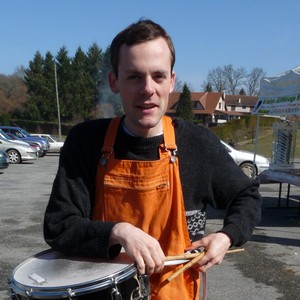
Samuel Thibault is a French guy like me, but it took years until we met. He tends to keep a low profile, even though he s doing lots of good work that deserves to be mentioned. He focuses on improving Debian s accessibility and contributes to the Hurd. Who said he s a dreamer? :-) Checkout his interview to have some news of Wheezy s status on those topics. Raphael: Who are you? Samuel: I am 30 years old, and live in Bordeaux, France. During the workday, I teach Computer Science (Architecture, Networking, Operating Systems, and Parallel Programming, roughly) at the University of Bordeaux, and conduct researches in heterogeneous parallel computing. During the evening, I play the drums and the trombone in various orchestra (harmonic/symphonic/banda/brass). During the night, I hack on whatever fun things I can find, mainly accessibility and the Hurd at the moment, but also miscellaneous bits such as the Linux console support. I am also involved in the development of Aquilenet, an associative ISP around Bordeaux, and getting involved in the development of the network infrastructure in Bordeaux. I am not practicing Judo any more, but I roller-skate to work, and I like hiking in the mountains. I also read quite a few mangas. Saturday mornings do not exist in my schedule (Sunday mornings do, it s Brass Band rehearsal :) ). Raphael: How did you start contributing to Debian? Samuel: Bit by bit. I have been hacking around GNU/Linux since around 1998. I installed my first Debian system around 2000, as a replacement for my old Mandrake installation (which after all my tinkering was actually no longer looking like a Mandrake system any more!). That was Potato at the time, which somebody offered me through a set of CDs (downloading packages over the Internet was unthinkable at the time with the old modems). I have been happily reading and hacking around documentation, source code, etc. provided on them. Contribution things really started to take off when I went to the ENS Lyon high school in 2001: broadband Internet access in one s own student room! Since sending a mail was then really free, I started submitting bugs against various packages I was using. Right after that I started submitting patches along them, and then patches to other bugs. I did that for a long time actually. I had very little knowledge of all packaging details at the time, I was just a happy hacker submitting reports and patches against the upstream source code. At ENS Lyon, I met a blind colleague with very similar hacking tastes (of course we got friends) and he proposed me, for our student project, to work on a brlnet project (now called brlapi), a client/server protocol that lets applications render text on braille devices themselves. Along the way, I got to learn in details how a blind person can use a Unix system and the principles that should be followed when developing Accessibility. That is how I got involved in it. We presented our project at JDLL, and the Hurd booth happened to be next to our table, so I discussed with the Hurd people there about how the Hurd console could be used through braille. That is how I got into the Hurd too. From then on, I progressively contributed more and more to the upstream parts of both accessibility software and the Hurd. And then to the packaging part of them. Through patches in bug reports first, as usual, as well as through discussions on the mailing lists. But quickly enough people gave me commit access so I could just throw the code in. I was also given control over the Hurd buildds to keep them running. It was all good at that stage: I could contribute in all the parts I was caring about. People however started telling me that I should just apply for being a Debian Developer; both from accessibility and Hurd sides. I had also seen a bunch of my friends going through the process. I was however a bit scared (or probably it was just an excuse) by having to manage a gpg key, it seemed like a quite dangerous tool to me (even if I already had commit access to glibc at the time anyway ). I eventually applied for DM in 2008 so as to at least be able to upload some packages to help the little manpower of the Accessibility and Hurd teams. Henceforth I had already a gpg key, thus no excuse any more. And having it in the DM keyring was not enough for e.g. signing the hurd-i386 buildd packages. So I ended up going through NM in 2009, which went very fast, since I had already been contributing to Debian and learning all the needed stuff for almost 10 years! I now have around 50 packages in my QA page, and being a DD is actually useful for my work, to easily push our software to the masses :) So to sum it up, the Debian project is very easy to contribute to and open to new people. It was used during discussions at the GNU Hackers Meeting 2011 as an example of a very open community with public mailing lists and discussions. The mere fact that anybody can take the initiative of manipulating the BTS (if not scared by the commands) without having to ask anybody is an excellent thing to welcome contributions; it is notable tha the GNU project migrated to the Debbugs BTS. More generally, I don t really see the DD status as a must, especially now that we have the DM status (which is still a very good way to drag people into becoming DDs). For instance, I gave a talk at FOSDEM 2008 about the state of accessibility in Debian. People did not care whom I was, they cared that there was important stuff going on and somebody talking about it. More generally, decisions that are made through a vote are actually very rare. Most of the time, things just happen on the mailing lists or IRC channels where anybody can join the discussion. So I would recommend beginners to first use the software, then start reporting bugs, then start digging in the software to try fix the bugs by oneself, eventually propose patches, get them reviewed. At some point the submitted patches will be correct already most of the time. That s when the maintainers will start getting bored of just applying the patches, and simply provide with commit access, and voil , one has become a main contributor. Raphael: You re one of the main contributors to the Debian GNU/Hurd port. What motivates you in this project? Samuel: As I mentioned above, I first got real contact with the Hurd from the accessibility point of view. That initially brought me into the Hurd console, which uses a flexible design and nice interfaces to interact with it. The Hurd driver for console accessibility is actually very straightforward, way simpler than the Windows or Linux drivers. That is what caught me initially. I have continued working on it for several reasons. First, the design is really interesting for users. There are many things that are natural in the Hurd while Linux is still struggling to achieve them, such as UID isolation, recently mentioned in LWN. What I really like in the Hurd is that it excels at providing users with the same features as the administrator s. For instance, I find it annoying that I still can not mount an ISO image that I build on e.g. ries.debian.org. Linux now has FUSE which is supposed to permit that, but I have never seen it enabled on an ssh-accessible machine, only on desktop machines, and usually just because the administrator happens to be the user of the machine (who could as well just have used sudo ) For me, it is actually Freedom #0 of Free Software: let the user run programs for any purpose, that is, combining things together all the possible ways, and not being prevented from doing some things just because the design does not permit to achieve them securely. I had the chance to give a Hurd talk to explain that at GHM 2011, whose main topic was extensibility , I called it GNU/Hurd AKA Extensibility from the Ground, because the design of the Hurd is basically meant for extensibility, and does not care whether it is done by root or a mere user. All the tools that root uses to build a GNU/Hurd system can be used by the user to build its own GNU/Hurd environment. That is guaranteed by the design itself: the libc asks for things not to the kernel, but to servers (called translators), which can be provided by root, or by the user. It is interesting to see that it is actually also tried with varying success in GNU/Linux, through gvfs or Plash. An example of things I love being able to do is: $ zgrep foo ~/ftp://cdn.debian.net/debian/dists/sid/main/Contents-*.gz On my Hurd box, the ~/ftp: directory is indeed actually served by an ftpfs translator, run under my user uid, which is thus completely harmless to the system. Secondly and not the least, the Hurd provides me with interesting yet not too hard challenges. LWN confirmed several times that the Linux kernel has become very difficult to significantly contribute to, so it is no real hacking fun any more. I have notably implemented TLS support in the Hurd and the Xen and 64bit support in the GNU Mach kernel used by the Hurd. All three were very interesting to do, but were already done for Linux (at least for all the architectures which I actually know a bit and own). It happens that both TLS and Xen hacking experience became actually useful later on: I implemented TLS in the threading library of our research team, and the Xen port was a quite interesting line on my CV for getting a postdoc position at XenSource :) Lastly, I would say that I am used to lost causes :) My work on accessibility is sometimes a real struggle, so the Hurd is almost a kind of relief. It is famous for his vapourware reputation anyway, and so it is fun to just try to contribute to it nevertheless. An interesting thing is that the opinion of people on the Hurd is often quite extreme, and only rarely neutral. Some will say it is pure vapourware, while others will say that it is the hope of humanity (yes we do see those coming to #hurd, and they are not always just trolls!). When I published a 0.401 version on 2011 April 1st, the comments of people were very diverse, and some even went as far as saying that it was horrible of us to make a joke about the promised software :) Raphael: The FTPmasters want to demote the Hurd port to the debian-ports.org archive if it doesn t manage a stable release with wheezy. We re now at 2 months of the freeze. How far are you from being releasable ? Samuel: Of course, I can not speak for the Debian Release team. The current progress is however encouraging. During Debconf11, Michael Banck and I discussed with a few Debian Release team members about the kind of goals that should be achieved, and we are near completion of that part. The Debian GNU/Hurd port can almost completely be installed from the official mirrors, using the standard Debian Installer. Some patches need some polishing, but others are just waiting for being uploaded Debian GNU/Hurd can start a graphical desktop and run office tools such as gnumeric, as well as the iceweasel graphical web browser, KDE applications thanks to Pino Toscano s care, and GNOME application thanks to Emilio Pozuelo Monfort s care. Of course, general textmode hacking with gcc/make/gdb/etc. just works smoothly. Thanks to recent work on ghc and ada by Svante Signell, the archive coverage has passed 76%. There was a concern about network board driver support: until recently, the GNU Mach kernel was indeed still using a glue layer to embed the Linux 2.2 or even 2.0 drivers (!). Finding a network board supported by such drivers had of course become a real challenge. Thanks to the GSoC work of Zheng Da, the DDE layer can now be used to embed Linux 2.6.32 drivers in userland translators, which was recently ACCEPTed into the archive, and thus brings way larger support for network boards. It also pushes yet more toward the Hurd design: network drivers as userland process rather than kernel modules. That said, the freeze itself is not the final deadline. Actually, freeze periods are rests for porters, because maintainers stop bringing newer upstream versions which of course break on peculiar architectures. That will probably be helpful to continue improving the archive coverage. Raphael: The kfreebsd port brought into light all the packages which were not portable between different kernels. Did that help the Hurd port or are the problems too different to expect any mutual benefit? Samuel: The two ports have clearly helped each other in many aspects. The hurd-i386 port is the only non-Linux one that has been kept working (at least basically) for the past decade. That helped to make sure that all tools (dpkg, apt, toolchain, etc.) were able to cope with non-Linux ports, and keep that odd-but-why-not goal around, and evidently-enough achievable. In return, the kFreeBSD port managed to show that it was actually releasable, at least as a technological preview, thus making an example. In the daily work, we have sometimes worked hand in hand. The recent porting efforts of the Debian Installer happened roughly at the same time. When fixing some piece of code for one, the switch-case would be left for the other. When some code could be reused by the other, a mail would be sent to advise doing so, etc. In the packaging effort, it also made a lot of difference that a non-Linux port is exposed as released architecture: people attempted by themselves to fix code that is Linuxish for no real reason. The presence of the kFreeBSD is however also sometimes a difficulty for the Hurd: in the discussions, it sometimes tends to become a target to be reached, even if the systems are not really comparable. I do not need to detail the long history of the FreeBSD kernel and the amount of people hacking on it, some of them full-time, while the Hurd has only a small handful of free-time hackers. The FreeBSD kernel stability has already seen long-term polishing, and a fair amount of the Debian software was actually already ported to the FreeBSD kernel, thanks to the big existing pure-FreeBSD hackerbase. These do not hold for the GNU/Hurd port, so the expectations should go along. Raphael: You re also very much involved in the Debian Accessibility team. What are the responsibilities of this team and what are you doing there? Samuel: As you would expect it, the Debian Accessibility team works on packaging accessibility-related packages, and helping users with them; I thus do both. But the goal is way beyond just that. Actual accessibility requires integration. Ideally enough, a blind user should be able to just come to a Debian desktop system, plug his braille device, or press a shortcut to enable speech synthesis, and just use the damn computer, without having to ask the administrator to install some oddly-named package and whatnot. Just like any sighted user would do. He should be able to diagnose why his system does not boot, and at worse be able to reinstall his computer all by himself (typically at 2am ). And that is hard to achieve, because it means discussing about integration by default of accessibility features. For instance, the Debian CD images now beep during at the boot menu. That is a precious feature that has been discussed between debian-boot and debian-accessibility for a few weeks before agreeing on how to do it without too much disturbance. Similarly, my proposition of installing the desktop accessibility engines has been discussed for some time before being commited. What was however surprisingly great is that when somebody brought the topic back for discussion, non-debian-accessibility people answered themselves. This is reassuring, because it means things can be done durably in Debian. On the installation side, our current status is that the stable Debian installer has a high contrast color theme, and several years ago, I have pushed toward making standard CD images automatically detect braille devices, which permits standalone installation. I have added to the Wheezy installer some software speech synthesis (which again brought discussion about size increase vs versatility etc.) for blind people who do not have a braille device. I find it interesting to work on such topic in Debian rather than another distribution, because Debian is an upstream for a lot of distributions. Hopefully they just inherit our accessibility work. It at least worked for the text installer of Ubuntu. Of course, the Accessibility team is looking for help, to maintain our current packages, but also introduce new packages from the TODO list or create some backports. One does not need to be an expert in accessibility: tools can usually be tested, at least basically, by anybody, without particular hardware (I do not own any, I contributed virtual ones to qemu). For new developments and ideas, it is strongly recommended to come and discuss on debian-accessibility, because it is easy to get on a wrong track that does not bring actual accessibility. We still have several goals to achieve: the closest one is to just fix the transition to gnome3, which has been quite bad for accessibility so far :/ On the longer run, we should ideally reach the scenario I have detailed above: desktop accessibility available and ready to be enabled easily by default. Raphael: What s the biggest problem of Debian? Samuel: Debian is famous for its heated debian-devel discussions. And some people eventually say this no fun any more . That is exemplified in a less extreme way in the debian-boot/accessibility discussions that I have mentioned above. Sometimes, one needs to have a real stubborn thick head to continue the discussion until finding a compromise that will be accepted for commit. That is a problem because people do not necessarily have so much patience, and will thus prefer to contribute to a project with easier acceptance. But it is also a quality: as I explained above, once it is there, it is apparently for good. The Ubuntu support of accessibility in its installer has been very diverse, in part due to quite changing codebase. The Debian Installer codebase is more in a convergence process. Its base will have almost not changed between squeeze and wheezy. That allowed the Debian Accessibility team to continue improving its accessibility support, and not have to re-do it. A wiki page explains how to test its accessibility features, and some non-debian-accessibility people do go through it. A problem I am much more frightened by is the manpower in some core teams. The Debian Installer, grub, glibc, Xorg, gcc, mozilla derivatives, When reading the changelogs of these, we essentially keep seeing the same very few names over and over. And when one core developer leaves, it is very often still the same names which appear again to do the work. It is hard to believe that there are a thousand DDs working on Debian. I fear that Debian does not manage to get people to work on core things. I often hear people saying that they do not even dare thinking about putting their hands inside Xorg, for instance. Xorg is complex, but it seems to me that it tends to be overrated, and a lot of people could actually help there, as well as all the teams mentioned above. And if nobody does it, who will? Raphael: Do you have wishes for Debian Wheezy? Samuel: That is an easy one :) Of course I wish that we manage to release the hurd-i386 port. I also wish that accessibility of gnome3 gets fixed enough to become usable again. The current state is worrying: so much has changed that the transition will be difficult for users already, the current bugs will clearly not help. I also hope to find the time to fix the qt-at-spi bridge, which should (at last!) bring complete KDE accessibility. Raphael: Is there someone in Debian that you admire for their contributions? Samuel: Given the concerns I expressed above, I admire all the people who do spend time on core packages, even when that is really not fun everyday. Just to alphabetically name a few people I have seen so often here and there in the areas I have touched in the last few years: Aur lien Jarno, Bastian Blank, Christian Perrier, Colin Watson, Cyril Brulebois, Frans Pop, J rg Jaspert, Joey Hess, Josselin Mouette, Julien Cristau, Matthias Klose, Mike Hommey, Otavio Salvador, Petr Salinger, Robert Millan, Steve Langasek. Man, so many things that each of them works on! Of course this list is biased towards the parts that I touched, but people working in others core areas also deserve the same admiration.
Thank you to Samuel for the time spent answering my questions. I hope you enjoyed reading his answers as I did. Note that older interviews are indexed on wiki.debian.org/PeopleBehindDebian.

Subscribe to my newsletter to get my monthly summary of the Debian/Ubuntu news and to not miss further interviews. You can also follow along on Identi.ca, Google+, Twitter and Facebook.

3 comments Liked this article? Click here. My blog is Flattr-enabled.

18 April 2012

Richard Hartmann: Potpourri I

Google rant Seems venting can be a worthwhile once in a while; the content of this post made its way into Google. No promises of any kind were made, but it's good to know that this is getting some exposure within Google :) That was quick. moreutils et al Steve Kemp is right; moreutils is very useful in some situations. And yes, it's a pity that we all have our own scripts without a central repository to host them all. The problem is one of diminishing returns and information overload; if any given collection becomes too large, it becomes tedious to look through it. You may have the Most Awesome Ever solution to any given problem, but unless whoever needs it can find it quickly, it's useless to them. Thorsten Glaser suggested this collection, but it suffers from the same basic problem: Not enough content? You won't find what you need. Too much content? You won't find what you need. Finding the right balance is highly non-trivial. Linux storage Russell Coker shared yet another chapter of his continuing quest for modern, reliable, software-based storage on Linux. The short version is "ZFS is not that good on Linux while btrfs is not ready for prime time, yet." That's, unfortunately, not much of a surprise. fsck.btrfs is still too new and the lack of RAID 5/6 is an absolute show-stopper as far as I am concerned. COW solves the writing speed issues so, hopefully, that old argument can finally be laid to rest. And on top of the "wastng" of more disks for RAID 10, the minimum number of failed disks that can lead to data loss on RAID 10 is two whereas it's three for RAID 6. No-brainer, imo. Anyone who does not agree with Dell's pricing structure should seriously consider looking at SuperMicro, by the way. Cheap(ish), reliable, high disk densities. Password hashes Saku Ytti talks about password hashing and the relative merits of different algorithms. While I agree that bcrypt incorporates a good approach inasmuch it's designed to be slow to compute and can be made slower as needed, I think he focuses on one aspect while disregarding all others. Still, the premise that deterring brute force attacks on known hashes is the only concern is wrong. Avoiding collisions, reasonable certainty that there are no computational shortcuts, irreversibility, pseudo-random output, full use of the output's possible values, and thorough analysis by experts in the field are important concerns, as well. Brute forcing known hashes is hardly the only attack. When brute forcing a service, i.e. against an unknown hash, no matter if the system is remote or local, the computational cost of hashing is mostly irrelevant. Rainbow tables help mitigate computational cost when trying to extract clear text in case the hash is known. And if there are a lot of collisions or an easy way to find them, knowing the clear text password is not needed. Simply use whatever generates the correct output and you're done. Again, I am not saying that bcrypt is a bad idea; it's just that there are more concerns than computational cost alone. Travel If you know your way around Novosibirsk, please contact me. We have almost no idea what to do while there other than visiting the railroad museum; part of the reason why we are stopping there is to have a break after ~50 hours on the train and because Novosibirsk is just an awesome name. Our focus while there will be on seeing interesting industrial or research sites. Given that there are large industrial complexes and formerly secret cold war secret research cities situated around Novosibirsk it would be a pity not to see any of them. We may end up hiring a taxi via the hotel and having that drive us around a bit. Somewhat boring and potentially costly, but a feasible backup. Blogging frequency I have to admit being am a bit worried about spamming the various aggregators which are fed from this blog. Writing this catchall post is an attempt to mitigate this. While I am getting a surprising amount of positive feedback, I would be interested to hear anything negative, if applicable, as well. You know how to reach me.

Richard Hartmann: Woegle is me

Google seems to become more and more annoying. Package download http://dl.google.com/linux/chrome/deb/ is slow. Not just slow, but slow. Any random apt-get update will take ages; just sitting there waiting for Google's servers to send any data. Downloading actual packages is slow, as well. Ironically, Google's PageRank will punish sites for loading slowly; it's a pity they don't use their considerable server & bandwidth capacities to fix slowness they are causing, themselves. Chrome Copy and paste is a central part of what I use a mouse for. X has had two copy buffers for as long as I can remember, one for mouse selection, pasting with middle mouse button and one for CTRL-c/CTRL-v. Chrome merges the two. That's bad enough in and as of itself, but every time Chrome gets focus, it will clobber anything you may have in your copy buffers at that time with anything that's selected. No matter if you selected it via mouse, via keyboard, a context switch autoselected something. Selection goes into buffer. Every time. Every. Single. Time. To add insult to injury, this is dependent on which tab is active. And if you happen to search on the site (CTRL-f), it will always use what's in the search bar to clobber buffers, no matter if anything on the actual website has been selected. I can't find the bug report about this at the moment, but Google's stance is that this is a feature and introducing an option for traditional copy & paste handling is not desirable. Google+ I get that they feel a need to combat Facebook, but still, pushing Google+ on you is just annoying. At least the Android application has had a permission change on ICS so it can not auto-update. It's the little things ;) WWW Unified branding, the need to support touch-based devices in their UI, etc. Still, GMail's new interface sucks and the old one will be going away for good. And while making some UI elements larger or displaying them unconditionally makes sense for hand-held portrait displays, this is highly annoying on wide-screen landscape displays. 1366x768 may have overtaken 1024x768, but 768 is a constant here and still not a lot. As an aside, hopefully the Apple Effect and the iPad 3 will break the age-long stalemate with regards to screen resolution. More is better, here. Android Bloatware Using stock Android means you won't get Facebook and other useless apps pre-installed. Yet, uninstalling stock applications, like Google+, is impossible. Rights management It's nice that I get to see what kind of access an application would like to have. It's not nice that I can not choose what access I am willing to grant any given application. I can make a binary decision, install or not install, but I can't refuse random access rights to applications. There are custom versions of Android out there which allow you to do this and many applications seem to cope with being unable to do some things. This should be a standard feature. Access management The concept of "access to USB storage" meaning "whatver your SD card or, in the Galaxy Nexus' case, just a specific directory" is also broken. There is a middle ground between "this application needs access to a large chunk of storage" and "this application needs complete access to said large chunk". Just assign the application a specific directory to write into and read from and done's done. Multi-user I can not hand anyone my phone to play a game or surf the Internet without giving them the ability to look through all my email, contacts, calendar, you name it. While I only give my phone to people I trust completely, this still sucks. How hard can it be to create a minimal guest mode which allows people to access a few pre-selected applications with a custom setting of if they are allowed to use cellular data and/or WiFi? Data access Authorized Access Ah, the big one.... Keep in mind that I am using Google's latest and greatest, the Samsung Galaxy Nexus GSM. It's as cutting-edge as you can get. Yes, having one continuous storage device is nice. But MTP support on Linux is abysmal and you are forced to access your data by means of MTP or PTP. gphoto2, gwenview, and gthumb are all unable to import any photos via PTP; no program I tried can transfer anything via MTP. gphoto2 will transfer the background images which APOD (highly recommended, by the way; there's also a donation application for this) stores on my phone. That's it. So, unless I send email to myself, use WiFi-based hacks, or root my phone, I can not access my data. On the strongest mobile platform in the world. Using the most powerful and versatile OS with up-to-date packages. In 2012. Yay. Unauthorized Access Not being able to access my data is a Bad Thing. Even worse is when others can access my data. Contrary to older Android versions, someone decided that it would be a good idea to allow MTP or PTP, only. As in "you can not disable MTP and PTP. One of them has the be activated." This is awesome when you want to charge your phone at an airport or at an acquaintance's possibly malware-ridden Windows machine. Everyone and their bot-herder can potentially access my data while I can not. Usability And while MTP/PTP is an either/or decision, they are using check-boxes, not radio buttons. There's a decade or more of UI experience about check-box versus radio button, so why not use it? I know of at least one owner of a Galaxy Nexus who was not even aware that he couldn't turn off MTP (the default) as the UI pretends otherwise. Opaqueness And good luck trying to contact anybody about this. Having filed a few bugs against Google stuff in the past, I simply gave up on it. Back when Gmail's mailing list filtering and labelling system was somewhat broken, I spent months hunting down people who knew people who knew someone who was able to actually do something about it.

17 April 2012

Tanguy Ortolo: Camera with a standard USB cable?

Digital camera icon Since some years, there has been a movement towards standardization: mobile devices are now using Micro-USB for data transfer and charging, and SD or Micro-SD for storage extension (except Apple of course). One piece is lacking to this perfection, however; as far as I know, digital camera producers did realize that SD won for storage, but they do not seem to have acknowledged the Micro-USB standard yet. Now, since manufacturers and resellers do not indicate the connector type, I have no way to be sure that this is still the case. So, dear lazyweb, do you know if, by chance, there exists a compact digital camera that would use SD cards and a Micro-USB connector for data transfer and integrated charging?

15 April 2012

Richard Hartmann: All aboard the Choo Choo train!

All aboard the Choo Choo train! As some of you know, we are planning our trip on the Trans-Siberian (well, Trans-Mongolian to be exact) railway, at the moment. Given the wall of text my post about Svalbard turned out to be, I am trying to split early and often. The plan Our three-week itinerary is pretty much fixed, by now: Visa issues Not wanting to just book any random package with any random travel agent, we are picking and mixing our own, as usual. Given visa requirements, language barriers and things that are plain weird, it's been an interesting ride before we even pack our bags a month or two from now. Being European, visas are something that do not concern us a lot, normally. I am starting to realize how incredibly lucky we are... barring India, we never needed to do much to be allowed to enter any foreign country. Not so on this trip... While Mongolia has rather lax, or let's just say reasonable, terms, China and Russia are different. To get a visa for Russia, you need: For China, you need to provide a night-to-night itinerary of hotel stays. This may be a remnant of Mao's philosophy of restricting free movement of the population within China, I don't know. On the plus side, they don't require an invitation, health insurance or means of industrial espionage. With processing times ranging from one to four weeks per visa, you will wait one to two months until your passports are back with you and properly visa'ed by everyone. Tickets, please Purchasing tickets in advance, but not through a travel agent, is turning out to be rather complicated. As you can not book train tickets with RZD, the Russian rail company, more than 45 days in advance, you end up with nice circular dependencies. We could pay a premium for faster processing of our visas and buy via travel agencies which sell train tickets from their special contingents, but that's kinda boring, innit? Also, rzd.ru offers Russian order forms, only. With the help of Google translate, ##russian on irc.freenode.net, and a lot of guess-work, we were able to hammer out the connections from Moscow to Novosibirsk and from there on to Irkutsk. Yet, it's quite a different experience not to not be able to fall back to English. No matter where we went in the past, English was the lingua franca, at least to some extent. That's not the case in any of our three intended destinations so those phrase books will get used a lot, I suspect... We are still not sure if the 4-people cabins in second class have a door, let alone one that can be locked, but we decided that this is not too much of an issue. Generally speaking, people are nice and there are train attendants so crime should not be an issue. And even if things do disappear, as long as we stay healthy and I still have one of my several copies of all photos I will take, I will be reasonably happy. As to getting from Irkutsk to Ulan Bator... even a Russian travel agent we contacted claimed you can only purchase tickets on site, not online. From Ulan Bator to Beijing, it's a different booking system. And from Beijing to Shanghai, it's yet another one. This is the most fragmented booking process we ever went through. Other than a few moments of stress and frustration, the hunting for information, cross-referencing and having the occasional eureka moment is tons of fun, though; no complaints here. When in Rome... According to Lonely Planet, the Trans-Siberian is more or less one large picnic where everyone shares whatever they have with them with everyone else. I poked a few Russians about what typically German food they like and they came up with Frankfurters, mustard, and beer. Guess that's what we will be stuffing our backpack with once everything else is packed. And snuff; apparently it's common courtesy to offer your snuff to other men you meet in Mongolia and then snuff from their bottle. When in Rome... German snuff tends to be mixed with menthol, I suspect that will raise some eyebrows ;) No idea if there is any non-obvious social grease to bring to China; still working on that. Initially, we wanted to tour Mongolia's main attractions, but we would either have to sit in a car for days on end or go by plane. Driving for days in between a solid week(!) spent on trains is not very appealing and neither is breaking our personal ground travel record by cheating flying. Thus, we decided to take the eco-tourism route: After a two-hour orientation course in Mongolian behaviour and manners, we will travel a few hundred kilometers by public bus, be picked up by a local, driven out into the outback and ride from ger to ger by camel and horse before returning to Ulan Bator by bus. The stays at the gers are immersive, if short; we will live with the families, help them do their daily chores, and visit local places of interest in between. Oddly enough, I am looking to forward to the bus ride even more than to the gers. At the gers, at least one person is able to speak basic English. Not so with the local bus. People on the various trains will be used to strangers, as are the families at the gers. People on the bus are, most likely, not. Communicating with hand, foot, phrasebook, and a smile will, hopefully, be a lasting experience. If time permits, we will try to visit kiva.org borrowers while in Ulan Bator; this is something we never had a chance to do before and it's been on the bucket list for some time, now. As an aside, the local agent in Mongolia asked us if our sleeping bags are rated down to -26 degrees Celsius. I do hope he was joking... On the privileges of living in a first-world country... Travelling by horse means travelling light. Not a problem for us as we pack light by default and still manage to bring everything from Swiss Tool to water bottles, zip ties, medkit, and everything in between. Still, there's one major thing I have been taking for granted all my life: electricity. Being without any source of power for four to five days is... challenging. Even more so as every single gadget I rely on uses a different type of battery. Flashlight: CR123A and AA; GPS: Ni-MH AA rechargeables and Lithium AAA primaries respectively; Laptop, cameras, cell phone, ebook reader, Nintendo DS and MP3 player: proprietary. I am starting to truly understand why NATO has a hard rule of allowing AA-powered devices, only; planning spares is a pain. Obviously, I am focusing on flashlights, GPS, and, above all, cameras. Battery grips with AA adapters to the rescue! Another even more unsettling realization came when I asked if it would be possible to have boodog (vegetarians/vegans: don't click). Mongolians do not usually prepare boodog in spring as the animals which survived the harsh winter need to fatten and breed before being killed for food. All my life, I have never even once considered the remote possibility of not being able to slaughter domesticated animals due to outside constraints. Mongolian nomads need their animals. This is not about wanting to do things one way or another; this is about survival. Quite fascinating, and humbling, to think about. I am incredibly privileged and, as you are reading this, so are you. An exercise for the reader If you have any information regarding: please let me know. As usual, but just a little bit more than usual, comments are appreciated.

14 April 2012

Dominique Dumont: My setup for vdr automatic wake up and shutdown

Hello Like all kids, my kids really enjoy watching cartoons. Unfortunately, most of them are broadcast during the morning, sometimes very early in the morning. Since I don t want my kids to wake up (or wake me up ) too early in the morning to watch cartoon, I record the most interesting programs with vdr (I also edit out commercials before my kids watch them) To limit my carbon (or equivalent radio-active waste) footprint, I do not want to leave the computer on 24/24, so the machine has to power up by itself before a recording time. So I ve setup vdr to automatically setup the wake up time of the computer and shutdown the machine once the recording is finished. Note that this machine is also my main home machine, so it must not shutdown while I m working on it (typing this blog, for instance). This should have been easy and fairly documented. Well, it was not that easy. A lot of doc mentions nvram-wakeup which is more or less obsolete. Other docs were in German. So, here s a summary of the setup so other can benefit from my experience. First, this was done on a Debian/sid machine, this post should be usable on other distros, provided some adaptations. These adaptations are left as an exercise to the reader (which is marketing lingo for I don t have a clue ) First add this line in /etc/default/vdr:
 ENABLE_SHUTDOWN=1
When vdr has nothing to do, it will run some shutdown scripts, including /usr/share/vdr/shutdown-hooks/S90.custom, which is a link to /etc/vdr/shutdown-hooks/S90.custom. The output of this script will be eval ed by vdr, so vdr knows what to do next (e.g. abort shutdown, display a message to user, retry later ). Here are the possible output of a vdr shutdown script (list taken from vdr-wiki): This script will mess with /sys/class/rtc/rtc0/wakealarm so it must be run as root. But vdr will launch this script and does not run as root. Instead of setting a suid bit, let s setup sudo to enable this script to gain root privilege from vdr. Add this line in /etc/sudoers (with visudo):
vdr ALL= NOPASSWD: /etc/vdr/shutdown-hooks/S90.custom *
And here s a commented Perl script that handle the shutdown test:
#!/usr/bin/perl
use IO::File ;
use 5.10.0 ;
use English;
use Path::Class; 
use Sys::Syslog qw(:standard :macros);  # standard functions & macros
openlog('vdr-shutdown', "", "user");
Here s the call to sudo to gain root privilege (if not already run as root):
if ($EUID)  
    system('sudo','/etc/vdr/shutdown-hooks/S90.custom', @ARGV) ;
    syslog(info => "vdr-shutdown: sudo myself returned $@") ;
 
Get the next timer info from the command arguments provided by vdr:
my ($next_timer,$interval) = @ARGV ;
Setup the next alarm in the mother board:
if ( $next_timer)  
  my $dev_fh = IO::File->new("> /sys/class/rtc/rtc0/wakealarm");
  die "cannot open $dev_fh: $!" unless $dev_fh ;
  my $newtime = $next_timer - 300  ;  # Start 5 minutes earlier
  $dev_fh->print( "$newtime\n" ) ;
  $dev_fh->close ;
  syslog(info => "vdr-shutdown: set wakeup to $newtime") ;
 
Now, let s check if someone is logged on the system. Weirdly enough, forking a command from this Perl script does not work when it s run by vdr. Calling the who command always return empty. The trick to find if anyone is logged is to check the content of /dev/pts directory. No files in there means that nobody is logged:
my @pts  = dir('/dev/pts')->children;
syslog(info => "vdr-shutdown:  found pts @pts") ;
if (@pts > 1)  
    syslog(info => "vdr-shutdown: retry later: someone is logged") ;
    say 'ABORT_MESSAGE="someone is logged, shutting down deferred"';
    say 'TRY_AGAIN=30'
 
else  
    syslog(info => "vdr-shutdown: nobody is logged, halting") ;
 
Now some cleanup then exit:
closelog() ;
exit 0;
This script has been working for one month, and not a single programs was missed. My kids are happy. I m not so happy because I now have a lot of commercials to edit out ;-) All the best
Tagged: debian, Perl, vdr

13 April 2012

Dirk Eddelbuettel: RDieHarder 0.1.2

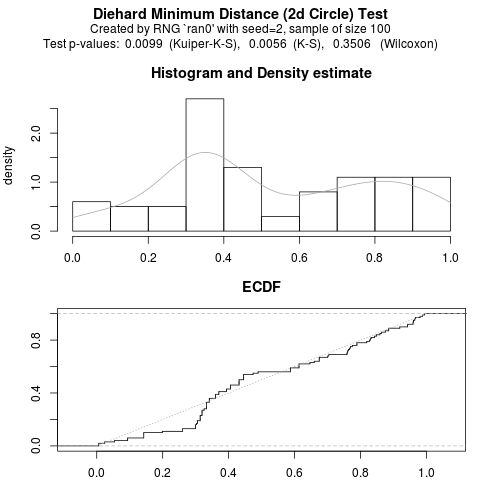
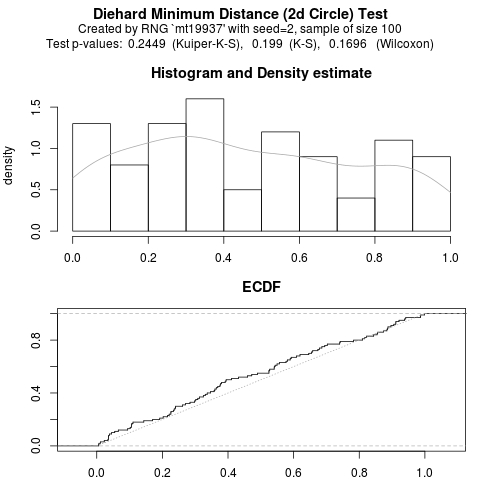
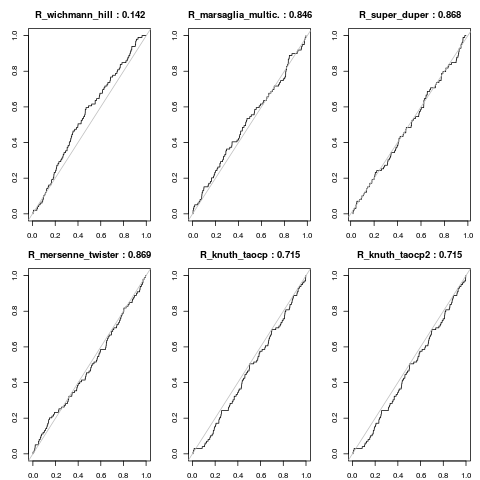
RDieHarder is an R package providing access to the DieHarder battery of tests for random number generators developed by Robert G. Brown and others. DieHarder had been updated to version 3.1.1 a while back, and I had been a little behind with updating RDieHarder. Version 0.1.2 rectifies this. The package still comes with a vignette describing both DieHarder and the RDieHarder package. And because pictures speak louder than a thousand (blogged) words, here is the first chart from the vignette: RDieHarder test of weak RNG RDieHarder test of stronger RNG On the left, we have a poor random-number generator (RNG), the older ran0 function. The histogram illustrating the distribution of test scores is somewhat uneven. An ideal (and asymptotic) outcode is a uniform distribution of p-values from the test. The empirical cumulative distribution function (ECDF) below indicates a somewhat pronounced departure from the diagonal. Informally speaking, this is what the (Kuiper-)Kolmogorov-Smirnov test quantifies, and we see (in the text in the chart) that the null of can be rejected an conventional levels. Based on this example (which had a short run-time with few samples) we would indeed mistrust this (known bad) RNG. On the right, we have a more recent and trusted RNG, the well-known Mersenne Twister. The ten histogram buckets are all closer to the expected value of one-tenth, the estimated density is closer to flat, the ECDF is closer to the diagonal and the tests don't reject---so no reason to mistrust this RNG based on this test alone. RDieHarder lets you run a battery of such tests against a boatload of known RNGs. Here is a second example, comparing the six RNGs built into R itself: RDieHarder test of RNGs in GNU R And these six look fine, as you'd expect. (And yes, the ECDF charts should each be on a square plot. Another time...) Courtesy of CRANberries, there is also a diffstat report for 0.1.2 relative to the older 0.1.1 release. More detailed information is on the RDieHarder page.
Gregor Herrmann: cme fix dpkg-copyright

a short note to all fans of Copyright-Format 1.0: if you have debian/copyright files formatted according to one of the myriads of revisions of DEP5 & want to convert them to the released format, just run
cme fix dpkg-copyright
& be done with it.

cme is in the libconfig-model-perl package, & you should try to use the version from unstable, since Dominique constantly improves it (& he's also always open to proposals & nit-pickings from me merci beaucoup !).

More info about Config::Model on its homepage.

Clint Adams: The moistness of the Apocalypse

Normally people aren't stupid or evil enough to demand that I not use a word at all. On the occasions that they are that stupid or evil, typically only one word is singled out. Thus, when someone demonstrates enough unwisdom to give me a list, I feel the need to share publicly: Seriously.

Martin F. Krafft: Mouse on Mars

The atmosphere in Munich s Backstage Werk just before the opening act to the Mouse on Mars was very chilled. People sat on the stairs or scattered themselves over the dance floor while low-fi ambient tunes came from the speakers. It wasn t loud, you had to try hard to hear the people mumble. I have no idea who the opening act was, and their first tune was very nice and groovy. Then ensued a noise explosion, one could only pity the electronic equipment that was being asked to perform in ways that may be described as everything else than you expect , and of course, the base beat shook the building; I am quite sure they didn t use treble at all, but I may also simply have been unable to hear it. Plus, it seemed to us that the musicians catered for what may be a widespread decrease of attention span: it was noticable how they jumped from one thing to the next, not leaving them (or their listeners) any time to get in the groove. My brother and I went outside for a bit and talked about today s music and its simplicity. We postulated the repetitiveness as the basis of a mass movement, considered scene clubs that played heavy techno to an audience that is so entirely different to who historically frequented such musical performances, and in general tried to avoid assuming a position between simplifying society and accepting that individual freedom is as eclectic as can be. When MoM opened, they continued pretty much in line with their openers and half way through the first tune, I started to wonder how long I would last, or when it would be reasonable to step outside again. I had been a little afraid this would happen, having bought and listened to their latest album Parastrophics in preparation of the concert and not being able to get into it. However, what then followed blew us away. Still heavy, still all over the place, but now they were developing sound scenes, ripping them apart, having fun playing with and teasing the audience, while putting on a groove that inevitably made your muscles twitch with the beat. David Bowie called MoM the next big thing and I have to give it to them: MoM have always had a certain aura of that s what your music is like? we can improve on that! to them, and yesterday, they continued along those lines with astounding consistency, and it felt fresh. It also felt real. They weren t just pushing buttons and computers making music, they were making music and the computers were their instruments. Between the two founding members of MoM sat Dodo Nkishi, drummer and microphone artist, and if you don t believe, fast, big breakbeat can be performed live, well, you re wrong. Most everyone in the room was dancing. And while I was more swaying in awe, watching and wondering how the heck they are doing what they are doing, I couldn t contain the bouncing any longer. They came back for an encore and there was no more stopping the crowd, Thomas or me. Three tracks later, they waved goodbye and left, but a bunch of us simply continued to dance. Thomas questioned who would last longer and I started yelling loudly for another encore. The lights turned on, I considered it a slap in the face, but I did not stop yelling. Others tuned in. And then the lights went off and the band came back. Following their 2.5 hour show, gosh was I exhausted. It was a magnificent show. If you aren t afraid of big beat electronica and you take pleasure in nonstandard art, I heartily recommend you ensure that MoM aren t soon playing near you without you there. PS: MoM will play at the (D sseldorf Open-Source Festival)[http://www.open-source-festival.de/en/] on 30 June 2012! PPS: Now I listen to Parastrophics and I am really enjoying it. NP: Mouse on Mars: Parastrophics

12 April 2012

Tanguy Ortolo: Why www. ?

Three big  W s in shades of green Many websites have addresses that use a www.- prefix. Some people are encouraging this practice, other are advising against it. I, for one, think this prefix makes sense and is really useful, so here is an explanation of my opinion. In a nutshell: the Wold Wide Web is one Internet service among many other such as domain name, mail, mailboxes or instant messenging; using a dedicated prefix allows to distribute all these services to specific servers in a convenient way.On Internet, you can expose several services, the most common being domain names (DNS), websites (HTTP), incoming mail (SMTP), outgoing mail submission (submission), mailbox fetching (POP) or consultating (IMAP) and instant messenging (XMPP). Constraints Modern Internet services can have constraints such as load balancing, failover and most importantly the possibility to use specific servers for each service instead of having all of them on the same server. Dedicated records Some service were designed or revised to take these contraints into account; this include the domain name, incoming mail and instant messenging, by using dedicated DNS records:
example.com.                    NS              roquefort.example.com.
example.com.                    MX  10          morbier.example.com.
_xmpp-server._tcp.example.com.  SRV 10 100 5269 morbier.example.com.
In that example, the name service of example.com. is provided by the server Roquefort while the incoming mail and instant messenging service are provided by Morbier Dedicated prefixes On the contrary, some services were not designed to take these constraint into account, and may be too fossilized to be revised for that; this includes the Web and mailbox service. A convenient way to work around the antiquated design of these services is to use a well known prefix:
www.example.com.                CNAME           ossau-iraty.example.com.
smtp.example.com.               CNAME           morbier.example.com.
pop.example.com.                CNAME           morbier.example.com.
imap.example.com.               CNAME           morbier.example.com.
In that example, the Web service of example.com. is provided by the server Ossay-Iraty while the email submission and mailbox services are provided by Morbier. Readability and flexibility Using dedicated records and prefixes increases the consistency and readability of a DNS zone, since it allows to refer to the servers by their canonical host name, and to define their IP addresses once and for all:
; Services
example.com.                    NS              roquefort.example.com.
example.com.                    MX  10          morbier.example.com.
pop.example.com.                CNAME           morbier.example.com.
imap.example.com.               CNAME           morbier.example.com.
www.example.com.                CNAME           ossau-iraty.example.com.
; Hosts
roquefort.example.com.          A               192.2.0.12
                                AAAA            2001:db8::12
morbier.example.com             A               192.2.0.42
                                AAAA            2001:db8::42
ossau-iraty.example.com.        A               192.2.0.51
                                AAAA            2001:db8::51
You can think of that practice as connecting dots between services and hosts:
name service    Roquefort
incoming mail   Morbier
mailboxes         Ossau-Iraty
website        
With such a DNS zone, it is very easy to identify which server is hosting each service. Using host names rather than IP addresses multiple times reduces the information duplication, which in turn facilitates future chances and reduces the risk of error (it is easier to swith the website from Ossay-Iraty to Morbier than from 192.2.0.51/2001:db8::51 to 192.2.0.42/2001:db8::42).

11 April 2012

Dirk Eddelbuettel: RcppArmadillo 0.3.0 is now on CRAN

Conrad Sanderson has released a new major version 3.0.0 of his excellent Armadillo C++ template library for linear algebra. A corresponding new release 0.3.0 of RcppArmadillo is now on CRAN. This follows four pre-releases of Armadillo which we packaged as before, but for reasons detailed in another post did not send to CRAN. All that said, here are the NEWS entries for all release since the last non-test release:
0.3.0   2012-04-10
    o   Upgraded to Armadillo release 3.0.0 "Antarctic Chilli Ranch"
          * added non-contiguous submatrix views
          * added shorthand for inverse: .i()
          * added hist() and histc()
          * faster repmat()
          * faster handling of submatrix views with one row or column 
          * faster generation of random numbers
          * faster element access in fixed size matrices
          * better detection of vector expressions by sum(), cumsum(),
            prod(), min(), max(), mean(), median(), stddev(), var() 
          * expressions X=A.i()*B and X=inv(A)*B are automatically converted
            to X=solve(A,B) 
0.2.40  2012-04-04
    o   Upgraded to Armadillo release 2.99.4 "Antarctic Chilli Ranch (Beta 4)"
          * fixes for handling expressions with fixed size matrices
0.2.39  2012-04-02
    o   Upgraded to Armadillo release 2.99.3 "Antarctic Chilli Ranch (Beta 3)"
          * faster repmat()
          * workarounds for braindead compilers (eg. Visual Studio)
0.2.38  2012-03-28
    o   Upgraded to Armadillo release 2.99.2 "Antarctic Chilli Ranch (Beta 2)"
          * added .i()
          * much faster handling of .col() and .row()
          * expressions X=A.i()*B and X=inv(A)*B are automatically converted
            to X=solve(A,B) 
0.2.37  2012-03-19
    o   Upgraded to Armadillo release 2.99.1 "Antarctic Chilli Ranch (Beta 1)"
          * added non-contiguous submatrix views
          * added hist() and histc()
          * faster handling of submatrix views
          * faster generation of random numbers
          * faster element access in fixed size matrices
          * better detection of vector expressions by sum(), cumsum(),
            prod(), min(), max(), mean(), median(), stddev(), var() 
Courtesy of CRANberries, there is also a diffstat report for 0.3.0 relative to 0.2.36 As always, more detailed information is on the RcppArmadillo page. Questions, comments etc should go to the rcpp-devel mailing list off the R-Forge page.

9 April 2012

Russell Coker: Guest/Link Post Spam

I ve been getting a lot of spam recently from people wanting to write guest posts or have their site included in a future links post. Guest Posts For guest posts the social convention for the planets which aggregate my blog seems to be that random guest posts are unacceptable. I could change my blog feed to have some posts excluded from the planet feeds but that s too much effort and I don t want random guest posts anyway. The only situations in which I will accept guest posts are when someone is writing what I might have written (IE they generally agree with me) or if they are a member of the free software community who doesn t have their own blog but has something relevant to say. Any applicant for a guest post who runs a business that is useless and/or evil IMHO (EG anything related to the TSA) is going to get rejected firmly. Any applicant who tells me that they can write on a wide variety of topics probably isn t capable of making me an offer that I would accept. Tell me that you can write about Linux programming or computer security and I ll be interested, but you have to provide links to your previous work. An application to write a guest post that starts with something like I liked your recent post at the above URL but I think you missed some important points, as I have some experience in that field I think I could write a guest post that would help educate your readers may be accepted. Probably the best thing to do however is to write comments on my blog, if you can write informative comments and offer to make a longer comment into a guest post then there s a good chance that I ll be interested. Generally though I will only offer the opportunity to write a guest post to someone who writes something really informative in private email or on a closed mailing list. If you can solve a technical problem about Linux that has me stumped then I will almost certainly be willing to accept a guest post about it! Links Posts There are many sites which consist of nothing but links to other sites. In the 90 s such sites were really useful but since the rise of Google their value has declined dramatically. As an aside when I ran an Internet Cafe in the 90 s I had every web browser start with the main page of my Hot Stuff list, the purpose of this was to increase the hit rate of my Squid cache by having most of the customers visit the same sites. Even back then I probably wouldn t have bothered if it wasn t for Squid hits. It must seem like an easy way to make money to create pages of links to articles with short summaries and then hope for advertising revenue, a domain sale, or the launch of some sort of profitable business once people start using the site. I wonder whether that ever works out for people. It doesn t seem like a good business model, doing something that requires little skill, which can be done by almost anyone, and which is done by many people. Maybe there are sweat-shops dedicated to this. Anyway my links posts are unlikely to ever link to any such links pages, I don t think that the people who read my blog want double indirection. I won t entirely rule out linking to a links page, but it would have to be of very high quality and related to something very technical about computers. Basically anyone who reads this should give up on the idea of submitting a links page to me, if it s good enough to make me break my policy of not linking to such things then I ll probably find it myself. Conclusion As a general rule if you want someone to publish your work then you need to look at what they are publishing and make sure that your work fits. With the recent requests for links and guest posts I ve been getting I have to wonder whether the people making the requests have even read my blog. That method of operating is unlikely to give any success at a blog that has any reasonable number of readers. I ll probably link to this from my about page or something. It might discourage some of the spammers. Related posts:
  1. Link Within Good Things about LinkWithin For the last 10 weeks I ve...
  2. Feedburner Item Link Clicks For a while I used the Item Link Clicks feature...
  3. Can you run SE Linux on a Xen Guest? I was asked Can you run SELinux on a XEN...

Steve Kemp: Bye-bye AOL

Today I took that final step:
touch /srv/_global_/blacklisted/domains/aol.com
I remember, even a couple of years ago, I had friends who would mail me from their @aol.com email addresses. These days people have moved on. The two single biggest mail-providers I see in terms of spam are: I'd like to drop @yahoo.com but I have some (misguided) friends who continue to use it to mail me. I might start dropping non-friend mails from that domain, but that's a bigger job. Yes, this is a dull entry. Sorry. My existing bathroom has been ripped out and turned into this as a stepping stone into its new incarnation. I'm trapped in my office. Dust almost everywhere. Noise everywhere else. ObQuote: "There can be no understanding between the hand and the brain unless the heart acts as mediator. " - Metropolis

8 April 2012

Lars Wirzenius: What is a Linux distribution?

I got into a discussion recently about what a Linux distribution actually is. To some people, a distro is just a convenient way of source of binaries from which to pick what you install, either on your own computer or when creating an embedded system, or some other specific kind of system. To others it's a way of life, and the realization of the ideals of software freedom. To yet others, a distro is an outdated concept that will go away in the near-ish future, to be replaced by ... something. Here's my take: a Linux distribution is defined by the following things: Historically, there has been a lot of variation in all aspects mentioned above. Some of this variation may today be unnecessary. For example, it might be helpful for more distributions to share work on common tools, so that not everyone needs to re-invent and re-implement the same kinds of tools. However, my gut feeling is that due to the inherent interconnectedness of all things, it may be very difficult to have one set of tools to support well all workflows, policies, processes, and communities. The most important differentiating factors between the various distros are not the tools, but the community values, the perceived purpose of the distro, and the resultant criteria for choosing what to include and the workflow for developing the distro. Even when two distros use the same tools, there can be a lot of difference in the end result. Fedora and RHEL, for example, use a lot of the same infrastructure, but their purpose is entirely different. Debian and Ubuntu use mostly the same packages, even, and still there's a huge difference between the two distros: one aims at a high quality system based on free software, the other aims to support the business of one particular company. For this reason, there will always be a lot of Linux distributions around, and that is good.

5 April 2012

Dominique Dumont: My activities during Perl/QA hackathon in Paris

Hello Last week-end, I ve participated Perl/QA hackathon in Paris. Here s a short summary of the main activities during this week-end. I was not in the best of shape due to a nasty (biological) bug that wore me down before the hackathon. First of all, I discussed with rjbs about the bunch of debian patches I ve written for Software::License. These patches (and hacks) are used in Debian to provide licenses summaries in Debian::Dpkg::Copyright model to help write Debian copyright files. License management is boring but necessary. cme and Software::License help in making this task slightly less boring. Ricardo kindly suggested some modifications and agreed to include my patches. I implemented these modifications directly during the hackathon. The other tasks during this week-end were (not necessarily in that order): Many thanks to FreeSide who sponsored my travel, to the hackathons organisers and to all the participants for their welcome. All the best

MJ Ray: Debian Project Leader Election 2012

Voting is open in the Debian Project Leader Elections 2012 So now I need to figure out who to vote for. This year I didn t take part in the discussions (all my spare time was bought, basically). The platforms are linked from the Debian Project Leader Elections 2012 page above and the key discussions were: Thanks to everyone who asked these great questions. So, what do you think?

Next.

Previous.