Search Results: "az"

30 May 2011

Steve Kemp: How do you deploy applications?

I've got a few projects which are hosted in mercurial repositories. To deploy them I manually checkout the repository, create symlinks by hand, then update apache thttpd to make them work. When I want to update my applications I manually become the correct user, find the repository and run "hg pull --update". I think it is about time that I sat down and started doing things neatly. I made a start at this by writing a shell script for each site called .deploy then I drive it like so:
#!/bin/sh
#
# ~/bin/deploy  execute the .deploy file associated with this project.
#
while true; do
    #
    #  If we're at the root directory we're done.
    #
    if [ $PWD = "/" ]; then
        echo "Reached /"
        exit
    fi
    # found our file?
    #
    if [ -x ".deploy" ]; then
       ./.deploy
       exit
    fi
    cd ..
done
It seems the main candidate is capistrano, which was previously very Ruby on Rails centric, but these days seems to be divorced from it. Alternatively there is the python-based fabric project which has been stalled for two years, vlad the deployer (great name!) which is another Rake-based and thus Ruby-loving system, and finally whiskey disk which is limited to Git-based projects as far as I can tell. In short each of these projects is very similar, and each relies upon being able to do two things: I've automated SSH before, and I've automed SCP/rsync. The hard part is doing both "copy" and "command" over one SSH channel - such that you don't get prompted for passwords multiple times - and handling the case of runnign sudo where appropriate. Still most of the initial stages are trivial. I wonder what project I should be using: Anything I've missed? Or pointers to good documentation? ObQuote: "We need to be a little more constructive here, okay? " - Terminator 2

27 May 2011

Erich Schubert: Dear Lazyweb, how to write multi-locale python code

Dear Lazyweb,
I've been toying around with a python WSGI application, i.e. a multi-threaded persistent web application. Now I'd like to add multi-language support to this application. I need to format datetimes to human readable formats, but I havn't found a way yet to do this in a sane way using strftime. Essentially, strftime will use the current application locale; however since I'm running multi-threaded, different threads might want to use different locales. So changing the locale is bound to cause race conditions.
So what is the best way to pretty-print (including week day names!) datetime, currency and similar values in a multi-threaded multi-locale context in python? Gettext and manually emulating strftime doesn't sound that sensible to me. And of course, I don't want to have to translate the weekday names myself into any language I choose to support...

25 May 2011

Guillaume Mazoyer: Here is a new GSoC student

java.pngHello Planet Debian reader.

And now you re thinking, who is this crazy guy who does not even know how to write English (is my sentence wrong?). My name is Guillaume Mazoyer and I am the Google Summer of Code student working on Jigsaw with Tom Marble and Sylvestre Ledru. I blog from France and I plan to write my GSoC reports right here.

Maybe you don t know what is Jigsaw yet. If so, go read this wiki page, you should be able to understand the goal of my project. Here is the description:

Since the beginning of Java, the JVM is a big virtual machine will all the features incorporated in it. This JVM provides many features which are useful in only limited areas (Corba) or which are not used at all in some contexts (AWT/Swing are useless for a web server).

The goal of the jigsaw project is to provide a modular JVM.

This will provide many improvements in the performance area (startup, solving of the dependencies, etc) but also the size of the dependencies.

There are already some works done by upstream (Oracle) but it does not complain to the Debian standards. The target is Java 8.

The goal is this Google Summer of Code project is to package the current development version of Jigsaw into Debian.

Please note that this project is not only about packaging. This will probably implies some developments and contributions to upstream (upstream is aware of this effort). Updating javahelper to manage specifities of Jigsaw could be considered.

I m pretty excited to work on this project and the work has already started. Can t wait to go deeper and enjoy working on two things that I love: Debian and Java.

24 May 2011

Russell Coker: Are Assholes Essential to a Free Software Project?

What do Assholes do? Rusty just wrote a post titled If you didn t run code written by assholes, your machine wouldn t boot [1] about some of the anti-social tendencies demonstrated by programmers, including some that are implied to be fairly important. His post seems to imply that there are really great programmers who are anti-social and that we should just put up with it because of their great code. One of the problems with his post is that he doesn t define asshole . Holocaust deniers and all other Nazi supporters seem to clearly by assholes by any definition. People who have silly ideas about medicine and tell others seem to be merely misguided (although my dictionary gives stupid or irritating or ridiculous in the definition of asshole so technically they can meet the criteria). In the comments Rusty states that nuttiness is relative . While that is correct it doesn t seem to have much bearing on whether someone is an asshole. For example I know some very nice people who are utterly convinced by creationism. Is Anyone Essential to Free Software? Most projects have one person or several people in leadership positions, usually there seems to be a combination of project management and lead-programmer positions. Such people are obviously quite important to a project. But we have seen examples of people dying, being employed by Microsoft, retiring, relicensing the source in a bad way, and just losing interest without the project ceasing. It seems clear that in most cases when a project which has a significant amount of use has significant bugs and no maintainer then someone will step in. The cases where no-one takes over the project are often resolved by someone creating a competing project. If no-one takes over an abandoned Free Software project then it s a strong indication that the project wasn t particularly important anyway. I have no doubt that if any bug or missing feature made Linux systems stop booting then someone would fix it quite quickly. In a more general sense it seems that every time someone takes a position in a project that is of wide interest they are displacing someone else who might have done the job. When you volunteer to do significant work for a project you may be displacing someone who is more skillful than you this isn t necessarily a bad thing as there are plenty of other projects to work on, some of which require more skill. Growing More Programmers It seems to me that a large part of becoming a great programmer is facing great challenges. People who could be described as optimistic or arrogant will tend to take on more challenging tasks and therefore learn more. I m sure that there are a lot of people out there who have the potential to be great programmers apart from not taking on the challenging work, this seems to be an unfortunate waste of talent. Given a large enough population if someone leaves a senior position there should be someone else who can obtain the skills needed to take over. One advantage of this for Free Software development is that even if the best person to take on the challenge isn t living in the most convenient continent that won t be an obstacle, while with proprietary software development projects the teams are small and it s common that no-one else is capable of stepping up to a lead position. Another advantage is that when the lead developer leaves there are generally many candidates to replace them, all of whom can start work and be judged on the work that they do. I think that the best claims that can be made regarding essential people are not in regard to technical skill alone but to a combination of technical and people skills. Getting a group of programmers to work together is really hard but it s something that needs to be done for any significant project. Also the larger projects tend not to stand alone, being able to get changes included in other projects requires some skill. Ben Collins-Sussman and Brian Fitzpatrick gave an insightful talk at Google IO 2008 titled How to Protect Your Open Source Project From Poisonous People [2]. The first half of their talk is mostly about people who are misguided or difficult rather than what most people would consider poisonous and the second half is more about people who are actively poisonous and need to be removed. They advocate a community based on Politeness, Respect, Trust, and Humility. They describe in detail how the methods they advocate result in the members of their community being more productive, it seems obvious that those principles will lead to better career growth for people within the community and more friendly people wanting to join. When is being an Asshole OK? I once worked for a company that apparently had a team consisting solely of assholes. Apparently one asshole got promoted to management and after some internal transfers they ended up with all the assholes in the company on one team. I guess that when someone has negative interactions with everyone they won t notice the difference if they are put in a team where everyone is difficult. For a corporate environment that lacks a no jerks hiring policy this is probably a good way of improving productivity overall. I am not aware of any significant Free Software project that was comprised of mostly jerks although I have seen a few with dysfunctional environments that encourage the worst behavior from their members. The smaller Free Software projects have less need for people who can relate to other people. There are many useful Free Software projects which have only one developer, in most cases anyone can take the source code and use it without dealing with the author. But even for a single-developer project an asshole can cause some serious problems. One example I know of concerns a developer who had unclear licenses and started making legal threats in response to a request for a clear license. Another example is of a developer who released code that was designed to not work when one particular user compiled it and redistributed the binaries. Both of them caused some significant amounts of time to be wasted by people who were unfortunate enough to develop systems that interacted with the code in question, and even more time was wasted when some misguided people defended them in the inevitable flame-wars. Even for a project with only one developer it s still better for everyone if that developer isn t an asshole. One comment I ve seen related to this issue suggesting that some types of asshole behavior shouldn t be a problem an example that was cited is a colleague who cheats on a romantic partner. Jeremy Clyman (who is currently doing a Ph.D in Psychology) has written an interesting article about this for Psychology Today [3]. He reviews the movie The Dilemma which deals with someone catching their colleague s wife cheating. Jeremy analyses the psychological issues involved and how they can (among other things) impact the ability for such people to work. I once worked in an office where two married employees were very open about having an affair and we were all apparently expected to lie on their behalf if necessary, it really affected the quality of the working environment. Extreme Assholes There are lots of people involved in Free Software development who are difficult and many who are to some extent assholes. But some of them take being an asshole to the extreme, such as Holocaust deniers (an example which Rusty used). In the comments on his post the Westboro Baptist Church is also mentioned. It is possible to entirely disagree with someone on a contentious issue such as abortion but still be able to get along with them. But when someone supports a hate-based organisation such as the WBC or supports Nazis in any way then there will be many people who just can t tolerate them and no-one should be expected to tolerate such people. I have seen two instances where Free Software developers advocated pro-Nazi positions (one had an archive of neo-Nazi propaganda and the other claimed that Nazis were not responsible for the Holocaust). Neither of the pro-Nazi programmers was evicted for defending Nazis, but both of them ended up leaving the community in adverse ways after causing other damage in the mean time. I don t think it takes any great ability to predict the future to determine that someone who defends Nazis will eventually end up doing something that requires expulsion and drive away users and developers in the mean-time. There is no possibility that someone can support the Nazi or WBC ideology only when not associated with your project, it will affect all aspects of their life. When a Holocaust denier is allowed to be a member of a community it also sends out a message that members of the groups which were persecuted by Nazis aren t particularly welcome in the community. Helping Minor Assholes There are a lot of people who don t have malevolent aims but who unintentionally cause some difficulty (it seems that the truly malicious are a tiny minority). I don t think that excusing the bad things that they do on the basis of writing good code helps them in the long term. Many of the suggestions that Ben Collins-Sussman and Brian Fitzpatrick make seem likely to help people who don t want to be assholes and direct them towards positive involvement in the community. One trend that seems apparent is the non-linear response to certain types of bad behavior. There is often little difference in severity between something that gets almost no attention and something that results in a large and extremely hostile reaction. If someone persists in acting like an asshole for long enough it seems to be inevitable that they will eventually exceed some threshold for what is tolerated and get a very significant negative response. It would be good if things didn t need to get to that stage. I think that the most unfortunate aspect of Rusty s blog post is that most people will probably interpret it as encouragement to write better code as a way of getting a free pass for being an asshole. I know that this isn t what Rusty intended, but most people on the Internet don t know Rusty as well as I do. Conclusion Ben Collins-Sussman and Brian Fitzpatrick seem to have some of the best ideas for how to deal with these issues when you control a project, but most of us aren t in that position. Everyone can advocate better behavior. Extreme assholes need to be removed quickly and without a great debate about their contributions, freedom of speech, or other issues. Since considering this issue I ve been wondering about when one should avoid the lesser assholes and asshole-positive environments. People tend to adapt to their environment, so if you associate with assholes a lot then there s a good chance you will start to become like them. Is

23 May 2011

Amaya Rodrigo: Monday Cat Blogging


Jazz on the table
Originally uploaded by Amayita.
Jazz on the table

David Welton: Summary: Built To Sell - Creating A Business That Can Thrive Without You

<iframe frameborder="0" marginheight="0" marginwidth="0" scrolling="no" src="http://rcm.amazon.com/e/cm?lt1=_blank&amp;bc1=000000&amp;IS2=1&amp;bg1=FFFFFF&amp;fc1=000000&amp;lc1=0000FF&amp;t=dedasys-20&amp;o=1&amp;p=8&amp;l=as4&amp;m=amazon&amp;f=ifr&amp;ref=ss_til&amp;asins=B004IYISQW" style="width: 120px; height: 240px; float: left; margin-right: 20px; margin-bottom: 8px;"></iframe> Many small business owners start a business with the idea of greater freedom in mind, yet end up chaining themselves to something that takes even more dedication than a regular job. This book discusses the dos and don'ts that business owners need to be conscious of in order to create a business that is independent of its owner(s) in order to be able to sell it. It does so in an easy to read format that's a bit of a gimmick - a fictional story illustrating the authors points. Like most business books, the core idea isn't that hard to explain. the book even includes a handy summary of the main points, which I'll paraphrase here:
  1. Focus on one thing you can do really well; even a service business can be 'productized' by creating a standard service that is the focus of the business.
  2. If your business revolves around one or two key clients, the risk inherent in that approach will lower the value or scare of potential buyers completely.
  3. Put a process in place, from sales through production.
  4. Don't "be" your company. If the company is all about you, what's a potential buyer really getting if you sell it and leave?
  5. By focusing on products, you can charge up front rather than having poor cash flow. If you pay people to work on a project for 3 months, and don't get paid for another month, you are, by the end, out 4 months salary while waiting for the payment.
  6. Say no to projects outside the scope of your business. Only by focusing narrowly can you really excel at what you do.
  7. Spend time doing some research and calculations to estimate your potential market size; buyers will want to know this.
  8. If you have a business that has sales people, hire at least two so that they'll compete with one another.
  9. You want people who are good at selling products, not services; the latter will want to tweak your offering for each and every client, rather than selling it as-is and trying to find how it can meet the customer's needs that way, which is the best strategy for a product.
  10. If you were previously running a more 'generic' services company, and you switch to a more productized approach, be prepared to take a hit the year when you switch.
  11. Potential acquirers will want to see at least a couple of years of steady growth with the new model after making the switch.
  12. If you grow, you'll need a management team that can work without you. Put an incentive system into place to reward their loyalty and results.
  13. When looking for an adviser to sell your company, aim for one where you will not be the largest or smallest client.
  14. If your adviser really only has one company in mind to sell yours to, they may be trying to sell you off cheap as a favor.
  15. Consider how much you could grow with the resources of a buyer. Think big, and show them what kind of growth could happen with the right backing.
  16. Think and speak like a product business with 'customers' rather than 'clients'.
  17. Stock options are more complex than simpler options like bonuses that are paid out over a period of time, in terms of ways to give people an incentive to stay.
All in all, it was an enjoyable read, with solid points. Even if you have no intention of selling your business, thinking of the business itself as a sort of "product" that is not dependent on you to work correctly is a sensible way to go about creating and growing a business. He's certainly not, nor claims to be the first one to discuss this idea, and indeed references the well known E-Myth Revisited which focuses less on selling a business, and more on how to go about extricating you and your skills from the business.

22 May 2011

Russell Coker: Preventing the End of the World

Some crazy people led by Harold Camping who call themselves Christian claimed that the world was going to end yesterday [1]. Harold had previously done this in 1994 so he s got form for predictions that don t come true. The bible says that the day of the Lord so cometh as a thief in the night [2], so obviously Jesus can t return on a day when billboards all around the world are predicting him! Maybe rather than being wrong, Harold has in fact prevented the end of the world by predicting it correctly! Now if a church like Harold s can make predictions separated by slightly less than 17 years (let s round it off to 6000 days) then we only need 6000 such churches scheduled to predict different days to cause the rapture to be indefinitely deferred. If the churches were to predict which week the world would end then we would only need something less than 900 such churches or maybe 1800 so we have redundancy. It seems that Harold Camping makes his money by scaring gullible people into selling everything they own and giving the money to him [3]. If we are to achieve the goal of having someone forecast the end of the world every day then it would be good if such people were forced to raise money more often than every 17 years. A good solution to this might be a tax on end of days religious investments, money that was given to a religious corporation or sole trader following a scare about the end of the world could be subject to a 100% tax rate if not spent within 1 year. Then Harold would be forced to make a prediction for every year and thus give us greater protection from the end of the world. </Satire> But seriously we need to tax religious organisations in the same way as other companies. A religious organisation that gives money to help the needy can use that as a tax deduction, and operating expenses such as paying salaries of staff are also tax deductable. So the serious religious groups would have a tax rate that is fairly close to zero anyway. When a religious leader wants to have 27 Rolls Royces they should be forced to pay tax on all that money, and additionally they should be compelled to publish a statement of company accounts for everyone who gave money just as corporations are compelled to provide information to stock-holders. Currently various religious organisations are denouncing Harold and his followers to try and save Christianity from ridicule (here s one example [4]). It seems to me that if they want to avoid ridicule they should advocate that religious organisations be forced to open their books and pay tax on their profits so that people like Harold can t use religion as a money-making scam.

18 May 2011

Sandro Tosi: I'm going to EuroPython 2011

I just got confirmation my company will sponsor me for EuroPython 2011 (thanks Register.it), so I'll be able to attend the whole week; a lot of amazing talks and the code sprints in the weekend: this is going to be a great time!

Are you coming?

17 May 2011

Reinhard Tartler: Mini Server PCs

Dear Lazyweb,

Hot or not, which of the following devices is the best? And which of them are actually available for purchase in Europe, preferably from Germany?

Please share your opinions in the comments.

16 May 2011

DebConf team: DebConf Newbies/Non-Regulars Funding for 2011 (Posted by Tiago Bortoletto Vaz)

As previously announced in Ganneff s blog and Debian News, a special funding for DebConf11 is available for Debian Developers and Debian Maintainers who have either never attended a DebConf before, or who have not been to a DebConf since DebConf7 (in Scotland). How to apply Email the DebConf Newbies Team (newbies@debconf.org) providing the following information: the DebConf team

15 May 2011

Clint Adams: Fast and Furious Fourier Transform

A while ago, MusicBrainz used a technique called TRM for associating audio fingerprints with tracks. This relied on a proprietary, non-free database controlled by a for-profit company. Your choices were to either use it and have music fingerprinting, or to not have the ability to fingerprint, since no one who knew how to develop a free database was doing so. After some time with TRMs, MusicBrainz underwent a transition to PUIDs, and after running in parallel for some time, TRMs were dropped. PUIDs rely on a proprietary, non-free database controlled by a for-profit company. Amazingly, things have changed. Now you can use free software to contribute to a publicly-available database. If you have a music collection cleanly and properly tagged with MusicBrainz IDs, I urge you to participate in this project.

13 May 2011

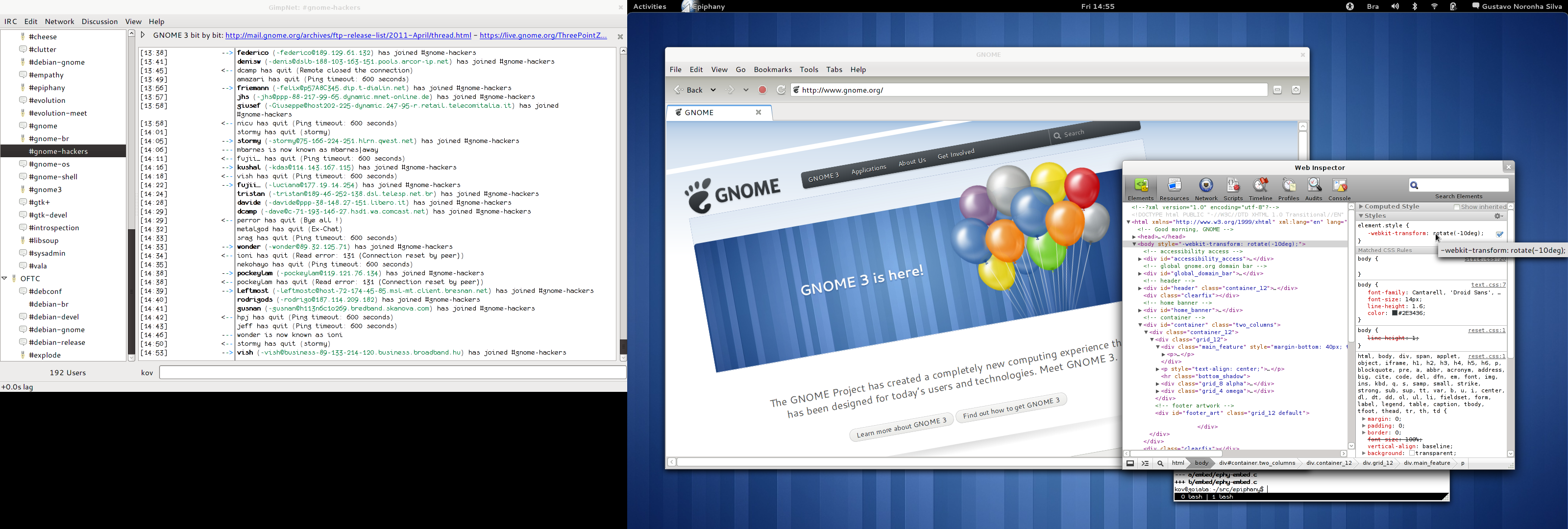
Gustavo Noronha Silva: My experience with GNOME 3 so far

You know, GNOME Shell and I are not really strangers to each other for a long time now. I have been using it almost daily as my main desktop since late 2009, when I started shipping it to Debian experimental. That means that I had ample opportunity to both get used to it and witness the huge improvements it had with every new release. My general feeling towards GNOME 3 is this: . Yes, I love it! I love the new themes, I love the window borders, I love the top panel, the overview, the dynamic workspaces, I love the Me menu, I love the clock and the calendar, the system indicators with the beautiful symbolic icons, being able to search for applications in such a nice way, the window animations, the multi-screen support, the new nautilus, the dash, looking glass. It s hard for me to even express how thankful I am and how much admiration I have for the awesome folks who helped bring this to life. Thanks so much!
My GNOME3 desktop

My GNOME 3 desktop

After all this time, there are only two things I can say I dislike about GNOME3, apart from some minor wishlists: the alt-tab behaviour and the message tray. Let me expand on those. Message Tray Of the very few things I dislike, there is only 1 I hate and cannot see myself living with: the accordion animation in the message tray. No, really, it s such a terrible, terrible idea. Every single time I try to use that thing I overshoot while moving the mouse to the left, then overshoot again moving the mouse to the right because the frigging icon has moved. It s no good knowing that I can click in the text or in the empty area to its right, it feels wrong. It s terrible that my actual target is moving at all. Every single time I use it is a small frustration for me it s as if the message tray was playing games with me, laughing at me for not having good enough mouse pointer driving skills even more than the infamous sub-menus used to. And I had to go through that penance whenever I wanted to find the person I was chating with to resume the conversation. I wrote an extension that disables the accordion animation by simply not showing the title at all when you hover the icon, and I patched GNOME Shell s CSS to make the icons a bit bigger, so that it s easier for me to hit them with the mouse. It s clearly not ideal, and you still have to click the various people icons to figure out which of your friends who were lazy enough to not add a picture to their IM profiles is that one, but it s still much better than chasing the (smaller) ones around to figure that out. Perhaps we should have the icons be bigger and always have the title bellow them? I don t know, I trust the awesome designers who designed the awesomess that s everywhere else will come up with a great idea.
My Message Tray

My message tray with bigger icons and no accordion animation.

Alt Tab The number 1 feature of workspaces for me has always been locality being able to not see all of the other applications and windows that are open elsewhere. This lowers the amount of noise when I m trying to find something. The overview is very nice in this matter only windows in the current workspace are shown, and even when you have an extra screen, the windows in there appear in that screen. The alt-tab behaviour, on the other hand, of showing all windows and apps, even with the separator, bothers me. It s really useful to have when you want to go to a specific window no matter where it is (I usually use the dash for that, though), but it adds noise when you want to go to a specific window _in this_ workspace, which is the most common use case for my usage. So I copied the alt-tab code over to an extension and modified it so that only windows in the current workspace would be considered. In addition to that, with the windows in the extra screen always being there no matter what workspace you re in (which I think is an awesome idea), they are effectively in all workspaces, so they add constant noise even with my extension. It s also weird to have to look at the main screen to switch to a window in the extra screen. There s a huge discontinuity. What I would prefer is having alt-tab to follow the mouse regarding screens only show windows in the extra screen if you hit alt-tab in there, making sure the selector thing appears in there as well.

11 May 2011

Vincent Bernat: New website with Hyde

My previous website was generated (dynamically) with mod_autoindex, a module from Apache targeted at rendering an index page for the files contained in a directory. Pretty basic (but themable). Here is a new revamped web site using Hyde, a static web generator written in Python.

Static or dynamic ? It has been a long time since almost everybody is creating dynamic websites. Most often, they are powered by some blog engine written in PHP like DotClear or WordPress. Infrequently, they are crafted with bare hands using one s preferred language. Nowadays, hosting a dynamic website is pretty easy. There are a lot of cheap virtual servers solution that allow you to get a root access. However, dynamic websites have some drawbacks:
  • Security need to be monitored tightly, especially security upgrades; some platforms are more often vulnerable than others.
  • Dynamic websites may have some problem to handle increased load.
With a static website, security problems are easier: there are far less components to monitor and most of them (for example, the web server) are pretty solid and well audited. A site powered by nginx can handle several thousands of new connections per second without any special tuning. Getting this kind of performance with a dynamic website is far more difficult. Scaling is also easier. Just add more webservers and copy the content. No database, no synchronisation mechanism needed. Hosting can even be done on simple platforms like Amazon S3, even if there is now more appropriate platforms for this like Amazon CloudFront. Moreover, even a static website can receive comments using a system like Disqus which leverages the use of Javascript to add comment system to any static page.

Hyde Hyde is a static website generator written in Python. There exists a lot of those beasts. On StackOverflow, a question about this got some interesting answers. You will also find a fairly complete list on this blog. If you like Ruby, I assume that nanoc and Webgen are good candidates. Let s go back to Hyde. It was rewritten recently and the documentation is a bit incomplete. You will need to read the source code or look at examples (like the shipped one or this site) to understand how things are handled. Everything is handled by a plugin system. I hope it will not become a mess in one year (I play a large part in this). Hyde takes your files, apply a lot of filters on them and generate the final website. It uses Jinja as a template system, Markdown for markup syntax, Less to write CSS in a more efficient way (and to minify them), UglifyJS to minify Javascript, etc. It is also possible to add metadata to files (title, author, creation date, etc.). But since everything comes as a plugin, you can use any technology you like. In the end, you can tune all knobs but you need to do most of the work (HTML, CSS, Javascript), as well. Conveniently, there is a small web server that rebuild modified files on the fly. This comes handy but this is a common feature with this kind of generator.

New website Here is a new website crafted with Hyde. It is translated both in French and in English. This is done with the help of a small plugin plugin. I am quite happy about the result. Technically, there is one minified CSS file, one minified Javascript file and the dependencies (like jQuery) are loaded with the help of yepnope.js which will become part of Modernizr. I don t want to support Internet Explorer 6, but I plan to support Firefox 3, Internet Explorer 7 and recent versions of Chrome and Safari. For the design, I have always been undecided. I am pretty impressed by some raw website but also by some others more elaborate. Since I am not a talented graphic designer, I have tried to keep things plain and simple. If you are interested, sources are available on GitHub !

10 May 2011

Ian Wienand: PLT and GOT - the key to code sharing and dynamic libraries

(this post was going to be about something else, but after getting this far, I think it stands on its own as an introduction to dynamic linking) The shared library is an integral part of a modern system, but often the mechanisms behind the implementation are less well understood. There are, of course, many guides to this sort of thing. Hopefully this adds another perspective that resonates with someone. Let's start at the beginning - relocations are entries in binaries that are left to be filled in later -- at link time by the toolchain linker or at runtime by the dynamic linker. A relocation in a binary is a descriptor which essentially says "determine the value of X, and put that value into the binary at offset Y" each relocation has a specific type, defined in the ABI documentation, which describes exactly how "determine the value of" is actually determined. Here's the simplest example:
$ cat a.c
extern int foo;
int function(void)  
    return foo;
 
$ gcc -c a.c 
$ readelf --relocs ./a.o  
Relocation section '.rel.text' at offset 0x2dc contains 1 entries:
 Offset     Info    Type            Sym.Value  Sym. Name
00000004  00000801 R_386_32          00000000   foo
The value of foo is not known at the time you make a.o, so the compiler leaves behind a relocation (of type R_386_32) which is saying "in the final binary, patch the value at offset 0x4 in this object file with the address of symbol foo". If you take a look at the output, you can see at offset 0x4 there are 4-bytes of zeros just waiting for a real address:
$ objdump --disassemble ./a.o
./a.o:     file format elf32-i386
Disassembly of section .text:
00000000 <function>:
   0:	 55			push   %ebp
   1:	 89 e5                	mov    %esp,%ebp
   3:	 a1 00 00 00 00       	mov    0x0,%eax
   8:	 5d                   	pop    %ebp
   9:	 c3                   	ret    
That's link time; if you build another object file with a value of foo and build that into a final executable, the relocation can go away. But there is a whole bunch of stuff for a fully linked executable or shared-library that just can't be resolved until runtime. The major reason, as I shall try to explain, is position-independent code (PIC). When you look at an executable file, you'll notice it has a fixed load address
$ readelf --headers /bin/ls
[...]
ELF Header:
[...]
  Entry point address:               0x8049bb0
Program Headers:
  Type           Offset   VirtAddr   PhysAddr   FileSiz MemSiz  Flg Align
[...]
  LOAD           0x000000 0x08048000 0x08048000 0x16f88 0x16f88 R E 0x1000
  LOAD           0x016f88 0x0805ff88 0x0805ff88 0x01543 0x01543 RW  0x1000
This is not position-independent. The code section (with permissions R E; i.e. read and execute) must be loaded at virtual address 0x08048000, and the data section (RW) must be loaded above that at exactly 0x0805ff88. This is fine for an executable, because each time you start a new process (fork and exec) you have your own fresh address space. Thus it is a considerable time saving to pre-calculate addresses from and have them fixed in the final output (you can make position-independent executables, but that's another story). This is not fine for a shared library (.so). The whole point of a shared library is that applications pick-and-choose random permutations of libraries to achieve what they want. If your shared library is built to only work when loaded at one particular address everything may be fine until another library comes along that was built also using that address. The problem is actually somewhat tractable you can just enumerate every single shared library on the system and assign them all unique address ranges, ensuring that whatever combinations of library are loaded they never overlap. This is essentially what prelinking does (although that is a hint, rather than a fixed, required address base). Apart from being a maintenance nightmare, with 32-bit systems you rapidly start to run out of address-space if you try to give every possible library a unique location. Thus when you examine a shared library, they do not specify a particular base address to be loaded at:
$ readelf --headers /lib/libc.so.6
Program Headers:
  Type           Offset   VirtAddr   PhysAddr   FileSiz MemSiz  Flg Align
[...]
  LOAD           0x000000 0x00000000 0x00000000 0x236ac 0x236ac R E 0x1000
  LOAD           0x023edc 0x00024edc 0x00024edc 0x0015c 0x001a4 RW  0x1000
Shared libraries also have a second goal code sharing. If a hundred processes use a shared library, it makes no sense to have 100 copies of the code in memory taking up space. If the code is completely read-only, and hence never, ever, modified, then every process can share the same code. However, we have the constraint that the shared library must still have a unqiue data instance in each process. While it would be possible to put the library data anywhere we want at runtime, this would require leaving behind relocations to patch the code and inform it where to actually find the data destroying the always read-only property of the code and thus sharability. As you can see from the above headers, the solution is that the read-write data section is always put at a known offset from the code section of the library. This way, via the magic of virtual-memory, every process sees its own data section but can share the unmodified code. All that is needed to access data is some simple maths; address of thing I want = my current address + known fixed offset. Well, simple maths is all relative! "My current address" may or may not be easy to find. Consider the following:
$ cat test.c
static int foo = 100;
int function(void)  
    return foo;
 
$ gcc -fPIC -shared -o libtest.so test.c
So foo will be in data, at a fixed offset from the code in function, and all we need to do is find it! On amd64, this is quite easy, check the disassembly:
000000000000056c <function>:
 56c:		 55			push   %rbp
 56d:		 48 89 e5             	mov    %rsp,%rbp
 570:		 8b 05 b2 02 20 00    	mov    0x2002b2(%rip),%eax        # 200828 <foo>
 576:		 5d                   	pop    %rbp
This says "put the value at offset 0x2002b2 from the current instruction pointer (%rip) into %eax. That's it we know the data is at that fixed offset so we're done. i386, on the other hand, doesn't have the ability to offset from the current instruction pointer. Some trickery is required there:
0000040c <function>:
 40c:	 55			push   %ebp
 40d:	 89 e5                	mov    %esp,%ebp
 40f:	 e8 0e 00 00 00       	call   422 <__i686.get_pc_thunk.cx>
 414:	 81 c1 5c 11 00 00    	add    $0x115c,%ecx
 41a:	 8b 81 18 00 00 00    	mov    0x18(%ecx),%eax
 420:	 5d                   	pop    %ebp
 421:	 c3                   	ret    
00000422 <__i686.get_pc_thunk.cx>:
 422:	 8b 0c 24		mov    (%esp),%ecx
 425:	 c3                   	ret    
The magic here is __i686.get_pc_thunk.cx. The architecture does not let us get the current instruction address, but we can get a known fixed address the value __i686.get_pc_thunk.cx pushes into cx is the return value from the call, i.e in this case 0x414. Then we can do the maths for the add instruction; 0x115c + 0x414 = 0x1570, the final move goes 0x18 bytes past that to 0x1588 ... checking the disassembly
00001588 <global>:
    1588:       64 00 00                add    %al,%fs:(%eax)
i.e., the value 100 in decimal, stored in the data section. We are getting closer, but there are still some issues to deal with. If a shared library can be loaded at any address, then how does an executable, or other shared library, know how to access data or call functions in it? We could, theoretically, load the library and patch up any data references or calls into that library; however as just described this would destroy code-sharability. As we know, all problems can be solved with a layer of indirection, in this case called global offset table or GOT. Consider the following library:
$ cat test.c
extern int foo;
int function(void)  
    return foo;
 
$ gcc -shared -fPIC -o libtest.so test.c
Note this looks exactly like before, but in this case the foo is extern; presumably provided by some other library. Let's take a closer look at how this works, on amd64:
$ objdump --disassemble libtest.so
[...]
00000000000005ac <function>:
 5ac:		 55			push   %rbp
 5ad:		 48 89 e5             	mov    %rsp,%rbp
 5b0:		 48 8b 05 71 02 20 00 	mov    0x200271(%rip),%rax        # 200828 <_DYNAMIC+0x1a0>
 5b7:		 8b 00                	mov    (%rax),%eax
 5b9:		 5d                   	pop    %rbp
 5ba:		 c3                   	retq   
$ readelf --sections libtest.so
Section Headers:
  [Nr] Name              Type             Address           Offset
       Size              EntSize          Flags  Link  Info  Align
[...]
  [20] .got              PROGBITS         0000000000200818  00000818
       0000000000000020  0000000000000008  WA       0     0     8
$ readelf --relocs libtest.so
Relocation section '.rela.dyn' at offset 0x418 contains 5 entries:
  Offset          Info           Type           Sym. Value    Sym. Name + Addend
[...]
000000200828  000400000006 R_X86_64_GLOB_DAT 0000000000000000 foo + 0
The disassembly shows that the value to be returned is loaded from an offset of 0x200271 from the current %rip; i.e. 0x0200828. Looking at the section headers, we see that this is part of the .got section. When we examine the relocations, we see a R_X86_64_GLOB_DAT relocation that says "find the value of symbol foo and put it into address 0x200828. So, when this library is loaded, the dynamic loader will examine the relocation, go and find the value of foo and patch the .got entry as required. When it comes time for the code loads to load that value, it will point to the right place and everything just works; without having to modify any code values and thus destroy code sharability. This handles data, but what about function calls? The indirection used here is called a procedure linkage table or PLT. Code does not call an external function directly, but only via a PLT stub. Let's examine this:
$ cat test.c
int foo(void);
int function(void)  
    return foo();
 
$ gcc -shared -fPIC -o libtest.so test.c
$ objdump --disassemble libtest.so
[...]
00000000000005bc <function>:
 5bc:		 55			push   %rbp
 5bd:		 48 89 e5             	mov    %rsp,%rbp
 5c0:		 e8 0b ff ff ff       	callq  4d0 <foo@plt>
 5c5:		 5d                   	pop    %rbp
$ objdump --disassemble-all libtest.so
00000000000004d0 <foo@plt>:
 4d0:   ff 25 82 03 20 00       jmpq   *0x200382(%rip)        # 200858 <_GLOBAL_OFFSET_TABLE_+0x18>
 4d6:   68 00 00 00 00          pushq  $0x0
 4db:   e9 e0 ff ff ff          jmpq   4c0 <_init+0x18>
$ readelf --relocs libtest.so
Relocation section '.rela.plt' at offset 0x478 contains 2 entries:
  Offset          Info           Type           Sym. Value    Sym. Name + Addend
000000200858  000400000007 R_X86_64_JUMP_SLO 0000000000000000 foo + 0
So, we see that function makes a call to code at 0x4d0. Disassembling this, we see an interesting call, we jump to the value stored in 0x200382 past the current %rip (i.e. 0x200858), which we can then see the relocation for the symbol foo. It is interesting to keep following this through; let's look at the initial value that is jumped to:
$ objdump --disassemble-all libtest.so
Disassembly of section .got.plt:
0000000000200840 <.got.plt>:
  200840:       98                      cwtl   
  200841:       06                      (bad)  
  200842:       20 00                   and    %al,(%rax)
        ...
  200858:       d6                      (bad)  
  200859:       04 00                   add    $0x0,%al
  20085b:       00 00                   add    %al,(%rax)
  20085d:       00 00                   add    %al,(%rax)
  20085f:       00 e6                   add    %ah,%dh
  200861:       04 00                   add    $0x0,%al
  200863:       00 00                   add    %al,(%rax)
  200865:       00 00                   add    %al,(%rax)
        ...
Unscrambling 0x200858 we see its initial value is 0x4d6 i.e. the next instruction! Which then pushes the value 0 and jumps to 0x4c0. Looking at that code we can see it pushes a value from the GOT, and then jumps to a second value in the GOT:
00000000000004c0 <foo@plt-0x10>:
 4c0:   ff 35 82 03 20 00       pushq  0x200382(%rip)        # 200848 <_GLOBAL_OFFSET_TABLE_+0x8>
 4c6:   ff 25 84 03 20 00       jmpq   *0x200384(%rip)        # 200850 <_GLOBAL_OFFSET_TABLE_+0x10>
 4cc:   0f 1f 40 00             nopl   0x0(%rax)
What's going on here? What's actually happening is lazy binding by convention when the dynamic linker loads a library, it will put an identifier and resolution function into known places in the GOT. Therefore, what happens is roughly this: on the first call of a function, it falls through to call the default stub, which loads the identifier and calls into the dynamic linker, which at that point has enough information to figure out "hey, this libtest.so is trying to find the function foo". It will go ahead and find it, and then patch the address into the GOT such that the next time the original PLT entry is called, it will load the actual address of the function, rather than the lookup stub. Ingenious! Out of this indirection falls another handy thing the ability to modify the symbol binding order. LD_PRELOAD, for example, simply tells the dynamic loader it should insert a library as first to be looked-up for symbols; therefore when the above binding happens if the preloaded library declares a foo, it will be chosen over any other one provided. In summary code should be read-only always, and to make it so that you can still access data from other libraries and call external functions these accesses are indirected through a GOT and PLT which live at compile-time known offsets. In a future post I'll discuss some of the security issues around this implementation, but that post won't make sense unless I can refer back to this one :)

9 May 2011

Wouter Verhelst: Moved house

I was amazed this morning that it's only been a month since I moved house. So much has happened since. For reasons that I won't go into, I've had to move house. Since I like living in Mechelen, not too far from work, however, I decided to search for something close by. And I did find something close by; I moved to "just around the corner". Which is a bit silly, but then blame the bureaucrats. At any rate, I'm starting to feel at home in the new spot. It's a bit smaller and a bit more expensive than the old place, but it looks a lot better, and that more than makes up for it. And it's not like I needed the extra space in the old place -- I kept having this big empty spot in the middle of my living room, anyway. To make matters more interesting, I've been on stage three times and out of the country once in this past month: One wedding, two concerts, and a work trip to Cork. I guess that's why it seemed like so much more time. But that's over now, and recently I finally managed to make some time working on other projects. Today it was incorporating some patches (which turned out not to work entirely) and doing a release for nbd. That release was overdue by quite a bit; there were a few fairly serious bugs outstanding that I had commits for in the git repository already, I just had to get them out there. Oh well. A few weeks back I've also managed to work a bit on ipcfg some more. The reason it has been so long since the last time I worked on it was that I had started to realize there were several things wrong with it, and I wasn't sure how to best move forward. But then not so long ago I had an epiphany, and I've now started to reimplement the broken bits which is, well, most of it. But hey. Moving isn't fun. Glad it's over. Almost.

Christian Perrier: Debconf 10 pictures, finally

Yes, finally, I decided to upload my Debconf 10 pictures. Not to my own gallery, as usual, because it is apparently broken (viewing pictures works but upload plugins aren't). So, they are on Debconf gallery site. So, please enjoy a few more gazillion of weird Debconf pictures. Sorry to the Debconf 10 official report editors: I should have done this before so that you have pictures of Debconf runners.

Gunnar Wolf: A different demonstration. What will it mean?

Today we had a very interesting demonstration. People who know me for some time know I like to be a part of demonstrations, adding my voice to the people. And even though I know most demonstrations, as massive as they might be, have no real and tangible effect... Well, I try to be there. Today we had a large demonstration in Mexico City of people angry with the government's tactics on the war on drugs Have you been to Mexico before 2007? You will remember we have always had our problems, but violence was basically limited to keeping an eye open, not flashing your money/jewels, and not looking too touristy. We were, all in all, a quiet country Known even as "the country where nothing happens, even if it happens". Five years later, a good portion of the country lives really in war-like conditions, and close to 45,000 people have been killed. At some point about a year ago (where the body count was at ~22,000), our oh-so-bright de-facto president said that "only" 10% of them were civilians. If that is still the case, and if proportions are held, we can now talk about ~4,500 people killed just because they were there Oh, but remember the country is not at war, and death penalty has very long been abolished, so we cannot give the other 90% a different status. We have had over 45,000 killed people. That means at least ~200,000 torn lifes. About six weeks ago, the cry from a father who lost his son started getting heard. And no, I do not want to talk about specific names or anything like that It is just the voice-bearer of many people who are fed up. Four days ago, he and a group of people left Cuernavaca city on a caravan and walked to Mexico city. Yesterday evening they arrived to the National University (UNAM), and were greeted by an amazing open-air concert: Mozart's Requiem. Today, our day started very early. My mother wanted to help, as many more anonymous citizens did, so we started making and packing sandwiches and apples at ~5:30AM, delivered them to the camp where they were staying and grouping with other people, and came back home for our breakfast. Later, at around 9AM, as the demonstration started going by our house (we live a block from UNAM), my girlfriend, father and me started walking with them. Why do I say this was a different demonstration than others I have been to?
  1. Much longer. We walked for close to 16Km, for about five hours. Most demonstrations I have been part of are 3-5Km long
  2. A different kind of support. I was surprised, even laughed at first when I saw a lady standing by us with a sign that read, I cannot join you today, but I'm there in spirit . But then I saw more, more people that just went out of their houses to a point close to where we walked on, and just stayed there on the streets. Not walking, yes, but being part of it.
  3. The march was silent And yes, this is the first time I see it for true. At the very beginning we heard some people chanting, cheering, but the cheerers were requested not to be noisy. People wearing political parties' logos were requested not to wear them (as political parties are at an all-time low prestige). No, we were not silent for the whole 5 hours; we were talking with each other, but it felt... just very different from any other times.
  4. Not only were people supporting, but this is the first time I saw this amount of people wanting to materially help. As I said, my mother delivered a little breakfast for 50 people, for those that slept at the camp, for those that had already walked ~70Km. But all along the road we were offered oranges, cookies, water, bread... Whatever people were able to offer, to somehow help. Very nice feeling of solidarity.
  5. Contrary to all other times, we were really spread out, it was a very low density walk, os it was quite pleasant. Of course, I have not even seen an estimation of the number of participants... And I doubt anyboy can be decently close to it
Will this change anything? I doubt it. I am happy that for the first time, the de-facto president (remember a large percentage of Mexicans still believe he lost the presidential election, and it was only due to his lack of legitimacy that he pushed the army to the streets to start this war on drugs) is recognizing that this might not be the best strategy but it is the only one he has... People are still, despite what I saw many felt, very far from organized. And, yes, no short-term concrete proposals are made on how to stop the killing I feel the population agrees that drugs should be legalized and regulated, that would at least shift the problem, reduce the direct violence (and money) related to it... But, of course, it is plainly not feasible with our current reality. Anyway, after a 5hr walk today (and even after a nice nap and shower), I don't want to dig into hypotheses anymore. I just wanted to share about a very interesting and different experience I had the opportunity to be part of.

DebConf team: DebConf10 Final Report released! (Posted by Tiago Bortoletto Vaz)

After numerous contributions from many of you, the DebConf team has finally released the DebConf10 Final Report. It s a 46-page document which gives the reader an idea about the conference as a whole. It includes descriptions of talks, DebCamp and Debian Day activities, personal impressions, attendee and budgeting numbers, the work of various teams, social events, funny pictures and so on. If you attended Debconf10, the report will refresh some of your remarkable memories and bring you closer to the organization team work. If not, it will certainly encourage you to be part of future Debian events :) The report is available in two PDF sizes and can be downloaded from Debconf media website. Enjoy! the DebConf team

6 May 2011

Rapha&#235;l Hertzog: People behind Debian: Steve Langasek, release wizard

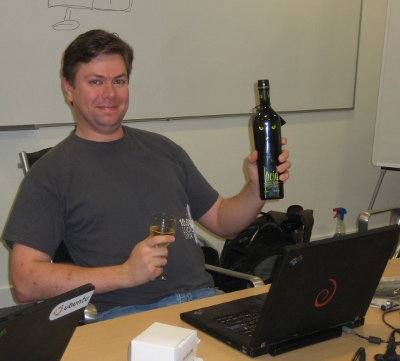
Steve Langasek has been contributing to Debian for more than a decade. He was a release manager for sarge and etch, and like many former release managers, he s still involved in the Debian release team although as a release wizard (i.e. more of an advisory role than a day-to-day contributor). Oh, and he did the same with Ubuntu: on the picture on the left, he just announced the release of Ubuntu 10.04 from his Debian-branded laptop. ;-) He has also been maintaining PAM in Debian for as long as can I remember and does a great job at that. He s very knowledgeable and fully deserves his place within the Debian Technical Committee. I m glad he still has the time to participate on several important Debian mailing lists because his contributions are always very useful. I m sure you ll notice this just by reading his answers below. My questions are in bold, the rest is by Steve. Who are you? I m 32 years old, have been running Linux since my first year in college back in 96, and have been a Debian developer now for ten years. Along the way I ve been involved in maintaining a variety of server packages, worked on the Alpha port for a while, did a stint as a release manager for a couple of years, and serve on the technical committee. This year I m also celebrating my ten year anniversary with my lovely wife Patty, who many know as an erstwhile front-desk volunteer at DebConf. God only knows why she puts up with my late-night hacking! These days in my day job I m a manager on the Ubuntu Platform team at Canonical, working to help make Ubuntu a daughter distribution that the Debian community can be proud of. What s your biggest achievement within Debian or Ubuntu? There s no doubt that my biggest achievement in Debian has been overseeing the release of two Debian releases as release manager. On the other hand, the scope of a release is so huge, and it represents the output of so many developers working together, that it would be arrogant to claim the release itself as an achievement of my own. Also, sarge and etch have long since been rotated off of the mirrors so no one cares about them anymore. ;) For a more personal and lasting contribution in the distro itself, I m very proud of writing pam-auth-update. It s a small piece of code, but one that Debian was missing for a long time it s made a big difference to PAM module integration in packages! What are your plans for Debian Wheezy? My top priority for this cycle is to see multiarch through. We re still not far enough along in Debian for most developers to see any difference and once we are, the first thing people are going to see is a fair bit of breakage when we start breaking a lot of assumptions about paths that have been hard-coded upstream. But I m still excited by the progress that is being made here. We should be able to ship wheezy without any ia32-libs package. We might even be able to get rid of all the biarch library packages, including those used by the toolchain itself. 54 packages in testing build-depend on gcc-multilib right now, in order to build 32-bit code to ship in the amd64 package; a bunch of those should go away with absolutely no reduction in functionality, saving us a bit of space in the archive and saving the maintainers a lot of complexity in their packages, while at the same time giving us much better support for cross-compilation than we ve ever had before. It s a tall order, certainly, but the pieces are falling into place one by one. My second priority is to get a policy in Debian around packages integrating upstart jobs. It would of course benefit Ubuntu to have many packages back in sync with Debian, but if all we wanted was to sync with Debian, we could mostly just make debhelper ignore upstart jobs in Debian, prefer them in Ubuntu, and call it good. I m interested in making sure Debian also gets the benefits of being able to use upstart, because as Linux has become increasingly asynchronous (doing more in parallel at start up), the traditional sysvinit has not been able to keep up. There are all kinds of bugs now related to network startup, for instance, that we don t have a good answer for in a sysvinit model but that we can fix with an event-based system. Upstart has been around for a while now, but we ve been slow to integrate it into Debian because it only works on Linux. It would be a shame if right after the first Debian GNU/kFreeBSD technology preview, packages all stopped working on kFreeBSD because they started to assume the availability of upstart! Unfortunately, having been so cautious we now have systemd on the scene, which not only doesn t support non-Linux but seems to be in the process of trying to gobble up other, non-Linux-specific components of the desktop stack. So I have to wonder what the future holds for the free desktop on non-Linux kernels. If you could spend all your time on Debian, what would you work on? Well, based on my previous experiences when I did spend all my time on Debian, I think the answer here is QA / release work. :) Otherwise, I don t know. My hands are full enough now with multiarch that it s hard for me to see what the Next Thing would be. You re a member of the technical committee. In the interview of Bdale Garbee, I have argued that it s not working well. What s your point of view on this topic? Well, I feel a constant low level guilt about my own poor level of activity in the TC; but that doesn t translate into a belief that the system is broken. This is, after all, the decision making body of last resort for technical disputes in Debian, and as such it should really be used sparingly. And if a reputation for glacial deliberation means more developers work out their disputes on their own rather than asking the TC to step in, I think that s actually a healthy thing! I do still wish we were more effective at resolving those issues that do come our way, but there s no silver bullet for this. Though the funny thing is, I ve noticed that the majority of issues that get referred to the TC nowadays never even need us to make a decision; a short conversation with the disputants is often enough to get them to come to an agreement. What s the biggest problem of Debian? By and large, I think Debian is still doing a great job at what it s best at delivering a rock-solid distribution that users can rely on. If I would highlight one problem in Debian, though, it would be that I think we re becoming less innovative as time goes on. Part of that comes from being such a large project that we re bound to be more conservative as an institution; but even though the three pet Debian projects of mine that I mentioned above are fairly innovative (multiarch, pam-auth-update, upstart), each of these has landed first in Ubuntu rather than in Debian. Always with a clear intent of pushing back up into Debian, of course, but it just wasn t possible to do this work within Debian for the first cut without much longer delays. I worry that if Debian is no longer the place to try new things, that we re going to miss out on attracting contributions from the folks who are inspired to make Free Software better and not simply to make it stable. I m not sure how to address this, though. Maybe improved conversations with derivatives such as (but not limited to) Ubuntu, about what crack of the day is being tried where and how that can be integrated into Debian once it s proven to work? I don t think that team-based maintenance or low-threshold NMUs do anything to address this, though, as the kinds of innovation that matter most are ones that require discussion and consensus-finding not just routing around inactive maintainers. Do you have wishes for Debian Wheezy? Well, I d like to see the armhf port get on its feet and become an official port. Over the lifetime of the arm and armel ports, the state of the art on ARM has changed quite a bit; it would be great to see Debian taking advantage of this richer platform, to let people make better use of their hardware via Debian. As a former release manager, you re now a release wizard . I guess you have seen it on debian-devel, there are proposals to not freeze testing and to use another distribution starting as a snapshot of testing to finalize the new stable release. According to your experience, what needs to happen to make this possible? Frankly, I ve stayed out of that discussion because I don t think what s being asked for is possible. I think proponents of a freezeless release have seriously underestimated the amount of work required on the part of the release team to wrangle testing into a releasable product, and that anything that makes propagation of fixes into the pending release more time consuming will make Debian worse on the whole, not better. If people really want to avoid long freezes for the Debian release, the best way they can help this happen is by making Debian more releasable on an ongoing basis, by helping to hold our packages to our shared standards for quality (i.e., by fixing RC bugs!). The biggest factor in long freezes for Debian is the slow rate at which we bring the RC bug count down during the freeze. Back in the sarge, etch days we used to have really great bug squashing parties that would get people together on weekends to hack through RC bugs by the dozens. I don t see that happening as much anymore. I d really like us to get back to that, but my few attempts at this so far since retiring as release manager have led me to think I m really terrible at organizing parties of any kind. :) On the other side, as seen at http://bugs.debian.org/release-critical/, the RC bug count for testing at the beginning of the release cycle keeps getting higher and higher. I d love to know why that is so we can address it. I know we ve gotten better at detecting some classes of RC bugs; that s part of it, but I don t think it explains the whole trend. Is there someone in Debian that you admire for their contributions? Wow, what kind of arrogant jerk would I be if I didn t admire anyone in Debian for their contributions? Debian is and always has been an amazing community of top-notch developers; there are certainly too many I admire to list them all here. Joey Hess certainly makes the list, for his longstanding example of code speaking louder than words and for his ability to get to the heart of common problems and come up with elegant solutions. So does Russ Allbery, who by all accounts had his ability to feel anger in response to email burned out of him at a young age in a flame-related accident on Usenet. ;-) The list goes on, but here I think I have to follow Joey s example and cut the words short.
Thank you to Steve for the time spent answering my questions. I hope you enjoyed reading his answers as I did. Subscribe to my newsletter to get my monthly summary of the Debian/Ubuntu news and to not miss further interviews. You can also follow along on Identi.ca, Twitter and Facebook.

3 comments Liked this article? Click here. My blog is Flattr-enabled.

Tiago Bortoletto Vaz: Q: What is the most historical day in Brazil's recent history?

A: Today!/me happy

Next.

Previous.