Search Results: "ag"

10 April 2023

Russell Coker: BTRFS Rebuild Time

In February I replaced a Dell T320 server with a HP Z640 workstation for a home server/workstation [1]. The T320 has 8*3.5 drive bays which I had used to put 3*4TB disks in a BTRFS RAID-10 array for 6TB of usable capacity. The Z640 has only 2*3.5 bays and 4*2.5 bays, so one option I could have taken was to buy a 4TB 2.5 SSD and keep the same 3*4TB array as before. Instead I chose to use an 8TB disk I had spare in an array with one of the original 4TB disks and some extra on NVMe devices (the system has 2*1TB NVMe devices which are used as a 380G RAID-1 for the root filesystem and the rest for the storage array). It s nice how BTRFS allows putting any storage you have in a RAID-10 configuration. Unfortunately it seems that I chose the wrong 4TB disk to use for this as it failed three days ago. It gave thousands of read and write errors and Linux decided that the drive no longer existed. I tried rebooting the system to get it in the BTRFS array again but it failed again and failed so quickly that it wasn t even possible to use the data on it as part of a RAID rebuild. So I removed that disk and put in one of the other 4TB disks. As the array is comprised of an 8TB disk and 3 other devices that don t add up to 8TB the layout is the 8TB disk having one copy of everything and the other devices having parts of it. So the rebuild process comprised of copying data from the 8TB disk to the 4TB disk. For a RAID array run in the manner of Linux software RAID the rebuild of a RAID-1 involves a linear copy of data which is the optimal case for hard disks, copying 4TB of data in that manner would have an average speed of a bit over 100MB/s and take about 11 hours. With BTRFS the source disk has to be updated for each block that is recreated so the process was bottlenecked on writing to the 8TB disk. It took 2 days 23 hours to complete. The process involved reading 3,478,031MB and writing 4,405,545MB. The system was live for the process and some cron jobs etc were writing to the array, but in the 12 hours since the rebuild completed the array has had 7,038MB written. So presumably during the rebuild time about 42G of actual data were written to the array and the other 4.3TB written to the 8TB disk were from the process of copying 3.5TB from it to another device. Iostat reported that there were 645.36 TPS for the duration of the rebuild which seems like a decent number for a hard drive, during the process iostat reported that the drive had 99%+ of IO capacity used for the duration. While waiting for this to complete I wrote a blog post about storage trends [2]. One thing I didn t mention in that post is that if you are the type of person who checks the rebuild process fifty times a day then that should be counted as part of the cost of using slow storage. If instead of an 8TB disk plus some SSD storage I had used 2*4TB disks and 1*4TB SSD as I had considered doing then instead of having 3.8TB on one device I would have had about 2.5TB and the reconstruct would have probably taken 2/3 of the time. If I had moved the array to 3*4TB SSDs then it would have taken a small fraction of the time. One thing to note is that I made a mistake in this operation by removing the failed device instead of doing a btrfs replace operation which can be significantly faster. If I had correctly done this then I would have written a blog post about the rebuild taking 2 days or something, the issues of hard drives being slow and me compulsively checking the progress would still apply.

9 April 2023

Marco d'Itri: Installing Debian 12 on a Banana Pi M5

I recently bought a Banana Pi BPI-M5, which uses the Amlogic S905X3 SoC: these are my notes about installing Debian on it. While this SoC is supported by the upstream U-Boot it is not supported by the Debian U-Boot package, so debian-installer does not work. Do not be fooled by seeing the DTB file for this exact board being distributed with debian-installer: all DTB files are, and it does not mean that the board is supposed to work. As I documented in #1033504, the Debian kernels are currently missing some patches needed to support the SD card reader. I started by downloading an Armbian Banana Pi image and booted it from an SD card. From there I partitioned the eMMC, which always appears as /dev/mmcblk1:
parted /dev/mmcblk1
(parted) mklabel msdos
(parted) mkpart primary ext4 4194304B -1
(parted) align-check optimal 1
mkfs.ext4 /dev/mmcblk1p1
Make sure to leave enough space before the first partition, or else U-Boot will overwrite it: as it is common for many ARM SoCs, U-Boot lives somewhere in the gap between the MBR and the first partition. I looked at Armbian's /usr/lib/u-boot/platform_install.sh and installed U-Boot by manually copying it to the eMMC:
dd if=/usr/lib/linux-u-boot-edge-bananapim5_22.08.6_arm64/u-boot.bin of=/dev/mmcblk1 bs=1 count=442
dd if=/usr/lib/linux-u-boot-edge-bananapim5_22.08.6_arm64/u-boot.bin of=/dev/mmcblk1 bs=512 skip=1 seek=1
Beware: Armbian's U-Boot 2022.10 is buggy, so I had to use an older image. I did not want to install a new system, so I copied over my old Cubieboard install:
mount /dev/mmcblk1p1 /mnt/
rsync -xaHSAX --delete --numeric-ids root@old-server:/ /mnt/ --exclude='/tmp/*' --exclude='/var/tmp/*'
Since the Cubieboard has a 32 bit CPU and the Banana Pi requires an arm64 kernel I enabled the architecture and installed a new kernel:
dpkg --add-architecture arm64
apt update
apt install linux-image-arm64
apt purge linux-image-6.1.0-6-armmp linux-image-armmp
At some point I will cross-grade the entire system. Even if ttyS0 exists it is not the serial console, which appears as ttyAML0 instead. Nowadays systemd automatically start a getty if the serial console is enabled on the kernel command line, so I just had to disable the old manually-configured getty:
systemctl disable serial-getty@ttyS0.service
I wanted to have a fully working flash-kernel, so I used Armbian's boot.scr as a template to create /etc/flash-kernel/bootscript/bootscr.meson and then added a custom entry for the Banana Pi to /etc/flash-kernel/db:
Machine: Banana Pi BPI-M5
Kernel-Flavors: arm64
DTB-Id: amlogic/meson-sm1-bananapi-m5.dtb
U-Boot-Initrd-Address: 0x0
Boot-Initrd-Path: /boot/uInitrd
Boot-Initrd-Path-Version: yes
Boot-Script-Path: /boot/boot.scr
U-Boot-Script-Name: bootscr.meson
Required-Packages: u-boot-tools
All things considered I do not think that I would recommend to Debian users to buy Amlogic-based boards since there are many other better supported SoCs.

8 April 2023

Evgeni Golov: Running autopkgtest with Docker inside Docker

While I am not the biggest fan of Docker, I must admit it has quite some reach across various service providers and can often be seen as an API for running things in isolated environments. One such service provider is GitHub when it comes to their Actions service. I have no idea what isolation technology GitHub uses on the outside of Actions, but inside you just get an Ubuntu system and can run whatever you want via Docker as that comes pre-installed and pre-configured. This especially means you can run things inside vanilla Debian containers, that are free from any GitHub or Canonical modifications one might not want ;-) So, if you want to run, say, lintian from sid, you can define a job to do so:
  lintian:
    runs-on: ubuntu-latest
    container: debian:sid
    steps:
      - [ do something to get a package to run lintian on ]
      - run: apt-get update
      - run: apt-get install -y --no-install-recommends lintian
      - run: lintian --info --display-info *.changes
This will run on Ubuntu (latest right now means 22.04 for GitHub), but then use Docker to run the debian:sid container and execute all further steps inside it. Pretty short and straight forward, right? Now lintian does static analysis of the package, it doesn't need to install it. What if we want to run autopkgtest that performs tests on an actually installed package? autopkgtest comes with various "virt servers", which are providing isolation of the testbed, so that it does not interfere with the host system. The simplest available virt server, autopkgtest-virt-null doesn't actually provide any isolation, as it runs things directly on the host system. This might seem fine when executed inside an ephemeral container in an CI environment, but it also means that multiple tests have the potential to influence each other as there is no way to revert the testbed to a clean state. For that, there are other, "real", virt servers available: chroot, lxc, qemu, docker and many more. They all have one in common: to use them, one needs to somehow provide an "image" (a prepared chroot, a tarball of a chroot, a vm disk, a container, , you get it) to operate on and most either bring a tool to create such an "image" or rely on a "registry" (online repository) to provide them. Most users of autopkgtest on GitHub (that I could find with their terrible search) are using either the null or the lxd virt servers. Probably because these are dead simple to set up (null) or the most "native" (lxd) in the Ubuntu environment. As I wanted to execute multiple tests that for sure would interfere with each other, the null virt server was out of the discussion pretty quickly. The lxd one also felt odd, as that meant I'd need to set up lxd (can be done in a few commands, but still) and it would need to download stuff from Canonical, incurring costs (which I couldn't care less about) and taking time which I do care about!). Enter autopkgtest-virt-docker, which recently was added to autopkgtest! No need to set things up, as GitHub already did all the Docker setup for me, and almost no waiting time to download the containers, as GitHub does heavy caching of stuff coming from Docker Hub (or at least it feels like that). The only drawback? It was added in autopkgtest 5.23, which Ubuntu 22.04 doesn't have. "We need to go deeper" and run autopkgtest from a sid container! With this idea, our current job definition would look like this:
  autopkgtest:
    runs-on: ubuntu-latest
    container: debian:sid
    steps:
      - [ do something to get a package to run autopkgtest on ]
      - run: apt-get update
      - run: apt-get install -y --no-install-recommends autopkgtest autodep8 docker.io
      - run: autopkgtest *.changes --setup-commands="apt-get update" -- docker debian:sid
(--setup-commands="apt-get update" is needed as the container comes with an empty apt cache and wouldn't be able to find dependencies of the tested package) However, this will fail:
# autopkgtest *.changes --setup-commands="apt-get update" -- docker debian:sid
autopkgtest [10:20:54]: starting date and time: 2023-04-07 10:20:54+0000
autopkgtest [10:20:54]: version 5.28
autopkgtest [10:20:54]: host a82a11789c0d; command line:
  /usr/bin/autopkgtest bley_2.0.0-1_amd64.changes '--setup-commands=apt-get update' -- docker debian:sid
Unexpected error:
Traceback (most recent call last):
  File "/usr/share/autopkgtest/lib/VirtSubproc.py", line 829, in mainloop
    command()
  File "/usr/share/autopkgtest/lib/VirtSubproc.py", line 758, in command
    r = f(c, ce)
        ^^^^^^^^
  File "/usr/share/autopkgtest/lib/VirtSubproc.py", line 692, in cmd_copydown
    copyupdown(c, ce, False)
  File "/usr/share/autopkgtest/lib/VirtSubproc.py", line 580, in copyupdown
    copyupdown_internal(ce[0], c[1:], upp)
  File "/usr/share/autopkgtest/lib/VirtSubproc.py", line 607, in copyupdown_internal
    copydown_shareddir(sd[0], sd[1], dirsp, downtmp_host)
  File "/usr/share/autopkgtest/lib/VirtSubproc.py", line 562, in copydown_shareddir
    shutil.copy(host, host_tmp)
  File "/usr/lib/python3.11/shutil.py", line 419, in copy
    copyfile(src, dst, follow_symlinks=follow_symlinks)
  File "/usr/lib/python3.11/shutil.py", line 258, in copyfile
    with open(dst, 'wb') as fdst:
         ^^^^^^^^^^^^^^^
FileNotFoundError: [Errno 2] No such file or directory: '/tmp/autopkgtest-virt-docker.shared.kn7n9ioe/downtmp/wrapper.sh'
autopkgtest [10:21:07]: ERROR: testbed failure: unexpected eof from the testbed
Running the same thing locally of course works, so there has to be something special about the setup at GitHub. But what?! A bit of digging revealed that autopkgtest-virt-docker tries to use a shared directory (using Dockers --volume) to exchange things with the testbed (for the downtmp-host capability). As my autopkgtest is running inside a container itself, nothing it tells the Docker deamon to mount will be actually visible to it. In retrospect this makes total sense and autopkgtest-virt-docker has a switch to "fix" the issue: --remote as the Docker deamon is technically remote when viewed from the place autopkgtest runs at. I'd argue this is not a bug in autopkgtest(-virt-docker), as the situation is actually cared for. There is even some auto-detection of "remote" daemons in the code, but that doesn't "know" how to detect the case where the daemon socket is mounted (vs being set as an environment variable). I've opened an MR (assume remote docker when running inside docker) which should detect the case of running inside a Docker container which kind of implies the daemon is remote. Not sure the patch will be accepted (it is a band-aid after all), but in the meantime I am quite happy with using --remote and so could you ;-)

Russell Coker: Storage Trends 2023

It s been 2 years since my last blog post about storage trends [1]. Minimum Storage <=2TB In 2021 I stated that as MSY had 2TB disks for $72 and 2TB SSD for $245 it was barely worth considering a 2TB disk and anything less than 2TB wasn t worth considering. Now for 2TB storage from MSY NVMe starts at $129, SATA SSD starts at $143, and hard disks start at $75. I guess that NVMe is slightly cheaper due to some combination of economies of scale for manufacture/sales and having less postage costs. It really doesn t make sense to consider hard disks for storing 2TB or less. For storage for a small system (PC or laptop) the cheapest storage device is $19 for a 128G SATA SSD. But it wouldn t make sense to buy that when you can get a 256G SATA SSD for $22 or a 240G NVMe device for $23, saving $3 on storage wouldn t make any sense. For 512G of storage the prices are $32 for NVMe and $33 for SATA SSD. For 1TB of storage the prices start at $68 for SATA SSD and $74 for NVMe. Probably for the vast majority of home users 1TB of SATA SSD or NVMe is the minimum storage capacity to consider, the $50 price difference isn t much when considering the entire price of a PC or laptop and anything less than 1TB will run out quickly with modern use. Larger Storage 4TB+ The price for 4TB of storage from MSY is NVMe starting at $349, SATA SSD starting at $369, and hard disks starting at $115. If you need 4TB of RAID-1 storage then it might be worth saving $470 and getting hard drives for a home user. For business use it wouldn t make sense. Some laptops have two NVMe sockets so 8TB of storage (or 4TB of RAID-1) in a laptop would be interesting. For 8TB of storage the MSY prices are SATA SSD for $739 and hard drives starting at $179. Probably hard drives are the best choice for most situations where there is a need to store 8TB or more of data. But the prices are low enough to make 8TB SSD something that can be considered for home use, it doesn t seem that long ago that the 4TB hard drives I bought for my home server were almost that expensive. Big Storage MSY doesn t have 8TB NVMe, such devices are on eBay for $1700 for regular M.2 NVMe and just under $1000 for U.2 (server hot-swap devices). So if you need more than 8TB of NVMe storage then probably buying a server with U.2 built in is the correct solution. For home users who need more than 8TB of storage hard drives are a good solution. One issue is that the more affordable and larger drives use Shingled Magnetic Recording (SMR) which has some different performance characteristics for certain workloads. Apparently SMR performs badly for anything other than large file storage. Why MSY? I primarily used MSY prices for this post because they are a reliable local store that has a list of prices that is easy to read. For everything in this post I can get better prices by using eBay, the StaticIce.com.au price comparison site [2], and the computing section of the OzBargain site that gamifies finding good prices [3]. But a good shopping strategy nowadays is to compare prices in a store to determine what items are in your price range and then shop around for price on the item you want. Checking all the different bargain sites for all these items would take much more time than I want to spend writing a blog post! Conclusion Hard drives don t make sense for the vast majority of systems. Not for laptops, not for typical desktop PCs, and not for small business servers (say 8TB or less of RAID storage). Hard drives only make sense for dozens or hundreds of TB of storage and even then finding out how to deal with SMR issues is going to increase the pain of deployment. Maybe using a combination of SSD and hard drives to deal with the SMR issues is going to be a competitive advantage for NAS vendors in future. NVMe looks like it s on the way to being cheaper than SATA SSD. There is likely to be a good market for systems with NVMe as the only internal storage option. The long term trend of systems without DVD drives and with maybe 2.5 SATA devices but no 3.5 SATA devices seems to lead to the GPU being the major part that needs to fit into a PC case that determines the overall size. Maybe there will be a new trend of GPUs connected to riser cards so they can be parallel to the motherboard for compact PCs. For business desktop systems (IE low powered graphics hardware as it s not for gaming) I expect that the trend will be towards NUC type devices which are already based around the M.2 as a storage device size.

7 April 2023

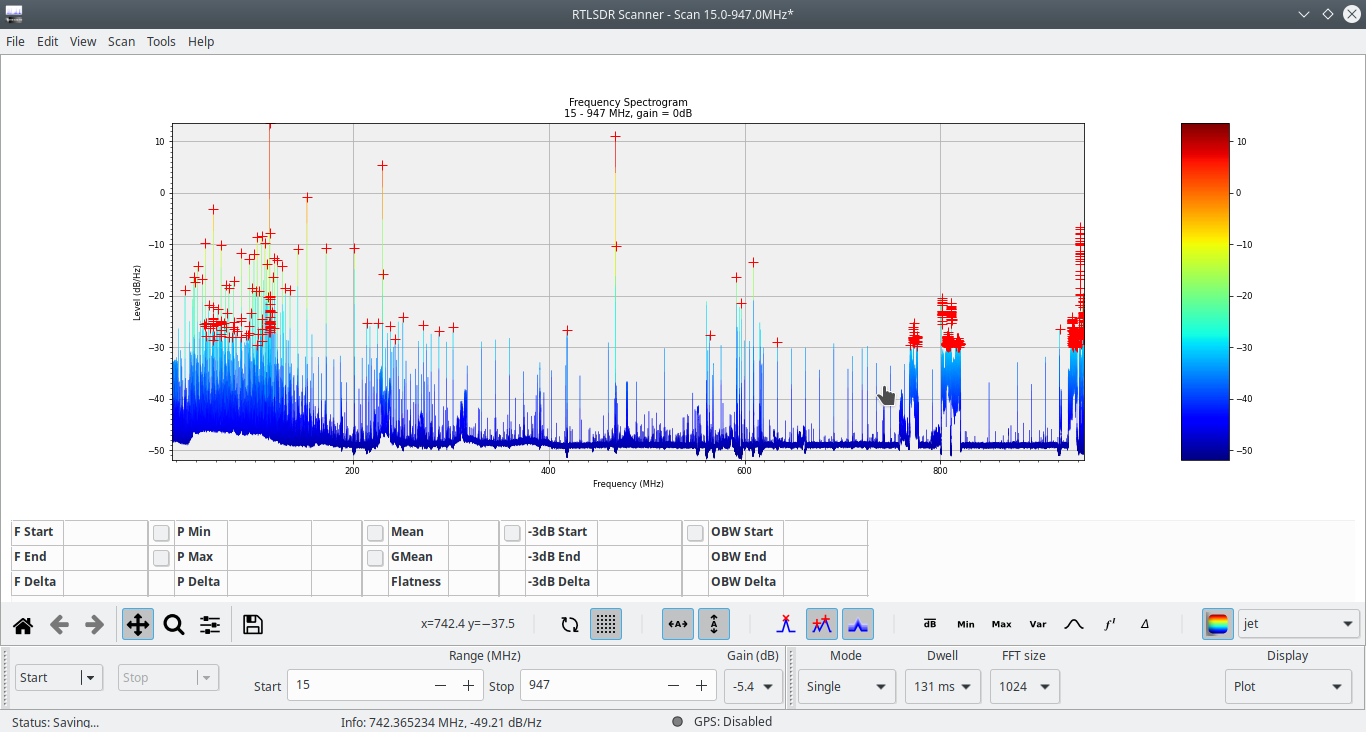
Petter Reinholdtsen: rtlsdr-scanner, software defined radio frequency scanner for Linux - nice free software

Today I finally found time to track down a useful radio frequency scanner for my software defined radio. Just for fun I tried to locate the radios used in the areas, and a good start would be to scan all the frequencies to see what is in use. I've tried to find a useful program earlier, but ran out of time before I managed to find a useful tool. This time I was more successful, and after a few false leads I found a description of rtlsdr-scanner over at the Kali site, and was able to track down the Kali package git repository to build a deb package for the scanner. Sadly the package is missing from the Debian project itself, at least in Debian Bullseye. Two runtime dependencies, python-visvis and python-rtlsdr had to be built and installed separately. Luckily 'gbp buildpackage' handled them just fine and no further packages had to be manually built. The end result worked out of the box after installation. My initial scans for FM channels worked just fine, so I knew the scanner was functioning. But when I tried to scan every frequency from 100 to 1000 MHz, the program stopped unexpectedly near the completion. After some debugging I discovered USB software radio I used rejected frequencies above 948 MHz, triggering a unreported exception breaking the scan. Changing the scan to end at 957 worked better. I similarly found the lower limit to be around 15, and ended up with the following full scan: Saving the scan did not work, but exporting it as a CSV file worked just fine. I ended up with around 477k CVS lines with dB level for the given frequency. The save failure seem to be a missing UTF-8 encoding issue in the python code. Will see if I can find time to send a patch upstream later to fix this exception:
Traceback (most recent call last):
  File "/usr/lib/python3/dist-packages/rtlsdr_scanner/main_window.py", line 485, in __on_save
    save_plot(fullName, self.scanInfo, self.spectrum, self.locations)
  File "/usr/lib/python3/dist-packages/rtlsdr_scanner/file.py", line 408, in save_plot
    handle.write(json.dumps(data, indent=4))
TypeError: a bytes-like object is required, not 'str'
As usual, if you use Bitcoin and want to show your support of my activities, please send Bitcoin donations to my address 15oWEoG9dUPovwmUL9KWAnYRtNJEkP1u1b.

Matthew Palmer: Database Encryption: If It's So Good, Why Isn't Everyone Doing It?

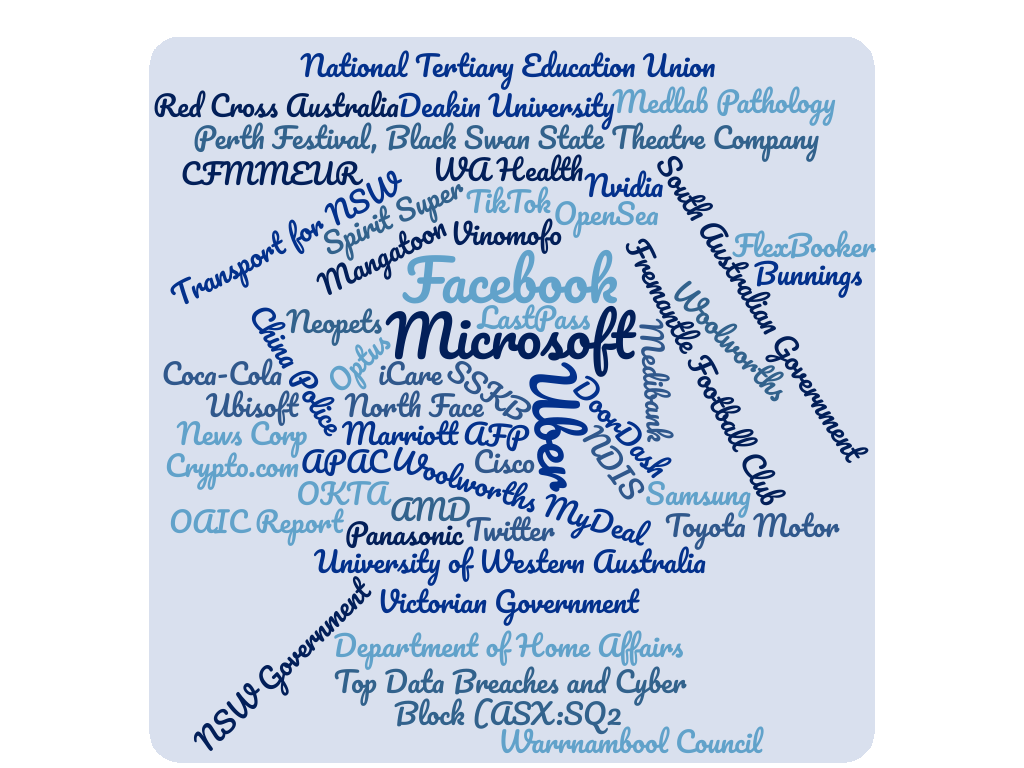
a wordcloud of organisations who have been reported to have had data breaches in 2022 Just some of the organisations that leaked data in 2022

It seems like just about every day there s another report of another company getting hacked and having its sensitive data (or, worse, the sensitive data of its customers) stolen. Sometimes, people s most intimate information gets dumped for the world to see. Other times it s just used for identity theft, extortion, and other crimes. In the least worst case, the attacker gets cold feet, but people suffer stress and inconvenience from having to replace identity documents. A great way to protect information from being leaked is to encrypt it. We encrypt data while it s being sent over the Internet (with TLS), and we encrypt it when it s at rest (with disk or volume encryption). Yet, everyone s data seems to still get stolen on a regular basis. Why? Because the data is kept online in an unencrypted form, sitting in the database while its being used. This means that attackers can just connect to the database, or trick the application into dumping the database, and all the data is just lying there, waiting to be misused.

It s Not the Devs Fault, Though You may be thinking that leaving an entire database full of sensitive data unencrypted seems like a terrible idea. And you re right: it is a terrible idea. But it s seemingly unavoidable. The problem is that in order to do what a database does best (query, sort, and aggregate data), it needs to be able to know what the data is. When you encrypt data, however, all the database sees is a locked box.
a locked box Not very useful for a database
The database can t tell what s in the locked box whether it s a number equal to 42, or a date that s less than 2023-01-01, or a string that contains the substring foo . Every value is just an opaque blob of stuff , and the database is rendered completely useless. Since modern applications usually rely pretty heavily on their database, it s essentially impossible to build an application if you ve turned your database into a glorified flat-file by encrypting everything in it. Thus, it s hardly surprising that developers have to leave the data laying around unencrypted, for anyone to come along and take.

Introducing Enquo I said before that having data unencrypted in a database is seemingly unavoidable. That s because there are some innovative cryptographic techniques that can make it possible to query encrypted data.
Andy Dwyer being amazed Indeed
The purpose of the Enquo project is to provide a common set of cryptographic primitives that implement ENcrypted QUery Operations (ie Enquo ), and integrate those operations into databases, ORMs, and anywhere else that could benefit. The end goal is to provide the ability to encrypt all the data stored in any database server, while still allowing the data to be queried and aggregated. So far, the project consists of these components:
  • the enquo-core library, that implements queryable encrypted integers, dates, and text in Rust and Ruby;
  • a PostgreSQL extension, pg_enquo, that allows PostgreSQL to query encrypted data; and
  • a Rails ActiveRecord extension, ActiveEnquo, that augments ActiveRecord to do the encryption/decryption required.
Support for other languages and ORMs is designed to be as straightforward as possible, and integration with other databases is mostly dependent on their own extensibility. The project s core tenets emphasise both uncompromising security, and a friendly developer experience. Naturally, all Enquo code is open source, released under the MIT licence.

Would You Like To Know More?
Desire to know more intensifies Everyone who uses a database...

If all this sounds relevant to your interests:
  1. If you use Ruby on Rails and PostgreSQL, you re halfway home already. Follow the ActiveEnquo getting started tutorial and see how much of your data Enquo can already protect. When you find data you want to encrypt but can t, tell me about it.
    • If you use Ruby and PostgreSQL with another ORM, such as Sequel, writing a plugin to support Enquo shouldn t be too difficult. The ActiveEnquo code should give you a good start. If you get stuck, get in touch.
  2. If you use PostgreSQL with another programming language, tell me what language you use and we ll work together to get bindings for that library created.
  3. If you use another database server, support is coming for your database of choice eventually, but at present there s no timeline on support. On the off chance that you happen to be a hard-core database hacking expert, and would like to work on getting Enquo support in your preferred database server, I d love to talk to you.

6 April 2023

Reproducible Builds: Reproducible Builds in March 2023

Welcome to the March 2023 report from the Reproducible Builds project. In these reports we outline the most important things that we have been up to over the past month. As a quick recap, the motivation behind the reproducible builds effort is to ensure no malicious flaws have been introduced during compilation and distributing processes. It does this by ensuring identical results are always generated from a given source, thus allowing multiple third-parties to come to a consensus on whether a build was compromised. If you are interested in contributing to the project, please do visit our Contribute page on our website.

News There was progress towards making the Go programming language reproducible this month, with the overall goal remaining making the Go binaries distributed from Google and by Arch Linux (and others) to be bit-for-bit identical. These changes could become part of the upcoming version 1.21 release of Go. An issue in the Go issue tracker (#57120) is being used to follow and record progress on this.
Arnout Engelen updated our website to add and update reproducibility-related links for NixOS to reproducible.nixos.org. [ ]. In addition, Chris Lamb made some cosmetic changes to our presentations and resources page. [ ][ ]
Intel published a guide on how to reproducibly build their Trust Domain Extensions (TDX) firmware. TDX here refers to an Intel technology that combines their existing virtual machine and memory encryption technology with a new kind of virtual machine guest called a Trust Domain. This runs the CPU in a mode that protects the confidentiality of its memory contents and its state from any other software.
A reproducibility-related bug from early 2020 in the GNU GCC compiler as been fixed. The issues was that if GCC was invoked via the as frontend, the -ffile-prefix-map was being ignored. We were tracking this in Debian via the build_path_captured_in_assembly_objects issue. It has now been fixed and will be reflected in GCC version 13.
Holger Levsen will present at foss-north 2023 in April of this year in Gothenburg, Sweden on the topic of Reproducible Builds, the first ten years.
Anthony Andreoli, Anis Lounis, Mourad Debbabi and Aiman Hanna of the Security Research Centre at Concordia University, Montreal published a paper this month entitled On the prevalence of software supply chain attacks: Empirical study and investigative framework:
Software Supply Chain Attacks (SSCAs) typically compromise hosts through trusted but infected software. The intent of this paper is twofold: First, we present an empirical study of the most prominent software supply chain attacks and their characteristics. Second, we propose an investigative framework for identifying, expressing, and evaluating characteristic behaviours of newfound attacks for mitigation and future defense purposes. We hypothesize that these behaviours are statistically malicious, existed in the past, and thus could have been thwarted in modernity through their cementation x-years ago. [ ]

On our mailing list this month:
  • Mattia Rizzolo is asking everyone in the community to save the date for the 2023 s Reproducible Builds summit which will take place between October 31st and November 2nd at Dock Europe in Hamburg, Germany. Separate announcement(s) to follow. [ ]
  • ahojlm posted an message announcing a new project which is the first project offering bootstrappable and verifiable builds without any binary seeds. That is to say, a way of providing a verifiable path towards trusted software development platform without relying on pre-provided binary code in order to prevent against various forms of compiler backdoors. The project s homepage is hosted on Tor (mirror).

The minutes and logs from our March 2023 IRC meeting have been published. In case you missed this one, our next IRC meeting will take place on Tuesday 25th April at 15:00 UTC on #reproducible-builds on the OFTC network.
and as a Valentines Day present, Holger Levsen wrote on his blog on 14th February to express his thanks to OSUOSL for their continuous support of reproducible-builds.org. [ ]

Debian Vagrant Cascadian developed an easier setup for testing debian packages which uses sbuild s unshare mode along and reprotest, our tool for building the same source code twice in different environments and then checking the binaries produced by each build for any differences. [ ]
Over 30 reviews of Debian packages were added, 14 were updated and 7 were removed this month, all adding to our knowledge about identified issues. A number of issues were updated, including the Holger Levsen updating build_path_captured_in_assembly_objects to note that it has been fixed for GCC 13 [ ] and Vagrant Cascadian added new issues to mark packages where the build path is being captured via the Rust toolchain [ ] as well as new categorisation for where virtual packages have nondeterministic versioned dependencies [ ].

Upstream patches The Reproducible Builds project detects, dissects and attempts to fix as many currently-unreproducible packages as possible. We endeavour to send all of our patches upstream where appropriate. This month, we wrote a large number of such patches, including: In addition, Vagrant Cascadian filed a bug with a patch to ensure GNU Modula-2 supports the SOURCE_DATE_EPOCH environment variable.

Testing framework The Reproducible Builds project operates a comprehensive testing framework (available at tests.reproducible-builds.org) in order to check packages and other artifacts for reproducibility. In March, the following changes were made by Holger Levsen:
  • Arch Linux-related changes:
    • Build Arch packages in /tmp/archlinux-ci/$SRCPACKAGE instead of /tmp/$SRCPACKAGE. [ ]
    • Start 2/3 of the builds on the o1 node, the rest on o2. [ ]
    • Add graphs for Arch Linux (and OpenWrt) builds. [ ]
    • Toggle Arch-related builders to debug why a specific node overloaded. [ ][ ][ ][ ]
  • Node health checks:
    • Detect SetuptoolsDeprecationWarning tracebacks in Python builds. [ ]
    • Detect failures do perform chdist calls. [ ][ ]
  • OSUOSL node migration.
    • Install megacli packages that are needed for hardware RAID. [ ][ ]
    • Add health check and maintenance jobs for new nodes. [ ]
    • Add mail config for new nodes. [ ][ ]
    • Handle a node running in the future correctly. [ ][ ]
    • Migrate some nodes to Debian bookworm. [ ]
    • Fix nodes health overview for osuosl3. [ ]
    • Make sure the /srv/workspace directory is owned by by the jenkins user. [ ]
    • Use .debian.net names everywhere, except when communicating with the outside world. [ ]
    • Grant fpierret access to a new node. [ ]
    • Update documentation. [ ]
    • Misc migration changes. [ ][ ][ ][ ][ ][ ][ ][ ]
  • Misc changes:
    • Enable fail2ban everywhere and monitor it with munin [ ].
    • Gracefully deal with non-existing Alpine schroots. [ ]
In addition, Roland Clobus is continuing his work on reproducible Debian ISO images:
  • Add/update openQA configuration [ ], and use the actual timestamp for openQA builds [ ].
  • Moved adding the user to the docker group from the janitor_setup_worker script to the (more general) update_jdn.sh script. [ ]
  • Use the (short-term) reproducible source when generating live-build images. [ ]

diffoscope development diffoscope is our in-depth and content-aware diff utility. Not only can it locate and diagnose reproducibility issues, it can provide human-readable diffs from many kinds of binary formats as well. This month, Mattia Rizzolo released versions 238, and Chris Lamb released versions 239 and 240. Chris Lamb also made the following changes:
  • Fix compatibility with PyPDF 3.x, and correctly restore test data. [ ]
  • Rework PDF annotation handling into a separate method. [ ]
In addition, Holger Levsen performed a long-overdue overhaul of the Lintian overrides in the Debian packaging [ ][ ][ ][ ], and Mattia Rizzolo updated the packaging to silence an include_package_data=True [ ], fixed the build under Debian bullseye [ ], fixed tool name in a list of tools permitted to be absent during package build tests [ ] and as well as documented sending out an email upon [ ]. In addition, Vagrant Cascadian updated the version of GNU Guix to 238 [ and 239 [ ]. Vagrant also updated reprotest to version 0.7.23. [ ]

Other development work Bernhard M. Wiedemann published another monthly report about reproducibility within openSUSE


If you are interested in contributing to the Reproducible Builds project, please visit our Contribute page on our website. However, you can get in touch with us via:

Dirk Eddelbuettel: RcppArmadillo 0.12.2.0.0 on CRAN: New Upstream Minor

armadillo image Armadillo is a powerful and expressive C++ template library for linear algebra and scientific computing. It aims towards a good balance between speed and ease of use, has a syntax deliberately close to Matlab, and is useful for algorithm development directly in C++, or quick conversion of research code into production environments. RcppArmadillo integrates this library with the R environment and language and is widely used by (currently) 1052 other packages on CRAN, downloaded 28.6 million times (per the partial logs from the cloud mirrors of CRAN), and the CSDA paper (preprint / vignette) by Conrad and myself has been cited 522 times according to Google Scholar. This release brings a new upstream release 12.2.0 made by Conrad a day or so ago. We prepared the usual release candidate, tested on the over 1000 reverse depends, found no issues and sent it to CRAN. Where it got tested again and was auto-processed smoothly by CRAN. The releases actually has a relatively small set of changes as a first follow-up release in the 12.2.* series.

Changes in RcppArmadillo version 0.12.2.0.0 (2023-04-04)
  • Upgraded to Armadillo release 12.2.0 (Cortisol Profusion Deluxe)
    • more efficient use of FFTW3 by fft() and ifft()
    • faster in-place element-wise multiplication of sparse matrices by dense matrices
    • added spsolve_factoriser class to allow reuse of sparse matrix factorisation for solving systems of linear equations

Courtesy of my CRANberries, there is a diffstat report relative to previous release. More detailed information is on the RcppArmadillo page. Questions, comments etc should go to the rcpp-devel mailing list off the R-Forge page. If you like this or other open-source work I do, you can sponsor me at GitHub.

This post by Dirk Eddelbuettel originated on his Thinking inside the box blog. Please report excessive re-aggregation in third-party for-profit settings.

Michael Ablassmeier: tracking changes between pypi package releases

I wondered if there is some tracking for differences between packages published on pypi, something that stores this information in a format similar to debdiff.. I failed to find something on the web, so created a little utility which watches the pypi changelog for new releaes and fetches the new and old version. It uses diffoscope to create reports on the published releases and automatically pushes them to a github repository: https://github.com/pypi-diff Is it useful? I dont know, it may be handy for code review or maybe running different security scanners on it, to identify accidentaly pushed keys or other sensitive data. Currently its pushing the changes for every released package every 10 minutes, lets see how far this can go just for fun :-)

5 April 2023

Valhalla's Things: Fitting Top and Camisole

Posted on April 5, 2023
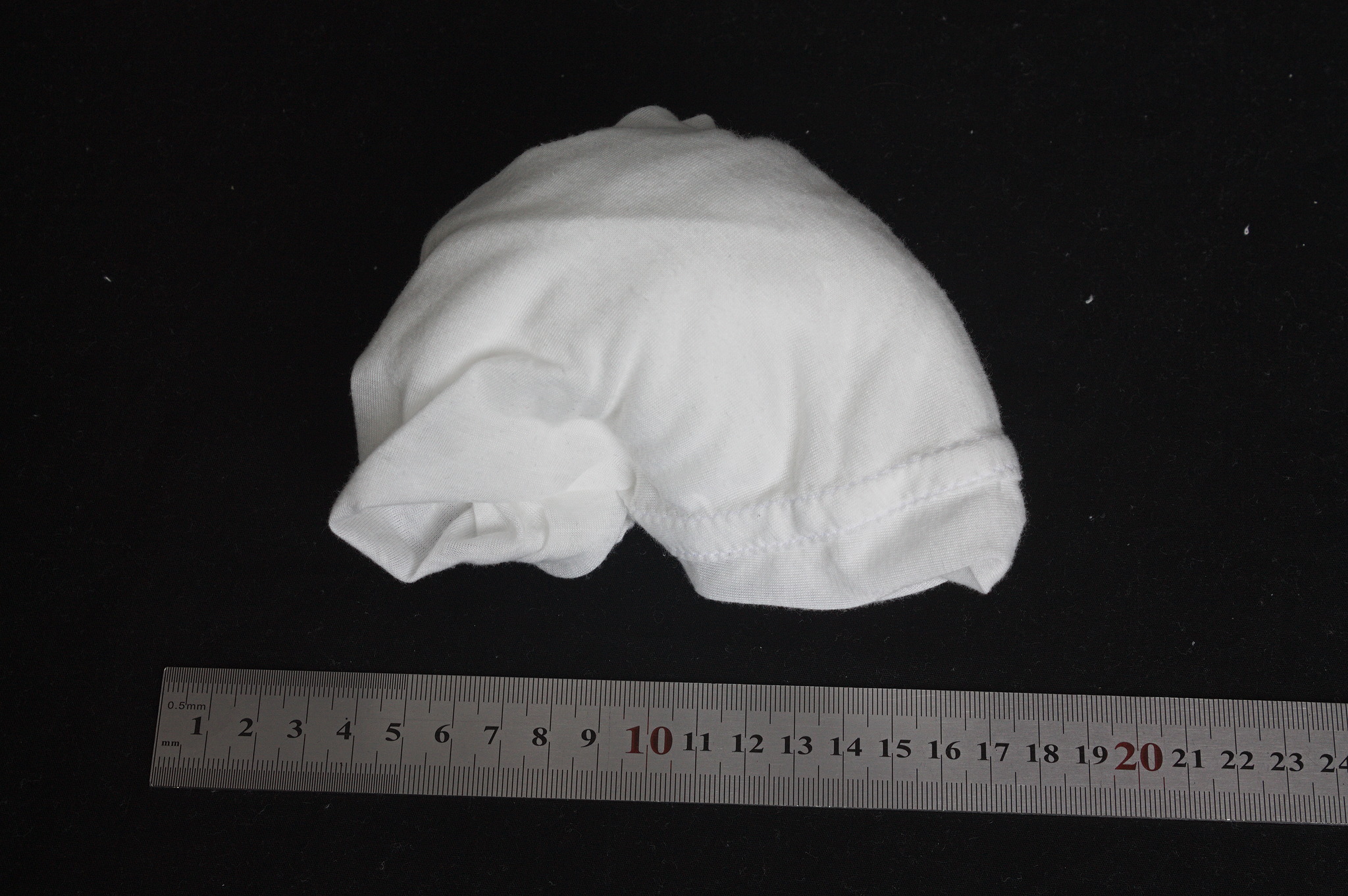
A woman wearing a simple, long sleeved, fitted white top; the fabric is somewhat transparent and the outline of a camisole can be seen. For this summer, I ve just made a nice sleeveless dress, but that doesn t mean that I m planning to go around with bare arms like, I don t know, a peasant or even somebody with no health issues, perish the thought! Instead, at the end of last season I ve bought a remnant of white ramie / viscose jersey that is a bit too transparent to be decent when worn on its own, but should still give some protection from the sun without being unconfortable in the heat, with the intent to make myself a new top. Because of the transparency I wasn t sure whether to actually use it for a top, or just to make camisoles, but with the decency preserved by the dress the choice was made: I had enough fabric for a top, a camisole and maybe something small. I already have a trusted pattern for the top and camisole, but they still had to be published, so I took care to write down instructions and take step-by-step pictures; maybe the white fabric isn t the best, but it s better than nothing, and I can still take better pictures the next time I ll do another make. They are of course on my pattern webiste: top and camisole. some fabric (the top pictured above) crunched up in a loose ball, less than 15 cm in diameter (there is a ruler for scale). Since the fabric was bought online as a remnant, I didn t exactly know what to expect, and was pleasantly surprised by how soft it is: it feels like touching a cloud. This however means that it felt like working with a cloud, and, well, let s just say I m happy that both patterns were quite simple and I didn t have to deal with fiddly bits. I was also not so pleasantly surprised by the fact that part of the fabric had a few small holes as if the end of the roll had been caught on something; I was able to cut everything around the holes, other than a small bit that I hadn t noticed and had to be mended. It s not a big deal, but I suspect it s a sign that this fabric may not be as sturdy as it could have been, and that there will be more mending in the future as I wear it. And then, when I had finished the set I was faced with another problem: taking pictures. For one thing, worn on their own they aren t exactly decent, and then there was the fact that after a week of late spring weather in March, as I was working on summer clothing the temperature dropped and there was even a hint of rain. image I solved this by wearing the new set on top of another set of fitting top and camisole, with matching leggings. Not exactly something I would wear on the regular streets, but good enough for a picture of underwear. A woman wearing a white camisole on top of black top and leggings. Still, the pictures were taken in quite a hurry, because I wasn t completely freezing, but still pretty cold. Anyway, I m off to find some other piece of summer wear to make, hoping that it will bring proper rain. :)


3 April 2023

Russ Allbery: Review: The Nordic Theory of Everything

Review: The Nordic Theory of Everything, by Anu Partanen
Publisher: Harper
Copyright: 2016
Printing: June 2017
ISBN: 0-06-231656-7
Format: Kindle
Pages: 338
Anu Partanen is a Finnish journalist who immigrated to the United States. The Nordic Theory of Everything, subtitled In Search of a Better Life, is an attempt to explain the merits of Finnish approaches to government and society to a US audience. It was her first book. If you follow US policy discussion at all, you have probably been exposed to many of the ideas in this book. There was a time when the US left was obsessed with comparisons between the US and Nordic countries, and while that obsession has faded somewhat, Nordic social systems are still discussed with envy and treated as a potential model. Many of the topics of this book are therefore predictable: parental leave, vacation, health care, education, happiness, life expectancy, all the things that are far superior in Nordic countries than in the United States by essentially every statistical measure available, and which have been much-discussed. Partanen brings two twists to this standard analysis. The first is that this book is part memoir: she fell in love with a US writer and made the decision to move to the US rather than asking him to move to Finland. She therefore experienced the transition between social and government systems first-hand and writes memorably on the resulting surprise, trade-offs, anxiety, and bafflement. The second, which I've not seen previously in this policy debate, is a fascinating argument that Finland is a far more individualistic country than the United States precisely because of its policy differences.
Most people, including myself, assumed that part of what made the United States a great country, and such an exceptional one, was that you could live your life relatively unencumbered by the downside of a traditional, old-fashioned society: dependency on the people you happened to be stuck with. In America you had the liberty to express your individuality and choose your own community. This would allow you to interact with family, neighbors, and fellow citizens on the basis of who you were, rather than on what you were obligated to do or expected to be according to old-fashioned thinking. The longer I lived in America, therefore, and the more places I visited and the more people I met and the more American I myself became the more puzzled I grew. For it was exactly those key benefits of modernity freedom, personal independence, and opportunity that seemed, from my outsider s perspective, in a thousand small ways to be surprisingly missing from American life today. Amid the anxiety and stress of people s daily lives, those grand ideals were looking more theoretical than actual.
The core of this argument is that the structure of life in the United States essentially coerces dependency on other people: employers, spouses, parents, children, and extended family. Because there is no universally available social support system, those relationships become essential for any hope of a good life, and often for survival. If parents do not heavily manage their children's education, there is a substantial risk of long-lasting damage to the stability and happiness of their life. If children do not care for their elderly parents, they may receive no care at all. Choosing not to get married often means choosing precarity and exhaustion because navigating society without pooling resources with someone else is incredibly difficult.
It was as if America, land of the Hollywood romance, was in practice mired in a premodern time when marriage was, first and foremost, not an expression of love, but rather a logistical and financial pact to help families survive by joining resources.
Partanen contrasts this with what she calls the Nordic theory of love:
What Lars Tr g rdh came to understand during his years in the United States was that the overarching ambition of Nordic societies during the course of the twentieth century, and into the twenty-first, has not been to socialize the economy at all, as is often mistakenly assumed. Rather the goal has been to free the individual from all forms of dependency within the family and in civil society: the poor from charity, wives from husbands, adult children from parents, and elderly parents from their children. The express purpose of this freedom is to allow all those human relationships to be unencumbered by ulterior motives and needs, and thus to be entirely free, completely authentic, and driven purely by love.
She sees this as the common theme through most of the policy differences discussed in this book. The Finnish approach is to provide neutral and universal logistical support for most of life's expected challenges: birth, child-rearing, education, health, unemployment, and aging. This relieves other social relations family, employer, church of the corrosive strain of dependency and obligation. It also ensures people's basic well-being isn't reliant on accidents of association.
If the United States is so worried about crushing entrepreneurship and innovation, a good place to start would be freeing start-ups and companies from the burdens of babysitting the nation s citizens.
I found this fascinating as a persuasive technique. Partanen embraces the US ideal of individualism and points out that, rather than being collectivist as the US right tends to assume, Finland is better at fostering individualism and independence because the government works to removes unnecessary premodern constraints on individual lives. The reason why so many Americans are anxious and frantic is not a personal failing or bad luck. It's because the US social system is deeply hostile to healthy relationships and individual independence. It demands a constant level of daily problem-solving and crisis management that is profoundly exhausting, nearly impossible to navigate alone, and damaging to the ideal of equal relationships. Whether this line of argument will work is another question, and I'm dubious for reasons that Partanen (probably wisely) avoids. She presents the Finnish approach as a discovery that the US would benefit from, and the US approach as a well-intentioned mistake. I think this is superficially appealing; almost all corners of US political belief at least give lip service to individualism and independence. However, advocates of political change will eventually need to address the fact that many US conservatives see this type of social coercion as an intended feature of society rather than a flaw. This is most obvious when one looks at family relationships. Partanen treats the idea that marriage should be a free choice between equals rather than an economic necessity as self-evident, but there is a significant strain of US political thought that embraces punishing people for not staying within the bounds of a conservative ideal of family. One will often find, primarily but not exclusively among the more religious, a contention that the basic unit of society is the (heterosexual, patriarchal) family, not the individual, and that the suffering of anyone outside that structure is their own fault. Not wanting to get married, be the primary caregiver for one's parents, or abandon a career in order to raise children is treated as malignant selfishness and immorality rather than a personal choice that can be enabled by a modern social system. Here, I think Partanen is accurate to identify the Finnish social system as more modern. It embraces the philosophical concept of modernity, namely that social systems can be improved and social structures are not timeless. This is going to be a hard argument to swallow for those who see the pressure towards forming dependency ties within families as natural, and societal efforts to relieve those pressures as government meddling. In that intellectual framework, rather than an attempt to improve the quality of life, government logistical support is perceived as hostility to traditional family obligations and an attempt to replace "natural" human ties with "artificial" dependence on government services. Partanen doesn't attempt to have that debate. Two other things struck me in this book. The first is that, in Partanen's presentation, Finns expect high-quality services from their government and work to improve it when it falls short. This sounds like an obvious statement, but I don't think it is in the context of US politics, and neither does Partanen. She devotes a chapter to the topic, subtitled "Go ahead: ask what your country can do for you." This is, to me, one of the most frustrating aspects of US political debate. Our attitude towards government is almost entirely hostile and negative even among the political corners that would like to see government do more. Failures of government programs are treated as malice, malfeasance, or inherent incompetence: in short, signs the program should never have been attempted, rather than opportunities to learn and improve. Finland had mediocre public schools, decided to make them better, and succeeded. The moment US public schools start deteriorating, we throw much of our effort into encouraging private competition and dismantling the public school system. Partanen doesn't draw this connection, but I see a link between the US desire for market solutions to societal problems and the level of exhaustion and anxiety that is so common in US life. Solving problems by throwing them open to competition is a way of giving up, of saying we have no idea how to improve something and are hoping someone else will figure it out for a profit. Analyzing the failures of an existing system and designing incremental improvements is hard and slow work. Throwing out the system and hoping some corporation will come up with something better is disruptive but easy. When everyone is already overwhelmed by life and devoid of energy to work on complex social problems, it's tempting to give up on compromise and coalition-building and let everyone go their separate ways on their own dime. We cede the essential work of designing a good society to start-ups. This creates a vicious cycle: the resulting market solutions are inevitably gated by wealth and thus precarious and artificially scarce, which in turn creates more anxiety and stress. The short-term energy savings from not having to wrestle with a hard problem is overwhelmed by the long-term cost of having to navigate a complex and adversarial economic relationship. That leads into the last point: schools. There's a lot of discussion here about school quality and design, which I won't review in detail but which is worth reading. What struck me about Partanen's discussion, though, is how easy the Finnish system is to use. Finnish parents just send their kids to the most convenient school and rarely give that a second thought. The critical property is that all the schools are basically fine, and therefore there is no need to place one's child in an exceptional school to ensure they have a good life. It's axiomatic in the US that more choice is better. This is a constant refrain in our political discussion around schools: parental choice, parental control, options, decisions, permission, matching children to schools tailored for their needs. Those choices are almost entirely absent in Finland, at least in Partanen's description, and the amount of mental and emotional energy this saves is astonishing. Parents simply don't think about this, and everything is fine. I think we dramatically underestimate the negative effects of constantly having to make difficult decisions with significant consequences, and drastically overstate the benefits of having every aspect of life be full of major decision points. To let go of that attempt at control, however illusory, people have to believe in a baseline of quality that makes the choice less fraught. That's precisely what Finland provides by expecting high-quality social services and working to fix them when they fall short, an effort that the United States has by and large abandoned. A lot of non-fiction books could be turned into long articles without losing much substance, and I think The Nordic Theory of Everything falls partly into that trap. Partanen repeats the same ideas from several different angles, and the book felt a bit padded towards the end. If you're already familiar with the policy comparisons between the US and Nordic countries, you will have seen a lot of this before, and the book bogs down when Partanen strays too far from memoir and personal reactions. But the focus on individualism and eliminating dependency is new, at least to me, and is such an illuminating way to look at the contrast that I think the book is worth reading just for that. Rating: 7 out of 10

Matt Brown: Retrospective: Mar 2023

The key decision I made mid-March was to commit to pursuing ventilation monitoring as my primary product development focus. Prior to that decision, I hoped to use my writing plan to drive a breadth-first survey of the opportunities for each of my product ideas before deciding which had the best business potential to focus on first. Two factors changed my mind:
  1. As noted last month, I m finding the writing process much slower and harder than I expected the survey across all the ideas may not complete until mid-year or later!
  2. I ve realised that having begun building co2mon.nz last year, to stop work on the project at this point would leave me feeling that I had not done justice to developing the product and testing the market - seeing it to a conclusion is important to me.
This decision is an explicit choice to prioritize seeing a project through to a conclusion (successful, or otherwise) regardless of whether or not it has the highest potential of the various ideas I could invest time into. I m comfortable making that trade-off in this instance, but I am going to bound my time investment to two months. I ll evaluate at the end of May whether I m seeing sufficient traction and potential to justify continuing further with the idea. I had only one fully uninterrupted work week in March due to a combination of days out due to school trips, two LandSAR call outs and various farm maintenance tasks. April will be similarly disrupted given school holidays and a planned family trip to Brisbane. Sharpening my focus feels particularly necessary given this reality to ensure I m not spread overly thin.

Goal Scoring See last month s retrospective for a refresher on my scoring methodology.

Consulting - 4/10 Goal: Execute a series of successful consulting engagements, building a reputation for myself and leaving happy customers willing to provide testimonials that support a pipeline of future opportunities. Consulting hours were down from February, hitting only 31% of target this month as the client didn t make use of all the hours I had allocated for them. I didn t invest any time in advertising my services or developing new clients or projects over the month, which will now become a priority for April.

Product Development - 4/10 Goal: Grow my product development skill set by taking several ideas to MVP stage with customer feedback received, and launch at least one product which generates revenue and has growth potential. With the new focus entirely on co2mon.nz, I spent a lot of time re-working and developing my thinking around how I want to take this forward, specifically trying to analyse where I saw an opportunity in the market. After attending a workshop on finding product market fit using quantifiable metrics at the Southern SaaS conference this month, I ve realised that much of the time I spent on this analysis is too insular and focused on my own observations - I need to get out and talk to a lot more people and get more feedback on their needs and understanding of the space instead. Seems obvious in retrospect! I also spent a few days beginning to build another batch of prototype CO2 monitors so I have some units to use for experimentation and testing with potential customers as I get out and have those conversations. I can probably build one or two more batches of prototype monitors before needing to look at PCB assembly in earnest.

Professional Network Development - 8/10 Goal: To build a professional relationship with at least 30 new people this year. This goal continues to be my highlight with 8 new contacts added this month and catch-ups with 4 existing people I had not spoken to for a while. I joined the KiwiSaaS central community and attended the SouthernSaas conference this month as well, which has been time well spent given the workshop learnings discussed above.

Writing - 3/10 Goal: To publish a high-quality piece of writing on this site at least once a week. I published a single post, the first half of my updated ventilation monitoring business plan. I continue to find the writing process much harder and slower than I hoped or expected and remain well below my target publishing rate, but one post is better than zero! I tested working with an editor I contracted via UpWork who provided some very useful feedback on the structure of my writing which helped to unblock some of my progress. I plan to continue doing this for at least a few more posts.

Community - 5/10 Goal: To support the growth of my local technical community by volunteering my experience and knowledge with others through activities such as mentoring, conference talks and similar.

Feedback As always, I d love to hear from you if you have thoughts or feedback triggered by anything I ve written above.

2 April 2023

Thorsten Alteholz: My Debian Activities in March 2023

FTP master This month I accepted 78 and rejected 12 packages. The overall number of packages that got accepted was 78. I still love this calm and peaceful time now within the Debian project, when everybody only cares for RC bugs and NEW does not grow. Debian LTS This was my hundred-fifth month that I did some work for the Debian LTS initiative, started by Raphael Hertzog at Freexian. This month my all in all workload has been 14h. During that time I uploaded: I also participated in the monthly LTS-meeting. Last but not least I did some days of frontdesk duties and took care of issues on security-master. Debian ELTS This month was the fifty sixth ELTS month. The duktape update in Stretch is more complicated than expected and I could not finish it this month. I also started to work on openssl1.0 Last but not least I did some days of frontdesk duties Debian Printing This month I uploaded new versions or improved packages of: The unblock bug for hplip was already processed, the unblock bug for cups is still waiting. Hopefully the last minute work of the translators was not wasted. Parts of this work is generously funded by Freexian! Other stuff Looking at my notes, there is nothing to be reported here.

David Bremner: Installing Debian using the OVH rescue environment

Problem description(s) For some of its cheaper dedicated servers, OVH does not provide a KVM (in the virtual console sense) interface. Sometimes when a virtual console is provided, it requires a horrible java applet that won't run on modern systems without a lot of song and dance. Although OVH provides a few web based ways of installing,
  • I prefer to use the debian installer image I'm used to and trust, and
  • I needed some way to debug a broken install.
I have only tested this in the OVH rescue environment, but the general approach should work anywhere the rescue environment can install and run QEMU.

QEMU to the rescue Initially I was horrified by the ovh forums post but eventually I realized it not only gave a way to install from a custom ISO, but provided a way to debug quite a few (but not all, as I discovered) boot problems by using the rescue env (which is an in-memory Debian Buster, with an updated kernel). The original solution uses VNC but that seemed superfluous to me, so I modified the procedure to use a "serial" console.

Preliminaries
  • Set up a default ssh key in the OVH web console
  • (re)boot into rescue mode
  • ssh into root@yourhost (you might need to ignore changing host keys)
  • cd /tmp
  • You will need qemu (and may as well use kvm). ovmf is needed for a UEFI bios.
    apt install qemu-kvm ovmf
  • Download the netinstaller iso
  • Download vmlinuz and initrd.gz that match your iso. In my case: https://deb.debian.org/debian/dists/testing/main/installer-amd64/current/images/cdrom/

Doing the install
  • Boot the installer in qemu. Here the system has two hard drives visible as /dev/sda and /dev/sdb.
qemu-system-x86_64               \
   -enable-kvm                    \
   -nographic \
   -m 2048                         \
   -bios /usr/share/ovmf/OVMF.fd  \
   -drive index=0,media=disk,if=virtio,file=/dev/sda,format=raw  \
   -drive index=1,media=disk,if=virtio,file=/dev/sdb,format=raw  \
   -cdrom debian-bookworm-DI-alpha2-amd64-netinst.iso \
   -kernel ./vmlinuz \
   -initrd ./initrd.gz \
   -append console=ttyS0,9600,n8
  • Optionally follow Debian wiki to configure root on software raid.
  • Make sure your disk(s) have an ESP partition.
  • qemu and d-i are both using Ctrl-a as a prefix, so you need to C-a C-a 1 (e.g.) to switch terminals
  • make sure you install ssh server, and a user account

Before leaving the rescue environment
  • You may have forgotten something important, no problem you can boot the disks you just installed in qemu (I leave the apt here for convenient copy pasta in future rescue environments).
apt install qemu-kvm ovmf && \
qemu-system-x86_64               \
   -enable-kvm                    \
   -nographic \
   -m 2048                         \
   -bios /usr/share/ovmf/OVMF.fd  \
   -drive index=0,media=disk,if=virtio,file=/dev/sda,format=raw  \
   -drive index=1,media=disk,if=virtio,file=/dev/sdb,format=raw  \
   -nic user,hostfwd=tcp:127.0.0.1:2222-:22 \
   -boot c
  • One important gotcha is that the installer guess interface names based on the "hardware" it sees during the install. I wanted the network to work both in QEMU and in bare hardware boot, so I added a couple of link files. If you copy this, you most likely need to double check the PCI paths. You can get this information, e.g. from udevadm, but note you want to query in rescue env, not in QEMU, for the second case.
  • /etc/systemd/network/50-qemu-default.link
[Match]
Path=pci-0000:00:03.0
Virtualization=kvm
[Link]
Name=lan0
  • /etc/systemd/network/50-hardware-default.link
[Match]
Path=pci-0000:03:00.0
Virtualization=no
[Link]
Name=lan0
  • Then edit /etc/network/interfaces to refer to lan0

1 April 2023

Debian Brasil: MiniDebConf Bras lia 2023 - 25 a 27 de maio

Nesse ano a MiniDebConf Brasil est de volta! A comunidade brasileira de usu rios(as) e desenvolvedores(as) Debian convida a todos(as) a participarem da MiniDebConf Bras lia 2023 que acontecer durante 3 dias na capital federal. Nos dias 25 e 26 de maio estaremos no Complexo Avan ado da C mara dos Deputados - LabHacker/CEFOR, promovendo palestras, oficinas e outras atividades. E, no - dia 27 de maio (s bado), estaremos em um coworking (local a definir) para - colocar a m o na massa hackeando software e contribuindo para o Projeto Debian. A MiniDebConf Bras lia 2023 um evento aberto a todos(as), independente do seu n vel de conhecimento sobre Debian. O mais importante ser reunir a comunidade para celebrar o maior projeto de Software Livre do mundo, por isso queremos receber desde usu rios(as) inexperientes que est o iniciando o seu contato com o Debian at Desenvolvedores(as) oficiais do projeto. A programa o da MiniDebConf Bras lia 2023 ser composta de palestras de n vel b sico e intermedi rio para aqueles(as) participantes que est o tendo o primeiro contato com o Debian ou querem conhecer mais sobre determinados assuntos, e workshops/oficinas de n vel intermedi rio e avan ado para usu rios(as) do Debian que querem colocar a m o-na-massa durante o evento. No ltimo dia do evento, teremos um Hacking Day em um espa o de coworking para que todos possam interagir e de fato fazerem contribui es para o projeto. Inscri o A inscri o na MiniDebConf Bras lia 2023 totalmente gratuita e poder ser feita no formul rio dispon vel no site do evento. mandat ria a inscri o pr via para que todos(as) possam acessar a C mara dos Deputados - devido a quest es de seguran a da casa. Al m de auxiliar a organiza o no dimensionamento do evento. O evento organizado de forma volunt ria, e toda ajuda bem-vinda. Portanto, se voc gostaria de contribuir para a realiza o do evento, preencha o formul rio para inscri o de volunt rios. Os formul rios para inscri o (na MiniDebConf e para ajudar na organiza o) e submiss o de atividades ser o abertos no dia 1 de abril (n o tem nenhuma pegadinha, se inicia nesse dia mesmo :) Contato Para entrar em contato com o time local, a lista de emails debian-br-eventos, o canal IRC #debian-bsb no OFTC e o grupo no telegram DebianBras lia podem ser utilizados. Al m do endere o de email: brasil.mini@debconf.org.

Debian Brasil: First 2023 translation workshop from the pt_BR team

The Brazilian translation team debian-l10n-portuguese had their first workshop of 2023 in February, with great results: Our focus was to complete the descriptions of the 500 most popular packages (popcon). Although we were unable to reach 100% of the translation cycle, much of these descriptions are in progress and with a little more work will be available to the community. The Brazilian Portuguese translation team

Debian Brasil: Primeira oficina de tradu o em 2023 da equipe pt_BR

The Brazilian translation team debian-l10n-portuguese realizou a primeira oficina de 2023 em fevereiro, com timos resultados: Nosso foco era completar as descri es dos 500 pacotes mais populares (popcon). Apesar de n o termos conseguido chegar 100% do ciclo de tradu o, grande parte dessas descri es est o em andamento e com um pouco mais de trabalho estar o dispon veis comunidade. Agrade o aos( s) participantes pelas contribui es. As oficinas foram bem movimentadas e, muito al m das tradu es em si, conversamos sobre diversas faces da comunidade Debian. Esperamos ter ajudado aos( s) iniciantes a contribuir com o projeto de maneira frequente. Agrade o em especial ao Charles (charles) que ministrou um dos dias da oficina, ao Paulo (phls) que sempre est a dando uma for a, e ao Fred Maranh o pelo seu incans vel trabalho no DDTSS. Equipe de tradu o do portugu s do Brasil

Russ Allbery: rra-c-util 10.4

rra-c-util is my library of supporting functions, code, Autoconf macros, and similar portability and build machinery helpers. This is a very minor release, made mostly because I haven't done a non-work free software release in rather too long. This release adds serial numbers to all of the provided Autoconf macros, which enables some features in Automake's aclocal tool. It properly fixes the portable/getnameinfo test that the last release tried to fix (thanks again to Julien LIE). And it incorporates some new perltidy flags into my standard perltidy configuration that were added in the 20230309 release (also thanks to Julien LIE for the heads up). You can get the latest release from the rra-c-util distribution page.

Mike Hommey: Announcing git-cinnabar 0.6.0

Git-cinnabar is a git remote helper to interact with mercurial repositories. It allows to clone, pull and push from/to mercurial remote repositories, using git. Get it on github. These release notes are also available on the git-cinnabar wiki. What s new since 0.5.11? What s new since 0.6.0rc2?

Paul Wise: FLOSS Activities March 2023

Focus This month I didn't have any particular focus. I just worked on issues in my info bubble.

Changes

Issues

Review

Administration
  • Debian QA services: disabled updating jessie as it was removed
  • Debian IRC: rescued #debian-s390x from inactive person
  • Debian servers: repair a /etc git repo
  • Debian wiki: unblock IP addresses, approve accounts

Communication
  • Respond to queries from Debian users and contributors on the mailing lists and IRC

Sponsors The gensim, sptag, purple-discord, harmony work was sponsored. All other work was done on a volunteer basis.

Next.

Previous.