Search Results: "ads"

30 September 2021

Dirk Eddelbuettel: RcppArmadillo 0.10.7.0.0 on CRAN: New Upstream

armadillo image Armadillo is a powerful and expressive C++ template library for linear algebra aiming towards a good balance between speed and ease of use with a syntax deliberately close to a Matlab. RcppArmadillo integrates this library with the R environment and language and is widely used by (currently) 912 other packages on CRAN. This new release brings us Armadillo 10.7.0 released this morning by Conrad. Leading up to this were three runs of reverse dependencies the first of which uncovered the need for a small PR for subview_cols support which Conrad kindly supplied. The full set of changes follows. We include the last interim release (sent as usual to the drat repo) as well.

Changes in RcppArmadillo version 0.10.7.0.0 (2021-09-30)
  • Upgraded to Armadillo release 10.7.0 (Entropy Maximizer)
    • faster handling of submatrix views accessed by X.cols(first_col,last_col)
    • faster handling of element-wise min() and max() in compound expressions
    • expanded solve() with solve_opts::force_approx option to force use of the approximate solver

Changes in RcppArmadillo version 0.10.6.2.0 (2021-08-05)
  • Upgraded to Armadillo release 10.6.2 (Keep Calm)
    • fix incorrect use of constexpr for handling fixed-size matrices and vectors
    • improved documentation
  • GitHub- and drat-only release

Courtesy of my CRANberries, there is a diffstat report relative to previous release. More detailed information is on the RcppArmadillo page. Questions, comments etc should go to the rcpp-devel mailing list off the R-Forge page. If you like this or other open-source work I do, you can sponsor me at GitHub.

This post by Dirk Eddelbuettel originated on his Thinking inside the box blog. Please report excessive re-aggregation in third-party for-profit settings.

Holger Levsen: 20210930-Debian-Reunion-Hamburg-2021

Debian Reunion Hamburg 2021 is almost over... The Debian Reunion Hamburg 2021 is almost over now, half the attendees have already left for Regensburg, while five remaining people are still busy here, though tonight there will be two concerts at the venue, plus some lovely food and more. Together with the day trip tomorrow (involving lots of water but hopefully not from above...) I don't expect much more work to be done, so that I feel comfortable publishing the following statistics now, even though I expect some more work will be done while travelling back or due to renewed energy from the event! So I might update these numbers later :-) Together we did: I think that's a pretty awesome and am very happy we did this event! Debian Reunion / MiniDebConf Hamburg 2022 - save the date, almost! Thus I think we should have another Debian event at Fux in 2022, and after checking suitable free dates with the venue I think what could work out is an event from Monday May 23rd until Sunday May 29th 2022. What do you think? For now these dates are preliminary. If you know any reasons why these dates could be less than optimal for such an event, please let me know. Assuming there's no feedback indicating this is a bad idea, the dates shall be finalized by November 1st 2021. Obviously assuming having physical events is still and again a thing! ;-)

29 September 2021

Ingo Juergensmann: LetsEncrypt CA Chain Issues with Ejabberd

UPDATE:
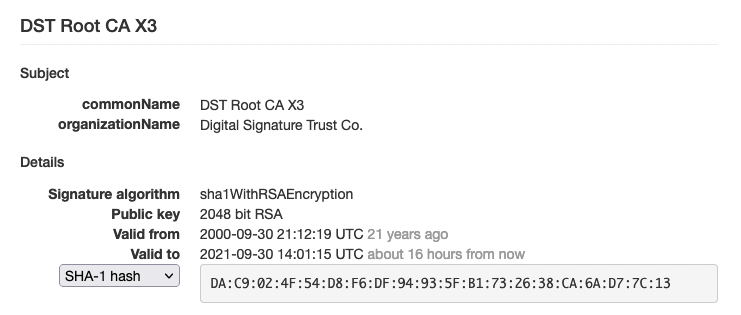
It s not as simple as described below, I m afraid It appears that it s not that easy to obtain new/correct certs from LetsEncrypt that are not cross-signed by DST Root X3 CA. Additionally older OpenSSL version (1.0.x) seems to have problems. So even when you think that your system is now ok, the remote server might refuse to accept your SSL cert. The same is valid for the SSL check on xmpp.net, which seems to be very outdated and beyond repair. Honestly, I think the solution needs to be provided by LetsEncrypt
I was having some strange issues on my ejabberd XMPP server the other day: some users complained that they couldn t connect anymore to the MUC rooms on my server and in the logfiles I discovered some weird warnings about LetsEncrypt certificates being expired although they were just new and valid until end of December. It looks like this:
[warning] <0.368.0>@ejabberd_pkix:log_warnings/1:393 Invalid certificate in /etc/letsencrypt.sh/certs/buildd.net/fullchain.pem: at line 37: certificate is no longer valid as its expiration date has passed
and
[warning] <0.18328.2>@ejabberd_s2s_out:process_closed/2:157 Failed to establish outbound s2s connection nerdica.net -> forum.friendi.ca: Stream closed by peer: Your server's certificate is invalid, expired, or not trusted by forum.friendi.ca (not-authorized); bouncing for 237 seconds
When checking out with some online tools like SSLlabs or XMPP.net the result was strange, because SSLlabs reported everything was ok while XMPP.net was showing the chain with X3 and D3 certs as having a short term validity of a few days:
After some days of fiddling around with the issue, trying to find a solution, it appears that there is a problem in Ejabberd when there are some old SSL certifcates being found by Ejabberd that are using the old CA chain. Ejabberd has a really nice feature where you can just configure a SSL cert directory (or a path containing wildcars. Ejabberd then reads all of the SSL certs and compare them to the list of configured domains to see which it will need and which not. What helped (for me at least) was to delete all expired SSL certs from my directory, downloading the current CA file pems from LetsEncrypt (see their blog post from September 2020), run update-ca-certificates and ejabberdctl restart (instead of just ejabberdctl reload-config). UPDATE: be sure to use dpkg-reconfigure ca-certificates to uncheck the DST Root X3 cert (and others if necessary) before renewing the certs or running update-ca-certificates. Otherwise the update will bring in the expired cert again. Currently I see at least two other XMPP domains in my server logs having certicate issues and in some MUCs there are reports of other domains as well. Disclaimer: Again: this helped me in my case. I don t know if this is a bug in Ejabberd or if this procedure will help you in your case nor if this is the proper solution. But maybe my story will help you solving your issue if you experience SSL certs issues in the last few days, especially now that the R3 cert has already expired and the X3 cert following in a few hours.

28 September 2021

Jonathan McDowell: Adding Zigbee to my home automation

SonOff Zigbee Door Sensor My home automation setup has been fairly static recently; it does what we need and generally works fine. One area I think could be better is controlling it; we have access Home Assistant on our phones, and the Alexa downstairs can control things, but there are no smart assistants upstairs and sometimes it would be nice to just push a button to turn on the light rather than having to get my phone out. Thanks to the fact the UK generally doesn t have neutral wire in wall switches that means looking at something battery powered. Which means wifi based devices are a poor choice, and it s necessary to look at something lower power like Zigbee or Z-Wave. Zigbee seems like the better choice; it s a more open standard and there are generally more devices easily available from what I ve seen (e.g. Philips Hue and IKEA TR DFRI). So I bought a couple of Xiaomi Mi Smart Home Wireless Switches, and a CC2530 module and then ignored it for the best part of a year. Finally I got around to flashing the Z-Stack firmware that Koen Kanters kindly provides. (Insert rant about hardware manufacturers that require pay-for tool chains. The CC2530 is even worse because it s 8051 based, so SDCC should be able to compile for it, but the TI Zigbee libraries are only available in a format suitable for IAR s embedded workbench.) Flashing the CC2530 is a bit of faff. I ended up using the CCLib fork by Stephan Hadinger which supports the ESP8266. The nice thing about the CC2530 module is it has 2.54mm pitch pins so nice and easy to jumper up. It then needs a USB/serial dongle to connect it up to a suitable machine, where I ran Zigbee2MQTT. This scares me a bit, because it s a bunch of node.js pulling in a chunk of stuff off npm. On the flip side, it Just Works and I was able to pair the Xiaomi button with the device and see MQTT messages that I could then use with Home Assistant. So of course I tore down that setup and went and ordered a CC2531 (the variant with USB as part of the chip). The idea here was my test setup was upstairs with my laptop, and I wanted something hooked up in a more permanent fashion. Once the CC2531 arrived I got distracted writing support for the Desk Viking to support CCLib (and modified it a bit for Python3 and some speed ups). I flashed the dongle up with the Z-Stack Home 1.2 (default) firmware, and plugged it into the house server. At this point I more closely investigated what Home Assistant had to offer in terms of Zigbee integration. It turns out the ZHA integration has support for the ZNP protocol that the TI devices speak (I m reasonably sure it didn t when I first looked some time ago), so that seemed like a better option than adding the MQTT layer in the middle. I hit some complexity passing the dongle (which turns up as /dev/ttyACM0) through to the Home Assistant container. First I needed an override file in /etc/systemd/nspawn/hass.nspawn:
[Files]
Bind=/dev/ttyACM0:/dev/zigbee
[Network]
VirtualEthernet=true
(I m not clear why the VirtualEthernet needed to exist; without it networking broke entirely but I couldn t see why it worked with no override file.) A udev rule on the host to change the ownership of the device file so the root user and dialout group in the container could see it was also necessary, so into /etc/udev/rules.d/70-persistent-serial.rules went:
# Zigbee for HASS
SUBSYSTEM=="tty", ATTRS idVendor =="0451", ATTRS idProduct =="16a8", SYMLINK+="zigbee", \
	MODE="660", OWNER="1321926676", GROUP="1321926676"
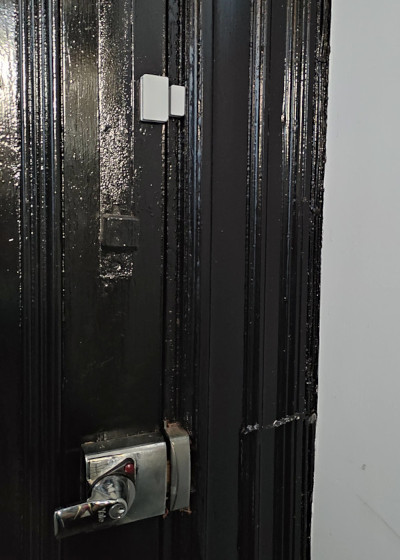
In the container itself I had to switch PrivateDevices=true to PrivateDevices=false in the home-assistant.service file (which took me a while to figure out; yay for locking things down and then needing to use those locked down things). Finally I added the hass user to the dialout group. At that point I was able to go and add the integration with Home Assistant, and add the button as a new device. Excellent. I did find I needed a newer version of Home Assistant to get support for the button, however. I was still on 2021.1.5 due to upstream dropping support for Python 3.7 and not being prepared to upgrade to Debian 11 until it was actually released, so the version of zha-quirks didn t have the correct info. Upgrading to Home Assistant 2021.8.7 sorted that out. There was another slight problem. Range. Really I want to use the button upstairs. The server is downstairs, and most of my internal walls are brick. The solution turned out to be a TR DFRI socket, which replaced the existing ESP8266 wifi socket controlling the stair lights. That was close enough to the server to have a decent signal, and it acts as a Zigbee router so provides a strong enough signal for devices upstairs. The normal approach seems to be to have a lot of Zigbee light bulbs, but I have mostly kept overhead lights as uncontrolled - we don t use them day to day and it provides a nice fallback if the home automation has issues. Of course installing Zigbee for a single button would seem to be a bit pointless. So I ordered up a Sonoff door sensor to put on the front door (much smaller than expected - those white boxes on the door are it in the picture above). And I have a 4 gang wireless switch ordered to go on the landing wall upstairs. Now I ve got a Zigbee setup there are a few more things I m thinking of adding, where wifi isn t an option due to the need for battery operation (monitoring the external gas meter springs to mind). The CC2530 probably isn t suitable for my needs, as I ll need to write some custom code to handle the bits I want, but there do seem to be some ARM based devices which might well prove suitable

Holger Levsen: 20210928-Debian-Reunion-Hamburg-2021

Debian Reunion Hamburg 2021, klein aber fein / small but beautiful So the Debian Reunion Hamburg 2021 has been going on for not yet 48h now and it appears people are having fun, enjoying discussions between fellow Debian people and getting some stuff done as well. I guess I'll write some more about it once the event is over... Sharing android screens... For now I just want to share one little gem I learned about yesterday on the hallway track:
$ sudo apt install scrcpy
$ scrcpy
And voila, once again I can type on my phone with a proper keyboard and copy and paste URLs between the two devices. One can even watch videos on the big screen with it :) (This requires ADB debugging enabled on the phone, but doesn't require root access.)

27 September 2021

Wouter Verhelst: SReview::Video is now Media::Convert

SReview, the video review and transcode tool that I originally wrote for FOSDEM 2017 but which has since been used for debconfs and minidebconfs as well, has long had a sizeable component for inspecting media files with ffprobe, and generating ffmpeg command lines to convert media files from one format to another. This component, SReview::Video (plus a number of supporting modules), is really not tied very much to the SReview webinterface or the transcoding backend. That is, the webinterface and the transcoding backend obviously use the ffmpeg handling library, but they don't provide any services that SReview::Video could not live without. It did use the configuration API that I wrote for SReview, but disentangling that turned out to be very easy. As I think SReview::Video is actually an easy to use, flexible API, I decided to refactor it into Media::Convert, and have just uploaded the latter to CPAN itself. The intent is to refactor the SReview webinterface and transcoding backend so that they will also use Media::Convert instead of SReview::Video in the near future -- otherwise I would end up maintaining everything twice, and then what's the point. This hasn't happened yet, but it will soon (this shouldn't be too difficult after all). Unfortunately Media::Convert doesn't currently install cleanly from CPAN, since I made it depend on Alien::ffmpeg which currently doesn't work (I'm in communication with the Alien::ffmpeg maintainer in order to get that resolved), so if you want to try it out you'll have to do a few steps manually. I'll upload it to Debian soon, too.

Russ Allbery: Review: The Problem with Work

Review: The Problem with Work, by Kathi Weeks
Publisher: Duke University Press
Copyright: 2011
ISBN: 0-8223-5112-9
Format: Kindle
Pages: 304
One of the assumptions baked deeply into US society (and many others) is that people are largely defined by the work they do, and that work is the primary focus of life. Even in Marxist analysis, which is otherwise critical of how work is economically organized, work itself reigns supreme. This has been part of the feminist critique of both capitalism and Marxism, namely that both devalue domestic labor that has traditionally been unpaid, but even that criticism is normally framed as expanding the definition of work to include more of human activity. A few exceptions aside, we shy away from fundamentally rethinking the centrality of work to human experience. The Problem with Work begins as a critical analysis of that centrality of work and a history of some less-well-known movements against it. But, more valuably for me, it becomes a discussion of the types and merits of utopian thinking, including why convincing other people is not the only purpose for making a political demand. The largest problem with this book will be obvious early on: the writing style ranges from unnecessarily complex to nearly unreadable. Here's an excerpt from the first chapter:
The lack of interest in representing the daily grind of work routines in various forms of popular culture is perhaps understandable, as is the tendency among cultural critics to focus on the animation and meaningfulness of commodities rather than the eclipse of laboring activity that Marx identifies as the source of their fetishization (Marx 1976, 164-65). The preference for a level of abstraction that tends not to register either the qualitative dimensions or the hierarchical relations of work can also account for its relative neglect in the field of mainstream economics. But the lack of attention to the lived experiences and political textures of work within political theory would seem to be another matter. Indeed, political theorists tend to be more interested in our lives as citizens and noncitizens, legal subjects and bearers of rights, consumers and spectators, religious devotees and family members, than in our daily lives as workers.
This is only a quarter of a paragraph, and the entire book is written like this. I don't mind the occasional use of longer words for their precise meanings ("qualitative," "hierarchical") and can tolerate the academic habit of inserting mostly unnecessary citations. I have less patience with the meandering and complex sentences, excessive hedge words ("perhaps," "seem to be," "tend to be"), unnecessarily indirect phrasing ("can also account for" instead of "explains"), or obscure terms that are unnecessary to the sentence (what is "animation of commodities"?). And please have mercy and throw a reader some paragraph breaks. The writing style means substantial unnecessary effort for the reader, which is why it took me six months to read this book. It stalled all of my non-work non-fiction reading and I'm not sure it was worth the effort. That's unfortunate, because there were several important ideas in here that were new to me. The first was the overview of the "wages for housework" movement, which I had not previously heard of. It started from the common feminist position that traditional "women's work" is undervalued and advocated taking the next logical step of giving it equality with paid work by making it paid work. This was not successful, obviously, although the increasing prevalence of day care and cleaning services has made it partly true within certain economic classes in an odd and more capitalist way. While I, like Weeks, am dubious this was the right remedy, the observation that household work is essential to support capitalist activity but is unmeasured by GDP and often uncompensated both economically and socially has only become more accurate since the 1970s. Weeks argues that the usefulness of this movement should not be judged by its lack of success in achieving its demands, which leads to the second interesting point: the role of utopian demands in reframing and expanding a discussion. I normally judge a political demand on its effectiveness at convincing others to grant that demand, by which standard many activist campaigns (such as wages for housework) are unsuccessful. Weeks points out that making a utopian demand changes the way the person making the demand perceives the world, and this can have value even if the demand will never be granted. For example, to demand wages for housework requires rethinking how work is defined, what activities are compensated by the economic system, how such wages would be paid, and the implications for domestic social structures, among other things. That, in turn, helps in questioning assumptions and understanding more about how existing society sustains itself. Similarly, even if a utopian demand is never granted by society at large, forcing it to be rebutted can produce the same movement in thinking in others. In order to rebut a demand, one has to take it seriously and mount a defense of the premises that would allow one to rebut it. That can open a path to discussing and questioning those premises, which can have long-term persuasive power apart from the specific utopian demand. It's a similar concept as the Overton Window, but with more nuance: the idea isn't solely to move the perceived range of accepted discussion, but to force society to examine its assumptions and premises well enough to defend them, or possibly discover they're harder to defend than one might have thought. Weeks applies this principle to universal basic income, as a utopian demand that questions the premise that work should be central to personal identity. I kept thinking of the Black Lives Matter movement and the demand to abolish the police, which (at least in popular discussion) is a more recent example than this book but follows many of the same principles. The demand itself is unlikely to be met, but to rebut it requires defending the existence and nature of the police. That in turn leads to questions about the effectiveness of policing, such as clearance rates (which are far lower than one might have assumed). Many more examples came to mind. I've had that experience of discovering problems with my assumptions I'd never considered when debating others, but had not previously linked it with the merits of making demands that may be politically infeasible. The book closes with an interesting discussion of the types of utopias, starting from the closed utopia in the style of Thomas More in which the author sets up an ideal society. Weeks points out that this sort of utopia tends to collapse with the first impossibility or inconsistency the reader notices. The next step is utopias that acknowledge their own limitations and problems, which are more engaging (she cites Le Guin's The Dispossessed). More conditional than that is the utopian manifesto, which only addresses part of society. The least comprehensive and the most open is the utopian demand, such as wages for housework or universal basic income, which asks for a specific piece of utopia while intentionally leaving unspecified the rest of the society that could achieve it. The demand leaves room to maneuver; one can discuss possible improvements to society that would approach that utopian goal without committing to a single approach. I wish this book were better-written and easier to read, since as it stands I can't recommend it. There were large sections that I read but didn't have the mental energy to fully decipher or retain, such as the extended discussion of Ernst Bloch and Friedrich Nietzsche in the context of utopias. But that way of thinking about utopian demands and their merits for both the people making them and for those rebutting them, even if they're not politically feasible, will stick with me. Rating: 5 out of 10

25 September 2021

Junichi Uekawa: Wrote a HTML ping-like something.

Wrote a HTML ping-like something. Uses fetch to fetch a page and measures time until 404 returns to js. Here's my http ping. The challenge was writing code to calculate standard deviation in multiple languages and making sure it matched, d'oh.

24 September 2021

Dirk Eddelbuettel: digest 0.6.28 on CRAN: Small Enhancements

Release 0.6.28 of the digest package arrived at CRAN earlier today, and has already been uploaded Debian as well. digest creates hash digests of arbitrary R objects (using the md5, sha-1, sha-256, sha-512, crc32, xxhash32, xxhash64, murmur32, spookyhash, and blake3 algorithms) permitting easy comparison of R language objects. It is a mature and widely-used as many tasks may involve caching of objects for which it provides convenient general-purpose hash key generation. This release comes eleven months after the previous releases and rounds out a number of corners. Continuous Integration was updated using r-ci. Several contribututors help with a small fix applied to avoid unaligned reads, a rewording for a help page as well as windows path encoding for in the vectorised use case. My CRANberries provides the usual summary of changes to the previous version. For questions or comments use the issue tracker off the GitHub repo. If you like this or other open-source work I do, you can now sponsor me at GitHub. For the first year, GitHub will match your contributions.

This post by Dirk Eddelbuettel originated on his Thinking inside the box blog. Please report excessive re-aggregation in third-party for-profit settings.

23 September 2021

Dirk Eddelbuettel: prrd 0.0.5: Incremental Mode

prrd facilitates the parallel running [of] reverse dependency [checks] when preparing R packages. It is used extensively for Rcpp, RcppArmadillo, RcppEigen, BH, and others. prrd screenshot image The key idea of prrd is simple, and described in some more detail on its webpage and its GitHub repo. Reverse dependency checks are an important part of package development that is easily done in a (serial) loop. But these checks are also generally embarassingly parallel as there is no or little interdependency between them (besides maybe shared build depedencies). See the (dated) screenshot (running six parallel workers, arranged in a split byobu session). This release brings some new features I used of late when testing and re-testing reverse dependencies for Rcpp. Enqueuing jobs can now consider the most recent prior job queue file. This allows us to find new packages that were not part of the previous runs. We added a second toggle to also add those packages who failed in the previous run. Finally, the dequeue interface allows to specify a date (rather than defaulting to the current date, useful for long-running jobs or restarts). The release is summarised in the NEWS entry:

Changes in prrd version 0.0.5 (2021-09-22)
  • Some remaing http URLs were changed to https.
  • The dequeueJobs script has a new argument date to help specify a queue file.
  • The enqueueJobs can now compute just a delta of (new) packages relative to a given prior queuefile and run.
  • When running in delta mode, previously failed packages can also be selected.

My CRANberries provides the usual summary of changes to the previous version. See the aforementioned webpage and its repo for details. For more questions or comments use the issue tracker off the GitHub repo. If you like this or other open-source work I do, you can now sponsor me at GitHub.

This post by Dirk Eddelbuettel originated on his Thinking inside the box blog. Please report excessive re-aggregation in third-party for-profit settings.

22 September 2021

Gunnar Wolf: New book out! Mecanismos de privacidad y anonimato en redes, una visi n transdisciplinaria

Three years ago, I organized a fun and most interesting colloquium at Facultad de Ingenier a, UNAM about privacy and anonymity online. I would have loved to share this earlier with the world, but The university s processes are quite slow (and, to be fair, I also took quite a bit of time to push things through). But today, I m finally happy to share the result of that work with all of you. We managed to get 11 of the talks in the colloquium as articles. The back-cover text reads (in Spanish):
We live in an era where human to human interactions are more and more often mediated by technology. This, of course, means everything leaves a digital trail, a trail that can follow and us relentlessly. Privacy is recognized, however, as a human right although one that is under growing threats. Anonymity is the best tool to secure it. Throughout history, clear steps have been taken legally, technically and technologically to defend it. Various studies point out this is not only a known issue for the network's users, but that a large majority has searched for alternatives to protect their communications' privacy. This book stems from a colloquium held by *Laboratorio de Investigaci n y Desarrollo de Software Libre* (LIDSOL) of Facultad de Ingenier a, UNAM, towards the end of 2018, where we invited experts from disciplines so far apart as law and systems development, psychology and economics, to contribute with their experiences to a transdisciplinary vision.
If this interests you, you can get the book at our institutional repository. Oh, and What about the birds? In Spanish (Mexican only?), we have a saying, hay p jaros en el alambre , meaning watch your words, as uninvited people might be listening, as birds resting over the wires over which phone calls used to be made (back in the day where wiretapping was that easy). I found the design proposed by our editor ingenious and very fitting for our topic!

Norbert Preining: TeX Live 2021 for Debian

The release of TeX Live 2021 is already half a year away, but due to the delay of waiting for Debian/Bullseye release, we haven t updated TeX Live in Debian for quite some time. But the waiting is over, today I uploaded the first packages of TeX Live 2021 to unstable. All the changes listed in the upstream release blog apply also to the Debian packages. I expect a few hiccups, but it is good to see it out of the door finally. Enjoy.

21 September 2021

Clint Adams: Outrage culture killed my dog

Why can't Debian have embarrassing flamewars like this thread?
Posted on 2021-09-21
Tags: barks

Norbert Preining: Plasma 5.23 Anniversary Edition Beta for Debian available for testing

Last week has seen the release of the first beta of Plasma 5.23 Anniversary Edition. Work behind the scenes to get this release as soon as possible into Debian has progressed well. Starting with today, we provide binaries of Plasma 5.23 for Debian stable (bullseye), testing, and unstable, in each case for three architectures: amd64, i386, and aarch64. To test the current beta, please add

deb https://download.opensuse.org/repositories/home:/npreining:/debian-kde:/plasma523/DISTRIBUTION/ ./
to your apt sources (replacing DISTRIBUTION with one of Debian_11 (for Bullseye), Debian_Testing, or Debian_Unstable). For further details see this blog. Warning This is a beta release, and let me recall the warning from the upstream release announcement:
DISCLAIMER: This is beta software and is released for testing purposes. You are advised to NOT use Plasma 25th Anniversary Edition Beta in a production environment or as your daily desktop. If you do install Plasma 25th Anniversary Edition Beta, you must be prepared to encounter (and report to the creators) bugs that may interfere with your day-to-day use of your computer. https://kde.org/announcements/plasma/5/5.22.90/
Enjoy, and please report bugs!

20 September 2021

Andy Simpkins: COVID-19

Nearly 4 weeks after contracting COVID-19 I am finally able to return to work Yes I have had both Jabs (my 2nd dose was back in June), and this knocked me for six. I spent most of the time in bed, and only started to get up and about 10 days ago. I passed this on to both my wife and daughter (my wife has also been double jabbed), fortunately they didn t get it as bad as me and have been back at work / school for the last week. I also passed it on to a friend at the UK Debian BBQ, hosted once again by Sledge and Randombird, before I started showing symptoms. Fortunately (after a lot of PCR tests for attendees) it doesn t look like I passed it to anyone else I wouldn t wish this on anyone. I went on holiday back in August (still in England) thinking that having both jabs we would be fine. We stayed in self catering accommodation and we spent our time outside, we visited open air museums, walked around gardens etc, however we did eat out in relatively empty pubs and restaurants. And yes we did all have face masks on when we went indoors (although obviously we removed them whilst eating). I guess that is when I caught this, but have no idea exactly when or where. Even after vaccination, it is still possible to both catch and spread this virus. Fortunately having been vaccinated my resulting illness was (statistically) less bad than it would otherwise have been. I dread to think how bad I would have been if I had not already been vaccinated, I suspect that I would have ended up in ICU. I am still very tired, and have been told it may take many more weeks to get back to my former self. Other than being overweight, prior to this I have been in good health. If you are reading this and have NOT yet had a vaccine and one is available for you, please, please get it done.

Holger Levsen: 20210920-Debian-Reunion-Hamburg-2021

Debian Reunion Hamburg 2021, we still have free beds We still have some free slots and beds available for the "Debian Reunion Hamburg 2021" taking place in Hamburg at the venue of the 2018 & 2019 MiniDebConfs from Monday, Sep 27 2021 until Friday Oct 1 2021, with Sunday, Sep 26 2021 as arrival day. So again, Debian people will meet in Hamburg. The exact format is less defined and structured than previous years, probably we will just be hacking from Monday to Wednesday, have talks on Thursday and a nice day trip on Friday. Please read https://wiki.debian.org/DebianEvents/de/2021/DebianReunionHamburg and if you intend to attend, please register there. If additionally you would like to stay on site (in a single room or shared with one another person), please mail me. I'm looking forward to this event, even though (or maybe also because) it will be much smaller than last years. I suppose this will lead to more personal interactions and more intense hacking, though of course it is to be seen how this works out exactly!

Junichi Uekawa: podman build (user namespace) and Rename.

podman build (user namespace) and Rename. It seems like Debian bullseye, if I run podman, it runs in user namespace mode if you run it inside a regular user. That's fine, but it uses fuse overlayfs driver. Now I am yet to pinpoint what is happening, but rename() is handled in a weird way, I think it's broken. os.Rename() in golang is copying the file and not deleting the original file.

19 September 2021

Ben Hutchings: Debian LTS work, August 2021

In August I was assigned 13.25 hours of work by Freexian's Debian LTS initiative and carried over 6 hours from earlier months. I worked 1.25 hours and will carry over the remainder. I attended an LTS team meeting, and wrote my report for July 2021, but did not work on any updates.

18 September 2021

Mike Gabriel: X2Go, Remmina and X2GoKdrive

In this blog post, I will cover a few related but also different topics around X2Go - the GNU/Linux based remote computing framework. Introduction and Catch Up For those, who haven't come across X2Go, so far... With X2Go [0] you can log into remote GNU/Linux machines graphically and launch headless desktop environments, seamless/published applications or access an already running desktop session (on a local Xserver or running as a headless X2Go desktop session) via X2Go's session shadowing / mirroring feature. Graphical backend: NXv3 For several years, there was only one graphical backend available in X2Go, the NXv3 software. In NXv3, you have a headless or nested (it can do both) Xserver that has some remote magic built-in and is able to transfer the Xserver's graphical data to a remote client (NX proxy). Over the wire, the NX protocol allows for data compression (JPEG, PNG, etc.) and combines it with bitmap caching, so that the overall result is a fast and responsive desktop experience even on low latency and low bandwidth connections. This especially applies to X desktop environments that use many native X protocol operations for drawing windows and widget onto the screen. The more bitmaps involved (e.g. in applications with client-side rendering of window controls and such), the worse the quality of a session experience. The current main maintainer of NVv3 (aka nx-libs [1]) is Ulrich Sibiller. Uli has my and the X2Go community's full appreciation, admiration and gratitude for all the work he does on nx-libs, constantly improving NXv3 without breaking compatibility with legacy use cases (yes, FreeNX is still alive, by the way). NEW: Alternative Graphical Backend: X2Go Kdrive Over the past 1.5 years, Oleksandr Shneyder (Alex), co-founder of X2Go, has been working on a re-implementation of an alternative, less X11-dependent graphical backend. The underlying Xserver technology is the kdrive part of the X.org server project. People on GNU/Linux might have used kdrive technology already: The Xephyr nested Xserver uses the kdrive implementation. The idea of the X2Go Kdrive [2] implementation in X2Go is providing a headless Xserver on the X2Go Server side for running X11 based desktop sessions inside while using an X11-agnostic data protocol for sending the graphical desktop data to the client-side for rendering. Whereas, with NXv3 technology, you need a local Xserver on the client side, with X2Go Kdrive you only need a client app(lication) that can draw bitmaps into some sort of framebuffer, such as a client-side X11 Xserver, a client-side Wayland compositor or (hold your breath) an HTMLv5 canvas in a web browser. X2Go Kdrive Client Implementations During first half of this year, I tested and DEB-packaged Alex's X2Go HTMLv5 client code [3] and it has been available for testing in the X2Go nightly builds archive for a while now. Of course, the native X2Go Client application has X2Go Kdrive support for a while, too, but it requires a Qt5 application in the background, the x2gokdriveclient (which is still only available in X2Go nightly builds or from X2Go Git [4]). X2Go and Remmina As currently posted by the Remmina community [5], one of my employees has been working on finalizing an already existing draft of mine for the last couple of months: Remmina Plugin X2Go. This project has been contracted by BAUR-ITCS UG (haftungsbeschr nkt) already a while back and has been financed via X2Go funding from one of their customers. Unfortunately, I never got around really to finalizing the project. Apologies for this. Daniel Teichmann, who has been in the company for a while now, but just recently switched to an employment model with considerably more work hours per week, now picked up this project two months ago and achieved awesome things on the way. Daniel Teichmann and Antenore Gatta (Remmina core developer, aka tmow) have been cooperating intensely on this, recently, with the objective of getting the X2Go plugin code merged into Remmina asap. We are pretty close to the first touchdown (i.e. code merge) of this endeavour. Thanks to Antenore for his support on this. This is much appreciated. Remmina Plugin X2Go - Current Challenges The X2Go Plugin for Remmina implementation uses Python X2Go (PyHoca-CLI) under the bonnet and basically does a system call to pyhoca-cli according to the session settings configured in the Remmina session profile UI. When using NXv3 based sessions, the session window appears on the client-side Xserver and immediately gets caught by Remmina and embedded into the Remmina frame (via Xembed protocol) where its remote sessions are supposed to appear. (Thanks that GtkSocket is still around in GTK-3). The knowing GTK-3 experts among you may have noticed: GtkSocket is obsolete and has been removed from GTK-4. Also, GtkSocket support is only available in GTK-3 when using its X11 rendering backend. For the X2Go Kdrive implementation, we tested a similar approach (embedding the x2gokdriveclient Qt5 window via Xembed/GtkSocket), but it seems that GtkSocket and Qt5 applications don't work well together and we did not succeed in embedding the Qt5 window of the x2gokdriveclient application into Remmina, so far. Also, this would be a work-around for the bigger problem: We want, long-term, provide X2Go Kdrive support in Remmina, not only for Remmina running with GTK-3/X11, but also when Remmina is used natively on top of Wayland. So, the more sustainable approach for showing an X2Go Kdrive based X2Go session in Remmina would be a GTK-3/4 or a Glib-2.0 + Cairo based rendering client provided as a shared library. This then could be used by Remmina for drawing the session bitmaps into the Remmina session frame. This would require a port of the x2gokdriveclient Qt code into a non-Qt implementation. However, we are running out of funding to make this happen at the moment. More Funding Needed for this Journey As you might guess, such a project as proposed is a project that some people do in their spare time, others do it for a living. I'd love to continue this project and have Daniel Teichmann continue his work on this, so that Remmina might soon be able to provide native X2Go Kdrive Client support. If people read this and are interested in supporting such a project, please get in touch [6]. Thanks so much! light+love
Mike (aka sunweaver) [0] https://wiki.x2go.org/
[1] https://github.com/ArcticaProject/nx-libs
[2] https://code.x2go.org/gitweb?p=x2gokdrive.git;a=tree
[3] https://code.x2go.org/gitweb?p=x2gohtmlclient.git;a=tree
[4] https://code.x2go.org/gitweb?p=x2gokdriveclient.git;a=tree
[5] https://remmina.org/x2go/
[6] https://das-netzwerkteam.de/

17 September 2021

Dirk Eddelbuettel: tidyCpp 0.0.5 on CRAN: More Protect ion

Another small release of the tidyCpp package arrived on CRAN overnight. The packages offers a clean C++ layer (as well as one small C++ helper class) on top of the C API for R which aims to make use of this robust (if awkward) C API a little easier and more consistent. See the vignette for motivating examples. The Protect class now uses the default methods for copy and move constructors and assignment allowing for wide use of the class. The small NumVec class now uses it for its data member. The NEWS entry (which I failed to update for the releases) follows.

Changes in tidyCpp version 0.0.5 (2021-09-16)
  • The Protect class uses default copy and move assignments and constructors
  • The data object in NumVec is now a Protect object

Thanks to my CRANberries, there is also a diffstat report for this release. For questions, suggestions, or issues please use the issue tracker at the GitHub repo. If you like this or other open-source work I do, you can now sponsor me at GitHub.

This post by Dirk Eddelbuettel originated on his Thinking inside the box blog. Please report excessive re-aggregation in third-party for-profit settings.

Next.

Previous.