Search Results: "ag"

5 November 2007

Gunnar Wolf: Mini-post-mortem of a failed mini-Debconf

Over one year ago, still at DebConf 6, the Latin American Debian people (and by people I mean just interested people, regardless of whether they were/are official DDs or not) held a BoF session. One of the ideas we discussed there was that, in order to increase Debian presence in our region (which is by no means small - Let alone the geographical aspects, I'm guessing we are about 350 million people, roughly split in half between [officially] Spanish- and Portuguese- speaking countries). Yet, this is an area with very little involvement in Debian in particular, and with Free Software in general.One of our first issues seems to be language - Just by its scale and economic importance, we cannot even put in the same scale Brazil and the Spanish-speaking countries... So I'll focus on Spanish-speaking Latin America, as (I recall) we did in that session.So, we agree: We need more local involvement in each of our communities. And, so far, we have seen quite relevant results. The number of people directly involved in Debian in Argentina, Chile, Per , Colombia, Venezuela, El Salvador and Mexico (excuse me if I forget you in another country!) has notably risen since I brought this topic up, together with Christian Perrier, back in DebConf5, Helsinki. An undeniable fact is that distances in our continent, however, are huge. In the 2006 BoF, we agreed we should promote regional meetings, that would serve both for working focused on Debian topics (i.e. hack sessions, as we do in DebConf) and for spreading our work to the local population, to help them see that it is not needed to be super-skilled or anything like that to contribute to a real, important and large Free Software project such as ours. Of course, taking into account the distances in the continent, we thought it would be sensible to split it in two - and to try and hold regional mini-debconfs - One for the Northern half (i.e. Per , Ecuador, Colombia, Venezuela, Central America, Cuba and Mexico), and one for the Southern half (Bolivia, Chile, Argentina, Uruguay, Paraguay). And, for logistical reasons mainly, I strongly advocated having our first Northern meeting in Panam . Why Panam ? Because it is a place cheap and easy to get to. They have a very important international airport, connecting to most if not all countries in the region, and -as they have risen as a business center- have good connectivity. Visa is required for many of the interested countries, but trivial to get (as opposed to what happened here in Mexico :-( ). Of course, other countries also looked interesting (there was some argument pushing Venezuela, but in the end, we all conceded it would be in Panam .I have to strongly thank Guillermo Garc a - He is not (yet? :) I hope he still wants to get involved with this bunch of people) in Debian in any way, but after I contacted him, he agreed to start looking for a way to get us the right facilities in Panam . He coordinated with a team which did most of the organization - A very nice web site is still available so you can look at their work - Quite a good job, I must add.They contacted Universidad Tecnol gica de Panam , started talking with several potential sponsors, got information regarding hotels for us... But in the end, it flopped. Why? Because, although many of us were originally interested, in the end very few people (only three, none of them officially a Debian Developer, according to their last press release) confirmed their intention to attend.Which brings me again to the question: Why?First and foremost, I think it was lack of involvement. For one reason or another, all of the people that in the beginning pushed for this miniDebConf ended up busy doing other stuff, and didn't get at all involved in organization. It would have been a great present from our Panaman friends, yes, but quite unfair. And, of course, with no Debian people involved in organizing it, we got an chicken-and-eggesque situation... Where it didn't grab the attention of other Debian people.Second, what they offered us was quite different to what we intended in the first place - At least, to what I imagined. On my first messages both to debian-devel-spanish and to Guillermo, I tried to get something close to what we had in mind: Something as informal and as intimate as it could be. My original request to Guillermo was just to get us a room where we could hack and talk, and probably sleep with sleeping bags.Of course, I can perfectly imagine that when he requested the space to the university, on one hand, they didn't feel at ease having International Guests (with capital I and G - Very important for most Latin American universities!) sleeping on the floor. And, on the other hand, they would love to be able to show us around! Having an international project focus on a university in a non-technologically-well-known little country is quite something to show off!Anyway... What happened? I was among the instigators, but Real Life called me away (I've been mostly inactive in Debian since September! :-( ). The miniconf was scheduled for November 14-17. I also insisted originally on having the miniconf on a long weekend (say, Friday through Sunday), as -being a miniconf and not the Real Deal- it'd be much easier for most of us to rob one day off work than a full week. In the end, this was the most important point for my decision not to join: I cannot afford more time off my work, not at this time of year. About the other involved people? I do not want to speak for any other people.In the end, sadly, Guillermo had to inform us they cancelled - No, not postponed, but definitively cancelled. Why? Because -and I have to agree- next year we will have DebConf in Argentina... And many people in the region will focus our time and money on getting there. Ok, making this whole story short: I'm very, very ashamed and sorry, with you personally, Guillermo, and with your whole team. And I hope we can resurrect this idea - be it in Venezuela (as it was suggested once) or elsewhere.

Eddy Petrișor: (debian) work and the silence

I've been really busy lately in RL and Debian work took the hit.

Some news:

Amaya Rodrigo: Hermanos...

El general en jefe del ejercito libertador del sur Emiliano Zapata Manifiesto Zapatista en Nagua

Hermanos nosotros nacimos de la noche
en ella vivimos
y moriremos en ella
pero la luz ser ma ana para los m s,
para todos aquellos que hoy lloran la noche,
para quienes se niega el d a.
Para todos la luz,
para todos todo.
Para nosotros el dolor y la angustia,
para nosotros la alegria de la rebeli n
para nosotros el futuro negado,
Para nosotros la dignidad insurrecta
Para nosotros nada
Nuestra lucha es por hacernos escuchar y el mal gobierno
grita soberbia y tapa con ca ones sus o dos,
nuestra lucha es por un trabajo justo y digno y el mal gobierno compra y vende cuerpos y verg enza,
nuestra lucha es por la vida y el mal gobierno oferta muerte como futuro,
nuestra lucha es por la justicia y el mal gobierno se llena de criminales y asesinos,
nuestra lucha es por la paz y el mal gobierno anuncia guerra y destrucci n.
Techo, tierra, trabajo, pan, salud, educaci n, independencia, democracia, libertad,
estas fueran nuestras demandas en la larga noche de los 500 a os,
estas son hoy nuestras exigencias.

John Goerzen: Viper

Well, now this is quite the experience.

I've been trying Viper for the past few days. Viper, for those that don't know, is usually described as a set of Vi bindings for Emacs.

After reading the nearly 100 pages of documentation and trying it a bit, I have realized that this is not really an accurate description. Viper is a port of vi to Elisp.

But that doesn't really do it justice. Viper seems to have pretty much everything going for it that Vim does, and then some. It is extensible with Elisp, and works with all the Emacs major modes (indentation and so forth). Yet it also is a very authentic Vi implementation, yet more customizable than Vim. And, in my opinion, more capable than Vim too.

On the one hand, this is a really neat combination: the power of the vi editing commands with the power of Emacs and Elisp for indentation, customization, etc.

On the other hand, it makes my head hurt. While Viper and Vim both are supersets of the vi command set, they don't always implement extensions (such as multiple windows) the same way or with the same keys. Of course, you could remap them in both, but it's a bit jarring to run Viper in expert mode, press C-w to start creating a new window, and have it run the Emacs cut command. (You can run Viper in a more limited mode where it does not recognize any regular Emacs keys if you don't want that)

It's just weird. It mostly looks like Emacs. It is modal like Vim, and responds to all Vi and most Vim commands. It has an additional mode: the Emacs mode. Also if configured to run in expert configuration, Emacs commands are accepted most places. Yes, you can move with h, j, k, l and C-n, C-p, C-f, C-b all at the same time.

The main drawback I can see is that Viper mode doesn't work well with Info mode, which has other bindings for keyboard shortcuts... so all of a sudden, hjkl don't work in info mode.

I don't know yet if I'll use viper much, but it is a slick program.

Uwe Hermann: Recent LinuxBIOS progress

LinuxBIOS ROM Chip Logo Since the "World's First Motherboard Using LinuxBIOS Released" hype at the beginning of this year (which was incorrect btw; it was not the first supported desktop board, there were many others before), LinuxBIOS hasn't been in the news very much. That doesn't mean that there was no progress, however. We've been working hard behind the scenes to improve the LinuxBIOS code, add support for new chipsets and boards, and advance the upcoming next-generation LinuxBIOSv3 version which will brings lots of great improvements in various areas. Here's a random collection of stuff that happened in the last few months. New chipsets: New mainboards: Note that not all of these may be 100% supported, some may still be work in progress with some TODO items left... Check the LinuxBIOS wiki or ask on the mailing list for details. The future Most work will probably go into LinuxBIOSv3 in the future, in order to make it suitable for productive use.
Of course, work on new chipsets and boards will continue, too. For example the VIA CN700 chipset (plus Jetway J7F2WE board using it) is being worked on right now, probably also several others I don't know about. Call for board testers If you're interesting in trying out LinuxBIOS, please check the list of supported motherboards. If your board is not listed there, but the chipset is already supported we can probably add support for your board relatively easy with some testing help from you. Please contact us on IRC or preferrably on the mailing list if you want to help get your board supported! An (incomplete) list of good candidate boards for future support is available in the wiki. Thanks! We're very grateful for the many contributors who have helped us with testing and fixing existing code, or who even contributed code for new chipsets and motherboards. Thanks a lot! Many thanks especially to all hardware vendors who have been supporting us or even actively contributed by submitting code for their chipsets or boards (recently or in the past), including AMD, SiS, VIA, MSI, Tyan, Artec Group, and many others. Your efforts are very appreciated. Thanks!

Michal Čihař: New Gammu is in Debian

After massive processing of new queue during weekend (check graphs to get better impression, kudos to all who managed to handle hundredth of packages during weekend), new Gammu is in unstable. It is still not in shape for migration to testing, but it is much better than the one I accidentally uploaded before. Currently there are no known open regressions, so if you see something failing what used to work before, just report it!

Martin F. Krafft: How to ruin music, German-style

Solar Project are a German progressive band. I like most of their music, but they ruin it on almost every song by opening their mouths. The problem is not that they can't sing, the problem is that they sing ein English. Even zough zey doo not h ve i Dsch rm n ccent, they still can't pronunce their words, usually stressing the wrong syllables or resting too long on a vowel. For instance, they love the word "animals," but they always pronunce it aa-niiii-mals. As a result, I tend to think I am listening to some sort of "Learning English Special, First-Year Edition for German Folk Singers" CD, rather than progressive rock. What a shame. When The Beatles sing "O komm doch, komm zu mir" to the tune of "I Want to Hold Your Hand", I get the chills; when Peter Gabriel sings "Eindringling" instead of "Intruder", I turn off the stereo. But those experimented with their curiosity and translated their originals into German, which is applaudable even if horrific; well, it's "art", right? Solar Project seem to think English is so hip that they don't even bother with German. That's not uncommon either, many German bands sing English, but none have rubbed me so badly as Solar Project has. NP: Solar Project: Chromagnitude

Lucas Nussbaum: NEW processing

NEW is currently nearly empty (only 3 packages), and there are only 2 NMs waiting for DAM approval. Some people deserve beers (… or milk ;) )!

Manoj Srivastava: Manoj: Filtering accuracy: Hard numbers

I have often posted on the accuracy of my mail filtering mechanisms on the mailing lists (I have not had a false positive in years, and I stash all discards/rejects locally, and do spot checks frequently; and I went through 6 months of exhaustive checks when I put this system in place). False negatives are down to about 3-4 a month (0.019%). Yes, that is right: I am claiming that my classification correctness record is 99.92 (99.98% accuracy for messages my classifiers are sure about). Incorrectly classified unsure ham is about 3-4(0.019%) a month; incorrectly classified unsure Spam is roughly the same, perhaps a little higher. Adding these to the incorrect classification, my best estimate of not confidently classified mail is 0.076%, based on the last 60 days of data (which is what gets you the 99.92%). I get unsure/retrain messages at the rate of about 20 a day (about 3.2% of non-spam email) about 2/3 rds of which are classified correctly; but either SA and crm114 disagree, or crm114 is unsure. So I have to look at about 20 messages a day to see if a ham message slipped in there; and train my filters based on these; and the process is highly automated (just uses my brain as a classifier). The mail statistics can be seen on my mail server. Oh, my filtering front end also switches between reject/discard and turns grey listing on and off based on whether or not the mail is coming from mailing lists/newsletters I have authorized; mimedefang-filter However, all these numbers are manually gathered, and I still have not gotten around to automating my setup s overall accuracy, but now I have some figures on one of the two classifies in my system. Here is the data from CRM114. I ll update the numbers below via cron. First, some context: when training CRM114 using the mailtrainer command, one can specify to leave out a certain percentage of the training set in the learn phase, and run a second pass over the mails so skipped to test the accuracy of the training. The way you do this is by specifying a regular expression to match the file names. Since my training set has message numbers, it was simple to use the least significant two digits as a regexp; but I did not like the idea of always leaving out the same messages. So I now generate two sets of numbers for every training run, and leave out messages with those two trailing digits, in effect reserving 2% of all mails for the accuracy run. An interesting thing to note is the assymetry in the accuracy: CRM114 has never identified a Spam message incorrectly. This is because the training mechanism is skewed towards letting a few spam messages slip through, rather than let a good message slip into the spam folder. I like that. So, here are the accuracy numbers for CRM114; adding in Spamassassin into the mix only improves the numbers. Also, I have always felt that a freshly learned css file is somewhat brittle in the sense that if one trains an unsure message, and then tried to TUNE (Train Until No Errors) the css file, a large number of runs through the training set are needed until the thing stabilizes. So it is as if the learning done initially was minimalistic, and adding the information for the new unsure message required all kinds of tweaking. After a while TOEing (Training on Errors) and TUNEing, this brittleness seems to get hammered out of the CSS files. I also expect to see accuracy rise as the css files get less brittle The table below starts with data from a newly minted .css file.
Accuracy number and validation regexp
Date Corpus Ham Spam Overall Validation
  Size Count Correct Accuracy Count Correct Accuracy Count Correct Accuracy Regexp
Wed Oct 31 10:22:23 UTC 2007 43319 492 482 97.967480 374 374 100.000000 866 856 98.845270 [1][6][_][_] [0][3][_][_]
Wed Oct 31 17:32:44 UTC 2007 43330 490 482 98.367350 378 378 100.000000 868 860 99.078340 [3][7][_][_] [2][3][_][_]
Thu Nov 1 03:01:35 UTC 2007 43334 491 483 98.370670 375 375 100.000000 866 858 99.076210 [2][0][_][_] [7][9][_][_]
Thu Nov 1 13:47:55 UTC 2007 43345 492 482 97.967480 376 376 100.000000 868 858 98.847930 [1][2][_][_] [0][2][_][_]
Sat Nov 3 18:27:00 UTC 2007 43390 490 480 97.959180 379 379 100.000000 869 859 98.849250 [4][1][_][_] [6][4][_][_]
Sat Nov 3 22:38:12 UTC 2007 43394 491 482 98.167010 375 375 100.000000 866 857 98.960740 [3][1][_][_] [7][8][_][_]
Sun Nov 4 05:49:45 UTC 2007 43400 490 483 98.571430 377 377 100.000000 867 860 99.192620 [4][6][_][_] [6][8][_][_]
Sun Nov 4 13:35:15 UTC 2007 43409 490 485 98.979590 377 377 100.000000 867 862 99.423300 [3][7][_][_] [7][9][_][_]
Sun Nov 4 19:22:02 UTC 2007 43421 490 486 99.183670 379 379 100.000000 869 865 99.539700 [7][2][_][_] [9][4][_][_]
Mon Nov 5 05:47:45 UTC 2007 43423 490 489 99.795920 378 378 100.000000 868 867 99.884790 [4][0][_][_] [8][3][_][_]
As you can see, the accuracy numbers are trending up, and already are nearly up to the values observed on my production system.

Kartik Mistry: GreenMirchi-IceCream-Meet

* On Saturday night, while watching some horror movie, I got SMS of Anurag (and Pradeepto already invited me/us on IRC!) that we are meeting Kishore tomorrow. Wanna come? It was undecided until 10:30 am, and suddenly, I took bath. Camera was ready. And, I reached and found dudes after some try. Chicken Salad Kishor looking for nice pose of outsiders * It was ‘Pizzeteria’ in front of ‘Hotel Ambassador’. Good Pizza. Roshan and me were veggie, others (Kishore, Anurag, Pradeepto) were only non-veggie! And, we talked lots of things. Mostly about upcoming events like Foss.in and Feb’s Freed.in. * We then walked to Chopati for having ‘Green Mirchi Ice Cream’, Kishore discovered this during his early visit to Mumbai and we were not knowing this wonderful stuff even being Mumbaikars! The Dudes Bachelorr's * Again, we had nice discussion and nice photography on ‘Pradeepto’ ;) And then ‘Orange Ginger’ and then ‘Orange Juice’. Kishore, we will love to meet you again :P

Raphael Geissert: First outputs of a more or less functional DeBaBaReTools

Finally after fixing a lot of code (errors caused specially because of the different behaviour used on shell scripts) here are some of the first outputs generated by the scripts.

This post should give a better idea of how DeBaBaReTools work.

Test packages:


$ ls /home/raphael/Deb/repository/pub/UploadQueue/
kcheckgmail_0.5.7.2-0+etch1.diff.gz php5-htscanner_0.8.1-1_i386.deb
kcheckgmail_0.5.7.2-0+etch1.dsc php-htscanner_0.8.1-1.diff.gz
kcheckgmail_0.5.7.2-0+etch1_i386.changes php-htscanner_0.8.1-1.dsc
kcheckgmail_0.5.7.2-0+etch1_i386.deb php-htscanner_0.8.1-1_i386.changes
kcheckgmail_0.5.7.2-0+etch1_source.changes php-htscanner_0.8.1-1_source.changes
kcheckgmail_0.5.7.2-0+sarge1.diff.gz php-htscanner_0.8.1.orig.tar.gz
kcheckgmail_0.5.7.2-0+sarge1.dsc zend-framework_1.0.2-1.diff.gz
kcheckgmail_0.5.7.2-0+sarge1_i386.changes zend-framework_1.0.2-1.dsc
kcheckgmail_0.5.7.2-0+sarge1_i386.deb zend-framework_1.0.2-1_source.changes
kcheckgmail_0.5.7.2-0+sarge1_source.changes zend-framework_1.0.2.orig.tar.gz
kcheckgmail_0.5.7.2.orig.tar.gz


I've included the already built binary packages (built by a previous, functional, version of wannaBuild) because I'm recreating my repository from scratch.

So let's run processIncoming:

$ DEBUG=1 EXTRA_PROBE_DIRS=$PWD/backends VERBOSE=1 ./processIncoming 2> /tmp/log
processIncoming v0.1 started.
Processing /home/raphael/Deb/repository/pub/UploadQueue/php-htscanner_0.8.1-1_i386.changes...
Processing /home/raphael/Deb/repository/pub/UploadQueue/zend-framework_1.0.2-1_source.changes...
Processing /home/raphael/Deb/repository/pub/UploadQueue/kcheckgmail_0.5.7.2-0+sarge1_i386.changes...
Processing /home/raphael/Deb/repository/pub/UploadQueue/php-htscanner_0.8.1-1_source.changes...
Processing /home/raphael/Deb/repository/pub/UploadQueue/kcheckgmail_0.5.7.2-0+sarge1_source.changes...
Processing /home/raphael/Deb/repository/pub/UploadQueue/kcheckgmail_0.5.7.2-0+etch1_source.changes...
Processing /home/raphael/Deb/repository/pub/UploadQueue/kcheckgmail_0.5.7.2-0+etch1_i386.changes...
mv'ing "/home/raphael/Deb/repository/pub/UploadQueue/kcheckgmail_0.5.7.2-0+etch1.diff.gz" to "/home/raphael/Deb/repository/incoming/accepted/"
mv'ing "/home/raphael/Deb/repository/pub/UploadQueue/kcheckgmail_0.5.7.2-0+etch1.dsc" to "/home/raphael/Deb/repository/incoming/accepted/"
mv'ing "/home/raphael/Deb/repository/pub/UploadQueue/kcheckgmail_0.5.7.2-0+etch1_i386.changes" to "/home/raphael/Deb/repository/incoming/accepted/"
mv'ing "/home/raphael/Deb/repository/pub/UploadQueue/kcheckgmail_0.5.7.2-0+etch1_i386.deb" to "/home/raphael/Deb/repository/incoming/accepted/"
mv'ing "/home/raphael/Deb/repository/pub/UploadQueue/kcheckgmail_0.5.7.2-0+etch1_source.changes" to "/home/raphael/Deb/repository/incoming/accepted/"
mv'ing "/home/raphael/Deb/repository/pub/UploadQueue/kcheckgmail_0.5.7.2-0+sarge1.diff.gz" to "/home/raphael/Deb/repository/incoming/accepted/"
mv'ing "/home/raphael/Deb/repository/pub/UploadQueue/kcheckgmail_0.5.7.2-0+sarge1.dsc" to "/home/raphael/Deb/repository/incoming/accepted/"
mv'ing "/home/raphael/Deb/repository/pub/UploadQueue/kcheckgmail_0.5.7.2-0+sarge1_i386.changes" to "/home/raphael/Deb/repository/incoming/accepted/"
mv'ing "/home/raphael/Deb/repository/pub/UploadQueue/kcheckgmail_0.5.7.2-0+sarge1_i386.deb" to "/home/raphael/Deb/repository/incoming/accepted/"
mv'ing "/home/raphael/Deb/repository/pub/UploadQueue/kcheckgmail_0.5.7.2-0+sarge1_source.changes" to "/home/raphael/Deb/repository/incoming/accepted/"
mv'ing "/home/raphael/Deb/repository/pub/UploadQueue/kcheckgmail_0.5.7.2.orig.tar.gz" to "/home/raphael/Deb/repository/incoming/accepted/"
mv'ing "/home/raphael/Deb/repository/pub/UploadQueue/php5-htscanner_0.8.1-1_i386.deb" to "/home/raphael/Deb/repository/incoming/accepted/"
mv'ing "/home/raphael/Deb/repository/pub/UploadQueue/php-htscanner_0.8.1-1.diff.gz" to "/home/raphael/Deb/repository/incoming/accepted/"
mv'ing "/home/raphael/Deb/repository/pub/UploadQueue/php-htscanner_0.8.1-1.dsc" to "/home/raphael/Deb/repository/incoming/accepted/"
mv'ing "/home/raphael/Deb/repository/pub/UploadQueue/php-htscanner_0.8.1-1_i386.changes" to "/home/raphael/Deb/repository/incoming/accepted/"
mv'ing "/home/raphael/Deb/repository/pub/UploadQueue/php-htscanner_0.8.1-1_source.changes" to "/home/raphael/Deb/repository/incoming/accepted/"
mv'ing "/home/raphael/Deb/repository/pub/UploadQueue/php-htscanner_0.8.1.orig.tar.gz" to "/home/raphael/Deb/repository/incoming/accepted/"
mv'ing "/home/raphael/Deb/repository/pub/UploadQueue/zend-framework_1.0.2-1.diff.gz" to "/home/raphael/Deb/repository/incoming/accepted/"
mv'ing "/home/raphael/Deb/repository/pub/UploadQueue/zend-framework_1.0.2-1.dsc" to "/home/raphael/Deb/repository/incoming/accepted/"
mv'ing "/home/raphael/Deb/repository/pub/UploadQueue/zend-framework_1.0.2-1_source.changes" to "/home/raphael/Deb/repository/incoming/accepted/"
mv'ing "/home/raphael/Deb/repository/pub/UploadQueue/zend-framework_1.0.2.orig.tar.gz" to "/home/raphael/Deb/repository/incoming/accepted/"


The DEBUG=1 var makes the scripts (it works on all the scripts of DeBaBaReTools) set -x.

$ cat /tmp/log wc -l
2542

:)

Now, let's see what happens when an unsigned file is in the upload queue.
For this I've copied zend-framework_1.0.2-1_source.changes again to UploadQueue and stripped the signature information (note that it is only the .changes file):

$ DEBUG=1 EXTRA_PROBE_DIRS=$PWD/backends VERBOSE=1 ./processIncoming 2> /tmp/log
processIncoming v0.1 started.
Processing /home/raphael/Deb/repository/pub/UploadQueue/zend-framework_1.0.2-1_source.changes...
gpgv: no valid OpenPGP data found.
gpgv: the signature could not be verified.
Please remember that the signature file (.sig or .asc)
should be the first file given on the command line.
mv'ing "/home/raphael/Deb/repository/pub/UploadQueue/zend-framework_1.0.2-1_source.changes" to "/home/raphael/Deb/repository/incoming/rejected/"
processIncoming v0.1 stopped.


$ wc -l < /tmp/log
374


$ ls /home/raphael/Deb/repository/incoming/rejected
zend-framework_1.0.2-1_source.changes


Nice :D

So, let's continue with needsBuild:

$ DEBUG=1 EXTRA_PROBE_DIRS=$PWD/backends VERBOSE=1 ./needsBuild 2> /tmp/log
needsBuild v0.2 started.
Architectures: i386 amd64 all
Now processing /home/raphael/Deb/repository/incoming/accepted/kcheckgmail_0.5.7.2-0+etch1_i386.changes
mv'ing "/home/raphael/Deb/repository/incoming/accepted/kcheckgmail_0.5.7.2-0+etch1_i386.deb" to "/home/raphael/Deb/repository/incoming"
mv'ing "/home/raphael/Deb/repository/incoming/accepted/kcheckgmail_0.5.7.2-0+etch1_i386.changes" to "/home/raphael/Deb/repository/incoming"
Now processing /home/raphael/Deb/repository/incoming/accepted/kcheckgmail_0.5.7.2-0+etch1_source.changes
NOT Adding kcheckgmail to be built in i386 for the etch distribution (already listed)
Adding kcheckgmail to be built in amd64 for the etch distribution
mv'ing "/home/raphael/Deb/repository/incoming/accepted/kcheckgmail_0.5.7.2-0+etch1.dsc" to "/home/raphael/Deb/repository/incoming"
mv'ing "/home/raphael/Deb/repository/incoming/accepted/kcheckgmail_0.5.7.2.orig.tar.gz" to "/home/raphael/Deb/repository/incoming"
mv'ing "/home/raphael/Deb/repository/incoming/accepted/kcheckgmail_0.5.7.2-0+etch1.diff.gz" to "/home/raphael/Deb/repository/incoming"
mv'ing "/home/raphael/Deb/repository/incoming/accepted/kcheckgmail_0.5.7.2-0+etch1_source.changes" to "/home/raphael/Deb/repository/incoming"
Now processing /home/raphael/Deb/repository/incoming/accepted/kcheckgmail_0.5.7.2-0+sarge1_i386.changes
mv'ing "/home/raphael/Deb/repository/incoming/accepted/kcheckgmail_0.5.7.2-0+sarge1_i386.deb" to "/home/raphael/Deb/repository/incoming"
mv'ing "/home/raphael/Deb/repository/incoming/accepted/kcheckgmail_0.5.7.2-0+sarge1_i386.changes" to "/home/raphael/Deb/repository/incoming"
Now processing /home/raphael/Deb/repository/incoming/accepted/kcheckgmail_0.5.7.2-0+sarge1_source.changes
NOT Adding kcheckgmail to be built in i386 for the sarge distribution (already listed)
Adding kcheckgmail to be built in amd64 for the sarge distribution
mv'ing "/home/raphael/Deb/repository/incoming/accepted/kcheckgmail_0.5.7.2-0+sarge1.dsc" to "/home/raphael/Deb/repository/incoming"
mv'ing "/home/raphael/Deb/repository/incoming/accepted/kcheckgmail_0.5.7.2-0+sarge1.diff.gz" to "/home/raphael/Deb/repository/incoming"
mv'ing "/home/raphael/Deb/repository/incoming/accepted/kcheckgmail_0.5.7.2-0+sarge1_source.changes" to "/home/raphael/Deb/repository/incoming"
Now processing /home/raphael/Deb/repository/incoming/accepted/php-htscanner_0.8.1-1_i386.changes
mv'ing "/home/raphael/Deb/repository/incoming/accepted/php5-htscanner_0.8.1-1_i386.deb" to "/home/raphael/Deb/repository/incoming"
mv'ing "/home/raphael/Deb/repository/incoming/accepted/php-htscanner_0.8.1-1_i386.changes" to "/home/raphael/Deb/repository/incoming"
Now processing /home/raphael/Deb/repository/incoming/accepted/php-htscanner_0.8.1-1_source.changes
NOT Adding php-htscanner to be built in i386 for the sid distribution (already listed)
Adding php-htscanner to be built in amd64 for the sid distribution
mv'ing "/home/raphael/Deb/repository/incoming/accepted/php-htscanner_0.8.1-1.dsc" to "/home/raphael/Deb/repository/incoming"
mv'ing "/home/raphael/Deb/repository/incoming/accepted/php-htscanner_0.8.1.orig.tar.gz" to "/home/raphael/Deb/repository/incoming"
mv'ing "/home/raphael/Deb/repository/incoming/accepted/php-htscanner_0.8.1-1.diff.gz" to "/home/raphael/Deb/repository/incoming"
mv'ing "/home/raphael/Deb/repository/incoming/accepted/php-htscanner_0.8.1-1_source.changes" to "/home/raphael/Deb/repository/incoming"
Now processing /home/raphael/Deb/repository/incoming/accepted/zend-framework_1.0.2-1_source.changes
Adding zend-framework to be built in all for the sid distribution
mv'ing "/home/raphael/Deb/repository/incoming/accepted/zend-framework_1.0.2-1.dsc" to "/home/raphael/Deb/repository/incoming"
mv'ing "/home/raphael/Deb/repository/incoming/accepted/zend-framework_1.0.2.orig.tar.gz" to "/home/raphael/Deb/repository/incoming"
mv'ing "/home/raphael/Deb/repository/incoming/accepted/zend-framework_1.0.2-1.diff.gz" to "/home/raphael/Deb/repository/incoming"
mv'ing "/home/raphael/Deb/repository/incoming/accepted/zend-framework_1.0.2-1_source.changes" to "/home/raphael/Deb/repository/incoming"
needsBuild v0.2 stopped.


$ wc -l < /tmp/log
1983


And a quick look at sid's needsBuild list:
$ cat /home/raphael/Deb/repository/build/data/needsBuild.sid
php-htscanner_0.8.1-1 i386 built
php-htscanner_0.8.1-1 amd64 needsBuild
zend-framework_1.0.2-1 all needsBuild


So, next time processIncoming is run all those files will be installed in the repository :yes:

(of course, I first have to fix my reprepro setup :s)

4 November 2007

Joey Hess: fall back day

I think I'll cut down on ranting just once per year about how daylight savings time wastes time, money, and even lives. So instead of pointing to new indicators of that, I'll post some daylight related code today, since daylight just got very scarce. Here's my old sunrise/sunset program. Install under either name and it'll print the time of sunrise or sunset. Implemented as an insane remind script. Here's my new version of the same thing, featuring a spiffier output and saner implementation:

sunset at Sun Nov  4 17:29:00 2007   (1 hour and 23 minutes ago)
Both versions have the latitude and longitude hardcoded.

Lior Kaplan: Lazarus and fpc in Debian

A friend involved in the Lazarus and Free Pascal Compiler projects told me that they maintain a private repository for their packages. And .deb files for newer versions for Lazarus and fpc are available on SF.net. It’s funny to read the Lazarus Ubuntu repository while Ubuntu is using the Debian packages through the Universe section. And as far as I noticed these are the same packages. Anyway, I don’t think ignoring Debian gives us motivation regarding these packages (at least to myself as I’m not involved with these packages). It seems there’s a good will by Carlos Laviola, the fpc package maintainer and Mazen Neifer from freepascal.org to build the new version for Debian. I think that working tighter may result in better packages for the project. Looking at the Mazen’s changelog reveals that the new version closes 3 bug reports in Debian. But without releasing the source package (or at least the diff.gz file), we can’t really see all the changes done by you. From the changelog, I can also see the private packages don’t use changes done in Debian. Meaning they probably have some bugs already fixed in Debian. I see both people are members of the http://bollin.googlecode.com/svn/fpc/trunk/ repository, so what is the problem? It seems to me that a win-win situation is in our grasp with a little effort which will result in better packages for the fpc community.

Bernd Zeimetz: mod_wsgi 1.2 + 2.0~c1

mod_wsgi 1.2 + 2.0~c1 We had two mod_wsgi uploads a few days ago:

Raphael Geissert: Re: Dear Blogger - the truth about your CAPTCHA

Reading MJ Ray's post on planet.debian.org and the interesting news of how spamers "crack" CAPTCHA's I keep thinking solutions like the one offered by projecthoneypot.org might be the feature of anti-spam technologies.


Please let me know if you see other successful ways to reduce spam or encourage good comments.

I would say using projecthoneypot's http:BL API could help (even tough I haven't actually tried it).

But the statistics and available IP data give a good impression of the system :D

I've even suggested to collaborate and use http:BL at b.d.o but at the moment there has been no reply.

Marc 'HE' Brockschmidt: Still not campaigning for DPL

In my first post about my current problems with Debian, I noticed that there doesn't seem to be a common vision of Debian's future. My last post was about Debian's current state of moving from stable release to stable release without actual aims.

Today I would like to rant about our lack of enthusiasm. Could you name the biggest new feature of Debian Etch? I think the graphical installer is very cool, it made the installation look a lot friendlier and made translations to languages not based on the Latin alphabet easier. But what else happened in Etch? We added SecureApt, which might be cool if you are a hardcore hacker, but leaves most people bored. The same is true for using UTF8 for new installations and the addition of udev to the default install. If you don't know where I got this impressive list of thing - look at the Debian Wiki.

Most of the things listed on that page miss the bling we see in other distributions. Ubuntu 7.10 introduced Compiz bling while Fedora 7 had full NetworkManager support and tried to "just work" [tm]. Yeah, Debian isn't that far away from such things, whenever we release, such things are also picked up. But somehow it doesn't look like people would get out and party because we include the newest and coolest feature - no, Debian Developers prefer to discuss such things as the default MTA.

Of course, we need to discuss the default MTA - and exim4 might not be perfect for the job - but we should also start to think about advertising the features that impress non-geeks, so that we can go out and say "Hey, lenny came out and now we have a full dependency based init system and a smaller MTA and our kernel is now completely free of binary blobs" to our geek friends, while our non-geek friends can hear about the new easy-to-use and beautiful desktop environments and configuration applications that allow them to just install and use their Debian, without moving to a command line once.

We are half-way there. Debian is cool. Debian becomes better every day (*cough* please look away from the RC bug graph, thanks). We should start telling people about it and have fun doing so.

Manoj Srivastava: Manoj: The White Company

I had somehow managed to miss out on The White Company while I was growing up and devouring all of Sherlock Holmes stories and The Lost World. This is a pity, since I would have like this bit of the hundred years war much better when I was young and uncritical. Oh, I do like the book. The pacing is fast, if somewhat predictable. The book is well researched, and leads you from one historic event to the other, and is peppered with all kinds of historical figures, and I believe it to be quite authentic in it s period settings. Unfortunately, there is very little character development, and though the characters are deftly sketched, they all lack depth, which would not have bothered the young me. Also, Sir John Hawkwood, of the white company, is mentioned only briefly in passing. This compares less favourably than Walter Scott s Quentin Durward, set in a period less than 80 years in the future. but then, I ve always have had a weakness for Scott. As for Conan Doyle, the lost world was far more gripping. I am now looking for books about Hawkwood, a mercenary captain mentioned in this book, as well as Dickson s Childe Cycle books. The only books I have found so far on the golden age of the Condottieri are so darned expensive.

MJ Ray: Dear Blogger - the truth about your CAPTCHA

Dear Blogger, Your CAPTCHA (word verification or whatever) doesn't test whether someone is spamming. It tests whether someone has good eyesight, hearing, literacy, numeracy or browser-configuration, which is correlated in one way (few spambots include captcha-crackers yet, but there are some and they already have an 80% success rate IIRC) but it is not strongly correlated for humans (are blind people more likely to spam? I doubt it) and now some spammers are using porno-trojans to get humans to crack the eyetests for them - see http://www.schneier.com/blog/archives/2007/11/spammers_using.html http://news.bbc.co.uk/1/hi/technology/7067962.stm I block spam by premoderating all comments (they're well over 95% spam), but that does mean you need to check your site dashboard a lot to avoid cooling discussions too much. Other anti-spam tactics include OpenID, URL blacklists and so on - I don't use them because I've not added support for them to my site yet. I suspect Blogger.com users can't use them because Google hasn't added support for them. They've bought captcha's false sense of security. http://www.w3.org/TR/turingtest#security As for encouraging non-spam comments, I'll generally defer to this top 10 from Darren Rowse: http://www.problogger.net/archives/2006/10/12/10-techniques-to-get-more-comments-on-your-blog/ On my sites, I find that inviting questions doesn't make much difference, asking questions has limited use because readers are suffering from "question-fatigue" these days and I have difficulty appearing to be humble or gracious (people often read it as sarcasm! Hopefully that's just my audience), but the rest of the techniques seem to work for me and I use them when I can (not all of the sites I write are under my full control). Please let me know if you see other successful ways to reduce spam or encourage good comments. Hope that helps, MJR/slef

Steve Kemp: When the day is through

The webpages for the Debian Security Audit Project have been outdated for quite some time. Specifically because they contained two static pages comprised of large lists which were annoying to update: Last week, with the help of Rhonda, and a couple of other people, I removed the static lists and replaced them with simple data files, and a perl script to convert those data files into HTML content. Now the advisories which have been released are ordered by date, and broken down into years. For example 2002, 2003, & etc. We also have a list of all the people who've been credited with at least one advisory. There are some outstanding advisories still to be included, but otherwise I'm much happier with the process (and feel only guilt at the breakage of the translations). There isn't much actual auditing happening at the moment, with only four advisories released in 2007 compared to many more at the peak. But I guess that is a separate problem, and one that I can do less about - short of finding more time to look at source code.

Lucas Nussbaum: Some numbers about Debian s history

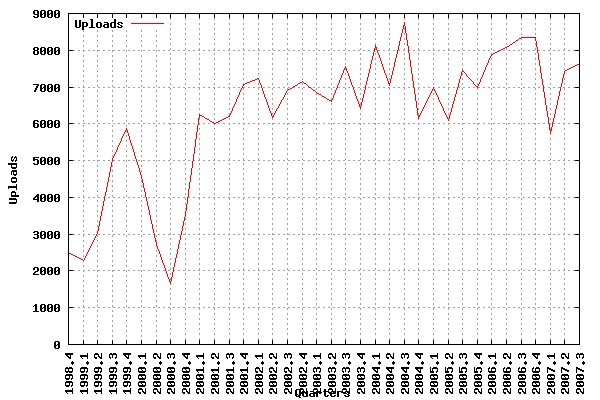
There’s an interesting article on LWN.net about Gentoo: Who made Gentoo Linux, and when? A commit analysis I was wondering how Debian compared, so I made some stats using the debian-devel-changes archives. First, the number of source uploads per quarter:
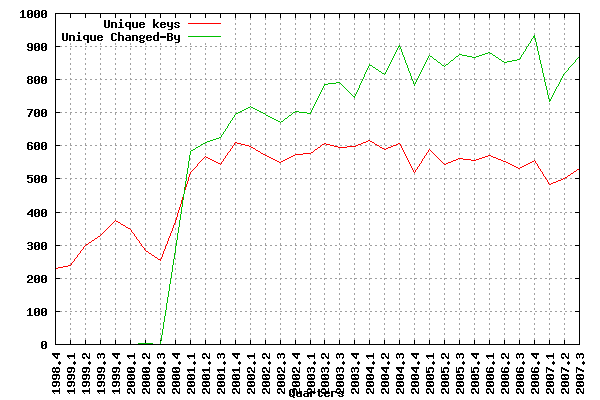
It’s interesting to note that, while the number of packages in Debian increased a lot, the number of uploads basically stayed the same since 2001. Then, I wondered about the number of active developers in Debian. So I counted: I can provide the raw data on demand, if someone else want to work on this. There’s probably a lot of other interesting things to do!

Next.

Previous.