Search Results: "xam"

23 July 2014

Matthew Palmer: Per-repo update hooks with gitolite

Gitolite is a popular way to manage collections of git repositories entirely from the command line it s configured using configuration stored in a git repo, which is nicely self-referential. Providing per-branch access control and a wide range of addons, it s quite a valuable system. In recent versions (3.6), it added support for configuring per-repository git hooks from within the gitolite-admin repo itself something which previously required directly jiggering around with the repo metadata on the filesystem. It allows you to chain multiple hooks together, too, which is a nice touch. You can, for example, define hooks for validate style guidelines , submit patch to code review and push to the CI server . Then for each repo you can pick which of those hooks to execute. It s neat. There s one glaring problem, though you can only use these chained, per-repo hooks on the pre-receive, post-receive, and post-update hooks. The update hook is special, and gitolite wants to make sure you never, ever forget it. You can hook into the update processing chain by using something called a virtual ref ; they re stored in a separate configuration directory, use a different syntax in the config file, and if you re trying to learn what they do, you ll spend a fair bit of time on them. The documentation describes VREFs as a mechanism to add additional constraints to a push . The association between that and the update hook is one you get to make for yourself. The interesting thing is that there s no need for this gratuitous difference in configuration methods between the different hooks. I wrote a very small and simple patch that makes the update hook configurable in exactly the same way as the other server-side hooks, with no loss of existing functionality. The reason I m posting it here is that I tried to submit it to the primary gitolite developer, and was told I m not touching the update hook [ ] I m not discussing this [ ] take it or leave it . So instead, I m publicising this patch for anyone who wants to locally patch their gitolite installation to have a consistent per-repo hook UI. Share and enjoy!

22 July 2014

Russell Coker: Public Lectures About FOSS

Eventbrite I ve recently started using the Eventbrite Web site [1] and the associated Eventbrite Android app [2] to discover public events in my area. Both the web site and the Android app lack features for searching (I d like to save alerts for my accounts and have my phone notify me when new events are added to their database) but it is basically functional. The main issue is content, Eventbrite has a lot of good events in their database (I ve got tickets for 6 free events in the next month). I assume that Eventbrite also has many people attending their events, otherwise the events wouldn t be promoted there. At this time I haven t compared Eventbrite to any similar services, Eventbrite events have taken up much of my available time for the next 6 weeks (I appreciate the button on the app to add an entry to my calendar) so I don t have much incentive to find other web sites that list events. I would appreciate comments from users of competing event registration systems and may write a post in future comparing different systems. Also I have only checked for events in Melbourne, Australia as I don t have any personal interest in events in other places. For the topic of this post Eventbrite is good enough, it meets all requirements for Melbourne and I m sure that if it isn t useful in other cities then there are competing services. I think that we need to have free FOSS events announced through Eventbrite. We regularly have experts in various fields related to FOSS visiting Melbourne who give a talk for the Linux Users of Victoria (and sometimes other technical groups). This is a good thing but I think we could do better. Most people in Melbourne probably won t attend a LUG meeting and if they did they probably wouldn t find it a welcoming experience. Also I recommend that anyone who is looking for educational things to do in Melbourne visit the Eventbrite web site and/or install the Android app. Accessible Events I recently attended an Eventbrite event where a professor described the work of his research team, it was a really good talk that made the topic of his research accessible to random members of the public like me. Then when it came to question time the questions were mostly opinion pieces disguised as questions which used a lot of industry specific jargon and probably lost the interest of most people in the audience who wasn t from the university department that hosted the lecture. I spent the last 15 minutes in that lecture hall reading Wikipedia and resisted the temptation to load an Android game. Based on this lecture (and many other lectures I ve seen) I get the impression that when the speaker or the MC addresses a member of the audience by name (EG John Smith has a question ) then it s strongly correlated with a low quality question. See my previous post about the Length of Conference Questions for more on this topic [3]. It seems to me that when running a lecture everyone involved has to agree about whether it s a public lecture (IE one that is for any random people) as opposed to a society meeting (which while free for anyone to attend in the case of a LUG is for people with specific background knowledge). For a society meeting (for want of a better term) it s OK to assume a minimum level of knowledge that rules out some people. If 5% of the audience of a LUG don t understand a lecture that doesn t necessarily mean it s a bad lecture, sometimes it s not possible to give a lecture that is easily understood by those with the least knowledge that also teaches the most experienced members of the audience. For a public lecture the speaker has to give a talk for people with little background knowledge. Then the speaker and/or the MC have to discourage or reject questions that are for a higher level of knowledge. As an example of how this might work consider the case of an introductory lecture about how an OS kernel works. When one of the experienced Linux kernel programmers visits Melbourne we could have an Eventbrite event organised for a lecture introducing the basic concepts of an OS kernel (with Linux as an example). At such a lecture any questions about more technical topics (such as specific issues related to compilers, drivers, etc) could be met with we are having a meeting for more technical people at the Linux Users of Victoria meeting tomorrow night or we are having coffee at a nearby cafe afterwards and you can ask technical questions there . Planning Eventbrite Events When experts in various areas of FOSS visit Melbourne they often offer a talk for LUV. For any such experts who read this post please note that most lectures at LUV meetings are by locals who can reschedule, so if you are only in town for a short time we can give you an opportunity to speak at short notice. I would like to arrange to have some of those people give a talk aimed at a less experienced audience which we can promote through Eventbrite. The venue for LUV talks (Melbourne University 7PM on the first Tuesday of the month) might not work for all speakers so we need to find a sponsor for another venue. I will contact Linux companies that are active in Melbourne and ask whether they would be prepared to sponsor the venue for such a talk. The fallback option would be to have such a lecture at a LUV meeting. I will talk to some of the organisers of science and technology events advertised on Eventbrite and ask why they chose the times that they did. Maybe they have some insight into which times are best for getting an audience. Also I will probably get some idea of the best times by just attending many events and observing the attendance. I think that the aim of an Eventbrite event is to attract delegates who wouldn t attend other meetings, so it is a priority to choose a suitable time and place. Finally please note that while I am a member of the LUV committee I m not representing LUV in this post. My aim is that community feedback on this post will help me plan such events. I will discuss this with the LUV committee after I get some comments here. Please comment if you would like to give such a public lecture, attend such a lecture, or if you just have any general ideas.

Hideki Yamane: GeoIP support for installer is really nice


RHEL7 installation note says "The new graphical installer also generates automatic default settings where applicable. For example, if the installer detects a network connection, the user's general location is determined with GeoIP and sane suggestions are made for the default keyboard layout, language and timezone." but CentOS7 doesn't work as expected ;-)

GeoIP support in Fedora20 Installer works well and it's pretty nice. Boot from live media and it shows "Try Fedora" and "Install to Hard Drive" menu.

Then, select "Install" and...Boom! it shows in Japanese without any configuration automagically!

I want same feature for d-i, too.

21 July 2014

Chris Lamb: Disabling internet for specific processes with libfiu

My primary usecase is to prevent testsuites and build systems from contacting internet-based services. This, at the very least, introduces an element of non-determinism and malicious code at worst. I use Alberto Bertogli's libfiu for this, specifically the fiu-run utility which part of the fiu-utils package on Debian and Ubuntu. Here's a contrived example, where I prevent Curl from talking to the internet:
$ fiu-run -x -c 'enable name=posix/io/net/connect' curl google.com
curl: (6) Couldn't resolve host 'google.com'
... and here's an example of it detecting two possibly internet-connecting tests:
$ fiu-run -x -c 'enable name=posix/io/net/connect' ./manage.py text
[..]
----------------------------------------------------------------------
Ran 892 tests in 2.495s
FAILED (errors=2)
Destroying test database for alias 'default'...

Note that libfiu inherits all the drawbacks of LD_PRELOAD; in particular, we cannot limit the child process that calls setuid binaries such as /bin/ping:
$ fiu-run -x -c 'enable name=posix/io/net/connect' ping google.com
PING google.com (173.194.41.65) 56(84) bytes of data.
64 bytes from lhr08s01.1e100.net (17.194.41.65): icmp_req=1 ttl=57 time=21.7 ms
64 bytes from lhr08s01.1e100.net (17.194.41.65): icmp_req=2 ttl=57 time=18.9 ms
[..]
Whilst it would certainly be more robust and flexible to use iptables such as allowing localhost and other local socket connections but disabling all others I gravitate towards this entirely userspace solution as it requires no setup and I can quickly modify it to block other calls on an ad-hoc basis. The list of other "modules" libfiu supports is viewable here.

Daniel Pocock: Australia can't criticize Putin while competing with him

While much of the world is watching the tragedy of MH17 and contemplating the grim fate of 298 deceased passengers sealed into a refrigerated freight train in the middle of a war zone, Australia (with 28 victims on that train) has more than just theoretical skeletons in the closet too. At this moment, some 153 Tamil refugees, fleeing the same type of instability that brought a horrible death to the passengers of MH17, have been locked up in the hull of a customs ship on the high seas. Windowless cabins and a supply of food not fit for a dog are part of the Government's strategy to brutalize these people for simply trying to avoid the risk of enhanced imprisonment(TM) in their own country. Under international protocol for rescue at sea and political asylum, these people should be taken to the nearest port and given a humanitarian visa on arrival. Australia, however, is trying to lie and cheat their way out of these international obligations while squealing like a stuck pig about the plight of Australians in the hands of Putin. If Prime Minister Tony Abbott wants to encourage Putin to co-operate with the international community, shouldn't he try to lead by example? How can Australians be safe abroad if our country systematically abuses foreigners in their time of need?

Steve Kemp: An alternative to devilspie/devilspie2

Recently I was updating my dotfiles, because I wanted to ensure that media-players were "always on top", when launched, as this suits the way I work. For many years I've used devilspie to script the placement of new windows, and once I googled a recipe I managed to achieve my aim. However during the course of my googling I discovered that devilspie is unmaintained, and has been replaced by something using Lua - something I like. I'm surprised I hadn't realized that the project was dead, although I've always hated the configuration syntax it is something that I've used on a constant basis since I found it. Unfortunately the replacement, despite using Lua, and despite being functional just didn't seem to gell with me. So I figured "How hard could it be?". In the past I've written softare which iterated over all (visible) windows, and obviously I'm no stranger to writing Lua bindings. However I did run into a snag. My initial implementation did two things: This worked. This worked well. This worked too well. The problem I ran into was that if I wrote something like "Move window 'emacs' to desktop 2" that action would be applied, over and over again. So if I launched emacs, and then manually moved the window to desktop3 it would jump back! In short I needed to add a "stop()" function, which would cause further actions against a given window to cease. (By keeping a linked list of windows-to-ignore, and avoiding processing them.) The code did work, but it felt wrong to have an ever-growing linked-list of processed windows. So I figured I'd look at the alternative - the original devilspie used libwnck to operate. That library allows you to nominate a callback to be executed every time a new window is created. If you apply your magic only on a window-create event - well you don't need to bother caching prior-windows. So in conclusion : I think my code is better than devilspie2 because it is smaller, simpler, and does things more neatly - for example instead of a function to get geometry and another to set it, I use one. (e.g. "xy()" returns the position of a window, but xy(3,3) sets it.). kpie also allows you to run as a one-off job, and using the simple primitives I wrote a file to dump your windows, and their size/placement, which looks like this:
shelob ~/git/kpie $ ./kpie --single ./samples/dump.lua
-- Screen width : 1920
-- Screen height: 1080
..
if ( ( window_title() == "Buddy List" ) and
     ( window_class() == "Pidgin" ) and
     ( window_application() == "Pidgin" ) ) then
     xy(1536,24 )
     size(384,1032 )
     workspace(2)
end
if ( ( window_title() == "feeds" ) and
     ( window_class() == "Pidgin" ) and
     ( window_application() == "Pidgin" ) ) then
     xy(1,24 )
     size(1536,1032 )
     workspace(2)
end
..
As you can see that has dumped all my windows, along with their current state. This allows a simple starting-point - Configure your windows the way you want them, then dump them to a script file. Re-run that script file and your windows will be set back the way they were! (Obviously there might be tweaks required.) I used that starting-point to define a simple recipe for configuring pidgin, which is more flexible than what I ever had with pidgin, and suits my tastes. Bug-reports welcome.

19 July 2014

Steve Kemp: Did you know xine will download and execute scripts?

Today I was poking around the source of Xine, the well-known media player. During the course of this poking I spotted that Xine has skin support - something I've been blissfully ignorant of for many years. How do these skins work? You bring up the skin-browser, by default this is achieved by pressing "Ctrl-d". The browser will show you previews of the skins available, and allow you to install them. How does Xine know what skins are available? It downloads the contents of: NOTE: This is an insecure URL. The downloaded file is a simple XML thing, containing references to both preview-images and download locations. For example the theme "Sunset" has the following details: if you choose to install the skin the Sunset.tar.gz file is downloaded, via HTTP, extracted, and the shell-script doinst.sh is executed, if present. So if you control DNS on your LAN you can execute arbitrary commands if you persuade a victim to download your "corporate xine theme". Probably a low-risk attack, but still a surprise.

Jo Shields: Transition tracker

Friday was my last day at Collabora, the awesome Open Source consultancy in Cambridge. I d been there more than three years, and it was time for a change. As luck would have it, that change came in the form of a job offer 3 months ago from my long-time friend in Open Source, Miguel de Icaza. Monday morning, I fly out to Xamarin s main office in Boston, for just over a week of induction and face time with my new co workers, as I take on the title of Release Engineer. My job is to make sure Mono on Linux is a first-class citizen, rather than the best-effort it s been since Xamarin was formed from the ashes of the Attachmate/Novell deal. I m thrilled to work full-time on what I do already as community work including making Mono great on Debian/Ubuntu and hope to form new links with the packer communities in other major distributions. And I m delighted that Xamarin has chosen to put its money where its mouth is and fund continued Open Source development surrounding Mono. If you re in the Boston area next week or the week after, ping me via the usual methods! IMG_20140719_203043

18 July 2014

Ian Donnelly: How-To: Write a Plug-In

Hi Everybody! I wanted to write a how-to on how to write an Elektra plug-in. Plug-ins are what allow Elektra to translate regular configuration files into the Elektra key database, and allow keys to be coverted back into regular configuration files. For example, the hosts plug-in is used to transcribe a hosts file into a meaningful KeySet in the Elektra Key Database. This plugin is what allows the kdb tool to be able to work with hosts files like in our mount tutorial. While there are already a good number of plug-ins written for Elektra, we obviously don t cover all the different types of configuration files. If you want to be able to use the features of Elektra, you may have to write a plug-in for your type of configuration file. Luckily, its not hard to do. Over the new few weeks I will be writing a tutorial for how to write your very own plug-in as well as explaining all the components of an Elektra plug-in. I will link the tutorials below as I finish them for easy reference, or if you already follow my blog I am sure you will notice them as they get published. Part 1: The Basics Sincerely,
Ian S. Donnelly

17 July 2014

Juliana Louback: Contribute a JSCommunicator Translation

To those who don t know, JSCommunicator is a SIP communication tool developed in HTML and JavaScript, currently supporting audio/video calls and SIP SIMPLE instant messaging. We ve recently added i18n internationalization support for English, Portuguese, Spanish, French and now Hebrew. We would like to have support for other languages and it s a pretty straightforward process to add a translation, so even if you do not have a tech background you can contribute! Setup First, create and account in Github. Github is a hosting service for git repositories and open source projects get to use Github for FREE! As a result, many open source project repositories are hosted on Github, including but not limited to JSCommunicator. Once you have created your git account, follow steps 1-4 in the section Setting up git listed in Github s setup tutorial. This will help you install git and configure anything you need. Fork Now fork the JSCommunicator repo. I really like the word fork . Great term. If this is your first fork, know that this will make a copy of the JSCommunicator repo and all its respective code to your Github account. Here s how we go about it:
  1. Sign in to Github
  2. Browse to https://github.com/JLouback/jscommunicator
  3. Somewhere around the upper left corner, you will see a button labeled Fork . Click that.
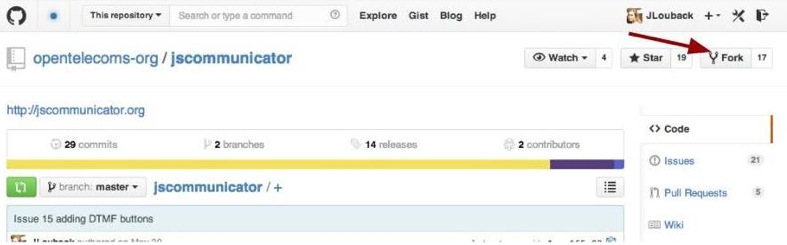
fork You should now have your own JSCommunicator repository on your Github account. On your main page select the tab Repositories . It should be the first on the list. The url will be https://github.com/YOUR-USERNAME/jscommunicator. My Github username is JLouback, so my jscommunicator repo can be found at https://github.com/JLouback/jscommunicator. Clone Now you should download all that code to your local machine so you can edit it. On your JSCommunicator page somewhere around the lower right corner you ll see a field entitled HTTPS clone URL: clone I don t know if this is correct, but you can just copy the URL on your browser too. I do that. Now on your terminal, navigate to the directory you d like to place your repository and enter
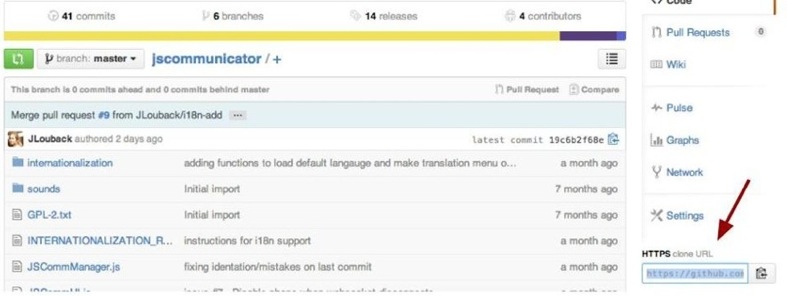
git clone https://github.com/YOUR-USERNAME/jscommunicator
The current directory should now have a folder named jscommunicator and in it is all the JSCommunicator code. Switch branches The JSCommunicator repo has a branch for the i18n support. A branch is basically a copy of the code that you can modify without changing the original code. It s great for adding new features, once everything is done and tested you can add the new feature to the original code. A more detailed explanation of branches can be found here. On the terminal, enter
cd jscommunicator
git branch -a
This will list all the branches in the repository, both local and remote. There should be a branch named remotes/origin/i18n-support . Switch to this branch by entering
git checkout --track origin/i18n-support
This will create a local branch named i18n-support with all the contents of the remote i18n-branch in https://github.com/opentelecoms-org/jscommunicator. Create a .properties file Now your jscommunicator directory will have some new files for the internationalization functionality. Among them you should find an INTERNATIONALIZATION_README file with instructions for adding a JSCommunicator translation. It s a less detailed version of this post, but it s worth a read in case I ve missed something here. Go to the directory internationalization . You ll see a few .properties files with different language codes. Choose the language of your preference for the translation base and make a copy of it in the internationalization directory. Your copy should be named Messages_LANGUAGECODE.properties . For example, the language code for german is de , so the german file should be named Messages_de.properties . If you re not sure about the code for your language, please check out this list of ISO 639-1 language codes so you re using the same code as (most) browsers. The .properties file is list of key-value pairs, a word or a few words joined by _ which is the key, the equals sign = then a word or phrase which is the value. Do not change anything to the left of the equals sign. Translate what is on the right of the equals sign. Modify available_languages.xml Go back to the root directory (jscommunicator) and open the file named available_languages.ruby . This .ruby has a series of language elements. At the end of the last </language> add a new language element with your language display name and code, copying the previous languge elements. You actually can put your language element anwhere, as long as it s after the ' and before the , as well as not cutting into any of the other language elements. Your display name should be the name of the language in its native language, for example for a french translation we ll put Fran ais (I think). And the code is the code we used for the .properties file. Here s how it should look:
<language>
    <display>Deutsch</display>
    <code>de</code>
</language>
Save your changes and voila! Test your work Once you ve made a .properties file, JSCommunicator will automatically load your translation if you ve set your browser preference to that language. If your browser preference is french, it will load the Messages_fr.properties. If your browser preference is a language we don t have a translation for (let s say german), JScommunicator will load the default Messages.properties file which is in english. The available_languages.ruby is used to build a language selection menu. If you add a language element without a corresponding .properties file, JSCommunicator will throw a JS error and load the default (english) translation. The same happens if you use different language codes in the .properties file name and the available_languages.ruby. The error won t disturb your use of JSCommunicator, it just won t load the language you selected. No harm, no foul. But if you want others to use your translation, do take care to do this correctly. If you read the INTERNATIONALIZATION_README, you will have seen that we need the jquery.i18n.properties.js file that s included in the .html pages. You can download that code here. Be sure to place it in the jscommunicator directory. This is only necessary if you want to see your addition at work, you don t need this file to contribute your translation. There are other 3rd party code dependencies to run JSCommunicator too as you may have noticed. Just creating the .properties file and adding a language element to available_languages.ruby, if done correctly, is enough to make a pull request. Commit Here s the part where we load all your local changes to your remote repository. In the terminal, navigate to the root directory (jscommunicator) and enter
git add internationalization/Messages_de.properties
git add available_languages.ruby
Of course, please replace Messages_de.properties with the name of your new .properties file. And mind you, we don t have a german translation yet! Then enter
git commit -m "German translation"
You can enter whatever you d like in the part, it s a good idea to explain what language you are adding. Now we can push the changes:
git push -u origin i18n-support
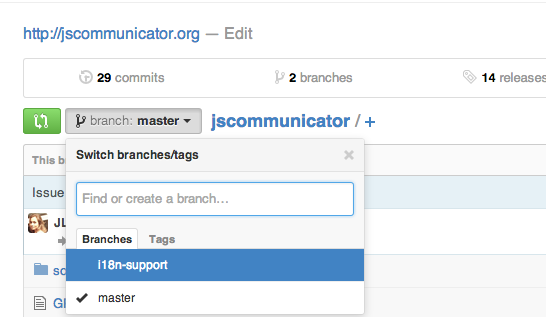
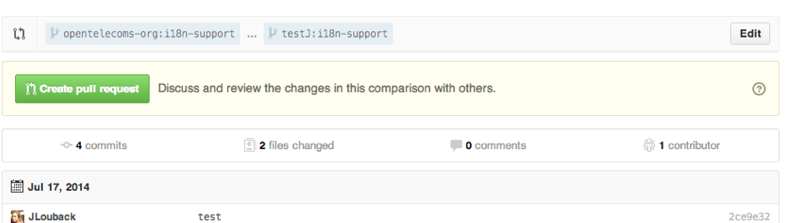
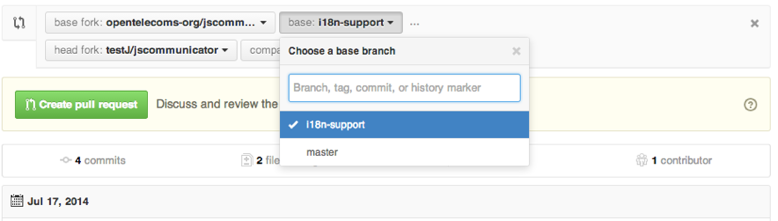
You should now see the changes you made in your Github account page at github.com/YOUR_USER/jscommunicator. The message you put in double quotations ( ) in the commit will be beside each modified file. This push also creates a new branch in your jscommunicator repository, now you will have a master and a i18n-support branch. Pull Now it s time to share your translation with everyone else if you feel so inclined. Your version of JSCommunicator has a new translation but not the official version. First navigate to you jscommunicator repo at github.com/YOUR_USER/jscommunicator and make sure you are on the i18n-branch as that will contain your changes. branches Click the green button directly to the left of the branch drop down menu shown above. This will create a pull request to add your new code to the official jscommunicator code. Once you click that button, you should see this: pull Make sure that the base repo (the first on the line above the green Create pull request button) is opentelecoms-org:i18n-support and not opentelecoms-org:master or another branch name. If it is, just click Edit on the right and you ll be able to select the branch from a dropdown like so: pullEdit If first repo is opentelecoms-org:i18n-support and the second is YOUR_USER:i18n-support and you ve verified (scroll down) that there are 2 files changed which are your new .properties file and the added element to the available_languages.xml, go ahead and press create pull request. It ll open a window with a text box you can add an explanation to with one final Create pull request button. Click that and you re done! You ve kindly contributed with a translation for JSCommunicator!
16 July 2014

Steve Kemp: So what can I do for Debian?

So I recently announced my intention to rejoin the Debian project, having been a member between 2002 & 2011 (inclusive). In the past I resigned mostly due to lack of time, and what has changed is that these days I have more free time - primarily because my wife works in accident & emergency and has "funny shifts". This means we spend many days and evenings together, then she might work 8pm-8am for three nights in a row, which then becomes Steve-time, and can involve lots of time browsing reddit, coding obsessively, and watching bad TV (currently watching "Lost Girl". Shades of Buffy/Blood Ties/similar. Not bad, but not great.) My NM-progress can be tracked here, and once accepted I have a plan for my activities: I believe this will be useful, even though there will be limits - I've no patience for PHP and will just ignore it, along with its ecosystem, for example. As progress today I reported #754899 / CVE-2014-4978 against Rawstudio, and discussed some issues with ITP: tiptop (the program seems semi-expected to be installed setuid(0), but if it is then it will allow arbitrary files to be truncated/overwritten via "tiptop -W /path/to/file" (ObRandom still waiting for a CVE identifier for #749846/TS-2867..) And now sleep.

Matthias Klumpp: AppStream 0.7 specification and library released

appstream-logoToday I am very happy to announce the release of AppStream 0.7, the second-largest release (judging by commit number) after 0.6. AppStream 0.7 brings many new features for the specification, adds lots of good stuff to libappstream, introduces a new libappstream-qt library for Qt developers and, as always, fixes some bugs. Unfortunately we broke the API/ABI of libappstream, so please adjust your code accordingly. Apart from that, any other changes are backwards-compatible. So, here is an overview of what s new in AppStream 0.7: Specification changes Distributors may now specify a new <languages/> tag in their distribution XML, providing information about the languages a component supports and the completion-percentage for the language. This allows software-centers to apply smart filtering on applications to highlight the ones which are available in the users native language. A new addon component type was added to represent software which is designed to be used together with a specific other application (think of a Firefox addon or GNOME-Shell extension). Software-center applications can group the addons together with their main application to provide an easy way for users to install additional functionality for existing applications. The <provides/> tag gained a new dbus item-type to expose D-Bus interface names the component provides to the outside world. This means in future it will be possible to search for components providing a specific dbus service:
$ appstream-index what-provides dbus org.freedesktop.PackageKit.desktop system
(if you are using the cli tool) A <developer_name/> tag was added to the generic component definition to define the name of the component developer in a human-readable form. Possible values are, for example The KDE Community , GNOME Developers or even the developer s full name. This value can be (optionally) translated and will be displayed in software-centers. An <update_contact/> tag was added to the specification, to provide a convenient way for distributors to reach upstream to talk about changes made to their metadata or issues with the latest software update. This tag was already used by some projects before, and has now been added to the official specification. Timestamps in <release/> tags must now be UNIX epochs, YYYYMMDD is no longer valid (fortunately, everyone is already using UNIX epochs). Last but not least, the <pkgname/> tag is now allowed multiple times per component. We still recommend to create metapackages according to the contents the upstream metadata describes and place the file there. However, in some cases defining one component to be in multiple packages is a short way to make metadata available correctly without excessive package-tuning (which can become difficult if a <provides/> tag needs to be satisfied). As small sidenote: The multiarch path in /usr/share/appdata is now deprecated, because we think that we can live without it (by shipping -data packages per library and using smarter AppStream metadata generators which take advantage of the ability to define multiple <pkgname/> tags) Documentation updates In general, the documentation of the specification has been reworked to be easier to understand and to include less duplication of information. We now use excessive crosslinking to show you the information you need in order to write metadata for your upstream project, or to implement a metadata generator for your distribution. Because the specification needs to define the allowed tags completely and contain as much information as possible, it is not very easy to digest for upstream authors who just want some metadata shipped quickly. In order to help them, we now have Quickstart pages in the documentation, which are rich of examples and contain the most important subset of information you need to write a good metadata file. These quickstart guides already exist for desktop-applications and addons, more will follow in future. We also have an explicit section dealing with the question How do I translate upstream metadata? now. More changes to the docs are planned for the next point releases. You can find the full project documentation at Freedesktop. AppStream GObject library and tools The libappstream library also received lots of changes. The most important one: We switched from using LGPL-3+ to LGPL-2.1+. People who know me know that I love the v3 license family of GPL licenses I like it for tivoization protection, it s explicit compatibility with some important other licenses and cosmetic details, like entities not loosing their right to use the software forever after a license violation. However, a LGPL-3+ library does not mix well with projects licensed under other open source licenses, mainly GPL-2-only projects. I want libappstream to be used by anyone without forcing the project to change its license. For some reason, using the library from proprietary code is easier than using it from a GPL-2-only open source project. The license change was also a popular request of people wanting to use the library, so I made the switch with 0.7. If you want to know more about the LGPL-3 issues, I recommend reading this blogpost by Nikos (GnuTLS). On the code-side, libappstream received a large pile of bugfixes and some internal restructuring. This makes the cache builder about 5% faster (depending on your system and the amount of metadata which needs to be processed) and prepares for future changes (e.g. I plan to obsolete PackageKit s desktop-file-database in the long term). The library also brings back support for legacy AppData files, which it can now read. However, appstream-validate will not validate these files (and kindly ask you to migrate to the new format). The appstream-index tool received some changes, making it s command-line interface a bit more modern. It is also possible now to place the Xapian cache at arbitrary locations, which is a nice feature for developers. Additionally, the testsuite got improved and should now work on systems which do not have metadata installed. Of course, libappstream also implements all features of the new 0.7 specification. With the 0.7 release, some symbols were removed which have been deprecated for a few releases, most notably as_component_get/set_idname, as_database_find_components_by_str, as_component_get/set_homepage and the pkgname property of AsComponent (which is now a string array and called pkgnames ). API level was bumped to 1. Appstream-Qt A Qt library to access AppStream data has been added. So if you want to use AppStream metadata in your Qt application, you can easily do that now without touching any GLib/GObject based code! Special thanks to Sune Vuorela for his nice rework of the Qt library! And that s it with the changes for now! Thanks to everyone who helped making 0.7 ready, being it feedback, contributions to the documentation, translation or coding. You can get the release tarballs at Freedesktop. Have fun!

Juliana Louback: Become an Open-source Contributor Video Conference

A couple weeks ago I was contacted by Yehuda Korotkin through one of the Debian mailing lists. Yehuda is a tech professor at one of Israel s leading colleges for women. He proposed a video conference to present the open source community to his class and explain how they can contribute to open source projects. I volunteered to participate and last Monday (July 14th 2014) we had our virtual meeting, which I hope was the first of many. Shauna G. also participated from Boston, making it a Israel - USA - Brazil meetup. Pretty impressive, eh? The conference was hosted on Google Hangouts, the video is available for viewing here. Run time is around 2.5 hours so to save you time I ve kindly posted a summary of the conference! To be frank, I look ghastly half the time so I d much prefer that you read this post. First there was a Q&A period which was more of a discussion panel, followed by a hands-on session where the girls made their first contribution to an open source project. Here s the gist of it: Q&A Hands on For the practical part of our conference, Yehuda s students contributed to Jscommunicator s Issue #5 which requests i18n support for major languages. JSCommunicator is a SIP communication tool developed in HTML and JavaScript, currently supporting audio/video calls and SIP SIMPLE instant messaging. First we set up Github in their local machines and forked the Jscommunicator repo. We learned the basic git commands needed to push changes to their remote repositories and to create a pull requests. This is explained in further detail here. At the end of the conference with nearly an hour overtime due to my tendency to be overly verbose, Yehuda s class made their first contribution with a Hebrew translation for Jscommunicator! All in all, it was great to virtually meet Yehuda and his epic students who all seemed very clever engineers. I m looking forward to our next meetup once I gain some time-management skills.

13 July 2014

Russ Allbery: Review: Neptune's Brood

Review: Neptune's Brood, by Charles Stross
Series: Freyaverse #2
Publisher: Ace
Copyright: July 2013
ISBN: 1-101-62453-1
Format: Kindle
Pages: 325
Neptune's Brood is set in the same universe as Saturn's Children, but I wouldn't call it a sequel. It takes place considerably later, after substantial expansion of the robot civilization to the stars, and features entirely different characters (or, if there was overlap, I didn't notice). It also represents a significant shift in tone: while Saturn's Children is clearly a Heinlein pastiche and parody, Neptune's Brood takes its space opera more seriously. There is some situational humor assault auditors, for example but this book is played mostly straight, and I detected little or no Heinlein. This is Stross fleshing out his own space opera concept. This being Stross, that concept is not exactly conventional. This is a space opera about economics. Specifically, it's a space opera about interstellar economics, a debt pyramid, and a very interesting remapping of the continual growth requirements of capitalism to the outward expansion of colonization. The first-person protagonist comes from a "family" (as in Saturn's Children, the concept exists but involves rather more aggressive control of the instantiated "children") of bankers, but she is a forensic accountant and historian who specializes in analysis of financial scams. As you might expect, this is a significant clue about the plot. Neptune's Brood opens with Krina in search of her sister. She is supposed to be an itinerant scholar, moving throughout colonized space to spend some time with various scattered sisters, spreading knowledge and expanding her own. But it's clear from the start of the book that something else is going on, even before an assassin with Krina's face appears on her trail. Unfortunately, it takes roughly a third of the book to learn just what is happening beneath the surface, and most of that time is spent in a pointless interlude on a flying cathedral run by religious fanatics. The religion is a callback to Saturn's Children: robots who are trying to spread original humanity (the Fragiles) to the stars. This mostly doesn't go well, and is going particularly poorly for the ship that Krina works for passage on. But this is a brief gag that I thought went on much too long. The plot happens to Krina for this first section of the book rather than the other way around, little of lasting significance other than some character introductions occurs, and the Church itself, while playing a minor role in the later plot, is not worth the amount of attention that it gets. The best parts of the early book are the interludes in which Krina explains major world concepts to the reader. These are absolutely blatant infodumping, and I'm not sure how Stross gets away with them, but somehow he does, at least for me. They remind me of some of his blog posts, except tighter and fit into an interesting larger structure. Thankfully, once Krina finally arrives on Shin-Tethys, the plot improves considerably. There was a specific moment for me when the book became interesting: when Krina finds her sib's quarters in Shin-Tethys and analyzes what she finds there. It's the first significant thing in the book that she does rather than have done to her or thrust upon her, and she's a much better character when she's making decisions. This is also about the point where Stross starts fully explaining slow money, which is key to both the economics and the plot, and the plot starts to unwind its various mysteries and identify the motives of the players. Even then, Krina suffers from a lack of agency. Only at rare intervals does she get a chance to affect the story. Most of what she did of relevance to this book she did in the past, and while those descriptions of the backstory are interesting, they don't entirely make up for a passive protagonist. Thankfully, the other characters are varied and interesting enough, and the political machinations and cascading revelations captivating enough, that the last part of the book was very satisfying even with Krina on for the ride. This is a Stross novel, so it's full of two-dollar technical words mixed with technobabble. However, it shares with Saturn's Children the recasting of robots as the norm and fleshy humans as the exception, which means much of the technobabble is a straight substitution for our normal babble about meaty bodies and often works as an alienation technique. That makes it a bit more tolerable for me, although I still wished Stross would turn down the manic vocabulary in places. This bothers some people more than others; if you had no trouble with Accelerando, Neptune's Brood will pose no problems. I don't think the first section of this book was successful, but I liked the rest well enough to recommend it. If you like your space opera with a heavy dose of economics, a realistic attitude towards deep space exploration without faster-than-light technology, and a realistic perspective on the hostility of alien planets to Earth life, Neptune's Brood is a good choice. And any book that quotes David Graeber's Debt, and whose author has clearly paid attention to its contents, wins bonus points from me. Rating: 8 out of 10

11 July 2014

Russell Coker: Improving Computer Reliability

In a comment on my post about Taxing Inferior Products [1] Ben pointed out that most crashes are due to software bugs. Both Ben and I work on the Debian project and have had significant experience of software causing system crashes for Debian users. But I still think that the widespread adoption of ECC RAM is a good first step towards improving the reliability of the computing infrastructure. Currently when software developers receive bug reports they always wonder whether the bug was caused by defective hardware. So when bugs can t be reproduced (or can t be reproduced in a way that matches the bug report) they often get put in a list of random crash reports and no further attention is paid to them. When a system has ECC RAM and a filesystem that uses checksums for all data and metadata we can have greater confidence that random bugs aren t due to hardware problems. For example if a user reports a file corruption bug they can t repeat that occurred when using the Ext3 filesystem on a typical desktop PC I ll wonder about the reliability of storage and RAM in their system. If however the same bug report came from someone who had ECC RAM and used the ZFS filesystem then I would be more likely to consider it a software bug. The current situation is that every part of a typical PC is unreliable. When a bug can be attributed to one of several pieces of hardware, the OS kernel and even malware (in the case of MS Windows) it s hard to know where to start in tracking down a bug. Most users have given up and accepted that crashing periodically is just what computers do. Even experienced Linux users sometimes give up on trying to track down bugs properly because it s sometimes very difficult to file a good bug report. For the typical computer user (who doesn t have the power that a skilled Linux user has) it s much worse, filing a bug report seems about as useful as praying. One of the features of ECC RAM is that the motherboard can inform the user (either at boot time, after a NMI reboot, or through system diagnostics) of the problem so it can be fixed. A feature of filesystems such as ZFS and BTRFS is that they can inform the user of drive corruption problems, sometimes before any data is lost. My recommendation of BTRFS in regard to system integrity does have a significant caveat, currently the system reliability decrease due to crashes outweighs the reliability increase due to checksums at this time. This isn t all bad because at least when BTRFS crashes you know what the problem is, and BTRFS is rapidly improving in this regard. When I discuss BTRFS in posts like this one I m considering the theoretical issues related to the design not the practical issues of software bugs. That said I ve twice had a BTRFS filesystem seriously corrupted by a faulty DIMM on a system without ECC RAM.

10 July 2014

Steve Kemp: Blogspam moved, redis alternatives being examined

As my previous post suggested I'd been running a service for a few years, using Redis as a key-value store. Redis is lovely. If your dataset will fit in RAM. Otherwise it dies hard. Inspired by Memcached, which is a simple key=value store, redis allows for more operations: using sets, using hashes, etc, etc. As it transpires I mostly set keys to values, so it crossed my mind last night an alternative to rewriting the service to use a non-RAM-constrained service might be to juggle redis out and replace it with something else. If it were possible to have a redis-compatible API which secretly stored the data in leveldb, sqlite, or even Berkley DB, then that would solve my problem of RAM-constraints, and also be useful. Looking around there are a few projects in this area nds fork of redis, ssdb, etc. I was hoping to find a Perl Redis::Server module, but sadly nothing exists. I should look at the various node.js stub-servers which exist as they might be easy to hack too. Anyway the short version is that this might be a way forward, the real solution might be to use sqlite or postgres, but that would take a few days work. For the moment the service has been moved to a donated guest and has 2Gb of RAM instead of the paltry 512Mb it was running on previously. Happily the server is installed/maintained by my slaughter tool so reinstalling took about ten minutes - the only hard part was migrating the Redis-contents, and that's trivial thanks to the integrated "slave of" support. (I should write that up regardless though.)

Russell Coker: A Linux Conference as a Ritual

Sociological Images has an interesting post by Jay Livingston PhD about a tennis final as a ritual [1]. The main point is that you can get a much better view of the match on your TV at home with more comfort and less inconvenience, so what you get for the price of the ticket (and all the effort of getting there) is participating in the event as a spectator. It seems to me that the same idea applies to community Linux conferences (such as LCA) and some Linux users group meetings. In terms of watching a lecture there are real benefits to downloading it after the conference so that you can pause it and study related web sites or repeat sections that you didn t understand. Also wherever you might sit at home to watch a video of a conference lecture you will be a lot more comfortable than a university lecture hall. Some people don t attend conferences and users group meetings because they would rather watch a video at home. Benefits of Attending (Apart from a Ritual) One of the benefits of attending a lecture is the ability to ask questions. But that seems to mostly apply to the high status people who ask most questions. I ve previously written about speaking stacks and my observations about who asks questions vs the number that can reasonably be asked [2]. I expect that most delegates ask no questions for the entire conference. I created a SurveyMonkey survey to discover how many questions people ask [3]. I count LCA as a 3 day conference because I am only counting the days where there are presentations that have been directly approved by the papers committee, approving a mini-conf (and thus delegating the ability to approve speeches) is different. Another benefit of attending is the so-called hallway track where people talk to random other people. But that seems to be of most benefit to people who have some combination of high status in the community and good social skills. In the past I ve attended the Professional Delegates Networking Session which is an event for speakers and people who pay the Professional registration fee. Sometimes at such events there has seemed to be a great divide between speakers (who mostly knew each other before the conference) and Professional Delegates which diminishes the value of the event to anyone who couldn t achieve similar benefits without it. How to Optimise a Conference as a Ritual To get involvement of people who have the ritualistic approach one could emphasise the issue of being part of the event. For example to get people to attend the morning keynote speeches (which are sometimes poorly attended due to partying the night before) one could emphasise that anyone who doesn t attend the keynote isn t really attending the conference. Conference shirts seem to be strongly correlated with the ritual aspect of conferences, the more corporate conferences don t seem to offer branded clothing to delegates. If an item of branded schwag was given out before each keynote then that would increase the attendance by everyone who follows the ritual aspect (as well as everyone who just likes free stuff). Note that I m not suggesting that organisers of LCA or other conferences go to the effort of giving everyone schwag before the morning keynote, that would be a lot of work. Just telling people that anyone who misses the keynote isn t really attending the conference would probably do. I ve always wondered why conference organisers want people to attend the keynotes and award prizes to random delegates who attend them. Is a keynote lecture a ritual that is incomplete if the attendance isn t good enough?

Russell Coker: Taxing Inferior Products

I recently had a medical appointment cancelled due to a computer crash . Apparently the reception computer crashed and lost all bookings for a day and they just made new bookings for whoever called and anyone who had a previous booking just missed out. I ll probably never know whether they really had a computer problem or just used computer problems as an excuse when they made a mistake. But even if it wasn t a real computer problem the fact that computers are so unreliable overall that computer crash is an acceptable excuse indicates a problem with the industry. The problem of unreliable computers is a cost to everyone, it s effectively a tax on all business and social interactions that involve computers. While I spent the extra money on a server with ECC RAM for my home file storage I have no control over the computers purchased by all the companies I deal with which are mostly the cheapest available computers. I also have no option to buy a laptop with ECC RAM because companies like Lenovo have decided not to manufacture them. It seems to me that the easiest way of increasing overall reliability of computers would be to use ECC RAM everywhere. In the early 90 s all IBM compatible PCs had parity RAM, that meant that for each byte there was one extra bit which would report 100% of single-bit errors and 50% of errors that involved random memory corruption. Then manufacturers decided to save a tiny amount of money on memory by using 8/9 the number of chips for desktop/laptop systems and probably make more money on selling servers with ECC RAM. If the government was to impose a 20% tax on computers that lack ECC RAM then manufacturers would immediately start using it everywhere and the end result would be no price increase overall as it s cheaper to design desktop systems and servers with the same motherboards apparently some desktop systems have motherboard support for ECC RAM but don t ship with suitable RAM or advertise the support for such RAM. This principle applies to many other products too. One obvious example is cars, a car manufacturer can sell cheap cars with few safety features and then when occupants of those cars and other road users are injured the government ends up paying for medical expenses and disability pensions. If there was a tax for every car that has a poor crash test rating and a tax for every car company that performs badly in real world use then it would give car companies some incentive to manufacture safer vehicles. Now there are situations where design considerations preclude such features. For example implementing ECC RAM in mobile phones might involve technical difficulties (particularly for 32bit phones) and making some trucks and farm equipment safer might be difficult. But when a company produces multiple similar products that differ significantly in quality such as PCs with and without ECC RAM or cars with and without air-bags there would be no difficulty in making them all of them higher quality. I don t think that we will have a government that implements such ideas any time soon, it seems that our government is more interested in giving money to corporations than taxing them. But one thing that could be done is to adopt a policy of only giving money to companies if they produce high quality products. If a car company is to be given hundreds of millions of dollars for not closing a factory then that factory should produce cars with all possible safety features. If a computer company is going to be given significant tax breaks for doing R&D then they should be developing products that won t crash.

9 July 2014

Sune Vuorela: CMake and library properties

When writing libraries with CMake, you need to set a couple of properties, especially the VERSION and SOVERSION properties. For library libbar, it could look like:

set_property(TARGET bar PROPERTY VERSION 0.0.0 )
set_property(TARGET bar PROPERTY SOVERSION 0 )
This will give you a libbar.so => libbar.so.0 => libbar.so.0.0.0 symlink chain with a SONAME of libbar.so.0 encoded into the library. The SOVERSION target property controls the number in the middle part of the symlink chain as well as the numeric part of the SONAME encoded into the library. The VERSION target property controls the last part of the last element of the symlink chain This also means that the first part of VERSION should match what you put in SOVERSION to avoid surprises for others and for the future you. Both these properties control Technical parts and should be looked at from a technical perspective. They should not be used for the version of the software , but purely for the technical versioning of the library. In the kdeexamples git repository, it is handled like this:
set(BAR_VERSION_MAJOR 1)
set(BAR_VERSION_MINOR 2)
set(BAR_VERSION_PATCH 3)
set(BAR_VERSION $ BAR_VERSION_MAJOR .$ BAR_VERSION_MINOR .$ BAR_VERSION_PATCH )
And a bit later:
set_target_properties(bar PROPERTIES VERSION $ BAR_VERSION
SOVERSION $ BAR_VERSION_MAJOR )
which is a fine way to ensure that things actually matches. Oh. And these components is not something that should be inherited from other external projects. So people, please be careful to use these correct.

7 July 2014

Jonathan McDowell: 2014 SPI Board election nominations open

I put out the call for nominations for the 2014 Software in the Public Interest (SPI) Board election last week. At this point I haven't yet received any nominations, so I'm mentioning it here in the hope of a slightly wider audience. Possibly not the most helpful as I would hope readers who are interested in SPI are already reading spi-announce. There are 3 positions open this election and it would be good to see a bit more diversity in candidates this year. Nominations are open until the end of Tuesday July 13th. The primary hard and fast time commitment a board member needs to make is to attend the monthly IRC board meetings, which are conducted publicly via IRC (#spi on the OFTC network). These take place at 20:00 UTC on the second Thursday of every month. More details, including all past agendas and minutes, can be found at http://spi-inc.org/meetings/. Most of the rest of the board communication is carried out via various mailing lists. The ideal candidate will have an existing involvement in the Free and Open Source community, though this need not be with a project affiliated with SPI. Software in the Public Interest (SPI, http://www.spi-inc.org/) is a non-profit organization which was founded to help organizations develop and distribute open hardware and software. We see it as our role to handle things like holding domain names and/or trademarks, and processing donations for free and open source projects, allowing them to concentrate on actual development. Examples of projects that SPI helps includes Debian, LibreOffice, OFTC and PostgreSQL. A full list can be found at http://www.spi-inc.org/projects/.

Next.

Previous.