Search Results: "tb"

3 April 2013

Julien Danjou: Hy, Lisp in Python

I've meant to look at Hy since Paul Tagliamonte started to talk to me about it, but never took a chance until now. Yesterday, Paul indicated it was a good time for me to start looking at it, so I spent a few hours playing. But what's Hy? Python is very nice: it has a great community and a wide range of useful libraries. But let's face it, it misses a great language. Hy is an implementation of a Lisp on top of Python. Technically, Hy is built directly with a custom made parser (for now) which then translates expressions using the Python AST module to generate code, which is then run by Python. Therefore, it shares the same properties as Python, and is a Lisp-1 (i.e. with a single namespace for symbols and functions). If you're interested to listen Paul talking about Hy during last PyCon US, I recommend watching his lightning talk. As the name implies, it's only a few minutes long. <iframe allowfullscreen="allowfullscreen" class="shadow" frameborder="0" height="374" src="http://www.youtube.com/embed/1vui-LupKJI?wmode=transparent&amp;autohide=1&amp;egm=0&amp;hd=1&amp;iv_load_policy=3&amp;modestbranding=1&amp;rel=0&amp;showinfo=0&amp;showsearch=0#t=16m14s" width="500"></iframe> Does it work? I've been cloning the code and played around a bit with Hy. And to my greatest surprise and pleasure, it works quite well. You can imagine writing Python from there easily. Part of the syntax smells like Clojure's, which looks like a good thing since they're playing in the same area. You can try a Hy REPL in your Web browser if you want. Here's what some code look like:
(import requests)

(setv req (requests.get "http://hy.pault.ag"))
(if (= req.status_code 200)
(for (kv (.iteritems req.headers))
(print kv))
(throw (Exception "Wrong status code")))

This code would ouput:
('date', 'Wed, 03 Apr 2013 12:09:23 GMT')
('connection', 'keep-alive')
('content-encoding', 'gzip')
('transfer-encoding', 'chunked')
('content-type', 'text/html; charset=utf-8')
('server', 'nginx/1.2.6')
As you can see, it's really simple to write Lispy code that really uses Python idioms. There's obviously still a lots of missing features in Hy. The language if far from complete and many parts are moving, but it's really promising, and Paul's doing a great job implementing every idea. I actually started to hack a bit on Hy, and will try to continue to do so, since I'm really eager to learn a bit more about both Lisp and Python internals in the process. I've already send a few patches on small bugs I've encountered, and proposed a few ideas. It's really exciting to be able to influence early a language design that I'll love to use! Being a recent fan of Common Lisp, I tend to grab the good stuff from it to add them into Hy.

Daniel Pocock: The multiple repository conundrum in Linux packaging

I'm involved with a number of free software projects as both a developer and as the maintainer of packages for various distributions such as Debian (which also feeds packages to Ubuntu) and OpenCSW. I regularly come across the following situations:
  • Developers of great software who would like to see it packaged, distributed and promoted conveniently through platforms like Debian
  • Users of Linux distributions who are keen to use free software if it is presented in a convenient and accessible manner they are familiar with.
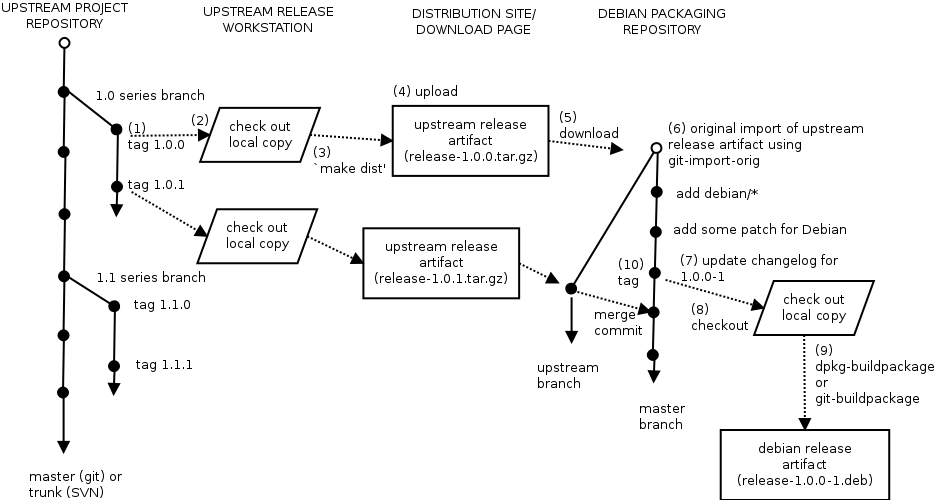
Sadly, despite everybody having the best intentions, there is sometimes a chasm separating these two groups of people. Upstream developers are often busy developing new features and don't have time to work on the intricacies of packaging. I hope that by sharing a few of my own experiences I can help more developers get their software packaged more easily. Fortunately, a number of great tools like git-buildpackage have emerged for streamlining the packaging process, but this has also created more confusion for developers who have their own git repositories and don't quite understand how the Debian git repository and patching process relates to their own repository. The autotools world Here, I focus on autotools based software, because this type of software has it's own peculiar issues when packaging. In particular, these issues appear when using a version control system to track upstream releases. Some of the concepts can be applied to the study of regular Makefile or cmake projects as well. Here is a diagram giving an overview: Let's work through each of the steps in the diagram: The upstream release
  1. The developer/release manager updates the version number in
    configure.ac
    (sometimes called configure.in) and tags the code. (Usually this tag is on a dedicated release branch.)
  2. The developer checks out a copy of the code from the tag into a fresh working directory
  3. The developer runs the autoreconf/automake tools, usually from a bootstrap script. These tools create a number of new files that don't exist in the project repository. Finally, the developer runs
    make dist
    , which puts all the files,
    including the generated files, into a distribution tarball. It is worth emphasizing this point: the tarball is not just an archive of the files from the repository/tag, it also contains a number of
    files generated by autotools.
  4. The developer uploads the tarball to a web site such as the Sourceforge download page. Usually a release announcement is made now containing checksums for the tarball.
At this point, the upstream developer's work is done and packaging teams from various projects such as Debian will take over. Sometimes, the upstream developer is also building the packages and continues
onto the next steps himself: Packaging
  1. The package is downloaded by the package maintainer
  2. If it is the first download, the maintainer creates a new git repository. If it has been packaged before, he clones the repository. The important point here is that this is not the upstream repository, it is an independent repository for Debian packaging. The maintainer uses the git-import-orig tool to import the upstream tarball into the packaging repository. The git-import-orig tool captures an exact snapshot of the upstream release tarball contents in a branch called upstream. One point where the Debian repository differs fundamentally from the upstream repository is that all files from the tarball will be tracked in the Debian git repository, even those automatically generated files that were created by autotools and don't exist in the upstream repository.
  3. The maintainer creates or updates the various artifacts for packaging. These files are kept on the master branch, and the tarball contents from the upstream branch are merged into master to create packages.
  4. When the maintainer feels the code is ready, he will check out a clean copy of the repository to build the package from.
  5. The maintainer executes a tool such as git-buildpackage or regular dpkg-buildpackage, which creates the *.deb files.
  6. The files are checked with a tool like lintian and some manual testing/installation. If all is OK, a tag is made in the packaging repository, with a suffix appended to the upstream version number to indicate which iteration of the package it applies to.
AttachmentSize
release-packaging-workflow.dia3.97 KB

Paul Tagliamonte: Here s my talk from PyCon 2013 (I tried to queue it up to...

<iframe allowfullscreen="allowfullscreen" frameborder="0" height="299" src="http://www.youtube.com/embed/1vui-LupKJI?wmode=transparent&amp;autohide=1&amp;egm=0&amp;hd=1&amp;iv_load_policy=3&amp;modestbranding=1&amp;rel=0&amp;showinfo=0&amp;showsearch=0#t=16m14s" width="400"></iframe>

Here s my talk from PyCon 2013 (I tried to queue it up to where I start (@ 16:14)

A bit more giggley then I intended, but apparently it s endearing.

If anyone s actually interested in Hy, check out #hy on irc.freenode.net, star the code @ git.io/hy - it s actually pretty feature complete. If you want to play with it, check out the magic repl I ve been pondering taking it a bit more serious, so there is even a bit of documentation thanks to Chris Webber (hey, thanks!). Rock on!

2 April 2013

Russ Allbery: Review: An Election

Review: An Election, by John Scalzi
Publisher: Subterranean
Copyright: 2010
Printing: 2012
ISBN: 1-59606-496-X
Format: Kindle
Pages: 24
This is another story from the Subterranean Scalzi Super Bundle that probably doesn't justify a full review, particularly since this time it's a short story and not even a novelette, but as with the others it's been independently published on the Kindle (and is still available that way for 99 cents). So by my obsessive internal consistency that matters only to me, it gets a full review anyway. I was mildly surprised to find that this was actually my second reading, and now vaguely remember that Subterranean had actually sponsored the story's appearance on Scalzi's blog as an advertising experiment. So I originally read the story from Scalzi's blog, and if you don't really want to pay money for it, you still can as well. Along with a couple of ads that appear to have bit-rotted. The chief feature of An Election is the background: a world in which aliens and humans are intermingled in a political district, going about their lives against a background of rather extreme multispecies diversity. The protagonist, David, decides to run for the upcoming city council special election, despite living in a district that's minority-human and that hasn't seen a human councilor in forty-four years. (David also happens to be a gay man, which goes entirely unremarked in the story and is, in fact, entirely unremarkable given the excitingly diverse characteristics of his alien neighbors. I thought that was a nice touch.) He of course appears to stand no chance, particularly when one of the city bosses decides to run as well, but ends up with a campaign advisor almost by accident and determinedly attempts to connect with his neighbors and earn their votes. This felt quite typical to me of Scalzi's humor writing. The protagonist is a good-hearted person who gets in rather over his head but is still determined to do the right thing, while not taking anything too seriously. The background humor is never particularly threatening and tends towards slapstick and banter. I found it similar in tone to most of Agent to the Stars, although of course much shorter. As usual, Scalzi's grasp of conversational banter is probably the strongest part of the story; the dynamic between David, his husband James, and his campaign advisor brought several chuckles for me. This is slight but enjoyable. I wouldn't go out of my way to read it, but it's a good story to toss into a bundle of other work, and I remember it holding my interest when reading it on-line. (Which is rare; usually I fail to finish any fiction I try to read in a browser unless it's extremely short.) Rating: 6 out of 10

1 April 2013

Russ Allbery: Review: Echo

Review: Echo, by Jack McDevitt
Series: Alex Benedict #5
Publisher: Ace
Copyright: November 2010
Printing: November 2011
ISBN: 1-937007-00-6
Format: Mass market
Pages: 367
This is the fifth book in the ongoing Alex Benedict series, but reading the previous volumes is generally optional. While there are references to earlier events (and indeed I resorted to Wikipedia at one point to refresh my memory of the plot of the the first book in the series), they aren't critical to the plot. They mostly are background for the reactions of other characters to Benedict and his firm. Echo opens with the now-familiar prologue, giving us a fleeting and limited glimpse into the mystery that Benedict and Chase Kolpath will be pursuing for the rest of the book. This time, it features the explorer Somerest Tuttle, who has spent most of his life looking for intelligent alien life. (In the far future setting of these books, humanity has spread through a large region of the galaxy but has only encountered one other alien race.) In the twilight of his career and life, a friend who works as a tour guide for astronomical tours comes to him with a story about something she saw. What, we don't know, and won't for most of the book. But, whatever it is, Tuttle never goes public with it, which is directly contrary to what everyone would expect him to do with any news about alien life. Benedict and Kolpath get involved some years later, after Tuttle's death, when a stone slab with unknown markings that was part of his estate shows up on the future equivalent of Craigslist, free to the first person who will haul it away. Benedict finds that interesting enough to go pick up, but then is really hooked when someone else goes to considerable lengths to try to make the slab disappear before anyone can get a good look at it. This, slowly, leads into poking around Tuttle's life and connections, the star tour industry, and the possible origins of the slab. If you've read any of the previous books in this series, Echo is more of the same, and I mean that in a good way. I think McDevitt is at his best when writing this sort of cross between scientific puzzle, mystery, and non-military adventure, full of people who care deeply about knowing and understanding things and don't like to be thwarted in their efforts. There is McDevitt's trademark halting and red-herring-ridden investigation that succeeds in being engrossing and compelling, plenty of opportunities to guess what's really going on (a bit easier this book than in some others), and a bit of action that I thought was better-handled than the somewhat strained action scenes of The Devil's Eye. The book moves right along, despite multiple reversals in the progress of the investigation, and the final revelation does indeed justify the strange behavior of the various people Benedict encounters. As with McDevitt in general and this series in particular, there is one caveat: the astronomical details are often interesting, but the world building in general is not terribly believable. Despite supposedly taking place millennia into the future, the society is a straight transplant (projection would imply more change than exists) of middle-class American culture, with bonus air cars, space ships, and slightly better computers. Similarly, alien ecologies suffer from severe Star Trek problems: all the planets feel like copies of Earth with a few minor tweaks. This just goes with the territory, and if you're up to the fifth book of the series, you've probably gotten used to it, but the unrealistic lack of divergence is actually used as a plot point here. That strained my suspension of disbelief a bit. That said, this sort of extremely familiar social context does give the books an oddly calm, comfortable feeling. It's tempting to describe McDevitt as cozy science fiction. There's a bit of danger, a bit of suspense, but one is fairly certain that everything will work out in the end and the reader will leave the book knowing the solutions to most of the mysteries raised without having to work very hard at understanding the society or the puzzle. If that's what you're in the mood for (and I was when I read Echo), McDevitt delivers reliably. If you like the Alex Benedict series in general, recommended, as this is an excellent example of the type. Rating: 8 out of 10

31 March 2013

Russell Coker: Links March 2013

Russ Allbery wrote an informative post about how to determine which charities are worth donating to [1]. He has a link to another article about the charities to which he donates and concentrates on ways of analysing the effectiveness of charities. So someone who has different ideas about which types of charity are worthy of donation could still learn a lot from his post. Adam Green wrote an interesting article for The New Yorker about Apollo Robbins who is one of the world s best pick-pockets [2]. Apollo picks pockets as a magician to entertain people and always returns what he steals. Now he is working with neuroscientists who are devising experiments to determine why his tricks work. Rick Falkvinge wrote an insightful article describing the way that the copyright monopoly is in direct opposition to the freedom to make contracts [3]. It s a good rebuttal of a common argument in favor of copyright law. Seth Godin gave an interesting TED talk about the problems with the education system, how and why it teaches conformity and little else [4]. One of his suggestions for improvement is to have students spend their evenings watching lectures by experts and class time asking questions. He also says that everything should be open book and that there is no value in memorising anything it s a bit of an overstatement but it s essentially correct. Cory Doctorow wrote an interesting article for The Guardian about positive externalities and copyright law [5]. I think that he didn t choose the best way of framing this issue, but he makes some very interesting points anyway. Andrew Norton wrote an interesting article about how to reduce corruption in the police force and other government agencies [6]. A large part of this is based on making them subject to the same laws as everyone else, which seems to be a radical idea. Valerie Aurora wrote an insightful blog post about suicide [7]. Emily Oster gave an interesting TED talk about the factors that determine the spread of AIDS in Africa [8]. It s quite different to what you probably expect.

30 March 2013

Evgeni Golov: Opera, standards and why I should have stayed in my cave

So you probably heard that I have that little new project of mine: QiFi the pure JavaScript WiFi QR Code Generator. It s been running pretty well and people even seem to like it. One of its (unannounced) features is a pretty clean stylesheet that is used for printing. When you print the result will be just the SSID and the QR code, so you can put that piece of paper everywhere you like. That works (I tested!) fine on Iceweasel/Firefox 10.0.12 and Chromium 25.0. Today I tried to do the same in Opera 12.14 and it failed terribly: the SSID was there, the QR code not. And here my journey begins First I suspected the CSS I used was fishy, so I kicked all the CSS involved and retried: still no QR code in the print-out. So maybe it s the QR code library I use that produces a weird canvas? Nope, the examples on http://diveintohtml5.info/canvas.html and http://devfiles.myopera.com/articles/649/example5.html don t print either. Uhm, let s Google for opera canvas print And oh boy I should not have done that. It seems it s a bug in Opera. And the proposed solution is to use canvas.toDataURL() to render the canvas as an image and load the image instead of the canvas. I almost went that way. But I felt that urge need to read the docs before. So I opened http://www.w3.org/html/wg/drafts/html/master/embedded-content-0.html#dom-canvas-todataurl and https://developer.mozilla.org/en-US/docs/DOM/HTMLCanvasElement and started puking:
When trying to use types other than image/png , authors can check if the image was really returned in the requested format by checking to see if the returned string starts with one of the exact strings data:image/png, or data:image/png; . If it does, the image is PNG, and thus the requested type was not supported. (The one exception to this is if the canvas has either no height or no width, in which case the result might simply be data:, .)
If the type requested is not image/png, and the returned value starts with data:image/png, then the requested type is not supported.
Really? I have to check the returned STRING to know if there was an error? Go home HTML5, you re drunk! Okay, okay. No canvas rendered to images then. Let s just render the QR code as a <table> instead of a <canvas> when the browser looks like Opera. There is nothing one could do wrong with tables, right? But let s test with the basic example first: Yes, this is 2013. Yes, this is Opera 12.14. Yes, the rendering of a fucking HTML table is wrong. Needles to say, Iceweasel and Chromium render the example just fine. I bet even a recent Internet Explorer would That said, there is no bugfixworkaround for Opera I want to implement. If you use Opera, I feel sorry for you. But that s all. Update: before someone cries ZOMG! BUG PLZ!!! , I filled this as DSK-383716 at Opera.

29 March 2013

Richard Hartmann: Release Critical Bug report for Week 13

Hallowed fornicating k lusk tur, Chiroptera Sapiens Sapiens! Look at that corrected bug count... It seems week 16, or even week 15, will really be the week of the penguin! The UDD bugs interface currently knows about the following release critical bugs: How do we compare to the Squeeze release cycle?
Week Squeeze Wheezy Diff
43 284 (213+71) 468 (332+136) +184 (+119/+65)
44 261 (201+60) 408 (265+143) +147 (+64/+83)
45 261 (205+56) 425 (291+134) +164 (+86/+78)
46 271 (200+71) 401 (258+143) +130 (+58/+72)
47 283 (209+74) 366 (221+145) +83 (+12/+71)
48 256 (177+79) 378 (230+148) +122 (+53/+69)
49 256 (180+76) 360 (216+155) +104 (+36/+79)
50 204 (148+56) 339 (195+144) +135 (+47/+90)
51 178 (124+54) 323 (190+133) +145 (+66/+79)
52 115 (78+37) 289 (190+99) +174 (+112/+62)
1 93 (60+33) 287 (171+116) +194 (+111/+83)
2 82 (46+36) 271 (162+109) +189 (+116/+73)
3 25 (15+10) 249 (165+84) +224 (+150/+74)
4 14 (8+6) 244 (176+68) +230 (+168/+62)
5 2 (0+2) 224 (132+92) +222 (+132/+90)
6 release! 212 (129+83) +212 (+129/+83)
7 release+1 194 (128+66) +194 (+128/+66)
8 release+2 206 (144+62) +206 (+144/+62)
9 release+3 174 (105+69) +174 (+105/+69)
10 release+4 120 (72+48) +120 (+72/+48)
11 release+5 115 (74+41) +115 (+74/+41)
12 release+6 93 (47+46) +93 (+47/+46)
13 release+7 50 (24+26) +50 (+24/+26)
14 release+8
15 release+9
16 release+10
17 release+11
18 release+12
Graphical overview of bug stats thanks to azhag:

27 March 2013

Benjamin Mako Hill: The Institute for Cultural Diplomacy and Wikipedia

A month ago, Mark Donfried from the Institute for Cultural Diplomacy (ICD) an organization dedicated to promoting open dialogue sent me this letter threatening me with legal action because of contributions I ve made to Wikipedia. Yesterday, he sent me this followup threat. According to the letters, Donfried has threatened me with legal action because I participated in a discussion on Wikipedia that resulted in his organization s article being deleted. It is not anything I wrote in any Wikipedia article that made Donfried so upset although Donfried is also unhappy about at least one off-hand comment I made during the deletion discussion on a now-deleted Wikipedia process page. Donfried is unhappy that my actions, in small part, have resulted in his organization not having an article in Wikipedia. He is able to threaten me personally because unlike many people I edit Wikipedia using my real, full, name. Donfried s letter is the latest step in a saga that has been ongoing since last June. It has been a frustrating learning experience for me that has made me worried about Wikipedia, its processes, and its future. In Wikipedia, debates can be won by stamina. If you care more and argue longer, you will tend to get your way. The result, very often, is that individuals and organizations with a very strong interest in having Wikipedia say a particular thing tend to win out over other editors who just want the encyclopedia to be solid, neutral, and reliable. These less-committed editors simply have less at stake and their attention is more distributed. The ICD is a non-profit organization based in Berlin. According to its own website, a large part of the organization s activities are based around arranging conferences. Its goals peace, cultural interchange, human rights are admirable and close to my heart. Its advisors and affiliates are impressive. I had never heard of the ICD before their founder, Mark Donfried, emailed me in April 2012 asking me to give a keynote address at their conference on The 2012 International Symposium on Cultural Diplomacy & Human Rights. I replied, interested, but puzzled because my own research seems very far afield of both cultural diplomacy (which I had never heard of) and human rights. I replied saying:
What would you like me to talk about I ask because I don t consider myself an expert in (or even particularly knowledgeable about) cultural diplomacy. Did someone else refer you to me?
Donfried replied with a long message seemingly copy and pasted thanking me for considering attending and asking me for details of my talk. I replied again repeating text from my previous email and asking why he was interested in me. Donfried suggested a phone call to talk about details. But by this point, I had looked around the web for information about the ICD and had decided to decline the invitation. Among things I found was a blog post by my friend James Grimmelmann that suggests that, at least in his case, the ICD had a history of sending unsolicited email and an apparently inability to take folks off their email lists even after repeated requests. I also read the Wikipedia article about the ICD. Although the Wikipedia article was long and detailed, it sent off some internal Wikipedian-alarm-bells for me. The page read, to me, like an advertisement or something written by the organization being described; it simply did not read to me like an encyclopedia article written by a neutral third-party. I looked through the history of the article and found that the article had been created by a user called Icd_berlin who had made no other substantive edits to the encyclopedia. Upon further examination, I found that almost all other significant content contributions were from a series of anonymous editors with IP addresses associated with Berlin. I also found that a couple edits had removed criticism when it had been added to the article. The criticism was removed by an anonymous editor from Berlin. Criticisms on the article included links to a website called Inside the ICD which was a website that mostly consisted of comments by anonymous people claiming to be former interns of the ICD complaining about the working conditions at the organization. There were also many very positive descriptions of work at the ICD. A wide array of pseudonymous users on the site accused the negative commenters of being liars and detractors and the positive commenters of being ICD insiders. I also found that there had been evidence on Wikipedia also removed without discussion by an anonymous IP from Berlin of an effort launched by the youth wing of ver.di one of the largest trade unions in Germany to campaign for good internships at the ICD. Although details of the original campaign have been removed from ver.di s website, the campaigned ended after coming to an agreement with the ICD that made explicit a set of expectations and created an Intern Council. Although the article about ICD on Wikipedia had many citations, many were to the ICD s own website. Most of the rest were to articles that only tangentially mentioned the ICD. Many were about people with ICD connections but did not mention the ICD at all. As Wikipedia editor, I was worried that Wikipedia s policies on conflict of interest, advertising, neutrality, and notability were not being served by the article in its state. But as someone with no real experience or knowledge of the ICD, I wasn t sure what to do. I posted a request for help on Wikipedia asking for others to get involved and offer their opinions. It turns out, there were several editors who had tried to improve the article in the past and had been met by pro-ICD editors reverting their changes. Eventually, those editors lost patience or simply moved on to other topics. By raising the issue again, I kicked off a round of discussion about the article. At the termination of that discussion, the article was proposed for deletion under Wikipedia s Articles for Deletion policy. A new Wikipedia editor began working enthusiastically to keep the article by adding links and by arguing that the article should stay. The new user edited the Wikipedia article about me to accuse me of slander and defamation although they removed that claim after I tried to explain that I was only trying to help. I spent quite a bit of time trying to rewrite and improve the article during the deletion discussion and I went link by link through the many dozens of citations. During the deletion discussion, Mark Donfried contacted me over email and explained that his representatives had told him that I was working against the ICD in Wikipedia. He suggested that we meet. We had a tentative plan to meet in Berlin on an afternoon last July but, in the end, I was too busy trying to submit my thesis proposal and neither of us followed up to confirm a particular time within the time window we had set. I have still never met him. My feeling, toward the end of the deletion discussion on Wikipedia, was mostly exasperation. Somewhat reluctantly, I voted to delete the article saying:
Delete This AFD is a complete mess for all the reasons that the article itself is. Basically: there are a small number of people who seem to have a very strong interest in the Institute for Cultural Diplomacy having an article in Wikipedia and, from what I can tell, very little else. Hessin fahem, like all the major contributors to the page, joined Wikipedia in order to participate in this issue. This article has serious problems. I have posted a detailed list of my problems on the article talk page: primary sources, conflict of interest for nearly all substantive contributions and reading like an advert are the biggest issues. My efforts to list these problems were reverted without discussion by an anonymous editor from Berlin. I have seen no evidence that the Institute for Cultural Diplomacy satisfies WP:ORG but I agree that it is possible that it does. I strongly agree with Arxiloxos that articles should always be fixed, and not deleted, if they are fixable. But I also know that Wikipedia does not deserve this article, that I don t know to fix it, and that despite my efforts to address these issues (and I ll keep trying), the old patterns of editing have continued and the article is only getting worse. This ICD seems almost entirely based around a model that involves organizing conferences and then calling and emailing to recruit speakers and attendees. A large number of people will visit this Wikipedia article to find out more about the organization before deciding to pay for a conference or to join to do an internship. What Wikipedia shows to them reads like an advert, links almost exclusively to of pages on the organizations websites and seems very likely to have been written by the organization itself. We are doing an enormous disservice to our readers by keeping this page in its current form. If somebody wants to make a serious effort to improve the article, I will help and will happily reconsider my !vote. But after quite a bit of time trying to raise interest and to get this fixed, I m skeptical this can be addressed and my decision reflects this fact. mako 05:18, 12 June 2012 (UTC)
I concluded that although the organization might be notable according to Wikipedia s policies and although the Wikipedia article about it might be fixable, the pattern of editing gave me no faith that it could be fixed until something changed. When the article was deleted, things became quiet. Several months later a new article was created again, by an anonymous user with no other edit history. Although people tend to look closely at previously deleted new pages, this page was created under a different name: The Institute of Cultural Diplomacy and was not noticed. Deleted Wikipedia articles are only supposed to be recreated after they go through a process called deletion review. Because the article was recreated out of this process, I nominated it for what is called speedy deletion under a policy specifically dealing with recreated articles. It was deleted again. Once again, things were quiet. In January, it seems, the Inside the ICD website was threatened with a lawsuit by the ICD and the maintainers of the site took it down with the following message:
Apparently, the ICD is considering filing a lawsuit against this blog and it will now be taken down. We completely forgot about this blog. Let s hope no one is being sued. Farewell.
On February 25, the Wikipedia article on ICD was recreated once again out of process and by a user with almost no previous edit history. The next day, I received an email from Mark Donfried. In the message, Donfried said:
Please note that the ICD is completely in favor of fostering open dialogue and discussions, even critical ones, however some of your activities are raising serious questions about the motives behind your actions and some even seem to be motives of sabotage, since they resulted in ICD not having any Wikipedia page at all. We are deeply concerned regarding these actions of yours, which are causing us considerable damages. As the person who initiated these actions with Wikipedia and member of the board of Wikipedia [1], we would therefore request your answer regarding our questions below within the next 10 days (by March 6th). If we do not receive your response we will unfortunately have to consider taking further legal actions with these regards against you and other anonymous editors.
I responded to Donfried to say that I did not think it was prudent to speak with him while he was threatening me. Meanwhile, other Wikipedia editors nominated the ICD article for deletion once again and unanimously decided to delete it. And although I did not participate in the discussion, Donfried emailed again with more threats of legal action hours after the ICD article was deleted:
[A]s the case of the ICD and its presentation on the Wikipedia has seriously worsened in recent days, we see no alternative but to forward this case (including all relevant visible and anonymous contributors) to our legal representatives in both USA and Europe/Germany as well as to the authorities and other corresponded organizations in order to find a remedy to this case.
Donfried has made it very clear that his organization really wants a Wikipedia article and that they believe they are being damaged without one. But the fact that he wants one doesn t mean that Wikipedia s policies mean he should have one. Anonymous editors in Berlin and in unknown locations have made it clear that they really want a Wikipedia article about the ICD that does not include criticism. Not only do Wikipedia s policies and principles not guarantee them this, Wikipedia might be hurt as a project when this happens. The ICD claims to want to foster open dialogue and criticism. I think they sound like a pretty nice group working toward issues I care about personally. I wish them success. But there seems to be a disconnect between their goals and the actions of both their leader and proponents. Because I used my real name and was skeptical about the organization on discussion pages on Wikipedia, I was tracked down and threatened. Donfried insinuated that I was motivated to sabotage his organization and threatened legal action if I do not answer his questions. The timing of his first letter the day after the ICD page was recreated means that I was unwilling to act on my commitment to Wikipedia and its policies. I have no problem with the ICD and I deeply regret being dragged into this whole mess simply because I wanted to improve Wikipedia. That said, Donfried s threat has scared me off from attempts to improve the ICD articles. I suspect I will not edit ICD pages in Wikipedia in the future. The saddest part for me is that I recognize that what is in effect bullying is working. There are currently Wikipedia articles about the ICD in many languages. For several years, ICD has had an article on English Wikipedia. For almost all of that period, that article has consisted entirely of universally positive text, without criticism, and has been written almost entirely by anonymous editors who have only contributed to articles related to the ICD. In terms of the ICD and its article on Wikipedia, I still have hope. I encourage Donfried and his representatives to create accounts on Wikipedia with their full names just like I have. I encourage them to engage in open dialogue in public on the wiki. I encourage them go through deletion review, make any conflicts of interest they have unambiguously clear, and to work with demonstrably non-conflicted editors on Wikipedia to establish notability under Wikipedia s policies. The result still can be an awesome, neutral, article about their organization. I have offered both advice on how to do this and help in that process in the past. I have faith this can happen and I will be thrilled when it does. But the general case still worries me deeply. If I can be scared off by threats like these, anybody can. After all, I have friends at the Wikimedia Foundation, a position at Harvard Law School, and am close friends with many of the world s greatest lawyer-experts on both wikis and cyberlaw. And even I am intimidated into not improving the encyclopedia. I am concerned by what I believe is the more common case where those with skin in the game will fight harder and longer than a random Wikipedian. The fact that it s usually not me on the end of the threat gives me lots of reasons to worry about Wikipedia at a time when its importance and readership continues to grow as its editor-base remains stagnant.
[1] It s a minor mistake but worth pointing out that I am not on the board of Wikipedia ; I am on its advisory board which carries no power or responsbility within the organization. Sometimes, the foundation asks for my advice and I happily give it.

26 March 2013

Ryan Kavanagh: Setting up full-disk encryption in OpenBSD 5.3

I recently decided to try out a snapshot of OpenBSD 5.3, intrigued by the notice that
softraid(4) RAID1 and crypto volumes are now bootable on i386 and amd64 (full disk encryption).
I ve always used an encrypted LVM (as setup by the alternate CD) with a fully encrypted root on my netbook and laptop when running Debian/Kubuntu and never noticed much a performance hit. Unfortunately, I m not the only one who has noticed a significant drop in performance with full-disk encryption on OpenBSD. Although the steps required to setup full-disk encryption (as opposed to requiring manual intervention at boot or the equivalent of loop-mounted encrypted images via vnconfig(8)) on OpenBSD are not explicitly documented anywhere, searching through the mailing lists, man pages, and trial and error provided the following steps:
  1. Boot from your install media. Select the (S)hell option.
  2. Assuming the disk you re installing to is wd0 , run fdisk -i wd0 if you re on an i386. If I m not mistaken, you can skip to the following step otherwise.
  3. Run disklabel -E wd0. Create a label (typically b) of the appropriate size of type swap for swap, and then add a label a using the remainder of the space of type RAID. We aren t going to put swap on our crypto device since OpenBSD has encrypted the swap partition by default since 2005.
  4. Setup the crypto volume as described in bioctl(8). You will be prompted for a passphrase and presented with a message along the lines of softraid0: SR CRYPTO volume attached as sd0 on successful setup. I used bioctl -c C -l /dev/wd0a softraid0 where - -c C specifies a device with raidlevel CRYPTO , - -l /dev/wd0a specifies the label of type RAID created in step 3 to use for the CRYPTO device, and - softraid0 is the softraid device to configure (this value should work unless you already have a softraid0 device).
  5. exit from the shell and (I)nstall as normal, installing to the disk sd0 (or whichever disk the crypto volume got attached as). In the partitioning dialog, you may need to manually adjust things since the auto-partitioning creates an additional swap label on sd0, which we don t need given we already have wd0b.
  6. Using ed(1), add the line 1a8bab44e9cc178d.b none swap sw to /mnt/etc/fstab, assuming that 1a8bab44e9cc178d is the DUID associated with wd0 (you can find this out by running sysctl hw.disknames, which will output something like hw.disknames=wd0:1a8bab44e9cc178d,cd0:,rd0:6ce80c78714fa32f,sd0:fce7bfa23c8ec20d; just search for the DUID associated with wd0). Alternatively, wait until you boot into your system, and add it to your /etc/fstab using vi(1) or mg(1).
  7. Reboot, and you ll be prompted for your passhprase. You re done!
Here s a screenshot of steps 1 through 4. Steps 1 through 4 Here s a screenshot of the passphrase prompt, after successfully entering the passphrase: Passphrase prompt If I ve made any errors in the steps above, please point them out in the comments below or by sending me an email.

25 March 2013

Joey Hess: difficulties in backing up live git repositories

But you can t just tar.gz up the bare repositories on the server and hope for the best. Maybe a given repository will be in a valid state; maybe it won t.
-- Jeff Mitchell in a followup to the recent KDE near git disaster This was a surprising statement to me. I seem to remember that one of (many) selling points for git talked about back in the day was that it avoided the problem that making a simple cp (or backup) of a repository could lead to an inconsistent result. A problem that subversion repositories had, and required annoying commands to work around. (svnadmin $something -- iirc the backend FSFS fixed or avoided most of this issue.) This prompted me to check how I handle it in ikiwiki-hosting. I must have anticipated a problem at some point, since ikisite backup takes care to lock the git repository in a way that prevents eg, incoming pushes while a backup is running. Probably, like the KDE developers, I was simply exercising reasonable caution. The following analysis has probably been written up before (train; limited network availability; can't check), but here are some scenarios to consider: I think that it's important git support naive backups of git repositories as well as possible, because that's probably how most backups of git repositories are made. We don't all have time to carefully tune our backup systems to do something special around our git repositories to ensure we get them in a consistent state like the KDE project did, and as their experience shows, even if we do it, we can easily introduce other, unanticipated problems. Can anyone else think of any other failure modes like these, or find holes in my slightly rushed analysis?
PS: git-annex is itself entirely crash-safe, to the best of my abilities, and also safe for naive backups. But inherits any problems with naive backups of git repositories.

24 March 2013

Thorsten Glaser: Earthcache Master (Bronze)

Since a while
I am a proud
EarthCache Master
On the other hand I should probably put up my own, local, list of found caches, considering what happened to me on Open caching. And maybe write intros for people new to geocaching, since it d be virtually no work now had I done it initially. (And for fanfiction readers! I wish I d kept a list of read fics, not just of these I currently read and/or are currently unfinished.)

22 March 2013

Richard Hartmann: Release Critical Bug report for Week 12

Let's see if we will have 82 open bugs next week ;) Current trend points towards week 16/17. The UDD bugs interface currently knows about the following release critical bugs: How do we compare to the Squeeze release cycle?
Week Squeeze Wheezy Diff
43 284 (213+71) 468 (332+136) +184 (+119/+65)
44 261 (201+60) 408 (265+143) +147 (+64/+83)
45 261 (205+56) 425 (291+134) +164 (+86/+78)
46 271 (200+71) 401 (258+143) +130 (+58/+72)
47 283 (209+74) 366 (221+145) +83 (+12/+71)
48 256 (177+79) 378 (230+148) +122 (+53/+69)
49 256 (180+76) 360 (216+155) +104 (+36/+79)
50 204 (148+56) 339 (195+144) +135 (+47/+90)
51 178 (124+54) 323 (190+133) +145 (+66/+79)
52 115 (78+37) 289 (190+99) +174 (+112/+62)
1 93 (60+33) 287 (171+116) +194 (+111/+83)
2 82 (46+36) 271 (162+109) +189 (+116/+73)
3 25 (15+10) 249 (165+84) +224 (+150/+74)
4 14 (8+6) 244 (176+68) +230 (+168/+62)
5 2 (0+2) 224 (132+92) +222 (+132/+90)
6 release! 212 (129+83) +212 (+129/+83)
7 release+1 194 (128+66) +194 (+128/+66)
8 release+2 206 (144+62) +206 (+144/+62)
9 release+3 174 (105+69) +174 (+105/+69)
10 release+4 120 (72+48) +120 (+72/+48)
11 release+5 115 (74+41) +115 (+74/+41)
12 release+6 93 (47+46) +93 (+47/+46)
13 release+7
14 release+8
15 release+9
16 release+10
17 release+11
18 release+12
Graphical overview of bug stats thanks to azhag:

20 March 2013

Masayuki Hatta: Recipe for Debian Haskell packaging

The following is what I usually do when I want to debianize a Haskell stuff from Hackage. This is a personal recipe, by no means official procedure or such. I may be wrong, badly at that.

  1. Check pkg-haskell repository whether your intended package already exists or not. Somebody might work on it already.
  2. Find the webpage of your intended package at HackageDB, then download Cabal source package . Untar it. The tarball filename should be changed to fit the Debian source package convention. For example, if the original name is something like foobar-1.0.tar.gz, then it should be haskell-foobar_1.0.orig.tar.gz.
  3. File ITP. reportbug is your friend.
  4. Run cabal-debian in untared dir:
     $ cabal-debian --debianize --quilt
    
    We do have the upstream tarball, so use quilt. See http://wiki.debian.org/UsingQuilt. It might give you warnings about changelog. debian/changelog doesn t exist yet, so ignore it.
  5. Now read http://wiki.debian.org/Haskell/CollabMaint/Processes and http://wiki.debian.org/Haskell/CollabMaint/PackageTemplate carefully. Then do things as they say. These two are short, but well-written instructions. Edit the generated debian/control appropriately. Do not forget to make your debian/copyright machine-friendly. See http://www.debian.org/doc/packaging-manuals/copyright-format/1.0/.
  6. Test whether your package is flawless and really buildable. Do lintian. Use pbuilder.
     $ lintian haskell-foobar_1.0-1_amd64.changes
     # pbuilder --build haskell-foobar_1.0-1.dsc
    
  7. Read http://wiki.debian.org/Haskell/CollabMaint/DarcsBasic. Darcs is quite easy to use, and you don t have to be the master of Darcs to merely debianize things anyway. Basically, what I usually do is
     $ darcs record -a; darcs push --repo=debian
    
    Darcs is well-suited to Haskell-related development, but seems you can use Git, too.
  8. Change debian/changelog. UNRELEASED in the first line should be unstable or experimental . Do not forget to close ITP.
  9. Finally, do
     $ debuild -tc; debcommit -r; debrelease; darcs push --repo=debian
    
    That s all folks!

Jan Wagner: Chemnitzer Linux-Tage 2013!

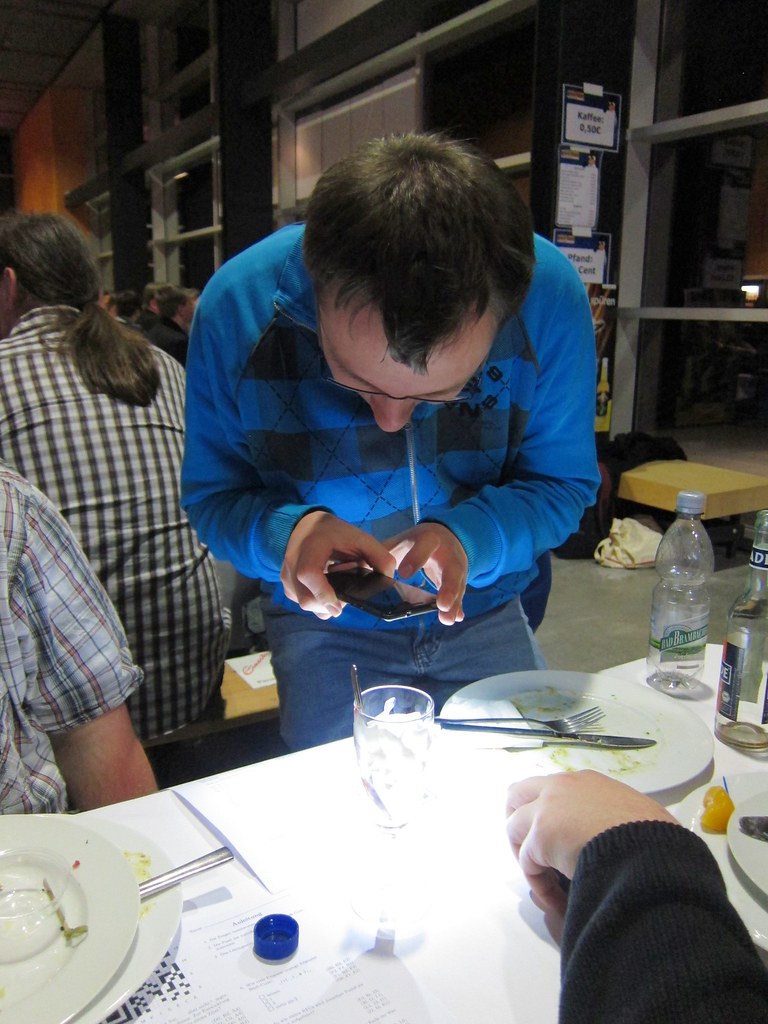
Also this year the Debian project was present at Chemnitzer Linuxtage, this time right next the debianforum.de booth. The booth folks arriving on friday organized a flashmob at Expitas after booth setup. Unfortunatly our second planned flashmob at the mensa was boycotted by much more students, so we ended up in the Turm-Brauhaus, which is a great location with good drinks but the service was very harshly. On the next two days at the booth we chatted and discussed with visitors and other exhibitors a wide variety of questions, including 'When will be (the next Debian version) released?' and 'Are there installation disks available?'. The answers was as always 'When we are ready and we will have reached the quality-level we defined', 'No we don't have installation medias, as they are always outdated. Do you have an USB-dongle with you?'. Merchandising was requested by visitors as always, but we just had some leftovers of fosdem, brought by Axel. The demonstration was as usual a small box running Babelbox and xpenguins which worked out the last years too. This year there were three lectures held by Debian related people, about Debian GIS, Aptitude - known but even unknown and SSH and unreliable network connections. The organisation team did a really great job. The social event at saturday night was very exciting and we left it early in the morning. The whole event was indeed fun and a pleasure to find new friends and meet old ones of the Free Software community. Many thanks to Florian Baumann, Jan Dittberner, Andreas Tille, Christian Hoffmann, Axel Beckert, Markus Rekkenbeil, Daniel Schier, Jonas Genannt, Jan H rsch and kurio for taking care and running the booth, which worked out this year extreme smoothly from my point of view. Likewise as the last years a special thanks to TMT GmbH & Co. KG, which kindly donated additional boothtickets, the equipment, its transportation and accommodation for almost half of the booth staff.
17 March 2013

Gregor Herrmann: RC bugs 2013/11

& another week has gone by where I tried to work on RC bugs. here's the overview:

16 March 2013

Stefano Zacchiroli: bits from the DPL for February 2013 and a half

Dear project members, here's another report of DPL activities, this time for a period longer than usual (February + 1st week of March), so that the next one will be at the very end of the current DPL term. Highlights Appointments DPL helpers Two more DPL helpers IRC meetings have happened, minutes and logs of both are available. Assets Events Past At the beginning of February, I've attended FOSDEM 2013, together with many other Debian people. I didn't have any specific talk this year, but it's been a chance to talk F2F about several ongoing issues (see logs), and help mediating in some conflicts. I've also accepted the invitation to participate in the GNOME Advisory Board meeting, together with Laurent Bigonville of our GNOME team. No report of that has been prepared as of yet (sorry about that), but we have both reported "live" to the rest of the team on IRC. Future Miscellaneous A couple of months ago I've mentioned that I had filed an application, as Debian representative, to participate in a working table to define software procurement rules for the Italian public administration. Good news: my application has been accepted, together with those of other well-known FOSS communities and organizations (e.g. KDE, FSFE). I'll keep you posted of how it goes. Let's go back to elect a new DPL and release Wheezy now,
Cheers.
PS the day-to-day activity logs for February and March 2013 are available at the usual place master:/srv/leader/news/bits-from-the-DPL.txt.20130 2,3

15 March 2013

Richard Hartmann: Release Critical Bug report for Week 11

Current prediction remains at six weeks. This is a tad meh. The UDD bugs interface currently knows about the following release critical bugs: How do we compare to the Squeeze release cycle?
Week Squeeze Wheezy Diff
43 284 (213+71) 468 (332+136) +184 (+119/+65)
44 261 (201+60) 408 (265+143) +147 (+64/+83)
45 261 (205+56) 425 (291+134) +164 (+86/+78)
46 271 (200+71) 401 (258+143) +130 (+58/+72)
47 283 (209+74) 366 (221+145) +83 (+12/+71)
48 256 (177+79) 378 (230+148) +122 (+53/+69)
49 256 (180+76) 360 (216+155) +104 (+36/+79)
50 204 (148+56) 339 (195+144) +135 (+47/+90)
51 178 (124+54) 323 (190+133) +145 (+66/+79)
52 115 (78+37) 289 (190+99) +174 (+112/+62)
1 93 (60+33) 287 (171+116) +194 (+111/+83)
2 82 (46+36) 271 (162+109) +189 (+116/+73)
3 25 (15+10) 249 (165+84) +224 (+150/+74)
4 14 (8+6) 244 (176+68) +230 (+168/+62)
5 2 (0+2) 224 (132+92) +222 (+132/+90)
6 release! 212 (129+83) +212 (+129/+83)
7 release+1 194 (128+66) +194 (+128/+66)
8 release+2 206 (144+62) +206 (+144/+62)
9 release+3 174 (105+69) +174 (+105/+69)
10 release+4 120 (72+48) +120 (+72/+48)
11 release+5 115 (74+41) +115 (+74/+41)
12 release+6
13 release+7
14 release+8
15 release+9
16 release+10
17 release+11
18 release+12
Graphical overview of bug stats thanks to azhag:

14 March 2013

Matthias Klumpp: Tanglu

Hi everyone! Today I make an announcement I thought I would never ever make. But things changed. Discussion about this has a long history, starting as a non-serious suggestion at DesktopSummit 2011, continued with people on IRC, but it was decided back then that it wouldn t be worth the effort. This has changed too, and a small team has formed to work on it. We hereby announce Tanglu, a new Debian-based-Linux distribution. A new logo?Why do we need another one? Let me explain the concepts of that distro: Tanglu will be based on Debian Testing and follow the Debian development closely. It will have a 6-months release-cycle and it s target audience are Linux desktop users. We will make installing and setting up the distro as easy as possible. Tanglu will be usable for both developers of upstream software and the average Linux user and Linux newbie. This is possible because in our opinion developers and users don t have different needs for a desktop system. Both kinds of users like a polished desktop which just works . We will, hwever, not apply any kind of fancy modification on upstream software, we will basically just distribute what upstream created, so users can get an almost pure GNOME and KDE experience. Tanglu is designed to be able to solve the issue that Debian is frozen for a long time and Debian Developers can t make new upstream versions available for testing easily. During a Debian freeze, DDs can upload their software to the current Tanglu development version and later start the new Debian cycle with already tested packages from Tanglu. The delta between Tanglu and Debian should be kept as minimal as possible. However, Tanglu is not meant as experimental distribution for Debian, so please upload experimental stuff to Experimental. Only packages good enough for a release should go into Tanglu. Ideally, Tanglu and Debian should be working well together in mixed environments, where you for example have Debian servers and multiple Tanglu desktops with the new software, targeted at desktop user. Since the differences between Tanglu and Debian should not be very high, administering both systems should be very easy (if you know Debian). Tanglu will be an open project, driven by community. At the beginning of each cycle, people can make suggestions for release goals they want to implement (similar to Fedora, but without FESCo). These proposals are discussed in public and are rejected if there are major technical concerns. If consensus about a certain proposal is lacking, a vote is done for it. The proposal can be accepted with absolute majority. If this does not happen, the proposal is postponed for the next release, where people can vote for it again. If nobody wants that function, it is rejected. In general, decisions made by Debian are superior and have to be followed. We don t think we know every package and every software better than the original upstream. That s why it makes much sense to rely on feedback from others and to have a community-based and peer-reviewed distribution, instead of secretly developing stuff and dumping it on the community. Tanglu will have a highly predictable set of features, defined at the beginning of a cycle, so you will know what you can expect from the next release as soon as possible and plan for it. Tanglu will make it easy to deploy applications for it. It will contain a software-center, similar to what Ubuntu has. We will also try to establish a solution for a Linux-AppCenter , a place for Linux applications, which will be open not only for Tanglu, but can be implemented in any other distribution too. Possible income will flow back into development of the platform. Now, let s answer the FQA (Future Questions Asked): Why don t you contribute to Debian directly and create yet another distribution? First of all, we contribute to Debian ;-) And for me, I can say that I will contribute to Debian even more. The point is that Debian can not cover all possible use-cases, and with Tanglu we want to make a distro which solves this. You might ask why we have to create a new distro for that, instead of creating improvements inside Debian? Creating a new distro allows us to do stuff we can never do in Debian. For example, we will include proprietary firmware in that distro, we will make installations of proprietary stuff possible easily (but don t ship with it by default) and we will have a time-based release cycle. These are already things which are a no-go for Debian, and that s fine. We don t want Debian to support these cases, as it is already a great distribution. We want to offer a distro as close to Debian as possible, but with a few modifications for use-cases which are not covered by Debian itself. Of course we will participate in DEX. If Debian Developers contribute to Tanglu, freezes will take even longer! This is an often-heard concern, it comes up on every mailinglist discussion about continuing development while freeze. I would disagree here, packaging new upstream stuff is not slowing down testing and improving of packages in Testing. Also, Tanglu is an offer for Debian developers to participate (we will sync privileges for their packages) we don t expect anyone to work on it, but as we think DDs know their packages best, we will make it possible for them to participate without extra barriers. We hope that Tanglu can add value to Debian and that Debian cycles can start with better-tested packages. You said you are a small team you cannot develop a whole distribution with it! Let s put that to the test! ;-) All people working on this are well aware of the issue that the project can not survive without much community-involvement on the long run. But we see a chance that many people are interested in it and that there is a high demand for it. At the beginning, we will just start with a small set of packages. We will also sync many packages from Ubuntu, to reduce workload. For example, it is planned to use the Ubuntu-Kernel and KDE packaging. By doing this, we keep the workload at the beginning low. We also reduce duplicate work with that. We even have some possible sponsors for the new distribution. But nothing is set in stone yet, so just wait for it to happen. :) Why not participate in Arch, OpenSUSE $other_distro? These are not Debian ;-) . I know, it sounds odd, but if you like the Debian way of doing things, you want to use a Debian-based distribution. There is nothing wrong with OpenSUSE. And Debian has issues too. But we want to be close to Debian and use it s tools and way of doing things. I hate you!!! You are doing it wrong!! The project is useless!
Well, that s fine. But there is no reason for hating us. If you dislike our idea, there are basically two options: First, you hate us but the project is successful. In that case, you have been wrong with hate, as there are definitely people who liked the project and contributed to it. Second, you hate us and we fail. In this case, there is no reason for hate, as the project will just vanish and you don t have to worry about it. So hating it would ve been just a big waste of energy. Also keep in mind that forking is a way to keep development healthy and to adapt software to new use-cases which it didn t target before. And we are not introducing incompatibilities here (like e.g. writing our own display server could). Instead, we want to stay close to Debian and reuse as much code as possible. Which desktop will you use? Everyone can add a new desktop to Tanglu, as long as the desktop-environment is present in Debian. Long term, we will have to offer Linux-newbies a default flavour, probably by setting a default download on the website. But as long as there is a community for a given desktop-environment, the desktop is considered as supported. At the beginning, we will focus on KDE, as many people have experience with it. But adding vanilla GNOME is planned too. Can you say something about the software used in Tanglu? Yes, but this is still in flow, so I can t promise final decisions here. On the server, side, we will try to use the Dak for repository management, as soon as we have enough server capacity. We will also use the standard Debian repository GUI and basically reuse most of the software there, to diverge less from Debian. The distribution itself will use a Linux Kernel from Ubuntu and systemd as the primary init system, as well as the login manager logind. It will be based on current Debian Testing with some fresh packages from Unstable and Experimental. We might also use the Ubuntu driver packages and KDE packaging. We expect to have a very rough start with the first release, but there will be enough time to polish Tanglu. Nice idea! How can I help? Well, you can help with basically anything at time from writing manuals, over designing logos and pages to administering a webserver and create packages. We are at an early stage of development at the moment, but we wanted to go public with it as soon as possible, to include the community and receive feedback so we can make that distro community-centric from the beginning. Most of the infrastructure is currently in progress too. So, if you want to get started with Tanglu, subscribe to our mailinglist tanglu-devel and write a mail to it, intruducing yourself. We can then include you in the loop. Generally, if you want to get access to our machines, a trusted GPG-signature will help a lot. If you want to talk to us, join #tanglu-devel or Freenode! Most discussions are currently happening there. And that s it! Tanglu will be awesome!

Some other projects of mine will develop a bit slower because I am now involved in Tanglu. But nothing will stop, and there is some pretty cool stuff coming for both GNOME and KDE (and I still have to implement DEP-11 for Debian). :)

Russ Allbery: Review: Higher Order Perl

Review: Higher Order Perl, by Mark Jason Dominus
Publisher: Morgan Kaufmann
Copyright: 2005
ISBN: 1-55860-701-3
Format: Trade paperback
Pages: 563
Disclaimer: The author and I both used to be (technically still are, but the newsgroup is dead) moderators of comp.lang.perl.moderated, and I knew him electronically from answering questions on the Perl Usenet newsgroups many years ago. Perl is, in general construction, a typical imperative language in the style of C, with object-oriented capabilities bolted (somewhat awkwardly) on. Most Perl code looks remarkably like C code with more powerful built-in data types and no memory management. A minority of Perl programs embrace object-oriented techniques and remind one of C++ or Java (or Python). But Perl also has powerful capabilities borrowed from functional programming languages and the Lisp tradition, even though many Perl programmers rarely use them and aren't familiar with them. Higher Order Perl focuses on those capabilities and how to use them effectively, starting with callbacks and uses of function pointers and moving into recursion and analysis of recursive functions, iterators, currying, and parsers. It concludes with a fully-worked example of constructing a declarative programming system using the techniques developed earlier in the book. Higher Order Perl is a programming book for an intermediate to advanced Perl programmer, already a rare topic. This is not a look at how to apply Perl to another area of programming, or a cookbook of techniques. It's an attempt to help a Perl programmer think about and use the language differently, and it follows through on that. It's refreshing and rare to read a programming technique book that's targeted at the practicing expert. (I think the size of the audience is often too small for publishers to target it.) Even the most experienced Perl programmer is probably going to learn something fundamental from this book, not just interesting trivia around the edges. On the negative side, though, I found the book a bit too focused on computer science and mathematics problems, particularly in the choice of examples and sample scripts. (And I say this as someone who has a master's degree in computer science with a software theory focus.) This is a bit hard to avoid for topics like recursion, where problems like computing Fibonacci numbers are classic, but throughout the book I struggled to focus past feelings of "but why would I ever do that"? The extended discussion of the Newton-Raphson method is the most memorable; I'm not sure that's a problem many Perl programmers would have and need a higher-order technique for. There's also a lot of discussion of recursion analysis and transformations between recursive and iterative expressions of problems, which is ground I remember well from my degree but which I've rarely had any practical use for in day-to-day programming. This is not a uniform problem, though, just a tendency. There are some great examples that I think are more in the mainstream of Perl problems, including a reinvention of File::Find that shows how to add more flexibility, a web spider, and a great discussion on how to construct a conventional queryable database on top of a flat file (a topic that's near and dear to my heart). And then there's the chapter on infinite streams. Dominus presents a method of using closures to create a version of an interator: a sort of infinite linked list that can keep generating additional elements. He presents this in several contexts, but one of them is log parsing, and that turned out to be exactly the solution that I needed for a problem I was working on while reading this book. I've written about this elsewhere, but this was a wonderful idea that helped me think about both Perl and a major application area in a completely new way, and I wrote an application using that knowledge that would have taken me much longer using different techniques and would have been much less fun. So, for me, this chapter was more than worth the entire book, and blankets the rest of it in a delighted feeling. Other people may or may not have that experience. I think it will depend on whether one of these techniques hits home for you the way that one did for me. This is a book with some idiosyncracies, and some sections that may drag. Having lots of fully-worked examples is a major plus, but some of those are so comprehensive that one can get a bit lost in the details. That particularly hit me with the last couple of chapters on parsing and on the example declarative programming application. Quite a bit of that text involved reinventing a recursive descent parser (another very computer science example), when I'm not quite sure why one wouldn't use one of the existing parser generators on CPAN for practical purposes, and inventing a lot of new syntax to try to make parser Perl code more readable. But one certainly can't complain that Dominus omits necessary details, and there is some appeal in watching an experienced programmer work through a problem from analysis to implementation. But, despite the idiosyncracies, I recommend this book to any experienced Perl programmer who wants to expand their view of the language. The techniques here closures, higher-order functions, iterators and streams, and formal parsers are powerful and underused in the Perl community. You may want to pick and choose which sections you pay close attention to, but I think everyone will find something of interest here. In the weeks since I read this book, my opinion of it has only grown. And I can't tell you just how much I loved the infinite stream concept. Rating: 8 out of 10

Next.

Previous.