Search Results: "bod"

27 May 2012

Petter Reinholdtsen: Debian Edu interview: Ralf Gesellensetter

In 2003, a German teacher showed up on the Debian Edu and Skolelinux mailing list with interesting problems and reports proving he setting up Linux for a (for us at the time) lot of pupils. His name was Ralf Gesellensetter, and he has been an important tester and contributor since then, helping to make sure the Debian Edu Squeeze release became as good as it is.. Who are you, and how do you spend your days? I am a teacher from Germany, and my subjects are Geography, Mathematics, and Computer Science ("Informatik"). During the past 12 years (since 2000), I have been working for a comprehensive (and soon, also inclusive) school leading to all kind of general levels, such as O- or A-level ("Abitur"). For quite as long, I've been taking care of our computer network. Now, in my early 40s, I enjoy the privilege of spending a lot of my spare time together with my wife, our son (3 years) and our daughter (4 months). How did you get in contact with the Skolelinux/Debian Edu project? We had tried different Linux based school servers, when members of my local Linux User Group (LUG OWL) detected Skolelinux. I remember very well, being part of a party celebrating the Linux New Media Award ("Best Newcomer Distribution", also nominated: Ubuntu) that was given to Skolelinux at Linux World Exposition in Frankfurt, 2005 (IIRC). Few months later, I had the chance to join a developer meeting in Ulsrud (Oslo) and to hand out the award to Knut Yrvin and others. For more than 7 years, Skolelinux is part of our schools infrastructure, namely our main server (tjener), one LTSP (today without thin clients), and approximately 50 work stations. Most of these have the option to boot a locally installed Skolelinux image. As a consequence, I joined quite a few events dealing with free software or Linux, and met many Debian (Edu) developers. All of them seemed quite nice and competent to me, one more reason to stick to Skolelinux. What do you see as the advantages of Skolelinux/Debian Edu? Debian driven, you are given all the advantages of a community project including well maintained updates. Once, you are familiar with the network layout, you can easily roll out an entire educational computer infrastructure, from just one installation media. As only free software (FOSS) is used, that supports even elderly hardware, up-sizing your IT equipment is only limited by space (i.e. available labs). Especially if you run a LTSP thin client server, your administration costs tend towards zero. What do you see as the disadvantages of Skolelinux/Debian Edu? While Debian's stability has loads of advantages for servers, this might be different in some cases for clients: Schools with unlimited budget might buy new hardware with components that are not yet supported by Debian stable, or wish to use more recent versions of office packages or desktop environments. These schools have the option to run Debian testing or other distributions - if they have the capacity to do so. Another issue is that Debian release cycles include a wide range of changes; therefor a high percentage of human power seems to be absorbed by just keeping the features of Skolelinux within the new setting of the version to come. During this process, the cogs of Debian Edu are getting more and more professional, i.e. harder to understand for novices. Which free software do you use daily? LibreOffice, Wikipedia, Openstreetmap, Iceweasel (Mozilla Firefox), KMail, Gimp, Inkscape - and of course the Linux Kernel (not only on PC, Laptop, Mobile, but also our SAT receiver) Which strategy do you believe is the right one to use to get schools to use free software?
  1. Support computer science as regular subject in schools to make people really "own" their hardware, to make them understand the difference between proprietary software products, and free software developing.
  2. Make budget baskets corresponding: In Germany's public schools there are more or less fixed budgets for IT equipment (including licenses), so schools won't benefit from any savings here. This privilege is left to private schools which have consequently a large share among German Skolelinux schools.
  3. Get free software in the seminars where would-be teachers are trained. In many cases, teachers' software customs are respected by decision makers rather than the expertise of any IT experts.
  4. Don't limit ourself to free software run natively. Everybody uses free software or free licenses (for instance Wikipedia), and this general concept should get expanded to free educational content to be shared world wide (school books e.g.).
  5. Make clear where ever you can that the market share of free (libre) office suites is much above 20 p.c. today, and that you pupils don't need to know the "ribbon menu" in order to get employed.
  6. Talk about the difference between freeware and free software.
  7. Spread free software, or even collections of portable free apps for USB pen drives. Endorse students to get a legal copy of Libreoffice rather than accepting them to use illegal serials. And keep sending documents in ODF formats.

Ingo Juergensmann: DaviCal and Addressbook Sync

After exchanging my rusted Nokia N97 against an iPhone I was in need to setup calendar and addressbook syncing again. Addressbook syncing wasn't possible with N97 anyways, or I haven't found out how to do it. Previously I synced my N97 by using iSync, but iSync doesn't sync anymore with iPhone, although iPhone now syncs with iTunes. Weird? Yes. But that's how it works. The iPhone syncs now via WLAN instead of Bluetooth, which is an improvement, but I don't really want to fire up iTunes everytime I want to sync my calendar or addressbook. And using iCloud is really not an option as well, because of privacy concerns. I'm a big fan of selfhosting and already have a running DaviCal instance running on my server. DaviCal is a great piece of software from Debian maintainer Andrew McMillan, who is doing a survey on Davical, so there's, of course, a Debian package for it. Anyway, one problem with OSX and addressbook sync via carddav is that it is not working out of the box with Addressbook.app on OSX, although the documentation in the DaviCal wiki is quite useful. When you try to enter a new account in Addressbook.app the sync will not work. The solution can be found on the private blog of Harald Nikolisin, which is in German. He writes (German, English translation follows)
Mac OS X Adressbuch anschliessen
Oh ja wenn man mittels SSL drauzugreift, dann gibts Probleme.
Im der Applikation Adressbuch kann man zwar ein CardDAV Account anlegen bei dem man die Authorisierungsdaten und den kompletten Serverpfad (s.o.) eingeben kann, man l uft aber immer auf eine Fehlermeldung hinaus.
Die L sung ist, zweimal Create anzuklicken um den fehlerhaften Account anzulegen. Dann editiert man manuell folgende Datei: ~/Library/Application Support/AddressBook/Sources/UNIQUE-ID/Configuration.plist
Dort tr gt man unter Server String die komplette URL ein.
https://SERVERNAME/davical/caldav.php/USERNAME/contacts
Am besten modifiziert man noch das Feld HaveWriteAccess auf den Wert auf 1
English translation: 
Connecting Mac OS X addressbook
Oh, yes - there are problems when accessing via SSL.
In Addressbook.app you can add a CardDAV account where you can define authentication and 
server path, but you'll always get an error message.
The solution is to click twice on "Create" in order to create the faulty entry.
Then you can edit the following file:
~/Library/Application Support/AddressBook/Sources/UNIQUE-ID/Configuration.plist
There you enter your complete URL under Server String.
https://SERVERNAME/davical/caldav.php/USERNAME/contacts 
It's best to modify the field HaveWriteAccess to the value "1"
After following this advice my Addressbook.app did successfully stored the contacts into DaviCals CardDAV from where I can sync with my iPhone. Maybe Andrew want to include this to the DaviCal wiki, maybe I'll do this myself by registering in the Wiki for that purpose... Oh, and I forgot: Using the Roundcube plugin from graviox is working nice as well with DaviCals CardDAV!
Kategorie:

25 May 2012

Alexander Reichle-Schmehl: Release Critical Bug report for Week 21

The bug webinterface of the Ultimate Debian Database currently knows about the following release critical bugs:
In Total:1534
Affecting Wheezy:1095
Wheezy only:238
Remaining to be fixed in Wheezy:857
Of these 857 bugs, the following tags are set:
Pending in Wheezy:82
Patched in Wheezy:175
Duplicates in Wheezy:62
Can be fixed in a security Update:27
Contrib or non-free in Wheezy:11
Claimed in Wheezy:2
Delayed in Wheezy:18
Otherwise fixed in Wheezy:86
Ignoring all the above (multiple tags possible) 500 bugs need to be fixed by Debian Contributors to get Debian 7.0 Wheezy released. However, with the view of the Release Managers, 975 need to be dealt with for the release to happen. Please see Interpreting the release critical bug statistics for an explanation of the different numbers.

Matthew Garrett: Fedora 17 and Mac support

Fedora 17 will be shipping next week. It's got a bunch of new features, none of which I contributed to in the slightest. What I did work on was improving our support for installation on x86 Apple hardware. There's still a few shortcomings in this so it's not an announced or supported feature, but it's sufficient progress that it's worth writing about.

There's a few ways that Apple platforms differs from normal PC hardware. The first is that Apples are very much intended to be EFI first and BIOS second, while that's still not really true for commodity PC hardware. Apple launched Boot Camp shortly after they started shipping x86 Macs (and shortly after I'd got Ubuntu running on one for the first time[1]) but the focus of Boot Camp has always been to be good enough to boot Windows and not much else[2]. The other is the integration with the boot environment. You can boot Linux easily enough by setting the standard EFI boot variables, but if you ever boot back into OS X it's easy to trigger deletion of those. There's then no straightforward way of resetting them, and you're left having to recover your installation.

The other difficult bit has been actually starting the installer at all. If you're happy to use BIOS emulation than this can be done without too much misery, but you're then left with dealing with Apple's custom synchronised GPT/MBR. More modern Macs will boot via the standard EFI mechanisms, but there's a range of problems that can be caused that way. Fedora 17 is the first Linux distribution to ship install media that will EFI boot a Mac when either written to optical media or a USB stick[3]. Put the install media in your system and then either select it in the OS X Startup Disk preferences menu and reboot, or reboot and hold down the alt key. In the latter case there'll be a nice Fedora logo. Click on it and it'll boot.

The biggest difference between Apple hardware and anyone else is that we'd normally put the bootloader in a FAT partition that's shared with any other installed operating systems. That does actually work on Apples, but then you run into the earlier point I mentioned. The Apple startup picker that you get by holding down the alt key doesn't pay any attention to the standard EFI boot variables, so it won't show a FAT partition merely because it's got an EFI bootloader on it. The same is true of the OS X Startup Disk preferences. The best way to get a drive to appear in the menu is to make it look like an OS X drive.

This was problematic in a few ways, due to the requirement for an OS X drive to be HFS+. The first was that we didn't have any support for that in our installer, so work had to be done there. The second was that the state of HFS+ was woefully poor in Linux[4]. Linux will refuse to write to an HFS+ filesystem if it hasn't been cleanly unmounted or fscked, and since we can't rely on everyone always shutting their machine down cleanly that means a working fsck.hfsplus. In theory we were shipping one of those. In practice, it reliably segfaulted on 64-bit systems[5]. So I had to package the latest version of Apple's code, and doing that involved dealing with the fact that Apple now use blocks almost as much as Grub 2 uses nested functions, and that meant using Clang and that meant dealing with a bug where Clang segfaulted if it had been built with gcc 4.7[6], but finally once all of those yaks had been shaven we could trust our filesystem.

Of course, more problems existed. You can't just drop a bootloader onto an HFS+ partition and expect it to work. You need to write its inode value into the superblock. Trivial, except that if you do this from userspace then the kernel kindly overwrites your update when you unmount the disk and it updates the superblock. That required a mechanism for updating that data via the kernel, which meant adding an ioctl. This would have been fine, except the OS X Startup Disk preference looks for a bootloader in a location other than where Fedora installs it. Changing our bootloader install path wasn't a great option, so the easiest thing to do was just to link them together. Except HFS+ doesn't really support hardlinks. When you hardlink something the original file gets moved into a magic directory in the filesystem root and the links are special files that refer to it. And it turns out that it's not actually the inode that the firmware wants when finding the bootloader, it's the catalogue ID, and these aren't the same when hardlinks are involved. So, another kernel patch.

All that was left for the boot partition then was adding an icon and a drive label. We already had code for generating the icon, and the drive label wasn't that difficult. Hurrah!

Ok, so we can construct a filesystem that (a) appears in the bootpicker, and (b) appears in the OS X Startup Disk preferences. We can even put a bootloader on it. This led to the next problem. The bootloader started without any trouble. But the bootloader couldn't read any files off the boot partition, including its configuration. This should have been obvious with hindsight - the problem was simply that grub legacy[7] doesn't support HFS+. Writing an HFS+ driver seemed like an excessive amount of work, especially since the firmware already supported reading HFS+, so instead I wrote a simple grub filesystem driver that uses the UEFI interfaces to read files.

A working bootloader! One more problem there. grub looks in its startup directory to find its configuration file. We have two "copies" of grub hardlinked to each other, each looking in a different directory for configuration. Hardlinking the config files together worked fine, except that most tools that update config files have this irritating habit of writing to a temporary file and moving that over the original, thus breaking the hardlink. Easily solved by using a symlink instead, except that the UEFI filesystem semantics don't really support symlinks because UEFI only really envisaged using FAT. If you use Apple's UEFI HFS+ driver to open a symlink, you get a short file containing the target path of the symlink. Rather less than ideal, and a rather gross hack to cope with it.

All set now, other than a bug in some older Mac firmware where read would return BUFFER_TOO_SMALL without returning the real buffersize and the odd way that Apple treat CDs. Oh, and a bug in Apple's Broadcom wifi driver that could overwrite the kernel, and case-sensitivity, something that obviously isn't something you often hit on UEFI when all you usually see is FAT.

Kernel-side, we had a couple of things. Obviously there the bugs I'd mentioned in the past, but those had already been dealt with. New issues included the fact that we were frequently picking the wrong framebuffer address, especially on machines with multiple GPUs. Fixed now, along with another issue where we'd sometimes get confused by models with different GPU configurations. And at that point, most of the implementation work was done.

Of course, there was also the work of integrating this into the tools that we use to generate our install media, and I'd like to thank Will Woods, Brian Lane and Dennis Gilmore for the work they put into that, along with anyone I've forgotten. Tom Calloway handled getting the device label graphics generated right before deadline. A cast of thousands helped with testing.

So why did I mention shortcomings? First, this only works on machines with 64-bit firmware. Early 64-bit Apples still had 32-bit firmware. In theory we can support that case - in practice it's a moderate amount of writing, including some mildly awkward kernel code. But anything later than mid-2007 should have 64-bit firmware, so it's not a massive concern. Second, we seem to have fairly significant trouble with Radeon hardware on a lot of Macs. We fixed one bug there, but something's still going wrong in setup and you'll frequently end up with a black screen. And thirdly, I'm sure there's some other machines that still don't work for (as yet) undetermined reasons.

With luck we'll get these things dealt with by Fedora 18. But even with these flaws, Fedora 17 will work fine on a lot of Apple hardware, and testing it is as simple as downloading and booting a live image. Bugs go in the usual place.

[1] Note my charming belief that the Ubuntu installer would fully support this hardware via EFI in the near future. 6 years ago. It still doesn't.
[2] This can be fairly easily seen from little things like the name "Windows" being hardcoded into every UI that sees a Boot Camp drive.
[3] I cover this in more depth here
[4] To be fair, it mostly still is - there's plenty of work to be done there.
[5] Approximately nobody had noticed this, which is all kinds of unreassuring.
[6] Thanks to Kalev Lember for dealing with that
[7] Still the EFI bootloader in Fedora 17. We've already swapped Fedora 18 over to grub 2.

comment count unavailable comments

24 May 2012

Ingo Juergensmann: About Gallery3 in Debian and MySQL

Years ago, when I started using a cheap Kodak DX3600 digital camera to make some digital photos, I used Gallery from Menalto to collect these pictures within a gallery. Gallery (version 1) was using plain text files to keep its information about galleries and photos and as the number of photos I put into the gallery the more it got slower and slower. Then Gallery2 was released which used a database, either MySQL or PostgreSQL, and was a huge improvement in speed. My main galleries do have about 10-20.000 pictures each. But Gallery2 is aged nowadays and the next logical step would be to migrate to Gallery3. But what a mess! Gallery3 has some drawbacks:
  1. there is currently no gallery3 package in Debian, although it's been released upstream for some time now.
  2. there is actually a bug open (#511715), stating that there are some license issues with Gallery3 and some SWF files
  3. it's been said that Gallery3 doesn't support per picture permissions anymore, only permission per album is now possible, which is giving me headache as I changed permissions of some personal pictures in the past for privacy reasons and which would either lead to completely unavailable albums to the public or the need of splitting album into a public and a private section, which breaks the timely order of the pictures
  4. whereas G2 supported both MySQL and PostgreSQL as database backends, G3 only supports MySQL. That's a real pitty because I prefer PostgreSQL because of its stability and easiness over MySQL. It already happened several times that MySQL databases were gone after a kernel crash or something. Even mysql.user table was gone more than once, whereas PostgreSQL never ever has shown such behaviour to me. It just works.
I'm really upset about the last point! Why is there such a strong believe in MySQL. In my eyes, MySQL is utter crap. It's more like MS Access than a real thing when talking DBMS/SQL. And my impression is that, after Oracle bought MySQL, Oracle did a good job to scare their customers off. PostgreSQL on the other hand gained a good momentum in usage since the Oracle/MySQL deal. So, it's a total mystery to me how a big software package with dozens of developers can decide not to support PostgreSQL or even drop the support of PostgreSQL for a new release! It's driving me nuts, again and again. Other big software packages like Drupal are doing the right thing: while PostgreSQL support in drupal6 was weak and buggy because of all these awful MySQLisms around, Drupal now uses a database abstraction layer in drupal7 to allow even sqlite or Oracle to be used as underlying database. That's the way to go, but it's totally awkward to drop PostgreSQL support as Gallery3 did. So, is there a way out of my dilemma? Will gallery3 be a package within Debian soon (no offense to Michael Schultheiss, I think he's doing a great job and needs assistance from upstream in this case)? Is there any good replacement for Gallery3 that can deal with tenthousends of images and dozens of users and supports PostgreSQL and has some kind of import tool from gallery2?
Kategorie:

22 May 2012

Raphael Geissert: On mirrors and why there are so few

Yes, I said few.

Even if in my blog post about Debian's ever-growing mirrors network it seemed like we have a lot of mirrors, truth be told: they are too few. There are many partial or even complete mirrors out there that are not listed.

If you are the administrator of one of those mirrors, please consider submitting your Debian mirror. It helps keep track of them and expose them to more users.

Granted, there are some that due to policies (on remote connections, bandwidth use, etc.) they are kept private. Hidden behind a LAN, hoping that people inside actually use them. As of this time, there's not much that can be done about them. If they were to be listed somewhere, there's no way for somebody to check them from the outside.

Some other mirror networks require that an IP (or a range) be whitelisted, allowing them to access the mirrors from the outside to perform routine checks. For some reason, I thought Fedora's was one of them but, apparently, they use a different approach: they ask private mirrors to run a tool.

I think that each approach has its pros and cons.

Gunnar Wolf: e-voting: Bad when it's near, worse when it's far.

Note: All of the information linked to from this post is in Spanish and related to Mexico Part of it will be translatable via automated means, some will not. Sorry, that's what I have, and it's too much text to invest the effort to hand-translate
I have been following the development of the different e-vote modalities in Mexico for several years already, although I have only managed to do so methodically in the last half year or so. If you are interested in my line of reasoning as to why I completely oppose e-voting, you can look at the short article I published in 2010 or the slightly longer and more updated version published in our book in 2011. Currently, in Mexico there are two different venues of e-vote that are being pushed: Bad and worse. The bad one will be carried out for about 10% of the population of the state of Jalisco and somewhat less for the state of Coahuila (Distrito Federal was also to be in this list, but the contract was cancelled due to the provider company delivering booths with too many problems and unable to deliver in the due time). The worse one is, fortunately, likely to have the least impact. Why? Because it regards votes cast by Distrito Federal residents (the capital entity, where part of Mexico City is located) living abroad. And it will have less impact because of the amount of the population registered for it: We are about 9 million residents in DF, and in the last election (first time IIRC there was the right to vote from abroad) there were only about 10,000 people registered for casting a (enveloped and sent by post) vote. Even if this year we the campaign for this was better (and I'm not yet sure about it), the number of voters will not be enough to make a dent on the results. I'm not going into details as to why it is bad in this post I requested information from the DF Electoral Institute (IEDF) with academic interest, to try to find more information about it, and I want to share my results with you and, of course, to request for your input on how to continue with this. On May 3rd, I sent the following request (this I am translating to English :) You can look at the receipt for the request for the original redaction) to the official contact address, oficinadeinformacionpublica@iedf.org.mx: Of course, I wasn't very optimistic when receiving this information. Still, I have to share my results: My information request was largely denied:
( )
III. The divulgation of this information harms the interest it protects
Given that, were it to be divulged it would affect the informatic security of the refered system. Anyway, we have to point out that said systems have enough measures and security provisions, so that the citizen can emit his vote in a universal, free, secret and direct way.
IV. The damage that can be produced by making this information public is larger than the public interest to know it
This is so because making this information public puts at risk the correct development of the Internet-based voting, because were the technical, purpose-specific information be made public, it could be misused to carry out informatic attacks.
It is also important to mention that a confidentiality agreement was signed with the company that developed said systems.
( )
VI. The time for the information to be reserved
It will be seven years starting at the present resolution, this information will be made public when the reserve period is over or when the target is reached, except for the confidemtial information that it could contain. ( )
In case some other person is interested in following this information, the other two points were answered, and I'll try to get some relevant information from it: So, I don't have any real conclusions yet. I'm just reporting how work is unfolding. Tomorrow evening (Wednesday May 23) I'll give a talk on the "e-voting in Mexico 2012" subject in Congreso Internacional de Software Libre in Zacatecas, Mexico. I'll talk on the situation on this and the other topics I have been able to work on.
AttachmentSize
Receipt of my information request11.64 KB
Transparency Committee resolution354.66 KB
Information request answered by UTCSTyPDP (IEDF)85.75 KB

Matthew Garrett: I've been a terrible person (and so have most of you)

John Scalzi recently wrote a piece on straight white male privilege. If you haven't read it already, go and do so. No rush. I'll wait.

So. Some facts:

(If you disagree with any of these then that's absolutely your right. You're wrong, but that's ok. But please do me a favour and stop reading here. Otherwise you'll just get angry and then you'll write something ill-tempered and still wrong in the comments and then I'll have to delete it and why not just save everybody the time and effort and go and eat ice cream or something instead)

I know I've said this before, but inappropriate and marginalising behaviour is rife in our community, and at all levels of our community. There's the time an open source evangelist just flat out told a woman that her experiences didn't match his so she must be an outlier. There's the time a leading kernel developer said that most rape statistics were basically made up. There's the time that I said the most useful thing Debian could do with its money would be to buy prostitutes for its developers, simultaneously sexualising the discussion, implying that Debian developers were all straight men and casting sex workers as property. These aren't the exceptions. It's endemic. Almost all of us have been part of the problem, and in doing so we've contributed to an environment that has at best driven away capable contributors. You probably don't want to know what it's done at worst.

But what people have done in the past isn't important. What's important is how we behave in the future. If you're not angry about social injustice like this then you're doing it wrong. If you're reading this then there's a pretty high probability that you're a white male. So, it's great that you're angry. You should be! As a straight white male born into a fairly well-off family, a native English speaker in an English speaking country, I have plenty of time to be angry before going back to my nice apartment and living my almost entirely discrimination-free life. So if it makes me angry, I have absolutely no way of comprehending how angry it must make the people who actually have to live with this shit on a daily basis.


(Were tampon mouse able to form and express coherent thoughts, tampon mouse would not put up with this shit)

The point isn't to be smugly self aware of our own shortcomings and the shortcomings of others. The point is to actually do something about it. If you're not already devoting some amount of your resources to improving fairness in the world, then why not? It doesn't have to be about women in technology - if you're already donating to charity or helping out at schools or engaging in local politics or any of the countless other ways an individual can help make the world a better place, large or small, then keep on doing that. But do consider that many of us have done things in the past that contributed to the alienation of an astounding number of potential community members, and if you can then please do do something to make up for it. It might be donating to groups like The Ada Initiative. It might be mentoring students for projects like the GNOME Outreach Program for Women, or working to create similar programs. Even just making our communities less toxic by pointing out unacceptable behaviour when you see it makes a huge difference.

But most importantly, be aware that it was people like me who were responsible for this problem in the first place and people like me who need to take responsibility for solving it. We can't demand the victims do that for us.

comment count unavailable comments

21 May 2012

Thomas Goirand: Unit tests for PHP: PHPUnit

PHPUnit, according to its PTS, has been in Debian since 2009. But it was orphaned, and nobody took care of it for a while. That is until few weeks ago, Luis Uribe started to work on it. Since he isn t a DD, and that I take care of, I believe, about half of the all the PHP PEAR packages in Debian, I started working with him on re-doing the work of packaging PHPUnit for Debian. Previously, the old version was quite wrong, with missing dependencies, and not really working, what a shame PHPUnit 3.6 has been in Debian SID for 3 days now. And it s working well. I m now adding runs of unit testings from upstream packages at build time (of course, only if DEB_BUILD_OPTIONS doesn t contains nocheck , as per the policy). All together, it s been quite some fun to hack this, and I m quite happy of the results, even though there s still a lot of work remaining. PHP itself is running unit tests at build time. And not just a few: more than 11000 of them. The only small issue, is that they are totally outdated. Over the time, the vardump() function has evolved, and doesn t print things the same way. One may say that it prints things in a nicer way, but as a result, many of the tests that were suppose to work, actually fails because of these differences in vardump() over time. So I started working on fixing some of the tests. It s most of the time very easy to fix, but it takes a long time to fix all these small unit tests. So far, I ve been able to fix most of what s in the tests/, Zend/tests (more than 161 tests fixed), and the beginning of ext/*/tests: for the moment: bcmath, bz2, calendar, curl, date, dba, dom, ereg, and a part of exif, which for the moment represent 214 fixed tests, and I ll try to do more fixes when I have time. I hope to send the patches upstream soon. The final goal is of course to have the build of PHP to fail if unit tests are failing as well. For the moment, unit tests do run at build time, but the build don t care of the results, which I think is stupid (it s wasting CPU cycles for no reasons, IMO). If you maintain some PEAR packages, I would welcome you to first join the PKG-PEAR team on Alioth, and team maintain your packages, switch over to pkg-php-tools and dh 8 auto-sequencer, and to follow the PKG-PHP-PEAR packaging guide lines so that we have consistency in the archive. And of course, run unit testings, by doing a build-depends on phpunit (>= 3.6). Note that unit testings in PEAR packages are tracked on the Debian wiki. This post is also a call for help, because I feel quite alone doing this work of packaging PEAR packages, which many PHP applications depend on (think about roundcube, horde, extplorer, and many more). Other teams are doing very well, like the Perl team, and there s no reason why Debian wouldn t maintain PHP libraries as well as the ones for Perl.

Johannes Schauer: sisyphus wins ICRA 2012 VMAC

Sisyphus is a piece of software that I wrote as a member of a team from Jacobs University led by Prof. Dr. Andreas N chter. It managed to place our team first in this year's IEEE ICRA 2012 Virtual Manufacturing Automation Competition in all three rounds. The goal was, to stack a given set of boxes of different length, height and width on a pallet in a way that achieved optimal volume utilization, center of mass and interlock of the boxes. Besides the cartesian placement of a box on the pallet, the only other degree of freedom was a 90 rotation of the box around a vertical axis. Since the arrangement of boxes into a three dimensional container is NP hard (three dimensional orthogonal knapsack), I decided for a heuristic for an approximate solution. The premise is, that there are many boxes of equal height which was the case in the test cases that were available from the 2011 VMAC. Given this premise, my heuristic was, to arrange the boxes into layers of equal height and then stack these layers on top of each other. A set of boxes that would be left over or too little from the start to form its own full layer, would then be stacked on the top of the completed layers. There is a video of how this looked like. My code is now online on github and it even documented for everybody who is not me (or a potential future me of course). This blog post is about the "interesting" parts of sisyphus. You can read about the overall workings of it in the project's README. Python dict to XML and XML to Python dict The evaluation program for the challenge is reading XML files and the pallet size and the list of articles with their sizes are also given in XML format. So I had to have a way to easily read article information from XML and to easily dump my data into XML format. Luckily, all the XML involved was not making use of XML attributes at all, so the only children a node had, where other nodes. Thus, the whole XML file could be represented as an XML dictionary with keys being tagnames and the values being other dictionaries or lists or strings or integers. The code doing that uses xml.etree.ElementTree and turns out to be very simple:
from xml.etree import ElementTree

def xmltodict(element):
def xmltodict_handler(parent_element):
result = dict()
for element in parent_element:
if len(element):
obj = xmltodict_handler(element)
else:
obj = element.text
if result.get(element.tag):
if hasattr(result[element.tag], "append"):
result[element.tag].append(obj)
else:
result[element.tag] = [result[element.tag], obj]
else:
result[element.tag] = obj
return result
return element.tag: xmltodict_handler(element)

def dicttoxml(element):
def dicttoxml_handler(result, key, value):
if isinstance(value, list):
for e in value:
dicttoxml_handler(result, key, e)
elif isinstance(value, basestring):
elem = ElementTree.Element(key)
elem.text = value
result.append(elem)
elif isinstance(value, int) or isinstance(value, float):
elem = ElementTree.Element(key)
elem.text = str(value)
result.append(elem)
elif value is None:
result.append(ElementTree.Element(key))
else:
res = ElementTree.Element(key)
for k, v in value.items():
dicttoxml_handler(res, k, v)
result.append(res)
result = ElementTree.Element(element.keys()[0])
for key, value in element[element.keys()[0]].items():
dicttoxml_handler(result, key, value)
return result

def xmlfiletodict(filename):
return xmltodict(ElementTree.parse(filename).getroot())

def dicttoxmlfile(element, filename):
ElementTree.ElementTree(dicttoxml(element)).write(filename)

def xmlstringtodict(xmlstring):
return xmltodict(ElementTree.fromstring(xmlstring))

def dicttoxmlstring(element):
return ElementTree.tostring(dicttoxml(element))
Lets try this out:
>>> from util import xmlstringtodict, dicttoxmlstring
>>> xmlstring = "<foo><bar>foobar</bar><baz><a>1</a><a>2</a></baz></foo>"
>>> xmldict = xmlstringtodict(xmlstring)
>>> print xmldict
 'foo':  'baz':  'a': ['1', '2'] , 'bar': 'foobar' 
>>> dicttoxmlstring(xmldict)
'<foo><baz><a>1</a><a>2</a></baz><bar>foobar</bar></foo>'
The dict container doesnt preserve order, but as XML doesnt require that, this is also not an issue. Arranging items in layers When it was decided, that I wanted to take the layered approach, it boiled down the 3D knapsack problem to a 2D knapsack problem. The problem statement now was: how to best fit small rectangles into a big rectangle? I decided for a simple and fast approach as it is explained in Jake Gordon's blog article. There is a demo of his code and should the site vanish from the net, the code is on github. This solution seemed to generate results that were "good enough" while simple to implement and fast to execute. If you look very hard, you can still see some design similarities between my arrange_spread.py and his packer.js code. Jake Gordon got his idea from Jim Scott who wrote an article of arranging randomly sized lightmaps into a bigger texture. There is also an ActiveState Code recipe from 2005 which looks very similar to the code by Jake Gordon. The posts of Jake Gordon and Jim Scott explain the solution well, so that I dont have to repeat it. Should the above resources go offline, I made backups of them here and here. There is also a backup of the ActiveState piece here. Spreading items out The algorithm above would cram all rectangles into a top-left position. As a result, there would mostly be space at the bottom and left edge of the available pallet surface. This is bad for two reasons:
  1. the mass is distributed unequally
  2. articles on the layer above at the bottom or left edge, are prone to overhang too much so that they tumble down
Instead all articles should be spread over the available pallet area, creating small gaps between them instead big spaces at the pallet borders. Since articles were of different size, it was not clear to me from the start what "equal distribution" would even mean because it was obvious that it was not as simple as making the space between all rectangles equal. The spacing had to be different between them to accommodate for differently sized boxes. The solution I came up with, made use of the tree structure, that was built by the algorithm that arranged the rectangles in the first place. The idea is, to spread articles vertically first, recursively starting with the deepest nodes and spreading them out in their parent rectangle. And then spreading them horizontally, spreading the upper nodes first, recursively resizing and spreading child nodes. The whole recursion idea created problems of its own. One of the nicest recursive beauty is the following function:
def get_max_horiz_nodes(node):
if node is None or not node['article']:
return [], []
elif node['down'] and node['down']['article']:
rightbranch, sr = get_max_horiz_nodes(node['right'])
rightbranch = [node] + rightbranch
downbranch, sd = get_max_horiz_nodes(node['down'])
ar = rightbranch[len(rightbranch)-1]['article']
ad = downbranch[len(downbranch)-1]['article']
if ar['x']+ar['width'] > ad['x']+ad['width']:
return rightbranch, sr+[downbranch[0]]
else:
return downbranch, sd+[rightbranch[0]]
else:
rightbranch, short = get_max_horiz_nodes(node['right'])
return [node] + rightbranch, short
get_max_horiz_nodes() traverses all branches of the tree that node has below itself and returns a tuple containing the list of nodes that form the branch that stretches out widest plus the list of nodes that are in the other branches (which are shorter than the widest). Another interesting problem was, how to decide on the gap between articles. This was interesting because the number resulting of the subtraction of the available length (or width) and the sum of the articles lengths (or widths), was mostly not divisible by the amount of gaps without leaving a rest. So there had to be an algorithm that gives me a list of integers, neither of them differing by more than one to any other, that when summed up, would give me the total amount of empty space. Or in other words: how to divide a number m into n integer pieces such that each of those integers doesnt differ more than 1 from any other. Surprisingly, generating this list doesnt contain any complex loop constructs:
>>> m = 108 # total amount
>>> n = 7 # number of pieces
>>> d,e = divmod(m, n)
>>> pieces = (e)*[(d+1)]+(n-e)*[d]
>>> print pieces
[16, 16, 16, 15, 15, 15, 15]
>>> sum(pieces) == m
True
>>> len(pieces) == n
True
You can test out the algorithms that arrange rectangles and spread them out by cloning the git and then running:
PYTHONPATH=. python legacy/arrange_spread.py
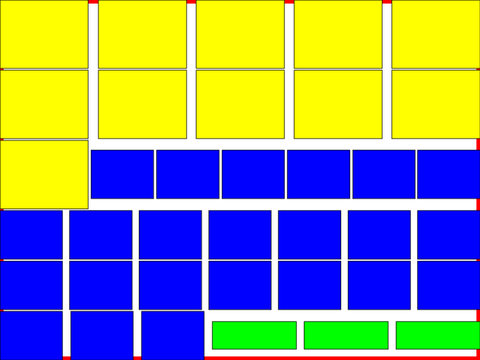
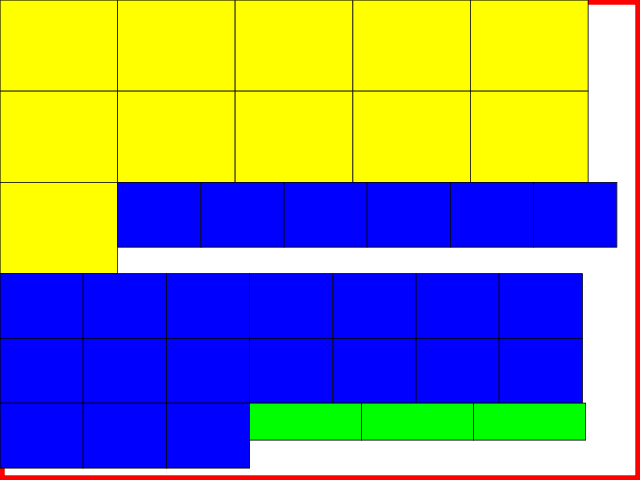
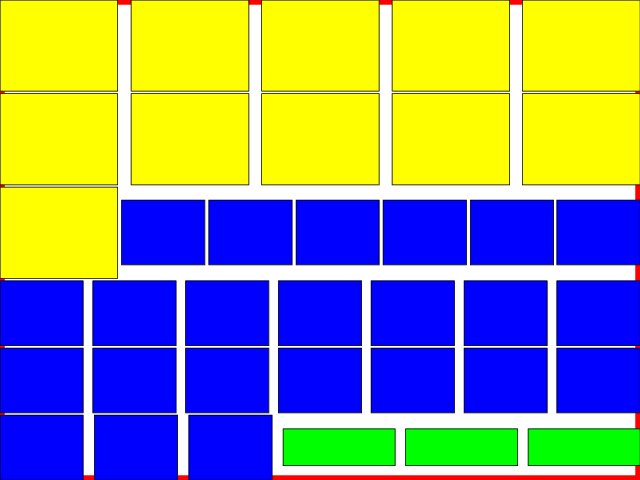
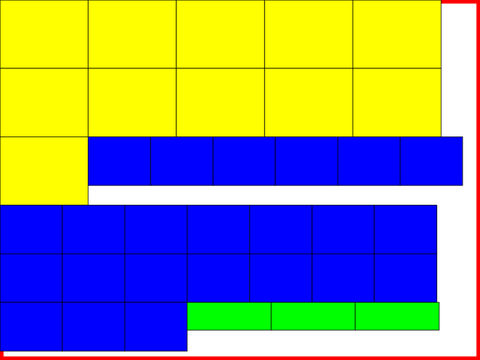
The results will be svg files test1.svg and test2.svg, the latter showing the spread-out result. Here is an example how the output looks like (without the red border which is drawn to mark the pallet border): arrange_spread2.py contains an adaption of arrange_spread.py for the actual problem. Permutations without known length When creating a layer out of articles of same height, then there are four strategies that I can choose from. It is four because there are two methods that I can either use or not. I can rotate the article by 90 per default or not and I can rotate the pallet or not. So every time that I build a new layer, there are those four options. Depending on which strategy I choose, there is a different amount of possible leftover articles that did not fit into any layer. The amount is different because each strategy is more or less efficient. To try out all combinations of possible layer arrangements, I have to walk through a tree where at each node I branch four times for each individual strategy. Individual neighboring nodes might be the same but this outcome is unlikely due to the path leading to those neighboring nodes being different. To simplify, lets name the four possible strategies for each layers 0, 1, 2 and 3. I now want an algorithm that enumerates through all possible permutations of those four numbers for "some" length. This is similar to counting. And the itertools module comes with the product() method that nearly does what I want. For example, should I know that my tree does not become deeper than 8 (read: no more than eight layers will be built), then I can just run:
>>> for i in itertools.product([0,1,2,3], repeat=8):
...     print i
...
(0,0,0,0,0,0,0,0)
(0,0,0,0,0,0,0,1)
(0,0,0,0,0,0,0,2)
(0,0,0,0,0,0,0,3)
(0,0,0,0,0,0,1,0)
(0,0,0,0,0,0,1,1)
(0,0,0,0,0,0,1,2)
(0,0,0,0,0,0,1,3)
This would work if the number of layers created with each strategy was the same. But as each strategy behaves differently depending on the input, it cannot be known before actually trying out a sequence of strategies, how many layers it will yield. The strategy (0,0,0,0,0,0,0,0) might create 7 layers, resulting in (0,0,0,0,0,0,0,1), (0,0,0,0,0,0,0,2) and (0,0,0,0,0,0,0,3) yielding the same output as only the first 7 strategies count. This would create duplicates which I should not waste cpu cycles on later. It might also be that (0,0,0,0,0,0,1,0) turns out to be a combination of strategies that creates more than 8 layers in which case the whole thing fails. So what I need is a generator, that gives me a new strategy depending on how often it is asked for one. It should dynamically extend the tree of possible permutations to accommodate for any size. Since the tree will become humongous (4^11 = 4194304), already traversed nodes should automatically be cleaned so that only the nodes that make the current list of strategies stays in memory at any point in time. This sounded all complicated which made me even more surprised by how simple the solution was in the end. Here a version of the algorithm that could easily be ported to C:
class Tree:
def __init__(self, branch_factor):
self.branch_factor = branch_factor
self.root = "value": None, "parent": None, "children": []
self.current = self.root

def next(self):
if not self.current["children"]:
self.current["children"] = [ "value":val, "parent":self.current, "children":[] for val in range(self.branch_factor)]
self.current = self.current["children"][0]
return self.current["value"]

def reset(self):
if self.current["parent"]:
self.current["parent"]["children"].pop(0)
else:
return False
if self.current["parent"]["children"]:
self.current = self.root
return True
else:
self.current = self.current["parent"]
return self.reset()

def __str__(self):
return str(self.root)
It would be used like this:
>>> tree = Tree(4)
>>> print tree.next(), tree.next(), tree.next()
>>> while tree.reset():
...     print tree.next(), tree.next(), tree.next()
Which would be equivalent to calling itertools.product([1,2,3,4], 3). The special part is, that in each iteration of the loop I can call tree.next() an arbitrary amount of times, just how much it is needed. Whenever I cannot generate an additional layer anymore, I can call tree.reset() to start a new permutation. For my code I used a python specific version which is a generator:
def product_varlength(branch_factor):
root = "value": None, "parent": None, "children": []
current = root
while True:
if not current["children"]:
current["children"] = [ "value":val, "parent":current, "children":[] for val in range(branch_factor)]
current = current["children"][0]
if (yield current["value"]):
while True:
if current["parent"]:
current["parent"]["children"].pop(0)
else:
return
if current["parent"]["children"]:
current = root
break
else:
current = current["parent"]
It is used like this:
it = product_varlength(4)
print it.next(), it.send(False), it.send(False)
while True:
    print it.send(True), it.send(False), it.send(False)
Again, the expression in the loop can have any number of it.send(False). The first it.send(True) tells the generator to do a reset.

20 May 2012

Ana Beatriz Guerrero Lopez: long due TO-DO item: removal of Qt3 from Debian

A couple of weeks ago was the first anniversary of orphaning Qt3 in Debian, see bug 625502. In this year, Qt3 has got a few QA uploads with the most relevant change being support to multiarch. And, more importantly, nobody seemed to care enough to step into maintaining it. In the last days, I have taken a look into how much needed to be done to remove Qt3 and there were slightly more than 50 packages depending directly or indirectly from Qt3. A removal from Wheezy seemed doable given that removing packages is never a problem during the Debian freeze ;-)

All the packages affected have a bug opened since more than one year and half ago and I have pinged all the bugs with some maintainers responding quick (thanks!). I also filed some removals for packages that were clearly unmaintained and didn t seem worth keeping, with ftp-masters responding quick too (Thanks!). And finally, a couple of QA upload for orphaned software that were still useful without Qt3. There is a wiki page tracking the status of the removal if you are curious:
http://wiki.debian.org/qt3-x11-freeRemoval If in the future, you are reading this and you need Qt3 in Wheezy, you can fetch it from Debian snapshots.

19 May 2012

Richard Hartmann: Mongolia

I will start linking to places we stayed at etc, from now on. On the one hand, we already left those places so my paranoid self can rest assured that no one will come hunt us down, on the other hand, I decided to only to name and link to those places which really deserve a mention. If they are linked here, I can whole-heartedly recommend them. Mongolia After leaving through the Russian border fortifications, Mongolia was an instant and welcome change. Trees growing right next to the tracks, branches forming a bit of a natural tunnel; the trains passing by keeping branches at bay, but the trees free to grow wherever else they pleased. A few hundred meters later below a rocky ledge, a cow had apparently fallen down and died. Partially decomposed flesh still clinging halfway to its rib-cage, it proved to be a sign of the (mostly) more laid-back attitude Mongolians tend to take. After finally getting our passports back and being allowed to leave the train, we first headed to the station to get some money. At ~1800:1, the exchange rate for Tugruk against Euro speaks volumes about inflation; imagine my surprise that the MNT 20,000 note is the largest one. It's also the one and only amount any and all ATMs will default to. We were quite surprised by how cheap everything was, even in the one single store within the station directly behind the border. In Russia, travellers expect to pay hefty markups when shopkeepers know they can charge them, not so in Mongolia. The woman in the trash Upon returning from the station, our waggon was just merrily being driving away on its own by a lone engine, something we had not anticipated or appreciated a whole lot. A woman (we hadn't noticed her before) who was busy scavenging a trash container for food for herself and her scrawny-looking son happily stopped what she was doing and, with a big smile, moved her hands around and smacked them back together, signalling us that our waggon would be attached to a different train for the subsequent journey. To put it mildly, I was stunned; we had met people eating from the trash in Russia as well (yes, I always make a point of giving them enough for a few decent meals; anyone eating out of the trash actually needs and definitely deserves something good happening to them), but they were glum and disheartened. Here, there was someone who not only had to look out for herself, but for a three or four year old boy as well, and still was just so... positive... I don't know if I would have it in me to act the same way... As an aside, even though we were just a few kilometers across the border from Russia, she did not actually take the money from me, she cupped her hands to receive it by having me place it into her hands; this is a very Asian thing in my experience and something we would see both in Mongolia and China consistently. Later, when we were back in our waggon, she passed by and happened to see the Spot Messgenger 2 dangling in front of our window, its lights blinking every five seconds. For a solid twenty minutes, until the train started moving again, she squatted down with her son, oggling the Spot. I have no idea what she was thinking it was and I had no chance to explain it to her, but she was really fascinated and just kept staring and staring. When we finally left the station, we waved to and smiled at each other, she ran after us, and then she was gone. All in all, this was one the more memorable things which happened to us. Mongolian Infrastructure When I say that Mongolians as a whole tend to be a lot more laid back than Russians, this extends to infrastructure as well, but not in the good way. Ulan Bator Little Dhingis Khan We arrived in Ulan Bator at six in the morning and started haggling with taxi drivers. Our hostel had (stale, it turned out) information about acceptable fare from station to their place on their website, 5,000 MNT was supposedly OK. Our driver tried to get 20,000, then 15,000, then 12,000, then 10,000, went down to 7,000 and finally settled for 5,000, all this interspersed with frequent "no" by us and walking away. Once on the road, he wanted to convince me that we had agreed upon 5,000 per person, something that did not quite work out for him. When we arrived, he started to tell me that he was good friends with the hostel manager and that said manager would surely want us to pay more; again, that did not work too well. He made the mistake of getting our luggage out of his trunk immediately (we always kept all our stuff in the passenger area afterwards...) before I paid and even though I only had a 10,000 or 20,000 note, I insisted on correct change. The same old dance began anew, with him edging closer to the correct change in steps of 1,000 MNT. He tried to get away several times, but I stood in his door and held it open; if he had just driven off, I couldn't have stopped him, but that thankfully didn't occur to him. After he shoved all small change (MNT is bill only, no coins) he had with him at me and wanted to make off yet again, I was close to throwing all the small crap at him, but after he, a man of maybe 1.65 meter and sitting down, tried to signal his willingness for a fist fight and me, a man of 1.94 meter and standing started laughing, he gave me 2,000 more and drove off cursing. In case you forgot, at that exchange rate, we argued about two to three Euro, but as he tried to cheat, it became a matter of principle. The Hostel, part one All parking lots and other property in Ulan Bator have a small watchtower with private 24/7 guards; said guard ambled down, let us in and woke the poor woman who was forced to let us check in. As she was Mongolian as well, we were a bit surprised when she switched from broken English to perfect German, but the owners of the OASIS are a German-Austrian couple so I guess that makes sense. Fighting through the war Traffic in Ulan Bator is war. Lonely Planet talks about the city being too newly motorized and that it did not have to develop a culture of driving, yet. This is a euphemism for "no one has any qualms maiming or killing you". Everyone is driving like mad, nudging and racing their way in front of each other. If a driver has an oppurtunity to get ahead by a few centimeters with his small car, thereby blocking the way for several buses, making a whole parking lot grind to a halt and thereby deadlocking themselves, they will take said opportunity, and gladly. Red lights are gentle suggestions, there to be mainly ignored; police will not drive over red lights, but they will not stop anybody else from doing so, either. A hearse will have a dozen or more cars following it, all driving in a tight pack, aggressively attacking anyone who dares to wedge in between them and expecting all other traffic to make way even if they are driving over a red light. Crossing a main street in Ulan Bator as a pedestrian is hell. There are a few traffic lights and they help to some extent, but you still need to be extremely careful when crossing a street. Thailand, India, Russia, China, no matter where it's supposedly hard to cross a street by foot, I never had any issues weaseling through. In UB, it takes planning, determination, and a lot of attention, especially as there are stretches where there's not a traffic light in sight. While maintaining eye contact with a driver usually ensures that they will try not to hit you, this does not work in the least in UB. In the evening, I took to shining a high-powered flashlight at the ground to the oncoming traffic's side to mark ourselves and decrease the likelihood of being hit. This worked well in combination with sprinting through gaps in the traffic, except for one guy who actively aimed for us and did not slow down. He even changed lanes, just to keep us in front of his car... Shining the flashlight directly at him in highest mode made him break quite violently though; a good thing, as he may have hit us had he not slowed down. UB itself Ulan Bator is weird. It has clear signs of westernization, but it's still very much an old city. There is one large store which would fit into any random shopping center in Germany (which are tiny when compared to most other countries) and which carries most goods, if with a limited selection. Its supermarket is extremely well stocked with food and drink from all other the world and laughably cheap (for us) prices. While its infrastructure is definitely crumbling, the city is clean, especially when compared to Russia. Two girls from Stuttgart who we met during our Trans-Siberian travels commented on how clean Russian cities were when compared to home, but that may be more of a statement about Stuttgart than about Russia... Anyway, in Mongolia in general and in UB in particular, there's a concise effort to make what they have look nice and clean. There is no trash in the streets, loose gravel and earth is removed from the curb by dedicated workers, all areas of packed earth are sieved and all large stones removed. All in all, it's a lot cleaner (if more dusty and sandy) than Russian cities if somewhat older and more shabby-looking. That being said, Mongolia's countryside is littered There were several street stalls consisting of nothing more than a cardboard box on a stool selling single chewing gums and cigarettes from the original packaging; it's normal for people to buy one cigarette or one piece of chewing gum and walk on. The sights of UB were nice, but nothing too special. Outlook In the next part, I'll cover "The Hostel, part disaster" and generally talk more about excrement than I thought one could write before moving on to China (were I am located at the time of this writing).

Richard Hartmann: Motherland's bosom

I read a translated poem about Russia being "the Motherland" and its vast bosom years ago. Having driven through a significant part of it, I can agree on the "vast" part... Also, as I am on a train and without access to the Internet, I will refrain from linking to a lot of pages; sorry. (Turns out I am posting this a week later, but I will still not link to stuff now; no time). Russia in general Moscow Sights Kreml Our remaining time in Moscow was spent with touring the usual suspects; the Kreml is a lot less impressive in real life, the Red Square is tiny when compared to the stories I heard about it and the Chapel ofi St. Basil is even more colorful and impressive in real life. Lenin's body was inaccessible because workers built seats for the May 9th parade to the left and the right of it and they apparently thought it would be a good idea to block access to one of the main tourist attractions while doing so. A river tour of Moscow was a nice cool-off and we got to see quite a few things. We managed to see the weekly military parade within the Kreml grounds, but it was mostly pomp and little substance. The National Treasure which you can access with an extra ticket within the Kreml grounds is nice, but less impressive than the tourist guides would make you believe. That being said... There's another museum within the museum and.... Whoah... Tourists pay extra, visitors go through the only non-security-theater check I encountered in Russia, guards are armed, people can only enter and leave in batches, and the stuff which is presented is mind-boggling. Disregarding the fist-to-calf-sized chunks of gold and platinum which are still in their original form directly from the mine, there is real, actual treasure galore. Little heaps of uncut and cut diamonds, an outline of Russia filled with cut diamonds and other random "we have this stuff" displays can be found as well. Then, you have various tiaras and other jewellery made from various gems. Not incorporating, but largely made of. All that pales in comparison to the crown, royal apple, scepter, etc. It's hard to put the amount of tiny multi-colored light points that shine at you into words. I was just standing there, swaying back and forth to catch the moving pattern of pinpoints. It's said that this collection is equalled only by the ones in the Tower of London and the one Shaw of Iran had and boy do I believe it. TV Tower Getting up there was funny. The old-style Soviet queuing system was used: "Security" for approaching the tower was multi-level, the guards see you approach along a long walkway way in advance and the main guard shed had several small cabins separated by thick glass. So good so menacing. But in a twist that would make Bizarro and Garry Larson proud, I was required, by means of metal detector gate, metal detector wand and even an x-ray machine to remove every shred of metal and other hard objects from myself and the camera bag and put them onto a table. Once I was without anything except my clothes and the bag was completely empty, I could pass. Everything I had had to remove was just laying there, not inspected in the least, for me to stuff back into pockets and bag and to take with me. This "everything" included a Spot Messenger 2 with lots of green and red blinky lights. The guard did not even glance and it. Security theater? Security theater. The view from 364 meters down on Moscow was nice, but there was a lot of Smog so I couldn't see very far. Jumping on the glass floor while looking down was a lot of fun, though. Subway to Thiefing I bet Christopher Nolan rode the subway in Moscow at least once. That unnerving sound you hear during several key scenes in "The Dark Knight"? Two thirds of all subways make the same sound while moving. Also, I had an encounter with a pickpocket down there; very classical, too. Guy approaches quickly, talks loudly and sounds as if it's really important (in Russian... duh... that's sure to keep me interested). His approach made me turn and protect my left leg pocket automatically, most likely marking the target for the tiny woman standing behind me. Now, I have to tell you something about my usual travel layout. As my normal pockets are very deep, it looks as if their content was in the leg pocket. Plus, there's an extra, hidden leg pocket where I keep the passports and train tickets. The outermost leg pocket is protected by a velcro flap, but it contains nothing of value; usually the appropriate phrasebook, local map, maybe a tissue or chewing gum. Due to this layering, the outermost pocket looks as if it's full to the brim with stuff. Also, I took pains to make it a habit to protect said leg pocket with my hand, nothing else. This looks as if that's the target, but what I am actually doing is protect my normal pocket with my forearm. The right side is different, but the most easily accessibly pocket always holds some small change. I pay from that stash but my actual wallet is well out of reach. Anyway, once the guy ran off, talking to several others, most likely marking all them for the actual pickpockets, I wanted to enter the subway. While the Russian-style queuing took place, I felt an unusual tug at the velcro flap. I looked down and saw a tiny woman to the left of me with a jacket held over her right side with the left arm; I look up to check no one is trying to steal from my permanently assigned female, feel another tug, look the woman into the eyes, look up again and around me, look down again and she is gone. All that took maybe three seconds and I had boarded the subway after an additional two. In hindsight, it makes sense to choose the time of entry for attack. It's crowded, you are being pushed around, and once you are in the subway, it will start moving more or less immediately while the thief remains in the station. In this case, she would only have gotten a grubby map of Moscow's subway and an English-Russian phrasebook, but she got nothing at all. Moscow-Novosibirsk Where to begin... If you think a few hours on a train are a long time, try over fifty hours. Things get so bad, you start getting land-sick while not in a moving train. You even start missing the familiar tunk-cachunk, tunk-cachunk, tunk-cachunk... of driving over rails with gaps in them when you are not moving. The defining element of the Trans-Siberian Railway are birch trees. And birch trees. And then more birch trees. You would not believe how many birch trees there are. This is made "worse" by the way the Russian Railway protects their rails. Left and right of the track, there's a cleared area of maybe ten to twenty meters, sometimes as little as three. Outside of that, they plant ten to twenty meters of birch trees, presumably to catch snow during winter. Beyond that protective perimeter, there's the normal landscape.As a result, on top of the near endless stretches of birch woods, you see most if not all scenery through a layer of birch trees. You get sick sick of birch trees after a few hours and you see them for days on end. Bullet points to save myself some typing and you some reading... Novosibirsk The non-existent hostel We arrived at ~0200 local and made our way to the hostel we had booked a room with. Walking to the correct address, we saw several signs but they all turned out to be for a police station and some other state agency. We walked back, forth, double-checked, triple-checked: no hostel. We then walked around the building through some not-quite-nice back alleys, but other than a few entries to private flats, there was nothing. Thankfully, the booking slip included a number which we called and after at least twenty rings (no kidding), when I had given up and wanted to hang up, it stopped ringing. Dead silence. After maybe ten seconds, someone started talking in Russian. I asked him if he spoke English and told him that we could not find the hostel. He mumbled something about being sorry and that we should wait, he would come down. Fast forward a minute or two and someone walked towards us. Again, he mumbled about being sorry, that the hostel "did not work" at the moment and that we would need to sleep in his private apartment. He ushered us into some back alley entrance, into his flat, and proceeded to remove the sheets from the couch on which he had slept; after putting on new sheets, we had our "hostel" bed, ready to sleep on. We briefly considered if he would murder us in our sleep, but him and me even got to talking a bit. Over cheese, sausage and rum (at 0300), he admitted that the hostel did not exist and he merely planned to turn his flat into a hostel for the summer while he and his family moved into their summer house (the Russian term of which escapes me, at the moment) in the countryside. He had accepted our reservation as he thought he would be finished by that time. He did not even get started, though. While he sent us an overbooking notice through booking.com two days before, we were on the train at that time, so... booking.com even called him to check what happenend to us as we did not book another place through them. Good customer service/protection, that. Next morning, he didn't even want to take our money (we paid anyway) and, as a means of compensation, drove us into the city in the morning and to a train museum well outside the city limits, one of the fabled scientist cities, and a large lake which everyone in Novosibirsk claims is an ocean, in the afternoon. Foreigners, foreigners! All in all, Novosibirsk was relatively uneventful, safe for one bizarre episode. We took our lunch in a local fast food joint (why do all the good stories happen there, and not at the various truly local places?) and threw the cashier our well-rehearsed "Niet Russkie; anglisky?" with phrasebook in hand and he actually understood a few words of English (beef, chicken, fries). We told him, in our worst Russian, that we are from Germany wished him a nice day and went to sit down. A few minutes later, a girl approached us, literally hopping from one foot to the other and wringing her hands. She told us that the cashier had told her that we spoke English and if it would be OK if she talked to us. We suspected some sort of elaborate ruse, but went with it. Turns out, she had English at school and really wanted someone to practice English on. Two young men passed our table and exchanged a few words with her, sitting down out of sight. When she told us that she had to leave now but if it would be OK if the two boys joined us we suspected a ruse yet again. But those two were law students, one with a minor in English and one with a minor in German; both of them also extremely nervous, asking us if we would talk to them. When they had to leave, they told us that the three of them worked at the burger joint and that their shift was just about to start when the news that foreigners were here spread amongst staff like wildfire. The girl stopped by several times in between cleaning tables, getting in a sentence or two before being cussed at by her supervisor. All in all, this took about twenty minutes and seeing three people so nervous and grateful to talk with us felt beyond absurd. On the other hand, not a single traveller we met even considered stopping in Novosibirsk during their transit so there really does seem to be a shortage of non-Russians there. Weird, and memorable. Novosibirsk-Irkutsk Irkutsk / Listvianka / Lake Baikal Listvianka Aah, lake Baikal... the oldest and deepest lake on Earth which holds a fifth of the global non-salt water reserves; a must-see in my book. Quad tours at break-neck speeds, dry-suit diving with Russian regulators, walking barefoot in between and across drift ice that made its way onto the shorei, and extended hiking around the lake's coast... All of which I could not do because I was ill and had to spend two solid days in bed. The draft from the open window in between Novosibirsk and Irkutsk was enough to give me a rather bad cold which peaked at Lake Baikal. Still, the area was lovely and we were glad to be out of a train and able to unpack our stuff without having to repack immediately for once. I am not sure where my current losing streak with regards to diving is coming from (Grimsey, diving north of the Arctic circle with birds that plummet into the water and hunt fish: Only guy who does this is on the Icelandic mainland that day; Svalbard, diving north of the Arctic circle in permanent darkness: The few people who do this privately did not reply while I was there; Baikal, oldest, deepest, largest lake on Earth: ill), but I will most likely return to Russia for a week of ice diving in Lake Baikal next winter or the one after that. As an aside, I saw several people walking to Lake Baikal with buckets to get their water. Other people got it from a well which was still half frozen. If you have running water consider yourself lucky... Irkutsk Nice city, largely uneventful. The farther east you get within Russia, the more normal women look. In Moscow, just as in Paris, they are way over-dressed and even service personnel will walk with high heels. Thankfully, I don't have to wear heels, but for the other males out there: Walking and standing in these things hurts and thus most if not all people who stand and walk for a living have flat shoes. We happened upon preparations for a military parade, complete with cordon, viewing podests, at least half a dozen TV cameras etc, but were not sure if it would start soon enough for us to catch our train.We asked someone who told us it would start at 2100 local, at 1945 local it seemed about to start, and sure enough at 1955 sharp, the whole thing went under way. About a dozen groups of 50-100 people each, all in their own, respective uniforms stood against one side of a cordoned-off street and several higher-ups on the other side. Two highest-ups shouted into microphones and the throng of people on the other side shouted back answers. Then, the two highest-ups stood in the back of a jeep each and drove past said throng, stopping in front of each group, shouting into microphones mounted in the back of the jeeps and the groups shouted back once again. After that, all groups marched around the make-shift plaza once, saluting the higher ups. Once they were done, and they took ages, two trucks drove by with soldiers jumping out of the moving trucks and moving into crouching positions. They ran around in a circle a few times and engaged in pretend hand-to-hand combat. I am sure they are skilled at whatever style they wanted to show, but they were overdoing things so badly, they were funny, not imposing. When they jumped over some barriers, the barriers fell to pieces and everyone scrambled to make it look as if that was part of the show. While carrying off the gear, it fell into further pieces which was even more funny. An armoured personnel carrier ended the show; several tougher looking guys jumped off of that one and their mock combat involved fully automatic fire (of blanks), several flashbangs, smoke grenades and, to top things off, the machine gun mounted on the APC moving down the opposing team with blanks. I never witnessed a "real" military parade in person but this one was somewhat disappointing. On the one hand, there was a distinct lack of ballistic missile carriers and tanks like you see in movies, documentaries and games, on the other hand, the whole thing had a make-do feeling to it. The cordoning police had designated spots to stand on, yet walked around. They were standing to attention, yet checking their cell phones. Several people in one uniformed group were wearing track suits and jeans. Another uniformed guy had a grocery bag with him; yet another one was carrying a huge water bottle. Bikers zig-zagged through the cordon and when the whole show was just about to wrap up the police finally started putting up barriers around the unmoving pedestrians, not blocking the bikers. One little girl was standing well within the cordoned area, watching with big eyes and after she did not react to the police talking to her, they just built the barriers in a curve around her. And to top it all off, some guy with a cane walked all through the parade with his personal camcorder, trying to direct the whole show while being ignored by everyone. Still, I am sure he managed to mess up some otherwise perfectly good TV scenes. Irkutsk-Russian border TL;DR 3000 kilometers of birch trees

Johannes Schauer: network file transfer to marvell kirkwood

I have a Seagate GoFlex Net with two 2TB harddrives attached to it via SATA. The device itself is connected to my PC via its Gigabit Ethernet connection. It houses a Marvell Kirkwood at 1.2GHz and 128MB. I am booting Debian from a USB stick connected to its USB 2.0 port. The specs are pretty neat so I planned it as my NAS with 4TB of storage being attached to it. The most common use case is the transfer of big files (1-10 GB) between my laptop and the device. Now what are the common ways to achieve this? scp:
scp /local/path user@goflex:/remote/path
rsync:
rsync -Ph /local/path user@goflex:/remote/path
sshfs:
sshfs -o user@goflex:/remote/path /mnt
cp /local/path /mnt
ssh:
ssh user@goflex "cat > /remote/path" < /local/path
I then did some benchmarks to see how they perform: scp: 5.90 MB/s rsync: 5.16 MB/s sshfs: 5.05 MB/s ssh: 5.42 MB/s Since they all use ssh for transmission, the similarity of the result does not come as a surprise and 5.90 MB/s are also not too shabby for a plain scp. It means that I can transfer 1 GB in a bit under three minutes. I could live with that. Even for 10 GB files I would only have to wait for half an hour which is mostly okay since it is mostly known well in advance that a file is needed. But lets see if we can somehow get faster than this. Lets analyze where the bottleneck is. Lets have a look at the effective TCP transfer rate with netcat:
ssh user@goflex "netcat -l -p 8000 > /dev/null"
dd if=/dev/zero bs=10M count=1000   netcat goflex 8000
79.3 MB/s wow! Can we get more? Lets try increasing the buffer size on both ends. This can be done using nc6 with the -x argument on both sides.
ssh user@goflex "netcat -x -l -p 8000 > /dev/null"
dd if=/dev/zero bs=10M count=1000   netcat -x gloflex 8000
103 MB/s okay this is definitely NOT the bottleneck here. Lets see how fast I can read from my harddrive:
hdparm -tT /dev/sda
114.86 MB/s.. hmm... and writing to it?
ssh user@goflex "time sh -c 'dd if=/dev/zero of=/remote/path bs=10M count=100; sync'"
42.93 MB/s Those values are far faster than my puny 5.90 MB/s I get with scp. A look at the CPU usage during transfer shows, that the ssh process is at 100% CPU usage the whole time. It seems the bottleneck was found to be ssh and the encryption/decryption involved. I'm transferring directly from my laptop to the device. Not even a switch is in the middle so encryption seems to be quite pointless here. Even authentication doesnt seem to be necessary in this setup. So how to make the transfer unencrypted? The ssh protocol specifies a null cipher for not-encrypted connections. OpenSSH doesnt support this. Supposedly, adding
  "none", SSH_CIPHER_NONE, 8, 0, 0, EVP_enc_null  
to cipher.c adds a null cipher but I didnt want to patch around in my installation. So lets see how a plain netcat performs.
ssh user@goflex "netcat -l -p 8000 > /remote/path"
netcat goflex 8000 < /local/path
32.9 MB/s This is far better! Lets try a bigger buffer:
ssh user@goflex "netcat -x -l -p 8000 > /remote/path"
netcat -x goflex 8000 < /local/path
37.8 MB/s now this is far better! My Gigabyte will now take under half a minute and my 10 GB file under five minutes. But it is tedious to copy multiple files or even a whole directory structure with netcat. There are far better tools for this. An obvious candidate that doesnt encrypt is rsync when being used with the rsync protocol.
rsync -Ph /local/path user@goflex::module/remote/path
30.96 MB/s which is already much better! I used the following line to have the rsync daemon being started by inetd:
rsync stream tcp nowait root /usr/bin/rsync rsyncd --daemon
But it is slower than pure netcat. If we want directory trees, then how about netcatting a tarball?
ssh user@goflex "netcat -x -l -p 8000   tar -C /remote/path -x"
tar -c /local/path   netcat goflex 8000
26.2 MB/s so tar seems to add quite the overhead. How about ftp then? For this test I installed vsftpd and achieved a speed of 30.13 MB/s. This compares well with rsync. I also tried out nfs. Not surprisingly, its transfer rate is up in par with rsync and ftp at 31.5 MB/s. So what did I learn? Lets make a table: </dr></dr></dr></dr></dr></dr></dr></dr></dr></dr>
methodspeed in MB/s
scp5.90
rsync+ssh5.16
sshfs5.05
ssh5.42
netcat32.9
netcat -x37.8
netcat -x tar26.2
rsync30.96
ftp30.13
nfs31.5
For transfer of a directory structure or many small files, unencrypted rsync seems the way to go. It outperforms a copy over ssh more than five-fold. When the convenience of having the remote data mounted locally is needed, nfs outperforms sshfs at speeds similar to rsync and ftp. As rsync and nfs already provide good performance, I didnt look into a more convenient solution using ftp. My policy will now be to use rsync for partial file transfers and mount my remote files with nfs. For transfer of one huge file, netcat is faster. Especially with increased buffer sizes it is a quarter faster than without. But copying a file with netcat is tedious and hence I wrote a script that simplifies the whole remote-login, listen, send process to one command. First argument is the local file, second argument is the remote name and path just as in scp.
#!/bin/sh -e
HOST=$ 2%%:* 
USER=$ HOST%%@* 
if [ "$HOST" = "$2" -o "$USER" = "$HOST" ]; then
        echo "second argument is not of form user@host:path" >&2
        exit 1
fi
HOST=$ HOST#*@ 
LPATH=$1
LNAME= basename "$1" 
RPATH= printf %q $ 2#*: /$LNAME 
ssh "$USER@$HOST" "nc6 -x -l -p 8000 > $RPATH" &
sleep 1.5
pv "$LPATH"   nc6 -x "$HOST" 8000
wait $!
ssh "$USER@$HOST" "md5sum $RPATH" &
md5sum "$LPATH"
wait $!
I use pv to get a status of the transfer on my local machine and ssh to login to the remote machine and start netcat in listening mode. After the transfer I check the md5sum to be sure that everything went fine. This step can of course be left out but during testing it was useful. Escaping of the arguments is done with printf %q. Problems with the above are the sleep, which can not be avoided but must be there to give the remote some time to start netcat and listen. This is unclean. A next problem with the above is, that one has to specify a username. Another is, that in scp, one has to double-escape the argument while above this is not necessary. The host that it netcats to is the same as the host it ssh's to. This is not necessarily the case as one can specify an alias in ~/.ssh/config. Last but not least this only transfers from the local machine to the remote host. Doing it the other way round is of course possible in the same manner but then one must be able to tell how the local machine is reachable for the remote host. Due to all those inconveniences I decided not to expand on the above script. Plus, rsync and nfs seem to perform well enough for day to day use.

18 May 2012

Alexander Reichle-Schmehl: Release Critical Bug report for Week 20

The bug webinterface of the Ultimate Debian Database currently knows about the following release critical bugs:
In Total:1515
Affecting Wheezy:1078
Wheezy only:235
Remaining to be fixed in Wheezy:843
Of these 843 bugs, the following tags are set:
Pending in Wheezy:70
Patched in Wheezy:169
Duplicates in Wheezy:62
Can be fixed in a security Update:23
Contrib or non-free in Wheezy:12
Claimed in Wheezy:2
Delayed in Wheezy:12
Otherwise fixed in Wheezy:71
Ignoring all the above (multiple tags possible) 504 bugs need to be fixed by Debian Contributors to get Debian 7.0 Wheezy released. However, with the view of the Release Managers, 968 need to be dealt with for the release to happen. Please see Interpreting the release critical bug statistics for an explanation of the different numbers.

17 May 2012

Ritesh Raj Sarraf: Laptop Mode Tools - 1.61

Laptop Mode Tools, version 1.61, has been released and will land up soon for Debian. This is the version that would be targetting Wheezy.
This release includes many bug fixes and should make power savings much better on your machines.
This is mainly a bug fix release. Some parallel module execution approach has been used which could show runtime improvements.
Changelog:

1.61 - Thu May 17 17:44:26 IST 2012
* Handle devices with persistent device naming. This fixes the issues where
you don't have a disk referenced by a block name, the commit= value was
completely skipped
* Fix issue where hdparm skips SSDs for power management
* Add parallel execution for the modules. In theory this should speeden up the
execution. See git commit log comments for details
* Add support for non-deafult customized settings
* calculate design_capacity_warning on machines/arches where it is not readily
available

We have switched the SCM to git. The current code repository is
available at [1] along with the changelog.

The tarball is available here [2].
The md5 checksum for the tarball is 6685af5dbb34c3d51ca27933b58f484e

[1] https://github.com/rickysarraf/laptop-mode-tools
[2]http://samwel.tk/laptop_mode/tools/downloads/laptop-mode-tools_1.61.tar.gz

15 May 2012

John Goerzen: Suspicious Blog Activity any advice?

I ve been noticing a number of odd things happening surrounding my blog lately, and I thought it s about time to figure out what s going on and how to stop it. The first problem is that people are illegally copying my posts, probably using RSS scraping, and putting them up on their own ad-infested sites. It is trivial to find them using Google for any somewhat unique word or phrase in one of my posts. Lately one of them, linux-support.com, actually sends me pingbacks announcing the fact that they ve scraped me! Most of these sites seem to be nothing but content farms for selling ad impressions, and almost none of them have any identifiable names for the owners. (There is an exception: I have specifically set up sites like Planet Debian and Goodreads to copy my blog posts.) I m obviously an advocate of open content, but I do not feel it right that others should be profiting by putting photos and stories about Free Software, or photos of my family, on their ad farms. While I release a great deal of content under GPL or Creative Commons licenses, I have never done so with my blog an intentional decision. What should I do about this? Is it worth fighting a battle over, or is it about as useless as trying to block every spam follower on my twitter account? So that s the first weird thing. The second weird thing just started within the last few weeks. I have been getting a surprising amount (a few a week) of email addressed to me. It does not bear the appearance of being 100% automated spam, though it is possible that it is. It s taken a few forms: The profit motive in all of these is high, and in at least the second and third, so is the sleaze factor. I ve gotten two emails lately of this form:
Hi John, I am curious if you are the administrator for this site: changelog.complete.org/archives/174-house-outlaws-fast-forwarding-senate-pres-next I am a researcher / writer involved with a new project whose mission it is to provide accurate and useful information for those interested in the practice of law, whether as a lawyer or paralegal. I recently produced an article detailing the complex relationship between law and technology and the legal implications on personal privacy and free speech. I would love to share this resource with those who might find it useful and am curious of you are the correct person to contact about such a request? Thank you! All my best,
The details vary the URLs appear to be random (the one cited above was little more than a link to an article), the topics the website claims to discuss range from law to schizophrenia (that one actually came with a link to the site, which again seemed to be a content farm). I am slightly tempted to reply to one of these and ask where the heck people are getting my name. It seems as if somebody has put me into a mailing list they sell containing sleazebag bloggers. Frankly, I am puzzled at this attention. I guess I haven t checked, but I can t imagine that my blog has anything even remotely resembling a high PageRank or anything else. It s not high-traffic, not Slashdot, etc. Either people are desperate, naive, failing to be selective, or maybe working some scam on me that I don t know yet. In any case, I m interested if others have seen this, or any advice you might have.

James Morrison: Testing email receive for appengine

It's not too obvious how to test email receive handlers in Appengine. The important observation is that the handlers take HTTP POSTs with multipart/form-data encoded data. In python you can build an email to be handled with the following code:
from email.message import Message 

def test_email(self):
body = Message()
body.add_header('to', 'test-unknown@other-app.com')
body.add_header('from', 'test@app.com')
body.add_header('Content-Type', 'multipart/alternative', boundary=self.boundary)
text = Message()
text['content-type'] = 'text/plain'
text.set_payload('I am I! Don Quixote! The man of La Mancha!')
body.attach(text)

post(payload=body.as_string())

13 May 2012

Matthew Palmer: vmdksync helps you escape from VMware

When I wrote lvmsync late last year, I didn t realise I was being typecast. Before too long, I realised that the logic that I d implemented for lvmsync would also help me with a separate migration project I d been dreading getting the day job off VMware. Back in the early days of virtualisation, management made the decision to run VMware, for all the usual reasons ( commercially supported! , industry standard! , and so on). Unsurprisingly (to me, anyway) it didn t take too long for management to realise that it wasn t the best choice for us. When you ve got umpty-billion dollars to spend on hardware, software, and support, VMware might be the right option (although Amazon doesn t seem to think so). Anchor s company culture, on the other hand, is build around smart staff, simple systems over dumb staff, smart vendors , because no vendor is ever going to care about our customers as much as we do. So VMware was never going to work for us. Unfortunately, as happens all too often, once VMware was in place, there was very little motivation to get rid of it and move those customers onto the chosen replacement (that we were deploying all new customers on). I happen to think this is a terrible attitude in general one that makes life so much harder in the long term. I believe strongly in retrofitting old systems to keep them up-to-date with the current state of the art, and keeping technical debt under control. But, I wasn t running the show back when we stopped putting new customers on VMware, so the few VMware servers we had stayed around far longer than they should have. Recently, though, bad things started to happen. The VMware servers were starting to fall apart. The Windows machine we had to keep around to use the VMware management console started crapping out, and when the choice was between doing unspeakable things to Windows, and just ditching VMware well, it wasn t much of a choice. The only remaining question was how to do the migration off VMware with the least amount of downtime to our customers. I was really quite surprised that nobody out in Internet land appeared to have come up with a simple, robust tool to do this. Sure, some vendors had all-singing, all-dancing toolkits that cost ridiculous amounts of money, required you to install their agent on the machine involved, and promised the earth, but it all smelt of snakeoil and bullshit. In true hacker style, then, I decided to write something myself. The model I came up with mirrored lvmsync s quite closely because that one worked, and it turned out to be surprisingly easy to implement once I managed to reverse-engineer the file format (VMware has a PDF spec of a bunch of it s file formats, but whoever wrote it was enough of an evil genius to make it utterly incomprehensible to anyone who doesn t already know the file format, whilst making perfect sense to anyone who already does). The result: vmdksync. It is nothing but 80-odd lines of ruby whose sole purpose is to take a delta.vmdk file and write the changes that are stored in that file to a file or block device that is a copy of the flat.vmdk file that you can copy while the VM is still running (after you ve made a snapshot, of course). It helped me provide a painless migration path away from VMware, and I d be really pleased if it helped some other people do the same. Share and enjoy!

11 May 2012

Alexander Reichle-Schmehl: Release Critical Bug report for Week 19

The bug webinterface of the Ultimate Debian Database currently knows about the following release critical bugs:
In Total:1609
Affecting Wheezy:1136
Wheezy only:206
Remaining to be fixed in Wheezy:930
Of these 930 bugs, the following tags are set:
Pending in Wheezy:83
Patched in Wheezy:208
Duplicates in Wheezy:46
Can be fixed in a security Update:27
Contrib or non-free in Wheezy:12
Claimed in Wheezy:2
Delayed in Wheezy:31
Otherwise fixed in Wheezy:61
Ignoring all the above (multiple tags possible) 556 bugs need to be fixed by Debian Contributors to get Debian 7.0 Wheezy released. However, with the view of the Release Managers, 1025 need to be dealt with for the release to happen. Please see Interpreting the release critical bug statistics for an explanation of the different numbers.

Next.

Previous.