Search Results: "ag"

22 November 2007

Antti-Juhani Kaijanaho: Planet Debian RSS 2.0 feed is broken

Tollef Fog Heen asks:
Also, why does bloglines link to the completely wrong place on dburrow’s posts? It links to http://planet.debian.org/tag:blogger.com,1999:blog-$blah rather than the real URL.
I think I know why. I don’t know which Planet feed Tollef is reading, but a look at the Planet Debian RSS 2.0 feed is illuminating. Looking up Daniel’s entry, we can find the following sub-element:
<guid>tag:blogger.com,1999:blog-12729767.post-4989856010680867140</guid>
Looking at the RSS 2.0 specification, we can find the following note:
If the guid element has an attribute named “isPermaLink” with a value of true, the reader may assume that it is a permalink to the item, that is, a url that can be opened in a Web browser, that points to the full item described by the element. An example: <guid isPermaLink=”true”>http://inessential.com/2002/09/01.php#a2</guid> isPermaLink is optional, its default value is true. If its value is false, the guid may not be assumed to be a url, or a url to anything in particular.
Thus the Planet RSS 2.0 feed claims that tag:blogger.com,1999:blog-12729767.post-4989856010680867140 is a valid URL. There is no basis for this claim in Daniel’s Atom feed, as that string only occurs inside an id element, and RFC 4287 specifies that the string cannot be assumed to be dereferencable.

Tollef Fog Heen: Killing hold periods

Daniel Burrows writes about the feature of some call centres whereas if all operators are busy, it gives the caller the option of being called back. He'd like the nice twist of being able to enter his phone number on a web page and then be called back so he doesn't actually have to call, then wait. I'm not sure where Daniel lives, but I'm happy to report that this practice is quite common here in Norway, so it might well be on its way to whatever companies are local to Daniel. Also, why does bloglines link to the completely wrong place on dburrow's posts? It links to http://planet.debian.org/tag:blogger.com,1999:blog-$blah rather than the real URL.

Kartik Mistry: The festival story Or how to deal with dirty .diff.gz

* Once upon a time, I adopted ‘festival‘ and ‘speech-tools‘ packages. Updated it to my standard style of packaging (learned from different mentors) and fixed long pending bugs. I came to know that there is ‘New Upstream Version’ available from long time. Somehow, .diff.gz was so dirty that didn’t dare to touch it and apply and build the packages. Then, Kumar came and handed over me a nice little script.
#!/usr/bin/awk -f
/^—/
name = $2;
sub(/^[^[\/]+\//, “”, name);
gsub(/\//, “_”, name);
if (name !~ /\.diff$/)
name = name “.diff”;


print $0 >> name;
What it will do? gunzip your dirty .diff.gz and run it over .diff. It will split single .diff in multiple .diff s. You now need to merge or un-merge it manually (ah!). Dpatch can also converts .diff.gz in single patch (then you need to split it yourself! Correct me if I’m wrong!!) We are now able to successfully packaged festival and speech-tools. Thanks a lot to Kumar for help, patient and tweaks! I am now quilt lover! Package will be maintain using ‘collab-maint’ in near future. Ah, learning git for it!

Raphael Geissert: freshmeat.php: a watch helper

Yesterday I posted to -qa about a watch helper script I wrote so freshmeat projects can be used in watch files.


By the time of writing this post there hasn't been any reply yet, which actually disappoints me.
So abusing a little on the fact that my posts are visible on planet.d.o I'd like to know what is everybody's opinion (replying to my message on -qa is preferred to seeing some blog post comments :)).

Freshmeat by providing an XML file with the project's information seems to be addressing the common problems caused when trying to keep track of upstream in a more-or-less automated way.

I really hope this script is put together with sf.php at qa.debian.org/watch/ to make it possible for even more packages to use watch files to keep up with upstream versions :).
And about the xml-fetching *problem* I'm open to suggestions and preferred ways of doing it.

Next thing to do is write some similar script for the kde,maemo,gnome,xfce,debian,qt,etc - apps,look,art,themes,etc .org websites (this will require some collaboration on the site's side unless I play with some regexes, again, to extract the information and generate some listings like with freshmeat.php).

21 November 2007

Wouter Verhelst: Debian work

Been a while since I did so much Debian work in a fairly short time. Today, I finished work on belpic 2.6.0, the support software for the Belgian electronic ID card. My initial builds wouldn't work since I made some stupid (no, really, stupid) errors in properly using that ugly beast, but eventually I saw the light. Working packages are now in incoming, and will soon be on a Debian Mirror Near You(TM). Oh, in case you wonder: the difference between 2.6.0 upstream and 2.5.9 upstream is pretty small, mostly some housekeeping bugfixes; meaning, if 2.5.9 is working for you, there's probably no need to worry about getting the update. I've also added some extra changes to the packaging bits, so that you now no longer have to install the -dev packages just so you can use the browser plugins. Isn't that nice. I did some more work on getting emile, the Early Mac Image LoadEr, to work properly again. Unfortunately, after the initial 0.10-1 upload that I did to Debian, none of my other builds managed to actually work on my test machine. Since I don't want to break existing machines that are using emile, I didn't think to upload those non-working binaries; but now with #451415, I can't ignore that problem any longer. I think I've nailed it now, though, and once barok (my IIci) has finished building (which will take a few hours), the packages should work. Cross your fingers. Finally, I've also prepared an upstream bugfix update of nbd, the userland support tools for the Network Block Device in the Linux kernel, and have uploaded a package from that release into Debian. As if that wasn't enough, and since I genuinely care about the state of my packages in Debian derivatives, I've poked some Ubuntu-people to get it synced there, too. I guess I'm back in shape now.

Luciano Bello: It's a party... and you are invited!

Better than just a party, it s a bug squashing party! Imagemagick needs your help. It a very important package for Debian and its really outdated. It has more than 100 bugs.


The objective, is to reduce the bugs to less than 20 in a month in the current development version. Let s go for them! :)

Daniel Burrows: Facebook comments

My blog is syndicated on Planet Debian, Planet GSLUG, and Facebook (through their "notes" system). I occasionally get a comment about one of my posts over on Facebook, and every time I do I remember one of the reasons I avoid that site.


[someone] made a comment about your note "note title".

To see the comment, follow the link below:
[link to Facebook]


What's missing here is of course the actual text of the comment. Blogger does this right: the actual comment is emailed to me. Not only does this impose the annoyance of having to click on the link, but I often read my email offline, and so a message like this is worse than useless for me. (worse as I have to postpone it for later, which means I need to deal with it twice) It would be even better if I didn't have to click to reply, but with a Web service you kind of expect that. (one of the reasons that I'll be setting up my own blog at some point: I can use software that actually allows me to compose replies offline)

I don't know why Facebook does this, but my guess is that either (a) they haven't thought about it, or (b) they want to drive up page views and make it annoying for me to not use their site. If it's (b), then that apparently works for a large swathe of the population, but it makes me want to avoid them like a bad cliche.

Daniel Burrows: Good ideas in customer service: kill the hold period

The lender for one of my student loans has apparently started using a rather cool system to manage incoming customer service calls. If all the call-takers are busy, then instead of forcing you to sit there listening to a call telling you how important your business is to them, they let you request a call-back. They ask you to enter a phone number where they can reach you, then give you a time window in which they'll be calling (in my case I think it was about two minutes wide). When my turn came up, they called me and I was able to speak with a human immediately.

This is such a huge improvement over the typical call center experience that I'm amazed it hasn't caught on more broadly.


I'm guessing that this option will be available in more and more places as companies computerize their telephone systems. Another nice twist, if there are any telephony guys reading this, would be to allow me to request the customer service call from a Web page, eliminating the toll-free call altogether and presumably saving some expense for the company.

An interesting question for me is how they generate those estimates of when they'll be able to help you. I'm guessing that they use some queueing theory to estimate the most likely wait time for the next incoming customer, but this is something I have only a fuzzy awareness of. However they did it, the estimate seemed accurate enough to me.

Russell Coker: BoingBoing and Licenses

Today I was thrilled to see that Cory Doctorow (who among other things wrote one of my favourite Sci-fi novels [1]) copied one of my blog posts on to BoingBoing.net [2]. Then I reviewed the licence conditions (which had previously been contained in the About Page and is now a post on my documents blog [3]) and discovered that I had not permitted such use! In the second part of this post (not included in the RSS feed) I have the old and new license conditions for my blog content. My plan is that my document blog [4] will have the current version of such documents while this blog will have every iteration along the way. The new version of my license explicitly permits BoingBoing to do what they want with my content. I don’t have any objection to what Cory did, and I would have been rather unhappy if he had sent me an email saying “I wanted to feature your post on BoingBoing but sorry you miss out because of your license”. But his procedure does not work well. Now I am wondering, how do I construct a license agreement that permits my content to be used by big popular sites that give my blog new readers and my ideas a wider audience while denying the content to sploggers who just want to use my patterns of words for google hits? How do I permit my content to be used by people who contribute as much to the community as Cory but deny it to talentless people who want to exploit my work while contributing nothing to the world? How can I ensure that people who want to reference my work can learn about the licence conditions (the About Page apparently doesn’t work)? These are serious questions and I invite suggestions as to how to solve them. The fact that I have forgiven Cory for not abiding by my license and granted him permission to do the same thing again whenever he wishes is not the ideal solution. For authors to find people who copy their work and respond with forgiveness or DMCA take-down notices according to who does the copying and the reason for it is a losing game and a distraction from the work of creating the useful content. I understand the BoingBoing situation, they deliver summaries and copies of blog posts rapidly and frequently. Discovering conditions of use and asking for clarification from the authors (which may take days or weeks) would really affect the process. Also anyone who reads my blog would probably realise that I want to have such posts copied on sites such as BoingBoing. (more…)

MJ Ray: National Issues / Privacy, Lies and Government

On the same day that the government apologised for losing discs containing names, addresses, bank accounts and other details for nearly half the UK population, it was also revealed that another government agency has started demanding hand-over of encryption keys, like what seems to have happened to Hushmail but worse.

So, only the government really has security and privacy now in the UK, but it has failed to keep things private and secure!

What a great day that shows why we must support the Data Protection Act, repeal the RIPA at long last and campaign for a no2id.

Oh and privacy laws must apply to private companies like facebook (under investigation) and be understandable by the general public because leaving it to current user agreements isn't working.

Christian Perrier: I got my pink paper! Sam, read this...

First step of the ultimate organization steps of the trip to India for FOSS.IN, I went today to the Embassy of India in Paris to leave my visa application. I left home at 06:20 to get one of the few trains running because of our strikes. Got two buses relatively easily from the station to the Embassy, then I arrived there 8:30 with already about 40 people before me in the queue. Discussion with fellow people in the queue...and I learned that there was no certain chance that I could actually *enter* the embassy to leave the form, my passport, my photos and the 50 bucks^W euros needed for a passport to India. I entered the embassy at....11:00 when their doors opened (we've been told that strikes in French transport are the reasons for the employees to be late.....I really wonder *how* *we* got there, indeed. Apparently, all people applying for visas live in Paris 16th. Then I got a nice ticket with a number on it (215 for the record) and began waiting in a small romm packed with dozens of people. First number called: 170. Three hours later, I finally got the pink receipt which gives me the right to worry about my passport getting lost and, hopefully, get it back on Monday with a visa for India on it. It's 14:45 while I'm writing this and I'm simply on my way back home after losing a full work day for a stupid administrative piece of paper. Have to be back on Monday 16:00 to get the visa back. Someone was saying in the queue that some days, you can wait up to 23:00 to get your passport back. It is terribly sad that this visa system still exists in some countries (not even blaming India for this: we (European Union) do exactly the same for citizens of India, forcing them to visit the French/spanish/German/whatever Schengen country in Dehli or Mumbai, to get a visa for EU. And I can really imagine what mess it can be as well. It was however interesting to see that all this crap was happening with laughs, good stories and friendly atmosphere with all the other French people waiting. Who says that French people are harsh and rude? Or is it already the influence of India on us? Anyway, Sam Hocevar told me yesterday he plans to come tomorrow for his application. Good luck, Sam and don't forget any of the requirements as well as a good coat, something to read (or your laptop to hack, with some spare batteries....and, no, no hackable WiFi around). Note that the 50 euros *have* to be cash money. So, India, here I am....nearly..:-)

Ross Burton: Flickr

Some interesting Flickr news today, first some old news I only just heard: the two billionth photo was uploaded this month. Impressively, whilst it took three and a half years for the first billion pictures to be uploaded, the second billion took only three months. (source). Second, the Flickr team have just added some new features, specifically a world map with popular tags overlaid and a new Places interface, providing a summary of a particular location. The new map has temporarily lost the ability to zoom in straight away (press Search then Go to get the zoom bar), but the Places interface is amazing fun. NP: People's Instinctive Travels and the Paths of Rhythm, A Tribe Called Quest

Dirk Eddelbuettel: Several new Rmetrics packages

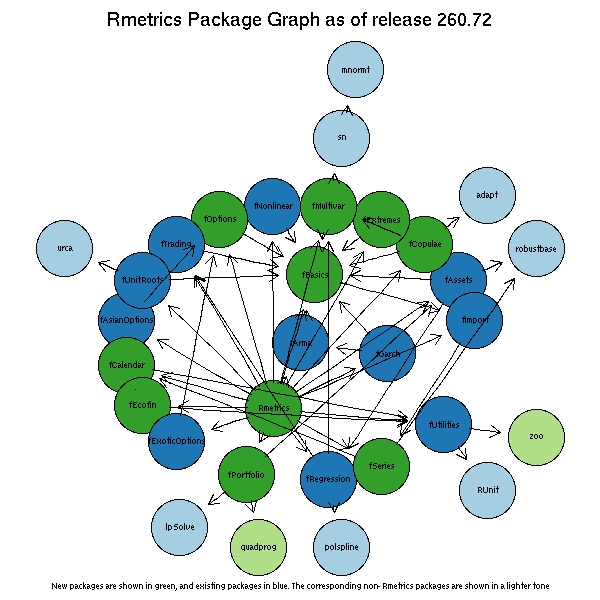
Debian has provided Rmetrics packages for financial engineering and computational finance since the Rmetrics release for R 1.9.0 in the summer of 2004. Over the years, Rmetrics has gotten more granular and changed from a handful of packages to two handfuls --- and the most recent release extended this trend even further to almost two dozen packages as shown in this chart. Dependency chart for Rmetrics packages Rmetrics now comprosises over twenty individual packages. Eleven new packages were added in the 260.72 release for R 2.6.0, and they required eight other new packages from CRAN. While I would have preferred a more spread-out approach than the shotgun approach of having to introduce all these new packages at once (which took the last four weeks), I am in support of the reorganisation which should make maintenance more easy going forward. So to get all of these packages onto a Debian box, a quick sudo apt-get install r-cran-rmetrics is all it takes. Currently supported only in the always-fresh unstable flavour, but hopefully soon in testing too. A big Thank You goes to the Debian FTPmasters. Of the 20-some packages that I added to Debian during this Rmetrics expansion, many were added within a day or two. Lastly, thanks also to Florian Hahne, Robert Gentleman and Elijah Wright for much appreciated help with R's Rgraphviz and graph packages to create the chart above. It only takes a handful of lines to create the basic graph, and another few lines for the colours and titles. The code is available on request, of course, but you need the current development versions of the BioConductor packages Rgraphviz and graph (which are not in Debian yet).

Gerfried Fuchs: In the mirror...

One says the eyes are the mirror of the soul. I made this experience back in easter for the first time. I was over at my brother's place for easter celebration when I got up in the morning, went into the bath and looked into the mirror for morning toilet. I washed my face like always with cold water to refresh myself, and when I removed my hands... I was sure I was looking into a female face. It quite a lot bewildered me; it was the first time this happened. And I wasn't even properly shaved...
An experience like this is something special I guess, and it happened more and more often in the meantime. I guess this is one more proof that what I feel is the right thing. ... even though still some others seem to be immensly ammused by it. When I went to the ceilidh at the debconf in EDI I received some pretty nasty responses to my outfit, which I didn't expect within a project about Freedom and Openness. Though, I give the people the doubt of not knowing what they have done. It's too much in human nature to joke about things they don't understand, not knowingly insulting others. I'd like to dedicate this fine tune from Garbage to them: Bleed Like Me. If you listen closely to the lyrics you might be able to find out why... There has also been a genderfuck night in the club next to the night venue which on the other hand was pretty nice. It was attended by quite some people from Debian, some expectedly, some to my happy surprise. Thank you again guys, for making this evening to something special. I hope you keep it in as nice remembrance as me. My former SO drew a while ago a pretty nice picture about me. I didn't ask for it, or did hint it, which makes me even more happier about it. Thank you Babsi, really. :) I switched my hackergotchi on Planet Debian to it just in case. Today is the Transgender Day of Remembrance. I stumbled upon it in the Venus Envy comic I got notified about earlier this year, you might want to check its contribution, but beware, it might as disturb you as it does to me. I'm thankful that Erin dis survive it, because she gives so much strength with her comic to me and possibly also others...

20 November 2007

Daniel Burrows: cwidget gets a Web page

I spent some time last weekend putting together the infrastructure to generate a basic Web page for cwidget. The Web page is generated by Ikiwiki (thanks to the incomparable Joey Hess for a really nice piece of code there) and doubles as the cwidget documentation; it will be included in the next upload of libcwidget-doc. It can be found in the source tree under doc/ikiwiki.

It's currently a bit skeletal: in particular, it really needs some tutorial/HOWTO material for new users. But it at least has all the basic information that I personally expect from a project Web site.


I was playing with ikiwiki for a week or so prior to setting this Web site up, and the more I use it the more impressed I am. When I get my new Slicehost instance set up (probably next weekend), this blog will probably migrate to an ikiwiki installation over there. Being able to edit my posts offline (about half my hacking time is offline), being able to expose a change history for posts, and not having to maintain an installation of a monster PHP program (as the docs put it, if you don't run the CGI then ikiwiki has the security implications of cat(1)), are all absolutely killer features for me, and I look forward to expanding my use of this tool. Joey has struck gold yet again.

Russell Coker: RAID and Bus Bandwidth

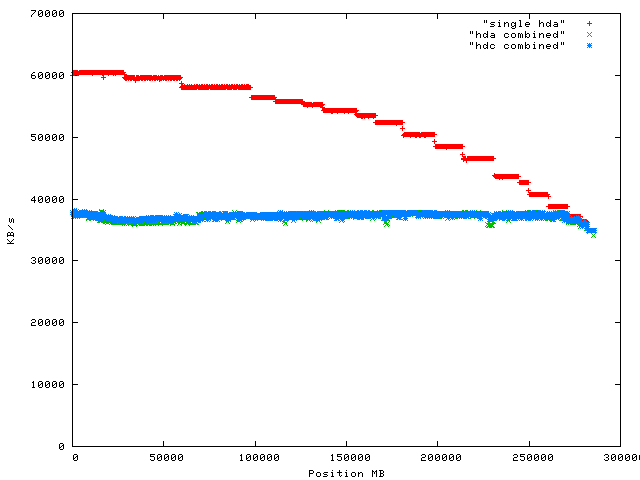
As correctly pointed out by cmot [1] my previous post about software RAID [2] made no mention of bus bandwidth. I have measured the bus bottlenecks of a couple of desktop machines running IDE disks with my ZCAV [3] benchmark (part of the Bonnie++ suite). The results show that two typical desktop machines had significant bottlenecks when running two disks for contiguous read operations [4]. Here is one of the graphs which shows that when two disks were active (on different IDE cables) the aggregate throughput was just under 80MB/s on a P4 1.5GHz while the disks were capable of delivering up to 120MB/s:
On a system such as the above P4 using software RAID will give a performance hit when compared to a hardware RAID device which is capable of driving both disks at full speed. I did not benchmark the relative speeds of read and write operations (writing is often slightly slower), but if for the sake of discussion we assume that read and write give the same performance then software RAID would only give 2/3 the performance of a theoretical perfect hardware RAID-1 implementation for large contiguous writes. On a RAID-5 array the bandwidth for large contiguous writes is the data size multiplied by N/(N-1) (where N is the number of disks), and on a RAID-6 array it is N/(N-2). For the case of a four disk RAID-6 array that would give the same overhead as writing to a RAID-1 and for the case of a minimal RAID-5 array it would be 50% more writes. So from the perspective of “I need X bandwidth, can my hardware deliver it” if I needed 40MB/s of bandwidth for contiguous writes then a 3 disk RAID-5 might work but a RAID-1 definitely would hit a bottleneck. Given that large contiguous writes to a RAID-1 is a corner case and that minimal sized RAID-5 and RAID-6 arrays are rare in most cases there should not be a significant overhead. As the number of seeks increases the actual amount of data transferred gets quite small. A few years ago I was running some mail servers which had a very intense IO load, four U320 SCSI disks in a hardware RAID-5 array was a system bottleneck - yet the IO was only 600KB/s of reads and 3MB/s of writes. In that case seeks were the bottleneck and write-back caching (which is another problem area for Linux software RAID) was necessary for good performance. For the example of my P4 system, it is quite obvious that with a four disk software RAID array consisting of disks that are reasonably new (anything slightly newer than the machine) there would be some bottlenecks. Another problem with Linux software RAID is that traditionally it has had to check the consistency of the entire RAID array in the case of an unexpected power failure. Such checks are the best way to get all disks in a RAID array fully utilised (Linux software RAID does not support reading from all disks in a mirror and checking that they are consistent for regular reads), so of course the issue of a bus bottleneck becomes an issue. Of course the solution to these problems is to use a server for server tasks and then you will not run out of bus bandwidth so easily. In the days before PCI-X and PCIe there were people running Linux software RAID-0 across multiple 3ware hardware controllers to get better bandwidth. A good server will have multiple PCI buses so getting an aggregate throughput greater than PCI bus bandwidth is possible. Reports of 400MB/s transfer rates using two 64bit PCI buses (each limited to ~266MB/s) were not uncommon. Of course then you run into the same problem, but instead of being limited to the performance of IDE controllers on the motherboard in a desktop system (as in my test machine) you would be limited to the number of PCI buses and the speed of each bus. If you were to install enough disks to even come close to the performance limits of PCIe then I expect that you would find that the CPU utilisation for the XOR operations is something that you want to off-load. But then on such a system you would probably want the other benefits of hardware RAID (dynamic growth, having one RAID that has a number of LUNs exported to different machines, redundant RAID controllers in the same RAID box, etc). I think that probably 12 disks is about the practical limit of Linux software RAID due to these issues and the RAID check speed. But it should be noted that the vast majority of RAID installations have significantly less than 12 disks. One thing that cmot mentioned was a RAID controller that runs on the system bus and takes data from other devices on that bus. Does anyone know of such a device?

Jacobo Tarr&#237;o Barreiro: AGPL

If I think that the FSF did the wrong thing, is there any way in which I can display my opposition? Can I become a negative member? Can I make an antidonation: get them to give me money? Update: In other words: I think that the AGPL is not free. Clause 13 is a restriction on usage. I’m very disappointed. (And the GPLv3 is not a high note for the FSF either).

Benjamin Mako Hill: Free Culture Distilled for Free Software Folks

I've posted an an article on my website called Free Culture Advanced which I wrote for the last edition of the Free Software Foundation Members' Bulletin which went out several months ago. The bulletin is one of things you get when you become an associate member of the FSF. The article makes the case for free culture and a freedom definition in terms that are directed to and I hope will resonate with folks from the free software community. I've posted versions of the article in HTML, PDF, and LaTeX.

Russell Coker: Perfect Code vs Quite Good Code

Some years ago I worked on a project where software reliability should have been a priority (managing data that was sometimes needed by the police, the fire brigade, and the ambulance service). Unfortunately the project had been tainted by a large consulting company that was a subsidiary of an accounting firm (I would never have expected accountants to know anything about programming and several large accounting firms have confirmed my expectations). I was hired to help port the code from OS/2 1.2 to NT 4.0. The accounting firm had established a standard practice of never calling free() because “you might call free() on memory that was still being used”. This was a terribly bad idea at the best of times and on a 16 bit OS with memory being allocated in 64K chunks the problems were quite obvious to everyone who had any programming experience. The most amusing example of this was a function that allocated some memory and returned a pointer which was being called as if it returned a boolean, one function had a few dozen lines of code similar to if(allocate_some_memory()). I created a second function which called the first, free’d any memory which had been allocated and then returned a boolean. Another serious problem with that project was the use of copy and paste coding. A section of code would perform a certain task and someone would need it elsewhere. Instead of making it a function and calling it from multiple places the code would be copied. Then one copy would be debugged or have new features added and the other copy wouldn’t. One classic example of this was a section of code that displayed an array of data points where each row would be in a colour that indicated it’s status. However setting a row to red would change the colour of all it’s columns, setting a row to blue would change all except the last, and changing it to green would change all but the second-last. The code in question had been copied and pasted to different sections with the colours hard-coded. Naturally I wrote a function to change the colour of a row and made it take the colour as a parameter, the program worked correctly and was smaller too. The next programmer who worked on that section of code would only need to make one change - instead of changing code in multiple places and maybe missing one. Another example of the copy/paste coding was comparing time-stamps. Naturally using libc or OS routines for managing time stamps didn’t occur to them so they had a structure with fields for the year, month, day, hours, minutes, and seconds that was different from every other such structure that is in common use and had to write their own code to compare them, for further excitement some comparisons were only on date and some were on date and time. Many of these date comparisons were buggy and often there were two date comparisons in the same function which had different bugs. I created functions for comparing dates and the code suddenly became a lot easier to read, less buggy, and smaller. I have just read an interesting post by Theodore Ts’o on whether perfect code exists [1]. While I understand both Theodore’s and Bryan’s points of view in this discussion I think that a more relevant issue for most programmers is how to create islands of reasonably good code in the swamp that is a typical software development project. While it was impossible for any one person to turn around a badly broken software development project such as the one I describe, it is often possible to make some foundation code work well which gives other programmers a place to start when improving the code quality. Having the worst of the memory leaks fixed meant that memory use could be analysed to find other bugs and having good functions for comparing dates made the code more readable and thus programmers could understand what they were looking at. I don’t claim that my code was perfect, even given the limitations of the data structures that I was using there was certainly scope for improvement. But my code was solid, clean, commented, and accepted by all members of the team (so they would continue writing code in the same way). It might even have resulted in saving someone’s life as any system which provides data to the emergency services can potentially kill people if it malfunctions. Projects based on free software tend not to be as badly run, but there are still some nasty over-grown systems based on free software where no-one seems able to debug them. I believe that the plan of starting with some library code and making it reasonably good (great code may be impossible for many reasons) and then trying to expand the sections of good code is a reasonable approach to many broken systems. Of course the ideal situation would be to re-write such broken systems from scratch, but as that is often impossible rewriting a section at a time often gives reasonable results.

MJ Ray: ASTEFAQ: Will I get the BBC on the Costa Blanca with a small dish?

CHRISTOPHER MCKINLEY asked:
"I live on the costa blanca spain. I have been told that bbc and itv are to start broadcasting a free to air service which we will be adle to pick up on a small dish. It's scheduled to start in Feb/March 2008. Could you tell me if this is true?"
No, I can't tell whether that's true. The BBC/ITV Freesat service is expected to start in 2008 and I think March is meant to be when Channel 4's Sky encryption contract finishes, so I guess that's where that date comes from. That seems highly probable to me. Then again, Freesat has been advertised as launching in 2006 before. However, I doubt that BBC and ITV will move off of the Astra 2D spot beam that they moved to when they went free-to-air and back to the wider beams needed for small dish reception on the Costa Blanca. So, it will still not work for you. Sorry. (I'm not too cross about that, because the main terrestial Spanish channels seem to be encrypted on satellite.)

Next.

Previous.