Search Results: "ag"

24 November 2007

Ross Burton: Devil's Pie "Sweet Music, Soul Music?" 0.22

Devil's Pie (someones favourite window manipulation tool) 0.22 is out. Just one bug fix, which shows that my users all use OpenBox. Downloads are in the usual place.

Lucas Nussbaum: Where is the NM bottleneck?

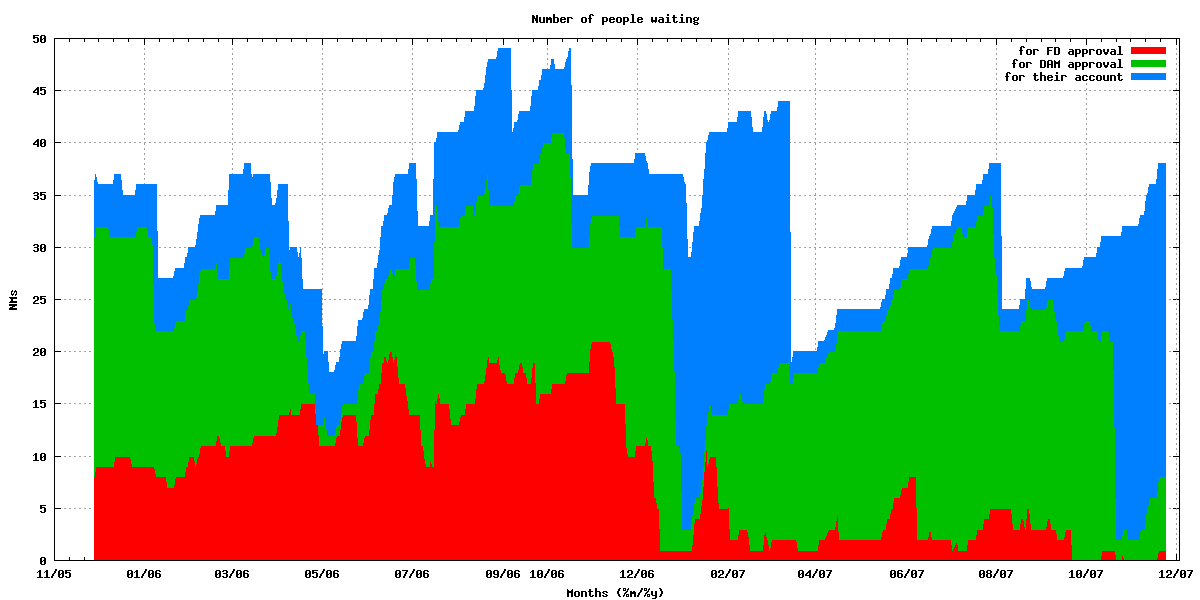
The current status of the NM process, with 1 NM awaiting FD approval, 7 awaiting DAM approval, and 30 waiting for their accounts to be created, leads people to thinking that the big bottleneck is the account creation stage. However, when you look at what happened since december 2005, it’s not that simple. NM queues status See the graph linked above, which shows where people are waiting. While it seems that the FD stage hasn’t been blocking people for nearly a year, it’s the DAM stage which has been the biggest blocker. Indeed, on average, 8.3 NMs have been blocked by FD, 16.2 by DAM, and 9.0 by account creation. I understand that processing NM reports in batch mode makes it more efficient. However, I’m wondering if processing them 20 per 20, is really that more efficient than processing them 5 per 5, which would justify such long queues. The NEW queue, which used to be a problem, is now being processed on a very regular basis, and hasn’t grown widely recently, except after Debconf when the ftpmaster processing NEW was on VAC. Couldn’t we have the same thing for DAM, account creations, and while we are at it, removals from unstable? Having clearly defined human-crontab-jobs would certainly make working on Debian less frustrating.

Christian Perrier: Thou Shalt Not Use Smbfs

A one may see with the regression recently introduced by the lastest security updates of the samba package, using smbfs is currently not possible with etch Samba servers if they're up-to-date. I'm afraid that people who experience this bug just deserve what they got. Smbfs is bloody deprecated for years in favor of the cifs filesystem (samba upstream QA work never includes checks for smbfs stuff). CIFS Userland utilities are provided in the smbfs Debian package so the switch is mostly a matter of a few minutes work and manpage reading (some options might differ). We should have told this earlier, probably, sorry for this. But it is now time to say it and even shoult it: if you're using smbfs, you're shooting in your own foot. So, check you machines and if you use "smbmount", consider switching (sams for positive output of "grep smbfs /etc/fstab"): it's quite likely that it is removed in next versions of samba as Steve Langasek, myself and other samba package maintainers are really fed up with bugs related to that obsolete thing.

Michal Čihař: I hate this system

My girlfriend has to use Windows, because university she studies does not give her another option. Now she got some crap on which she should do some statistics. This crap is being called SAS. I have not yet seen how does it look like, but I already enjoyed funny hours with it's installer. As I'm currently on the other side of world, I have to do all remotely... The basic problem is simple: I do not have much space on C: drive and it does not provide option to install on another drive. First she tried to install it herself, the setup fucked up so much, that it deleted NTLDR and friends from root folder, so Windows didn't boot up again. Fortunately there is also Debian on that machine, so she booted to it, I installed ntfs-3g and restored needed files from Windows XP installation CD (the recovery console did not work, don't ask me why). So great, after about one hour we have back working Windows! Now I still did not have idea what is the problem. However the failure appeared when the crap was trying to install some special JRE it has included. When I started the installer for this JRE manually, it showed that there is not enough space. Why the hell did not the original installer show this? Well I did some cleanup on the disk and I got 1GB of free space. Hope that it will be enough. No. Somewhere near 58% installation is fucked up again with error -2147483648. Wow nice number! Looking at disk space, it's down to few kilobytes. So again the same problem! Okay, let's clean it up more and hopefully installer will resume. But I should not hope for anything good from this installer. The only option it now gives me is to reboot. Reboot, start again installer and let's see what will break this time. Now it found out that some Microsofts runtime is missing. Why it was not missing last time? Okay, let's install it and (of course) we need another reboot. System started up, installer launched and it seems to go on quite well, only the last few percents are taking incredibly long, but the crap seems to finally installed and it even runs! Few questions: Why they do not check for required space in installer? Why do they force me to disable anti virus during installation? Why does not remote desktop from Windows work? Why is there such mess in Windows, especially in Windows folder? Why are temporary files located all over the disk? As last but not least thing I would like to thanks everybody who made ntfs-3g and VNC work, I would never fix this without these tools.

23 November 2007

Joachim Breitner: Descendant tree drawing problem

For a geneaology project of my familiy, I generated this fairly straight forward drawing of my Grand-Grand-Grand-Grandfather s descendants (click for full image): Unfortunately, this representation does not give any information about when someone lived, or how long. I tried to add this information to the graph, and I coudn t think of anything better than drawing each person as a rectangle whose upper edge lies above the parent s rectangle, and whose height and vertical possition represent the life span. This is the result (here you really have to click for a full view): This is obviouly not very helpful. Does anyone have a better idea how to draw this?By the way, these graphs are generated using haskell and the cairo bindings provided by gtk2hs very handy, as I also get svg output and pdf output for free.

Ross Burton: Eye of Gnome Bling

Last night I finally got around to having a play with Clutter. Considering I'd never used it before, I'm really impressed with just how easy the API is to use. Within half an hour I had images fading in and out, and this morning I built Eye of Gnome and rewrote my hack as a slideshow plugin. There is no point releasing the code just (patches required, and a nasty bug remaining), but I did make a screencast. NP: Maxinquaye, Tricky

Sune Vuorela: Debianized splash screens part 3?

Oh well.. I asked for a couple of brave testers some time ago. I guess it is time to try make my attempted work public. Use it at your own risk and fun. And please don’t comment on my ability to (not) use gimp and (not) to remove white. For brave people, try look at http://users.alioth.debian.org/~pusling-guest/.desktop-base/ Comments are welcome

Joerg Jaspert: Todays work

Work. No, not at my workplace, for Debian. I decided to modify the ftp-master webpage a little bit, just adding some css magic (and the ability to conform with that xhtml1.0 strict thing out there). (And to be honest - about 95% of the “work” needed for this was done by Mark Hymers…) But that only happened after something else, which took away most of my time today (and yesterday and the day before). Namely - a nice overview of pending removals. The main purpose of that overview is of course “ftpteam members doing removals can take it for their work”, but i think it may also be nice for users to look there, instead of wading through all the bugreports against ftp.debian.org, which include bugs about totally different topics than removals. (And then I am lazy and want a commandline to paste… :) ) The design for that page was done by Martin Ferrari AKA Tincho, you don’t want to see how my design did look like… :), the idea for it is from Jeroen van Wolffelaar who wrote the first version of it in Perl (it is now implemented in Ruby). The removals html page is regenerated every hour, using the SOAP interface to the BTS, so at least the bugs information should be recent. The other information might have errors in them, don’t trust them too far. It should be right, but then - its only informational.. :) And now: Lets do some of those removals!

Russell Coker: Election 2007

I am a member of the Greens. The main reason for joining them is that they have principles. The Greens Charter [1] guides everything, policy must comply with the charter and candidates agree to uphold the policies which have been ratified if they get elected. There are no “non-core promises“. The policies of the Greens are all positive. The major parties have some mean-spirited policies that aim to help Australians by making things worse for people in other countries. Unfortunately for them the world is very inter-connected at the moment, so it’s difficult to harm other countries without harming yourself in the process. As you might expect the Greens are very positive towards the environment. Anyone who expects to live for more than 30 years (or who has children) should be very concerned about this. Currently even the most cautious estimates of the scope of the climate change problem by reputable scientists suggest that there will be serious problems in the next few decades. If you are young or have children then you should vote for the Greens (that covers most people). Many religious groups have determined that God wants them to help the environment, for example the Australian Anglican Church General Synod 2007 resolved that “the Anglican Communion’s 5th mark of mission to safeguard the integrity of creation and sustain and renew the life of the earth; and recognises that human activity contributing to Climate change is one of the most pressing ethical issues of our time”. Anglicans and believers in other religions that have similar ideas should vote for the Greens. The Greens have policies that are very positive towards minority groups. If you are not a straight-white-Christian then this is a strong reason for voting for the Greens. If you are a straight-white-Christian but have compassion for others (as advocated in the Bible) then again voting for the Greens is the right thing to do. The Greens policies are humane towards people in unfortunate situations, including drug addicts, the mentally ill, and the unemployed. When considering who to vote for keep in mind that at some future time you or a close friend or relative may fall into one of those categories. Finally the Howard government’s industrial relations legislation is very bad for the majority of workers. If the Greens get the balance of power in the Senate then they will be able to get such laws significantly changed or removed. The Greens election web site is here [2]. As an aside, I never liked Paul Keating (our last Prime Minister) until I read his op-ed piece in The Age about John Howard [3]. Also here is an interesting article on preferences and why the major parties want people to misunderstand the Australian electoral system [4]. In summary if you vote for the Greens as your first preference and they don’t win, then your second preference gets counted, and if that party doesn’t win then the third preference counts, etc. So if you have the two major parties in last and second-last position then your second-last preference may make an impact on the result! Putting Greens in the #1 position does not “waste” your vote. Parties get government funding based on the number of #1 votes, vote for the Greens as your first preference and you effectively give them $2 for their next campaign. Finally when a party wins an election they immediately look at where the #1 votes went and often adjust their policies to please the people. Vote #1 for the Greens and if Labour wins they will have more of an incentive to adopt policies that are similar to those of the Greens.

22 November 2007

Sune Vuorela: Hit it!

It’s 106 miles to Chicago. We’ve got a full tank of gas, half a pack of cigarettes, it’s dark and we’re wearing sunglasses.

Neil Williams: Debian GPE team

I'd better put some details of this somewhere, so here goes.
Moray Allen and I have formed a Debian GPE team at Alioth. The idea is to gather all the GPE packaging stuff onto a mailing list as a single point of contact for all things related to GPE - the G Palmtop Environment.
I'm now busy updating the GPE packages to add the Debian GPE team as Uploader and taking advantage of these uploads to also add cross building support for all these packages for Emdebian as well as the normal upload tasks for keeping up with the Debian Menu transition and fixing lintian warnings that arose since the last upload, etc.
My basic idea is that everything under the "Debian GPE team" banner should be cross-buildable - it's only logical.
Once dpkg is fixed to once again allow cross-building properly, I'll upload these packages to Emdebian and lots more of their dependencies.
Next task is to file a few more ITP bugs and make good on my existing ones so that GPE can be a complete environment within Debian and Emdebian.

Gerfried Fuchs: Strange ...

Haven't written anything for way too long, I tried to put something down again last week, and this is what I came up with. It's not influenced by anything special, it's not as well as I usual prefer, but still, I thought I should share.
life is strange
it starts off without knowledge
in the end you die love is strange
it starts off with bad heartaches
in the end - alone things are strange
still we try to survive it
go on day by day

Jonathan McDowell: Getting Linux talking to a Nortel VPN

At work we're currently in a managed office, which means we don't control the network in any way. As a result we're all individually VPNing back to the lab network in the US. Not a great situation, but it does the job while we work out what's happening with our own building and a local lab. The HQ end is running on a Nortel Contivity. This causes a bit of a problem; I need a working VPN setup in order to work, but the Nortel stuff is non standard. How to get it going under Linux so I can switch from XP to Debian? I found 3 options, in order of preference: vpnc There's a Nortel branch of vpnc, though it's from an old release (0.3.2). There are some reports of it working ok, and quite a few of problems. vpnc gains points for being entirely Free software. http://ubuntuforums.org/showthread.php?t=441042 has some further details. Novell VPN client Novell have a hacked up version of ipsec-tools that adds http://forge.novell.com/modules/xfmod/project/?turnpike, a framework for different types of IKE. They have a novell-nortelplugins package that has a binary plugin supposedly supporting Nortel VPN access. Not quite as nice as vpnc, but it's still userland and does use the kernel's IPSEC stack. Apani Nortel client Apani do a commerical Nortel VPN client for Linux, as well as Windows CE/MacOS and Solaris. It's not that up to date (supports up to kernel 2.6.18, though there are patches that get it working on 2.6.22) and involves a binary blob kernel driver, but they do claim to offer support for it and it's where Nortel will point you for single client licenses. I have, of course, ended up with the (paid for) Apani client. I tried vpnc and the Novell client but couldn't get any degree of success from them. VPN remote ends don't really provide a lot of feedback (which is understandable - it hardly wants to tell me if I'm failing on a username, password, or something entirely different) and I don't have any access to the Contivity device to read its logs. I think the main issue is that my connection has no IPSEC group id or password, and both vpnc and the Novell stuff ask for that. The Apani client is happy with just my username and password, which I think is used for some corruption of xauth. At some point I'll try fighting vpnc again, but for the moment I have my VPN connection working under Debian and thus I'm back to Debian at work. As an added bonus the reaction of my coworkers has been good - instead of "Why would you want to?" I've had comments like "I wish I'd installed Linux when I started." and "Actually, I might do that myself after Christmas."

Russell Coker: Drugs and an Election

As mentioned in my previous post [1] the government is using our money to advertise its policies. I previously covered the “Internet as a threat to children” issue, the other big one is drugs. The first significant message in the “Talking with your kids about drugs” document concerns the criminal penalties for drug use. That could largely be removed if the penalties were dramatically decreased and if hard drugs were administered to registered addicts for a nominal fee. Forcing addicts to commit crimes or work as prostitutes to pay for their addiction just doesn’t work, economically or socially. The next message is that parents should be involved in their children’s lives and be trusted enough that their children will accept advice. A large part of this would be related to the amount of time spent with children which is determined to a large degree by the amount of time not spent working. As I mentioned in my previous post it seems that the actions of the Howard government over the last 10 years has made things significantly worse in this regard by forcing more parents to spend large amounts of their time working (including situations where both parents work full-time) just to pay for a home. One notable omission from the document was any mention of alcohol problems (apart from when mixed with illegal drugs). By many metrics alcohol causes more harm than all the illegal drugs combined. The US attempted to prohibit alcohol and failed dismally, and alcohol is legal in most countries. The government doesn’t want to adopt a harm-minimisation approach to drugs (which bears some similarities to the approach taken to alcohol) and therefore is stuck trying to claim that one somewhat addictive mind-altering substance is somehow inherently different to all other mind-altering substances. The document provided no information at all on harm minimisation. The idea seems to be that it’s better for some children to die of overdoses than for other children to potentially be less scared of the consequences of drug use. The problem is that children are very bad at assessing personal risk so they simply won’t be scared off. It’s best to provide equipment for testing drug purity etc to reduce the harm. The list of reasons for young people to try drugs starts with “availability and acceptability of the drug“, Parmesan cheese is more available and acceptable than any drug but I’ve been avoiding it at every opportunity since I was very young. :-# More serious reasons in the list include “rebellion“, “depression“, “as a way to relax or cope with stress, boredom or pain“, and “to feel OK, at least temporarily (self-medication)“. But predictably there was nothing in the document about why children might consider that their life sucks to badly that they want to rebel in that way, be depressed, stressed, bored, or in pain to a degree that drugs seem like the solution. It seems unreasonable to believe that the school system isn’t a significant part of the cause of teenage problems. Flag poles for flying the Australian Flag [2] seems to be John Howard’s idea of a solution to school problems. I believe that the solution to school problems (both in terms of education and protection of children) is smaller classes, better supervision, an active program to eradicate bullying, and better salaries for teachers. I’ve written about related issues in my school category. I believe that the best thing for individual families to do is to home-school their children from the age of 12 instead of sending them to a high-school (which is much more damaging than a primary school). Another significant issue is drug pushers. They are usually drug users who try to finance their own drug use by selling to others. As most drug users get the same idea there is a lot of competition for sales and therefore they try to encourage more people to use drugs to get more customers. In the Netherlands, Coffee Shops sell a range of the milder drugs at reasonable prices which removes the street market and therefore the pushers. When drugs are produced commercially the quality is standardised which dramatically reduces the risk of infection and overdoses. When drugs are sold by legal companies they are not sold to children (a typical pusher can be expected to sell to anyone). The document has 3.5 pages of information about some of the illegal drugs (out of 23 pages total). They include all the most severe symptoms that most users don’t encounter. If someone reads that information and then talks to a drug user they will be laughed at. They also group drugs in an unreasonable way, for example listing “marijuana” and “hashish” as synonyms and list problems that are caused indirectly. If alcohol was included in that list it would include beer and methylated spirits (ethanol mixed with methanol to supposedly make it undrinkable - rumoured to be consumed by homeless people) in the same section and imply that blindness and other bad results of drinking “metho” apply to beer. It would also say that alcohol kills many people through drunk-driving and is responsible for rapes, wife-beating, and any other crime which can statistically shown to be more likely to be committed by a drunk person. A final issue with the document is that it advises parents to be “informed, up-front and honest” when talking to their children about drugs. Unfortunately the document itself doesn’t demonstrate such qualities. By omitting all information on harm minimisation it is not being up-front at all, and by not mentioning alcohol it’s simply being dishonest. Anyone who tries to convince someone else to not use illegal drugs can expect to hear “but you drink alcohol” as the immediate response from the drug user, it’s necessary to have sensible answers to that issue if you want to be effective in discouraging drug use.

Adam Rosi-Kessel: MBTA Followup

This Universal Hub thread and Boston Globe article sum up my several MBTA complaint postings nicely (1 2 3 4 5 6 7 8 9 10 11). The “work to rule” comments are particularly interesting. Okay, if I’ve really written twelve entries on this topic, I’m done for now. Technorati Tags: ,

Jeff Bailey: Southpark

Okay, I really do live in a jar. I finally saw my second and third southpark episode ever a couple of nights ago, the Scientology one and the Mormon one. OMFG, hilarious.

I'm only sad that UUism probably isn't a big enough religion to get on their radar. Which is too bad, because it would probably be fabulous. =)

Wouter Verhelst: Four DVDs

A week or two ago, I went to the local standaard boekhandel to use the gift certificate that my mother had bought me for my birthday (which was in may). For the 50 of that certificate, I bought me the Dutch version of 1984, plus 4 DVD boxes: one with Hitchcock's Psycho, one containing Superman Returns, another one of Dances with wolves, and a final box containing David Lynch's masterpiece Mulholland Drive. Not a bad deal, I must say; especially as the latter two boxes were on a "buy one, get one free" promotion, where those boxes each had a second DVD with a different movie. For Dances with wolves, I forgot which one it is; but for Mulholland Drive, that was The Singing Detective. Now if anyone ever tells me that 20 for a DVD with a single movie is a reasonable price, then, well, hah. Anyway. I hadn't seen Psycho before; but in a past life where I did drama school, we had some classes about this movie. As a result, some of its secrets were spoiled, and I didn't enjoy it as much as I probably would have had I not had this knowledge beforehand. Still, it was an enjoyable experience. If you've never seen this movie, shame on you! Go to the local video store, and rent it. Preferably in its original black & white form, not the 1998 remake. Dances with wolves is a pretty interesting movie, too. Of course, as I'd seen part of it before, I already knew that. Superman Returns is not bad, as a no-brainer entertainment movie. It's nothing beyond that, however. Finally, Mulholland Drive is strange. Back in 2001, when the movie first came out, I went to see it at the local movie theatre; it is one of those complex movies which, once you've finished seeing it, will still leave you puzzled until you see it a few more times. Few other movies ever manage to do that to me (I think the only other one is Pulp Fiction). At the time, I planned to watch the movie again as soon as possible, but for various reasons that didn't happen; and now, after six years, I had almost completely forgotten the plot. Which is good, really—I enjoyed it much more. And I think I got it, this time; rather than trying to find the logic in the plot, I just went with the flow, which helps a lot. The other two I still have to see. But hey, there's still time, right? Oh, and 1984? It's nice how you want to scream and yell when the system completely takes over Winston's mind. An interesting book.

Tollef Fog Heen: Renewing CA certificates

I'm in the process of moving servers at the moment, and amongst the services I am moving is my authenticated, but public SMTP relay service. That service includes a basic web-based CA whose CA certificate is going to expire in July 2008. Apparently, it is possible to refresh CA certificates without having to distribute fresh certificates to all the clients. The magic steps, using openssl are: First, generate a new CSR using the existing certificate and key as input:
openssl x509 -x509toreq -in cacert.crt \
  -signkey cakey.key -out renew.pem
Then sign it:
openssl x509 \
  -extfile openssl.cnf \
  -extensions v3_ca \
  -CA cacert.crt -CAkey cakey.key \
  -set_serial 0 -days 365 \
  -req -in renew.pem -out newcacert.pem
This information was quite hard to come by, so hereby put here so I can find it if I need it again.

Russell Coker: Internet and an Election

Before the election was called the Howard government (being unethical in every way) started using public money to campaign. Part of this election campaign was two documents sent out to every home (AFAIK) coupled with a media campaign, one was about children and drugs, the other was about children and the Internet. I have to wonder how many people were fooled by this, including a picture of John Howard on the first page after the index made it pretty clear what the purpose was. Before I analyse the content of the documents one thing to keep in mind is the cost of the Iraq war, which the Sydney Morning Herald [1] estimates at $3,000,000,000. Note that this doesn’t include the life-long medical and psychiatric care that some veterans will require or the cost to the economy of such people not being productive tax-payers. It does note that 121 employees of the Australian military have been discharged on medical grounds. If each of those 121 people was disabled in a way that significantly impacted their life then the cost could be as much as $242,000,000. Let’s not assume that everyone who is currently serving and regarded as completely fit will be fine in 10 years time either. The Prime Minister gives a personal introduction to each document, the “NetAlert” document states that $189,000,000 is being spent to protect children on the Internet. The “Talking with your kids about drugs” document states that “more than $1.4 billion” has been spent to combat illicit drug use, I’m not sure what time period that covers - it seems to be his entire 10 years as PM so that would be $140,000,000 per annum. Obviously declaring a war of aggression against Saddam Hussein is something that he considers to be more important than protecting Australian children. Now the content of the NetAlert document. It starts with $84,800,000 to provide access to “the best available internet filtering technology“. I have to wonder, how much would it cost to develop some new Internet filtering software from scratch, or what the opportunity cost might be to re-assign resources from organisations such as CSIRO to the task. I expect that in either case the total would be a lot less than $84,800,000. Developing free software for the task would be a much better use of resources and would also allow cooperation with similar programs in other countries. In the unlikely event that $40,000,000 was required to develop such free software it probably wouldn’t be difficult to get a few other governments to kick in some money and make it $10,000,000 per country. Of course saving $70,000,000 doesn’t sound like much (a mere $3 per person in the country), but it is significantly more than the Free Trade Agreement with the US [2] was supposed to bring in (from memory it was promoted as improving the economic position of the country by $50,000,000 but the best available information is that it made our balance of trade worse). $43,500,000 in additional funding for the police to combat online child sex exploitation is small but OK (it would be better if some of that $84,800,000 had been saved on filtering software and allowed greater expenditure in this area). But it should be noted how child rape in Aboriginal communities is used as a political issue and nothing constructive is done about the problem [3]. I believe that protecting children against rape is far more important than controlling illegal porn (which is where the majority of that $43,500,000 will go). Another possible avenue of research would be on more secure computer systems for Australian homes. It’s all very well to install some filtering software, but if the PC running the software in question is hacked then it’s immediately turned off. Attacks that involve turning web cameras on without the knowledge or consent of the owner are not uncommon either, it’s not unreasonable for a child to get out of bed and then do some homework on their computer before getting dressed - with an insecure computer and a web-cam connected this could be a bad thing… If the Australian government was to mandate that all government data be stored in open formats and that all communication with government computer systems can be done with free software (as a matter of principle you should not have to buy expensive software to communicate with your government) then the incidence of insecure desktop OSs would decrease. The document does recommend some basic OS security mechanisms, but if you use an OS that is insecure by design it’s not going to work. The core message of NetAlert is that children should be supervised when using the net. There is one significant problem with this, full supervision of children requires that at least one parent is not working full-time. In a previous post I compared median house prices and median incomes [4] with the conclusion that even with both parents working it’s difficult to afford a house. It would be difficult for a single income that is below the median to be used to pay the rent on a decent house. So it seems that a significant portion (maybe the vast majority) of Australian families will be forced to do what the government would consider to be a compromise of the Internet safety of their children by having both parents working full-time jobs to pay off a large mortgage (or in some cases merely to pay rent). I believe that making houses more affordable would improve the protection of children and provide other significant benefits for society. If you look at chart 1 and chart 2 on the House Prices research note from the Australian Parliamentary Library [5] you can see a significant increase in the difference between CPI increases and house prices increases since 1996 (when John Howard became Prime Minister) and a significant increase in the ratio of house prices to average income. The charts only include data up to 2006 so don’t show the effects of the Howard government’s “workplace reform” which lowers wages for many people who are below the median income. John Howard is responsible for houses being less affordable and parents being forced to spend more time working and less time supervising their children, I find it offensive that he now tells people to spend more time supervising their children. The document does have some good basic advice about how to supervise children and what level of supervision is necessary. The problem is that children from an early age know more than the typical parents. I doubt the ability of typical Australian parents to implement some of the supervision suggestions on 12yo children. I have been considering writing my own documents on how to filter and monitor child Internet access but the main problem is determining ways of doing so that can be implemented by someone who is not a computer expert. In summary, the Howard government is responsible for reducing the supervision of children and therefore exacerbating the problems that they are claiming to solve. Their NetAlert program provides some information that can’t be implemented by the majority of Australians and entirely skips some of the most sensible steps such as using only secure OSs on machines that will be used on the Internet. I believe that Fedora and CentOS should be recommended by the government in this regard because of the combination of good security by default (of which SE Linux is only one component) and the ease of use. Computers are cheap enough that most families with good Internet connections (the ones at risk in this regard) have multiple computers so no extra cost would be incurred.

David Welton: Android, Hecl and scripting

Aside from my hard drive crash, I've been working to figure out the best way to integrate Android and Hecl. Since Hecl has been a small, simple, humble language suitable for J2ME (or JavaME or whatever), that has meant in the past that it hasn't really been able to utilize more complex or advanced Java features like reflection, because they aren't present in the J2ME API. Android's more complete implementation of "Java" (yes, I know about the VM, but the programming language I'm writing in is still Java) opens up a number of possibilities. First on my list of things to do was aim for a generic access layer for Java objects using reflection, so that you can do things like this:
$button settext "blah blah"
Now that we have that working, I also wanted to be able to create new Android widgets from Hecl, which is where things get tricky. The "problem" is that I want something that feels like a scripting language, not simply a reflection of the underlying Java. For instance, the XML description of a button looks like this:
<Button id="@+id/execute"
android:layout_width="fill_parent"
android:layout_height="wrap_content"
android:text="Execute"
/>
Which is actually not so bad in terms of verbosity. The Java code is uglier, in my opinion:
Button button = new Button(activity);
button.setLayoutParams(new LinearLayout.LayoutParams(LayoutParams.FILL_PARENT, LayoutParams.WRAP_CONTENT));
button.setText("Execute");
Especially the LayoutParams business, that is nowhere near as clear as the XML, where it's very obvious what values you're giving to what parameters. You wouldn't know that from the Java code without looking up the constructor for the LinearLayout.LayoutParams class. Now, with Hecl I could of course write the code by hand to make things 'friendlier', but I'm worried that if I have to do that too much, it will take a long time to cover the rather extensive API, and it will also bloat the code. The ideal solution would be subvert the XML stuff for my own purposes, however, that's proving tricky. My first idea was to utilize the AttributeSet parameter that you pass to many View derived objects' constructors, in order to transform code like this:
button -text hello -layout_width 100 -layout_height 34
Into something that Android can digest. Unfortunately, that's proving difficult, as the internals of Android barf on the class I'm passing them, even though it, to my knowledge, implements the AttributeSet interface without any problems. This really made me wish that they would hurry up and release the source code, because I would have a far better understanding of the relationship between the XML attributes and the Java methods if I had access to what's going on under the hood. Harumph. My next attempt was a hack that takes things like -text and transforms them into calls to setText, but that isn't as good, because you need a little bit more custom code for things like the layout parameters, which require special handling. However, lacking the source code, or some help from the Google folks with access to it (which isn't likely over the next few days as they're doubtless off consuming turkeys), it looks like that's what I'll have to do.

Next.

Previous.