Search Results: "ag"

4 December 2007

Junichi Uekawa: oprofile, opreport --reset not working?

oprofile, opreport --reset not working? Apart from opreport being completely broken right now, 446360, which can be worked around by recompiling opreport package, opreport --reset doesn't seem to be working properly. After opreport --reset, no samples seem to be collected anymore. Strange.

Evan Prodromou: 13 Frimaire CCXVI

I'm organizing a micro-coworking session here in Montreal for 6 December (15 Frimaire). "Micro-coworking session" is just a fancy way of saying "hanging out together and working at a caf ". Folks will be meeting in the back of Caff ArtJava from about 9AM to about 5PM. More info on the subStation Coworking event page on Upcoming. The event is for people interested/involved in (or supportive of) Station-C, the incipient Montreal coworking facility scheduled to open in February 2008. But everyone's welcome to come by -- heck, we'd have a hard time keeping you away. tag:

Private and public life in the age of Facebook One of the things I find interesting about life on the Internet is the distinction between public and private life. So much of our lives are on-line today; for many of us, the Web is where we make our living, make our friends, enjoy our social life, and plan our off-line activities. But what about those personal activities that don't jibe with our intended professional image? If we have out-of-the-mainstream political or religious views, or unorthodox social activities, how do we keep them to ourselves? How do you talk about things on-line with friends that maybe you don't want your parents or other family to know about -- or vice versa? How do we preserve our reputation in more than one sphere, in situations where those spheres are very different? I think there are a number of strategies for doing this.
  1. Be discreet. In other words, just don't put personal stuff on the Web. Keep up your professional image at all times, and don't use Web sites or tools to make connections in more private ways. This is probably the safest strategy, and the one that most privacy groups and media recommend. But there are some downsides, too. You miss out on the Web's power to enhance your life as a well-rounded human being -- your personal life languishes for the benefit of your professional one. You give up on some important opportunities to connect with other human beings in a deep and meaningful way. Especially if your interests are shared by only a small percent of the human population, it's unlikely you'll run into other people who share them off-line. I also think there's something unhealthy about stifling your personal side for your professional life's benefit.
  2. Use pseudonyms. Another way of being "discrete" -- here, I mean separated into different parts. I think this is one of the most common ways to deal with the problem. Use your "real name" for activities, groups, and opinions that you feel safe presenting to the world at large, and use made-up names or handles for activities you might not feel like discussing at a job interview. This can be very successful, but also nerve-wracking. What parts of life require a "secret identity", and what parts don't? What if one part of your life leaks into another? It can also be tedious to set up, say, two or three different Flickr accounts, two or three Facebook accounts, umpteen blogs, etc. Or, you keep a LinkedIn account for work and a MySpace one for your partying set, and hope that Google doesn't make a link between the two. But you can get sick of managing them, and other people don't know which name or pseudonym to use and when to "out" you to their other friends.
  3. Integrate. By this I mean: let your personal and professional life grow together. Decide what parts of your personal life you're willing to make public, and bring them into your public persona. Parts of your life that you don't feel you can integrate, consider letting go of. I think this can be risky and difficult, but ultimately I think it's the most healthy psychologically for people who spend a lot of time on the Web. Most often, these people either work for themselves and don't have to answer to others, or they work in industries where offbeat or out-of-the-mainstream lifestyles are tolerated or encouraged (or the need for highly-skilled people makes those "quirks" easier to ignore). Or they just gamble that nobody at their work or in their family is really checking (quite often the case).
  4. Wait for better software. I think the main reason that this is a problem is that social software developers aren't very good sociologists. Or, rather, we focus on the software rather than on the social. It would be nice to see the next generation of Web services support the multiple facets of a person's life. I'm an Open Source fanatic, a Web developer, a wikitista, an entrepreneur, a father, a Burner, a Montrealer, a man, a prankster, a partier and a cook -- among many other things. How can social software, or a federation of services, let me reflect these different aspects of my personality to my friends, coworkers, colleagues, relatives and strangers? Could I define finer-grained relationships with others than just "friend", and choose what parts of my life to feature or downplay with each? It's a fascinating design and implementation question, and my hope is that someone will take on the challenge in the future.
I think this is a situation where our society and our software both need to evolve and change. It would be nice -- very nice -- if edgy politics or weirdo culture didn't hurt your chances of advancing in your chosen field. And if friends, family and colleagues could accept us all for who we are, in all our parts. But it will also be nice if software and software usage patterns on the Web let us find a way to adapt to that, too. People have lots of different parts and lots of different personae that they inhabit at different times and in different contexts -- it would be great to match our social software more to that reality. tags:

One-liners Some other things to note:
  • Montr al has had an insane amount of snow in the last few days. I dug out our car for about 90 minutes this morning, and drove for hours in snow-blind traffic. Not an easy time, but boy the city is lovely like this.
  • I'm doing a talk on extending MediaWiki at the PHP Qu bec meeting this Thursday, Dec 6. Meeting info is here.
  • Pictures from Montreal Santarchy are available on Grimmwire's Santarchy Montreal 2007 set. Great group, fun crowd, loooooong night. Oh boy.
  • Speaking of SantaCon, Santarchy in Second Life sounds totally nutso.
  • My server overload problems seem to be getting better. I moved Vinismo to its own server on Amazon Elastic Compute Cloud. I also moved SonaUiki and the Br leurs site to GoDaddy, where I have a ridiculous number of free Web hosting credits. It worked surprisingly well, and GoDaddy supports PmWiki out-of-the-box. Nice! Update: Apparently GoDaddy adds a whole bunch of ads in on their free Web hosting. I didn't notice; I have Adblock Plus installed. Gar. I'll have to move these sites back pronto.
  • My light and convenient Toshiba Port g R200 has been throwing I/O errors. So I gotta get a new hard drive. Good news: the thing's still under warranty (yay!). Bad news: I gotta drive through this miserable weather to a place in St. L onard to get the HD replaced. Boo!
tags:

Steve Kemp: don't go breaking my heart

If you're interested in working upon your CV/Resume, as Otavio Salvador was recently, then I'd highly recommend the xml-resume-library. It allows you to write your address, previous jobs, and skills as XML then generate PDF, HTML, and plain text format documents via a simple Makefile. It won't help with clueless agencies that mandate the use of Microsoft Word Documents for submission, so they can butcher your submission and "earn" their fee(s), but otherwise it rocks.

Romain Francoise: Shared links for 2007-12-04

Peter Van Eynde: Note to self: direct rendering on G33

If you cannot find out why oh why the Xorg server refuses to play nice and enable direct rendering, remember to check if libgl1-mesa-dri is installed...

So I'm almost there, installing debian on the G33 motherboard (an intel DG33TL) was non-trivial (I'll file a di bug soon), but now the advantages are becoming clear: the video is quite fast, very clear (DVI output) and the Q6600 cpu is just too fast.

Now to restore my backups and I'm back in the game!

Luciano Bello: Debian Logo and Messier 74

Many years ago I heard that the Debian logo represents a galaxy. And I always thought There is no galaxy that looks like that . Of course, I was wrong.

The Astronomy Picture of the Day from few days ago is a really nice picture of the Messier 74 galaxy.

Any resemblance is purely coincidental :)

Otavio Salvador: A Resume made easy

It was a very long time ago since I did my last resume and never found the energy to update (or translate it to English) so I thought it was nice to have this kind of information about myself. It was nice since it gave to me a nice impressions of events I participated and like. I’ve decided to do my resume using LaTeX (I use it for majority of my documents) and started to browse the web to find something useful to use as basis. I ended up finding Making a Resume in LaTeX and liked the final result. I then wanted to have it in English and Portuguese and them I remembered about po4a that makes that task very easy :-) I ended changing Adrew’s style to a class and writing a cuple of Makefiles to automate all this. All well done :-D I suggest that anyone interested on it to take a look on the GIT repository and also provide tips about how to improve it. I hope it’s useful to anybody else :-D

3 December 2007

Sune Vuorela: Save my laptop, save the world

I think my title is some tagline from some tv show I am not following, but anyway. Today my laptop stopped working. *GRR*. The usual: The power plug in the laptop stops working because it has been molested over the last 4 years. I haven’t planned in investing in a new laptop currently, so the alternative was fixing it. After splitting it into every little part I finally found the plug. And yes. The soldering was broken, the plug itself was broken. Needs replacement. I never bragged about my soldering skills before, but \o/ - I managed to get it removed - the only spare one I had came with 8 cm wire I now have this wire hanging out my laptop, but it is working again. Even better than before. The last weeks, I constantly needed to wiggle the powerplug. No need for that anymore. Finishing off with a big piece of warm glue to keep everything at its place. It is not beatiful, but it works:
laptoprepair.jpg I wonder for how long. It is probably time to consider saving up for a new laptop.

Michael Prokop: git[-svn] in 30 minutes

… or something like that… I planned to write a short note about how to start with using git-svn so I can provide a pointer to some of my colleagues. It turned out that git has too many nice features that you should be aware of. :) Hopefully my notes (now being a reference for myself as well, thx to gebi for all the help and feedback) are useful anyway. If you think something (more or less essential, or at least something most of us should be aware of) is missing: please feel free to mention that in the comment section of my blog entry, thanks. Disclaimer: I’m still happy with mercurial for what I - and we at grml in general - use it: linear, but anyway distributed development. git on the other hand provides some really nice features. Rebasing and branching with git is really great - so non-linear development just works. As usual: use the right tool for the right job. git is a bit complicate to use. Not only but especially in the beginning. On the other hand I’m not such a big friend of subversion. If you wanthave to use subversion (Graz University of Technology for example provides a svn service to their students and employees) but prefer to work with git instead you should be aware of git-svn. git-svn gives you bidirectional operation between subversion and git. First of all make sure you have all you might need when working with git. Make sure to use a current version of git (I’m refering to version >=1.5.3). Just execute the following command line on your Debian system to install all relevant packages:
aptitude install \
git-buildpackage git-core git-cvs git-daemon-run \
git-doc git-email git-gui git-load-dirs git-svn \
gitk gitweb qgit
Now let’s start with some general and basic configuration:
# Remove directories from the SVN tree if there
# are no files left behind, configure it globaly:
git config --global svn.rmdir=true
# Want some more global, personal git configuration?
for line in  
  user.name=Michael Prokop 
  user.email=foo@example.invalid 
  color.diff=auto 
  color.diff.new=cyan 
  color.diff.old=magenta 
  color.diff.frag=yellow 
  color.diff.meta=green 
  color.diff.commit=normal 
do
  git config --global $line
done
Check out man git-config for much more details about configuration options. First tip: set ‘g’ as an alias for git so you don’t have to type that much. I’ll write the long version in the following examples so copy/paste works for everyone. Make sure to use the short options of git itself as well: use ‘git co’ for example instead of ‘git checkout’. You can define your own aliases inside git as well - either manually in ~/.gitconfig or running something like:
git config --global alias.st status
Enough pre-configuration for now. It’s time to checkout the SVN repository:
# Check out the SVN repository and set 'svn/' as
# prefix for the branches:
git svn clone -s --prefix=svn/ \
https://svn.tugraz.at/svn/$project foobar && 
cd foobar
# Adjust svn:ignore settings within git:
git svn show-ignore >> .git/info/exclude
# List all branches:
git branch -a
# List all remote branches:
git branch -r
# Rebase your local changes against the
# latest changes in SVN (kind of 'svn up'):
git svn rebase
# Checkout a specific branch:
git checkout $branch
Ok so far? But what do we have to do if we want to work on the upstream source and are allowed to commit/push directly to the repository? Let’s see how to work on that without using branches:
# Hack:
$EDITOR foobar
# Check status
git st[atus]
# List diff:
git diff [foobar]
# Commit it with a commit message using $EDITOR:
git commit -a
# Now commit your changes (that were committed
# previously using git) to SVN, as well as
# automatically updating your working HEAD:
git svn dcommit
But what should we do if we do not have commit rights? Let’s create our own branch and send a patch via mail to upstream:
# Make a new branch:
git checkout -b mikas_demo_patch
# and hack...
$EDITOR
# Commit all changes:
git ci -a -m 'Best patch but worst commit msg ever'
# ... and prepare patch[es]:
git format-patch -s -p -n master
# Now send mail(s) either use git-send-email:
git send-email --to foo@example.invalid *.patch
# ... or if you prefer mutt instead (short zsh syntax):
for f in *.patch ; mutt -H $f
You got a mail from someone else and would like to incorporate changes from the attached patch in your repository? Just store the mail in a seperate mailbox (use save-message in mutt for example, keybinding ’s’ by default), then execute:
# Apply a [series of] patch[es] from a mailbox
git am /path/to/mailbox
Want to work on a seperate branch and rebase your work with upstream?
# First of all make sure to use recent sources...
# So pull when using plain git:
git pull -u
# .. or when using git-svn use:
git svn rebase
# Then create a new branch:
git checkout -b mika
# Hack:
$EDITOR
# Commit:
git ci -a -m 'Best patch but worst commit msg ever'
# Switch to master branch:
git checkout master
# Pull again when using plain git:
git pull -u
# .. or when using git-svn use:
git svn rebase
# Finally switch back
git checkout mika
# Now rebase it with plain git using:
git rebase origin/master
# ... or when using git-svn:
git svn rebase
# Now check out the last 5 commits:
git log -n5
Another branch-session might look like:
git co -b foo
$EDITOR
git ci -a -m 'foo changes'
git co master
git co -b bar
$EDITOR
git ci -a -m 'bar changes''
git co foo
git rebase bar
git log -n5
git st
git branch
Pfuhhh? Right. :) Now it’s time to check out another cool feature: git stash, which is just great when pulling into a dirty tree or when suffering from interrupted workflow. Demo:
git stash
git pull / fetch+rebase
$EDITOR # fix conflicts
git commit -a -m "Fix in a hurry"
git stash apply
git stash clear # unless you want to keep the stash
git reset rocks as well:
# List all recent actions:
git reflog
# Now undo the last action:
git reset --hard HEAD@ 0 
How to get rid of branches?
# Delete a branch. The branch must be fully merged:
git branch -d remove_me_branch
# Delete a branch irrespective of its index status:
git branch -D remove_me_branch
# Delete a remote branch:
git push reponame :branch
Repack a git repository to minimize its disk usage:
git pack-refs --prune
git reflog expire --all
git repack -a -d -f -l
git prune
git rerere gc
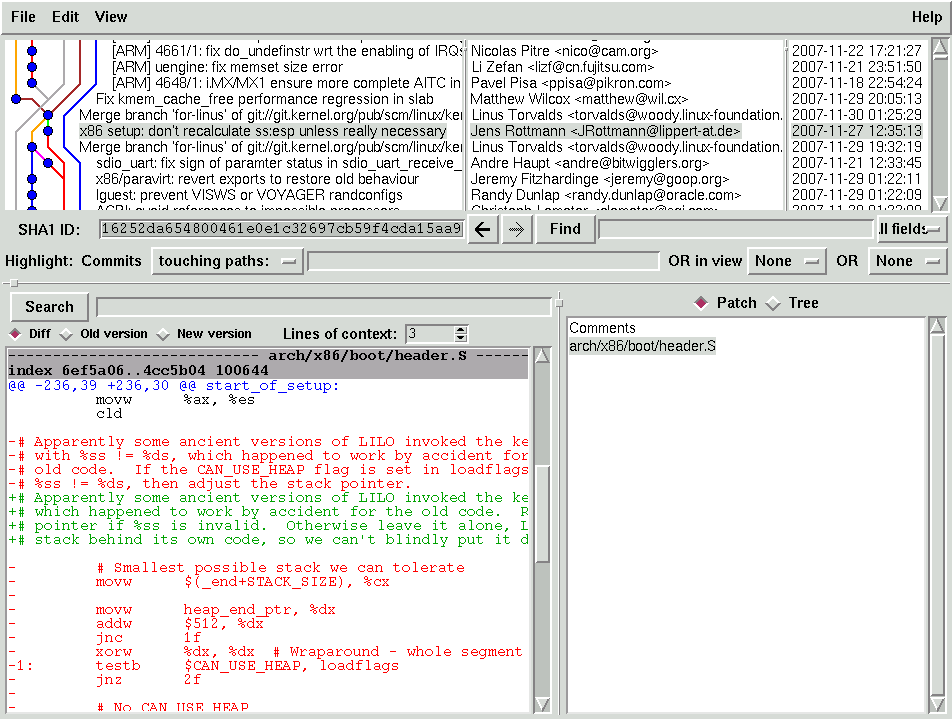
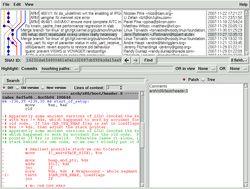
Use git cherry to find commits not merged upstream. Another really cool feature is the interactive rebasing: git rebase –interactive Make sure you are aware of gitk: Screenshot of gitk … and don’t forget to set readable fonts for gitk, like:
[ -r ~/.gitk ]   cat > ~/.gitk << EOF
set mainfont  Arial 10 
set textfont   Courier 10 
set uifont  Arial 10 bold 
EOF
If you prefer a Qt based interface check out qgit. Useful ressources:

Roland Mas: More GForge progress

I'm on a roll... Plans for the near future include continuing to clean up upstream code and maintainer scripts, making sure the installation process is as simple as possible (even for other subpackages), splitting out a few plugins into their own packages. And the big placeholders-in-prepared-SQL-queries audit I mentioned last time, but it may happen progressively rather than in one big go.

Enrico Zini: mod-proxy-html-and-gzip

mod_proxy_html and compressed pages After putting it behind a reverse proxy, our phpmyadmin setup started showing empty pages. After one morning of deep cursing, this is what happened:
  1. the web server where phpmyadmin runs generates compressed html pages;
  2. modproxyhtml tries to edit them, and "normalises" them, adding <html>...</html> headers around the compressed data;
  3. Firefox fails to decompress because there is extra garbage, and shows a blank page instead of complaining.
Other things to note: How I found it:
  1. nc -l -p 444;
  2. configure mod_proxy to send connections to netcat instead of the web browser;
  3. compare curl headers and Firefox headers;
  4. add the headers from Firefox to curl one by one, until the output breaks.
How to solve it:
  1. a2enmod deflate
  2. Replace SetOutputFilter proxy-html with SetOutputFilter DEFLATE;proxy-html;INFLATE so that we always have mod_proxy_html work on decompressed HTML.

Miriam Ruiz: Software patents are buggy

Patents are the best way to improve development, and software inventors have just the natural right to their algorithms and designs. Research and Development in industry wouldn’t just work without patent protection, and technology improvements would just stop, right? Well, I’m not so sure of that. Key arguments against software patents, stolen from Pieter Hintjens’ article:

Christian Perrier: It took 5 years...

...to make the use of gettext for debconf messages i18n mandatory. Policy 3.7.3 states:
     * Packages following the Debian Configuration management
        specification must allow for translation of their messages by using
        a gettext-based system such as po-debconf.                [3.9.1]
Not to say this took too long. Such changes are always long processes. Anyway, I think that Denis Barbier, who built the first po-debconf packages and uploaded the first version on 9/11/2002, would appreciate this. Now, let's hunt the last remaining black sheep....:)

Edd Dumbill: Smartcard authentication on Linux and Mac

For various reasons, I need to secure access to some resources using two-factor authentication, and thus have been looking at smartcards. These little devices store digital keys and certificates, protected by a passphrase, and calculate digital signatures on-device. Hence the two factors: possession of the card, and knowledge of the password.This sort of scheme is widely used by government agencies and large corporations (and largely reliant on Windows, too), but I wanted to find the low cost way in for the small operator using open source.
OpenSC on Linux
The best starting point for Linux is the OpenSC project. It supports a reasonably broad array of devices, and is well supported by Linux distributions. Using command line tools you can create keys and certificates, as you would in OpenSSL for web servers and so on, and then upload them to the smartcard.Although OpenSSH source code has support for OpenSC, it is not compiled in by default in Debian and derived distributions. Unfortunately this means a bit of recompilation to get SSH supporting OpenSC. When that's done, you have an SSH implementation that can use an RSA key from your smartcard, and best of all, you can add this key to the ssh-agent like you would with regular keys. The hardwareI ordered two devices, which seemed to have the best support from OpenSC, the Axalto Cryptoflex E-Gate, and an Aladdin eToken. I got these from UsaSmartCard, who have a special section in their catalogue for Open Source compatible products. Both these cards have a USB interface built-in, I didn't want to be toting around an extra card reader in addition to the tokens themselves.
On the MacWhile both the devices worked as advertised under Linux, the experience has been a lot less fruitful under Mac OS 10.5 Leopard. There is a port of the OpenSC project for Mac OS, called SCA. The promise of the integration is great: you can use the on-device keys with apps like Safari and Mail, but there is a change in the way that the daemon responsible for talking to the smartcards (pcscd) works on Leopard, which means OpenSC won't recognise the cards.
With some fiddling, I have managed to force the Cryptoflex device to work with Mac. Unfortunately the Leopard/Darwin source for OpenSSH has diverged significantly enough from the upstream OpenSSH, that I couldn't apply the OpenSC patches. Not having ssh-agent work with the smartcard is a significant nuisance for me, as it's the easiest way to patch in the extra security to deployment processes.The Aladdin eToken just plain didn't work on Leopard. There is a report that Aladdin are working on Leopard drivers, however.I think a small number of mainly US federal smart cards will work out of the box on Leopard, though I've seen a few complaints about these on the Apple forums. It loooks unfortunately like smartcard support slipped through the net a bit. ConclusionSmartcard support is relatively straightforward on Linux. On Mac OS 10.5, it looks like some waiting is in order before things will work properly.

Christian Perrier: Arrived in BLR

I finally arrived in Bangalore. Unfortunately, alone, without suitcase, which Air India apparently managed to lose. So, it will be the first time I experience the happiness of people who don't get their luggage in an airport and have to live for a few days with nothing but the clothes they had on them while travelling. Running around in local shops to get socks or pants wasn't exactly what I planned to do here and I probably won't. So, I'll take the local stance and learn about patience, and wait. The place we're hosted at is *very* nice (B&B, probably with a few other speakers I haven't seen yet). And, it has a really good Internet connection so I feel pretty safe and can give news around. I'm currently waiting for Sam whose flight was apparently delayed (I hope *he* gets his suitcase).... I hope he won't be too much in trouble: we don't want to lose our DPL in India (maybe they want to keep him here, though).

Yves-Alexis Perez: Xfce 4.4.2 has just been released.

But you won't have it in your favorite distro. Not yet. Not yet even if the packages are ready since more than a week (thanks to unofficial release by Xfce team to have it tested by packagers), and they only need the last checks before upload. No, you won't have it today because this week, like the previous, and the previous, and the previous:  0 applicants became maintainers. Just. too. bad. 

Adam Rosi-Kessel: Success as a Parent

Success as a parent is when your two year old recognizes and demands, at various times, Joni Mitchell, Paul McCartney (particular tracks), They Might Be Giants, and the White Stripes. And when she knows how to operate her own portable CD player and navigate your cell phone photo library. These are skills that the Class of 2026 is going to need.
Biella Coleman: The other AAA s

The (overpriced) Amtrak train is rapidly hurling itself north toward New York City, the vanishing light gently illuminating the first snowfall of the year. I am heading back from the American Anthropological Association annual meetings, which were held in Washington D.C this year. After a year’s hiatus, I attended to present a short version of my paper on hacker conferences, which I have pushed along further to entertain more general questions and ideas about the role of conferences in ensuring forms of solidarity among publics that are dispersed geographically. While there are other events that are far more visceral or more profoundly produce what Emile Durkheim has called collective effervescence, conferences are probably one of the most common social forms for ensuring a steady state of moral solidarity among connected but geographically dispersed groups of people. Their importance and role is often overlooked, I think, because of their sheer ubiquity (and I am sure the fact that many are held in creepy corporate hotels populated by seriously over sized & gaudy furniture where you can sit and sip your overpriced Starbuck’s coffee does not help). But it is because they are so common that I think we need to take them a little more seriously as distinctly 20th century events that combine much older elements of ritual and pilgrimage. Because I have attended so many developer and hacker conferences, which tend to be longer as well as far more more enveloping, festive, and, frankly, well executed than academic ones, I tend to think of academic conferences as tepid, lightweight versions. But as I make my way back home, I am pretty worn yet inspired from this one as I decided to sort of let go to give it my all, sleeping far less than I really should have. I usually hold back some, perhaps because most academic conferences I attend are smack in the middle of the academic year, so my mind is partially occupied with the pile of work that awaits me, somewhat depressingly, at the end of your journey. Academic conferences can also produce a fair bit of anxiety, especially for younglings like myself, given that you are performing your skills (or lack of) and ideas (or lack of) to people you respect and admire too. Perhaps it is also due to the hotel environment, which I find not only particularly uninspiring but in all honesty, sort of soul sucking, though albeit, *very* conveniently so. This time, however, I was not going to let the hotel suck any more soul out of me because I was thrilled to see friends from time’s past, had a great time on my panel on digital subjectivities, and was excited to meet new folks and talk about those topics that I spend a lot of time thinking about. I also think the proliferation of (very cute) babies among my friends and the now visible crow’s feet adorning the smiling eyes of my friends made me feel the passing of time a little more forcefully than really I wanted to. So I did my best to turn that pesky faucet of time of off so as to give way to immersion, drawing those from past into the shared nest of the present, so that I would want to see them again in the future. And in the end, that is the point: social reproduction and shouldn’t procreation be fun? I think so… Now back to that pile of work.

2 December 2007

Chris Lamb: Custom Debian-Installer images for DCS

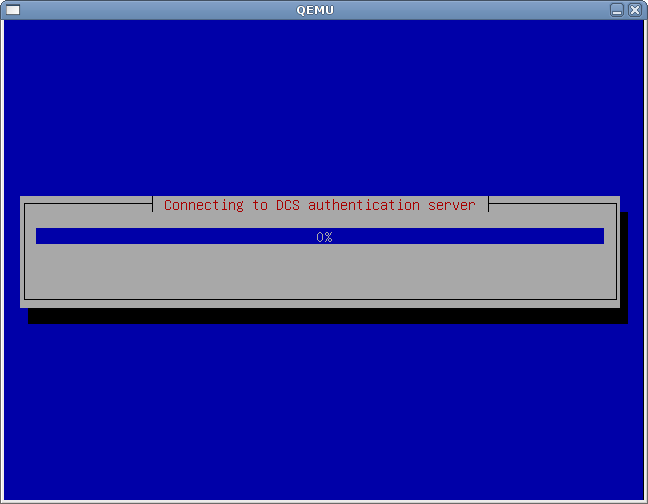
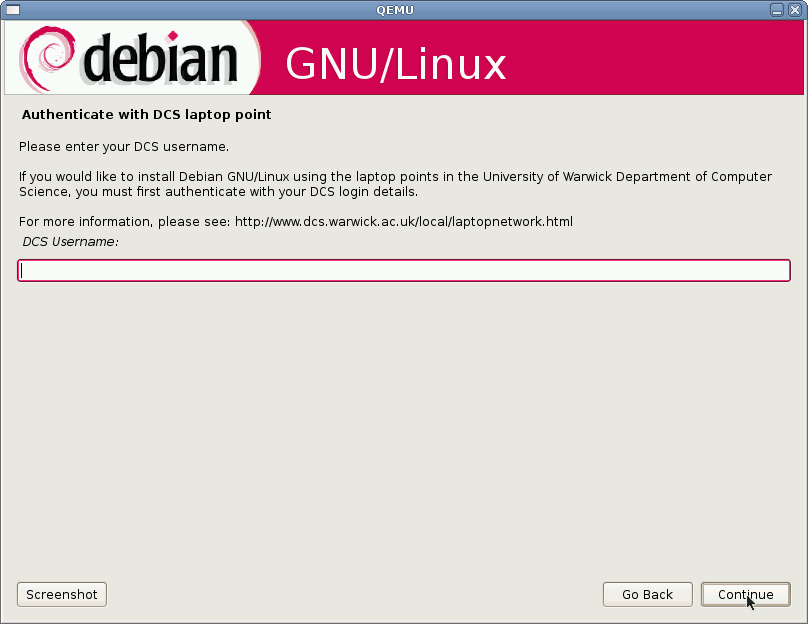
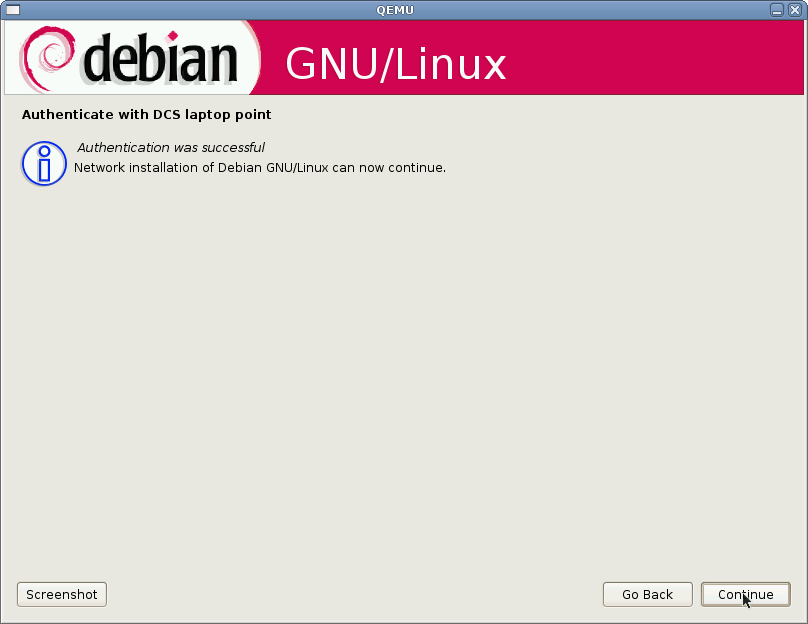
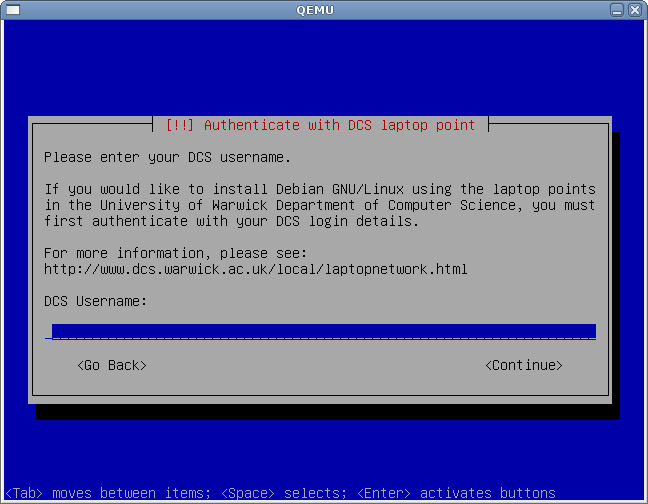
It can be a little awkward installing Debian in my Department’s labs. After obtaining a DHCP lease, you cannot establish any useful connection without first authenticating against a HTTP Basic page. However, as this page uses SSL and D-I’s Wget is not linked against any SSL libraries, you are a little stuck. To solve this (and to avoid resorting to ugly hacks), I created a udeb that prompts the user for their username and password (see screenshots above) and then authenticates using a statically-linked build of Curl. It seems to be fairly robust, and only bloats the ISO by about 200KB. I’ve also preseeded a number of options suitable for DCS, such as using the local mirror and assuming UK locales and keyboard, etc. My modifications are available, along with some documentation on how to recreate my images. I have also uploaded a few images to our mirror. D-I hacking turns out to be quite fun and relatively painless, but I’m now stuck for a useful project to use it again, and I probably don’t know enough yet to tackle some of its Lenny goals either. Any ideas? Oh, if some d-i guru can explain how I can force the display of the “Choose suite” question without patching choose-mirror, that would also be excellent.

Neil Williams: Emdebian translation support

I've just uploaded the first (hopefully) working version of langupdate to Emdebian. Full details on the emdebian website.
There are only a few packages in the emdebian locale repository right now. langupdate will be part of the default Emdebian GPE setup.
This is all very experimental. Emdebian needs tdebs urgently so the decision was taken to proceed on an experimental basis and then feed back to the Debian tdeb implementation and fold the Emdebian code into the Debian tdeb support.

Next.

Previous.