Search Results: "tim"

19 November 2021

Mike Hommey: Announcing git-cinnabar 0.5.8

Git-cinnabar is a git remote helper to interact with mercurial repositories. It allows to clone, pull and push from/to mercurial remote repositories, using git. Get it on github. These release notes are also available on the git-cinnabar wiki. What s new since 0.5.7?

Gunnar Wolf: For our millionth bug, bookworms eat raspberries alive

I guess you already heard, right? The Debian Bug Tracking System has hit a big milestone! We just passed our one millionth bug report! (and yes, that s a cause for celebration; bug reporting is probably the best way for the system to grow and improve) So, to celebrate, I want to announce I have nudged our unofficial Raspberry Pi images build scripts to now also build images for our upcoming Debian release, Debian 12 Bookworm (image above: A bookworm learns about raspberries in various stages of testing. Image sources: Transformers Wiki, CC BY-SA and Sam Saunders at Flickr, CC BY-SA) So Get em while they are fresh! https://raspi.debian.net/! And enjoy the following (non-book)worm-on-a-raspberry picture from Wikimedia Commons: Oh, FWIW The site still shows images for Buster. You will notice they are no longer being autobuilt (why spend CPU time in something that s no longer going to change significatively?). The Bookworm images are not yet tested; as soon as I can test them, I will drop the Buster ones.

Evgeni Golov: A String is not a String, and that's Groovy!

Halloween is over, but I still have some nightmares to share with you, so sit down, take some hot chocolate and enjoy :) When working with Jenkins, there is almost no way to avoid writing Groovy. Well, unless you only do old style jobs with shell scripts, but y'all know what I think about shell scripts Anyways, Eric have been rewriting the jobs responsible for building Debian packages for Foreman to pipelines (and thus Groovy). Our build process for pull requests is rather simple:
  1. Setup sources - get the orig tarball and adjust changelog to have an unique version for pull requests
  2. Call pbuilder
  3. Upload the built package to a staging archive for testing
For merges, it's identical, minus the changelog adjustment. And if there are multiple packages changed in one go, it runs each step in parallel for each package. Now I've been doing mass changes to our plugin packages, to move them to a shared postinst helper instead of having the same code over and over in every package. This required changes to many packages and sometimes I'd end up building multiple at once. That should be fine, right? Well, yeah, it did build fine, but the upload only happened for the last package. This felt super weird, especially as I was absolutely sure we did test this scenario (multiple packages in one PR) and it worked just fine So I went on a ride though the internals of the job, trying to understand why it didn't work. This requires a tad more information about the way we handle packages for Foreman:
  • the archive is handled by freight
  • it has suites like buster, focal and plugins (that one is a tad special)
  • each suite has components that match Foreman releases, so 2.5, 3.0, 3.1, nightly etc
  • core packages (Foreman etc) are built for all supported distributions (right now: buster and focal)
  • plugin packages are built only once and can be used on every distribution
As generating the package index isn't exactly fast in freight, we tried not not run it too often. The idea was that when we build two packages for the same target (suite/version combination), we upload both at once and run import only once for both. That means that when we build Foreman for buster and focal, this results in two parallel builds and then two parallel uploads (as they end up in different suites). But if we build Foreman and Foreman Installer, we have four parallel builds, but only two parallel uploads, as we can batch upload Foreman and Installer per suite. Well, or so was the theory. The Groovy code, that was supposed to do this looked roughly like this:
def packages_to_build = find_changed_packages()
def repos = [:]
packages_to_build.each   pkg ->
    suite = 'buster'
    component = '3.0'
    target = "$ suite -$ component "
    if (!repos.containsKey(target))  
        repos[target] = []
     
    repos[target].add(pkg)
 
do_the_build(packages_to_build)
do_the_upload(repos)
That's pretty straight forward, no? We create an empty Map, loop over a list of packages and add them to an entry in the map which we pre-create as empty if it doesn't exist. Well, no, the resulting map always ended with only having one element in each target list. And this is also why our original tests always worked: we tested with a PR containing changes to Foreman and a plugin, and plugins go to this special target we have So I started playing with the code (https://groovyide.com/playground is really great for that!), trying to understand why the heck it erases previous data. The first finding was that it just always ended up jumping into the "if map entry not found" branch, even though the map very clearly had the correct entry after the first package was added. The second one was weird. I was trying to minimize the reproducer code (IMHO always a good idea) and switched target = "$ suite -$ component " to target = "lol". Two entries in the list, only one jump into the "map entry not found" branch. What?! So this is clearly related to the fact that we're using String interpolation here. But hey, that's a totally normal thing to do, isn't it?! Admittedly, at this point, I was lost. I knew what breaks, but not why. Luckily, I knew exactly who to ask: Jens. After a brief "well, that's interesting", Jens quickly found the source of our griefs: Double-quoted strings are plain java.lang.String if there s no interpolated expression, but are groovy.lang.GString instances if interpolation is present.. And when we do repos[target] the GString target gets converted to a String, but when we use repos.containsKey() it remains a GString. This is because GStrings get converted to Strings, if the method wants one, but containsKey takes any Object while the repos[target] notation for some reason converts it. Maybe this is because using GString as Map keys should be avoided. We can reproduce this with simpler code:
def map = [:]
def something = "something"
def key = "$ something "
map[key] = 1
println key.getClass()
map.keySet().each  println it.getClass()  
map.keySet().each  println it.equals(key) 
map.keySet().each  println it.equals(key as String) 
Which results in the following output:
class org.codehaus.groovy.runtime.GStringImpl
class java.lang.String
false
true
With that knowledge, the fix was to just use the same repos[target] notation also for checking for existence Groovy helpfully returns null which is false-y when it can't find an entry in a Map absent. So yeah, a String is not always a String, and it'll bite you!

Neil Williams: git worktrees

A few scenarios have been problematic with git and I've now discovered git worktrees which help with each. You could go to the trouble of making a new directory and re-cloning the same tree. However, a local commit in one tree is then not accessible to the other tree. You could commit everything every time, but with a dirty tree, that involves sorting out the .gitignore rules as well. That could well be pointless with an experimental change. Git worktrees allow multiple filesystems from a single git tree. Commits on any branch are visible from other branches, even when the commit was on a different worktree. This makes things like cherry-picking easy, without needing to push pointless changes or branches. Branches on a worktree can be rebased as normal, with the benefit that commit hashes from other local changes are available for reference and cherry-picks. I'm sure git worktrees are not new. However, I've only started using them recently and others have asked about how the worktree operates. Creating a new tree can be done with a new or existing branch. To make it easier, set the new directory at the same time, usually in ../ New branch (branched from the current branch):
git worktree add -b branch_name ../branch_name
Existing branch - note, slightly different syntax here, specify the commit-ish last (branch name, tag or hash):
git worktree add ../branch_name branch_name
git worktree list
/home/neil/Documents/testing/testrepo        0612677 [master]
/home/neil/Documents/testing/testtree        d38f5a3 [testtree]
Use git worktree remove <name> to drop the entire directory for that tree and the git tracking. I'm using this for work on the Debian Security Tracker. I have two local branches and having two worktrees allows me to have three terminals open, using the same files and the same git repository. One to run make serve and update the local SQLite database. One to access master to run git pull One to make local changes without risking collisions on master.
git add data/CVE/list
git commit
# pre commit hook runs here
git log -n 1
# copy the hash
# switch to master terminal
git pull
git cherry-pick <HASH>
git push
# switch to server terminal
git rebase master
# no git pull or fetch, it's all local
make
# switch back to changes terminal
git rebase master
Sadly, one area where this isn't as easy is with importing a new DSC into Salsa with git-buildpackage as that uses several branches at the same time. It would be possible but you'll need to have a separate upstream and possibly pristine-tar branches and supply the relevant options. Possibly something git-buildpackage to adopt - it is common to need to make changes to the packaging with a new upstream release & a lot of those changes are currently done outside git. For the rest of the support, see git worktree (1)

Dirk Eddelbuettel: RcppArmadillo 0.10.7.3.0 on CRAN: Bugfix, New Features

armadillo image Armadillo is a powerful and expressive C++ template library for linear algebra aiming towards a good balance between speed and ease of use with a syntax deliberately close to a Matlab. RcppArmadillo integrates this library with the R environment and language and is widely used by (currently) 928 other packages on CRAN. I somehow missed to blog and tweet about the recent release based on the Armadillo 10.7.3 upstream release. Conrad is in long-term support mode , and 10.7.* is meant to provide fixes and stability relative to the most recent release which we did on September 30. We did actually find a regression when checking reverse-dependencies requiring an upstream move to 10.7.3. At the same time, we folded pull request #352 in. It addresses an old bug of ours where Armadillo fields types were not converted correctly in all dimensions. So no we do have 0.10.7.3.0 on CRAN, as well as 0.10.7.3.1 with the (opt-in) field) fixes on the drat repo) repo. As the change perturbs a few existing packages, it is opt-in for now. We will likely aim at a proper deprecation of the old behaviour and give packages time to adjust. Stay tuned. With that, big thanks to Jonathan Berrisch for filing issue #351 and basically addressing it in pull request #352. Very nice work, and I basically just wrapped a few more tests around it. The full set of changes (since the last CRAN release 0.10.7.0.) follows.

Changes in RcppArmadillo version 0.10.7.3.1 (2021-11-18)
  • Correct dimensions setting in import/export of arma::field types, protected by #define (Jonathan Berrisch in #352 fixing #351)
  • Add unit tests for fields both with and without new #define (Dirk)

Changes in RcppArmadillo version 0.10.7.3.0 (2021-11-04)
  • Upgraded to Armadillo release 10.7.3
    • fix regression in alias handling by fliplr(), flipud(), reverse()

Changes in RcppArmadillo version 0.10.7.2.0 (2021-11-02)
  • Upgraded to Armadillo release 10.7.2
    • more robust handling of diagonal matrices by pinv()

Changes in RcppArmadillo version 0.10.7.1.0 (2021-10-08)
  • Upgraded to Armadillo release 10.7.1
    • fix regression in interactions between dense matrix subviews and sparse matrices

Courtesy of my CRANberries, there is a diffstat report relative to previous release. More detailed information is on the RcppArmadillo page. Questions, comments etc should go to the rcpp-devel mailing list off the R-Forge page. If you like this or other open-source work I do, you can sponsor me at GitHub.

This post by Dirk Eddelbuettel originated on his Thinking inside the box blog. Please report excessive re-aggregation in third-party for-profit settings.

17 November 2021

Christoph Berg: PostgreSQL and Undelete

pg_dirtyread Earlier this week, I updated pg_dirtyread to work with PostgreSQL 14. pg_dirtyread is a PostgreSQL extension that allows reading "dead" rows from tables, i.e. rows that have already been deleted, or updated. Of course that works only if the table has not been cleaned-up yet by a VACUUM command or autovacuum, which is PostgreSQL's garbage collection machinery. Here's an example of pg_dirtyread in action:
# create table foo (id int, t text);
CREATE TABLE
# insert into foo values (1, 'Doc1');
INSERT 0 1
# insert into foo values (2, 'Doc2');
INSERT 0 1
# insert into foo values (3, 'Doc3');
INSERT 0 1
# select * from foo;
 id    t
 
  1   Doc1
  2   Doc2
  3   Doc3
(3 rows)
# delete from foo where id < 3;
DELETE 2
# select * from foo;
 id    t
 
  3   Doc3
(1 row)
Oops! The first two documents have disappeared. Now let's use pg_dirtyread to look at the table:
# create extension pg_dirtyread;
CREATE EXTENSION
# select * from pg_dirtyread('foo') t(id int, t text);
 id    t
 
  1   Doc1
  2   Doc2
  3   Doc3
All three documents are still there, but only one of them is visible. pg_dirtyread can also show PostgreSQL's system colums with the row location and visibility information. For the first two documents, xmax is set, which means the row has been deleted:
# select * from pg_dirtyread('foo') t(ctid tid, xmin xid, xmax xid, id int, t text);
 ctid    xmin   xmax   id    t
 
 (0,1)   1577   1580    1   Doc1
 (0,2)   1578   1580    2   Doc2
 (0,3)   1579      0    3   Doc3
(3 rows)
Undelete Caveat: I'm not promising any of the ideas quoted below will actually work in practice. There are a few caveats and a good portion of intricate knowledge about the PostgreSQL internals might be required to succeed properly. Consider consulting your favorite PostgreSQL support channel for advice if you need to recover data on any production system. Don't try this at work. I always had plans to extend pg_dirtyread to include some "undelete" command to make deleted rows reappear, but never got around to trying that. But rows can already be restored by using the output of pg_dirtyread itself:
# insert into foo select * from pg_dirtyread('foo') t(id int, t text) where id = 1;
This is not a true "undelete", though - it just inserts new rows from the data read from the table. pg_surgery Enter pg_surgery, which is a new PostgreSQL extension supplied with PostgreSQL 14. It contains two functions to "perform surgery on a damaged relation". As a side-effect, they can also make delete tuples reappear. As I discovered now, one of the functions, heap_force_freeze(), works nicely with pg_dirtyread. It takes a list of ctids (row locations) that it marks "frozen", but at the same time as "not deleted". Let's apply it to our test table, using the ctids that pg_dirtyread can read:
# create extension pg_surgery;
CREATE EXTENSION
# select heap_force_freeze('foo', array_agg(ctid))
    from pg_dirtyread('foo') t(ctid tid, xmin xid, xmax xid, id int, t text) where id = 1;
 heap_force_freeze
 
(1 row)
Et voil , our deleted document is back:
# select * from foo;
 id    t
 
  1   Doc1
  3   Doc3
(2 rows)
# select * from pg_dirtyread('foo') t(ctid tid, xmin xid, xmax xid, id int, t text);
 ctid    xmin   xmax   id    t
 
 (0,1)      2      0    1   Doc1
 (0,2)   1578   1580    2   Doc2
 (0,3)   1579      0    3   Doc3
(3 rows)
Disclaimer Most importantly, none of the above methods will work if the data you just deleted has already been purged by VACUUM or autovacuum. These actively zero out reclaimed space. Restore from backup to get your data back. Since both pg_dirtyread and pg_surgery operate outside the normal PostgreSQL MVCC machinery, it's easy to create corrupt data using them. This includes duplicated rows, duplicated primary key values, indexes being out of sync with tables, broken foreign key constraints, and others. You have been warned. pg_dirtyread does not work (yet) if the deleted rows contain any toasted values. Possible other approaches include using pageinspect and pg_filedump to retrieve the ctids of deleted rows. Please make sure you have working backups and don't need any of the above.

16 November 2021

Paul Tagliamonte: Measuring the Power Output of my SDRs

Over the last few years, I ve often wondered what the true power output of my SDRs are. It s a question with a shocking amount of complexity in the response, due to a number of factors (mostly Frequency). The ranges given in spec sheets are often extremely vague, and if I m being honest with myself, not incredibly helpful for being able to determine what specific filters and amplifiers I ll need to get a clean signal transmitted.

Hey, heads up! - This post contains extremely unvalidated and back of the napkin quality work to understand how my equipment works. Hopefully this work can be of help to others, but please double check any information you need for your own work!
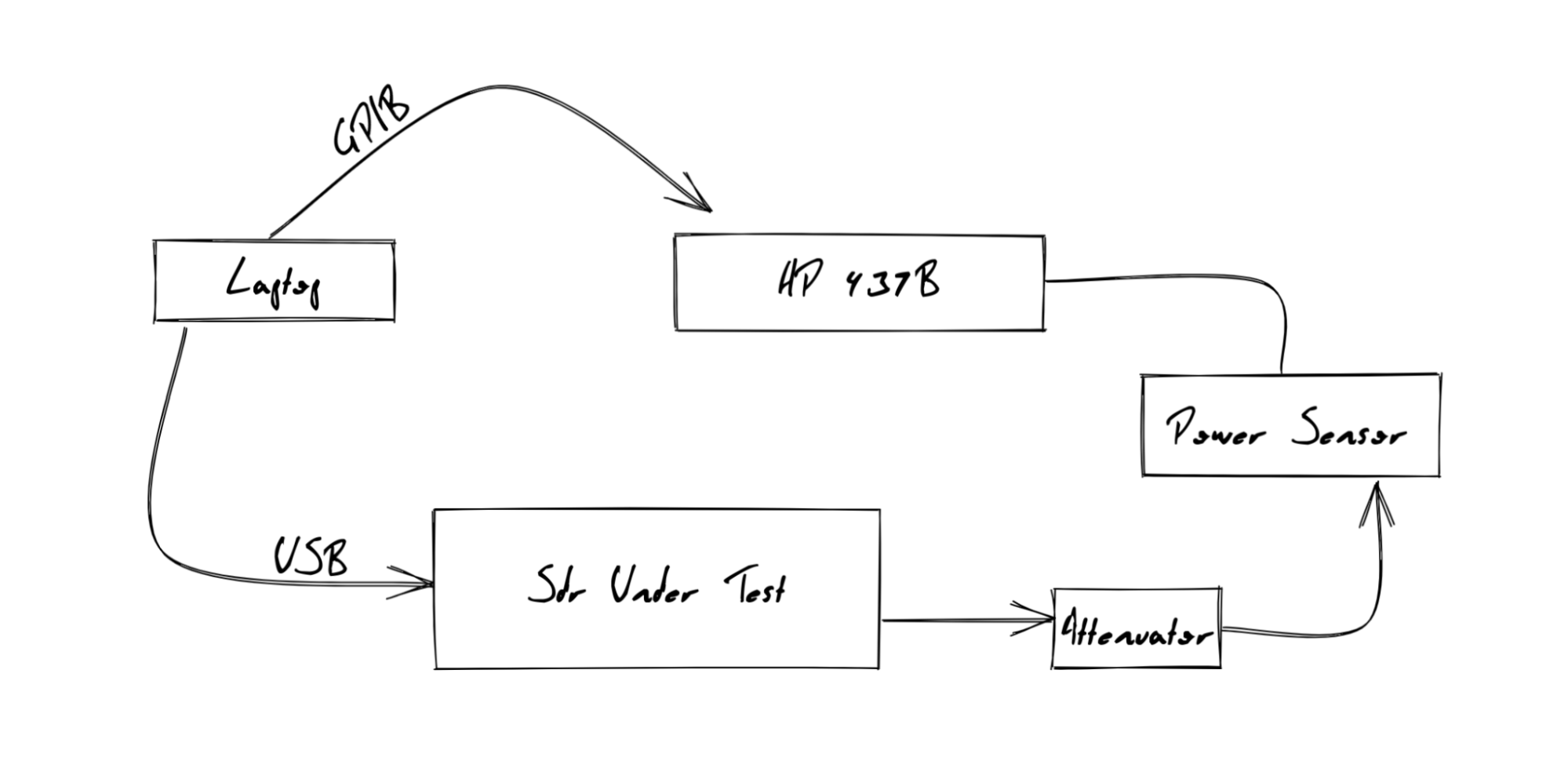
I was specifically interested in what gain output (in dBm) looks like across the frequency range in particular, how variable the output dBm is when I change frequencies. The second question I had was understanding how linear the output gain is when adjusting the requested gain from the radio. Does a 2 dB increase on a HackRF API mean 2 dB of gain in dBm, no matter what the absolute value of the gain stage is? I ve finally bit the bullet and undertaken work to characterize the hardware I do have, with some outdated laboratory equipment I found on eBay. Of course, if it s worth doing, it s worth overdoing, so I spent a bit of time automating a handful of components in order to collect the data that I need from my SDRs. I bought an HP 437B, which is the cutting edge of 30 years ago, but still accurate to within 0.01dBm. I paired this Power Meter with an Agilent 8481A Power Sensor (-30 dBm to 20 dBm from 10MHz to 18GHz). For some of my radios, I was worried about exceeding the 20 dBm mark, so I used a 20db attenuator while I waited for a higher power power sensor. Finally, I was able to find a GPIB to USB interface, and get that interface working with the GPIB Kernel driver on my system. With all that out of the way, I was able to write Go bindings to my HP 437B to allow for totally headless and automated control in sync with my SDR s RF output. This allowed me to script the transmission of a sine wave at a controlled amplitude across a defined gain range and frequency range and read the Power Sensor s measured dBm output to characterize the Gain across frequency and configured Gain.
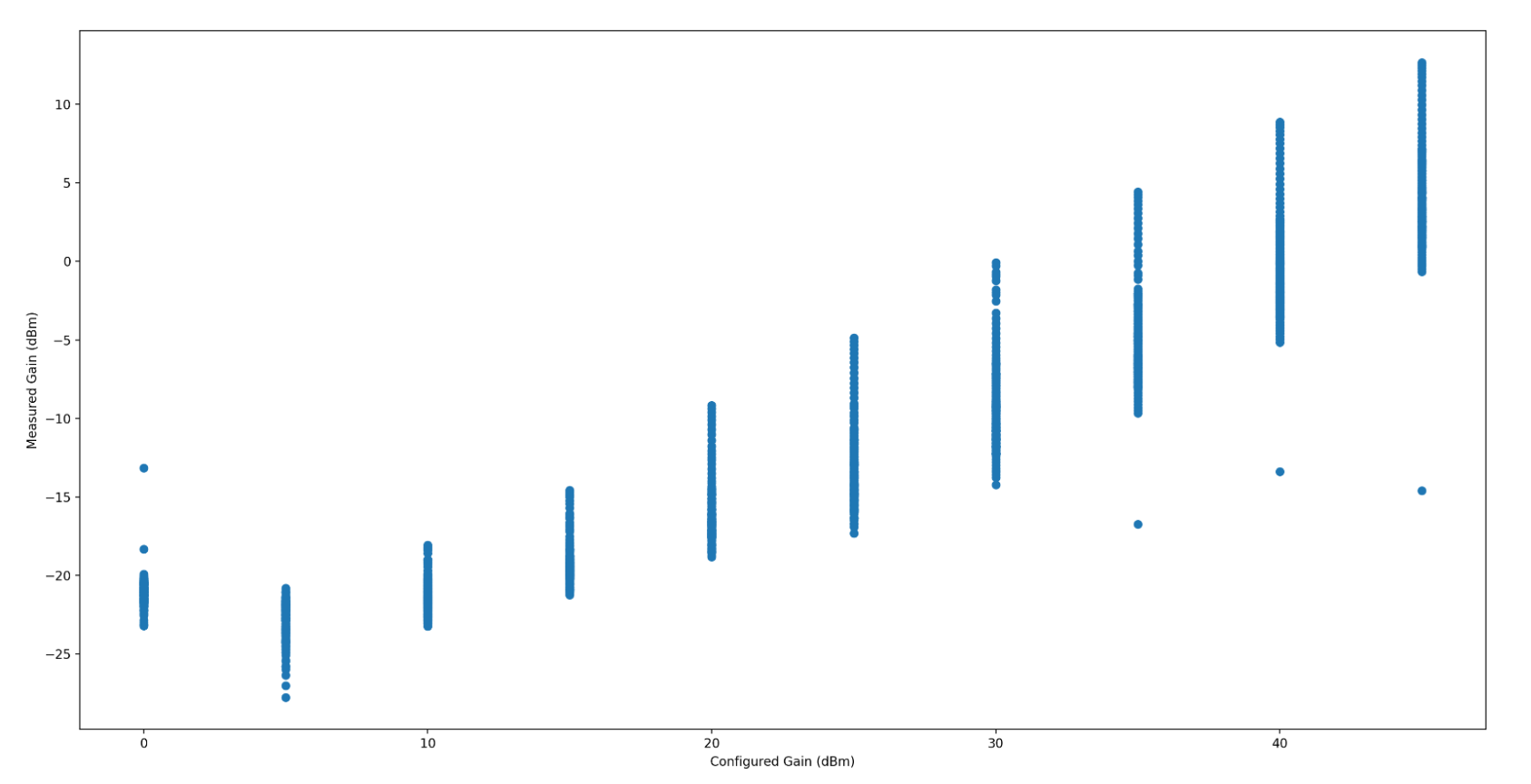
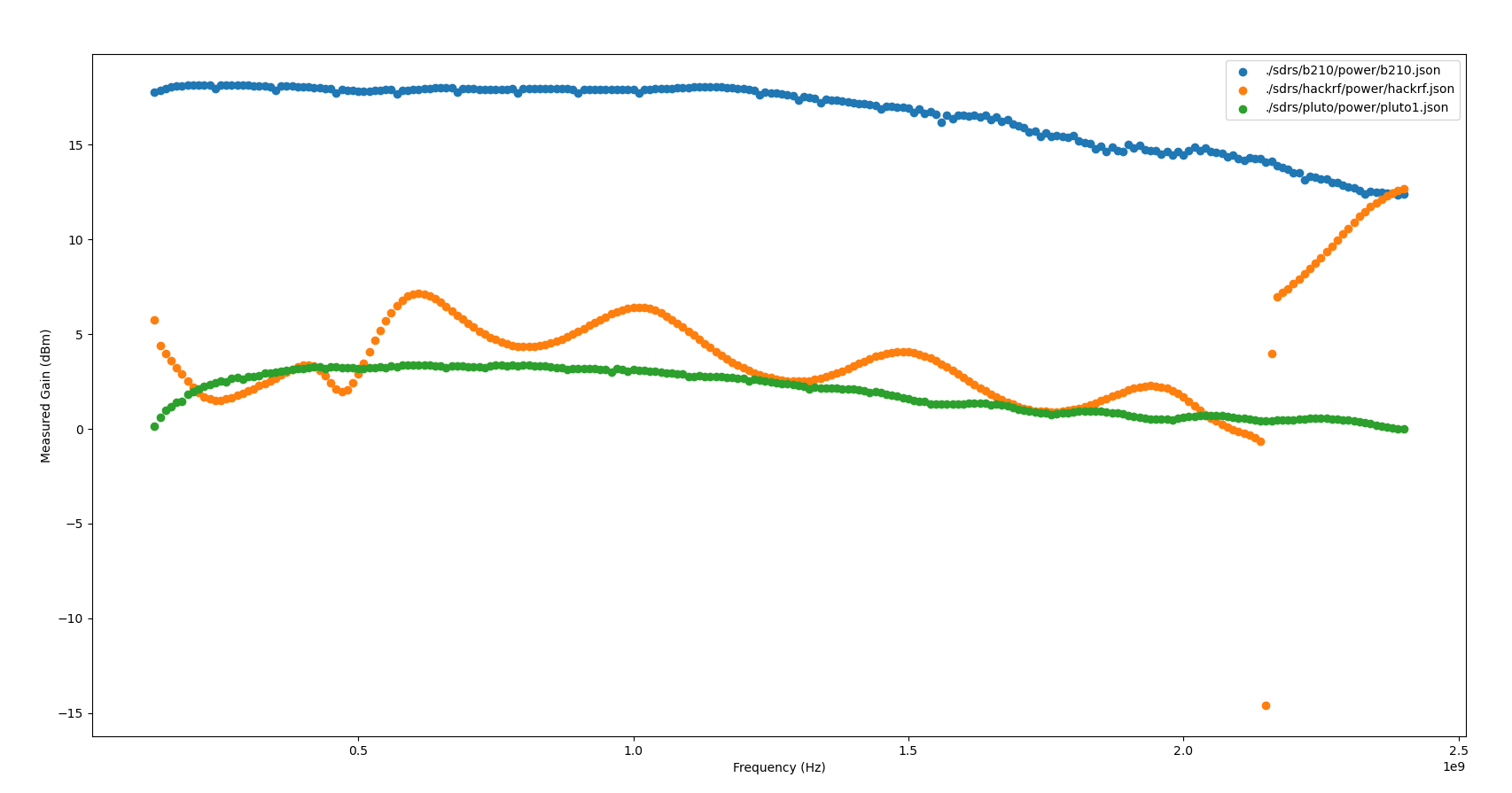
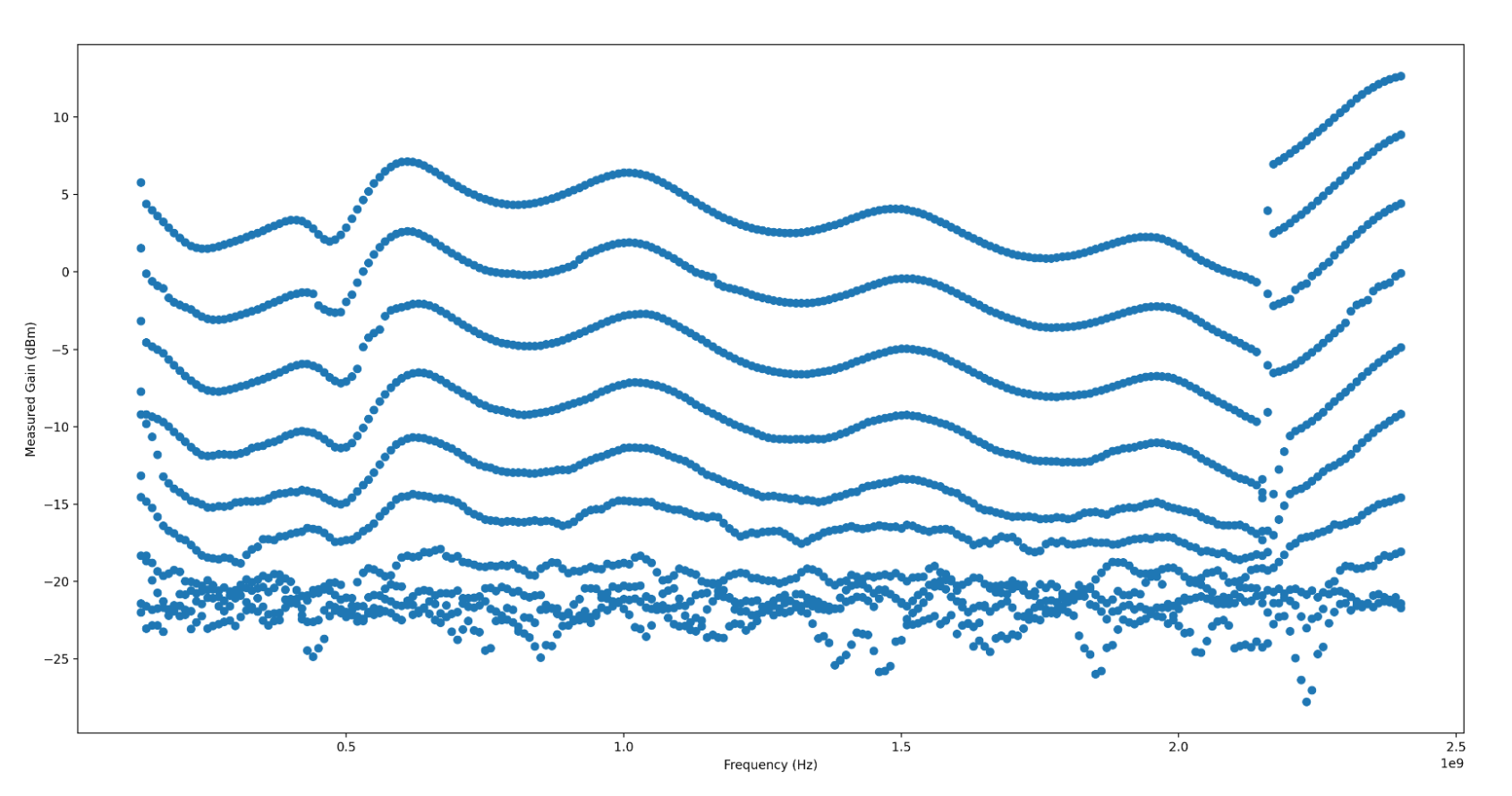
HackRF Looking at configured Gain against output power, the requested gain appears to have a fairly linear relation to the output signal power. The measured dBm ranged between the sensor noise floor to approx +13dBm. The average standard deviation of all tested gain values over the frequency range swept was +/-2dBm, with a minimum standard deviation of +/-0.8dBm, and a maximum of +/-3dBm. When looking at output power over the frequency range swept, the HackRF contains a distinctive (and frankly jarring) ripple across the Frequency range, with a clearly visible jump in gain somewhere around 2.1GHz. I have no idea what is causing this massive jump in output gain, nor what is causing these distinctive ripples. I d love to know more if anyone s familiar with HackRF s RF internals!
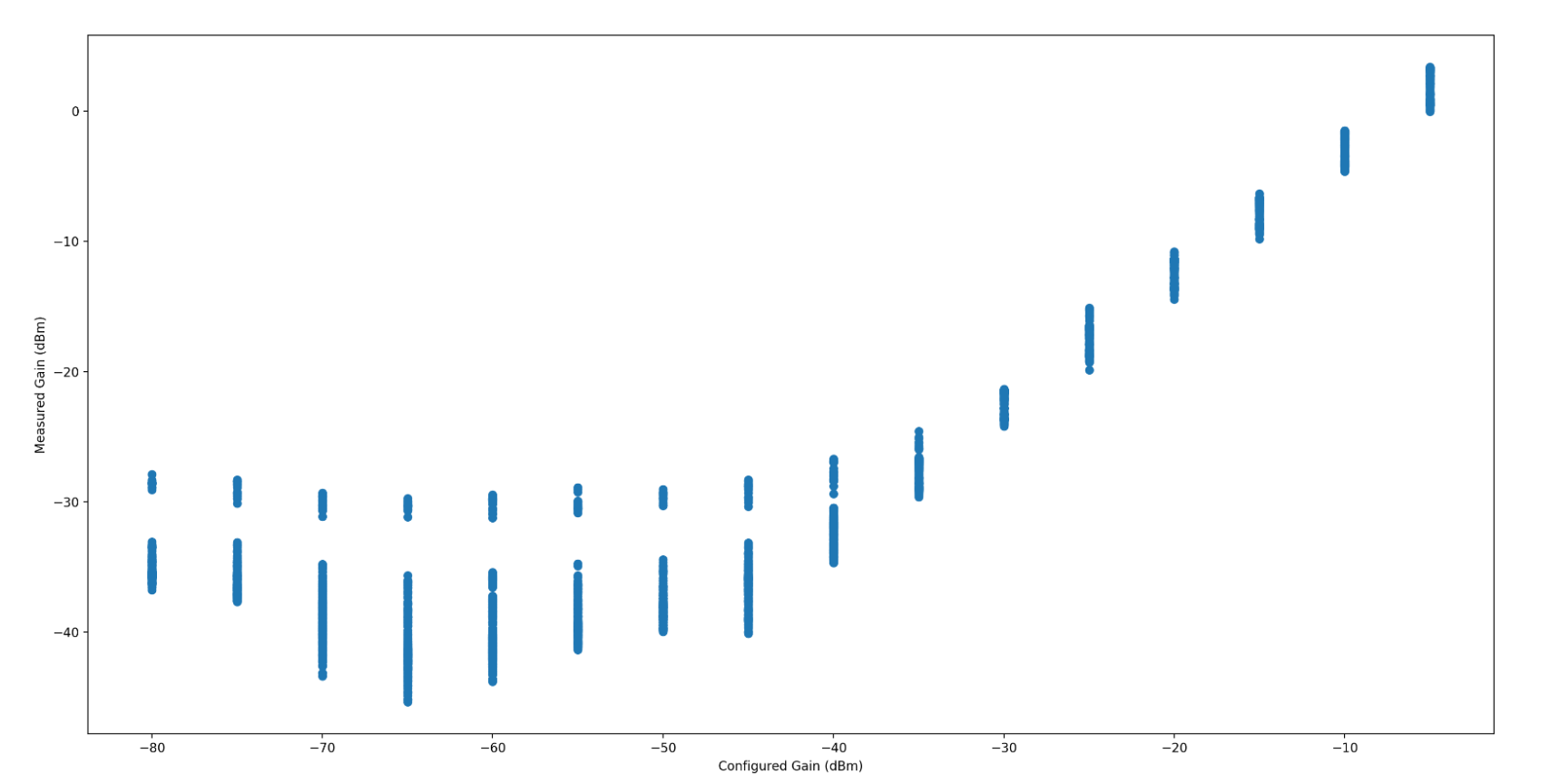
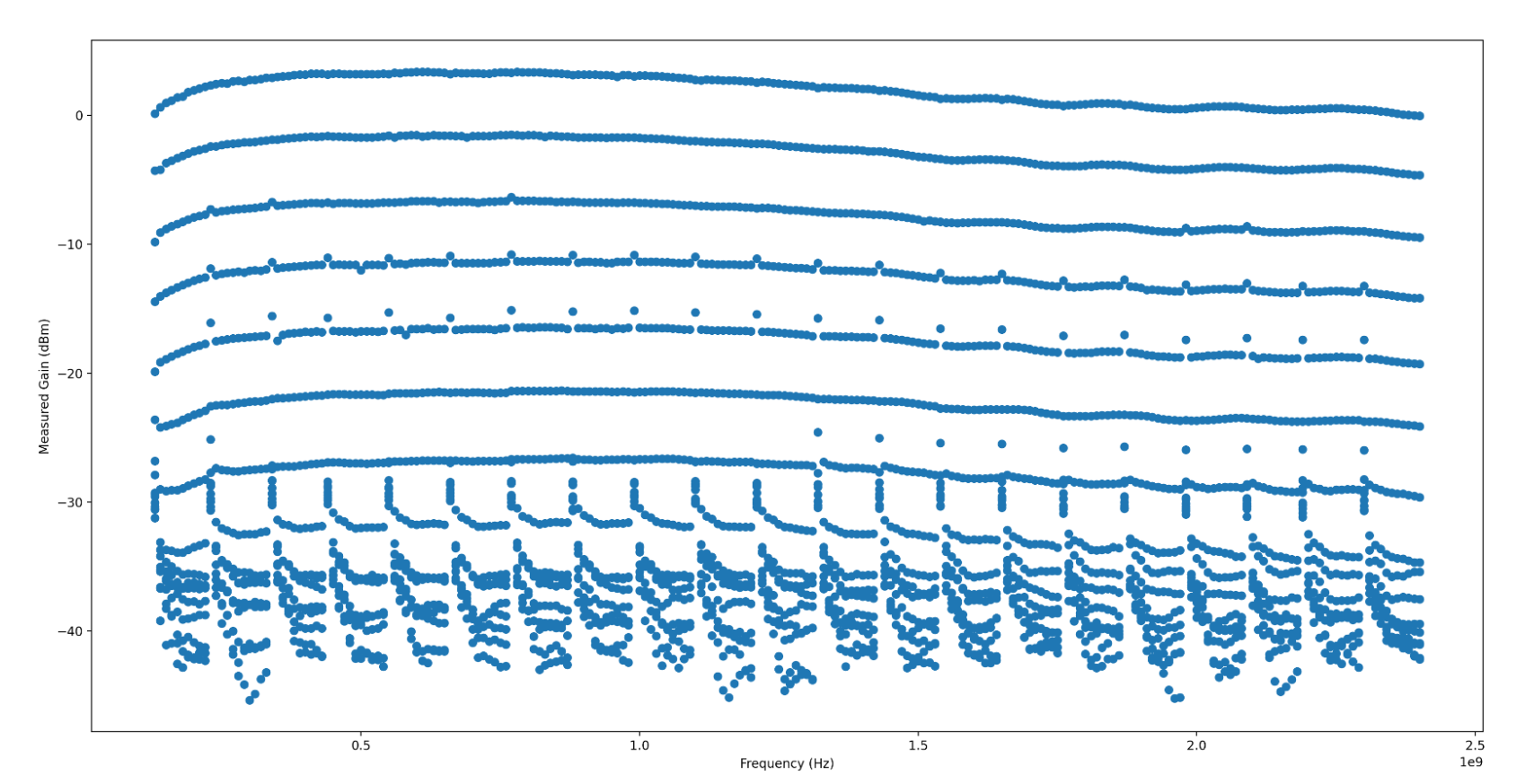
PlutoSDR The power output is very linear when operating above -20dB TX channel gain, but can get quite erratic the lower the output power is configured. The PlutoSDR s output power is directly related to the configured power level, and is generally predictable once a minimum power level is reached. The measured dBm ranged from the noise floor to 3.39 dBm, with an average standard deviation of +/-1.98 dBm, a minimum standard deviation of +/-0.91 dBm and a maximum standard deviation of +/-3.37 dBm. Generally, the power output is quite stable, and looks to have very even and wideband gain control. There s a few artifacts, which I have not confidently isolated to the SDR TX gain, noise (transmit artifacts such as intermodulation) or to my test setup. They appear fairly narrowband, so I m not overly worried about them yet. If anyone has any ideas what this could be, I d very much appreciate understanding why they exist!
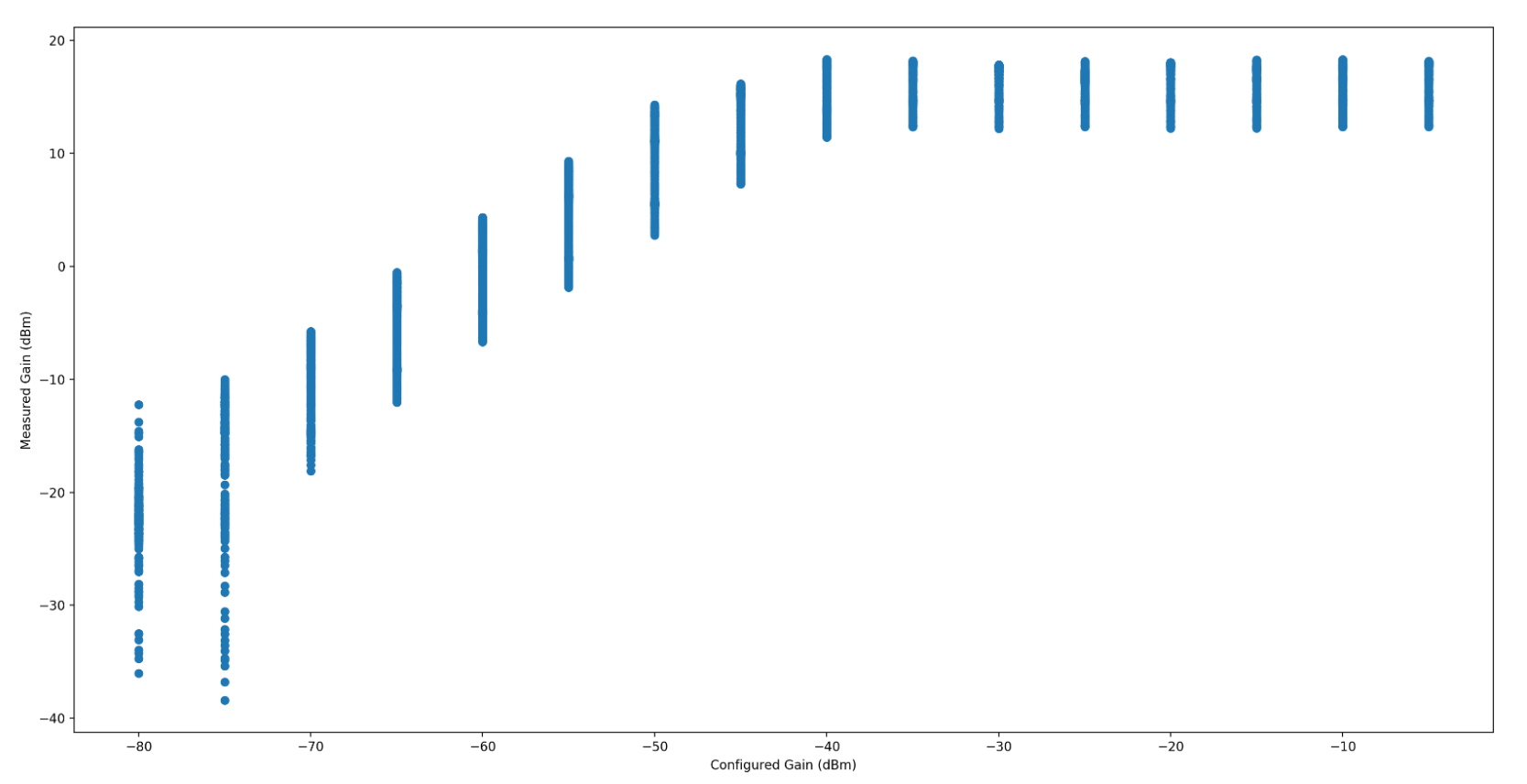
Ettus B210 The power output on the Ettus B210 is higher (in dBm) than any of my other radios, but it has a very odd quirk where the power becomes nonlinear somewhere around -55dB TX channel gain. After that point, adding gain has no effect on the measured signal output in dBm up to 0 dB gain. The measured dBm ranged from the noise floor to 18.31 dBm, with an average standard deviation of +/-2.60 dBm, a minimum of +/-1.39 dBm and a maximum of +/-5.82 dBm. When the Gain is somewhere around the noise floor, the measured gain is incredibly erratic, which throws the maximum standard deviation significantly. I haven t isolated that to my test setup or the radio itself. I m inclined to believe it s my test setup. The radio has a fairly even and wideband gain, and so long as you re operating between -70dB to -55dB, fairly linear as well.
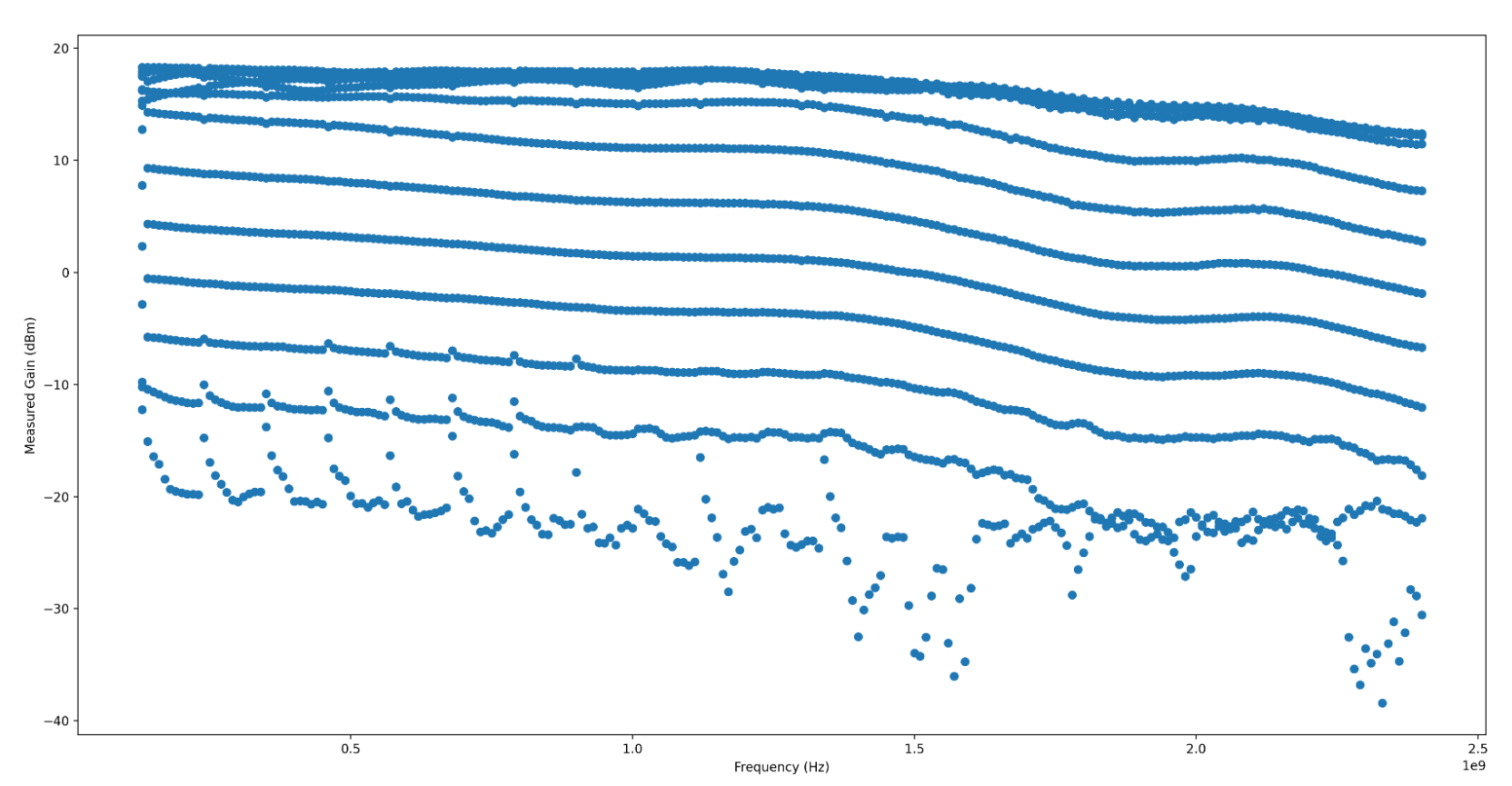
Summary Of all my radios, the Ettus B210 has the highest output (in dBm) over the widest frequency range, but the HackRF is a close second, especially after the gain bump kicks in around 2.1GHz. The Pluto SDR feels the most predictable and consistent, but also a very low output, comparatively - right around 0 dBm.
Name Max dBm stdev dBm stdev min dBm stdev max dBm
HackRF +12.6 +/-2.0 +/-0.8 +/-3.0
PlutoSDR +3.3 +/-2.0 +/-0.9 +/-3.7
B210 +18.3 +/-2.6 +/-1.4 +/-6.0

15 November 2021

Vincent Bernat: Git as a source of truth for network automation

The first step when automating a network is to build the source of truth. A source of truth is a repository of data that provides the intended state: the list of devices, the IP addresses, the network protocols settings, the time servers, etc. A popular choice is NetBox. Its documentation highlights its usage as a source of truth:
NetBox intends to represent the desired state of a network versus its operational state. As such, automated import of live network state is strongly discouraged. All data created in NetBox should first be vetted by a human to ensure its integrity. NetBox can then be used to populate monitoring and provisioning systems with a high degree of confidence.
When introducing Jerikan, a common feedback we got was: you should use NetBox for this. Indeed, Jerikan s source of truth is a bunch of YAML files versioned with Git.

Why Git? If we look at how things are done with servers and services, in a datacenter or in the cloud, we are likely to find users of Terraform, a tool turning declarative configuration files into infrastructure. Declarative configuration management tools like Salt, Puppet,1 or Ansible take care of server configuration. NixOS is an alternative: it combines package management and configuration management with a functional language to build virtual machines and containers. When using a Kubernetes cluster, people use Kustomize or Helm, two other declarative configuration management tools. Tapped together, these tools implement the infrastructure as code paradigm.
Infrastructure as code is an approach to infrastructure automation based on practices from software development. It emphasizes consistent, repeatable routines for provisioning and changing systems and their configuration. You make changes to code, then use automation to test and apply those changes to your systems. Kief Morris, Infrastructure as Code, O Reilly.
A version control system is a central tool for infrastructure as code. The usual candidate is Git with a source code management system like GitLab or GitHub. You get:
Traceability and visibility
Git keeps a log of all changes: what, who, why, and when. With a bit of discipline, each change is explained and self-contained. It becomes part of the infrastructure documentation. When the support team complains about a degraded experience for some customers over the last two months or so, you quickly discover this may be related to a change to an incoming policy in New York.
Rolling back
If a change is defective, it can be reverted quickly, safely, and without much effort, even if other changes happened in the meantime. The policy change at the origin of the problem spanned over three routers. Reverting this specific change and deploying the configuration let you solve the situation until you find a better fix.
Branching, reviewing, merging
When working on a new feature or refactoring some part of the infrastructure, a team member creates a branch and works on their change without interfering with the work of other members. Once the branch is ready, a pull request is created and the change is ready to be reviewed by the other team members before merging. You discover the issue was related to diverting traffic through an IX where one ISP was connected without enough capacity. You propose and discuss a fix that includes a change of the schema and the templates used to declare policies to be able to handle this case.
Continuous integration
For each change, automated tests are triggered. They can detect problems and give more details on the effect of a change. Branches can be deployed to a test infrastructure where regression tests are executed. The results can be synthesized as a comment in the pull request to help the review. You check your proposed change does not modify the other existing policies.

Why not NetBox? NetBox does not share these features. It is a database with a REST and a GraphQL API. Traceability is limited: changes are not grouped into a transaction and they are not documented. You cannot fork the database. Usually, there is one staging database to test modifications before applying them to the production database. It does not scale well and reviews are difficult. Applying the same change to the production database can be hazardous. Rolling back a change is non-trivial.

Update (2021-11) Nautobot, a fork of NetBox, will soon address this point by using Dolt, an SQL database engine allowing you to clone, branch, and merge, like a Git repository. Dolt is compatible with MySQL clients. See Nautobots, Roll Back! for a preview of this feature.

Moreover, NetBox is not usually the single source of truth. It contains your hardware inventory, the IP addresses, and some topology information. However, this is not the place you put authorized SSH keys, syslog servers, or the BGP configuration. If you also use Ansible, this information ends in its inventory. The source of truth is therefore fragmented between several tools with different workflows. Since NetBox 2.7, you can append additional data with configuration contexts. This mitigates this point. The data is arranged hierarchically but the hierarchy cannot be customized.2 Nautobot can manage configuration contexts in a Git repository, while still allowing to use of the API to fetch them. You get some additional perks, thanks to Git, but the remaining data is still in a database with a different lifecycle. Lastly, the schema used by NetBox may not fit your needs and you cannot tweak it. For example, you may have a rule to compute the IPv6 address from the IPv4 address for dual-stack interfaces. Such a relationship cannot be easily expressed and enforced in NetBox. When changing the IPv4 address, you may forget the IPv6 address. The source of truth should only contain the IPv4 address but you also want the IPv6 address in NetBox because this is your IPAM and you need it to update your DNS entries.

Why not Git? There are some limitations when putting your source of truth in Git:
  1. If you want to expose a web interface to allow an external team to request a change, it is more difficult to do it with Git than with a database. Out-of-the-box, NetBox provides a nice web interface and a permission system. You can also write your own web interface and interact with NetBox through its API.
  2. YAML files are more difficult to query in different ways. For example, looking for a free IP address is complex if they are scattered in multiple places.
In my opinion, in most cases, you are better off putting the source of truth in Git instead of NetBox. You get a lot of perks by doing that and you can still use NetBox as a read-only view, usable by other tools. We do that with an Ansible module. In the remaining cases, Git could still fit the bill. Read-only access control can be done through submodules. Pull requests can restrict write access: a bot can check the changes only modify allowed files before auto-merging. This still requires some Git knowledge, but many teams are now comfortable using Git, thanks to its ubiquity.

  1. Wikimedia manages its infrastructure with Puppet. They publish everything on GitHub. Creative Commons uses Salt. They also publish everything on GitHub. Thanks to them for doing that! I wish I could provide more real-life examples.
  2. Being able to customize the hierarchy is key to avoiding repetition in the data. For example, if switches are paired together, some data should be attached to them as a group and not duplicated on each of them. Tags can be used to partially work around this issue but you lose the hierarchical aspect.

14 November 2021

Russ Allbery: Review: The Last Graduate

Review: The Last Graduate, by Naomi Novik
Series: The Scholomance #2
Publisher: Del Rey
Copyright: 2021
ISBN: 0-593-12887-7
Format: Kindle
Pages: 388
This is a direct sequel to A Deadly Education, by which I mean it starts in the same minute at which A Deadly Education ends (and let me say how grateful I am for a sequel that doesn't drop days, months, or years between books). You do not want to read this series out of order. This book is also very difficult to review without spoiling either it or the previous book, so please bear with me if I'm elliptical in my ravings. Because The Last Graduate is so good. So good, not only as a piece of writing, but as a combination of two of my favorite tropes in fiction, one of which I can't talk about because of spoilers. I adored this book in a way that is not entirely rational. I will attempt a review below anyway, but if you liked the first book, just stop reading here and go read the second one. It's more of everything I loved in the first book except even better, it did some things I was expecting and some things I didn't expect at all, and it's just so ridiculously good. Just be aware that it has another final-line cliffhanger. The third book is coming in (hopefully) 2022. Novik handles the cliffhanger at the end of the previous book beautifully, which is worth noting because there were so many ways in which it could have gone poorly. One of the best things about this series is Novik's skill at writing El's relationship with her mother, even though her mother has not appeared in the series so far. El argues with her mother's voice in her head, tells stories about her, wonders what her mother would think of her classmates (or in some cases knows exactly what her mother would think of her classmates), and sometimes makes the explicit decision to not be her mother. The relationship has the sort of messy complexity, shared history, and underlying respect that many people experience in life but that I've rarely seen portrayed this well in a fantasy novel. Novik's presentation of that relationship works because El's voice is so strong. Within fifteen minutes of starting The Last Graduate, I was already muttering "I love this book" to myself, mostly because of how much I enjoy El's sarcastic, self-deprecating internal commentary. Novik strikes a balance between self-awareness, snark, humor, and real character growth that rivals Murderbot in its effectiveness of first-person perspective. It carries the story over a few weak points, such as a romance that didn't do much for me. Even when I didn't care about part of the plot, I cared about El's opinion of the plot and what it said about El's growing understanding of how to navigate the world. A Deadly Education was scene and character establishment. El insisted on being herself and following her own morals and social rules, and through that found some allies. The Last Graduate gives El enough breathing space to make more nuanced decisions. This is the part of growing up where one realizes the limitations of one's knee-jerk reactions and innate moral judgment. It's also when it becomes hard to trust success that is entirely outside of one's previous experience. El was not a kid who had friends, so she doesn't know what to do with them now that she has them. She's barely able to convince herself that they are friends. This is one of the two fictional tropes I mentioned, the one that I can talk about (at least briefly) without major spoilers. I have such a soft spot for stubborn, sarcastic, principled characters who refuse to play by the social rules that they think are required to make friends and who then find friends who like them for themselves. The moment when they start realizing this has happened and have no idea how to deal with it or how to be a person who has friends is one I will happily read over and over again. I enjoyed this book from the beginning, but there were two points when it grabbed my heart and I was all in. The first one is a huge spoiler that I can't talk about. The second was this paragraph:
[She] came round to me and put her arm around my waist and said under her breath, "Hey, she can be taught," with a tease in her voice that wobbled a little, and when I looked at her, her eyes were bright and wet, and I put my arm around her shoulders and hugged her.
You'll know it when you get there. The Last Graduate also gives the characters other than El and Orion more room, which is part of how it handles the chosen one trope. It's been obvious since early in the first book that Orion is a sort of chosen one, and it becomes obvious to the reader that El may be as well. But Novik doesn't let the plot focus only on them; instead, she uses that trope to look at how alliances and collective action happen, and how no one can carry the weight by themselves. As El learns more and gains power, she also becomes less central to the plot resolution and has to learn how to be less self-reliant. This is not a book where one character is trained to save the world. It's a book where she manages to enlist the support of a kick-ass project manager and becomes part of a team. Middle books of a trilogy are notoriously challenging. Often they're travel books: the first book sets up a problem, the second book moves the characters both physically and emotionally into a position to solve the problem, and the third book is the payoff. Travel books often sag. They can feel obligatory but somewhat boring, like a chore on the way to the third-book climax. The Last Graduate is not a travel book; it is, instead, a pivot book, which is my favorite form of trilogy. It's a book that rewrites the problem the first book set up, both resolving it and expanding the scope beyond what the reader had expected. This is immensely satisfying when done well, and Novik does it extremely well. This is not a flawless book. There are some pacing hiccups, there is a romance angle that didn't work for me (although it does arrive at some character insights that I thought were spot on), and although I think Novik is doing something interesting with the trope, there is a lot of chosen one power escalation happening here. It's not the sort of book that I can claim is perfectly written. Instead, it's the sort of book that uses some of my favorite plot elements and emotional beats in such an effective way and with such a memorable character that I do not have it in me to care about any of the flaws. Your mileage may therefore vary, but I would be happy to read books like this until the end of time. As mentioned above, The Last Graduate ends on another cliffhanger. This time I was worried that Novik might have ended the series there, since there's enough of an internal climax that I could imagine some literary fiction (which often seems allergic to endings) would have stopped here. Thankfully, Novik's web site says this is not the case. The next year is going to be a difficult wait. The third book of this series is going to be incredibly difficult to write, and I hope Novik is up to the challenge she's made for herself. But she handled the transition between the first and second book so well, and this book is so good that I have a lot of hope. If the third book is half as good as I'm hoping, this is going to be one of my favorite fantasy series of all time. Followed by an as-yet-untitled third book. Rating: 10 out of 10

Ruby Team: Ruby transition and packaging hints #2 - Gemfile.lock created by bundler/setup with Ruby 2.7 preventing successful test with Ruby 3.0

We currently face an issue in all packages requiring bunlder/setup and trying to run the tests for Ruby 2.7 and 3.0. The problem is that the first tests will create Gemfile.lock (or gemfile/gemfile-*.lock) using Ruby 2.7 and the next run for Ruby 3 will report e.g.:
Failure/Error: require 'bundler/setup' # Set up gems listed in the Gemfile.
Bundler::GemNotFound:
  Could not find racc-1.4.16 in any of the sources
or
/usr/share/rubygems-integration/all/gems/bundler-2.2.27/lib/bundler/definition.rb:496:in  materialize':
  Could not find rexml-3.2.3.1 in any of the sources (Bundler::GemNotFound)
Both bugs #996207 and #996302 are incarnations of this issue. The fix is as easy as making sure that the .lock files are removed before each run. This can be done in e.g. debian/ruby-tests.rake as very first task:
File.delete("Gemfile.lock") if File.exist?("Gemfile.lock")
In another case the .lock file is created by the tests in gemfiles/. While the first examples could actually be solved by gem2deb removing Gemfile.lock on its own, I m not quite sure how to handle the last case using packaging tools. The interesting part is that we will unlikely be confronted with this issue anytime soon again. It seems very specific to the Ruby 3.0 transition.

Update After talking to Antonio he added some code to gem2deb-test-runner to moving Gemfile.lock files out of the way. The tool already did this in an autopkgtest environment. In the upcoming 1.7 release it will do it in general and this will fix some more FTBFSes, e.g. #998497 and #996141 - originally reported against ruby-voight-kampff and ruby-bootsnap.

13 November 2021

John Goerzen: Managing an External Display on Linux Shouldn t Be This Hard

I first started using Linux and FreeBSD on laptops in the late 1990s. Back then, there were all sorts of hassles and problems, from hangs on suspend to pure failure to boot. I still worry a bit about suspend on unknown hardware, but by and large, the picture of Linux on laptops has dramatically improved over the last years. So much so that now I can complain about what would once have been a minor nit: dealing with external monitors. I have a USB-C dock that provides both power and a Thunderbolt display output over the single cable to the laptop. I think I am similar to most people in wanting the following behavior from the laptop: This sounds so simple. But somehow on Linux we ve split up these things into a dozen tiny bits: Problems I ve Seen My problems don t even begin with laptops, but with my desktop, running XFCE with xmonad and lightdm. My desktop is hooked to a display that has multiple inputs. This scenario (reproducible in both buster and bullseye) causes the display to be unusable until a reboot on the desktop:
  1. Be logged in and using the desktop
  2. Without locking the desktop screen, switch the display input to another device
  3. Keep the display input on another device long enough for the desktop screen to auto-lock
  4. At this point, it is impossible to re-awaken the desktop screen.
I should not here that the problems aren t limited to Debian, but also extend to Ubuntu and various hardware. Lightdm: which greeter? At some point while troubleshooting things after upgrading my laptop to bullseye, I noticed that while both were running lightdm, I had different settings and a different appearance between the two. Upon further investigation, I realized that one hat slick-greeter and lightdm-settings installed, while the other had lightdm-gtk-greeter and lightdm-gtk-greeter-settings installed. Very strange. XFCE: giving up I eventually gave up on making lightdm work. No combination of settings or greeters would make things work reliably when changing screen configurations. I installed xscreensaver. It doesn t hang, but it does sometimes take a few tries before it figures out what device to display on. Worse, since updating from buster to bullseye, XFCE no longer automatically switches audio output when the docking station is plugged in, and there seems to be no easy way to convince Pulseaudio to do this. X-Based Gnome and derivatives sigh. I also tried Gnome, Mate, and Cinnamon, and all of them had various inabilities to configure things to act the way I laid out above. I ve long not been a fan of Gnome s way of hiding things from the user. It now has a Windows-like situation of three distinct settings programs (settings, tweaks, and dconf editor), which overlap in strange ways and interact with systemd in even stranger ways. Gnome 3 make it quite non-intuitive to make app icons from various programs work, and so forth. Trying Wayland I recently decided to set up an older laptop that I hadn t used in awhile. After reading up on Wayland, I decided to try Gnome 3 under Wayland. Both the Debian and Arch wikis note that KDE is buggy on Wayland. Gnome is the only desktop environment that supports it then, unless I want to go with Sway. There s some appeal to Sway to this xmonad user, but I ve read of incompatibilities of Wayland software when Gnome s not available, so I opted to try Gnome. Well, it s better. Not perfect, but better. After finding settings buried in a ton of different Settings and Tweaks boxes, I had it mostly working, except gdm3 would never shut off power to the external display. Eventually I found /etc/gdm3/greeter.dconf-defaults, and aadded:
sleep-inactive-ac-timeout=60
sleep-inactive-ac-type='blank'
sleep-inactive-battery-timeout=120
sleep-inactive-battery-type='suspend'
Of course, these overlap with but are distinct from the same kinds of things in Gnome settings. Sway? Running without Gnome seems like a challenge; Gnome is switching audio output appropriately, for instance. I am looking at some of the Gnome Shell tiling window manager extensions and hope that some of them may work for me.

12 November 2021

Alo s Micard: Laravel: beware of $touches

I have been using Laravel professionally since almost 1year, and I must say: I m very impressed with the framework. Everything s run smoothly, there s a feature for (almost everything) you can think of, so you (almost) never need to reinvent the wheel. This is very advantageous since you only focus on building your product features by features and spend less time working on technical stuff who are less business valuable. Everything is fine until it s not.

10 November 2021

Neil Williams: LetsEncrypt with Apache, Gunicorn and Debian Bullseye

This took me far too long to identify and debug, so I'm going to write it up here for my own reference and to possibly help others.
Background Upgrading an old codebase from Python2 on Buster to Python3 ready for Bullseye and from Django1 to Django2 (prepared for Django3). Everything is fine at this stage - the Django test server is happy with HTTP and it gives enough support to do the actual code changes to get to Python3. All well and good so far. The main purpose of this particular code was to support payments, so a chunk of the testing cannot be done without HTTPS, which is where things got awkward. This particular service needs HTTPS using LetsEncrypt and Apache2. To support Django, I typically use Gunicorn. All of this works with HTTP. Moving to HTTPS was easy to test using the default-ssl virtual host that comes with Apache2 in Debian. It's a static page and it worked well with https. The problems all start when trying to use this known-working HTTPS config with the other Apache virtual host to add support for the gunicorn proxy.
Apache reverse proxy AH00898 Error during SSL Handshake with remote server
Investigating Now that I know why this happened, it's easier to see what was happening. At the time, I was swamped in a plethora of options and permutations between the Django HTTPS options and the Apache VirtualHost SSL and proxy commands. Going through all of those took up huge amounts of time, all in the wrong area. In previous configurations using packages in Buster, gunicorn could simply run on http://localhost:8000 and Apache would proxy that as https. In versions in Bullseye, this no longer works and it is that handover from https in Apache to http in the proxy is where it is failing. Apache is using HTTPS because the LetsEncrypt certificates, created using dehydrated, are specified in the VirtualHost configuration. To fix the handshake error, the proxy server needs to know about the certificates created by dehydrated as well.
Gunicorn needs the certificates The clue is in the gunicorn help:
--keyfile FILE        SSL key file [None]
--certfile FILE       SSL certificate file [None]
The final part of the puzzle is that the certificates created by dehydrated are in a private location:
drwx------ 2 root root /var/lib/dehydrated/certs/
To test gunicorn, this will mean using sudo but that's just a step towards running gunicorn as a systemd service (when access to the certs will not be a problem). Starting gunicorn using these options shows the proxy now being available at https://localhost:8000 which is a subtle but very important change.
Environment=LOGLEVEL=DEBUG WORKERS=4 LOGFILE=/var/log/gunicorn/site.log
ExecStart=/usr/bin/gunicorn3 site.wsgi --log-level $LOGLEVEL --log-file $LOGFILE --workers $WORKERS \
--certfile /var/lib/dehydrated/certs/site/cert.pem \
--keyfile /var/lib/dehydrated/certs/site/privkey.pem
The specified locations are symbolic links created by dehydrated to cope with regular updates of the certificates using cron.

Craig Small: Changing Grafana Legends

I m not sure if I just can search Google properly, or this really is just not written down much, but I have had problems with Grafana Legends (I would call them the series labels). The issue is that Grafana queries Prometheus for a time series and you want to display multiple lines, but the time-series labels you get are just not quite right. A simple example is you might be using the black-box exporter to monitor an external TCP port and you would just like the port number separate to display. The default output would look like this:
probe_duration_seconds instance="example.net:5222",job="blackbox",module="xmpp_banner"  = 0.01
probe_duration_seconds instance="example.net:5269",job="blackbox",module="xmpp_banner"  = 0.01
I can graph the number of seconds that it takes to probe the 5222 and 5269 TCP ports, but my graph legend is going to have the hostname, making it cluttered. I just want the legend to be the port numbers on Grafana. The answer is to use a Prometheus function called label_replace that takes an existing label, applies a regular expression, then puts the result into another label. That s right, regular expressions, and if you get them wrong then the label just doesn t appear.
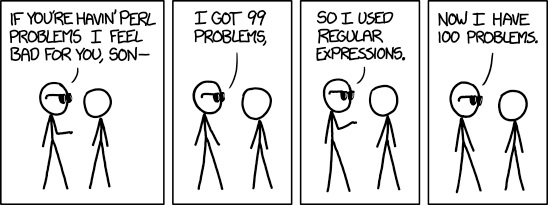
Perl REGEX Problems courtesy of XKCD
The label_replace documentation is a bit terse, and in my opinion, the order of parameters is messed up, but after a few goes I had what I needed:
label_replace(probe_duration_seconds module="xmpp_banner" , "port", "$1", "instance", ".*:(.*)")
probe_duration_seconds instance="example.net:5222",job="blackbox",module="xmpp_banner",port="5222" 	0.001
probe_duration_seconds instance="example.net:5269",job="blackbox",module="xmpp_banner",port="5269" 	0.002
The response now has a new label (or field if you like) called port. So what is this function to our data coming from probe_duration_seconds? The function format is: label_replace(value, dst_label, replacement, src_label, regex) So the function does the following:
  1. Evaluate value, which is generally some sort of query such as probe_duration_seconds
  2. Find the required source label src_label, in this example is instance, in this case the values are example.net:5222 and example.net:5269
  3. Apply regular expression regex, for us its .*:(.*) That says skip everying before : then capture/store everything past : . The brackets mean copy what is after the colon and put it in match #1
  4. Make a new label specified in dst_label, for us this is port
  5. Whatever is in replacement goes into dst_label. For this example it is $1 which means match #1 in our regular expression in the label called port.
In short, the function captures everything after the colon in the instance label and puts that into a new label called port. It does this for each value that is returned into the first parameter. This means I can use the port in my Grafana graph Legend and it will show 5222 or 5269 respectively. I have made the Legend TCP port to give the below result, but I could have used port in Grafana Legend and made the result TCP $1 in the label_replace function to get the same result.
Grafana console showing the use of the label_replace function

9 November 2021

Joachim Breitner: How to audit an Internet Computer canister

I was recently called upon by Origyn to audit the source code of some of their Internet Computer canisters ( canisters are services or smart contracts on the Internet Computer), which were written in the Motoko programming language. Both the application model of the Internet Computer as well as Motoko bring with them their own particular pitfalls and possible sources for bugs. So given that I was involved in the creation of both, they reached out to me. In the course of that audit work I collected a list of things to watch out for, and general advice around them. Origyn generously allowed me to share that list here, in the hope that it will be helpful to the wider community.

Inter-canister calls The Internet Computer system provides inter-canister communication that follows the actor model: Inter-canister calls are implemented via two asynchronous messages, one to initiate the call, and one to return the response. Canisters process messages atomically (and roll back upon certain error conditions), but not complete calls. This makes programming with inter-canister calls error-prone. Possible common sources for bugs, vulnerabilities or simply unexpected behavior are:
  • Reading global state before issuing an inter-canister call, and assuming it to still hold when the call comes back.
  • Changing global state before issuing an inter-canister call, changing it again in the response handler, but assuming nothing else changes the state in between (reentrancy).
  • Changing global state before issuing an inter-canister call, and not handling failures correctly, e.g. when the code handling the callback rolls backs.
If you find such pattern in your code, you should analyze if a malicious party can trigger them, and assess the severity that effect These issues apply to all canisters, and are not Motoko-specific.

Rollbacks Even in the absence of inter-canister calls the behavior of rollbacks can be surprising. In particular, rejecting (i.e. throw) does not rollback state changes done before, while trapping (e.g. Debug.trap, assert , out of cycle conditions) does. Therefore, one should check all public update call entry points for unwanted state changes or unwanted rollbacks. In particular, look for methods (or rather, messages, i.e. the code between commit points) where a state change is followed by a throw. This issues apply to all canisters, and are not Motoko-specific, although other CDKs may not turn exceptions into rejects (which don t roll back).

Talking to malicious canisters Talking to untrustworthy canisters can be risky, for the following (likely incomplete) reasons:
  • The other canister can withhold a response. Although the bidirectional messaging paradigm of the Internet Computer was designed to guarantee a response eventually, the other party can busy-loop for as long as they are willing to pay for before responding. Worse, there are ways to deadlock a canister.
  • The other canister can respond with invalidly encoded Candid. This will cause a Motoko-implemented canister to trap in the reply handler, with no easy way to recover. Other CDKs may give you better ways to handle invalid Candid, but even then you will have to worry about Candid cycle bombs that will cause your reply handler to trap.
Many canisters do not even do inter-canister calls, or only call other trustwothy canisters. For the others, the impact of this needs to be carefully assessed.

Canister upgrade: overview For most services it is crucial that canisters can be upgraded reliably. This can be broken down into the following aspects:
  1. Can the canister be upgraded at all?
  2. Will the canister upgrade retain all data?
  3. Can the canister be upgraded promptly?
  4. Is three a recovery plan for when upgrading is not possible?

Canister upgradeability A canister that traps, for whatever reason, in its canister_preupgrade system method is no longer upgradeable. This is a major risk. The canister_preupgrade method of a Motoko canister consists of the developer-written code in any system func preupgrade() block, followed by the system-generated code that serializes the content of any stable var into a binary format, and then copies that to stable memory. Since the Motoko-internal serialization code will first serialize into a scratch space in the main heap, and then copy that to stable memory, canisters with more than 2GB of live data will likely be unupgradeable. But this is unlikely the first limit: The system imposes an instruction limit on upgrading a canister (spanning both canister_preupgrade and canister_postupgrade). This limit is a subnet configuration value, and sepearate (and likely higher) than the normal per-message limit, and not easily determined. If the canister s live data becomes too large to be serialized within this limit, the canister becomes non-upgradeable. This risk cannot be eliminated completely, as long as Motoko and Stable Variables are used. It can be mitigated by appropriate load testing: Install a canister, fill it up with live data, and exercise the upgrade. If this succeeds with a live data set exceeding the expected amount of data by a margin, this risk is probably acceptable. Bonus points for adding functionality that will prevent the canister s live data to increase above a certain size. If this testing is to be done on a local replica, extra care needs to be taken to make sure the local replica actually performs instruction counting and has the same resource limits as the production subnet. An alternative mitigation is to avoid canister_pre_upgrade as much as possible. This means no use of stable var (or restricted to small, fixed-size configuration data). All other data could be
  • mirrored off the canister (possibly off chain), and manually re-hydrated after an upgrade.
  • stored in stable memory manually, during each update call, using the ExperimentalStableMemory API. While this matches what high-assurance Rust canisters (e.g. the Internet Identity) do, This requires manual binary encoding of the data, and is marked experimental, so I cannot recommend this at the moment.
  • not put into a Motoko canister until Motoko has a scalable solution for stable variable (for example keeping them in stable memory permanently, with smart caching in main memory, and thus obliterating the need for pre-upgrade code.)

Data retention on upgrades Obviously, all live data ought to be retained during upgrades. Motoko automatically ensures this for stable var data. But often canisters want to work with their data in a different format (e.g. in objects that are not shared and thus cannot be put in stable vars, such as HashMap or Buffer objects), and thus may follow following idiom:
stable var fooStable =  ;
var foo = fooFromStable(fooStable);
system func preupgrade()   fooStable := fooToStable(foo);  )
system func postupgrade()   fooStable := (empty);  )
In this case, it is important to check that
  • All non-stable global vars, or global lets with mutable values, have a stable companion.
  • The assignments to foo and fooStable are not forgotten.
  • The fooToStable and fooFromStable form bijections.
An example would be HashMaps stored as arrays via Iter.toArray( .entries()) and HashMap.fromIter( .vals()). It is worth pointiong out that a code view will only look at a single version of the code, but cannot check whether code changes will preserve data on upgrade. This can easily go wrong if the names and types of stable variables are changed in incompatible way. The upgrade may fail loudly in this cases, but in bad cases, the upgrade may even succeed, losing data along the way. This risk needs to be mitigated by thorough testing, and possibly backups (see below).

Prompt upgrades Motoko and Rust canisters cannot be safely upgraded when they are still waiting for responses to inter-canister calls (the callback would eventually reach the new instance, and because of infelicities of the IC s System API, could possibly call arbitrary internal functions). Therefore, the canister needs to be stopped before upgrading, and started again. If the inter-canister calls take a long time, this mean that upgrading may take a long time, which may be undesirable. Again, this risk is reduced if all calls are made to trustworthy canisters, and elevated when possibly untrustworthy canisters are called, directly or indirectly.

Backup and recovery Because of the above risk around upgrades it is advisable to have a disaster recovery strategy. This could involve off-chain backups of all relevant data, so that it is possible to reinstall (not upgrade) the canister and re-upload all data. Note that reinstall has the same issue as upgrade described above in prompt upgrades : It ought to be stopped first to be safe. Note that the instruction limit for messages, as well as the message size limit, limit the amount of data returned. If the canister needs to hold more data than that, the backup query method might have to return chunks or deltas, with all the extra complexity that entails, e.g. state changes between downloading chunks. If large data load testing is performed (as Irecommend anyways to test upgradeability), one can test whether the backup query method works within the resource limits.

Time is not strictly monotonic The timestamps for current time that the Internet Computer provides to its canisters is guaranteed to be monotonic, but not strictly monotonic. It can return the same values, even in the same messages, as long as they are processed in the same block. It should therefore not be used to detect happens-before relations. Instead of using and comparing time stamps to check whether Y has been performed after X happened last, introduce an explicit var y_done : Bool state, which is set to False by X and then to True by Y. When things become more complex, it will be easier to model that state via an enumeration with speaking tag names, and update this state machine along the way. Another solution to this problem is to introduce a var v : Nat counter that you bump in every update method, and after each await. Now v is your canister s state counter, and can be used like a timestamp in many ways. While we are talking about time: The system time (typically) changes across an await. So if you do let now = Time.now() and then await, the value in now may no longer be what you want.

Wrapping arithmetic The Nat64 data type, and the other fixed-width numeric types provide opt-in wrapping arithmetic (e.g. +%, fromIntWrap). Unless explicitly required by the current application, this should be avoided, as usually a too large or negatie value is a serious, unrecoverable logic error, and trapping is the best one can do.

Cycle balance drain attacks Because of the IC s canister pays model, all canisters are prone to DoS attacks by draining their cycle balance, and this risk needs to be taken into account. The most elementary mitigation strategy is to monitor the cycle balance of canisters and keep it far from the (configurable) freezing threshold. On the raw IC-level, further mitigation strategies are possible:
  • If all update calls are authenticated, perform this authentication as quickly as possible, possibly before decoding the caller s argument. This way, a cycle drain attack by an unauthenticated attacker is less effective (but still possible).
  • Additionally, implementing the canister_inspect_message system method allows the above checks to be performed before the message even is accepted by the Internet Computer. But it does not defend against inter-canister messages and is therefore not a complete solution.
  • If an attack from an authenticated user (e.g. a stakeholder) is to be expected, the above methods are not effective, and an effective defense might require relatively involved additional program logic (e.g. per-caller statistics) to detect such an attack, and react (e.g. rate-limiting).
  • Such defenses are pointless if there is only a single method where they do not apply (e.g. an unauthenticated user registration method). If the application is inherently attackable this way, it is not worth the bother to raise defenses for other methods.
Related: A justification why the Internet Identity does not use canister_inspect_message) A motoko-implemented canister currently cannot perform most of these defenses: Argument decoding happens unconditionally before any user code that may reject a message based on the caller, and canister_inspect_message is not supported. Furthermore, Candid decoding is not very cycle defensive, and one should assume that it is possible to construct Candid messages that require many instructions to decode, even for simple argument type signatures. The conclusion for the audited canisters is to rely on monitoring to keep the cycle blance up, even during an attack, if the expense can be born, and maybe pray for IC-level DoS protections to kick in.

Large data attacks Another DoS attack vector exists if public methods allow untrustworthy users to send data of unlimited size that is persisted in the canister memory. Because of the translation of async-await code into multiple message handlers, this applies not only to data that is obviously stored in global state, but also local data that is live across an await point. The effectiveness of such attacks is limited by the Internet Computer s message size limit, which is in the order of a few megabytes, but many of those also add up. The problem becomes much worse if a method has an argument type that allows a Candid space bomb: It is possible to encode very large vectors with all values null in Candid, so if any method has an argument of type [Null] or [?t], a small message will expand to a large value in the Motoko heap. Other types to watch out:
  • Nat and Int: This is an unbounded natural number, and thus can be arbitrarily large. The Motoko representation will however not be much larger than the Candid encoding (so this does not qualify as a space bomb).
It is still advisable to check if the number is reasonable in size before storing it or doing an await. For example, when it denotes an index in an array, throw early if it exceeds the size of the array; if it denotes a token amount to transfer, check it against the available balance, if it denotes time, check it against reasonable bounds.
  • Principal: A Principal is effectively a Blob. The Interface specification says that principals are at most 29 bytes in length, but the Motoko Candid decoder does not check that currently (fixed in the next version of Motoko). Until then, a Principal passed as an argument can be large (the principal in msg.caller is system-provided and thus safe). If you cannot wait for the fix to reach you, manually check the size of the princial (via Principal.toBlob) before doing the await.

Shadowing of msg or caller Don t use the same name for the message context of the enclosing actor and the methods of the canister: It is dangerous to write shared(msg) actor, because now msg is in scope across all public methods. As long as these also use public shared(msg) func , and thus shadow the outer msg, it is correct, but it if one accidentially omits or mis-types the msg, no compiler error would occur, but suddenly msg.caller would now be the original controller, likely defeating an important authorization step. Instead, write shared(init_msg) actor or shared( caller = controller ) actor to avoid using msg.

Conclusion If you write a serious canister, whether in Motoko or not, it is worth to go through the code and watch out for these patterns. Or better, have someone else review your code, as it may be hard to spot issues in your own code. Unfortunately, such a list is never complete, and there are surely more ways to screw up your code in addition to all the non-IC-specific ways in which code can be wrong. Still, things get done out there, so best of luck!

8 November 2021

Dima Kogan: mrcal 2.0: triangulation and stereo

mrcal is my big toolkit for geometric computer vision: making models (camera calibration) and using models (mapping, ranging, etc). Since the release of mrcal 1.0 back in February I've been busy using the tools in the field, fixing things and improving things. Today I'm happy to finally be able to announce the release of mrcal 2.0. A big part of this release is maintenance and cleanup that resulted from me heavily using the tools over the course of this past year, and improving whatever was bugging me. The most notable result of that effort, is that splined models are no longer "experimental". They work well and they're awesome. Go try them. And there're a number of new features, most notably nice dense stereo support and nice sparse triangulation support (with uncertainty propagation!) These are awesome. Go try them. As before, the tour of mrcal provides a good overview of the capabilities of the toolkit, and is a good place to start reading the documentation. Reading these docs would be very illuminating for anybody that calibrates cameras, even for those that have no intent to actually use the mrcal tools. Let me know if you try it out! The most list of most notable improvements, from the release notes:

Enrico Zini: An educational debugging session

This morning we realised that a test case failed on Fedora 34 only (the link is in Italian) and we set to debugging. The initial analysis This is the initial reproducer:
$ PROJ_DEBUG=3 python setup.py test
test_recipe (tests.test_litota3.TestLITOTA3NordArkimetIFS) ... pj_open_lib(proj.db): call fopen(/lib64/../share/proj/proj.db) - succeeded
proj_create: Open of /lib64/../share/proj/proj.db failed
pj_open_lib(proj.db): call fopen(/lib64/../share/proj/proj.db) - succeeded
proj_create: no database context specified
Cannot instantiate source_crs
EXCEPTION in py_coast(): ProjP: cannot create crs to crs from [EPSG:4326] to [+proj=merc +lon_0=0 +k=1 +x_0=0 +y_0=0 +ellps=WGS84 +datum=WGS84 +over +units=m +no_defs]
ERROR
Note that opening /lib64/../share/proj/proj.db sometimes succeeds, sometimes fails. It's some kind of Schr dinger path, which works or not depending on how you observe it:
# ls -lad /lib64
lrwxrwxrwx 1 1000 1000 9 Jan 26  2021 /lib64 -> usr/lib64
$ ls -la /lib64/../share/proj/proj.db
-rw-r--r-- 1 root root 8925184 Jan 28  2021 /lib64/../share/proj/proj.db
$ cd /lib64/../share/proj/
$ cd /lib64
$ cd ..
$ cd share
-bash: cd: share: No such file or directory
And indeed, stat(2) finds it, and sqlite doesn't (the file is a sqlite database):
$ stat /lib64/../share/proj/proj.db
  File: /lib64/../share/proj/proj.db
  Size: 8925184     Blocks: 17432      IO Block: 4096   regular file
Device: 33h/51d Inode: 56907       Links: 1
Access: (0644/-rw-r--r--)  Uid: (    0/    root)   Gid: (    0/    root)
Access: 2021-11-08 14:09:12.334350779 +0100
Modify: 2021-01-28 05:38:11.000000000 +0100
Change: 2021-11-08 13:42:51.758874327 +0100
 Birth: 2021-11-08 13:42:51.710874051 +0100
$ sqlite3 /lib64/../share/proj/proj.db
Error: unable to open database "/lib64/../share/proj/proj.db": unable to open database file
A minimal reproducer Later on we started stripping layers of code towards a minimal reproducer: here it is. It works or doesn't work depending on whether proj is linked explicitly, or via MagPlus:
$ cat tc.cc
#include <magics/ProjP.h>
int main()  
    magics::ProjP p("EPSG:4326", "+proj=merc +lon_0=0 +k=1 +x_0=0 +y_0=0 +ellps=WGS84 +datum=WGS84 +over +units=m +no_defs");
    return 0;
 
$ g++ -o tc  tc.cc -I/usr/include/magics  -lMagPlus
$ ./tc
proj_create: Open of /lib64/../share/proj/proj.db failed
proj_create: no database context specified
terminate called after throwing an instance of 'magics::MagicsException'
  what():  ProjP: cannot create crs to crs from [EPSG:4326] to [+proj=merc +lon_0=0 +k=1 +x_0=0 +y_0=0 +ellps=WGS84 +datum=WGS84 +over +units=m +no_defs]
Aborted (core dumped)
$ g++ -o tc  tc.cc -I/usr/include/magics -lproj  -lMagPlus
$ ./tc
What is going on here? A difference between the two is the path used to link to libproj.so:
$ ldd ./tc   grep proj
    libproj.so.19 => /lib64/libproj.so.19 (0x00007fd4919fb000)
$ g++ -o tc  tc.cc -I/usr/include/magics   -lMagPlus
$ ldd ./tc   grep proj
    libproj.so.19 => /lib64/../lib64/libproj.so.19 (0x00007f6d1051b000)
Common sense screams that this should not matter, but we chased an intuition and found that one of the ways proj looks for its database is relative to its shared library. Indeed, gdb in hand, that dladdr call returns /lib64/../lib64/libproj.so.19. From /lib64/../lib64/libproj.so.19, proj strips two paths from the end, presumably to pass from something like /something/usr/lib/libproj.so to /something/usr. So, dladdr returns /lib64/../lib64/libproj.so.19, which becomes /lib64/../, which becomes /lib64/../share/proj/proj.db, which exists on the file system and is used as a path to the database. But depending how you look at it, that path might or might not be valid: it passes the stat(2) check that stops the lookup for candidate paths, but sqlite is unable to open it. Why does the other path work? By linking libproj.so in the other way, dladdr returns /lib64/libproj.so.19, which becomes /share/proj/proj.db, which doesn't exist, which triggers a fallback to a PROJ_LIB constant defined at compile time, which is a path that works no matter how you look at it. Why that weird path with libMagPlus? To complete the picture, we found that libMagPlus.so is packaged with a rpath set, which is known to cause trouble
# readelf -d /usr/lib64/libMagPlus.so grep rpath
 0x000000000000000f (RPATH)              Library rpath: [$ORIGIN/../lib64]
The workaround We found that one can set PROJ_LIB in the environment to override the normal proj database lookup. Building on that, we came up with a simple way to override it on Fedora 34 only:
    if distro is not None and distro.linux_distribution()[:2] == ("Fedora", "34") and "PROJ_LIB" not in os.environ:
         self.env_overrides["PROJ_LIB"] = "/usr/share/proj/"
This has been a most edifying and educational debugging session, with only the necessary modicum of curses and swearwords. Working in a team of excellent people really helps.

Russell Coker: Installing NextCloud

NextCloud and OwnCloud History Some time ago I tried OwnCloud, it wasn t a positive experience for me. Since that time I ve got a server with a much faster CPU, a faster Internet connection, and the NextCloud code is newer and running on a newer version of PHP, I didn t make good notes so I m not sure which factors were most responsible for having a better experience this time. According to the NextCloud Wikipedia page [1] the fork of NextCloud from the OpenCloud base happened in 2016 so it s obviously been a while since I tried it, it was probably long before 2016. Recently the BBC published an interesting article on Turnover contagion which is when one resignation can trigger many more [2] which is interesting to read in the context of OwnCloud losing critical staff failing after one key developer resigned. I mentioned OwnCloud in a 2012 blog post about Liberty and Mobile Phones [3], since then I haven t done well at achieving those goals. A few days ago I decided to try NextCloud and found it a much better experience than I recall OwnCloud being in the past. Installation I installed OwnCloud on an Oracle Cloud ARM VM (see my previous blog post about the Oracle Cloud Free Tier [4]). This CloudCone article on installing NextCloud on Debian 10 (Buster) covers the basics well [5]. Here is the NextCloud URL for downloading the PHP files (a large ZIP archive) [6]. You have to extract to where Apache is configured to have it s webroot and then run chown -R www-data nextcloud/lib/private/Log nextcloud/config nextcloud/apps (or if you use php-fpm then chown it to the user for that). NextCloud recommend having all of the NextCloud files owned by www-data, but that s just a bad idea, allowing it to rewrite some of it s program files is bad, allowing it to rewrite all of them is worse. For my installation I used the Apache modiles macro, rewrite, ssl, php7.4, and headers (this is more about how I configure Apache than about NextCloud). Also I edited /etc/php/7.4/apache2/php.ini and changed memory_limit to 512M (the default of 128M is not enough). I m currently only testing it, for a production use I would use php-fpm and run it under it s own UID so that it can t interact with other PHP apps. After that it was just a matter of visiting the configuration URL and giving it the details of the database etc. After setting it up the command php -d memory_limit=512M occ app:install richdocumentscode_arm64 when run from the root of the OwnCloud installation installs the Cloudera components for editing LibreOffice documents in OwnCloud, this is the command for ARM64 architecture, I presume the command for other architectures is similar. Conclusion OwnCloud is very usable, it has a decent feature set built in and the option to download modules such as the components for editing LibreOffice files on the web is useful. But I am hesitant to install things that require the sort of access it requires. I think it would be better if there was a documented and supported way of installing things and then locking them down so that at runtime it can only write to data files not any program files or configuration files. It would also be better if it was packaged for Debian and had the Debian update process for security fixes. I can imagine many people installing it, forgetting to update it, and ending up with insecure systems.

Michael Ablassmeier: Libvirt/KVM Backup on Debian Bullseye

The libvirt and qemu versions in Debian Bullseye support a new feature that allows for easier backup and recovery of virtual machines. Instead of using snapshots for backup operation, its now possible to enable dirty bitmaps. Other hypervisors tend to call this changed block tracking . Using the new backup begin approach, its not only possible to create live full backups (without having to create an snapshot) but also track the changes between so called checkpoints, which is very useful for incremental backups. Over the course of the last few months, i have been working on a simple backup and recovery utility called virtnbdbackup It uses the pull based approach in the libvirt api set and currently supports: Preparing the virtual machines The dirty bitmap feature is not enabled by default, users can enable it by adding a new capability to a virtual machine configuration:
 <domain type='kvm' id='1' xmlns:qemu='http://libvirt.org/schemas/domain/qemu/1.0'>
 [..]
 <qemu:capabilities>
   <qemu:add capability='incremental-backup'/>
 </qemu:capabilities>
 [..]
 </domain>
To finally enable the feature, power cycle virtual machine once. Creating backups By default, virtnbdbackup saves the virtual machine config, disks and its logfiles to a given target directory. Its also possible to stream the output into a uncompressed zip archive Taking a backup is as simple as:
# virtnbdbackup -d vm2 -l full -o /tmp/WEEKLY_BACKUP/
 [..]
[2021-11-08 15:43:46] INFO virtnbdbackup - main [MainThread]: Backup jobs finished, stopping backup task.
[2021-11-08 15:43:46] INFO virtnbdbackup - main [MainThread]: Finished
# tree /tmp/WEEKLY_BACKUP/
 /tmp/WEEKLY_BACKUP/
  backup.full.11082021154343.log
  checkpoints
    virtnbdbackup.0.xml
  sda.full.data
  vm2.cpt
  vmconfig.virtnbdbackup.0.xml
From that point on, its now possible to create incremental backups:
 # virtnbdbackup -d vm2 -l inc -o /tmp/WEEKLY_BACKUP/
 # tree /tmp/WEEKLY_BACKUP/
 /tmp/WEEKLY_BACKUP/
  backup.full.11082021154343.log
  backup.inc.11082021154538.log
  checkpoints
    virtnbdbackup.0.xml
    virtnbdbackup.1.xml
  sda.full.data
  sda.inc.virtnbdbackup.1.data
  vm2.cpt
  vmconfig.virtnbdbackup.0.xml
  vmconfig.virtnbdbackup.1.xml
Restoring backups The virtnbdrestore utility can be used to reconstruct the backup sets into usable qcow images, like so:
 # virtnbdrestore -a restore -i /tmp/WEEKLY_BACKUP/ -o /tmp/VM_RESTORE
Using the --until option its also possible to only reconstruct the images to a certain checkpoint, allowing for point in time recovery. Restoring single files Via virtnbdmap you can map full backups back into an usable block device, without having to reconstruct the complete backup image:
# virtnbdmap -f /tmp/WEEKLY_BACKUP/sda.full.data
 [..] INFO virtnbdmap - <module> [MainThread]: Done mapping backup image to [/dev/nbd0]
 [..] INFO virtnbdmap - <module> [MainThread]: Press CTRL+C to disconnect
# fdisk -l /dev/nbd0
Disk /dev/nbd0: 2 GiB, 2147483648 bytes, 4194304 sectors
From here, you can either mount the disc and recover single files, or boot from it via:
qemu-img create -b /dev/nbd0 -f qcow2 bootme.qcow2
qemu-system-x86_64 -enable-kvm -m 2000 -hda bootme.qcow2
Check out the README for the full feature set.

5 November 2021

Jonathan Dowland: 25 things I would like to 3D print

Last year I started collecting ideas of things I would like to 3D print one day, on Twitter. Twitter is fundamentally ephemeral, so I'll collect it here instead. I got up to 14 items on Twitter, and now I'm up to 25. I don't own a 3D printer, but I have access to one at the work office. Perhaps this list is my subconcious trying to convince me to buy one. What am I missing? What else should I be thinking of printing? Let me know!
  1. Some kind of 45 leaning prong to dry bottles and flasks on
  2. A tea tray and coasters
  3. a replacement prop arm/foot for my computer keyboard (something like this but for the Lenovo Ultranav)
  4. some attempted representation of Borges Library of Babel, a la @jwz The Library of Babel, again
  5. an exploration of the geometry of Susanna Clarke s Piranesi
  6. further iterations of my castle
  7. Small tins to keep loose-leaf tea in
  8. Who am I kidding, bound to be a map from DOOM. E1M1 perhaps, or something more regular (MAP07? E2M8?) See also this amazing print of Quake 3: Arena's "Camping Grounds"
  9. replacement bits for kids toy sets, e.g. a bolt with long shank from Early Learning Centre Build It Deluxe Set, without all 4 of which you can't build much of anything
  10. A stand for a decorative Christmas bauble (kid's hand print on it) A roll of cellotape works pretty well in the mean time
  11. DIY bits-and-bobs sorter/storage (nuts and bolts etc)
  12. A space ship from Elite/Frontier. Probably a Cobra mk3 or maybe a Viper mk2. In a glow-in-the-dark PLA which i d overpaint with gunmetal except for the fuselage
  13. A watch stand/holder/storage thing Except it would look nicer in wood (And I m more inclined to get rid of all but one watch instead)
  14. Little tabbed 7 dividers for vinyl records, with A-Z cut into the tabs 12 ones might be a stretch (something like this)
  15. A low-profile custom trackpoint cover like the ones by SaotoTech (e.g.)
  16. A vinyl record. (Not sure that any 3D printer I would have access to would have the necessary resolution. I haven't done any research yet.)
  17. A free-standing inclined vinyl record display stand (e.g.)
  18. A "Settlers of Catan" set. I've got the travel edition which is great but it would be nicer to have a larger-sized set. There are some things I really like about the travel set that the full-size set lacks; so designing and printing a larger set myself could incorporate them. Also I don't feel inclined to buy the full-size set for 50 or so to end up with essentially the same game I already bought. No doubt I'd spent at least that much in PLA.
  19. Little kids trinkets. Pacman ghosts, that sort-of thing. Whatever my daughters come up with next.
  20. Lego storage/sorters.
  21. Some kind of lenticular picture. Perhaps a gift or Christmas card combined in one.
  22. A bracket to install a Gotek drive in my Amiga 500 (e.g.). I've managed without but the fit isn't great.
  23. An attempt at using the 3D printer for 2D drawing. I would never get the same kind of quality results you can get from a proper plotter, but still Take a look at some proper plotter art!
  24. Garden decorations. I like the idea of porous geometric shapes that you can plant mosses or ferns into, but also things which might be taken over and "used" by nature in ways I hadn't thought of.
  25. Floor plans / 3D plans of my house (including variations if I remodelled)

Next.

Previous.