Search Results: "sto"

25 May 2020

Russ Allbery: Review: The Last Emperox

Review: The Last Emperox, by John Scalzi
Series: Interdependency #3
Publisher: Tor
Copyright: April 2020
ISBN: 0-7653-8917-7
Format: Kindle
Pages: 318
This is the conclusion of the Interdependency trilogy, which is a single story told in three books. Start with The Collapsing Empire. You don't want to read this series out of order. All the pieces and players are in place, the causes and timeline of the collapse of the empire she is accidentally ruling are now clear, and Cardenia Wu-Patrick knows who her friends and enemies are. What she doesn't know is what she can do about it. Her enemies, unfettered Cardenia's ethics or desire to save the general population, have the advantage of clearer and more achievable goals. If they survive and, almost as important, remain in power, who cares what happens to everyone else? As with The Consuming Fire, the politics may feel a bit too on-the-nose for current events, this time for the way that some powerful people are handling (or not handling) the current pandemic. Also as with The Consuming Fire, Scalzi's fast-moving story, likable characters, banter, and occasional humorous descriptions prevent those similarities from feeling heavy or didactic. This is political wish fulfillment to be sure, but it doesn't try to justify itself or linger too much on its improbabilities. It's a good story about entertaining people trying (mostly) to save the world with a combination of science and political maneuvering. I picked up The Last Emperox as a palate cleanser after reading Gideon the Ninth, and it provided exactly what I was looking for. That gave me an opportunity to think about what Scalzi does in his writing, why his latest novel was one of my first thoughts for a palate cleanser, and why I react to his writing the way that I do. Scalzi isn't a writer about whom I have strong opinions. In my review of The Collapsing Empire, I compared his writing to the famous description of Asimov as the "default voice" of science fiction, but that's not quite right. He has a distinct and easily-recognizable style, heavy on banter and light-hearted description. But for me his novels are pleasant, reliable entertainment that I forget shortly after reading them. They don't linger or stand out, even though I enjoy them while I'm reading them. That's my reaction. Others clearly do not have that reaction, fully engage with his books, and remember them vividly. That indicates to me that there's something his writing is doing that leaves substantial room for difference of personal taste and personal reaction to the story, and the sharp contrast between The Last Emperox and Gideon the Ninth helped me put my finger on part of it. I don't feel like Scalzi's books try to tell me how to feel about the story. There's a moment in The Last Emperox where Cardenia breaks down crying over an incredibly difficult decision that she's made, one that the readers don't find out about until later. In another book, there would be considerably more emotional build-up to that moment, or at least some deep analysis of it later once the decision is revealed. In this book, it's only a handful of paragraphs and then a few pages of processing later, primarily in dialogue, and less focused on the emotions of the characters than on the forward-looking decisions they've made to deal with those emotions. The emotion itself is subtext. Many other authors would try to pull the reader into those moments and make them feel what the characters are feeling. Scalzi just relates them, and leaves the reader free to feel what they choose to feel. I don't think this is a flaw (or a merit) in Scalzi's writing; it's just a difference, and exactly the difference that made me reach for this book as an emotional break after a book that got its emotions all over the place. Calling Scalzi's writing emotionally relaxing isn't quite right, but it gives me space to choose to be emotionally relaxed if I want to be. I can pick the level of my engagement. If I want to care about these characters and agonize over their decisions, there's enough information here to mull over and use to recreate their emotional states. If I just want to read a story about some interesting people and not care too much about their hopes and dreams, I can choose to do that instead, and the book won't fight me. That approach lets me sidle up on the things that I care about and think about them at my leisure, or leave them be. This approach makes Scalzi's books less intense than other novels for me. This is where personal preference comes in. I read books in large part to engage emotionally with the characters, and I therefore appreciate books that do a lot of that work for me. Scalzi makes me do the work myself, and the result is not as effective for me, or as memorable. I think this may be part of what I and others are picking up on when we say that Scalzi's writing is reminiscent of classic SF from decades earlier. It used to be common for SF to not show any emotional vulnerability in the main characters, and to instead focus on the action plot and the heroics and martial virtues. This is not what Scalzi is doing, to be clear; he has a much better grasp of character and dialogue than most classic SF, adds considerable light-hearted humor, and leaves clear clues and hooks for a wide range of human emotions in the story. But one can read Scalzi in that tone if one wants to, since the emotional hooks do not grab hard at the reader and dig in. By comparison, you cannot read Gideon the Ninth without grappling with the emotions of the characters. The book will not let you. I think this is part of why Scalzi is so consistent for me. If you do not care deeply about Gideon Nav, you will not get along with Gideon the Ninth, and not everyone will. But several main characters in The Last Emperox (Mance and to some extent Cardenia) did little or nothing for me emotionally, and it didn't matter. I liked Kiva and enjoyed watching her strategically smash her way through social conventions, but it was easy to watch her from a distance and not get too engrossed in her life or her thoughts. The plot trundled along satisfyingly, regardless. That lack of emotional involvement precludes, for me, a book becoming the sort of work that I will rave about and try to press into other people's hands, but it also makes it comfortable and gentle and relaxing in a way that a more emotionally fraught book could not be. This is a long-winded way to say that this was a satisfying conclusion to a space opera trilogy that I enjoyed reading, will recommend mildly to others, and am already forgetting the details of. If you liked the first two books, this is an appropriate and fun conclusion with a few new twists and a satisfying amount of swearing (mostly, although not entirely, from Kiva). There are a few neat (albeit not horribly original) bits of world-building, a nice nod to and subversion of Asimov, a fair bit of political competency wish fulfillment (which I didn't find particularly believable but also didn't mind being unbelievable), and one enjoyable "oh no she didn't" moment. If you like the thing that Scalzi is doing, you will enjoy this book. Rating: 8 out of 10

24 May 2020

Enrico Zini: Music links

It's the end of the world as we know it, twice as fast
After Homemade Instruments Week on the facebook page, here is an article with some PVC pipes instruments! Percussion on PVC pipes A classic, long pipes for big bass, easy to tune by changing the length
"Ut queant laxis" or "Hymnus in Ioannem" is a Latin hymn in honor of John the Baptist, written in Horatian Sapphics and traditionally attributed to Paulus Diaconus, the eighth-century Lombard historian. It is famous for its part in the history of musical notation, in particular solmization. The hymn belongs to the tradition of Gregorian chant.

Dirk Eddelbuettel: #3 T^4: Customizing The Shell

The third video (following the announcement, the shell colors) one as well as last week s shell prompt one, is up in the stil new T^4 series of video lightning talks with tips, tricks, tools, and toys. Today we cover customizing the shell some more.

The slides are here. This repo at GitHub support the series: use it to open issues for comments, criticism, suggestions, or feedback. If you like this or other open-source work I do, you can now sponsor me at GitHub. For the first year, GitHub will match your contributions.

This post by Dirk Eddelbuettel originated on his Thinking inside the box blog. Please report excessive re-aggregation in third-party for-profit settings.

22 May 2020

Steve Kemp: Updated my linux-security-modules for the Linux kernel

Almost three years ago I wrote my first linux-security-module, inspired by a comment I read on LWN I did a little more learning/experimentation and actually produced a somewhat useful LSM, which allows you to restrict command-execution via the use of a user-space helper: Because the detection is done in userspace writing your own custom rules is both safe and easy. No need to touch the kernel any further! Yesterday I rebased all the modules so that they work against the latest stable kernel 5.4.22 in #7.
The last time I'd touched them they were built against 5.1, which was itself a big jump forwards from the 4.16.7 version I'd initially used.
Finally I updated the can-exec module to make it gated, which means you can turn it on, but not turn it off without a reboot. That was an obvious omission from the initial implementation #11. Anyway updated code is available here: I'd kinda like to write more similar things, but I lack inspiration.

18 May 2020

Arturo Borrero Gonz lez: A better Toolforge: upgrading the Kubernetes cluster

Logos This post was originally published in the Wikimedia Tech blog, and is authored by Arturo Borrero Gonzalez and Brooke Storm. One of the most successful and important products provided by the Wikimedia Cloud Services team at the Wikimedia Foundation is Toolforge. Toolforge is a platform that allows users and developers to run and use a variety of applications that help the Wikimedia movement and mission from the technical point of view in general. Toolforge is a hosting service commonly known in the industry as a Platform as a Service (PaaS). Toolforge is powered by two different backend engines, Kubernetes and GridEngine. This article focuses on how we made a better Toolforge by integrating a newer version of Kubernetes and, along with it, some more modern workflows. The starting point in this story is 2018. Yes, two years ago! We identified that we could do better with our Kubernetes deployment in Toolforge. We were using a very old version, v1.4. Using an old version of any software has more or less the same consequences everywhere: you lack security improvements and some modern key features. Once it was clear that we wanted to upgrade our Kubernetes cluster, both the engineering work and the endless chain of challenges started. It turns out that Kubernetes is a complex and modern technology, which adds some extra abstraction layers to add flexibility and some intelligence to a very old systems engineering need: hosting and running a variety of applications. Our first challenge was to understand what our use case for a modern Kubernetes was. We were particularly interested in some key features: Soon enough we faced another Kubernetes native challenge: the documentation. For a newcomer, learning and understanding how to adapt Kubernetes to a given use case can be really challenging. We identified some baffling patterns in the docs. For example, different documentation pages would assume you were using different Kubernetes deployments (Minikube vs kubeadm vs a hosted service). We are running Kubernetes like you would on bare-metal (well, in CloudVPS virtual machines), and some documents directly referred to ours as a corner case. During late 2018 and early 2019, we started brainstorming and prototyping. We wanted our cluster to be reproducible and easily rebuildable, and in the Technology Department at the Wikimedia Foundation, we rely on Puppet for that. One of the first things to decide was how to deploy and build the cluster while integrating with Puppet. This is not as simple as it seems because Kubernetes itself is a collection of reconciliation loops, just like Puppet is. So we had to decide what to put directly in Kubernetes and what to control and make visible through Puppet. We decided to stick with kubeadm as the deployment method, as it seems to be the more upstream-standardized tool for the task. We had to make some interesting decisions by trial and error, like where to run the required etcd servers, what the kubeadm init file would look like, how to proxy and load-balance the API on our bare-metal deployment, what network overlay to choose, etc. If you take a look at our public notes, you can get a glimpse of the number of decisions we had to make. Our Kubernetes wasn t going to be a generic cluster, we needed a Toolforge Kubernetes service. This means we don t use some of the components, and also, we add some additional pieces and configurations to it. By the second half of 2019, we were working full-speed on the new Kubernetes cluster. We already had an idea of what we wanted and how to do it. There were a couple of important topics for discussions, for example: We will describe in detail the final state of those pieces in another blog post, but each of the topics required several hours of engineering time, research, tests, and meetings before reaching a point in which we were comfortable with moving forward. By the end of 2019 and early 2020, we felt like all the pieces were in place, and we started thinking about how to migrate the users, the workloads, from the old cluster to the new one. This migration plan mostly materialized in a Wikitech page which contains concrete information for our users and the community. The interaction with the community was a key success element. Thanks to our vibrant and involved users, we had several early adopters and beta testers that helped us identify early flaws in our designs. The feedback they provided was very valuable for us. Some folks helped solve technical problems, helped with the migration plan or even helped make some design decisions. Worth noting that some of the changes that were presented to our users were not easy to handle for them, like new quotas and usage limits. Introducing new workflows and deprecating old ones is always a risky operation. Even though the migration procedure from the old cluster to the new one was fairly simple, there were some rough edges. We helped our users navigate them. A common issue was a webservice not being able to run in the new cluster due to stricter quota limiting the resources for the tool. Another example is the new Ingress layer failing to properly work with some webservices s particular options. By March 2020, we no longer had anything running in the old Kubernetes cluster, and the migration was completed. We then started thinking about another step towards making a better Toolforge, which is introducing the toolforge.org domain. There is plenty of information about the change to this new domain in Wikitech News. The community wanted a better Toolforge, and so do we, and after almost 2 years of work, we have it! All the work that was done represents the commitment of the Wikimedia Foundation to support the technical community and how we really want to pursue technical engagement in general in the Wikimedia movement. In a follow-up post we will present and discuss more in-depth about some technical details of the new Kubernetes cluster, stay tuned! This post was originally published in the Wikimedia Tech blog, and is authored by Arturo Borrero Gonzalez and Brooke Storm.

Russell Coker: A Good Time to Upgrade PCs

PC hardware just keeps getting cheaper and faster. Now that so many people have been working from home the deficiencies of home PCs are becoming apparent. I ll give Australian prices and URLs in this post, but I think that similar prices will be available everywhere that people read my blog. From MSY (parts list PDF ) [1] 120G SATA SSDs are under $50 each. 120G is more than enough for a basic workstation, so you are looking at $42 or so for fast quiet storage or $84 or so for the same with RAID-1. Being quiet is a significant luxury feature and it s also useful if you are going to be in video conferences. For more serious storage NVMe starts at around $100 per unit, I think that $124 for a 500G Crucial NVMe is the best low end option (paying $95 for a 250G Kingston device doesn t seem like enough savings to be worth it). So that s $248 for 500G of very fast RAID-1 storage. There s a Samsung 2TB NVMe device for $349 which is good if you need more storage, it s interesting to note that this is significantly cheaper than the Samsung 2TB SSD which costs $455. I wonder if SATA SSD devices will go away in the future, it might end up being SATA for slow/cheap spinning media and M.2 NVMe for solid state storage. The SATA SSD devices are only good for use in older systems that don t have M.2 sockets on the motherboard. It seems that most new motherboards have one M.2 socket on the motherboard with NVMe support, and presumably support for booting from NVMe. But dual M.2 sockets is rare and the price difference is significantly greater than the cost of a PCIe M.2 card to support NVMe which is $14. So for NVMe RAID-1 it seems that the best option is a motherboard with a single NVMe socket (starting at $89 for a AM4 socket motherboard the current standard for AMD CPUs) and a PCIe M.2 card. One thing to note about NVMe is that different drivers are required. On Linux this means means building a new initrd before the migration (or afterwards when booted from a recovery image) and on Windows probably means a fresh install from special installation media with NVMe drivers. All the AM4 motherboards seem to have RADEON Vega graphics built in which is capable of 4K resolution at a stated refresh of around 24Hz. The ones that give detail about the interfaces say that they have HDMI 1.4 which means a maximum of 30Hz at 4K resolution if you have the color encoding that suits text (IE for use other than just video). I covered this issue in detail in my blog post about DisplayPort and 4K resolution [2]. So a basic AM4 motherboard won t give great 4K display support, but it will probably be good for a cheap start. $89 for motherboard, $124 for 500G NVMe, $344 for a Ryzen 5 3600 CPU (not the cheapest AM4 but in the middle range and good value for money), and $99 for 16G of RAM (DDR4 RAM is cheaper than DDR3 RAM) gives the core of a very decent system for $656 (assuming you have a working system to upgrade and peripherals to go with it). Currently Kogan has 4K resolution monitors starting at $329 [3]. They probably won t be the greatest monitors but my experience of a past cheap 4K monitor from Kogan was that it is quite OK. Samsung 4K monitors started at about $400 last time I could check (Kogan currently has no stock of them and doesn t display the price), I d pay an extra $70 for Samsung, but the Kogan branded product is probably good enough for most people. So you are looking at under $1000 for a new system with fast CPU, DDR4 RAM, NVMe storage, and a 4K monitor if you already have the case, PSU, keyboard, mouse, etc. It seems quite likely that the 4K video hardware on a cheap AM4 motherboard won t be that great for games and it will definitely be lacking for watching TV documentaries. Whether such deficiencies are worth spending money on a PCIe video card (starting at $50 for a low end card but costing significantly more for 3D gaming at 4K resolution) is a matter of opinion. I probably wouldn t have spent extra for a PCIe video card if I had 4K video on the motherboard. Not only does using built in video save money it means one less fan running (less background noise) and probably less electricity use too. My Plans I currently have a workstation with 2*500G SATA SSDs in a RAID-1 array, 16G of RAM, and a i5-2500 CPU (just under 1/4 the speed of the Ryzen 5 3600). If I had hard drives then I would definitely buy a new system right now. But as I have SSDs that work nicely (quiet and fast enough for most things) and almost all machines I personally use have SSDs (so I can t get a benefit from moving my current SSDs to another system) I would just get CPU, motherboard, and RAM. So the question is whether to spend $532 for more than 4* the CPU performance. At the moment I ll wait because I ll probably get a free system with DDR4 RAM in the near future, while it probably won t be as fast as a Ryzen 5 3600, it should be at least twice as fast as what I currently have.

17 May 2020

Enrico Zini: Art links

Guglielmo Achille Cavellini (11 September 1914 20 November 1990), also known as GAC, was an Italian artist and art collector. After an initial activity as a painter, in the 1940s and 1950s he became one of the major collectors of contemporary Italian abstract art, developing a deep relationship of patronage and friendship with the artists. This experience has its pinnacle in the exhibition Modern painters of the Cavellini collection at the National Gallery of Modern Art in Rome in 1957. In the 1960s Cavellini resumed his activity as an artist, with an ample production spanning from Neo-Dada to performance art to mail art, of which he became one of the prime exponents with the Exhibitions at Home and the Round Trip works. In 1971 he invented autostoricizzazione (self-historicization), upon which he acted to create a deliberate popular history surrounding his existence. He also authored the books Abstract Art (1959), Man painter (1960), Diary of Guglielmo Achille Cavellini (1975), Encounters/Clashes in the Jungle of Art (1977) and Life of a Genius (1989).
Paul Gustave Louis Christophe Dor (/d re /; French: [ ys.tav d . e]; 6 January 1832 23 January 1883[1]) was a French artist, printmaker, illustrator, comics artist, caricaturist, and sculptor who worked primarily with wood-engraving.
Enrico Baj era bravissimo a pij per culo er potere usanno a fantasia. Co quaa sempricit che solo dii granni, raccatta robbe tipo bottoni, pezzi de stoffa, cordoni, passamanerie varie, e l appiccica su a tela insieme aa pittura sua: che pare quasi che sta a gioc ma giocanno giocanno, zitto zitto, riesce a rovesci er monno. >>

Dirk Eddelbuettel: #2 T^4: Customizing The Shell Prompt

The second video (following the announcement and last week s shell colors) is up in the stil new T^4 series of video lightning talks with tips, tricks, tools, and toys. Today we cover customizing shell prompts.

The slides are available here. Next week we likely continue on shell customization with aliases. This repo at GitHub support the series: use it to open issues for comments, criticism, suggestions, or feedback. If you like this or other open-source work I do, you can now sponsor me at GitHub. For the first year, GitHub will match your contributions.

This post by Dirk Eddelbuettel originated on his Thinking inside the box blog. Please report excessive re-aggregation in third-party for-profit settings.

Russ Allbery: krb5-strength 3.2

krb5-strength provides password strength checking for Kerberos KDCs (either MIT or Heimdal), and also provides a password history implementation for Heimdal. This release adds a check-only mode to the heimdal-history command to interrogate history without modifying it and increases the default hash iterations used when storing old passwords. explicit_bzero is now used, where available, to clear the memory used for passwords after processing. krb5-strength can now optionally be built without CrackLib support at all, if you only want to use the word list, edit distance, or length and character class rules. It's been a few years since the previous release, so this release also updates all the portability code, overhauls valgrind testing, and now passes tests when built with system CrackLib (by skipping tests for passwords that are rejected by the stronger rules of the embedded CrackLib fork). You can get the latest release from the krb5-strength distribution page. New packages will be uploaded to Debian unstable shortly (as soon as a Perl transition completes enough to make the package buildable in unstable).

Steve Kemp: Some brief sysbox highlights

I started work on sysbox again recently, adding a couple of simple utilities. (The whole project is a small collection of utilities, distributed as a single binary to ease installation.) Imagine you want to run a command for every line of STDIN, here's a good example:
 $ cat input   sysbox exec-stdin "youtube-dl  "
Here you see for every (non-empty) line of input read from STDIN the command "youtube-dl" has been executed. " " gets expanded to the complete line read. You can also access individual fields, kinda like awk. (Yes youtube-dl can read a list of URLs from a file, this is an example!) Another example, run groups for every local user:
$ cat /etc/passwd   sysbox exec-stdin --split=: groups  1 
Here you see we have split the input-lines read from STDIN by the : character, instead of by whitespace, and we've accessed the first field via " 1 ". This is certainly easier for scripting than using a bash loop. On the topic of bash; command-completion for each subcommand, and their arguments, is now present:
$ source <(sysbox bash-completion)
And I've added a text-based UI for selecting files. You can also execute a command, against the selected file:
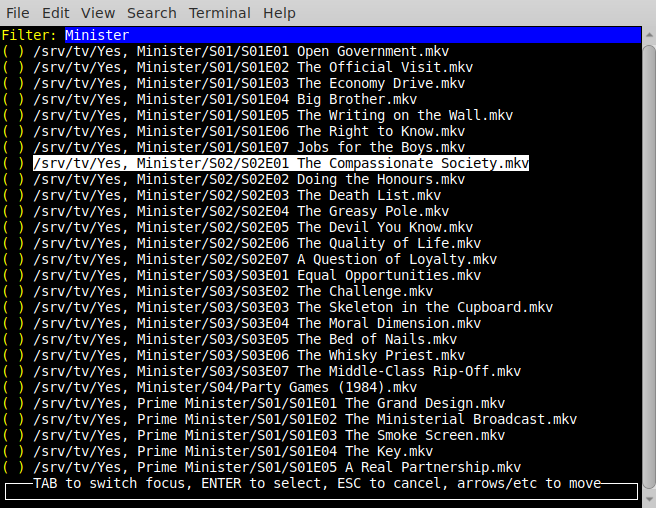
$ sysbox choose-file -exec "xine  " /srv/tv
This is what that looks like: /2020/05/17-choose-file.png You'll see: As well as choosing files, you can also select from lines read via STDIN, and you can filter the command in the same way as before. (i.e. " " is the selected item.) Other commands received updates, so the calculator now allows storing results in variables:
$ sysbox calc
calc> let a = 3
3
calc> a / 9 * 3
1
calc> 1 + 2 * a
7
calc> 1.2 + 3.4
4.600000

Erich Schubert: Contact Tracing Apps are Useless

Some people believe that automatic contact tracing apps will help contain the Coronavirus epidemic. They won t. Sorry to bring the bad news, but IT and mobile phones and artificial intelligence will not solve every problem. In my opinion, those that promise to solve these things with artificial intelligence / mobile phones / apps / your-favorite-buzzword are at least overly optimistic and blinder Aktionismus (*), if not naive, detachted from reality, or fraudsters that just want to get some funding. (*) there does not seem to be an English word for this doing something just for the sake of doing something, without thinking about whether it makes sense to do so Here are the reasons why it will not work:
  1. Signal quality. Forget detecting proximity with Bluetooth Low Energy. Yes, there are attempts to use BLE beacons for indoor positioning. But these use that you can learn fingerprints of which beacons are visible at which points, combined with additional information such as movement sensors and history (you do not teleport around in a building). BLE signals and antennas apparently tend to be very prone to orientation differences, signal reflections, and of course you will not have the idealized controlled environment used in such prototypes. The contacts have a single device, and they move this is not comparable to indoor positioning. I strongly doubt you can tell whether you are close to someone, or not.
  2. Close vs. protection. The app cannot detect protection in place. Being close to someone behind a plexiglass window or even a solid wall is very different from being close otherwise. You will get a lot of false contacts this way. That neighbor that you have never seen living in the appartment above will likely be considered a close contact of yours, as you sleep next to each other every day
  3. Low adoption rates. Apparently even in technology affine Singapore, fewer than 20% of people installed the app. That does not even mean they use it regularly. In Austria, the number is apparently below 5%, and people complain that it does not detect contact But in order for this approach to work, you will need Chinese-style mass surveillance that literally puts you in prison if you do not install the app.
  4. False alerts. Because of these issues, you will get false alerts, until you just do not care anymore.
  5. False sense of security. Honestly: the app does not pretect you at all. All it tries to do is to make the tracing of contacts easier. It will not tell you reliably if you have been infected (as mentioned above, too many false positives, too few users) nor that you are relatively safe (too few contacts included, too slow testing and reporting). It will all be on the quality of about 10 days ago you may or may not have contact with someone that tested positive, please contact someone to expose more data to tell you that it is actually another false alert .
  6. Trust. In Germany, the app will be operated by T-Systems and SAP. Not exactly two companies that have a lot of fans SAP seems to be one of the most hated software around. Neither company is known for caring about privacy much, but they are prototypical for business first . Its trust the cat to keep the cream. Yes, I know they want to make it open-source. But likely only the client, and you will still have to trust that the binary in the app stores is actually built from this source code, and not from a modified copy. As long as the name T-Systems and SAP are associated to the app, people will not trust it. Plus, we all know that the app will be bad, given the reputation of these companies at making horrible software systems
  7. Too late. SAP and T-Systems want to have the app ready in mid June. Seriously, this must be a joke? It will be very buggy in the beginning (because it is SAP!) and it will not be working reliably before end of July. There will not be a substantial user before fall. But given the low infection rates in Germany, nobody will bother to install it anymore, because the perceived benefit is 0 one the infection rates are low.
  8. Infighting. You may remember that there was the discussion before that there should be a pan-european effort. Except that in the end, everybody fought everybody else, countries went into different directions and they all broke up. France wanted a centralized systems, while in Germany people pointed out that the users will not accept this and only a distributed system will have a chance. That failed effort was known as Pan-European Privacy-Preserving Proximity Tracing (PEPP-PT) vs. Decentralized Privacy-Preserving Proximity Tracing (DP-3T) , and it turned out to have become a big clusterfuck . And that is just the tip of the iceberg.
Iceleand, probably the country that handled the Corona crisis best (they issued a travel advisory against Austria, when they were still happily spreading the virus at apres-ski; they massively tested, and got the infections down to almost zero within 6 weeks), has been experimenting with such an app. Iceland as a fairly close community managed to have almost 40% of people install their app. So did it help? No: The technology is more or less I wouldn t say useless [ ] it wasn t a game changer for us. The contact tracing app is just a huge waste of effort and public money. And pretty much the same applies to any other attempts to solve this with IT. There is a lot of buzz about solving the Corona crisis with artificial intelligence: bullshit! That is just naive. Do not speculate about magic power of AI. Get the data, understand the data, and you will see it does not help. Because its real data. Its dirty. Its late. Its contradicting. Its incomplete. It is all what AI currently can not handle well. This is not image recognition. You have no labels. Many of the attempts in this direction already fail at the trivial 7-day seasonality you observe in the data For example, the widely known John Hopkins Has the curve flattened trend has a stupid, useless indicator based on 5 day averages. And hence you get the weekly up and downs due to weekends. They show pretty up and down indicators. But these are affected mostly by the day of the week. And nobody cares. Notice that they currently even have big negative infections in their plots? There is no data on when someone was infected. Because such data simply does not exist. What you have is data when someone tested positive (mostly), when someone reported symptons (sometimes, but some never have symptoms!), and when someone dies (but then you do not know if it was because of Corona, because of other issues that became just worse because of Corona, or hit by a car without any relation to Corona). The data that we work with is incredibly delayed, yet we pretend it is live . Stop reading tea leaves. Stop pretending AI can save the world from Corona.

Matthew Palmer: Private Key Redaction: UR DOIN IT RONG

Because posting private keys on the Internet is a bad idea, some people like to redact their private keys, so that it looks kinda-sorta like a private key, but it isn t actually giving away anything secret. Unfortunately, due to the way that private keys are represented, it is easy to redact a key in such a way that it doesn t actually redact anything at all. RSA private keys are particularly bad at this, but the problem can (potentially) apply to other keys as well. I ll show you a bit of Inside Baseball with key formats, and then demonstrate the practical implications. Finally, we ll go through a practical worked example from an actual not-really-redacted key I recently stumbled across in my travels.

The Private Lives of Private Keys Here is what a typical private key looks like, when you come across it:
-----BEGIN RSA PRIVATE KEY-----
MGICAQACEQCxjdTmecltJEz2PLMpS4BXAgMBAAECEDKtuwD17gpagnASq1zQTYEC
CQDVTYVsjjF7IQIJANUYZsIjRsR3AgkAkahDUXL0RSECCB78r2SnsJC9AghaOK3F
sKoELg==
-----END RSA PRIVATE KEY-----
Obviously, there s some hidden meaning in there computers don t encrypt things by shouting BEGIN RSA PRIVATE KEY! , after all. What is between the BEGIN/END lines above is, in fact, a base64-encoded DER format ASN.1 structure representing a PKCS#1 private key. In simple terms, it s a list of numbers very important numbers. The list of numbers is, in order:
  • A version number (0);
  • The public modulus , commonly referred to as n ;
  • The public exponent , or e (which is almost always 65,537, for various unimportant reasons);
  • The private exponent , or d ;
  • The two private primes , or p and q ;
  • Two exponents, which are known as dmp1 and dmq1 ; and
  • A coefficient, known as iqmp .

Why Is This a Problem? The thing is, only three of those numbers are actually required in a private key. The rest, whilst useful to allow the RSA encryption and decryption to be more efficient, aren t necessary. The three absolutely required values are e, p, and q. Of the other numbers, most of them are at least about the same size as each of p and q. So of the total data in an RSA key, less than a quarter of the data is required. Let me show you with the above toy key, by breaking it down piece by piece1:
  • MGI DER for this is a sequence
  • CAQ version (0)
  • CxjdTmecltJEz2PLMpS4BX n
  • AgMBAA e
  • ECEDKtuwD17gpagnASq1zQTY d
  • ECCQDVTYVsjjF7IQ p
  • IJANUYZsIjRsR3 q
  • AgkAkahDUXL0RS dmp1
  • ECCB78r2SnsJC9 dmq1
  • AghaOK3FsKoELg== iqmp
Remember that in order to reconstruct all of these values, all I need are e, p, and q and e is pretty much always 65,537. So I could redact almost all of this key, and still give all the important, private bits of this key. Let me show you:
-----BEGIN RSA PRIVATE KEY-----
..............................................................EC
CQDVTYVsjjF7IQIJANUYZsIjRsR3....................................
........
-----END RSA PRIVATE KEY-----
Now, I doubt that anyone is going to redact a key precisely like this but then again, this isn t a typical RSA key. They usually look a lot more like this:
-----BEGIN RSA PRIVATE KEY-----
MIIEogIBAAKCAQEAu6Inch7+mWtKn+leB9uCG3MaJIxRyvC/5KTz2fR+h+GOhqj4
SZJobiVB4FrE5FgC7AnlH6qeRi9MI0s6dt5UWZ5oNIeWSaOOeNO+EJDUkSVf67wj
SNGXlSjGAkPZ0nRJiDjhuPvQmdW53hOaBLk5udxPEQbenpXAzbLJ7wH5ouLQ3nQw
HwpwDNQhF6zRO8WoscpDVThOAM+s4PS7EiK8ZR4hu2toon8Ynadlm95V45wR0VlW
zywgbkZCKa1IMrDCscB6CglQ10M3Xzya3iTzDtQxYMVqhDrA7uBYRxA0y1sER+Rb
yhEh03xz3AWemJVLCQuU06r+FABXJuY/QuAVvQIDAQABAoIBAFqwWVhzWqNUlFEO
PoCVvCEAVRZtK+tmyZj9kU87ORz8DCNR8A+/T/JM17ZUqO2lDGSBs9jGYpGRsr8s
USm69BIM2ljpX95fyzDjRu5C0jsFUYNi/7rmctmJR4s4uENcKV5J/++k5oI0Jw4L
c1ntHNWUgjK8m0UTJIlHbQq0bbAoFEcfdZxd3W+SzRG3jND3gifqKxBG04YDwloy
tu+bPV2jEih6p8tykew5OJwtJ3XsSZnqJMwcvDciVbwYNiJ6pUvGq6Z9kumOavm9
XU26m4cWipuK0URWbHWQA7SjbktqEpxsFrn5bYhJ9qXgLUh/I1+WhB2GEf3hQF5A
pDTN4oECgYEA7Kp6lE7ugFBDC09sKAhoQWrVSiFpZG4Z1gsL9z5YmZU/vZf0Su0n
9J2/k5B1GghvSwkTqpDZLXgNz8eIX0WCsS1xpzOuORSNvS1DWuzyATIG2cExuRiB
jYWIJUeCpa5p2PdlZmBrnD/hJ4oNk4oAVpf+HisfDSN7HBpN+TJfcAUCgYEAyvY7
Y4hQfHIdcfF3A9eeCGazIYbwVyfoGu70S/BZb2NoNEPymqsz7NOfwZQkL4O7R3Wl
Rm0vrWT8T5ykEUgT+2ruZVXYSQCKUOl18acbAy0eZ81wGBljZc9VWBrP1rHviVWd
OVDRZNjz6nd6ZMrJvxRa24TvxZbJMmO1cgSW1FkCgYAoWBd1WM9HiGclcnCZknVT
UYbykCeLO0mkN1Xe2/32kH7BLzox26PIC2wxF5seyPlP7Ugw92hOW/zewsD4nLze
v0R0oFa+3EYdTa4BvgqzMXgBfvGfABJ1saG32SzoWYcpuWLLxPwTMsCLIPmXgRr1
qAtl0SwF7Vp7O/C23mNukQKBgB89DOEB7xloWv3Zo27U9f7nB7UmVsGjY8cZdkJl
6O4LB9PbjXCe3ywZWmJqEbO6e83A3sJbNdZjT65VNq9uP50X1T+FmfeKfL99X2jl
RnQTsrVZWmJrLfBSnBkmb0zlMDAcHEnhFYmHFuvEnfL7f1fIoz9cU6c+0RLPY/L7
n9dpAoGAXih17mcmtnV+Ce+lBWzGWw9P4kVDSIxzGxd8gprrGKLa3Q9VuOrLdt58
++UzNUaBN6VYAe4jgxGfZfh+IaSlMouwOjDgE/qzgY8QsjBubzmABR/KWCYiRqkj
qpWCgo1FC1Gn94gh/+dW2Q8+NjYtXWNqQcjRP4AKTBnPktEvdMA=
-----END RSA PRIVATE KEY-----
People typically redact keys by deleting whole lines, and usually replacing them with [...] and the like. But only about 345 of those 1588 characters (excluding the header and footer) are required to construct the entire key. You can redact about 4/5ths of that giant blob of stuff, and your private parts (or at least, those of your key) are still left uncomfortably exposed.

But Wait! There s More! Remember how I said that everything in the key other than e, p, and q could be derived from those three numbers? Let s talk about one of those numbers: n. This is known as the public modulus (because, along with e, it is also present in the public key). It is very easy to calculate: n = p * q. It is also very early in the key (the second number, in fact). Since n = p * q, it follows that q = n / p. Thus, as long as the key is intact up to p, you can derive q by simple division.

Real World Redaction At this point, I d like to introduce an acquaintance of mine: Mr. Johan Finn. He is the proud owner of the GitHub repo johanfinn/scripts. For a while, his repo contained a script that contained a poorly-redacted private key. He since deleted it, by making a new commit, but of course because git never really deletes anything, it s still available. Of course, Mr. Finn may delete the repo, or force-push a new history without that commit, so here is the redacted private key, with a bit of the surrounding shell script, for our illustrative pleasure:
#Add private key to .ssh folder
cd /home/johan/.ssh/
echo  "-----BEGIN RSA PRIVATE KEY-----
MMMMMMMMMMMMMMMMMMMMMMMMMMMMMMMMMMMMMMMMMMMMMMMMMMMMMMMMMMMMMMMM
NNNNNNNNNNNNNNNNNNNNNNNNNNNNNNNNNNNNNNNNNNNNNNNNNNNNNNNNNNNNNNNN
KKKKKKKKKKKKKKKKKKKKKKKKKKKKKKKKKKKKKKKKKKKKKKKKKKKKKKKKKKKKKKKK
 
MIIJKgIBAAKCAgEAxEVih1JGb8gu/Fm4AZh+ZwJw/pjzzliWrg4mICFt1g7SmIE2
TCQMKABdwd11wOFKCPc/UzRH/fHuQcvWrpbOSdqev/zKff9iedKw/YygkMeIRaXB
fYELqvUAOJ8PPfDm70st9GJRhjGgo5+L3cJB2gfgeiDNHzaFvapRSU0oMGQX+kI9
ezsjDAn+0Pp+r3h/u1QpLSH4moRFGF4omNydI+3iTGB98/EzuNhRBHRNq4oBV5SG
Pq/A1bem2ninnoEaQ+OPESxYzDz3Jy9jV0W/6LvtJ844m+XX69H5fqq5dy55z6DW
sGKn78ULPVZPsYH5Y7C+CM6GAn4nYCpau0t52sqsY5epXdeYx4Dc+Wm0CjXrUDEe
Egl4loPKDxJkQqQ/MQiz6Le/UK9vEmnWn1TRXK3ekzNV4NgDfJANBQobOpwt8WVB
rbsC0ON7n680RQnl7PltK9P1AQW5vHsahkoixk/BhcwhkrkZGyDIl9g8Q/Euyoq3
eivKPLz7/rhDE7C1BzFy7v8AjC3w7i9QeHcWOZFAXo5hiDasIAkljDOsdfD4tP5/
wSO6E6pjL3kJ+RH2FCHd7ciQb+IcuXbku64ln8gab4p8jLa/mcMI+V3eWYnZ82Yu
axsa85hAe4wb60cp/rCJo7ihhDTTvGooqtTisOv2nSvCYpcW9qbL6cGjAXECAwEA
AQKCAgEAjz6wnWDP5Y9ts2FrqUZ5ooamnzpUXlpLhrbu3m5ncl4ZF5LfH+QDN0Kl
KvONmHsUhJynC/vROybSJBU4Fu4bms1DJY3C39h/L7g00qhLG7901pgWMpn3QQtU
4P49qpBii20MGhuTsmQQALtV4kB/vTgYfinoawpo67cdYmk8lqzGzzB/HKxZdNTq
s+zOfxRr7PWMo9LyVRuKLjGyYXZJ/coFaobWBi8Y96Rw5NZZRYQQXLIalC/Dhndm
AHckpstEtx2i8f6yxEUOgPvV/gD7Akn92RpqOGW0g/kYpXjGqZQy9PVHGy61sInY
HSkcOspIkJiS6WyJY9JcvJPM6ns4b84GE9qoUlWVF3RWJk1dqYCw5hz4U8LFyxsF
R6WhYiImvjxBLpab55rSqbGkzjI2z+ucDZyl1gqIv9U6qceVsgRyuqdfVN4deU22
LzO5IEDhnGdFqg9KQY7u8zm686Ejs64T1sh0y4GOmGsSg+P6nsqkdlXH8C+Cf03F
lqPFg8WQC7ojl/S8dPmkT5tcJh3BPwIWuvbtVjFOGQc8x0lb+NwK8h2Nsn6LNazS
0H90adh/IyYX4sBMokrpxAi+gMAWiyJHIHLeH2itNKtAQd3qQowbrWNswJSgJzsT
JuJ7uqRKAFkE6nCeAkuj/6KHHMPsfCAffVdyGaWqhoxmPOrnVgECggEBAOrCCwiC
XxwUgjOfOKx68siFJLfHf4vPo42LZOkAQq5aUmcWHbJVXmoxLYSczyAROopY0wd6
Dx8rqnpO7OtZsdJMeBSHbMVKoBZ77hiCQlrljcj12moFaEAButLCdZFsZW4zF/sx
kWIAaPH9vc4MvHHyvyNoB3yQRdevu57X7xGf9UxWuPil/jvdbt9toaraUT6rUBWU
GYPNKaLFsQzKsFWAzp5RGpASkhuiBJ0Qx3cfLyirjrKqTipe3o3gh/5RSHQ6VAhz
gdUG7WszNWk8FDCL6RTWzPOrbUyJo/wz1kblsL3vhV7ldEKFHeEjsDGroW2VUFlS
asAHNvM4/uYcOSECggEBANYH0427qZtLVuL97htXW9kCAT75xbMwgRskAH4nJDlZ
IggDErmzBhtrHgR+9X09iL47jr7dUcrVNPHzK/WXALFSKzXhkG/yAgmt3r14WgJ6
5y7010LlPFrzaNEyO/S4ISuBLt4cinjJsrFpoo0WI8jXeM5ddG6ncxdurKXMymY7
:::::::::::::::::::::::::::::::::::::::::::::::::::::::::::::.::
:::::::::::::::::::::::::::.::::::::::::::::::::::::::::::::::::
LLLLLLLLLLLLLLLLLLLLLLLLLLLLLLLLLLLLLLLLLLLLLLLLLLLLLLLLLLLLLLlL


YYYYYYYYYYYYYYYYYYYYYyYYYYYYYYYYYYYYYYYYYYYYYYYYYYYYYYYYYYYYYY
gff0GJCOMZ65pMSy3A3cSAtjlKnb4fWzuHD5CFbusN4WhCT/tNxGNSpzvxd8GIDs
nY7exs9L230oCCpedVgcbayHCbkChEfoPzL1e1jXjgCwCTgt8GjeEFqc1gXNEaUn
O8AJ4VlR8fRszHm6yR0ZUBdY7UJddxQiYOzt0S1RLlECggEAbdcs4mZdqf3OjejJ
06oTPs9NRtAJVZlppSi7pmmAyaNpOuKWMoLPElDAQ3Q7VX26LlExLCZoPOVpdqDH
KbdmBEfTR4e11Pn9vYdu9/i6o10U4hpmf4TYKlqk10g1Sj21l8JATj/7Diey8scO
sAI1iftSg3aBSj8W7rxCxSezrENzuqw5D95a/he1cMUTB6XuravqZK5O4eR0vrxR
AvMzXk5OXrUEALUvt84u6m6XZZ0pq5XZxq74s8p/x1JvTwcpJ3jDKNEixlHfdHEZ
ZIu/xpcwD5gRfVGQamdcWvzGHZYLBFO1y5kAtL8kI9tW7WaouWVLmv99AyxdAaCB
Y5mBAQKCAQEAzU7AnorPzYndlOzkxRFtp6MGsvRBsvvqPLCyUFEXrHNV872O7tdO
GmsMZl+q+TJXw7O54FjJJvqSSS1sk68AGRirHop7VQce8U36BmI2ZX6j2SVAgIkI
9m3btCCt5rfiCatn2+Qg6HECmrCsHw6H0RbwaXS4RZUXD/k4X+sslBitOb7K+Y+N
Bacq6QxxjlIqQdKKPs4P2PNHEAey+kEJJGEQ7bTkNxCZ21kgi1Sc5L8U/IGy0BMC
PvJxssLdaWILyp3Ws8Q4RAoC5c0ZP0W2j+5NSbi3jsDFi0Y6/2GRdY1HAZX4twem
Q0NCedq1JNatP1gsb6bcnVHFDEGsj/35oQKCAQEAgmWMuSrojR/fjJzvke6Wvbox
FRnPk+6YRzuYhAP/YPxSRYyB5at++5Q1qr7QWn7NFozFIVFFT8CBU36ktWQ39MGm
cJ5SGyN9nAbbuWA6e+/u059R7QL+6f64xHRAGyLT3gOb1G0N6h7VqFT25q5Tq0rc
Lf/CvLKoudjv+sQ5GKBPT18+zxmwJ8YUWAsXUyrqoFWY/Tvo5yLxaC0W2gh3+Ppi
EDqe4RRJ3VKuKfZxHn5VLxgtBFN96Gy0+Htm5tiMKOZMYAkHiL+vrVZAX0hIEuRZ
JJJJJJJJJJJJJJJJJJJJJJJJJJJJJJJJJJJJJJJJJJJJJJJJJJJJJJJJJJJJJJJJ
MMMMMMMMMMMMMMMMMMMMMMMMMMMMMMMMMMMMMMMMMMMMMMMMMMMMMMMMMMMMMMMM
-----END RSA PRIVATE KEY-----" >> id_rsa
Now, if you try to reconstruct this key by removing the obvious garbage lines (the ones that are all repeated characters, some of which aren t even valid base64 characters), it still isn t a key at least, openssl pkey doesn t want anything to do with it. The key is very much still in there, though, as we shall soon see. Using a gem I wrote and a quick bit of Ruby, we can extract a complete private key. The irb session looks something like this:
>> require "derparse"
>> b64 = <<EOF
MIIJKgIBAAKCAgEAxEVih1JGb8gu/Fm4AZh+ZwJw/pjzzliWrg4mICFt1g7SmIE2
TCQMKABdwd11wOFKCPc/UzRH/fHuQcvWrpbOSdqev/zKff9iedKw/YygkMeIRaXB
fYELqvUAOJ8PPfDm70st9GJRhjGgo5+L3cJB2gfgeiDNHzaFvapRSU0oMGQX+kI9
ezsjDAn+0Pp+r3h/u1QpLSH4moRFGF4omNydI+3iTGB98/EzuNhRBHRNq4oBV5SG
Pq/A1bem2ninnoEaQ+OPESxYzDz3Jy9jV0W/6LvtJ844m+XX69H5fqq5dy55z6DW
sGKn78ULPVZPsYH5Y7C+CM6GAn4nYCpau0t52sqsY5epXdeYx4Dc+Wm0CjXrUDEe
Egl4loPKDxJkQqQ/MQiz6Le/UK9vEmnWn1TRXK3ekzNV4NgDfJANBQobOpwt8WVB
rbsC0ON7n680RQnl7PltK9P1AQW5vHsahkoixk/BhcwhkrkZGyDIl9g8Q/Euyoq3
eivKPLz7/rhDE7C1BzFy7v8AjC3w7i9QeHcWOZFAXo5hiDasIAkljDOsdfD4tP5/
wSO6E6pjL3kJ+RH2FCHd7ciQb+IcuXbku64ln8gab4p8jLa/mcMI+V3eWYnZ82Yu
axsa85hAe4wb60cp/rCJo7ihhDTTvGooqtTisOv2nSvCYpcW9qbL6cGjAXECAwEA
AQKCAgEAjz6wnWDP5Y9ts2FrqUZ5ooamnzpUXlpLhrbu3m5ncl4ZF5LfH+QDN0Kl
KvONmHsUhJynC/vROybSJBU4Fu4bms1DJY3C39h/L7g00qhLG7901pgWMpn3QQtU
4P49qpBii20MGhuTsmQQALtV4kB/vTgYfinoawpo67cdYmk8lqzGzzB/HKxZdNTq
s+zOfxRr7PWMo9LyVRuKLjGyYXZJ/coFaobWBi8Y96Rw5NZZRYQQXLIalC/Dhndm
AHckpstEtx2i8f6yxEUOgPvV/gD7Akn92RpqOGW0g/kYpXjGqZQy9PVHGy61sInY
HSkcOspIkJiS6WyJY9JcvJPM6ns4b84GE9qoUlWVF3RWJk1dqYCw5hz4U8LFyxsF
R6WhYiImvjxBLpab55rSqbGkzjI2z+ucDZyl1gqIv9U6qceVsgRyuqdfVN4deU22
LzO5IEDhnGdFqg9KQY7u8zm686Ejs64T1sh0y4GOmGsSg+P6nsqkdlXH8C+Cf03F
lqPFg8WQC7ojl/S8dPmkT5tcJh3BPwIWuvbtVjFOGQc8x0lb+NwK8h2Nsn6LNazS
0H90adh/IyYX4sBMokrpxAi+gMAWiyJHIHLeH2itNKtAQd3qQowbrWNswJSgJzsT
JuJ7uqRKAFkE6nCeAkuj/6KHHMPsfCAffVdyGaWqhoxmPOrnVgECggEBAOrCCwiC
XxwUgjOfOKx68siFJLfHf4vPo42LZOkAQq5aUmcWHbJVXmoxLYSczyAROopY0wd6
Dx8rqnpO7OtZsdJMeBSHbMVKoBZ77hiCQlrljcj12moFaEAButLCdZFsZW4zF/sx
kWIAaPH9vc4MvHHyvyNoB3yQRdevu57X7xGf9UxWuPil/jvdbt9toaraUT6rUBWU
GYPNKaLFsQzKsFWAzp5RGpASkhuiBJ0Qx3cfLyirjrKqTipe3o3gh/5RSHQ6VAhz
gdUG7WszNWk8FDCL6RTWzPOrbUyJo/wz1kblsL3vhV7ldEKFHeEjsDGroW2VUFlS
asAHNvM4/uYcOSECggEBANYH0427qZtLVuL97htXW9kCAT75xbMwgRskAH4nJDlZ
IggDErmzBhtrHgR+9X09iL47jr7dUcrVNPHzK/WXALFSKzXhkG/yAgmt3r14WgJ6
5y7010LlPFrzaNEyO/S4ISuBLt4cinjJsrFpoo0WI8jXeM5ddG6ncxdurKXMymY7
EOF
>> b64 += <<EOF
gff0GJCOMZ65pMSy3A3cSAtjlKnb4fWzuHD5CFbusN4WhCT/tNxGNSpzvxd8GIDs
nY7exs9L230oCCpedVgcbayHCbkChEfoPzL1e1jXjgCwCTgt8GjeEFqc1gXNEaUn
O8AJ4VlR8fRszHm6yR0ZUBdY7UJddxQiYOzt0S1RLlECggEAbdcs4mZdqf3OjejJ
06oTPs9NRtAJVZlppSi7pmmAyaNpOuKWMoLPElDAQ3Q7VX26LlExLCZoPOVpdqDH
KbdmBEfTR4e11Pn9vYdu9/i6o10U4hpmf4TYKlqk10g1Sj21l8JATj/7Diey8scO
sAI1iftSg3aBSj8W7rxCxSezrENzuqw5D95a/he1cMUTB6XuravqZK5O4eR0vrxR
AvMzXk5OXrUEALUvt84u6m6XZZ0pq5XZxq74s8p/x1JvTwcpJ3jDKNEixlHfdHEZ
ZIu/xpcwD5gRfVGQamdcWvzGHZYLBFO1y5kAtL8kI9tW7WaouWVLmv99AyxdAaCB
Y5mBAQKCAQEAzU7AnorPzYndlOzkxRFtp6MGsvRBsvvqPLCyUFEXrHNV872O7tdO
GmsMZl+q+TJXw7O54FjJJvqSSS1sk68AGRirHop7VQce8U36BmI2ZX6j2SVAgIkI
9m3btCCt5rfiCatn2+Qg6HECmrCsHw6H0RbwaXS4RZUXD/k4X+sslBitOb7K+Y+N
Bacq6QxxjlIqQdKKPs4P2PNHEAey+kEJJGEQ7bTkNxCZ21kgi1Sc5L8U/IGy0BMC
PvJxssLdaWILyp3Ws8Q4RAoC5c0ZP0W2j+5NSbi3jsDFi0Y6/2GRdY1HAZX4twem
Q0NCedq1JNatP1gsb6bcnVHFDEGsj/35oQKCAQEAgmWMuSrojR/fjJzvke6Wvbox
FRnPk+6YRzuYhAP/YPxSRYyB5at++5Q1qr7QWn7NFozFIVFFT8CBU36ktWQ39MGm
cJ5SGyN9nAbbuWA6e+/u059R7QL+6f64xHRAGyLT3gOb1G0N6h7VqFT25q5Tq0rc
Lf/CvLKoudjv+sQ5GKBPT18+zxmwJ8YUWAsXUyrqoFWY/Tvo5yLxaC0W2gh3+Ppi
EDqe4RRJ3VKuKfZxHn5VLxgtBFN96Gy0+Htm5tiMKOZMYAkHiL+vrVZAX0hIEuRZ
EOF
>> der = b64.unpack("m").first
>> c = DerParse.new(der).first_node.first_child
>> version = c.value
=> 0
>> c = c.next_node
>> n = c.value
=> 80071596234464993385068908004931... # (etc)
>> c = c.next_node
>> e = c.value
=> 65537
>> c = c.next_node
>> d = c.value
=> 58438813486895877116761996105770... # (etc)
>> c = c.next_node
>> p = c.value
=> 29635449580247160226960937109864... # (etc)
>> c = c.next_node
>> q = c.value
=> 27018856595256414771163410576410... # (etc)
What I ve done, in case you don t speak Ruby, is take the two chunks of plausible-looking base64 data, chuck them together into a variable named b64, unbase64 it into a variable named der, pass that into a new DerParse instance, and then walk the DER value tree until I got all the values I need. Interestingly, the q value actually traverses the split in the two chunks, which means that there s always the possibility that there are lines missing from the key. However, since p and q are supposed to be prime, we can sanity check them to see if corruption is likely to have occurred:
>> require "openssl"
>> OpenSSL::BN.new(p).prime?
=> true
>> OpenSSL::BN.new(q).prime?
=> true
Excellent! The chances of a corrupted file producing valid-but-incorrect prime numbers isn t huge, so we can be fairly confident that we ve got the real p and q. Now, with the help of another one of my creations we can use e, p, and q to create a fully-operational battle key:
>> require "openssl/pkey/rsa"
>> k = OpenSSL::PKey::RSA.from_factors(p, q, e)
=> #<OpenSSL::PKey::RSA:0x0000559d5903cd38>
>> k.valid?
=> true
>> k.verify(OpenSSL::Digest::SHA256.new, k.sign(OpenSSL::Digest::SHA256.new, "bob"), "bob")
=> true
and there you have it. One fairly redacted-looking private key brought back to life by maths and far too much free time. Sorry Mr. Finn, I hope you re not still using that key on anything Internet-facing.

What About Other Key Types? EC keys are very different beasts, but they have much the same problems as RSA keys. A typical EC key contains both private and public data, and the public portion is twice the size so only about 1/3 of the data in the key is private material. It is quite plausible that you can redact an EC key and leave all the actually private bits exposed.

What Do We Do About It? In short: don t ever try and redact real private keys. For documentation purposes, just put KEY GOES HERE in the appropriate spot, or something like that. Store your secrets somewhere that isn t a public (or even private!) git repo. Generating a dummy private key and sticking it in there isn t a great idea, for different reasons: people have this odd habit of reusing demo keys in real life. There s no need to encourage that sort of thing.
  1. Technically the pieces aren t 100% aligned with the underlying DER, because of how base64 works. I felt it was easier to understand if I stuck to chopping up the base64, rather than decoding into DER and then chopping up the DER.

16 May 2020

Russ Allbery: rra-c-util 8.2

This release of my general utility libraries and support code includes a large grab bag of fixes and improvements. portable/system.h now defines explicit_bzero in terms of memset if it is not available. The memset version is unlikely to have the same security properties since the compiler may optimize it away, but that allows me to use explicit_bzero to erase security data where it is available. For packages with Kerberos tests, generating a test krb5.conf file now works properly even if the system krb5.conf file does not set a default realm, and a krb5.conf file dropped into the test configuration directory now works properly. Thanks to Jeffrey Hutzelman for the latter fix. For packages with PAM modules, the ENTRY and EXIT logging macros can now be used like function calls, and portable/pam.h now defines PAM_MAX_RESP_SIZE if it isn't defined. Header ordering in some of the portability socket code has been restored to compatibility with a few ancient UNIX systems. This was accidentally broken by the clang-format reformatting. Thanks to Julien LIE for the fix. A few bugs in the test for SPDX license identifiers have been fixed. Finally, this release fixes warnings with Clang 10 and GCC 10. You can get the latest release from the rra-c-util distribution page.

Norbert Preining: Upgrading AMD Radeon 5700 to 5700 XT via BIOS

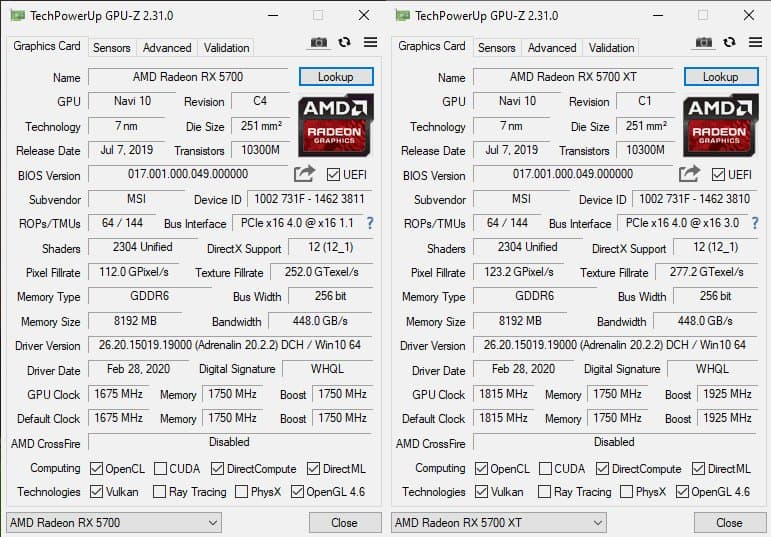
Having recently switched from NVIDIA to AMD graphic cards, in particular a RX 5700, I found out that I can get myself a free upgrade to the RX 5700 XT variant without paying one Yen, by simply flashing a compatible 5700 XT BIOS onto the 5700 card. Not that this is something new, a detailed explanation can be found here.
The same article also gives a detailed technical explanation on the difference between the two cards. The 5700 variant has less stream processors (2304 against 2560 in the XT variant), and lower power limits and clock speeds. Other than this they are based on the exact same chip layout (Navi 10), and with the same amount and type of memory 8 GB GDDR6. Flashing the XT BIOS onto the plain 5700 will not changes the number of stream processors, but power limits and clock speeds are raised to the same level of the 5700 XT, providing approximately a 7% gain without any over-clocking and over-powering, and potentially more by raising voltage etc. Detailed numbers can be found in the linked article above. The first step in this free upgrade is to identify ones own card correctly, best with device id and subsystem id, and then find the correct BIOS. Lots of BIOS dumps are provided in the BIOS database (link already restricting to 5700 XT BIOS). I used CPU-Z (Windows program) to determine this items, see image on the right (click to enlarge). In my case I got 1002 731F - 1462 3811 for the complete device id. The card is a MSI RX 5700 8 GB Mech OC, so I found the following alternative BIOS for MSI RX 5700 XT 8 GB Mech OC. Unfortunately, it seems that MSI is distinguishing 5700 and 5700 XT by their device id, because the XT variant gives 1002 731F - 1462 3810 for the complete device id, meaning that the last digit is 1 off compared to mine (3811 versus 3810). And indeed, trying to flash this video BIOS the normal way (using the Windows version ended in a warning that the subsystem id is different. A bit of search led to a thread in the TechPowerup Fora and this post explaining how to force the flashing in this case. Disclaimer: The following might brick your graphic card, you are doing this on your own risk! Necessary software: I did all the flashing and checking under Windows, but only because I realized too late that there is a fully uptodate flashing program for Linux that exhibits the same functionality. Also, I didn t know how to get the device id since the current AMD ROCm tools seem not to provide this data. If you are lucky and the device ids for your card are the same for both 5700 and 5700 XT variants, then you can use the graphical client (amdvbflashWin.exe), but if there is a difference, the command line is necessary. After unpacking the AMD Flash program and getting the correct BIOS rom file, the steps taken on Windows are (the very same steps can be taken on Linux): This should succeed in both cases. After that shutdown and restart your computer and you should be greeted with a RT 5700 XT card, without twisting a single screw. Starting Windows for the first time gave some flickering, because the driver for the new card was installed. On Linux the system auto-detects the card and everything works out of the box. Very smooth. Finally, a word of warning: Don t do these kind of things if you are not ready to pay the prize of a bricked GPU card in case something goes wrong! Everything is on your own risk! Let me close with a before/after image, most of the fields are identical, but the default/gpu clocks both at normal as well as boost levels see a considerable improvement

Sven Hoexter: Quick and Dirty: masquerading / NAT with nftables

Since nftables is now the new default, a short note to myself on how to setup masquerading, like the usual NAT setup you use on a gateway.
nft add table nat
nft add chain nat postrouting   type nat hook postrouting priority 100 \;  
nft add rule nat postrouting ip saddr 192.168.1.0/24 oif wlan0 masquerade
In this case the wlan0 is basically the "WAN" interface, because I use an old netbook as a wired to wireless network adapter.

Lucas Kanashiro: Quarantine times

After quite some time without publishing anything here, I decided to share the latest events. It is a hard time for most of us but with all this time at home, one can also do great things. I would like to start with the wonderful idea the Debian Brasil community had! Why not create an online Debian related conference to keep people s minds busy and also share knowledge? After brainstorming, we came up with our online conference called #FiqueEmCasaUseDebian (in English it would be #StayHomeUseDebian). It started on May 3rd and will last until May 30th (yes, one month)! Every weekday, we have one online talk at night and on every Saturday, a Debian packaging workshop. The feedback so far has been awesome and the Brazilian Debian community is reaching out to more people than usual at our regular conferences (as you might have imagined, Brazil is huge and it is hard to bring people at the same place). At the end of the month, we will have the first MiniDebConf online and I hope it will be as successful as our experience here in Brazil. Another thing that deserves a highlight is the fact that I became an Ubuntu Core Developer this month; yay! After 9 months of working almost daily on the Ubuntu Server, I was able to get my upload rights to the Ubuntu archive. I was tired of asking for sponsorship, and probably my peers were tired of me too. I could spend more time here complaining about the Brazilian government but I think it isn t worth it. Let s try to do something useful instead!

15 May 2020

Ingo Juergensmann: XMPP: ejabberd Project on the-federation.info

For those interested in alternative social networks there is that website that is called the-federation.info, which collects some statistics of "The Fediverse". The biggest part of the fediverse is Mastodon, but there are other projects (or parts) like Friendica or Matrix that do "federation". One of the oldest projects doing federation is XMPP. You could find some Prosody servers for some time now, because there is a Prosody module "mod_nodeinfo2" that can be used. But for ejabberd there is no such module (yet?) so far, which makes it a little bit difficult to get listed on the-federation.info. Some days ago I wrote a small script to export the needed values to x-nodeinfo2 that is queried by the-federation.info. It's surely not the best script or solution for that job and is currently limited to ejabberd servers that use a PostgreSQL database as backend, although it should be fairly easy to adapt the script for use with MySQL. Well, at least it does its job. At least as there is no native ejabberd module for this task. You can find the script on Github: https://github.com/ingoj/ejabberd-nodeinfo2 Enjoy it and register your ejabberd server on the-federation.info! :-)
Kategorie:

14 May 2020

Iustin Pop: New internet provider

Note: all this is my personal experience, on my personal machines, and I don t claim it to be the absolute truth. Also, I don t directly call out names, although if you live in Switzerland it s pretty easy to guess who the old provider is from some hints. For a long time, I wanted to move away from my current (well, now past) provider, for a multitude of reasons. The main being that the company is very classic company, with classic support system, that doesn t work very well - I had troubles with their billing system that left me out cold without internet for 15 days, but for the recent few years, they were mostly OK, and changing to a different provider would have meant me routing a really long Ethernet cable around the apartment, so I kept postponing it. Yes, self-inflicted pain, I know. Until the entire work-from-home thing, when the usually stable connection start degrading in a very linear fashion day-by-day (this is a graph that basically reflects download bandwidth):
1+ month download bandwidth test 1+ month download bandwidth test
At first, I didn t realise this, as even 100Mbps is still fast enough. But once the connection went below (I believe) 50Mbps, it became visible in day to day work. And since I work daily from home yeah. Not fun. So I started doing speedtest.net - and oh my, ~20Mbps was a good result, usually 12-14Mbps. On a wired connection. On a connection that officially is supposed to be 600Mbps down. The upload speed was spot on, so I didn t think it was my router, but: Nothing helped. Once in a blue moon, speedtest would give me 100Mbps, but like once every two days, then it would be back and showing 8Mbps. Eight! It ended up as even apt update was tediously slow, and kernel downloads took ages The official instructions for dealing with bad internet are a joke: And the best part: If you are not satisfied with the results, read our internet optimisation guide. If you are still not happy, use our community forums or our social platforms. Given that it was a decline over 3-weeks, that I don t know of any computer component that would degrade this steadily but not throw any other errors, and that my upload speed was all good, I assumed it s the provider. Maybe I was wrong, but I wanted to do this anyway for a long while, so I went through the find how to route cable, check if other provider socket is good, order service, etc. dance, and less than a week later, I had the other connection. Now, of course, bandwidth works as expected:
1+ month updated bandwidth test 1+ month updated bandwidth test
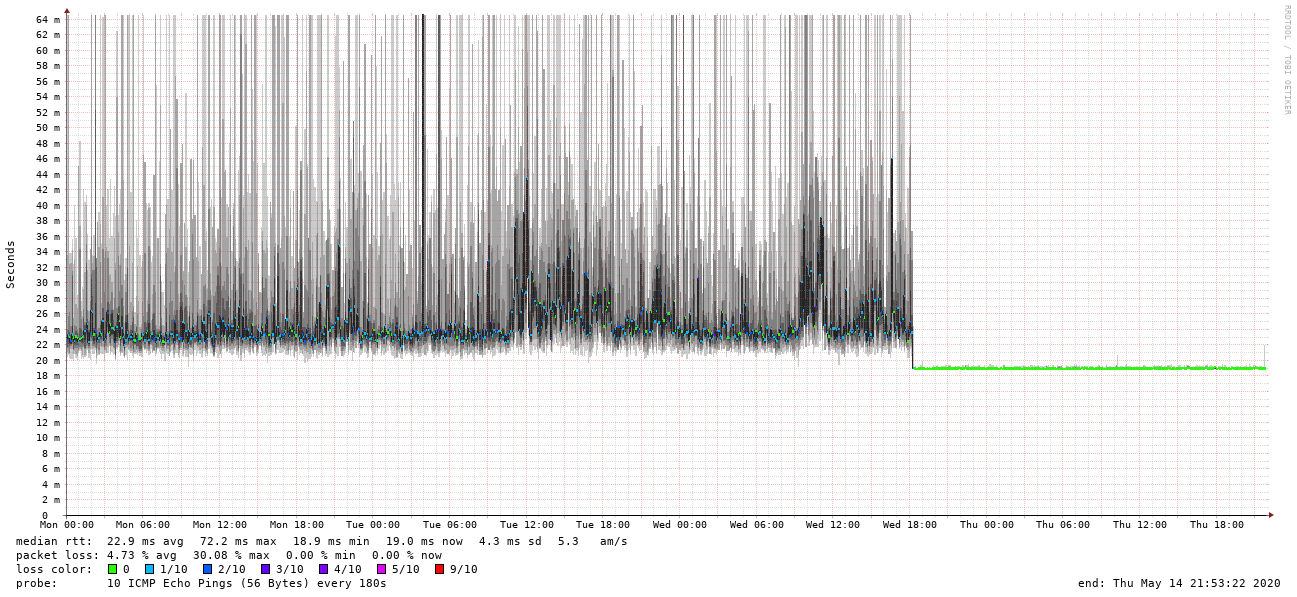
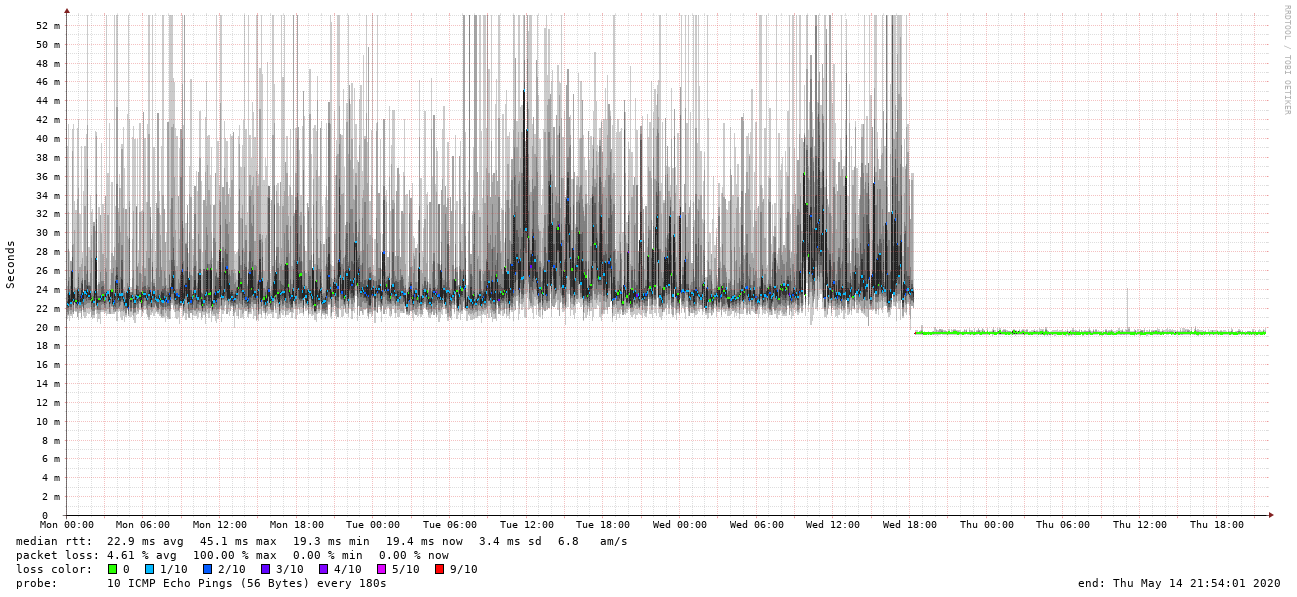
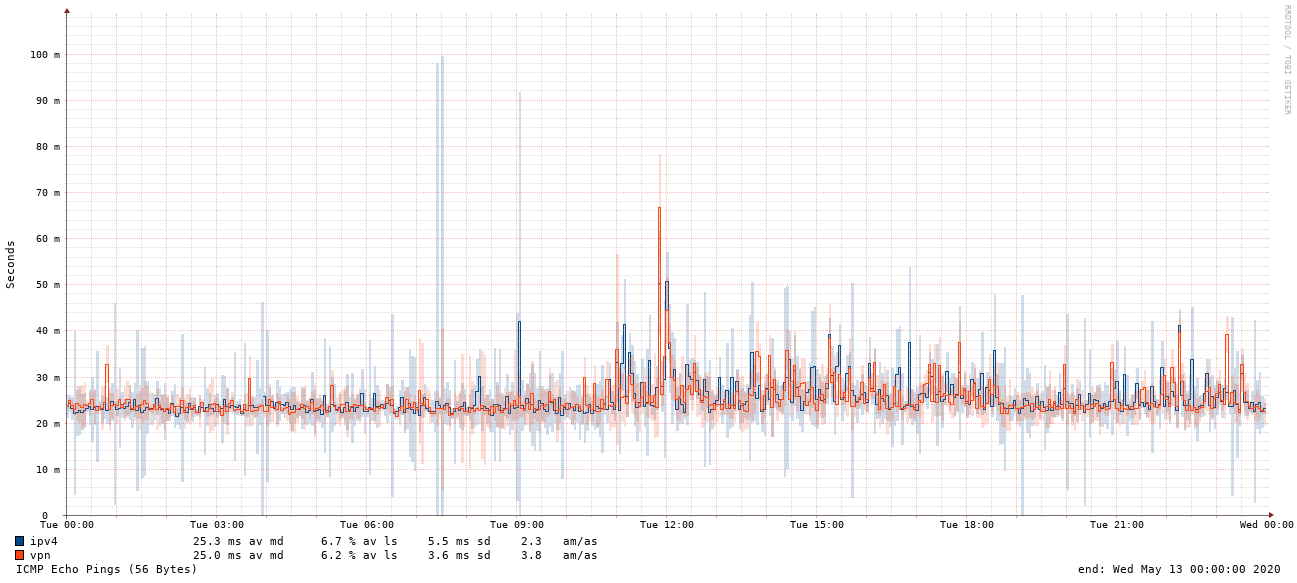
Both download and upload are fine (the graph above is just download). Latency is also much better, towards many parts of the internet that matter. But what is shocking is the difference in jitter to some external hosts I care about. On the previous provider, a funny thing was that both outgoing and incoming pings had both more jitter and packet loss when done directly (IPv4 to IPv4) than when done over a VPN. This doesn t make sense, since VPN is just overhead over IPv4, but the graphs show it, and what I think happens is that a VPN flow is cached in the provider s routers, whereas a simple ping packet not. But, the fact that there s enough jitter for a ping to a not-very-far host doesn t make me happy. Examples, outgoing:
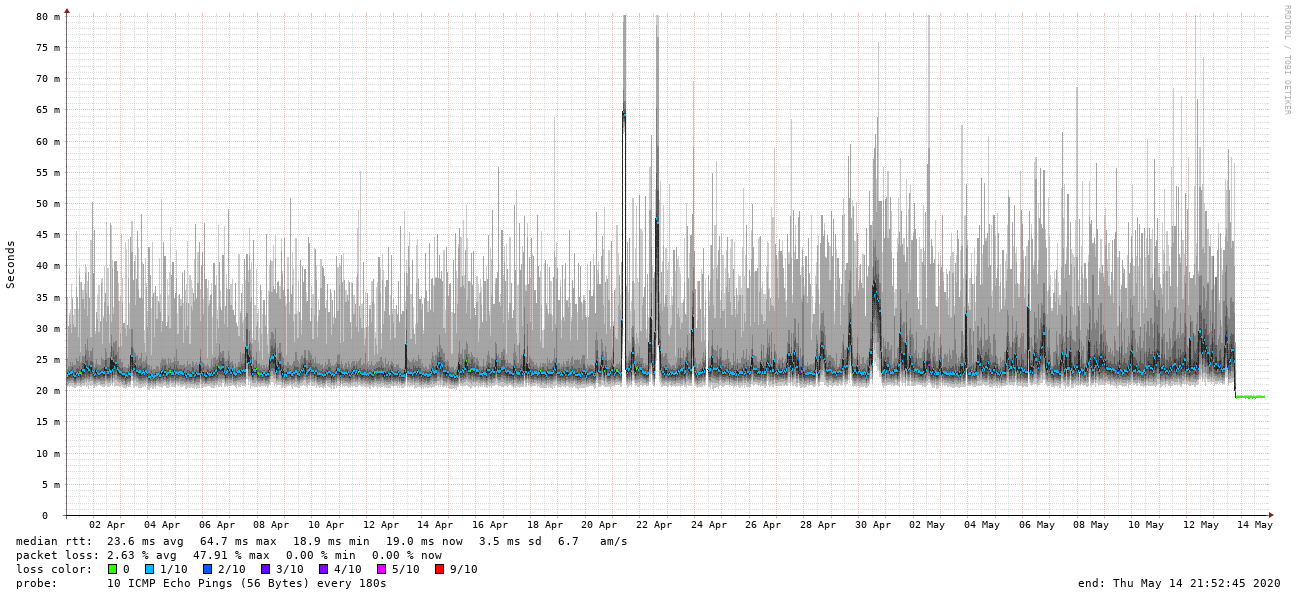
Outgoing smokeping to public IPv4 Outgoing smokeping to public IPv4
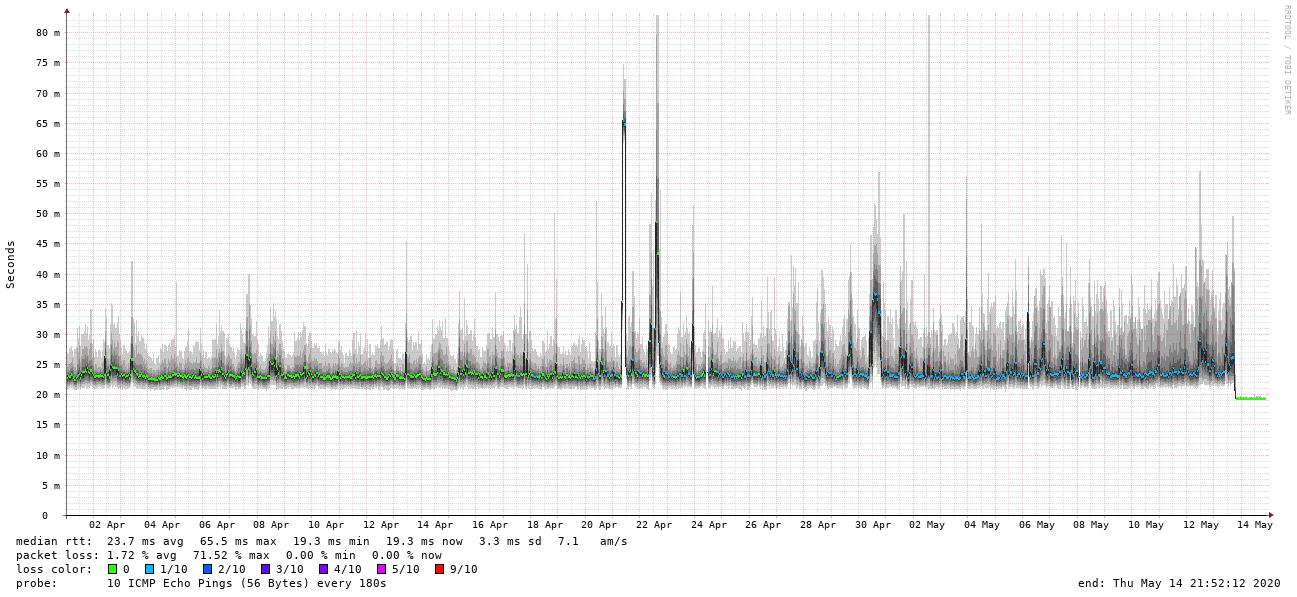
Outgoing smokeping over VPN Outgoing smokeping over VPN
And incoming:
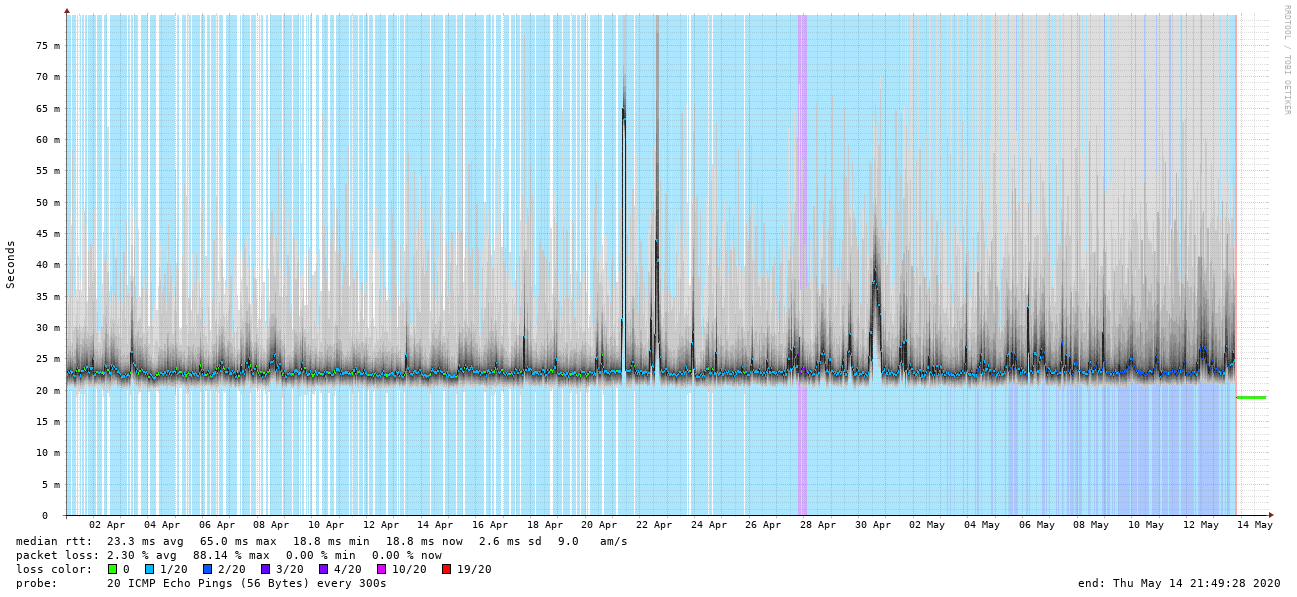
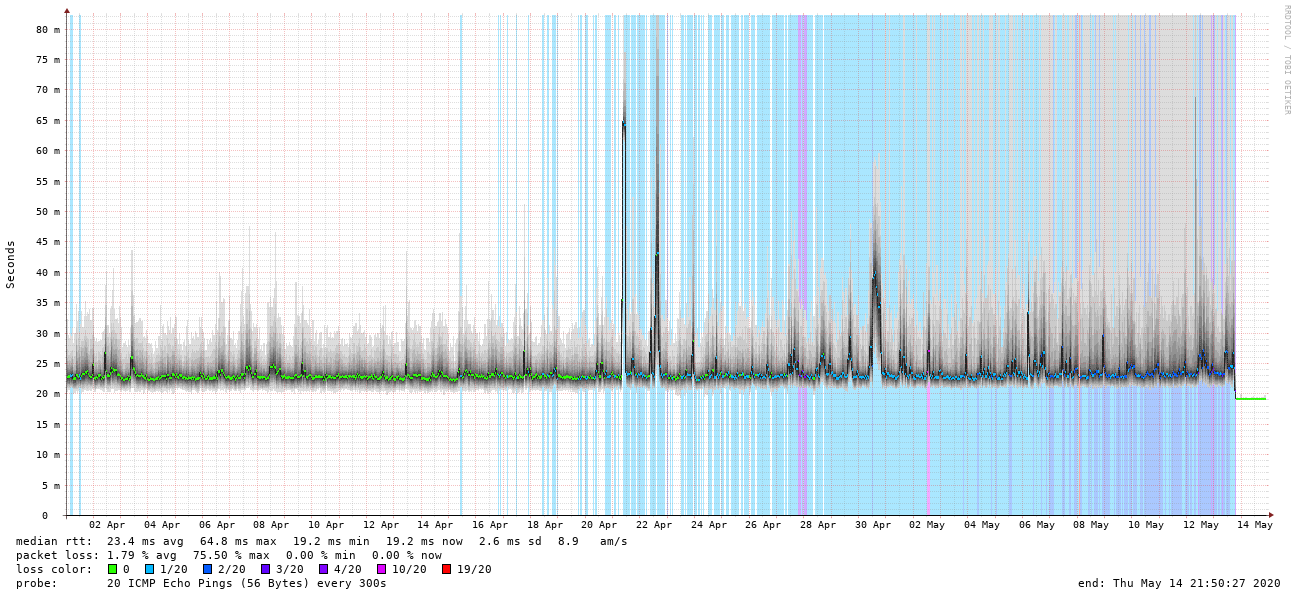
Incoming smokeping to public IPv4 Incoming smokeping to public IPv4
Incoming smokeping over VPN Incoming smokeping over VPN
Both incoming and outgoing show this weirdness - more packet loss and more jitter over VPN. Again, this is not a problem in practice, or not much, but makes me wonder what other shenanigans happen behind the scenes. You can also see clearly when the work from home traffic entered the picture and started significantly degrading my connection, even over the magically better VPN connection. Switching to this week s view shows the (in my opinion) dramatic improvement in consistency of the connection:
Outgoing current week smokeping to public IPv4 Outgoing current week smokeping to public IPv4
Outgoing current week smokeping over VPN Outgoing current week smokeping over VPN
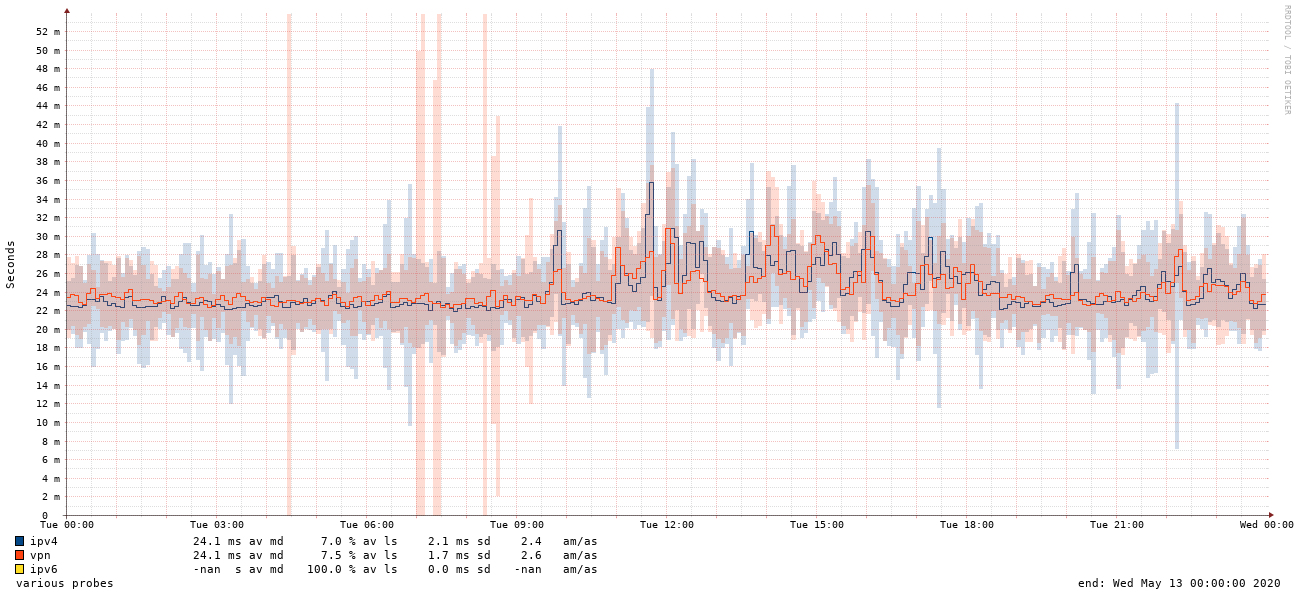
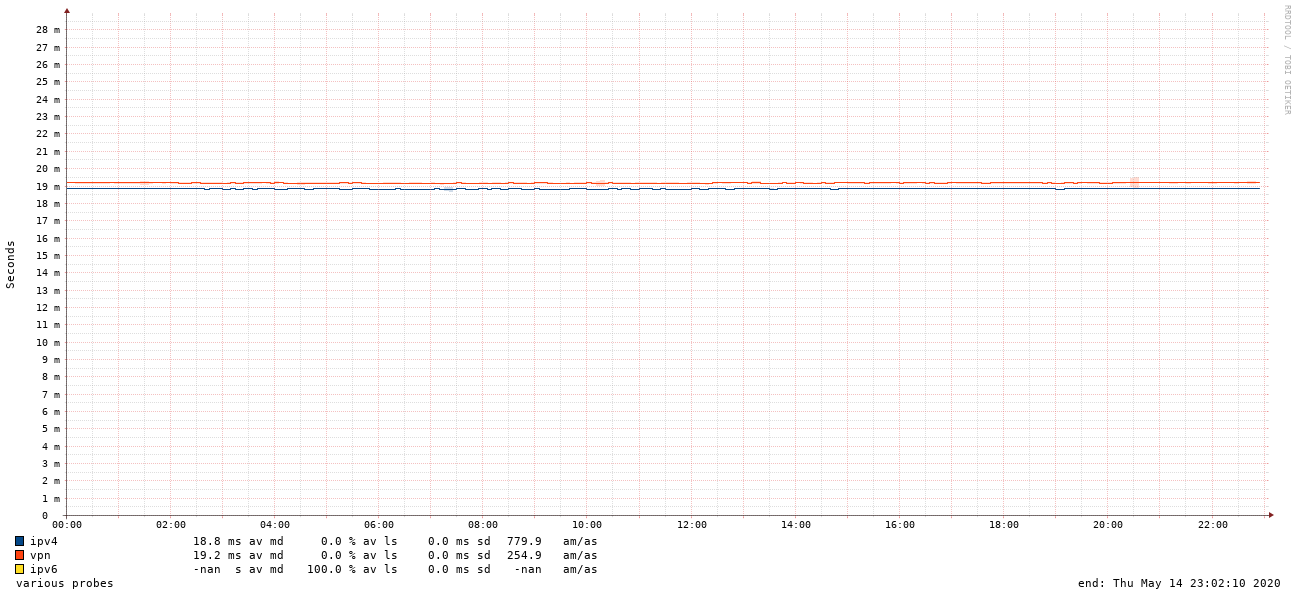
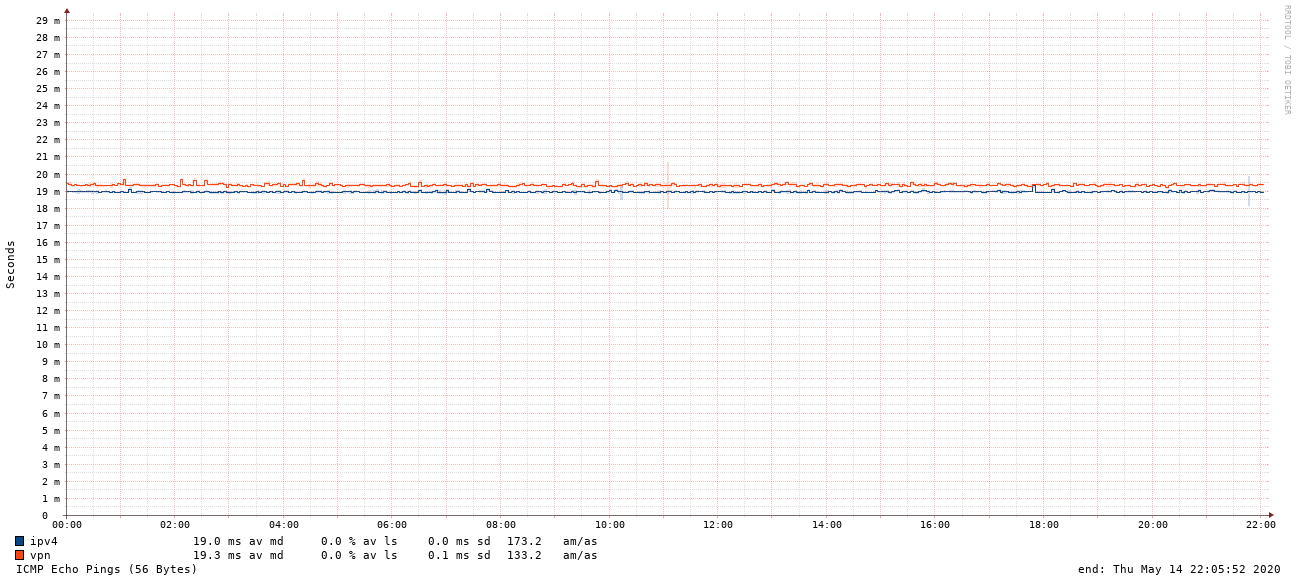
No more packet loss, no more jitter. You can also see my VPN being temporarily down during provider switchover because my firewall was not quite correct for a moment. And the last drill down, at high resolution, one day before and one day after switchover. Red is VPN, blue is plain IPv4, yellow is the missing IPv6 connection :) Incoming old:
Incoming 1-day smokeping, old provider Incoming 1-day smokeping, old provider
and new:
Incoming 1-day smokeping, new provider Incoming 1-day smokeping, new provider
Outgoing old:
Outgoing 1-day smokeping, old provider Outgoing 1-day smokeping, old provider
and new:
Outgoing 1-day smokeping, new provider Outgoing 1-day smokeping, new provider
This is what I expect, ping-over-VPN should of course be slower than plain ping. Note that incoming and outgoing have slightly different consistency, but that is fine for me :) The endpoints doing the two tests are different, so this is expected. Reading the legend on the graphs for the incoming connection (similar story for outgoing): So to my previous provider: it can be done better. Or at least, allow people easier ways to submit performance issue problems. For me, the moral of the story is that I should have switched a couple of years ago, instead of being lazy. And that I m curious to see how IPv6 traffic will differ, if at all :) Take care, everyone! And thanks for looking at these many graphs :)

13 May 2020

Russ Allbery: Review: Gideon the Ninth

Review: Gideon the Ninth, by Tamsyn Muir
Series: The Locked Tomb #1
Publisher: Tor
Copyright: September 2019
ISBN: 1-250-31317-1
Format: Kindle
Pages: 448
Despite being raised there, Gideon Nav is an outsider in the Ninth House. Her mother, already dead, fell from the sky with a one-day-old Gideon in tow, leaving her an indentured servant. She's a grumpy, caustic teenager in a world of moldering corpses, animated skeletons, and mostly-dead adults whose parts are falling off. Her world is sword fighting, dirty magazines, a feud with the house heir Harrowhark, and a determination to escape the terms of her indenture. Gideon does get off the planet, but not the way that she expects. She doesn't get accepted into the military. She ends up in the middle of a bizarre test, or possibly an ascension rite, mingling with and competing with the nobility of the empire alongside her worst enemy. I struggled to enjoy the beginning of Gideon the Ninth. Gideon tries to carry the story on pure snark, but it is very, very goth. If you like desiccated crypts, mostly-dead goons, betrayal, frustration, necromancers, black robes, disturbing family relationships, gloom, and bitter despair, the first six chapters certainly deliver, but I was sick of it by the time Gideon gets out. Thankfully, the opening is largely unlike the rest of the book. What starts as an over-the-top teenage goth rebellion turns into a cross between a manor house murder mystery and a competitive escape room. This book is a bit of a mess, but it's a glorious mess. It's also the sort of glorious mess that I don't think would have been written or published twenty years ago, and I have a pet theory that attributes this to the invigorating influence of fanfic and writers who grew up reading and writing it. I read a lot of classic science fiction and epic fantasy as a teenager. Those books have many merits, obviously, but emotional range is not one of them. There are a few exceptions, but on average the genre either focused on puzzles and problem solving (how do we fix the starship, how do we use the magic system to take down the dark god) or on the typical "heroic" (and male-coded) emotions of loyalty, bravery, responsibility, authority, and defiance of evil. Characters didn't have messy breakups, frenemies, anxiety, socially-awkward love affairs, impostor syndrome, self-hatred, or depression. And authors weren't allowed to fall in love with the messiness of their characters, at least on the page. I'm not enough of a scholar to make the argument well, but I suspect there's a case to be made that fanfic exists partially to fill this gap. So much of fanfic starts from taking the characters on the canonical page or screen and letting them feel more, live more, love more, screw up more, and otherwise experience a far wider range of human drama, particularly compared to what made it into television, which was even more censored than what made it into print. Some of those readers and writers are now writing for publication, and others have gone into publishing. The result, in my theory, is that the range of stories that are acceptable in the genre has broadened, and the emotional texture of those stories has deepened. Whether or not this theory is correct, there are now more novels like this in the world, novels full of grudges, deflective banter, squabbling, messy emotional processing, and moments of glorious emotional catharsis. This makes me very happy. To describe the emotional payoff of this book in any more detail would be a huge spoiler; suffice it to say that I unabashedly love fragile competence and unexpected emotional support, and adore this book for containing it. Gideon's voice, irreverent banter, stubborn defiance, and impulsive good-heartedness are the center of this book. At the start, it's not clear whether there will be another likable character in the book. There will be, several of them, but it takes a while for Gideon to find them or for them to become likable. You'll need to like Gideon well enough to stick with her for that journey. I read books primarily for the characters, not for the setting, and Gideon the Ninth struck some specific notes that I will happily read endlessly. If that doesn't match your preferences, I would not be too surprised to hear you bounced off the book. There's a lot here that won't be to everyone's taste. The setting felt very close to Warhammer 40K: an undead emperor that everyone worships, endless war, necromancy, and gothic grimdark. The stage for most of the book is at least more light-filled, complex, and interesting than the Ninth House section at the start, but everything is crumbling, drowning, broken, or decaying. There's quite a lot of body horror, grotesque monsters, and bloody fights. And the ending is not the best part of the book; roughly the last 15% of the novel is composed of two running fight scenes against a few practically unkillable and frankly not very interesting villains. I got exhausted by the fighting long before it was over, and the conclusion is essentially a series cliffhanger. There are also a few too many characters. The collection of characters and the interplay between the houses is one of the strengths of this book, but Muir sets up her story in a way that requires eighteen significant characters and makes the reader want to keep track of all of them. It took me about halfway through the book before I felt like I had my bearings and wasn't confusing one character for another or forgetting a whole group of characters. That said, most of the characters are great, and the story gains a lot from the interplay of their different approaches and mindsets. Palamedes Sextus's logical geekery, in particular, is a great counterpoint to the approaches of most of the other characters. The other interesting thing Muir does in this novel that I've not seen before, and that feels very modern, is to set the book in essentially an escape room. Locking a bunch of characters in a sprawling mansion until people start dying is an old fictional trope, but this one has puzzles, rewards, and a progressive physical structure that provides a lot of opportunities to motivate the characters and give them space to take wildly different problem-solving approaches. I liked this a lot, and I'm looking forward to seeing it in future books. This is not the best book I've read, but I thoroughly enjoyed it, despite some problems with the ending. I've already pre-ordered the sequel. Followed by Harrow the Ninth. Rating: 8 out of 10

12 May 2020

Daniel Silverstone: The Lars, Mark, and Daniel Club

Last night, Lars, Mark, and I discussed Jeremy Kun's The communicative value of using Git well post. While a lot of our discussion was spawned by the article, we did go off-piste a little, and I hope that my notes below will enlighten you all as to a bit of how we see revision control these days. It was remarkably pleasant to read an article where the comments section wasn't a cesspool of horror, so if this posting encourages you to go and read the article, don't stop when you reach the bottom -- the comments are good and useful too.
This was a fairly non-contentious article for us though each of us had points we wished to bring up and chat about it turned into a very convivial chat. We saw the main thrust of the article as being about using the metadata of revision control to communicate intent, process, and decision making. We agreed that it must be possible to do so effectively with Mercurial (thus deciding that the mention of it was simply a bit of clickbait / red herring) and indeed Mark figured that he was doing at least some of this kind of thing way back with CVS. We all discussed how knowing the fundamentals of Git's data model improved our ability to work wih the tool. Lars and I mentioned how jarring it has originally been to come to Git from revision control systems such as Bazaar (bzr) but how over time we came to appreciate Git for what it is. For Mark this was less painful because he came to Git early enough that there was little more than the fundamental data model, without much of the porcelain which now exists. One point which we all, though Mark in particular, felt was worth considering was that of distinguishing between published and unpublished changes. The article touches on it a little, but one of the benefits of the workflow which Jeremy espouses is that of using the revision control system as an integral part of the review pipeline. This is perhaps done very well with Git based workflows, but can be done with other VCSs. With respect to the points Jeremy makes regarding making commits which are good for reviewing, we had a general agreement that things were good and sensible, to a point, but that some things were missed out on. For example, I raised that commit messages often need to be more thorough than one-liners, but Jeremy's examples (perhaps through expedience for the article?) were all pretty trite one-liners which perhaps would have been entirely obvious from the commit content. Jeremy makes the point that large changes are hard to review, and Lars poined out that Greg Wilson did research in this area, and at least one article mentions 200 lines as a maximum size of a reviewable segment. I had a brief warble at this point about how reviewing needs to be able to consider the whole of the intended change (i.e. a diff from base to tip) not just individual commits, which is also missing from Jeremy's article, but that such a review does not need to necessarily be thorough and detailed since the commit-by-commit review remains necessary. I use that high level diff as a way to get a feel for the full shape of the intended change, a look at the end-game if you will, before I read the story of how someone got to it. As an aside at this point, I talked about how Jeremy included a 'style fixes' commit in his example, but I loathe seeing such things and would much rather it was either not in the series because it's unrelated to it; or else the style fixes were folded into the commits they were related to. We discussed how style rules, as well as commit-bisectability, and other rules which may exist for a codebase, the adherence to which would form part of the checks that a code reviewer may perform, are there to be held to when they help the project, and to be broken when they are in the way of good communication between humans. In this, Lars talked about how revision control histories provide high level valuable communication between developers. Communication between humans is fraught with error and the rules are not always clear on what will work and what won't, since this depends on the communicators, the context, etc. However whatever communication rules are in place should be followed. We often say that it takes two people to communicate information, but when you're writing commit messages or arranging your commit history, the second party is often nebulous "other" and so the code reviewer fulfils that role to concretise it for the purpose of communication. At this point, I wondered a little about what value there might be (if any) in maintaining the metachanges (pull request info, mailing list discussions, etc) for historical context of decision making. Mark suggested that this is useful for design decisions etc but not for the style/correctness discussions which often form a large section of review feedback. Maybe some of the metachange tracking is done automatically by the review causing the augmentation of the changes (e.g. by comments, or inclusion of design documentation changes) to explain why changes are made. We discussed how the "rebase always vs. rebase never" feeling flip-flopped in us for many years until, as an example, what finally won Lars over was that he wants the history of the project to tell the story, in the git commits, of how the software has changed and evolved in an intentional manner. Lars said that he doesn't care about the meanderings, but rather about a clear story which can be followed and understood. I described this as the switch from "the revision history is about what I did to achieve the goal" to being more "the revision history is how I would hope someone else would have done this". Mark further refined that to "The revision history of a project tells the story of how the project, as a whole, chose to perform its sequence of evolution." We discussed how project history must necessarily then contain issue tracking, mailing list discussions, wikis, etc. There are exist free software projects where part of their history is forever lost because, for example, the project moved from Sourceforge to Github, but made no effort (or was unable) to migrate issues or somesuch. Linkages between changes and the issues they relate to can easily be broken, though at least with mailing lists you can often rewrite URLs if you have something consistent like a Message-Id. We talked about how cover notes, pull request messages, etc. can thus also be lost to some extent. Is this an argument to always use merges whose message bodies contain those details, rather than always fast-forwarding? Or is it a reason to encapsulate all those discussions into git objects which can be forever associated with the changes in the DAG? We then diverted into discussion of CI, testing every commit, and the benefits and limitations of automated testing vs. manual testing; though I think that's a little too off-piste for even this summary. We also talked about how commit message audiences include software perhaps, with the recent movement toward conventional commits and how, with respect to commit messages for machine readability, it can become very complex/tricky to craft good commit messages once there are multiple disparate audiences. For projects the size of the Linux kernel this kind of thing would be nearly impossible, but for smaller projects, perhaps there's value. Finally, we all agreed that we liked the quote at the end of the article, and so I'd like to close out by repeating it for you all... Hal Abelson famously said:
Programs must be written for people to read, and only incidentally for machines to execute.
Jeremy agrees, as do we, and extends that to the metacommit information as well.

Next.

Previous.