Search Results: "sf"

3 January 2013

Michal Čihař: Free software plans for 2013

Year 2013 has just started and it's time to think how to spend my free time during this year. Weblate Weblate was my toy project number one in last year and I expect it to stay for next year as well. I have several ideas for new features, but all that depends on free time. I will most likely spend my hackweek on that as well. phpMyAdmin I think my involvement will stay at about same level at phpMyAdmin - doing few random bugfixes, mostly security ones, taking care of infrastructure for translations and wiki and mentoring few GSoC students. Gammu and Wammu Gammu and Wammu has not seen much activity from me in past year and it will probably not change. I don't use the program anymore and this pretty much limits my interest in adding new features. In case somebody active will pop up on mailing list, I'd be happy to transfer the project ownership. Mobile apps I'd like to make some progress here, I was also thinking about making some of them working on Android as well, but this involves lot of learning and time is always an issue here. Anyway this might be good challenge for hackweek as well. Debian No changes expected here :-). Others I consider pretty much anything else from my software projects abandoned or finished.

Filed under: Debian English Gammu Phpmyadmin Suse Weblate 0 comments Flattr this!

1 January 2013

Craig Small: procps 3.3.6 and Mudlet 2.0

Mudlet - Graphical MUD clientYesterday was a busy Debian day for me with the release of not one but two packages. procps procps version 3.3.6 was released both as an upstream and a Debian package. While there were many bug fixes in this release, the main new feature for it was the top inspect feature. The top inspect feature allows you to run top in the normal way then you can inspect a specific process you have selected within top for more information. Examples of this include fuser or lsof type output to see what files or libraries are open but really the limit is how clever the operator is and how often you would need this information. Even scripts can be run off this feature if you have some customised or cooked output you need to see. Once the output is there, you can search for text. There will be a small hold-up with the Debian packages as the section for the library has been moved to libs, where it should be. At least I think that s why there is a delay. procps infrastructure procps currently has only an email list and a gitorious git repository. While this works most of the time, there are two main problems with this setup. The first is that the only two ways you can report bugs is send an email to the list or create a git merge request. The email has the problem with tracking and gathering history while the git sets the bar pretty high for reporting something has gone wrong. Second problem is there is no tarball file repository. gitorious does have the feature of downloading tarballs of the tag checkpoints, but this is the raw repository. When you make a tarball with make dist there are some generated files included in the tarball that don t appear in the gitorious ones, which means its not a simple for some as you expect. So I ll be creating a project for these two features soon. Not sure where they will be but I use sourceforge for both these for a few other projects so that might be where they end up. Mudlet Mudlet, the multi-user dungeon or MUD client, has finally made it to version 2.0! It looks a lot more stable and polished at least from the scripting side than the previous RC versions but has all the features that we ve come to expect with it. The most important thing is that the developers have finally put a line in the sand and said this is version 2.0 . The Debian package was uploaded yesterday and should be on its way to your local mirror soon.

Russ Allbery: 2012 Book Reading in Review

For the year of 2012, I finished and reviewed 60 books, the same number as 2011. Given how stressful and chaotic much of the year was, I count this a major triumph. The hardest part was not the reading but the review writing; the end of the year required a significant push to finish writing reviews of all the books I'd read that year, and at one point I was reviewing things I'd read more than two months earlier. But I can enter 2013 entirely caught-up. This continues to feel like about the right pace, striking a balance between reading enough that I can pursue multiple reading goals at the same time, while leaving enough time for other projects and video games. I gave three novels a 10 out of 10 this year, but the stand-out even among that group was Elizabeth Wein's Code Name Verity. Not only was it my favorite book of the year, but it was one of the best books I've ever read. The other two 10-rated books are also highly recommended, of course: Matt Ruff's fascinating novel of multiple personalities, Set This House in Order; and C.J. Cherryh's SF classic, Cyteen. The latter was a re-read in advance of reading the sequel, Regenesis, which I also recommend if you've read and liked the last third of Cyteen. Other fiction highlights of the year were China Mi ville's Embassytown and Suzanne Collins's The Hunger Games triology, particularly the third book, Mockingjay. Embassytown continues the trend from Mi ville's The City & The City of tighter, faster-moving novels while moving into space opera and first contact territory. It keeps Mi ville in the top rank of current SFF writers, despite having some suspension of disbelief problems. Collins's world-building in The Hunger Games also has suspension of disbelief problems, but I understood why the series was so popular. I was caught by surprise by its look at violence and its after-effects and was particularly impressed by Mockingjay and Collins's chosen ending. I think this is a popular series that lives up to the hype. There were no 10 ratings in non-fiction this year, but several books nonetheless stood out. John Kenneth Galbraith's The Affluent Society is a thought-provoking book that questions the foundation of a consumer-oriented economy while perceptively pointing out how it distorts choices away from public goods. Susan Cain's Quiet is a passionate defense of introversion in an extroverted world. And, finally, Joshua Bloch's Effective Java and Damian Conway's Perl Best Practices are both insightful looks at the good and bad of their respective languages and taught me a great deal as a practicing programmer. One final highlight to mention: Eclipse Phase by Posthuman Studios is an excellent RPG sourcebook, at least from the perspective of interesting world-building. I haven't played it, but I thoroughly enjoyed reading it (and have acquired nearly all of the supplements). The full analysis includes some additional personal reading statistics, probably only of interest to me.

Vincent Sanders: I don't drink coffee I take tea my dear, I like my toast done on one side...

Choices, options, selections if you rather. These are what set us all apart from our fellow man, perhaps it is only the appearance of free will and individuality but our world is full of choice.

In software it might be argued programming is nothing more than making thousands perhaps millions of choices which result in a list of instructions for a machine incapable of making decisions of its own.

On a more mundane level sometimes a programmer cannot make a choice suitable for all expected use cases and a user option is created. These options have become something of a cause for arguments within certain sections of the open source software community especially amongst the groups that influence the graphical user experience.

The discussion should be nuanced and varied (perhaps that is my age, or maybe I am more diplomatic than I thought?) but there seems to be little compromise on this discussion which (from an outsiders point of view) splits into two viewpoints:


The reductionist group is currently winning the argument in the popular graphical environments and seem to be removing functionality which requires user choice wherever they can find it. This results in the absurd "joke" that the UI will become a single button, which they are trying to remove.

Personally my view is that an option should be present only when an option cannot be satisfactorily selected by the computer and even then a default suitable for as many users as possible should be picked.

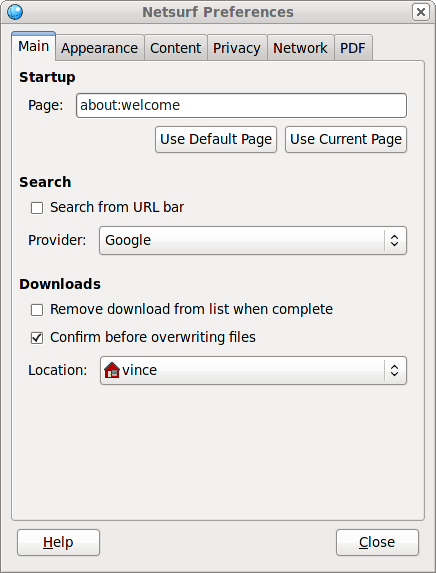
You may ask why I have raised this topic at all? well over the last few days I have been trying to fix the preferences selection for the GTK port of NetSurf. The NetSurf project follows my view on this subject pretty closely but being a browser its very difficult to do the right thing for everyone

NetSurf has numerous frontends for the core browser, I use the term frontend because in some places the toolkit and OS are conflated (windows, cocoa) and not in others (gtk). For each frontend NetSurf is a native application, this is an important distinction, the windows and widgets a user interfaces with are produced by that platforms toolkit.

Old NetSurf Preferences Dialog
This is a deliberate choice unlike other browsers which render their UI themselves as web content, this is a beguiling solution when the authors wish there to be a single browsing "experience" with a common look and feel. However NetSurf looks and feels like a native browser for each frontend, which is what the project decided it wanted to achieve.

Given this the gtk frontend (is it a Gnome application? not sure of the distinction TBH) has had no dedicated maintainer for some time it has suffered from a bad case of bitrot from both GTK library changes and general neglect.

I have slowly been improving this situation, the browser can now be compiled with GTK version 2 (2.12 onwards) or 3, the menus and other UI elements have been translated for the supported languages and now the turn has come for the options dialog.

Oh, right, its "Preferences" not options, fair enough a common semantic throughout all applications does give a degree of homogeneousness but the word choice does seem to indicate the users control has been reduced. At this point I gained an education in just how unfriendly GTK and its tools have become towards the casual programmer.

The dialog I wanted to construct was a pretty standard tabbed layout which reflected the current options and allowed the user to change them in an obvious way. Given that I have constructed and equivalent interface in idiomatic manner for cocoa and windows I thought this would be straightforward, I was very wrong.

The interface construction tool is called glade which used to be the name of the UI "resource" file and interfaces. However the tool is still called glade but the interface is now GtkBuilder which has a different (but similar) XML based file format. Then we discover that despite it being an extensible file format the UI files are specifically versioned against the GTK library. Also why on earth can these resources not be compiled into my program? OK make them over-ridable perhaps. Generally it is yet another file to distribute and update in step with the executable.

New NetSurf Properties Dialog open on Main tab
New NetSurf Preferences
So because I want to support back to version 2.12 of GTK I do not get to use any of the features from 2.16 in my UI unless I load a different UI builder file...oh and GTK3? requires a completely different version of glade and the UI files which are incompatible with gtk 2. Once this was worked round with having multiple UI files I then moved on to the next issue.

The GTK model uses function callbacks on events, these are known as signals. Perfectly reasonable but because the ui files are loaded at runtime and not compiled in there must be a way for the GTKBuilder to map the textural signal names to function pointers.

The way the GTK developers have chosen to do this is to search the global function table which means any signal handler function symbol has also to be global which means unnecessary overhead for the ELF loader increasing load times.

This lookup should have been confined to a single object or even placed in an alternative section to avoid these issues, this would not have seemed especially challenging to implement as all callback handlers have to use a preprocessor to define already (G_MODULE_EXPORT).

Another thing that makes developing GTK applications worse is the documentation, this seems to be a continuous complaint about may open source projects, which is taciturn or simply missing in many cases. GTK seems to suffer dreadfully from having multiple API versions all subtly different resulting in a lot of work on the developers part to simply find what they want.

A specific example of this is the signals and under what circumstance they occur I wanted to update all the widgets with the current configuration state whenever the options window is shown (using gtk_widget_show()) so I figured that would be the "show" signal...right? nope, never did find the right one to use, ended up with "realize" which occurs once when the dialog is created, not what I wanted, but is at least consistent and works.

NetSurf with is Properties dialog open on the content tab
NetSurf with Preferences Dialog
Overall my impression of developing just one small dialog (60 widgets total exclusing labels and containers) for a GTK program is that the toolkit and its tooling is missing the facilities to make developers life easier when doing the drudge work that a good proportion of graphical program development.

It is not the case that one cannot do things, just that everything has to be done manually instead of having the tools do the work, and because of the documentation that tedium is magnified.

I did eventually reach the stage that the thought of writing the boilerplate to add another check button to enable "do not track" had me thinking "do they really need this or can I avoid the work?" perhaps that is why they are all reductionist?


Russ Allbery: Review: City of Diamond

Review: City of Diamond, by Jane Emerson
Publisher: DAW
Copyright: March 1996
ISBN: 0-88677-704-6
Format: Mass market
Pages: 624
The setting is deep into the star-faring future of humanity. Humans have settled many other worlds, thanks largely to technology from a race named the Curosa. There is a thriving network of settlement based around a sort of warp conduit network. But, standing apart from most human settlements, are three huge ships: the City of Opal, the City of Pearl, and the City of Diamond. Their inhabitants are devout members of the Redemptionist faith, a merging of Christian (primarily Catholic) belief and Curosa religion. Their ships are gifts from the now-departed Curosa, featuring drives unknown to the rest of humanity that allows them to ignore the normal transport network. They are meant to witness and spread their religion, but now, six centuries later, they primarily trade. Much of this is not apparent at the start. City of Diamond opens with Adrian Mercati, chosen heir of the current dying Protector, dodging people in what seems to be an oddly-organized city. Impudent, occasionally flippant, utterly charming, and in love with danger, he inherits the position of Protector shortly after we meet him. Emerson slowly reveals more of the nature of the ship while Adrian is shocking (and charming) the nobility and the church, and consorting with demons. Or, at least, one demon: Tal, an entirely human-appearing creature except for his eyes, who the Redemptionists claim is born without a soul. Slowly, it becomes clear that he's actually the offspring of an alien and a human, a mating of species whose children cannot socialize as human and behave in ways that seem like human sociopaths. Tal is no exception, but his interests align with Adrian's for the time. To those two viewpoint characters, Emerson adds four more: a low-rank administrator named Spider who works for Tal after Tal saved him from death by recycling, Adrian's politically-arranged bride-to-be from the rival (and even more religious) ship City of Opal, a guard from a French-descended slum on City of Opal, and a dangerously honorable and literal mercenary from an off-shoot culture of humanity that's now only a legend. This is a book that tends to sprawl. There's quite a lot going on, starting with the negotiations between City of Diamond and City of Opal to put to rest the remnants of a civil war and leading to the search for a legendary Curosa artifact on the planet they're both visiting. All of the characters have their own agendas, their own history, and their own goals, and are pursuing them in parallel and occasionally in opposition. Emerson takes the time to let all of this build. Despite that, there is very little in this book that drags or bores, and that's due primarily to the strength of the characters. Every one of the viewpoint characters is unique, bringing a different perspective to the story, and every one of them changes and grow over the course of the story. They also play off of each other in delightful ways. This is a book that makes full use of the fact that three characters make seven character interactions. For example, Tal by himself is logical but just slightly askew, Tal seen by Spider is uncomfortable and worrisome, Tal and Adrian is a dance of mutual amusement and respect, and Tal and Keylinn finding points of commonality is just delightful. I did wish that there was a bit more Keylinn and Tal and a bit less of Spider, but once Emerson built her world, introduced her characters, and got the story moving, there aren't many weak pieces. Part of the fun is figuring out the world background. There are almost no infodumps here; Emerson just starts telling stories of characters in the surroundings in which they find themselves, and the reader is left to piece things together from background description, the occasional explanation from one character to another, and parallels with long-standing SF tropes. It's not a puzzle book, but it is a book of where the reader is dropped as an alien into a fully-developed culture. In both that way and in the use of nobility, religion, and formal hierarchy against a starfaring backdrop, City of Diamond reminds me of the sort of classic space opera that led up to Star Wars but isn't seen as much these days. It's also funny. I was unsurprised to discover that Emerson is a pseudonym for Doris Egan, who (in addition to writing some other SF) is an occasional writer and producer for House. The humor isn't entirely obvious at the start, although Adrian frequently provokes a grin from the start of the book, but Tal's perceptive but obliviously blunt comments become more and more fun as the book progresses, and both Iolanthe (Adrian's bride) and Keylinn (the mercenary, sort of) are a delight. I want to see more of both of them, but sadly the book ends just as they (particularly Iolanthe) are hitting their strides. And that's the biggest problem with City of Diamond: it's a failed (or at least postponed) trilogy. As with Walter Jon Williams's Metropolitan and City on Fire, there were supposed to be more books, but apparently either the publisher lost interest or other projects took precedence. The story does come to something of a conclusion, but most of the major story arcs aren't resolved. Emerson is still bringing more guns onto the set late in the book. None of the villains truly get their just desserts, nor do most of the character arcs fully resolve, although friendships and more have formed satisfyingly by the end of the book. There is obviously far more to both these characters and this universe, including an entire ship that was never visited and an alien whose presence should prove startling. This is a great book: warm, funny, full of interesting characters, and with a nicely complex background universe. If it were complete in itself, or if the sequels had materialized, I would recommend it unreservedly. As is, you will have to weigh your dislike of unfinished stories against its stand-alone merits. But I enjoyed it a great deal. Rating: 7 out of 10

31 December 2012

Benjamin Mako Hill: Freedom for Users, Not for Software

I finally published a short essay I wrote about a year ago: Freedom for Users, Not for Software. Anybody who has hung around the free software community for a while will be familiar with the confusion created by the ambiguity between "free as in price" versus "free as freedom." In the essay I argue that there is a less appreciated semantic ambiguity that arises when we begin to think that what matters is that software is free. Software doesn't need freedom, of course; Users of software need freedom. My essay looks at how the focus on free software, as opposed to on free users, has created challenges and divisions in the free software movement. The essay was recently published in Wealth of the Commons: A World Beyond Market and State, a book edited by David Bollier and Silke Helfrich and published by Levellers Press. The book includes essays by 73 authors that include some other folks from the free software and free culture communities along with a ton of people working on very different types of commons. My essay is short and has two parts: The first is basically a short introduction to free software movement. The second lays out what I see as major challenges for free software. I will point out that these are some of the areas that I am working most closely with the FSF who are having their annual fundraiser at the moment to support and build advocacy programs around.

Russ Allbery: Review: Wasted Heart

Review: Wasted Heart, by Lynn Galli
Publisher: Penikila
Copyright: 2010
ISBN: 1-935611-32-1
Format: Kindle
Pages: 252
Austy is a lawyer working for the US District Attorney's office in Seattle. Six months ago, she moved there from Virginia, in large part because she fell in love with her best friend. Her married best friend. Now, she's trying (mostly unsuccessfully) to deal with the Seattle lesbian scene while becoming (successfully) the go-to lawyer for prosecuting cases with a substantial technology component. Two things are about to complicate that life: meeting and working with FBI special agent Elise Bridie, and working on a case that involves her best friend's company. Yes, that best friend. This is, as you might have guessed, a lesbian romance novel, so with that should come my "reading out of genre disclaimer": it's rather easy, when reading a genre one normally doesn't read, to find books fresh and interesting when they're unoriginal to regular genre readers, or to miss genre conventions or reactions because one has not read the previous work. You should therefore take my opinions with a grain of salt, particularly if you read more romance novels than I do (which wouldn't be hard). I grabbed this book for a few reasons: I felt like reading a warm-hearted story focused on human relationships, I wanted a reasonably fast read (since I'm obsessed with meaningless numeric milestones, like how many books I read in a year), and I wanted something with an upbeat ending. Romance generally delivers on those fronts. Lesbian romance has the added bonus of avoiding a whole bunch of gender essentialism and heterosexual romance tropes that tend to give me hives. Landing was excellent, so I thought I'd see if I could find more of that. Wasted Heart does indeed deliver, although it's not quite as good as Landing. There's a bit too much physical attraction and love based on appearance for my taste, but Galli leavens that with quite a lot of interesting psychology. Both Austy and Elise are private and cautious people, and for me that makes the romance feel more realistic. It also draws out the initial phase of getting to know the other person, which is the part of the romance that I often find the most interesting. Elise in particular is a great character maybe a little too ideal in a few places, but smart and observant in a way that's very fun to read about. Like a lot of romances, there is some annoying miscommunication and misunderstanding (predictably right around the height of the tension), but it's not quite as stupid as those problems usually are, and Galli doesn't drag it out until one starts wanting to hit the characters with blunt objects. As good or better is the community that surrounds the main characters. Galli has a full cast of believable and interesting characters, most notably including Austy's old gang from Virginia. The tensions between having a group of friends one cares about deeply, wanting to build a new life after making a major break and major decision but having difficulty sustaining that under the onslaught of those friends, and being easily tossed about by expressive and outgoing people when one is private and a bit quiet all play out here. And, refreshingly, without a lot of angst, and with quite a bit of intelligent introspection. Both Austy and her friends are smarter and more considerate than most of the characters I've seen in this sort of situation. Another good bit is the little pieces of legal drama. Galli doesn't neglect Austy's work life, and while this is certainly not a legal thriller or procedural, we do get some nice scenes of Austy doing her job. I love courtroom scenes, particularly ones (like these) that are more on the realistic side, so that was a nice bonus. Austy and Elise's jobs also lead to a somewhat predictable bit of drama, and I was a bit less enamored of that; the more I thought about it, the less well it hung together for me. But I did like that it stayed firmly on the realistic side, including a look at psychological aftereffects for real people rather than thriller protagonists. This is not the sort of book that I would tell someone to rush out and buy, but it met my criteria nicely and delivered just the sort of entertainment I was looking for. (And it's not particularly expensive on Kindle, at least in the US.) There was a bit too much focus on physical appearance and physical infatuation, and Elise might be just a little too perfect, but I enjoyed it. Note that I read the special edition, which includes a (much appreciated) epilogue that closes out the story. That seems to be the default edition for sale everywhere I look, but in case you see the older version, I recommend the special edition. Rating: 7 out of 10

Gregor Herrmann: RC bugs 2012/52

hey, this week the list of RC bugs I touched is even shorter than in the last weeks:

Russell Coker: Modern Swap Use

A while ago I wrote a blog post debunking the idea that swap should be twice as large as RAM [1]. The issue of swap size has come up for discussion in a mailing list so it seems that it s worth another blog post. Swap Size In my previous post I suggested making swap space equal to RAM size for systems with less than 1G of RAM and half RAM size for systems with 2-4G of RAM with a maximum of 2G for any system. Generally it s better to have the kernel Oom handler kill a memory hungry process than to have the entire system go so slow that a hardware reset is needed. I wrote memlockd to lock the important system programs and the shared objects and data files they use into RAM to make it easier to recover from some bad paging situations [2], but even that won t always make it possible to login to a thrashing system in a reasonable amount of time. But it s not always good to reduce swap size. Sometimes if you don t have enough swap then performance sucks in situations where it would be OK if there was more swap. One factor in this regard is that pages mapped read-only from files are discarded when there is great memory pressure and no swap space to page-out the read-write pages. This can mean that you get thrashing among memory for executables and shared objects while there s lots of unused data pages in RAM that can t be paged out. One noteworthy corner case in this regard is Chromium which seems to take a lot of RAM if you have many tabs open for a long time. Another factor is that there is a reasonable amount of memory allocated which will almost never get used (EG all the X based workstations which have 6 gettys running on virtual consoles which will almost never be used). So a system which has a large amount of RAM relative to it s use (EG a single-user workstation with 8G of RAM) can still benefit from having a small amount of swap to allow larger caches. One workstation I run has 8G of RAM for a single user and typically has about 200M of the 1G swap space in use. It doesn t have enough swap to make much difference if really memory hungry programs are run, but having 4G of memory for cache instead of 3.8G might make a difference to system performance. So even systems which can run without using any swap can still be expected to give better performance if there is some swap space for programs that are very inactive. I have some systems with as much 4G of swap, but they are for corner cases where swap is allocated but there isn t a lot of paging going on. For example I have a workstation with 3G of RAM and 4G of swap for the benefit of Chromium. Hardware Developments Disk IO performance hasn t increased much when compared to increases in RAM size over the last ~15 years. A low-end 1988 era hard drive could sustain 512KB/s contiguous transfer rates and had random access times of about 28ms. A modern SATA disk will have contiguous transfer rates getting close to 200MB/s and random access times less than 4ms. So we are looking at about 400* the contiguous performance and about 10* the random access since 1988. In 1988 2MB was a lot of RAM for a PC, now no-one would buy a new PC with less than 4G so we are looking at something like 2000* the RAM size in the same period. When comparing with 1993 (when I first ran a Linux server 24*7) it was 4M of RAM, maybe 15ms random access, and maybe 1MB/s contiguous IO approximately double everything I had in 1988. But I ll use the numbers from 1988 because I m more certain of them even though I never ran an OS capable of proper memory management on the 1988 PC. In the most unrealistically ideal situation paging IO will be a factor of 5* more expensive now relatively than it was in 1988 (RAM size increase by a factor of 2000 divided by contiguous IO performance increase by a factor of 400). But in a more realistic situation (random IO) it will be 200* more expensive relatively than it was. In the early 90s a Linux system with swap use equal or greater than RAM could perform well (my recollection is that a system with 4M of RAM and 4M of active swap performed well and the same system with 8M of active swap was usable). But nowadays there s no chance of a system that has 4G of RAM and 4G of swap in active use being usable in any way unless you have some corner case of an application allocating RAM and not using it much. Note that 4G of RAM doesn t make a big system by today s standards, so it might be reasonable to compare 2M in 1988 to 8G or 16G today. But I think that assuming 4G of RAM for the purpose of comparison makes my point. Using Lots of Swap It is probably possible to have some background Chromium tabs using 4G of paged out RAM with good system performance. I ve had a system use 2G of swap for Chromium and perform well overall. There are surely many other ways that a user can launch processes that use a lot of memory and not use them actively. But this will probably require that the user know how the system works and alter their usage patterns. If you have a lot of swap in use and one application starts to run slowly you really don t want to flip to another application which would only make things worse. If you use tmpfs for /tmp then you need enough swap to store everything that is written to /tmp. There is no real upper limit to how much data that could be apart from the fact that applications and users generally don t want to write big data files that disappear on reboot. I generally only use a tmpfs for /tmp on servers. Programs that run on servers tend not to store a large amount of data in /tmp and that data is usually very temporary, unlike workstation users who store large video files in /tmp and leave them there until the next reboot. Are there any other common corner cases that allow using a lot of swap space without serious performance problems? My Swap Space Allocation When I setup Linux workstations for other people I generally use 1G of swap. For a system that often has multiple users (via the user-switch feature) I use 2G of swap if it only has 3G of RAM (I run many systems which are limited to 3G of RAM by their chipset). For systems that I personally use I generally allocate 4G of swap, this is to cater to excessive RAM use by Chromium and also because I test out random memory hungry programs and can t easily predict how much swap space will be needed a typical end-user desktop system is a lot more predictable than a workstation used for software development. For servers I generally allocate 512M of swap space. That s enough to page out things that aren t used and make space for cache memory. If that turns out to be inadequate then it s probably best to just let the watchdog daemon reboot the system.

30 December 2012

Hideki Yamane: put, put, put

put, put, put.

Just ITPed(dependency package is not satisfied yet).

Russ Allbery: Review: Countdown

Review: Countdown, by Mira Grant
Publisher: Orbit
Copyright: August 2011
ISBN: 0-316-20448-X
Format: Kindle
Pages: 75
Countdown is a novella that tells the "origin story" of Grant's Newsflesh universe, the setting for Feed and sequels. It's the story of the initial creation of Kellis-Amberlee and the first zombie Rising, mixed with a small bit of backstory for the Mason family. There are two ways to read this novella that work. It's possible to read it prior to reading any of the Newsflesh books as a sort of teaser. It sets up the universe, shows the devastation of society, and raises the question of how society will respond. Alternately, and I think more effectively, it can be read as an appendix to the Newsflesh trilogy that fills in the backstory. Reading it after all three books led to some fun moments of "oh, that's how that happened." It shows the accidents and bad decisions that led to the Rising, and provides a bit of a counterbalance to some of Georgia and Shaun's snarky comments about the government, scientists, and the media. The way to read it that doesn't work is to try to read it as a stand-alone work. Countdown has very little in the way of a story. It's told in the disaster epic style of brief scenes following numerous characters, some who are only seen once. There are small plot arcs following the Kellis virus, the Amberlee virus, and the Masons, but none of them are satisfying when read as a traditional story. Some events, particularly in the Masons' thread, have no real meaning by themselves and only acquire significance as part of Georgia and Shaun's backstory. The reason to read this novella is because you're invested in the universe, either to whet your appetite for more or to fill in some of the background. With that caveat, I think Countdown is more effective as horror than the Newsflesh trilogy itself is. Feed and its sequels are more action novels that become political thrillers, and the confident first-person narration and snark undermines most of the sense of dread or horror in the world. (Please note: not being a horror fan, I consider this a feature.) Countdown doesn't have that strong narrative presence. Instead, it covers events that are both horrific and inevitable and towards which the characters are largely helpless. Some of the scenes towards the end are haunting. Grant still isn't very subtle, but I think she does a good job writing quiet desperation and leaving some of the emotions for the reader to interpolate. Countdown could be read after Feed, if you're interested enough in the world to want more, but I think it works best after Blackout (for reasons that are minor spoilers). It could be read before the whole series, but I recommend reading it as an appendix instead. Don't expect too much of it it's background filler rather than more story but I thought it was effective and enjoyed the additional filling-in of the world. Rating: 7 out of 10

29 December 2012

Russ Allbery: Review: Blackout

Review: Blackout, by Mira Grant
Series: Newsflesh #3
Publisher: Orbit
Copyright: 2012
ISBN: 0-316-20218-5
Format: Kindle
Pages: 631
Blackout is the third book in the Newsflesh series that started with Feed. As with the second book, Deadline, you do not want to read this book out of order. All the emotional heavy lifting is done in Feed, and the book won't mean as much without that. Also, as with Deadline, be very careful about any information you read bout the sequels if you've not yet read Feed, since it's very easy to spoil that book and most information about subsequent books will do so. I'm going to try to write this review without spoilers. That's going to be a bit tricky due to events in Feed, so bear with me if I'm less specific than normal. This is the grand finale of the series, and it is a firm conclusion. As you might expect, particularly from Deadline, that involves a lot more politics, a few more big revelations, some reunions, escalating scale, and a lot of fighting. Unfortunately, it also involves setup. A lot of setup. I didn't expect that, given that Deadline ended at a run, but it takes about half of Blackout and a whole lot of pages before we get to the events that logically follow from the end of Blackout. And those pages dragged for me. There are some great moments. The banter continues to be strong, there are some deeply affecting scenes with Shaun, and Maggie continues to be wonderful. Grant also introduces some new secondary characters (Monkey and the rest of his household) who are brilliant and feel like they could have come directly from Borderlands. All of Blackout has a bit more of that mad scientist feel, full of slightly deranged people who take the fight to the world in their own ways. But it still drags. One branch of the book has the protagonists going here, there, and everywhere in several roundabout attempts to advance the plot. The other branch is more psychologically tense, but it takes too long to get moving and therefore turns into a repetition of the same emotions and the same complaints. I wanted to get to the key events that happen about halfway through the book in about half as many pages as they took. Thankfully, things do pick up when the two strands of the book come together. Some of the emotional dynamics strengthen as well, which I'd been missing. Grant does a great job here tying the whole series together in a way that shows the differences between Feed and Deadline and digs into their nature a bit more. There is one big reveal that I found disappointing, both because it had been obvious since early in Deadline and yet was treated as a big reveal and because I think it put the book and series onto slightly more conventional territory in a place where it had previously been interestingly distinct. (I'm being vague because of spoilers.) But that didn't bother me too much, and the surrounding character dynamics I think made up for it. The final ending isn't exactly bad, but neither did it entirely work for me. The whole series seems a touch too naive. This worked in Feed (at least for me; some other reviewers disliked it) since the naivete felt like part of the dynamic of the story and the characters, and the stakes were mostly kept small enough that it was believable. The stakes are large enough here that I needed the world to be a touch more complicated and the villains less hissable. (If there's been one consistent flaw throughout this series, it's that Grant's villains are too purely evil.) And, in the end, I didn't quite buy the conflict at the heart of the story; after everything that had happened, I wanted something more complex and nuanced. I'm a bit unsatisfied, but, like Deadline, Blackout is still a good book. Neither of them live up to Feed, but they're both enjoyable, action-filled, and creative looks at a zombie apocalypse. I think Blackout is at its best when it's being Fallout or Borderlands and emphasizing the mad scientist angle of Grant's world, and I would have happily read several more chapters about Monkey. The mix of wacky risk-taking and serious political idealism doesn't quite gel, and the latter never worked for me in Blackout, but I still had a lot of fun with the core character interactions. If you read Deadline, you certainly want to read Blackout. If you stopped at Feed, Blackout is probably not a persuasive argument to continue. Rating: 7 out of 10

Russ Allbery: Review: Dragonhaven

Review: Dragonhaven, by Robin McKinley
Publisher: Ace
Copyright: September 2007
Printing: October 2008
ISBN: 0-441-01643-X
Format: Mass market
Pages: 338
With a title like Dragonhaven from a well-established fantasy author like Robin McKinley, one's first expectations are probably some variety of medieval fantasy, perhaps with a boy or girl who encounters a rare dragon and befriends them. To some extent, those expectations are right: there is a boy, a rare dragon, and a friendship. But they're mostly wrong. Dragonhaven could easily pass for science fiction if one allowed a bit of handwaving, and the setting is contemporary. Jake is the first-person narrator and the center of this story. He lives with his father and a small group of park rangers and other scientists at Smokehill National Park, one of the few remaining reserves for dragons in the world. McKinley's world is much like ours, with the same politics and governments, except that dragons exist: huge, flying dragons that breathe fire. But they've been hunted to near-extinction, including via an actual war in Australia, and are now dwindling in a small handful of isolated reserves. No one is entirely sure how many are left since, for huge creatures, they're remarkably hard to find and document. The Smokehill staff mostly estimate them from prey kills and other indirect signs. This book is Jake's telling of his story, and McKinley goes to quite a bit of effort to find the right tone for a teenage boy. It's more verbal than written in style, with lots of capital letters, italics, tangents, digressions, and short sentences. He's also trying to tell the story in order without skipping ahead but sometimes failing, which turns into a mechanism to do foreshadowing as he slips in comments or mentions things he wasn't aware of at the time. The voice McKinley constructs is very strong and makes this book read unlike any other books of hers I've read. How much you enjoy the book will probably depend heavily on your opinion of Jake's storytelling style. The story proper starts when Jake, on his first overnight trip in the park, encounters a dying dragon and a dead poacher. This is a catastrophe for the park: the dead poacher will provide ammunition for everyone who thinks dragons are too dangerous and should be wiped out. But for Jake, it's a more immediately life-changing event. The dragon was a mother with newborn infants, one of whom has survived and who promptly bonds with Jake. This may sound like it's moving back into traditional fantasy territory, but it's not. Jake's relationship with Lois (the name he gives the baby dragon) is very unlike fantasy bonds with baby hatchlings and quite a bit like taking care of an actual infant. Except the infant is hot enough to burn the skin. And wants to be in a pouch (McKinley's dragons are marsupial, sort of) and therefore needs to crawl inside Jake's clothing and press against skin. And that's not mentioning the smell. Or the excretions. The vast majority of the book is concerned with Jake raising Lois, so you'd better be prepared for lots of description of this. Thankfully, Jake is not the sort to describe in gruesome detail (at least most of the time), and some of the description is quite funny. I was particularly fond of his account of the Smell being so intense and overwhelming that it became a third person in the room. But still, it is a lot of pages of, essentially, child-rearing, and I got tired of it before it was over. Also frustrating is that Jake obviously has never read any science fiction or fantasy. He doesn't even guess at certain aspects of the situation that are immediately obvious to any experienced SFF reader early on. One of those reveals is dragged out until nearly the end of the book. (I'll refrain from spoiling it, but I'll be very surprised if any regular reader of my reviews takes long to pick up on it.) McKinley does a good job with that part of the plot when Jake finally figures out what's going on, but it was still exasperating to have it take so long. Dragonhaven is already somewhat slow-paced due its detailed descriptions of Lois's rearing, and adding an obvious plot element that the protagonist is too dense to figure out makes the pace feel even slower. About a third of the way into this book, I didn't care for it. It was sort of gross, Lois wasn't very interesting, Jake was more frustrating than entertaining, and nothing was happening. But then it started to win me over, and the last part of the book wasn't bad at all. McKinley's best talent is her ability to mix the fantastic with the quotidian and give them equal weight and importance, to embed the reader so thoroughly with the character that one thinks about all the day-to-day impact of fantastic events that is normally skimmed over in books of this type. If you get engrossed in that angle of Jake and Lois's story, Dragonhaven can be quite enjoyable. When you're waiting for the plot to advance, it's a bit painful. Probably the best thing to do with this book, if you can, is read the first chapter or so and see what you think of Jake's voice. If you enjoy reading it, that's probably a good sign for the rest of the book. I do like McKinley's dragons: she avoids the traps of both making them too human and making them too much like animals, and manages to give Lois (once she's a bit older) a sort of intelligence that's inhuman but still canny and clearly sharper than a dog's. You'll likely get tired, as I did, of Jake's omnipresent headache and Lois's endless upbringing, but there is a payoff in the end. Rating: 7 out of 10

28 December 2012

Russ Allbery: Review: Perl Best Practices

Review: Perl Best Practices, by Damian Conway
Publisher: O'Reilly
Copyright: July 2005
Printing: April 2011
ISBN: 0-596-00173-8
Format: Trade paperback
Pages: 492
I had a rather bad first reaction to this book or, rather, the existence of this book. Some time ago, I started hearing about a new program named perlcritic that served as a lint program for Perl and decided to give it a try. I was taken aback by the flood of diagnostics, but even more taken aback by the fact that most of them were apparently explained only by a reference to a book that I didn't own. It struck me wrong in an open source project and gave me a negative reaction towards the book, which lingered for years. That was exacerbated by discovering that it recommended using use English in some circumstances, something that I consider to be a horrible idea. So, when a coworker recommended it and suggested I really should read it, I was dubious. I'm glad I gave it a chance, since it turns out that nearly all of my objections were based on misunderstandings or false information. (Well, except for the use English part, but more on that in a moment.) Perl Best Practices does provide a lot of advice, explaining that flood of diagnostics, but perlcritic also warns about the same thing repeatedly, inflating a handful of issues into a lot of messages. Most of the recommendations in Perl Best Practices were things I was doing already; most of the rest are entirely sensible. Also, perlcritic does come with complete explanations of its diagnostics once you know where they're hidden (the perldoc of Perl::Critic::Policy modules whose names you can get at by insisting perlcritic divulge them). And, even more delightfully, once I got past my objections, I discovered that Perl Best Practices is one of the best books on coding style that I've read. Coding style is a notoriously difficult subject, since nearly everyone is convinced their personal style is the best (or at least that they don't want to change). Conway acknowledges that up-front, and acknowledges that some things are just arbitrary and consistency with any rule set is better than following some specific rule set. He then spends surprisingly little time on the sorts of things that dominate most coding style discussions (indentation, spacing, commenting, etc.). Instead, this is primarily a book about how to write efficient and transparent Perl code, one that focuses much more on the content and structure of that code than on how it is indented. The best part is that there are no undefended rules here. Perl Best Practices contains 256 separate guidelines, some quite general ("Provide an optimal interface, rather than a minimal one") and some quite specific ("Pass constructor arguments as labeled values, using a hash reference"), but every one of them has a supporting argument and specific reasons behind it. Conway backs up every recommendation with code samples and practical scenarios showing the pluses and minuses of different approaches. This is a book unconcerned with being an authority; rather, it reads like optional advice from a good mentor, complete with insightful discussions on each point raised. You may come away from it disagreeing with Conway's specific recommendation (and I did, in several places), but you'll almost certainly be better-informed about the problem for having read it. Plus, this book is just fun to read. Admittedly, I love this sort of thing; I spend lots of time thinking about coding style in any language, and a lot more time refactoring coding style when working on my own projects to try to achieve clarity and simplicity. But even without sharing my love of the material, I think this book will be a delight for any practicing Perl programmer who hasn't yet read it. Conway clearly has a wealth of experience and years in the trenches of working with other people's Perl code. The examples he draws on are brief, comprehensible, and illuminating. He also gave me a tour of a variety of helper modules and libraries that I didn't know existed. List::Util is the most prominant example; this incredibly helpful supply of list manipulation functions that I've always half-known I wanted but never bothered to write is now part of Perl core (as of 5.7.3), so there's no reason to avoid it. You too can stop using grep when you actually mean first, or rewriting max in ad hoc ways. That does raise two of the rare flaws in this book, though. One is that I disagree (partially) with Conway's willingness to recommend non-core modules. He is a particular champion of the Readonly module over either normal file global variables or use constant, for very good reasons. But making Readonly a prerequisite for all other Perl code that one releases seems a bit annoying (speaking as someone who used to maintain local Perl installations). Maybe this isn't as big of a deal in these days of ubiquitous Linux distributions and willingness to use the CPAN shell, but I still dislike releasing code that depends on a half-dozen (or more) other CPAN modules for reasons of coding convenience and minor readability rather than core functionality. (His advocacy of Sub::Install raised similar objections.) The second flaw is not something Conway could have done anything about: this book is from 2005, and it's now 2012. Now, the Perl ecosystem is now quite mature, so that hampers the book much less than it would a corresponding book about Ruby or even Python. I also aim for compatibility with the oldest thing out there I know someone is still running, so I'm still hesitant to require anything newer than Perl 5.8. But still, this book was written seven years ago, and Perl is now at 5.14. In the meantime, we've seen core language features like given/when added, the addition of state variables, the need for substantial reworking of how Unicode I/O is handled, the addition of the new // operator, and the new package syntax, among many other things. The Perl taught here is a bit dated, and I would love to hear Conway's opinion about when (or if) to use say. Maybe someday we'll get a second edition. There are two other points that I do have to argue with. One is that Conway does advocate, in a limited way, use English. I could almost go along with his recommendation to use it only for those variables that one has to look up, except that in nearly every case there are other options and one can take the much better approach of simply not using those variables at all. But he then writes the remaining examples in the book using $EVAL_ERROR rather than $@, and I'm sorry, but no. One could not construct a more frustrating annoyance for an experienced Perl programmer than sending them on a futile hunt for where the global variable $EVAL_ERROR is defined. One can debate the merits of Larry Wall's original decision to use variables like $_, @_, $?, $!, and $?, but for better or ill this is Perl, and marginal readability gains for inexperienced programmers do not warrant confusing experienced programmers. This is particularly true when the use English variables are completely indistinguishable from normal global variables, and not infrequently look like a global variable that a programmer might choose. The second is more of an amusement that a real disagreement. Conway rightfully points out that Perl OO, and particularly the way that Perl stores object instance data, is awkward, and none of the commonly-used techniques are particularly satisfying. He then introduces a completely new way of doing instance data that, while having some advantages, has a very strange syntax and is utterly unlike how any OO code one finds in the wild is written. While the discussion of the problem that he's trying to solve is still interesting, I think the solutions he proposes will be more of a curiosity than a style that most programmers will adopt. But, those disagreements aside, I thoroughly enjoyed this book. I found it so engrossing that I kept reading it straight through a long train ride rather than switching to fiction halfway, like I do with most programming books. I've since recommended it to several other coworkers, and we're in the process of revising our internal Perl coding style based heavily on it. It's the sort of book that I expect to re-read several times to refresh my memory of Conway's analysis. If you've been avoiding this one due to misconceptions like I had, or because you think it might be too dry, or even just because you're afraid it's outdated, I strongly recommend it. If you're worried about the price of a printed (or electronic) book on this topic and you do Perl programming as part of your job, see if your employer will buy you a copy as training. It's worth it. I've been writing Perl professionally for more than fifteen years, and I learned a ton from this book. (And if it inspires you to change your coding style, take a look at perlcritic. It requires some configuration, and getting started is quite frustrating, but it reliably detects a surprisingly high percentage of the issues discussed here and can help a great deal in making the coding style shift stick until you can build new habits.) Rating: 9 out of 10

27 December 2012

Russ Allbery: Charity review

I'm thankfully in a place where I can afford to give money to charity, and I've slowly built up a set of charities that I give money to. But I've never been that systematic about it. I've had a vague target for how much I want to give, I add new charities when they seem neat, I'll rarely drop a charity when it doesn't seem to be effective, and I probably spread my money out too much. Recently, I followed a chain of blog references and discovered GiveWell, a site that's devoted to doing more in-depth analysis of charities than the basic financial analysis done by sites like Charity Navigator. In particular, they do literature surveys to try to dig into the effectiveness of particular interventions and take a closer look at how effectively a charity can use new donations. After reading quite a bit on their site and some related sites, I sat down yesterday and did a comprehensive review of my goals and principles and then put together a new plan. Some of that may be interesting to other people, so I'll write up that process here. This will be somewhat US-centric, since charities vary a lot by tax regime, but I think some of the general principles will still apply elsewhere. (But most of my specific examples will be US charities.) First, a few basic principles about charitable giving:
  1. Charity goals cannot be evaluated uniformly. Different types of organizations need different criteria. I've found that charities divide generally into ones that are trying to accomplish a specific task and ones that are trying to create political change. For the former, small and quiet organizations are often the best. For the latter, the charity has to get to a certain size before it's part of the conversation, and that involves a different set of tradeoffs.
  2. When you care about efficiency (number of lives saved or quality of life improvement per dollar spent), don't give money to organizations you've heard about via means other than word of mouth or third-party evaluations. This is for a simple reason: if the charity has successfully made you aware of it, that means they're advertising themselves to you. Advertising generally costs quite a bit of money. That's money they're not spending on whatever they're trying to accomplish. Excellent examples are many of the health research and education charities, such as the American Heart Association and the American Lung Association, or the massive disaster relief organizations like the American Red Cross. These are not efficient organizations. If you're trying to get the most impact for your dollar, this isn't a good place to spend it. As a special case of this, please don't ever give money to any organization that produces TV commercials showing starving children in Africa. If the commercial makes you want to give money, that's great; just don't give it to the organization on TV. TV commercials are extremely expensive, and those organizations are notorious for being some of the least efficient charities in existence (in some cases bordering on scams). You'll be lucky if 50% of your money actually goes to Africa, and the money that is spent probably isn't spent wisely.
  3. If your donation gets you a membership that comes with a glossy magazine, remember that means that the organization is spending your money producing that magazine. This is counted as program funding, not administrative costs, in sites like Charity Navigator because the charity probably counts the magazine as part of their educational mission. If you want to subscribe to the magazine and enjoy it, there's not necessarily anything wrong with this. But if you were giving them money to do something else, be aware that money is being used to produce the magazine (and the Christmas cards and the mailing labels and the tote bag) instead of doing things that you might consider program funding. For example, I stopped giving money to the Audubon Foundation because I want my environmental giving to go directly to protecting the environment, not towards printing calendars and making a glossy magazine full of bird pictures. As a counter-example, I consider the Southern Poverty Law Center to be one of the most effective US political charities, despite the fact that they produce a glossy magazine. That's because a large part of their mission is investigative reporting and research, and that magazine is how they publish that research. In this case, I both want to read the magazine and consider the magazine something that I'm happy to fund.
  4. Efficiency isn't everything. For some types of charities, the charity has to be huge in order to be effective. This is particularly true of political charities. For example, the ACLU is not a particularly efficient charity and has several fund-raising practices that I dislike. However, what the ACLU does requires that they have extensive media access and respect from legislators and the judicial system. It cannot be done effectively by a smaller and more efficient organization. Similar principles apply to a lot of political and environmental charities, and to some international aid charities such as Doctors without Borders (M decins Sans Fronti res).
If you're looking to increase the efficiency and effectiveness of your giving according to objective measures, I highly recommend reading through GiveWell's site. They recommend charities that avoid all the pitfalls above. You've probably never heard of them because they don't spend their money on advertising and marketing. However, keep in mind that efficiency isn't everything. With those principles in mind, and after doing a lot of reading on GiveWell, I redid my charity plan by dividing my giving up into five categories with different goals. Services. There are some things that I use that I think should be paid for by tax dollars but aren't, and are instead funded by charitable donations. I don't consider this charity in the same sense as the rest of this list. Rather, I'm paying for what I use plus some extra so that other people who can't afford it can use the service for free. Efficiency doesn't matter as much because there's usually only one organization supporting the thing that I personally use. Examples include my local PBS (public broadcasting) station, the non-profit that works with city government to support the local library system, and the trust that helps maintain the state parks where I go on vacation. Education. This is a special category for me since I regularly give money to the community college I attended. I know the region and the college and have some idea of what they need and what matters to the students there, so I can make specific choices. I give all the money in this category to the same place. Free software. Here, I know that my donations won't be used as efficiently in terms of quality of life as they could be if sent somewhere else, but this is my community and I want to support it because it's my community. Here, as with education, I have a lot more data and can pick and choose places that I think can use my money. Examples here are the Ada Initiative and the Free Software Foundation. Politics. This is the hardest area for efficiency, since it's so difficult to measure effectiveness in any organization where much of the goal of the organization is to persuade politicians or the general public. I try to measure effectiveness by how many concrete actions the organization takes (rather than press releases), which is easiest for organizations like the ACLU or the EFF that file lawsuits or legal documents and requests. As mentioned above, I think the standout in this area is the Southern Poverty Law Center, but political charities are so targeted that I give to multiple charities to cover my range of interests. I've found environmental charities particularly difficult to evaluate, but the one that appears the most effective to me so far is the Environmental Defense Fund, so that's where I concentrate my environmental money. I used to give to small political charities but have given up on that as basically useless, at least for national politics. I think the charity has to be of a minimum size to get anyone in government to listen to them. Poverty and Health. This is where efficiency matters much more than size. GiveWell's analysis is very interesting here, and sadly shows that most interventions either don't work or at least can't be proven to work. Here, I abandoned nearly all of my traditional large charities and have gone almost entirely with GiveWell's recommendations, with two exceptions. I still cycle money through Kiva (a microfinance support charity) because I have a bit of an emotional attachment to it, although microfinance is looking increasingly suspect as an effective charity method and I may yet drop them. And I still give money to Doctors without Borders because, despite being less efficient, I think their size and history has won them an international credibility that lets them get into areas that smaller, more efficient charities wouldn't be able to help. One of GiveWell's recommendations is my new favorite charity: GiveDirectly. All aid charities run a serious risk of having a colonialist bent, where rich countries come into poor countries and build things or tell them how to do things following the priorities of the rich countries. (This is one of the reasons why I prefer medical charities, since they're less susceptible to this.) GiveDirectly identifies the poorest people in a region (using a very transparent process) and transfers money to them directly using the M-Pesa cell system to spend however they choose, with no strings attached other than some due diligence to protect against fraud. This is refreshingly non-paternalistic and makes me far more comfortable than typical aid projects. Originally, I was going to assign money into those buckets and then break the buckets down further, but I ended up not quite doing that. The services bucket is more driven by the services I use than by an even allocation. Of the rest, it goes approximately three shares to poverty and health, two to politics, and one each to education and free software. I think I've managed to eliminate most of the places where I'm giving money to multiple organizations that do the same thing, but I'm still spreading my money rather widely and could stand to focus it more. That's hard, though; there are a lot of different things that I care about, and political charities in particular aren't very interchangeable. I'm currently not giving locally very much, which might be worth changing. The easiest way to do so would be to find a good local food bank and start donating to them (giving cash, not food). For a more comprehensive list of charities I support, see my charities link page.

Jamie McClelland: Live video streaming using vp8enc and webm on Debian

The vp8 video codec and webm container format (which are alternates for theora/ogg and h264/flv) are getting lots of attention, especially as more web browsers are supporting html5 - which includes a new video tag that plays video directly in a web page, rather than requiring a plugin. With Google fully behind these new formats (and converting YouTube videos) and even skype using vp8, it seems as though it could supplant h264/flash as the default video codec and container. After years under the boot of the proprietary flash video, this change could usher in a lot of exciting developments. While the shift in formats is also significant for on-demand video, I'm focusing on live streaming in this blog. There are a lot of tools needed to successfully stream a live video. Enough of them support vp8 and webm to create a live video stream, however, not all of the right versions of these tools have landed in Debian. Without any patches or changes, if you try to send a live video stream to icecast using vp8 encoding and webm, you'll get something like this:
0 jamie@animal:~$ gst-launch v4l2src ! video/x-raw,width=320,height=240 ! vp8enc ! webmmux ! shout2send ip=icecast.server port=8000 password=secret mount=/test.webm
WARNING: erroneous pipeline: could not link webmmux0 to shout2send0
1 jamie@animal:~$
I've documented the steps for patching/upgrading gstreamer and icecast2 so you can get a live video stream using vp8 encoding and the webmc container that originates on a Debian wheezy machine using gstreamer and streams to a Debian squeeze server running icecast2. On the workstation, you'll need libshout3 version 2.3.0 or higher, which is at the moment available in experimental and installable without bringing in any dependencies. In addition, you will need to bring in gstreamer1.0 from sid and you will need to rebuild gstreamer1.0-plugins-good after libshout-dev has been installed from experimental. So, begin by adding experimental and sid to your sources list by creating the files /etc/apt/sources.list.d/experimental.list and /etc/apt/sources/lists.d/sid.list with the respective contents:
deb http://mirror.cc.columbia.edu/debian experimental main
and
deb http://mirror.cc.columbia.edu/debian sid main 
deb-src http://mirror.cc.columbia.edu/debian sid main
In order to avoid upgrading your entire machine to sid (experimental packages won't upgrade by default), you'll also need to add the file /etc/apt/preferences.d/sid:
Package: *
Pin: release n=sid
Pin-Priority: 200
Then update and install:
apt-get update
apt-get install -t experimental libshout3
apt-get install gir1.2-clutter-gst-1.0 gir1.2-gst-plugins-base-1.0 gir1.2-gstreamer-1.0 gstreamer0.10-ffmpeg  gstreamer1.0-libav:amd64 gstreamer1.0-plugins-bad:amd64 gstreamer1.0-plugins-base:amd64 gstreamer1.0-plugins-base-apps gstreamer1.0-plugins-good:amd64 gstreamer1.0-pulseaudio:amd64 gstreamer1.0-tools gstreamer1.0-x:amd64 libclutter-gst-1.0-0:amd64 libgstreamer-plugins-bad1.0-0:amd64 libgstreamer-plugins-base1.0-0:amd64 libgstreamer-plugins-base1.0 libgstreamer1.0-0:amd64 libgstreamer1.0
Fortunately, the version of gstreamer1.0-plugins-good in sid includes a fix for a bug patched on November 31, 2012 that allows the use of the webm container. However, for it to work properly gstreamer1.0-plugins-good has to be built against libshout version 2.3.0 or higher (which is in experimental, not sid). Therefore, you have install libshout-dev from experimental and then rebuild gstreamer1.0-plugins-good.
sudo apt-get build-dep gstreamer1.0-plugins-good
sudo apt-get -t experimental install libshout-dev
apt-get source gstreamer1.0-plugins-good
cd gst-plugins-good1.0-1.0.4
dch -v 1.0.4-1+webmmux
fakeroot debian/rules binary
sudo dpkg -i ../gstreamer1.0-plugins-good_1.0.4-1+webmmux_amd64.deb
Now if you try the command, things should work on the client side. When streaming to an icecast2 server running squeeze, I don't get any errors, however, when opening the streaming page via the icecast URL, there is a play button, which can be clicked, but no picture is shown. That's because the version of Icecast2 in squeeze doesn't support either vp8 or webm. On the server side, you will need icecast2 version 2.4beta or higher. This version hasn't landed anywhere in Debian as of this writing. However, you can build it from source by following these steps (the patches I'm removing have all been applied to the new upstream version).
apt-get source icecast2
wget http://downloads.xiph.org/releases/icecast/icecast-2.4-beta.tar.gz
tar -xzvf icecast-2.4-beta.tar.gz
cp -r icecast2-2.3.2/debian icecast-2.3.99.0/
cd icecast-2.3.99.0/
rm debian/patches/ 1001_autotools_avoid_debian-subdir.patch,1002_add_missing_xspf_file,1003_fix_memory_leak.patch,series 
dch -v 2.3.99.0-1
fakeroot debian/rules binary
When you install it, be sure to replace the icecast2.xml configuration file and update it with your server-specific customizations. Hopefully this version of icecast2 will make it to experimental soon. And now... you can successfully stream via:
gst-launch-1.0 v4l2src ! video/x-raw,width=320,height=240 ! vp8enc ! webmmux !  shout2send ip=icecast.server port=8000 password=secret mount=/test.webm
If you want full audio and video, here's a more complete pipeline: gst-launch-1.0 v4l2src ! queue ! video/x-raw,width=320,height=240 ! tee name=tscreen ! queue ! autovideosink tscreen. ! queue ! videorate ! video/x-raw,framerate=25/2 ! queue ! vp8enc ! queue ! webmmux name=mux pulsesrc ! queue ! audioconvert ! vorbisenc ! queue ! queue ! mux. mux. ! queue ! shout2send ip=hobo port=8000 mount=jamie.webm password=secret Unfortunately, since I'm not sure how to deal with the python2.7 vs python3 dependecies, my elegant mobi python script that creates this pipeline for you using python-gtk as been reduced to a crude bash script. Another item on the todo list is opus audio encoding. gstreamer doesn't seem able to use opus in the webm container (although it seems to work with ogg). In the course of this research I found directions for getting gstreamer-1.0 installed on debian independent of packages installed on the system. If you follow the directions above, these steps should not be necessary. I'm including in case you need the latest sources for another reason. Extra steps I needed were:

Russ Allbery: Review: Science Fiction: The 101 Best Novels: 1985 2010

Review: Science Fiction: The 101 Best Novels: 1985 2010, by Damien Broderick & Paul Di Filippo
Publisher: Nonstop
Copyright: 2012
ISBN: 1-933065-39-7
Format: Trade paperback
Pages: 288
I like book reviews and lists of best novels, as a follower of my reviews probably noticed, so I couldn't resist when this collection made my radar. A follow-up to the earlier Science Fiction: The 101 Best Novels: 1949 1985 by David Pringle (which I have not read), it is a collection of short (two to three pages, generally) reviews of 101 recent SF novels. The date spread is fairly balanced: at least two novels from each year under consideration are featured, and no year gets more than seven or eight. The authors also clearly tried to cover the range of what falls under the science fiction genre, from alternate history through space opera and including novels normally marketed as mainstream, so the result should contain something to everyone's taste. With those characteristics, you may suspect that the "best" part of the title is a bit questionable, and you would be right. "101 of the better novels" would be a more accurate description. While most Hugo and Nebula winners are included here, the section is at times eclectic. But it's eclectic in the spirit of broad inclusiveness: Jumper, Temeraire, or The Hunger Games would normally not be included on this sort of list because they're too popular or "light," but they're here alongside more obscure books (at least for SF readers) like Galatea 2.2, Distance Haze, or My Dirty Little Book of Stolen Time. I doubt anyone will seriously argue that this selection should have replaced the Hugo or Nebula short lists, but one doesn't read review collections like this only to hear about books one already knows about. Those books one has either already read or already chosen not to read. The wide-ranging selection makes it likely that something here will be new to most readers. The authors, Damien Broderick and Paul Di Filippo, are known reviewers in the SF world, and I've read reviews from both of them before. I bought this book largely on the strength of Broderick's name, since I've usually enjoyed his contributions to The New York Review of Science Fiction. Paul Di Filippo was more of a gamble; he's one of the regular reviewers for Asimov's Science Fiction and not one of my favorites. But what I usually disliked about his columns was their focus on obscure small-press titles, graphic novels, and slipstream, so I was hoping that an SF review collection aiming towards the genre mainstream would be more to my taste. The result is mixed. There are things about this selection, and about the reviews, that I enjoyed, and there are other things I found quite annoying. First, the selection. I could (and will in a moment) talk about good and bad selections, but I also have a good statistical metric for at least the alignment of the authors' taste with mine. Of the 107 novels reviewed here (in several case, duologies and trilogies are given single entries), I've read 39, or a little over a third. (Note that I've read every Nebula or Hugo winner in that time period and most of the Hugo nominees, so that will give you a good feel for how broad-ranging this selection is, and how far afield of the normal award slates it goes.) My average rating for those 39 books was 7.49 (including four perfect 10s). By comparison, my average rating for Hugo winners is 6.68 and for Nebula winners is 7.10. There was one 4 (The White Queen) and one 5 (Red Mars), and in both cases I can see why they're here. Of the rest of the books I read I rated them all at least at 6 out of 10. At least among the books I've read, this seems to be a solid selection. Sometimes the details of those selections are odd, though. For example, the authors make an effort to limit the number of selections for each author, a wise choice since they're clearly going by diversity. But if one is operating within that limitation, choosing Ammonite over Slow River for Nicola Griffith, or particularly Ventus over Lady of Mazes or even Permanence for Karl Schroeder, is baffling. There were several similar places where I thought the selection for an author was obscure, minor, or just missed obvious alternatives. Perhaps this was to fill in one of the other breadth criteria, such as balancing number of novels per year or attempting to cover each subgenre. Also, if one is going to divide science fiction and fantasy and try to cover only the science fiction (a division that I think is quite difficult, which is why I don't do it, but it does have the merit of narrowing the field), including The Falling Woman is quite strange. It's a solid book, to be sure, and a Nebula winner. It is also quite straightforward contemporary fantasy involving ghosts and Mayan mythology, without a hint of science-fictional content. Making the protagonists archeologists and scientists doesn't make the book science fiction. The authors try to defend this (unpersuasively to me), but it wasn't the only instance here where I thought their line between science fiction and fantasy was a bit off. That said, there are a lot of great selections here, including books that I love but that aren't frequently picked for this sort of list (The Fortunate Fall, The Time Traveler's Wife, or China Mountain Zhang, for example). It's great to see underappreciated authors like Linda Nagata, Joan Slonczewski, and Karl Schroeder featured. But, of course, one doesn't buy this sort of book just for the list, if for no other reason than that lists aren't copyrightable and one can easily find the complete list of reviewed novels on the Internet (just one example that turned up in a search). Rather, one reads this sort of book for the reviews. And that's where this book moves onto more questionable ground. First, while I realize that everyone has different thresholds for what they consider spoilers and most professional reviewers are more cavalier about them than I am, Broderick and Di Filippo cross any line that I consider reasonable. Most of the reviews are okay, if skirting the limits, but in several places they give away key reveals of books or discuss plot twists right up to, or even including, the ending. The combined review of The Sparrow and Children of God is particularly egregious, containing unambiguous, book-destroying spoilers for The Sparrow. Giving away the ending of Ammonite is only slightly less bad. And those are just two examples I remember. This is not okay. The whole point of this sort of collection is to expose the reader to books they've not yet read but may want to. Proceeding to spoil the book for them in the course of the review is perverse. This alone would make me hesitant to recommend this collection. Second, quite a few of the reviews in this book are, for lack of a better term, emotionally overreaching. Here's an excerpt of a review picked at random (As She Climbed Across the Table by Jonathan Lethem) that will hopefully illustrate:
Lethem's beautifully balanced, metaphorically rich prose propels this blackly jolly fable to a surprising yet satisfying conclusion. By book's end, a sense that the author had accomplished his takeoff taxiing and was now fully in flight for more cosmopolitan cities pervades the pages.
What's "beautifully balanced prose"? Could you recognize it? Does that phrase communicate anything to you other than that the authors liked the book? The whole review collection is written with adjectives and metaphors like this, and after a while it all seems a bit much. It felt like the authors were straining for ways to describe how important or significant the books are and, in the process, lost sight of the basic goal of conveying information about the book. It feels overwrought rather than informative. Even if one is reviewing the books that one considers the pinnacle of achievement in science fiction, a conversational tone with concrete examples and specifics communicates more than impressive but slippery terms like "metaphorically rich." Lest I sound entirely negative, one thing that I did appreciate is that the reviews go to some effort (particularly for their short length) to put the work in the broader context of the field and within the author's oeuvre. Often there's some discussion of previous and subsequent work or related books, and the reviews that feature books from larger series provide good explanations for why those particular books were singled out. Sometimes the number of dangling references was frustrating; authors of these sorts of collections need to remember that most readers will not be as widely read, and reviewing books largely by comparison to other books runs the risk of missing the reader's knowledge entirely. But the reviews convey a real sense of SF as a broad conversation and provide a sense of the breadth and variety of themes and subgenres available. This is one of the fun explorations that this sort of catalog lets the authors and reader do together. Another, more minor, touch that I appreciated was the cover art. Each review leads with an image of the reviewed book's cover (alas, only in black and white for obvious printing reasons). But rather than taking the obvious approach of using the covers of the first releases, or the covers from a particular country, they're chosen from all of the world-wide editions in all their delightful variety. Typical artistic styles for book covers vary drastically between countries, and getting to see a sample of artwork from different markets is a treat. I want to recommend this book. It casts a much broader net than most collections of its kind and provides some needed attention to smaller corners of the genre. I was impressed by the book list before I bought it, and (with the inevitable quibbles) am even more impressed now that I've read it. Broderick and Di Filippo go out of their way to broaden the reader's horizon and open up new avenues for reading, which is one of the best things a review collection can do. But when reviewers don't avoid spoilers, I just can't recommend their work. For me, this is a cardinal sin. Combine that with a writing style that was occasionally overblown and overwritten and the merits don't quite overcome the flaws. I'm glad I read it; it got me excited about reading many books I've already purchased but not gotten to, and I got from it another slew of books to add to my to-purchase list. But I had to read it uncomfortably and lightly, constantly prepared to jump past a review that was too revealing. Rating: 6 out of 10

26 December 2012

Russ Allbery: Review: Code Name Verity

Review: Code Name Verity, by Elizabeth Wein
Publisher: Hyperion
Copyright: 2012
ISBN: 1-4231-5219-0
Format: Hardcover
Pages: 339
I don't read very much historical fiction, and I mostly avoid historical fiction from the 20th century. I'm particularly uninterested in reading about Nazis after the saturation programming in places like the History Channel and the number of alternative histories that involve them. I've read enough about World War II to last me a lifetime, and I also avoid books about people being tortured. When Code Name Verity showed up in reviews I read, I was therefore rather dubious: a book set during World War II featuring someone being tortured by Nazis seemed unlikely to appeal to me. But after two steller reviews from reviewers who don't give out top marks easily, I bought a copy with some trepidation. That was one of the best decisions that I've ever made. This is the sort of book that is severely hurt by spoilers. In a moment, I'm going to attempt the impossible dance of giving you a feeling for the book and why I love it so much without spoiling anything. But if you trust my taste in books, let me give you a short warning, and then I suggest you stop reading this review and just go read the book. I avoided as much information about it as possible before reading it and never regretted it. The short warning: This is a book that hurts. lightreads describes it as searing. I think that's a very good term. It's not that it's gruesome; there is torture, but most of it happens off-camera and the focus is on emotional reactions rather than physical description. But the story sneaks up on you with sudden flashes of insight, and parts of it are a gut punch. It's the kind of book that had me in tears for a quarter of the book. It's the kind of book that nearly has me in tears remembering it to write this review. So, you may want to save this one until you are in the mood for that kind of book. But, that warning aside, Code Name Verity is unspeakably brilliant. This is one of the best books I have ever read in my life. I will try to explain more, but if your tastes mostly align with mine, just stop here and go read it.
I AM A COWARD.
That's how Code Name Verity starts: the words of a captured female British agent in Nazi-occupied France. The book opens near the end of her interrogation (and torture). The important information has already been discussed, and now she's likely destined to be executed. For the last set of wireless codes, she's bought herself paper and two weeks to write, and is expected to record everything that she remembers about the British war effort. The pages of this book are that writing (quite literally in the frontpiece and part of the cover, which are beautifully designed). The way she chooses to approach that task is to tell a story about the person whose ID she had when she was captured, a story that becomes the recounting of how she ended up where she is. That story is the heart and soul of this book. It's about the war, yes, and about British operations during the war. But it's a story about airplanes, too, and about the Air Transport Auxiliary, and about women finding a place in the war (with just a bit of a fictional push, detailed by the author in an afterword, although not quite as much of one as you might expect). And it's a story of a friendship, an amazing friendship of two women who would have never met each other if it weren't for the war and its leveling and transcending of normal social separations. It's a story about a friendship of opposites, about two people who find ways to support each other, about two people who see the best in each other. This is quite possibly the best novel about a friendship that I've ever read. This story, by itself, is wonderful. The tone starts light and irreverant, with an undertone of complex despair and defiance that's hard to analyze. One wonders where it's going and whether any of this is relevant, and then it slowly draws in the reader and becomes utterly compelling. But that's only the start of what this book has in store. Wein does some amazing structural things here that turn and broaden and transform, things that absolutely should not be spoiled because experiencing them without advance knowledge is a breathtaking reading experience. And all the parts play off against each other with a confidence that lets Wein understate and even hint at deeper emotions and be completely confident that the reader is right where she wants them to be. It's not a one-trick book, nor is it one that's going to lose you in the structure, but it's a book that opens up layers as you read it and tempts you re-read it immediately with new eyes once you finish it. Except it hurts so much that re-reading it immediately might be more than your heart can take. Perhaps the most astonishing part of this book is the way it hits its emotional notes. It is a masterpiece of showing rather than telling. Wein undersells the emotions in exactly the right way to make them stronger and more effective, avoiding, in the process, multiple traps that I've rarely seen avoided. The ending is absolutely note-perfect to everything that's happened before in a way that I thought, five pages from the end, was going to be impossible to pull off, and gets even better the more that one thinks about it. And the whole book is like that. It's been a month and a half since I read this book, in part because I wasn't sure how to write this review, and I did not, in fact, manage to finish writing it without crying. If I didn't have to be on a train in eight hours from when I'm writing this (a few days before I post it), I'd start reading it again right now. I can't talk about most of the things that make it amazing with anyone who hasn't read it, but it really is that good. Rating: 10 out of 10

25 December 2012

Russ Allbery: Kindle haul

Happy winder holiday of choice to all and sundry! Enough new Kindle books have accumulated that it seems time for another post so that I can remember what I bought. Elizabeth Bear Garret Investigates (sff)
eluki bes shahar Hellflower (sff)
Elizabeth Cleghorn Gaskell Cranford (mainstream)
John Scalzi Subterranean Scalzi Super Bundle (sff) Cranford was free since it was written in the 1800s. I picked it up because of Jo Walton's review on Tor.com. The eluki bes shahar novel is from Daniel Moran's e-book site FS&, an impulse buy from browsing through his catalog while picking up the Long Run bundle for my mother. The Scalzi super-bundle is a collection of five separately-published novellas and chapbooks plus one non-fiction essay, only one of which I already owned (The God Engines), which seemed like a fairly good deal. In a separate note, the problem with watching interesting lectures on YouTube (apart from the fact that it's very easy to lose a day doing so) is that I usually end up wanting to buy the book on the topic and then read that. That happened to me today: I finally got around to watching Philip Ball's lecture on the chemistry of painting, and now Bright Earth is in my non-fiction want list. And there are three more hour-long TVO programs linked off of related material that look interesting. I fear the day may disappear.... Well, I will be rescued at least partly by being called to help decorate Christmas cookies. This is the beginning of by far my favorite two weeks of the year, although not for the reasons that people might suspect. Other than food (yum) my family doesn't do Christmas: no decorations, no huge family get-togethers, and we all give each other the freedom from guilt and stress of having to find presents. But I get two weeks of mandatory vacation from work, as does, importantly, everyone else. Which means there's nothing going on to suck me in from vacation and a very pleasant sense of resting and resetting for the new year. It's quiet, I can sit and read, I can focus on one thing at a time, and I can reorganize and order my life and revisit priorities and to-do lists with a lovely sense of perspective. Any other mandatory or at least widespread holiday would work as well, so it's unrelated to the season. (I find the commercialism somewhat distracting rather than a positive part of the experience.) But this is the one that we get, and it happens to coincide nicely with the meaningless but psychologically significant change of the year number. And it's delightful every year.

Petter Reinholdtsen: How to backport bitcoin-qt version 0.7.2-2 to Debian Squeeze

Let me start by wishing you all marry Christmas and a happy new year! I hope next year will prove to be a good year. Bitcoin, the digital decentralised "currency" that allow people to transfer bitcoins between each other with minimal overhead, is a very interesting experiment. And as I wrote a few days ago, the bitcoin situation in Debian is about to improve a bit. The new debian source package (version 0.7.2-2) was uploaded yesterday, and is waiting in the NEW queue for one of the ftpmasters to approve the new bitcoin-qt package name. And thanks to the great work of Jonas and the rest of the bitcoin team in Debian, you can easily test the package in Debian Squeeze using the following steps to get a set of working packages:
git clone git://git.debian.org/git/collab-maint/bitcoin
cd bitcoin
DEB_MAINTAINER_MODE=1 DEB_BUILD_OPTIONS=noupnp fakeroot debian/rules clean
DEB_BUILD_OPTIONS=noupnp git-buildpackage --git-ignore-new
You might have to install some build dependencies as well. The list of commands should give you two packages, bitcoind and bitcoin-qt, ready for use in a Squeeze environment. Note that the client will download the complete set of bitcoin "blocks", which need around 5.6 GiB of data on my machine at the moment. Make sure your ~/.bitcoin/ directory have lots of spare room if you want to download all the blocks. The client will warn if the disk is getting full, so there is not really a problem if you got too little room, but you will not be able to get all the features out of the client. As usual, if you use bitcoin and want to show your support of my activities, please send Bitcoin donations to my address 15oWEoG9dUPovwmUL9KWAnYRtNJEkP1u1b.

Next.

Previous.