Search Results: "pa"

6 June 2023

Michael Ablassmeier: updating to bookworm

Just updated to bookworm. Only thing that gave me headaches was OpenVPN refusing to accept the password/username combination specified via auth-user-pass option.. Mystery was solved by adding providers legacy default to the configuration file used.

5 June 2023

Reproducible Builds: Reproducible Builds in May 2023

Welcome to the May 2023 report from the Reproducible Builds project In our reports, we outline the most important things that we have been up to over the past month. As always, if you are interested in contributing to the project, please visit our Contribute page on our website.


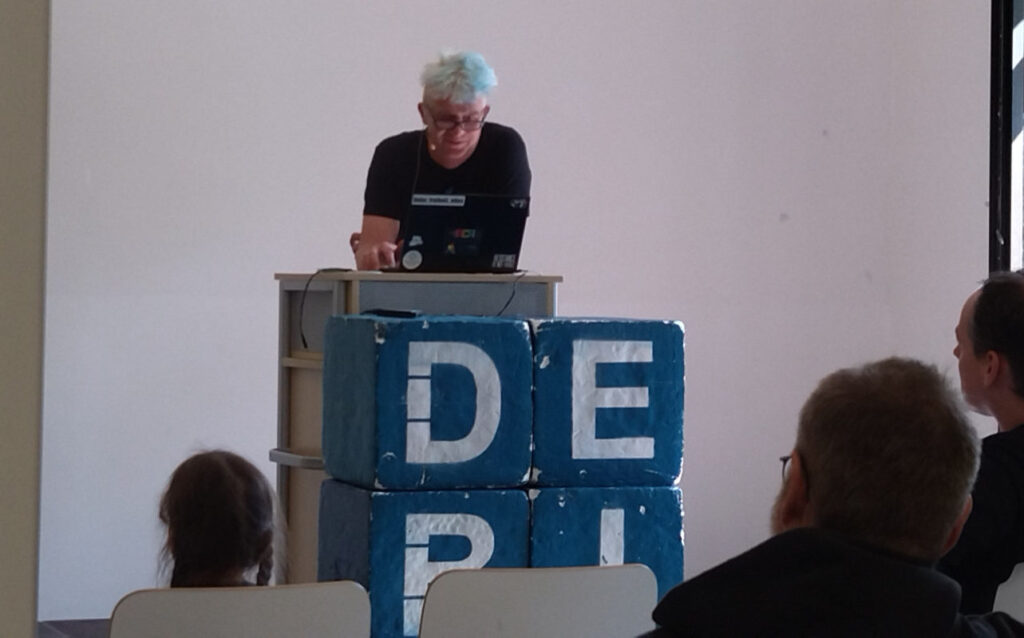
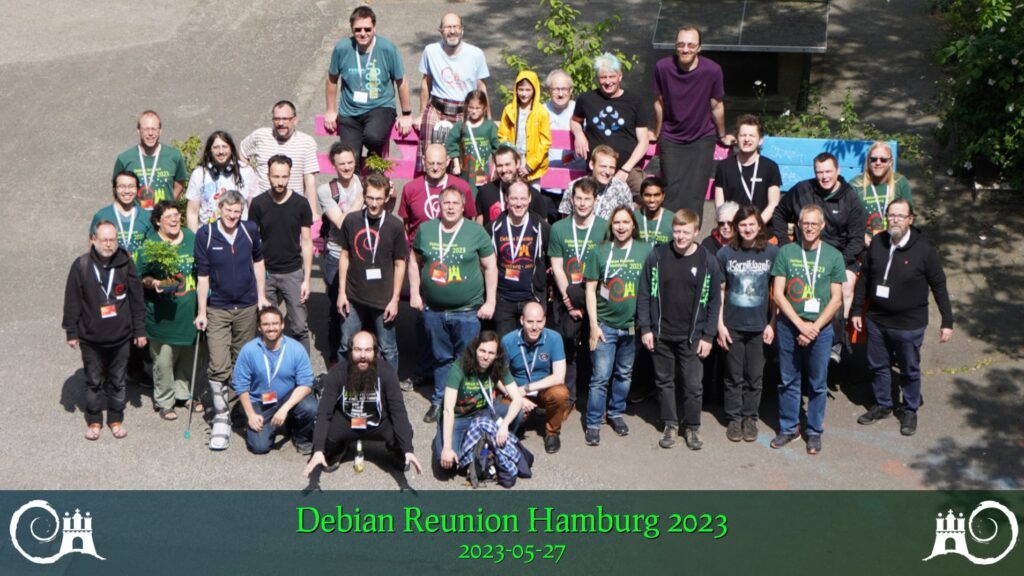
Holger Levsen gave a talk at the 2023 edition of the Debian Reunion Hamburg, a semi-informal meetup of Debian-related people in northern Germany. The slides are available online.
In April, Holger Levsen gave a talk at foss-north 2023 titled Reproducible Builds, the first ten years. Last month, however, Holger s talk was covered in a round-up of the conference on the Free Software Foundation Europe (FSFE) blog.
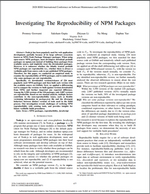
Pronnoy Goswami, Saksham Gupta, Zhiyuan Li, Na Meng and Daphne Yao from Virginia Tech published a paper investigating the Reproducibility of NPM Packages. The abstract includes:
When using open-source NPM packages, most developers download prebuilt packages on npmjs.com instead of building those packages from available source, and implicitly trust the downloaded packages. However, it is unknown whether the blindly trusted prebuilt NPM packages are reproducible (i.e., whether there is always a verifiable path from source code to any published NPM package). [ ] We downloaded versions/releases of 226 most popularly used NPM packages and then built each version with the available source on GitHub. Next, we applied a differencing tool to compare the versions we built against versions downloaded from NPM, and further inspected any reported difference.
The paper reports that among the 3,390 versions of the 226 packages, only 2,087 versions are reproducible, and furthermore that multiple factors contribute to the non-reproducibility including flexible versioning information in package.json file and the divergent behaviors between distinct versions of tools used in the build process. The paper concludes with insights for future verifiable build procedures. Unfortunately, a PDF is not available publically yet, but a Digital Object Identifier (DOI) is available on the paper s IEEE page.
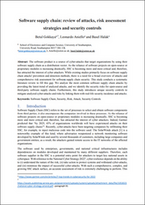
Elsewhere in academia, Betul Gokkaya, Leonardo Aniello and Basel Halak of the School of Electronics and Computer Science at the University of Southampton published a new paper containing a broad overview of attacks and comprehensive risk assessment for software supply chain security. Their paper, titled Software supply chain: review of attacks, risk assessment strategies and security controls, analyses the most common software supply-chain attacks by providing the latest trend of analyzed attack, and identifies the security risks for open-source and third-party software supply chains. Furthermore, their study introduces unique security controls to mitigate analyzed cyber-attacks and risks by linking them with real-life security incidence and attacks . (arXiv.org, PDF)
NixOS is now tracking two new reports at reproducible.nixos.org. Aside from the collection of build-time dependencies of the minimal and Gnome installation ISOs, this page now also contains reports that are restricted to the artifacts that make it into the image. The minimal ISO is currently reproducible except for Python 3.10, which hopefully will be resolved with the coming update to Python version 3.11.
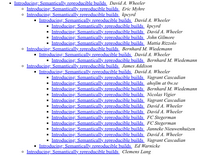
On our rb-general mailing list this month: David A. Wheeler started a thread noting that the OSSGadget project s oss-reproducible tool was measuring something related to but not the same as reproducible builds. Initially they had adopted the term semantically reproducible build term for what it measured, which they defined as being if its build results can be either recreated exactly (a bit for bit reproducible build), or if the differences between the release package and a rebuilt package are not expected to produce functional differences in normal cases. This generated a significant number of replies, and several were concerned that people might confuse what they were measuring with reproducible builds . After discussion, the OSSGadget developers decided to switch to the term semantically equivalent for what they measured in order to reduce the risk of confusion. Vagrant Cascadian (vagrantc) posted an update about GCC, binutils, and Debian s build-essential set with some progress, some hope, and I daresay, some fears . Lastly, kpcyrd asked a question about building a reproducible Linux kernel package for Arch Linux (answered by Arnout Engelen). In the same, thread David A. Wheeler pointed out that the Linux Kernel documentation has a chapter about Reproducible kernel builds now as well.
In Debian this month, nine reviews of Debian packages were added, 20 were updated and 6 were removed this month, all adding to our knowledge about identified issues. In addition, Vagrant Cascadian added a link to the source code causing various ecbuild issues. [ ]
The F-Droid project updated its Inclusion How-To with a new section explaining why it considers reproducible builds to be best practice and hopes developers will support the team s efforts to make as many (new) apps reproducible as it reasonably can.
In diffoscope development this month, version 242 was uploaded to Debian unstable by Chris Lamb who also made the following changes: In addition, Mattia Rizzolo documented how to (re)-produce a binary blob in the code [ ] and Vagrant Cascadian updated the version of diffoscope in GNU Guix to 242 [ ].
reprotest is our tool for building the same source code twice in different environments and then checking the binaries produced by each build for any differences. This month, Holger Levsen uploaded versions 0.7.24 and 0.7.25 to Debian unstable which added support for Tox versions 3 and 4 with help from Vagrant Cascadian [ ][ ][ ]

Upstream patches The Reproducible Builds project detects, dissects and attempts to fix as many currently-unreproducible packages as possible. We endeavour to send all of our patches upstream where appropriate. This month, we wrote a large number of such patches, including: In addition, Jason A. Donenfeld filed a bug (now fixed in the latest alpha version) in the Android issue tracker to report that generateLocaleConfig in Android Gradle Plugin version 8.1.0 generates XML files using non-deterministic ordering, breaking reproducible builds. [ ]

Testing framework The Reproducible Builds project operates a comprehensive testing framework (available at tests.reproducible-builds.org) in order to check packages and other artifacts for reproducibility. In May, a number of changes were made by Holger Levsen:
  • Update the kernel configuration of arm64 nodes only put required modules in the initrd to save space in the /boot partition. [ ]
  • A huge number of changes to a new tool to document/track Jenkins node maintenance, including adding --fetch, --help, --no-future and --verbose options [ ][ ][ ][ ] as well as adding a suite of new actions, such as apt-upgrade, command, deploy-git, rmstamp, etc. [ ][ ][ ][ ] in addition a significant amount of refactoring [ ][ ][ ][ ].
  • Issue warnings if apt has updates to install. [ ]
  • Allow Jenkins to run apt get update in maintenance job. [ ]
  • Installed bind9-dnsutils on some Ubuntu 18.04 nodes. [ ][ ]
  • Fixed the Jenkins shell monitor to correctly deal with little-used directories. [ ]
  • Updated the node health check to warn when apt upgrades are available. [ ]
  • Performed some node maintenance. [ ]
In addition, Vagrant Cascadian added the nocheck, nopgo and nolto when building gcc-* and binutils packages [ ] as well as performed some node maintenance [ ][ ]. In addition, Roland Clobus updated the openQA configuration to specify longer timeouts and access to the developer mode [ ] and updated the URL used for reproducible Debian Live images [ ].

If you are interested in contributing to the Reproducible Builds project, please visit our Contribute page on our website. However, you can get in touch with us via:

4 June 2023

Thorsten Alteholz: My Debian Activities in May 2023

FTP master This month I accepted 157 and rejected 22 packages. The overall number of packages that got accepted was 160. Debian LTS This was my hundred-seventh month that I did some work for the Debian LTS initiative, started by Raphael Hertzog at Freexian. This month my all in all workload has been 14h. During that time I uploaded: The CVEs for cups-filters and cups have been embargoed ones, so the work for cups was done in May but the uploads happen in June. I also did some work on security-master to inject missing dependencies for hugo and gitlab-workhose. Last but not least I did some days on frontdesk duties. Debian ELTS This month was the fifty eighth ELTS month. The CVEs for cups-filters and cups have been embargoed ones, so the work for cups was done in May but the uploads happen in June. Last but not least I did some days on frontdesk duties. Debian Astro This month I uploaded some packages to fix RC bugs, that were
detected by one of many QA tools: Thanks a lot to all the hardworking people who run these tools! Debian Printing This month I could fix RC bugs in: This work is generously funded by Freexian! Debian Mobcom This month I could fix RC bugs in: Other stuff Some other packages also had last minute RC bugs: I even did an upload of a new package force-ip-protocol. I finally had enough of people using IPv6 for their hosts but are unable to configure it. Now I can force firefox, or whatever software, to only use IPv4. One nuisance settled.

Debian Brasil: Oficina de tradu o do Manual do(a) Administrador(a) Debian em 13 de junho

A equipe de tradu o do Debian para o portugu s do Brasil realizar , no dia 13 de junho a partir das 20h, uma oficina de tradu o do Manual do(a) Administrador(a) Debian (The Debian Administrator's Handbook). O objetivo mostrar aos( s) iniciantes como colaborar na tradu o deste importante material, que existe desde 2004 e vem sendo traduzido para o portugu s ao longo dos anos. Agora a tradu o precisa ser atualizada para a vers o 12 do Debian (bookworm), que ser lan ada este m s. A ferramenta usada para traduzir o Manual o site weblate, ent o voc j pode criar sua conta e acessar o Projeto Debian Handbook para se ambientar. A oficina acontecer no formato online, e o link para participar da sala no jitsi ser divulgado no grupo debl10nptBR no telegram e no canal #debian-l10n-br do IRC.

3 June 2023

Ben Hutchings: FOSS activity in May 2023

2 June 2023

Jelmer Vernooij: Porting Python projects to Rust

I ve recently been working on porting some of my Python code to rust, both for performance reasons, and because of the strong typing in the language. As a fan of Haskell, I also just really enjoy using the language. Porting any large project to a new language can be a challenge. There is a temptation to do a rewrite from the ground-up in idiomatic rust and using all new fancy features of the language.
Porting in one go However, this is a bit of a trap:
  • It blocks other work. It can take a long time to finish the rewrite, during which time there is no good place to make other bug fixes/feature changes. If you make the change in the python branch, then you may also have to patch the in-progress rust fork.
  • No immediate return on investment. While the rewrite is happening, all of the investment in it is sunk costs.
  • Throughout the process, you can only run the tests for subsystems that have already been ported. It s common to find subtle bugs later in code ported early.
  • Understanding existing code, porting it and making it idiomatic rust all at the same time takes more time and post-facto debugging.
Iterative porting Instead, we ve found that it works much better to take an iterative approach. One of the hidden gems of rust is the excellent PyO3 crate, which allows creating python bindings for rust code in a way that is several times less verbose and less painful than C or SWIG. Because of rust s strong ownership model, it s also really hard to muck up e.g. reference counts when creating Python bindings for rust code. We port individual functions or classes to rust one at a time, starting with functionality that doesn t have dependencies on other python code and gradually working our way up the call stack. Each subsystem of the code is converted to two matching rust crates: one with a port of the code to pure rust, and one with python bindings for the rust code. Generally multiple python modules end up being a single pair of rust crates. The signature for the pure Rust code follow rust conventions, but the business logic is mostly ported as-is (just in rust syntax) and the signatures of the python bindings match that of the original python code. This then allows running the original python tests to verify that the code still behaves the same way. Changes can also immediately land on the main branch. A subsequent step is usually to refactor the rust code to be more idiomatic - all the while keeping the tests passing. There is also the potential to e.g. switch to using external rust crates (with perhaps subtly different behaviour), or drop functionality altogether. At some point, we will also port the tests from python to rust, and potentially drop the python bindings - once all the caller s have been converted to rust.
Example For example, imagine I have a Python module janitor/mail_filter.py with this function:
 1
 2
 3
 4
 5
 6
 7
 8
 9
10
11
12
13
14
15
16
def parse_plain_text_body(text):
   lines = text.splitlines()
   for i, line in enumerate(lines):
       if line == 'Reply to this email directly or view it on GitHub:':
           return lines[i + 1].split('#')[0]
       if (line == 'For more details, see:'
               and lines[i + 1].startswith('https://code.launchpad.net/')):
           return lines[i + 1]
       try:
           (field, value) = line.split(':', 1)
       except ValueError:
           continue
       if field.lower() == 'merge request url':
           return value.strip()
   return None
Porting this to rust naively (in a crate I ve called mailfilter ) it might look something like this:
 1
 2
 3
 4
 5
 6
 7
 8
 9
10
11
12
13
14
15
16
17
18
19
20
pub fn parse_plain_text_body(text: &str) -> Option<String>  
     let lines: Vec<&str> = text.lines().collect();
     for (i, line) in lines.iter().enumerate()  
         if line == &"Reply to this email directly or view it on GitHub:"  
             return Some(lines[i + 1].split('#').next().unwrap().to_string());
          
         if line == &"For more details, see:"
             && lines[i + 1].starts_with("https://code.launchpad.net/")
          
             return Some(lines[i + 1].to_string());
          
         if let Some((field, value)) = line.split_once(':')  
             if field.to_lowercase() == "merge request url"  
                 return Some(value.trim().to_string());


     None
  
Bindings are created in a crate called mailfilter-py, which looks like this:
 1
 2
 3
 4
 5
 6
 7
 8
 9
10
11
12
13
use pyo3::prelude::*;
 #[pyfunction]
 fn parse_plain_text_body(text: &str) -> Option<String>  
     janitor_mail_filter::parse_plain_text_body(text)
  
 #[pymodule]
 pub fn _mail_filter(py: Python, m: &PyModule) -> PyResult<()>  
     m.add_function(wrap_pyfunction!(parse_plain_text_body, m)?)?;
     Ok(())
  
The metadata for the crates is what you d expect. mailfilter-py uses PyO3 and depends on mailfilter.
 1
 2
 3
 4
 5
 6
 7
 8
 9
10
11
12
[package]
 name = "mailfilter-py"
 version = "0.0.0"
 authors = ["Jelmer Vernoo  <jelmer@jelmer.uk>"]
 edition = "2018"
 [lib]
 crate-type = ["cdylib"]
 [dependencies]
 janitor-mail-filter =   path = "../mailfilter"  
 pyo3 =   version = ">=0.14", features = ["extension-module"] 
I use python-setuptools-rust to get the python ecosystem to build the python bindings. Here is what setup.py looks like:
1
2
3
4
5
6
7
8
9
#!/usr/bin/python3
from setuptools import setup
from setuptools_rust import RustExtension, Binding
setup(
        rust_extensions=[RustExtension(
        "janitor._mailfilter", "crates/mailfilter-py/Cargo.toml",
        binding=Binding.PyO3)],
)
And of course, setuptools-rust needs to be listed as a setup requirement in pyproject.toml or setup.cfg. After that, we can replace the original python code with a simple import and verify that the tests still run:
1
from ._mailfilter import parse_plain_text_body
Of course, not all bindings are as simple as this. Iterators in particular are more complicated, as is code that has a loose idea of ownership in python. But I ve found that the time investment is usually well worth the ability to land changes on the development head early and often. I d be curious to hear if people have had success with other approaches to porting Python code to Rust. If you do, please leave a comment.

Matt Brown: Calling time on DNSSEC: The costs exceed the benefits

I m calling time on DNSSEC. Last week, prompted by a change in my DNS hosting setup, I began removing it from the few personal zones I had signed. Then this Monday the .nz ccTLD experienced a multi-day availability incident triggered by the annual DNSSEC key rotation process. This incident broke several of my unsigned zones, which led me to say very unkind things about DNSSEC on Mastodon and now I feel compelled to more completely explain my thinking: For almost all domains and use-cases, the costs and risks of deploying DNSSEC outweigh the benefits it provides. Don t bother signing your zones. The .nz incident, while topical, is not the motivation or the trigger for this conclusion. Had it been a novel incident, it would still have been annoying, but novel incidents are how we learn so I have a small tolerance for them. The problem with DNSSEC is precisely that this incident was not novel, just the latest in a long and growing list. It s a clear pattern. DNSSEC is complex and risky to deploy. Choosing to sign your zone will almost inevitably mean that you will experience lower availability for your domain over time than if you leave it unsigned. Even if you have a team of DNS experts maintaining your zone and DNS infrastructure, the risk of routine operational tasks triggering a loss of availability (unrelated to any attempted attacks that DNSSEC may thwart) is very high - almost guaranteed to occur. Worse, because of the nature of DNS and DNSSEC these incidents will tend to be prolonged and out of your control to remediate in a timely fashion. The only benefit you get in return for accepting this almost certain reduction in availability is trust in the integrity of the DNS data a subset of your users (those who validate DNSSEC) receive. Trusted DNS data that is then used to communicate across an untrusted network layer. An untrusted network layer which you are almost certainly protecting with TLS which provides a more comprehensive and trustworthy set of security guarantees than DNSSEC is capable of, and provides those guarantees to all your users regardless of whether they are validating DNSSEC or not. In summary, in our modern world where TLS is ubiquitous, DNSSEC provides only a thin layer of redundant protection on top of the comprehensive guarantees provided by TLS, but adds significant operational complexity, cost and a high likelihood of lowered availability. In an ideal world, where the deployment cost of DNSSEC and the risk of DNSSEC-induced outages were both low, it would absolutely be desirable to have that redundancy in our layers of protection. In the real world, given the DNSSEC protocol we have today, the choice to avoid its complexity and rely on TLS alone is not at all painful or risky to make as the operator of an online service. In fact, it s the prudent choice that will result in better overall security outcomes for your users. Ignore DNSSEC and invest the time and resources you would have spent deploying it improving your TLS key and certificate management. Ironically, the one use-case where I think a valid counter-argument for this position can be made is TLDs (including ccTLDs such as .nz). Despite its many failings, DNSSEC is an Internet Standard, and as infrastructure providers, TLDs have an obligation to enable its use. Unfortunately this means that everyone has to bear the costs, complexities and availability risks that DNSSEC burdens these operators with. We can t avoid that fact, but we can avoid creating further costs, complexities and risks by choosing not to deploy DNSSEC on the rest of our non-TLD zones.

But DNSSEC will save us from the evil CA ecosystem! Historically, the strongest motivation for DNSSEC has not been the direct security benefits themselves (which as explained above are minimal compared to what TLS provides), but in the new capabilities and use-cases that could be enabled if DNS were able to provide integrity and trusted data to applications. Specifically, the promise of DNS-based Authentication of Named Entities (DANE) is that with DNSSEC we can be free of the X.509 certificate authority ecosystem and along with it the expensive certificate issuance racket and dubious trust properties that have long been its most distinguishing features. Ten years ago this was an extremely compelling proposition with significant potential to improve the Internet. That potential has gone unfulfilled. Instead of maturing as deployments progressed and associated operational experience was gained, DNSSEC has been beset by the discovery of issue after issue. Each of these has necessitated further changes and additions to the protocol, increasing complexity and deployment cost. For many zones, including significant zones like google.com (where I led the attempt to evaluate and deploy DNSSEC in the mid 2010s), it is simply infeasible to deploy the protocol at all, let alone in a reliable and dependable manner. While DNSSEC maturation and deployment has been languishing, the TLS ecosystem has been steadily and impressively improving. Thanks to the efforts of many individuals and companies, although still founded on the use of a set of root certificate authorities, the TLS and CA ecosystem today features transparency, validation and multi-party accountability that comprehensively build trust in the ability to depend and rely upon the security guarantees that TLS provides. When you use TLS today, you benefit from:
  • Free/cheap issuance from a number of different certificate authorities.
  • Regular, automated issuance/renewal via the ACME protocol.
  • Visibility into who has issued certificates for your domain and when through Certificate Transparency logs.
  • Confidence that certificates issued without certificate transparency (and therefore lacking an SCT) will not be accepted by the leading modern browsers.
  • The use of modern cryptographic protocols as a baseline, with a plausible and compelling story for how these can be steadily and promptly updated over time.
DNSSEC with DANE can match the TLS ecosystem on the first benefit (up front price) and perhaps makes the second benefit moot, but has no ability to match any of the other transparency and accountability measures that today s TLS ecosystem offers. If your ZSK is stolen, or a parent zone is compromised or coerced, validly signed TLSA records for a forged certificate can be produced and spoofed to users under attack with minimal chances of detection. Finally, in terms of overall trust in the roots of the system, the CA/Browser forum requirements continue to improve the accountability and transparency of TLS certificate authorities, significantly reducing the ability for any single actor (say a nefarious government) to subvert the system. The DNS root has a well established transparent multi-party system for establishing trust in the DNSSEC root itself, but at the TLD level, almost intentionally thanks to the hierarchical nature of DNS, DNSSEC has multiple single points of control (or coercion) which exist outside of any formal system of transparency or accountability. We ve moved from DANE being a potential improvement in security over TLS when it was first proposed, to being a definite regression from what TLS provides today. That s not to say that TLS is perfect, but given where we re at, we ll get a better security return from further investment and improvements in the TLS ecosystem than we will from trying to fix DNSSEC.

But TLS is not ubiquitous for non-HTTP applications The arguments above are most compelling when applied to the web-based HTTP-oriented ecosystem which has driven most of the TLS improvements we ve seen to date. Non-HTTP protocols are lagging in adoption of many of the improvements and best practices TLS has on the web. Some claim this need to provide a solution for non-HTTP, non-web applications provides a motivation to continue pushing DNSSEC deployment. I disagree, I think it provides a motivation to instead double-down on moving those applications to TLS. TLS as the new TCP. The problem is that costs of deploying and operating DNSSEC are largely fixed regardless of how many protocols you are intending to protect with it, and worse, the negative side-effects of DNSSEC deployment can and will easily spill over to affect zones and protocols that don t want or need DNSSEC s protection. To justify continued DNSSEC deployment and operation in this context means using a smaller set of benefits (just for the non-HTTP applications) to justify the already high costs of deploying DNSSEC itself, plus the cost of the risk that DNSSEC poses to the reliability to your websites. I don t see how that equation can ever balance, particularly when you evaluate it against the much lower costs of just turning on TLS for the rest of your non-HTTP protocols instead of deploying DNSSEC. MTA-STS is a worked example of how this can be achieved. If you re still not convinced, consider that even DNS itself is considering moving to TLS (via DoT and DoH) in order to add the confidentiality/privacy attributes the protocol currently lacks. I m not a huge fan of the latency implications of these approaches, but the ongoing discussion shows that clever solutions and mitigations for that may exist. DoT/DoH solve distinct problems from DNSSEC and in principle should be used in combination with it, but in a world where DNS itself is relying on TLS and therefore has eliminated the majority of spoofing and cache poisoning attacks through DoT/DoH deployment the benefit side of the DNSSEC equation gets smaller and smaller still while the costs remain the same.

OK, but better software or more careful operations can reduce DNSSEC s cost Some see the current DNSSEC costs simply as teething problems that will reduce as the software and tooling matures to provide more automation of the risky processes and operational teams learn from their mistakes or opt to simply transfer the risk by outsourcing the management and complexity to larger providers to take care of. I don t find these arguments compelling. We ve already had 15+ years to develop improved software for DNSSEC without success. What s changed that we should expect a better outcome this year or next? Nothing. Even if we did have better software or outsourced operations, the approach is still only hiding the costs behind automation or transferring the risk to another organisation. That may appear to work in the short-term, but eventually when the time comes to upgrade the software, migrate between providers or change registrars the debt will come due and incidents will occur. The problem is the complexity of the protocol itself. No amount of software improvement or outsourcing addresses that. After 15+ years of trying, I think it s worth considering that combining cryptography, caching and distributed consensus, some of the most fundamental and complex computer science problems, into a slow-moving and hard to evolve low-level infrastructure protocol while appropriately balancing security, performance and reliability appears to be beyond our collective ability. That doesn t have to be the end of the world, the improvements achieved in the TLS ecosystem over the same time frame provide a positive counter example - perhaps DNSSEC is simply focusing our attention at the wrong layer of the stack. Ideally secure DNS data would be something we could have, but if the complexity of DNSSEC is the price we have to pay to achieve it, I m out. I would rather opt to remain with the simpler yet insecure DNS protocol and compensate for its short comings at higher transport or application layers where experience shows we are able to more rapidly improve and develop our security capabilities.

Summing up For the vast majority of domains and use-cases there is simply no net benefit to deploying DNSSEC in 2023. I d even go so far as to say that if you ve already signed your zones, you should (carefully) move them back to being unsigned - you ll reduce the complexity of your operating environment and lower your risk of availability loss triggered by DNS. Your users will thank you. The threats that DNSSEC defends against are already amply defended by the now mature and still improving TLS ecosystem at the application layer, and investing in further improvements here carries far more return than deployment of DNSSEC. For TLDs, like .nz whose outage triggered this post, DNSSEC is not going anywhere and investment in mitigating its complexities and risks is an unfortunate burden that must be shouldered. While the full incident report of what went wrong with .nz is not yet available, the interim report already hints at some useful insights. It is important that InternetNZ publishes a full and comprehensive review so that the full set of learnings and improvements this incident can provide can be fully realised by .nz and other TLD operators stuck with the unenviable task of trying to safely operate DNSSEC.

Postscript After taking a few days to draft and edit this post, I ve just stumbled across a presentation from the well respected Geoff Huston at last weeks RIPE86 meeting. I ve only had time to skim the slides (video here) - they don t seem to disagree with my thinking regarding the futility of the current state of DNSSEC, but also contain some interesting ideas for what it might take for DNSSEC to become a compelling proposition. Probably worth a read/watch!

1 June 2023

Gunnar Wolf: Cheatable e-voting booths in Coahuila, Mexico, detected at the last minute

It s been a very long time I haven t blogged about e-voting, although some might remember it s been a topic I have long worked with; particularly, it was the topic of my 2018 Masters thesis, plus some five articles I wrote in the 2010-2018 period. After the thesis, I have to admit I got weary of the subject, and haven t pursued it anymore. So, I was saddened and dismayed to read that once again, as it has already happened the electoral authorities would set up a pilot e-voting program in the local elections this year, that would probably lead to a wider deployment next year, in the Federal elections. This year ( this week!), two States will have elections for their Governors and local Legislative branches: Coahuila (North, bordering with Texas) and Mexico (Center, surrounding Mexico City). They are very different states, demographically and in their development level. Pilot programs with e-voting booths have been seen in four states TTBOMK in the last ~15 years: Jalisco (West), Mexico City, State of Mexico and Coahuila. In Coahuila, several universities have teamed up with the Electoral Institute to develop their e-voting booth; a good thing that I can say about how this has been done in my country is that, at least, the Electoral Institute is providing their own implementations, instead of sourcing with e-booth vendors (which have their long, tragic story mostly in the USA, but also in other places). Not only that: They are subjecting the machines to audit processes. Not open audit processes, as demanded by academics in the field, but nevertheless, external, rigorous audit processes. But still, what me and other colleagues with Computer Security background oppose to is not a specific e-voting implementation, but the adoption of e-voting in general. If for nothing else, because of the extra complexity it brings, because of the many more checks that have to be put in place, and Because as programmers, we are aware of the ease with which bugs can creep in any given implementation both honest bugs (mistakes) and, much worse, bugs that are secretly requested and paid for. Anyway, leave this bit aside for a while. I m not implying there was any ill intent in the design or implementation of these e-voting booths. Two days ago, the Electoral Institute announced there was an important bug found in the Coahuila implementation. The bug consists, as far as I can understand from the information reported in newspapers, in: The problem was that the activation codes remained active after voting, so a voter could vote multiple times. This seems like an easy problem to be patched It most likely is. However, given the inability to patch, properly test, and deploy in a timely manner the fix to all of the booths (even though only 74 e-voting booths were to be deployed for this pilot), the whole pilot for Coahuila was scratched; Mexico State is voting with a different implementation that is not affected by this issue. This illustrates very well one of the main issues with e-voting technology: It requires a team of domain-specific experts to perform a highly specialized task (code and physical audits). I am happy and proud to say that part of the auditing experts were the professors of the Information Security Masters program of ESIME Culhuac n (the Masters program I was part of). The reaction by the Electoral Institute was correct. As far as I understand, there is no evidence suggesting this bug could have been purposefully built, but it s not impossible to rule it out. A traditional, paper-and-ink-based process is not only immune to attacks (or mistakes!) based on code such as this one, but can be audited by anybody. And that is, I believe, a fundamental property of democracy: ensuring the process is done right is not limited to a handful of domain experts. Not only that: In Mexico, I am sure there are hundreds of very proficient developers that could perform a code and equipment audit such as this one, but the audits are open by invitation only, so being an expert is not enough to get clearance to do this. In a democracy, the whole process should be observable and verifiable by anybody interested in doing so. Some links about this news:

Russell Coker: Do Desktop Computers Make Sense?

Laptop vs Desktop Price Currently the smaller and cheaper USB-C docks start at about $25 and Dell has a new Vostro with 8G of RAM and 2*USB-C ports for $788. That gives a bit over $800 for a laptop and dock vs $795 for the cheapest Dell desktop which also has 8G of RAM. For every way of buying laptops and desktops (EG buying from Officeworks, buying on ebay, etc) the prices for laptops and desktops seem very similar. For all those comparisons the desktop will typically have a faster CPU and more options for PCIe cards, larger storage, etc. But if you don t want to expand storage beyond the affordable 4TB NVMe/SSD devices, don t need to add PCIe cards, and don t need much CPU power then a laptop will do well. For the vast majority of the computer work I do my Thinkpad Carbon X1 Gen1 (from 2012) had plenty of CPU power. If someone who s not an expert in PC hardware was to buy a computer of a given age then laptops probably aren t more expensive than desktops even disregarding the fact that a laptop works without the need to purchase a monitor, a keyboard, or a mouse. I can get regular desktop PCs for almost nothing and get parts to upgrade them very cheaply but most people can t do that. I can also get a decent second-hand laptop and USB-C dock for well under $400. Servers and Gaming Systems For people doing serious programming or other compute or IO intensive tasks some variation on the server theme is the best option. That may be something more like the servers used by the r/homelab people than the corporate servers, or it might be something in the cloud, but a server is a server. If you are going to have a home server that s a tower PC then it makes sense to put a monitor on it and use it as a workstation. If your server makes so much noise that you can t spend much time in the same room or if it s hosted elsewhere then using a laptop to access it makes sense. Desktop computers for PC gaming makes sense as no-one seems to be making laptops with moderately powerful GPUs. The most powerful GPUs draw 150W which is more than most laptop PSUs can supply and even if a laptop PSU could supply that much there would be the issue of cooling. The Steam Deck [1] and the Nintendo Switch [2] can both work with USB-C docks. The PlayStation 5 [3] has a 350W PSU and doesn t support video over USB-C. The Steam Deck can do 8K resolution at 60Hz or 4K at 120Hz but presumably the newer Steam games will need a desktop PC with a more powerful GPU to properly use such resolutions. For people who want the best FPS rates on graphics intensive games it could make sense to have a tower PC. Also a laptop that s run at high CPU/GPU use for a long time will tend to have it s vents clogged by dust and possibly have the cooling fan wear out. Monitor Resolution Laptop support for a single 4K monitor became common in 2012 with the release of the Ivy Bridge mobile CPUs from Intel in 2012. My own experience of setting up 4K monitors for a Linux desktop in 2019 was that it was unreasonably painful and that the soon to be released Debian/Bookworm will make things work nicely for 4K monitors with KDE on X11. So laptop hardware has handled the case of a single high resolution monitor since before such monitors were cheap or common and before software supported it well. Of course at that time you had to use either a proprietary dock or a mini-DisplayPort to HDMI adaptor to get 4K working. But that was still easier than getting PCIe video cards supporting 4K resolution which is something that according to spec sheets wasn t well supported by affordable cards in 2017. Since USB-C became a standard feature in laptops in about 2017 support of more monitors than most people would want through a USB-C dock became standard. My Thinkpad X1 Carbon Gen5 which was released in 2017 will support 2*FullHD monitors plus a 4K monitor via a USB-C dock, I suspect it would do at least 2*4K monitors but haven t had a chance to test. Cheap USB-C docks supporting this sort of thing have only become common in the last year or so. How Many Computers per Home Among middle class Australians it s common to have multiple desktop PCs per household. One for each child who s over the age of about 13 and one for the parents seems to be reasonably common. Students in the later years of high-school and university students are often compelled to have laptops so having the number of laptops plus the number of desktops be larger than the population of the house probably isn t uncommon even among people who aren t really into computers. As an aside it s probably common among people who read my blog to have 2 desktops, a laptop, and a cloud server for their own personal use. But even among people who don t do that sort of thing having computers outnumber people in a home is probably common. A large portion of the computer users can do everything they need on a laptop. For gamers the graphics intensive games often run well on a console and that s probably the most effective way of getting to playing the games. Of course the fact that there is RGB RAM (RAM with Red, Green, and Blue LEDs to light up) along with a lot of other wild products sold to gamers suggests that gaming PCs are not about what runs the game most effectively and that an art/craft project with the PC is more important than actually playing games. Instead of having one desktop PC per bedroom and laptops for school/university as well it would make more sense to have a laptop per person and have a USB-C dock and monitor in each bedroom and a USB-C dock connected to a large screen TV in the lounge. This gives plenty of flexibility for moving around to do work and sharing what s on your computer with other people. It also allows taking a work computer home and having work with your monitor, having a friend bring their laptop to your home to work on something together, etc. For most people desktop computers don t make sense. While I think that convergence of phones with laptops and desktops is the way of the future [4] for most people having laptops take over all functions of desktops is the best option today.

Jamie McClelland: Enough about the AI Apocalypse Already

After watching Democracy Now s segment on artificial intelligence I started to wonder - am I out of step on this topic? When people claim artificial intelligence will surpass human intelligence and thus threaten humanity with extinction, they seem to be referring specifically to advances made with large language models. As I understand them, large language models are probability machines that have ingested massive amounts of text scraped from the Internet. They answer questions based on the probability of one series of words (their answer) following another series of words (the question). It seems like a stretch to call this intelligence, but if we accept that definition then it follows that this kind of intelligence is nothing remotely like human intelligence, which makes the claim that it will surpass human intelligence confusing. Hasn t this kind of machine learning surpassed us decades ago? Or when we say surpass does that simply refer to fooling people into thinking an AI machine is a human via conversation? That is an important milestone, but I m not ready to accept the turing test as proof of equal intelligence. Furthermore, large language models hallucinate and also reflect the biases of their training data. The word hallucinate seems like a euphemism, as if it could be corrected with the right medication when in fact it seems hard to avoid when your strategy is to correlate words based on probability. But even if you could solve the here is a completely wrong answer presented with sociopathic confidence problem, reflecting the biases of your data sources seems fairly intractable. In what world would a system with built-in bias be considered on the brink of surpassing human intelligence? The danger from LLMs seems to be their ability to convince people that their answers are correct, including their patently wrong and/or biased answers. Why do people think they are giving correct answers? Oh right terrifying right wing billionaires (with terrifying agendas have been claiming AI will exceed human intelligence and threaten humanity and every time they sign a hyperbolic statement they get front page mainstream coverage. And even progressive news outlets are spreading this narrative with minimal space for contrary opinions (thank you Tawana Petty from the Algorithmic Justice League for providing the only glimpse of reason in the segment). The belief that artificial intelligence is or will soon become omnipotent has real world harms today: specifically it creates the misperception that current LLMs are accurate, which paves the way for greater adoption among police forces, social service agencies, medical facilities and other places where racial and economic biases have life and death consequences. When the CEO of OpenAI calls the technology dangerous and in need of regulation, he gets both free advertising promoting the power and supposed accuracy of his product and the possibility of freezing further developments in the field that might challenge OpenAI s current dominance. The real threat to humanity is not AI, it s massive inequality and the use of tactics ranging from mundane bureaucracy to deadly force and incarceration to segregate the affluent from the growing number of people unable to make ends meet. We have spent decades training bureaucrats, judges and cops to robotically follow biased laws to maintain this order without compassion or empathy. Replacing them with AI would be make things worse and should be stopped. But, let s be clear, the narrative that AI is poised to surpass human intelligence and make humanity extinct is a dangerous distraction that runs counter to a much more important story about the very real and very present exploitative practices of the [companies building AI], who are rapidly centralizing power and increasing social inequities. . Maybe we should talk about that instead?

Paul Wise: FLOSS Activities May 2023

Focus This month I didn't have any particular focus. I just worked on issues in my info bubble.

Changes

Issues

Review

Administration
  • Debian IRC: set topic on new #debian-sa channel
  • Debian wiki: unblock IP addresses, approve accounts

Communication
  • Respond to queries from Debian users and contributors on the mailing lists and IRC

Sponsors The SIMDe, gensim, sptag work was sponsored. All other work was done on a volunteer basis.

31 May 2023

Arturo Borrero Gonz lez: Wikimedia Hackathon 2023 Athens summary

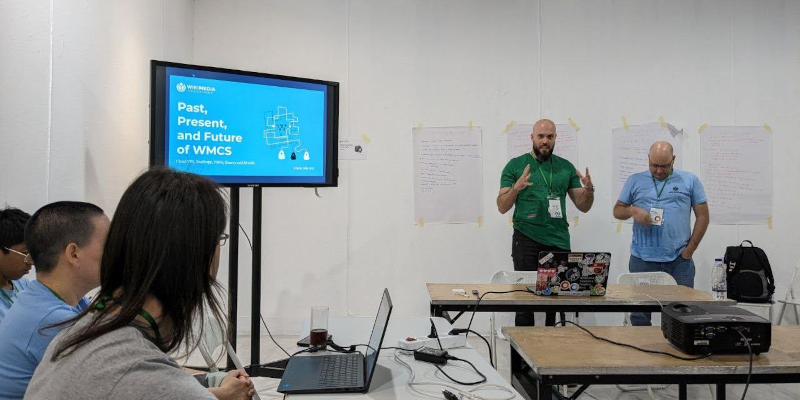
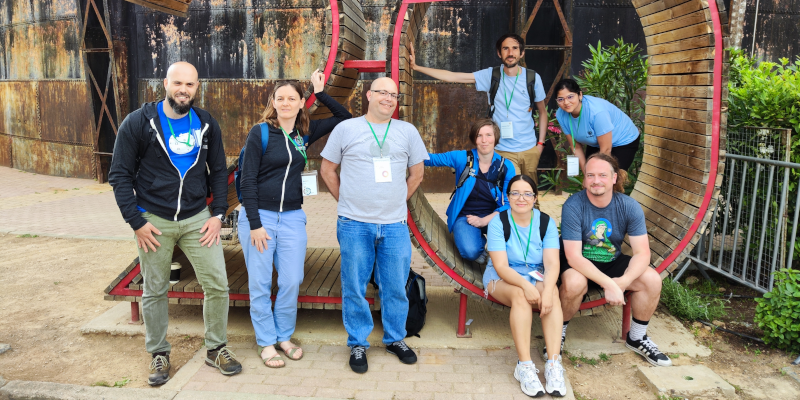
Post logo During the weekend of 19-23 May 2023 I attended the Wikimedia hackathon 2023 in Athens, Greece. The event physically reunited folks interested in the more technological aspects of the Wikimedia movement in person for the first time since 2019. The scope of the hacking projects include (but was not limited to) tools, wikipedia bots, gadgets, server and network infrastructure, data and other technical systems. My role in the event was two-fold: on one hand I was in the event because of my role as SRE in the Wikimedia Cloud Services team, where we provided very valuable services to the community, and I was expected to support the technical contributors of the movement that were around. Additionally, and because of that same role, I did some hacking myself too, which was specially augmented given I generally collaborate on a daily basis with some community members that were present in the hacking room. The hackathon had some conference-style track and I ran a session with my coworker Bryan, called Past, Present and Future of Wikimedia Cloud Services (Toolforge and friends) (slides) which was very satisfying to deliver given the friendly space that it was. I attended a bunch of other sessions, and all of them were interesting and well presented. The number of ML themes that were present in the program schedule was exciting. I definitely learned a lot from attending those sessions, from how LLMs work, some fascinating applications for them in the wikimedia space, to what were some industry trends for training and hosting ML models. Session Despite the sessions, the main purpose of the hackathon was, well, hacking. While I was in the hacking space for more than 12 hours each day, my ability to get things done was greatly reduced by the constant conversations, help requests, and other social interactions with the folks. Don t get me wrong, I embraced that reality with joy, because the social bonding aspect of it is perhaps the main reason why we gathered in person instead of virtually. That being said, this is a rough list of what I did: The hackathon was also the final days of Technical Engagement as an umbrella group for WMCS and Developer Advocacy teams within the Technology department of the Wikimedia Foundation because of an internal reorg.. We used the chance to reflect on the pleasant time we have had together since 2019 and take a final picture of the few of us that were in person in the event. Technical Engagement It wasn t the first Wikimedia Hackathon for me, and I felt the same as in previous iterations: it was a welcoming space, and I was surrounded by friends and nice human beings. I ended the event with a profound feeling of being privileged, because I was part of the Wikimedia movement, and because I was invited to participate in it.

Russell Coker: Links May 2023

Petter Reinholdtsen wrote an interesting blog post about their work on packaging speech to text for Debian [1]. The work of the Debian Deep Learning Team seems really interesting and I look forward to playing with this sort of thing after the release of Bookworm (the packages in question will NOT go in Bookworm but I ll run at least one system on Testing after Bookworm). It would be nice to get more information on the hardware used for running such programs, the minimum hardware needed for real-time speech to text would be interesting to know. Brian Krebs wrote an informative article about attacks involving supply chain compromise and fake LinkedIn profiles [2]. The attacks targetted Linux as well as Windows. Interesting video about the Illium cameras, a bit harsh though, they criticise Illium devices for being too low resolution, too expensive, and taking too much CPU time to process [3]. The Illium cameras still sell for decent prices on eBay, I wonder if it s because of curious people like me who would like to play with them and have money to spare or whether some other interesting things are being done. I wonder how a 4*4 array of the rectangular cameras secured together with duct tape would go. The ideas of Illium should work better if implemented for multi-core CPUs or GPUs. Bruce Schneier with Henry Farrell and Nathan Sanders wrote an insightful blog post about how AT Chatbots could improve democracy [4]. Wired has an interesting article about the way DJI drones transmit the location of the drone operator without encryption by design [5]. Apparently this has been used for targetting attacks on drone operators in Ukraine. This video about robot mice navigating mazes is interesting [6]. But I think it became less interesting when they got to the stage of milliseconds counting for the win, it s very optimised for one case just like F1. I think it would be interesting if they had a rally contest where they go across grass or sand, 3D mazes both in air and water, and contests where Tungsten weights have to be transported. They should push some of the other limits of engineering as completing a maze quickly has been solved. The Guardian has an interesting article about a blood test for sleepy driving [7]. Once they have an objective test they can punish people for it. This github repository listing public APIs is interesting [8]. Lots of fun ideas for phone apps there. Simon Josefsson wrote an insightful blog post about the threat model of security devices [9]. Unfortunately the security of most people is way below the level where this is an issue. But it s good to think about future steps needed for good security. Cory Doctorow wrote an interesting article The Swivel Eyed Loons have a Point [10] about the fact that some of the nuttiest people are protesting about real issues, just in the wrong way.

Russell Coker: Genesis GV60

I recently test drove a Genesis GV70, but the GV60 [1] which I didn t test drive is a nicer car. The GV70 and GV60 are all electric so they are quiet and perform well. The GV70 has a sun-roof that opens, it was the first car I ve driven like that and I decided I don t like it. Having the shade open so I can see the sky while stuck in a traffic jam is nice though. The GV60 has a non-opening sun-roof with a shade that can be retracted, this is a feature I d really like to have in my next car. Electric cars as a general rule have good acceleration and are quiet, the GV70 performed as expected in that regard. It has a head-up display projected on the windscreen for the speed and the speed limit on the road in question which is handy. When driving in a car park it showed images from all sides which is really handy, I wish I had explored that feature more. The console is all electronic with a TFT display instead of mechanical instruments but the only significant difference this makes in driving is that when a turn indicator is used the console display shows a video feed for the blind-spot that matches the lane change direction. This is a significant safety feature and will reduce the incidence of collisions. But the capabilities of the hardware seem under utilised, hopefully they will release a software update at some future time to do more with it. The most significant benefit of the GV60 over the GV70 is that it has cameras instead of mirrors at the sides of the car. This reduces drag and also removes the need to adjust mirrors to match the height of the driver. Also for driver instruction the instructor and learner get to see the same view. A logical development of such cars is an expansion pack for instruction that has displays in the passenger seat to show the instructor the same instrument view as the driver sees. The minimum list driveaway price for the GV60 is $117,171.50 and for the GV70 it is $138,119.89 both of which are more than I m prepared to pay for a car. The GV60 apparently can be started by fingerprint which seems like a bad idea given the poor security of fingerprint sensors, but as regular car keys tend not to be too difficult to work around it probably doesn t matter. The Genesis web site makes it difficult to find the ranges of electric cars which is surprising. A Google search suggests that the GV60 can do 466Km and the GV70 can do 410Km which are both reasonable numbers and nothing to be ashamed of. The GV70 was a fun car to drive and the GV60 looks like it would be even better. I recommend that everyone who likes technology take one for a test drive, but for my own use I m looking for something that costs less than half as much.

Russ Allbery: Review: Night Watch

Review: Night Watch, by Terry Pratchett
Series: Discworld #29
Publisher: Harper
Copyright: November 2002
Printing: August 2014
ISBN: 0-06-230740-1
Format: Mass market
Pages: 451
Night Watch is the 29th Discworld novel and the sixth Watch novel. I would really like to tell people they could start here if they wanted to, for reasons that I will get into in a moment, but I think I would be doing you a disservice. The emotional heft added by having read the previous Watch novels and followed Vimes's character evolution is significant. It's the 25th of May. Vimes is about to become a father. He and several of the other members of the Watch are wearing sprigs of lilac for reasons that Sergeant Colon is quite vehemently uninterested in explaining. A serial killer named Carcer the Watch has been after for weeks has just murdered an off-duty sergeant. It's a tense and awkward sort of day and Vimes is feeling weird and wistful, remembering the days when he was a copper and not a manager who has to dress up in ceremonial armor and meet with committees. That may be part of why, when the message comes over the clacks that the Watch have Carcer cornered on the roof of the New Hall of the Unseen University, Vimes responds in person. He's grappling with Carcer on the roof of the University Library in the middle of a magical storm when lightning strikes. When he wakes up, he's in the past, shortly after he joined the Watch and shortly before the events of the 25th of May that the older Watch members so vividly remember and don't talk about. I have been saying recently in Discworld reviews that it felt like Pratchett was on the verge of a breakout book that's head and shoulders above Discworld prior to that point. This is it. This is that book. The setup here is masterful: the sprigs of lilac that slowly tell the reader something is going on, the refusal of any of the older Watch members to talk about it, the scene in the graveyard to establish the stakes, the disconcerting fact that Vetinari is wearing a sprig of lilac as well, and the feeling of building tension that matches the growing electrical storm. And Pratchett never gives into the temptation to explain everything and tip his hand prematurely. We know the 25th is coming and something is going to happen, and the reader can put together hints from Vimes's thoughts, but Pratchett lets us guess and sometimes be right and sometimes be wrong. Vimes is trying to change history, which adds another layer of uncertainty and enjoyment as the reader tries to piece together both the true history and the changes. This is a masterful job at a "what if?" story. And, beneath that, the commentary on policing and government and ethics is astonishingly good. In a review of an earlier Watch novel, I compared Pratchett to Dickens in the way that he focuses on a sort of common-sense morality rather than political theory. That is true here too, but oh that moral analysis is sharp enough to slide into you like a knife. This is not the Vimes that we first met in Guards! Guards!. He has has turned his cynical stubbornness into a working theory of policing, and it's subtle and complicated and full of nuance that he only barely knows how to explain. But he knows how to show it to people.
Keep the peace. That was the thing. People often failed to understand what that meant. You'd go to some life-threatening disturbance like a couple of neighbors scrapping in the street over who owned the hedge between their properties, and they'd both be bursting with aggrieved self-righteousness, both yelling, their wives would either be having a private scrap on the side or would have adjourned to a kitchen for a shared pot of tea and a chat, and they all expected you to sort it out. And they could never understand that it wasn't your job. Sorting it out was a job for a good surveyor and a couple of lawyers, maybe. Your job was to quell the impulse to bang their stupid fat heads together, to ignore the affronted speeches of dodgy self-justification, to get them to stop shouting and to get them off the street. Once that had been achieved, your job was over. You weren't some walking god, dispensing finely tuned natural justice. Your job was simply to bring back peace.
When Vimes is thrown back in time, he has to pick up the role of his own mentor, the person who taught him what policing should be like. His younger self is right there, watching everything he does, and he's desperately afraid he'll screw it up and set a worse example. Make history worse when he's trying to make it better. It's a beautifully well-done bit of tension that uses time travel as the hook to show both how difficult mentorship is and also how irritating one's earlier naive self would be.
He wondered if it was at all possible to give this idiot some lessons in basic politics. That was always the dream, wasn't it? "I wish I'd known then what I know now"? But when you got older you found out that you now wasn't you then. You then was a twerp. You then was what you had to be to start out on the rocky road of becoming you now, and one of the rocky patches on that road was being a twerp.
The backdrop of this story, as advertised by the map at the front of the book, is a revolution of sorts. And the revolution does matter, but not in the obvious way. It creates space and circumstance for some other things to happen that are all about the abuse of policing as a tool of politics rather than Vimes's principle of keeping the peace. I mentioned when reviewing Men at Arms that it was an awkward book to read in the United States in 2020. This book tackles the ethics of policing head-on, in exactly the way that book didn't. It's also a marvelous bit of competence porn. Somehow over the years, Vimes has become extremely good at what he does, and not just in the obvious cop-walking-a-beat sort of ways. He's become a leader. It's not something he thinks about, even when thrown back in time, but it's something Pratchett can show the reader directly, and have the other characters in the book comment on. There is so much more that I'd like to say, but so much would be spoilers, and I think Night Watch is more effective when you have the suspense of slowly puzzling out what's going to happen. Pratchett's pacing is exquisite. It's also one of the rare Discworld novels where Pratchett fully commits to a point of view and lets Vimes tell the story. There are a few interludes with other people, but the only other significant protagonist is, quite fittingly, Vetinari. I won't say anything more about that except to note that the relationship between Vimes and Vetinari is one of the best bits of fascinating subtlety in all of Discworld. I think it's also telling that nothing about Night Watch reads as parody. Sure, there is a nod to Back to the Future in the lightning storm, and it's impossible to write a book about police and street revolutions without making the reader think about Les Miserables, but nothing about this plot matches either of those stories. This is Pratchett telling his own story in his own world, unapologetically, and without trying to wedge it into parody shape, and it is so much the better book for it. The one quibble I have with the book is that the bits with the Time Monks don't really work. Lu-Tze is annoying and flippant given the emotional stakes of this story, the interludes with him are frustrating and out of step with the rest of the book, and the time travel hand-waving doesn't add much. I see structurally why Pratchett put this in: it gives Vimes (and the reader) a time frame and a deadline, it establishes some of the ground rules and stakes, and it provides a couple of important opportunities for exposition so that the reader doesn't get lost. But it's not good story. The rest of the book is so amazingly good, though, that it doesn't matter (and the framing stories for "what if?" explorations almost never make much sense). The other thing I have a bit of a quibble with is outside the book. Night Watch, as you may have guessed by now, is the origin of the May 25th Pratchett memes that you will be familiar with if you've spent much time around SFF fandom. But this book is dramatically different from what I was expecting based on the memes. You will, for example see a lot of people posting "Truth, Justice, Freedom, Reasonably Priced Love, And a Hard-Boiled Egg!", and before reading the book it sounds like a Pratchett-style humorous revolutionary slogan. And I guess it is, sort of, but, well... I have to quote the scene:
"You'd like Freedom, Truth, and Justice, wouldn't you, Comrade Sergeant?" said Reg encouragingly. "I'd like a hard-boiled egg," said Vimes, shaking the match out. There was some nervous laughter, but Reg looked offended. "In the circumstances, Sergeant, I think we should set our sights a little higher " "Well, yes, we could," said Vimes, coming down the steps. He glanced at the sheets of papers in front of Reg. The man cared. He really did. And he was serious. He really was. "But...well, Reg, tomorrow the sun will come up again, and I'm pretty sure that whatever happens we won't have found Freedom, and there won't be a whole lot of Justice, and I'm damn sure we won't have found Truth. But it's just possible that I might get a hard-boiled egg."
I think I'm feeling defensive of the heart of this book because it's such an emotional gut punch and says such complicated and nuanced things about politics and ethics (and such deeply cynical things about revolution). But I think if I were to try to represent this story in a meme, it would be the "angels rise up" song, with all the layers of meaning that it gains in this story. I'm still at the point where the lilac sprigs remind me of Sergeant Colon becoming quietly furious at the overstep of someone who wasn't there. There's one other thing I want to say about that scene: I'm not naturally on Vimes's side of this argument. I think it's important to note that Vimes's attitude throughout this book is profoundly, deeply conservative. The hard-boiled egg captures that perfectly: it's a bit of physical comfort, something you can buy or make, something that's part of the day-to-day wheels of the city that Vimes talks about elsewhere in Night Watch. It's a rejection of revolution, something that Vimes does elsewhere far more explicitly. Vimes is a cop. He is in some profound sense a defender of the status quo. He doesn't believe things are going to fundamentally change, and it's not clear he would want them to if they did. And yet. And yet, this is where Pratchett's Dickensian morality comes out. Vimes is a conservative at heart. He's grumpy and cynical and jaded and he doesn't like change. But if you put him in a situation where people are being hurt, he will break every rule and twist every principle to stop it.
He wanted to go home. He wanted it so much that he trembled at the thought. But if the price of that was selling good men to the night, if the price was filling those graves, if the price was not fighting with every trick he knew... then it was too high. It wasn't a decision that he was making, he knew. It was happening far below the areas of the brain that made decisions. It was something built in. There was no universe, anywhere, where a Sam Vimes would give in on this, because if he did then he wouldn't be Sam Vimes any more.
This is truly exceptional stuff. It is the best Discworld novel I have read, by far. I feel like this was the Watch novel that Pratchett was always trying to write, and he had to write five other novels first to figure out how to write it. And maybe to prepare Discworld readers to read it. There are a lot of Discworld novels that are great on their own merits, but also it is 100% worth reading all the Watch novels just so that you can read this book. Followed in publication order by The Wee Free Men and later, thematically, by Thud!. Rating: 10 out of 10

30 May 2023

Russ Allbery: Review: The Mimicking of Known Successes

Review: The Mimicking of Known Successes, by Malka Older
Series: Mossa and Pleiti #1
Publisher: Tordotcom
Copyright: 2023
ISBN: 1-250-86051-2
Format: Kindle
Pages: 169
The Mimicking of Known Successes is a science fiction mystery novella, the first of an expected series. (The second novella is scheduled to be published in February of 2024.) Mossa is an Investigator, called in after a man disappears from the eastward platform on the 4 63' line. It's an isolated platform, five hours away from Mossa's base, and home to only four residential buildings and a pub. The most likely explanation is that the man jumped, but his behavior before he disappeared doesn't seem consistent with that theory. He was bragging about being from Valdegeld University, talking to anyone who would listen about the important work he was doing not typically the behavior of someone who is suicidal. Valdegeld is the obvious next stop in the investigation. Pleiti is a Classics scholar at Valdegeld. She is also Mossa's ex-girlfriend, making her both an obvious and a fraught person to ask for investigative help. Mossa is the last person she expected to be waiting for her on the railcar platform when she returns from a trip to visit her parents. The Mimicking of Known Successes is mostly a mystery, following Mossa's attempts to untangle the story of what happened to the disappeared man, but as you might have guessed there's a substantial sapphic romance subplot. It's also at least adjacent to Sherlock Holmes: Mossa is brilliant, observant, somewhat monomaniacal, and very bad at human relationships. All of this story except for the prologue is told from Pleiti's perspective as she plays a bit of a Watson role, finding Mossa unreadable, attractive, frustrating, and charming in turn. Following more recent Holmes adaptations, Mossa is portrayed as probably neurodivergent, although the story doesn't attach any specific labels. I have no strong opinions about this novella. It was fine? There's a mystery with a few twists, there's a sapphic romance of the second chance variety, there's a bit of action and a bit of hurt/comfort after the action, and it all felt comfortably entertaining but kind of predictable. Susan Stepney has a "passes the time" review rating, and while that may be a bit harsh, that's about where I ended up. The most interesting part of the story is the science fiction setting. We're some indefinite period into the future. Humans have completely messed up Earth to the point of making it uninhabitable. We then took a shot at terraforming Mars and messed that planet up to the point of uninhabitability as well. Now, what's left of humanity (maybe not all of it the story isn't clear) lives on platforms connected by rail lines high in the atmosphere of Jupiter. (Everyone in the story calls Jupiter "Giant" for reasons that I didn't follow, given that they didn't rename any of its moons.) Pleiti's position as a Classics scholar means that she studies Earth and its now-lost ecosystems, whereas the Modern faculty focus on their new platform life. This background does become relevant to the mystery, although exactly how is not clear at the start. I wouldn't call this a very realistic setting. One has to accept that people are living on platforms attached to artificial rings around the solar system's largest planet and walk around in shirt sleeves and only minor technological support due to "atmoshields" of some unspecified capability, and where the native atmosphere plays the role of London fog. Everything feels vaguely Edwardian, including to the occasional human porter and message runner, which matches the story concept but seems unlikely as a plausible future culture. I also disbelieve in humanity's ability to do anything to Earth that would make it less inhabitable than the clouds of Jupiter. That said, the setting is a lot of fun, which is probably more important. It's fun to try to visualize, and it has that slightly off-balance, occasionally surprising feel of science fiction settings where everyone is recognizably human but the things they consider routine and unremarkable are unexpected by the reader. This novella also has a great title. The Mimicking of Known Successes is simultaneously a reference a specific plot point from late in the story, a nod to the shape of the romance, and an acknowledgment of the Holmes pastiche, and all of those references work even better once you know what the plot point is. That was nicely done. This was not very memorable apart from the setting, but it was pleasant enough. I can't say that I'm inspired to pre-order the next novella in this series, but I also wouldn't object to reading it. If you're in the mood for gender-swapped Holmes in an exotic setting, you could do worse. Followed by The Imposition of Unnecessary Obstacles. Rating: 6 out of 10

29 May 2023

Shirish Agarwal: Pearls of Luthra, Dahaad, Tetris & Discord.

Pearls of Luthra Pearls of Luthra is the first book by Brian Jacques and I think I am going to be a fan of his work. This particular book you have to be wary of. While it is a beautiful book with quite a few illustrations, I have to warn that if you are somebody who feels hungry at the very mention of food, then you will be hungry throughout the book. There isn t a single page where food isn t mentioned and not just any kind of food, the kind of food that is geared towards sweet tooth. So if you fancy tarts or chocolates or anything sweet you will right at home. The book also touches upon various teas and wines and various liquors but food is where it shines in literally. The tale is very much like a Harry Potter adventure but isn t as dark as HP was. In fact, apart from one death and one ear missing rest of our heroes and heroines and there are quite a few. I don t want to give too much away as it s a book to be treasured.

Dahaad Dahaad (the roar) is Sonakshi Sinha s entry in OTT/Web Series. The stage is set somewhere in North India while the exploits are based on a real life person called Cyanide Mohan who killed 20 women between 2005-2009. In the web series however, the antagonist s crimes are done over a period of 12 years and has 29 women as his victims. Apart from that it s pretty much a copy of what was done by the person above. It s a melting pot of a series which quite a few stories enmeshed along with the main one. The main onus and plot of the movie is about women from lower economic and caste order whose families want them to be wed but cannot due to huge demands for dowry. Now in such a situation, if a person were to give them a bit of attention, promise marriage and ask them to steal a bit and come with him and whatever, they will do it. The same modus operandi was done by Cynaide Mohan. He had a car that was not actually is but used it show off that he s from a richer background, entice the women, have sex, promise marriage and in the morning after pill there will be cynaide which the women unwittingly will consume. This is also framed by the protagonist Sonakshi Sinha to her mother as her mother is also forcing her to get married as she is becoming older. She shows some of the photographs of the victims and says that while the perpetrator is guilty but so is the overall society that puts women in such vulnerable positions. AFAIK, that is still the state of things. In fact, there is a series called Indian Matchmaking that has all the snobbishness that you want. How many people could have a lifestyle like the ones shown in that, less than 2% of the population. It s actually shows like the above that make the whole thing even more precarious  Apart from it, the show also shows prejudice about caste and background. I wouldn t go much into it as it s worth seeing and experiencing.

Tetris Tetris in many a ways is a story of greed. It s also a story of a lone inventor who had to wait almost 20 odd years to profit from his invention. Forbes does a marvelous job of giving some more background and foreground info. about Tetris, the inventor and the producer that went to strike it rich. It also does share about copyright misrepresentation happens but does nothing to address it. Could talk a whole lot but better to see the movie and draw your own conclusions. For me it was 4/5.

Discord Discord became Discord 2.0 and is a blank to me. A blank page. Can t do anything. First I thought it was a bug. Waited for a few days as sometimes webservices do fix themselves. But two weeks on and it still wasn t fixed then decided to look under. One of the tools in Firefox is Web Developer Tools ( CTRL+Shift+I) that tells you if an element of a page is not appearing or at least gives you a hint. To me it gave me the following
Content Security Policy: Ignoring 'unsafe-inline' within script-src or style-src: nonce-source or hash-source specified
Content Security Policy: The page s settings blocked the loading of a resource at data:text/css,%0A%20%20%20%20%20%20%20%2 ( style-src ). data:44:30
Content Security Policy: Ignoring 'unsafe-inline' within script-src or style-src: nonce-source or hash-source specified
TypeError: AudioContext is not a constructor 138875 https://discord.com/assets/cbf3a75da6e6b6a4202e.js:262 l https://discord.com/assets/f5f0b113e28d4d12ba16.js:1ed46a18578285e5c048b.js:241:118 What is being done is dom.webaudio.enabled being disabled in Firefox. Then on a hunch, searched on reddit and saw the following. Be careful while visiting the link as it s labelled NSFW although to my mind there wasn t anything remotely NSFW about it. They do mention using another tool AudioContext Fingerprint Defender which supposedly fakes or spoofs an id. As this add-on isn t tracked by Firefox privacy team it s hard for me to say anything positive or negative. So, in the end I stopped using discord as the alternative was being tracked by them  Last but not the least, saw this about a week back. Sooner or later this had to happen as Elon tries to make money off Twitter.

John Goerzen: Recommendations for Tools for Backing Up and Archiving to Removable Media

I have several TB worth of family photos, videos, and other data. This needs to be backed up and archived. Backups and archives are often thought of as similar. And indeed, they may be done with the same tools at the same time. But the goals differ somewhat: Backups are designed to recover from a disaster that you can fairly rapidly detect. Archives are designed to survive for many years, protecting against disaster not only impacting the original equipment but also the original person that created them. Reflecting on this, it implies that while a nice ZFS snapshot-based scheme that supports twice-hourly backups may be fantastic for that purpose, if you think about things like family members being able to access it if you are incapacitated, or accessibility in a few decades time, it becomes much less appealing for archives. ZFS doesn t have the wide software support that NTFS, FAT, UDF, ISO-9660, etc. do. This post isn t about the pros and cons of the different storage media, nor is it about the pros and cons of cloud storage for archiving; these conversations can readily be found elsewhere. Let s assume, for the point of conversation, that we are considering BD-R optical discs as well as external HDDs, both of which are too small to hold the entire backup set. What would you use for archiving in these circumstances? Establishing goals The goals I have are: I would welcome your ideas for what to use. Below, I ll highlight different approaches I ve looked into and how they stack up. Basic copies of directories The initial approach might be one of simply copying directories across. This would work well if the data set to be archived is smaller than the archival media. In that case, you could just burn or rsync a new copy with every update and be done. Unfortunately, this is much less convenient with data of the size I m dealing with. rsync is unavailable in that case. With some datasets, you could manually design some rsyncs to store individual directories on individual devices, but that gets unwieldy fast and isn t scalable. You could use something like my datapacker program to split the data across multiple discs/drives efficiently. However, updates will be a problem; you d have to re-burn the entire set to get a consistent copy, or rely on external tools like mtree to reflect deletions. Not very convenient in any case. So I won t be using this. tar or zip While you can split tar and zip files across multiple media, they have a lot of issues. GNU tar s incremental mode is clunky and buggy; zip is even worse. tar files can t be read randomly, making it extremely time-consuming to extract just certain files out of a tar file. The only thing going for these formats (and especially zip) is the wide compatibility for restoration. dar Here we start to get into the more interesting tools. Dar is, in my opinion, one of the best Linux tools that few people know about. Since I first wrote about dar in 2008, it s added some interesting new features; among them, binary deltas and cloud storage support. So, dar has quite a few interesting features that I make use of in other ways, and could also be quite helpful here: Additionally, dar comes with a dar_manager program. dar_manager makes a database out of dar catalogs (or archives). This can then be used to identify the precise archive containing a particular version of a particular file. All this combines to make a useful system for archiving. Isolated catalogs are tiny, and it would be easy enough to include the isolated catalogs for the entire set of archives that came before (or even the dar_manager database file) with each new incremental archive. This would make restoration of a particular subset easy. The main thing to address with dar is that you do need dar to extract the archive. Every dar release comes with source code and a win64 build. dar also supports building a statically-linked Linux binary. It would therefore be easy to include win64 binary, Linux binary, and source with every archive run. dar is also a part of multiple Linux and BSD distributions, which are archived around the Internet. I think this provides a reasonable future-proofing to make sure dar archives will still be readable in the future. The other challenge is user ability. While dar is highly portable, it is fundamentally a CLI tool and will require CLI abilities on the part of users. I suspect, though, that I could write up a few pages of instructions to include and make that a reasonably easy process. Not everyone can use a CLI, but I would expect a person that could follow those instructions could be readily-enough found. One other benefit of dar is that it could easily be used with tapes. The LTO series is liked by various hobbyists, though it could pose formidable obstacles to non-hobbyists trying to aceess data in future decades. Additionally, since the archive is a big file, it lends itself to working with par2 to provide redundancy for certain amounts of data corruption. git-annex git-annex is an interesting program that is designed to facilitate managing large sets of data and moving it between repositories. git-annex has particular support for offline archive drives and tracks which drives contain which files. The idea would be to store the data to be archived in a git-annex repository. Then git-annex commands could generate filesystem trees on the external drives (or trees to br burned to read-only media). In a post about using git-annex for blu-ray backups, an earlier thread about DVD-Rs was mentioned. This has a few interesting properties. For one, with due care, the files can be stored on archival media as regular files. There are some different options for how to generate the archives; some of them would place the entire git-annex metadata on each drive/disc. With that arrangement, one could access the individual files without git-annex. With git-annex, one could reconstruct the final (or any intermediate) state of the archive appropriately, handling deltions, renames, etc. You would also easily be able to know where copies of your files are. The practice is somewhat more challenging. Hundreds of thousands of files what I would consider a medium-sized archive can pose some challenges, running into hours-long execution if used in conjunction with the directory special remote (but only minutes-long with a standard git-annex repo). Ruling out the directory special remote, I had thought I could maybe just work with my files in git-annex directly. However, I ran into some challenges with that approach as well. I am uncomfortable with git-annex mucking about with hard links in my source data. While it does try to preserve timestamps in the source data, these are lost on the clones. I wrote up my best effort to work around all this. In a forum post, the author of git-annex comments that I don t think that CDs/DVDs are a particularly good fit for git-annex, but it seems a couple of users have gotten something working. The page he references is Managing a large number of files archived on many pieces of read-only medium. Some of that discussion is a bit dated (for instance, the directory special remote has the importtree feature that implements what was being asked for there), but has some interesting tips. git-annex supplies win64 binaries, and git-annex is included with many distributions as well. So it should be nearly as accessible as dar in the future. Since git-annex would be required to restore a consistent recovery image, similar caveats as with dar apply; CLI experience would be needed, along with some written instructions. Bacula and BareOS Although primarily tape-based archivers, these do also also nominally support drives and optical media. However, they are much more tailored as backup tools, especially with the ability to pull from multiple machines. They require a database and extensive configuration, making them a poor fit for both the creation and future extractability of this project. Conclusions I m going to spend some more time with dar and git-annex, testing them out, and hope to write some future posts about my experiences.

Jonathan Carter: MiniDebConf Germany 2023

This year I attended Debian Reunion Hamburg (aka MiniDebConf Germany) for the second time. My goal for this MiniDebConf was just to talk to people and make the most of the time I have there. No other specific plans or goals. Despite this simple goal, it was a very productive and successful event for me. Tuesday 23rd:
Wednesday 24th:
Thursday 25th:
Friday 26th:
Saturday 27th: Sunday 28th: Monday 29th:
Das is nicht gut.
Tuesday 30th:

Thank you to Holger for organising this event yet again!

Russell Coker: Considering Convergence

What is Convergence In 2013 Kyle Rankin (at the time Linux Journal columnist and CSO of Purism) wrote a Linux Journal article about Linux convergence [1] (which means using a phone and a dock to replace a desktop) featuring the Nokia N900 smart phone and a chroot environment on the Motorola Droid 4 Android phone. Both of them have very limited hardware even by the standards of the day and neither of which were systems I d consider using all the time. None of the Android phones I used at that time were at all comparable to any sort of desktop system I d want to use. Hardware for Convergence Comparing a Phone to a Laptop The first hardware issue for convergence is docks and other accessories to attach a small computer to hardware designed for larger computers. Laptop docks have been around for decades and for decades I haven t been using them because they have all been expensive and specific to a particular model of laptop. Having an expensive dock at home and an expensive dock at the office and then replacing them both when the laptop is replaced may work well for some people but wasn t something I wanted to do. The USB-C interface supports data, power, and DisplayPort video over the same cable and now USB-C docks start at about $20 on eBay and dock functionality is built in to many new monitors. I can take a USB-C device to the office of any large company and know there s a good chance that there will be a USB-C dock ready for me to use. The fact that USB-C is a standard feature for phones gives obvious potential for convergence. The next issue is performance. The Passmark benchmark seems like a reasonable way to compare CPUs [2]. It may not be the best benchmark but it has an excellent set of published results for Intel and AMD CPUs. I ran that benchmark on my Librem5 [3] and got a result of 507 for the CPU score. At the end of 2017 I got a Thinkpad X301 [4] which rates 678 on Passmark. So the Librem5 has 3/4 the CPU power of a laptop that was OK for my use in 2018. Given that the X301 was about the minimum specs for a PC that I can use (for things other than serious compiles, running VMs, etc) the Librem 5 has 3/4 the CPU power, only 3G of RAM compared to 6G, and 32G of storage compared to 64G. Here is the Passmark page for my Librem5 [5]. As an aside my Libnrem5 is apparently 25% faster than the other results for the same CPU did the Purism people do something to make their device faster than most? For me the Librem5 would be at the very low end of what I would consider a usable desktop system. A friend s N900 (like the one Kyle used) won t complete the Passmark test apparently due to the Extended Instructions (NEON) test failing. But of the rest of the tests most of them gave a result that was well below 10% of the result from the Librem5 and only the Compression and CPU Single Threaded tests managed to exceed 1/4 the speed of the Librem5. One thing to note when considering the specs of phones vs desktop systems is that the MicroSD cards designed for use in dashcams and other continuous recording devices have TBW ratings that compare well to SSDs designed for use in PCs, so swap to a MicroSD card should work reasonably well and be significantly faster than the hard disks I was using for swap in 2013! In 2013 I was using a Thinkpad T420 as my main system [6], it had 8G of RAM (the same as my current laptop) although I noted that 4G was slow but usable at the time. Basically it seems that the Librem5 was about the sort of hardware I could have used for convergence in 2013. But by today s standards and with the need to drive 4K monitors etc it s not that great. The N900 hardware specs seem very similar to the Thinkpads I was using from 1998 to about 2003. However a device for convergence will usually do more things than a laptop (IE phone and camera functionality) and software had become significantly more bloated in 1998 to 2013 time period. A Linux desktop system performed reasonably with 32MB of RAM in 1998 but by 2013 even 2G was limiting. Software Issues for Convergence Jeremiah Foster (Director PureOS at Purism) wrote an interesting overview of some of the software issues of convergence [7]. One of the most obvious is that the best app design for a small screen is often very different from that for a large screen. Phone apps usually have a single window that shows a view of only one part of the data that is being worked on (EG an email program that shows a list of messages or the contents of a single message but not both). Desktop apps of any complexity will either have support for multiple windows for different data (EG two messages displayed in different windows) or a single window with multiple different types of data (EG message list and a single message). What we ideally want is all the important apps to support changing modes when the active display is changed to one of a different size/resolution. The Purism people are doing some really good work in this regard. But it is a large project that needs to involve a huge range of apps. The next thing that needs to be addressed is the OS interface for managing apps and metadata. On a phone you swipe from one part of the screen to get a list of apps while on a desktop you will probably have a small section of a large monitor reserved for showing a window list. On a desktop you will typically have an app to manage a list of items copied to the clipboard while on Android and iOS there is AFAIK no standard way to do that (there is a selection of apps in the Google Play Store to do this sort of thing). Purism has a blog post by Sebastian Krzyszkowiak about some of the development of the OS to make it work better for convergence and the status of getting it in Debian [8]. The limitations in phone hardware force changes to the software. Software needs to use less memory because phone RAM can t be upgraded. The OS needs to be configured for low RAM use which includes technologies like the zram kernel memory compression feature. Security When mobile phones first came out they were used for less secret data. Loss of a phone was annoying and expensive but not a security problem. Now phone theft for the purpose of gaining access to resources stored on the phone is becoming a known crime, here is a news report about a thief stealing credit cards and phones to receive the SMS notifications from banks [9]. We should expect that trend to continue, stealing mobile devices for ssh keys, management tools for cloud services, etc is something we should expect to happen. A problem with mobile phones in current use is that they have one login used for all access from trivial things done in low security environments (EG paying for public transport) to sensitive things done in more secure environments (EG online banking and healthcare). Some applications take extra precautions for this EG the Android app I use for online banking requires authentication before performing any operations. The Samsung version of Android has a system called Knox for running a separate secured workspace [10]. I don t think that the Knox approach would work well for a full Linux desktop environment, but something that provides some similar features would be a really good idea. Also running apps in containers as much as possible would be a good security feature, this is done by default in Android and desktop OSs could benefit from it. The Linux desktop security model of logging in to a single account and getting access to everything has been outdated for a long time, probably ever since single-user Linux systems became popular. We need to change this for many reasons and convergence just makes it more urgent. Conclusion I have become convinced that convergence is the way of the future. It has the potential to make transporting computers easier, purchasing cheaper (buy just a phone and not buy desktop and laptop systems), and access to data more convenient. The Librem5 doesn t seem up to the task for my use due to being slow and having short battery life, the PinePhone Pro has more powerful hardware and allegedly has better battery life [11] so it might work for my needs. The PinePhone Pro probably won t meet the desktop computing needs of most people, but hardware keeps getting faster and cheaper so eventually most people could have their computing needs satisfied with a phone. The current state of software for convergence and for Linux desktop security needs some improvement. I have some experience with Linux security so this is something I can help work on. To work on improving this I asked Linux Australia for a grant for me and a friend to get PinePhone Pro devices and a selection of accessories to go with them. Having both a Librem5 and a PinePhone Pro means that I can test software in different configurations which will make developing software easier. Also having a friend who s working on similar things will help a lot, especially as he has some low level hardware skills that I lack. Linux Australia awarded the grant and now the PinePhones are in transit. Hopefully I will have a PinePhone in a couple of weeks to start work on this.

Next.

Previous.