Search Results: "eric"

23 November 2006

John Goerzen: hpodder to be multithreaded... done right.

I'll be hacking on my hpodder program this weekend. hpodder is a full-featured podcast aggregator that runs on the command line, and has many features over other command-line podcatchers like bashpodder, and even over GUI tools like iPodder.

I originally envisioned hpodder to be something that I'd cron up and run in the background. But I have tended to run it in the foreground more than in the background. Some others have too, and the #1 requested hpodder feature is parallel downloads.

So I am working on that. I already have code working, in fact, that will parallelize both the hpodder update (downloading the feeds) and the hpodder download (downloading the actual episodes) commands.

Unlike ipodder, my code will make sure that no more than 1 thread will ever be downloading from a given server at a given time. ipodder had the terribly annoying habit of pointing all of its threads at a single server, thus pounding it while also providing little benefit for someone with a pipe fatter than the server's.

Before all this multithreaded stuff could be written, I needed to write my own status bar code instead of just letting curl display its own status bar. (That wouldn't work when there are 5 curls running at once)

I decided that I would write some generic status bar code, rather than something specific to hpodder. I took the apt-get status bar as an example, and whipped one up in Haskell and added it to my MissingH Haskell library.

But a status bar just begged for another feature: a generalized progress tracker. Something that could keep track of where a task (and its sub-tasks) are, calculate ETA, estimated time remaining, speed, etc. So I wrote that and made the status bar use it.

AND, a status bar begged for a generalized numeric formatter: something that could render 512 as 512, 2048 as 2K, 1048576 as 1M, etc. So I wrote that, and it's general enough that it can render into both SI and "binary" units by default (and others that users may want).

Finally, I wrote a function to take a number of seconds and render it in something friendly like 23m5s like apt uses, and shoved that in MissingH as well.

So now hpodder will have a status bar, and any other Haskell program can use the same status bar code in minutes because it's all generic. Or if someone just needs to render a number in megabytes, they can do that.

I really enjoy it when a program needs a solution that is generic enough to put in a larger library. I try to put as much of my Haskell code in MissingH as I can, so as to make it useful to others (and my other programs).

22 November 2006

Gunnar Wolf: O mighty Tezcatlipoca, we bow before you!


Tezcatlipoca, the smoking mirror, was (quoting from Wikipedia) the god of the night, the north, temptation, sorcery, beauty and war. He was known by other descriptive names, such as Titlacauan (We His Slaves), Ipalnemoani (He by whom we live), Necocyaotl (Sower of Discord on Both Sides) and Tloque Nahuaque (Lord of the Near and Nigh) and Yohualli ecatl (Night, Wind). And today, I strongly feel as being born his servant. Why? Because today I took courage and started working on the integration of our ~20 print servers into a single, smarter scheme, with user control and printer assignment done by a central server. I cannot, of course, say that in the course of a day my troubles are over - No, no, quite far from it... But at least, I managed to grasp how to send the CUPS generic Postscript driver as the default driver for W2K/XP clients (no, I haven't worked on older ones yet - and yes, we still have many W98 machines around). I'm quite used to the fact that things in a Unix system are just easy to understand. Yes, sometimes it takes some time, sometimes you have to dig into the manuals, but all in all things can be finally understood. Today, after a couple of hours sticking my nose into the extremely extensive Official Samba HOWTO and Reference guide (chapters 21 and 22) and having my attention drift over the quite interesting Implementing CIFS book in a vain attempt to fully understand what goes on behind the curtains, after trying to debug my Windows-Linux communication issues by grokking what Wireshark finds over the wire... I can only understand that CUPS is pure black magic, although quite well documented. Samba is elegant and feels nice and easy, but really begs to be debugged with the Malleus Maleficarum at hand. CIFS (also here) is the subtle utterance of a dark spell pronounced by a stuttering sorcerer. And the way Windows integrates with it all is... Bah.

Erich Schubert: JSF XML syntax for c:url in attributes?

Dear Lazyweb, What is the JSF 1.2 XML-Syntax equivalent for
<img src="<c:url value='/static/foo.png' />" />
(this will make the URL relative to your application root, not to your web server; so if the app is installed in /foobar, the resulting URL will be /foobar/static/foo.png) My preferred solution would have a useful src= value so an XHTML browser can still display the page. Same for CSS stylesheets, links and similar. Please send me an email at erich@debian.org, I'll update the entry. (Comments are intentially not enabled.) Thanks. [Update: at least in apache myfaces, this should work (untested):
<c:url value="/static/foo.png" var="url" />
<img src="$ url " />
However, the template file won't render approximately in a regular browser. For easy-to-edit templates it would be nice to have an actual value in the src property. I have an idea how that could work with custom tags...]

21 November 2006

Eric Dorland: So I missed one...

Erich, give me a break man :) There are definitely still some branding issues left, I'm working on them.

The reason Ubuntu, Red Hat, etc can use the icon is that they've struck deals with Mozilla Corporation to include the trademark, where they submit there patches back upstream for quality assurance or what have you. Even if we came to a similar bargain, the logo has a non-free copyright license, so it isn't going into main.

Erich Schubert: Iceweasel is the latest firefox

Debian unstable now has iceweasel. Running iceweasel presented me with the pretty message
You've Updated To The Latest Version of Firefox
Great. Note: Ubuntu has more patches to firefox than Debian, so if Debian is (or: was) violating Mozillas trademark, so is Ubuntu. And probably Fedora. And Redhat. And Gentoo (well, maybe not; from what I know Gentoo is closed to unmodified upstream usually, and not as anal about LSB and desktop integration etc. as the others), ... you name it. Anyway, go, iceweasel, go.

20 November 2006

Eric Dorland: Iceweasel released from its cage

Iceweasel has hit incoming after spending only 90 minutes in the NEW queue (I think one of the ftp-masters must have a crush on me). Please test, test, test, especially upgrades from sarge. There are still a few branding issues to sort out, but I'll try to get them fixed over the next couple of days. Should we go with one of these icons? I particularly like the weasel humping the globe.

Eric Dorland: My last week in Montr al

This is my last full week here before moving to New York. What should I do with myself?

Andrew Pollock: [life/americania] The cultural acclimatisation continues

One of Sarah's co-workers at VMware invited us to a "no so very thanksgiving" Thanksgiving dinner/shindig at her house this weekend. One of the other co-workers had a relative with a liquor store that had some surplus kegs of beer, so there was a keg there as well. Turns out from conversation that one of the things that happens in College (or maybe it's a Frat-house thing) is the keg stand. This involves one doing a handstand on top of the beer keg, whilst two other people hold you up there, and third person shoves the hose in your mouth and you drink until beer comes out of your ears or something. Mmm, hygienic. Anyway, somehow it was decided that that had to be done, and the key who brought the keg was only going to do it if someone else would do it, so I volunteered, to see what all the fuss was about. It wasn't terribly eventful. No beer came out of my nose. I don't think I got exceptionally pissed from it, either. I think it's got mythical status for rapid intoxication like drinking through a straw supposedly has. So now I know what a keg stand is, first hand. Everyone was very polite at the party. We couldn't stand around for very long without other people introducing themselves to us. It was nice. Turns out it's a small world, and we met Carol, who knew Kate, the receptionist in my building at work.

19 November 2006

Jos Parrella: Elections in Venezuela

In two weeks (Dec 3rd) there will be presidential elections in Venezuela. This will be the third time where Hugo Chavez, the current President, will be participating in the elections. The first time, in 1998, he won by 62%, then dropped to 59% in 2000 and currently some polls are giving him between 50 and 60 percent of vote intention. Since 1998, we’ve got a very active electoral movement and controversial situations which have raised very diverse opinions about our electoral system. If I recall correctly, in 1998 people voted using optic forms. In that moment, spanish Indra was the company in charge for the machines and most of the technology used in the elections. That was the time where the Supreme Electoral Council depended on the Executive power, i.e., the President. In 1999, Chavez proposed to rewrite the Constitution, and the National Electoral Council became an independent power. This Constitution was approved in two referenda in 1999, where touchscreen machines were used. In 2000, after the new Constitution was approved, new presidential elections were made. The same touchscreen machines were used and we made a transition between Indra and a multinational holding named Smartmatic. In 2004, after two millions and a half of signatures were gathered to recall Chavez presidency, the revocatory referendum was made, using the Smartmatic machines. Almost six million people voted to maintain Chavez in power. Of course, after eight years of the same party in the power, as well as other problems (namely a national strike and a Coup d’Etat in 2002), several ideas arised regarding the legitimacy of the election process.
Today, the National Electoral Council released a flyer in the press, where they try to issue these topics. I must recognize that, being a newbie voter, I was unaware of several of the things they published today. For example, 8 of every 10 venezuelans over 18 are signed for voting in the elections. That’s one of the higher percentages of public awareness about elections in Latin America, higher than, for example, Colombia. That means 16 million people are able to vote, and we’re used to get around 60 percent of participation. We do vote with touchscreen machines, and the results are completely computerized. The military guards all the equipment, and provides security to the randomly elected civilian which work as temporary personnel. Members of every involved party are present in all the election centers, as well as national and international observers. After you’re checked to vote, you have to give your fingerprint in a special biometric device. This is transmitted live, were possible, avoiding two people voting in the same day. After you vote, your finger is marked with silver nitrate, which goes away after two days or so. Of course, you’re only allowed to vote if you don’t have the mark in your fingers. The touchscreen machines prints a paper which you put into the traditional box. After the voting has concluded, more than half of the boxes will be opened and checked against the information in the machine. The boxes subject to this check are randomly selected, as well. A brief thought about the software used in the machines. In 2004 or so, we (the Free Software Community in Venezuela) struggled and made pressure to the National Electoral Council to reveal the code and publish it wide open. This has been achieved until some point, since every interested person or organization is allowed to take a peek at the code. Dozens of organizations have already done so and are impressed by the features that are now present in the code. Before the first vote is registered, the machine prints a zero-vote confirmation, and then subsequently randomizes the order of the votes registered in memory. Only after all the election centers are closed, the machines start transmitting information. This year, three hours past the closing time we’ll have the results. The final and most important, from my point of view, argument held to support our election system is the random queue organization at the election centres. The registry is sorted by ID number, the votes are randomly stored in the memory and the biometric device is used in a per-arrival basis. Therefore, since nobody takes the same time to vote, the queues will be unarranged therefore making it quite difficult to determine a possible vote sequence. This has been certified lately by the European Union, the Organization of American States and other organizations. Whoever wins this election, I’m quite confident about our election system. I just hope that other institutions in our Country start using reliable systems (for example, the national ID office) in order to give at least the feeling of being in a rightful State.

Erich Schubert: Video transcoding

My camera has a video function. Nothing special, but it works okay. Actually the image quality maybe is even better than a typical PAL or NTSC camera. There are other drawbacks - tiny microphone, and I can't zoom while recording or handle light changes. So it can't replace a real camera, but it's okay for some limited use cases. Last weekend there was a Balboa workshop in Munich, with excellent teachers. At the end of the days we recorded the teachers repeating the moves they tought us during the day. A perfect situation to use my camera: good lighting, no lighting changes, no zoom changing needed. These videos are quite big, due to the limited compression capabilities of the camera. (the video codec they used is MJPG, i.e. the camera just saves 30 jpg images per second). So I decided to recompress them. I tried transcode first, but it messed up the audio (which played back at double speed). Mencoder worked like a charm. Size savings of a factor of 8-12 are easily possible (well, depending on your camera, YMMV) without much tuning or serious loss in image quality. Here's the commandline I used:
mkdir out
for nam in *.avi; do
  mencoder "$nam" -ovc lavc -oac lavc -vf hqdn3d \
  -lavcopts acodec=mp3:abitrate=48:vb_strategy=1:vbitrate=600 \
  -o "out/$nam"
done
Notice that I also enabled a noise filter. Due to the nature of MJPEG, there is a certain amount of noise in dark areas, which I don't really care about. Filtering noise both improves compression and image quality IMHO. Depending on your video, of course. Here the dancers are well-lit, just the background isn't; I don't want to see noise in the background amplified by a compression trying to adopt to it. :-)

Sven Mueller: Why is VoIP/SIP so hard?

Eric has asked: Why is video conferencing so hard? Actually, I would extend that: Why is SIP so hard? It’s far from being easy to find suitable SIP clients which support chat, voice calls and preferably also video calls. Preferably, I would obviously like to find versions of the same client for different operating systems, but I would actually accept any sufficiently stable clients. Currently, my research is focussed on a Windows client, but I will soon also need one for Linux. As of now, the client closest to what I would like seems to be CounterPath’s eyebeam/X-Lite, which supports chat, voice and video, including proper presence support, but it has several problems, the most annoying ones being a nice “little” memory leak (going from 50MB total size to 350MB total size within a few days without much SIP activity) and the fact that it sometimes uses up 100% CPU while putting itself to high priority, which makes it almost impossible to recover from this without a hardware reset. I’m glad WengoPhone went GPL[*] for their 2.0 version. From what I saw, WengoPhone is quite promissing and the fact that it is now opensource makes it much more likely that it evolves quickly into a stable, portable and usable platform for SIP telephony. Anyway, if someone knows good SIP clients, which support at least voice and IM/chat and run on Windows or Linux (preferably both), I would surely be interested. [*] In case anyone wonders like I did: the source for the WengoPhone 2.0 pre-releases/release candidates is available only via a subversion checkout as described in their wiki.

Robert Collins: 18 Nov 2006

Well, UDS mountain view is over, and all-hands. I found the USA fun in a number of ways. However, for some reason I recieved the 'SSSS' ("Selected for Secondary Security Screening") marker on my boarding pass in both directions, which is known to not be a coincidence. So someone out there with my name is a security risk, or its because I flew from .au to .us on a .nz passport or perhaps they think I'm this guy. I think its time we did something about this. I urge every American to start writing to your senator or representative about this.. Bruce Schneier and others have already commented on how ineffective the SSSS mechanism is. For my part, I'm now boycotting as much as possible every company based in the USA. And I shall never visit the USA except when work compels me to. Which is of course a shame, as many of the people in the USA are nice: but unless they collectively *do something* and fix their out of control government, the USA is heading into being a surveillance state.

Eric Dorland: Why is video conferencing so hard?

Dear LazyWeb,

Why is Linux to Windows video conferencing so hard? I'm trying to communicate with [info]ndusart and we can't seem to make a go of it. For me under Debian, ekiga seems like the best bet, but the windows port sounds a bit scary and hard to install, considering I'm not there to do it for her. We also tried WengoPhone, which seems very promising, but was crashing a lot for me and although we appeared to be placing calls to each other, no sound or video was heard or seen by either of us.

So, has anyone done this and had success?

Update: I also tried Skype, but the Linux version doesn't appear to do video.

18 November 2006

Daniel Baumann: Debian NEW queue

As you may know, initial uploads of new packages in Debian need to go through the NEW queue for several reasons. As you may not know, I do store all my own packages I did, do and will do, as well as all the packages I did and do sponsor on my homepage for archive reasons. Currently, there are a few packages of mine waiting in NEW to be reviewed by one of the ftp-master team member. As some of them maybe are of generic interests, I do list them here for your convenience, so you can get them already now while they are waiting in NEW. These are, in alphabetic order:

Sven Mueller: CBDS and kittens

Steinar H. Gunderson wrote about CDBS once again, and I couldn’t agree more. CDBS introduces a lot of complexity for non-trivial packages, and it especially is basically undocumented. So what is CDBS’s value? For non-trivial packages, it is hard to use, since you basically need to decipher the CDBS code. For trivial packages however, it doesn’t add much value over dh_make. That’s actually sad: I like the general idea behind CDBS, but it is implemented badly IMHO. What it should do, if implemented right is to automate anything you want done on an easy package while providing and documenting (which includes consistently named hooks and options) all the interfaces needed to maintain non-trivial packages. Ideally, this would even include packages which need multiple build runs (like providing two differently configured versions of the same binary in two packages). But as said: It would need consistent names and proper documentation, and CDBS fails both currently. I however hope this improves in the future. Don’t ask me to work on this however, since personally, I’m quite happy using debhelper on my packages, since it is removing complexity (not typing work or lines of code) from debian/rules while keeping it obvious from that file what is done during a build. I would really like to see the reasoning from Erich on why he thinks CDBS is NMU-friendly, since I don’t get why he thinks so from his blog post.

17 November 2006

Biella Coleman: The Politics of (lyme) bacteria

Recently I read an amazing review of patient advocacy and health (counter)movements by Steven Epstein from the STS program at UCSD. It is still a draft but bound to be published in the New Handbook of Science and Technology Studies and when it is, anyone who works in this area will gain so much from reading the review. It was stunningly broad yet highly specific. He is able to synthesize an enormous literature on patient advocacy, a field that has seen a blizzard of activity, especially in the last twenty years. Along with providing points of entry and departure into the field, he also examines who the burgeoning interest in the field of STS. What I found interesting is that there is very little work being done on a topic I happen to know a lot about, lyme disease and whose politics I have been following since at least 1999. I am not sure why the lacuna but it is an odd disease dripping and screaming with controversy and seems to stand apart from many illnesses, in part because of its odd dual existence. On the one hand, it is an illness that the medical establishment totally recognize as real (and thus in some respects is unlike the class of syndromes from MCS to chronic fatigue, which another STS researcher, Joe Dumit provocatively describes as illnesses you have to fight to get ). But that is only half the picture because mainstream medicine tends think that lyme is not only easy to diagnose but also to treat, so much so that if a person thinks they have lyme (even after a round of antibiotics or lacking diagnostic markers), the are either seen as suffering from something else (and usually then told they have one of those highly contested syndromes), or more often just crazy. So it exists dually: at once recognized but only narrowly, so that in another form, that of chronicty, lyme cannot exist. It is this dual quality of lyme that defines and shapes its politics and just recently, new developments have fueled the controversy. Namely it follows from the Infectious Diseases Society of America new guidelines for the diagnosis and treatment of lyme, published last month. In a nutshell, they basically re-reduce lyme to a very easily diagnosable and treatable illness, calling for even more strict guidelines for its diagnosis than now exist. They sanction a small range of blood tests and thus totally nullify the role for clinical diagnosis, which even the CDC had acknowledged as vital in times past. Unsurprisingly this has thrown the chronic lyme community in a total tizzy and they have not taken this sitting down. A petition has been launched and protests have been planned. And amid the controversy, politicians have already heard the call to arms. In the state where lyme is a famous entity for it was first discovered there, Connecticut, its Attorney General is calling for an anti-trust investigation into the Infectious Diseases Society of America, in essence for using their clout and prestige to legitimate a gold standard in diagnosis and treatment, when it seems far from obvious that this should be the standard. According to the LDA press release:
The national non-profit Lyme Disease Association (LDA), representing more Lyme disease patients than any organization in the United States, applauds Connecticut State Attorney General Richard Blumenthal for beginning an investigation into the Infectious Diseases Society of America (IDSA) Lyme disease guidelines development process. In an unprecedented move, the Attorney General’s office filed a Civil Investigative Demand (CID) to look into possible anti-trust violations by the IDSA in connection with exclusionary conduct and monopolization in the development of the Lyme guidelines
What I find so interesting is that this latest chapter in the grungy and torrid politics of lyme encapsulates the very nature of the politics of lyme, which really is about the agency of bacteria and in the Latourian sense. If Pasteur had to put a lot of effort into making credible the bacteriological model of disease as Brunto Latour covers in The Pasteurization of France and if there was plenty of future prostelyzing needed to bring credibility to the bacteria to more general publics, as Nancy Tomes illustrates in The Gospel of Germs, well now, I think we are in an era where we think we have such intimacy with the biological ins and outs of bacteria, it is almost impossible for the scientific community to imagine bacteria as such complex organisms that they can be in fact very difficult to diagnose, eradicate and treat. It is just no longer part of the basic conceptual universe of most doctors and medical researchers to think of bacteria in this way. The LDA press release acknowledges this very fact in the following way:
The October 2006 guidelines do not acknowledge that a complex bacterium such as the Lyme disease spirochete could possibly survive in the body and the brain, evading the immune system and short-term courses of antibiotics.
For many lyme researchers and doctors, since lyme is a bacteria and we know how to treat those pesky critters, it is frivolous to even imagine or contemplate otherwise. I would call this a hubris that arises not from the arrogance of doctors and the medical establishment but following the heels of success that medicine has indeed had with conquering the bacteria with antibiotics. Even new forms of poweful and highly resistanant TB are still treatable with a potent cocktail. That is, at a cultural level, I understand the blinders. At a political level, however, because people are suffering and because it is plausible that lyme can exist chronically, it is imperative to unseat this cultural comfort borne from past success to get the ball of research rolling anew. I think bacteria (and parasites for that matter as a recent smattering of articles demonstrate) are a lot more savvy creatures that should be treated as novel, wondorous creatures, once again. I would dare say the medical establishment, by refocusing energies on that which they think they have solved, would find themselves quite surprised. updateHere is an article discussing the issues.

Erich Schubert: Apple spam

One more reason not to buy Apple: they spam. Yesterday and today I received Spam from "insideapple.apple.com". The same mail twice I think; and to the same old old email address. I can even trace back that they bought the email address from the old uni.de student portal site (which has since been sold or relaunched, I don't know). I unsubscribed yesterday, but received the same mail again today. Apple, thats NOT the way to go.

16 November 2006

Stefano Zacchiroli: cdbs relevance

/me on the Relevance of CDBS Whoa, people discussing about CDBS, I can't help joining them. My position: I love CDBS. I started switching my packages to CDBS an year ago or so and nowadays I've almost finished. I understand that people not knowing CDBS might have trouble fixing bugs in my packages, but that's life and it's the same as having to fix a bug in a software written in a programming language you are not fond of. It's just a matter of setting a minimal standard: today people in the NM have to learn debhelper, tomorrow they will have to learn CDBS too. I think it's worth the effort, because CDBS, if used extensively in our archive, has the benefit of providing a single place where to massively make changes to potentially all packages of the archive. That's a huge win for QA in Debian. The same does debhelper, but it only takes care of technical aspects in the packaging process while CDBS also takes care of behavioural aspects. Of course CDBS has drawbacks and nuisances (the available hooks for examples are not properly standardized nor documented IMO), but I think it's a step in the right direction. In Debian we should push more and more toward the possibility of making changes in a centralized/batch manner, so that when maintainers tend to get MIA we have a quick and easy way to take over their unfulfilled duties. Collaborative maintenance is a social step in that direction, CDBS is a technical one.

Zak B. Elep: Ubuntu-PH Release Party for 6.10 (Edgy Eft)


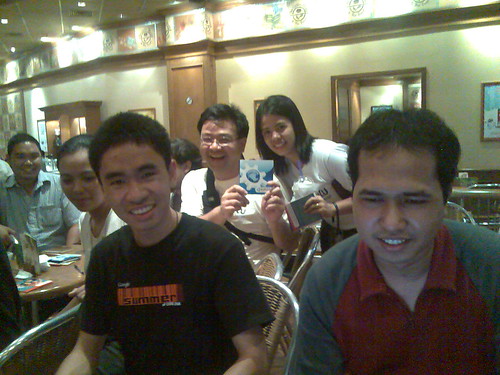
Last night I called Ubunteros nearby Manila for the Edgy Eft (belated) release party at the Coffee Bean and Tea Leaf at Greenbelt 3. Little did I know that there will be a lot of folks coming from the just-concluded FOSS@work workshop joining in the fun, thanks to Yolynne Medina and Eric Pareja. Diane Gonzales and I got to the venue first, then followed by the FOSS@Work folks. Dominique Cimafranca, Migs Paraz, Ranulf Goss, Jopes Gallardo, and Joel Bryan Juliano were there too, and all in all we were easily the noisiest group in the coffee shop, seemingly occupying the entirety of the place. I originally planned to move the group to have dinner somewhere, but along the way everybody seemed to forgot dinner and we quite engaged in talking to everyone else. It was terrific. The 2 boxes of Edgy ,K,Ed Ubuntu CDs I brought were easily given away to everyone; we even had them exchanged and autographed (naks!) reminiscent of what Ealden and I did last February when Mark came here. As a finale, we had a group photo of everyone with their CDs; Dominique remarks that in his informal’ study, more and more women prefer Ubuntu (and I sure do think he’ll be blogging more about this soon. ;) Needless to say, the above photo doesn’t do great justice to what happened last night; it came from my elric which I didn’t get use much as a camera since I too was happily chatting away. That said, I expect RJ Ian will be posting his photos from his brand-spanking-new Kodak camera to the Ubuntu-PH site once he gets back to Mindanao with Yolynne and company. I also think the FOSS@Work folks also have their own photosite or wiki to post more photos, which we’ll be seeing sooner. Jerome Gotangco and Ealden Esca an, the guys whom we all owe Ubuntu-PH to, were unfortunately unable to attend last night, as Jerome was off to Cebu to participate in the ICT congress there, while Ealden was quite busy at work. Hopefully they (as well as last night’s attendees!) can attend the next Release Party for 7.04 (aka Feisty Fawn,) and hopefully it will be just as fun, and be more meaningful if more Ubuntu-PH folks get involved in its development! Update: Yolynne and RJ just posted pics fresh from their arrival to home. Expect more pics later, nicely tagged too…

15 November 2006

Jonathan McDowell: MPEG2 straight to the brane

I received a Freecom DVB-T stick last week (early wedding present). I've not actually played with DVB-T before, so I wasn't sure how much of a hassle it would be. My first act was to plug it into my laptop, with the aim of finding out the USB ID and thus which driver I'd need to compile up (I have a tendancy to build my own kernels with only drivers I think I'm likely to need). I did so and was greeted with:
dvb-usb: found a 'WideView WT-220U PenType Receiver (Typhoon/Freecom)' in cold state, will try to load a firmware
dvb-usb: did not find the firmware file. (dvb-usb-wt220u-02.fw) Please see linux/Documentation/dvb/ for more details on firmware-problems. (-2)
usbcore: registered new driver dvb_usb_dtt200u
Interesting, think I. I'm more organised than I thought and have already compiled up all the various v4l bits I thought I might end up using. So I go looking for the firmware file, find a copy, dump it in /usr/lib/hotplug/firmware/. Replug the device. And get:
dvb-usb: found a 'WideView WT-220U PenType Receiver (Typhoon/Freecom)' in cold state, will try to load a firmware
dvb-usb: downloading firmware from file 'dvb-usb-wt220u-02.fw'
usb 1-4: USB disconnect, address 15
dvb-usb: generic DVB-USB module successfully deinitialized and disconnected.
usb 1-4: new high speed USB device using ehci_hcd and address 16
usb 1-4: configuration #1 chosen from 1 choice
dvb-usb: found a 'WideView WT-220U PenType Receiver (Typhoon/Freecom)' in warm state.
dvb-usb: will use the device's hardware PID filter (table count: 15).
DVB: registering new adapter (WideView WT-220U PenType Receiver (Typhoon/Freecom)).
DVB: registering frontend 0 (WideView USB DVB-T)...
Rockin'. Now I need to tune it. I find Adam's DVB page which has the initial tuning file for the Tacolneston transmitter in Norfolk. I type scan uk-Tacolneston. It fails to find anything. I wonder if I'm using the wrong transmitter. I decide the supplied antenna is probably to blame and go to see about sorting out the one in the attic. I try again. I get a channels.conf containing 91 channels. Wooo. Copy this into ~/.mplayer/ and fire up mplayer dvb://. And have Freeview on my laptop. Nice. Unfortunately this requires me to have the loft aerial plugged into my laptop, which isn't very portable. Paddy tell me this will get better when the analogue transmitters get turned off and the digital power ramped up, so I look forward to that. Until then it should still prove useful to have a portable DVB-T stick - I intend to see if I can pick up BBC HD next time I'm staying in London, and check if Freeview coverage has made it to my parents' yet. Writing this all down makes it seem quite convoluted, but actually the process was a lot smoother than I expected; plug in stick, copy firmware, replug stick, scan for channels, watch tv. The issue that took most time to sort was the aerial. It's really quite cool to think about how easily you can get yourself an MPEG2 stream of TV to play with.

Next.

Previous.