Search Results: "don"

9 September 2020

Reproducible Builds: Reproducible Builds in August 2020

Welcome to the August 2020 report from the Reproducible Builds project. In our monthly reports, we summarise the things that we have been up to over the past month. The motivation behind the Reproducible Builds effort is to ensure no flaws have been introduced from the original free software source code to the pre-compiled binaries we install on our systems. If you re interested in contributing to the project, please visit our main website.


This month, Jennifer Helsby launched a new reproduciblewheels.com website to address the lack of reproducibility of Python wheels. To quote Jennifer s accompanying explanatory blog post:

One hiccup we ve encountered in SecureDrop development is that not all Python wheels can be built reproducibly. We ship multiple (Python) projects in Debian packages, with Python dependencies included in those packages as wheels. In order for our Debian packages to be reproducible, we need that wheel build process to also be reproducible
Parallel to this, transparencylog.com was also launched, a service that verifies the contents of URLs against a publicly recorded cryptographic log. It keeps an append-only log of the cryptographic digests of all URLs it has seen. (GitHub repo) On 18th September, Bernhard M. Wiedemann will give a presentation in German, titled Wie reproducible builds Software sicherer machen ( How reproducible builds make software more secure ) at the Internet Security Digital Days 2020 conference.

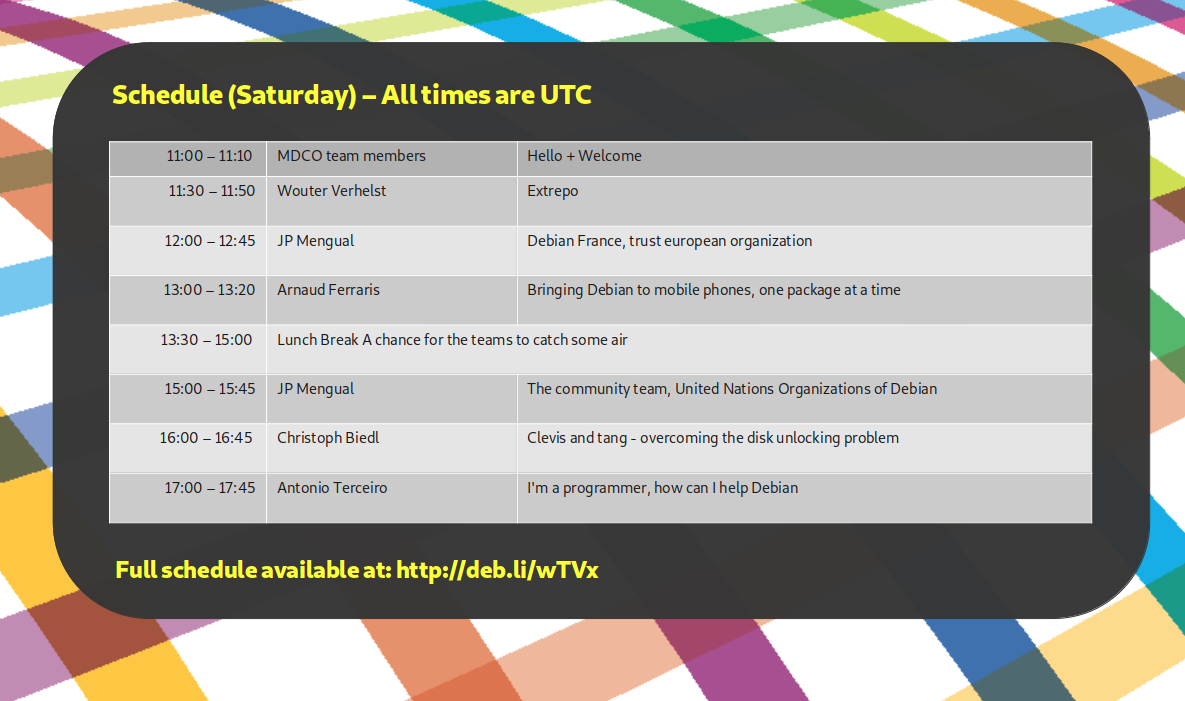
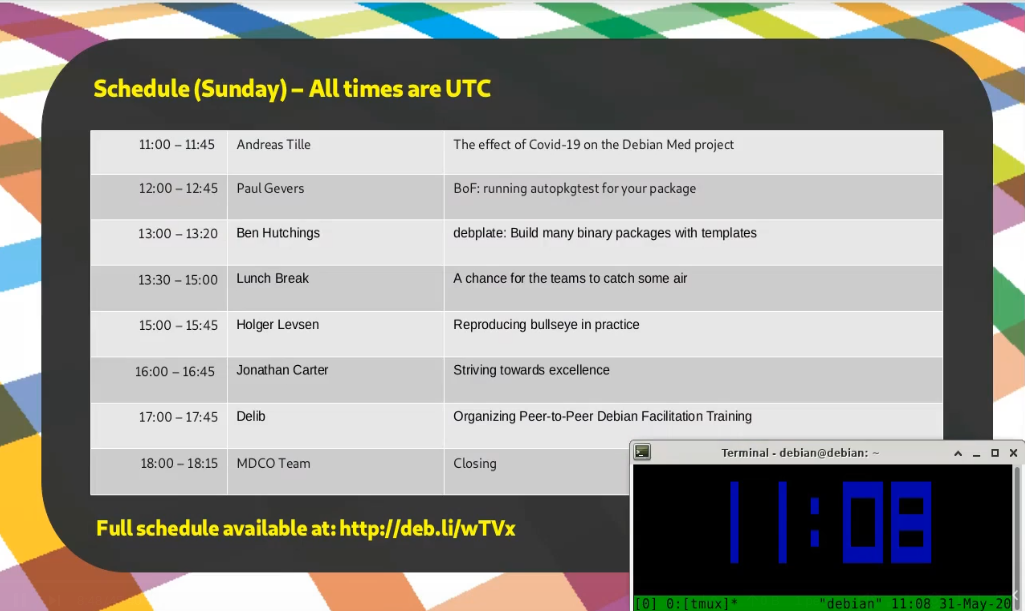
Reproducible builds at DebConf20 There were a number of talks at the recent online-only DebConf20 conference on the topic of reproducible builds. Holger gave a talk titled Reproducing Bullseye in practice , focusing on independently verifying that the binaries distributed from ftp.debian.org are made from their claimed sources. It also served as a general update on the status of reproducible builds within Debian. The video (145 MB) and slides are available. There were also a number of other talks that involved Reproducible Builds too. For example, the Malayalam language mini-conference had a talk titled , ? ( I want to join Debian, what should I do? ) presented by Praveen Arimbrathodiyil, the Clojure Packaging Team BoF session led by Elana Hashman, as well as Where is Salsa CI right now? that was on the topic of Salsa, the collaborative development server that Debian uses to provide the necessary tools for package maintainers, packaging teams and so on. Jonathan Bustillos (Jathan) also gave a talk in Spanish titled Un camino verificable desde el origen hasta el binario ( A verifiable path from source to binary ). (Video, 88MB)

Development work After many years of development work, the compiler for the Rust programming language now generates reproducible binary code. This generated some general discussion on Reddit on the topic of reproducibility in general. Paul Spooren posted a request for comments to OpenWrt s openwrt-devel mailing list asking for clarification on when to raise the PKG_RELEASE identifier of a package. This is needed in order to successfully perform rebuilds in a reproducible builds context. In openSUSE, Bernhard M. Wiedemann published his monthly Reproducible Builds status update. Chris Lamb provided some comments and pointers on an upstream issue regarding the reproducibility of a Snap / SquashFS archive file. [ ]


Debian Holger Levsen identified that a large number of Debian .buildinfo build certificates have been tainted on the official Debian build servers, as these environments have files underneath the /usr/local/sbin directory [ ]. He also filed against bug for debrebuild after spotting that it can fail to download packages from snapshot.debian.org [ ]. This month, several issues were uncovered (or assisted) due to the efforts of reproducible builds. For instance, Debian bug #968710 was filed by Simon McVittie, which describes a problem with detached debug symbol files (required to generate a traceback) that is unlikely to have been discovered without reproducible builds. In addition, Jelmer Vernooij called attention that the new Debian Janitor tool is using the property of reproducibility (as well as diffoscope when applying archive-wide changes to Debian:
New merge proposals also include a link to the diffoscope diff between a vanilla build and the build with changes. Unfortunately these can be a bit noisy for packages that are not reproducible yet, due to the difference in build environment between the two builds. [ ]
56 reviews of Debian packages were added, 38 were updated and 24 were removed this month adding to our knowledge about identified issues. Specifically, Chris Lamb added and categorised the nondeterministic_version_generated_by_python_param and the lessc_nondeterministic_keys toolchain issues. [ ][ ] Holger Levsen sponsored Lukas Puehringer s upload of the python-securesystemslib pacage, which is a dependency of in-toto, a framework to secure the integrity of software supply chains. [ ] Lastly, Chris Lamb further refined his merge request against the debian-installer component to allow all arguments from sources.list files (such as [check-valid-until=no]) in order that we can test the reproducibility of the installer images on the Reproducible Builds own testing infrastructure and sent a ping to the team that maintains that code.

Upstream patches The Reproducible Builds project detects, dissects and attempts to fix as many currently-unreproducible packages as possible. We endeavour to send all of our patches upstream where appropriate. This month, we wrote a large number of these patches, including:

diffoscope diffoscope is our in-depth and content-aware diff utility that can not only locate and diagnose reproducibility issues, it provides human-readable diffs of all kinds. In August, Chris Lamb made the following changes to diffoscope, including preparing and uploading versions 155, 156, 157 and 158 to Debian:
  • New features:
    • Support extracting data of PGP signed data. (#214)
    • Try files named .pgp against pgpdump(1) to determine whether they are Pretty Good Privacy (PGP) files. (#211)
    • Support multiple options for all file extension matching. [ ]
  • Bug fixes:
    • Don t raise an exception when we encounter XML files with <!ENTITY> declarations inside the Document Type Definition (DTD), or when a DTD or entity references an external resource. (#212)
    • pgpdump(1) can successfully parse some binary files, so check that the parsed output contains something sensible before accepting it. [ ]
    • Temporarily drop gnumeric from the Debian build-dependencies as it has been removed from the testing distribution. (#968742)
    • Correctly use fallback_recognises to prevent matching .xsb binary XML files.
    • Correct identify signed PGP files as file(1) returns data . (#211)
  • Logging improvements:
    • Emit a message when ppudump version does not match our file header. [ ]
    • Don t use Python s repr(object) output in Calling external command messages. [ ]
    • Include the filename in the not identified by any comparator message. [ ]
  • Codebase improvements:
    • Bump Python requirement from 3.6 to 3.7. Most distributions are either shipping with Python 3.5 or 3.7, so supporting 3.6 is not only somewhat unnecessary but also cumbersome to test locally. [ ]
    • Drop some unused imports [ ], drop an unnecessary dictionary comprehensions [ ] and some unnecessary control flow [ ].
    • Correct typo of output in a comment. [ ]
  • Release process:
    • Move generation of debian/tests/control to an external script. [ ]
    • Add some URLs for the site that will appear on PyPI.org. [ ]
    • Update author and author email in setup.py for PyPI.org and similar. [ ]
  • Testsuite improvements:
    • Update PPU tests for compatibility with Free Pascal versions 3.2.0 or greater. (#968124)
    • Mark that our identification test for .ppu files requires ppudump version 3.2.0 or higher. [ ]
    • Add an assert_diff helper that loads and compares a fixture output. [ ][ ][ ][ ]
  • Misc:
In addition, Mattia Rizzolo documented in setup.py that diffoscope works with Python version 3.8 [ ] and Frazer Clews applied some Pylint suggestions [ ] and removed some deprecated methods [ ].

Website This month, Chris Lamb updated the main Reproducible Builds website and documentation to:

  • Clarify & fix a few entries on the who page [ ][ ] and ensure that images do not get to large on some viewports [ ].
  • Clarify use of a pronoun re. Conservancy. [ ]
  • Use View all our monthly reports over View all monthly reports . [ ]
  • Move a is a suffix out of the link target on the SOURCE_DATE_EPOCH age. [ ]
In addition, Javier Jard n added the freedesktop-sdk project [ ] and Kushal Das added SecureDrop project [ ] to our projects page. Lastly, Michael P hn added internationalisation and translation support with help from Hans-Christoph Steiner [ ].

Testing framework The Reproducible Builds project operate a Jenkins-based testing framework to power tests.reproducible-builds.org. This month, Holger Levsen made the following changes:
  • System health checks:
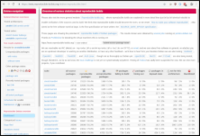
    • Improve explanation how the status and scores are calculated. [ ][ ]
    • Update and condense view of detected issues. [ ][ ]
    • Query the canonical configuration file to determine whether a job is disabled instead of duplicating/hardcoding this. [ ]
    • Detect several problems when updating the status of reporting-oriented metapackage sets. [ ]
    • Detect when diffoscope is not installable [ ] and failures in DNS resolution [ ].
  • Debian:
    • Update the URL to the Debian security team bug tracker s Git repository. [ ]
    • Reschedule the unstable and bullseye distributions often for the arm64 architecture. [ ]
    • Schedule buster less often for armhf. [ ][ ][ ]
    • Force the build of certain packages in the work-in-progress package rebuilder. [ ][ ]
    • Only update the stretch and buster base build images when necessary. [ ]
  • Other distributions:
    • For F-Droid, trigger jobs by commits, not by a timer. [ ]
    • Disable the Archlinux HTML page generation job as it has never worked. [ ]
    • Disable the alternative OpenWrt rebuilder jobs. [ ]
  • Misc;
Many other changes were made too, including:
  • Chris Lamb:
    • Use <pre> HTML tags when dumping fixed-width debugging data in the self-serve package scheduler. [ ]
  • Mattia Rizzolo:
  • Vagrant Cascadian:
    • Mark that the u-boot Universal Boot Loader should not build architecture independent packages on the arm64 architecture anymore. [ ]
Finally, build node maintenance was performed by Holger Levsen [ ], Mattia Rizzolo [ ][ ] and Vagrant Cascadian [ ][ ][ ][ ]

Mailing list On our mailing list this month, Leo Wandersleb sent a message to the list after he was wondering how to expand his WalletScrutiny.com project (which aims to improve the security of Bitcoin wallets) from Android wallets to also monitor Linux wallets as well:
If you think you know how to spread the word about reproducibility in the context of Bitcoin wallets through WalletScrutiny, your contributions are highly welcome on this PR [ ]
Julien Lepiller posted to the list linking to a blog post by Tavis Ormandy titled You don t need reproducible builds. Morten Linderud (foxboron) responded with a clear rebuttal that Tavis was only considering the narrow use-case of proprietary vendors and closed-source software. He additionally noted that the criticism that reproducible builds cannot prevent against backdoors being deliberately introduced into the upstream source ( bugdoors ) are decidedly (and deliberately) outside the scope of reproducible builds to begin with. Chris Lamb included the Reproducible Builds mailing list in a wider discussion regarding a tentative proposal to include .buildinfo files in .deb packages, adding his remarks regarding requiring a custom tool in order to determine whether generated build artifacts are identical in a reproducible context. [ ] Jonathan Bustillos (Jathan) posted a quick email to the list requesting whether there was a list of To do tasks in Reproducible Builds. Lastly, Chris Lamb responded at length to a query regarding the status of reproducible builds for Debian ISO or installation images. He noted that most of the technical work has been performed but there are at least four issues until they can be generally advertised as such . He pointed that the privacy-oriented Tails operation system, which is based directly on Debian, has had reproducible builds for a number of years now. [ ]

If you are interested in contributing to the Reproducible Builds project, please visit our Contribute page on our website. However, you can get in touch with us via:

7 September 2020

Arturo Borrero Gonz lez: Debconf 2020 online, summary

Debconf2020 logo Debconf2020 took place when I was on personal vacations time. But anyway I m lucky enough that my company, the Wikimedia Foundation, paid the conference registration fee for me and allowed me to take the time (after my vacations) to watch recordings from the conference. This is my first time attending (or watching) a full-online conference, and I was curious to see first hand how it would develop. I was greatly surprised to see it worked pretty nicely, so kudos to the organization, video team, volunteers, etc! What follows is my summary of the conference, from the different sessions and talks I watched (again, none of them live but recordings). The first thing I saw was the Welcome to Debconf 2020 opening session. It is obvious the video was made with lots of love, I found it entertaining and useful. I love it :-) Then I watched the BoF Can Free Software improve social equality. It was introduced and moderated by Hong Phuc Dang. Several participants, about 10 people, shared their visions on the interaction between open source projects and communities. I m pretty much aware of the interesting social advancement that FLOSS can enable in communities, but sometimes is not so easy, it may also present challenges and barriers. The BoF was joined by many people from the Asia Pacific region, and for me, it has been very interesting to take a step back from the usual western vision of this topic. Anyway, about the session itself, I have the feeling the participants may have spent too much time on presentations, sharing their local stories (which are interesting, don t get me wrong), perhaps leaving little room for actual proposal discussions or the like. Next I watched the Bits from the DPL talk. In the session, Jonathan Carter goes over several topics affecting the project, both internally and externally. It was interesting to know more about the status of the project from a high level perspective, as an organization, including subjects such as money, common project problems, future issues we are anticipating, the social aspect of the project, etc. The Lightning Talks session grabbed my attention. It is usually very funny to watch and not as dense as other talks. I m glad I watched this as it includes some interesting talks, ranging from HAM radios (I love them!), to personal projects to help in certain tasks, and even some general reflections about life. Just when I m writing this very sentence, the video for the Come and meet your Debian Publicity team! talk has been uploaded. This team does an incredible work in keeping project information flowing, and social networks up-to-date and alive. Mind that the work of this team is mostly non-engineering, but still, is a vital part of the project. The folks in session explain what the team does, and they also discuss how new people can contribute, the different challenges related to language barriers, etc. I have to admit I also started watching a couple other sessions that turned out to don t be interesting to me (and therefore I didn t finish the video). Also, I tried to watch a couple more sessions that didn t publish their video recording just yet, for example the When We Virtualize the Whole Internet talk by Sam Hartman. Will check again in a couple of days. It is a real pleasure the video recordings from the conference are made available online. One can join the conference anytime (like I m doing!) and watch the sessions at any pace at any time. The video archive is big, I won t be able to go over all of it. I won t lie, I still have some pending videos to watch from last year Debconf2019 :-)

6 September 2020

Russ Allbery: September haul

So many good books, so little reading time. Jairus Banaji A Brief History of Commercial Capitalism (nonfiction)
Steven Brust The Baron of Magister Valley (sff)
Micaiah Johnson The Space Between Worlds (sff)
Ian McDonald Luna: New Moon (sff)
Elizabeth Moon Trading in Danger (sff)
Tamsyn Muir Harrow the Ninth (sff)
Suzanne Palmer Finder (sff)
Kit Rocha Beyond Shame (sff)
Kit Rocha Beyond Control (sff)
Kit Rocha Beyond Pain (sff)
Arundhati Roy Azadi (nonfiction)
Jeff VanderMeer Authority (sff)
Jeff VanderMeer Acceptance (sff)
K.B. Wagers Behind the Throne (sff)
Jarrett Walker Human Transit (nonfiction) I took advantage of a few sales to get books I know I'm going to want to read eventually for a buck or two.

4 September 2020

Reproducible Builds (diffoscope): diffoscope 159 released

The diffoscope maintainers are pleased to announce the release of diffoscope version 159. This version includes the following changes:
[ Chris Lamb ]
* Show "ordering differences only" in strings(1) output.
  (Closes: reproducible-builds/diffoscope#216)
* Don't alias output from "os.path.splitext" to variables that we do not end
  up using.
* Don't raise exceptions when cleaning up after a guestfs cleanup failure.
[ Jean-Romain Garnier ]
* Make "Command" subclass a new generic Operation class.
You find out more by visiting the project homepage.

3 September 2020

Molly de Blanc: All Animals Are Equal, Peter Singer

I recently read Disability Visibility, which opens with a piece by Harriet McBryde Johnson about debating Peter Singer. When I got my first reading for my first class and saw it was Peter Singer, I was dismayed because of his (heinous) stances in disability. I assumed All Animals Are Equal was one of Singer s pieces about animal rights. While I agree with many of the principles Singer discusses around animal rights, I feel as though his work on this front is significantly diminished by his work around disability. To put it simply, I can t take Peter Singer seriously. Because of this I had a lot of trouble reading All Animals Are Equal and taking it in good faith. I judged everything from his arguments to his writing harshly. While I don t disagree with his basic point (all animals have rights) I disagree with how he made the point and the argument supporting it. One of the things I was told to ask when reading any philosophy paper is What is the argument? or What are they trying to convince you of? In this case, you could frame the answer as: Animals have some of) the same rights people do. I think it would be more accurate though to frame it as All animals (including humans) have (some of) the same rights or even Humans are as equally worthy of consideration as animals are. I think when we usually talk about animal rights, we do it from a perspective of wanting to elevate animals to human status. From one perspective, I don t like this approach because I feel as though it turns the framing of rights as something you deserve or earn, privileges you get for being good enough. The point about rights is that they are inherent you get them because they are. The valuable thing I got out of All Animals Are Equal is that rights are not universal. When we talk about things like abortion, for example, we talk about the right to have an abortion. Singer asks whether people who cannot get pregnant have the right to an abortion? What he doesn t dig into is that the right to an abortion is really just an extension of bodily autonomy turning one facet of bodily autonomy into the legal right to have a medical procedure. I think this is worth thinking about more turning high level human rights into the mundane rights, and acknowledging that not everyone can or needs them.

2 September 2020

Kees Cook: security things in Linux v5.6

Previously: v5.5. Linux v5.6 was released back in March. Here s my quick summary of various features that caught my attention: WireGuard
The widely used WireGuard VPN has been out-of-tree for a very long time. After 3 1/2 years since its initial upstream RFC, Ard Biesheuvel and Jason Donenfeld finished the work getting all the crypto prerequisites sorted out for the v5.5 kernel. For this release, Jason has gotten WireGuard itself landed. It was a twisty road, and I m grateful to everyone involved for sticking it out and navigating the compromises and alternative solutions. openat2() syscall and RESOLVE_* flags
Aleksa Sarai has added a number of important path resolution scoping options to the kernel s open() handling, covering things like not walking above a specific point in a path hierarchy (RESOLVE_BENEATH), disabling the resolution of various magic links (RESOLVE_NO_MAGICLINKS) in procfs (e.g. /proc/$pid/exe) and other pseudo-filesystems, and treating a given lookup as happening relative to a different root directory (as if it were in a chroot, RESOLVE_IN_ROOT). As part of this, it became clear that there wasn t a way to correctly extend the existing openat() syscall, so he added openat2() (which is a good example of the efforts being made to codify Extensible Syscall arguments). The RESOLVE_* set of flags also cover prior behaviors like RESOLVE_NO_XDEV and RESOLVE_NO_SYMLINKS. pidfd_getfd() syscall
In the continuing growth of the much-needed pidfd APIs, Sargun Dhillon has added the pidfd_getfd() syscall which is a way to gain access to file descriptors of a process in a race-less way (or when /proc is not mounted). Before, it wasn t always possible make sure that opening file descriptors via /proc/$pid/fd/$N was actually going to be associated with the correct PID. Much more detail about this has been written up at LWN. openat() via io_uring
With my attack surface reduction hat on, I remain personally suspicious of the io_uring() family of APIs, but I can t deny their utility for certain kinds of workloads. Being able to pipeline reads and writes without the overhead of actually making syscalls is pretty great for performance. Jens Axboe has added the IORING_OP_OPENAT command so that existing io_urings can open files to be added on the fly to the mapping of available read/write targets of a given io_uring. While LSMs are still happily able to intercept these actions, I remain wary of the growing syscall multiplexer that io_uring is becoming. I am, of course, glad to see that it has a comprehensive (if out of tree ) test suite as part of liburing. removal of blocking random pool
After making algorithmic changes to obviate separate entropy pools for random numbers, Andy Lutomirski removed the blocking random pool. This simplifies the kernel pRNG code significantly without compromising the userspace interfaces designed to fetch cryptographically secure random numbers. To quote Andy, This series should not break any existing programs. /dev/urandom is unchanged. /dev/random will still block just after booting, but it will block less than it used to. See LWN for more details on the history and discussion of the series. arm64 support for on-chip RNG
Mark Brown added support for the future ARMv8.5 s RNG (SYS_RNDR_EL0), which is, from the kernel s perspective, similar to x86 s RDRAND instruction. This will provide a bootloader-independent way to add entropy to the kernel s pRNG for early boot randomness (e.g. stack canary values, memory ASLR offsets, etc). Until folks are running on ARMv8.5 systems, they can continue to depend on the bootloader for randomness (via the UEFI RNG interface) on arm64. arm64 E0PD
Mark Brown added support for the future ARMv8.5 s E0PD feature (TCR_E0PD1), which causes all memory accesses from userspace into kernel space to fault in constant time. This is an attempt to remove any possible timing side-channel signals when probing kernel memory layout from userspace, as an alternative way to protect against Meltdown-style attacks. The expectation is that E0PD would be used instead of the more expensive Kernel Page Table Isolation (KPTI) features on arm64. powerpc32 VMAP_STACK
Christophe Leroy added VMAP_STACK support to powerpc32, joining x86, arm64, and s390. This helps protect against the various classes of attacks that depend on exhausting the kernel stack in order to collide with neighboring kernel stacks. (Another common target, the sensitive thread_info, had already been moved away from the bottom of the stack by Christophe Leroy in Linux v5.1.) generic Page Table dumping
Related to RISCV s work to add page table dumping (via /sys/fs/debug/kernel_page_tables), Steven Price extracted the existing implementations from multiple architectures and created a common page table dumping framework (and then refactored all the other architectures to use it). I m delighted to have this because I still remember when not having a working page table dumper for ARM delayed me for a while when trying to implement upstream kernel memory protections there. Anything that makes it easier for architectures to get their kernel memory protection working correctly makes me happy. That s in for now; let me know if there s anything you think I missed. Next up: Linux v5.7.

2020, Kees Cook. This work is licensed under a Creative Commons Attribution-ShareAlike 4.0 License.
CC BY-SA 4.0

Vincent Bernat: Syncing SSH keys on Cisco IOS-XR with a custom Ansible module

The cisco.iosxr collection from Ansible Galaxy provides an iosxr_user module to manage local users, along with their SSH keys. However, the module is quite slow, do not display a diff for changed SSH keys, never signal change when a key is modified, and does not delete obsolete keys. Let s write a custom Ansible module managing only the SSH keys while fixing these issues.

Notice I recommend that you read Writing a custom Ansible module as an introduction.

How to add an SSH key to a user Adding SSH keys to users in Cisco IOS-XR is quite undocumented. First, you need to encode the key with the ssh-rsa key ASN.1 format, like an OpenSSH public key, but without the base64-encoding:
$ awk ' print $2 ' id_rsa.pub \
      base64 -d \
    > publickey_vincent.raw
Then, you upload the key with SCP to harddisk:/publickey_vincent.raw and import it for the current user with the following IOS command:
crypto key import authentication rsa harddisk:/publickey_vincent.b64
However, if you want to import a key for another user, you need to be part of the root-system group:
username vincent
 group root-lr
 group root-system
With the following admin command, you can attach a key to another user:
admin crypto key import authentication rsa username cedric harddisk:/publickey_cedric.b64

Code The module has the following signature and it installs the specified key for each user and remove keys from retired users the ones we do not specify.
iosxr_users:
  keys:
    vincent: ssh-rsa AAAAB3NzaC1yc2EAA[ ]ymh+YrVWLZMJR
    cedric:  ssh-rsa AAAAB3NzaC1yc2EAA[ ]RShPA8w/8eC0n

Prerequisites Unlike the iosxr_user module, our custom module only handles SSH keys, one per user. Therefore, the user definitions have to already exist in the running configuration.1 Moreover, the user defined in ansible_user needs to be in the root-system group. The cisco.iosxr collection must also be installed as the module relies on its code. When running the module, ansible_connection needs to be set to network_cli and ansible_network_os to iosxr. These variables are usually defined in the inventory.

Module definition Starting from the skeleton described in the previous article, we define the module:
module_args = dict(
    keys=dict(type='dict', elements='str', required=True),
)
module = AnsibleModule(
    argument_spec=module_args,
    supports_check_mode=True
)
result = dict(
    changed=False
)

Getting the installed keys The next step is to retrieve the keys currently installed. This can be done with the following command:
# show crypto key authentication rsa all
Key label: vincent
Type     : RSA public key authentication
Size     : 2048
Imported : 16:17:08 UTC Tue Aug 11 2020
Data     :
 30820122 300D0609 2A864886 F70D0101 01050003 82010F00 3082010A 02820101
 00D81E5B A73D82F3 77B1E4B5 949FB245 60FB9167 7CD03AB7 ADDE7AFE A0B83174
 A33EC0E6 1C887E02 2338367A 8A1DB0CE 0C3FBC51 15723AEB 07F301A4 B1A9961A
 2D00DBBD 2ABFC831 B0B25932 05B3BC30 B9514EA1 3DC22CBD DDCA6F02 026DBBB6
 EE3CFADA AFA86F52 CAE7620D 17C3582B 4422D24F D68698A5 52ED1E9E 8E41F062
 7DE81015 F33AD486 C14D0BB1 68C65259 F9FD8A37 8DE52ED0 7B36E005 8C58516B
 7EA6C29A EEE0833B 42714618 50B3FFAC 15DBE3EF 8DA5D337 68DAECB9 904DE520
 2D627CEA 67E6434F E974CF6D 952AB2AB F074FBA3 3FB9B9CC A0CD0ADC 6E0CDB2A
 6A1CFEBA E97AF5A9 1FE41F6C 92E1F522 673E1A5F 69C68E11 4A13C0F3 0FFC782D
 27020301 0001
[ ]
ansible_collections.cisco.iosxr.plugins.module_utils.network.iosxr.iosxr contains a run_commands() function we can use:
command = "show crypto key authentication rsa all"
out = run_commands(module, command)
out = out[0].replace(' \n', '\n')
A common library to parse a command output is textfsm: a Python module using a template-based state machine for parsing semi-formatted text.
template = r"""
Value Required Label (\w+)
Value Required,List Data ([A-F0-9 ]+)
Start
 ^Key label: $ Label 
 ^Data\s+: -> GetData
GetData
 ^ $ Data 
 ^$$ -> Record Start
""".lstrip()
re_table = textfsm.TextFSM(io.StringIO(template))
got =  data[0]: "".join(data[1]).replace(' ', '')
       for data in re_table.ParseText(out) 
got is a dictionary associating key labels, considered as usernames, with a hexadecimal representation of the public key currently installed. It looks like this:
>>> pprint(got)
 'alfred': '30820122300D0609[ ]6F0203010001',
 'cedric': '30820122300D0609[ ]710203010001',
 'vincent': '30820122300D0609[ ]270203010001' 

Comparing with the wanted keys Let s now build the wanted dictionary using the same structure. In module.params['keys'], we have a dictionary associating usernames to public SSH keys in the OpenSSH format:
>>> pprint(module.params['keys'])
 'cedric': 'ssh-rsa AAAAB3NzaC1yc2[ ]',
 'vincent': 'ssh-rsa AAAAB3NzaC1yc2[ ]' 
We need to convert these keys in the same hexadecimal representation used by Cisco above. The ssh-keygen command and some glue can do the conversion:2
$ ssh-keygen -f id_rsa.pub -e -mPKCS8 \
     grep -v '^---' \
     base64 -d \
     hexdump -e '4/1 "%0.2X"'
30820122300D06092[ ]782D270203010001
Assuming we have a ssh2cisco() function doing that, we can build the wanted dictionary:
wanted =  k: ssh2cisco(v)
          for k, v in module.params['keys'].items() 

Applying changes Back to the skeleton described in the previous article, the last step is to apply the changes if there is a difference between got and wanted when not running with check mode. The part comparing got and wanted is taken verbatim from the skeleton module:
if got != wanted:
    result['changed'] = True
    result['diff'] = dict(
        before=yaml.safe_dump(got),
        after=yaml.safe_dump(wanted)
    )
if module.check_mode or not result['changed']:
    module.exit_json(**result)
Let s copy the new or changed keys and attach them to their respective users. For this purpose, we reuse the get_connection() and copy_file() functions from ansible_collections.cisco.iosxr.plugins.module_utils.network.iosxr.iosxr.
conn = get_connection(module)
for user in wanted:
    if user not in got or wanted[user] != got[user]:
        dst = f"/harddisk:/publickey_ user .raw"
        with tempfile.NamedTemporaryFile() as src:
            decoded = base64.b64decode(
                module.params['keys'][user].split()[1])
            src.write(decoded)
            src.flush()
            copy_file(module, src.name, dst)
    command = ("admin crypto key import authentication rsa "
               f"username  user   dst ")
    conn.send_command(command, prompt="yes/no", answer="yes")
Then, we remove obsolete keys:
for user in got:
    if user not in wanted:
        command = ("admin crypto key zeroize authentication rsa "
                   f"username  user ")
        conn.send_command(command, prompt="yes/no", answer="yes")

The complete code is available on GitHub. Compared to the iosxr_user module, this one displays a diff when running with --diff, correctly signals a change, is faster, 3 and deletes unwanted SSH keys. However, it is unable to create users and cannot configure passwords or multiple SSH keys.

  1. In our environment, the Ansible playbook pushes a full configuration, including the user definitions. Then, it synchronizes the SSH keys.
  2. Despite the argument provided to ssh-keygen, the format used by Cisco is not PKCS#8. This is the ASN.1 representation of a Subject Public Key Info structure, as defined in RFC 2459. Moreover, PKCS#8 is a format for a private key, not a public one.
  3. The main factors for being faster are:
    • not creating users, and
    • not reuploading existing SSH keys.

Vincent Bernat: Writing a custom Ansible module

Ansible ships a lot of modules you can combine for your configuration management needs. However, the quality of these modules may vary widely. Sometimes, it may be quicker and more robust to write your own module instead of shopping and assembling existing ones.1 In my opinion, a robust module exhibits the following characteristics: In a nutshell, it means the module can run with --diff --check and shows the changes it would apply. When run twice in a row, the second run won t apply or signal changes. The last bullet point suggests the module should be able to delete outdated objects configured during previous runs.2 The module code should be minimal and tailored to your needs. Making the module generic for use by other users is a non-goal. Less code usually means less bugs and easier to understand. I do not cover testing here. It is undeniably a good practice, but it requires a significant effort. In my opinion, it is preferable to have a well written module matching the above characteristics rather than a module that is well tested but without them or a module requiring further (untested) assembly to meet your needs.

Module skeleton Ansible documentation contains instructions to build a module, along with some best practices. As one of our non-goal is to distribute it, we choose to take some shortcuts and skip some of the boilerplate. Let s assume we build a module with the following signature:
custom_module:
  user: someone
  password: something
  data: "some random string"
There are various locations you can put a module in Ansible. A common possibility is to include it into a role. In a library/ subdirectory, create an empty __init__.py file and a custom_module.py file with the following code:3
#!/usr/bin/python
import yaml
from ansible.module_utils.basic import AnsibleModule
def main():
    # Define options accepted by the module.  
    module_args = dict(
        user=dict(type='str', required=True),
        password=dict(type='str', required=True, no_log=True),
        data=dict(type='str', required=True),
    )
    module = AnsibleModule(
        argument_spec=module_args,
        supports_check_mode=True
    )
    result = dict(
        changed=False
    )
    got =  
    wanted =  
    # Populate both  got  and  wanted .  
    # [...]
    if got != wanted:
        result['changed'] = True
        result['diff'] = dict(
            before=yaml.safe_dump(got),
            after=yaml.safe_dump(wanted)
        )
    if module.check_mode or not result['changed']:
        module.exit_json(**result)
    # Apply changes.  
    # [...]
    module.exit_json(**result)
if __name__ == '__main__':
    main()
The first part, in , defines the module, with the accepted options. Refer to the documentation on argument_spec for more details. The second part, in , builds the got and wanted variables. got is the current state while wanted is the target state. For example, if you need to modify records in a database server, got would be the current rows while wanted would be the modified rows. Then, we compare got and wanted. If there is a difference, changed is switched to True and we prepare the diff object. Ansible uses it to display the differences between the states. If we are running in check mode or if no change is detected, we stop here. The last part, in , applies the changes. Usually, it means iterating over the two structures to detect the differences and create the missing items, delete the unwanted ones and update the existing ones.

Documentation Ansible provides a fairly complete page on how to document a module. I advise you to take a more minimal approach by only documenting each option sparingly,4 skipping the examples and only documenting return values if it needs to. I usually limit myself to something like this:
DOCUMENTATION = """
---
module: custom_module.py
short_description: Pass provided data to remote service
description:
  - Mention anything useful for your workmate.
  - Also mention anything you want to remember in 6 months.
options:
  user:
    description:
      - user to identify to remote service
  password:
    description:
      - password for authentication to remote service
  data:
    description:
      - data to send to remote service
"""

Error handling If you run into an error, you can stop the execution with module.fail_json():
module.fail_json(
    msg=f"remote service answered with  code :  message ",
    **result
)
There is no requirement to intercept all errors. Sometimes, not swallowing an exception provides better information than replacing it with a generic message.

Returning additional values A module may return additional information that can be captured to be used in another task through the register directive. For this purpose, you can add arbitrary fields to the result dictionary. Have a look at the documentation for common return values. You should try to add these fields before exiting the module when in check mode. The returned values can be documented.

Examples Here are several examples of custom modules following the previous skeleton. Each example highlight why a custom module was written instead of assembling existing modules.

  1. Also, when using modules from Ansible Galaxy, you introduce a dependency to a third-party. This is not something that should be decided lightly: it may break later, it may only meet 80% of the needs, it may add bugs.
  2. Some declarative systems, like Terraform, exhibits all these behaviors.
  3. Do not worry about the shebang. It is hardcoded to /usr/bin/python. Ansible will modify it to match the chosen interpreter on the remote host. You can write Python 3 code if ansible_python_interpreter evaluates to a Python 3 interpreter.
  4. The main issue I have with this non-programmatic approach to documentation is that it partly repeats the information contained in argument_spec. I think an auto-documenting structure would avoid this.

Elana Hashman: My term at the Open Source Initiative thus far

When I ran for the OSI board in early 2019, I set three goals for myself: Now that the OSI has announced hiring an interim General Manager, I thought it would be a good time to publicly reflect on what I've accomplished and what I'd like to see next. As I promised in my campaign pitch, I aim to be publicly accountable :) Growing the OSI's membership I have served as our Membership Committee Chair since the May 2019 board meeting, tasked with devising and supervising strategy to increase membership and deliver value to members. As part of my election campaign last year, I signed up over 50 new individual members. Since May 2019, we've seen strong 33% growth of individual members, to reach a new all-time high over 600 (638 when I last checked). I see the OSI as a relatively neutral organization that occupies a unique position to build bridges among organizations within the FOSS ecosystem. In order to facilitate this, we need a representative membership, and we need to engage those members and provide forums for cross-pollination. As Membership Committee Chair, I have been running quarterly video calls on Jitsi for our affiliate members, where we can share updates between many global organizations and discuss challenges we all face. But it's not enough just to hold the discussion; we also need to bring fresh new voices into the conversation. Since I've joined the board, I'm thrilled to say that 16 new affiliate members joined (in chronological order) for a total of 81: I was also excited to run a survey of the OSI's individual and affiliate membership to help inform the future of the organization that received 58 long-form responses. The survey has been accepted by the board at our August meeting and should be released publicly soon! Defending the Open Source Definition When I joined the board, the first committee I joined was the License Committee, which is responsible for running the licence review process, making recommendations on new licenses, and maintaining our existing licenses. Over the past year, under Pamela Chestek's leadership as Chair, the full board has approved the following licenses (with SPDX identifiers in brackets) on the recommendation of the License Committee: We withheld approval of the following licenses: I've also worked to define the scope of work for hiring someone to improve our license review process, which we have an open RFP for! Chopping wood and carrying water I joined the OSI with the goal of improving an organization I didn't think was performing up to its potential. Its membership and board were not representative of the wider open source community, its messaging felt outdated, and it seemed to be failing to rise to today's challenges for FOSS. But before one can rise to meet these challenges, you need a strong foundation. The OSI needed the organizational structure, health, and governance in order to address such questions. Completing that work is essential, but not exactly glamourous and it's a place that I thrive. Honestly, I don't (yet?) want to be the public face of the organization, and I apologize to those who've missed me at events like FOSDEM. I want to talk a little about some of my behind-the-scenes activities that I've completed as part of my board service: All of this work is intended to improve the organization's health and provide it with an excellent foundation for its mission. Defining the future of open source Soon after I was elected to the board, I gave a talk at Brooklyn.js entitled "The Future of Open Source." In this presentation, I pondered about the history and future of the free and open source software movement, and the ethical questions we must face. In my election campaign, I wrote "Software licenses are a means, not an end, to open source software. Focusing on licensing is necessary but not sufficient to ensure a vibrant, thriving open source community. Focus on licensing to the exclusion of other serious community concerns is to our collective detriment." My primary goal for my first term on the board was to ensure the OSI would be positioned to answer wider questions about the open source community and its future beyond licenses. Over the past two months, I supported Megan Byrd-Sanicki's suggestion to hold (and then participated in, with the rest of the board) organizational strategy sessions to facilitate our long-term planning. My contribution to help inform these sessions was providing the member survey on behalf of the Membership Committee. Now, I think we are much better equiped to face the hard questions we'll have to tackle. In my opinion, the Open Source Initiative is better positioned than ever to answer them, and I can't wait to see what the future brings. Hope to see you at our first State of the Source conference next week!

Junichi Uekawa: Updated page to record how-to video.

Updated page to record how-to video. I don't need big camera image, I just need a tiny image with probably my face on it. As a start, I tried extracting a rectangle.

Norbert Preining: Multiple GPUs for graphics and deep learning

For long time I have been using a good old nvidia GeForce GTX 1050 for my display and deep learning needs. I reported a few times how to get Tensorflow running on Debian/Sid, see here and here. Later on I switched to AMD GPU in the hope that an open source approach to both GPU driver as well as deep learning (ROCm) would improve the general experience. Unfortunately it turned out that AMD GPUs are generally not ready for deep learning usage. The problems with AMD and ROCm are far and wide. First of all, it seems that for anything more complicated then simple stuff, AMD s flagship RX 5700(XT) and all GFX10 (Navi) based cards are not(!!!) supported in ROCm. Yes, you read correct AMD does not support 5700(XT) cards in the ROCm stack. Some simple stuff works, but nothing for real computations. Then, even IF they would support, ROCm as distributed is currently a huge pain in the butt. The source code is a huge mess, and building usable packages from it is probably possible, but quite painful (I am member of the ROCm packaging team in Debian, and have tried many hours). And the packages provided by AMD are not installable on Debian/sid due to library incompatibilities. So that left me with a bit a problem: for work I need to train quite some neural networks, do model selection, etc. Doing this on a CPU is a bit a burden. So at the end I decided to put the nVidia card back into the computer (well, after moving it to a bigger case but that is a different story to tell). Here are the steps I did to get both cards working for their respective target: AMD GPU for driving the console and X (and games!), and the nVidia card doing the deep learning stuff (tensorflow using the GPU). Starting point Starting point was a working AMD GPU installation. The AMD GPU is also the first GPU card (top slot) and thus the one that is used by the BIOS and the Linux console. If you want the video output on the second card you need to trick, and probably don t have console output, etc etc. So not a solution for me. Installing libcuda1 and the nvidia kernel drivers Next step was installing the libcuda1 package:

apt install libcuda1
This installs a lot of stuff, including the nvidia drivers, GLX libraries, alternatives setup, and update-glx tool and package. The kernel module should be built and installed automatically for your kernel. Installing CUDA Follow more or less the instructions here and do
wget -O- https://developer.download.nvidia.com/compute/cuda/repos/ubuntu1804/x86_64/7fa2af80.pub   sudo tee /etc/apt/trusted.gpg.d/nvidia-cuda.asc
echo "deb http://developer.download.nvidia.com/compute/cuda/repos/ubuntu1804/x86_64/ /"   sudo tee /etc/apt/sources.list.d/nvidia-cuda.list
sudo apt-get update
sudo apt-get install cuda-libraries-10-1
Warning! At the moment Tensorflow packages require CUDA 10.1, so don t install the 10.0 version. This might change in the future! This will install lots of libs into /usr/local/cuda-10.1 and add the respective directory to the ld.so path by creating a file /etc/ld.so.conf.d/cuda-10-1.conf. Install CUDA CuDNN One difficult to satisfy dependency are the CuDNN libraries. In our case we need the version 7 library for CUDA 10.1. To download these files one needs to have a NVIDIA developer account, which is quick and painless. After that go to the CuDNN page where one needs to select Archived releases and then Download cuDNN v7.N.N (xxxx NN, YYYY), for CUDA 10.1 and then cuDNN Runtime Library for Ubuntu18.04 (Deb). At the moment (as of today) this will download a file libcudnn7_7.6.5.32-1+cuda10.1_amd64.deb which needs to be installed with dpkg -i libcudnn7_7.6.5.32-1+cuda10.1_amd64.deb. Updating the GLX setting Here now comes the very interesting part one needs to set up the GLX libraries. Reading the output of update-glx --help and then the output of update-glx --list glx:
$ update-glx --help
update-glx is a wrapper around update-alternatives supporting only configuration
of the 'glx' and 'nvidia' alternatives. After updating the alternatives, it
takes care to trigger any follow-up actions that may be required to complete
the switch.
 
It can be used to switch between the main NVIDIA driver version and the legacy
drivers (eg: the 304 series, the 340 series, etc).
 
For users with Optimus-type laptops it can be used to enable running the discrete
GPU via bumblebee.
 
Usage: update-glx <command>
 
Commands:
  --auto <name>            switch the master link <name> to automatic mode.
  --display <name>         display information about the <name> group.
  --query <name>           machine parseable version of --display <name>.
  --list <name>            display all targets of the <name> group.
  --config <name>          show alternatives for the <name> group and ask the
                           user to select which one to use.
  --set <name> <path>      set <path> as alternative for <name>.
 
<name> is the master name for this link group.
  Only 'nvidia' and 'glx' are supported.
<path> is the location of one of the alternative target files.
  (e.g. /usr/lib/nvidia)
 
$ update-glx --list glx
/usr/lib/mesa-diverted
/usr/lib/nvidia
I was tempted into using
update-glx --config glx /usr/lib/mesa-diverted
because at the end the Mesa GLX libraries should be used to drive the display via the AMD GPU. Unfortunately, with this neither the nvidia kernel module was loaded, the nvidia persistenced couldn t run because the library libnvidia-cfg1 wasn t found (not sure it was needed at all ), and with that also no way to run tensorflow on GPU. So what I did I tried
update-glx --auto glx
(which is the same as update-glx --config glx /usr/lib/nvidia), and rebooted, and decided to check afterwards what is broken. To my big surprise, the AMD GPU still worked out of the box, including direct rendering, and the games I tried (Overload, Supraland via Wine) all worked without a hinch. Not that I really understand why the GLX libraries that are seemingly now in use are from nvidia but work the same (if anyone has an explanation, that would be great!), but since I haven t had any problems till now, I am content. Checking GPU usage in tensorflow Make sure that you remove tensorflow-rocm and reinstall tensorflow with GPU support:
pip3 uninstall tensorflow-rocm
pip3 install --upgrade tensorflow-gpu
After that a simple
$ python3 -c "import tensorflow as tf;print(tf.reduce_sum(tf.random.normal([1000, 1000])))"
....(lots of output)
2020-09-02 11:57:04.673096: I tensorflow/core/common_runtime/gpu/gpu_device.cc:1402] Created TensorFlow device (/job:localhost/replica:0/task:0/device:GPU:0 with 3581 MB memory) -> physical GPU (device: 0, name: GeForce GTX 1050 Ti, pci bus id: 0000:05:00.0, compute capability: 6.1)
tf.Tensor(1093.4915, shape=(), dtype=float32)
$
should indicate that the GPU is used by tensorflow! The R Keras package should also work out of the box and pick up the system-wide tensorflow which in turn picks the GPU, see this post for example code to run for tests. Conclusion All in all it was easier than expected, despite the dances one has to do for nvidia to get the correct libraries. What still puzzles me is the selection option in update-glx, and might need a better support for secondary nvidia GPU cards.

1 September 2020

Utkarsh Gupta: FOSS Activites in August 2020

Here s my (eleventh) monthly update about the activities I ve done in the F/L/OSS world.

Debian
This was my 20th month of contributing to Debian. I became a DM in late March last year and a DD last Christmas! \o/ Well, this month we had DebConf! \o/
(more about this later this week!) Anyway, here are the following things I did in Debian this month:

Uploads and bug fixes:

Other $things:
  • Mentoring for newcomers.
  • FTP Trainee reviewing.
  • Moderation of -project mailing list.
  • Sponsored php-dasprid-enum and php-bacon-baconqrcode for William and ruby-unparser, ruby-morpher, and ruby-path-exapander for Cocoa.

Goodbye GSoC! \o/ In May, I got selected as a Google Summer of Code student for Debian again! \o/
I am working on the Upstream-Downstream Cooperation in Ruby project. The other 5 blogs can be found here: Also, I log daily updates at gsocwithutkarsh2102.tk. Since this is a wrap and whilst the daily updates are already available at the above site^, I ll quickly mention the important points and links here.

Debian (E)LTS
Debian Long Term Support (LTS) is a project to extend the lifetime of all Debian stable releases to (at least) 5 years. Debian LTS is not handled by the Debian security team, but by a separate group of volunteers and companies interested in making it a success. And Debian Extended LTS (ELTS) is its sister project, extending support to the Jessie release (+2 years after LTS support). This was my eleventh month as a Debian LTS and my second as a Debian ELTS paid contributor.
I was assigned 21.75 hours for LTS and 14.25 hours for ELTS and worked on the following things:

LTS CVE Fixes and Announcements:

ELTS CVE Fixes and Announcements:
  • Issued ELA 255-1, fixing CVE-2020-14344, for libx11.
    For Debian 8 Jessie, these problems have been fixed in version 2:1.6.2-3+deb8u3.
  • Issued ELA 259-1, fixing CVE-2020-10177, for pillow.
    For Debian 8 Jessie, these problems have been fixed in version 2.6.1-2+deb8u5.
  • Issued ELA 269-1, fixing CVE-2020-11985, for apache2.
    For Debian 8 Jessie, these problems have been fixed in version 2.4.10-10+deb8u17.
  • Started working on clamAV update, it s a major bump from v0.101.5 to v0.102.4. There were lots of movings parts. Contacted upstream maintainers to help reduce the risk of regression. Came up with a patch to loosen the libcurl version requirement. Hopefully, the update could be rolled out soon!

Other (E)LTS Work:
  • I spent an additional 11.15 hours working on compiling the responses of the LTS survey and preparing a gist of it for its presentation during the Debian LTS BoF at DebConf20.
  • Triaged qemu, pillow, gupnp, clamav, apache2, and uwsgi.
  • Marked CVE-2020-11538/pillow as not-affected for Stretch.
  • Marked CVE-2020-11984/apache2 as not-affected for Stretch.
  • Marked CVE-2020-10378/pillow as not-affected for Jessie.
  • Marked CVE-2020-11538/pillow as not-affected for Jessie.
  • Marked CVE-2020-3481/clamav as not-affected for Jessie.
  • Marked CVE-2020-11984/apache2 as not-affected for Jessie.
  • Marked CVE-2020- 9490,11993 /apache2 as not-affected for Jessie.
  • Hosted Debian LTS BoF at DebConf20. Recording here.
  • General discussion on LTS private and public mailing list.

Until next time.
:wq for today.

Russell Coker: BBB vs Jitsi

I previously wrote about how I installed the Jitsi video-conferencing system on Debian [1]. We used that for a few unofficial meetings of LUV to test it out. Then we installed Big Blue Button (BBB) [2]. The main benefit of Jitsi over BBB is that it supports live streaming to YouTube. The benefits of BBB are a better text chat system and a whiteboard that allows conference participants to draw shared diagrams. So if you have the ability to run both systems then it s best to use Jitsi when you have so many viewers that a YouTube live stream is needed and to use BBB in all other situations. One problem is with the ability to run both systems. Jitsi isn t too hard to install if you are installing it on a VM that is not used for anything else. BBB is a major pain no matter what you do. The latest version of BBB is 2.2 which was released in March 2020 and requires Ubuntu 16.04 (which was released in 2016 and has standard support until April next year) and doesn t support Ubuntu 18.04 (released in 2018 and has standard support until 2023). The install script doesn t check for correct apt repositories and breaks badly with no explanation if you don t have Ubuntu Multiverse enabled. I expect that they rushed a release because of the significant increase in demand for video conferencing this year. But that s no reason for demanding the 2016 version of Ubuntu, why couldn t they have developed on version 18.04 for the last 2 years? Since that release they have had 6 months in which they could have released a 2.2.1 version supporting Ubuntu 18.04 or even 20.04. The dependency list for BBB is significant, among other things it uses LibreOffice for the whiteboard. This adds to the pain of installing and maintaining it. It wouldn t surprise me if some of the interactions between all the different components have security issues. Conclusion If you want something that s not really painful to install and run then use Jitsi. If you need YouTube live streaming use Jitsi. If you need whiteboards and a good text chat system or if you generally need to run things like a classroom then BBB is a good option. But only if you can manage it, know someone who can manage it for you, or are happy to pay for a managed service provider to do it for you.

Sylvain Beucler: Debian LTS and ELTS - August 2020

Debian LTS Logo Here is my transparent report for my work on the Debian Long Term Support (LTS) and Debian Extended Long Term Support (ELTS), which extend the security support for past Debian releases, as a paid contributor. In August, the monthly sponsored hours were split evenly among contributors depending on their max availability - I was assigned 21.75h for LTS (out of my 30 max; all done) and 14.25h for ELTS (out of my 20 max; all done). We had a Birds of a Feather videoconf session at DebConf20, sadly with varying quality for participants (from very good to unusable), where we shared the first results of the LTS survey. There were also discussions about evaluating our security reactivity, which proved surprisingly hard to estimate (neither CVE release date and criticality metrics are accurate nor easily available), and about when it is appropriate to use public naming in procedures. Interestingly ELTS gained new supported packages, thanks to a new sponsor -- so far I'd seen the opposite, because we were close to the EOL. As always, there were opportunities to de-dup work through mutual cooperation with the Debian Security team, and LTS/ELTS similar updates. ELTS - Jessie LTS - Stretch Documentation/Scripts

Paul Wise: FLOSS Activities August 2020

Focus This month I didn't have any particular focus. I just worked on issues in my info bubble.

Changes

Issues

Review

Administration
  • Debian: restarted RAM eating service
  • Debian wiki: unblock IP addresses, approve accounts

Sponsors The cython-blis/preshed/thinc/theano bugs and smart-open/python-importlib-metadata/python-pyfakefs/python-zipp/python-threadpoolctl backports were sponsored by my employer. All other work was done on a volunteer basis.

31 August 2020

Chris Lamb: Free software activities in August 2020

Here is another monthly update covering what I have been doing in the free software world during August 2020 (previous month): I uploaded Lintian versions 2.86.0, 2.87.0, 2.88.0, 2.89.0, 2.90.0, 2.91.0 and 2.92.0, as well as made the following changes:

Reproducible Builds One of the original promises of open source software is that distributed peer review and transparency of process results in enhanced end-user security. However, whilst anyone may inspect the source code of free and open source software for malicious flaws, almost all software today is distributed as pre-compiled binaries. This allows nefarious third-parties to compromise systems by injecting malicious code into ostensibly secure software during the various compilation and distribution processes. The motivation behind the Reproducible Builds effort is to ensure no flaws have been introduced during this compilation process by promising identical results are always generated from a given source, thus allowing multiple third-parties to come to a consensus on whether a build was compromised. The project is proud to be a member project of the Software Freedom Conservancy. Conservancy acts as a corporate umbrella allowing projects to operate as non-profit initiatives without managing their own corporate structure. If you like the work of the Conservancy or the Reproducible Builds project, please consider becoming an official supporter. This month, I:

diffoscope I made the following changes to diffoscope, including preparing and uploading versions 155, 156, 157 and 158 to Debian:

Debian Debian LTS This month I have worked 18 hours on Debian Long Term Support (LTS) and 12 hours on its sister Extended LTS project. You can find out more about the project via the following video:


Uploads to Debian

Jacob Adams: Command Line 101

How to Work in a Text-Only Environment.

What is this thing? When you first open a command-line (note that I use the terms command-line and shell interchangably here, they re basically the same, but command-line is the more general term, and shell is the name for the program that executes commands for you) you ll see something like this: thisfolder This line is called a command prompt and it tells you four pieces of information:

  1. jaadams: The username of the user that is currently running this shell.
  2. bg7: The name of the computer that this shell is running on, important for when you start accessing shells on remote machines.
  3. /tmp/thisfolder: The folder or directory that your shell is currently running in. Like a file explorer (like Window s Explorer or Mac s Finder) a shell always has a working directory, from which all relative paths (see sidenote below) are resolved.
When you first opened a shell, however, you might notice that is looks more like this: home This is a shorthand notation that the shell uses to make this output shorter when possible. ~ stands for your home directory, usually /home/<username>. Like C:\Users\<username>\ on Windows or /Users/<username> on Mac, this directory is where all your files should go by default. Thus a command prompt like this: downloads actually tells you that you are currently in the /home/jaadams/Downloads directory.


Sidenote: The Unix Filesystem and Relative Paths folders on Linux and other Unix-derived systems like MacOS are usually called directories. These directories are represented by paths, strings that indicate where the directory is on the filesystem. The one unusual part is the so-called root directory . All files are stored in this folder or directories under it. Its path is just / and there are no directories above it. For example, the directory called home typically contains all user directories. This is stored in the root directory, and each users specific data is stored in a directory named after that user under home. Thus, the home directory of the user jacob is typically /home/jacob, the directory jacob under the home directory stored in the root directory /. If you re interested in more details about what goes in what directory, man hier has the basics and the Filesystem Hierarchy Standard governs the layout of the filesystem on most Linux distributions. You don t always have to use the full path, however. If the path does not begin with a /, it is assumed that the path actually begins with the path of the current directory. So if you use a path like my/folders/here, and you re in the /home/jacob directory, the path will be treated like /home/jacob/my/folders/here. Each folder also contains the symbolic links .. and .. Symbolic links are a very powerful kind of file that is actually a reference to another file. .. always represents the parent directory of the current directory, so /home/jacob/.. links to /home/. . always links to the current directory, so /home/jacob/. links to /home/jacob.

Running commands To run a command from the command prompt, you type its name and then usually some arguments to tell it what to do. For example, the echo command displays the text passed as arguments.
jacob@lovelace/home/jacob$ echo hello world
hello world
Arguments to commands are space-separated, so in the previous example hello is the first argument and world is the second. If you need an argument to contain spaces, you ll want to put quotes around it, echo "like so". Certain arguments are called flags , or options (options if they take another argument, flags otherwise) usually prefixed with a hyphen, and they change the way a program operates. For example, the ls command outputs the contents of a directory passed as an argument, but if you add -l before the directory, it will give you more details on the files in that directory.
jacob@lovelace/tmp/test$ ls /tmp/test
1  2  3  4  5  6
jacob@lovelace/tmp/test$ ls -l /tmp/test
total 0
-rw-r--r-- 1 jacob jacob 0 Aug 26 22:06 1
-rw-r--r-- 1 jacob jacob 0 Aug 26 22:06 2
-rw-r--r-- 1 jacob jacob 0 Aug 26 22:06 3
-rw-r--r-- 1 jacob jacob 0 Aug 26 22:06 4
-rw-r--r-- 1 jacob jacob 0 Aug 26 22:06 5
-rw-r--r-- 1 jacob jacob 0 Aug 26 22:06 6
jacob@lovelace/tmp/test$
Most commands take different flags to change their behavior in various ways.

File Management
  • cd <path>: Change the current directory of the running shell to <path>.
  • ls <path>: Output the contents of <path>. If no path is passed, it prints the contents of the current directory.
  • touch <filename>: create an new empty file called <filename>. Used on an existing file, it updates the file s last accessed and modified times. Most text editors can also create a new file for you, which is probably more useful.
  • mkdir <directory>: Create a new folder/directory at path <directory>.
  • mv <src> <dest>: Move a file or directory at path <src> to <dest>.
  • cp <src> <dest>: Copy a file or directory at path <src> to <dest>.
  • rm <file>: Remove a file at path <file>.
  • zip -r <zipfile> <contents...>: Create a zip file <zipfile> with contents <contents>. <contents> can be multiple arguments, and you ll usually want to use the -r argument when including directories in your zipfile, as otherwise only the directory will be included and not the files and directories within it.

Searching
  • grep <thing> <file>: Look for the string <thing> in <file>. If no <file> is passed it searches standard input.
  • find <path> -name <name>: Find a file or directory called <name> somwhere under <path>. This command is actually very powerful, but also very complex. For example you can delete all files in a directory older than 30 days with:
    find -mtime +30 -exec rm  \;
    
  • locate <name>: A much easier to use command to find a file with a given name, but it is not usually installed by default.

Outputting Files
  • cat <files...>: Output (concatenate) all the files passed as arguments.
  • head <file>: Output the beginning of <file>
  • tail <file>: Output the end of <file>

How to Find the Right Command All commands (at least on sane Linux distributions like Debian or Ubuntu) are documented with a manual page, in man section 1 (for more information on manual sections, run man intro). This can be accessed using man <command> You can search for the right command using the -k flag, as in man -k <search>. You can also view manual pages in your browser, on sites like https://manpages.debian.org or https://linux.die.net/man. This is not always helpful, however, because some command s descriptions are not particularly useful, and also there are a lot of manual pages, which can make searching for a specific one difficult. For example, finding the right command to search inside text files is quite difficult via man (it s grep). When you can t find what you need with man I recommend falling back to searching the Internet. There are lots of bad Linux tutorials out there, but here are some reputable sources I recommend:
  • https://www.cyberciti.biz: nixCraft has excellent tutorials on all things Linux
  • Hosting providers like Digital Ocean or Linode: Good intro documentation, but can sometimes be outdated
  • https://tldp.org: The Linux Documentation project is great, but it can also be a little outdated sometimes.
  • https://stackoverflow.com: Oftentimes has great answers, but quality varies wildly since anyone can answer.
These are certainly not the only options but they re the sources I would recommend when available.

How to Read a Manual Page Manual pages consist of a series of sections, each with a specific purpose. Instead of attempting to write my own description here, I m going to borrow the excellent one from The Linux Documentation Project
The NAME section is the only required section. Man pages without a name section are as useful as refrigerators at the north pole. This section also has a standardized format consisting of a comma-separated list of program or function names, followed by a dash, followed by a short (usually one line) description of the functionality the program (or function, or file) is supposed to provide. By means of makewhatis(8), the name sections make it into the whatis database files. Makewhatis is the reason the name section must exist, and why it must adhere to the format I described. (Formatting explanation cut for brevity) The SYNOPSIS section is intended to give a short overview on available program options. For functions this sections lists corresponding include files and the prototype so the programmer knows the type and number of arguments as well as the return type. The DESCRIPTION section eloquently explains why your sequence of 0s and 1s is worth anything at all. Here s where you write down all your knowledge. This is the Hall Of Fame. Win other programmers and users admiration by making this section the source of reliable and detailed information. Explain what the arguments are for, the file format, what algorithms do the dirty jobs. The OPTIONS section gives a description of how each option affects program behaviour. You knew that, didn t you? The FILES section lists files the program or function uses. For example, it lists configuration files, startup files, and files the program directly operates on. (Cut details about installing files) The ENVIRONMENT section lists all environment variables that affect your program or function and tells how, of course. Most commonly the variables will hold pathnames, filenames or default options. The DIAGNOSTICS section should give an overview of the most common error messages from your program and how to cope with them. There s no need to explain system error error messages (from perror(3)) or fatal signals (from psignal(3)) as they can appear during execution of any program. The BUGS section should ideally be non-existent. If you re brave, you can describe here the limitations, known inconveniences and features that others may regard as misfeatures. If you re not so brave, rename it the TO DO section ;-) The AUTHOR section is nice to have in case there are gross errors in the documentation or program behaviour (Bzzt!) and you want to mail a bug report. The SEE ALSO section is a list of related man pages in alphabetical order. Conventionally, it is the last section.

Remote Access One of the more powerful uses of the shell is through ssh, the secure shell. This allows you to remotely connect to another computer and run a shell on that machine:
user@host:~$ ssh other@example.com
other@example:~$
The prompt changes to reflect the change in user and host, as you can see in the example above. This allows you to work in a shell on that machine as if it was right in front of you.

Moving Files Between Machines There are several ways you can move files between machines over ssh. The first and easiest is scp, which works much like the cp command except that paths can also take a user@host argument to move files across computers. For example, if you wanted to move a file test.txt to your home directory on another machine, the command would look like:
scp test.txt other@example.com:
(The home directory is the default path) Otherwise you can move files by reversing the order of the arguments and put a path after the colon to move files from another directory on the remote host. For example, if you wanted to fetch the file /etc/issue.net from example.com:
scp other@example.com:/etc/issue.net .
Another option is the sftp command, which gives you a very simple shell-like interface in which you can cd and ls, before either puting files onto the local machine or geting files off of it. The final and most powerful option is rsync which syncs the contents of one directory to another, and doesn t copy files that haven t changed. It s powerful and complex, however, so I recommend reading the USAGE section of its man page.

Long-Running Commands The one problem with ssh is that it will stop any command running in your shell when you disconnect. If you want to leave something on and come back later then this can be a problem. This is where terminal multiplexers come in. tmux and screen both allow you to run a shell in a safe environment where it will continue even if you disconnect from it. You do this by running the command without any arguments, i.e. just tmux or just screen. In tmux you can disconnect from the current session by pressing Ctrl+b then d, and reattach with the tmux attach command. screen works similarly, but with Ctrl+a instead of b and screen -r to reattach.

Command Inputs and Outputs Arguments are not the only way to pass input to a command. They can also take input from what s called standard input , which the shell usually connects to your keyboard. Output can go to two places, standard output and standard error, both of which are directed to the screen by default.

Redirecting I/O Note that I said above that standard input/output/error are only usually connected to the keyboard and the terminal? This is because you can redirect them to other places with the shell operators <, > and the very powerful .

File redirects The operators < and > redirect the input and output of a command to a file. For example, if you wanted a file called list.txt that contained a list of all the files in a directory /this/one/here you could use:
ls /this/one/here > list.txt

Pipelines The pipe character, , allows you to direct the output of one command into the input of another. This can be very powerful. For example, the following pipeline lists the contents of the current directory searches for the string test , then counts the number of results. (wc -l counts the number of lines in its input)
ls   grep test   wc -l
For a better, but even more contrived example, say you have a file myfile, with a bunch of lines of potentially duplicated and unsorted data
test
test
1234
4567
1234
You can sort it and output only the unique lines with sort and uniq:
$ uniq < myfile   sort
1234
1234
4567
test

Save Yourself Some Typing: Globs and Tab-Completion Sometimes you don t want to type out the whole filename when writing out a command. The shell can help you here by autocompleting when you press the tab key. If you have a whole bunch of files with the same suffix, you can refer to them when writing arguments as *.suffix. This also works with prefixes, prefix*, and in fact you can put a * anywhere, *middle*. The shell will expand that * into all the files in that directory that match your criteria (ending with a specific suffix, starting with a specific prefix, and so on) and pass each file as a separate argument to the command. For example, if I have a series of files called 1.txt, 2.txt, and so on up to 9, each containing just the number for which it s named, I could use cat to output all of them like so:
jacob@lovelace/tmp/numbers$ ls
1.txt  2.txt  3.txt  4.txt  5.txt  6.txt  7.txt  8.txt	9.txt
jacob@lovelace/tmp/numbers$ cat *.txt
1
2
3
4
5
6
7
8
9
Also the ~ shorthand mentioned above that refers to your home directory can be used when passing a path as an argument to a command.

Ifs and For loops The files in the above example were generated with the following shell commands:
for i in 1 2 3 4 5 6 7 8 9
do
echo $i > $i.txt
done
But I ll have to save variables, conditionals and loops for another day because this is already too long. Needless to say the shell is a full programming language, although a very ugly and dangerous one.

30 August 2020

Mike Hommey: [Linux] Disabling CPU turbo, cores and threads without rebooting

[Disclaimer: this has been sitting as a draft for close to three months ; I forgot to publish it, this is now finally done.] In my previous blog post, I built Firefox in a multiple different number of configurations where I d disable the CPU turbo, some of its cores or some of its threads. That is something that was traditionally done via the BIOS, but rebooting between each attempt is not really a great experience. Fortunately, the Linux kernel provides a large number of knobs that allow this at runtime. Turbo This is the most straightforward:
$ echo 0 > /sys/devices/system/cpu/cpufreq/boost
Re-enable with
$ echo 1 > /sys/devices/system/cpu/cpufreq/boost
CPU frequency throttling Even though I haven t mentioned it, I might as well add this briefly. There are many knobs to tweak frequency throttling, but assuming your goal is to disable throttling and set the CPU frequency to its fastest non-Turbo frequency, this is how you do it:
$ echo performance > /sys/devices/system/cpu/cpu$n/cpufreq/scaling_governor
where $n is the id of the core you want to do that for, so if you want to do that for all the cores, you need to do that for cpu0, cpu1, etc. Re-enable with:
$ echo ondemand > /sys/devices/system/cpu/cpu$n/cpufreq/scaling_governor
(assuming this was the value before you changed it ; ondemand is usually the default) Cores and Threads This one requires some attention, because you cannot assume anything about the CPU numbers. The first thing you want to do is to check those CPU numbers. You can do so by looking at the physical id and core id fields in /proc/cpuinfo, but the output from lscpu --extended is more convenient, and looks like the following:
CPU NODE SOCKET CORE L1d:L1i:L2:L3 ONLINE MAXMHZ    MINMHZ
0   0    0      0    0:0:0:0       yes    3700.0000 2200.0000
1   0    0      1    1:1:1:0       yes    3700.0000 2200.0000
2   0    0      2    2:2:2:0       yes    3700.0000 2200.0000
3   0    0      3    3:3:3:0       yes    3700.0000 2200.0000
4   0    0      4    4:4:4:1       yes    3700.0000 2200.0000
5   0    0      5    5:5:5:1       yes    3700.0000 2200.0000
6   0    0      6    6:6:6:1       yes    3700.0000 2200.0000
7   0    0      7    7:7:7:1       yes    3700.0000 2200.0000
(...)
32  0    0      0    0:0:0:0       yes    3700.0000 2200.0000
33  0    0      1    1:1:1:0       yes    3700.0000 2200.0000
34  0    0      2    2:2:2:0       yes    3700.0000 2200.0000
35  0    0      3    3:3:3:0       yes    3700.0000 2200.0000
36  0    0      4    4:4:4:1       yes    3700.0000 2200.0000
37  0    0      5    5:5:5:1       yes    3700.0000 2200.0000
38  0    0      6    6:6:6:1       yes    3700.0000 2200.0000
39  0    0      7    7:7:7:1       yes    3700.0000 2200.0000
(...)
Now, this output is actually the ideal case, where pairs of CPUs (virtual cores) on the same physical core are always n, n+32, but I ve had them be pseudo-randomly spread in the past, so be careful. To turn off a core, you want to turn off all the CPUs with the same CORE identifier. To turn off a thread (virtual core), you want to turn off one CPU. On machines with multiple sockets, you can also look at the SOCKET column. Turning off one CPU is done with:
$ echo 0 > /sys/devices/system/cpu/cpu$n/online
Re-enable with:
$ echo 1 > /sys/devices/system/cpu/cpu$n/online
Extra: CPU sets CPU sets are a feature of Linux s cgroups. They allow to restrict groups of processes to a set of cores. The first step is to create a group like so:
$ mkdir /sys/fs/cgroup/cpuset/mygroup
Please note you may already have existing groups, and you may want to create subgroups. You can do so by creating subdirectories. Then you can configure on which CPUs/cores/threads you want processes in this group to run on:
$ echo 0-7,16-23 > /sys/fs/cgroup/cpuset/mygroup/cpuset.cpus
The value you write in this file is a comma-separated list of CPU/core/thread numbers or ranges. 0-3 is the range for CPU/core/thread 0 to 3 and is thus equivalent to 0,1,2,3. The numbers correspond to /proc/cpuinfo or the output from lscpu as mentioned above. There are also memory aspects to CPU sets, that I won t detail here (because I don t have a machine with multiple memory nodes), but you can start with:
$ cat /sys/fs/cgroup/cpuset/cpuset.mems > /sys/fs/cgroup/cpuset/mygroup/cpuset.mems
Now you re ready to assign processes to this group:
$ echo $pid >> /sys/fs/cgroup/cpuset/mygroup/tasks
There are a number of tweaks you can do to this setup, I invite you to check out the cpuset(7) manual page. Disabling a group is a little involved. First you need to move the processes to a different group:
$ while read pid; do echo $pid > /sys/fs/cgroup/cpuset/tasks; done < /sys/fs/cgroup/cpuset/mygroup/tasks
Then deassociate CPU and memory nodes:
$ > /sys/fs/cgroup/cpuset/mygroup/cpuset.cpus
$ > /sys/fs/cgroup/cpuset/mygroup/cpuset.mems
And finally remove the group:
$ rmdir /sys/fs/cgroup/cpuset/mygroup

Jonathan Carter: The metamorphosis of Loopy Loop

Dealing with the void during MiniDebConf Online #1 Between 28 and 31 May this year, we set out to create our first ever online MiniDebConf for Debian. Many people have been meaning to do something similar for a long time, but it just didn t work out yet. With many of us being in lock down due to COVID-19, and with the strong possibility looming that DebConf20 might have had to become an online event, we rushed towards organising the first ever Online MiniDebConf and put together some form of usable video stack for it. I could go into all kinds of details on the above, but this post is about a bug that lead to a pretty nifty feature for DebConf20. The tool that we use to capture Jitsi calls is called Jibri (Jitsi Broadcasting Infrustructure). It had a bug (well, bug for us, but it s an upstream feature) where Jibri would hang up after 30s of complete silence, because it would assume that the call has ended and that the worker can be freed up again. This would result in the stream being ended at the end of every talk, so before the next talk, someone would have to remember to press play again in their media player or on the video player on the stream page. Hrmph. Easy solution on the morning that the conference starts? I was testing a Debian Live image the night before in a KVM and thought that I might as well just start a Jitsi call from there and keep a steady stream of silence so that Jibri doesn t hang up. It worked! But the black screen and silence on stream was a bit eery. Because this event was so experimental in nature, and because we were on such an incredibly tight timeline, we opted not to seek sponsors for this event, so there was no sponsors loop that we d usually stream during a DebConf event. Then I thought Ah! I could just show the schedule! .

The stream looked bright and colourful (and was even useful!) and Jitsi/Jibri didn t die. I thought my work was done. As usual, little did I know how untrue that was. The silence was slightly disturbing after the talks, and people asked for some music. Playing music on my VM and capturing the desktop audio in to Jitsi was just a few pulseaudio settings away, so I spent two minutes finding some freely licensed tracks that sounded ok enough to just start playing on the stream. I came across mini-albums by Captive Portal and Cinema Noir, During the course of the MiniDebConf Online I even started enjoying those. Someone also pointed out that it would be really nice to have a UTC clock on the stream. I couldn t find a nice clock in a hurry so I just added a tmux clock in the meantime while we deal with the real-time torrent of issues that usually happens when organising events like this.
Speaking of issues, during our very first talk of the last day, our speaker had a power cut during the talk and abruptly dropped off. Oops! So, since I had a screenshare open from the VM to the stream, I thought I d just pop in a quick message in a text editor to let people know that we re aware of it and trying to figure out what s going on.
In the end, MiniDebConf Online worked out all right. Besides the power cut for our one speaker, and another who had a laptop that was way too under-powered to deal with video, everything worked out very well. Even the issues we had weren t show-stoppers and we managed to work around them.

DebConf20 Moves Online For DebConf, we usually show a sponsors loop in between sessions. It s great that we give our sponsors visibility here, but in reality people see the sponsors loop and think Talk over! and then they look away. It s also completely silent and doesn t provide any additional useful information. I was wondering how I could take our lessons from MDCO#1 and integrate our new tricks with the sponsors loop. That is, add the schedule, time, some space to type announcements on the screen and also add some loopable music to it. I used OBS before in making my videos, and like the flexibility it provides when working with scenes and sources. A scene is what you would think of as a screen or a document with its own collection of sources or elements. For example, a scene might contain sources such as a logo, clock, video, image, etc. A scene can also contain another scene. This is useful if you want to contain a banner or play some background music that is shared between scenes.

The above screenshots illustrate some basics of scenes and sources. First with just the DC20 banner, and then that used embedded in another scene. For MDCO#1, I copied and pasted the schedule into a LibreOffice Impress slide that was displayed on the stream. Having to do this for all 7 days of DebConf, plus dealing with scheduling changes would be daunting. So, I started to look in to generating some schedule slides programmatically. Stefano then pointed me to the Happening Now page on the DebConf website, where the current schedule block is displayed. So all I would need to do in OBS was to display a web page. Nice! Unfortunately the OBS in Debian doesn t have the ability to display web pages out of the box (we need to figure out CEF in Debian), but fortunately someone provides a pre-compiled version of the plugin called Linux Browser that works just fine. This allowed me to easily add the schedule page in its own scene. Being able to display a web page solved another problem. I wasn t fond of having to type / manage the announcements in OBS. It would either be a bit prone to user error, and if you want to edit the text while the loop is running, you d have to disrupt the loop, go to the foreground scene, and edit the text before resuming the loop. That s a bit icky. Then I thought that we could probably just get that from a web page instead. We could host some nice html snippet in a repository in salsa, and then anyone could easily commit an MR to update the announcement. But then I went a step further, use an etherpad! Then anyone in the orga team can quickly update the announcement and it would be instantly changed on the stream. Nice! So that small section of announcement text on the screen is actually a whole web browser with an added OBS filter to crop away all the pieces we don t want. Overkill? Sure, but it gave us a decent enough solution that worked in time for the start of DebConf. Also, being able to type directly on to the loop screen works out great especially in an emergency. Oh, and uhm the clock is also a website rendered in its own web browser :-P
So, I had the ability to make scenes, add elements and add all the minimal elements I wanted in there. Great! But now I had to figure out how to switch scenes automatically. It s probably worth mentioning that I only found some time to really dig into this right before DebConf started, so with all of this I was scrambling to find things that would work without too many bugs while also still being practical. Now I needed the ability to switch between the scenes automatically / programmatically. I had never done this in OBS before. I know it has some API because there are Android apps that you can use to control OBS with from your phone. I discovered that it had an automatic scene switcher, but it s very basic. It can only switch based on active window, which can be useful in some cases, but since we won t have any windows open other than OBS, this tool was basically pointless.
After some quick searches, I found a plugin called Advanced Scene Switcher. This plugin can do a lot more, but has some weird UI choices, and is really meant for gamers and other types of professional streamers to help them automate their work flow and doesn t seem at all meant to be used for a continuous loop, but, it worked, and I could make it do something that will work for us during the DebConf. I had a chicken and egg problem because I had to figure out a programming flow, but didn t really have any content to work with, or an idea of all the content that we would eventually have. I ve been toying with the idea in my mind and had some idea that we could add fun facts, postcards (an image with some text), time now in different timezones, Debian news (maybe procured by the press team), cards that contain the longer announcements that was sent to debconf-announce, perhaps a shout out or two and some photos from previous DebConfs like the group photos. I knew that I wouldn t be able to build anything substantial by the time DebConf starts, but adding content to OBS in between talks is relatively easy, so we could keep on building on it during DebConf. Nattie provided the first shout out, and I made 2 video loops with the DC18/19 pictures and also two Did you know cards. So the flow I ended up with was: Sponsors -> Happening Now -> Random video (which would be any of those clips) -> Back to sponsors. This ended up working pretty well for quite a while. With the first batch of videos the sponsor loop would come up on average about every 2 minutes, but as much shorter clips like shout outs started to come in faster and faster, it made sense to play a few 2-3 shout-outs before going back to sponsors. So here is a very brief guide on how I set up the sequencing in Advanced Scene Switcher.
If no condition was met, a video would play from the Random tab.
Then in the Random tab, I added the scenes that were part of the random mix. Annoyingly, you have to specify how long it should play for. If you don t, the no condition thingy is triggered and another video is selected. The time is also the length of the video minus one second, because
You can t just say that a random video should return back to a certain scene, you have to specify that in the sequence tab for each video. Why after 1 second? Because, at least in my early tests, and I didn t circle back to this, it seems like 0s can randomly either mean instantly, or never. Yes, this ended up being a bit confusing and tedious, and considering the late hours I worked on this, I m surprised that I didn t manage to screw it up completely at any point. I also suspected that threads would eventually happen. That is, when people create video replies to other videos. We had 3 threads in total. There was a backups thread, beverage thread and an impersonation thread. The arrow in the screenshot above points to the backups thread. I know it doesn t look that complicated, but it was initially somewhat confusing to set up and make sense out of it.
For the next event, the Advanced Scene Switcher might just get some more taming, or even be replaced entirely. There are ways to drive OBS by API, and even the Advanced Scene Switcher tool can be driven externally to some degree, but I think we definitely want to replace it by the next full DebConf. We had the problem that when a talk ended, we would return to the loop in the middle of a clip, which felt very unnatural and sometimes even confusing. So Stefano helped me with a helper script that could read the socket from Vocto, which I used to write either Loop or Standby to a file, and then the scene switcher would watch that file and keep the sponsors loop ready for start while the talks play. Why not just switch to sponsors when the talk ends? Well, the little bit of delay in switching would mean that you would see a tiny bit of loop every time before switching to sponsors. This is also why we didn t have any loop for the ad-hoc track (that would have probably needed another OBS instance, we ll look more into solutions for this for the future).
Then for all the clips. There were over 50 of them. All of them edited by hand in kdenlive. I removed any hard clicks, tried to improve audibility, remove some sections at the beginning and the end that seemed extra and added some music that would reduce in volume when someone speaks. In the beginning, I had lots of fun with choosing music for the clips. Towards the end, I had to rush them through and just chose the same tune whether it made sense or not. For comparison of what a difference the music can make, compare the original and adapted version for Valhalla s clip above, or this original and adapted video from urbec. This part was a lot more fun than dealing with the video sequencer, but I also want to automate it a bit. When I can fully drive OBS from Python I ll likely instead want to show those cards and control music volume from Python (what could possibly go wrong ). The loopy name happened when I requested an @debconf.org alias for this. I was initially just thinking about loop@debconf.org but since I wanted to make it clear that the purpose of this loop is also to have some fun, I opted for loopy instead:
I was really surprised by how people took to loopy. I hoped it would be good and that it would have somewhat positive feedback, but the positive feedback was just immense. The idea was that people typically saw it in between talks. But a few people told me they kept it playing after the last talk of the day to watch it in the background. Some asked for the music because they want to keep listening to it while working (and even for jogging!?). Some people also asked for recordings of the loop because they want to keep it for after DebConf. The shoutouts idea proved to be very popular. Overall, I m very glad that people enjoyed it and I think it s safe to say that loopy will be back for the next event.
Also throughout this experiment Loopy Loop turned into yet another DebConf mascot. We gain one about every DebConf, some by accident and some on purpose. This one was not quite on purpose. I meant to make an image for it for salsa, and started with an infinite loop symbol. That s a loop, but by just adding two more solid circles to it, it looks like googly eyes, now it s a proper loopy loop! I like the progress we ve made on this, but there s still a long way to go, and the ideas keep heaping up. The next event is quite soon (MDCO#2 at the end of November, and it seems that 3 other MiniDebConf events may also be planned), but over the next few events there will likely be significantly better graphics/artwork, better sequencing, better flow and more layout options. I hope to gain some additional members in the team to deal with incoming requests during DebConf. It was quite hectic this time! The new OBS also has a scripting host that supports Python, so I should be able to do some nice things even within OBS without having to drive it externally (like, display a clock without starting a web browser).

The Loopy Loop Music The two mini albums that mostly played during the first few days were just a copy and paste from the MDCO#1 music, which was:

For shoutout tracks, that were later used in the loop too (because it became a bit monotonous), most of the tracks came from freepd.com: I have much more things to say about DebConf20, but I ll keep that for another post, and hopefully we can get all the other video stuff in a post from the video team, because I think there s been some real good work done for this DebConf. Also thanks to Infomaniak who was not only a platinum sponsor for this DebConf, but they also provided us with plenty of computing power to run all the video stuff on. Thanks again!

28 August 2020

Reproducible Builds (diffoscope): diffoscope 158 released

The diffoscope maintainers are pleased to announce the release of diffoscope version 158. This version includes the following changes:
* Improve PGP support:
  - Support extracting of files within PGP signed data.
    (Closes: reproducible-builds/diffoscope#214)
  - pgpdump(1) can successfully parse some unrelated, non-PGP binary files,
    so check that the parsed output contains something remotely sensible
    before identifying it as a PGP file.
* Don't use Python's repr(...)-style output in "Calling external command"
  logging output.
* Correct a typo of "output" in an internal comment.
You find out more by visiting the project homepage.

Next.

Previous.