Search Results: "dom"

3 June 2012

Johannes Schauer: cross-compilable and bootstrappable Debian

When packaging software for Debian, there exist two important assumptions:
  1. Compilation is done natively
  2. Potentially all of Debian is available at compile time
Both assumptions make the life of a package maintainer much easier and they do not create any problem unless you are one of the unlucky few who want to run Debian on an architecture that it does not yet exist for. You will then have to use other distributions like OpenEmbedded or Gentoo which you compiled (or retrieved otherwise) for that new architecture to hack a core of Debian source packages until they build a minimal Debian system that you can chroot into and continue natively building the rest of it. But even if you manage to get that far you will continue to be plagued by cyclic build and runtime dependencies. So you start to hack source packages so that they drop some dependencies and you can break enough cycles to advance step by step. The Debian ports page lists 24 ports of Debian, so despite its unpleasant nature, porting it is something that is not done seldom. The process as laid out above has a number of drawbacks: If Debian would provide a set of core packages that are cross-compilable and which suffice for a minimal foreign build system, and if it would also have enough source packages that provide a reduced build dependency set so that all dependency cycles can be broken, building Debian for a yet unknown architecture could be mostly automated. The benefits would be: With three of this year's GSoC projects, this dream seems to come into reach. There is the "Multiarch Cross-Toolchains" project by Thibaut Girka and mentored by Hector Oron and Marcin Juszkiewicz. Cross-compiling toolchains need packages from the foreign architecture to be installed alongside the native libraries. Cross-compiler packages have been available through the emdebian repositories but always were more of a hack. With multiarch, it is now possible to install packages from multiple architectures at once, so that cross-compilation toolchains can be realized in a proper manner and therefor can also enter the main archives. Besides creating multiarch enabled toolchains, he will also be responsible for making them build on the Debian builld system as cross-architecture dependencies are not yet supported. There is also the "Bootstrappable Debian" project by Patrick "P. J." McDermott and mentored by Wookey and Jonathan Austin. He will make a small set of source packages multiarch cross-compilable (using cross-compilers provided by Thibaut Girka) and add a Build-Depends-StageN header to critical packages so that they can be built with reduced build dependencies for breaking dependency cycles. He will also patch tools as necessary to recognize the new control header. And then there is my project: "Port bootstrap build-ordering tool" (Application). It is mentored by Wookey and Pietro Abate. In contrast to the other two, my output will be more on the meta-level as I will not modify any actual Debian package or patch Debian tools with more functionality. Instead the goal of this project is threefold:
  1. find the minimal set of source packages that have to be cross compiled
  2. help the user to find packages that are good candidates for breaking build dependency cycles through added staged build dependencies or by making them cross-compilable
  3. develop a tool that takes the information about packages that can be cross compiled or have staged build dependencies to output an ordering with which packages must be built to go from nothing to a full archive
More on that project in my follow-up post.

1 June 2012

C.J. Adams-Collier: Vacation Tasks

So, I m taking vacation this week and next. Here s a (partial) list of tasks that are left to do: That s probably enough, if not too much. Here s some of the bits I ve done this week: And probably some other stuff ;-)

31 May 2012

Dominique Dumont: cme fix dpkg now track and display changes

Hello I ve released Config::Model 2.018 which is now able to track the changes done with cme to your configuration data. Thw GUI now features a new menu entry File -> show unsaved change that will give you a list of the changes done since running the command or since the last save (whichever occured last). For instance: This feature is also available in non-graphic mode. As an example, let s refresh the lcdproc package:
$ cme fix dpkg
Fixing...
Reading package lists... Done
Building dependency tree       
Reading state information... Done
Warning in 'control source Standards-Version' value '3.9.2': Current standards version is 3.9.3
Warning in 'copyright Format' value 'http://dep.debian.net/deps/dep5/': Format does not match the recommended URL for DEP-5
Changes:
- control source Standards-Version: '3.9.2' -> '3.9.3' # applied fix
- copyright Format: 'http://dep.debian.net/deps/dep5/' -> 'http://www.debian.org/doc/packaging-manuals/copyright-format/1.0/' # applied fix
The Changes list can be reused to update the changelog, but the author does not dare injecting this directly in debian/changelog Let s check the resulting changes:
$ git diff
diff --git a/debian/control b/debian/control
index 11a5b8a..2b81192 100644
--- a/debian/control
+++ b/debian/control
@@ -20,7 +20,7 @@ Build-Depends: autoconf,
                libxosd-dev,
                pkg-config,
                texinfo
-Standards-Version: 3.9.2
+Standards-Version: 3.9.3
 Vcs-Browser: http://git.debian.org/?p=collab-maint/lcdproc.git;a=summary
 Vcs-Git: git://git.debian.org/collab-maint/lcdproc.git
 Homepage: http://www.lcdproc.org/
diff --git a/debian/copyright b/debian/copyright
index 6cea444..4b48619 100644
--- a/debian/copyright
+++ b/debian/copyright
@@ -1,4 +1,4 @@
-Format: http://dep.debian.net/deps/dep5/
+Format: http://www.debian.org/doc/packaging-manuals/copyright-format/1.0/
 Upstream-Name: lcdproc
 Upstream-Contact: William W. Ferrell 
 Source: http://www.lcdproc.org/
domi@ylum:~/debian-dev/lcdproc-stuff/lcdproc$ 
Last but not least, this track and display changes features is also available for other models, like OpenSsh, lcdproc, multistrap All the best
Tagged: Config::Model, dpkg, Perl

Richard Hartmann: Potpourri II

Traffic jams suck; but they do give you a chance to think and blog. Truckers hams are telling me that four trucks are totalled and need to be removed by the THW. As the trucker next to me just broke out his gas grill and several people are joining him in a spontaneous BBQ, I don't expect to be moving any time soon. Kicking things along This is coming along nicely RAID 4 Unless you are forced to support legacy systems or playing RAIDemon and gotta try them all, there is no valid use case for RAID 4. So doing so is a patently bad idea. RAID 5 is always the better option as you are not relying on a single disk which contains the checksums, but use striping to distribute them. RAID 4 has a chance of 1/n that a failed disk will force all remaining disks to read all respective sectors and then the controller/CPU to XOR everything. There is a reason why RAID 3 was replaced with RAID 4; just as there's a reason why RAID 4 was replaced by RAID 5. Don't use RAID 4. Seriously. Tom Tom vs OSM In case you have been following the news in the GPS circles, you will have noticed that TomTom pretty gave up on innovating and resigned themselves to dying a slow death. Well that and to start a nice amount of FUD. While they have been rebuked pretty thoroughly already, I wanted to add my own POV. There is a kernel of truth in what TomTom said inasmuch they state that pedestrian paths are better than car paths. Of course, while they got the relative quality right, they are wrong about the absolute quality of the data. They claim pedestrian is OK and motorized is bad. In my experience, maps for motorized traffic are good while pedestrian tracks are mind-boggingly great. These days, most people (and probably all who read this) will be at least somewhat familiar with the quality of OSM in the random cities they visit over the year. The common verdict is usually "very nice". But that's not where OSM shines. It's in the lesser-known places where you don't expect too many tech-minded people to come along where it starts to really impress me. While I found a few stubs on a dead-end street in Akureyri which were not mapped, every foot trail I ever walked along in Iceland has been mapped. ski-doo tracks on Svalbard? Check. Backyard in Novosibirsk? Check, as well. And we are talking "packed earth track in between garages opening up into a 'playground' where a man and a pregnant women are passing a bottle back and forth while smoking and watching over their two kids who play next to a middle-aged man who is lying on the ground wasted, using a rock as a pillow all the while an extremely blingy Mercedes with two muscle-packed thugs is cruising by, all in the time it took us to walk through". Mapped. Horse tracks and hiking trails in Mongolia? Yep. Hutongs in Beijing including alleys so narrow you have to walk single file? Of course. Richard Fairhurst is right that the plural of anecdote is not data, but OSM is good. TomTom is afraid for a reason. As an aside, I find the picture used in TomTom's newsletter extremely funny; I am sure they didn't intend this, but hey. Windows 100-300 MiB for any random driver installation package is par for the course. Be it GFX, audio, or network card. If you plug in a different USB mouse, Windows 7 will take several seconds while "setting up" a standard USB HID device. And hitting ctrl-alt-del in the login screen or while logged in does not give you a quick way to shut down or reboot the machine. As I am breaking out the Windows installation every month to install updates and every six months to actually use this does not affect me a lot. Still, it's amazing that so many people are putting up with this. UEFI It's nice to see that Matthew Garrett is still going strong. I am not sure if this is the best way, but it seems to be a workable solution while in between a rock and a hard place. Not sure about the requirements of GPLv3 with regards to the keys Fedora will use to sign GRUB 2 with. From what I remember without rereading the license, as long as Fedora is not selling a system on which you can not disable secure boot they should be in the clear. IANAL, IIRC, etc. Wrapping up And I have not moved a single meter, other than making way to a police motorbike, in over an hour. Pity I don't have anything to BBQ with me; smells delicious over there.

Matthew Garrett: Implementing UEFI Secure Boot in Fedora

Edit 16:17EDT 31/5/12: Clarification of who gets the $99
Edit 02:10EDT 01/6/12: Clarification that it's a one-off payment

(Brief disclaimer - while I work for Red Hat, I'm only going to be talking about Fedora here. Anything written below represents only my opinions and my work on Fedora, not Red Hat's opinions or future plans)

Fedora 17 was released this week. It's both useful and free, and serves as a welcome addition to any family gathering. Do give it a go. But it's also noteworthy for another reason - it's the last Fedora release in the pre-UEFI secure boot era. Fedora 18 will be released at around the same time as Windows 8, and as previously discussed all Windows 8 hardware will be shipping with secure boot enabled by default. While Microsoft have modified their original position and all x86 Windows machines will be required to have a firmware option to disable this or to permit users to enrol their own keys, it's not really an option to force all our users to play with hard to find firmware settings before they can run Fedora. We've been working on a plan for dealing with this. It's not ideal, but of all the approaches we've examined we feel that this one offers the best balance between letting users install Fedora while still permitting user freedom.

Getting the machine booted
Most hardware you'll be able to buy towards the end of the year will be Windows 8 certified. That means that it'll be carrying a set of secure boot keys, and if it comes with Windows 8 pre-installed then secure boot will be enabled by default. This set of keys isn't absolutely fixed and will probably vary between manufacturers, but anything with a Windows logo will carry the Microsoft key[1].

We explored the possibility of producing a Fedora key and encouraging hardware vendors to incorporate it, but turned it down for a couple of reasons. First, while we had a surprisingly positive response from the vendors, there was no realistic chance that we could get all of them to carry it. That would mean going back to the bad old days of scouring compatibility lists before buying hardware, and that's fundamentally user-hostile. Secondly, it would put Fedora in a privileged position. As one of the larger distributions, we have more opportunity to talk to hardware manufacturers than most distributions do. Systems with a Fedora key would boot Fedora fine, but would they boot Mandriva? Arch? Mint? Mepis? Adopting a distribution-specific key and encouraging hardware companies to adopt it would have been hostile to other distributions. We want to compete on merit, not because we have better links to OEMs.

An alternative was producing some sort of overall Linux key. It turns out that this is also difficult, since it would mean finding an entity who was willing to take responsibility for managing signing or key distribution. That means having the ability to keep the root key absolutely secure and perform adequate validation of people asking for signing. That's expensive. Like millions of dollars expensive. It would also take a lot of time to set up, and that's not really time we had. And, finally, nobody was jumping at the opportunity to volunteer. So no generic Linux key.

The last option wasn't hugely attractive, but is probably the least worst. Microsoft will be offering signing services through their sysdev portal. It's not entirely free (there's a one-off $99 fee to gain access edit: The $99 goes to Verisign, not Microsoft - further edit: once paid you can sign as many binaries as you want), but it's cheaper than any realistic alternative would have been. It ensures compatibility with as wide a range of hardware as possible and it avoids Fedora having any special privileges over other Linux distributions. If there are better options then we haven't found them. So, in all probability, this is the approach we'll take. Our first stage bootloader will be signed with a Microsoft key.

Bootloaders
We've decided to take a multi-layer approach to our signing for a fairly simple reason. Signing through the Microsoft signing service is a manual process, and that's a pain. We don't want to have bootloader updates delayed because someone needs to find a copy of Internet Explorer and a smartcard and build packages by hand. Instead we're writing a very simple bootloader[2]. This will do nothing other than load a real bootloader (grub 2), validate that it's signed with a Fedora signing key and then execute it. Using the Fedora signing key there means that we can build grub updates in our existing build infrastructure and sign them ourselves. The first stage bootloader should change very rarely, and we don't envisage updating it more than once per release cycle. It shouldn't be much of a burden on release management.

What about grub? We've already switched Fedora 18 over to using grub 2 by default on EFI systems, but it still needs some work before it's ready for secure boot. The first thing is that we'll be disabling the module loading. Right now you can load arbitrary code into grub 2 at runtime, and that defeats the point of secure boot. So that'll be disabled. Next we'll be adding support for verifying that the kernel it's about to boot is signed with a trusted key. And finally we'll be sanitising the kernel command line to avoid certain bits of functionality that would permit an attacker to cause even a signed kernel to launch arbitrary code. These restrictions will all vanish if secure boot is disabled.

Kernel
Secure boot is built on the idea that all code that can touch the hardware directly is trusted, and any untrusted code must go through the trusted code. This can be circumvented if users can execute arbitrary code in the kernel. So, we'll be moving to requiring signed kernel modules and locking down certain aspects of kernel functionality. The most obvious example is that it won't be possible to access PCI regions directly from userspace, which means all graphics cards will need kernel drivers. Userspace modesetting will be a thing of the past. Again, disabling secure boot will disable these restrictions.

Signed modules are obviously troubling from a user perspective. We'll be signing all the drivers that we ship, but what about out of tree drivers? We don't have a good answer for that yet. As before, we don't want any kind of solution that works for us but doesn't work for other distributions. Fedora-only or Ubuntu-only drivers are the last thing anyone wants, and this really needs to be handled in a cross-distribution way.

Wait signed what
Secure boot is designed to protect against malware code running before the operating system. This isn't a hypothetical threat. Pre-boot malware exists in the wild, and some of it is nastier than you expect. So obviously bootloaders need to be signed, since otherwise you'd just replace the signed bootloader with an unsigned one that installed malware and booted your OS.

But what about the kernel? The kernel is just code. If I take a signed Linux bootloader and then use it to boot something that looks like an unsigned Linux kernel, I've instead potentially just booted a piece of malware. And if that malware can attack Windows then the signed Linux bootloader is no longer just a signed Linux bootloader, it's a signed Windows malware launcher and that's the kind of thing that results in that bootloader being added to the list of blacklisted binaries and suddenly your signed Linux bootloader isn't even a signed Linux bootloader. So kernels need to be signed.

And modules? Again, modules are just code. It's a little trickier, but if your signed kernel loads an unsigned module then that unsigned module can set up a fake UEFI environment and chain into a compromised OS bootloader. Now the attacker just has to include a signed kernel and a minimal initramfs that loads their malware module. It'd slow down boot by a couple of seconds, but other than that it'd be undetectable. X? If you can access the registers on a GPU then you can get the GPU to DMA over the kernel and execute arbitrary code. Trickier again, but still achievable - and if you've locked down every other avenue of attack, it's even attractive.

If we produce signed code that can be used to attack other operating systems then those other operating systems are justified in blacklisting us. That doesn't seem like a good outcome.

Customisation
A lot of our users want to build their own kernels. Some even want to build their own distributions. Signing our bootloader and kernel is an impediment to that. We'll be providing all the tools we use for signing our binaries, but for obvious reasons we can't hand out our keys. There's three approaches here. The first is for a user to generate their own key and enrol it in their system firmware. We'll trust anything that's signed with a key that's present in the firmware. The second is to rebuild the shim loader with their own key installed and then pay $99 and sign that with Microsoft. That means that they'll be able to give copies to anyone else and let them install it without any fiddling. The third is to just disable secure boot entirely, at which point the machine should return to granting the same set of freedoms as it currently does.

But I don't trust Microsoft
A system in custom mode should allow you to delete all existing keys and replace them with your own. After that it's just a matter of re-signing the Fedora bootloader (like I said, we'll be providing tools and documentation for that) and you'll have a computer that will boot Fedora but which will refuse to boot any Microsoft code. It may be a little more awkward for desktops because you may have to handle the Microsoft-signed UEFI drivers on your graphics and network cards, but this is also solvable. I'm looking at ways to implement a tool to allow you to automatically whitelist the installed drivers. Barring firmware backdoors, it's possible to configure secure boot such that your computer will only run software you trust. Freedom means being allowed to run the software you want to run, but it also means being able to choose the software you don't want to run.

You've sold out
We've been working on this for months. This isn't an attractive solution, but it is a workable one. We came to the conclusion that every other approach was unworkable. The cause of free software isn't furthered by making it difficult or impossible for unskilled users to run Linux, and while this approach does have its downsides it does also avoid us ending up where we were in the 90s. Users will retain the freedom to run modified software and we wouldn't have accepted any solution that made that impossible.

But is this a compromise? Of course. There's already inequalities between Fedora and users - trademarks prevent the distribution of the Fedora artwork with modified distributions, and much of the Fedora infrastructure is licensed such that some people have more power than others. This adds to that inequality. It's not the ideal outcome for anyone, and I'm genuinely sorry that we weren't able to come up with a solution that was better. This isn't as bad as I feared it would be, but nor is it as good as I hoped it would be.

What about ARM
Microsoft's certification requirements for ARM machines forbid vendors from offering the ability to disable secure boot or enrol user keys. While we could support secure boot in the same way as we plan to on x86, it would prevent users from running modified software unless they paid money for a signing key. We don't find that acceptable and so have no plans to support it.

Thankfully this shouldn't be anywhere near as much of a problem as it would be in the x86 world. Microsoft have far less influence over the ARM market, and the only machines affected by this will be the ones explicitly designed to support Windows. If you want to run Linux on ARM then there'll be no shortage of hardware available to you.

Is this all set in stone?
No. We've spent some time thinking about all of this and are happy that we can implement it in the Fedora 18 timescale, but there's always the possibility that we've missed something or that a new idea will come up. If we can increase user freedom without making awful compromises somewhere else then we'll do it.

[1] In fact, chances are that everything will carry the Microsoft key. Secure boot requires that UEFI drivers also be signed. The signing format only permits a single signature per binary. For compatibility, approximately all add-on hardware shipped will be signed with Microsoft's key, and that means that all system vendors have to recognise Microsoft's key in order to permit that hardware to run on their systems.
[2] Current source is here. It relies on a port of the UEFI crypto library and OpenSSL that I have building with some handholding, and which I'll upload as soon as possible.

comment count unavailable comments

30 May 2012

Thomas Goirand: New release of MLMMJ (version 1.2.18.0) uploaded in Debian

MLMMJ stands for Mailing List Manager Made Joyful. To me, it s the best mailing list manager available. Not only its written in C (no slow interpreted language here ), but also it is easy and very convenient to setup. No hack is needed to make it run on a multi-domain environment, and no need to run a special subdomain for your lists (yes, I m thinking about you, silly Mailman ). If you didn t know, MLMMJ is used to handle relatively high traffic lists: all mailing lists for Gentoo are using MLMMJ for example. MLMMJ 1.2.18.0 has just been release upstream, few days ago (on the 29 of may). It s with a great pleasure that I packaged (and uploaded to SID) the latest version, and wrote the changelog, where I wrote that 6 Debian specific patches (out of 8) could be removed! One of the funny changes are the renaming of the mlmmj-recieve into mlmmj-receive as it always should have been (with a symlink to keep backward compatibility), and the removal of the .sh extension to the mlmmj-make-ml (which was patched in Debian to be kept policy compliant: that s one of the removed patches ). Even if I did a few quick functional tests before uploading, I d be happy to get some feedback before Wheezy is out, so please test and eventually bug-report!

Lucas Nussbaum: Debian archive rebuilds on Amazon Web Services

I like to think that archive rebuilds play an important role in Debian Quality Assurance and Release Management efforts. By trying to rebuild every Debian package from source, one can identify packages that do not build anymore due to changes in other packages (compilers, interpreters, libraries, ). It is also a good way to stress-test all packages that are involved in building other packages. Since 2007, I had been running Debian archive rebuilds on the Grid 5000 testbed, a research infrastructure for performing experiments on distributed systems HPC/Grid/Cloud/P2P. I filed more than 6000 release-critical bugs in the process. Late last year, Amazon kindly offered us a grant to allow us to run such QA tests on Amazon Web Services. With S bastien Badia, we ported the rebuild infrastructure to AWS (scripts), and several rebuilds have already been carried out on AWS. On the technical level, 50 to 100 EC2 spot instances are started, and then controlled from a master instance using SSH. On build instances, a classic sbuild setup is used. Logs are retrieved to the master node after rebuilds, and build instances are simply shut down when there are no more tasks to process. Several tasks are processed simultaneously on each instance, and when they fail, they are retried again with no other concurrent build on the same instance, to eliminate random failures caused by load or timing issues. All the scripts are designed to support other kind of QA tests, not just rebuilds. Moving to Amazon Web Services will facilitate sharing the human workload of doing those tests. It is now possible for developers interested in custom tests to do them themselves (hint hint).

27 May 2012

Bastian Blank: Installing Wheezy on Thinkpad X130e

I installed a Lenovo Thinkpad X130e with Wheezy.
UEFI The X130e does not want to boot via BIOS emulation. The Wheezy D-I installs only BIOS Grub. It does not provide the selection to use EFI at all. So the initial installation was BIOS only and EFI refused to boot it without an error. BIOS emulation simply don't want to work on the X130e. Partman does not align partitions in GPT. For some reasons the partitions created by partman are not aligned in the partition table at all. This is bad for performance. Also it makes it impossible to create an EFI partition on it that is recognizable by Grub. EFI Grub needs the EFI partition. This partition needs to be properly aligned and formatted with FAT16. It must be mounted on /boot/efi. Grub gets installed on this with the following commands:
apt-get install grub-efi-amd64
grub-install --bootloader-id=GRUB --removable
Grub Grub fails to load EFI console stuff. Grub needs extra modules to allow the kernel to write on the console. Otherwise the kernel just hangs without output. This can be done via /boot/grub/custom.cfg to load them:
insmod efi_gop
insmod efi_uga
Radeon The Radeon card needs a firmware. It just produces random output. To get a usable output, Radeon modeset must be disabled on the kernel command line:
radeon.modeset=0
Now the firmware can be installed:
apt-get install firmware-linux
Wireless card The Broadcom wireless card needs a firmware:
apt-get install firmware-brcm80211

26 May 2012

Charles Plessy: Cloud-init uploaded to Debian.

Each instance (virtual machine) started from the same image is configured identically. The same account and the same procedure will be used to connect to it. If the machine image is public and if the instance is open to the Internet, which is common when using commercial providers such as Amazon, an attacker could connect randomly to known IPs from the cloud, and eventually access to an instance before its owner. To individualise the connection to each instance, one can pass informations at startup, called instance metadata, which will be available to this instance only at a fixed HTTP URL. If the owner provides a public SSH key, this can be used to ensure that only the owner of the private key can connect. After the next update of network-console, this method of connection will be available for the Debian Installer. Likewise for the Debian images produced, by installing the cloud-init packages, that I uploaded to the experimental section of our archive. This package is far from ready. It lacks init scripts, it is not translated, and to be honest, I have not tested it. But to have it in Debian makes me benefit from the package and bugs tracking systems. Do not hesitate to report some, or better, to participate to the maintenance of this package. Cloud-init has many other interesting functionalities. I would like to thank Scott Moser, the upstream developer and maintainer of the Ubuntu package, for his cooperation during the creation of the Debian package, as I made large modifications, in particular the removal of the part managing the menu.lst for pv-grub, which will have its own package or will be transferred somewhere else.

25 May 2012

Johannes Schauer: setting up mailman, postfix, lighttpd

I was worried about having to learn hundreds of configuration options to properly set up mailman, postfix and lighttpd on Debian Squeeze. Turned out, that except for lighttpd it all works out of the box.
apt-get install postfix
When asked by debconf, I specified lists.mister-muffin.de as the fully qualified domain name.
apt-get install mailman
newlist mailman
The newlist command reminds me that I have to add its output to /etc/aliases. After doing so, I have to run:
newaliases
From now on, I can add any mailinglist by running newlist, editing /etc/aliases and running newaliases. Mailinglists can also be added through the mailman webinterface but one still has to put the according entries into /etc/aliases. Following is a working lighttpd configuration that works out of the box with the default settings of mailman on Debian squeeze. This was the only part that caused me some headaches.
server.modules += ("mod_alias", "mod_cgi", "mod_accesslog")
$HTTP["host"] == "lists.mister-muffin.de"   accesslog.filename =
    accesslog.filename = "/var/log/lighttpd/lists-access-log"
    alias.url += (
        "/cgi-bin/mailman/private/" => "/var/lib/mailman/archives/private/",
        "/cgi-bin/mailman/public/" => "/var/lib/mailman/archives/public/",
        "/pipermail/" => "/var/lib/mailman/archives/public/",
        "/cgi-bin/mailman/"=> "/var/lib/mailman/cgi-bin/",
        "/images/mailman/" => "/usr/share/images/mailman/",
    )
    cgi.assign = (
        "/admin" => "",
        "/admindb" => "",
        "/confirm" => "",
        "/create" => "",
        "/edithtml" => "",
        "/listinfo" => "",
        "/options" => "",
        "/private" => "",
        "/rmlist" => "",
        "/roster" => "",
        "/subscribe" => "")
 
server.document-root        = "/var/www"
server.errorlog             = "/var/log/lighttpd/error.log"
server.pid-file             = "/var/run/lighttpd.pid"
server.username             = "www-data"
server.groupname            = "www-data"
index-file.names            = ( "index.html" )
server.dir-listing          = "disable"
include_shell "/usr/share/lighttpd/create-mime.assign.pl"
As a bonus, I wanted to import my existing email exchange with my GSoC mentors into the mailinglist. First I was planning on manually sending the email messages to the list, but a much easier option is to just import them in mbox format. To extract all email messages, I first wrote the following python snippet:
import mailbox, itertools
box = mailbox.mbox('~/out')
for message in itertools.chain(mailbox.mbox('~/sent'), mailbox.Maildir('~/Mail/Web/', factory=None)):
if (("wookey" in message.get('to', "").lower()
or "wookey" in message.get('cc', "").lower()
or "wookey" in message.get('from', "").lower()
or "abate" in message.get('to', "").lower()
or "abate" in message.get('cc', "").lower()
or "abate" in message.get('from', "").lower())
and not message['subject'][0] == '['
and not message['subject'] == "multistrap"):
box.add(message)
box.close()
It iterates through messages in my mbox and maildir mailboxes, filters them for emails by wookey or pietro, strips away some messages I found to not be relevant and then saves the filtered result into the mbox mailbox ~/out. It is important to specify factory=None for the Maildir parser, because it otherwise defaults to rfc822.Message instead of MaildirMessage. Also do not forget to call box.close(). I initially forgot to do so and ended up with missing messages in ~/out. I then copy the archive in its place:
scp out lists.mister-muffin.de:/var/lib/mailman/archives/private/debian-bootstrap.mbox/debian-bootstrap.mbox
Another thing that initially caused me trouble, was that the mbox didnt have the correct permissions due to the scp. Fixing them:
chown -R list:www-data /var/lib/mailman/archives/private/
chmod 664 /var/lib/mailman/archives/private/debian-bootstrap.mbox/debian-bootstrap.mbox
And update the mailman archive like this:
sudo -u list /usr/lib/mailman/bin/arch debian-bootstrap /var/lib/mailman/archives/private/debian-bootstrap.mbox/debian-bootstrap.mbox
Initially I was running the above command as root which screws up permissions as well.

24 May 2012

Mark Brown: regmap updates in 3.4

Things are really quieting down with the regmap API, while we re still seeing a trickle of new features coming in they re getting much smaller than they were. plus the general bug fixes and tweaks you d expect.

22 May 2012

Pietro Abate: bootstrap puppet with ganeti

Third post about ganeti. Ganet-debootstrap-instance contains a nice set of scripts to create a debian (or derivatives) image using debootstrap. Images can be configured and customized by writing simple hooks script to modify various aspects of the default installation. However writing these script is not really fun and pushing it too far can lead to long messy scripts, loosing the overall benefit of automatic configuration. Puppet is my configuration management tool of choice, but installing puppet on a new machine requires few magic incantations that the user should perform manually, or in a semi automatic mode (autosign=true) to make it work. My goal is to install puppet automatically on the newly created instance so it will run and configure the new instance at the first boot. From that moment on I'll forget about ganeti and configure all remaining services of my new VM using puppet. In order to do so, we need to install puppet (and apt-get update/upgrade...), create the ssl certificates for the client and enabling the puppet daemon on the client. We add another hook in /etc/ganeti/instance-debootstrap/hooks/ :
if [ -z "$TARGET" -o ! -d "$TARGET" ]; then
echo "Missing target directory"
exit 1
fi

LANG=C
chroot "$TARGET" apt-get -y --force-yes update
chroot "$TARGET" apt-get -y --force-yes upgrade

# install puppet on the client
chroot "$TARGET" apt-get -y --force-yes install puppet

DOMAIN=localnet.org
instance=$INSTANCE_NAME.$DOMAIN

echo "Installing puppet certificates for $instance"
puppetca clean $instance
puppetca -g $instance

mkdir -p $TARGET/etc/puppet
mkdir -p $TARGET/var/lib/puppet/ssl/private_keys/
mkdir -p $TARGET/var/lib/puppet/ssl/certs/

cp /var/lib/puppet/ssl/private_keys/$instance.pem $TARGET/var/lib/puppet/ssl/private_keys/
rm -f $TARGET/var/lib/puppet/ssl/public_keys/$instance.pem

cp /var/lib/puppet/ssl/certs/$instance.pem $TARGET/var/lib/puppet/ssl/certs/
cp /var/lib/puppet/ssl/certs/ca.pem $TARGET/var/lib/puppet/ssl/certs/

chown root. $TARGET/var/lib/puppet/ssl/private_keys/$instance.pem
chmod 0400 $TARGET/var/lib/puppet/ssl/private_keys/$instance.pem

chown root. $TARGET/var/lib/puppet/ssl/certs/$instance.pem
chmod 0640 $TARGET/var/lib/puppet/ssl/certs/$instance.pem

chown root. $TARGET/var/lib/puppet/ssl/certs/ca.pem
chmod 0641 $TARGET/var/lib/puppet/ssl/certs/ca.pem

#echo "server=puppet" >> /etc/puppet/puppet.conf

echo "START=yes" > $TARGET/etc/default/puppet
echo "DAEMON_OPTS=\"\"" >> $TARGET/etc/default/puppet
This script uses puppetca to create on the puppet (and ganeti) server the client key, sign it, and then copy it to the target machine. Notice that we create the certificate for a fqnd name $INSTANCE_NAME.$DOMAIN or otherwise puppet will complain loudly. This is not strictly needed, but if you want to do otherwise, you'll need to fiddle with the puppet configuration a bit more. The procedure to create a puppet certificate server-side is well documented on the puppet website, so if you are curious about the details duck-duck-it .

21 May 2012

Thomas Goirand: Unit tests for PHP: PHPUnit

PHPUnit, according to its PTS, has been in Debian since 2009. But it was orphaned, and nobody took care of it for a while. That is until few weeks ago, Luis Uribe started to work on it. Since he isn t a DD, and that I take care of, I believe, about half of the all the PHP PEAR packages in Debian, I started working with him on re-doing the work of packaging PHPUnit for Debian. Previously, the old version was quite wrong, with missing dependencies, and not really working, what a shame PHPUnit 3.6 has been in Debian SID for 3 days now. And it s working well. I m now adding runs of unit testings from upstream packages at build time (of course, only if DEB_BUILD_OPTIONS doesn t contains nocheck , as per the policy). All together, it s been quite some fun to hack this, and I m quite happy of the results, even though there s still a lot of work remaining. PHP itself is running unit tests at build time. And not just a few: more than 11000 of them. The only small issue, is that they are totally outdated. Over the time, the vardump() function has evolved, and doesn t print things the same way. One may say that it prints things in a nicer way, but as a result, many of the tests that were suppose to work, actually fails because of these differences in vardump() over time. So I started working on fixing some of the tests. It s most of the time very easy to fix, but it takes a long time to fix all these small unit tests. So far, I ve been able to fix most of what s in the tests/, Zend/tests (more than 161 tests fixed), and the beginning of ext/*/tests: for the moment: bcmath, bz2, calendar, curl, date, dba, dom, ereg, and a part of exif, which for the moment represent 214 fixed tests, and I ll try to do more fixes when I have time. I hope to send the patches upstream soon. The final goal is of course to have the build of PHP to fail if unit tests are failing as well. For the moment, unit tests do run at build time, but the build don t care of the results, which I think is stupid (it s wasting CPU cycles for no reasons, IMO). If you maintain some PEAR packages, I would welcome you to first join the PKG-PEAR team on Alioth, and team maintain your packages, switch over to pkg-php-tools and dh 8 auto-sequencer, and to follow the PKG-PHP-PEAR packaging guide lines so that we have consistency in the archive. And of course, run unit testings, by doing a build-depends on phpunit (>= 3.6). Note that unit testings in PEAR packages are tracked on the Debian wiki. This post is also a call for help, because I feel quite alone doing this work of packaging PEAR packages, which many PHP applications depend on (think about roundcube, horde, extplorer, and many more). Other teams are doing very well, like the Perl team, and there s no reason why Debian wouldn t maintain PHP libraries as well as the ones for Perl.

Johannes Schauer: sisyphus wins ICRA 2012 VMAC

Sisyphus is a piece of software that I wrote as a member of a team from Jacobs University led by Prof. Dr. Andreas N chter. It managed to place our team first in this year's IEEE ICRA 2012 Virtual Manufacturing Automation Competition in all three rounds. The goal was, to stack a given set of boxes of different length, height and width on a pallet in a way that achieved optimal volume utilization, center of mass and interlock of the boxes. Besides the cartesian placement of a box on the pallet, the only other degree of freedom was a 90 rotation of the box around a vertical axis. Since the arrangement of boxes into a three dimensional container is NP hard (three dimensional orthogonal knapsack), I decided for a heuristic for an approximate solution. The premise is, that there are many boxes of equal height which was the case in the test cases that were available from the 2011 VMAC. Given this premise, my heuristic was, to arrange the boxes into layers of equal height and then stack these layers on top of each other. A set of boxes that would be left over or too little from the start to form its own full layer, would then be stacked on the top of the completed layers. There is a video of how this looked like. My code is now online on github and it even documented for everybody who is not me (or a potential future me of course). This blog post is about the "interesting" parts of sisyphus. You can read about the overall workings of it in the project's README. Python dict to XML and XML to Python dict The evaluation program for the challenge is reading XML files and the pallet size and the list of articles with their sizes are also given in XML format. So I had to have a way to easily read article information from XML and to easily dump my data into XML format. Luckily, all the XML involved was not making use of XML attributes at all, so the only children a node had, where other nodes. Thus, the whole XML file could be represented as an XML dictionary with keys being tagnames and the values being other dictionaries or lists or strings or integers. The code doing that uses xml.etree.ElementTree and turns out to be very simple:
from xml.etree import ElementTree

def xmltodict(element):
def xmltodict_handler(parent_element):
result = dict()
for element in parent_element:
if len(element):
obj = xmltodict_handler(element)
else:
obj = element.text
if result.get(element.tag):
if hasattr(result[element.tag], "append"):
result[element.tag].append(obj)
else:
result[element.tag] = [result[element.tag], obj]
else:
result[element.tag] = obj
return result
return element.tag: xmltodict_handler(element)

def dicttoxml(element):
def dicttoxml_handler(result, key, value):
if isinstance(value, list):
for e in value:
dicttoxml_handler(result, key, e)
elif isinstance(value, basestring):
elem = ElementTree.Element(key)
elem.text = value
result.append(elem)
elif isinstance(value, int) or isinstance(value, float):
elem = ElementTree.Element(key)
elem.text = str(value)
result.append(elem)
elif value is None:
result.append(ElementTree.Element(key))
else:
res = ElementTree.Element(key)
for k, v in value.items():
dicttoxml_handler(res, k, v)
result.append(res)
result = ElementTree.Element(element.keys()[0])
for key, value in element[element.keys()[0]].items():
dicttoxml_handler(result, key, value)
return result

def xmlfiletodict(filename):
return xmltodict(ElementTree.parse(filename).getroot())

def dicttoxmlfile(element, filename):
ElementTree.ElementTree(dicttoxml(element)).write(filename)

def xmlstringtodict(xmlstring):
return xmltodict(ElementTree.fromstring(xmlstring))

def dicttoxmlstring(element):
return ElementTree.tostring(dicttoxml(element))
Lets try this out:
>>> from util import xmlstringtodict, dicttoxmlstring
>>> xmlstring = "<foo><bar>foobar</bar><baz><a>1</a><a>2</a></baz></foo>"
>>> xmldict = xmlstringtodict(xmlstring)
>>> print xmldict
 'foo':  'baz':  'a': ['1', '2'] , 'bar': 'foobar' 
>>> dicttoxmlstring(xmldict)
'<foo><baz><a>1</a><a>2</a></baz><bar>foobar</bar></foo>'
The dict container doesnt preserve order, but as XML doesnt require that, this is also not an issue. Arranging items in layers When it was decided, that I wanted to take the layered approach, it boiled down the 3D knapsack problem to a 2D knapsack problem. The problem statement now was: how to best fit small rectangles into a big rectangle? I decided for a simple and fast approach as it is explained in Jake Gordon's blog article. There is a demo of his code and should the site vanish from the net, the code is on github. This solution seemed to generate results that were "good enough" while simple to implement and fast to execute. If you look very hard, you can still see some design similarities between my arrange_spread.py and his packer.js code. Jake Gordon got his idea from Jim Scott who wrote an article of arranging randomly sized lightmaps into a bigger texture. There is also an ActiveState Code recipe from 2005 which looks very similar to the code by Jake Gordon. The posts of Jake Gordon and Jim Scott explain the solution well, so that I dont have to repeat it. Should the above resources go offline, I made backups of them here and here. There is also a backup of the ActiveState piece here. Spreading items out The algorithm above would cram all rectangles into a top-left position. As a result, there would mostly be space at the bottom and left edge of the available pallet surface. This is bad for two reasons:
  1. the mass is distributed unequally
  2. articles on the layer above at the bottom or left edge, are prone to overhang too much so that they tumble down
Instead all articles should be spread over the available pallet area, creating small gaps between them instead big spaces at the pallet borders. Since articles were of different size, it was not clear to me from the start what "equal distribution" would even mean because it was obvious that it was not as simple as making the space between all rectangles equal. The spacing had to be different between them to accommodate for differently sized boxes. The solution I came up with, made use of the tree structure, that was built by the algorithm that arranged the rectangles in the first place. The idea is, to spread articles vertically first, recursively starting with the deepest nodes and spreading them out in their parent rectangle. And then spreading them horizontally, spreading the upper nodes first, recursively resizing and spreading child nodes. The whole recursion idea created problems of its own. One of the nicest recursive beauty is the following function:
def get_max_horiz_nodes(node):
if node is None or not node['article']:
return [], []
elif node['down'] and node['down']['article']:
rightbranch, sr = get_max_horiz_nodes(node['right'])
rightbranch = [node] + rightbranch
downbranch, sd = get_max_horiz_nodes(node['down'])
ar = rightbranch[len(rightbranch)-1]['article']
ad = downbranch[len(downbranch)-1]['article']
if ar['x']+ar['width'] > ad['x']+ad['width']:
return rightbranch, sr+[downbranch[0]]
else:
return downbranch, sd+[rightbranch[0]]
else:
rightbranch, short = get_max_horiz_nodes(node['right'])
return [node] + rightbranch, short
get_max_horiz_nodes() traverses all branches of the tree that node has below itself and returns a tuple containing the list of nodes that form the branch that stretches out widest plus the list of nodes that are in the other branches (which are shorter than the widest). Another interesting problem was, how to decide on the gap between articles. This was interesting because the number resulting of the subtraction of the available length (or width) and the sum of the articles lengths (or widths), was mostly not divisible by the amount of gaps without leaving a rest. So there had to be an algorithm that gives me a list of integers, neither of them differing by more than one to any other, that when summed up, would give me the total amount of empty space. Or in other words: how to divide a number m into n integer pieces such that each of those integers doesnt differ more than 1 from any other. Surprisingly, generating this list doesnt contain any complex loop constructs:
>>> m = 108 # total amount
>>> n = 7 # number of pieces
>>> d,e = divmod(m, n)
>>> pieces = (e)*[(d+1)]+(n-e)*[d]
>>> print pieces
[16, 16, 16, 15, 15, 15, 15]
>>> sum(pieces) == m
True
>>> len(pieces) == n
True
You can test out the algorithms that arrange rectangles and spread them out by cloning the git and then running:
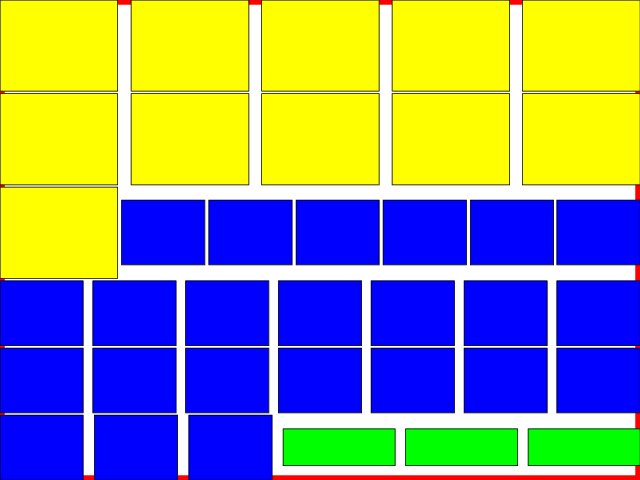
PYTHONPATH=. python legacy/arrange_spread.py
The results will be svg files test1.svg and test2.svg, the latter showing the spread-out result. Here is an example how the output looks like (without the red border which is drawn to mark the pallet border): arrange_spread2.py contains an adaption of arrange_spread.py for the actual problem. Permutations without known length When creating a layer out of articles of same height, then there are four strategies that I can choose from. It is four because there are two methods that I can either use or not. I can rotate the article by 90 per default or not and I can rotate the pallet or not. So every time that I build a new layer, there are those four options. Depending on which strategy I choose, there is a different amount of possible leftover articles that did not fit into any layer. The amount is different because each strategy is more or less efficient. To try out all combinations of possible layer arrangements, I have to walk through a tree where at each node I branch four times for each individual strategy. Individual neighboring nodes might be the same but this outcome is unlikely due to the path leading to those neighboring nodes being different. To simplify, lets name the four possible strategies for each layers 0, 1, 2 and 3. I now want an algorithm that enumerates through all possible permutations of those four numbers for "some" length. This is similar to counting. And the itertools module comes with the product() method that nearly does what I want. For example, should I know that my tree does not become deeper than 8 (read: no more than eight layers will be built), then I can just run:
>>> for i in itertools.product([0,1,2,3], repeat=8):
...     print i
...
(0,0,0,0,0,0,0,0)
(0,0,0,0,0,0,0,1)
(0,0,0,0,0,0,0,2)
(0,0,0,0,0,0,0,3)
(0,0,0,0,0,0,1,0)
(0,0,0,0,0,0,1,1)
(0,0,0,0,0,0,1,2)
(0,0,0,0,0,0,1,3)
This would work if the number of layers created with each strategy was the same. But as each strategy behaves differently depending on the input, it cannot be known before actually trying out a sequence of strategies, how many layers it will yield. The strategy (0,0,0,0,0,0,0,0) might create 7 layers, resulting in (0,0,0,0,0,0,0,1), (0,0,0,0,0,0,0,2) and (0,0,0,0,0,0,0,3) yielding the same output as only the first 7 strategies count. This would create duplicates which I should not waste cpu cycles on later. It might also be that (0,0,0,0,0,0,1,0) turns out to be a combination of strategies that creates more than 8 layers in which case the whole thing fails. So what I need is a generator, that gives me a new strategy depending on how often it is asked for one. It should dynamically extend the tree of possible permutations to accommodate for any size. Since the tree will become humongous (4^11 = 4194304), already traversed nodes should automatically be cleaned so that only the nodes that make the current list of strategies stays in memory at any point in time. This sounded all complicated which made me even more surprised by how simple the solution was in the end. Here a version of the algorithm that could easily be ported to C:
class Tree:
def __init__(self, branch_factor):
self.branch_factor = branch_factor
self.root = "value": None, "parent": None, "children": []
self.current = self.root

def next(self):
if not self.current["children"]:
self.current["children"] = [ "value":val, "parent":self.current, "children":[] for val in range(self.branch_factor)]
self.current = self.current["children"][0]
return self.current["value"]

def reset(self):
if self.current["parent"]:
self.current["parent"]["children"].pop(0)
else:
return False
if self.current["parent"]["children"]:
self.current = self.root
return True
else:
self.current = self.current["parent"]
return self.reset()

def __str__(self):
return str(self.root)
It would be used like this:
>>> tree = Tree(4)
>>> print tree.next(), tree.next(), tree.next()
>>> while tree.reset():
...     print tree.next(), tree.next(), tree.next()
Which would be equivalent to calling itertools.product([1,2,3,4], 3). The special part is, that in each iteration of the loop I can call tree.next() an arbitrary amount of times, just how much it is needed. Whenever I cannot generate an additional layer anymore, I can call tree.reset() to start a new permutation. For my code I used a python specific version which is a generator:
def product_varlength(branch_factor):
root = "value": None, "parent": None, "children": []
current = root
while True:
if not current["children"]:
current["children"] = [ "value":val, "parent":current, "children":[] for val in range(branch_factor)]
current = current["children"][0]
if (yield current["value"]):
while True:
if current["parent"]:
current["parent"]["children"].pop(0)
else:
return
if current["parent"]["children"]:
current = root
break
else:
current = current["parent"]
It is used like this:
it = product_varlength(4)
print it.next(), it.send(False), it.send(False)
while True:
    print it.send(True), it.send(False), it.send(False)
Again, the expression in the loop can have any number of it.send(False). The first it.send(True) tells the generator to do a reset.

19 May 2012

Richard Hartmann: Mongolia

I will start linking to places we stayed at etc, from now on. On the one hand, we already left those places so my paranoid self can rest assured that no one will come hunt us down, on the other hand, I decided to only to name and link to those places which really deserve a mention. If they are linked here, I can whole-heartedly recommend them. Mongolia After leaving through the Russian border fortifications, Mongolia was an instant and welcome change. Trees growing right next to the tracks, branches forming a bit of a natural tunnel; the trains passing by keeping branches at bay, but the trees free to grow wherever else they pleased. A few hundred meters later below a rocky ledge, a cow had apparently fallen down and died. Partially decomposed flesh still clinging halfway to its rib-cage, it proved to be a sign of the (mostly) more laid-back attitude Mongolians tend to take. After finally getting our passports back and being allowed to leave the train, we first headed to the station to get some money. At ~1800:1, the exchange rate for Tugruk against Euro speaks volumes about inflation; imagine my surprise that the MNT 20,000 note is the largest one. It's also the one and only amount any and all ATMs will default to. We were quite surprised by how cheap everything was, even in the one single store within the station directly behind the border. In Russia, travellers expect to pay hefty markups when shopkeepers know they can charge them, not so in Mongolia. The woman in the trash Upon returning from the station, our waggon was just merrily being driving away on its own by a lone engine, something we had not anticipated or appreciated a whole lot. A woman (we hadn't noticed her before) who was busy scavenging a trash container for food for herself and her scrawny-looking son happily stopped what she was doing and, with a big smile, moved her hands around and smacked them back together, signalling us that our waggon would be attached to a different train for the subsequent journey. To put it mildly, I was stunned; we had met people eating from the trash in Russia as well (yes, I always make a point of giving them enough for a few decent meals; anyone eating out of the trash actually needs and definitely deserves something good happening to them), but they were glum and disheartened. Here, there was someone who not only had to look out for herself, but for a three or four year old boy as well, and still was just so... positive... I don't know if I would have it in me to act the same way... As an aside, even though we were just a few kilometers across the border from Russia, she did not actually take the money from me, she cupped her hands to receive it by having me place it into her hands; this is a very Asian thing in my experience and something we would see both in Mongolia and China consistently. Later, when we were back in our waggon, she passed by and happened to see the Spot Messgenger 2 dangling in front of our window, its lights blinking every five seconds. For a solid twenty minutes, until the train started moving again, she squatted down with her son, oggling the Spot. I have no idea what she was thinking it was and I had no chance to explain it to her, but she was really fascinated and just kept staring and staring. When we finally left the station, we waved to and smiled at each other, she ran after us, and then she was gone. All in all, this was one the more memorable things which happened to us. Mongolian Infrastructure When I say that Mongolians as a whole tend to be a lot more laid back than Russians, this extends to infrastructure as well, but not in the good way. Ulan Bator Little Dhingis Khan We arrived in Ulan Bator at six in the morning and started haggling with taxi drivers. Our hostel had (stale, it turned out) information about acceptable fare from station to their place on their website, 5,000 MNT was supposedly OK. Our driver tried to get 20,000, then 15,000, then 12,000, then 10,000, went down to 7,000 and finally settled for 5,000, all this interspersed with frequent "no" by us and walking away. Once on the road, he wanted to convince me that we had agreed upon 5,000 per person, something that did not quite work out for him. When we arrived, he started to tell me that he was good friends with the hostel manager and that said manager would surely want us to pay more; again, that did not work too well. He made the mistake of getting our luggage out of his trunk immediately (we always kept all our stuff in the passenger area afterwards...) before I paid and even though I only had a 10,000 or 20,000 note, I insisted on correct change. The same old dance began anew, with him edging closer to the correct change in steps of 1,000 MNT. He tried to get away several times, but I stood in his door and held it open; if he had just driven off, I couldn't have stopped him, but that thankfully didn't occur to him. After he shoved all small change (MNT is bill only, no coins) he had with him at me and wanted to make off yet again, I was close to throwing all the small crap at him, but after he, a man of maybe 1.65 meter and sitting down, tried to signal his willingness for a fist fight and me, a man of 1.94 meter and standing started laughing, he gave me 2,000 more and drove off cursing. In case you forgot, at that exchange rate, we argued about two to three Euro, but as he tried to cheat, it became a matter of principle. The Hostel, part one All parking lots and other property in Ulan Bator have a small watchtower with private 24/7 guards; said guard ambled down, let us in and woke the poor woman who was forced to let us check in. As she was Mongolian as well, we were a bit surprised when she switched from broken English to perfect German, but the owners of the OASIS are a German-Austrian couple so I guess that makes sense. Fighting through the war Traffic in Ulan Bator is war. Lonely Planet talks about the city being too newly motorized and that it did not have to develop a culture of driving, yet. This is a euphemism for "no one has any qualms maiming or killing you". Everyone is driving like mad, nudging and racing their way in front of each other. If a driver has an oppurtunity to get ahead by a few centimeters with his small car, thereby blocking the way for several buses, making a whole parking lot grind to a halt and thereby deadlocking themselves, they will take said opportunity, and gladly. Red lights are gentle suggestions, there to be mainly ignored; police will not drive over red lights, but they will not stop anybody else from doing so, either. A hearse will have a dozen or more cars following it, all driving in a tight pack, aggressively attacking anyone who dares to wedge in between them and expecting all other traffic to make way even if they are driving over a red light. Crossing a main street in Ulan Bator as a pedestrian is hell. There are a few traffic lights and they help to some extent, but you still need to be extremely careful when crossing a street. Thailand, India, Russia, China, no matter where it's supposedly hard to cross a street by foot, I never had any issues weaseling through. In UB, it takes planning, determination, and a lot of attention, especially as there are stretches where there's not a traffic light in sight. While maintaining eye contact with a driver usually ensures that they will try not to hit you, this does not work in the least in UB. In the evening, I took to shining a high-powered flashlight at the ground to the oncoming traffic's side to mark ourselves and decrease the likelihood of being hit. This worked well in combination with sprinting through gaps in the traffic, except for one guy who actively aimed for us and did not slow down. He even changed lanes, just to keep us in front of his car... Shining the flashlight directly at him in highest mode made him break quite violently though; a good thing, as he may have hit us had he not slowed down. UB itself Ulan Bator is weird. It has clear signs of westernization, but it's still very much an old city. There is one large store which would fit into any random shopping center in Germany (which are tiny when compared to most other countries) and which carries most goods, if with a limited selection. Its supermarket is extremely well stocked with food and drink from all other the world and laughably cheap (for us) prices. While its infrastructure is definitely crumbling, the city is clean, especially when compared to Russia. Two girls from Stuttgart who we met during our Trans-Siberian travels commented on how clean Russian cities were when compared to home, but that may be more of a statement about Stuttgart than about Russia... Anyway, in Mongolia in general and in UB in particular, there's a concise effort to make what they have look nice and clean. There is no trash in the streets, loose gravel and earth is removed from the curb by dedicated workers, all areas of packed earth are sieved and all large stones removed. All in all, it's a lot cleaner (if more dusty and sandy) than Russian cities if somewhat older and more shabby-looking. That being said, Mongolia's countryside is littered There were several street stalls consisting of nothing more than a cardboard box on a stool selling single chewing gums and cigarettes from the original packaging; it's normal for people to buy one cigarette or one piece of chewing gum and walk on. The sights of UB were nice, but nothing too special. Outlook In the next part, I'll cover "The Hostel, part disaster" and generally talk more about excrement than I thought one could write before moving on to China (were I am located at the time of this writing).

Richard Hartmann: Motherland's bosom

I read a translated poem about Russia being "the Motherland" and its vast bosom years ago. Having driven through a significant part of it, I can agree on the "vast" part... Also, as I am on a train and without access to the Internet, I will refrain from linking to a lot of pages; sorry. (Turns out I am posting this a week later, but I will still not link to stuff now; no time). Russia in general Moscow Sights Kreml Our remaining time in Moscow was spent with touring the usual suspects; the Kreml is a lot less impressive in real life, the Red Square is tiny when compared to the stories I heard about it and the Chapel ofi St. Basil is even more colorful and impressive in real life. Lenin's body was inaccessible because workers built seats for the May 9th parade to the left and the right of it and they apparently thought it would be a good idea to block access to one of the main tourist attractions while doing so. A river tour of Moscow was a nice cool-off and we got to see quite a few things. We managed to see the weekly military parade within the Kreml grounds, but it was mostly pomp and little substance. The National Treasure which you can access with an extra ticket within the Kreml grounds is nice, but less impressive than the tourist guides would make you believe. That being said... There's another museum within the museum and.... Whoah... Tourists pay extra, visitors go through the only non-security-theater check I encountered in Russia, guards are armed, people can only enter and leave in batches, and the stuff which is presented is mind-boggling. Disregarding the fist-to-calf-sized chunks of gold and platinum which are still in their original form directly from the mine, there is real, actual treasure galore. Little heaps of uncut and cut diamonds, an outline of Russia filled with cut diamonds and other random "we have this stuff" displays can be found as well. Then, you have various tiaras and other jewellery made from various gems. Not incorporating, but largely made of. All that pales in comparison to the crown, royal apple, scepter, etc. It's hard to put the amount of tiny multi-colored light points that shine at you into words. I was just standing there, swaying back and forth to catch the moving pattern of pinpoints. It's said that this collection is equalled only by the ones in the Tower of London and the one Shaw of Iran had and boy do I believe it. TV Tower Getting up there was funny. The old-style Soviet queuing system was used: "Security" for approaching the tower was multi-level, the guards see you approach along a long walkway way in advance and the main guard shed had several small cabins separated by thick glass. So good so menacing. But in a twist that would make Bizarro and Garry Larson proud, I was required, by means of metal detector gate, metal detector wand and even an x-ray machine to remove every shred of metal and other hard objects from myself and the camera bag and put them onto a table. Once I was without anything except my clothes and the bag was completely empty, I could pass. Everything I had had to remove was just laying there, not inspected in the least, for me to stuff back into pockets and bag and to take with me. This "everything" included a Spot Messenger 2 with lots of green and red blinky lights. The guard did not even glance and it. Security theater? Security theater. The view from 364 meters down on Moscow was nice, but there was a lot of Smog so I couldn't see very far. Jumping on the glass floor while looking down was a lot of fun, though. Subway to Thiefing I bet Christopher Nolan rode the subway in Moscow at least once. That unnerving sound you hear during several key scenes in "The Dark Knight"? Two thirds of all subways make the same sound while moving. Also, I had an encounter with a pickpocket down there; very classical, too. Guy approaches quickly, talks loudly and sounds as if it's really important (in Russian... duh... that's sure to keep me interested). His approach made me turn and protect my left leg pocket automatically, most likely marking the target for the tiny woman standing behind me. Now, I have to tell you something about my usual travel layout. As my normal pockets are very deep, it looks as if their content was in the leg pocket. Plus, there's an extra, hidden leg pocket where I keep the passports and train tickets. The outermost leg pocket is protected by a velcro flap, but it contains nothing of value; usually the appropriate phrasebook, local map, maybe a tissue or chewing gum. Due to this layering, the outermost pocket looks as if it's full to the brim with stuff. Also, I took pains to make it a habit to protect said leg pocket with my hand, nothing else. This looks as if that's the target, but what I am actually doing is protect my normal pocket with my forearm. The right side is different, but the most easily accessibly pocket always holds some small change. I pay from that stash but my actual wallet is well out of reach. Anyway, once the guy ran off, talking to several others, most likely marking all them for the actual pickpockets, I wanted to enter the subway. While the Russian-style queuing took place, I felt an unusual tug at the velcro flap. I looked down and saw a tiny woman to the left of me with a jacket held over her right side with the left arm; I look up to check no one is trying to steal from my permanently assigned female, feel another tug, look the woman into the eyes, look up again and around me, look down again and she is gone. All that took maybe three seconds and I had boarded the subway after an additional two. In hindsight, it makes sense to choose the time of entry for attack. It's crowded, you are being pushed around, and once you are in the subway, it will start moving more or less immediately while the thief remains in the station. In this case, she would only have gotten a grubby map of Moscow's subway and an English-Russian phrasebook, but she got nothing at all. Moscow-Novosibirsk Where to begin... If you think a few hours on a train are a long time, try over fifty hours. Things get so bad, you start getting land-sick while not in a moving train. You even start missing the familiar tunk-cachunk, tunk-cachunk, tunk-cachunk... of driving over rails with gaps in them when you are not moving. The defining element of the Trans-Siberian Railway are birch trees. And birch trees. And then more birch trees. You would not believe how many birch trees there are. This is made "worse" by the way the Russian Railway protects their rails. Left and right of the track, there's a cleared area of maybe ten to twenty meters, sometimes as little as three. Outside of that, they plant ten to twenty meters of birch trees, presumably to catch snow during winter. Beyond that protective perimeter, there's the normal landscape.As a result, on top of the near endless stretches of birch woods, you see most if not all scenery through a layer of birch trees. You get sick sick of birch trees after a few hours and you see them for days on end. Bullet points to save myself some typing and you some reading... Novosibirsk The non-existent hostel We arrived at ~0200 local and made our way to the hostel we had booked a room with. Walking to the correct address, we saw several signs but they all turned out to be for a police station and some other state agency. We walked back, forth, double-checked, triple-checked: no hostel. We then walked around the building through some not-quite-nice back alleys, but other than a few entries to private flats, there was nothing. Thankfully, the booking slip included a number which we called and after at least twenty rings (no kidding), when I had given up and wanted to hang up, it stopped ringing. Dead silence. After maybe ten seconds, someone started talking in Russian. I asked him if he spoke English and told him that we could not find the hostel. He mumbled something about being sorry and that we should wait, he would come down. Fast forward a minute or two and someone walked towards us. Again, he mumbled about being sorry, that the hostel "did not work" at the moment and that we would need to sleep in his private apartment. He ushered us into some back alley entrance, into his flat, and proceeded to remove the sheets from the couch on which he had slept; after putting on new sheets, we had our "hostel" bed, ready to sleep on. We briefly considered if he would murder us in our sleep, but him and me even got to talking a bit. Over cheese, sausage and rum (at 0300), he admitted that the hostel did not exist and he merely planned to turn his flat into a hostel for the summer while he and his family moved into their summer house (the Russian term of which escapes me, at the moment) in the countryside. He had accepted our reservation as he thought he would be finished by that time. He did not even get started, though. While he sent us an overbooking notice through booking.com two days before, we were on the train at that time, so... booking.com even called him to check what happenend to us as we did not book another place through them. Good customer service/protection, that. Next morning, he didn't even want to take our money (we paid anyway) and, as a means of compensation, drove us into the city in the morning and to a train museum well outside the city limits, one of the fabled scientist cities, and a large lake which everyone in Novosibirsk claims is an ocean, in the afternoon. Foreigners, foreigners! All in all, Novosibirsk was relatively uneventful, safe for one bizarre episode. We took our lunch in a local fast food joint (why do all the good stories happen there, and not at the various truly local places?) and threw the cashier our well-rehearsed "Niet Russkie; anglisky?" with phrasebook in hand and he actually understood a few words of English (beef, chicken, fries). We told him, in our worst Russian, that we are from Germany wished him a nice day and went to sit down. A few minutes later, a girl approached us, literally hopping from one foot to the other and wringing her hands. She told us that the cashier had told her that we spoke English and if it would be OK if she talked to us. We suspected some sort of elaborate ruse, but went with it. Turns out, she had English at school and really wanted someone to practice English on. Two young men passed our table and exchanged a few words with her, sitting down out of sight. When she told us that she had to leave now but if it would be OK if the two boys joined us we suspected a ruse yet again. But those two were law students, one with a minor in English and one with a minor in German; both of them also extremely nervous, asking us if we would talk to them. When they had to leave, they told us that the three of them worked at the burger joint and that their shift was just about to start when the news that foreigners were here spread amongst staff like wildfire. The girl stopped by several times in between cleaning tables, getting in a sentence or two before being cussed at by her supervisor. All in all, this took about twenty minutes and seeing three people so nervous and grateful to talk with us felt beyond absurd. On the other hand, not a single traveller we met even considered stopping in Novosibirsk during their transit so there really does seem to be a shortage of non-Russians there. Weird, and memorable. Novosibirsk-Irkutsk Irkutsk / Listvianka / Lake Baikal Listvianka Aah, lake Baikal... the oldest and deepest lake on Earth which holds a fifth of the global non-salt water reserves; a must-see in my book. Quad tours at break-neck speeds, dry-suit diving with Russian regulators, walking barefoot in between and across drift ice that made its way onto the shorei, and extended hiking around the lake's coast... All of which I could not do because I was ill and had to spend two solid days in bed. The draft from the open window in between Novosibirsk and Irkutsk was enough to give me a rather bad cold which peaked at Lake Baikal. Still, the area was lovely and we were glad to be out of a train and able to unpack our stuff without having to repack immediately for once. I am not sure where my current losing streak with regards to diving is coming from (Grimsey, diving north of the Arctic circle with birds that plummet into the water and hunt fish: Only guy who does this is on the Icelandic mainland that day; Svalbard, diving north of the Arctic circle in permanent darkness: The few people who do this privately did not reply while I was there; Baikal, oldest, deepest, largest lake on Earth: ill), but I will most likely return to Russia for a week of ice diving in Lake Baikal next winter or the one after that. As an aside, I saw several people walking to Lake Baikal with buckets to get their water. Other people got it from a well which was still half frozen. If you have running water consider yourself lucky... Irkutsk Nice city, largely uneventful. The farther east you get within Russia, the more normal women look. In Moscow, just as in Paris, they are way over-dressed and even service personnel will walk with high heels. Thankfully, I don't have to wear heels, but for the other males out there: Walking and standing in these things hurts and thus most if not all people who stand and walk for a living have flat shoes. We happened upon preparations for a military parade, complete with cordon, viewing podests, at least half a dozen TV cameras etc, but were not sure if it would start soon enough for us to catch our train.We asked someone who told us it would start at 2100 local, at 1945 local it seemed about to start, and sure enough at 1955 sharp, the whole thing went under way. About a dozen groups of 50-100 people each, all in their own, respective uniforms stood against one side of a cordoned-off street and several higher-ups on the other side. Two highest-ups shouted into microphones and the throng of people on the other side shouted back answers. Then, the two highest-ups stood in the back of a jeep each and drove past said throng, stopping in front of each group, shouting into microphones mounted in the back of the jeeps and the groups shouted back once again. After that, all groups marched around the make-shift plaza once, saluting the higher ups. Once they were done, and they took ages, two trucks drove by with soldiers jumping out of the moving trucks and moving into crouching positions. They ran around in a circle a few times and engaged in pretend hand-to-hand combat. I am sure they are skilled at whatever style they wanted to show, but they were overdoing things so badly, they were funny, not imposing. When they jumped over some barriers, the barriers fell to pieces and everyone scrambled to make it look as if that was part of the show. While carrying off the gear, it fell into further pieces which was even more funny. An armoured personnel carrier ended the show; several tougher looking guys jumped off of that one and their mock combat involved fully automatic fire (of blanks), several flashbangs, smoke grenades and, to top things off, the machine gun mounted on the APC moving down the opposing team with blanks. I never witnessed a "real" military parade in person but this one was somewhat disappointing. On the one hand, there was a distinct lack of ballistic missile carriers and tanks like you see in movies, documentaries and games, on the other hand, the whole thing had a make-do feeling to it. The cordoning police had designated spots to stand on, yet walked around. They were standing to attention, yet checking their cell phones. Several people in one uniformed group were wearing track suits and jeans. Another uniformed guy had a grocery bag with him; yet another one was carrying a huge water bottle. Bikers zig-zagged through the cordon and when the whole show was just about to wrap up the police finally started putting up barriers around the unmoving pedestrians, not blocking the bikers. One little girl was standing well within the cordoned area, watching with big eyes and after she did not react to the police talking to her, they just built the barriers in a curve around her. And to top it all off, some guy with a cane walked all through the parade with his personal camcorder, trying to direct the whole show while being ignored by everyone. Still, I am sure he managed to mess up some otherwise perfectly good TV scenes. Irkutsk-Russian border TL;DR 3000 kilometers of birch trees

Pietro Abate: how to create VMs with ganeti / xen and dnsmaq

I'll start here a small series of posts about ganeti, xen and puppet. For my work I run few servers sitting on xen and it has always been a bit of a pain to create a new instance and keep it up to date. Up to now I've used the excellent xen-create-image tool to create my VMs, but I wanted to try something new and more sexy... Last week I finally found some time to learn (and a spare box to run my experiments) how to use ganeti. Ganeti is the only tool I tried out, but it seems to fit the bill for my use and it seems polished and mature project to me... Moreover I've seen a presentation about it in every FLOSS conference I've attended in the last few years and I thought it was time to give it a try. Installing and configuring ganeti is fairly easy, there is a lot of documentation available and this post is not going to be about installing it, but rather how to create a new bare instance with ganeti-deboostrap-instance. There is also a way to create a new instance from an image, but I didn't go that way yet. This first post is about the first problem I've encountered, that is, how to automatically assign a network address and a name to each new instance created by gnt-instance add. Since all my instances should be able to communicate together on the same subnet, I've decided to configure xen to create a NATted private network and add each new instance to this network. The first step is to create an interface in /etc/network/interfaces .
auto xen-br0
iface xen-br0 inet static
address 10.0.0.1
netmask 255.255.255.0
pre-up brctl addbr xen-br0
post-down brctl delbr xen-br0
bridge_stp off
bridge_fd 0
This is the standard debian way but since xen uses a different naming convention (here I'm using ganeti naming convention xenbr0 vs xen-br0), I need to convince tell xen what I intend to do by adding these lines in /etc/xen/xend.config :
(network-script 'network-virtual bridgeip="10.0.0.1/24" brnet="10.0.0.0/24" bridge="xen-br0"')
(vif-script vif-bridge)
Next I have to connect my real network interface to the private network using few iptables rules in /etc/rc.local (probably there is a better place to do this...):
echo 1 > /proc/sys/net/ipv4/ip_forward
/sbin/iptables -t nat -A POSTROUTING -o eth0 -j MASQUERADE
/sbin/iptables -A FORWARD -i eth0 -o xen-br0 -m state --state RELATED,ESTABLISHED -j ACCEPT
/sbin/iptables -A FORWARD -i xen-br0 -o eth0 -j ACCEPT
The xen setup is complete and every new image should have a vif connected to the subbet 10.0.0.0. The xen setup corresponds to the physical wiring of the network. The next step is to configure each instance so to allow them to communicate on this subnet. Since I build my VMs using ganeti-debootstrap-instance, and by default debootstrap does not configure the network, we need to add a new hook in the directory /etc/ganeti/instance-debootstrap/hooks.
#!/bin/bash
if [ -z "$TARGET" -o ! -d "$TARGET" ]; then
echo "Missing target directory"
exit 1
fi

if [ ! -d "$TARGET/etc/network" ]; then
echo "Missing target network directory"
exit 1
fi

if [ -z "$NIC_COUNT" ]; then
echo "Missing NIC COUNT"
exit 1
fi

if [ "$NIC_COUNT" -gt 0 ]; then

cat > $TARGET/etc/network/interfaces <<EOF
# This file describes the network interfaces available on your system
# and how to activate them. For more information, see interfaces(5).

auto lo
iface lo inet loopback

auto eth0
iface eth0 inet dhcp

EOF


fi

DAEMON_PID_FILES="/var/run/dnsmasq.pid /var/run/dnsmasq/dnsmasq.pid"

instance=$INSTANCE_NAME
[ -n "$instance" ] exit 1
nic_count=$((NIC_COUNT - 1))
mac_var="NIC_$ nic_count _MAC"
echo $mac_var
echo $nic_count
mac=$ !mac_var
echo $mac
echo "dhcp-host=$mac,$instance" > /etc/dnsmasq.d/$instance.conf
This hook will do two things. First it will configure the interfaces of the new instance to get configured using dhcp, second, it will add an entry to the dnsmasq configuration file to make this instance known to the world. This basically boils down to add a file in /etc/dnsmasq.d/ with the mac address of the new instance and its designated name. Dnsmasq will then provide an ip address for this instance and add it to the dns. dhcp-host=aa:00:00:24:6c:8a,node1 Configuring dnsmasq is pretty easy as well. First I want it to answer dhcp queries only on the internal network, second I want to configure my clients passing 10.0.0.1 as nameserver and gataway. You can just add the following lines in /etc/dnsmasq.d/general to get it going.
interface=xen-br0
interface=lo
dhcp-range=10.0.0.128,10.0.0.250
domain=localnet.org,10.0.0.128,10.0.0.250
dhcp-option=3,10.0.0.1
bogus-priv
#expand-hosts
local=/localnet.org/
To create your new instance you can just run the following command :
gnt-instance add -t plain -s 5g -B memory=1024 -o debootstrap+unstable --no-ip-check --no-name-check node1
I use --no-ip-check and --no-name-check to skip ip and dns check performed by ganeti and to avoid a sort of chicken-egg problem, where the name and address of this new instance is yet unknown to dnsmasq and that node1 is the name that will be used by the hook to add an entry in the dnsmasq configuration. debootstrap+unstable is a variant of the default configuration and you need to add it to the list of variants used by ganeti-deboostrap-instance. That should be it. The new instance should come up with a dynamically assigned ip address, able to talk to the outside world and automatically known by all the other machine on the subnet via dns. Next post will be about how to add a swap hook for ganete-debootstrap-istance.

Pietro Abate: how to create VMs with ganeti / xen and dnsmasq

I'll start here a small series of posts about ganeti, xen and puppet. For my work I run few servers sitting on xen and it has always been a bit of a pain to create a new instance and keep it up to date. Up to now I've used the excellent xen-create-image tool to create my VMs, but I wanted to try something new and more sexy... Last week I finally found some time to learn (and a spare box to run my experiments) how to use ganeti. Ganeti is the only tool I tried out, but it seems to fit the bill for my use and it seems polished and mature project to me... Moreover I've seen a presentation about it in every FLOSS conference I've attended in the last few years and I thought it was time to give it a try. Installing and configuring ganeti is fairly easy, there is a lot of documentation available and this post is not going to be about installing it, but rather how to create a new bare instance with ganeti-deboostrap-instance. There is also a way to create a new instance from an image, but I didn't go that way yet. This first post is about the first problem I've encountered, that is, how to automatically assign a network address and a name to each new instance created by gnt-instance add. Since all my instances should be able to communicate together on the same subnet, I've decided to configure xen to create a NATted private network and add each new instance to this network. The first step is to create an interface in /etc/network/interfaces .
auto xen-br0
iface xen-br0 inet static
address 10.0.0.1
netmask 255.255.255.0
bridge_stp off
bridge_fd 0
bridge_ports none
This is the standard debian way but since xen uses a different naming convention (here I'm using ganeti naming convention xenbr0 vs xen-br0), I need to convince tell xen what I intend to do by adding these lines in /etc/xen/xend.config :
(network-script 'network-virtual bridgeip="10.0.0.1/24" brnet="10.0.0.0/24" bridge="xen-br0"')
(vif-script vif-bridge)
Next I have to connect my real network interface to the private network using few iptables rules in /etc/rc.local (probably there is a better place to do this...):
echo 1 > /proc/sys/net/ipv4/ip_forward
/sbin/iptables -t nat -A POSTROUTING -o eth0 -j MASQUERADE
/sbin/iptables -A FORWARD -i eth0 -o xen-br0 -m state --state RELATED,ESTABLISHED -j ACCEPT
/sbin/iptables -A FORWARD -i xen-br0 -o eth0 -j ACCEPT
The xen setup is complete and every new image should have a vif connected to the subbet 10.0.0.0. The xen setup corresponds to the physical wiring of the network. The next step is to configure each instance so to allow them to communicate on this subnet. Since I build my VMs using ganeti-debootstrap-instance, and by default debootstrap does not configure the network, we need to add a new hook in the directory /etc/ganeti/instance-debootstrap/hooks.
#!/bin/bash
if [ -z "$TARGET" -o ! -d "$TARGET" ]; then
echo "Missing target directory"
exit 1
fi

if [ ! -d "$TARGET/etc/network" ]; then
echo "Missing target network directory"
exit 1
fi

if [ -z "$NIC_COUNT" ]; then
echo "Missing NIC COUNT"
exit 1
fi

if [ "$NIC_COUNT" -gt 0 ]; then

cat > $TARGET/etc/network/interfaces <<EOF
# This file describes the network interfaces available on your system
# and how to activate them. For more information, see interfaces(5).

auto lo
iface lo inet loopback

auto eth0
iface eth0 inet dhcp

EOF


fi

DAEMON_PID_FILES="/var/run/dnsmasq.pid /var/run/dnsmasq/dnsmasq.pid"

instance=$INSTANCE_NAME
[ -n "$instance" ] exit 1
nic_count=$((NIC_COUNT - 1))
mac_var="NIC_$ nic_count _MAC"
echo $mac_var
echo $nic_count
mac=$ !mac_var
echo $mac
echo "dhcp-host=$mac,$instance" > /etc/dnsmasq.d/$instance.conf
This hook will do two things. First it will configure the interfaces of the new instance to get configured using dhcp, second, it will add an entry to the dnsmasq configuration file to make this instance known to the world. This basically boils down to add a file in /etc/dnsmasq.d/ with the mac address of the new instance and its designated name. Dnsmasq will then provide an ip address for this instance and add it to the dns. dhcp-host=aa:00:00:24:6c:8a,node1 Configuring dnsmasq is pretty easy as well. First I want it to answer dhcp queries only on the internal network, second I want to configure my clients passing 10.0.0.1 as nameserver and gataway. You can just add the following lines in /etc/dnsmasq.d/general to get it going.
interface=xen-br0
interface=lo
dhcp-range=10.0.0.128,10.0.0.250
domain=localnet.org,10.0.0.128,10.0.0.250
dhcp-option=3,10.0.0.1
bogus-priv
#expand-hosts
local=/localnet.org/
To create your new instance you can just run the following command :
gnt-instance add -t plain -s 5g -B memory=1024 -o debootstrap+unstable --no-ip-check --no-name-check node1
If you are running your dom0 on debian squeeze before running this command you should configure ganeti to pass the right xen parameters to the newly created instance :
gnt-cluster modify --hypervisor-parameter xen-pvm:root_path='/dev/xvda1'
gnt-cluster modify --hypervisor-parameter xen-pvm:initrd_path='/boot/initrd-2.6-xenU'
I use --no-ip-check and --no-name-check to skip ip and dns check performed by ganeti and to avoid a sort of chicken-egg problem, where the name and address of this new instance is yet unknown to dnsmasq and that node1 is the name that will be used by the hook to add an entry in the dnsmasq configuration. debootstrap+unstable is a variant of the default configuration and you need to add it to the list of variants used by ganeti-deboostrap-instance. That should be it. The new instance should come up with a dynamically assigned ip address, able to talk to the outside world and automatically known by all the other machine on the subnet via dns. Next post will be about how to add a swap hook for ganete-debootstrap-istance.

17 May 2012

Philipp Kern: Lazyweb question: How to avoid leaking process info?

Dear Lazyweb,

is there a simple way to block some users who login with SSH to read /proc/<pid>/cmdline of processes they don't own? Or better yet: don't see these pids at all?

I know that there are PID namespaces, but they seem to require a special PID 1. Seems hard to get for a simple SSH login. (I wouldn't mind changing a user's shell. But brittle shell startup scripts wouldn't cut it.) systemd-nspawn wants to boot a full Linux distribution in a container and even then I'd be unsure how to wire it up so that it cannot be skipped. I wouldn't mind a read-only bind mount of the outermost Linux installation into a chroot environment, as long as the parent SSH process can get the user jailed into it securely. (No need for someone to be root in the chroot.)

I know that there are RBAC frameworks, but they're cumbersome to use. I don't need file labelling or path-based access control, as I do trust the Linux file permissions for this. I think SMACK wouldn't help here, AppArmor isn't really useable in Debian testing and TOMOYO is a tad crazy to use with its domain transitions through process invocations.

I bet that grsecurity would have something for me up its sleeve. But it's not in a Debian kernel. Even though I know how to compile my own kernel I'd only do that if everything else fails.

Thanks in advance for your help.

UPDATE: That was quick, thanks to everyone who participated! Vasiliy Kulikov came up with a kernel patch to my problem (a hidepid mount option for procfs) that landed in 3.3. I tested it with the kernel in experimental and it works just fine and as expected. With hidepid set to 1, it will still leak the process count and their euids and egids. With hidepid set to 2, you only see your own processes, unless you're root. For ps there's no visible distinction between the two. So to test it you can just invoke this as root on a host running 3.3+:
mount -o remount,hidepid=1 /proc
There's even a backport request in the Debian BTS to get the feature into the wheezy kernel (3.2).

16 May 2012

David Welton: Up for Auction: LinuxSi.com

A number of years back, I read yet another complaint about someone having trouble finding a computer with Linux preinstalled. So I did something about it: I created LinuxSi.com, where it is possible to register computer stores in Italy (this was an Italian Linux mailing list) that are helpful towards people wishing to buy a Linux machine. Fast forward past getting married, having kids and buying a house, and LinuxSi.com is not something I have much time to run any more. I still think it's a useful service, even if the site itself is a bit creaky. In any event, I've put it up for auction with Flippa.com, and there's one week left on the auction. Right now, it's going for just $10, which even with the low amounts of adsense income it brings in, you'd make back pretty quickly. I hope that it goes to someone who cares about promoting Linux in Italy - if nothing else, the domain name is a good one that could be employed for many things.

Next.

Previous.