Neil McGovern: I m going to
 I've recently book my places at a few conferences, so just to confirm:
 |
 |
 |
I've recently book my places at a few conferences, so just to confirm:
|
|
|
|

 (This blog post is a more firm version of a series of tweets and forum posts I made a few weeks ago. This should also be considered a refresh of this post by Mirco Bauer a few years ago)
It has been said that Mono is bloated, and that people should use lighter frameworks that don t pull in hundreds of meg .
How much basis in reality is there for those comments?
Well, let s do a little thought exercise. How much space is the minimum space needed for several languages to work?
For this experiment, we will be looking at the required installation size on disk of several language frameworks, each time installing the bare minimum for a command-line hello world app in that language to run. For example, the Ruby result is the minimum install required to run:
puts 'Hello world'and the Mono result is the minimum install required to run the following code, which has been compiled on a different machine using dmcs :
public class Hello1

   public static void Main()

      System.Console.WriteLine("Hello, World!");
Obviously, for dynamic languages like Ruby and Python, there is no compiler step needed. For languages like C# and Java, it is fair to compile these on a different machine as end-users of packages running these frameworks receive binaries, not source they do not need a development environment.
So, on to the test environment. This is a bare bootstrapped AMD64 Debian Unstable system, as of today (i.e. debootstrap sid /tmp/badger ). Its install size is 275MB. So how much space?
Ruby 1.9
Test code is as follows:
puts 'Hello world'Install requirements are as follows:
root@dream:/# aptitude install ruby1.9.1
The following NEW packages will be installed:
  libffi5 a  libruby1.9.1 a  libyaml-0-2 a  ruby1.9.1
0 packages upgraded, 4 newly installed, 0 to remove and 0 not upgraded.
Need to get 4703 kB of archives. After unpacking 13.1 MB will be used.
OpenJDK 7 Test code is as follows:
class HelloWorldApp
    public static void main(String[] args)
        System.out.println("Hello world");
Install requirements are as follows:
root@dream:/# aptitude install openjdk-7-jre-headless
The following NEW packages will be installed:
  ca-certificates a  ca-certificates-java a  dbus a  fontconfig-config a
  icedtea-7-jre-cacao a  icedtea-7-jre-jamvm a  java-common a
  krb5-locales a  libavahi-client3 a  libavahi-common-data a
  libavahi-common3 a  libcap2 a  libcups2 a  libdbus-1-3 a  libexpat1 a
  libffi5 a  libfontconfig1 a  libfreetype6 a  libglib2.0-0 a
  libglib2.0-data a  libgssapi-krb5-2 a  libjpeg8 a  libk5crypto3 a
  libkeyutils1 a  libkrb5-3 a  libkrb5support0 a  liblcms2-2 a  libnspr4 a
  libnss3 libnss3-1d a  libpcre3 a  libpcsclite1 a  libsystemd-login0 a
  libxml2 a  openjdk-7-jre-headless openjdk-7-jre-lib a  openssl a
  sgml-base a  shared-mime-info a  ttf-dejavu-core a  tzdata-java a  ucf a
  xml-core a
0 packages upgraded, 43 newly installed, 0 to remove and 0 not upgraded.
Need to get 51.5 MB of archives. After unpacking 137 MB will be used.
Python 3.2 Test code is as follows:
print ("Hello world")
Install requirements are as follows:
root@dream:/# aptitude install python3.2-minimal
The following NEW packages will be installed:
  file a  libexpat1 a  libffi5 a  libmagic1 a  mime-support a  python3.2 a  python3.2-minimal
0 packages upgraded, 7 newly installed, 0 to remove and 0 not upgraded.
Need to get 4853 kB of archives. After unpacking 17.7 MB will be used.
Mono 2.10 (C#) Test code is as follows:
public class Hello

   public static void Main()

      System.Console.WriteLine("Hello world");
Install requirements are as follows:
root@dream:/# aptitude install mono-runtime
The following NEW packages will be installed:
  binfmt-support a  cli-common a  libmono-corlib4.0-cil a  libmono-i18n-west4.0-cil a  libmono-i18n4.0-cil a
  libmono-security4.0-cil a  libmono-system-configuration4.0-cil a  libmono-system-security4.0-cil a
  libmono-system-xml4.0-cil a  libmono-system4.0-cil a  mono-4.0-gac a  mono-gac a  mono-runtime
0 packages upgraded, 13 newly installed, 0 to remove and 0 not upgraded.
Need to get 4383 kB of archives. After unpacking 11.5 MB will be used.
Of course, every time I try to make the argument that Mono is much leaner than what people propose as an alternative, the anti-Mono brigade go on the defensive and insist that nobody in their right minds uses Python or Ruby either everything ever should be written in Qt. So, hypothetically Qt 4.8 (C++) Test code is as follows:
#include <QTextStream>
int main(int argc, char **argv)

   QTextStream s(stdout);
   s << "Hello, world!\n";
   return 0;
Install requirements are as follows:
root@dream:/# aptitude install libqtcore4
The following NEW packages will be installed:
  libffi5 a  libglib2.0-0 a  libglib2.0-data a  libpcre3 a  libqtcore4
  libxml2 a  sgml-base a  shared-mime-info a  xml-core a
0 packages upgraded, 9 newly installed, 0 to remove and 0 not upgraded.
Need to get 10.3 MB of archives. After unpacking 27.8 MB will be used.
Presented without comment for your consideration. Edit: There are complaints that these numbers are misleading, because they show default package manager behaviour, rather than what happens when passing extra flags or config file settings to Apt. When disabling installation of Recommends: packages, the numbers change as follows:


 The bug webinterface of the
Ultimate Debian Database
currently knows about the following release critical bugs:
| In Total: | 1289 |
|---|---|
| Affecting Wheezy: | 862 |
| Wheezy only: | 180 |
| Remaining to be fixed in Wheezy: | 682 |
| Pending in Wheezy: | 37 |
|---|---|
| Patched in Wheezy: | 86 |
| Duplicates in Wheezy: | 57 |
| Can be fixed in a security Update: | 22 |
| Contrib or non-free in Wheezy: | 10 |
| Claimed in Wheezy: | 2 |
| Delayed in Wheezy: | 2 |
| Otherwise fixed in Wheezy: | 41 |
Wheezyreleased. However, with the view of the Release Managers, 757 need to be dealt with for the release to happen. Please see
Interpreting the release critical bug statisticsfor an explanation of the different numbers.
 So, I was reading the coverage of the newly announced Canon 650D last week and it so happened that a friend needed a camera, so I sold my old Canon 550D and started looking for a replacement.
For the last few years 95+% of the photos I have taken were with Canon 35mm f/2.0 lens on my Canon 550D, sometimes helped with a bounce&swivel flash. Which is very close to 50mm in full-frame equivalent. So I am looking to continue shooting in a similar way with a near-50mm prime lens and sometimes with bounce flash.
As a given I have: Canon 35mm f/2.0, Canon 50mm f/1.8, Canon Speedlite 430EX II (bounce&swivel flash) and a budget of around 1k USD.
It is a fun time to be looking around for a new camera body, so I found that I have many interesting options:
Option 1: safe bet. Wait a bit and get the new Canon 650D body and continue shooting with the 35mm and the Canon flash. Pros: safe, new tech, good video. Cons: rather bulky and heavy, boring.
Option 2: old school. Get a used Canon 5D Mark II body that pros are selling off to buy their Mark III and then start taking photos with the Canon 50mm f/1.8 lens and the Canon flash. Sell Canon 35mm f/2.0 to cover the price difference between bodies. Pros: full frame, higher resolution, huge viewfinder. Cons: very heavy and bulky, evolutionary dead-end, used, bad corner performance even with best lenses.
Option 3: new wave. Sell the rest of my Canon stuff and buy into one of the new mirrorless cameras. The problem with this approach is that I can not find a mirrorless camera with all of: 18+ Mpix, sharp and fast near-50mm-equivalent prime autofocus lens, bounce&swivel external flash. Pros: light and small, new tech, funky. Cons: lens fragmentation, bad adapters (no AF), bad flashes.
So, basically I am torn three ways. Any advice? Which mirrorless camera system would best match my needs?
P.S. Due to work issues and the long distance, I am *not* attending this years Debconf.
|
| I'm going to Debconf12 |
 The bug webinterface of the
Ultimate Debian Database
currently knows about the following release critical bugs:
| In Total: | 1422 |
|---|---|
| Affecting Wheezy: | 978 |
| Wheezy only: | 244 |
| Remaining to be fixed in Wheezy: | 734 |
| Pending in Wheezy: | 39 |
|---|---|
| Patched in Wheezy: | 93 |
| Duplicates in Wheezy: | 63 |
| Can be fixed in a security Update: | 18 |
| Contrib or non-free in Wheezy: | 11 |
| Claimed in Wheezy: | 2 |
| Delayed in Wheezy: | 7 |
| Otherwise fixed in Wheezy: | 69 |
Wheezyreleased. However, with the view of the Release Managers, 874 need to be dealt with for the release to happen. Please see
Interpreting the release critical bug statisticsfor an explanation of the different numbers.
 The other complaint about UEFI Secure Boot is that it doesn't add any security. There's two aspects to this - people either think it'll be quickly broken, or people think that the public availability of signing services will render it useless.
 This is time again for my annual report about the number of developers per
country.
This is now the fourth edition of this report, after the 2011,
2010 and 2009 editions.
So, here we are with the June 2012 version, sorted by the ratio of *active* developers per million
population for each country.
Act: number of active developers
Dev: total number of developers
A/M: number of active devels per million pop.
D/M: number of devels per million pop.
2009: rank in 2009
2010: rank in 2010
2011: rank in 2011 (June)
2012: rank now
| Code | Name | Population | Act Dev | Dev | Act/Million | Dev/Million | 2009 | 2010 | June 2011 | June 2012 | |
| fi | Finland | 5259250 | 21 | 33 | 3,99 | 6,27 | 1 | 1 | 1 | 1 | |
| ie | Ireland | 4670976 | 12 | 15 | 2,57 | 3,21 | 13 | 9 | 6 | 2 | * |
| ch | Switzerland | 7870134 | 20 | 26 | 2,54 | 3,3 | 2 | 2 | 2 | 3 | |
| mq | Martinique | 396404 | 1 | 1 | 2,52 | 2,52 | 3 | 4 | |||
| se | Sweden | 9088728 | 22 | 37 | 2,42 | 4,07 | 3 | 6 | 7 | 5 | * |
| no | Norway | 4973029 | 12 | 15 | 2,41 | 3,02 | 5 | 4 | 4 | 6 | |
| nz | New Zealand | 4331600 | 10 | 15 | 2,31 | 3,46 | 4 | 3 | 5 | 7 | |
| lu | Luxemburg | 503302 | 1 | 1 | 1,99 | 1,99 | 8 | 5 | 8 | 8 | |
| de | Germany | 81471834 | 155 | 223 | 1,9 | 2,74 | 7 | 7 | 9 | 9 | |
| at | Austria | 8217280 | 14 | 24 | 1,7 | 2,92 | 6 | 8 | 10 | 10 | |
| fr | France | 65350000 | 94 | 124 | 1,44 | 1,9 | 12 | 12 | 11 | 11 | |
| au | Australia | 22607571 | 29 | 57 | 1,28 | 2,52 | 9 | 10 | 12 | 12 | |
| be | Belgium | 11071483 | 13 | 16 | 1,17 | 1,45 | 10 | 11 | 13 | 13 | |
| uk | United-Kingdom | 62698362 | 71 | 111 | 1,13 | 1,77 | 14 | 14 | 14 | 14 | |
| nl | Netherlands | 16728091 | 18 | 38 | 1,08 | 2,27 | 11 | 13 | 15 | 15 | |
| ca | Canada | 33476688 | 31 | 60 | 0,93 | 1,79 | 15 | 15 | 17 | 16 | * |
| dk | Denmark | 5529888 | 5 | 10 | 0,9 | 1,81 | 17 | 17 | 16 | 17 | |
| es | Spain | 46754784 | 32 | 53 | 0,68 | 1,13 | 16 | 16 | 19 | 18 | * |
| it | Italy | 59464644 | 37 | 52 | 0,62 | 0,87 | 23 | 22 | 22 | 19 | * |
| hu | Hungary | 10076062 | 6 | 11 | 0,6 | 1,09 | 18 | 25 | 26 | 20 | * |
| cz | Czech Rep | 10190213 | 6 | 6 | 0,59 | 0,59 | 21 | 20 | 21 | 21 | |
| lt | Lithuania | 3535547 | 2 | 2 | 0,57 | 0,57 | 28 | 19 | 20 | 22 | |
| bg | Bulgaria | 7364570 | 4 | 4 | 0,54 | 0,54 | 25 | 23 | 23 | 23 | |
| us | USA | 313232044 | 165 | 368 | 0,53 | 1,17 | 19 | 21 | 25 | 24 | * |
| il | Israel | 7740900 | 4 | 6 | 0,52 | 0,78 | 24 | 24 | 24 | 25 | |
| hr | Croatia | 4290612 | 2 | 2 | 0,47 | 0,47 | 20 | 18 | 18 | 26 | * |
| lv | Latvia | 2204708 | 1 | 1 | 0,45 | 0,45 | 26 | 26 | 27 | 27 | |
| uy | Uruguay | 3477778 | 1 | 2 | 0,29 | 0,58 | 22 | 27 | 28 | 28 | |
| jp | Japan | 127078679 | 35 | 50 | 0,28 | 0,39 | 30 | 28 | 29 | 29 | |
| pl | Poland | 38441588 | 9 | 13 | 0,23 | 0,34 | 29 | 29 | 30 | 30 | |
| cr | Costa Rica | 4301712 | 1 | 1 | 0,23 | 0,23 | 31 | 30 | 31 | 31 | |
| ar | Argentina | 40677348 | 8 | 10 | 0,2 | 0,25 | 34 | 33 | 35 | 32 | * |
| sg | Singapore | 5183700 | 1 | 1 | 0,19 | 0,19 | 33 | * | |||
| pt | Portugal | 10561614 | 2 | 4 | 0,19 | 0,38 | 27 | 32 | 32 | 34 | |
| gr | Greece | 10787690 | 2 | 3 | 0,19 | 0,28 | 33 | 38 | 34 | 35 | |
| sk | Slovakia | 5477038 | 1 | 1 | 0,18 | 0,18 | 32 | 31 | 33 | 36 | |
| tw | Taiwan | 23040040 | 3 | 3 | 0,13 | 0,13 | 37 | 34 | 37 | 37 | |
| br | Brazil | 192376496 | 21 | 22 | 0,11 | 0,11 | 36 | 35 | 38 | 38 | |
| by | Belarus | 9577552 | 1 | 1 | 0,1 | 0,1 | 35 | 36 | 39 | 39 | |
| mg | Madagascar | 21281844 | 2 | 2 | 0,09 | 0,09 | 44 | 37 | 40 | 40 | |
| cu | Cuba | 11241161 | 1 | 1 | 0,09 | 0,09 | 38 | 41 | 41 | ||
| kr | South Korea | 48754657 | 4 | 6 | 0,08 | 0,12 | 39 | 39 | 42 | 42 | |
| ec | Ecuador | 15007343 | 1 | 1 | 0,07 | 0,07 | 40 | 43 | 43 | ||
| cl | Chile | 16746491 | 1 | 2 | 0,06 | 0,12 | 42 | 41 | 44 | 44 | |
| ru | Russia | 143030106 | 7 | 8 | 0,05 | 0,06 | 43 | 42 | 47 | 45 | * |
| ro | Romania | 21904551 | 1 | 2 | 0,05 | 0,09 | 45 | 43 | 45 | 46 | |
| co | Colombia | 45566856 | 2 | 3 | 0,04 | 0,07 | 41 | 44 | 46 | 47 | |
| za | South Africa | 50590000 | 2 | 9 | 0,04 | 0,18 | 38 | 48 | 48 | 48 | |
| ve | Venezuela | 28047938 | 1 | 1 | 0,04 | 0,04 | 40 | 45 | 50 | 49 | |
| my | Malaysia | 28250000 | 1 | 1 | 0,04 | 0,04 | 49 | 50 | |||
| pe | Peru | 29907003 | 1 | 1 | 0,03 | 0,03 | 46 | 46 | 51 | 51 | |
| tr | Turkey | 74724269 | 2 | 2 | 0,03 | 0,03 | 47 | 47 | 52 | 52 | |
| mx | Mexico | 112336538 | 2 | 2 | 0,02 | 0,02 | 49 | 49 | 53 | 53 | |
| th | Thailand | 66720153 | 1 | 2 | 0,01 | 0,03 | 50 | 50 | 54 | 54 | |
| eg | Egypt | 80081093 | 1 | 3 | 0,01 | 0,04 | 51 | 51 | 55 | 55 | |
| cn | China | 1344413526 | 9 | 13 | 0,01 | 0,01 | 53 | 53 | 57 | 56 | |
| in | India | 1210193422 | 8 | 8 | 0,01 | 0,01 | 52 | 52 | 56 | 57 | |
| sv | El Salvador | 7066403 | 0 | 1 | 0 | 0,14 | 36 | 58 | * | ||
| ua | Ukraine | 45134707 | 0 | 0 | 0 | 0 | 48 | 53 | 58 | 59 | |
| 920 | 1490 | 61,74% |
 Jo and I flew in to HK a few days early for the Linaro conference,
so we got some time to ourselves for doing touristy stuff. That was a
good plan - we got to see quite a lot of Kowloon for a couple of days,
then we wandered over to Hong Kong island itself for a day. Jo also
had more time during the week while I was in the sessions at the
conference.
Hong Kong is a busy place, very densely packed at all
times of day and night that we could see. The first impression we got
on the taxi from the airport on day one was that it was a city full of
tower blocks - huge numbers of apartments stacked very closely
together for living space. That makes sense, I guess, with the large
population in such a small space. There are houses around with more
space for people to live, but they are understandably very
expensive.
Later on in Kowloon, we got to meet lots of the local street
vendors, mostly offering us "Copy Rolex", "Fake handbag" and the
like. Even "Sharp trousers" at one point. We decided not to try them
out... :-) We saw lots and lots of very expensive shops downtown,
crammed into huge shopping centres in the tourist area. As an antidote
for all of that, we headed up to the "Golden Computer Arcade" to go
browsing around the vast array of tiny technology stalls and shops
there. Picked up some nice cheap laptop memory and some SD cards
there. Yay!
Across on Hong Kong island itself on Sunday,
we found
my grandfather's grave then rode around on
the trams for a
while to get a good view of the city, including
a democracy
protest that happened to be on that day! We had a quick look
around Tin Hau
Temple, where we found a very specific set of rules for
visitors:
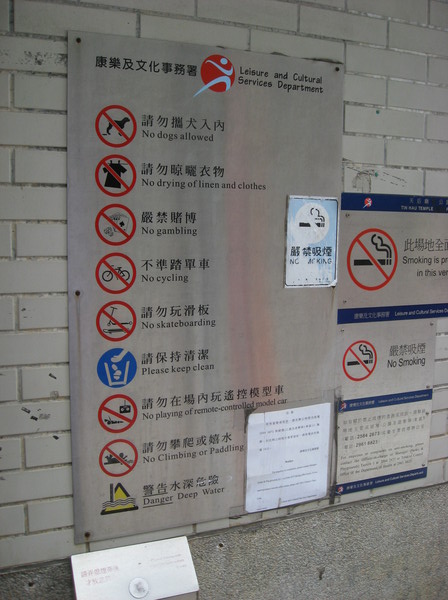 I can only guess that they must have been terrified by gangs of
kids racing their RC cars at one point!
We finished the day by heading up to Victoria Peak for the sunset
view and some dinner, then back to the hotel. Killing time in a
shopping centre waiting for the bus to turn up, we found a truly
astonishing little item on sale, a Solar Queen!
 Apparently this gift has a solar panel on the handbag to provide
power to a little motor in the Queen's hand to make her wave to her
subjects. We decided that we'd somehow have to live without such a
delight in our lives... :-)
HK was a cool place to visit. It still feels very British in some
ways, as you'd expect from an ex-colony (power sockets are still the
same as ours, driving on the left, everybody spoke English, etc.) but
utterly alien in others (the climate, working public transport
*grin*). I look forwards to heading out there again!
 Sometimes conferences can be dull and
boring, but sometimes they can be just awesome in terms of finding the
right people to collaborate with. Linaro Connect in Hong Kong last
week was definitely one of the great ones!
I chaired my my usual sessions
(armhf
status
and cross-distro
ARM) and we had some lively discussion in both. We're probably
just about done with the armhf sessions, as most distros have accepted
a hard-float ARMv7 port now and there's not so much specific work left
there now that future sessions will be necessary. The cross-distro
work for ARM ports is likely to continue into the future, but we're
going to be concentrating on bootstrapping work for ARMv8 soon.
Talking v8, there were a lot of meetings discussing the various
work topics for this new 64-bit ARM architecture: kernel, toolchains,
bootstrapping etc. More to come on that soon!
On top of all this useful discussion and planning, we also found
time during the week for some hacking. This was the highlight of the
week for me, as I found some expert help to solve my long-standing
Ruby on ARM bug
(Debian
bug #652674, ruby1.9.1: FTBFS on armhf: test suite
segfaults). Ulrich Weigand (an IBM toolchain wizard seconded into the
Linaro team) sat with me for a couple of hours while we worked through
reproducing the problem, only to find that he could not reproduce it!
The crash had looked very much like a pthreads locking bug, which
was scaring me. After some digging, we worked out where the
problem was, and how it was now fixed.
For a long time on ARM, the Linux getcontext/setcontext system
calls have never been implemented; apparently nobody really missed
them, so they have never been a priority. In Ruby 1.9.x, the
implementation of the new "fiber" primitive wanted to use
getcontext/setcontext to control stack state etc. in different threads
of control. In cases where they are not available or known not to work
well, Ruby has fallback code to implement similar functionality. It
seems that fallback code is buggy. Maybe it was correct at some point
and has bit-rotted due to not being exercised, or maybe it was buggy
as written, but it clearly does not work correctly for us now. In the
last few months, getcontext/setcontext have finally
been implemented
for ARM in glibc trunk (by Michael Hope, also in the Linaro
toolchain team!) and backported into current Debian and Ubuntu eglibc
versions. Re-running configure and rebuilding Ruby against the most
recent code in both Sid and Precise fixed the test suite crash we were
seeing earlier. Yay! We could also provoke the bug again at will by
quickly hacking around the Ruby source to force it to switch back to
the fallback code, thereby verifying the fix.
Why does this matter? As we're expecting ARM servers to enter the
market soon, web apps written in Ruby on Rails are going to be an
important part of the software stack that customers will want to
run. Broken fibers and threading would not help here!
It's great to meet up and work with talented folks like this;
Linaro Connect is an excellent event for getting stuff done!
I never met my father's father, as he died many years before I was
born. He was a soldier in the British Army and was killed in an
accident in Burma in the 1950s. I'm told that back then the Army did
not repatriate casualties as a matter of course like they do today, so
none of the family got to see his funeral or even visit the
grave. Like many of the military casualties in the Far East, he was
buried in the Colonial Cemetery in Hong Kong. A few photographs were
sent to my grandmother of the ceremony and the headstone, but that's
all we ever saw.
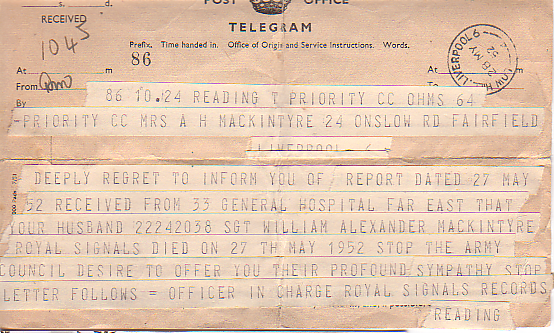
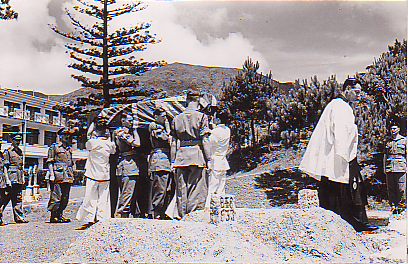 Fast forward to 2012. I travelled to Hong Kong for a conference
(Linaro Connect, more
about that later...). I looked up the details of where grandad was
laid to rest, and found a major coincidence. He was killed on 27th May
1952, almost exactly 60 years ago! I resolved to go to find him on
27th May 2012 to make the most of this lucky anniversary. Wikipedia
told me that in the intervening years the Colonial Cemetery had been
renamed to Happy Valley Cemetery, then
simply Hong
Kong Cemetery, and repurposed from military to civilian use.
Jo and I bought some flowers and headed over to Happy Valley on
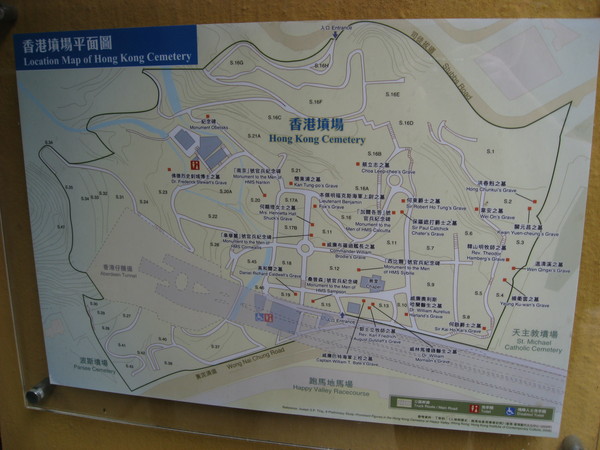
Hong Kong Island on Sunday afternoon. We found a very large cemetery
with a helpful map posted to show the different sections, but nothing
to tell us where we should be looking. One of the attendants at the
office on site looked at the details we had and shrugged to say
"sorry, can't help". Ah well, nobody said this was going to be very
easy... What we found after a few minutes was that the graves weren't
laid out in any obviously logical fashion. In any given small area,
you'd find people buried from roughly the same period, but
people for any given period could (and would) be scattered across
multiple sections at all corners of the site. Great, time for an
exhaustive search then. I started combing the site, checking all the
markers I could find that looked anything like the tiny grainy black
and white photo we had of grandad's headstone.
 Almost two hours later, I eventually found him. Two hours of heavy
work: the cemetery is built on the side of quite a steep hill, and the
prevailing weather was very hot with 100% humidity. But, I forgot all
that as we eventually stumbled across the correct grave in (no
exaggeration!) the very last part of the last section of the site,
20a.
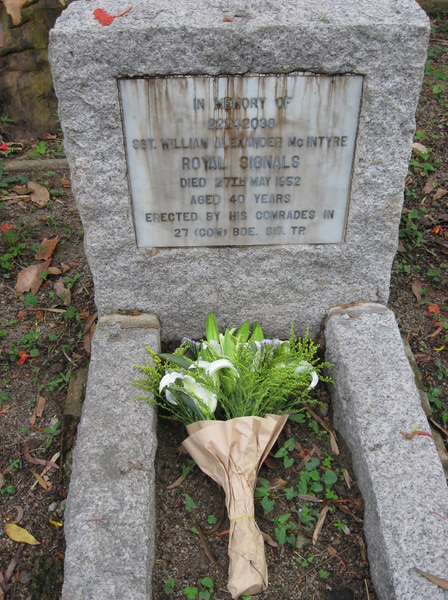 I was relieved at this point: as things had taken so long, I had
started to worry that maybe the grave had been moved or the headstone
damaged and lost. But no, I found the man who had gone off to war
leaving my dad and aunt as small children. We took some photos and
took note of where we had found the final resting place of Sergeant
William Alexander McIntyre of the Royal Signals, a man I never met in
life but clearly a very important member of our family.
 A lot of people interested in free software, and user autonomy
and network services are very worried about Facebook. Folks are
worried for the same reason that so many investors are interested: the
networks effects brought by hundreds of millions of folks signed
up to use the service.
Network effects -- the concept that a good or service
increases in value as more people use it -- are not a new problem for
free software. Software developers target Microsoft Windows because
that is where the large majority of users are. Users with no love for
Microsoft and who are otherwise sympathetic to free software use
Windows because programs they need will only run there.
Folks worried about Facebook are afraid for similar reasons. Sure, you
can close down your Facebook account and move to Diaspora. But who
will you talk to there? You can already hear people complaining about
Facebook the same way they've been complaining about Windows or Office
for years. People feel that their hands are tied and that their
software, and their social network, will be determined by what everybody is
doing.
I'm worried about Facebook. But I'm not too intimidated by Facebook's
network effects for two reasons.
First, using Facebook doesn't preclude using anything else.
Twitter has enormous overlapping functionality with Facebook.
Sure, people use the systems very differently. But they both ask you to
create lists of friends and followers and are designed around sending
and receiving short status
messages. Millions of people do both and both systems are
thriving. For the millions of people who use both Facebook and
Twitter, the two services have had to negotiate their marginal utility
in a world they share with the other one. People decide that Twitter
is for certain types of short messages and Facebook is for others. But
these arrangements shift over time.
And the relationships between services aren't always peaceful coexistence.
Remember Friendster? Remember Orkut? Remember Tribe? Remember
MySpace? MySpace, and all the others, are great examples of how
social networks die. They very slowly fade away. MySpace
users signed up for Facebook accounts and used both. They almost never just
switched. Over time, as one platform became more
attractive than the other, for many complicated reasons, attention and
activity shifted. People logged in on MySpace less and Facebook more
and, eventually, realized they were effectively no longer MySpace
users. Anyone that has been on the Internet long enough to watch a few
of these shifts from one platform to another knows that they're not
abrupt -- even if they can be set in motion by a particular event or
action. Users of social networking sites simply don't have to choose
in the way that a person choosing to boot Windows and
GNU/Linux does.
I'm sure the vast majority of people with Diaspora accounts use
Facebook actively. This is not a problem for Diaspora. It is
how Diaspora -- or whatever else eventually achieves what many of us
hoped Diaspora would -- could win.
Second, Facebook is for the ephemeral.
Facebook is primarily used for information that was produced very
recently. This week if not today. If not this hour.
Facebook has an enormous amount of data that users have fed it that
may be hard to get out and move somewhere else. But most people don't
care very much about having any regular access to the large majority
of this information. What people care deeply about
is having access to the data that they and their friends created today. And
that data can just as easily be created somewhere else tomorrow. Or,
with the right tools, created just as easily in both places.
Compare this to something like Windows where moving away would require
learning, converting, and perhaps even writing, new software. Perhaps even in
new programming languages that most developers don't know yet. Compared to
Windows, a migration away from Facebook will be easy.
Facebook's photo galleries are an example of an important place where this
holds less well. Social network information -- i.e., the list of who is friends
with who -- is another example of something that is persistently
valuable. That said, people really enjoy the act of finding and
friending. Indeed, this process was
part of the initial draw of Facebook and other social networks.
None of this means that Facebook is over. It doesn't even mean that its
ascendancy will be slowed. What it does mean is that Facebook is vulnerable
to the next thing more than many technology firms that have benefited
from network effects in the past. If users are given compelling reasons to
switch to something else, they can with less trouble and they will.
That compelling reason might be a new
social network with better features or an awesome distributed architecture that
allows freedom for users and the ability of those users to
benefit from new and fantastic things that Facebook's overseers would never let them have and without the things Facebook's users suffer through today. Or it
might be a sexier proprietary box to store users' private information.
It doesn't mean that I'm not worried about Facebook. I remain
deeply worried. It's just not very hard for me to imagine the end.
 A copy of this post is sent to
soc-coordination@lists.alioth.debian.org
as well as to
debian-bootstrap@lists.mister-muffin.de.
Diary
May 21
git clone git://gitorious.org/debian-bootstrap/bootstrap.git
# (1) number of packages with priority:required: 62
# (2) plus, number of dependencies of priority:required packages: 20
# (3) plus, build-essential and dependencies: 31
# number of source packages to build the above: 71
# number of additional packages built from the above source packages: 292
# (4) number of packages of those plus arch:all packages that are installable: 6421
# total number of installable packages (1)+(2)+(3)+(4): 6534
# (1) number of packages with priority:required: 96
# (2) plus, number of dependencies of priority:required packages: 7
# (3) plus, build-essential and dependencies: 31
# number of source packages to build the above: 87
# number of additional packages built from the above source packages: 217
# (4) number of packages of those plus arch:all packages that are installable: 2102
# total number of installable packages (1)+(2)+(3)+(4): 2236
| In Total: | 1412 |
|---|---|
| Affecting Wheezy: | 977 |
| Wheezy only: | 272 |
| Remaining to be fixed in Wheezy: | 705 |
| Pending in Wheezy: | 51 |
|---|---|
| Patched in Wheezy: | 118 |
| Duplicates in Wheezy: | 57 |
| Can be fixed in a security Update: | 24 |
| Contrib or non-free in Wheezy: | 9 |
| Claimed in Wheezy: | 2 |
| Delayed in Wheezy: | 4 |
| Otherwise fixed in Wheezy: | 99 |
Wheezyreleased. However, with the view of the Release Managers, 867 need to be dealt with for the release to happen. Please see
Interpreting the release critical bug statisticsfor an explanation of the different numbers.
 This is my monthly summary of my Debian related activities. If you re among the people who made a donation to support my work (338.26 , thanks everybody!), then you can learn how I spent your money. Otherwise it s just an interesting status update on my various projects.
 Dpkg
Like last month, I did almost nothing concerning dpkg. This will probably change in June now that the book is out
The only thing worth noting is that I have helped Carey Underwood who was trying to diagnose why btrfs was performing so badly when unpacking Debian packages (compared to ext4). Apparently this already resulted in some btrfs improvements.
But not as much as what could be hoped. The sync_file_range() calls that dpkg are doing only force the writeback of the underlying data and not of the meta-data. So the numerous fsync() that follow still create many journal transactions that would be better handled as one big transaction. As a proof of this, replacing the fsync() with a sync() brings the performance on par with ext4.
(Beware this is my own recollection of the discussion, while it should be close to the truth, it s probably not 100% accurate when speaking of the brtfs behaviour)
Packaging
I uploaded new versions of smarty-gettext and smarty-validate because they were uninstallable after the removal of smarty. The whole history of smarty in Debian/Ubuntu has been a big FAIL since the start.
Once upon a time, there was a smarty package and some plugins. Everything was great except that the files were installed in a way that differs from the upstream recommendations. So Ubuntu changed the path in their version of the package and did not check whether it broke anything else (and it did break all the plugins). Despite the brokenness of the plugins, this divergence survived for years. So several packages that were using Smarty were modified to use dpkg-vendor to use the correct path depending on whether it was built on Debian or Ubuntu.
In 2010, Smarty 3.0 has been released and instead of upgrading the smarty package to this version, one of the smarty co-maintainers introduced a smarty3 package that used yet another path (despite the fact that smarty 3 had a mode to be compatible with smarty 2).
No comment Liked this article? Click here. My blog is Flattr-enabled.
Edit 16:17EDT 31/5/12: Clarification of who gets the $99  Android support in Gammu is one of frequently requested features. I don't have neither time to motivation to do that, so unless somebody else will step up, it won't be done.
Recently, I got offer from MyPhoneExplorer author to share it's
applet for communicating with Android phones. It basically provides
protocol similar to Sony-Ericsson phones Gammu already supports, just
over TCP/IP. So all what would have to be done is glue layer for using
TCP/IP and possibly some minor adjustments to Sony-Ericsson code. Both
of these should be quite easy tasks and I'm willing to guide you
through this process.
In case anybody would be interested in this challenge, just let me
know :-).
Filed under: English Gammu 1 comments Flattr this!
Next.