Search Results: "ag"

28 April 2023

Sven Hoexter: What's wrong in IT: commit messages

In my day job someone today took the time in the team daily to explain his research why some of our configuration is wrong. He spent quite some time on his own to look at the history in git and how everything was setup initially, and ended up in the current - wrong - way. That triggered me to validate that quickly, another 5min of work. So we agreed to change it. A one line change, nothing spectacular, but lifetime was invested to figure out why it should've a different value. When the pull request got opened a few minutes later there was nothing of that story in the commit message. Zero, nada, nothing. :( I'm really puzzled why someone invests lifetime to dig into company internal history to try get something right, do a lengthy explanation to the whole team, use the time of others, even mention that there was no explanation of why it's not the default value anymore it should be, and repeat the same mistake by not writing down anything in the commit message. For the current company I'm inclined to propose a commit message validator. For a potential future company I might join, I guess I ask for real world git logs from repositories I should contribute to. Seems that this is another valuable source of information to qualify the company culture. Next up to the existence of whiteboards in the office. I'm really happy that at least a majority of the people contributing to Debian writes somewhat decent commit messages and changelogs. Let that be a reminder to myself to improve in that area the next time I've to change something.

Shirish Agarwal: John Grisham s books, Evolution removed from textbooks

Gray Mountain John Grisham I have been perusing John Grisham s books, some read and some re-read again. Almost all of the books that Mr. Grisham wrote are relevant even today. The Gray Mountain talks about how mountain top removal was done in Applachia, the U.S. (South). In fact NASA made a summary which either was borrowed from this book or the author borrowed from NASA, either could be true although seems it might be the former. And this is when GOI just made a new Forest Conservation Bill 2023 which does the opposite. There are many examples of the same, the latest from my own city as an e.g. Vetal Tekdi is and was a haven for people animals, birds all kinds of ecosystem and is a vital lung of the city, one of the few remaining green spaces in the city but BJP wants to commercialize it as it has been doing for everything, I haven t been to the Himalayas since 4-5 years back as I hear the rape of the land daily. Even after Joshimath tragedy, if people are not opening the eyes what can I do  The more I say, the more depressed I will become so will leave it for now. In many ways the destruction seems similar to the destruction that happened in Brazil under Jair Bolsonaro. So as can be seen from what I have shared this book was mostly about environment and punitive damages and also how punitive damages have been ceiling in America (South). This was done via lobbying by the coal groups and apparently destroyed people s lives, communities, even whole villages. It also shared how most people called black lung and how those claims had been denied by Coal Companies all the time. And there are hardly any unions. While the book itself is a fiction piece, there is a large amount of truth in it. And that is one of the reasons people write a fiction book. You could write about reality using fictional names and nobody can sue you while you set the reality as it is. In many ways, it is a tell-all.

The Testament John Grisham One of the things I have loved about John Grisham is he understands human condition. In this book it starts with an eccentric billionaire who makes a will which leaves all his property to an illegitimate child who coincidentally also lives in Brazil, she is a missionary. The whole book is about human failings as well as about finding the heir. I am not going to give much detail as the book itself is fun.

The Appeal John Grisham In this, we are introduced to a company that does a chemical spill for decades and how that leads to lobbying and funding Judicial elections. It does go into quite a bit of length how private money coming from Big business does all kind of shady things to get their person elected to the Supreme Court. Sadly, this seems to happen all the time, for e.g. two weeks ago. This piece from the Atlantic also says the same. Again, won t tell as there is a bit of irony at the end of the book.

The Rainmaker John Grisham This in short is about how Insurance Companies stiff people. It s a wonderful story that has all people in grey including our hero. An engaging book that sorta tells how the Insurance Industry plays the game. In India, the companies are safe as they ask for continuance for years together and their object is to delay the hearings till the grandchildren are not alive unlike in the U.S. or UK. It also does tell how more lawyers are there then required. Both of which are the same in my country.

The Litigators John Grisham This one is about Product Liability, both medicines as well as toys for young kids. What I do find funny a bit is how the law in States allows people to file cases but doesn t protect people while in EU they try their best that if there is any controversy behind any medicine or product, they will simply ban it. Huge difference between the two cultures.

Evolution no longer part of Indian Education A few days ago, NCERT (one of the major bodies) that looks into Indian Education due to BJP influence has removed Darwin s Theory of Evolution. You can t even debate because the people do not understand adaptability. So the only conclusion is that Man suddenly appeared out of nowhere. If that is so, then we are the true aliens. They discard the notion that we and Chimpanzees are similar. Then they also have to discard this finding that genetically we are 96% similar.

27 April 2023

Jonathan McDowell: Repurposing my C.H.I.P.

Way back at DebConf16 Gunnar managed to arrange for a number of Next Thing Co. C.H.I.P. boards to be distributed to those who were interested. I was lucky enough to be amongst those who received one, but I have to confess after some initial experimentation it ended up sitting in its box unused. The reasons for that were varied; partly about not being quite sure what best to do with it, partly due to a number of limitations it had, partly because NTC sadly went insolvent and there was less momentum around the hardware. I ve always meant to go back to it, poking it every now and then but never completing a project. I m finally almost there, and I figure I should write some of it up. TL;DR: My C.H.I.P. is currently running a mainline Linux 6.3 kernel with only a few DTS patches, an upstream u-boot v2022.1 with a couple of minor patches and an unmodified Debian bullseye armhf userspace.

Storage The main issue with the C.H.I.P. is that it uses MLC NAND, in particular mine has an 8MB H27QCG8T2E5R. That ended up unsupported in Linux, with the UBIFS folk disallowing operation on MLC devices. There s been subsequent work to enable an SLC emulation mode which makes the device more reliable at the cost of losing capacity by pairing up writes/reads in cells (AFAICT). Some of this hit for the H27UCG8T2ETR in 5.16 kernels, but I definitely did some experimentation with 5.17 without having much success. I should maybe go back and try again, but I ended up going a different route. It turned out that BytePorter had documented how to add a microSD slot to the NTC C.H.I.P., using just a microSD to full SD card adapter. Every microSD card I buy seems to come with one of these, so I had plenty lying around to test with. I started with ensuring the kernel could see it ok (by modifying the device tree), but once that was all confirmed I went further and built a more modern u-boot that talked to the SD card, and defaulted to booting off it. That meant no more relying on the internal NAND at all! I do see some flakiness with the SD card, which is possibly down to the dodgy way it s hooked up (I should probably do a basic PCB layout with JLCPCB instead). That s mostly been mitigated by forcing it into 1-bit mode instead of 4-bit mode (I tried lowering the frequency too, but that didn t make a difference). The problem manifests as:
sunxi-mmc 1c11000.mmc: data error, sending stop command
and then all storage access freezing (existing logins still work, if the program you re trying to run is in cache). I can t find a conclusive software solution to this; I m pretty sure it s the hardware, but I don t understand why the recovery doesn t generally work.

Random power offs After I had storage working I d see random hangs or power offs. It wasn t quite clear what was going on. So I started trying to work out how to find out the CPU temperature, in case it was overheating. It turns out the temperature sensor on the R8 is part of the touchscreen driver, and I d taken my usual approach of turning off all the drivers I didn t think I d need. Enabling it (CONFIG_TOUCHSCREEN_SUN4I) gave temperature readings and seemed to help somewhat with stability, though not completely. Next I ended up looking at the AXP209 PMIC. There were various scripts still installed (I d started out with the NTC Debian install and slowly upgraded it to bullseye while stripping away the obvious pieces I didn t need) and a start-up script called enable-no-limit. This turned out to not be running (some sort of expectation of i2c-dev being loaded and another failing check), but looking at the script and the data sheet revealed the issue. The AXP209 can cope with 3 power sources; an external DC source, a Li-battery, and finally a USB port. I was powering my board via the USB port, using a charger rated for 2A. It turns out that the AXP209 defaults to limiting USB current to 900mA, and that with wifi active and the CPU busy the C.H.I.P. can rise above that. At which point the AXP shuts everything down. Armed with that info I was able to understand what the power scripts were doing and which bit I needed - i2cset -f -y 0 0x34 0x30 0x03 to set no limit and disable the auto-power off. Additionally I also discovered that the AXP209 had a built in temperature sensor as well, so I added support for that via iio-hwmon.

WiFi WiFi on the C.H.I.P. is provided by an RTL8723BS SDIO attached device. It s terrible (and not just here, I had an x86 based device with one where it also sucked). Thankfully there s a driver in staging in the kernel these days, but I ve still found it can fall out with my house setup, end up connecting to a further away AP which then results in lots of retries, dropped frames and CPU consumption. Nailing it to the AP on the other side of the wall from where it is helps. I haven t done any serious testing with the Bluetooth other than checking it s detected and can scan ok.

Patches I patched u-boot v2022.01 (which shows you how long ago I was trying this out) with the following to enable boot from external SD:
u-boot C.H.I.P. external SD patch
diff --git a/arch/arm/dts/sun5i-r8-chip.dts b/arch/arm/dts/sun5i-r8-chip.dts
index 879a4b0f3b..1cb3a754d6 100644
--- a/arch/arm/dts/sun5i-r8-chip.dts
+++ b/arch/arm/dts/sun5i-r8-chip.dts
@@ -84,6 +84,13 @@
 		reset-gpios = <&pio 2 19 GPIO_ACTIVE_LOW>; /* PC19 */
 	 ;
 
+	mmc2_pins_e: mmc2@0  
+		pins = "PE4", "PE5", "PE6", "PE7", "PE8", "PE9";
+		function = "mmc2";
+		drive-strength = <30>;
+		bias-pull-up;
+	 ;
+
 	onewire  
 		compatible = "w1-gpio";
 		gpios = <&pio 3 2 GPIO_ACTIVE_HIGH>; /* PD2 */
@@ -175,6 +182,16 @@
 	status = "okay";
  ;
 
+&mmc2  
+	pinctrl-names = "default";
+	pinctrl-0 = <&mmc2_pins_e>;
+	vmmc-supply = <&reg_vcc3v3>;
+	vqmmc-supply = <&reg_vcc3v3>;
+	bus-width = <4>;
+	broken-cd;
+	status = "okay";
+ ;
+
 &ohci0  
 	status = "okay";
  ;
diff --git a/arch/arm/include/asm/arch-sunxi/gpio.h b/arch/arm/include/asm/arch-sunxi/gpio.h
index f3ab1aea0e..c0dfd85a6c 100644
--- a/arch/arm/include/asm/arch-sunxi/gpio.h
+++ b/arch/arm/include/asm/arch-sunxi/gpio.h
@@ -167,6 +167,7 @@ enum sunxi_gpio_number  
 
 #define SUN8I_GPE_TWI2		3
 #define SUN50I_GPE_TWI2		3
+#define SUNXI_GPE_SDC2		4
 
 #define SUNXI_GPF_SDC0		2
 #define SUNXI_GPF_UART0		4
diff --git a/board/sunxi/board.c b/board/sunxi/board.c
index fdbcd40269..f538cb7e20 100644
--- a/board/sunxi/board.c
+++ b/board/sunxi/board.c
@@ -433,9 +433,9 @@ static void mmc_pinmux_setup(int sdc)
 			sunxi_gpio_set_drv(pin, 2);
 		 
 #elif defined(CONFIG_MACH_SUN5I)
-		/* SDC2: PC6-PC15 */
-		for (pin = SUNXI_GPC(6); pin <= SUNXI_GPC(15); pin++)  
-			sunxi_gpio_set_cfgpin(pin, SUNXI_GPC_SDC2);
+		/* SDC2: PE4-PE9 */
+		for (pin = SUNXI_GPE(4); pin <= SUNXI_GPE(9); pin++)  
+			sunxi_gpio_set_cfgpin(pin, SUNXI_GPE_SDC2);
 			sunxi_gpio_set_pull(pin, SUNXI_GPIO_PULL_UP);
 			sunxi_gpio_set_drv(pin, 2);
 		 

I ve sent some patches for the kernel device tree upstream - there s an outstanding issue with the Bluetooth wake GPIO causing the serial port not to probe(!) that I need to resolve before sending a v2, but what s there works for me. The only remaining piece is patch to enable the external SD for Linux; I don t think it s appropriate to send upstream but it s fairly basic. This limits the bus to 1 bit rather than the 4 bits it s capable of, as mentioned above.
Linux C.H.I.P. external SD DTS patch diff diff --git a/arch/arm/boot/dts/sun5i-r8-chip.dts b/arch/arm/boot/dts/sun5i-r8-chip.dts index fd37bd1f3920..2b5aa4952620 100644 --- a/arch/arm/boot/dts/sun5i-r8-chip.dts +++ b/arch/arm/boot/dts/sun5i-r8-chip.dts @@ -163,6 +163,17 @@ &mmc0 status = "okay"; ; +&mmc2 + pinctrl-names = "default"; + pinctrl-0 = <&mmc2_4bit_pe_pins>; + vmmc-supply = <&reg_vcc3v3>; + vqmmc-supply = <&reg_vcc3v3>; + bus-width = <1>; + non-removable; + disable-wp; + status = "okay"; + ; + &ohci0 status = "okay"; ;

As for what I m doing with it, I think that ll have to be a separate post.

Thomas Lange: New feature for FAI.me build service

After the initial installation of a new machine, you often want to login as root via ssh. Therefore it's convenient to provide a ssh public key for a passwordless login. This can now be done by just adding your user name from salsa.debian.org, gitlab.com or github.com. You can also give a customized URL from where to download the keys. Before it was only possible to use a github account name. The FAI.me build service then creates a customized installation ISO for you, which will automatically install the ssh public key into the root account. Also the ready-to-boot cloud images support this feature. The build service is available on the FAI project website at https://fai-project.org/FAIme

Simon Josefsson: A Security Device Threat Model: The Substitution Attack

I d like to describe and discuss a threat model for computational devices. This is generic but we will narrow it down to security-related devices. For example, portable hardware dongles used for OpenPGP/OpenSSH keys, FIDO/U2F, OATH HOTP/TOTP, PIV, payment cards, wallets etc and more permanently attached devices like a Hardware Security Module (HSM), a TPM-chip, or the hybrid variant of a mostly permanently-inserted but removable hardware security dongles. Our context is cryptographic hardware engineering, and the purpose of the threat model is to serve as as a thought experiment for how to build and design security devices that offer better protection. The threat model is related to the Evil maid attack. Our focus is to improve security for the end-user rather than the traditional focus to improve security for the organization that provides the token to the end-user, or to improve security for the site that the end-user is authenticating to. This is a critical but often under-appreciated distinction, and leads to surprising recommendations related to onboard key generation, randomness etc below.

The Substitution Attack
An attacker is able to substitute any component of the device (hardware or software) at any time for any period of time.
Your takeaway should be that devices should be designed to mitigate harmful consequences if any component of the device (hardware or software) is substituted for a malicious component for some period of time, at any time, during the lifespan of that component. Some designs protect better against this attack than other designs, and the threat model can be used to understand which designs are really bad, and which are less so.

Terminology The threat model involves at least one device that is well-behaving and one that is not, and we call these Good Device and Bad Device respectively. The bad device may be the same physical device as the good key, but with some minor software modification or a minor component replaced, but could also be a completely separate physical device. We don t care about that distinction, we just care if a particular device has a malicious component in it or not. I ll use terms like security device , device , hardware key , security co-processor etc interchangeably. From an engineering point of view, malicious here includes unintentional behavior such as software or hardware bugs. It is not possible to differentiate an intentionally malicious device from a well-designed device with a critical bug. Don t attribute to malice what can be adequately explained by stupidity, but don t na vely attribute to stupidity what may be deniable malicious.

What is some period of time ? Some period of time can be any length of time: seconds, minutes, days, weeks, etc. It may also occur at any time: During manufacturing, during transportation to the user, after first usage by the user, or after a couple of months usage by the user. Note that we intentionally consider time-of-manufacturing as a vulnerable phase. Even further, the substitution may occur multiple times. So the Good Key may be replaced with a Bad Key by the attacker for one day, then returned, and later this repeats a month later.

What is harmful consequences ? Since a security key has a fairly well-confined scope and purpose, we can get a fairly good exhaustive list of things that could go wrong. Harmful consequences include:
  • Attacker learns any secret keys stored on a Good Key.
  • Attacker causes user to trust a public generated by a Bad Key.
  • Attacker is able to sign something using a Good Key.
  • Attacker learns the PIN code used to unlock a Good Key.
  • Attacker learns data that is decrypted by a Good Key.

Thin vs Deep solutions One approach to mitigate many issues arising from device substitution is to have the host (or remote site) require that the device prove that it is the intended unique device before it continues to talk to it. This require an authentication/authorization protocol, which usually involves unique device identity and out-of-band trust anchors. Such trust anchors is often problematic, since a common use-case for security device is to connect it to a host that has never seen the device before. A weaker approach is to have the device prove that it merely belongs to a class of genuine devices from a trusted manufacturer, usually by providing a signature generated by a device-specific private key signed by the device manufacturer. This is weaker since then the user cannot differentiate two different good devices. In both cases, the host (or remote site) would stop talking to the device if it cannot prove that it is the intended key, or at least belongs to a class of known trusted genuine devices. Upon scrutiny, this solution is still vulnerable to a substitution attack, just earlier in the manufacturing chain: how can the process that injects the per-device or per-class identities/secrets know that it is putting them into a good key rather than a malicious device? Consider also the consequences if the cryptographic keys that guarantee that a device is genuine leaks. The model of the thin solution is similar to the old approach to network firewalls: have a filtering firewall that only lets through intended traffic, and then run completely insecure protocols internally such as telnet. The networking world has evolved, and now we have defense in depth: even within strongly firewall ed networks, it is prudent to run for example SSH with publickey-based user authentication even on locally physical trusted networks. This approach requires more thought and adds complexity, since each level has to provide some security checking. I m arguing we need similar defense-in-depth for security devices. Security key designs cannot simply dodge this problem by assuming it is working in a friendly environment where component substitution never occur.

Example: Device authentication using PIN codes To see how this threat model can be applied to reason about security key designs, let s consider a common design. Many security keys uses PIN codes to unlock private key operations, for example on OpenPGP cards that lacks built-in PIN-entry functionality. The software on the computer just sends a PIN code to the device, and the device allows private-key operations if the PIN code was correct. Let s apply the substitution threat model to this design: the attacker replaces the intended good key with a malicious device that saves a copy of the PIN code presented to it, and then gives out error messages. Once the user has entered the PIN code and gotten an error message, presumably temporarily giving up and doing other things, the attacker replaces the device back again. The attacker has learnt the PIN code, and can later use this to perform private-key operations on the good device. This means a good design involves not sending PIN codes in clear, but use a stronger authentication protocol that allows the card to know that the PIN was correct without learning the PIN. This is implemented optionally for many OpenPGP cards today as the key-derivation-function extension. That should be mandatory, and users should not use setups that sends device authentication in the clear, and ultimately security devices should not even include support for that. Compare how I build Gnuk on my PGP card with the kdf_do=required option.

Example: Onboard non-predictable key-generation Many devices offer both onboard key-generation, for example OpenPGP cards that generate a Ed25519 key internally on the devices, or externally where the device imports an externally generated cryptographic key. Let s apply the subsitution threat model to this design: the user wishes to generate a key and trust the public key that came out of that process. The attacker substitutes the device for a malicious device during key-generation, imports the private key into a good device and gives that back to the user. Most of the time except during key generation the user uses a good device but still the attacker succeeded in having the user trust a public key which the attacker knows the private key for. The substitution may be a software modification, and the method to leak the private key to the attacker may be out-of-band signalling. This means a good design never generates key on-board, but imports them from a user-controllable environment. That approach should be mandatory, and users should not use setups that generates private keys on-board, and ultimately security devices should not even include support for that.

Example: Non-predictable randomness-generation Many devices claims to generate random data, often with elaborate design documents explaining how good the randomness is. Let s apply the substitution threat model to this design: the attacker replaces the intended good key with a malicious design that generates (for the attacker) predictable randomness. The user will never be able to detect the difference since the random output is, well, random, and typically not distinguishable from weak randomness. The user cannot know if any cryptographic keys generated by a generator was faulty or not. This means a good design never generates non-predictable randomness on the device. That approach should be mandatory, and users should not use setups that generates non-predictable randomness on the device, and ideally devices should not have this functionality.

Case-Study: Tillitis I have warmed up a bit for this. Tillitis is a new security device with interesting properties, and core to its operation is the Compound Device Identifier (CDI), essentially your Ed25519 private key (used for SSH etc) is derived from the CDI that is computed like this:
cdi = blake2s(UDS, blake2s(device_app), USS)
Let s apply the substitution threat model to this design: Consider someone replacing the Tillitis key with a malicious key during postal delivery of the key to the user, and the replacement device is identical with the real Tillitis key but implements the following key derivation function:
cdi = weakprng(UDS , weakprng(device_app), USS)
Where weakprng is a compromised algorithm that is predictable for the attacker, but still appears random. Everything will work correctly, but the attacker will be able to learn the secrets used by the user, and the user will typically not be able to tell the difference since the CDI is secret and the Ed25519 public key is not self-verifiable.

Conclusion Remember that it is impossible to fully protect against this attack, that s why it is merely a thought experiment, intended to be used during design of these devices. Consider an attacker that never gives you access to a good key and as a user you only ever use a malicious device. There is no way to have good security in this situation. This is not hypothetical, many well-funded organizations do what they can to derive people from having access to trustworthy security devices. Philosophically it does not seem possible to tell if these organizations have succeeded 100% already and there are only bad security devices around where further resistance is futile, but to end on an optimistic note let s assume that there is a non-negligible chance that they haven t succeeded. In these situations, this threat model becomes useful to improve the situation by identifying less good designs, and that s why the design mantra of mitigate harmful consequences is crucial as a takeaway from this. Let s improve the design of security devices that further the security of its users!

Arturo Borrero Gonz lez: Kubecon and CloudNativeCon 2023 Europe summary

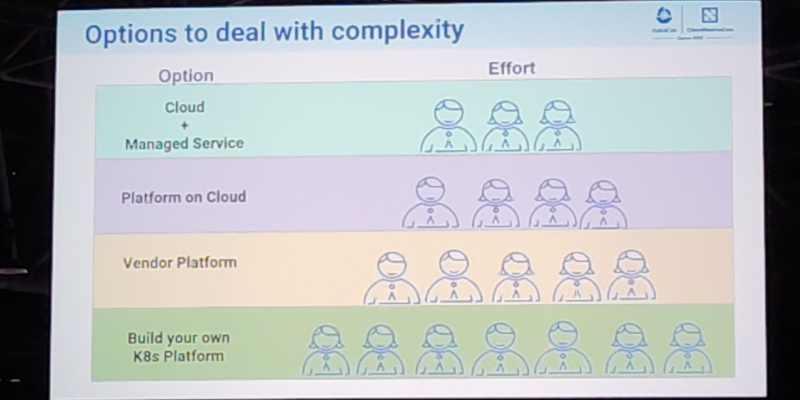
Post logo This post serves as a report from my attendance to Kubecon and CloudNativeCon 2023 Europe that took place in Amsterdam in April 2023. It was my second time physically attending this conference, the first one was in Austin, Texas (USA) in 2017. I also attended once in a virtual fashion. The content here is mostly generated for the sake of my own recollection and learnings, and is written from the notes I took during the event. The very first session was the opening keynote, which reunited the whole crowd to bootstrap the event and share the excitement about the days ahead. Some astonishing numbers were announced: there were more than 10.000 people attending, and apparently it could confidently be said that it was the largest open source technology conference taking place in Europe in recent times. It was also communicated that the next couple iteration of the event will be run in China in September 2023 and Paris in March 2024. More numbers, the CNCF was hosting about 159 projects, involving 1300 maintainers and about 200.000 contributors. The cloud-native community is ever-increasing, and there seems to be a strong trend in the industry for cloud-native technology adoption and all-things related to PaaS and IaaS. The event program had different tracks, and in each one there was an interesting mix of low-level and higher level talks for a variety of audience. On many occasions I found that reading the talk title alone was not enough to know in advance if a talk was a 101 kind of thing or for experienced engineers. But unlike in previous editions, I didn t have the feeling that the purpose of the conference was to try selling me anything. Obviously, speakers would make sure to mention, or highlight in a subtle way, the involvement of a given company in a given solution or piece of the ecosystem. But it was non-invasive and fair enough for me. On a different note, I found the breakout rooms to be often small. I think there were only a couple of rooms that could accommodate more than 500 people, which is a fairly small allowance for 10k attendees. I realized with frustration that the more interesting talks were immediately fully booked, with people waiting in line some 45 minutes before the session time. Because of this, I missed a few important sessions that I ll hopefully watch online later. Finally, on a more technical side, I ve learned many things, that instead of grouping by session I ll group by topic, given how some subjects were mentioned in several talks. On gitops and CI/CD pipelines Most of the mentions went to FluxCD and ArgoCD. At that point there were no doubts that gitops was a mature approach and both flux and argoCD could do an excellent job. ArgoCD seemed a bit more over-engineered to be a more general purpose CD pipeline, and flux felt a bit more tailored for simpler gitops setups. I discovered that both have nice web user interfaces that I wasn t previously familiar with. However, in two different talks I got the impression that the initial setup of them was simple, but migrating your current workflow to gitops could result in a bumpy ride. This is, the challenge is not deploying flux/argo itself, but moving everything into a state that both humans and flux/argo can understand. I also saw some curious mentions to the config drifts that can happen in some cases, even if the goal of gitops is precisely for that to never happen. Such mentions were usually accompanied by some hints on how to operate the situation by hand. Worth mentioning, I missed any practical information about one of the key pieces to this whole gitops story: building container images. Most of the showcased scenarios were using pre-built container images, so in that sense they were simple. Building and pushing to an image registry is one of the two key points we would need to solve in Toolforge Kubernetes if adopting gitops. In general, even if gitops were already in our radar for Toolforge Kubernetes, I think it climbed a few steps in my priority list after the conference. Another learning was this site: https://opengitops.dev/. Group On etcd, performance and resource management I attended a talk focused on etcd performance tuning that was very encouraging. They were basically talking about the exact same problems we have had in Toolforge Kubernetes, like api-server and etcd failure modes, and how sensitive etcd is to disk latency, IO pressure and network throughput. Even though Toolforge Kubernetes scale is small compared to other Kubernetes deployments out there, I found it very interesting to see other s approaches to the same set of challenges. I learned how most Kubernetes components and apps can overload the api-server. Because even the api-server talks to itself. Simple things like kubectl may have a completely different impact on the API depending on usage, for example when listing the whole list of objects (very expensive) vs a single object. The conclusion was to try avoiding hitting the api-server with LIST calls, and use ResourceVersion which avoids full-dumps from etcd (which, by the way, is the default when using bare kubectl get calls). I already knew some of this, and for example the jobs-framework-emailer was already making use of this ResourceVersion functionality. There have been a lot of improvements in the performance side of Kubernetes in recent times, or more specifically, in how resources are managed and used by the system. I saw a review of resource management from the perspective of the container runtime and kubelet, and plans to support fancy things like topology-aware scheduling decisions and dynamic resource claims (changing the pod resource claims without re-defining/re-starting the pods). On cluster management, bootstrapping and multi-tenancy I attended a couple of talks that mentioned kubeadm, and one in particular was from the maintainers themselves. This was of interest to me because as of today we use it for Toolforge. They shared all the latest developments and improvements, and the plans and roadmap for the future, with a special mention to something they called kubeadm operator , apparently capable of auto-upgrading the cluster, auto-renewing certificates and such. I also saw a comparison between the different cluster bootstrappers, which to me confirmed that kubeadm was the best, from the point of view of being a well established and well-known workflow, plus having a very active contributor base. The kubeadm developers invited the audience to submit feature requests, so I did. The different talks confirmed that the basic unit for multi-tenancy in kubernetes is the namespace. Any serious multi-tenant usage should leverage this. There were some ongoing conversations, in official sessions and in the hallway, about the right tool to implement K8s-whitin-K8s, and vcluster was mentioned enough times for me to be convinced it was the right candidate. This was despite of my impression that multiclusters / multicloud are regarded as hard topics in the general community. I definitely would like to play with it sometime down the road. On networking I attended a couple of basic sessions that served really well to understand how Kubernetes instrumented the network to achieve its goal. The conference program had sessions to cover topics ranging from network debugging recommendations, CNI implementations, to IPv6 support. Also, one of the keynote sessions had a reference to how kube-proxy is not able to perform NAT for SIP connections, which is interesting because I believe Netfilter Conntrack could do it if properly configured. One of the conclusions on the CNI front was that Calico has a massive community adoption (in Netfilter mode), which is reassuring, especially considering it is the one we use for Toolforge Kubernetes. Slide On jobs I attended a couple of talks that were related to HPC/grid-like usages of Kubernetes. I was truly impressed by some folks out there who were using Kubernetes Jobs on massive scales, such as to train machine learning models and other fancy AI projects. It is acknowledged in the community that the early implementation of things like Jobs and CronJobs had some limitations that are now gone, or at least greatly improved. Some new functionalities have been added as well. Indexed Jobs, for example, enables each Job to have a number (index) and process a chunk of a larger batch of data based on that index. It would allow for full grid-like features like sequential (or again, indexed) processing, coordination between Job and more graceful Job restarts. My first reaction was: Is that something we would like to enable in Toolforge Jobs Framework? On policy and security A surprisingly good amount of sessions covered interesting topics related to policy and security. It was nice to learn two realities:
  1. kubernetes is capable of doing pretty much anything security-wise and create greatly secured environments.
  2. it does not by default. The defaults are not security-strict on purpose.
It kind of made sense to me: Kubernetes was used for a wide range of use cases, and developers didn t know beforehand to which particular setup they should accommodate the default security levels. One session in particular covered the most basic security features that should be enabled for any Kubernetes system that would get exposed to random end users. In my opinion, the Toolforge Kubernetes setup was already doing a good job in that regard. To my joy, some sessions referred to the Pod Security Admission mechanism, which is one of the key security features we re about to adopt (when migrating away from Pod Security Policy). I also learned a bit more about Secret resources, their current implementation and how to leverage a combo of CSI and RBAC for a more secure usage of external secrets. Finally, one of the major takeaways from the conference was learning about kyverno and kubeaudit. I was previously aware of the OPA Gatekeeper. From the several demos I saw, it was to me that kyverno should help us make Toolforge Kubernetes more sustainable by replacing all of our custom admission controllers with it. I already opened a ticket to track this idea, which I ll be proposing to my team soon. Final notes In general, I believe I learned many things, and perhaps even more importantly I re-learned some stuff I had forgotten because of lack of daily exposure. I m really happy that the cloud native way of thinking was reinforced in me, which I still need because most of my muscle memory to approach systems architecture and engineering is from the old pre-cloud days. List of sessions I attended on the first day: List of sessions I attended on the second day: List of sessions I attended on third day: The videos have been published on Youtube.

25 April 2023

B lint R czey: Improve build time of Rust, Java and Intel Fortran projects with Firebuild s new release!

Rust is a hugely popular compiled programming language and accelerating it was an important goal for Firebuild for some time. Firebuild s v0.8.0 release finally added Rust support in addition to numerous other improvements including support for Doxygen, Intel s Fortran compiler and restored javac and javadoc acceleration.

Firebuild s Rust + Cargo support Firebuild treats programs as black boxes intercepting C standard library calls and system calls. It shortcuts the program invocations that predictably generate the same outputs because the program itself is known to be deterministic and all inputs are known in advance. Rust s compiler, rustc is deterministic in itself and simple rustc invocations were already accelerated, but parallel builds driven by Cargo needed a few enhancements in Firebuild.

Cargo s jobserver Cargo uses the Rust variant of the GNU Make s jobserver to control the parallelism in a build. The jobserver creates a file descriptor from which descendant processes can read tokens and are allowed to run one extra thread or parallel process per token received. After the extra threads or processes are finished the tokens must be returned by writing to the other file descriptor the jobserver created. The jobserver s file descriptors are shared with the descendant processes via environment variables:
# rustc's environment variables
...
CARGO_MAKEFLAGS="-j --jobserver-fds=4,5 --jobserver-auth=4,5"
...
Since getting tokens from the jobserver involves reading them as nondeterministic bytes from an inherited file descriptor this is clearly an operation that would depend on input not known in advance. Firebuild needs to make an exception and ignore jobserver usage related reads and writes since they are not meant to change the build results. However, there are programs not caring at all about jobservers and their file descriptors. They happily close the inherited file descriptors and open new ones with the same id, to use them for entirely different purposes. One such program is the widely used ./configure script, thus the case is far from being theoretical. To stay on the safe side firebuild ignores jobserver fd usage only in programs which are known to use the jobserver properly. The list of the programs is now configurable in /etc/firebuild.conf and since rustc is on the list by default parallel Rust builds are accelerated out of the box!

Writable dependency dir The other issue that prevented highly accelerated Rust builds was rustc s -L dependency=<dir> parameter. This directory is populated in a not fully deterministic order in parallel builds. Firebuild on the other hand hashes directory listings of open()-ed directories treating them as inputs assuming that the directory content will influence the intercepted programs outputs. As rustc programs started in parallel scanned the dependency directory in different states depending on what other Rust compilations finished already Firebuild had to store the full directory content as an input for each rustc cache entry resulting low hit rate when rustc was started again with otherwise identical inputs. The solution here is ignoring rustc scanning the dependency directory, because the dependencies actually used are still treated as input and are checked when shortcutting rustc. With that implemented in firebuild, too, librsvg s build that uses Rust and Cargo can be accelerated by more than 90%, even on a system having 12 cores/24 threads!:
Firebuild accelerating librsvg s Rust + Cargo build from 38s to 2.8s on a Ryzen 5900X (12C/24T) system

On the way to accelerate anything Firebuild s latest release incorporated more than 100 changes just from the last two months. They unlocked acceleration of Rust builds with Cargo, fixed Firebuild to work with the latest Java update that slightly changed its behavior, started accelerating Intel s Fortran compiler in addition to accelerating gfortran that was already supported and included many smaller changes improving the acceleration of other compilers and tools. If your favorite toolchain is not mentioned, there is still a good chance that it is already supported. Give Firebuild a try and tell us about your experience! Update 1: Comparison to sccache came up in the reddit topic about Firebuild s Rust acceleration , thus by popular demand this is how sccache performs on the same project:
Firebuild 0.8.0 vs. sccache 0.4.2 accelerating librsvg s Rust + Cargo build
All builds took place on the same Ryzen 5900X system with 12 cores / 24 threads in LXC containers limited to using 1-12 virtual CPUs. A warm-up build took place before the vanilla (without any instrumentation) build to download and compile the dependency crates to measure only the project s build time. A git clean command cleared all the build artifacts from the project directory before each build and ./autogen.sh was run to measure only clean rebuilds (without autotools). See test configuration in the Firebuild performance test repository for more details and easy reproduction. Firebuild had lower overhead than sccache (2.83% vs. 6.10% on 1 CPU and 7.71% vs. 22.05% on 12 CPUs) and made the accelerated build finish much faster (2.26% vs. 19.41% of vanilla build s time on 1 CPU and 7.5% vs. 27.4% of vanilla build s time on 12 CPUs).

24 April 2023

Bits from Debian: Debian Project Leader Election 2023, Jonathan Carter re-elected

The voting period for the Debian Project Leader election has ended, with all of the votes tallied we announce the winner is: Jonathan Carter, who has been elected for the forth time. Congratulations! The new term for the project leader started on 2023-04-21. 279 of 997 Developers voted using the Condorcet method. More information about the results of the voting are available on the Debian Project Leader Elections 2023 page. Many thanks all of our Developers for voting.

Jonathan Dowland: Separate hledgers

In a previous blog post I described the use of virtual postings to track accidental personal/family expenses. I've always been uncomfortable with that, and in hledger 1yr I outlined a potential scheme for finally addressing the virtual posting problem. separate journals My outline built on top of continuing to maintain both personal and family financial data in the same place, but I've decided that this can't work, because the different "directions" (or signs) of accidental transactions originating from either the family or personal side can't be addressed with any kind of alternate view on the same data. To illustrate with an example. A negative balance in family:liabilities:jon means "family owes jon". A coffee bought by mistake on the family credit card will have a negative posting on the credit card, and thus a positive one on the liabilities account. ("jon owes family"). That's fine. But what about when I buy family stuff on a personal card? The other side of of the transaction is also going to have a positive sign, so it can't be posted to family:liabilities:jon: it would have to go to somewhere else, like jon:liabilities:family. Now I have two accounts which track versions of the same thing, and they cannot be combined with a simple transaction since they're looking at the same value from opposite directions (and signs). Back when I first described the problem I was using a single journal file for all my transactions. After moving to lots of separate journal files (in hledger 1yr), it's become clearer to me that I don't need to maintain the Family and Personal data together, at all: they can be entirely separate journals. getting data between journals When I moved to a new set of ledger files for 2023, I needed to carry forward the balances from 2022 in the form of "opening balance" transactions. This was achieved by a report on the 2022 data, exported as CSV, and imported into the 2023 data (all following the scheme outlined by fully-fledged hledger.)) Separate Personal and Family journals need some information from each other, and I can achieve that in the same way as for opening balances: with an export of the relevant transactions as CSV, then imported on the other side. HLedger's CSV import system is flexible enough that we can effectively invert the sign of liabilities, addressing the problem above. Worked example We start with an accidental coffee purchased on the family card (and so this belongs to the Family ledger)
2022-08-20 coffee
    liabilities:creditcard             -3
    liabilities:jon:expenses:coffee     3
I've encoded the expense category that the Personal ledger will be interested in (the last bit, expenses:coffee) as a sub-account of the liabilities category that the Family ledger is interested in1 (the first bit, liabilities:jon). When viewed on the Family side, the expense category is not interesting, and we can hide it with HLedger's alias feature2:
    alias /^liabilities:jon(.*)$/ = liabilities:jon
It then looks like this from the Family side:
2022-08-20 coffee
    liabilities:creditcard             -3
    liabilities:jon                     3
This transaction (and others like it) are exported via
hledger reg -f family/2023-back.journal liabilities:jon: -O csv \
        jon/import/family/liabilities.csv
(The trailing colon on liabilities:jon: is important here!) In the resulting CSV file, the running example transaction looks like
"55","2022-08-20","","coffee","liabilities:jon:expenses:coffee","  3.00","  3.00"
This is then converted into a journal file by hledger import. The rules file for the import is very simple: the fields date, description, account1 and amount are taken as-is; account2 is hard-coded to liabilities:family. The resulting transaction looks like
2022-08-20 coffee
    liabilities:jon:expenses:coffee     3
    liabilities:family                 -3
Before this journal is included by the main one, we have to adjust the expense account, to remove the liabilities:jon: prefix. The import rules can't do this3 , so we use another journal file as a go-between with another alias rule:
    alias /^liabilities.jon:/ =
This results, finally, in the following transaction in the Personal ledger:
2022-08-20 coffee
    expenses:coffee                     3
    liabilities:family                 -3
avoiding double-counting There's one set of transactions that we don't want to export across this divide, and that's because they're already there: any time I transfer money from myself to the family accounts (or vice versa) to address the accrued debt, the transaction is visible from both my family and personal statements. To avoid exporting these and double-counting them, I make sure those transactions don't post to an account matching the pattern used in the hledger reg report. That's what the trailing colon is for: It ensures I only export transactions which are to a sub-account of liabilities:jon, and not to the root account liabilities:jon itself: which is where I put the repayment transactions. I could instead use a more explicit sub-account like liabilities:jon:repayments or similar, since the trailing colon is quite subtle, but this works for me. Wrap up I've been really on the fence as to whether the complexity of this scheme is worth it to avoid the virtual postings. The previous scheme was much simpler. I have definitely made some mistakes with it, which didn't get caught by the double-entry rules that virtual postings ignore, but they're for small sums of money anyway. On the other hand, a lot of the "machinery" of this already existed for getting opening balances between calendar years, and the gory details are written down and hidden inside the Makefile. I also expect that I will continue to see advantages in having Family and Personal entirely separate, as they can each develop and adapt to their own needs without having to consider the other side of things every time. It's a running experiment, and time will tell if it's a good idea.

  1. This scheme was originally suggested to me by Pranesh on Twitter (described in dues), but I discounted it at the time because of the exact arrangement they suggested, not realising the broader idea might work.
  2. I've hand-waved one problem with using hledger aliases here. If we use them as described, to hide the Personal expense details, we need them to not be applied when performing the CSV-generating report. Therefore, in practise I have them in a front-most family/2023.journal file, which imports the data from another family/2023-back.journal, and the CSV export is performed on the backing journal with the data and not the alias.
  3. HLedger import rules can't manipulate the fields from the CSV a great deal, but one change I proposed and started hacking on would allow for this: to expose Regexp match-groups as interpolatable tokens: https://github.com/simonmichael/hledger/issues/2009.

23 April 2023

Petter Reinholdtsen: Speech to text, she APTly whispered, how hard can it be?

While visiting a convention during Easter, it occurred to me that it would be great if I could have a digital Dictaphone with transcribing capabilities, providing me with texts to cut-n-paste into stuff I need to write. The background is that long drives often bring up the urge to write on texts I am working on, which of course is out of the question while driving. With the release of OpenAI Whisper, this seem to be within reach with Free Software, so I decided to give it a go. OpenAI Whisper is a Linux based neural network system to read in audio files and provide text representation of the speech in that audio recording. It handle multiple languages and according to its creators even can translate into a different language than the spoken one. I have not tested the latter feature. It can either use the CPU or a GPU with CUDA support. As far as I can tell, CUDA in practice limit that feature to NVidia graphics cards. I have few of those, as they do not work great with free software drivers, and have not tested the GPU option. While looking into the matter, I did discover some work to provide CUDA support on non-NVidia GPUs, and some work with the library used by Whisper to port it to other GPUs, but have not spent much time looking into GPU support yet. I've so far used an old X220 laptop as my test machine, and only transcribed using its CPU. As it from a privacy standpoint is unthinkable to use computers under control of someone else (aka a "cloud" service) to transcribe ones thoughts and personal notes, I want to run the transcribing system locally on my own computers. The only sensible approach to me is to make the effort I put into this available for any Linux user and to upload the needed packages into Debian. Looking at Debian Bookworm, I discovered that only three packages were missing, tiktoken, triton, and openai-whisper. For a while I also believed ffmpeg-python was needed, but as its upstream seem to have vanished I found it safer to rewrite whisper to stop depending on in than to introduce ffmpeg-python into Debian. I decided to place these packages under the umbrella of the Debian Deep Learning Team, which seem like the best team to look after such packages. Discussing the topic within the group also made me aware that the triton package was already a future dependency of newer versions of the torch package being planned, and would be needed after Bookworm is released. All required code packages have been now waiting in the Debian NEW queue since Wednesday, heading for Debian Experimental until Bookworm is released. An unsolved issue is how to handle the neural network models used by Whisper. The default behaviour of Whisper is to require Internet connectivity and download the model requested to ~/.cache/whisper/ on first invocation. This obviously would fail the deserted island test of free software as the Debian packages would be unusable for someone stranded with only the Debian archive and solar powered computer on a deserted island. Because of this, I would love to include the models in the Debian mirror system. This is problematic, as the models are very large files, which would put a heavy strain on the Debian mirror infrastructure around the globe. The strain would be even higher if the models change often, which luckily as far as I can tell they do not. The small model, which according to its creator is most useful for English and in my experience is not doing a great job there either, is 462 MiB (deb is 414 MiB). The medium model, which to me seem to handle English speech fairly well is 1.5 GiB (deb is 1.3 GiB) and the large model is 2.9 GiB (deb is 2.6 GiB). I would assume everyone with enough resources would prefer to use the large model for highest quality. I believe the models themselves would have to go into the non-free part of the Debian archive, as they are not really including any useful source code for updating the models. The "source", aka the model training set, according to the creators consist of "680,000 hours of multilingual and multitask supervised data collected from the web", which to me reads material with both unknown copyright terms, unavailable to the general public. In other words, the source is not available according to the Debian Free Software Guidelines and the model should be considered non-free. I asked the Debian FTP masters for advice regarding uploading a model package on their IRC channel, and based on the feedback there it is still unclear to me if such package would be accepted into the archive. In any case I wrote build rules for a OpenAI Whisper model package and modified the Whisper code base to prefer shared files under /usr/ and /var/ over user specific files in ~/.cache/whisper/ to be able to use these model packages, to prepare for such possibility. One solution might be to include only one of the models (small or medium, I guess) in the Debian archive, and ask people to download the others from the Internet. Not quite sure what to do here, and advice is most welcome (use the debian-ai mailing list). To make it easier to test the new packages while I wait for them to clear the NEW queue, I created an APT source targeting bookworm. I selected Bookworm instead of Bullseye, even though I know the latter would reach more users, is that some of the required dependencies are missing from Bullseye and I during this phase of testing did not want to backport a lot of packages just to get up and running. Here is a recipe to run as user root if you want to test OpenAI Whisper using Debian packages on your Debian Bookworm installation, first adding the APT repository GPG key to the list of trusted keys, then setting up the APT repository and finally installing the packages and one of the models:
curl https://geekbay.nuug.no/~pere/openai-whisper/D78F5C4796F353D211B119E28200D9B589641240.asc \
  -o /etc/apt/trusted.gpg.d/pere-whisper.asc
mkdir -p /etc/apt/sources.list.d
cat > /etc/apt/sources.list.d/pere-whisper.list <<EOF
deb https://geekbay.nuug.no/~pere/openai-whisper/ bookworm main
deb-src https://geekbay.nuug.no/~pere/openai-whisper/ bookworm main
EOF
apt update
apt install openai-whisper
The package work for me, but have not yet been tested on any other computer than my own. With it, I have been able to (badly) transcribe a 2 minute 40 second Norwegian audio clip to test using the small model. This took 11 minutes and around 2.2 GiB of RAM. Transcribing the same file with the medium model gave a accurate text in 77 minutes using around 5.2 GiB of RAM. My test machine had too little memory to test the large model, which I believe require 11 GiB of RAM. In short, this now work for me using Debian packages, and I hope it will for you and everyone else once the packages enter Debian. Now I can start on the audio recording part of this project. As usual, if you use Bitcoin and want to show your support of my activities, please send Bitcoin donations to my address 15oWEoG9dUPovwmUL9KWAnYRtNJEkP1u1b.

21 April 2023

Steve Kemp: Managing header-spacing in markdown/org-mode files

It seems I'm having a theme recently on this blog, of making emacs-related posts. Here's another. I write a bunch of stuff in markdown, such as my emacs init-file, blog-posts and other documents. I try to be quite consistent about vertical spacing, for example a post might look like this:
# header1
Some top-level stuff.
## header2
Some more details.
## header2
Some more things on a related topic.
# header2
Here I'm trying to breakup sections, so there is a "big gap" between H1 and smaller gaps between the lesser-level headings. After going over my init file recently, making some changes, I noticed that the spacing was not at all consistent. So I figured "How hard could it be to recognize headers and insert/remove newlines before them?" A trivial regexp search for "^#" identifies headers, and that counting the "#" characters lets you determine their depth. From their removing any previous newlines is the work of a moment, and inserting the appropriate number to ensure consistency is simple. I spent 15 minutes writing the initial implementation, which was markdown-specific, then another 30 minutes adding support for org-mode files - because my work-diary is written using the org-diary package (along with other helpers, such as the org-tag-cloud. Anyway the end result is that now when I save a markdown/org file the headers are updated automatically:

Reproducible Builds (diffoscope): diffoscope 241 released

The diffoscope maintainers are pleased to announce the release of diffoscope version 241. This version includes the following changes:
[ Chris Lamb ]
* Add a missing 'raise' statement dropped in 2d95ae41e. Thanks, Mattia!
[ Mattia Rizzolo ]
* document sending out an email upon release
You find out more by visiting the project homepage.

20 April 2023

Dirk Eddelbuettel: qlcal 0.0.5 on CRAN: Updates from QuantLib 1.3.0

The fifth release of the still new-ish qlcal package arrivied at CRAN just now. qlcal delivers the calendaring parts of QuantLib. It is provided (for the R package) as a set of included files, so the package is self-contained and does not depend on an external QuantLib library (which can be demanding to build). qlcal covers over sixty country / market calendars and can compute holiday lists, its complement (i.e. business day lists) and much more. This release brings updates to five calendars from the QuantLib 1.30 release from this week.

Changes in version 0.0.5 (2023-04-19)
  • Calendars routines for Australia, Denmark, New Zealand, Turkey and the US have been updated from QuantLib 1.30.
  • Support for 'Australia/ASX' has been added.
  • Added demo showing all US holidays in current year

We also added a quick little demo using xts to column-bind calendars produced from each of the different US sub-calendars. This is a slightly updated version of the sketch we tooted a few days ago. The output now is
> print(Reduce(cbind, Map(makeHol, cals)))
           LiborImpact NYSE GovernmentBond NERC FederalReserve
2023-01-02        TRUE TRUE           TRUE TRUE           TRUE
2023-01-16        TRUE TRUE           TRUE   NA           TRUE
2023-02-20        TRUE TRUE           TRUE   NA           TRUE
2023-04-07          NA TRUE             NA   NA             NA
2023-05-29        TRUE TRUE           TRUE TRUE           TRUE
2023-06-19        TRUE TRUE           TRUE   NA           TRUE
2023-07-04        TRUE TRUE           TRUE TRUE           TRUE
2023-09-04        TRUE TRUE           TRUE TRUE           TRUE
2023-10-09        TRUE   NA           TRUE   NA           TRUE
2023-11-10        TRUE   NA             NA   NA             NA
2023-11-23        TRUE TRUE           TRUE TRUE           TRUE
2023-12-25        TRUE TRUE           TRUE TRUE           TRUE
> 
(and we just discovered a tiny h -> hols bug in the demo so see the git repo sorry!). The release was finalized uploaded yesterday morning. But because we have to set CXX_STD=CXX14 as satisfy requirements of some of the Boost headers, we get ourselves a NOTE and with that a manual inspection and a delay of 1 1/2 days. Not really all that meaningful in the grand scheme of things but still suboptimal relative to the fully automated passage this release should have gotten. Oh well. Courtesy of my CRANberries, there is a diffstat report for this release. See the project page and package documentation for more details, and more examples. If you like this or other open-source work I do, you can now sponsor me at GitHub.

This post by Dirk Eddelbuettel originated on his Thinking inside the box blog. Please report excessive re-aggregation in third-party for-profit settings.

Simon Josefsson: Sigstore for Apt Archives: apt-cosign

As suggested in my initial announcement of apt-sigstore my plan was to look into stronger uses of Sigstore than rekor, and I m now happy to announce that the apt-cosign plugin has been added to apt-sigstore and the operational project debdistcanary is publishing cosign-statements about the InRelease file published by the following distributions: Trisquel GNU/Linux, PureOS, Gnuinos, Ubuntu, Debian and Devuan. Summarizing the commands that you need to run as root to experience the great new world:
# run everything as root: su / sudo -i / doas -s
apt-get install -y apt gpg bsdutils wget
wget -nv -O/usr/local/bin/apt-verify-gpgv https://gitlab.com/debdistutils/apt-verify/-/raw/main/apt-verify-gpgv
chmod +x /usr/local/bin/apt-verify-gpgv
mkdir -p /etc/apt/verify.d
ln -s /usr/bin/gpgv /etc/apt/verify.d
echo 'APT::Key::gpgvcommand "apt-verify-gpgv";' > /etc/apt/apt.conf.d/75verify
wget -O/usr/local/bin/cosign https://github.com/sigstore/cosign/releases/download/v2.0.1/cosign-linux-amd64
echo 924754b2e62f25683e3e74f90aa5e166944a0f0cf75b4196ee76cb2f487dd980  /usr/local/bin/cosign   sha256sum -c
chmod +x /usr/local/bin/cosign
wget -nv -O/etc/apt/verify.d/apt-cosign https://gitlab.com/debdistutils/apt-sigstore/-/raw/main/apt-cosign
chmod +x /etc/apt/verify.d/apt-cosign
mkdir -p /etc/apt/trusted.cosign.d
dist=$(lsb_release --short --id   tr A-Z a-z)
wget -O/etc/apt/trusted.cosign.d/cosign-public-key-$dist.txt "https://gitlab.com/debdistutils/debdistcanary/-/raw/main/cosign/cosign-public-key-$dist.txt"
echo "Cosign::Base-URL \"https://gitlab.com/debdistutils/canary/$dist/-/raw/main/cosign\";" > /etc/apt/apt.conf.d/77cosign
Then run your usual apt-get update and look in the syslog to debug things. This is the kind of work that gets done while waiting for the build machines to attempt to reproducibly build PureOS. Unfortunately, the results is that a meager 16% of the 765 added/modifed packages are reproducible by me. There is some infrastructure work to be done to improve things: we should use sbuild for example. The build infrastructure should produce signed statements for each package it builds: One statement saying that it attempted to reproducible build a particular binary package (thus generated some build logs and diffoscope-output for auditing), and one statements saying that it actually was able to reproduce a package. Verifying such claims during apt-get install or possibly dpkg -i is a logical next step. There is some code cleanups and release work to be done now. Which distribution will be the first apt-based distribution that includes native support for Sigstore? Let s see. Sigstore is not the only relevant transparency log around, and I ve been trying to learn a bit about Sigsum to be able to support it as well. The more improved confidence about system security, the merrier!

Jamie McClelland: Electron doesn't like negative layout coordinates

I got a second external monitor. Overkill? Probably, but I like having a dedicated space to instant messaging (now left monitor) and also a dedicated space for a web browser (right monitor). But, when I moved signal-desktop to the left monitor, clicks stopped working. I moved it back to my laptop screen, clicks started working. Other apps (like gajim) worked fine. A real mystery. I spent a lot of time on the wrong thing. I turned this monitor into portrait mode. Maybe signal doesn t like portrait mode? Nope. Maybe signal doesn t think it has enough horizontal space? Nope. Maybe signal suddently doesn t like being on an external monitor? Nope. Maybe signal will output something useful if I start it via the terminal? Nope (but that was a real distraction). Then, I discovered that mattermost desktop behaves the same way. A clue! So, now I know it s an electron app limitation, not a signal limitation. Finally I hit on the problem: Via my sway desktop, I set my laptop screen to the x,y coordinates: 0,0 (since it s in the middle). I set the left monitor to negative coordinates so it would appear on the left. Well, electron does not like that, not sure why. Now, my left monitor occupies 0,0 and the rest are adjusted to that center. I originally used negative coordinates so when I unplugged my monitors, my laptop would still be 0,0 and display all desktops properly. Fortunately, sway magically figures that all out even when the center shifts by unplugging the monitors. Hooray for sway.

19 April 2023

Ian Jackson: The Rust Foundation's bad draft trademark policy

tl;dr The Rust Foundation s proposed new trademark policy is far too restrictive, and will cause (more) drama unless it is substantially revised. Process Rust is a trademark owned by the Foundation. The Rust Foundation still seems to be finding its feet. Evidently, one of the items on its backlog was to update the trademark policy. Apparently they have been working on this for some time, in an informal working group. In August, there was a survey. (I saw it in This Week In Rust, the community-curated newsletter where most important stuff appears, and responded.) I don t think the results of this survey have been published anywhere. Last week (12th April) the Foundation published an official Inside Rust blog post linking to a draft. They included a link to a feedback survey, closing on the 17th of April i.e., it was open for 5 days. This is far too short a period for formal feedback on such a draft. Especially given that this process has apparently already been generating significant controversy within parts of the Rust community. Substance Overall, this policy is poor. It is far too restrictive. It is likely to lead to (further) controversy and argument, including conflicts with Rust s downstreams. It does not serve the needs of the Rust community. In particular, the Rust community does not need the trademark to: The community does need the trademark to: It might be useful to use the trademark to strengthen licensing or CoC compliance. For example, good faith redistributions of a modified Rust, as Rust , would be Free Software, even though the copyright licence permits proprietary derivatives; so use of the Rust trademark should probably require use of a Free licence. There should be a series of blanket permissions to use the word Rust in for example: Currently there aren t. For example the current Debian practice of calling Rust libraries rust-<name-of-crate> is probably in violation. There are a number of more detailed problems with the wording. Values The policy has all the hallmarks of excessive influence from traditional trademark lawyers and not enough influence from the Free Software community. I would like to remind the Free Software activists on the inside of this process that the lawyers are there to serve you and the community. The values embodied in trademark law often conflict with the values of the Free Software community. The Rust Project should adopt a trademark policy which follows the community s values - even if that might weaken our ability to sue evildoers. Next steps The Foundation should take a step back and pause the process. Then, the Foundation should restart the process from a much earlier stage, with much wider publicity. Each stage should be widely advertised to the whole community, with opportunities for feedback. This should include publishing the results of the August 2022 survey. The Foundation should publish a sketch of the legal advice they have received, publicly say what the plausible options are and what their consequences might be (for the community, for downstreams, and for the Foundation s enforcement ability). (Some of this will no doubt repeat the work that has been done in the informal trademark working group. That work wasn t widely enough advertised.) Echoes of a dispute from 2006 Mozilla made a very similar mistake with Firefox in 2006. The official policy stated that no-one was allowed to distribute Firefox with any patches, unless those patches had been pre-approved by Mozilla. Debian is committed to Software Freedom. This must includes the freedom to modify the software as one sees fit, even if the original authors don t agree. Now, overly-restrictive trademark policies are hardly new. Debian often takes the practical view that usually the upstream with such a policy doesn t really mean it. But Mozilla decided they did mean it. They contacted Debian asking for Debian to get their patches approved. Since that wasn t acceptable to Debian, they stopped using the word Firefox . For a decade, Debian s Firefox browser was called Iceweasel . We don t want something similar happening to Rust .

comment count unavailable comments

18 April 2023

Tim Retout: Data Diodes

At ArgoCon today, Thomas Fricke gave a nice talk on Cloud Native Deployments in Air Gapped Environments describing container vulnerability scanning in the German energy sector and since he didn t mention data diodes, and since some of my colleagues at Oakdoor/PA Consulting make data diodes for a living, I thought this might be interesting to write about! It s one thing to have an air-gapped system, but eventually in order to be useful you re going to have to move data into it, and this is going to need something better than just plugging a USB stick into your critical system. Just ask Iran how well this goes. Eight years after Stuxnet, the UK National Cyber Security Centre published the NCSC Safely Importing Data Pattern - but I found this a bit cryptic on first reading, because it s not clear what type of systems the pattern applies to, and deliberately uses technology-neutral language. Also, this was published around the same time GDPR was being implemented, mentions sensitive or personal data , and claims to be aimed at small to medium organisations - but I don t know how many small businesses implement a MILS security architecture. So without picking up on the mention of data diode , you can be left scratching your head about how to actually implement the pattern. One answer using Oakdoor components: The Oakdoor diodes themselves are quite interesting - they re electrical rather than optical like most data diodes. The other thing I d always wondered is how on earth you could even establish a TCP handshake across one - the answer is, you can t, so you use a UDP-based protocol like TFTP for file transfer. In this way, you build the transform/verify and protocol break that the NCSC pattern requires. Congratulations, you can now import your documents to your otherwise air-gapped system without also importing malicious code, and without risking data exfiltration. Note carefully that the Safely Importing Data pattern makes no guarantees about the integrity of your documents - they could be severely modified going through this process. For the same reason, I anticipate challenges applying this pattern to software binaries.

Shirish Agarwal: Philips LCD Monitor 22 , 1984, Reaper Man, The Firm.

PHILIPS PHL 221S8L Those who have been reading this blog for a long time would perhaps know that I had bought a Viewsonic 19 almost 12 years ago. The Monitor was functioning well till last week. I had thought to change it to a 24 monitor almost 3-4 years ago when 24 LCD Monitors were going for around 4k/- or thereabouts. But the monitor kept on functioning and I didn t have space (nor do) to have a dual-monitor setup. It just didn t make sense. Apart from higher electricity charges it would have also have made more demands on my old system which somehow is still functioning even after all those years. Then last week, it started to dim and after couple of days completely conked out. I had wanted to buy a new monitor in front of mum so she could watch movies or whatever but this was not to be. Sp I had to buy an LCD Monitor as Government raised taxes enormously after pandemic. Same/similar monitor that used to cost INR 4k/- today costed me almost INR 7k/- almost double the price. Hooking it to Debian I got the following

$ sudo hwinfo --monitor grep Model Model: "PHILIPS PHL 221S8L" FWIW hwinfo is the latest version

~$ sudo hwinfo --version21.82
I did see couple of movies before starting to write this blog post. Not an exceptional monitor but better than before. I had option from three brands, Dell (most expensive), Philips (middle) and & LG (lowest in prices). Interestingly, Viewsonic disappeared from the market about 5 years back and made a comeback just couple of years ago. Even Philips which had exited the PC Monitor almost a decade back re-entered the market. Apart from the branding, it doesn t make much of a difference as almost all the products including the above monitors are produced in China. I did remember her a lot while buying the monitor as I m sure she would have enjoyed it far more than me but that was not to be

1984 During last week when I didn t have the monitor I re-read 1984. To be completely honest, I had read the above book when I was in the 20 s and I had no context. The protagonist seemed like a whiner and for the life of me I couldn t understand why he didn t try to escape. Re-reading after almost 2 decades and a bit more I shat a number of times because now the context is pretty near and pretty real. I can see why the Republicans in the U.S. banned it. I also realized why the protagnist didn t attempt to run away because wherever he would run away it would be the same thing. It probably is one of the most depressing books I have ever read. To willfully accept what is false after all that torture. What was also interesting to me is to find that George Orwell was also a soldier just like Tolkien was. Both took part and wrote such different stories. While Mr. Tolkien writes and shares the pendulum between hope and despair, Mr. Orwell is decidedly dark. Not grey but dark. I am not sure if I would like to read Animal Farm anytime soon.

The Reaper Man Terry Pratchett It is by sheer coincidence or perhaps I needed something to fill me up when I got The Reaper Man from Terry Pratchett. It was practically like a breath of fresh air. And I love Mr. Pratchett for the inclusivity he brings in. We think about skin color, and what not and here Mr. Pratchett writes about an undead gentleman who s extremely polite as he was a wizard. I won t talk more as I don t really want to spoil the surprise but rest assured everybody is gonna love it. I also read Long Utopia but this is for those who believe and think of multiverses long before it became a buzzword that it is today.

The Firm John Grisham Now I don t know what I should write about this book as there aren t many John Grisham books where a rookie wins against more than one party opposite him. I wouldn t go much into depth but simply say it was worth a read. I am currently reading Gray Mountain. It very much shows how the coal Industry is corrupt and what all it does. It also brings to mind the amount of mining that is done in which Iron is the mostly sought after and done. Now if we are mining 94% Iron then wouldn t it make sense to ask to have a circular economy around Iron but we don t even hear a word about it. Even with all the imagined projections of lithium mining, it would hardly be 10% . I could go on but will finish for now, till later.

Matt Brown: co2mon.nz: Ventilation monitoring as a service

Previously, I explained why ventilation monitoring is important, and the opportunity I see to help accelerate deployment of high quality ventilation monitoring for small businesses and organisations. In this post, I m going to discuss my plans to tackle that opportunity:

My journey to ventilation monitoring I started looking into ventilation monitoring in detail last year when I wanted to ensure that the classrooms of our local primary school were well ventilated during the Omicron outbreak. That research revealed that the existing products on offer were challenging to deploy in a school environment from a cost perspective while also not providing perfect functionality. I built and deployed a set of monitors to our local school, along with a corresponding set of software and web services that provide management of the monitors and visibility into the collected data and trends. The benefit of the monitoring is evident - CO2 concentration drops immediately after a notification occurs, indicating the intended action of increasing ventilation is taking place. Initially this occurred more frequently, but over time low concentrations of CO2, indicating good ventilation levels, are regularly achieved across the school day thanks to simple changes in routine being established, such as leaving windows cracked open. As the benefits of the project to the school became clear, my ambition and vision for ventilation monitoring grew from wanting to see my children learn in a safe and effective environment to desiring safe and effective learning, working, living and social spaces for everyone.

co2mon.nz: Ventilation monitoring as a service prototype co2mon.nz is the service that I have launched to explore this opportunity. Based on the same hardware and software that I used for the school deployment I am selling both a physical CO2 monitor and an ongoing subscription service for the management and monitoring. Together, the monitor and software provide an effective and affordable path to understanding indoor air quality and ventilation status that anyone can use.

CO2 monitor The CO2 monitor hardware and firmware are based on Oliver Seiler s design using a Sensirion SCD40 module for CO2 measurement and providing immediate in-room feedback via an on-monitor screen as well as a red/orange/green traffic light . In addition to the immediate feedback provided by the monitor itself, a WiFi connection can be configured allowing every measurement to be reported back to the supporting monitoring and management service. At the current prototype stage, I am building all the hardware, 3D printing the plastic cases and assembling the circuit board from purchased components through a production line in my home workshop. The monitor is powered via a standard USB cable and wall adaptor for simplicity. The first batch of monitors I built have been operating smoothly for nearly a year now. Further refinement and development of the design is required but already I am impressed with the potential this combination of easily accessible components provides to enable widespread adoption and deployment of ventilation monitoring.

Monitoring and management service The web service provides a historical record of CO2 levels from each monitor through a set of graphs and other dashboards and allows for this data to be shared or published. This is useful both for providing visibility into ventilation status to those not directly present in the space (e.g. across an entire school) and to allow insights into trends and patterns in ventilation to be observed and acted upon. When I began the project I approached the software side as an opportunity to explore the real-world equivalents of many of the internal tools and components that I was used to using within Google. That s been a fun process, even though it means I ve invested far more time on the software than the current number of customers or business state can really justify. Communication with the monitors occurs via MQTT into a custom Go service responsible for maintaining the fleet and exposing the measurement data to Prometheus which acts as the storage layer. A second service (based on the Buffalo web framework) is responsible for serving the web interface containing the dashboards and configuration options. Alongside these core components another small Golang service manages a private X509 certificate authority to provide monitor identity and encryption of the measurement data and an automated pipeline of scripts and triggers takes care of firmware provisioning, sensor calibration and burn-in/failure testing when building batches of monitors. While simple, the design is easy to manage and could scale to support many, many more monitors without significant effort. I m hosting the infrastructure on AWS, which I ve found pleasant and easy to use, and while not a typical choice, I m very pleased with the performance and flexibility that Prometheus offers as a data storage layer.

Areas of development The prototype has been effective in proving the feasibility of offering ventilation monitoring as a service, but to evolve the prototype into an actual business is going to require further effort in the following areas:

Finding product market fit I m confident that what co2mon.nz is offering could provide a useful and needed service for many small business owners and numerous others, but the question of whether it s sufficiently compelling that a sizeable group of customers see enough value that they re willing to regularly pay for it and therefore sustain a business providing the service is not yet proven. While initial feedback on the idea has been positive, much of it has been from family and friends and I ve spent more time building the software (which has been fun and educational) than I have talking to actual potential customers and understanding their needs and wants. This is a classic trap that technical founders fall into, and I m guilty despite my best intentions it s comfortable and easy for me to work on the parts where I have existing experience and neglect putting time into the customer-facing sales, marketing and research which are more uncomfortable, new and challenging!

Scaling monitor production Scaling from the current prototype batches I have built to even modest levels (e.g. hundreds) of sales will require outsourcing. There are several potential New Zealand and overseas providers I can work with which look very promising, but will require iteration of the hardware design (e.g. to remove through-hole components which add complexity and expense to the PCB assembly process). The lead times I ve been quoted for working with these outsourced providers are in the order of 1-2 months per batch, and on top of this there are a number of other risks in terms of component availability and regulatory compliance that may add additional delays or time to resolve, particularly as my experience leans towards the software rather than the hardware. It seems counter-intuitive to worry about how to scale to meet demand that doesn t yet provably exist, but given the potentially long lead times involved in establishing outsourced production I think it s worth taking some risk in starting this journey early.

Next steps My aim now is to intentionally change my focus from the software to learning about the market and finding the right product to offer via two channels:
  1. Via online marketing, to reach a wide range of potential customers and allow rapid iteration and testing of a variety of product/service combinations, including referral options for existing customers.
  2. In-person with small businesses in my local area to seek out direct feedback and thoughts on the general issue of ventilation monitoring and the specific service I m offering.
One concrete possibility I m keen to test via both channels is a simple monthly price for the combined service, rather than purchasing a monitor and separate software subscription. This has the potential to be both simpler to market and explain to customers, while also opening the possibility of short-term rental or evaluation to customers who are not willing to make a long-term investment or commitment. In parallel to the customer-focused discovery work, but as an explicit lower priority, I ll order an initial small batch of outsourced monitors to begin gaining experience with that process accepting the risk that the time and cost may turn out to be wasted if the product is wrong or not a good match for customers needs.

Matthew Garrett: PSA: upgrade your LUKS key derivation function

Here's an article from a French anarchist describing how his (encrypted) laptop was seized after he was arrested, and material from the encrypted partition has since been entered as evidence against him. His encryption password was supposedly greater than 20 characters and included a mixture of cases, numbers, and punctuation, so in the absence of any sort of opsec failures this implies that even relatively complex passwords can now be brute forced, and we should be transitioning to even more secure passphrases.

Or does it? Let's go into what LUKS is doing in the first place. The actual data is typically encrypted with AES, an extremely popular and well-tested encryption algorithm. AES has no known major weaknesses and is not considered to be practically brute-forceable - at least, assuming you have a random key. Unfortunately it's not really practical to ask a user to type in 128 bits of binary every time they want to unlock their drive, so another approach has to be taken.

This is handled using something called a "key derivation function", or KDF. A KDF is a function that takes some input (in this case the user's password) and generates a key. As an extremely simple example, think of MD5 - it takes an input and generates a 128-bit output, so we could simply MD5 the user's password and use the output as an AES key. While this could technically be considered a KDF, it would be an extremely bad one! MD5s can be calculated extremely quickly, so someone attempting to brute-force a disk encryption key could simply generate the MD5 of every plausible password (probably on a lot of machines in parallel, likely using GPUs) and test each of them to see whether it decrypts the drive.

(things are actually slightly more complicated than this - your password is used to generate a key that is then used to encrypt and decrypt the actual encryption key. This is necessary in order to allow you to change your password without having to re-encrypt the entire drive - instead you simply re-encrypt the encryption key with the new password-derived key. This also allows you to have multiple passwords or unlock mechanisms per drive)

Good KDFs reduce this risk by being what's technically referred to as "expensive". Rather than performing one simple calculation to turn a password into a key, they perform a lot of calculations. The number of calculations performed is generally configurable, in order to let you trade off between the amount of security (the number of calculations you'll force an attacker to perform when attempting to generate a key from a potential password) and performance (the amount of time you're willing to wait for your laptop to generate the key after you type in your password so it can actually boot). But, obviously, this tradeoff changes over time - defaults that made sense 10 years ago are not necessarily good defaults now. If you set up your encrypted partition some time ago, the number of calculations required may no longer be considered up to scratch.

And, well, some of these assumptions are kind of bad in the first place! Just making things computationally expensive doesn't help a lot if your adversary has the ability to test a large number of passwords in parallel. GPUs are extremely good at performing the sort of calculations that KDFs generally use, so an attacker can "just" get a whole pile of GPUs and throw them at the problem. KDFs that are computationally expensive don't do a great deal to protect against this. However, there's another axis of expense that can be considered - memory. If the KDF algorithm requires a significant amount of RAM, the degree to which it can be performed in parallel on a GPU is massively reduced. A Geforce 4090 may have 16,384 execution units, but if each password attempt requires 1GB of RAM and the card only has 24GB on board, the attacker is restricted to running 24 attempts in parallel.

So, in these days of attackers with access to a pile of GPUs, a purely computationally expensive KDF is just not a good choice. And, unfortunately, the subject of this story was almost certainly using one of those. Ubuntu 18.04 used the LUKS1 header format, and the only KDF supported in this format is PBKDF2. This is not a memory expensive KDF, and so is vulnerable to GPU-based attacks. But even so, systems using the LUKS2 header format used to default to argon2i, again not a memory expensive KDFwhich is memory strong, but not designed to be resistant to GPU attack (thanks to the comments pointing out my misunderstanding here). New versions default to argon2id, which is. You want to be using argon2id.

What makes this worse is that distributions generally don't update this in any way. If you installed your system and it gave you pbkdf2 as your KDF, you're probably still using pbkdf2 even if you've upgraded to a system that would use argon2id on a fresh install. Thankfully, this can all be fixed-up in place. But note that if anything goes wrong here you could lose access to all your encrypted data, so before doing anything make sure it's all backed up (and figure out how to keep said backup secure so you don't just have your data seized that way).

First, make sure you're running as up-to-date a version of your distribution as possible. Having tools that support the LUKS2 format doesn't mean that your distribution has all of that integrated, and old distribution versions may allow you to update your LUKS setup without actually supporting booting from it. Also, if you're using an encrypted /boot, stop now - very recent versions of grub2 support LUKS2, but they don't support argon2id, and this will render your system unbootable.

Next, figure out which device under /dev corresponds to your encrypted partition. Run

lsblk

and look for entries that have a type of "crypt". The device above that in the tree is the actual encrypted device. Record that name, and run

sudo cryptsetup luksHeaderBackup /dev/whatever --header-backup-file /tmp/luksheader

and copy that to a USB stick or something. If something goes wrong here you'll be able to boot a live image and run

sudo cryptsetup luksHeaderRestore /dev/whatever --header-backup-file luksheader

to restore it.

(Edit to add: Once everything is working, delete this backup! It contains the old weak key, and someone with it can potentially use that to brute force your disk encryption key using the old KDF even if you've updated the on-disk KDF.)

Next, run

sudo cryptsetup luksDump /dev/whatever

and look for the Version: line. If it's version 1, you need to update the header to LUKS2. Run

sudo cryptsetup convert /dev/whatever --type luks2

and follow the prompts. Make sure your system still boots, and if not go back and restore the backup of your header. Assuming everything is ok at this point, run

sudo cryptsetup luksDump /dev/whatever

again and look for the PBKDF: line in each keyslot (pay attention only to the keyslots, ignore any references to pbkdf2 that come after the Digests: line). If the PBKDF is either "pbkdf2" or "argon2i" you should convert to argon2id. Run the following:

sudo cryptsetup luksConvertKey /dev/whatever --pbkdf argon2id

and follow the prompts. If you have multiple passwords associated with your drive you'll have multiple keyslots, and you'll need to repeat this for each password.

Distributions! You should really be handling this sort of thing on upgrade. People who installed their systems with your encryption defaults several years ago are now much less secure than people who perform a fresh install today. Please please please do something about this.

comment count unavailable comments

Next.

Previous.