Neil Williams: em_installtdeb
 Further to my musings on a debhelper-type script to handle tdebs, I'm considering two modes:
- maintainer mode - the default. With no options, operate on all .po files in all identifiable gettext directories (if -d /^po.*/), creating absolutely minimal control data on-the-fly, installing the directories and the binary translation data (.gmo) and building the .deb for each translation (with nothing else in the package). Emdebian will use this mode when cross building.
- translator mode - when passed the name of a translation locale (either in the gettext form, e.g. sr@Ltn, or the filename form, sr+ltn) only builds a package for that po file. Should be relatively simple to create upload wrappers that can handle single translations in a similar manner to current uploads from porters.
Likely that some kind of update tool is going to be needed to retrieve the updated translations from the locale repository and merge back into the upstream package - which in turn means some form of "translation source" in the repository (the po file as a gz maybe?). Need to keep the POT file somewhere as a source file too so that new translations can be created easily. Such a tool would also need to be distribution-neutral as upstream may not be using Debian at all. Likely to investigate linkage with the Translation Project on an opt-in basis. (Not all upstreams use TP).
I can see an apt-locale package in the offing . . . - get source, build a single tdeb for a new or updated translation, query the locale cache, partner to langupdate . . .
Still not convinced on the script name: em_installtdeb because this script also generates stuff and the 't' is almost hidden in the name. (Eventually, I'd seek inclusion into debhelper and change the prefix accordingly).
Also not sure how to handle the package version string - this isn't commonly in the POT file (and may often be wrong or apply to the upstream version) but some Debian-compatible versioning will be needed. May need a stump debian/changelog that is discarded during building and which is generated within maintainer mode - i.e. held in the tdeb source.
Yes, I know some of this diverges from the Debian TranslationDebs approach but this is done with good reasons:
- Emdebian does not want more than just the translation binary files in the tdeb package.
- To get a working implementation soon, Emdebian is doing without the .tdeb suffix and going with .deb
- No dependencies at all
- No "language packs" as Emdebian needs full control over individual translation files, not over mere collections of localisation support files.
 Working on the project here at Japan is sometimes really fun. Tomorrow
we have important delivery and this afternoon out Japanese colleagues
decided that 2000 pages describing our software solution is not enough.
They need at least 500 extra pages. Fortunately it could be any existing
documentation, so we randomly choose POSIX standard Part 1 (535 pages)
and the Eclipse basic tutorial (592 pages). Japanese guys were really
happy that they have 1100 more pages and we're happy that we don't have
to produce more documents. Now I only wonder why the hell customer is
interested in quantity of paper and not in quality of work.
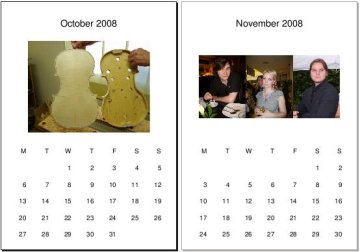 As an alternative to those Christmas “round robin” letters, my mum likes to create a calendar to send to relatives. This year, I rewrote the original crufty PHP script in Python:
 I was considering importing my car to Switzerland. When I moved in 2002,
I asked the customs office about the process and was told that I'd need to pay
taxes and fees, so I postponed the import until Day Unknown. Today, a very
friendly customs official told me that this is not true and that I could have
imported my car duty-free if I had done so as part of my move.
Slightly annoyed, I went on to discover what those duties would be today.
I found out that there are seven different types of fees I'll have to pay, and
tried to understand the reason for these fees:

 Since I received a terrifying amount of insults via mail for not implementing

 Now this has really been a waste of time. Months ago I convinced myself that NIS isn’t really a modern way to keep my user accounts network-wide - be it even only my home network. So I tried libnss-ldap and read wiki.debian.org on LDAP and literally found dozens of documents that describe how to do [...]
 However: this is an alpha release, for those interested in hacking on it. If you are bothered by broken code, don't like to report bugs, don't want to think about how to improve it, complain loudly about missing features, then this code is not for you yet. Soon, I hope, it will be stable and useful for many more people, but for the moment, a lot of things are up in the air:
 Why don't you
 Linux has already been the main OS here at the computer sciences for some time.
The computer pool was just switched to Ubuntu, after having been on SuSE and
OpenSuSE for the last 6 years or more. With the latest hardware upgrades, our
computer lab is nicer than ever: dual-core AMD64 systems with 2.6 GHz, a couple
of them with two LCD screens connected (which is great for developing, having
the editor on one screen and documentation on the other). I wonder if the
machines spend more than 1% of their time at full CPU speed - I havn't seen any
running at more than the minimum 1 GHz.But one thing I've noticed, which has changed: even those people I can see
in the lab having their own laptop with them have Linux running.A few years ago, most people bringing their laptops were doing so to have
Windows around. Now with the nice dual-screen setups here, bringing along a
laptop to have Linux is less attractive than ever. Still more people bringing
their laptops run Linux anyway.I figure this means that they've noticed that the DEs a Linux system offers is
very useful (granted, and more to what they have at the university when they
don't have their laptop around. However the main part - Java and Eclipse -
actually wouldn't differ). They still dual-boot (I overheard something about
'on Windows, this and that and foo) - and even accept the effort of
dual-booting to get the Linux benefits.In a few years, will there still be Windows developers you can hire, when
everybody studying computer science is being taught Linux? (Granted, not all
universities have made the full switch to Linux for their computer sciences)P.S. I'm not involved with the computer admin group; for detailed inquiries
you should talk to them directly. Especially for e.g. software distribution
questions and such. Oh, and I heard that the servers were running Debian for
some time already, while the clients were OpenSuSE. So maybe they still are
Debian.
 I was checking my mail and saw a message to



 Last night I sat down and hacked a bit more on my
 It still needs a fair amount of work, the layout of the labels on the left
is clearly sub-optimal and I'd like to have a marker on the satellite
image to precisely locate you, but apart from that it's coming together
nicely.
NP: Storm, Heather Nova