Search Results: "don"

21 September 2020

Kees Cook: security things in Linux v5.7

Previously: v5.6 Linux v5.7 was released at the end of May. Here s my summary of various security things that caught my attention: arm64 kernel pointer authentication
While the ARMv8.3 CPU Pointer Authentication (PAC) feature landed for userspace already, Kristina Martsenko has now landed PAC support in kernel mode. The current implementation uses PACIASP which protects the saved stack pointer, similar to the existing CONFIG_STACKPROTECTOR feature, only faster. This also paves the way to sign and check pointers stored in the heap, as a way to defeat function pointer overwrites in those memory regions too. Since the behavior is different from the traditional stack protector, Amit Daniel Kachhap added an LKDTM test for PAC as well. BPF LSM
The kernel s Linux Security Module (LSM) API provide a way to write security modules that have traditionally implemented various Mandatory Access Control (MAC) systems like SELinux, AppArmor, etc. The LSM hooks are numerous and no one LSM uses them all, as some hooks are much more specialized (like those used by IMA, Yama, LoadPin, etc). There was not, however, any way to externally attach to these hooks (not even through a regular loadable kernel module) nor build fully dynamic security policy, until KP Singh landed the API for building LSM policy using BPF. With this, it is possible (for a privileged process) to write kernel LSM hooks in BPF, allowing for totally custom security policy (and reporting). execve() deadlock refactoring
There have been a number of long-standing races in the kernel s process launching code where ptrace could deadlock. Fixing these has been attempted several times over the last many years, but Eric W. Biederman and Ernd Edlinger decided to dive in, and successfully landed the a series of refactorings, splitting up the problematic locking and refactoring their uses to remove the deadlocks. While he was at it, Eric also extended the exec_id counter to 64 bits to avoid the possibility of the counter wrapping and allowing an attacker to send arbitrary signals to processes they normally shouldn t be able to. slub freelist obfuscation improvements
After Silvio Cesare observed some weaknesses in the implementation of CONFIG_SLAB_FREELIST_HARDENED s freelist pointer content obfuscation, I improved their bit diffusion, which makes attacks require significantly more memory content exposures to defeat the obfuscation. As part of the conversation, Vitaly Nikolenko pointed out that the freelist pointer s location made it relatively easy to target too (for either disclosures or overwrites), so I moved it away from the edge of the slab, making it harder to reach through small-sized overflows (which usually target the freelist pointer). As it turns out, there were a few assumptions in the kernel about the location of the freelist pointer, which had to also get cleaned up. RISCV page table dumping
Following v5.6 s generic page table dumping work, Zong Li landed the RISCV page dumping code. This means it s much easier to examine the kernel s page table layout when running a debug kernel (built with PTDUMP_DEBUGFS), visible in /sys/kernel/debug/kernel_page_tables. array index bounds checking
This is a pretty large area of work that touches a lot of overlapping elements (and history) in the Linux kernel. The short version is: C is bad at noticing when it uses an array index beyond the bounds of the declared array, and we need to fix that. For example, don t do this:
int foo[5];
...
foo[8] = bar;
The long version gets complicated by the evolution of flexible array structure members, so we ll pause for a moment and skim the surface of this topic. While things like CONFIG_FORTIFY_SOURCE try to catch these kinds of cases in the memcpy() and strcpy() family of functions, it doesn t catch it in open-coded array indexing, as seen in the code above. GCC has a warning (-Warray-bounds) for these cases, but it was disabled by Linus because of all the false positives seen due to fake flexible array members. Before flexible arrays were standardized, GNU C supported zero sized array members. And before that, C code would use a 1-element array. These were all designed so that some structure could be the header in front of some data blob that could be addressable through the last structure member:
/* 1-element array */
struct foo  
    ...
    char contents[1];
 ;
/* GNU C extension: 0-element array */
struct foo  
    ...
    char contents[0];
 ;
/* C standard: flexible array */
struct foo  
    ...
    char contents[];
 ;
instance = kmalloc(sizeof(struct foo) + content_size);
Converting all the zero- and one-element array members to flexible arrays is one of Gustavo A. R. Silva s goals, and hundreds of these changes started landing. Once fixed, -Warray-bounds can be re-enabled. Much more detail can be found in the kernel s deprecation docs. However, that will only catch the visible at compile time cases. For runtime checking, the Undefined Behavior Sanitizer has an option for adding runtime array bounds checking for catching things like this where the compiler cannot perform a static analysis of the index values:
int foo[5];
...
for (i = 0; i < some_argument; i++)  
    ...
    foo[i] = bar;
    ...
 
It was, however, not separate (via kernel Kconfig) until Elena Petrova and I split it out into CONFIG_UBSAN_BOUNDS, which is fast enough for production kernel use. With this enabled, it's now possible to instrument the kernel to catch these conditions, which seem to come up with some regularity in Wi-Fi and Bluetooth drivers for some reason. Since UBSAN (and the other Sanitizers) only WARN() by default, system owners need to set panic_on_warn=1 too if they want to defend against attacks targeting these kinds of flaws. Because of this, and to avoid bloating the kernel image with all the warning messages, I introduced CONFIG_UBSAN_TRAP which effectively turns these conditions into a BUG() without needing additional sysctl settings. Fixing "additive" snprintf() usage
A common idiom in C for building up strings is to use sprintf()'s return value to increment a pointer into a string, and build a string with more sprintf() calls:
/* safe if strlen(foo) + 1 < sizeof(string) */
wrote  = sprintf(string, "Foo: %s\n", foo);
/* overflows if strlen(foo) + strlen(bar) > sizeof(string) */
wrote += sprintf(string + wrote, "Bar: %s\n", bar);
/* writing way beyond the end of "string" now ... */
wrote += sprintf(string + wrote, "Baz: %s\n", baz);
The risk is that if these calls eventually walk off the end of the string buffer, it will start writing into other memory and create some bad situations. Switching these to snprintf() does not, however, make anything safer, since snprintf() returns how much it would have written:
/* safe, assuming available <= sizeof(string), and for this example
 * assume strlen(foo) < sizeof(string) */
wrote  = snprintf(string, available, "Foo: %s\n", foo);
/* if (strlen(bar) > available - wrote), this is still safe since the
 * write into "string" will be truncated, but now "wrote" has been
 * incremented by how much snprintf() *would* have written, so "wrote"
 * is now larger than "available". */
wrote += snprintf(string + wrote, available - wrote, "Bar: %s\n", bar);
/* string + wrote is beyond the end of string, and availabe - wrote wraps
 * around to a giant positive value, making the write effectively 
 * unbounded. */
wrote += snprintf(string + wrote, available - wrote, "Baz: %s\n", baz);
So while the first overflowing call would be safe, the next one would be targeting beyond the end of the array and the size calculation will have wrapped around to a giant limit. Replacing this idiom with scnprintf() solves the issue because it only reports what was actually written. To this end, Takashi Iwai has been landing a bunch scnprintf() fixes. That's it for now! Let me know if there is anything else you think I should mention here. Next up: Linux v5.8.

2020, Kees Cook. This work is licensed under a Creative Commons Attribution-ShareAlike 4.0 License.

CC BY-SA 4.0

Jonathan McDowell: Mainline Linux on the MikroTik RB3011

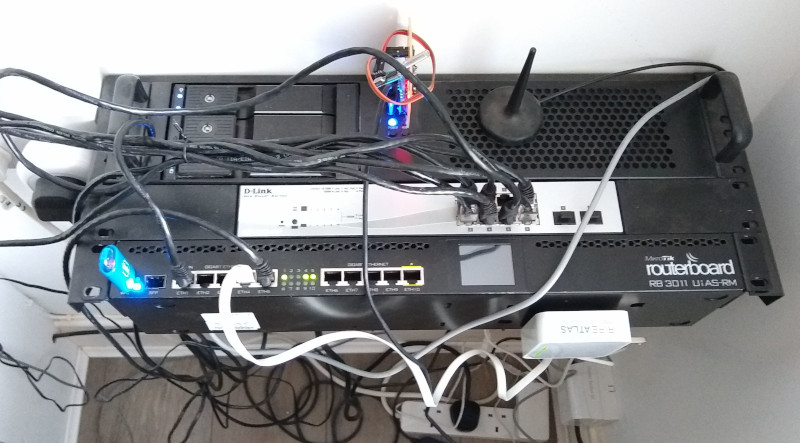
I upgraded my home internet connection to fibre (FTTP) last October. I m still on an 80M/20M service, so it s no faster than my old VDSL FTTC connection was, and as a result for a long time I continued to use my HomeHub 5A running OpenWRT. However the FTTP ONT meant I was using up an additional ethernet port on the router, and I was already short, so I ended up with a GigE switch in use as well. Also my wifi is handled by a UniFi, which takes its power via Power-over-Ethernet. That mean I had a router, a switch and a PoE injector all in close proximity. I wanted to reduce the number of devices, and ideally upgrade to something that could scale once I decide to upgrade my FTTP service speed. Looking around I found the MikroTik RB3011UiAS-RM, which is a rack mountable device with 10 GigE ports (plus an SFP slot) and a dual core Qualcomm IPQ8064 ARM powering it. There s 1G RAM and 128MB NAND flash, as well as a USB3 port. It also has PoE support. On paper it seemed like an ideal device. I wasn t particularly interested in running RouterOS on it (the provided software), but that s based on Linux and there was some work going on within OpenWRT to add support, so it seemed like a worthwhile platform to experiment with (what, you expected this to be about me buying an off the shelf device and using it with only the supplied software?). As an added bonus a friend said he had one he wasn t using, and was happy to sell it to me for a bargain price. RB3011 router in use I did try out RouterOS to start with, but I didn t find it particularly compelling. I m comfortable configuring firewalling and routing at a Linux command line, and I run some additional services on the router like my MQTT broker, and mqtt-arp, my wifi device presence monitor. I could move things around such that they ran on the house server, but I consider them core services and as a result am happier with them on the router. The first step was to get something booting on the router. Luckily it has an RJ45 serial console port on the back, and a reasonably featured bootloader that can manage to boot via tftp over the network. It wants an ELF binary rather than a plain kernel, but Sergey Sergeev had done the hard work of getting u-boot working for the IPQ8064, which mean I could just build normal u-boot images to try out. Linux upstream already had basic support for a lot of the pieces I was interested in. There s a slight fudge around AUTO_ZRELADDR because the network coprocessors want a chunk of memory at the start of RAM, but there s ongoing discussions about how to handle this cleanly that I m hopeful will eventually mean I can drop that hack. Serial, ethernet, the QCA8337 switches (2 sets of 5 ports, tied to different GigE devices on the processor) and the internal NOR all had drivers, so it was a matter of crafting an appropriate DTB to get them working. That left niggles. First, the second switch is hooked up via SGMII. It turned out the IPQ806x stmmac driver didn t initialise the clocks in this mode correctly, and neither did the qca8k switch driver. So I need to fix up both of those (Sergey had handled the stmmac driver, so I just had to clean up and submit his patch). Next it turned out the driver for talking to the Qualcomm firmware (SCM) had been updated in a way that broke the old method needed on the IPQ8064. Some git archaeology figured that one out and provided a solution. Ansuel Smith helpfully provided the DWC3 PHY driver for the USB port. That got me to the point I could put a Debian armhf image onto a USB stick and mount that as root, which made debugging much easier. At this point I started to play with configuring up the device to actually act as a router. I make use of a number of VLANs on my home network, so I wanted to make sure I could support those. Turned out the stmmac driver wasn t happy reconfiguring its MTU because the IPQ8064 driver doesn t configure the FIFO sizes. I found what seem to be the correct values and plumbed them in. Then the qca8k driver only supported port bridging. I wanted the ability to have a trunk port to connect to the upstairs switch, while also having ports that only had a single VLAN for local devices. And I wanted the switch to handle this rather than requiring the CPU to bridge the traffic. Thankfully it s easy to find a copy of the QCA8337 datasheet and the kernel Distributed Switch Architecture is pretty flexible, so I was able to implement the necessary support. I stuck with Debian on the USB stick for actually putting the device into production. It makes it easier to fix things up if necessary, and the USB stick allows for a full Debian install which would be tricky on the 128M of internal NAND. That means I can use things like nftables for my firewalling, and use the standard Debian packages for things like collectd and mosquitto. Plus for debug I can fire up things like tcpdump or tshark. Which ended up being useful because when I put the device into production I started having weird IPv6 issues that turned out to be a lack of proper Ethernet multicast filter support in the IPQ806x ethernet device. The driver would try and setup the multicast filter for the IPv6 NDP related packets, but it wouldn t actually work. The fix was to fall back to just receiving all multicast packets - this is what the vendor driver does. Most of this work will be present once the 5.9 kernel is released - the basics are already in 5.8. Currently not queued up that I can think of are the following: Overall I consider the device a success, and it s been entertaining getting it working properly. I m running a mostly mainline kernel, it s handling my house traffic without breaking a sweat, and the fact it s running Debian makes it nice and easy to throw more things on it as I desire. However it turned out the RB3011 isn t as perfect device as I d hoped. The PoE support is passive, and the UniFi wants 802.1af. So I was going to end up with 2 devices. As it happened I picked up a cheap D-Link DGS-1210-10P switch, which provides the PoE support as well as some additional switch ports. Plus it runs Linux, so more on that later
Russ Allbery: Review: Lower Ed

Review: Lower Ed, by Tressie McMillan Cottom
Publisher: The New Press
Copyright: 2017
Printing: 2018
ISBN: 1-62097-472-X
Format: Kindle
Pages: 217
Lower Ed (subtitled The Troubling Rise of For-Profit Colleges in the New Economy) is the first book by sociologist Tressie McMillan Cottom. (I previously reviewed her second book, the excellent essay collection Thick.) It is a deep look at the sociology of for-profit higher education in the United States based on interviews with students and executives, analysis of Wall Street filings, tests of the admissions process, and her own personal experiences working for two of the schools. One of the questions that McMillan Cottom tries to answer is why students choose to enroll in these institutions, particularly the newer type of institution funded by federal student loans and notorious for being more expensive and less valuable than non-profit colleges and universities. I was hesitant to read this book because I find for-profit schools depressing. I grew up with the ubiquitous commercials, watched the backlash develop, and have a strongly negative impression of the industry, partly influenced by having worked in traditional non-profit higher education for two decades. The prevailing opinion in my social group is that they're a con job. I was half-expecting a reinforcement of that opinion by example, and I don't like reading infuriating stories about people being defrauded. I need not have worried. This is not that sort of book (nor, in retrospect, do I think McMillan Cottom would approach a topic from that angle). Sociology is broader than reporting. Lower Ed positions for-profit colleges within a larger social structure of education, credentialing, and changes in workplace expectations; takes a deep look at why they are attractive to their students; and humanizes and complicates the motives and incentives of everyone involved, including administrators and employees of for-profit colleges as well as the students. McMillan Cottom does of course talk about the profit motive and the deceptions surrounding that, but the context is less that of fraud that people are unable to see through and more a balancing of the drawbacks of a set of poor choices embedded in institutional failures. One of my metrics for a good non-fiction book is whether it introduces me to a new idea that changes how I analyze the world. Lower Ed does that twice. The first idea is the view of higher education through the lens of risk shifting. It used to be common for employers to hire people without prior job-specific training and do the training in-house, possibly through an apprenticeship structure. More notably, once one was employed by a particular company, the company routinely arranged or provided ongoing training. This went hand-in-hand with a workplace culture of long tenure, internal promotion, attempts to avoid layoffs, and some degree of mutual loyalty. Companies expected to invest significantly in an employee over their career and thus also had an incentive to retain that employee rather than train someone for a competitor. However, from a purely financial perspective, this is a risk and an inefficiency, similar to the risk of carrying a large inventory of parts and components. Companies have responded to investor-driven focus on profits and efficiency by reducing overhead and shifting risk. This leads to the lean supply chain, where no one pays for parts to sit around in warehouses and companies aren't caught with large stockpiles of now-useless components, but which is more sensitive to any disruption (such as from a global pandemic). And, for employment, it leads to a desire to hire pre-trained workers, retain only enough workers to do the current amount of work, and replace them with new workers who already have appropriate training rather than retrain them. The effect of the corporate decision to only hire pre-trained employees is to shift the risk and expense of training from the company to the prospective employee. The individual has to seek out training at their own expense in the hope (not guarantee) that at the conclusion of that training they will get or retain a job. People therefore turn to higher education to both provide that training and to help them decide what type of training will eventually be valuable. This has a long history with certain professional fields (doctors and lawyers, for example), but the requirements for completing training in those fields are relatively clear (a professional license to practice) and the compensation reflects the risk. What's new is the shift of training risk to the individual in more mundane jobs, without any corresponding increase in compensation. This, McMillan Cottom explains, is the background for the growth in demand for higher education in general and the the type of education offered by for-profit colleges in particular. Workers who in previous eras would be trained by their employers are now responsible for their own training. That training is no longer judged by the standards of a specific workplace, but is instead evaluated by a hiring process that expects constant job-shifting. This leads to increased demand by both workers and employers for credentials: some simple-to-check certificate of completion of training that says that this person has the skills to immediately start doing some job. It also leads to a demand for more flexible class hours, since the student is now often someone older with a job and a family to balance. Their ongoing training used to be considered a cost of business and happen during their work hours; now it is something they have to fit around the contours of their life because their employer has shifted that risk to them. The risk-shifting frame makes sense of the "investment" language so common in for-profit education. In this job economy, education as investment is not a weird metaphor for the classic benefits of a liberal arts education: broadened perspective, deeper grounding in philosophy and ethics, or heightened aesthetic appreciation. It's an investment in the literal financial sense; it is money that you spend now in order to get a financial benefit (a job) in the future. People have to invest in their own training because employers are no longer doing so, but still require the outcome of that investment. And, worse, it's primarily a station-keeping investment. Rather than an optional expenditure that could reap greater benefits later, it's a mandatory expenditure to prevent, at best, stagnation in a job paying poverty wages, and at worst the disaster of unemployment. This explains renewed demand for higher education, but why for-profit colleges? We know they cost more and have a worse reputation (and therefore their credentials have less value) than traditional non-profit colleges. Flexible hours and class scheduling explains some of this but not all of it. That leads to the second perspective-shifting idea I got from Lower Ed: for-profit colleges are very good at what they focus time and resources on, and they focus on enrolling students. It is hard to enroll in a university! More precisely, enrolling in a university requires bureaucracy navigation skills, and those skills are class-coded. The people who need them the most are the least likely to have them. Universities do not reach out to you, nor do they guide you through the process. You have to go to them and discover how to apply, something that is often made harder by the confusing state of many university web sites. The language and process is opaque unless other people in your family have experience with universities and can explain it. There might be someone you can reach on the phone to ask questions, but they're highly unlikely to proactively guide you through the remaining steps. It's your responsibility to understand deadlines, timing, and sequence of operations, and if you miss any of the steps (due to, for example, the overscheduled life of someone in need of better education for better job prospects), the penalty in time and sometimes money can be substantial. And admission is just the start; navigating financial aid, which most students will need, is an order of magnitude more daunting. Community colleges are somewhat easier (and certainly cheaper) than universities, but still have similar obstacles (and often even worse web sites). It's easy for people like me, who have long professional expertise with bureaucracies, family experience with higher education, and a support network of people to nag me about deadlines, to underestimate this. But the application experience at a for-profit college is entirely different in ways far more profound than I had realized. McMillan Cottom documents this in detail from her own experience working for two different for-profit colleges and from an experiment where she indicated interest in multiple for-profit colleges and then stopped responding before signing admission paperwork. A for-profit college is fully invested in helping a student both apply and get financial aid, devotes someone to helping them through that process, does not expect them to understand how to navigate bureaucracies or decipher forms on their own, does not punish unexpected delays or missed appointments, and goes to considerable lengths to try to keep anyone from falling out of the process before they are enrolled. They do not expect their students to already have the skills that one learns from working in white-collar jobs or from being surrounded by people who do. They provide the kind of support that an educational institution should provide to people who, by definition, don't understand something and need to learn. Reading about this was infuriating. Obviously, this effort to help people enroll is largely for predatory reasons. For-profit schools make their money off federal loans and they don't get that money unless they can get someone to enroll and fill out financial paperwork (and to some extent keep them enrolled), so admissions is their cash cow and they act accordingly. But that's not why I found it infuriating; that's just predictable capitalism. What I think is inexcusable is that nothing they do is that difficult. We could being doing the same thing for prospective community college students but have made the societal choice not to. We believe that education is valuable, we constantly advocate that people get more job training and higher education, and yet we demand prospective students navigate an unnecessarily baroque and confusing application process with very little help, and then stereotype and blame them for failing to do so. This admission support is not a question of resources. For-profit colleges are funded almost entirely by federally-guaranteed student loans. We are paying them to help people apply. It is, in McMillan Cottom's term, a negative social insurance program. Rather than buffering people against the negative effects of risk-shifting of employers by helping them into the least-expensive and most-effective training programs (non-profit community colleges and universities), we are spending tax dollars to enrich the shareholders of for-profit colleges while underfunding the alternatives. We are choosing to create a gap that routes government support to the institution that provides worse training at higher cost but is very good at helping people apply. It's as if the unemployment system required one to use payday lenders to get one's unemployment check. There is more in this book I want to talk about, but this review is already long enough. Suffice it to say that McMillan Cottom's analysis does not stop with market forces and the admission process, and the parts of her analysis that touch on my own personal experience as someone with a somewhat unusual college path ring very true. Speaking as a former community college student, the discussion of class credit transfer policies and the way that institutional prestige gatekeeping and the desire to push back against low-quality instruction becomes a trap that keeps students in the for-profit system deserves another review this length. So do the implications of risk-shifting and credentialism on the morality of "cheating" on schoolwork. As one would expect from the author of the essay "Thick" about bringing context to sociology, Lower Ed is personal and grounded. McMillan Cottom doesn't shy away from including her own experiences and being explicit about her sources and research. This is backed up by one of the best methodological notes sections I've seen in a book. One of the things I love about McMillan Cottom's writing is that it's solidly academic, not in the sense of being opaque or full of jargon (the text can be a bit dense, but I rarely found it hard to follow), but in the sense of being clear about the sources of knowledge and her methods of extrapolation and analysis. She brings her receipts in a refreshingly concrete way. I do have a few caveats. First, I had trouble following a structure and line of reasoning through the whole book. Each individual point is meticulously argued and supported, but they are not always organized into a clear progression or framework. That made Lower Ed feel at times like a collection of high-quality but somewhat unrelated observations about credentials, higher education, for-profit colleges, their student populations, their business models, and their relationships with non-profit schools. Second, there are some related topics that McMillan Cottom touches on but doesn't expand sufficiently for me to be certain I understood them. One of the big ones is credentialism. This is apparently a hot topic in sociology and is obviously important to this book, but it's referenced somewhat glancingly and was not satisfyingly defined (at least for me). There are a few similar places where I almost but didn't quite follow a line of reasoning because the book structure didn't lay enough foundation. Caveats aside, though, this was meaty, thought-provoking, and eye-opening, and I'm very glad that I read it. This is a topic that I care more about than most people, but if you have watched for-profit colleges with distaste but without deep understanding, I highly recommend Lower Ed. Rating: 8 out of 10

20 September 2020

Enrico Zini: Relationships links

The Bouletcorp Love & Dragons is a strip I like about fairytale relationships. There are a lot of mainstream expectations about relationships. These links challenge a few of them: More about emotional work, some more links to follow a previous links post:

Dirk Eddelbuettel: RcppSpdlog 0.0.2: New upstream, awesome new stopwatch

Following up on the initial RcppSpdlog 0.0.1 release earlier this week, we are pumped to announce release 0.0.2. It contains upstream version 1.8.0 for spdlog which utilizes (among other things) a new feature in the embedded fmt library, namely completely automated formatting of high resolution time stamps which allows for gems like this (taken from this file in the package and edited down for brevity):
    spdlog::stopwatch sw;                                   // instantiate a stop watch

    // some other code

    sp->info("Elapsed time:  ", sw);
What we see is all there is: One instantiates a stopwatch object, and simply references it. The rest, as they say, is magic. And we get tic / toc alike behaviour in modern C++ at essentially no cost us (as code authors). So nice. Output from the (included in the package) function exampleRsink() (again edited down just a little):
R> RcppSpdlog::exampleRsink()
[13:03:23.845114] [fromR] [I] [thread 793264] Welcome to spdlog!
[...]
[13:03:23.845205] [fromR] [I] [thread 793264] Elapsed time: 0.000103611
[...]
[13:03:23.845281] [fromR] [I] [thread 793264] Elapsed time: 0.00018203
R> 
We see that the two simple logging instances come 10 and 18 microseconds into the call. RcppSpdlog bundles spdlog, a wonderful header-only C++ logging library with all the bells and whistles you would want that was written by Gabi Melman, and also includes fmt by Victor Zverovic. The NEWS entry for this release follows.

Changes in RcppSpdlog version 0.0.2 (2020-09-17)
  • Upgraded to upstream release 1.8.0
  • Switched Travis CI to using BSPM, also test on macOS
  • Added 'stopwatch' use to main R sink example

Courtesy of my CRANberries, there is a diffstat report relative to previous release. More detailed information is on the RcppSpdlog page. The only sour grapes, again, are once more over the CRAN processing. And just how 0.0.1 was delayed for no good reason for three weeks, 0.0.2 was delayed by three days just because well that is how CRAN rules sometimes. I d be even more mad if I had an alternative but I don t. We remain grateful for all they do but they really could have let this one through even at one-day update delta. Ah well, now we re three days wiser and of course nothing changed in the package. If you like this or other open-source work I do, you can now sponsor me at GitHub. For the first year, GitHub will match your contributions.

This post by Dirk Eddelbuettel originated on his Thinking inside the box blog. Please report excessive re-aggregation in third-party for-profit settings.

Russell Coker: Links September 2020

MD5 cracker, find plain text that matches MD5 hash [1]. Debian Quick Image Baker Debian VM images for various architectures [2]. Insightful article on Scientific American about how dental and orthodontic problems are caused by our modern lifestyle [3]. Cory Doctorow wrote an insightful article for Locus Magazine about Intellectual Property [4]. He makes the case that we are losing our rights due to changes in the legal system that benefits corporations. Anarcat has an informative blog post about how to stop people using your Mailman installation to attack others [5]. Since version 1:2.1.27-1 the Debian package of Mailman has created a SUBSCRIBE_FORM_SECRET by default on install, but any installation upgraded from an older version of the Debian package won t have it.

19 September 2020

Vincent Bernat: Syncing NetBox with a custom Ansible module

The netbox.netbox collection from Ansible Galaxy provides several modules to update NetBox objects:
- name: create a device in NetBox
  netbox_device:
    netbox_url: http://netbox.local
    netbox_token: s3cret
    data:
      name: to3-p14.sfo1.example.com
      device_type: QFX5110-48S
      device_role: Compute Switch
      site: SFO1
However, if NetBox is not your source of truth, you may want to ensure it stays in sync with your configuration management database1 by removing outdated devices or IP addresses. While it should be possible to glue together a playbook with a query, a loop and some filtering to delete unwanted elements, it feels clunky, inefficient and an abuse of YAML as a programming language. A specific Ansible module solves this issue and is likely more flexible.

Notice I recommend that you read Writing a custom Ansible module as an introduction, as well as Syncing MySQL tables for a first simpler example.

Code The module has the following signature and it syncs NetBox with the content of the provided YAML file:
netbox_sync:
  source: netbox.yaml
  api: https://netbox.example.com
  token: s3cret
The synchronized objects are:
  • sites,
  • manufacturers,
  • device types,
  • device roles,
  • devices, and
  • IP addresses.
In our environment, the YAML file is generated from our configuration management database and contains a set of devices and a list of IP addresses:
devices:
  ad2-p6.sfo1.example.com:
     datacenter: sfo1
     manufacturer: Cisco
     model: Catalyst 2960G-48TC-L
     role: net_tor_oob_switch
  to1-p6.sfo1.example.com:
     datacenter: sfo1
     manufacturer: Juniper
     model: QFX5110-48S
     role: net_tor_gpu_switch
# [ ]
ips:
  - device: ad2-p6.example.com
    ip: 172.31.115.18/21
    interface: oob
  - device: to1-p6.example.com
    ip: 172.31.115.33/21
    interface: oob
  - device: to1-p6.example.com
    ip: 172.31.254.33/32
    interface: lo0.0
# [ ]
The network team is not the sole tenant in NetBox. While adding new objects or modifying existing ones should be relatively safe, deleting unwanted objects can be risky. The module only deletes objects it did create or modify. To identify them, it marks them with a specific tag, cmdb. Most objects in NetBox accept tags.

Module definition Starting from the skeleton described in the previous article, we define the module:
module_args = dict(
    source=dict(type='path', required=True),
    api=dict(type='str', required=True),
    token=dict(type='str', required=True, no_log=True),
    max_workers=dict(type='int', required=False, default=10)
)
result = dict(
    changed=False
)
module = AnsibleModule(
    argument_spec=module_args,
    supports_check_mode=True
)
It contains an additional optional arguments defining the number of workers to talk to NetBox and query the existing objects in parallel to speedup the execution.

Abstracting synchronization We need to synchronize different object types, but once we have a list of objects we want in NetBox, the grunt work is always the same:
  • check if the objects already exist,
  • retrieve them and put them in a form suitable for comparison,
  • retrieve the extra objects we don t want anymore,
  • compare the two sets, and
  • add missing objects, update existing ones, delete extra ones.
We code these behaviours into a Synchronizer abstract class. For each kind of object, a concrete class is built with the appropriate class attributes to tune its behaviour and a wanted() method to provide the objects we want. I am not explaining the abstract class code here. Have a look at the source if you want.

Synchronizing tags and tenants As a starter, here is how we define the class synchronizing the tags:
class SyncTags(Synchronizer):
    app = "extras"
    table = "tags"
    key = "name"
    def wanted(self):
        return  "cmdb": dict(
            slug="cmdb",
            color="8bc34a",
            description="synced by network CMDB") 
The app and table attributes defines the NetBox objects we want to manipulate. The key attribute is used to determine how to lookup for existing objects. In this example, we want to lookup tags using their names. The wanted() method is expected to return a dictionary mapping object keys to the list of wanted attributes. Here, the keys are tag names and we create only one tag, cmdb, with the provided slug, color and description. This is the tag we will use to mark the objects we create or modify. If the tag does not exist, it is created. If it exists, the provided attributes are updated. Other attributes are left untouched. We also want to create a specific tenant for objects accepting such an attribute (devices and IP addresses):
class SyncTenants(Synchronizer):
    app = "tenancy"
    table = "tenants"
    key = "name"
    def wanted(self):
        return  "Network": dict(slug="network",
                                description="Network team") 

Synchronizing sites We also need to synchronize the list of sites. This time, the wanted() method uses the information provided in the YAML file: it walks the devices and builds a set of datacenter names.
class SyncSites(Synchronizer):
    app = "dcim"
    table = "sites"
    key = "name"
    only_on_create = ("status", "slug")
    def wanted(self):
        result = set(details["datacenter"]
                     for details in self.source['devices'].values()
                     if "datacenter" in details)
        return  k: dict(slug=k,
                        status="planned")
                for k in result 
Thanks to the use of the only_on_create attribute, the specified attributes are not updated if they are different. The goal of this synchronizer is mostly to collect the references to the different sites for other objects.
>>> pprint(SyncSites(**sync_args).wanted())
 'sfo1':  'slug': 'sfo1', 'status': 'planned' ,
 'chi1':  'slug': 'chi1', 'status': 'planned' ,
 'nyc1':  'slug': 'nyc1', 'status': 'planned' 

Synchronizing manufacturers, device types and device roles The synchronization of manufacturers is pretty similar, except we do not use the only_on_create attribute:
class SyncManufacturers(Synchronizer):
    app = "dcim"
    table = "manufacturers"
    key = "name"
    def wanted(self):
        result = set(details["manufacturer"]
                     for details in self.source['devices'].values()
                     if "manufacturer" in details)
        return  k:  "slug": slugify(k) 
                for k in result 
Regarding the device types, we use the foreign attribute linking a NetBox attribute to the synchronizer handling it.
class SyncDeviceTypes(Synchronizer):
    app = "dcim"
    table = "device_types"
    key = "model"
    foreign =  "manufacturer": SyncManufacturers 
    def wanted(self):
        result = set((details["manufacturer"], details["model"])
                     for details in self.source['devices'].values()
                     if "model" in details)
        return  k[1]: dict(manufacturer=k[0],
                           slug=slugify(k[1]))
                for k in result 
The wanted() method refers to the manufacturer using its key attribute. In this case, this is the manufacturer name.
>>> pprint(SyncManufacturers(**sync_args).wanted())
 'Cisco':  'slug': 'cisco' ,
 'Dell':  'slug': 'dell' ,
 'Juniper':  'slug': 'juniper' 
>>> pprint(SyncDeviceTypes(**sync_args).wanted())
 'ASR 9001':  'manufacturer': 'Cisco', 'slug': 'asr-9001' ,
 'Catalyst 2960G-48TC-L':  'manufacturer': 'Cisco',
                           'slug': 'catalyst-2960g-48tc-l' ,
 'MX10003':  'manufacturer': 'Juniper', 'slug': 'mx10003' ,
 'QFX10002-36Q':  'manufacturer': 'Juniper', 'slug': 'qfx10002-36q' ,
 'QFX10002-72Q':  'manufacturer': 'Juniper', 'slug': 'qfx10002-72q' ,
 'QFX5110-32Q':  'manufacturer': 'Juniper', 'slug': 'qfx5110-32q' ,
 'QFX5110-48S':  'manufacturer': 'Juniper', 'slug': 'qfx5110-48s' ,
 'QFX5200-32C':  'manufacturer': 'Juniper', 'slug': 'qfx5200-32c' ,
 'S4048-ON':  'manufacturer': 'Dell', 'slug': 's4048-on' ,
 'S6010-ON':  'manufacturer': 'Dell', 'slug': 's6010-on' 
The device roles are defined like this:
class SyncDeviceRoles(Synchronizer):
    app = "dcim"
    table = "device_roles"
    key = "name"
    def wanted(self):
        result = set(details["role"]
                     for details in self.source['devices'].values()
                     if "role" in details)
        return  k: dict(slug=slugify(k),
                        color="8bc34a")
                for k in result 

Synchronizing devices A device is mostly a name with references to a role, a model, a datacenter and a tenant. These references are declared as foreign keys using the synchronizers defined previously.
class SyncDevices(Synchronizer):
    app = "dcim"
    table = "devices"
    key = "name"
    foreign =  "device_role": SyncDeviceRoles,
               "device_type": SyncDeviceTypes,
               "site": SyncSites,
               "tenant": SyncTenants 
    remove_unused = 10
    def wanted(self):
        return  name: dict(device_role=details["role"],
                           device_type=details["model"],
                           site=details["datacenter"],
                           tenant="Network")
                for name, details in self.source['devices'].items()
                if  "datacenter", "model", "role"  <= set(details.keys()) 
The remove_unused attribute is a safety implemented to fail if we have to delete more than 10 devices: this may be the indication there is a bug somewhere, unless one of your datacenter suddenly caught fire.
>>> pprint(SyncDevices(**sync_args).wanted())
 'ad2-p6.sfo1.example.com':  'device_role': 'net_tor_oob_switch',
                             'device_type': 'Catalyst 2960G-48TC-L',
                             'site': 'sfo1',
                             'tenant': 'Network' ,
 'to1-p6.sfo1.example.com':  'device_role': 'net_tor_gpu_switch',
                             'device_type': 'QFX5110-48S',
                             'site': 'sfo1',
                             'tenant': 'Network' ,
[ ]

Synchronizing IP addresses The last step is to synchronize IP addresses. We do not attach them to a device.2 Instead, we specify the device names in the description of the IP address:
class SyncIPs(Synchronizer):
    app = "ipam"
    table = "ip-addresses"
    key = "address"
    foreign =  "tenant": SyncTenants 
    remove_unused = 1000
    def wanted(self):
        wanted =  
        for details in self.source['ips']:
            if details['ip'] in wanted:
                wanted[details['ip']]['description'] = \
                    f" details['device']  (and others)"
            else:
                wanted[details['ip']] = dict(
                    tenant="Network",
                    status="active",
                    dns_name="",        # information is present in DNS
                    description=f" details['device'] :  details['interface'] ",
                    role=None,
                    vrf=None)
        return wanted
There is a slight difficulty: NetBox allows duplicate IP addresses, so a simple lookup is not enough. In case of multiple matches, we choose the best by preferring those tagged with cmdb, then those already attached to an interface:
def get(self, key):
    """Grab IP address from NetBox."""
    # There may be duplicate. We need to grab the "best".
    results = super(Synchronizer, self).get(key)
    if len(results) == 0:
        return None
    if len(results) == 1:
        return results[0]
    scores = [0]*len(results)
    for idx, result in enumerate(results):
        if "cmdb" in result.tags:
            scores[idx] += 10
        if result.interface is not None:
            scores[idx] += 5
    return sorted(zip(scores, results),
                  reverse=True, key=lambda k: k[0])[0][1]

Getting the current and wanted states Each synchronizer is initialized with a reference to the Ansible module, a reference to a pynetbox s API object, the data contained in the provided YAML file and two empty dictionaries for the current and expected states:
source = yaml.safe_load(open(module.params['source']))
netbox = pynetbox.api(module.params['api'],
                      token=module.params['token'])
sync_args = dict(
    module=module,
    netbox=netbox,
    source=source,
    before= ,
    after= 
)
synchronizers = [synchronizer(**sync_args) for synchronizer in [
    SyncTags,
    SyncTenants,
    SyncSites,
    SyncManufacturers,
    SyncDeviceTypes,
    SyncDeviceRoles,
    SyncDevices,
    SyncIPs
]]
Each synchronizer has a prepare() method whose goal is to compute the current and wanted states. It returns True in case of a difference:
# Check what needs to be synchronized
try:
    for synchronizer in synchronizers:
        result['changed']  = synchronizer.prepare()
except AnsibleError as e:
    result['msg'] = e.message
    module.fail_json(**result)

Applying changes Back to the skeleton described in the previous article, the last step is to apply the changes if there is a difference between these states. Each synchronizer registers the current and wanted states in sync_args["before"][table] and sync_args["after"][table] where table is the name of the table for a given NetBox object type. The diff object is a bit elaborate as it is built table by table. This enables Ansible to display the name of each table before the diff representation:
# Compute the diff
if module._diff and result['changed']:
    result['diff'] = [
        dict(
            before_header=table,
            after_header=table,
            before=yaml.safe_dump(sync_args["before"][table]),
            after=yaml.safe_dump(sync_args["after"][table]))
        for table in sync_args["after"]
        if sync_args["before"][table] != sync_args["after"][table]
    ]
# Stop here if check mode is enabled or if no change
if module.check_mode or not result['changed']:
    module.exit_json(**result)
Each synchronizer also exposes a synchronize() method to apply changes and a cleanup() method to delete unwanted objects. Order is important due to the relation between the objects.
# Synchronize
for synchronizer in synchronizers:
    synchronizer.synchronize()
for synchronizer in synchronizers[::-1]:
    synchronizer.cleanup()
module.exit_json(**result)

The complete code is available on GitHub. Compared to using netbox.netbox collection, the logic is written in Python instead of trying to glue Ansible tasks together. I believe this is both more flexible and easier to read, notably when trying to delete outdated objects. While I did not test it, it should also be faster. An alternative would have been to reuse code from the netbox.netbox collection, as it contains similar primitives. Unfortunately, I didn t think of it until now.

  1. In my opinion, a good option for a source of truth is to use YAML files in a Git repository. You get versioning for free and people can get started with a text editor.
  2. This limitation is mostly due to laziness: we do not really care about this information. Our main motivation for putting IP addresses in NetBox is to keep track of the used IP addresses. However, if an IP address is already attached to an interface, we leave this association untouched.

Russell Coker: Burning Lithium Ion Batteries

I had an old Nexus 4 phone that was expanding and decided to test some of the theories about battery combustion. The first claim that often gets made is that if the plastic seal on the outside of the battery is broken then the battery will catch fire. I tested this by cutting the battery with a craft knife. With every cut the battery sparked a bit and then when I levered up layers of the battery (it seems to be multiple flat layers of copper and black stuff inside the battery) there were more sparks. The battery warmed up, it s plausible that in a confined environment that could get hot enough to set something on fire. But when the battery was resting on a brick in my backyard that wasn t going to happen. The next claim is that a Li-Ion battery fire will be increased with water. The first thing to note is that Li-Ion batteries don t contain Lithium metal (the Lithium high power non-rechargeable batteries do). Lithium metal will seriously go off it exposed to water. But lots of other Lithium compounds will also react vigorously with water (like Lithium oxide for example). After cutting through most of the center of the battery I dripped some water in it. The water boiled vigorously and the corners of the battery (which were furthest away from the area I cut) felt warmer than they did before adding water. It seems that significant amounts of energy are released when water reacts with whatever is inside the Li-Ion battery. The reaction was probably giving off hydrogen gas but didn t appear to generate enough heat to ignite hydrogen (which is when things would really get exciting). Presumably if a battery was cut in the presence of water while in an enclosed space that traps hydrogen then the sparks generated by the battery reacting with air could ignite hydrogen generated from the water and give an exciting result. It seems that a CO2 fire extinguisher would be best for a phone/tablet/laptop fire as that removes oxygen and cools it down. If that isn t available then a significant quantity of water will do the job, water won t stop the reaction (it can prolong it), but it can keep the reaction to below 100C which means it won t burn a hole in the floor and the range of toxic chemicals released will be reduced. The rumour that a phone fire on a plane could do a China syndrome type thing and melt through the Aluminium body of the plane seems utterly bogus. I gave it a good try and was unable to get a battery to burn through it s plastic and metal foil case. A spare battery for a laptop in checked luggage could be a major problem for a plane if it ignited. But a battery in the passenger area seems unlikely to be a big problem if plenty of water is dumped on it to prevent the plastic case from burning and polluting the air. I was not able to get a result that was even worthy of a photograph. I may do further tests with laptop batteries.

18 September 2020

Daniel Lange: Fixing the Nextcloud menu to show more than eight application icons

I have been late to adopt an on-premise cloud solution as the security of Owncloud a few years ago wasn't so stellar (cf. my comment from 2013 in Encryption files ... for synchronization across the Internet). But the follow-up product Nextcloud has matured quite nicely and we use it for collaboration both in the company and in FLOSS related work at multiple nonprofit organizations. There is a very annoying "feature" in Nextcloud though that the designers think menu items for apps at the top need to be limited to eight or less to prevent information overload in the header. The whole item discussion is worth reading as it it an archetypical example of design prevalence vs. user choice. And of course designers think they are right. That's a feature of the trade.

And because they know better there is no user configurable option to extend that 8 items to may be 12 or so which would prevent the annoying overflow menu we are seeing with 10 applications in use: Screenshot of stock Nextcloud menu Luckily code can be changed and there are many comments floating around the Internet to change const minAppsDesktop = 8. In this case it is slightly complicated by the fact that the javascript code is distributed in compressed form (aka "minified") as core/js/dist/main.js and you probably don't want to build the whole beast locally to change one constant. Basically
const breakpoint_mobile_width = 1024;

const resizeMenu = () =>
const appList = $('#appmenu li')
const rightHeaderWidth = $('.header-right').outerWidth()
const headerWidth = $('header').outerWidth()
const usePercentualAppMenuLimit = 0.33
const minAppsDesktop = 8
let availableWidth = headerWidth - $('#nextcloud').outerWidth() - (rightHeaderWidth > 210 ? rightHeaderWidth : 210)
const isMobile = $(window).width() < breakpoint_mobile_width
if (!isMobile)
availableWidth = availableWidth * usePercentualAppMenuLimit

let appCount = Math.floor((availableWidth / $(appList).width()))
if (isMobile && appCount > minAppsDesktop)
appCount = minAppsDesktop

if (!isMobile && appCount < minAppsDesktop)
appCount = minAppsDesktop


// show at least 2 apps in the popover
if (appList.length - 1 - appCount >= 1)
appCount--


$('#more-apps a').removeClass('active')
let lastShownApp
for (let k = 0; k < appList.length - 1; k++)
const name = $(appList[k]).data('id')
if (k < appCount)
$(appList[k]).removeClass('hidden')
$('#apps li[data-id=' + name + ']').addClass('in-header')
lastShownApp = appList[k]
else
$(appList[k]).addClass('hidden')
$('#apps li[data-id=' + name + ']').removeClass('in-header')
// move active app to last position if it is active
if (appCount > 0 && $(appList[k]).children('a').hasClass('active'))
$(lastShownApp).addClass('hidden')
$('#apps li[data-id=' + $(lastShownApp).data('id') + ']').removeClass('in-header')
$(appList[k]).removeClass('hidden')
$('#apps li[data-id=' + name + ']').addClass('in-header')


// show/hide more apps icon
if ($('#apps li:not(.in-header)').length === 0)
$('#more-apps').hide()
$('#navigation').hide()
else
$('#more-apps').show()

gets compressed during build time to become part of one 15,000+ character line. The relevant portion reads:
var f=function() var e=s()("#appmenu li"),t=s()(".header-right").outerWidth(),n=s()("header").outerWidth()-s()("#nextcloud").outerWidth()-(t>210?t:210),i=s()(window).width()<1024;i (n*=.33);var r,o=Math.floor(n/s()(e).width());i&&o>8&&(o=8),!i&&o<8&&(o=8),e.length-1-o>=1&&o--,s()("#more-apps a").removeClass("active");for(var a=0;a<e.length-1;a++) var l=s()(e[a]).data("id");a<o?(s()(e[a]).removeClass("hidden"),s()("#apps li[data-id="+l+"]").addClass("in-header"),r=e[a]):(s()(e[a]).addClass("hidden"),s()("#apps li[data-id="+l+"]").removeClass("in-header"),o>0&&s()(e[a]).children("a").hasClass("active")&&(s()(r).addClass("hidden"),s()("#apps li[data-id="+s()(r).data("id")+"]").removeClass("in-header"),s()(e[a]).removeClass("hidden"),s()("#apps li[data-id="+l+"]").addClass("in-header"))) 0===s()("#apps li:not(.in-header)").length?(s()("#more-apps").hide(),s()("#navigation").hide()):s()("#more-apps").show()
Well, we can still patch that, can we? Continue reading "Fixing the Nextcloud menu to show more than eight application icons"

17 September 2020

Russell Coker: Dell BIOS Updates

I have just updated the BIOS on a Dell PowerEdge T110 II. The process isn t too difficult, Google for the machine name and BIOS, download a shell script encoded firmware image and GPG signature, then run the script on the system in question. One problem is that the Dell GPG key isn t signed by anyone. How hard would it be to get a few well connected people in the Linux community to sign the key used for signing Linux scripts for updating the BIOS? I would be surprised if Dell doesn t employ a few people who are well connected in the Linux community, they should just ask all employees to sign such GPG keys! Failing that there are plenty of other options. I d be happy to sign the Dell key if contacted by someone who can prove that they are a responsible person in Dell. If I could phone Dell corporate and ask for the engineering department and then have someone tell me the GPG fingerprint I ll sign the key and that problem will be partially solved (my key is well connected but you need more than one signature). The next issue is how to determine that a BIOS update works. What you really don t want is to have a BIOS update fail and brick your system! So the Linux update process loads the image into something (special firmware RAM maybe) and then reboots the system and the reboot then does a critical part of the update. If the reboot doesn t work then you end up with the old version of the BIOS. This is overall a good thing. The PowerEdge T110 II is a workstation with an NVidia video card (I tried an ATI card but that wouldn t boot for unknown reasons). The Nouveau driver has some issues. One thing I have done to work around some Nouveau issues is to create a file ~/.config/plasma-workspace/env/nouveau-broken.sh (for KDE sessions) with the following contents:
export LIBGL_ALWAYS_SOFTWARE=1
I previously wrote about using this just for Kmail to stop it crashing [1]. But after doing that I still had other problems with video and disabling all GL on the NVidia card was necessary. The latest problem I ve had is that even when using that configuration things don t go well. When I run the reboot command I end up with a kernel message about the GPU not responding and then it doesn t reboot. That means that the BIOS update doesn t apply, a hard reboot signals to the system that the new BIOS wasn t good and I end up with the old BIOS again. I discovered that disabling sddm (the latest xdm program in Debian) from starting on boot meant that a reboot command would work. Then I ran the BIOS update script and it s reboot command worked and gave a successful BIOS update. So I ve gone from a 2013 BIOS to a 2018 BIOS! The update list says that some CVEs have been addressed, but the spectre-meltdown-checker doesn t report any fewer vulnerabilities.

16 September 2020

Joey Hess: comically bad shipping estimates and middlemen

My inverter has unfortunately died, and I wanted to replace it with the same model. Ideally before I lose the contents of the fridge. It's a 24v inverter, which is not at all as easy to find a replacement for as a 12v inverter would be. Somehow Walmart was the only retailer that had it available with a delivery estimate: Just 2 days. It's the second day now, with no indication they've shipped it. I noticed the "sold and shipped by Zoro", so went and found it on that website. So, the reality is it ships direct from China via container ship. As does every product from Zoro, which all show as 2 day delivery on Walmart's website. I don't think this is a pandemic thing. I think it's a trying to compete with Amazon and failing thing.

My other comically bad shipping estimate this pandemic was from Amazon though. There was a run this summer on Kayaks, because social distancing is great on the water. I found a high quality inflatable kayak. Amazon said "only 2 left in stock" and promised delivery in 1 week. One week later, it had not shipped, and they updated the delivery estimate forward 1 week. A week after that, ditto. Eventually I bought a new model from the same manufacturer, Advanced Elements. Unfortunately, that kayak exploded the second time I inflated it, due to a manufacturing defect. So I got in touch with Advanced Elements and they offered a replacement. I asked if, instead, they maybe still had any of the older model of kayak I had tried to order. They checked their warehouse, and found "the last one" in a corner somewhere. No shipping estimate was provided. It arrived in 3 days.

15 September 2020

Molly de Blanc: Actions, Inactions, and Consequences: Doctrine of Doing and Allowing W. Quinn

There are a lot of interesting and valid things to say about the philosophy and actual arguments of the Actions, Inactions, and Consequences: Doctrine of Doing and Allowing by Warren Quinn. Unfortunately for me, none of them are things I feel particularly inspired by. I m much more attracted to the many things implied in this paper. Among them are the role of social responsibility in making moral decisions. At various points in the text, Quinn makes brief comments about how we have roles that we need to fulfill for the sake of society. These roles carry with them responsibilities that may supersede our regular moral responsibilities. Examples Quinn makes include being a private life guard (and being responsible for the life of one particular person) and being a trolley driver (and your responsibility is to make sure the train doesn t kill anyone). This is part of what has led to me brushing Quinn off as another classist. Still, I am interested in the question of whether social responsibilities are more important than moral ones or whether there are times when this might occur. One of the things I maintain is that we cannot be the best versions of ourselves because we are not living in societies that value our best selves. We survive capitalism. We negotiate climate change. We make decisions to trade the ideal for the functional. For me, this frequently means I click through terms of service, agree to surveillance, and partake in the use and proliferation of oppressive technology. I also buy an iced coffee that comes in a single use plastic cup; I shop at the store with questionable labor practices; I use Facebook. But also, I don t give money to panhandlers. I see suffering and I let it pass. I do not get involved or take action in many situations because I have a pass to not. These things make society work as it is, and it makes me work within society. This is a self-perpetuating, mutually-abusive, co-dependent relationship. I must tell myself stories about how it is okay that I am preferring the status quo, that I am buying into the system, because I need to do it to survive within it and that people are relying on the system as it stands to survive, because that is how they know to survive. Among other things, I am worried about the psychic damage this causes us. When we view ourselves as social actors rather than moral actors, we tell ourselves it is okay to take non-moral actions (or in-actions); however, we carry within ourselves intuitions and feelings about what is right, just, and moral. We ignore these in order to act in our social roles. From the perspective of the individual, we re hurting ourselves and suffering for the sake of benefiting and perpetuating an caustic society. From the perspective of society, we are perpetuating something that is not just less than ideal, but actually not good because it is based on allowing suffering.[1] [1] This is for the sake of this text. I don t know if I actually feel that this is correct. My goal was to make this only 500 words, so I am going to stop here.

Russell Coker: More About the PowerEdge R710

I ve got the R710 (mentioned in my previous post [1]) online. When testing the R710 at home I noticed that sometimes the VGA monitor I was using would start flickering when in some parts of the BIOS setup, it seemed that the horizonal sync wasn t working properly. It didn t seem to be a big deal at the time. When I deployed it the KVM display that I had planned to use with it mostly didn t display anything. When the display was working the KVM keyboard wouldn t work (and would prevent a regular USB keyboard from working if they were both connected at the same time). The VGA output of the R710 also wouldn t work with my VGA->HDMI device so I couldn t get it working with my portable monitor. Fortunately the Dell front panel has a display and tiny buttons that allow configuring the IDRAC IP address, so I was able to get IDRAC going. One thing Dell really should do is allow the down button to change 0 to 9 when entering numbers, that would make it easier to enter 8.8.8.8 for the DNS server. Another thing Dell should do is make the default gateway have a default value according to the IP address and netmask of the server. When I got IDRAC going it was easy to setup a serial console, boot from a rescue USB device, create a new initrd with the driver for the MegaRAID controller, and then reboot into the server image. When I transferred the SSDs from the old server to the newer Dell server the problem I had was that the Dell drive caddies had no holes in suitable places for attaching SSDs. I ended up just pushing the SSDs in so they are hanging in mid air attached only by the SATA/SAS connectors. Plugging them in took the space from the above drive, so instead of having 2*3.5 disks I have 1*2.5 SSD and need the extra space to get my hand in. The R710 is designed for 6*3.5 disks and I m going to have trouble if I ever want to have more than 3*2.5 SSDs. Fortunately I don t think I ll need more SSDs. After booting the system I started getting alerts about a fault in one SSD, with no detail on what the fault might be. My guess is that the SSD in question is M.2 and it s in a M.2 to regular SATA adaptor which might have some problems. The data seems fine though, a BTRFS scrub found no checksum errors. I guess I ll have to buy a replacement SSD soon. I configured the system to use the nosmt kernel command line option to disable hyper-threading (which won t provide much performance benefit but which makes certain types of security attacks much easier). I ve configured BOINC to run on 6/8 CPU cores and surprisingly that didn t cause the fans to be louder than when the system was idle. It seems that a system that is designed for 6 SAS disks doesn t need a lot of cooling when run with SSDs. Update: It s a R710 not a T710. I mostly deal with Dell Tower servers and typed the wrong letter out of habit.

14 September 2020

Russ Allbery: Review: Who Do You Serve, Who Do You Protect?

Review: Who Do You Serve, Who Do You Protect?, edited by Maya Schenwar, et al.
Editor: Maya Schenwar
Editor: Joe Macar
Editor: Alana Yu-lan Price
Publisher: Haymarket Books
Copyright: June 2016
ISBN: 1-60846-684-1
Format: Kindle
Pages: 250
Who Do You Serve, Who Do You Protect? is an anthology of essays about policing in the United States. It's divided into two sections: one that enumerates ways that police are failing to serve or protect communities, and one that describes how communities are building resistance and alternatives. Haymarket Books (a progressive press in Chicago) has made it available for free in the aftermath of the George Floyd killing and resulting protests in the United States. I'm going to be a bit unfair to this book, so let me start by admitting that the mismatch between it and the book I was looking for is not entirely its fault. My primary goal was to orient myself in the discussion on the left about alternatives to policing. I also wanted to sample something from Haymarket Books; a free book was a good way to do that. I was hoping for a collection of short introductions to current lines of thinking that I could selectively follow in longer writing, and an essay collection seemed ideal for that. What I had not realized (which was my fault for not doing simple research) is that this is a compilation of articles previously published by Truthout, a non-profit progressive journalism site, in 2014 and 2015. The essays are a mix of reporting and opinion but lean towards reporting. The earliest pieces in this book date from shortly after the police killing of Michael Brown, when racist police violence was (again) reaching national white attention. The first half of the book is therefore devoted to providing evidence of police abuse and violence. This is important to do, but it's sadly no longer as revelatory in 2020, when most of us have seen similar things on video, as it was to white America in 2014. If you live in the United States today, while you may not be aware of the specific events described here, you're unlikely to be surprised that Detroit police paid off jailhouse informants to provide false testimony ("Ring of Snitches" by Aaron Miguel Cant ), or that Chicago police routinely use excessive deadly force with no consequences ("Amid Shootings, Chicago Police Department Upholds Culture of Impunity" by Sarah Macaraeg and Alison Flowers), or that there is a long history of police abuse and degradation of pregnant women ("Your Pregnancy May Subject You to Even More Law Enforcement Violence" by Victoria Law). There are about eight essays along those lines. Unfortunately, the people who excuse or disbelieve these stories are rarely willing to seek out new evidence, let alone read a book like this. That raises the question of intended audience for the catalog of horrors part of this book. The answer to that question may also be the publication date; in 2014, the base of evidence and example for discussion had not been fully constructed. This sort of reporting is also obviously relevant in the original publication context of web-based journalism, where people may encounter these accounts individually through social media or other news coverage. In 2020, they offer reinforcement and rhetorical evidence, but I'm dubious that the people who would benefit from this knowledge will ever see it in this form. Those of us who will are already sickened, angry, and depressed. My primary interest was therefore in the second half of the book: the section on how communities are building resistance and alternatives. This is where I'm going to be somewhat unfair because the state of that conversation may have been different in 2015 than it is now in 2020. But these essays were lacking the depth of analysis that I was looking for. There is a human tendency, when one becomes aware of an obvious wrong, to simply publicize the horrible thing that is happening and expect someone to do something about it. It's obviously and egregiously wrong, so if more people knew about it, certainly it would be stopped! That has happened repeatedly with racial violence in the United States. It's also part of the common (and school-taught) understanding of the Civil Rights movement in the 1960s: activists succeeded in getting the violence on the cover of newspapers and on television, people were shocked and appalled, and the backlash against the violence created political change. Putting aside the fact that this is too simplistic of a picture of the Civil Rights era, it's abundantly clear at this point in 2020 that publicizing racist and violent policing isn't going to stop it. We're going to have to do something more than draw attention to the problem. Deciding what to do requires political and social analysis, not just of the better world that we want to see but of how our current world can become that world. There is very little in that direction in this book. Who Do You Serve, Who Do You Protect? does not answer the question of its title beyond "not us" and "white supremacy." While those answers are not exactly wrong, they're also not pushing the analysis in the direction that I wanted to read. For example (and this is a long-standing pet peeve of mine in US political writing), it would be hard to tell from most of the essays in this book that any country besides the United States exists. One essay ("Killing Africa" by William C. Anderson) talks about colonialism and draws comparisons between police violence in the United States and international treatment of African and other majority-Black countries. One essay talks about US military behavior oversees ("Beyond Homan Square" by Adam Hudson). That's about it for international perspective. Notably, there is no analysis here of what other countries might be doing better. Police violence against out-groups is not unique to the United States. No one has entirely solved this problem, but versions of this problem have been handled with far more success than here. The US has a comparatively appalling record; many countries in the world, particularly among comparable liberal democracies in Europe, are doing far better on metrics of racial oppression by agents of the government and of law enforcement violence. And yet it's common to approach these problems as if we have to develop a solution de novo, rather than ask what other countries are doing differently and if we could do some of those things. The US has some unique challenges, both historical and with the nature of endemic violence in the country, so perhaps such an analysis would turn up too many US-specific factors to copy other people's solutions. But we need to do the analysis, not give up before we start. Novel solutions can lead to novel new problems; other countries have tested, working improvements that could provide a starting framework and some map of potential pitfalls. More fundamentally, only the last two essays of this book propose solutions more complex than "stop." The authors are very clear about what the police are doing, seem less interested in why, and are nearly silent on how to change it. I suspect I am largely in political agreement with most of the authors, but obviously a substantial portion of the country (let alone its power structures) is not, and therefore nothing is changing. Part of the project of ending police violence is understanding why the violence exists, picking apart the motives and potential fracture lines in the political forces supporting the status quo, and building a strategy to change the politics. That isn't even attempted here. For example, the "who do you serve?" question of the book's title is more interesting than the essays give it credit. Police are not a monolith. Why do Black people become police officers? What are their experiences? Are there police forces in the United States that are doing better than others? What makes them different? Why do police act with violence in the moment? What set of cultural expectations, training experiences, anxieties, and fears lead to that outcome? How do we change those factors? Or, to take another tack, why are police not held accountable even when there is substantial public outrage? What political coalition supports that immunity from consequences, what are its fault lines and internal frictions, and what portions of that coalition could be broken off, pealed away, or removed from power? To whom, institutionally, are police forces accountable? What public offices can aspiring candidates run for that would give them oversight capability? This varies wildly throughout the United States; political approaches that work in large cities may not work in small towns, or with county sheriffs, or with the FBI, or with prison guards. To treat these organizations as a monolith and their motives as uniform is bad political tactics. It gives up points of leverage. I thought the best essays of this collection were the last two. "Community Groups Work to Provide Emergency Medical Alternatives, Separate from Police," by Candice Bernd, is a profile of several local emergency response systems that divert emergency calls from the police to paramedics, mental health experts, or social workers. This is an idea that's now relatively mainstream, and it seems to be finding modest success where it has been tried. It's more of a harm mitigation strategy than an attempt to deal with the root problem, but we're going to need both. The last essay, "Building Community Safety" by Ejeris Dixon, is the only essay in this book that is pushing in the direction that I was hoping to read. Dixon describes building an alternative system that can intervene in violent situations without using the police. This is fascinating and I'm glad that I read it. It's also frustrating in context because Dixon's essay should be part of a discussion. Dixon describes spending years learning de-escalation techniques, doing hard work of community discussion and collective decision-making, and making deep investment in the skills required to handle violence without calling in a dangerous outside force. I greatly admire this approach (also common in parts of the anarchist community) and the people who are willing to commit to it. But it's an immense amount of work, and as Dixon points out, that work often falls on the people who are least able to afford it. Marginalized communities, for whom the police are often dangerous, are also likely to lack both time and energy to invest in this type of skill training. And many people simply will not do this work even if they do have the resources to do it. More fundamentally, this approach conflicts somewhat with division of labor. De-escalation and social work are both professional skills that require significant time and practice to hone, and as much as I too would love to live in a world where everyone knows how to do some amount of this work, I find it hard to imagine scaling this approach without trained professionals. The point of paying someone to do this work as their job is that the money frees up their time to focus on learning those skills at a level that is difficult to do in one's free time. But once you have an organized group of professionals who do this work, you have to find a way to keep them from falling prey to the problems that plague the police, which requires understanding the origins of those problems. And that's putting aside the question of how large the residual of dangerous crime that cannot be addressed through any form of de-escalation might be, and what organization we should use to address it. Dixon's essay is great; I wouldn't change anything about it. But I wanted to see the next essay engaging with Dixon's perspective and looking for weaknesses and scaling concerns, and then the next essay that attempts to shore up those weaknesses, and yet another essay that grapples with the challenging philosophical question of a government monopoly on force and how that can and should come into play in violent crime. And then essays on grass-roots organizing in the context of police reform or abolition, and on restorative justice, and on the experience of attempting police reform from the inside, and on how to support public defenders, and on the merits and weaknesses of focusing on electing reform-minded district attorneys. Unfortunately, none of those are here. Overall, Who Do You Serve, Who Do You Protect? was a disappointment. It was free, so I suppose I got what I paid for, and I may have had a different reaction if I read it in 2015. But if you're looking for a deep discussion on the trade-offs and challenges of stopping police violence in 2020, I don't think this is the place to start. Rating: 3 out of 10

13 September 2020

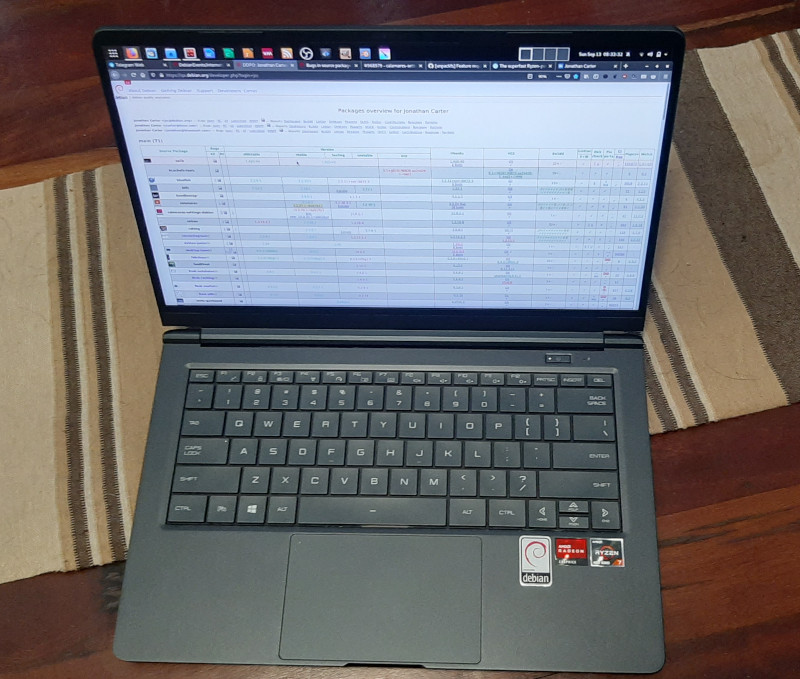
Jonathan Carter: Wootbook / Tongfang laptop

Old laptop I ve been meaning to get a new laptop for a while now. My ThinkPad X250 is now 5 years old and even though it s still adequate in many ways, I tend to run out of memory especially when running a few virtual machines. It only has one memory slot, which I maxed out at 16GB shortly after I got it. Memory has been a problem in considering a new machine. Most new laptops have soldered RAM and local configurations tend to ship with 8GB RAM. Getting a new machine with only a slightly better CPU and even just the same amount of RAM as what I have in the X250 seems a bit wasteful. I was eyeing the Lenovo X13 because it s a super portable that can take up to 32GB of RAM, and it ships with an AMD Ryzen 4000 series chip which has great performance. With Lenovo s discount for Debian Developers it became even more attractive. Unfortunately that s in North America only (at least for now) so that didn t work out this time.

Enter Tongfang I ve been reading a bunch of positive reviews about the Tuxedo Pulse 14 and KDE Slimbook 14. Both look like great AMD laptops, supports up to 64GB of RAM and clearly runs Linux well. I also noticed that they look quite similar, and after some quick searches it turns out that these are made by Tongfang and that its model number is PF4NU1F. I also learned that a local retailer (Wootware) sells them as the Wootbook. I ve seen one of these before although it was an Intel-based one, but it looked like a nice machine and I was already curious about it back then. After struggling for a while to find a local laptop with a Ryzen CPU and that s nice and compact and that breaks the 16GB memory barrier, finding this one that jumped all the way to 64GB sealed the deal for me. This is the specs for the configuration I got:

This configuration cost R18 796 ( 947 / $1122). That s significantly cheaper than anything else I can get that even starts to approach these specs. So this is a cheap laptop, but you wouldn t think so by using it.
I used the Debian netinstall image to install, and installation was just another uneventful and boring Debian installation (yay!). Unfortunately it needs the firmware-iwlwifi and firmare-amd-graphics packages for the binary blobs that drives the wifi card and GPU. At least it works flawlessly and you don t need an additional non-free display driver (as is the case with NVidia GPUs). I haven t tested the graphics extensively yet, but desktop graphics performance is very snappy. This GPU also does fancy stuff like VP8/VP9 encoding/decoding, so I m curious to see how well it does next time I have to encode some videos. The wifi upgrade was nice for copying files over. My old laptop maxed out at 300Mbps, this one connects to my home network between 800-1000Mbps. At this speed I don t bother connecting via cable at home. I read on Twitter that Tuxedo Computers thinks that it s possible to bring Coreboot to this device. That would be yet another plus for this machine. I ll try to answer some of my own questions about this device that I had before, that other people in the Debian community might also have if they re interested in this device. Since many of us are familiar with the ThinkPad X200 series of laptops, I ll compare it a bit to my X250, and also a little to the X13 that I was considering before. Initially, I was a bit hesitant about the 14 form factor, since I really like the portability of the 12.5 ThinkPad. But because the screen bezel is a lot smaller, the Wootbook (that just rolls off the tongue a lot better than the PF4NU1F ) is just slightly wider than the X250. It weighs in at 1.1KG instead of the 1.38KG of the X250. It s also thinner, so even though it has a larger display, it actually feels a lot more portable. Here s a picture of my X250 on top of the Wootbook, you can see a few mm of Wootbook sticking out to the right.
Card Reader One thing that I overlooked when ordering this laptop was that it doesn t have an SD card reader. I see that some variations have them, like on this Slimbook review. It s not a deal-breaker for me, I have a USB card reader that s very light and that I ll just keep in my backpack. But if you re ordering one of these machines and have some choice, it might be something to look out for if it s something you care about. Keyboard/Touchpad On to the keyboard. This keyboard isn t quite as nice to type on as on the ThinkPad, but, it s not bad at all. I type on many different laptop keyboards and I would rank this keyboard very comfortably in the above average range. I ve been typing on it a lot over the last 3 days (including this blog post) and it started feeling natural very quickly and I m not distracted by it as much as I thought I would be transitioning from the ThinkPad or my mechanical desktop keyboard. In terms of layout, it s nice having an actual Insert button again. This is things normal users don t care about, but since I use mc (where insert selects files) this is a welcome return :). I also like that it doesn t have a Print Screen button at the bottom of my keyboard between alt and ctrl like the ThinkPad has. Unfortunately, it doesn t have dedicated pgup/pgdn buttons. I use those a lot in apps to switch between tabs. At leas the Fn button and the ctrl buttons are next to each other, so pressing those together with up and down to switch tabs isn t that horrible, but if I don t get used to it in another day or two I might do some remapping. The touchpad has en extra sensor-button on the top left corner that s used on Windows to temporarily disable the touchpad. I captured it s keyscan codes and it presses left control + keyscan code 93. The airplane mode, volume and brightness buttons work fine. I do miss the ThinkPad trackpoint. It s great especially in confined spaces, your hands don t have to move far from the keyboard for quick pointer operations and it s nice for doing something quick and accurate. I painted a bit in Krita last night, and agree with other reviewers that the touchpad could do with just a bit more resolution. I was initially disturbed when I noticed that my physical touchpad buttons were gone, but you get right-click by tapping with two fingers, and middle click with tapping 3 fingers. Not quite as efficient as having the real buttons, but it actually works ok. For the most part, this keyboard and touchpad is completely adequate. Only time will tell whether the keyboard still works fine in a few years from now, but I really have no serious complaints about it. Display The X250 had a brightness of 172 nits. That s not very bright, I think the X250 has about the dimmest display in the ThinkPad X200 range. This hasn t been a problem for me until recently, my eyes are very photo-sensitive so most of the time I use it at reduced brightness anyway, but since I ve been working from home a lot recently, it s nice to sometimes sit outside and work, especially now that it s spring time and we have some nice days. At full brightness, I can t see much on my X250 outside. The Wootbook is significantly brighter even (even at less than 50% brightness), although I couldn t find the exact specification for its brightness online. Ports The Wootbook has 3x USB type A ports and 1x USB type C port. That s already quite luxurious for a compact laptop. As I mentioned in the specs above, it also has a full-sized ethernet socket. On the new X13 (the new ThinkPad machine I was considering), you only get 2x USB type A ports and if you want ethernet, you have to buy an additional adapter that s quite expensive especially considering that it s just a cable adapter (I don t think it contains any electronics). It has one hdmi port. Initially I was a bit concerned at lack of displayport (which my X250 has), but with an adapter it s possible to convert the USB-C port to displayport and it seems like it s possible to connect up to 3 external displays without using something weird like display over usual USB3.

Overall remarks When maxing out the CPU, the fan is louder than on a ThinkPad, I definitely noticed it while compiling the zfs-dkms module. On the plus side, that happened incredibly fast. Comparing the Wootbook to my X250, the biggest downfall it has is really it s pointing device. It doesn t have a trackpad and the touchpad is ok and completely usable, but not great. I use my laptop on a desk most of the time so using an external mouse will mostly solve that. If money were no object, I would definitely choose a maxed out ThinkPad for its superior keyboard/mouse, but the X13 configured with 32GB of RAM and 128GB of SSD retails for just about double of what I paid for this machine. It doesn t seem like you can really buy the perfect laptop no matter how much money you want to spend, there s some compromise no matter what you end up choosing, but this machine packs quite a punch, especially for its price, and so far I m very happy with my purchase and the incredible performance it provides. I m also very glad that Wootware went with the gray/black colours, I prefer that by far to the white and silver variants. It s also the first laptop I ve had since 2006 that didn t come with Windows on it. The Wootbook is also comfortable/sturdy enough to carry with one hand while open. The ThinkPads are great like this and with many other brands this just feels unsafe. I don t feel as confident carrying it by it s display because it s very thin (I know, I shouldn t be doing that with the ThinkPads either, but I ve been doing that for years without a problem :) ). There s also a post on Reddit that tracks where you can buy these machines from various vendors all over the world.

Russell Coker: Setting Up a Dell T710 Server with DRAC6

I ve just got a Dell T710 server for LUV and I ve been playing with the configuration options. Here s a list of what I ve done and recommendations on how to do things. I decided not to try to write a step by step guide to doing stuff as the situation doesn t work for that. I think that a list of how things are broken and what to avoid is more useful. BIOS Firstly with a Dell server you can upgrade the BIOS from a Linux root shell. Generally when a server is deployed you won t want to upgrade the BIOS (why risk breaking something when it s working), so before deployment you probably should install the latest version. Dell provides a shell script with encoded binaries in it that you can just download and run, it s ugly but it works. The process of loading the firmware takes a long time (a few minutes) with no progress reports, so best to plug both PSUs in and leave it alone. At the end of loading the firmware a hard reboot will be performed, so upgrading your distribution while doing the install is a bad idea (Debian is designed to not lose data in this situation so it s not too bad). IDRAC IDRAC is the Integrated Dell Remote Access Controller. By default it will listen on all Ethernet ports, get an IP address via DHCP (using a different Ethernet hardware address to the interface the OS sees), and allow connections. Configuring it to be restrictive as to which ports it listens on may be a good idea (the T710 had 4 ports built in so having one reserved for management is usually OK). You need to configure a username and password for IDRAC that has administrative access in the BIOS configuration. Web Interface By default IDRAC will run a web server on the IP address it gets from DHCP, you can connect to that from any web browser that allows ignoring invalid SSL keys. Then you can use the username and password configured in the BIOS to login. IDRAC 6 on the PowerEdge T710 recommends IE 6. To get a ssl cert that matches the name you want to use (and doesn t give browser errors) you have to generate a CSR (Certificate Signing Request) on the DRAC, the only field that matters is the CN (Common Name), the rest have to be something that Letsencrypt will accept. Certbot has the option --config-dir /etc/letsencrypt-drac to specify an alternate config directory, the SSL key for DRAC should be entirely separate from the SSL key for other stuff. Then use the --csr option to specify the path of the CSR file. When you run letsencrypt the file name of the output file you want will be in the format *_chain.pem . You then have to upload that to IDRAC to have it used. This is a major pain for the lifetime of letsencrypt certificates. Hopefully a more recent version of IDRAC has Certbot built in. When you access RAC via ssh (see below) you can run the command racadm sslcsrgen to generate a CSR that can be used by certbot. So it s probably possible to write expect scripts to get that CSR, run certbot, and then put the ssl certificate back. I don t expect to use IDRAC often enough to make it worth the effort (I can tell my browser to ignore an outdated certificate), but if I had dozens of Dells I d script it. SSH The web interface allows configuring ssh access which I strongly recommend doing. You can configure ssh access via password or via ssh public key. For ssh access set TERM=vt100 on the host to enable backspace as ^H. Something like TERM=vt100 ssh root@drac . Note that changing certain other settings in IDRAC such as enabling Smartcard support will disable ssh access. There is a limit to the number of open sessions for managing IDRAC, when you ssh to the IDRAC you can run racadm getssninfo to get a list of sessions and racadm closessn -i NUM to close a session. The closessn command takes a -a option to close all sessions but that just gives an error saying that you can t close your own session because of programmer stupidity. The IDRAC web interface also has an option to close sessions. If you get to the limits of both ssh and web sessions due to network issues then you presumably have a problem. I couldn t find any documentation on how the ssh host key is generated. I Googled for the key fingerprint and didn t get a match so there s a reasonable chance that it s unique to the server (please comment if you know more about this). Don t Use Graphical Console The T710 is an older server and runs IDRAC6 (IDRAC9 is the current version). The Java based graphical console access doesn t work with recent versions of Java. The Debian package icedtea-netx has has the javaws command for running the .jnlp command for the console, by default the web browser won t run this, you download the .jnlp file and pass that as the first parameter to the javaws program which then downloads a bunch of Java classes from the IDRAC to run. One error I got with Java 11 was Exception in thread Timer-0 java.util.ServiceConfigurationError: java.nio.charset.spi.CharsetProvider: Provider sun.nio.cs.ext.ExtendedCharsets could not be instantiated , Google didn t turn up any solutions to this. Java 8 didn t have that problem but had a connection failed error that some people reported as being related to the SSL key, but replacing the SSL key for the web server didn t help. The suggestion of running a VM with an old web browser to access IDRAC didn t appeal. So I gave up on this. Presumably a Windows VM running IE6 would work OK for this. Serial Console Fortunately IDRAC supports a serial console. Here s a page summarising Serial console setup for DRAC [1]. Once you have done that put console=tty0 console=ttyS1,115200n8 on the kernel command line and Linux will send the console output to the virtual serial port. To access the serial console from remote you can ssh in and run the RAC command console com2 (there is no option for using a different com port). The serial port seems to be unavailable through the web interface. If I was supporting many Dell systems I d probably setup a ssh to JavaScript gateway to provide a web based console access. It s disappointing that Dell didn t include this. If you disconnect from an active ssh serial console then the RAC might keep the port locked, then any future attempts to connect to it will give the following error:
/admin1-> console com2
console: Serial Device 2 is currently in use
So far the only way I ve discovered to get console access again after that is the command racadm racreset . If anyone knows of a better way please let me know. As an aside having racreset being so close to racresetcfg (which resets the configuration to default and requires a hard reboot to configure it again) seems like a really bad idea. Host Based Management
deb http://linux.dell.com/repo/community/ubuntu xenial openmanage
The above apt sources.list line allows installing Dell management utilities (Xenial is old but they work on Debian/Buster). Probably the packages srvadmin-storageservices-cli and srvadmin-omacore will drag in enough dependencies to get it going. Here are some useful commands:
# show hardware event log
omreport system esmlog
# show hardware alert log
omreport system alertlog
# give summary of system information
omreport system summary
# show versions of firmware that can be updated
omreport system version
# get chassis temp
omreport chassis temps
# show physical disk details on controller 0
omreport storage pdisk controller=0
RAID Control The RAID controller is known as PERC (PowerEdge Raid Controller), the Dell web site has an rpm package of the perccli tool to manage the RAID from Linux. This is statically linked and appears to have different versions of libraries used to make it. The command perccli show gives an overview of the configuration, but the command perccli /c0 show to give detailed information on controller 0 SEGVs and the kernel logs a vsyscall attempted with vsyscall=none message. Here s an overview of the vsyscall enmulation issue [2]. Basically I could add vsyscall=emulate to the kernel command line and slightly reduce security for the system to allow system calls from perccli that are called from old libc code to work, or I could run code from a dubious source as root. Some versions of IDRAC have a racadm raid command that can be run from a ssh session to perform RAID administration remotely, mine doesn t have that. As an aside the help for the RAC system doesn t list all commands and the Dell documentation is difficult to find so blog posts from other sysadmins is the best source of information. I have configured IDRAC to have all of the BIOS output go to the virtual serial console over ssh so I can see the BIOS prompt me for PERC administration but it didn t accept my key presses when I tried to do so. In any case this requires downtime and I d like to be able to change hard drives without rebooting. I found vsyscall_trace on Github [3], it uses the ptrace interface to emulate vsyscall on a per process basis. You just run vsyscall_trace perccli and it works! Thanks Geoffrey Thomas for writing this! Here are some perccli commands:
# show overview
perccli show
# help on adding a vd (RAID)
perccli /c0 add help
# show controller 0 details
perccli /c0 show
# add a vd (RAID) of level RAID0 (r0) with the drive 32:0 (enclosure:slot from above command)
perccli /c0 add vd r0 drives=32:0
When a disk is added to a PERC controller about 525MB of space is used at the end for RAID metadata. So when you create a RAID-0 with a single device as in the above example all disk data is preserved by default except for the last 525MB. I have tested this by running a BTRFS scrub on a disk from another system after making it into a RAID-0 on the PERC.

12 September 2020

Markus Koschany: My Free Software Activities in August 2020

Welcome to gambaru.de. Here is my monthly report (+ the first week in September) that covers what I have been doing for Debian. If you re interested in Java, Games and LTS topics, this might be interesting for you. Debian Games

teeworlds
Debian Java Misc Debian LTS This was my 54. month as a paid contributor and I have been paid to work 20 hours on Debian LTS, a project started by Rapha l Hertzog. In that time I did the following: ELTS Extended Long Term Support (ELTS) is a project led by Freexian to further extend the lifetime of Debian releases. It is not an official Debian project but all Debian users benefit from it without cost. The current ELTS release is Debian 8 Jessie . This was my 27. month and I have been paid to work 14,25 hours on ELTS. Thanks for reading and see you next time.

11 September 2020

Petter Reinholdtsen: Buster update of Norwegian Bokm l edition of Debian Administrator's Handbook almost done

Thanks to the good work of several volunteers, the updated edition of the Norwegian translation for "The Debian Administrator's Handbook" is now almost completed. After many months of proof reading, I consider the proof reading complete enough for us to move to the next step, and have asked for the print version to be prepared and sent of to the print on demand service lulu.com. While it is still not to late if you find any incorrect translations on the hosted Weblate service, but it will be soon. :) You can check out the Buster edition on the web until the print edition is ready. The book will be for sale on lulu.com and various web book stores, with links available from the web site for the book linked to above. I hope a lot of readers find it useful. As usual, if you use Bitcoin and want to show your support of my activities, please send Bitcoin donations to my address 15oWEoG9dUPovwmUL9KWAnYRtNJEkP1u1b.

Louis-Philippe V ronneau: Hire me!

I'm happy to announce I handed out my Master's Thesis last Monday. I'm not publishing the final copy just yet1, as it still needs to go through the approval committee. If everything goes well, I should have my Master of Economics diploma before Christmas! It sure hasn't been easy, and although I regret nothing, I'm also happy to be done with university. Looking for a job What an odd time to be looking for a job, right? Turns out for the first time in 12 years, I don't have an employer. It's oddly freeing, but also a little scary. I'm certainly not bitter about it though and it's nice to have some time on my hands to work on various projects and read things other than academic papers. Look out for my next blog posts on using the NeTV2 as an OSHW HDMI capture card, on hacking at security tokens and much more! I'm not looking for anything long term (I'm hoping to teach Economics again next Winter), but for the next few months, my calendar is wide open. For the last 6 years, I worked as Linux system administrator, mostly using a LAMP stack in conjunction with Puppet, Shell and Python. Although I'm most comfortable with Puppet, I also have decent experience with Ansible, thanks to my work in the DebConf Videoteam. I'm not the most seasoned Debian Developer, but I have some experience packaging Python applications and libraries. Although I'm no expert at it, lately I've also been working on Clojure packages, as I'm trying to get Puppet 6 in Debian in time for the Bullseye freeze. At the rate it's going though, I doubt we're going to make it... If your company depends on Puppet and cares about having a version in Debian 11 that is maintained (Puppet 5 is EOL in November 2020), I'm your guy! Oh, and I guess I'm a soon-to-be Master of Economics specialising in Free and Open Source Software business models and incentives theory. Not sure I'll ever get paid putting that in application, but hey, who knows. If any of that resonates with you, contact me and let's have a chat! I promise I don't bite :)

  1. The title of the thesis is What are the incentive structures of Free Software? An economic analysis of Free Software's specific development model. Once the final copy is approved, I'll be sure to write a longer blog post about my findings here.

10 September 2020

Daniel Silverstone: Broccoli Sync Conversation

Broccoli Sync Conversation A number of days ago (I know, I'm an awful human who failed to post this for over a week), myself, Lars, Mark, and Vince discussed Dropbox's article about Broccoli Sync. It wasn't quite what we'd expected but it was an interesting discussion of compression and streamed data. Vince observed that it was interesting in that it was a way to move storage compression cost to the client edge. This makes sense because decompression (to verify the uploaded content) is cheaper than compression; and also since CPU and bandwidth are expensive, spending the client CPU to reduce bandwidth is worthwhile. Lars talked about how even in situations where everyone has gigabit data connectivity with no limit on total transit, bandwidth/time is a concern, so it makes sense. We liked how they determined the right compresison level to use available bandwidth (i.e. not be CPU throttled) but also gain the most compression possible. Their diagram showing relative compression sizes for level 1 vs. 3 vs. 5 suggests that the gain for putting the effort in for 5 rather than 1. It's interesting in that diagram that 'documents' don't compress well but then again it is notable that such documents are likely DEFLATE'd zip files. Basically if the data is already compressed then there's little hope Brotli will gain much. I raised that it was interesting that they chose Brotli, in part, due to the availability of a pure Rust implementation of Brotli. Lars mentioned that Microsoft and others talk about how huge quantities of C code has unexpected memory safety issues and so perhaps that is related. Daniel mentioned that the document talked about Dropbox having a policy of not running unconstrained C code which was interesting. Vince noted that in their deployment challenges it seemed like a very poor general strategy to cope with crasher errors; but Daniel pointed out that it might be an over-simplified description, and Mark suggested that it might be sufficient until a fix can be pushed out. Vince agreed that it's plausible this is a tiered/sharded deployment process and thus a good way to smoke out problems. Daniel found it interesting that their block storage sounds remarkably like every other content-addressible storage and that while they make it clear in the article that encryption, client identification etc are elided, it looks like they might be able to deduplicate between theoretically hostile clients. We think that the compressed-data plus type plus hash (which we assume also contains length) is an interesting and nice approach to durability and integrity validation in the protocol. And the compressed blocks can then be passed to the storage backend quickly and effectively which is nice for latency. Daniel raised that he thought it was fun that their rust-brotli library is still workable on Rust 1.12 which is really quite old. We ended up on a number of tangential discussions, about Rust, about deployment strategies, and so on. While the article itself was a little thin, we certainly had a lot of good chatting around topics it raised. We'll meet again in a month (on the 28th Sept) so perhaps we'll have a chunkier article next time. (Possibly this and/or related articles)

Next.

Previous.