Search Results: "cas"

26 September 2016

Kees Cook: security things in Linux v4.3

When I gave my State of the Kernel Self-Protection Project presentation at the 2016 Linux Security Summit, I included some slides covering some quick bullet points on things I found of interest in recent Linux kernel releases. Since there wasn t a lot of time to talk about them all, I figured I d make some short blog posts here about the stuff I was paying attention to, along with links to more information. This certainly isn t everything security-related or generally of interest, but they re the things I thought needed to be pointed out. If there s something security-related you think I should cover from v4.3, please mention it in the comments. I m sure I haven t caught everything. :) A note on timing and context: the momentum for starting the Kernel Self Protection Project got rolling well before it was officially announced on November 5th last year. To that end, I included stuff from v4.3 (which was developed in the months leading up to November) under the umbrella of the project, since the goals of KSPP aren t unique to the project nor must the goals be met by people that are explicitly participating in it. Additionally, not everything I think worth mentioning here technically falls under the kernel self-protection ideal anyway some things are just really interesting userspace-facing features. So, to that end, here are things I found interesting in v4.3: CONFIG_CPU_SW_DOMAIN_PAN Russell King implemented this feature for ARM which provides emulated segregation of user-space memory when running in kernel mode, by using the ARM Domain access control feature. This is similar to a combination of Privileged eXecute Never (PXN, in later ARMv7 CPUs) and Privileged Access Never (PAN, coming in future ARMv8.1 CPUs): the kernel cannot execute user-space memory, and cannot read/write user-space memory unless it was explicitly prepared to do so. This stops a huge set of common kernel exploitation methods, where either a malicious executable payload has been built in user-space memory and the kernel was redirected to run it, or where malicious data structures have been built in user-space memory and the kernel was tricked into dereferencing the memory, ultimately leading to a redirection of execution flow. This raises the bar for attackers since they can no longer trivially build code or structures in user-space where they control the memory layout, locations, etc. Instead, an attacker must find areas in kernel memory that are writable (and in the case of code, executable), where they can discover the location as well. For an attacker, there are vastly fewer places where this is possible in kernel memory as opposed to user-space memory. And as we continue to reduce the attack surface of the kernel, these opportunities will continue to shrink. While hardware support for this kind of segregation exists in s390 (natively separate memory spaces), ARM (PXN and PAN as mentioned above), and very recent x86 (SMEP since Ivy-Bridge, SMAP since Skylake), ARM is the first upstream architecture to provide this emulation for existing hardware. Everyone running ARMv7 CPUs with this kernel feature enabled suddenly gains the protection. Similar emulation protections (PAX_MEMORY_UDEREF) have been available in PaX/Grsecurity for a while, and I m delighted to see a form of this land in upstream finally. To test this kernel protection, the ACCESS_USERSPACE and EXEC_USERSPACE triggers for lkdtm have existed since Linux v3.13, when they were introduced in anticipation of the x86 SMEP and SMAP features. Ambient Capabilities Andy Lutomirski (with Christoph Lameter and Serge Hallyn) implemented a way for processes to pass capabilities across exec() in a sensible manner. Until Ambient Capabilities, any capabilities available to a process would only be passed to a child process if the new executable was correctly marked with filesystem capability bits. This turns out to be a real headache for anyone trying to build an even marginally complex least privilege execution environment. The case that Chrome OS ran into was having a network service daemon responsible for calling out to helper tools that would perform various networking operations. Keeping the daemon not running as root and retaining the needed capabilities in children required conflicting or crazy filesystem capabilities organized across all the binaries in the expected tree of privileged processes. (For example you may need to set filesystem capabilities on bash!) By being able to explicitly pass capabilities at runtime (instead of based on filesystem markings), this becomes much easier. For more details, the commit message is well-written, almost twice as long as than the code changes, and contains a test case. If that isn t enough, there is a self-test available in tools/testing/selftests/capabilities/ too. PowerPC and Tile support for seccomp filter Michael Ellerman added support for seccomp to PowerPC, and Chris Metcalf added support to Tile. As the seccomp maintainer, I get excited when an architecture adds support, so here we are with two. Also included were updates to the seccomp self-tests (in tools/testing/selftests/seccomp), to help make sure everything continues working correctly. That s it for v4.3. If I missed stuff you found interesting, please let me know! I m going to try to get more per-version posts out in time to catch up to v4.8, which appears to be tentatively scheduled for release this coming weekend.

2016, Kees Cook. This work is licensed under a Creative Commons Attribution-ShareAlike 3.0 License.
Creative Commons License

Reproducible builds folks: Reproducible Builds: week 74 in Stretch cycle

Here is what happened in the Reproducible Builds effort between Sunday September 18 and Saturday September 24 2016: Outreachy We intend to participate in Outreachy Round 13 and look forward for new enthusiastic applications to contribute to reproducible builds. We're offering four different areas to work on: Reproducible Builds World summit #2 We are planning e a similar event to our Athens 2015 summit and expect to reveal more information soon. If you haven't been contacted yet but would like to attend, please contact holger. Toolchain development and fixes Mattia uploaded dpkg/1.18.10.0~reproducible1 to our experimental repository. and covered the details for the upload in a mailing list post. The most important change is the incorporation of improvements made by Guillem Jover (dpkg maintainer) to the .buildinfo generator. This is also in the hope that it will speed up the merge in the upstream. One of the other relevant changes from before is that .buildinfo files generated from binary-only builds will no longer include the hash of the .dsc file in Checksums-Sha256 as documented in the specification. Even if it was considered important to include a checksum of the source package in .buildinfo, storing it that way breaks other assumptions (eg. that Checksums-Sha256 contains only files part of that are part of a single upload, wheras the .dsc might not be part of that upload), thus we look forward for another solution to store the source checksum in .buildinfo. Bugs filed Reviews of unreproducible packages 250 package reviews have been added, 4 have been updated and 4 have been removed in this week, adding to our knowledge about identified issues. 4 issue types have been added: 3 issue types have been updated: Weekly QA work FTBFS bugs have been reported by: Documentation updates h01ger created a new Jenkins job so that every commit pushed to the master branch for the website will update reproducible-builds.org. diffoscope development strip-nondeterminism development reprotest development tests.reproducible-builds.org Misc. This week's edition was written by Chris Lamb, Holger Levsen and Mattia Rizzolo and reviewed by a bunch of Reproducible Builds folks on IRC.

25 September 2016

Vincent Sanders: I'll huff, and I'll puff, and I'll blow your house in

Sometimes it really helps to have a different view on a problem and after my recent writings on my Public Suffix List (PSL) library I was fortunate to receive a suggestion from my friend Enrico Zini.

I had asked for suggestions on reducing the size of the library further and Enrico simply suggested Huffman coding. This was a technique I had learned about long ago in connection with data compression and the intervening years had made all the details fuzzy which explains why it had not immediately sprung to mind.

A small subset of the Public Suffix List as stored within libnspslHuffman coding named for David A. Huffman is an algorithm that enables a representation of data which is very efficient. In a normal array of characters every character takes the same eight bits to represent which is the best we can do when any of the 256 values possible is equally likely. If your data is not evenly distributed this is not the case for example if the data was english text then the value is fifteen times more likely to be that for e than k.

every step of huffman encoding tree build for the example string tableSo if we have some data with a non uniform distribution of probabilities we need a way the data be encoded with fewer bits for the common values and more bits for the rarer values. To be efficient we would need some way of having variable length representations without storing the length separately. The term for this data representation is a prefix code and there are several ways to generate them.

Such is the influence of Huffman on the area of prefix codes they are often called Huffman codes even if they were not created using his algorithm. One can dream of becoming immortalised like this, to join the ranks of those whose names are given to units or whole ideas in a field must be immensely rewarding, however given Huffman invented his algorithm and proved it to be optimal to answer a question on a term paper in his early twenties I fear I may already be a bit too late.

The algorithm itself is relatively straightforward. First a frequency analysis is performed, a fancy way of saying count how many of each character is in the input data. Next a binary tree is created by using a priority queue initialised with the nodes sorted by frequency.

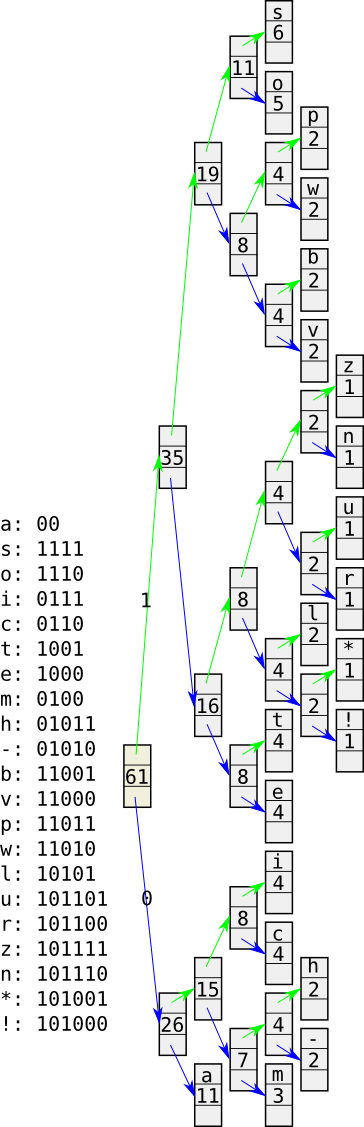
The resulting huffman tree and the binary representation of the input symbols
The two least frequent items count is summed together and a node placed in the tree with the two original entries as child nodes. This step is repeated until a single node exists with a count value equal to the length of the input.

To encode data once simply walks the tree outputting a 0 for a left node or 1 for right node until reaching the original value. This generates a mapping of values to bit output, the input is then simply converted value by value to the bit output. To decode the data the data is used bit by bit to walk the tree to arrive at values.

If we perform this algorithm on the example string table *!asiabvcomcoopitamazonawsarsaves-the-whalescomputebasilicata we can reduce the 488 bits (61 * 8 bit characters) to 282 bits or 40% reduction. Obviously in a real application the huffman tree would need to be stored which would probably exceed this saving but for larger data sets it is probable this technique would yield excellent results on this kind of data.

Once I proved this to myself I implemented the encoder within the existing conversion program. Although my perl encoder is not very efficient it can process the entire PSL string table (around six thousand labels using 40KB or so) in less than a second, so unless the table grows massively an inelegant approach will suffice.

The resulting bits were packed into 32bit values to improve decode performance (most systems prefer to deal with larger memory fetches less frequently) and resulted in 18KB of output or 47% of the original size. This is a great improvement in size and means the statically linked test program is now 59KB and is actually smaller than the gzipped source data.

$ ls -alh test_nspsl
-rwxr-xr-x 1 vince vince 59K Sep 25 23:58 test_nspsl
$ ls -al public_suffix_list.dat.gz
-rw-r--r-- 1 vince vince 62K Sep 1 08:52 public_suffix_list.dat.gz

To be clear the statically linked program can determine if a domain is in the PSL with no additional heap allocations and includes the entire PSL ordered tree, the domain label string table and the huffman decode table to read it.

An unexpected side effect is that because the decode loop is small it sits in the processor cache. This appears to cause the string comparison function huffcasecmp() (which is not locale dependant because we know the data will be limited ASCII) performance to be close to using strcasecmp() indeed on ARM32 systems there is a very modest improvement in performance.

I think this is as much work as I am willing to put into this library but I am pleased to have achieved a result which is on par with the best of breed (libpsl still has a data representation 20KB smaller than libnspsl but requires additional libraries for additional functionality) and I got to (re)learn an important algorithm too.

Julian Andres Klode: Introducing TrieHash, a order-preserving minimal perfect hash function generator for C(++)

Abstract I introduce TrieHash an algorithm for constructing perfect hash functions from tries. The generated hash functions are pure C code, minimal, order-preserving and outperform existing alternatives. Together with the generated header files,they can also be used as a generic string to enumeration mapper (enums are created by the tool). Introduction APT (and dpkg) spend a lot of time in parsing various files, especially Packages files. APT currently uses a function called AlphaHash which hashes the last 8 bytes of a word in a case-insensitive manner to hash fields in those files (dpkg just compares strings in an array of structs). There is one obvious drawback to using a normal hash function: When we want to access the data in the hash table, we have to hash the key again, causing us to hash every accessed key at least twice. It turned out that this affects something like 5 to 10% of the cache generation performance. Enter perfect hash functions: A perfect hash function matches a set of words to constant values without collisions. You can thus just use the index to index into your hash table directly, and do not have to hash again (if you generate the function at compile time and store key constants) or handle collision resolution. As #debian-apt people know, I happened to play a bit around with tries this week before guillem suggested perfect hashing. Let me tell you one thing: My trie implementation was very naive, that did not really improve things a lot Enter TrieHash Now, how is this related to hashing? The answer is simple: I wrote a perfect hash function generator that is based on tries. You give it a list of words, it puts them in a trie, and generates C code out of it, using recursive switch statements (see code generation below). The function achieves competitive performance with other hash functions, it even usually outperforms them. Given a dictionary, it generates an enumeration (a C enum or C++ enum class) of all words in the dictionary, with the values corresponding to the order in the dictionary (the order-preserving property), and a function mapping strings to members of that enumeration. By default, the first word is considered to be 0 and each word increases a counter by one (that is, it generates a minimal hash function). You can tweak that however:
= 0
WordLabel ~ Word
OtherWord = 9
will return 0 for an unknown value, map Word to the enum member WordLabel and map OtherWord to 9. That is, the input list functions like the body of a C enumeration. If no label is specified for a word, it will be generated from the word. For more details see the documentation C code generation
switch(string[0]   32)  
case 't':
    switch(string[1]   32)  
    case 'a':
        switch(string[2]   32)  
        case 'g':
            return Tag;


return Unknown;
Yes, really recursive switches they directly represent the trie. Now, we did not really do a straightforward translation, there are some optimisations to make the whole thing faster and easier to look at: First of all, the 32 you see is used to make the check case insensitive in case all cases of the switch body are alphabetical characters. If there are non-alphabetical characters, it will generate two cases per character, one upper case and one lowercase (with one break in it). I did not know that lowercase and uppercase characters differed by only one bit before, thanks to the clang compiler for pointing that out in its generated assembler code! Secondly, we only insert breaks only between cases. Initially, each case ended with a return Unknown, but guillem (the dpkg developer) suggested it might be faster to let them fallthrough where possible. Turns out it was not faster on a good compiler, but it s still more readable anywhere. Finally, we build one trie per word length, and switch by the word length first. Like the 32 trick, his gives a huge improvement in performance. Digging into the assembler code The whole code translates to roughly 4 instructions per byte:
  1. A memory load,
  2. an or with 32
  3. a comparison, and
  4. a conditional jump.
(On x86, the case sensitive version actually only has a cmp-with-memory and a conditional jump). Due to https://gcc.gnu.org/bugzilla/show_bug.cgi?id=77729 this may be one instruction more: On some architectures an unneeded zero-extend-byte instruction is inserted this causes a 20% performance loss. Performance evaluation I run the hash against all 82 words understood by APT in Packages and Sources files, 1,000,000 times for each word, and summed up the average run-time:
host arch Trie TrieCase GPerfCase GPerf DJB
plummer ppc64el 540 601 1914 2000 1345
eller mipsel 4728 5255 12018 7837 4087
asachi arm64 1000 1603 4333 2401 1625
asachi armhf 1230 1350 5593 5002 1784
barriere amd64 689 950 3218 1982 1776
x230 amd64 465 504 1200 837 693
Suffice to say, GPerf does not really come close. All hosts except the x230 are Debian porterboxes. The x230 is my laptop with a a Core i5-3320M, barriere has an Opteron 23xx. I included the DJB hash function for another reference. Source code The generator is written in Perl, licensed under the MIT license and available from https://github.com/julian-klode/triehash I initially prototyped it in Python, but guillem complained that this would add new build dependencies to dpkg, so I rewrote it in Perl. Benchmark is available from https://github.com/julian-klode/hashbench Usage See the script for POD documentation.
Filed under: General

Sven Hoexter: in causa wosign

Since I kind of recommended the free WoSign CA in the past, I would like to point out the issues that have piled up. Mozilla has a writeup due to a removal discussion for NSS: https://wiki.mozilla.org/CA:WoSign_Issues (Yes I'm late with this post, about a month or two by now ...) Since WoSign, or the person behind it, silently also bought StartCom we've now with StartSSL and WoSign two of the three free CAs in one hand with a questionable track record. That leaves everyone looking for a low budget option with Let's Encrypt.

24 September 2016

Iain R. Learmonth: Azure from Debian

Around a week ago, I started to play with programmatically controlling Azure. I needed to create and destroy a bunch of VMs over and over again, and this seemed like something I would want to automate once instead of doing manually and repeatedly. I started to look into the azure-sdk-for-python and mentioned that I wanted to look into this in #debian-python. ardumont from Software Heritage noticed me, and was planning to package azure-storage-python. We joined forces and started a packaging team for Azure-related software. I spoke with the upstream developer of the azure-sdk-for-python and he pointed me towards azure-cli. It looked to me that this fit my use case better than the SDK alone, as it had the high level commands I was looking for. Between me and ardumont, in the space of just under a week, we have now packaged: python-msrest (#838121), python-msrestazure (#838122), python-azure (#838101), python-azure-storage (#838135), python-adal (#838716), python-applicationinsights (#838717) and finally azure-cli (#838708). Some of these packages are still in the NEW queue at the time I m writing this, but I don t foresee any issues with these packages entering unstable. azure-cli, as we have packaged, is the new Python-based CLI for Azure. The Microsoft developers gave it the tagline of our next generation multi-platform command line experience for Azure . In the short time I ve been using it I ve been very impressed with it. In order to set it up initially, you have to configure a couple of of defaults using az configure. After that, you need to az login which again is an entirely painless process as long as you have a web browser handy in order to perform the login. After those two steps, you re only two commands away from deploying a Debian virtual machine:

az resource group create -n testgroup -l "West US"
az vm create -n testvm -g testgroup --image credativ:Debian:8:latest --authentication-type ssh
This will create a resource group, and then create a VM within that resource group with a user automatically created with your current username and with your SSH public key (~/.ssh/id_rsa.pub) automatically installed. Once it returns you the IP address, you can SSH in straight away. Looking forward to some next steps for Debian on Azure, I d like to get images built for Azure using vmdebootstrap and I ll be exploring this in the lead up to, and at, the upcoming vmdebootstrap sprint in Cambridge, UK later in the year (still being organised).

Ritesh Raj Sarraf: Laptop Mode Tools 1.70

I'm pleased to announce the release of Laptop Mode Tools, version 1.70. This release adds support for AHCI Runtime PM, introduced in Linux 4.6. It also includes many important bug fixes, mostly related to invocation and determination of power states. Changelog: 1.70 - Sat Sep 24 16:51:02 IST 2016
* Deal harder with broken battery states
* On machines with 2+ batteries, determine states from all batteries
* Limit status message logging frequency. Some machines tend to send
ACPI events too often. Thanks Maciej S. Szmigiero
* Try harder to determine power states. As reports have shown, the
power_supply subsystem has had incorrect state reporting on many machines,
for both, BAT and AC.
* Relax conditional events where Laptop Mode Tools should be executed. This
affected for use cases of Laptop being docked and undocked
Thanks Daniel Koch.
* CPU Hotplug settings extended
* Cleanup states for improved Laptop Mode Tools invocation
Thanks: Tomas Janousek
* Align Intel P State default to what the actual driver (intel_pstate.c)
uses
Thanks: George Caswell and Matthew Gabeler-Lee
* Add support for AHCI Runtime PM in module intel-sata-powermgmt
* Many systemd and initscript fixes
* Relax default USB device list. This avoids the long standing issues with
USB devices (mice, keyboard) that mis-behaved during autosuspend Source tarball, Feodra/SUSE RPM Packages available at:
https://github.com/rickysarraf/laptop-mode-tools/releases Debian packages will be available soon in Unstable. Homepage: https://github.com/rickysarraf/laptop-mode-tools/wiki
Mailing List: https://groups.google.com/d/forum/laptop-mode-tools

Categories:

Keywords:

Like:

21 September 2016

Matthew Garrett: Microsoft aren't forcing Lenovo to block free operating systems

There's a story going round that Lenovo have signed an agreement with Microsoft that prevents installing free operating systems. This is sensationalist, untrue and distracts from a genuine problem.

The background is straightforward. Intel platforms allow the storage to be configured in two different ways - "standard" (normal AHCI on SATA systems, normal NVMe on NVMe systems) or "RAID". "RAID" mode is typically just changing the PCI IDs so that the normal drivers won't bind, ensuring that drivers that support the software RAID mode are used. Intel have not submitted any patches to Linux to support the "RAID" mode.

In this specific case, Lenovo's firmware defaults to "RAID" mode and doesn't allow you to change that. Since Linux has no support for the hardware when configured this way, you can't install Linux (distribution installers will boot, but won't find any storage device to install the OS to).

Why would Lenovo do this? I don't know for sure, but it's potentially related to something I've written about before - recent Intel hardware needs special setup for good power management. The storage driver that Microsoft ship doesn't do that setup. The Intel-provided driver does. "RAID" mode prevents the Microsoft driver from binding and forces the user to use the Intel driver, which means they get the correct power management configuration, battery life is better and the machine doesn't melt.

(Why not offer the option to disable it? A user who does would end up with a machine that doesn't boot, and if they managed to figure that out they'd have worse power management. That increases support costs. For a consumer device, why would you want to? The number of people buying these laptops to run anything other than Windows is miniscule)

Things are somewhat obfuscated due to a statement from a Lenovo rep:This system has a Signature Edition of Windows 10 Home installed. It is locked per our agreement with Microsoft. It's unclear what this is meant to mean. Microsoft could be insisting that Signature Edition systems ship in "RAID" mode in order to ensure that users get a good power management experience. Or it could be a misunderstanding regarding UEFI Secure Boot - Microsoft do require that Secure Boot be enabled on all Windows 10 systems, but (a) the user must be able to manage the key database and (b) there are several free operating systems that support UEFI Secure Boot and have appropriate signatures. Neither interpretation indicates that there's a deliberate attempt to prevent users from installing their choice of operating system.

The real problem here is that Intel do very little to ensure that free operating systems work well on their consumer hardware - we still have no information from Intel on how to configure systems to ensure good power management, we have no support for storage devices in "RAID" mode and we have no indication that this is going to get better in future. If Intel had provided that support, this issue would never have occurred. Rather than be angry at Lenovo, let's put pressure on Intel to provide support for their hardware.

comment count unavailable comments

20 September 2016

Vincent Sanders: If I see an ending, I can work backward.

Now while I am sure Arthur Miller was referring to writing a play when he said those words they have an oddly appropriate resonance for my topic.

In the early nineties Lou Montulli applied the idea of magic cookies to HTTP to make the web stateful, I imagine he had no idea of the issues he was going to introduce for the future. Like most of the web technology it was a solution to an immediate problem which it has never been possible to subsequently improve.

Chocolate chip cookie are much tastier than HTTP cookiesThe HTTP cookie is simply a way for a website to identify a connecting browser session so that state can be kept between retrieving pages. Due to shortcomings in the design of cookies and implementation details in browsers this has lead to a selection of unwanted side effects. The specific issue that I am talking about here is the supercookie where the super prefix in this context has similar connotations as to when applied to the word villain.

Whenever the browser requests a resource (web page, image, etc.) the server may return a cookie along with the resource that your browser remembers. The cookie has a domain name associated with it and when your browser requests additional resources if the cookie domain matches the requested resources domain name the cookie is sent along with the request.

As an example the first time you visit a page on www.example.foo.invalid you might receive a cookie with the domain example.foo.invalid so next time you visit a page on www.example.foo.invalid your browser will send the cookie along. Indeed it will also send it along for any page on another.example.foo.invalid

A supercookies is simply one where instead of being limited to one sub-domain (example.foo.invalid) the cookie is set for a top level domain (foo.invalid) so visiting any such domain (I used the invalid name in my examples but one could substitute com or co.uk) your web browser gives out the cookie. Hackers would love to be able to set up such cookies and potentially control and hijack many sites at a time.

This problem was noted early on and browsers were not allowed to set cookie domains with fewer than two parts so example.invalid or example.com were allowed but invalid or com on their own were not. This works fine for top level domains like .com, .org and .mil but not for countries where the domain registrar had rules about second levels like the uk domain (uk domains must have a second level like .co.uk).

 NetSurf cookie manager showing a supercookieThere is no way to generate the correct set of top level domains with an algorithm so a database is required and is called the Public Suffix List (PSL). This database is a simple text formatted list with wildcard and inversion syntax and is at time of writing around 180Kb of text including comments which compresses down to 60Kb or so with deflate.

A few years ago with ICANN allowing the great expansion of top level domains the existing NetSurf supercookie handling was found to be wanting and I decided to implement a solution using the PSL. At this point in time the database was only 100Kb source or 40Kb compressed.

I started by looking at limited existing libraries. In fact only the regdom library was adequate but used 150Kb of heap to load the pre-processed list. This would have had the drawback of increasing NetSurf heap usage significantly (we still have users on 8Mb systems). Because of this and the need to run PHP script to generate the pre-processed input it was decided the library was not suitable.

Lacking other choices I came up with my own implementation which used a perl script to construct a tree of domains from the PSL in a static array with the label strings in a separate table. At the time my implementation added 70Kb of read only data which I thought reasonable and allowed for direct lookup of answers from the database.

This solution still required a pre-processing step to generate the C source code but perl is much more readily available, is a language already used by our tooling and we could always simply ship the generated file. As long as the generated file was updated at release time as we already do for our fallback SSL certificate root set this would be acceptable.

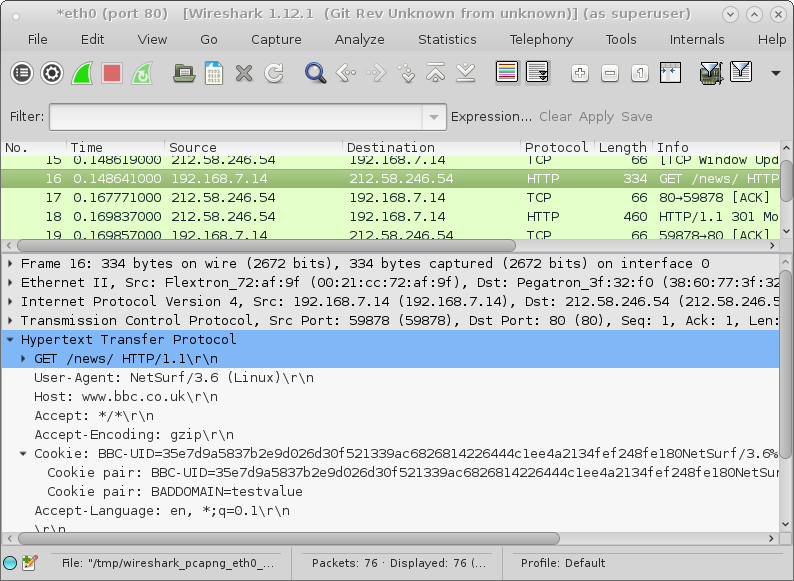
wireshark session shown NetSurf sending a co.uk supercookie to bbc.co.uk
I put the solution into NetSurf, was pleased no-one seemed to notice and moved on to other issues. Recently while fixing a completely unrelated issue in the display of session cookies in the management interface and I realised I had some test supercookies present in the display. After the initial "thats odd" I realised with horror there might be a deeper issue.

It quickly became evident the PSL generation was broken and had been for a long time, even worse somewhere along the line the "redundant" empty generated source file had been removed and the ancient fallback code path was all that had been used.

This issue had escalated somewhat from a trivial display problem. I took a moment to asses the situation a bit more broadly and came to the conclusion there were a number of interconnected causes, centered around the lack of automated testing, which could be solved by extracting the PSL handling into a "support" library.

NetSurf has several of these support libraries which could be used separately to the main browser project but are principally oriented towards it. These libraries are shipped and built in releases alongside the main browser codebase and mainly serve to make API more obvious and modular. In this case my main aim was to have the functionality segregated into a separate module which could be tested, updated and monitored directly by our CI system meaning the embarrassing failure I had found can never occur again.

Before creating my own library I did consider a library called libpsl had been created since I wrote my original implementation. Initially I was very interested in using this library given it managed a data representation within a mere 32Kb.

Unfortunately the library integrates a great deal of IDN and punycode handling which was not required in this use case. NetSurf already has to handle IDN and punycode translations and uses punycode encoded domain names internally only translating to unicode representations for display so duplicating this functionality using other libraries requires a great deal of resource above the raw data representation.

I put the library together based on the existing code generator Perl program and integrated the test set that comes along with the PSL. I was a little alarmed to discover that the PSL had almost doubled in size since the implementation was originally written and now the trivial test program of the library was weighing in at a hefty 120Kb.

This stemmed from two main causes:
  1. there were now many more domain label strings to be stored
  2. there now being many, many more nodes in the tree.
To address the first cause the length of the domain label strings was moved into the unused padding space within each tree node removing a byte from each domain label saving 6Kb. Next it occurred to me that while building the domain label string table that if the label to be added already existed as a substring within the table it could be elided.

The domain labels were sorted from longest to shortest and added in order searching for substring matches as the table was built this saved another 6Kb. I am sure there are ways to reduce this further I have missed (if you see them let me know!) but a 25% saving (47Kb to 35Kb) was a good start.

The second cause was a little harder to address. The structure representing nodes in the tree I started with was at first look reasonable.

struct pnode  
uint16_t label_index; /* index into string table of label */
uint16_t label_length; /* length of label */
uint16_t child_node_index; /* index of first child node */
uint16_t child_node_count; /* number of child nodes */
;

I examined the generated table and observed that the majority of nodes were leaf nodes (had no children) which makes sense given the type of data being represented. By allowing two types of node one for labels and a second for the child node information this would halve the node size in most cases and requiring only a modest change to the tree traversal code.

The only issue with this would be that a way to indicate a node has child information. It was realised that the domain labels can have a maximum length of 63 characters meaning their length can be represented in six bits so a uint16_t was excessive. The space was split into two uint8_t parts one for the length and one for a flag to indicate child data node followed.

union pnode  
struct
uint16_t index; /* index into string table of label */
uint8_t length; /* length of label */
uint8_t has_children; /* the next table entry is a child node */
label;
struct
uint16_t node_index; /* index of first child node */
uint16_t node_count; /* number of child nodes */
child;
;

static const union pnode pnodes[8580] =
/* root entry */
.label = 0, 0, 1 , .child = 2, 1553 ,
/* entries 2 to 1794 */
.label = 37, 2, 1 , .child = 1795, 6 ,

...

/* entries 8577 to 8578 */
.label = 31820, 6, 1 , .child = 8579, 1 ,
/* entry 8579 */
.label = 0, 1, 0 ,

;

This change reduced the node array size from 63Kb to 33Kb almost a 50% saving. I considered using bitfields to try and reduce the label length and has_children flag into a single byte but such packing will not reduce the length of a node below 32bits because it is unioned with the child structure.

A possibility of using the spare uint8_t derived by bitfield packing to store an additional label node in three other nodes was considered but added a great deal of complexity to node lookup and table construction for saving around 4Kb so was not incorporated.

With the changes incorporated the test program was a much more acceptable 75Kb reasonably close to the size of the compressed source but with the benefits of direct lookup. Integrating the libraries single API call into NetSurf was straightforward and resulted in correct operation when tested.

This episode just reminded me of the dangers of code that can fail silently. It exposed our users to a security problem that we thought had been addressed almost six years ago and squandered the limited resources of the project. Hopefully a lesson we will not have to learn again any time soon. If there is a positive to take away it is that the new implementation is more space efficient, automatically built and importantly tested

19 September 2016

Mike Gabriel: Rocrail changed License to some dodgy non-free non-License

The Background Story A year ago, or so, I took some time to search the internet for Free Software that can be used for controlling model railways via a computer. I was happy to find Rocrail [1] being one of only a few applications available on the market. And even more, I was very happy when I saw that it had been licensed under a Free Software license: GPL-3(+). A month ago, or so, I collected my old M rklin (Digital) stuff from my parents' place and started looking into it again after +15 years, together with my little son. Some weeks ago, I remembered Rocrail and thought... Hey, this software was GPLed code and absolutely suitable for uploading to Debian and/or Ubuntu. I searched for the Rocrail source code and figured out that it got hidden from the web some time in 2015 and that the license obviously has been changed to some non-free license (I could not figure out what license, though). This made me very sad! I thought I had found a piece of software that might be interesting for testing with my model railway. Whenever I stumble over some nice piece of Free Software that I plan to use (or even only play with), I upload this to Debian as one of the first steps. However, I highly attempt to stay away from non-free sofware, so Rocrail has become a no-option for me back in 2015. I should have moved on from here on... Instead... Proactively, I signed up with the Rocrail forum and asked the author(s) if they see any chance of re-licensing the Rocrail code under GPL (or any other FLOSS license) again [2]? When I encounter situations like this, I normally offer my expertise and help with such licensing stuff for free. My impression until here already was that something strange must have happened in the past, so that software developers choose GPL and later on stepped back from that decision and from then on have been hiding the source code from the web entirely. Going deeper... The Rocrail project's wiki states that anyone can request GitBlit access via the forum and obtain the source code via Git for local build purposes only. Nice! So, I asked for access to the project's Git repository, which I had been granted. Thanks for that. Trivial Source Code Investigation... So far so good. I investigated the source code (well, only the license meta stuff shipped with the source code...) and found that the main COPYING files (found at various locations in the source tree, containing a full version of the GPL-3 license) had been replaced by this text:
Copyright (c) 2002 Robert Jan Versluis, Rocrail.net
All rights reserved.
Commercial usage needs permission.
The replacement happened with these Git commits:
commit cfee35f3ae5973e97a3d4b178f20eb69a916203e
Author: Rob Versluis <r.j.versluis@rocrail.net>
Date:   Fri Jul 17 16:09:45 2015 +0200
    update copyrights
commit df399d9d4be05799d4ae27984746c8b600adb20b
Author: Rob Versluis <r.j.versluis@rocrail.net>
Date:   Wed Jul 8 14:49:12 2015 +0200
    update licence
commit 0daffa4b8d3dc13df95ef47e0bdd52e1c2c58443
Author: Rob Versluis <r.j.versluis@rocrail.net>
Date:   Wed Jul 8 10:17:13 2015 +0200
    update
Getting in touch again, still being really interested and wanting to help... As I consider such a non-license as really dangerous when distributing any sort of software, be it Free or non-free Software, I posted the below text on the Rocrail forum:
Hi Rob,
I just stumbled over this post [3] [link reference adapted for this
blog post), which probably is the one you have referred to above.
It seems that Rocrail contains features that require a key or such
for permanent activation.  Basically, this is allowed and possible
even with the GPL-3+ (although Free Software activists will  not
appreciate that). As the GPL states that people can share the source
code, programmers can  easily deactivate license key checks (and
such) in the code and re-distribute that patchset as they  like.
Furthermore, the current COPYING file is really non-protective at
all. It does not really protect   you as copyright holder of the
code. Meaning, if people crash their trains with your software, you  
could actually be legally prosecuted for that. In theory. Or in the
U.S. ( ;-) ). Main reason for  having a long long license text is to
protect you as the author in case your software causes t trouble to
other people. You do not have any warranty disclaimer in your COPYING
file or elsewhere. Really not a good idea.
In that referenced post above, someone also writes about the nuisance
of license discussions in  this forum. I have seen various cases
where people produced software and did not really care for 
licensing. Some ended with a letter from a lawyer, some with some BIG
company using their code  under their copyright holdership and their
own commercial licensing scheme. This is not paranoia,  this is what
happens in the Free Software world from time to time.
A model that might be much more appropriate (and more protective to
you as the author), maybe, is a  dual release scheme for the code. A
possible approach could be to split Rocrail into two editions:  
Community Edition and Professional/Commercial Edition. The Community
Edition must be licensed in a  way that it allows re-using the code
in a closed-source, non-free version of Rocrail (e.g.   MIT/Expat
License or Apache2.0 License). Thus, the code base belonging to the
community edition  would be licensed, say..., as Apache-2.0 and for
the extra features in the Commercial Edition, you  may use any
non-free license you want (but please not that COPYING file you have
now, it really  does not protect your copyright holdership).
The reason for releasing (a reduced set of features of a) software as
Free Software is to extend  the user base. The honey jar effect, as
practise by many huge FLOSS projects (e.g. Owncloud,  GitLab, etc.).
If people could install Rocrail from the Debian / Ubuntu archives
directly, I am  sure that the user base of Rocrail will increase.
There may also be developers popping up showing  an interest in
Rocrail (e.g. like me). However, I know many FLOSS developers (e.g.
like me) that  won't waste their free time on working for a non-free
piece of software (without being paid).
If you follow (or want to follow) a business model with Rocrail, then
keep some interesting  features in the Commercial Edition and don't
ship that source code. People with deep interest may  opt for that.
Furthermore, another option could be dual licensing the code. As the
copyright holder of Rocrail  you are free to juggle with licenses and
apply any license to a release you want. For example, this  can be
interesing for a free-again Rocrail being shipped via Apple's iStore. 
Last but not least, as you ship the complete source code with all
previous changes as a Git project  to those who request GitBlit
access, it is possible to obtain all earlier versions of Rocrail. In 
the mail I received with my GitBlit credentials, there was some text
that  prohibits publishing the  code. Fine. But: (in theory) it is
not forbidden to share the code with a friend, for local usage.  This
friend finds the COPYING file, frowns and rewinds back to 2015 where
the license was still  GPL-3+. GPL-3+ code can be shared with anyone
and also published, so this friend could upload the  2015-version of
Rocrail to Github or such and start to work on a free fork. You also
may not want  this.
Thanks for working on this piece of software! It is highly
interesing, and I am still sad, that it  does not come with a free
license anymore. I won't continue this discussion and move on, unless
you  are interested in any of the above information and ask for more
expertise. Ping me here or directly  via mail, if needed. If the
expertise leads to parts of Rocrail becoming Free Software again, the 
expertise is offered free of charge ;-).
light+love
Mike
Wow, the first time I got moderated somewhere... What an experience! This experience now was really new. My post got immediately removed from the forum by the main author of Rocrail (with the forum's moderator's hat on). The new experience was: I got really angry when I discovererd having been moderated. Wow! Really a powerful emotion. No harassment in my words, no secrets disclosed, and still... my free speech got suppressed by someone. That feels intense! And it only occurred in the virtual realm, not face to face. Wow!!! I did not expect such intensity... The reason for wiping my post without any other communication was given as below and quite a statement to frown upon (this post has also been "moderately" removed from the forum thread [2] a bit later today):
Mike,
I think its not a good idea to point out a way to get the sources back to the GPL periode.
Therefore I deleted your posting.
(The phpBB forum software also allows moderators to edit posts, so the critical passage could have been removed instead, but immediately wiping the full message, well...). Also, just wiping my post and not replying otherwise with some apology to suppress my words, really is a no-go. And the reason for wiping the rest of the text... Any Git user can easily figure out how to get a FLOSS version of Rocrail and continue to work on that from then on. Really. Now the political part of this blog post... Fortunately, I still live in an area of the world where the right of free speech is still present. I found out: I really don't like being moderated!!! Esp. if what I share / propose is really noooo secret at all. Anyone who knows how to use Git can come to the same conclusion as I have come to this morning. [Off-topic, not at all related to Rocrail: The last votes here in Germany indicate that some really stupid folks here yearn for another this time highly idiotic wind of change, where free speech may end up as a precious good.] To other (Debian) Package Maintainers and Railroad Enthusiasts... With this blog post I probably close the last option for Rocrail going FLOSS again. Personally, I think that gate was already closed before I got in touch. Now really moving on... Probably the best approach for my new train conductor hobby (as already recommended by the woman at my side some weeks back) is to leave the laptop lid closed when switching on the train control units. I should have listened to her much earlier. I have finally removed the Rocrail source code from my computer again without building and testing the application. I neither have shared the source code with anyone. Neither have I shared the Git URL with anyone. I really think that FLOSS enthusiasts should stay away from this software for now. For my part, I have lost my interest in this completely... References light+love,
Mike

17 September 2016

Jonas Meurer: apache rewritemap querystring

Apache2: Rewrite REQUEST_URI based on a bulk list of GET parameters in QUERY_STRING Recently I searched for a solution to rewrite a REQUEST_URI based on GET parameters in QUERY_STRING. To make it even more complicated, I had a list of ~2000 parameters that have to be rewritten like the following:
if % QUERY_STRING  starts with one of <parameters>:
    rewrite % REQUEST_URI  from /new/ to /old/
Honestly, it took me several hours to find a solution that was satisfying and scales well. Hopefully, this post will save time for others with the need for a similar solution. Research and first attempt: RewriteCond % QUERY_STRING ... After reading through some documentation, particularly Manipulating the Query String, the following ideas came to my mind at first:
RewriteCond % REQUEST_URI  ^/new/
RewriteCond % QUERY_STRING  ^(param1)(.*)$ [OR]
RewriteCond % QUERY_STRING  ^(param2)(.*)$ [OR]
...
RewriteCond % QUERY_STRING  ^(paramN)(.*)$
RewriteRule /new/ /old/?%1%2 [R,L]
or instead of an own RewriteCond for each parameter:
RewriteCond % QUERY_STRING  ^(param1 param2 ... paramN)(.*)$

There has to be something smarter ... But with ~2000 parameters to look up, neither of the solutions seemed particularly smart. Both scale really bad and probably it's rather heavy stuff for Apache to check ~2000 conditions for every ^/new/ request. Instead I was searching for a solution to lookup a string from a compiled list of strings. RewriteMap seemed like it might be what I was searching for. I read the Apache2 RewriteMap documentation here and here and finally found a solution that worked as expected, with one limitation. But read on ... The solution: RewriteMap and RewriteCond $ mapfile:% QUERY_STRING ... Finally, the solution was to use a RewriteMap with all parameters that shall be rewritten and check given parameters in the requests against this map within a RewriteCond. If the parameter matches, the simple RewriteRule applies. For the inpatient, here's the rewrite magic from my VirtualHost configuration:
RewriteEngine On
RewriteMap RewriteParams "dbm:/tmp/rewrite-params.map"
RewriteCond % REQUEST_URI  ^/new/
RewriteCond $ RewriteParams:% QUERY_STRING NOT_FOUND  !=NOT_FOUND
RewriteRule ^/new/ /old/ [R,L]

A more detailed description of the solution First, I created a RewriteMap at /tmp/rewrite-params.txt with all parameters to be rewritten. A RewriteMap requires two field per line, one with the origin and the other one with the replacement part. Since I use the RewriteMap merely for checking the condition, not for real string replacement, the second field doesn't matter to me. I ended up putting my parameters in both fields, but you could choose every random value for the second field: /tmp/rewrite-params.txt:
param1 param1
param2 param2
...
paramN paramN
Then I created a DBM hash map file from that plain text map file, as DBM maps are indexed, while TXT maps are not. In other words: with big maps, DBM is a huge performance boost:
httxt2dbm -i /tmp/rewrite-params.txt -o /tmp/rewrite-params.map

Now, let's go through the VirtualHost configuration rewrite magic from above line by line. First line should be clear: it enables the Apache Rewrite Engine:
RewriteEngine On
Second line defines the RewriteMap that I created above. It contains the list of parameters to be rewritten:
RewriteMap RewriteParams "dbm:/tmp/rewrite-params.map"
The third line limits the rewrites to REQUEST_URIs that start with /new/. This is particularly required to prevent rewrite loops. Without that condition, queries that have been rewritten to /old/ would go through the rewrite again, resulting in an endless rewrite loop:
RewriteCond % REQUEST_URI  ^/new/
The fourth line is the core condition: it checks whether QUERY_STRING (the GET parameters) is listed in the RewriteMap. A fallback value 'NOT_FOUND' is defined if the lookup didn't match. The condition is only true, if the lookup was successful and the QUERY_STRING was found within the map:
RewriteCond $ RewriteParams:% QUERY_STRING NOT_FOUND  !=NOT_FOUND
The last line is a simple RewriteRule from /new/ to /old/. It is executed only if all previous conditions are met. The flags are R for redirect (issuing a HTTP redirect to browser) and L for last (causing mod_rewrite to stop processing immediately after that rule):
RewriteRule ^/new/ /old/ [R,L]

Known issues A big limitation of this solution (compared to the ones above) is, that it looks up the whole QUERY_STRING in RewriteMap. Therefore, it works only if param is the only GET parameter. In case of additional GET parameters, the second rewrite condition fails and nothing is rewritten even if the first GET parameter is listed in RewriteMap. If anyone comes up with a solution to this limitation, I would be glad to learn about it :)

Jonas Meurer: data recovery

Data recovery with ddrescue, testdisk and sleuthkit From time to time I need to recover data from disks. Reasons can be broken flash/hard disks as well as accidently deleted files. Fortunately, this doesn't happen to often, which on the downside means that I usually don't remember the details about best practice. Now that a good friend asked me to recover very important data from a broken flash disk, I take the opportunity to write down what I did and hopefully don't need to read the same docs again next time :) Disclaimer: I didn't take the time to read through full documentation. This is rather a brief summary of the best practice to my knowledge, not a sophisticated and detailed explanation of data recovery techniques. Create image with ddrescue First and most secure rule for recovery tasks: don't work on the original, use a copied image instead. This way you can do, whatever you want without risking further data loss. The perfect tool for this is GNU ddrescue. Contrary to dd, it doesn't reiterate over a broken sector with I/O errors again and again while copying. Instead, it remembers the broken sector for later and goes on to the next sector first. That way, all sectors that can be read without errors are copied first. This is particularly important as every extra attempt to read a broken sector can further damage the source device, causing even more data loss. In Debian, ddrescue is available in the gddrescue package:
apt-get install gddrescue
Copying the raw disk content to an image with ddrescue is as easy as:
ddrescue /dev/disk disk-backup.img disk.log
Giving a logfile as third argument has the great advantage that you can interupt ddrescue at any time and continue the copy process later, possibly with different options. In case of very large disks where only the first part was in use, it might be useful to start with copying the beginning only:
ddrescue -i0 -s20MiB /dev/disk disk-backup.img disk.log
In case of errors after the first run, you should start ddrescue again with direct read access (-d) and tell it to try again bad sectors three times (-r3):
ddrescue -d -r3 /dev/disk disk-backup.img disk.log
If some sectors are still missing afterwards, it might help to run ddrescue with infinite retries for some time (e.g. one night):
ddrescue -d -r-1  /dev/disk disk-backup.img disk.log

Inspect the image Now that you have an image of the raw disk, you can take a first look at what it contains. If ddrescue was able to recover all sectors, chances are high that no further magic is required and all data is there. If the raw disk (used to) contain a partition table, take a first look with mmls from sleuthkit:
mmls disk-backup.img
In case of a intact partition table, you can try to create device maps with kpartx after setting up a loop device for the image file:
losetup /dev/loop0 disk-backup.img
kpartx -a /dev/loop0
If kpartx finds partitions, they will be made available at /dev/mapper/loop0p1, /dev/mapper/loop0p2 and so on. Search for filesystems on the partitions with fsstat from sleuthkit on the partition device map:
fsstat /dev/mapper/loop0p1
Or directly on the image file with the offset discovered by mmls earlier. This also might work in case of
fsstat -o 8064 disk-backup.img
The offset obviously is not needed if the image contains a partition dump (without partition table):
fsstat disk-backup.img
In case that a filesystem if found, simply try to mount it:
mount -t <fstype> -o ro /dev/mapper/loop0p1 /mnt
or
losetup -o 8064 /dev/loop1 disk-backup.img
mount -t <fstype> -o ro /dev/loop1 /mnt

Recover partition table If the partition table is broken, try to recover it with testdisk. But first, create a second copy of the image, as you will alter it now:
ddrescue disk-backup.img disk-backup2.img
testdisk disk-backup2.img
In testdisk, select a media (e.g. Disk disk-backup2.img) and proceed, then select the partition table type (usually Intel or EFI GPT) and analyze -> quick search. If partitions are found, select one or more and write the partition structure to disk.

Recover files Finally, let's try to recover the actual files from the image. testdisk If the partition table recovery was sucessfull, try to undelete files from within testdisk. Go back to the main menu and select advanced -> undelete. photorec Another option is to use the photorec tool that comes with testdisk. It searches the image for known file structures directly, ignoring possible filesystems:
photorec sdb2.img
You have to select either a particular partition or the whole disk, a file system (ext2/ext3 vs. other) and a destination for recovered files. Last time, photorec was my last resort as the fat32 filesystem was so damaged that testdisk detected only an empty filesystem. sleuthkit sleuthkit also ships with tools to undelete files. I tried fls and icat. fls searches for and lists files and directories in the image, searching for parts of the former filesystem. icat copies the files by their inode numer. Last time I tried, fls and icat didn't recover any new files compared to photorec. Still, for the sake of completeness, I document what I did. First, I invoked fls in order to search for files:
fls -f fat32 -o 8064 -pr disk-backup.img
Then, I tried to backup one particular file from the list:
icat -f fat32 -o 8064 <INODE>
Finally, I used the recoup.pl script from Dave Henk in order to batch-recover all discovered files:
wget http://davehenk.googlepages.com/recoup.pl
chmod +x recoup.pl
vim recoup.pl
[...]
my $fullpath="~/recovery/sleuthkit/";
my $FLS="/usr/bin/fls";
my @FLS_OPT=("-f","fat32","-o","8064","-pr","-m $fullpath","-s 0");
my $FLS_IMG="~/recovery/disk-image.img";
my $ICAT_LOG="~/recovery/icat.log";
my $ICAT="/usr/bin/icat";
my @ICAT_OPT=("-f","fat32","-o","8064");
[...]
Further down, the double quotes around $fullfile needed to be replaced by single quotes (at least in my case, as $fullfile contained a subdir called '$OrphanFiles'):
system("$ICAT @ICAT_OPT $ICAT_IMG $inode > \'$fullfile\' 2>> $ICAT_LOG") if ($inode != 0);
That's it for now. Feel free to comment with suggestions on how to further improve the process of recovering data from broken disks.

15 September 2016

Craig Sanders: Frankenwheezy! Keeping wheezy alive on a container host running libc6 2.24

It s Alive! The day before yesterday (at Infoxchange, a non-profit whose mission is Technology for Social Justice , where I do a few days/week of volunteer systems & dev work), I had to build a docker container based on an ancient wheezy image. It built fine, and I got on with working with it. Yesterday, I tried to get it built on my docker machine here at home so I could keep working on it, but the damn thing just wouldn t build. At first I thought it was something to do with networking, because running curl in the Dockerfile was the point where it was crashing but it turned out that many programs would segfault e.g. it couldn t run bash, but sh (dash) was OK. I also tried running a squeeze image, and that had the same problem. A jessie image worked fine (but the important legacy app we need wheezy for doesn t yet run in jessie). After a fair bit of investigation, it turned out that the only significant difference between my workstation at IX and my docker machine at home was that I d upgraded my home machines to libc6 2.24-2 a few days ago, whereas my IX workstation (also running sid) was still on libc6 2.23. Anyway, the point of all this is that if anyone else needs to run a wheezy on a docker host running libc6 2.24 (which will be quite common soon enough), you have to upgrade libc6 and related packages (and any -dev packages, including libc6-dev, you might need in your container that are dependant on the specific version of libc6). In my case, I was using docker but I expect that other container systems will have the same problem and the same solution: install libc6 from jessie into wheezy. Also, I haven t actually tested installing jessie s libc6 on squeeze if it works, I expect it ll require a lot of extra stuff to be installed too. I built a new frankenwheezy image that had libc6 2.19-18+deb8u4 from jessie. To build it, I had to use a system which hadn t already been upgraded to libc6 2.24. I had already upgraded libc6 on all the machines on my home network. Fortunately, I still had my old VM that I created when I first started experimenting with docker crazily, it was a VM with two ZFS ZVOLs, a small /dev/vda OS/boot disk, and a larger /dev/vdb mounted as /var/lib/docker. The crazy part is that /dev/vdb was formatted as btrfs (mostly because it seemed a much better choice than aufs). Disk performance wasn t great, but it was OK and it worked. Docker has native support for ZFS, so that s what I m using on my real hardware. I started with the base wheezy image we re using and created a Dockerfile etc to update it. First, I added deb lines to the /etc/apt/sources.list for my local jessie and jessie-updates mirror, then I added the following line to /etc/apt/apt.conf:
APT::Default-Release "wheezy";
Without that, any other apt-get installs in the Dockerfile will install from jesssie rather than wheezy, which will almost certainly break the legacy app. I forgot to do it the first time, and had to waste another 10 minutes or so building the app s container again. I then installed the following:
apt-get -t jessie install libc6 locales libc6-dev krb5-multidev comerr-dev zlib1g-dev libssl-dev libpq-dev
To minimise the risk of incompatible updates, it s best to install the bare minimum of jessie packages required to get your app running. The only reason I needed to install all of those -dev packages was because we needed libpq-dev, which pulled in all the rest. If your app doesn t need to talk to postgresql, you can skip them. In fact, I probably should try to build it again without them I added them after the first build failed but before I remembered to set Apt::Default::Release (OTOH, it s working OK now and we re probably better off with libssl-dev from jessie anyway). Once it built successfully, I exported the image to a tar file, copied it back to my real Docker machine (co-incidentally, the same machine with the docker VM installed) and imported it into docker there and tested it to make sure it didn t have the same segfault issues that the original wheezy image did. No problem, it worked perfectly. That worked, so I edited the FROM line in the Dockerfile for our wheezy app to use frankenwheezy and ran make build. It built, passed tests, deployed and is running. Now I can continue working on the feature I m adding to it, but I expect there ll be a few more yaks to shave before I m finished. When I finish what I m currently working on, I ll take a look at what needs to be done to get this app running on jessie. It s on the TODO list at work, but everyone else is too busy a perfect job for an unpaid volunteer. Wheezy s getting too old to keep using, and this frankenwheezy needs to float away on an iceberg. Frankenwheezy! Keeping wheezy alive on a container host running libc6 2.24 is a post from: Errata

12 September 2016

Shirish Agarwal: mtpfs, feh and not being able to share the debconf experience.

I have been sick for about 2 weeks now hence haven t written. I had joint pains and still am weak. There has been lot of reports of malaria, chikungunya and dengue fever around the city. The only thing I came to know is how lucky I am to be able to move around on 2 legs and how powerless and debilitating it feels when you can t move. In the interim I saw Me Before You and after going through my most miniscule experience, I could relate with Will Taylor s character. If I was in his place, I would probably make the same choices. But my issues are and were slightly different. Last month I was supposed to share my debconf experience in the local PLUG meet. For that purpose, I took some pictures from my phone on a pen-drive to share. But when reached the venue, found out that I had forgotten to take the pen-drive. What I had also done is used the mogrify command from the imagemagick stable to lossy compress the images on the pen-drive so it is easier on image viewers. But that was not to be and at the last moment had to use my phone plugged into the USB drive of the lappy and show some pictures. This was not good. I had known that it was mounted somewhere but hadn t looked at where. After coming back home, it took me hardly 10 minutes to find out where it was mounted. It is not mounted under /media/shirish but under /run/user/1000/gvfs . If I do list under it shows mtp:host=%5Busb%3A005%2C007%5D . I didn t need any packages under debian to make it work. Interestingly, the only image viewer which seems to be able to work with all the images is feh which is a command-line image viewer in Debian. [$] aptitude show feh
Package: feh
Version: 2.16.2-1
State: installed
Automatically installed: no
Priority: optional
Section: graphics
Maintainer: Debian PhotoTools Maintainers
Architecture: amd64
Uncompressed Size: 391 k
Depends: libc6 (>= 2.15), libcurl3 (>= 7.16.2), libexif12 (>= 0.6.21-1~), libimlib2 (>= 1.4.5), libpng16-16 (>= 1.6.2-1), libx11-6, libxinerama1
Recommends: libjpeg-progs
Description: imlib2 based image viewer
feh is a fast, lightweight image viewer which uses imlib2. It is commandline-driven and supports multiple images through slideshows, thumbnail
browsing or multiple windows, and montages or index prints (using TrueType fonts to display file info). Advanced features include fast dynamic
zooming, progressive loading, loading via HTTP (with reload support for watching webcams), recursive file opening (slideshow of a directory
hierarchy), and mouse wheel/keyboard control.
Homepage: http://feh.finalrewind.org/
I did try various things to get it to mount under /media/shirish/ but as of date have no luck. Am running Android 6.0 Marshmallow and have enabled USB debugging with help from my friend Akshat . I even changed the /etc/fuse.conf options but even that didn t work. #cat /etc/fuse.conf
[sudo] password for shirish:
# /etc/fuse.conf - Configuration file for Filesystem in Userspace (FUSE)
# Set the maximum number of FUSE mounts allowed to non-root users.
# The default is 1000.
mount_max = 1
# Allow non-root users to specify the allow_other or allow_root mount options.
user_allow_other
One way which I haven t explored is adding/making an entry into /etc/fstab. If anybody knows of a solution which doesn t involve changing content of /etc/fstab. At the same time you are able to get the card and phone directories mounted under /media// , in my case /media/shirish would be interested to know. I would like the /etc/fstab to remain as it is. I am using Samsung J5 (unrooted) Btw I tried all the mtpfs packages in Debian testing but without any meaningful change Look forward to tips.
Filed under: Miscellenous Tagged: #Android, #Debconf16, #debian, #mptfs, feh, FUSE, PLUG

Steve Kemp: If your code accepts URIs as input..

There are many online sites that accept reading input from remote locations. For example a site might try to extract all the text from a webpage, or show you the HTTP-headers a given server sends back in response to a request. If you run such a site you must make sure you validate the schema you're given - also remembering to do that if you're sent any HTTP-redirects.
Really the issue here is a confusion between URL & URI.
The only time I ever communicated with Aaron Swartz was unfortunately after his death, because I didn't make the connection. I randomly stumbled upon the html2text software he put together, which had an online demo containing a form for entering a location. I tried the obvious input:
file:///etc/passwd
The software was vulnerable, read the file, and showed it to me. The site gives errors on all inputs now, so it cannot be used to demonstrate the problem, but on Friday I saw another site on Hacker News with the very same input-issue, and it reminded me that there's a very real class of security problems here. The site in question was http://fuckyeahmarkdown.com/ and allows you to enter a URL to convert to markdown - I found this via the hacker news submission. The following link shows the contents of /etc/hosts, and demonstrates the problem: http://fuckyeahmarkdown.example.com/go/?u=file:///etc/hosts&read=1&preview=1&showframe=0&submit=go The output looked like this:
..
127.0.0.1 localhost
255.255.255.255 broadcasthost
::1 localhost
fe80::1%lo0 localhost
127.0.0.1 stage
127.0.0.1 files
127.0.0.1 brettt..
..
In the actual output of '/etc/passwd' all newlines had been stripped. (Which I now recognize as being an artifact of the markdown processing.) UPDATE: The problem is fixed now.

Reproducible builds folks: Reproducible Builds: week 72 in Stretch cycle

What happened in the Reproducible Builds effort between Sunday September 4 and Saturday September 10 2016: Reproducible work in other projects Python 3.6's dictonary type now retains the insertion order. Thanks to themill for the report. In coreboot, Alexander Couzens committed a change to make their release archives reproducible. Patches submitted Reviews of unreproducible packages We've been adding to our knowledge about identified issues. 3 issue types have been added: 1 issue type has been updated: 16 have been have updated: 13 have been removed, not including removed packages: 100s of packages have been tagged with the more generic captures_build_path, and many with captures_kernel_version, user_hostname_manually_added_requiring_further_investigation, user_hostname_manually_added_requiring_further_investigation, captures_shell_variable_in_autofoo_script, etc. Particular thanks to Emanuel Bronshtein for his work here. Weekly QA work FTBFS bugs have been reported by: diffoscope development strip-nondeterminism development tests.reproducible-builds.org: Misc. This week's edition was written by Chris Lamb and Holger Levsen and reviewed by a bunch of Reproducible Builds folks on IRC.

11 September 2016

Niels Thykier: Unseen changes to lintian.d.o

We have been making a lot of minor changes to lintian.d.o and the underlying report framework. Most of them were hardly noticeable to the naked. In fact, I probably would not have spotted any of them, if I had not been involved in writing them. Nonetheless, I felt like sharing them, so here goes. User visible changes: In case you were wondering, the section title is partly a pun as half of these changes were intended to assist visually impaired users. They were triggered by me running into Sam Hartmann at DebConf16, where I asked him about how easy Debian s websites were for blind people. Allegedly, we are generally doing quite good in his opinion (with one exception, for which Sam filed Bug#830213), which was a positive surprise for me. On a related note: Thanks Luke Faraone and Asheesh Laroia for getting helping me started on these changes. Reporting framework / Internal changes: With the last change + the no generate reports option, we were able to schedule lintian more frequently. Originally, lintian only ran once a day. With the no generate reports , we added a second run and with the last changes, we bumped it to 4 times a day. Unsurprisingly, it means that we are now reprocessing the archive a lot faster than previously. All of the above is basically the all the note-worthy changes on the Lintian reporting framework since the Partial rewrite of lintian s reporting setup (~1 years ago).
Filed under: Debian, Lintian

9 September 2016

Lars Wirzenius: Thinking about CI, maybe writing ick2

A year ago I got tired of Jenkins and wrote a CI system for myself, Ick. It's served me well since, but it's a bit clunky and awkward and I have to hope nobody else wants to use it. I've been thinking about re-architecting Ick from scratch, and so I wrote down some of my thinking about this. It's very raw, but just in case someone else might be interested, I put it online at ick2. At this point I'm still thinking about very high level concepts. I've not written any code, and probably won't in the next couple of months. But I had to get this out of my brain.

Jonathan Dowland: Metropolis

Every year since 2010 the Whitley Bay Film Festival has put on a programme of movies in my home town, often with some quirk or gimmick. A few years back we watched "Dawn Of The Dead" in a shopping centre the last act was interrupted by a fake film-reel break, then a load of zombies emerged from the shops. Sometime after that, we saw "The Graduate" within a Church as part of their annual "Secret Cinema" showing. Other famous stunts (which I personally did not witness) include a screening of Jaws on the beach and John Carpenter's "The Fog" in Whitley Bay Lighthouse. This year I only went to one showing, Fritz Lang's Metropolis. Two twists this time: it was being shown in The Rendezvous Cafe, an Art-Deco themed building on the sea front; the whole film was accompanied by a live, improvised synthesizer jam by a group of friends and synth/sound enthusiasts who branded themselves "The Mediators" for the evening. I've been meaning to watch Metropolis for a long time (I've got the Blu-Ray still sat in the shrink-wrap) and it was great to see the newly restored version, but the live synth accompaniment was what really made the night special for me. They used a bunch of equipment, most notably a set of Korg Volcas. The soundtrack varied in style and intensity to suit the scenes, with the various under-city scenes backed by a pumping, industrial-style improvisation which sounded quite excellent. I've had an interest in playing with synthesisers and making music for years, but haven't put the time in to do it properly. I left newly inspired and energised to finally try to make the time to explore it.

8 September 2016

Wouter Verhelst: Installing files for other applications with autotools

Let's say you have a configure.ac file which contains this:
PKG_CHECK_VAR([p11_moduledir], "p11-kit-1", "p11_module_path")
AC_SUBST([p11_moduledir])
and that it goes with a Makefile.am which contains this:
dist_p11_module_DATA = foo.module
Then things should work fine, right? When you run make install, your modules install to the right location, and p11-kit will pick up everything the way it should. Well, no. Not exactly. That is, it will work for the common case, but not for some other cases. You see, if you do that, then make distcheck will fail pretty spectacularly. At least if you run that as non-root (which you really really should do). The problem is that by specifying the p11_moduledir variable in that way, you hardcode it; it doesn't honour any $prefix or $DESTDIR variables that way. The result of that is that when a user installs your package by specifying --prefix=/opt/testmeout, it will still overwrite files in the system directory. Obviously, that's not desireable. The $DESTDIR bit is especially troublesome, as it makes packaging your software for the common distributions complicated (most packaging software heavily relies on DESTDIR support to "install" your software in a staging area before turning it into an installable package). So what's the right way then? I've been wondering about that myself, and asked for the right way to do something like that on the automake mailinglist a while back. The answer I got there wasn't entirely satisfying, and at the time I decided to take the easy way out (EXTRA_DIST the file, but don't actually install it). Recently, however, I ran against a similar problem for something else, and decided to try to do it the proper way this time around. p11-kit, like systemd, ships pkg-config files which contain variables for the default locations to install files into. These variables' values are meant to be easy to use from scripts, so that no munging of them is required if you want to directly install to the system-wide default location. The downside of this is that, if you want to install to the system-wide default location by default from an autotools package (but still allow the user to --prefix your installation into some other place, accepting that then things won't work out of the box), you do need to do the aforementioned munging. Luckily, that munging isn't too hard, provided whatever package you're installing for did the right thing:
PKG_CHECK_VAR([p11_moduledir], "p11-kit-1", "p11_module_path")
PKG_CHECK_VAR([p11kit_libdir], "p11-kit-1", "libdir")
if test -z $ac_cv_env_p11_moduledir_set; then
    p11_moduledir=$(echo $p11_moduledir sed -e "s,$p11kit_libdir,\$ libdir ,g")
fi
AC_SUBST([p11_moduledir])
Whoa, what just happened? First, we ask p11-kit-1 where it expects modules to be. After that, we ask p11-kit-1 what was used as "libdir" at installation time. Usually that should be something like /usr/lib or /usr/lib/gnu arch triplet or some such, but it could really be anything. Next, we test to see whether the user set the p11_moduledir variable on the command line. If so, we don't want to munge it. The next line looks for the value of whatever libdir was set to when p11-kit-1 was installed in the value of p11_module_path, and replaces it with the literal string $ libdir . Finally, we exit our if and AC_SUBST our value into the rest of the build system. The resulting package will have the following semantics: I suppose it would've been easier if the PKG_CHECK_VAR macro could (optionally) do that munging by itself, but then, can't have everything.

Next.

Previous.