Matthew Palmer: When Scientists Get Into The Kitchen...
 You get a rigorous analysis of the science behind boiling
eggs. I want one of those thermal circulators for Christmas.
You get a rigorous analysis of the science behind boiling
eggs. I want one of those thermal circulators for Christmas.
 Today, an episode of The Gadget Show aired in which they compared PC and Mac to put on their wall of fame .
I was shocked that there was no mention of Linux at all in their rundown.
Here is the email I just sent to them in response to the show:-
Date: Mon, 30 Nov 2009 22:16:28 +0000
From: Martin Meredith <mez AT debian DOT org>
To: gadget.show AT northonetv DOT com
Subject: PC vs Mac Yes, you mention windows But both PC s and Mac s have the ability to run a little thing called Linux Linux is the base of an operating system that s been around for years, often
making innovations BEFORE Windows or Mac are able to. It s an Operating system that s written by the people, for the people, which
shows in the fact that there are hundreds (if not thousands) of distributions
available to download and use for FREE!!!! A large motive behind the Linux movement is the fact that it s completely free.
Both in the sense of Free Speech, and in the sense of Free Beer. You don t have to pay for it, and you can do what you like with it. Compare the above to a Mac. With a mac, you re limited to the hardware you can use, you re limited in the functionality, etc etc. Comparing to Windows, you can see the benefit of the price. Constantly upgrading windows can cost a LOT of money. Ok, Linux does have it s flaws. Some hardware isn t supported correctly, and a lot of the software you ll find on the shelves of your local shop probably won t work with it. But, nowadays, with the advent of the iPhone, and to a lesser extent, Android based Mobile Phones, people are coming to expect easily available software. Enter the package Manager. Most distributions of Linux now offer an easy way to find and install applications, and some go a step further and give you an application that makes life even easier (See attached screenshot) Linux also has the benefit that, like the Mac, the fact that it s not Windows,
and something that 90%+ of people use, it s not a target for Viruses. Add that
to the fact that it has Least Privileged Access built in (Think Windows Vista
are you sure that you want to run this program as an admin? ), and has done
since the very beginning, and it makes it one of the most secure operating
systems you can find. Linux has come along in leaps and bounds in recent years, and is surely a
competitor for any operating system out there. While it may be unfamiliar,
with the advent of new technology, it s perfectly placed. This has been shown
by the fact that until Microsoft made a sly move to relicence Windows XP for
netbooks, it was hard to find a netbook with anything but a Linux based OS on it (and all those who tried out my eeePC 701 when it was new and shiny out of the box tended to prefer what was on that than Windows!)
Regards,
Martin Meredith Freelance Writer for Future Publishing
Debian Developer http://www.debian.org/
Ubuntu Developer http://www.ubuntu.com/
Deputy IT Manager for Mobile Fun Ltd. http://www.mobilefun.co.uk/
 Now that I'm not letting the cat out of the bag (I bought these as gifts) I
can write a review.
The use case was pretty simple: I thought it'd be a cool Christmas present
for our parents to give them something Internet-enabled that would give them
regular updates on their grandchild (when he/she arrives). I was thinking a
picture a day type of thing.
So I hunted around for a WiFi-enabled digital picture frame, and found the
iGala being sold pretty much
exclusively by ThinkGeek.
The reviews seemed pretty good. I know WiFi-capable frames have been around
for a few years, but they always seemed to be pretty lacking in terms of
WiFi functionality. Like they wouldn't do any security, or they'd only do
WEP. This particular product claimed to do the whole gamut, including
WPA2. The fact that it was a touch screen and ran Linux also made it
appealing.
So I ordered a couple of them for a few weeks before we headed to
Australia, with the intention of making sure that they'd work. Here's
the highlights.
WPA2 didn't work (nor did WPA)
Despite the software on the frames claiming to be able to talk WPA2, the
frame would not associate with my Linksys
WRTU54G-TM. I had to drop it all the way back to WEP to get it to
connect. For me, this was the most disappointing failure. I bought the
product specifically on the strength of its claim that it supported WPA2,
and it just didn't work. It was also pretty impossible to debug the failure.
I downloaded the latest firmware update, and that added additional settings
for TKIP or AES when selecting WPA2, but neither option helped.
The automatic updates are brain-dead
Speaking of downloading firmware updates, the latest firmware that I
downloaded and installed on the frames added automatic over-the-air firmware
updates. Nice enough feature, except for the implementation. The frame tried
to make an HTTP GET request for a non-existent file, every 6 seconds.
So the frequency of checking alone is totally ridiculous, but couple with
this the fact that it's making a GET request (this is what $DEITY invented
the HEAD
request for, people!) and the website has a "friendly" 404 Not Found
page that weighs in at a little over 10 Kb. By my calculations, that's
nearly 150 Mb of failed update checking traffic a day. Taking these
frames to a backward country like Australia, where ISP users still have
monthly quotas, gives the frame a pretty horrendous running cost in terms of
traffic. Not to mention the outbound bandwidth requirements for the server
hosting the updates. Crikey, the mind boggles.
I'd have thought checking once a day and on power on would be perfectly
sufficient.
Transitions are unavoidable
It may be just me, but I hate cheezy transitions. Digital picture frames
tend to come with a myriad of them, but they all look cheap. It's impossible
to tell the frame to just change the picture, it has to use at least one
transition effect all the time. It defaults to randomly choosing from all
the available ones. At least you can tone it down to just one.
Automatic on/off time
I liked that it was possible to configure operating times. No need to have
the thing chewing power 24x7. It just seems to turn off the backlight
outside of the programmed operating hours, so it's still doing the lame
uber-frequent and bandwidth-intensive checking for updates even when it's
"off".
Photo check frequency is configurable
Another nice feature was the ability to check for new photos at varying
intervals. What I wanted for my parents was to just update once a day, so
they'd get a new photo every day (assuming we put a new one in the Picasa
web album that it's checking). This was very doable, and coupled with the
automatic on/off time, means they should wake up to a new photo every day
(that we change it).
Built in photos are a bit too sticky
There's 3 or 4 in-built photos as part of the firmware. If there's nothing
accessible or available online, it'll cycle through these. Somewhat
annoyingly, you need to have at least two photos in your online
source for it to stop wanting to incorporate the stock photos in the mix.
The workaround is to put the same photo in the online album twice, so you
don't realise it's switching between two images. Lame, but it works...
Touch screen UI was adequate
Given the alternative user interface for digital picture frames is a little
IR remote control and some dinky menus, the iGala was nice to configure. A
full on-screen QWERTY keyboard pops up for entering WEP/WPA/WPA2 keys and
configuring the Picasa/Flickr connections.
Fairly responsive support
The main near-showstopper for me was the lack of advertised WPA2 support. I
emailed the Aequitech support folks quite a bit during my "evaluation"
period. They got back to me fairly quickly most of the time and wanted to
know exact details of my setup so they could reproduce it in the lab. They'd
be well served having an actual ticketing system, instead of hiding behind
an email address, as it made it hard to keep track of the multiple issues I
was raising with them.
It's written in Lua?!
I have no familiarity with Lua,
other than I know of its existence as a programming language. I'm curious as
to what their motivation was for this language choice. All of the Lua code
shipped in the complete firmware refresh ZIP files is bytecode. I have no
idea if it's possible to decompile it. The CPU architecture would appear to
be a Blackfin
based on the few compiled binaries included in the full firmware.
Easy to update
Prior to the new update "functionality" I've already railed against, it was
pretty easy to update. Download a ZIP file and a shell script, put them in
the root directory of a USB key, and plug it into the frame and stand back.
The updates don't seem to cryptographically verified (even the over-the-air
ones), so I wonder if it's possible to break into the frame by way of a
cleverly crafted "update". I have no idea what breaking into the frame would
buy you. I don't know what sort of computing power they have.
Conclusion
I still think the iGala is a reasonable, if somewhat immature product. If
the software is going to be actively worked on, and the support people
continue to be responsive, then I think it's got good potential. For the
price, I expected a more polished product, though.
I received an email from their support people shortly after returning from
Australia saying that they'd fixed the WPA2 problem. Unfortunately I had no
intention of trying to remotely talk my parents through how to reconfigure
their access point or the frame (interestingly WPA2 didn't work with their Linksys
WAG54G2 either, so I'd love to know what WPA2 devices it was tested
with), so it's 128-bit WEP until I next go to Australia.
Permission is hereby granted, free of charge, to any person obtaining aI wish most projects would use familiar licenses, instead of creating the license hell which already includes GPL compatible licenses, non GPL compatible licenses, apache style licenses, BSD/MIT licenses, private licenses (each company must have it s own license) and a few others as categorized at http://www.opensource.org/licenses/category . And of course dual or triple licensing which for most people doesn t make their life easier. See how many licenses there are to compare: http://en.wikipedia.org/wiki/Comparison_of_free_software_licenses Sun s re-licensing is a step forward for a simpler life for the xorg project. It s usually hard enough to make sure you track all the copyright info of files in a project, and having a different license to each file just makes things harder. This isn t the first time Sun helps to solve a licensing issue. It began in 2005 with retiring the Sun Industry Standards Source License (SISSL) which led to remove Openoffice.org dual license. It continued (2005) to solving some license issues with Java that we couldn t even have it in Debian s non-free In 2007 Sun started releasing most of java in GPL to help OpenJDK and IcedTea which now makes java available in main (lets not forget that there were a few free software projects already half way through like gcj, GNU classpath and others). So Thank you Sun for helping free software. I think that resolving licensing issues are very important for free software community, and for Sun itself by using free software. It s specially important to fix such issues if and before the company changes owners. Posted in Debian GNU/Linux, Free software applications, Free software licenses Tagged: free software, Java, Sun
copy of this software and associated documentation files (the Software ),
to deal in the Software without restriction, including without limitation
the rights to use, copy, modify, merge, publish, distribute, sublicense,
and/or sell copies of the Software, and to permit persons to whom the
Software is furnished to do so, subject to the following conditions: The above copyright notice and this permission notice (including the next
paragraph) shall be included in all copies or substantial portions of the
Software. THE SOFTWARE IS PROVIDED AS IS , WITHOUT WARRANTY OF ANY KIND, EXPRESS OR IMPLIED, INCLUDING BUT NOT LIMITED TO THE WARRANTIES OF MERCHANTABILITY, FITNESS FOR A PARTICULAR PURPOSE AND NONINFRINGEMENT. IN NO EVENT SHALL THE AUTHORS OR COPYRIGHT HOLDERS BE LIABLE FOR ANY CLAIM, DAMAGES OR OTHER LIABILITY, WHETHER IN AN ACTION OF CONTRACT, TORT OR OTHERWISE, ARISING FROM, OUT OF OR IN CONNECTION WITH THE SOFTWARE OR THE USE OR OTHER DEALINGS IN THE SOFTWARE.


 , but people maintaining programs
and libraries written in languages with concerns similar to OCaml's
(e.g. Haskell, hello nomeata) might want to
have a look.
 Earlier this summer, I wrote a blog post on taking a principled
position on software freedom where I argued that advocates of
free/libre and open source software (FLOSS) should take a principled
position because the pragmatic benefits associated with open source ---
"better quality, higher reliability, more flexibility [and] lower cost"
in OSI's words --- are simply not always present. More often than
not, FLOSS projects fail. When they survive, they are often not as good
as their proprietary competitors.
Over the last year, I've been back at MIT taking classes, reading
extensively, and otherwise learning how to act like a social scientist.
My research goals, which I'm now beginning to focus on, are to help
build a stronger understanding of the social dynamics in free software
and free culture communities.
With a slightly skeptical view toward my involvement with groups like
the FSF and my work in the FLOSS community, at least one academic
tried to suggest that taking a principled position in favor of software
freedom might compromise the positivist social science research program
in which I am engaged. "An advocate is too biased," they said. After
many months of thinking seriously about this warning, I believe that
this criticism can be addressed.
After all, a principled position in favor of software freedom is a
statement of how things should be, not a description of how they are.
OSI will argue that open source leads to inherently better software.
This statement, of course, is one that can be empirically tested and, in
fact, there seems to be plenty of evidence that it is often wrong. On
the other hand, the FSF's position that software should be free is
ethical in nature. One can disagree with it, just like one can disagree
with any other ethical position, but it can not be proved either right
or wrong --- only convincing or unconvincing, logical or illogical in
the context a certain set of other values that others might or might not
share.
Research has shown that the vast majority of FLOSS projects fizzle. A
advocate who argues that FLOSS is inherently better is left trying to
explain this fact and make excuses. As a result, OSI-style beliefs can
certainly be a source of problematic bias in a social scientist.
However, a person who believes that software should be free is welcome
to recognize that it both fails and succeeds and to ask why. A principled
idealist can argue in favor of behaviors that may be disruptive,
difficult, or inefficient. Indeed, Stallman has never suggested that
free software will be easier or better. Indeed, he routinely asks people
to sacrifice their convenience for freedom.
My goal, as a social scientist, is to understand why some FLOSS and free
culture projects succeed and why many fail. I never take FLOSS's success
for granted and, in fact, believe that proprietary software may often
leads to better software in OSI's terms. Unlike an advocate who tows the
OSI line, embracing evidence of the effectiveness of proprietary
software is no way in conflict with my belief that software should be
free. In fact, my desire to see software freedom grow becomes the driving
force between trying to understand FLOSS's shortcomings!
I am no more biased --- which is not to say completely unbiased --- than
the person who both thinks that crime is wrong and who wants to study
criminal behavior. In an analogous sense, starting out with the belief
that all people are naturally law-abiding may be a problem in a way
that beginning with the belief that people should be law-abiding is
not. Starting from the fomer assumption, one has to explain away
evidence to the contrary. Starting from the latter assumption, one can
build an understanding of what drives people to obey or violate laws
which, in turn, can help build a stronger society.
To me, the question is not why FLOSS will succeed. Indeed, I believe its
success is an empirical matter that remains very much up in the air. For
me, the question is how it might. Embracing a principled position lets
us face the facts and puts advocates and practitioners in a position to
devise laws, social structures, and technologies to insure that it does.
 The story behind it
 Recently, I decided to set up a subscription with a VoIP provider, Phonzo, here in Norway. On their webpage, Phonzo advertised a VoIP service which actually gave you the SIP information and allowed the user to connect their own equipment to this service. That s really cool , I thought. I can play with Asterisk on the PSTN now! . They also advertised an offer with rent of a Linksys SPA2102 included, at a very affordable rate.
Now, I suspected that the box might be locked as I d heard they were with some providers so I searched all over their webpage for any hint that it might be. None was to be found and since they included the specific model designation of the adapter rather than mentioning a generic Analogue Telephone Adapter , I basically assumed it wouldn t be crippled.
But when it did arrive (impeccable delivery time, and telephony worked out of the box, btw), I found to my dismay that the box was indeed locked. So I sent a polite email to customer service, saying basically that I know this is a matter mostly interesting to enthusiasts, but they ve advertised an SPA2102 , and what I have receieved is a crippled SPA2102 . They basically replied It says rent , so it belongs to us. I replied Renting does not exempt you from marketing laws; you ve sold me something else than what I paid for . I got the reply: We can t open it, it contains sensitive information and it s not crippled, it s optimized for Phonzo service[sic] (!). Yeah, that s really what they said.
A few more emails back and forth, and nothing of value came forth. When I received a letter from customer service saying Stop your nonsense, we re providing you a service and the adapter is a part of it I realized I wasn t getting anywhere there. I ve sent an email to the address in the SSL certificate (who also seems to be one of the founders) hoping I d get in touch with someone of relevance, but I don t have great hopes. (There s a copy of the correspondance in Norwegian, if you re interested.)
 So over to my plan B.
The Linksys SPA2102 has two interfaces for an administrator: The first is the HTTP interface bog-standard, with an admin password. The second is the Interactive Voice Response menu you know the kind, Press 1 for x, 2 for y, . Now, this menu has several different options, including one to enable HTTP access on the WAN port . By default, this option is set to False, and changing it requires an administrator password. But how do you enter an alphanumeric password on a DTMF dialpad? Aha the admin passnumber is derived from the admin password! The mapping is 1=1, [2ABCabc] = 2, [3DEFdef] = 3, , (everything else) = 0. This reduces the keyspace quite dramatically!
So basically, what I ve done is kludged together a shell script which tries the different combinations and sounds them out using a software DTMF tone generator, with earphones serving as acoustic couplers. (For now, I ve skipped numbers containing a 1 . The number 1 only represents itself, and thus its value is quite low.) It then tries port 80 on its WAN IP every 100 attempts to see if a passnumber has succeeded. The shellscript is accessible here: http://simula.gunkies.org/~toresbe/dtmfbruteforce.bash.
The phone adapter has two lines, but the second one is locked by Phonzo however, it is not possible to disable the IVR menu on this thing, so I have full use of the box while this is happening. (It nearly goes without saying that I ve spoofed the DNS so it connects to my Asterisk box.
 )
I m now averaging about one passkey per second. According to my calculations of each passkey representing the number of symbols per digit raised to the power of the number of digits, I am trying 16807 passwords per second and will be trying 117649 passwords per second when I get to six digits. I have a quite technical readership so please do correct me in the comments if I ve made an error in either the calculations or anywhere else. If there are any Phonzo users out there with an SPA2102, I would very much appreciate it if you contacted me brute force works a whole lot better when it s parallelized.
I am currently at #302362. I have not yet been contacted by anyone in the same situation.
 This is it. We know the faces of people who will count in Europe during the 2009-2014 period. And we can count on them to make the EU weigh even less than it did until now.
 Jos Manuel Dur o Barroso, president of the European Commission. For 5 years, this ultra-liberal brought in his fanatic views of the free market, leading to unprecedented removals of regulations and legislations that could prevent large corporations to extort money from citizens. He holds a non-negligible responsibility on the (still unsolved) bank crisis of 2007. Yet, citizens voted en masse earlier this year for the EPP all across Europe, leading to his renewal. You get the commission you deserve.
 Herman Van Rompuy, president of the European Council. This is no secret that this transparent non-leader was the choice of Sarkozy after Tony Blair turned out to be an unsustainable choice. Yet, none of the 26 other members of the Council dared to raise a single finger against this choice. Sarkozy has completely lost his credit in France, but that doesn t prevent this council of cowards from trusting him, apparently. It s not as if there weren t good candidates, like Jean-Claude Juncker or Vaira V e-Freiberga. But having a competent, Europe-friendly president who actually knows his files and speaks many languages would have cast shadows on those who don t (see below).
 Catherine Ashton, foreign ministry of the EU. If there was any worse possible choice, I don t know which. This was the only position supposed to be affected to a socialist. And since the Labour party is still member of the PASD, despite their insane liberal economic policy and their full-scale paranoia leading to unprecedented freedom hunting in the UK, the position was given to someone from this party. And among them, they chose a person with a reputation of sloppiness and incompetence, who doesn t speak correctly a single foreign language. It is probable that, just like Van Rompuy s going to be Sarkozy s puppet, she s going to be the UK Foreign Office s servant. And we continentals all love the Foreign Office s policy, which is often in complete opposition to what the rest of Europe feels like.
 Jerzy Buzek, president of the European Parliament. You don t know him? Neither do I. A weak parliament goes with a weak parliament president. This way, the European Council has its hands free for behind-the-curtains arrangements, rather than letting the citizens representatives take action.
 Martin Schultz, president of the PASD group at the European Parliament. In order to ensure his place as president of the Parliament for the second half of the period, he betrayed his own people, and accepted any rotten compromise the EPP would propose for the key positions. Socialists have never been so weak in Brussels, and the total absence of leadership has something to do with it.
Makes you proud to be European, heh? And of course you already know the real faces of Europe for the next years.

 Sarkozy, Merkel, Berlusconi, Brown. The main leaders from Western Europe, with their rotten governments who swore to slay any of the remaining personal freedoms in each of their countries. What a great image for EU in the world. What a great example to set.
But again, you get the leaders you deserve. That s the whole point of democracy.
 I m back from Dallas, where I was invited at the Ubuntu Developer Summit for Lucid. I spent a great week there ; the event was extremely well organized (by organizing them every 6 months, you are probably able to gather a lot of experience!). Of course, after all I had heard about people hugging each other all the time in the Ubuntu community, I was a bit worried, especially with the flu spreading! But there are lots of fantastic people around Ubuntu, and it was a very nice opportunity to be able to meet them all.
Since it was my first UDS (I was at FOSSCAMP in Prague a few years ago, but didn t stay for UDS back then), I was not really sure of what to expect. I was very pleasantly surprised.
UDS vs Debconf
UDS is very different from Debconf. In Debconf, we do three different kind of things:
 Just wanted to share comments on some movies I've watched recently.
 The difficulty with living on the Joey sleep schedule as the year wanes
is finding enough daylight to have a satisfying day.
The plan was to hike in the mountains, but my inbox said otherwise. Ugly
new debhelper bugs. Looking at the
hard one, I felt as if someone from
30 years ago was trying to take my day away. Why does
make(1) not provide
a way to discover which targets exist in a makefile? My hack to workaround
that historical oversight was breaking, and make was nearly fork-bombing
the system in the process. This seemed likely to eat my weekend -- I
was very glad to find a quick, ugly workaround.
By then it was 2:00. I'd not get to the mountain pass til after 3:00,
which was pushing it. Almost stayed home, but it was such a nice sunny day,
perfect weather. So I headed out. Spent half an hour along the way talking
with an old woman about a well (long story), but reached the Roan with
nearly two hours of daylight.
And it was sublime.
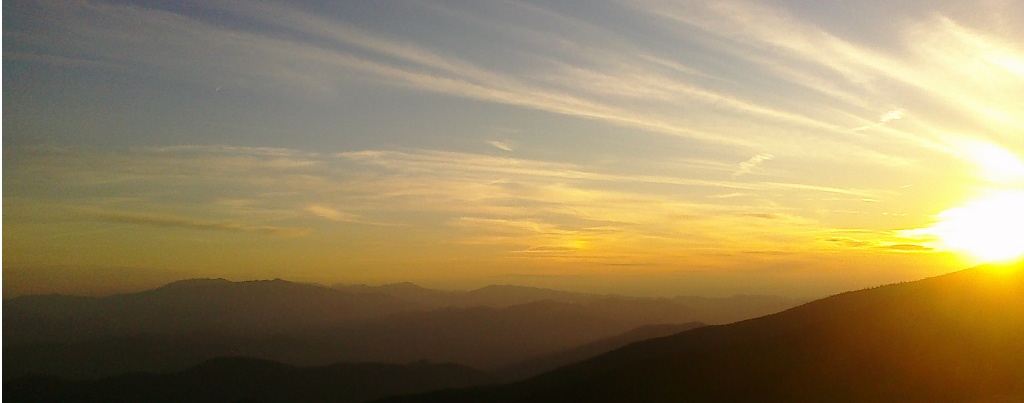 I realized I'd never stayed up there for sunset, so I hunkered down on a rock,
finished checking my email (left over from the earlier hurry), and then spent
half an hour chatting on the phone with my dad, as the sun inched down
a finger at a time. When it went behind the other peak, and mist crept up
the valleys below, it got cold and I hurried down.
Reached the car in deep dusk, and coasted down the mountian while listening
to a BBS nostalgia
piece on the radio. On the way home, pulled in at the Ridgewood BBQ, and am
sitting on the porch in the cold with about 50 other people, waiting for a
seat (hopefully before it closes), and blogging.
I accomplished everything I wanted to today, including getting something
significant done, hiking, and spending quiet time on top of the world.
Though only just, and feeling I was running late the whole time. Nice thing
about the Joey schedule though, is I will have seven more hours of quiet
time before sleep.
 Russell
Coker advocates putting -e on the shebang line of shell scripts.
I disagree. From my experience this is extremely unhelpful to people who may
be debugging your shell scripts in the future.
Consider this, you've added -e to the shebang of a script,
and some poor schmuck down the track is trying to debug why it spontaneously
exits. What's the most obvious way to do this? Run the script with sh
-x or bash -x.
What happens when you do this? The shebang is completely ignored, and the
script is directly run by the shell interpreter. If the person doing the
debugging doesn't happen to transpose all of the shell options on the
shebang line to the manual shell interpreter invocation, you're going to get
different behaviour.
So I advocate an explicit set -e on the second line of shell scripts
instead.
As much as making shell scripts set -e is a good practice, it
drives me absolutely batty having to deal with scripts that spontaneously
exit as soon as something they run exits non-zero. Particularly when you've
chained a bunch of shell scripts together, or have one sourcing a bunch of
script fragments from a directory. For this reason, I prefer to write in
Bash and use an exit handler, to make it very obvious when a shell script has
abended due to set -e.
Getting python2.6 as the default ASAP is currently the #1 priority for the Python modules team. I also consider it very important and tried to help with it, but it is starting to get depressing.
The plan is to fix all packages in unstable to be compatible with python2.6 first. This would be easy if there hadn t been a very badly planned change in the installation paths that came together. Because of it, quite a number of packages have to be fixed. Two months ago, I filed a lot of bugs in that order. I missed a number of issues, but overall, almost all packages have been fixed, thanks to Kumar Appaiah, Bastian Venthur and everyone else who sent patches and NMUs.
One of the biggest issues, though, comes from python-central. Since it doesn t handle some of the new paths that were introduced (which is somehow ironic, since the python-central maintainer, Matthias Klose, is also the python maintainer who did this change), a large number of packages FTBFS when built against python2.6. In Ubuntu, it turned out to be a giant mess, most packages using python-central needing changes, and we wanted to avoid that. This is why Piotr O arowski sent a NMU for python-central that fixes these issues for good.
Guess what happened? Matthias Klose uploaded a new version that does not include the python2.6 fixes, completely discarding the work that has been done. And of course, making the upload of python2.6 to unstable, which was ready to be done in a few days, impossible.
I think it s fine if Ubuntu maintainers don t have the time to handle their packages in Debian. But it is clearly not acceptable to hold back development in Debian, nor to treat it as a garbage dumpster where you can send all the crappy software solutions that were badly designed in Ubuntu to duplicate them in Debian. This is what Matthias has been doing for several years. For how long are we going to tolerate such behavior? For how long will we leave such a critical package in the hands of a single person with no interest in Debian?
 Under UNIX, it is possible to get into a position where your shell's working directory is pointing to an inode that no longer exists, but a "newer" directory with the same name exists.
The easiest way of reproducing this scenario is as follows:
$ cd $(mktemp -d)
$ rm -rf $PWD
$ mkdir $PWD
precmd ()
  # "DOS emulation mode"
  if [ "$(stat -c %i . 2>/dev/null)" != \
                 "$(stat -c %i -- "$ PWD " 2>/dev/null)" ]
  then
    OLDOLDPWD="$ OLDPWD "
    if ! cd -- "$ PWD " >/dev/null 2>&1
    then
      echo "W: $ PWD  does not exist anymore"
      return 1
    fi
    OLDPWD="$ OLDOLDPWD "
  fi
 He wanted me to sing Home On The Range several times as we drove. We stopped at WSU first, and he enjoyed running down the wide sidewalks and trying to hide behind bushes. Then it was on to lunch at HuHot Mongolian Grill. Jacob chose his own ingredients (with some help from me). He chose fish, which noodles he wanted, and of course had some baby corn and carrots. He got a full bowl of ingredients, and of course his favorite part was watching them grill it. He polished off most of his plate, too.
 He had been talking about ice cream all day. In fact, mention Wichita to Jacob, and he ll almost immediately say, Shall we get some ice cream? I wonder who he gets that from
Terah usually takes him to Cold Stone Creamery, but we didn t have enough time to go there. So we went to The Old Mill Tasy Shop, something of along-time local legend in downtown Wichita. Jacob enjoyed noticing that the old brick wall had holes in it while they scooped out his chocolate ice cream and my strawberry sundae. He was too busy devouring his ice cream to notice it came in a metal bowl until I pointed it out to him.
 Then it was off to the Great Plains Transportation Museum. It was a quiet afternoon in November; not the packed crowd like the last time we were there.
He went for the old Santa Fe diesel passenger locomotive first (which he insists is a freight train ). Of course you get to go inside almost everything, and he enjoyed going inside that one, sitting on the engineer s chair, and playing with handles and knobs.
We went in several of the cabooses, and he noticed the train potty in one. It s the old open to the ground type, and if you look down inside it, you see the rocks that are underneath the caboose. Jacob thought it was very interesting that the train potty has rocks in it.
The museum is right next to some active freight tracks, and Jacob was very much hoping that there d be a freight train going past. He wasn t disappointed; we saw two, plus an airplane and a helicopter. A successful visit, I d say.
<object classid="clsid:D27CDB6E-AE6D-11cf-96B8-444553540000" data="http://www.flickr.com/apps/video/stewart.swf?v=71377" height="267" type="application/x-shockwave-flash" width="400"><param name="flashvars" value="intl_lang=en-us&photo_secret=8517185815&photo_id=4104904370"><param name="movie" value="http://www.flickr.com/apps/video/stewart.swf?v=71377"><param name="bgcolor" value="#000000"><param name="allowFullScreen" value="true"><embed allowfullscreen="true" bgcolor="#000000" flashvars="intl_lang=en-us&photo_secret=8517185815&photo_id=4104904370" height="267" src="http://www.flickr.com/apps/video/stewart.swf?v=71377" type="application/x-shockwave-flash" width="400"></embed></object>
So I didn t really get done anything I had planned to today, but in spite of being behind on stuff, it s a better day than I had planned. I really enjoy going off and doing things with Jacob. While we were eating lunch, I asked him if he had fun at the bookstore. Yeah! I have fun EVERYWHERE! What a fun perspective, huh?
 I've spent chunks of the last couple of days fighting a problem that's existed for about 25 years. The 8086 was a 16-bit processor with a 20-bit address space, limiting the maximum physical address that could be accessed to 1MB. However, quirks of the segmented memory system meant that addresses greater than 1MB could be constructed - these would wrap around to the bottom of memory. Because loading the segment registers was a time consuming operation, some programmers used this behaviour as a performance optimisation.
Next.