Search Results: "tim"

11 December 2021

Molly de Blanc: Applications

The first time I applied for grad school it was a bit of a lark. I was serious about it, I wanted to go, I had goals, and I am happy to be here now. However, it was a little fun. I took a white paper and crisped it up with the help of some friends who read it and provided comments. I wrote a personal statement, got some letters of recommendation, and generally felt pretty good about the process. It wasn t stressful. The second time I applied to grad school it was a slog. For several weeks I gave up most of my free time to application writing and when I wasn t working on applications I thought about how I ought to be doing something about it. Applications are due while you re coming up on the end of your semester or end of the year push at work or both! There just isn t enough time for everything. I think even applying for grad school qualifies you to attend. Here are some things I learned in the application process. Note, I haven t gotten in anywhere (yet), so we ll see how it pans out. You have to do a lot of research. This changes by field, school, and even individual faculty preference. Some possible mentors / advisors like to talk with prospective students ahead of time. On two of my applications I was explicitly asked who I spoke with in the department. On others I was asked to list faculty (in order of preference even!) that I would be interested in working with. Some schools requested in essays to list faculty. In general, it s considered important to explain why a particular school: what about that school attracts you? What resources do they have that you want to take advantage of? What research that they are doing interests you? Faculty profiles and department websites are useful for this, but far from complete. A co-worker suggested I contact someone who, based on their profile, I shared no research interests with. However, we talked and it turns out we had things in common! In general, colleagues, peers, other academics, and friends were the best resource I had for investigating schools and potential faculty. I also went to some Q&A sessions / office hours run by schools / departments / labs. Some really cool people wrote blog posts and / or Tweets soliciting grad students. These are great. Sometimes the people you want to work with aren t taking grad students. Most schools I looked at did not maintain lists of who is taking on grad students starting in the fall, but I think two did. Sometimes I contacted people and got back Sorry, not taking on anyone this year. Try $OtherProfessor. This was actually really helpful! But, it s a downer to learn you re not going to get to work with one of your academic heroes because the timing is wrong. It s expensive and waivers might not help. Most applications in the US cost about $100 (USD). In some fields it s recommended you apply to 8-10 schools. That s a lot of money. I think everywhere I applied had a waiver you could apply for, but I generally didn t qualify. Some waivers require you to submit days to weeks ahead of the deadline. Others require that you participate in certain professional organizations, student organizations, or live locally to the school. These might be less useful than you were hoping. Everyone says your writing sample matters, but only five people will read it. This is what I was told anyway. I was told that my writing sample (which was 20 pages!) will probably only be read by faculty who are thinking of taking me on as an advisee. Someone else might pick it up and read it out of curiosity. I was told stories about how the right writing sample turned eh, maybe candidates into enthusiastic yeses. Everyone says letters of recommendation matter and it s extremely frustrating. My recommenders are all amazing people I have so much respect and admiration for it s wild. They re people I want to be like in my academic career. They also all got their letters in the day they were due. I had a moment where I genuinely thought I was just not going to go to grad school because of how close the deadline was. I ve been told that a great letter matters a lot, but meh letters don t hold you back as much as it sounds like they will. I ve been told that where a recommender is affiliated matters a lot. My personal statement radically changed based on school / program. Two of the schools I applied to had very specific requirements for their personal statements. Other schools wanted me to mostly talk about my research interests. One school had a 350 word personal statement, but a 1,000 word research statement. I wrote a research statement and a personal statement and then used them as the basis for what I submitted to different schools. Each application ended up with something pretty different, and not just because I talked about why each program was exciting to me in different ways. I also applied to different kinds of programs, and presented myself a differently depending on the program s focus and the faculty. For the more social science heavy programs I emphasized the empirical research I did, while for others I leaned more heavily on my philosophical background and theoretical interests. Oh, also, I was told to not use contractions. Getting rid of them in all my materials was super tedious. Diversity Statements are becoming more common. A few of my schools had diversity statements either required or optional. The purpose of these, I was told, is not to play some sort of marginalization Olympics, but to show that you can talk about diversity (and equity and inclusion, etc) without being offensive. It s just as valid to write about your own disability as the disability of a parent (though, ask their permission first). Triple check what s required. I made spreadsheets about what each school required. For example, some people wanted official transcripts, some unofficial. Some places required essays rather than generic personal statements, and I needed to build in enough time to manage that. Ask your friends to help. I hate asking for help, but applying for grad school made me shameless. I asked anyone I could to read over materials, proofread, or just talk with me about what I was writing. People picked up on things like you used the word technology five times in this one sentence and it looks real weird. Some schools have projects where current grad students will even look over materials!

Neil Williams: Diversity and gender

As a follow on to a previous blog entry of mine, Free and Open, I feel it worthwhile to do my bit to dismantle the pseudo-science and over simplification in the idea that gender is binary at a biological level.
TL;DR: Science simply does not support binary sexes or binary genders. Truth is a bit more complicated.
There is certainty and there are binary answers in mathematics. Things get less definitive in physics, certainly as soon as quantum is broached. Processes become more of an equilibrium between states in chemistry, never wholly one or the other. Yes, there is the oddity of absolute zero but no experiment has yet achieved that fully. It is accurate to describe physics as a development of applied mathematics and to view chemistry as applied physics. Biology, at the biochemical level, is applied chemistry. The sciences build on each other, "on the shoulders of giants", but at each level, some certainty is lost, some amount of uncertainty is expanded and measurements become probabilities, proportions and percentages. Biology is dependent on biochemistry - chemistry is how a biological change results in a different organism. Physics is how that chemical change occurs - temperature, pressure and physical states are inherent to all chemical changes. Outside laboratory constraints, few chemical reactions, especially in organic chemistry, produce one and only one result from two or more known reagents. In biology, everyone is familiar with genetic mutations but a genetic mutation only happens because a biochemical reaction (hydrogen bonding of nucleobases) does not always produce the expected result. Every cell division, every viral infection, there is a finite probability that a change will occur. It might be a small number but it is never zero and can never be dismissed. This is obvious in the current Covid pandemic - genetic mutations result in new variants. Some variants are inviable, some variants produce no net change in the way that the viral particles infect adjacent cells. Sometimes, a mutation happens that changes everything. These mutations are not mistakes - these are simply changes with undetermined outcomes. Genetic changes are the foundation of biodiversity and variety is what allows lifeforms of all kinds to survive changes in environmental factors and/or changes in prevalent diseases. It is precisely the same in humans, particularly in one of the principle spheres of human life that involves replicating genetic material - the creation of gametes for sexual reproduction. Every single time any DNA is copied, there is a finite chance that a different base will be put in place compared to the original. Copying genetic material is therefore non-binary. Given precisely the same initial conditions, the result is not always predictable and the range of how the results vary from one to another increases with every iteration. Let me stress that - at the molecular level, no genetic operation in any biological lifeform has a truly binary result. Repeat that operation sufficiently often and an unexpected result WILL inevitably occur. It is a mathematical certainty that genetic changes will arise by attempting precisely the same genetic operation enough times. Genetic changes are fundamental to how lifeforms survive changing conditions. Life would likely have died out a long time ago on this planet if every genetic operation was perfect. Diversity is life. Similarity leads to extinction. Viral load is interesting at this point. Someone can be infected with a virus, including coronavirus, by encountering a small number of viral particles. Some viruses, it may be a few hundred, some viruses may need a few thousand particles to infect a vulnerable host. But here's the thing, for that host to be at risk of infecting another host, the virus needs the host to produce billions upon billions of copies of the virus by taking over the genetic machinery within a huge number of cells in the host. This, as is accepted with Covid, is before the virus has been copied enough times to produce symptoms in the host. Before those symptoms become serious, billions more copies will be made. The numbers become unimaginable - and that is within a single host, let alone the 265 million (and counting) hosts in the current Covid19 pandemic. It's also no wonder that viral infections cause tiredness, the infection is diverting huge resources to propagating itself - before even considering the activity of the immune system. It is idiocy of the highest order to expect all those copies to be identical. The rise of variants is inevitable - indeed essential - in all spheres of biology. A single viral particle is absolutely no threat of any kind - it must first get inside and then copy the genetic information in a host cell. This is where the complexity lies in the definition of life itself. A virus can be considered a lifeform but it is only able to reproduce using another, more complex, lifeform. In truth, a viral particle does not and cannot mutate. The infected host mutates the virus. The longer it takes that host to clear the infection, the more mutations that host will create and then potentially spread to others. Now apply this to the creation of gametes in humans. With seven billion humans, the amount of copying of genetic material is not as large as the pandemic but it is still easy for everyone to understand that children do not merely combine the DNA of both parents. Changes happen. Human sexual reproduction is not as simple as 1 + 1 = 2. Sometimes, the copying of the genetic material produces an unexpected result. Sexual reproduction itself is non-binary. Sexual reproduction is not easy or simple for lifeforms to adopt - the diversity which results from the non-binary operations are exactly why so many lifeforms invest so much energy in reproducing in this way. Whilst many genetic changes in humans will be benign or beneficial, I d like to take an example of a genetic disorder that results from the non-binary nature of sex. Humans can be born with the XY phenotype - i.e. at a genetic level, the individual has the same combination of chromosomes as another XY individual but there are changes within the genes in those chromosomes. We accept this, some children of blonde parents do not have blonde hair, etc. There are also genetic changes where an XY phenotype is not binary. Some people, who at a genetic level would be almost identical to another person who is genetically male, have a genetic mutation which makes it impossible for the cells of that individual to respond to androgens (testosterone). (See Androgen insensitivity syndrome). Genetically, that individual has an X and a Y chromosome, just like many other individuals. However, due to a change in how the genes on those chromosomes were copied, that individual is biologically incapable of constructing the secondary sexual characteristics of a male. At a genetic level, the individual has the XY phenotype of a male. At the physical level, the individual has all the sexual characteristics of a female and none of the sexual characteristics of a male. The gender of that individual is not binary. Treatment is centred on supporting the individual and minimising some risks from the inactive genes on the Y chromosome. Human sexual reproduction is non-binary. The results of any sexual reproduction in humans will not always produce the binary option of male or female. It is a lie to claim that human gender is binary. The science is in plain view and cannot be ignored. Identifying as non-binary is not a "cop out" - it can be a biological, genetic, scientific fact. Human sexuality and gender are malleable. Where genetic changes result in symptoms, these can be ameliorated by treatment with human sex hormones, like oestrogen and testosterone. There are valid medical uses for anabolic steroids and hormone replacement therapies to help individuals who, at a genetic level, have non-binary gender. These treatments can help align the physical outer signs with the personality and identity of the individual, whether with or without surgery. It is unacceptable to abandon such people to suffer life long discrimination and harassment by imposing a binary definition that has no basis in science. When a human being has an XY phenotype, that human being is not necessarily male. That individual will be on a spectrum from female (left unaffected by sex hormones in the womb, the foetus will be female, even with an X and a Y chromosome), to various degrees of male. So, at a genetic, biological level, it is a scientific fact that human beings do not have binary gender. There is no evidence that this is new to the modern era, there is no scientific basis for thinking that copying of genetic material was somehow perfectly reliable in earlier history, or that such mutations are specific to homo sapiens. Changes in genetic material provide the diversity to fight infections and adapt to changing environmental factors. Species have and will continue to go extinct if this diversity is absent. With that out of the way, it is no longer a stretch to encompass other aspects of human non-binary genders beyond the known genetic syndromes based on changes in the XY phenotype. Science has not uncovered all of the ways that genes affect personality, behaviour, or identity. How other, less studied, genetic changes affect the much more subtle human facets, especially anything to do with consciousness, identity, personality, sexuality and behaviour, is guesswork. All of these facets can and likely are being affected by genetic factors as well as environmental factors in an endless range of permutations. Personality traits are a beautiful and largely unknowable blend of genes and environment. Genetic information has a finite probability of changes at each and every iteration. Environmental factors are more akin to chaos theory. The idea that the results will fit into binary constructs is laughable. Human society puts huge emphasis on societal norms. Individuals who do not fit into those norms suffer discrimination. The norms themselves have evolved over time as a response to various influences on human civilisation but most are not based on science. It is up to all humans in that society to call out discrimination, to call for changes in the accepted norms and support those who are marginalised. It is a precarious balance, one that humans rarely get right, but it must be based on an acceptance that variation is the natural state. Artificial constraints, like binary genders, must be dismantled because human beings and human sexual reproduction are not binary. To those who think, "well it is for 99%", think again about Covid. 99% (or closer to 98%) of infected humans recover without notable after effects. That has still crippled the nations of the globe and humbled all those who tried to deny it. Five million human beings are dead because "most infected people recover". Just because something only affects a proportion of human beings does not invalidate the suffering of those humans and the discrimination that those humans will face. Societal norms are not necessarily correct. Religious and other influences typically obscure and ignore scientific fact and undermine human kindness. The scientific truth of life on this planet is that gender is not binary. The more complex the lifeform, the more factors will affect where on the spectrum any one individual will appear. Just because we do not yet fully understand how genes affect human personality and sexuality, does not invalidate the science that variation is the natural order. My previous blog about diversity is not just about male vs female, one nationality vs another, one ethnicity compared to another. Diversity is diverse. Diversity requires accepting that every facet of humanity is subject to variation. That leads to tension at times, it is inevitable. Tension against societal norms, tension against discrimination, tension around those individuals who would abuse the tolerance of others for their own gratification or from their own ignorance. None of us are perfect, none of us have any of this fully sorted and all of us will make mistakes. Personally, I try to respect those around me. I will use whatever pronouns and other conventions that the person requests, from their perspective and not mine. To do otherwise is to deny the natural order and to deny the science. Celebrate all diversity, it is the very stuff of life. The discussions around (typically female) bathroom facilities often miss the point. The concern is not about individuals who describe themselves as non-binary. The concern is about individuals who are fully certain of their own sexuality and who act as sexual predators for their own gratification. These people are acting out a lie for their own ends. The problem people are the predators, so stop blaming the victims who are just as at risk as anyone else who identifies as female. Maybe the best people to spot such predators are those who are non-binary, who have had to pretend to fit into societal norms. Just as travel can be a good antidote to racism, openness and discussion can be a tool to undermine the lies of sexual predators and reassure those who are justifiably fearful. There can never be a biological binary test of gender, there can never be any scientific justification for binary division of facilities. Humanity itself is not binary, even life itself has blurry borders around comas, suspended animation and locked-in syndrome. Legal definitions of human death vary around the world. The only common thread I have ever found is: Be kind to each other. If you find anything above objectionable, then I can only suggest that you reconsider the science and learn to be kind to your fellow humans. None of us are getting out of this alive. I Think You ll Find It s a Bit More Complicated Than That - Ben Goldacre ISBN 978-0-00-750514-2 https://www.amazon.co.uk/dp/B00HATQA8K/ https://en.wikipedia.org/wiki/Androgen_insensitivity_syndrome https://www.bbc.co.uk/news/world-51235105 https://en.wikipedia.org/wiki/Nucleobase My degree is in pharmaceutical sciences and I practised community and hospital pharmacy for 20 years before moving into programming. I have direct experience of supporting people who were prescribed hormones to transition their physical characteristics to match their personal identity. I had a Christian upbringing but my work showed me that those religious norms were incompatible with being kind to others, so I rejected religion and I now consider myself a secular humanist.

9 December 2021

Dirk Eddelbuettel: qlcal 0.0.1 on CRAN: New Package

A new package of mine arrived on CRAN yesterday in its inaugural 0.0.1 upload: qlcal. qlcal is based on the calendaring subset of QuantLib. It is provided (for the R package) as a set of included files, so the package is self-contained and does not depend on an external QuantLib library (which can be challenging to build). The only build requirements are Rcpp for the seamless R/C++ integration, and BH for Boost headers. qlcal covers over sixty country / market calendars and can compute holiday lists, its complement (i.e. business day lists) and much more. As a teaser see this two-liner for 2022 holiday for the Federal Reserve calendar in the United States, now including Juneteenth (on June 20 next year) as the most recently added holiday:
> library(qlcal)
> setCalendar("UnitedStates/FederalReserve")
> getHolidays(as.Date("2022-01-01"), as.Date("2022-12-31"))
 [1] "2022-01-17" "2022-02-21" "2022-05-30" "2022-06-20" "2022-07-04" "2022-09-05" "2022-10-10"
 [8] "2022-11-11" "2022-11-24" "2022-12-26"
> 
See the project page and package documentation for more details, and more examples. Going forward, and time permitting, it would be nice to slowly reduce the Boost dependency to make the underlying qlcal C++ library more self-sufficient. If you like this or other open-source work I do, you can now sponsor me at GitHub.

This post by Dirk Eddelbuettel originated on his Thinking inside the box blog. Please report excessive re-aggregation in third-party for-profit settings.

David Kalnischkies: APT for Advent of Code

Screenshot of my Advent of Code 2021 status page as of today Advent of Code 2021
Advent of Code, for those not in the know, is a yearly Advent calendar (since 2015) of coding puzzles many people participate in for a plenary of reasons ranging from speed coding to code golf with stops at learning a new language or practicing already known ones. I usually write boring C++, but any language and then some can be used. There are reports of people implementing it in hardware, solving them by hand on paper or using Microsoft Excel so, after solving a puzzle the easy way yesterday, this time I thought: CHALLENGE ACCEPTED! as I somehow remembered an old 2008 article about solving Sudoku with aptitude (Daniel Burrows via archive.org as the blog is long gone) and the good same old a package management system that can solve [puzzles] based on package dependency rules is not something that I think would be useful or worth having (Russell Coker). Day 8 has a rather lengthy problem description and can reasonably be approached in a bunch of different way. One unreasonable approach might be to massage the problem description into Debian packages and let apt help me solve the problem (specifically Part 2, which you unlock by solving Part 1. You can do that now, I will wait here.) Be warned: I am spoiling Part 2 in the following, so solve it yourself first if you are interested. I will try to be reasonable consistent in naming things in the following and so have chosen: The input we get are lines like acedgfb cdfbe gcdfa fbcad dab cefabd cdfgeb eafb cagedb ab cdfeb fcadb cdfeb cdbaf. The letters are wires mixed up and connected to the segments of the displays: A group of these letters is hence a digit (the first 10) which represent one of the digits 0 to 9 and (after the pipe) the four displays which match (after sorting) one of the digits which means this display shows this digit. We are interested in which digits are displayed to solve the puzzle. To help us we also know which segments form which digit, we just don't know the wiring in the back. So we should identify which wire maps to which segment! We are introducing the packages wire-X-connects-to-Y for this which each provide & conflict1 with the virtual packages segment-Y and wire-X-connects. The later ensures that for a given wire we can only pick one segment and the former ensures that not multiple wires map onto the same segment. As an example: wire a's possible association with segment b is described as:
Package: wire-a-connects-to-b
Provides: segment-b, wire-a-connects
Conflicts: segment-b, wire-a-connects
Note that we do not know if this is true! We generate packages for all possible (and then some) combinations and hope dependency resolution will solve the problem for us. So don't worry, the hard part will be done by apt, we just have to provide all (im)possibilities! What we need now is to translate the 10 digits (and 4 outputs) from something like acedgfb into digit-0-is-eight and not, say digit-0-is-one. A clever solution might realize that a one consists only of two segments so a digit wiring up seven segments can not be a 1 (and must be 8 instead), but again we aren't here to be clever: We want apt to figure that out for us! So what we do is simply making every digit-0-is-N (im)possible choice available as a package and apply constraints: A given digit-N can only display one number and each N is unique as digit so for both we deploy Provides & Conflicts again. We also need to reason about the segments in the digits: Each of the digit packages gets Depends on wire-X-connects-to-Y where X is each possible wire (e.g. acedgfb) and Y each segment forming the digit (e.g. cf for one). The different choices for X are or'ed together, so that either of them satisfies the Y. We know something else too through: The segments which are not used by the digit can not be wired to any of the Xs. We model this with Conflicts on wire-X-connects-to-Y. As an example: If digit-0s acedgfb would be displaying a one (remember, it can't) the following package would be installable:
Package: digit-0-is-one
Version: 1
Depends: wire-a-connects-to-c   wire-c-connects-to-c   wire-e-connects-to-c   wire-d-connects-to-c   wire-g-connects-to-c   wire-f-connects-to-c   wire-b-connects-to-c,
         wire-a-connects-to-f   wire-c-connects-to-f   wire-e-connects-to-f   wire-d-connects-to-f   wire-g-connects-to-f   wire-f-connects-to-f   wire-b-connects-to-f
Provides: digit-0, digit-is-one
Conflicts: digit-0, digit-is-one,
  wire-a-connects-to-a, wire-c-connects-to-a, wire-e-connects-to-a, wire-d-connects-to-a, wire-g-connects-to-a, wire-f-connects-to-a, wire-b-connects-to-a,
  wire-a-connects-to-b, wire-c-connects-to-b, wire-e-connects-to-b, wire-d-connects-to-b, wire-g-connects-to-b, wire-f-connects-to-b, wire-b-connects-to-b,
  wire-a-connects-to-d, wire-c-connects-to-d, wire-e-connects-to-d, wire-d-connects-to-d, wire-g-connects-to-d, wire-f-connects-to-d, wire-b-connects-to-d,
  wire-a-connects-to-e, wire-c-connects-to-e, wire-e-connects-to-e, wire-d-connects-to-e, wire-g-connects-to-e, wire-f-connects-to-e, wire-b-connects-to-e,
  wire-a-connects-to-g, wire-c-connects-to-g, wire-e-connects-to-g, wire-d-connects-to-g, wire-g-connects-to-g, wire-f-connects-to-g, wire-b-connects-to-g
Repeat such stanzas for all 10 possible digits for digit-0 and then repeat this for all the other nine digit-N. We produce pretty much the same stanzas for display-0(-is-one), just that we omit the second Provides & Conflicts from above (digit-is-one) as in the display digits can be repeated. The rest is the same (modulo using display instead of digit as name of course). Lastly we create a package dubbed solution which depends on all 10 digit-N and 4 display-N all of them virtual packages apt will have to choose an installable provider from and we are nearly done! The resulting Packages file2 we can give to apt while requesting to install the package solution and it will spit out not only the display values we are interested in but also which number each digit represents and which wire is connected to which segment. Nifty!
$ ./skip-aoc 'acedgfb cdfbe gcdfa fbcad dab cefabd cdfgeb eafb cagedb ab   cdfeb fcadb cdfeb cdbaf'
[ ]
The following additional packages will be installed:
  digit-0-is-eight digit-1-is-five digit-2-is-two digit-3-is-three
  digit-4-is-seven digit-5-is-nine digit-6-is-six digit-7-is-four
  digit-8-is-zero digit-9-is-one display-1-is-five display-2-is-three
  display-3-is-five display-4-is-three wire-a-connects-to-c
  wire-b-connects-to-f wire-c-connects-to-g wire-d-connects-to-a
  wire-e-connects-to-b wire-f-connects-to-d wire-g-connects-to-e
[ ]
0 upgraded, 22 newly installed, 0 to remove and 0 not upgraded.
We are only interested in the numbers on the display through, so grepping the apt output (-V is our friend here) a bit should let us end up with what we need as calculating3 is (unsurprisingly) not a strong suit of our package relationship language so we need a few shell commands to help us with the rest.
$ ./skip-aoc 'acedgfb cdfbe gcdfa fbcad dab cefabd cdfgeb eafb cagedb ab   cdfeb fcadb cdfeb cdbaf' -qq
5353
I have written the skip-aoc script as a testcase for apt, so to run it you need to place it in /path/to/source/of/apt/test/integration and built apt first, but that is only due to my laziness. We could write a standalone script interfacing with the system installed apt directly and in any apt version since ~2011. To hand in the solution for the puzzle we just need to run this on each line of the input (~200 lines) and add all numbers together. In other words: Behold this beautiful shell one-liner: parallel -I ' ' ./skip-aoc ' ' -qq < input.txt paste -s -d'+' - bc (You may want to run parallel with -P to properly grill your CPU as that process can take a while otherwise and it still does anyhow as I haven't optimized it at all the testing framework does a lot of pointless things wasting time here, but we aren't aiming for the leaderboard so ) That might or even likely will fail through as I have so far omitted a not unimportant detail: The default APT resolver is not able to solve this puzzle with the given problem description we need another solver! Thankfully that is as easy as installing apt-cudf (and with it aspcud) which the script is using via --solver aspcud to make apt hand over the puzzle to a "proper" solver (or better: A solver who is supposed to be good at "answering set" questions). The buildds are using this for experimental and/or backports builds and also for installability checks via dose3 btw, so you might have encountered it before. Be careful however: Just because aspcud can solve this puzzle doesn't mean it is a good default resolver for your day to day apt. One of the reasons the default resolver has such a hard time solving this here is that or-groups have usually an order in which the first is preferred over every later option and so fort. This is of no concern here as all these alternatives will collapse to a single solution anyhow, but if there are multiple viable solutions (which is often the case) picking the "wrong" alternative can have bad consequences. A classic example would be exim4 postfix nullmailer. They are all MTAs but behave very different. The non-default solvers also tend to lack certain features like keeping track of auto-installed packages or installing Recommends/Suggests. That said, Julian is working on another solver as I write this which might deal with more of these issues. And lastly: I am also relatively sure that with a bit of massaging the default resolver could be made to understand the problem, but I can't play all day with this maybe some other day. Disclaimer: Originally posted in the daily megathread on reddit, the version here is just slightly better understandable as I have hopefully renamed all the packages to have more conventional names and tried to explain what I am actually doing. No cows were harmed in this improved version, either.

  1. If you would upload those packages somewhere, it would be good style to add Replaces as well, but it is of minor concern for apt so I am leaving them out here for readability.
  2. We have generated 49 wires, 100 digits, 40 display and 1 solution package for a grant total of 190 packages. We are also making use of a few purely virtual ones, but that doesn't add up to many packages in total. So few packages are practically childs play for apt given it usually deals with thousand times more. The instability for those packages tends to be a lot better through as only 22 of 190 packages we generated can (and will) be installed. Britney will hate you if your uploads to Debian unstable are even remotely as bad as this.
  3. What we could do is introduce 10.000 packages which denote every possible display value from 0000 to 9999. We would then need to duplicate our 10.190 packages for each line (namespace them) and then add a bit more than a million packages with the correct dependencies for summing up the individual packages for apt to be able to display the final result all by itself. That would take a while through as at that point we are looking at working with ~22 million packages with a gazillion amount of dependencies probably overworking every solver we would throw at it a bit of shell glue seems the better option for now.
This article was written by David Kalnischkies on apt-get a life and republished here by pulling it from a syndication feed. You should check there for updates and more articles about apt and EDSP.

8 December 2021

Dirk Eddelbuettel: #34: Less Is More

Less Is More. Ludwig Mies van der Rohe
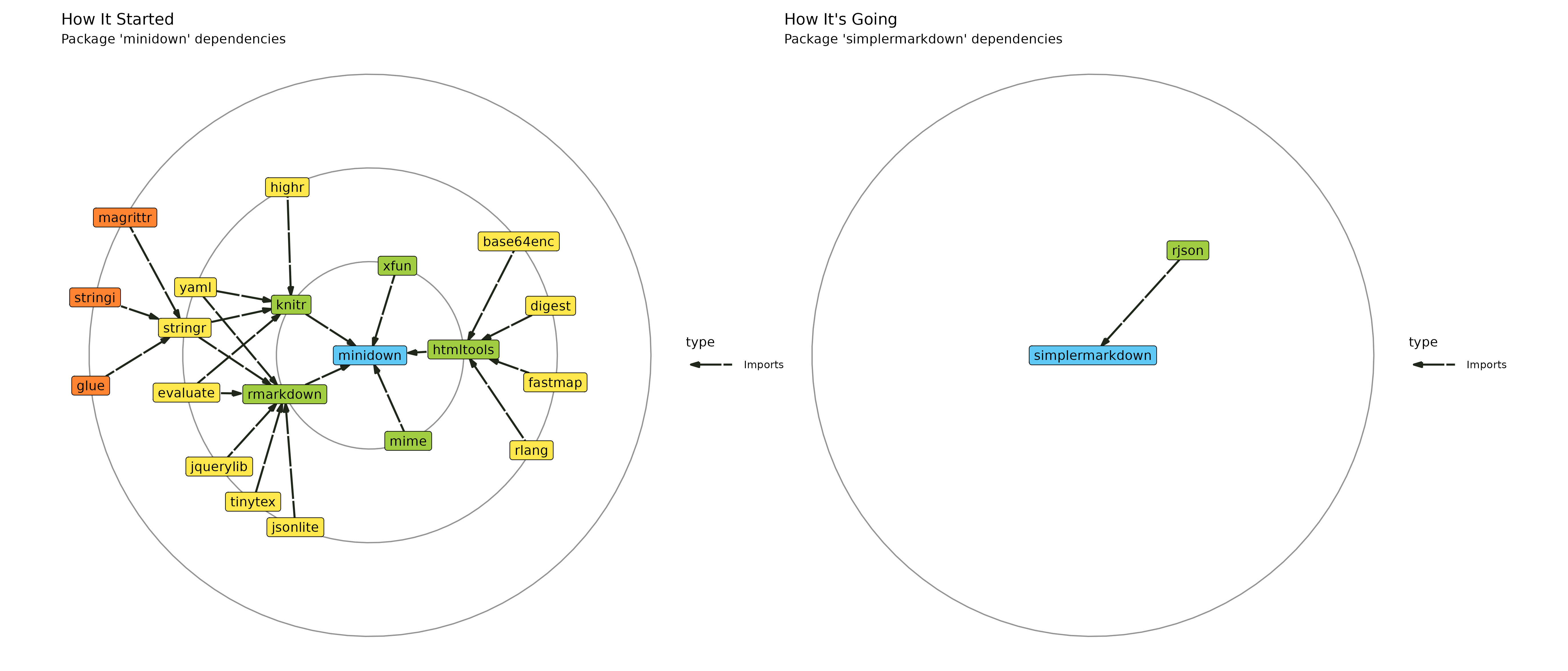
Welcome to the 34th post in the rambunctiously refreshing R recitations, or R4. Today s post is about architecture. Mies defined modernism. When still in Europe, I had been to the Neue Nationalgalerie in Berlin which provides a gorgeous space for the arts. Twenty-five years ago, I worked next to his Toronto-Dominion Center in Toronto. Here in Chicago we have numerous buildings: the Federal Center (the Dirksen, the Kluczynski and the US Post Office rounding out the square in the Loop), multiple buildings on the Illinois Tech (aka IIT) Campus where he taught in the architecture department he created and lead, the (formerly called) IBM Plaza building at the river and more. Structure and minimalism, often based on the same core elements of black steel beams and glass, are a landmark of these buildings. One immediately senses that there is nothing left to take away. Code and programming can be similar. We too compose based on parts we assemble and combine to create something hopefully larger than the parts. The difficulty arising from too many dependencies is something we discussed before both here in this 2018 post but also via the tinyverse site. Over the last seven days, and via uploads to new versions to CRAN, I have switched the vignettes of seven packages from using minidown (which in turn requires rmarkdown and knitr, plus their aggregate dependencies) to using simplermarkdown with its sole dependency. That is, of course, a personal choice. I tend to not even knit much in my vignettes (and simplermarkdown supports what I do) but to rely mostly on pandoc for code rendering. So I only need a small subset of the functionality provided, but I can not access just that as the default comes with numerous bells, whistles as well as enough other instruments to form a small marching band. A picture may express this better: (courtesy of the deepdep package for the figures). Which of these two setups is less likely to surprise you with random breaks, say in continuous integration? Which takes less time to install, and burns fewer cpu cycles just to be set up, each time we run a new test? Which is taxing your students, colleagues, collaborators, users, less on setup for use or replication? The first, comprises a total of 29 dependencies, or the second with just one? My money is on the second choice. Less is more.

Abiola Ajadi: Outreachy- Get to know me!

Hello Everyone! I am Abiola Ajadi from Lagos, Nigeria. I have my B.sc in computer science from the University of Ilorin where I was involved in various community building and also a student leader. In my free time, I love watching anime, reading comics also surfing the net. I enjoy learning about different cultures and will love to travel the world soon! Concerning pets, I love dogs(they are so cute!!)

My core values I will use the 3Cs to describe my core values, which stands for Curiosity, Compassion and Community. Curiosity: Being curious builds the thirst and interest for knowlegde and how things work. I believe being curious helps us as individuals be vigilant and gain knowledge. Compassion: This is one of my core values because i love to support people the way i can, especially in technology which is why community will be the third C. the role of community is very important i enjoy being with people who share the same goals and mindset with me.

Why I applied to Outreachy. I have been curious about open source and how to get started. I wasn t sure of the right way to start so i made some research and spoke to a friend who introduced me to outreachy as a good place to start. I submitted my initial application and made it to the contribution stage. It was exciting to see my first merged contribution to open source. I look forward to an exciting internship with the Debian community and Outreachy!

7 December 2021

Evgeni Golov: The Mocking will continue, until CI improves

One might think, this blog is exclusively about weird language behavior and yelling at computers Well, welcome to another episode of Jackass! Today's opponent is Ruby, or maybe minitest , or maybe Mocha. I'm not exactly sure, but it was a rather amusing exercise and I like to share my nightmares ;) It all started with the classical "you're using old and unmaintained software, please switch to something new". The first attempt was to switch from the ci_reporter_minitest plugin to the minitest-ci plugin. While the change worked great for Foreman itself, it broke the reporting in Katello - the tests would run but no junit.xml was generated and Jenkins rightfully complained that it got no test results. While investigating what the hell was wrong, we realized that Katello was already using a minitest reporting plugin: minitest-reporters. Loading two different reporting plugins seemed like a good source for problems, so I tried using the same plugin for Foreman too. Guess what? After a bit of massaging (mostly to disable the second minitest-reporters initialization in Katello) reporting of test results from Katello started to work like a charm. But now the Foreman tests started to fail. Not fail to report, fail to actually run. WTH The failure was quite interesting too:
test/unit/parameter_filter_test.rb:5:in  block in <class:ParameterFilterTest>':
  Mocha methods cannot be used outside the context of a test (Mocha::NotInitializedError)
Yes, this is a single test file failing, all others were fine. The failing code doesn't look problematic on first glance:
require 'test_helper'
class ParameterFilterTest < ActiveSupport::TestCase
  let(:klass) do
    mock('Example').tap do  k 
      k.stubs(:name).returns('Example')
    end
  end
  test 'something' do
    something
  end
end
The failing line (5) is mock('Example').tap and for some reason Mocha thinks it's not initialized here. This certainly has something to do with how the various reporting plugins inject themselves, but I really didn't want to debug how to run two reporting plugins in parallel (which, as you remember, didn't expose this behavior). So the only real path forward was to debug what's happening here. Calling the test on its own, with one of the working reporter was the first step:
$ bundle exec rake test TEST=test/unit/parameter_filter_test.rb TESTOPTS=-v
 
#<Mocha::Mock:0x0000557bf1f22e30>#test_0001_permits plugin-added attribute = 0.04 s = .
#<Mocha::Mock:0x0000557bf12cf750>#test_0002_permits plugin-added attributes from blocks = 0.49 s = .
 
Wait, what? #<Mocha::Mock: >? Shouldn't this read more like ParameterFilterTest:: as it happens for every single other test in our test suite? It definitely should! That's actually great, as it tells us that there is really something wrong with the test and the change of the reporting plugin just makes it worse. What comes next is sheer luck. Well, that, and years of experience in yelling at computers. We use let(:klass) to define an object called klass and this object is a Mocha::Mock that we'll use in our tests later. Now klass is a very common term in Ruby when talking about classes and needing to store them mostly because one can't use class which is a keyword. Is something else in the stack using klass and our let is overriding that, making this whole thing explode? It was! The moment we replaced klass with klass1 (silly, I know, but there also was a klass2 in that code, so it did fit), things started to work nicely. I really liked Tomer's comment in the PR: "no idea why, but I am not going to dig into mocha to figure that out." Turns out, I couldn't let (HAH!) the code rest and really wanted to understand what happened there. What I didn't want to do is to debug the whole Foreman test stack, because it is massive. So I started to write a minimal reproducer for the issue. All starts with a Gemfile, as we need a few dependencies:
gem 'rake'
gem 'mocha'
gem 'minitest', '~> 5.1', '< 5.11'
Then a Rakefile:
require 'rake/testtask'
Rake::TestTask.new(:test) do  t 
  t.libs << 'test'
  t.test_files = FileList["test/**/*_test.rb"]
end
task :default => :test
And a test! I took the liberty to replace ActiveSupport::TestCase with Minitest::Test, as the test won't be using any Rails features and I wanted to keep my environment minimal.
require 'minitest/autorun'
require 'minitest/spec'
require 'mocha/minitest'
class ParameterFilterTest < Minitest::Test
  extend Minitest::Spec::DSL
  let(:klass) do
    mock('Example').tap do  k 
      k.stubs(:name).returns('Example')
    end
  end
  def test_lol
    assert klass
  end
end
Well, damn, this passed! Is it Rails after all that breaks stuff? Let's add it to the Gemfile!
$ vim Gemfile
$ bundle install
$ bundle exec rake test TESTOPTS=-v
 
#<Mocha::Mock:0x0000564bbfe17e98>#test_lol = 0.00 s = .
Wait, I didn't change anything and it's already failing?! Fuck! I mean, cool! But the test isn't minimal yet. What can we reduce? let is just a fancy, lazy def, right? So instead of let(:klass) we should be able to write def class and achieve a similar outcome and drop that Minitest::Spec.
require 'minitest/autorun'
require 'mocha/minitest'
class ParameterFilterTest < Minitest::Test
  def klass
    mock
  end
  def test_lol
    assert klass
  end
end
$ bundle exec rake test TESTOPTS=-v
 
/home/evgeni/Devel/minitest-wtf/test/parameter_filter_test.rb:5:in  klass': Mocha methods cannot be used outside the context of a test (Mocha::NotInitializedError)
    from /home/evgeni/Devel/minitest-wtf/vendor/bundle/ruby/3.0.0/gems/railties-6.1.4.1/lib/rails/test_unit/reporter.rb:68:in  format_line'
    from /home/evgeni/Devel/minitest-wtf/vendor/bundle/ruby/3.0.0/gems/railties-6.1.4.1/lib/rails/test_unit/reporter.rb:15:in  record'
    from /home/evgeni/Devel/minitest-wtf/vendor/bundle/ruby/3.0.0/gems/minitest-5.10.3/lib/minitest.rb:682:in  block in record'
    from /home/evgeni/Devel/minitest-wtf/vendor/bundle/ruby/3.0.0/gems/minitest-5.10.3/lib/minitest.rb:681:in  each'
    from /home/evgeni/Devel/minitest-wtf/vendor/bundle/ruby/3.0.0/gems/minitest-5.10.3/lib/minitest.rb:681:in  record'
    from /home/evgeni/Devel/minitest-wtf/vendor/bundle/ruby/3.0.0/gems/minitest-5.10.3/lib/minitest.rb:324:in  run_one_method'
    from /home/evgeni/Devel/minitest-wtf/vendor/bundle/ruby/3.0.0/gems/minitest-5.10.3/lib/minitest.rb:311:in  block (2 levels) in run'
    from /home/evgeni/Devel/minitest-wtf/vendor/bundle/ruby/3.0.0/gems/minitest-5.10.3/lib/minitest.rb:310:in  each'
    from /home/evgeni/Devel/minitest-wtf/vendor/bundle/ruby/3.0.0/gems/minitest-5.10.3/lib/minitest.rb:310:in  block in run'
    from /home/evgeni/Devel/minitest-wtf/vendor/bundle/ruby/3.0.0/gems/minitest-5.10.3/lib/minitest.rb:350:in  on_signal'
    from /home/evgeni/Devel/minitest-wtf/vendor/bundle/ruby/3.0.0/gems/minitest-5.10.3/lib/minitest.rb:337:in  with_info_handler'
    from /home/evgeni/Devel/minitest-wtf/vendor/bundle/ruby/3.0.0/gems/minitest-5.10.3/lib/minitest.rb:309:in  run'
    from /home/evgeni/Devel/minitest-wtf/vendor/bundle/ruby/3.0.0/gems/minitest-5.10.3/lib/minitest.rb:159:in  block in __run'
    from /home/evgeni/Devel/minitest-wtf/vendor/bundle/ruby/3.0.0/gems/minitest-5.10.3/lib/minitest.rb:159:in  map'
    from /home/evgeni/Devel/minitest-wtf/vendor/bundle/ruby/3.0.0/gems/minitest-5.10.3/lib/minitest.rb:159:in  __run'
    from /home/evgeni/Devel/minitest-wtf/vendor/bundle/ruby/3.0.0/gems/minitest-5.10.3/lib/minitest.rb:136:in  run'
    from /home/evgeni/Devel/minitest-wtf/vendor/bundle/ruby/3.0.0/gems/minitest-5.10.3/lib/minitest.rb:63:in  block in autorun'
rake aborted!
Oh nice, this is even better! Instead of the mangled class name, we now get the very same error the Foreman tests aborted with, plus a nice stack trace! But wait, why is it pointing at railties? We're not loading that! Anyways, lets look at railties-6.1.4.1/lib/rails/test_unit/reporter.rb, line 68
def format_line(result)
  klass = result.respond_to?(:klass) ? result.klass : result.class
  "%s#%s = %.2f s = %s" % [klass, result.name, result.time, result.result_code]
end
Heh, this is touching result.klass, which we just messed up. Nice! But quickly back to railties What if we only add that to the Gemfile, not full blown Rails?
gem 'railties'
gem 'rake'
gem 'mocha'
gem 'minitest', '~> 5.1', '< 5.11'
Yepp, same failure. Also happens with require => false added to the line, so it seems railties somehow injects itself into rake even if nothing is using it?! "Cool"! By the way, why are we still pinning minitest to < 5.11? Oh right, this was the original reason to look into that whole topic. And, uh, it's pointing at klass there already! 4 years ago! So lets remove that boundary and funny enough, now tests are passing again, even if we use klass! Minitest 5.11 changed how Minitest::Test is structured, and seems not to rely on klass at that point anymore. And I guess Rails also changed a bit since the original pin was put in place four years ago. I didn't want to go another rabbit hole, finding out what changed in Rails, but I did try with 5.0 (well, 5.0.7.2) to be precise, and the output with newer (>= 5.11) Minitest was interesting:
$ bundle exec rake test TESTOPTS=-v
 
Minitest::Result#test_lol = 0.00 s = .
It's leaking Minitest::Result as klass now, instead of Mocha::Mock. So probably something along these lines was broken 4 years ago and triggered this pin. What do we learn from that?
  • klass is cursed and shouldn't be used in places where inheritance and tooling might decide to use it for some reason
  • inheritance is cursed - why the heck are implementation details of Minitest leaking inside my tests?!
  • tooling is cursed - why is railties injecting stuff when I didn't ask it to?!
  • dependency pinning is cursed - at least if you pin to avoid an issue and then forget about said issue for four years
  • I like cursed things!

Daniel Lange: Gradual improvements at the Linux Foundation

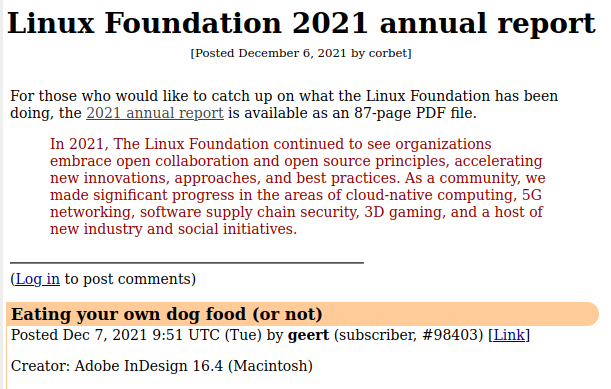
After last year's blunder with trying to hide the Adobe toolchain and using hilarious stock photos, the Linux Foundation did much better in their 2021 annual report1 published Dec. 6, 2021. Still they are using the Adobe toolchain (InDesign, Acrobat PDF) and my fellow DebianKernel2 Developer Geert was quick to point that out as the first comment to the LWN note on the publication: LWN comment from Geert I think it is important to call the Linux Foundation (LF) out again and again. Adobe is a Silver member of the LF and they can motivate them to publish their applications for Linux. And if that is not an option, there are Free alternatives like Scribus that could well use the exposure and funds of LF to help catch up to the market leading product, Adobe InDesign. Linux Foundation Annual report 2021, document properties Personally, as a photographer, I am very happy they used stock images from Unsplash to illustrate the 2021 edition over the cringeworthy Shutterstock footage from last year's report. And they gave proper credit: Thank you section for Unsplash from the Linux Foundation 2021 annual report Now for next year ... find an editor that knows how to spell photographers, please. And consider Scribus. And make Adobe publish their apps for Linux. Thank you.

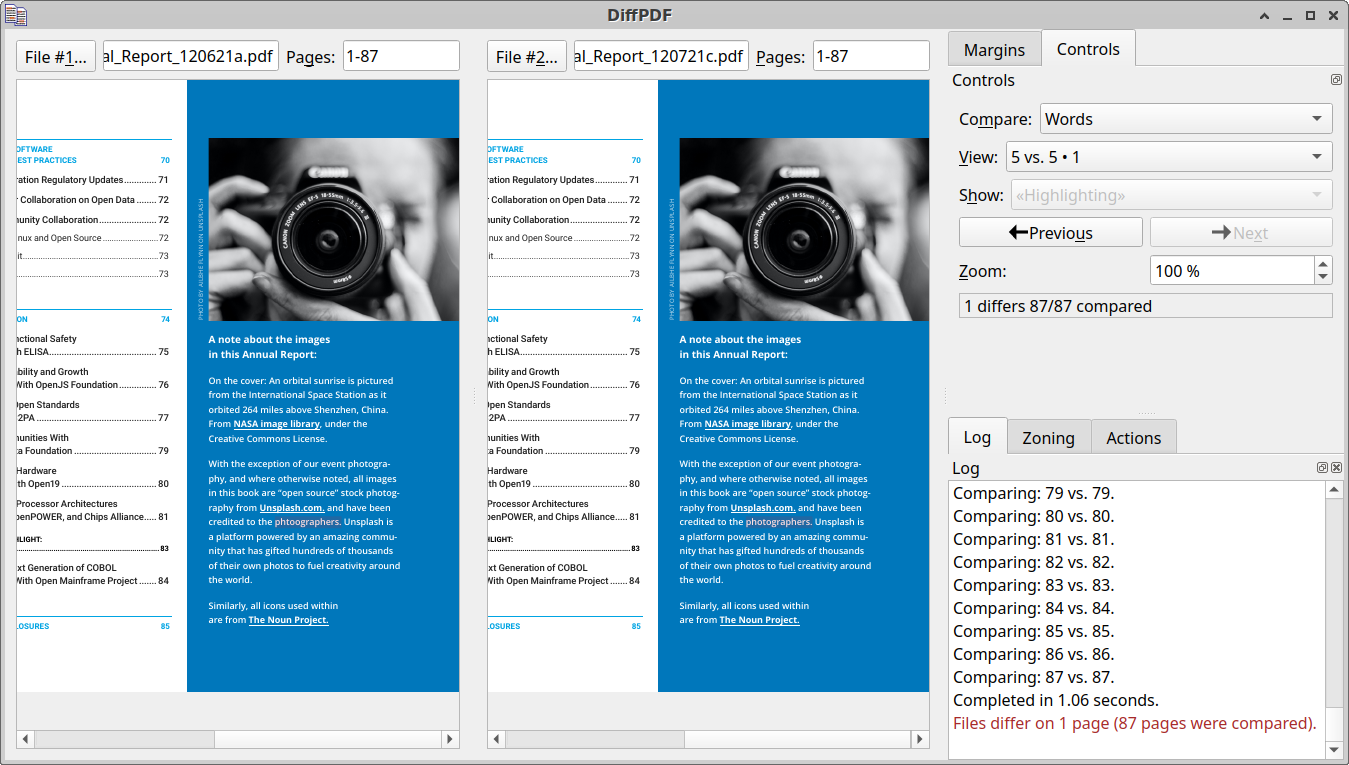
  1. Update 07.12.2021 22:00 CET: I had to replace the link to the Linux Foundation 2021 annual report with an archive.org one as they updated the report to fix the typo as per the comment from Melissa Schmidt below. Stable URLs are not a thing, apparently. You can find their new report at https://www.linuxfoundation.org/wp-content/uploads/2021_LF_Annual_Report_120721c.pdf. Unless somebody points out more typos. There is a Last-Modified Header in HTTP 1.1. Wordpress, Varnish and Nginx, serving the LF website, all support that. Diff of 2021_LF_Annual_Report_120621a and2021_LF_Annual_Report_120721c
  2. 08.12.2021: Geert Uytterhoeven wrote in that he is "geert" on LWN, both are very nice Geert's but different Geert's :-)

Russell Coker: AS400

The IBM i operating system on the AS/400 is a system that runs on PPC for midrange systems. I did a bit of reading about it after seeing an AS/400 on ebay for $300, if I had a lot more spare time and energy I might have put in a bid for that if it didn t look like it had been left out in the rain. It seems that AS/400 is not dead, there are cloud services available, here s one that provides a VM with 2GM of RAM for only EUR 251 monthly [1], wow. I m not qualified to comment on whether that s good value, but I think it s worth noting that a Linux VM running an AMD64 CPU with similar storage and the same RAM can be expected to cost about $10 per month. There is also a free AS/400 cloud named pub400 [2], this is the type of thing I d do if I had my own AS/400.

6 December 2021

Jonathan Dowland: Sixth Annual UK System Research Challenges Workshop lightning talk

me looking awkward, thanks [Mark Little](https://twitter.com/nmcl/status/1466148768043126791/photo/1) me looking awkward, thanks Mark Little
Last week I attended the UK Systems Research 2021 conference in County Durham, my first conference in nearly two years (since FOSDEM 2020, right on the cusp of the Pandemic). The Systems conference community is very pleasant and welcoming and so when I heard it was going to take place "physically" again this year I was so keen to attend I decided to hedge my bets and submit two talk proposals. I wasn't expecting them both to be accepted As well as the regular talks (more on those in another post) there is a tradition for people to give short, impromptu lightning talks after dinner on the second night. I've given two of these before, and I'd been considering whether to offer to one this time or not, but with two talks to deliver (and finish writing) I wasn't sure. Usually people talk about something interesting that they have been doing besides their research or day-jobs, but the last two years have been somewhat difficult and I didn't really think I had a topic to talk about. Then I wondered if that was a topic in itself During the first day of the conference (and especially one I'd got past one of my talks) I started to outline a lightning talk idea and it seemed to come out well enough that I thought I'd give it a go. Unusually I therefore had something written down and I was surprised how well it was received, so I thought I'd share it. Here it is:
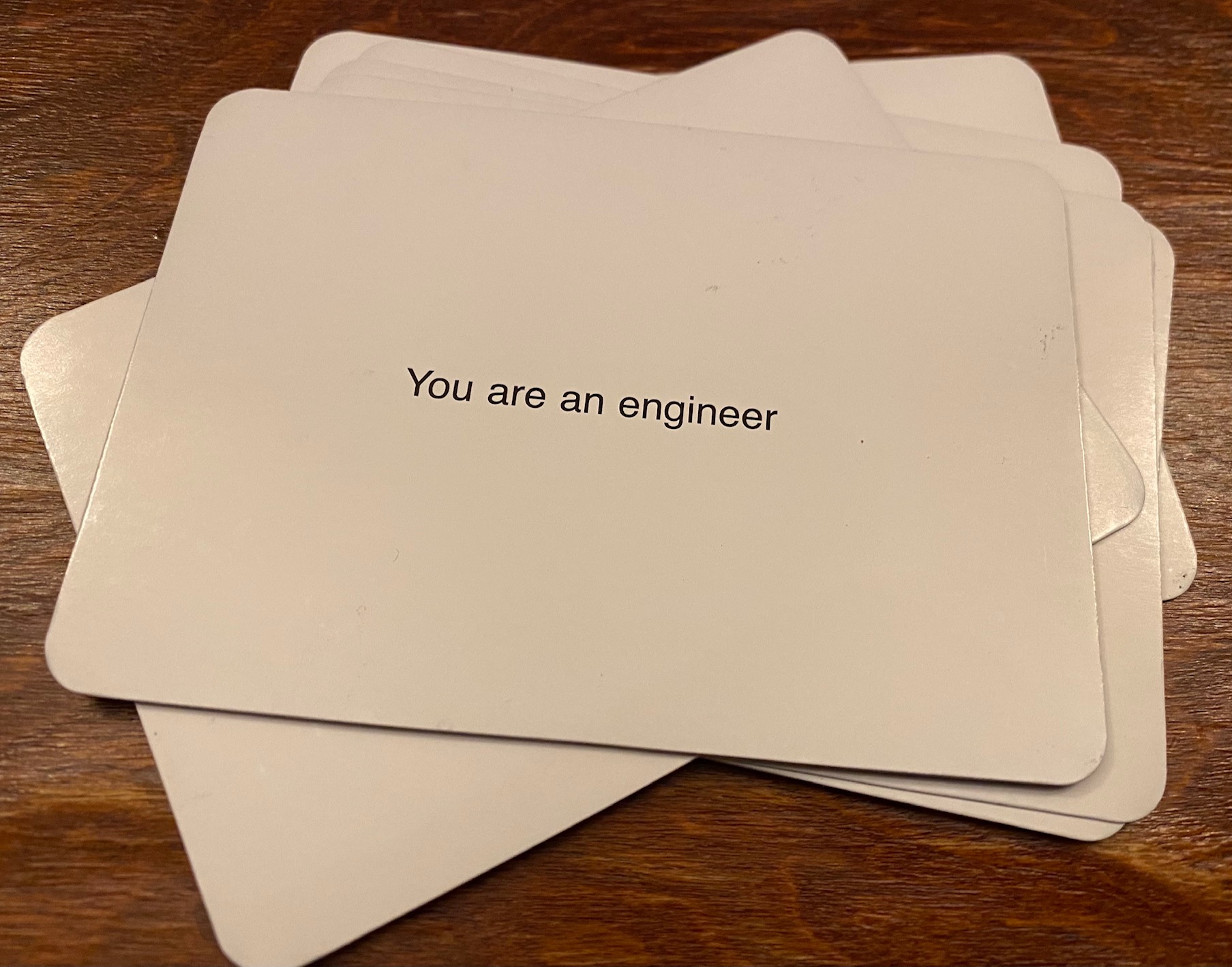
I was anticipating the lightning talks and being cajoled into talking about something. I've done it twice before. So I've been racking my brains to figure out if I've done anything interesting enough to talk about. in 2018 I talked about some hack I'd made to the classic computer game Doom from 1993. I've done several hacks to Doom that I could probably talk about except I've become a bit uncomfortable about increasingly being thought of as "that doom guy". I'd been reflecting on why it was that I continued to mess about with that game in the first place and I realised it was a form of expression: I was treating Doom like a canvas. I've spent most of my career thinking about what I do in the frame of either science or engineering. I suffer from the creative urge and I've often expressed (and sated) that through my work. And that's possible because there's a craft in what we do. In 2019 I talked about a project I'd embarked on to resurrect my childhood computer, a Commodore Amiga 500, in order to rescue my childhood drawings and digital paintings. (There's the artistic thing again). I'd achieved that and I have ambitions to do some more Amiga stuff but again that's a work in progress and there's nothing much to talk about. In recent years I've been thinking more and more about art and became interested in the works and writings of people like Grayson Perry, Laurie Anderson and Brian Eno. I first learned about Eno through his music but he's also a visual artist. and a music producer. As a producer in the 70s he co-invented a system to try and break out of writer's block called "oblique strategies": A deck of cards with oblique suggestions written on them. When you're stuck, you pull a card and it might help you to reframe what you are working on and think about it in a completely different way. I love this idea and I think we should use more things like that in software engineering at least. So back to casting about for something to talk about. What have I been doing in the last couple of years? Frankly, surviving - I've just about managed to keep doing my day job, and keep working on the PhD, at home with two young kids and home schooling and the rest of it. Which is an achievement but makes for a boring lightning talk. But I'd like to say that for anyone here who might have been worrying similarly: I think surviving is more than enough. I'll close on the subject of thinking like an artist and not an engineer. I brought some of the Oblique Strategies deck with me and I thought I'd draw a card to perhaps help you out of a creative dilemma if you're in one. And I kid you not, the first card I drew was this one:
Card reading 'You are an Engineer'

Matthias Klumpp: New things in AppStream 0.15

On the road to AppStream 1.0, a lot of items from the long todo list have been done so far only one major feature is remaining, external release descriptions, which is a tricky one to implement and specify. For AppStream 1.0 it needs to be present or be rejected though, as it would be a major change in how release data is handled in AppStream. Besides 1.0 preparation work, the recent 0.15 release and the releases before it come with their very own large set of changes, that are worth a look and may be interesting for your application to support. But first, for a change that affects the implementation and not the XML format: 1. Completely rewritten caching code Keeping all AppStream data in memory is expensive, especially if the data is huge (as on Debian and Ubuntu with their large repositories generated from desktop-entry files as well) and if processes using AppStream are long-running. The latter is more and more the case, not only does GNOME Software run in the background, KDE uses AppStream in KRunner and Phosh will use it too for reading form factor information. Therefore, AppStream via libappstream provides an on-disk cache that is memory-mapped, so data is only consuming RAM if we are actually doing anything with it. Previously, AppStream used an LMDB-based cache in the background, with indices for fulltext search and other common search operations. This was a very fast solution, but also came with limitations, LMDB s maximum key size of 511 bytes became a problem quite often, adjusting the maximum database size (since it has to be set at opening time) was annoyingly tricky, and building dedicated indices for each search operation was very inflexible. In addition to that, the caching code was changed multiple times in the past to allow system-wide metadata to be cached per-user, as some distributions didn t (want to) build a system-wide cache and therefore ran into performance issues when XML was parsed repeatedly for generation of a temporary cache. In addition to all that, the cache was designed around the concept of one cache for data from all sources , which meant that we had to rebuild it entirely if just a small aspect changed, like a MetaInfo file being added to /usr/share/metainfo, which was very inefficient. To shorten a long story, the old caching code was rewritten with the new concepts of caches not necessarily being system-wide and caches existing for more fine-grained groups of files in mind. The new caching code uses Richard Hughes excellent libxmlb internally for memory-mapped data storage. Unlike LMDB, libxmlb knows about the XML document model, so queries can be much more powerful and we do not need to build indices manually. The library is also already used by GNOME Software and fwupd for parsing of (refined) AppStream metadata, so it works quite well for that usecase. As a result, search queries via libappstream are now a bit slower (very much depends on the query, roughly 20% on average), but can be mmuch more powerful. The caching code is a lot more robust, which should speed up startup time of applications. And in addition to all of that, the AsPool class has gained a flag to allow it to monitor AppStream source data for changes and refresh the cache fully automatically and transparently in the background. All software written against the previous version of the libappstream library should continue to work with the new caching code, but to make use of some of the new features, software using it may need adjustments. A lot of methods have been deprecated too now. 2. Experimental compose support Compiling MetaInfo and other metadata into AppStream collection metadata, extracting icons, language information, refining data and caching media is an involved process. The appstream-generator tool does this very well for data from Linux distribution sources, but the tool is also pretty heavyweight with lots of knobs to adjust, an underlying database and a complex algorithm for icon extraction. Embedding it into other tools via anything else but its command-line API is also not easy (due to D s GC initialization, and because it was never written with that feature in mind). Sometimes a simpler tool is all you need, so the libappstream-compose library as well as appstreamcli compose are being developed at the moment. The library contains building blocks for developing a tool like appstream-generator while the cli tool allows to simply extract metadata from any directory tree, which can be used by e.g. Flatpak. For this to work well, a lot of appstream-generator s D code is translated into plain C, so the implementation stays identical but the language changes. Ultimately, the generator tool will use libappstream-compose for any general data refinement, and only implement things necessary to extract data from the archive of distributions. New applications (e.g. for new bundling systems and other purposes) can then use the same building blocks to implement new data generators similar to appstream-generator with ease, sharing much of the code that would be identical between implementations anyway. 2. Supporting user input controls Want to advertise that your application supports touch input? Keyboard input? Has support for graphics tablets? Gamepads? Sure, nothing is easier than that with the new control relation item and supports relation kind (since 0.12.11 / 0.15.0, details):
<supports>
  <control>pointing</control>
  <control>keyboard</control>
  <control>touch</control>
  <control>tablet</control>
</supports>
3. Defining minimum display size requirements Some applications are unusable below a certain window size, so you do not want to display them in a software center that is running on a device with a small screen, like a phone. In order to encode this information in a flexible way, AppStream now contains a display_length relation item to require or recommend a minimum (or maximum) display size that the described GUI application can work with. For example:
<requires>
  <display_length compare="ge">360</display_length>
</requires>
This will make the application require a display length greater or equal to 300 logical pixels. A logical pixel (also device independent pixel) is the amount of pixels that the application can draw in one direction. Since screens, especially phone screens but also screens on a desktop, can be rotated, the display_length value will be checked against the longest edge of a display by default (by explicitly specifying the shorter edge, this can be changed). This feature is available since 0.13.0, details. See also Tobias Bernard s blog entry on this topic. 4. Tags This is a feature that was originally requested for the LVFS/fwupd, but one of the great things about AppStream is that we can take very project-specific ideas and generalize them so something comes out of them that is useful for many. The new tags tag allows people to tag components with an arbitrary namespaced string. This can be useful for project-internal organization of applications, as well as to convey certain additional properties to a software center, e.g. an application could mark itself as featured in a specific software center only. Metadata generators may also add their own tags to components to improve organization. AppStream gives no recommendations as to how these tags are to be interpreted except for them being a strictly optional feature. So any meaning is something clients and metadata authors need to negotiate. It therefore is a more specialized usecase of the already existing custom tag, and I expect it to be primarily useful within larger organizations that produce a lot of software components that need sorting. For example:
<tags>
  <tag namespace="lvfs">vendor-2021q1</tag>
  <tag namespace="plasma">featured</tag>
</tags>
This feature is available since 0.15.0, details. 5. MetaInfo Creator changes The MetaInfo Creator (source) tool is a very simple web application that provides you with a form to fill out and will then generate MetaInfo XML to add to your project after you have answered all of its questions. It is an easy way for developers to add the required metadata without having to read the specification or any guides at all. Recently, I added support for the new control and display_length tags, resolved a few minor issues and also added a button to instantly copy the generated output to clipboard so people can paste it into their project. If you want to create a new MetaInfo file, this tool is the best way to do it! The creator tool will also not transfer any data out of your webbrowser, it is strictly a client-side application. And that is about it for the most notable changes in AppStream land! Of course there is a lot more, additional tags for the LVFS and content rating have been added, lots of bugs have been squashed, the documentation has been refined a lot and the library has gained a lot of new API to make building software centers easier. Still, there is a lot to do and quite a few open feature requests too. Onwards to 1.0!

5 December 2021

Reproducible Builds: Reproducible Builds in November 2021

Welcome to the November 2021 report from the Reproducible Builds project. As a quick recap, whilst anyone may inspect the source code of free software for malicious flaws, almost all software is distributed to end users as pre-compiled binaries. The motivation behind the reproducible builds effort is therefore to ensure no flaws have been introduced during this compilation process by promising identical results are always generated from a given source, thus allowing multiple third-parties to come to a consensus on whether a build was compromised. If you are interested in contributing to our project, please visit our Contribute page on our website.
On November 6th, Vagrant Cascadian presented at this year s edition of the SeaGL conference, giving a talk titled Debugging Reproducible Builds One Day at a Time:
I ll explore how I go about identifying issues to work on, learn more about the specific issues, recreate the problem locally, isolate the potential causes, dissect the problem into identifiable parts, and adapt the packaging and/or source code to fix the issues.
A video recording of the talk is available on archive.org.
Fedora Magazine published a post written by Zbigniew J drzejewski-Szmek about how to Use Diffoscope in packager workflows, specifically around ensuring that new versions of a package do not introduce breaking changes:
In the role of a packager, updating packages is a recurring task. For some projects, a packager is involved in upstream maintenance, or well written release notes make it easy to figure out what changed between the releases. This isn t always the case, for instance with some small project maintained by one or two people somewhere on GitHub, and it can be useful to verify what exactly changed. Diffoscope can help determine the changes between package releases. [ ]

kpcyrd announced the release of rebuilderd version 0.16.3 on our mailing list this month, adding support for builds to generate multiple artifacts at once.
Lastly, we held another IRC meeting on November 30th. As mentioned in previous reports, due to the global events throughout 2020 etc. there will be no in-person summit event this year.

diffoscope diffoscope is our in-depth and content-aware diff utility. Not only can it locate and diagnose reproducibility issues, it can provide human-readable diffs from many kinds of binary formats. This month, Chris Lamb made the following changes, including preparing and uploading versions 190, 191, 192, 193 and 194 to Debian:
  • New features:
    • Continue loading a .changes file even if the referenced files do not exist, but include a comment in the returned diff. [ ]
    • Log the reason if we cannot load a Debian .changes file. [ ]
  • Bug fixes:
    • Detect XML files as XML files if file(1) claims if they are XML files or if they are named .xml. (#999438)
    • Don t duplicate file lists at each directory level. (#989192)
    • Don t raise a traceback when comparing nested directories with non-directories. [ ]
    • Re-enable test_android_manifest. [ ]
    • Don t reject Debian .changes files if they contain non-printable characters. [ ]
  • Codebase improvements:
    • Avoid aliasing variables if we aren t going to use them. [ ]
    • Use isinstance over type. [ ]
    • Drop a number of unused imports. [ ]
    • Update a bunch of %-style string interpolations into f-strings or str.format. [ ]
    • When pretty-printing JSON, mark the difference as being reformatted, additionally avoiding including the full path. [ ]
    • Import itertools top-level module directly. [ ]
Chris Lamb also made an update to the command-line client to trydiffoscope, a web-based version of the diffoscope in-depth and content-aware diff utility, specifically only waiting for 2 minutes for try.diffoscope.org to respond in tests. (#998360) In addition Brandon Maier corrected an issue where parts of large diffs were missing from the output [ ], Zbigniew J drzejewski-Szmek fixed some logic in the assert_diff_startswith method [ ] and Mattia Rizzolo updated the packaging metadata to denote that we support both Python 3.9 and 3.10 [ ] as well as a number of warning-related changes[ ][ ]. Vagrant Cascadian also updated the diffoscope package in GNU Guix [ ][ ].

Distribution work In Debian, Roland Clobus updated the wiki page documenting Debian reproducible Live images to mention some new bug reports and also posted an in-depth status update to our mailing list. In addition, 90 reviews of Debian packages were added, 18 were updated and 23 were removed this month adding to our knowledge about identified issues. Chris Lamb identified a new toolchain issue, absolute_path_in_cmake_file_generated_by_meson.
Work has begun on classifying reproducibility issues in packages within the Arch Linux distribution. Similar to the analogous effort within Debian (outlined above), package information is listed in a human-readable packages.yml YAML file and a sibling README.md file shows how to classify packages too. Finally, Bernhard M. Wiedemann posted his monthly reproducible builds status report for openSUSE and Vagrant Cascadian updated a link on our website to link to the GNU Guix reproducibility testing overview [ ].

Software development The Reproducible Builds project detects, dissects and attempts to fix as many currently-unreproducible packages as possible. We endeavour to send all of our patches upstream where appropriate. This month, we wrote a large number of such patches, including: Elsewhere, in software development, Jonas Witschel updated strip-nondeterminism, our tool to remove specific non-deterministic results from a completed build so that it did not fail on JAR archives containing invalid members with a .jar extension [ ]. This change was later uploaded to Debian by Chris Lamb. reprotest is the Reproducible Build s project end-user tool to build the same source code twice in widely different environments and checking whether the binaries produced by the builds have any differences. This month, Mattia Rizzolo overhauled the Debian packaging [ ][ ][ ] and fixed a bug surrounding suffixes in the Debian package version [ ], whilst Stefano Rivera fixed an issue where the package tests were broken after the removal of diffoscope from the package s strict dependencies [ ].

Testing framework The Reproducible Builds project runs a testing framework at tests.reproducible-builds.org, to check packages and other artifacts for reproducibility. This month, the following changes were made:
  • Holger Levsen:
    • Document the progress in setting up snapshot.reproducible-builds.org. [ ]
    • Add the packages required for debian-snapshot. [ ]
    • Make the dstat package available on all Debian based systems. [ ]
    • Mark virt32b-armhf and virt64b-armhf as down. [ ]
  • Jochen Sprickerhof:
    • Add SSH authentication key and enable access to the osuosl168-amd64 node. [ ][ ]
  • Mattia Rizzolo:
    • Revert reproducible Debian: mark virt(32 64)b-armhf as down - restored. [ ]
  • Roland Clobus (Debian live image generation):
    • Rename sid internally to unstable until an issue in the snapshot system is resolved. [ ]
    • Extend testing to include Debian bookworm too.. [ ]
    • Automatically create the Jenkins view to display jobs related to building the Live images. [ ]
  • Vagrant Cascadian:
    • Add a Debian package set group for the packages and tools maintained by the Reproducible Builds maintainers themselves. [ ]


If you are interested in contributing to the Reproducible Builds project, please visit our Contribute page on our website. However, you can get in touch with us via:

Paul Tagliamonte: Framing data (Part 4/5)

This post is part of a series called "PACKRAT". If this is the first post you've found, it'd be worth reading the intro post first and then looking over all posts in the series.
In the last post, we we were able to build a functioning Layer 1 PHY where we can encode symbols to transmit, and receive symbols on the other end, we re now at the point where we can encode and decode those symbols as bits and frame blocks of data, marking them with a Sender and a Destination for routing to the right host(s). This is a Layer 2 scheme in the OSI model, which is otherwise known as the Data Link Layer. You re using one to view this website right now I m willing to bet your data is going through an Ethernet layer 2 as well as WiFi or maybe a cellular data protocol like 5G or LTE. Given that this entire exercise is hard enough without designing a complex Layer 2 scheme, I opted for simplicity in the hopes this would free me from the complexity and research that has gone into this field for the last 50 years. I settled on stealing a few ideas from Ethernet Frames namely, the use of MAC addresses to identify parties, and the EtherType field to indicate the Payload type. I also stole the idea of using a CRC at the end of the Frame to check for corruption, as well as the specific CRC method (crc32 using 0xedb88320 as the polynomial). Lastly, I added a callsign field to make life easier on ham radio frequencies if I was ever to seriously attempt to use a variant of this protocol over the air with multiple users. However, given this scheme is not a commonly used scheme, it s best practice to use a nearby radio to identify your transmissions on the same frequency while testing or use a Faraday box to test without transmitting over the airwaves. I added the callsign field in an effort to lean into the spirit of the Part 97 regulations, even if I relied on a phone emission to identify the Frames. As an aside, I asked the ARRL for input here, and their stance to me over email was I d be OK according to the regs if I were to stick to UHF and put my callsign into the BPSK stream using a widely understood encoding (even with no knowledge of PACKRAT, the callsign is ASCII over BPSK and should be easily demodulatable for followup with me). Even with all this, I opted to use FM phone to transmit my callsign when I was active on the air (specifically, using an SDR and a small bash script to automate transmission while I watched for interference or other band users). Right, back to the Frame:
sync
dest
source
callsign
type
payload
crc
With all that done, I put that layout into a struct, so that we can marshal and unmarshal bytes to and from our Frame objects, and work with it in software.
type FrameType [2]byte
type Frame struct  
Destination net.HardwareAddr
Source net.HardwareAddr
Callsign [8]byte
Type FrameType
Payload []byte
CRC uint32
 

Time to pick some consts I picked a unique and distinctive sync sequence, which the sender will transmit before the Frame, while the receiver listens for that sequence to know when it s in byte alignment with the symbol stream. My sync sequence is [3]byte 'U', 'f', '~' which works out to be a very pleasant bit sequence of 01010101 01100110 01111110. It s important to have soothing preambles for your Frames. We need all the good energy we can get at this point.
var (
FrameStart = [3]byte 'U', 'f', '~' 
FrameMaxPayloadSize = 1500
)
Next, I defined some FrameType values for the type field, which I can use to determine what is done with that data next, something Ethernet was originally missing, but has since grown to depend on (who needs Length anyway? Not me. See below!)
FrameType Description Bytes
Raw Bytes in the Payload field are opaque and not to be parsed. [2]byte 0x00, 0x01
IPv4 Bytes in the Payload field are an IPv4 packet. [2]byte 0x00, 0x02
And finally, I decided on a maximum length of the Payload, and decided on limiting it to 1500 bytes to align with the MTU of Ethernet.
var (
FrameTypeRaw = FrameType 0, 1 
FrameTypeIPv4 = FrameType 0, 2 
)
Given we know how we re going to marshal and unmarshal binary data to and from Frames, we can now move on to looking through the bit stream for our Frames.

Why is there no Length field? I was initially a bit surprised that Ethernet Frames didn t have a Length field in use, but the more I thought about it, the more it seemed like a big ole' failure mode without a good implementation outcome. Either the Length is right (resulting in no action and used bits on every packet) or the Length is not the length of the Payload and the driver needs to determine what to do with the packet does it try and trim the overlong payload and ignore the rest? What if both the end of the read bytes and the end of the subset of the packet denoted by Length have a valid CRC? Which is used? Will everyone agree? What if Length is longer than the Payload but the CRC is good where we detected a lost carrer? I decided on simplicity. The end of a Frame is denoted by the loss of the BPSK carrier when the signal is no longer being transmitted (or more correctly, when the signal is no longer received), we know we ve hit the end of a packet. Missing a single symbol will result in the Frame being finalized. This can cause some degree of corruption, but it s also a lot easier than doing tricks like bit stuffing to create an end of symbol stream delimiter.

Finding the Frame start in a Symbol Stream First thing we need to do is find our sync bit pattern in the symbols we re receiving from our BPSK demodulator. There s some smart ways to do this, but given that I m not much of a smart man, I again decided to go for simple instead. Given our incoming vector of symbols (which are still float values) prepend one at a time to a vector of floats that is the same length as the sync phrase, and compare against the sync phrase, to determine if we re in sync with the byte boundary within the symbol stream. The only trick here is that because we re using BPSK to modulate and demodulate the data, post phaselock we can be 180 degrees out of alignment (such that a +1 is demodulated as -1, or vice versa). To deal with that, I check against both the sync phrase as well as the inverse of the sync phrase (both [1, -1, 1] as well as [-1, 1, -1]) where if the inverse sync is matched, all symbols to follow will be inverted as well. This effectively turns our symbols back into bits, even if we re flipped out of phase. Other techniques like NRZI will represent a 0 or 1 by a change in phase state which is great, but can often cascade into long runs of bit errors, and is generally more complex to implement. That representation isn t ambiguous, given you look for a phase change, not the absolute phase value, which is incredibly compelling. Here s a notional example of how I ve been thinking about the phrase sliding window and how I ve been thinking of the checks. Each row is a new symbol taken from the BPSK receiver, and pushed to the head of the sliding window, moving all symbols back in the vector by one.
 var (
sync = []float  ...  
buf = make([]float, len(sync))
incomingSymbols = []float  ...  
)
for _, el := range incomingSymbols  
copy(buf, buf[1:])
buf[len(buf)-1] = el
if compare(sync, buf)  
// we're synced!
 break
 
 
Given the pseudocode above, let s step through what the checks would be doing at each step:
Buffer Sync Inverse Sync
[ ]float 0, ,0 [ ]float -1, ,-1 [ ]float 1, ,1
[ ]float 0, ,1 [ ]float -1, ,-1 [ ]float 1, ,1
[more bits in] [ ]float -1, ,-1 [ ]float 1, ,1
[ ]float 1, ,1 [ ]float -1, ,-1 [ ]float 1, ,1
After this notional set of comparisons, we know that at the last step, we are now aligned to the frame and byte boundary the next symbol / bit will be the MSB of the 0th Frame byte. Additionally, we know we re also 180 degrees out of phase, so we need to flip the symbol s sign to get the bit. From this point on we can consume 8 bits at a time, and re-assemble the byte stream. I don t know what this technique is called or even if this is used in real grown-up implementations, but it s been working for my toy implementation.

Next Steps Now that we can read/write Frames to and from PACKRAT, the next steps here are going to be implementing code to encode and decode Ethernet traffic into PACKRAT, coming next in Part 5!

Reproducible Builds (diffoscope): diffoscope 195 released

The diffoscope maintainers are pleased to announce the release of diffoscope version 195. This version includes the following changes:
[ Chris Lamb ]
* Don't use the runtime platform's native endianness when unpacking .pyc
  files to fix test failures on big-endian machines.
You find out more by visiting the project homepage.

4 December 2021

Jonathan Dowland: Haskell mortgage calculator

A few months ago I was trying to compare two mortgage offers, and ended up writing a small mortgage calculator to help me. Both mortgages were fixed-term for the same time period (5 years). One of the mortgages had a lower rate than the other, but much higher arrangement fees. A broker recommended the mortgage with the higher rate but lower fee, on an affordability basis for the fixed term: over all, we would spend less money within the fixed term on that deal than the other. (I thought) this left one bit of information missing: what remaining balance would there be at the end of the term? The mortgages I want to model are defined in terms of a monthly repayment figure and an annual interest rate for the fixed period. I think interest is usually recalculated on a daily basis, so I convert the annual rate down to a daily rate. Repayments only happen once a month. Months are not all the same size. Using mod 30 on the 'day' approximates a monthly payment. Over 5 years, there would be 60 months, meaning 60 repayments. (I'm ignoring leap years)
 > length . filter id .take (5*365) $ [ x mod 30==0   x <- [1..]]
60
Here's what I came up with. I was a little concerned the repayment approximation was too far out so I compared the output with a more precise (but boring) spreadsheet and they agreed to within an acceptable tolerance. The numbers that follow are all made up to illustrate the function and don't reflect my actual mortgage. :)
borrowed = 1000000 -- day 0 amount outstanding
aer   = 0.89
repay = 1000
der   = aer / 36
owed n   n == 0          = borrowed
         n  mod  30 == 0 = last + interest - repay
         otherwise       = last + interest
    where
        last     = owed (n - 1)
        interest = last * der

Paul Tagliamonte: Receiving BPSK symbols (Part 3/5)

This post is part of a series called "PACKRAT". If this is the first post you've found, it'd be worth reading the intro post first and then looking over all posts in the series.
In the last post, we worked through how to generate a BPSK signal, and hopefully transmit it using one of our SDRs. Let s take that and move on to Receiving BPSK and turning that back into symbols! Demodulating BPSK data is a bit more tricky than transmitting BPSK data, mostly due to tedious facts of life such as space, time, and hardware built with compromises because not doing that makes the problem impossible. Unfortunately, it s now our job to work within our imperfect world to recover perfect data. We need to handle the addition of noise, differences in frequency, clock synchronization and interference in order to recover our information. This makes life a lot harder than when we transmit information, and as a result, a lot more complex.

Coarse Sync Our starting point for this section will be working from a capture of a number of generated PACKRAT packets as heard by a PlutoSDR at (xz compressed interleaved int16, 2,621,440 samples per second) Every SDR has its own oscillator, which eventually controls a number of different components of an SDR, such as the IF (if it s a superheterodyne architecture) and the sampling rate. Drift in oscillators lead to drifts in frequency such that what one SDR may think is 100MHz may be 100.01MHz for another radio. Even if the radios were perfectly in sync, other artifacts such as doppler time dilation due to motion can cause the frequency to appear higher or lower in frequency than it was transmitted. All this is a long way of saying, we need to determine when we see a strong signal that s close-ish to our tuned frequency, and take steps to roughly correct it to our center frequency (in the order of 100s of Hz to kHz) in order to acquire a phase lock on the signal to attempt to decode information contained within. The easiest way of detecting the loudest signal of interest is to use an FFT. Getting into how FFTs work is out of scope of this post, so if this is the first time you re seeing mention of an FFT, it may be a good place to take a quick break to learn a bit about the time domain (which is what the IQ data we ve been working with so far is), frequency domain, and how the FFT and iFFT operations can convert between them. Lastly, because FFTs average power over the window, swapping phases such that the transmitted wave has the same number of in-phase and inverted-phase symbols the power would wind up averaging to zero. This is not helpful, so I took a tip from Dr. Marc Lichtman s PySDR project and used complex squaring to drive our BPSK signal into a single detectable carrier by squaring the IQ data. Because points are on the unit circle and at tau/2 (specifically, tau/(2^1) for BPSK, 2^2 for QPSK) angles, and given that squaring has the effect of doubling the angle, and angles are all mod tau, this will drive our wave comprised of two opposite phases back into a continuous wave effectively removing our BPSK modulation, making it much easier to detect in the frequency domain. Thanks to Tom Bereknyei for helping me with that!
...
var iq []complex 
var freq []complex 
for i := range iq  
iq[i] = iq[i] * iq[i]
 
// perform an fft, computing the frequency
 // domain vector in  freq  given the iq data
 // contained in  iq .
 fft(iq, freq)
// get the array index of the max value in the
 // freq array given the magnitude value of the
 // complex numbers.
 var binIdx = max(abs(freq))
...
Now, most FFT operations will lay the frequency domain data out a bit differently than you may expect (as a human), which is that the 0th element of the FFT is 0Hz, not the most negative number (like in a waterfall). Generally speaking, zero first is the most common frequency domain layout (and generally speaking the most safe assumption if there s no other documentation on fft layout). Negative first is usually used when the FFT is being rendered for human consumption such as a waterfall plot. Given that we now know which FFT bin (which is to say, which index into the FFT array) contains the strongest signal, we ll go ahead and figure out what frequency that bin relates to. In the time domain, each complex number is the next time instant. In the frequency domain, each bin is a discrete frequency or more specifically a frequency range. The bandwidth of the bin is a function of the sampling rate and number of time domain samples used to do the FFT operation. As you increase the amount of time used to preform the FFT, the more precise the FFT measurement of frequency can be, but it will cover the same bandwidth, as defined by the sampling rate.
...
var sampleRate = 2,621,440
// bandwidth is the range of frequencies
 // contained inside a single FFT bin,
 // measured in Hz.
 var bandwidth = sampleRate/len(freq)
...
Now that we know we have a zero-first layout and the bin bandwidth, we can compute what our frequency offset is in Hz.
...
// binIdx is the index into the freq slice
 // containing the frequency domain data.
 var binIdx = 0
// binFreq is the frequency of the bin
 // denoted by binIdx
 var binFreq = 0
if binIdx > len(freq)/2  
// This branch covers the case where the bin
 // is past the middle point - which is to say,
 // if this is a negative frequency.
 binFreq = bandwidth * (binIdx - len(freq))
  else  
// This branch covers the case where the bin
 // is in the first half of the frequency array,
 // which is to say - if this frequency is
 // a positive frequency.
 binFreq = bandwidth * binIdx
 
...
However, sice we squared the IQ data, we re off in frequency by twice the actual frequency if we are reading 12kHz, the bin is actually 6kHz. We need to adjust for that before continuing with processing.
...
var binFreq = 0
...
// [compute the binFreq as above]
 ...
// Adjust for the squaring of our IQ data
 binFreq = binFreq / 2
...
Finally, we need to shift the frequency by the inverse of the binFreq by generating a carrier wave at a specific frequency and rotating every sample by our carrier wave so that a wave at the same frequency will slow down (or stand still!) as it approaches 0Hz relative to the carrier wave.
 var tau = pi * 2
// ts tracks where in time we are (basically: phase)
 var ts float
// inc is the amount we step forward in time (seconds)
 // each sample.
 var inc float = (1 / sampleRate)
// amount to shift frequencies, in Hz,
 // in this case, shift +12 kHz to 0Hz
 var shift = -12,000
for i := range iq  
ts += inc
if ts > tau  
// not actually needed, but keeps ts within
 // 0 to 2*pi (since it is modulus 2*pi anyway)
 ts -= tau
 
// Here, we're going to create a carrier wave
 // at the provided frequency (in this case,
 // -12kHz)
 cwIq = complex(cos(tau*shift*ts), sin(tau*shift*ts))
iq[i] = iq[i] * cwIq
 
Now we ve got the strong signal we ve observed (which may or may not be our BPSK modulated signal!) close enough to 0Hz that we ought to be able to Phase Lock the signal in order to begin demodulating the signal.

Filter After we re roughly in the neighborhood of a few kHz, we can now take some steps to cut out any high frequency components (both positive high frequencies and negative high frequencies). The normal way to do this would be to do an FFT, apply the filter in the frequency domain, and then do an iFFT to turn it back into time series data. This will work in loads of cases, but I ve found it to be incredibly tricky to get right when doing PSK. As such, I ve opted to do this the old fashioned way in the time domain. I ve again opted to go simple rather than correct, and haven t used nearly any of the advanced level trickery I ve come across for fear of using it wrong. As a result, our process here is going to be generating a sinc filter by computing a number of taps, and applying that in the time domain directly on the IQ stream.
// Generate sinc taps

func sinc(x float) float  
if x == 0  
return 1
 
var v = pi * x
return sin(v) / v
 
...
var dst []float
var length = float(len(dst))
if int(length)%2 == 0  
length++
 
for j := range dst  
i := float(j)
dst[j] = sinc(2 * cutoff * (i - (length-1)/2))
 
...
then we apply it in the time domain
...
// Apply sinc taps to an IQ stream

var iq []complex
// taps as created in  dst  above
 var taps []float
var delay = make([]complex, len(taps))
for i := range iq  
// let's shift the next sample into
 // the delay buffer
 copy(delay[1:], delay)
delay[0] = iq[i]
var phasor complex
for j := range delay  
// for each sample in the buffer, let's
 // weight them by the tap values, and
 // create a new complex number based on
 // filtering the real and imag values.
 phasor += complex(
taps[j] * real(delay[j]),
taps[j] * imag(delay[j]),
)
 
// now that we've run this sample
 // through the filter, we can go ahead
 // and scale it back (since we multiply
 // above) and drop it back into the iq
 // buffer.
 iq[i] = complex(
real(phasor) / len(taps),
imag(phasor) / len(taps),
)
 
...
After running IQ samples through the taps and back out, we ll have a signal that s been filtered to the shape of our designed Sinc filter which will cut out captured high frequency components (both positive and negative). Astute observers will note that we re using the real (float) valued taps on both the real and imaginary values independently. I m sure there s a way to apply taps using complex numbers, but it was a bit confusing to work through without being positive of the outcome. I may revisit this in the future!

Downsample Now, post-filter, we ve got a lot of extra RF bandwidth being represented in our IQ stream at our high sample rate All the high frequency values are now filtered out, which means we can reduce our sampling rate without losing much information at all. We can either do nothing about it and process at the fairly high sample rate we re capturing at, or we can drop the sample rate down and help reduce the volume of numbers coming our way. There s two big ways of doing this; either you can take every Nth sample (e.g., take every other sample to half the sample rate, or take every 10th to decimate the sample stream to a 10th of what it originally was) which is the easiest to implement (and easy on the CPU too), or to average a number of samples to create a new sample. A nice bonus to averaging samples is that you can trade-off some CPU time for a higher effective number of bits (ENOB) in your IQ stream, which helps reduce noise, among other things. Some hardware does exactly this (called Oversampling ), and like many things, it has some pros and some cons. I ve opted to treat our IQ stream like an oversampled IQ stream and average samples to get a marginal bump in ENOB. Taking a group of 4 samples and averaging them results in a bit of added precision. That means that a stream of IQ data at 8 ENOB can be bumped to 9 ENOB of precision after the process of oversampling and averaging. That resulting stream will be at 1/4 of the sample rate, and this process can be repeated 4 samples can again be taken for a bit of added precision; which is going to be 1/4 of the sample rate (again), or 1/16 of the original sample rate. If we again take a group of 4 samples, we ll wind up with another bit and a sample rate that s 1/64 of the original sample rate.

Phase Lock Our starting point for this section is the same capture as above, but post-coarse sync, filtering downsampling (xz compressed interleaved float32, 163,840 samples per second) The PLL in PACKRAT was one of the parts I spent the most time stuck on. There s no shortage of discussions of how hardware PLLs work, or even a few software PLLs, but very little by way of how to apply them and/or troubleshoot them. After getting frustrated trying to follow the well worn path, I decided to cut my own way through the bush using what I had learned about the concept, and hope that it works well enough to continue on. PLLs, in concept are fairly simple you generate a carrier wave at a frequency, compare the real-world SDR IQ sample to where your carrier wave is in phase, and use the difference between the local wave and the observed wave to adjust the frequency and phase of your carrier wave. Eventually, if all goes well, that delta is driven as small as possible, and your carrier wave can be used as a reference clock to determine if the observed signal changes in frequency or phase. In reality, tuning PLLs is a total pain, and basically no one outlines how to apply them to BPSK signals in a descriptive way. I ve had to steal an approach I ve seen in hardware to implement my software PLL, with any hope it s close enough that this isn t a hazard to learners. The concept is to generate the carrier wave (as above) and store some rolling averages to tune the carrier wave over time. I use two constants, alpha and beta (which appear to be traditional PLL variable names for this function) which control how quickly the frequency and phase is changed according to observed mismatches. Alpha is set fairly high, which means discrepancies between our carrier and observed data are quickly applied to the phase, and a lower constant for Beta, which will take long-term errors and attempt to use that to match frequency. This is all well and good. Getting to this point isn t all that obscure, but the trouble comes when processing a BPSK signal. Phase changes kick the PLL out of alignment and it tends to require some time to get back into phase lock, when we really shouldn t even be loosing it in the first place. My attempt is to generate two predicted samples, one for each phase of our BPSK signal. The delta is compared, and the lower error of the two is used to adjust the PLL, but the carrier wave itself is used to rotate the sample.
 var alpha = 0.1
var beta = (alpha * alpha) / 2
var phase = 0.0
var frequency = 0.0
...
for i := range iq  
predicted = complex(cos(phase), sin(phase))
sample = iq[i] * conj(predicted)
delta = phase(sample)
predicted2 = complex(cos(phase+pi), sin(phase+pi))
sample2 = iq[i] * conj(predicted2)
delta2 = phase(sample2)
if abs(delta2) < abs(delta)  
// note that we do not update 'sample'.
 delta = delta2
 
phase += alpha * delta
frequency += beta * delta
// adjust the iq sample to the PLL rotated
 // sample.
 iq[i] = sample
 
...
If all goes well, this loop has the effect of driving a BPSK signal s imaginary values to 0, and the real value between +1 and -1.

Average Idle / Carrier Detect Our starting point for this section is the same capture as above, but post-PLL (xz compressed interleaved float32, 163,840 samples per second) When we start out, we have IQ samples that have been mostly driven to an imaginary component of 0 and real value range between +1 and -1 for each symbol period. Our goal now is to determine if we re receiving a signal, and if so, determine if it s +1 or -1. This is a deceptively hard problem given it spans a lot of other similarly entertaining hard problems. I ve opted to not solve the hard problems involved and hope that in practice my very haphazard implementation works well enough. This turns out to be both good (not solving a problem is a great way to not spend time on it) and bad (turns out it does materially impact performance). This segment is the one I plan on revisiting, first. Expect more here at some point! Given that I want to be able to encapsulate three states in the output from this section (our Symbols are no carrier detected ( 0 ), real value 1 ( 1 ) or real value -1 ("-1")), which means spending cycles to determine what the baseline noise is to try and identify when a signal breaks through the noise becomes incredibly important.
var idleThreshold
var thresholdFactor = 10
...
// sigThreshold is used to determine if the symbol
 // is -1, +1 or 0. It's 1.3 times the idle signal
 // threshold.
 var sigThreshold = (idleThreshold * 0.3) + idleThreshold
// iq contains a single symbol's worth of IQ samples.
 // clock alignment isn't really considered; so we'll
 // get a bad packet if we have a symbol transition
 // in the middle of this buffer. No attempt is made
 // to correct for this yet.
 var iq []complex
// avg is used to average a chunk of samples in the
 // symbol buffer.
 var avg float
var mid = len(iq) / 2
// midNum is used to determine how many symbols to
 // average at the middle of the symbol.
 var midNum = len(iq) / 50
for j := mid; j < mid+midNum; j++  
avg += real(iq[j])
 
avg /= midNum
var symbol float
switch  
case avg > sigThreshold:
symbol = 1
case avg < -sigThreshold:
symbol = -1
default:
symbol = 0
// update the idleThreshold using the thresholdFactor
 // to average the idleThreshold over more samples to
 // get a better idea of average noise.
 idleThreshold = (
(idleThreshold*(thresholdFactor-1) + symbol) \
/ thresholdFactor
)
 
// write symbol to output somewhere
...

Next Steps Now that we have a stream of values that are either +1, -1 or 0, we can frame / unframe the data contained in the stream, and decode Packets contained inside, coming next in Part 4!

3 December 2021

Paul Tagliamonte: Transmitting BPSK symbols (Part 2/5)

This post is part of a series called "PACKRAT". If this is the first post you've found, it'd be worth reading the intro post first and then looking over all posts in the series.
In the last post, we worked through what IQ is, and different formats that it may be sent or received in. Let s take that and move on to Transmitting BPSK using IQ data! When we transmit and receive information through RF using an SDR, data is traditionally encoded into a stream of symbols which are then used by a program to modulate the IQ stream, and sent over the airwaves. PACKRAT uses BPSK to encode Symbols through RF. BPSK is the act of modulating the phase of a sine wave to carry information. The transmitted wave swaps between two states in order to convey a 0 or a 1. Our symbols modulate the transmitted sine wave s phase, so that it moves between in-phase with the SDR s transmitter and 180 degrees (or radians) out of phase with the SDR s transmitter. The difference between a Bit and a Symbol in PACKRAT is not incredibly meaningful, and I ll often find myself slipping up when talking about them. I ve done my best to try and use the right word at the right stage, but it s not as obvious where the line between bit and symbol is at least not as obvious as it would be with QPSK or QAM. The biggest difference is that there are three meaningful states for PACKRAT over BPSK - a 1 (for In phase ), -1 (for 180 degrees out of phase ) and 0 (for no carrier ). For my implementation, a stream of all zeros will not transmit data over the airwaves, a stream of all 1s will transmit all 1 bits over the airwaves, and a stream of all -1s will transmit all 0 bits over the airwaves. We re not going to cover turning a byte (or bit) into a symbol yet I m going to write more about that in a later section. So for now, let s just worry about symbols in, and symbols out.

Transmitting a Sine wave at 0Hz If we go back to thinking about IQ data as a precisely timed measurements of energy over time at some particular specific frequency, we can consider what a sine wave will look like in IQ. Before we dive into antennas and RF, let s go to something a bit more visual. For the first example, you can see an example of a camera who s frame rate (or Sampling Rate!) matches the exact number of rotations per second (or Frequency!) of the propeller and it appears to stand exactly still. Every time the Camera takes a frame, it s catching the propeller in the exact same place in space, even though it s made a complete rotation. The second example is very similar, it s a light strobing (in this case, our sampling rate, since the darkness is ignored by our brains) at the same rate (frequency) as water dropping from a faucet and the video creator is even nice enough to change the sampling frequency to have the droplets move both forward and backward (positive and negative frequency) in comparison to the faucet. IQ works the same way. If we catch something in perfect frequency alignment with our radio, we ll wind up with readings that are the same for the entire stream of data. This means we can transmit a sine wave by setting all of the IQ samples in our buffer to 1+0i, which will transmit a pure sine wave at exactly the center frequency of the radio.
 var sine []complex 
for i := range sine  
sine[i] = complex(1.0, 0.0)
 
Alternatively, we can transmit a Sine wave (but with the opposite phase) by flipping the real value from 1 to -1. The same Sine wave is transmitted on the same Frequency, except when the wave goes high in the example above, the wave will go low in the example below.
 var sine []complex 
for i := range sine  
sine[i] = complex(-1.0, 0.0)
 
In fact, we can make a carrier wave at any phase angle and amplitude by using a bit of trig.
 // angle is in radians - here we have
 // 1.5 Pi (3 Tau) or 270 degrees.
 var angle = pi * 1.5
// amplitude controls the transmitted
 // strength of the carrier wave.
 var amplitude = 1.0
// output buffer as above
 var sine []complex 
for i := range sine  
sine[i] = complex(
amplitude*cos(angle),
amplitude*sin(angle),
)
 
The amplitude of the transmitted wave is the absolute value of the IQ sample (sometimes called magnitude), and the phase can be computed as the angle (or argument). The amplitude remains constant (at 1) in both cases. Remember back to the airplane propeller or water droplets we re controlling where we re observing the sine wave. It looks like a consistent value to us, but in reality it s being transmitted as a pure carrier wave at the provided frequency. Changing the angle of the number we re transmitting will control where in the sine wave cycle we re observing it at.

Generating BPSK modulated IQ data Modulating our carrier wave with our symbols is fairly straightforward to do we can multiply the symbol by 1 to get the real value to be used in the IQ stream. Or, more simply - we can just use the symbol directly in the constructed IQ data.
 var sampleRate = 2,621,440
var baudRate = 1024
// This represents the number of IQ samples
 // required to send a single symbol at the
 // provided baud and sample rate. I picked
 // two numbers in order to avoid half samples.
 // We will transmit each symbol in blocks of
 // this size.
 var samplesPerSymbol = sampleRate / baudRate
var samples = make([]complex, samplesPerSymbol)
// symbol is one of 1, -1 or 0.
 for each symbol in symbols  
for i := range samples  
samples[i] = complex(symbol, 0)
 
// write the samples out to an output file
 // or radio.
 write(samples)
 
If you want to check against a baseline capture, here s 10 example packets at 204800 samples per second.

Next Steps Now that we can transmit data, we ll start working on a receive path in Part 3, in order to check our work when transmitting the packets, as well as being able to hear packets we transmit from afar, coming up next in Part 3!!

Evgeni Golov: Dependency confusion in the Ansible Galaxy CLI

I hope you enjoyed my last post about Ansible Galaxy Namespaces. In there I noted that I originally looked for something completely different and the namespace takeover was rather accidental. Well, originally I was looking at how the different Ansible content hosting services and their client (ansible-galaxy) behave in regard to clashes in naming of the hosted content. "Ansible content hosting services"?! There are currently three main ways for users to obtain Ansible content:
  • Ansible Galaxy - the original, community oriented, free hosting platform
  • Automation Hub - the place for Red Hat certified and supported content, available only with a Red Hat subscription, hosted by Red Hat
  • Ansible Automation Platform - the on-premise version of Automation Hub, syncs content from there and allows customers to upload own content
Now the question I was curious about was: how would the tooling behave if different sources would offer identically named content? This was inspired by Alex Birsan: Dependency Confusion: How I Hacked Into Apple, Microsoft and Dozens of Other Companies and zofrex: Bundler is Still Vulnerable to Dependency Confusion Attacks (CVE - 2020 - 36327), who showed that the tooling for Python, Node.js and Ruby can be tricked into fetching content from "the wrong source", thus allowing an attacker to inject malicious code into a deployment. For the rest of this article, it's not important that there are different implementations of the hosting services, only that users can configure and use multiple sources at the same time. The problem is that, if the user configures their server_list to contain multiple Galaxy-compatible servers, like Ansible Galaxy and Automation Hub, and then asks to install a collection, the Ansible Galaxy CLI will ask every server in the list, until one returns a successful result. The exact order seems to differ between versions, but this doesn't really matter for the issue at hand. Imagine someone wants to install the redhat.satellite collection from Automation Hub (using ansible-galaxy collection install redhat.satellite). Now if their configuration defines Galaxy as the first, and Automation Hub as the second server, Galaxy is always asked whether it has redhat.satellite and only if the answer is negative, Automation Hub is asked. Today there is no redhat namespace on Galaxy, but there is a redhat user on GitHub, so The canonical answer to this issue is to use a requirements.yml file and setting the source parameter. This parameter allows you to express "regardless which sources are configured, please fetch this collection from here". That's is nice, but I think this not being the default syntax (contrary to what e.g. Bundler does) is a bad approach. Users might overlook the security implications, as the shorter syntax without the source just "magically" works. However, I think this is not even the main problem here. The documentation says: Once a collection is found, any of its requirements are only searched within the same Galaxy instance as the parent collection. The install process will not search for a collection requirement in a different Galaxy instance. But as it turns out, the source behavior was changed and now only applies to the exact collection it is set for, not for any dependencies this collection might have. For the sake of the example, imagine two collections: evgeni.test1 and evgeni.test2, where test2 declares a dependency on test1 in its galaxy.yml. Actually, no need to imagine, both collections are available in version 1.0.0 from galaxy.ansible.com and test1 version 2.0.0 is available from galaxy-dev.ansible.com. Now, given our recent reading of the docs, we craft the following requirements.yml:
collections:
- name: evgeni.test2
  version: '*'
  source: https://galaxy.ansible.com
In a perfect world, following the documentation, this would mean that both collections are fetched from galaxy.ansible.com, right? However, this is not what ansible-galaxy does. It will fetch evgeni.test2 from the specified source, determine it has a dependency on evgeni.test1 and fetch that from the "first" available source from the configuration. Take for example the following ansible.cfg:
[galaxy]
server_list = test_galaxy, release_galaxy, test_galaxy
[galaxy_server.release_galaxy]
url=https://galaxy.ansible.com/
[galaxy_server.test_galaxy]
url=https://galaxy-dev.ansible.com/
And try to install collections, using the above requirements.yml:
% ansible-galaxy collection install -r requirements.yml -vvv                 
ansible-galaxy 2.9.27
  config file = /home/evgeni/Devel/ansible-wtf/collections/ansible.cfg
  configured module search path = ['/home/evgeni/.ansible/plugins/modules', '/usr/share/ansible/plugins/modules']
  ansible python module location = /usr/lib/python3.10/site-packages/ansible
  executable location = /usr/bin/ansible-galaxy
  python version = 3.10.0 (default, Oct  4 2021, 00:00:00) [GCC 11.2.1 20210728 (Red Hat 11.2.1-1)]
Using /home/evgeni/Devel/ansible-wtf/collections/ansible.cfg as config file
Reading requirement file at '/home/evgeni/Devel/ansible-wtf/collections/requirements.yml'
Found installed collection theforeman.foreman:3.0.0 at '/home/evgeni/.ansible/collections/ansible_collections/theforeman/foreman'
Process install dependency map
Processing requirement collection 'evgeni.test2'
Collection 'evgeni.test2' obtained from server explicit_requirement_evgeni.test2 https://galaxy.ansible.com/api/
Opened /home/evgeni/.ansible/galaxy_token
Processing requirement collection 'evgeni.test1' - as dependency of evgeni.test2
Collection 'evgeni.test1' obtained from server test_galaxy https://galaxy-dev.ansible.com/api
Starting collection install process
Installing 'evgeni.test2:1.0.0' to '/home/evgeni/.ansible/collections/ansible_collections/evgeni/test2'
Downloading https://galaxy.ansible.com/download/evgeni-test2-1.0.0.tar.gz to /home/evgeni/.ansible/tmp/ansible-local-133/tmp9uqyjgki
Installing 'evgeni.test1:2.0.0' to '/home/evgeni/.ansible/collections/ansible_collections/evgeni/test1'
Downloading https://galaxy-dev.ansible.com/download/evgeni-test1-2.0.0.tar.gz to /home/evgeni/.ansible/tmp/ansible-local-133/tmp9uqyjgki
As you can see, evgeni.test1 is fetched from galaxy-dev.ansible.com, instead of galaxy.ansible.com. Now, if those servers instead would be Galaxy and Automation Hub, and somebody managed to snag the redhat namespace on Galaxy, I would be now getting the wrong stuff Another problematic setup would be with Galaxy and on-prem Ansible Automation Platform, as you can have any namespace on the later and these most certainly can clash with namespaces on public Galaxy. I have reported this behavior to Ansible Security on 2021-08-26, giving a 90 days disclosure deadline, which expired on 2021-11-24. So far, the response was that this is working as designed, to allow cross-source dependencies (e.g. a private collection referring to one on Galaxy) and there is an issue to update the docs to match the code. If users want to explicitly pin sources, they are supposed to name all dependencies and their sources in requirements.yml. Alternatively they obviously can configure only one source in the configuration and always mirror all dependencies. I am not happy with this and I think this is terrible UX, explicitly inviting people to make mistakes.

2 December 2021

Jonathan McDowell: Building a desktop to improve my work/life balance

ASRock DeskMini X300 It s been over 20 months since the first COVID lockdown kicked in here in Northern Ireland and I started working from home. Even when the strict lockdown was lifted the advice here has continued to be If you can work from home you should work from home . I ve been into the office here and there (for new starts given you need to hand over a laptop and sort out some login details it s generally easier to do so in person, and I ve had a couple of whiteboard sessions that needed the high bandwidth face to face communication), but day to day is all from home. Early on I commented that work had taken over my study. This has largely continued to be true. I set my work laptop on the stand on a Monday morning and it sits there until Friday evening, when it gets switched for the personal laptop. I have a lovely LG 34UM88 21:9 Ultrawide monitor, and my laptops are small and light so I much prefer to use them docked. Also my general working pattern is to have a lot of external connections up and running (build machine, test devices, log host) which means a suspend/resume cycle disrupts things. So I like to minimise moving things about. I spent a little bit of time trying to find a dual laptop stand so I could have both machines setup and switch between them easily, but I didn t find anything that didn t seem to be geared up for DJs with a mixer + laptop combo taking up quite a bit of desk space rather than stacking laptops vertically. Eventually I realised that the right move was probably a desktop machine. Now, I haven t had a desktop machine since before I moved to the US, realising at the time that having everything on my laptop was much more convenient. I decided I didn t want something too big and noisy. Cheap GPUs seem hard to get hold of these days - I m not a gamer so all I need is something that can drive a ~ 4K monitor reliably enough. Looking around the AMD Ryzen 7 5700G seemed to be a decent CPU with one of the better integrated GPUs. I spent some time looking for a reasonable Mini-ITX case + motherboard and then I happened upon the ASRock DeskMini X300. This turns out to be perfect; I ve no need for a PCIe slot or anything more than an m.2 SSD. I paired it with a Noctua NH-L9a-AM4 heatsink + fan (same as I use in the house server), 32GB DDR4 and a 1TB WD SN550 NVMe SSD. Total cost just under 650 inc VAT + delivery (and that s a story for another post). A desktop solves the problem of fitting both machines on the desk at once, but there s still the question of smoothly switching between them. I read Evgeni Golov s article on a simple KVM switch for 30. My monitor has multiple inputs, so that s sorted. I did have a cheap USB2 switch (all I need for the keyboard/trackball) but it turned out to be pretty unreliable at the host detecting the USB change. I bought a UGREEN USB 3.0 Sharing Switch Box instead and it s turned out to be pretty reliable. The problem is that the LG 32UM88 turns out to have a poor DDC implementation, so while I can flip the keyboard easily with the UGREEN box I also have to manually select the monitor input. Which is a bit annoying, but not terrible. The important question is whether this has helped. I built all this at the end of October, so I ve had a month to play with it. Turns out I should have done it at some point last year. At the end of the day instead of either sitting at work for a bit longer, or completely avoiding the study, I m able to lock the work machine and flick to my personal setup. Even sitting in the same seat that disconnect , and the knowledge I won t see work Slack messages or emails come in and feeling I should respond, really helps. It also means I have access to my personal setup during the week without incurring a hit at the start of the working day when I have to set things up again. So it s much easier to just dip in to some personal tech stuff in the evening than it was previously. Also from the point of view I don t need to setup the personal config, I can pick up where I left off. All of which is really nice. It s also got me thinking about other minor improvements I should make to my home working environment to try and improve things. One obvious thing now the winter is here again is to improve my lighting; I have a good overhead LED panel but it s terribly positioned for video calls, being just behind me. So I think I m looking some sort of strip light I can have behind the large monitor to give a decent degree of backlight (possibly bouncing off the white wall). Lots of cheap options I m not convinced about, and I ve had a few ridiculously priced options from photographer friends; suggestions welcome.

Steve Kemp: It has been some time..

I realize it has been quite some time since I last made a blog-post, so I guess the short version is "I'm still alive", or as Granny Weatherwax would have said:
I ATE'NT DEAD
Of course if I die now this would be an awkward post! I can't think of anything terribly interesting I've been doing recently, mostly being settled in my new flat and tinkering away with things. The latest "new" code was something for controlling mpd via a web-browser: This is a simple HTTP server which allows you to minimally control mpd running on localhost:6600. (By minimally I mean literally "stop", "play", "next track", and "previous track"). I have all my music stored on my desktop, I use mpd to play it locally through a pair of speakers plugged into that computer. Sometimes I want music in the sauna, or in the bedroom. So I have a couple of bluetooth speakers which are used to send the output to another room. When I want to skip tracks I just open the mpd-web site on my phone and tap the button. (I did look at android mpd-clients, but at the same time it seemed like installing an application for this was a bit overkill). I guess I've not been doing so much "computer stuff" outside work for a year or so. I guess lack of time, lack of enthusiasm/motivation. So looking forward to things? I'll be in the UK for a while over Christmas, barring surprises. That should be nice as I'll get to see family, take our child to visit his grandparents (on his birthday no less) and enjoy playing the "How many Finnish people can I spot in the UK?" game

Next.

Previous.