Search Results: "sf"

6 February 2013

Vincent Sanders: Recommending a 3D printer

In a previous entry I wrote about the technology of additive manufacture and the use in printing three dimensional objects.

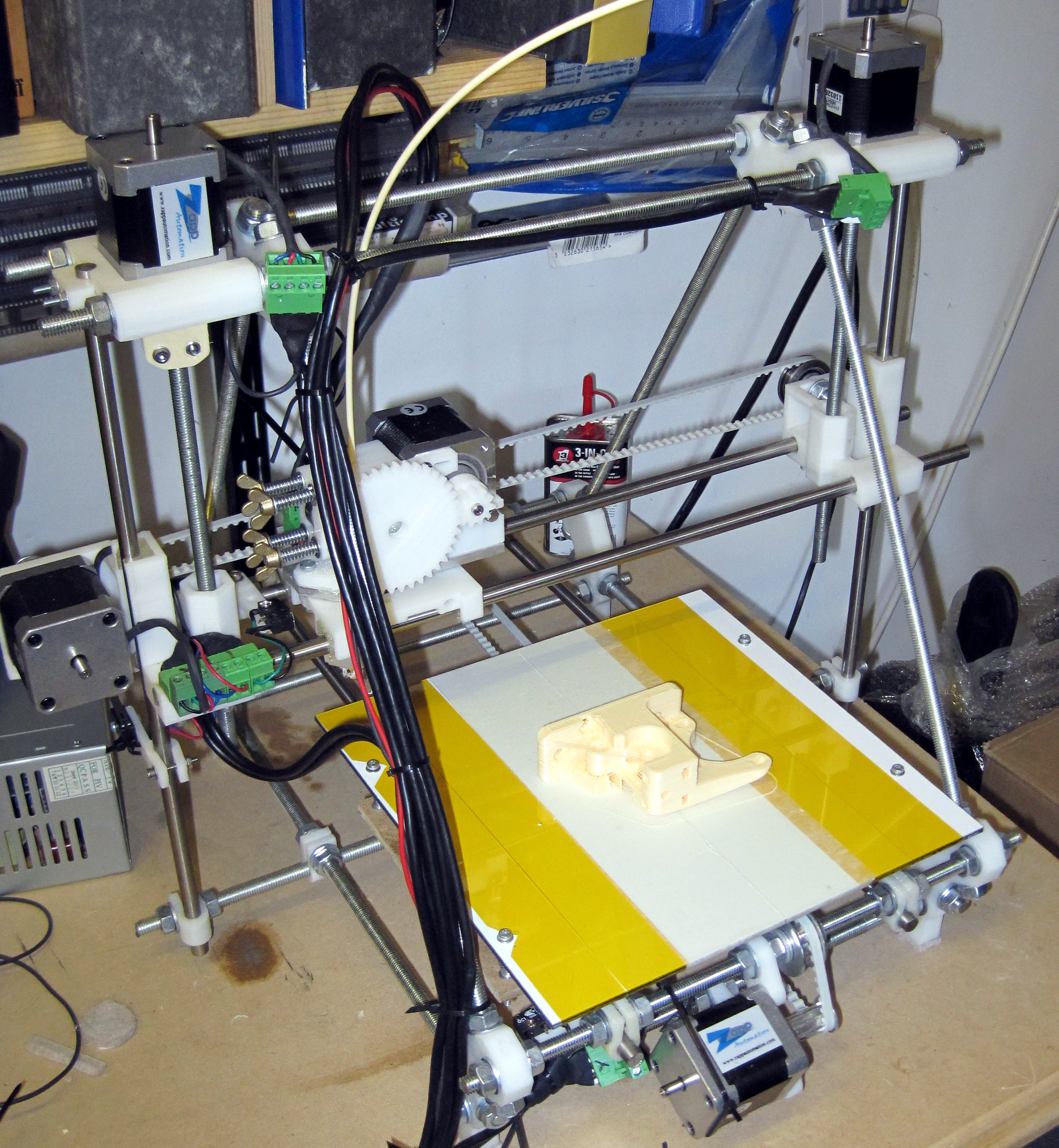
My Prusa Reprap printer, not recommended for new builds
It is now almost two years since I built my own 3D printer and I keep getting asked by colleagues and friends about the technology and often what printer to buy.

I will answer the purchase question first and then describe my experiences which have lead to the conclusion in another post. This may seem a bit backwards but the explanation is long and is not necessary if you are happy to learn from my mistakes.

Of all the options available right now, and there are many, I would choose a Mendal90 kit from Chris Palmer. The complete kit including everything to build the machine is 499 plus shipping. If I could afford it this is what I would buy myself to replace my current machine.

This is a Fused deposition modelling (FDM) printer similar to my Prusa Reprap but better engineered to produce repeatable results without the numerous issues of the other models. In Europe I would also recommend faberdashery as a materials source as their product is first rate every time.

Yes the kit requires some assembly but the commonly available commercial printers either cost many times more to deliver equivalent results, use an SLS or other print strategy requiring very expensive consumables or are from a company with dubious track record with the community.

If forced to recommend one, the 3DTouch from Bits From Bytes is not awful, but really do not be afraid of the kit, you will learn more about how it all fits together and save lots of money for your materials.

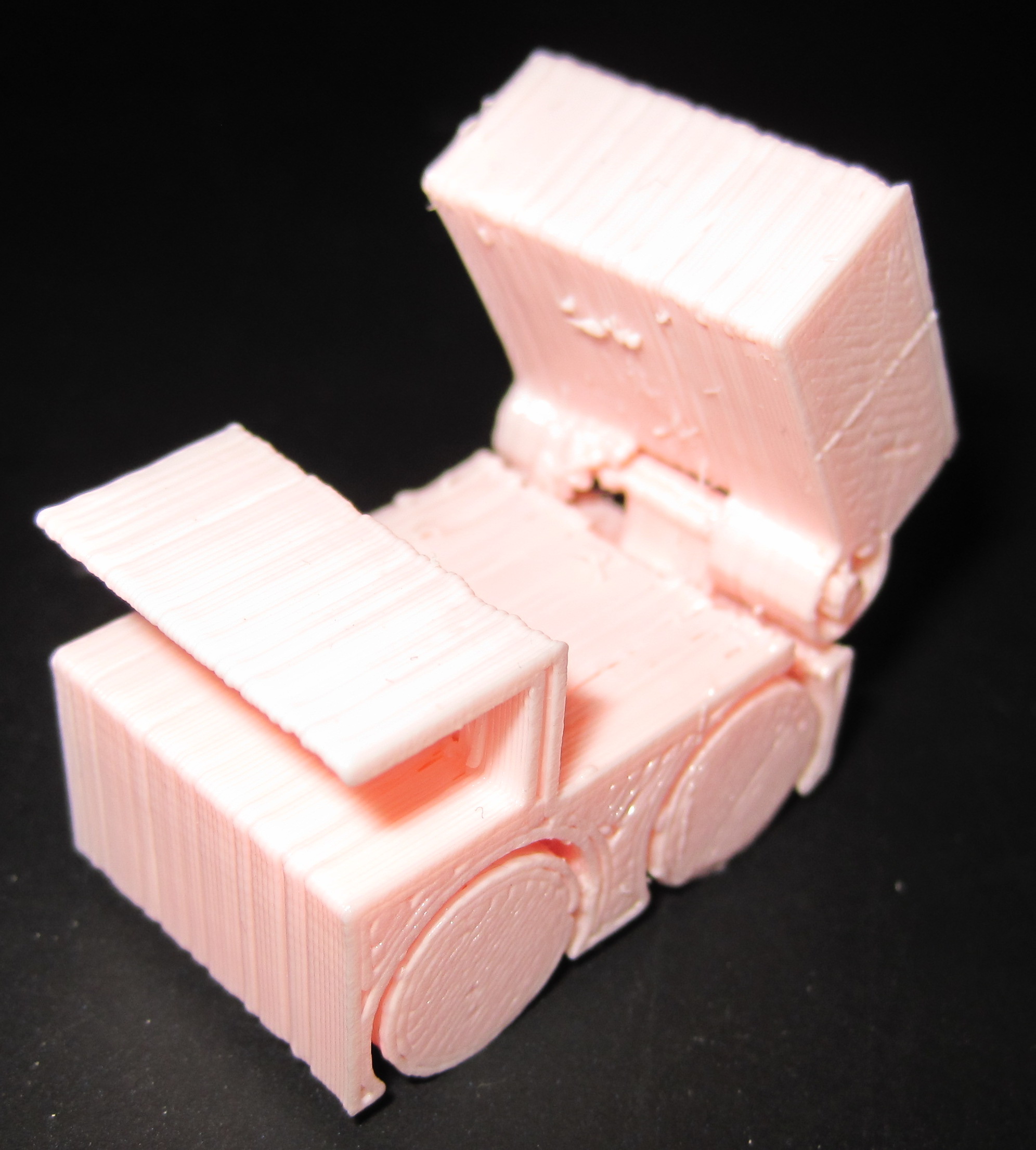
A 20mm high pink dump truck toy
One thing anyone buying a 3D printer right now should understand is that this technology is nowhere near as polished as the 2D equivalent. With the exception of the SLS systems like shapeways and the like use (and have price tags to match) The output will have clear "layering" and some objects simply cannot be created using the FDM process.

I guess what I am saying is do not expect a thousand pound machine to produce output that looks like that of a hundred thousand pound printer. To be clear you will not be printing complex moving machines on an FDM process more simple things that need assembly.

Having said that I have some pretty good results my favourite has to be the working recorder though, I might have said the whistles except my sons have them and they are way too loud.

You will spend a lot of time designing your things in 3D CAD packages and fair warning they all SUCK and I mean really, really badly. Add to that all the rest of the tools in the workflow are also iffy and I do wonder how anyone every gets anything printed.

My (open source) workflow is:


Which is probably a case of "least bad" tool selection though I warn you now that OpenSCAD is effectively a bad editor (I wish I could use emacs) for a 3D solid macro language with visualisation attached and definitely not a graphical tool.


5 February 2013

Russ Allbery: WebAuth 4.4.2

When I was testing C code coverage analysis tools using WebAuth, I really should have investigated the segfault that I started getting in the test suite before releasing 4.4.1. But since valgrind didn't report any problems, I thought it was something specific to code coverage. Nope, uninitialized variable inside the WebKDC code. Which valgrind didn't catch at all for some reason. Now fixed, and I did check for similar issues, but it's sort of disturbing that valgrind completely missed it, particularly for a variable whose address is taken and therefore which I wouldn't think would be optimized away. Since I hate to release WebAuth to only fix one thing, I also tested out-of-tree builds for the first time in a while and fixed a pile of issues around how the Perl module builds work. There's got to be a better way. Maybe sometime I'll try to come up with some patches to teach Module::Build how to handle VPATH. I also imported some additional Autoconf glue that will hopefully help Hurd builds proceed farther, although I didn't promise anything in NEWS since WebAuth has not yet successfully built on Hurd. You can get the latest release from the official WebAuth distribution site or from my WebAuth distribution pages.

John Goerzen: The Superbowl Pirate Bus

I ll forgive you for not noticing the bus full of pirates at the Superbowl. Because, well, unless you saw my 6-year-old, you have a pretty good excuse for missing it. I ll give you the Goerzen Superbowl play-by-play, just to make sure you re caught up. It involved pirates, cops, tractors, cookies, a card game, and yes, even troubles with HDMI. We were invited to a Superbowl party, and were going to bring a party snack. The boys love to help cook, and I try to give them choices. I started naming off potential snacks, starting with healthy options. They listened attentively, until I mentioned cookies. COOKIES! ***COOKIES!*** Yes, cookies! This reaction was, I must say, not exactly a surprise. Then I asked them what KIND of cookies. Jacob immediately knew what he wanted, so of course Oliver took a minute to come up with something else. No matter; we could make two kinds of cookies. Jacob, of course, picked a kind of cookie that needs cherries, while Oliver picked one that needs chocolate chips. Thus they both had opportunities to have a small taste of ingredients while we prepared the batter. And so make cookies we did. Plus a loaf of bread. Anyhow, once we got to the party, Jacob and Oliver saw a huge tub of Legos and were at it in a flash. One of Jacob s friends was pretending everything was a tractor, but it wasn t long before Jacob started in on his evening s project: building the largest bus he could build. He was pleased when he got 4 lego people into it. Even more happy when he got 10 into it. And by the time he figured out how to get 35 into it, he was quite proud of himself indeed. Oliver, meanwhile, in classic little brother fashion, tried to corner the market on surplus lego people. He appears to have the hardline negotiation skill down already, and perhaps is appreciating the value of artificial scarcity in the lego market <grin> Eventually the bus seemed to hit the limits of engineering and joint strength, and Jacob gave up for a little while. He had a cookie and some carrots, commented on the exciting game of Uno going on, ( Who is the loudest? All of them! ), brought me some carrots, and periodically commented that The ball team is ahead of the SF team. Sure is. They have more points! (This from the BAL and SF text on the screen.) And then he went back to playing. And here s where the pirates come in. Jacob s new bus had a lego flag that he decided was a pirate flag. So the bus was a pirate bus. He built a platform out the back for them to use to steal things . So his pirate bus went around the lego area, stealing this from one pile, stealing that from another, until it got almost as long as his first bus. Pretty soon, along came a police boat to chase the pirates. But the police boat appeared to suffer a humorous series of logistical failures and never could quite disrupt the pirates. But never mind that, for little brother Oliver was getting bored with the lego mountain he was building and decided it would be more fun if he would disrupt the pirates. An opinion that Jacob quite strongly disagreed with. When it was time to go, Jacob tried to extract a promise from the party hosts to not let anyone take apart the pirate bus until next time we would be there. Then this morning, Jacob and I had a discussion about pirates. Dad, are pirates real? Yes, Jacob, they are. Do they steal things? Yes, but they are far away. There are no pirates here. Are there pirates in Kansas? No. There are some pirates in Africa though. Oh. What state is Africa in? Africa is so far away that it isn t even in a state. You d have to take a boat or a plane to get there. Or a train! Nope, a train couldn t get across the ocean. It s too wide! They d build a bridge! It s too wide for a bridge. It s more than a thousand miles! WOW a thousand miles! Great! OK dad, it s time for me to get on that school bus!

3 February 2013

Dirk Eddelbuettel: The Rcpp Gallery and my Seinfeld Streak

A good three weeks ago, we introduced the Rcpp Gallery. While this is a joint effort by several of us on the Rcpp team, the backend was conceived and implemented entirely by JJ who also bootstrapped it with same first content, drawing on posts by Hadley, Romain and myself. As the How to contribute page makes plain, this is all backed by GitHub and all logs are public anyway. So after it was up and working, JJ and I refined the look and feel, and I started to add more content so that would have something by the time the initial announcement came around. A few years I read about an (attributed) secret to Seinfeld's producitivity: "Don't break the chain". Just keep writing, and write every day. I made my goal of a post every day for just over a month, and created this sequences: <quote> (20 Dec) simulating-pi, (21 Dec) vector-minimum, (22 Dec) gsl-colnorm-example, (23 Dec) fibonacci-sequence, (24 Dec) random-number-generation, (25 Dec) armadillo-sparse-matrix, (26 Dec) timing-rngs, (27 Dec) stl-inner-product, (28 Dec) stl-transform, (29 Dec) stl-transform-for-subsetting, (30 Dec) stl-random-shuffle, (31 Dec) stl-random-sample, (01 Jan) stl-for-each, (02 Jan) armadillo-subsetting, (03 Jan) accessing-environments, (04 Jan) armadillo-eigenvalues, (05 Jan) r-function-from-c++, (06 Jan) using-the-rcpp-timer, (07 Jan) sugar-function-clamp, (08 Jan) using-rcout, (09 Jan) first-steps-with-C++11, (10 Jan) simple-lambda-func-c++11, (11 Jan) eigen-eigenvalues, (12 Jan) getting-attributes-for-xts-example, (13 Jan) intro-to-exceptions, (14 Jan) a-first-boost-example, (15 Jan) a-second-boost-example, (16 Jan) timing-normal-rngs, (17 Jan) creating-xts-from-c++, (18 Jan) gsl-for-eigenvalues, (19 Jan) accessing-xts-api, (20 Jan) custom-as-and-wrap-example, (21 Jan) passing-cpp-function-pointers, </quote> The Rcpp Gallery continues to grow, we now have 58 posts from 7 different authors. And it is open for business: new contributions are always welcome.

Gregor Herrmann: RC bugs 2013/05

this week's report comes live from FOSDEM; which doesn't mean I've been doing any RC bug work here, I've looked at all the mentioned bugs below earlier this week. & as you can see, most was just a bit triaging

2 February 2013

Russ Allbery: First 2013 Powell's haul

I lost my will roll against placing another book order a couple of weeks ago. There are just too many people writing too many fascinating things that I want to read! Elizabeth Bear Shoggoths in Bloom (collection)
David Graeber Debt: The First 5,000 Years (non-fiction)
Eric Hobsbawm The Age of Revolution 1789 1848 (non-fiction)
China Mi ville Kraken (sff)
John McPhee Annals of the Former World (non-fiction)
C.E. Murphy The Queen's Bastard (sff)
C.E. Murphy The Pretender's Crown (sff)
Steven Pinker Words and Rules (non-fiction)
David Roodman Due Diligence (non-fiction)
Rebecca Skloot The Immortal Life of Henrietta Lacks (non-fiction)
Richard G. Wilkinson & Kate Pickett The Spirit Level (non-fiction)
Fumi Yoshinaga oku: The Inner Chambers #1 (graphic novel) As you can see, mostly non-fiction. Which is, of course, the type of book that takes the longest to read. I'm so smart about managing a backlog. The Pinker was recommended by one of my favorite Teaching Company courses (Myths, Lies, and Half-Truths of Language Usage by John McWhorter), and I was interested enough in linguistics to want to read something a bit more intensive. John McPhee's Annals of the Former World is about geology, something I've wanted to know more about for a while, and won the Pulitzer for general non-fiction. It's also huge. It might take me a while to get to that. Of the fiction, I read the first Murphy a long time back, but it was a borrowed copy, and I want to re-read it before reading the second volume in the duology. I remember really enjoying it, but don't remember anything about what happened. oku is manga that won the Tiptree award, so that sounded too interesting to pass up. And since I own just about everything else Elizabeth Bear has published, I figured I should keep the streak alive, even if I'm a bit behind on reading it.

1 February 2013

Daniel Kahn Gillmor: proprietary software activation fail

i have a colleague who is forced by work situations to use Windows. Somehow, I'm the idiot^W^W^W^W^Wfriendly guy who gets tapped to fix it when things break. Well, this time, the power supply broke. As in, dead, no lights, no fan, no nothing. No problem, though, the disk is still good, and i've got a spare machine lying around; and the spare is actually superior hardware to the old machine so it'll be an upgrade in addition to a fix. Nice! So i transplant the disk and fire up the new chassis. But WinXP fails to boot with a lovely "0x0000007b" BSOD. The internet tells me that this might mean it can't find its own disk. OK, pop into the new chassis' BIOS, tell it to run the SATA ports in "legacy IDE" mode, and try again. Now we get a "0x0000007e" BSOD. Some digging on the 'net makes me think it's now complaining now about the graphics driver. Hmm. Well, i figure i can probably work around that by installing new drivers from Safe Mode. So i reboot into Safe Mode. Success! It boots to the login screen in Safe Mode. And, mirabile dictu, i happen to know the Administrator password. I put it in, and get a message that this Windows installation isn't "activated" yet -- presumably because the hardware has changed out from under it. And by the way, i'm not allowed to log in via safe mode until it's activated. So please reboot to "normal" Windows and activate it first. Except, of course, the whole reason i'm booting into safe mode was because normal Windows gives a BSOD. Grrrr. Who thought up this particular lovely catch-22? OK, change tactics. Scavenging the scrap bin turns up a machine with a failed mainboard, but a power supply with all the right leads. It's rated for about 80W less than the old machine's failed supply, but i figure if i rip out the DVD-burner and the floppy drive maybe it will hold. Oh, and the replacement power supply doesn't physically fit the old chassis, but it hangs halfway out the back and sort of rattles around a bit. I sacrifice the rest of the scrap machine, rip out its power supply, stuff the power supply into the old chassis, swap the original disk back in, and ... it boots successfully, finally. That was the shorter version of the story :P So now my colleague has a horrible mess of a frankencomputer which is more likely to fail again in the future, instead of a nice shiny upgrade. Why? Because Microsoft's need to control the flow of software takes priority over the needs of their users. This is what you get when you let Marketing and BizDev drive your technical decisions. Do i still need to explain why i prefer free software? Tags: griping, windows

30 January 2013

James Morrison: Married

In response to my own post from 7 years ago Bachelorhood, I would like to announce that I am a much better married man than Simon. My bachelorhood days are truly over, my laundry goes in a laundry basket, my clothes are always put away (whether I like it or not). My fridge is plugged in, has real food in it; I have a cell phone (actually numerous cell phones); I have an awesome custom made table; lastly I have a TV in my house. Bachelorhood officially ended last year, 30 years was a good run :)

Paul Tagliamonte: dput-ng/1.4 in unstable

Changes:
dput-ng (1.4) unstable; urgency=low
   [ Arno T ll ]
   * Really fix #696659 by making sure the command line tool uses the most recent
     version of the library.
   * Mark several fields to be required in profiles (incoming, method)
   * Fix broken tests.
   * Do not run the check-debs hook in our mentors.d.n profile
   * Fix "[dcut] dm bombed out" by using the profile key only when defined
     (Closes: #698232)
   * Parse the gecos field to obtain the user name / email address from the local
     system when DEBFULLNAME and DEBEMAIL are not set.
   * Fix "dcut reschedule sends "None-day" to ftp-master if the delay is
     not specified" by forcing the corresponding parameter (Closes: #698719)
 .
   [ Luca Falavigna ]
   * Implement default_keyid option. This is particularly useful with multiple
     GPG keys, so dcut is aware of which one to use.
   * Make scp uploader aware of "port" configuration option.
 .
   [ Paul Tagliamonte ]
   * Hack around Launchpad's SFTP implementation. We musn't stat *anything*.
     "Be vewy vewy quiet, I'm hunting wabbits" (Closes: #696558).
   * Rewrote the test suite to actually test the majority of the codepaths we
     take during an upload. Back up to 60%.
   * Added a README for the twitter hook, Thanks to Sandro Tosi for the bug,
     and Gergely Nagy for poking me about it. (Closes: #697768).
   * Added a doc for helping folks install hooks into dput-ng (Closes: #697862).
   * Properly remove DEFAULT from loadable config blocks. (Closes: #698157).
   * Allow upload of more then one file. Thanks to Iain Lane for the
     suggestion. (Closes: #698855).
 .
   [ Bernhard R. Link ]
   * allow empty incoming dir to upload directly to the home directory
 .
   [ Sandro Tosi ]
   * Install example hooks (Closes: #697767).
Thanks to all the contributors! For anyone who doesn t know, you should check out the docs.

Rog rio Brito: Looking for (Free) a Video Editor

Let's suppose that you went to a show of your favourite some time ago and you were able to sneak in a camera (well, in those times, cell phones weren't able to record much more than 176x144 pixels at 12fps). But, then, you suddenly found that some people uploaded (short) fragments of that very same show to youtube and, collecting those, you may be able to create a "multi-camera" version of the video that you can record to keep of your memorable concert. The multi-camera, in the sense above, is not the same as multiple angles (like some DVDs), but something like a TV broadcast, where the stage is filmed by cameras positioned at some places and the image that is broadcast is switched from time to time according to that who is singing, or playing etc. So, Dear Lazyweb, do we happen to have any Free Software (preferably already packaged in Debian) that is able to help with the task of "aligning" (in time) videos from various (different) sources so as to produce one multi-camera video? What would my options be? I asked this on youtube for a person that did exactly what I want and their answer was Sony Vegas, which I fear that does not exactly would be allowed in Debian. :) Any comments are welcome, thanks, and if I am successful, I will upload the final video. :)

28 January 2013

Russ Allbery: Management and the problem stream

Well, today was another day of sleeping, zoning, and having no brain for programming (and no willpower for that or exercise, which is even more frustrating), so you all get more musing about missions and work. Tomorrow, I will re-engage my normal schedule and turn the television off again, because seriously, two days of recovery should be enough even for a whole afternoon of meetings. Perhaps the best concept in the scrum methodology for agile project management is the concept of the product backlog and the product owner. For those who aren't familiar, a scrum project has, as one of its inputs, a prioritized list of stories that the team will implement. During each planning session (generally between once a week and once a month), the development team estimates and takes from the front of the product backlog the top-priority stories that can be completed during that period of time. The product owner is responsible for building the list of pending development stories based on business needs and keeping them sorted in priority order so that the work of the team follows the goals of the larger organization. But the product owner does not get to say how difficult the stories are; the development team estimates the stories, and the product owner may change order based on those estimates (to do simpler things earlier, for example). We've been doing scrum to some extent or another for quite some time now, and while there are a variety of things that I like about it, I think this is the best part. And I think it has very useful concepts for management in general. The product backlog is effectively a problem stream of the sort that I talked about in my last couple of posts. It's a set of problems that need to be solved, that matter to other people. And, if the team is doing scrum properly, the problems are presented in a form that describe a complete unit of desired functionality with its requirements and constraints, but without assuming any sort of implementation. The problem is the domain of the product owner; the solution is the domain of the development team. I am increasingly convinced that my quality of life at work, and that of many other people doing similar sorts of development and project work, would be drastically improved if managers considered this role the core of their jobs. (Ironically, at least in our initial experiences with scrum, it was quite rare for regular managers to be product owners; instead, individual line staff or project managers act as product owners. I think this speaks to how confused a lot of managers are about their roles in a technical development organization. This seems to be improving.) The core of the sort of work that I do is a combination of ongoing maintenance and solving new problems. Both of those can be viewed as a sequence of (possibly recurring) stories; I know this because that's largely how I do my own time management. Apart from HR and staffing, the core role of a manager is almost exactly what scrum calls "backlog grooming": communicating with everyone who has input into what their group is doing, finding out what their problems are, translating that into a list of things that the organization needs to have done, prioritizing them, breaking them into manageable chunks, ensuring they are fully specified and actionable (read: well-written stories), and communicating their completion back to other stakeholders (and then possibly iterating). This lept out at me when I started thinking about our larger strategic vision. That strategic vision is a sort of product backlog: a set of development stories (or, in this case, epics that would be broken down into a large number of smaller stories). But most strategic plans have glaring flaws if they're evaluated by the standards of scrum product backlogs. They're normally written as marketing statements and aimed at the clients or customers rather than at the staff. From the staff perspective, they're often hopelessly vague, not concrete, actionable epics. Often, they are almost entirely composed of grand, conceptual epics that any scrum team would immediately reject as too large and nebulous to even discuss. And often they're undefined but still scheduled: statements that the organization will definitely complete some underspecified thing within the next year or two. Scrum rightfully rejects any form of scheduling for unspecified stories and epics. Additional vagueness and sketchiness is tolerated the farther the story is from the current iteration, so they can be put into the future backlog, but scrum makes no guarantees about when they'll get done until they've been sized and you can apply a reasonable velocity estimate. If you want to put a date on something, you have to make it concrete. This is exactly the problem that I have with long-range strategic plans. We already know this about technology development: long-range strategic plans are feel-good guesses, half-truths, and lies that we tell other people because we're expected to do so, but which no one really believes. The chance that we can predict anything about the shape of projects and rate of delivery of those projects three years from now is laughable, and certainly none of the work that would be required to make real estimates has normally been done for those sorts of long-term strategic projects. There are a lot of scrum advocates who would go farther than I in asking for a complete revolution of how technical projects are planned. I'm not sure how realistic that is, or how well the whole scrum process would work when rolling up work across dozens, if not hundreds, of scrum-sized teams. But in the specific area of the role of managers in a development organization, I think we could learn a lot from this product backlog concept. Right now, there is a constant tension between managers who feel like they need to provide some sort of visionary leadership and guidance (the cult of Steve Jobs) and line staff who feel like managers don't understand enough about specific technology to lead or guide anything. But if you ask a technical developer whether, instead, it would be useful for managers to provide a well-structured, priority-ordered, and clean problem stream from the larger organization so that the developer can trust the problem stream (and not have to go talk to everyone themselves) but have control over the choice of implementation within the described constraints, I think you would find a great deal of enthusiasm. As a further bonus, scrum has a lot of advice about what that problem stream should look like. I think some of the story structuring is overblown (for example, I can't stand the story phrasing structures, the "AS A... I WANT TO... SO THAT..." shackles), but one thing it does correctly emphasize is the difference between problem and solution. The purpose of the story is to describe the outcome from the perspective of the person who will use the resulting technology. Describing the constraints on the solution, in terms of cost or integrations, is actively encouraged. Describing the implementation is verboten; it's up to the project team to choose the implementation that satisfies the constraints. If managers in general would pick up even that simple distinction, I think it would greatly improve the engagement, excitement, and joy that developers could take in their work. There's very little that's more frustrating than to be given an interesting problem in the guise of a half-designed solution and be told that one is not permitted to apply any of one's expertise in elegance, robustness, or durability to replacing the half-baked partial solution. Or even be allowed to know the actual motivating problem, instead of the half-digested form that the manager is willing to pass on.

John Sullivan: FOSDEM

I'll be at FOSDEM again this year, arriving in Brussels on Thursday 31st and leaving on Tuesday 5th. I'll be speaking on Sunday in the legal issues devroom at 10:00. If you will be there and want to meet up, let me know. I may be trying to watch the Super Bowl from there, a plan that didn't quite work out last year but seems more likely this year. State of the GNUnion FSF licensing policy challenges in 2013 This talk will cover the main challenges facing the Free Software Foundation's Licensing and Compliance lab in 2013, and will invite discussion of the FSF's work and policies in this area. We'll explore:

27 January 2013

Jan Wagner: Fixing muninlite for up interfaces without link

Usually I'm monitoring stuff with Icinga (Nagios in the past). But for my small network, I primary needed monitoring of bandwidth. In our commercial environment we are using a closed source software for accounting traffic. There is also a license for testing purpose with a reduced number of sensors available. But I'm neither running windows in this network nor feeling happy with this. Cacti is a bit bloated for this small network and zabbix is (caused by what?) removed in wheezy, beside that I'm not getting the concept behind it. So I thought I could give munin a try and on the first view it doesn't look so bad. Monitoring my half dozens openwrt devices works like a charm by installing muninlite just the package. One central part of the network is a QNAP TS-459 Pro+, hosting a BackupPC and TimeMachine service, proving SMB/AFS data store and running SqueezeBox Server for another half dozen streaming devices. Unfortunately there is no optware package to provide a munin node. So I just copied the shell script of muninlite and the xinet config over from an openwrt device. At first it looked not bad, but than munin wasn't able to collect the data. After a while I realized, that munin was failing when collecting the network informations. A look into the muninlite script revealed that it was failing when trying to discover the interface speed of eth1 via ethtool. In my setup the QNAP is just connected with with one network interface, the second one is unconnected. Unfortunately all network interfaces on QNAP devices are up and therefore listed in /proc/net/dev where muninlite is discovering the network interfaces:
[~] # grep '^ *\(ppp\ eth\ wlan\ ath\ ra\ ipsec\ tap\ br-\)\([^:]\)\ 1,\ :' /proc/net/dev   cut -f1 -d:   sed 's/ //g
> s/\-/_/g'
eth1
eth0
Let's look into it:
[~] # ethtool eth0  grep Speed:
    Speed: 1000Mb/s
[~] # ethtool eth0  grep "Link detected:"
    Link detected: yes
[~] # ethtool eth1  grep Speed:
    Speed: Unknown! (65535)
[~] # ethtool eth1  grep "Link detected:"
    Link detected: no
Maybe you see .. the interface eth1 is up but has no link, so there is no speed negotiated and muninlite is failing. Thus I hacked the scripted and now it's working like a charme.
<notextile><figure class="code"><figcaption> (muninlite_fix-unused-up_interface.diff) download</figcaption>
1
2
3
4
5
6
7
8
9
10
11
12
13
14
15
16
17
18
19
20
21
22
23
24
25
26
27
28
29
30
31
32
33
34
35
36
37
38
39
40
41
42
43
44
45
46
47
48
49
50
51
--- /opt/sbin/munin-node.orig	2013-01-27 15:13:51.869007214 +0100
+++ /opt/sbin/munin-node	2013-01-27 16:11:20.536006950 +0100
@@ -133,7 +133,7 @@
   if [ -n "$(which ethtool)" ]; then
 	if [ -x "$(which ethtool)" ]; then
   		if ethtool $1   grep -q Speed; then
-    			MAX=$(($(ethtool $1   grep Speed   sed -e 's/[[:space:]]\ 1,\ / /g' -e 's/^ //' -e 's/M.*//'   cut -d\  -f2) * 1000000))
+    			MAX=$(($(ethtool $1   grep Speed   sed -e 's/[[:space:]]\ 1,\ / /g' -e 's/^ //' -e 's/M.*//'   sed -e 's/Unknown\!/0/'   cut -d\  -f2) * 1000000))
     			echo "up.max $MAX"
     			echo "down.max $MAX"
 		fi
@@ -535,19 +535,31 @@
     for INTER in $(grep '^ *\(ppp\ eth\ wlan\ ath\ ra\ ipsec\ tap\ br-\)\([^:]\)\ 1,\ :' /proc/net/dev   cut -f1 -d:   sed 's/ //g
 s/\-/_/g');
     do
-      INTERRES=$(echo $INTER   sed 's/\./VLAN/')
-      RES="$RES if_$INTERRES"
-      eval "fetch_if_$ INTERRES ()   fetch_if $INTER $@;  ;"
-      eval "config_if_$ INTERRES ()   config_if $INTER $@;  ;"
+      if [ -n "$(which ethtool)" ]; then
+        if [ -x "$(which ethtool)" ]; then
+          if [ -n "$(ethtool $INTER   grep 'Link detected: yes')" ]; then
+            INTERRES=$(echo $INTER   sed 's/\./VLAN/')
+            RES="$RES if_$INTERRES"
+            eval "fetch_if_$ INTERRES ()   fetch_if $INTER $@;  ;"
+            eval "config_if_$ INTERRES ()   config_if $INTER $@;  ;"
+          fi
+        fi
+      fi
     done
   elif [ "$PLUG" = "if_err_" ]; then
     for INTER in $(grep '^ *\(ppp\ eth\ wlan\ ath\ ra\ ipsec\ tap\ br-\)\([^:]\)\ 1,\ :' /proc/net/dev   cut -f1 -d:   sed 's/ //g
 s/\-/_/g');
     do
-      INTERRES=$(echo $INTER   sed 's/\./VLAN/')
-      RES="$RES if_err_$INTERRES"
-      eval "fetch_if_err_$ INTERRES ()   fetch_if_err $INTER $@;  ;"
-      eval "config_if_err_$ INTERRES ()   config_if_err $INTER $@;  ;"
+      if [ -n "$(which ethtool)" ]; then
+        if [ -x "$(which ethtool)" ]; then
+          if [ -n "$(ethtool $INTER   grep 'Link detected: yes')" ]; then
+            INTERRES=$(echo $INTER   sed 's/\./VLAN/')
+            RES="$RES if_err_$INTERRES"
+            eval "fetch_if_err_$ INTERRES ()   fetch_if_err $INTER $@;  ;"
+            eval "config_if_err_$ INTERRES ()   config_if_err $INTER $@;  ;"
+          fi
+        fi
+      fi
     done
   elif [ "$PLUG" = "netstat" ]; then
     if netstat -s >/dev/null 2>&1; then
</figure></notextile>

Russell Coker: LCA 2012

LCA 2013 [1] is starting so it seems like time to finish my write-up of LCA 2012. As usual it was a great conference, although I got sick immediately after getting there which reduced my ability to attend. Android A major unofficial theme of the conference was Android. Most delegates seemed to have Android phones, the Samsung Galaxy S and Galaxy Nexus seemed to be the most popular phones. Many delegates had two or more phones for development purposes. A large portion of the casual conversation at the conference concerned Android. There were a couple of really interesting talks about the Serval mesh networking project [2] which involves Android phones running in ad-hoc Wifi mode for long range communication without any official base station. Serval allows transferring messages, pictures, and voice calls. If you need to get longer range you can mount one phone in a convenient place and other phones will decide to use it as a relay there is no need to have a dedicated relay device (such as a mobile phone tower or Wifi access point). Serval is supposed to work with Wifi access points but due to Java not exposing some networking details to the higher levels of software the code that was available at the time of the conference didn t support networks other than a /24, which meant that the conference Wifi network didn t work with Serval. As an aside most people at the conference who installed Serval were using a development version that was newer than the version on the Android market. I can t remember what the extra features were though. Serval was designed for emergency situations, it can be installed on phones (and pushed to other phones via Wifi) in the field and allow communications when the infrastructure is broken. Also it s designed with some aim of circumventing censorship which among other things means that there are no facilities for tracking use. I think it would be really handy to be able to in some way track viewing of or interest in images that are transported via the mesh (maybe by something similar in concept to Google +1). Then in a crowd sourced environment people who take photos would be encouraged in their work by audience appreciation. One thing that interests me is the possibility of using Serval on a cruise ship. A cruise ship is an environment where mobile phone calls are unreasonably expensive, cabin phones aren t much use (who pays for a cruise and hangs out in their cabin?), and where there is usually a Wifi network installed. If a ship has a single bridged Wifi network that allows connecting to Wifi before authenticating for Internet access (which is probably the common case) then you could transport VOIP over that network without paying and without incurring any expense on the cruise company. One of the Serval developers assured me that this should be possible, of course a cruise ship with 3,000 passengers probably doesn t use a /24 for their Wifi so the current versions of Serval won t work At the geek my dinner event (a party where everyone brought $20 of food/drink which was cooked by volunteers) an artist showed me some art work that she created on her Samsung Galaxy Note (which was the biggest phone on sale at the time), it was very impressive. She recommended Picasso Mirror Draw, Sketch Free, Sketch Book Mobile Express, and Freenote as free graphical programs for Android. Samsung has a Noteworthy Project advertising campaign based on the artistic uses of the Galaxy Note which has some good videos of artists [3]. Chris Neugebauer and Paris Buttfield-Addison gave an informative and amusing talk about Android UI development (this link has the video) [4]. It s a pity that I missed seeing that one live but fortunately the video is of high quality. Accommodation picture of women cleaning As I ve become interested in Sociology I couldn t help but notice the pictures that accompanied the rules about cleaning the dormitory (which were displayed over the kitchen sink), it seems to imply that cleaning is only women s work. I wonder whether the people who created that poster deliberately chose pictures of women or whether they just chose the first available pictures from a collection of stock photos. Someone who was near my dorm room seemed to not realise how their alarm impacts other people. For the first two mornings I was woken repeatedly after 6AM by someone who was pressing the snooze button on their alarm. When sleeping in close proximity to other people the reasonable options involve some combination of having no loud alarm, immediately turning the alarm off and getting up (not pressing snooze to have it go off repeatedly), and setting the alarm for a time when almost everyone wants to get up (EG 1 hour before the first session). Networking Chris Neugebauer organised the Unprofessional Delegates Networking Session which was a great event. It was an event held at the same time as the Professional Delegates Networking Session with the difference being that you had to pay $5 for food and there was no free drink. A lot of great people attended the UPDNS so I m glad I don t pay for the PDNS. It seems that we won t have a UPDNS this year unfortunately. Conclusion LCA is always great fun and very educational. I recommend attending every year.

Russ Allbery: Introversion and mission statements

We had our tech leads retreat on Friday, including the discussion about "why," and I thought it was excellent, although I'm still trying to understand some parts of it. Part of why I'm still working on that is, well, you know that introversion thing? I had five and a half hours of meetings on Friday, and the tail end was an intense four and a half hour retreat, during which I was a major participant the whole time. And tried to say some difficult and intense things, both about the "why" conversation that I posted about and about why the tail end of last year was particularly difficult for me. All that went very well. I was very happy with the overall meeting. Sometimes, I half-convince myself that I'm overstating the degree that introversion or that interpersonal interaction affects me, or that I'm using it as an excuse to duck out of things that aren't really what I want to be working on. Then I do something like this, and find myself completely dead on my feet at the end of the meeting. Not physically tired, but utterly and completely drained. I went home and did something completely right-brain and creative and needed that so desperately that I stayed with it until two in the morning, slept in today until past noon, and still have, despite a couple of minor attempts, absolutely no capability to write code or focus on accomplishing anything. I'm fairly sure I'll still be feeling the after-effects on Monday and Tuesday. I'm a little annoyed at having both missed a day of releasing something to the world (I'd managed to post something every day this year until yesterday) and blowing off exercising yesterday evening for only the second time this year. But I think part of coming to terms with what introversion means is being kind to myself about this. That's something Cain talked a lot about in her book, and it's the advice I'd give to any other introvert, but it's something I'm not applying as well as I could. Being an introvert doesn't mean to not do meetings. It means to pick the ones that are important, do them with all your heart, and then be kind to yourself afterwards just as if you'd put in extreme effort to do something quite energetic and difficult. Because you have. So, I'm trying not to be annoyed at myself. And I think we need to be better about teaching people about this, because apart from Susan Cain, I don't remember many people writing about this, or understanding it. Occasionally there are screeds against meetings, but not a lot of discussion about when it's worth expending the energy, and about how to be kind to oneself and recharge after putting one's energy into the social interactions that are important. I did want to mention that while retreats seem to have a bad reputation in tech circles (and I've heard of a lot of retreats that I would hate), the ones that we do in our group are great. We spent about an hour talking about the things I posted about on Thursday, then a couple of hours talking about the larger organizational roadmap and searching out things that aren't on our upcoming work roadmap that feel like large missing pieces, and then a couple of hours identifying and enumerating our technical debt and deciding what major pieces of technical debt we're going to tackle in the next six months. It's a lot of concrete, specific discussion of what we're going to spend time on and what we're going to defend resources for by pushing back against other priorities. If I had to sum it up in a sentence, I'd say that these retreats are all about listing vaguely equal things that exceed our total capacity and making the decisions about which of them we're going to do and which of them we're not going to do so that we don't have to keep wasting time on revisiting unresolved decisions. The actual mission discussion turned into a discussion by each of us of what we most value in work, stated in terms very similar to what I used in my post, and that was wonderful. I found out things about my co-workers that I didn't know, and which will help me a great deal in improving their enjoyment of their work. I think we came away with a better idea of how to support each other in creating that engagement and excitement, and I think that's the best possible outcome. Since, like I said, I think that's the only real mission statement a group should have. We did, still, talk about having a mission statement anyway. Apparently having a shared statement is really important to people who aren't me. I'm still struggling with this, since it doesn't make sense to me and doesn't feel useful to me. But maybe it's a sort of validation and confirmation that we're allowed to focus on what we care about? But the group mission statement we came away with isn't about any specific technology and focuses on exactly the things that I care about: elegance, robustness, durability, and solving whatever problems the university has. As part of that discussion, we reached a surprising and really satisfying unanimity of opinion about what values we care deeply about. It's a value statement as opposed to a distillation of job descriptions, so if a mission statement is valuable for other people, that's one I'm quite happy with. Even if I don't understand why people want to have one. I'm less satisfied with the roadmap and strategic plan for our larger organization, but I'm starting to realize that's because I'm utterly not the target audience and it's not going to engage or interest me. It's more of a marketing statement that's focused externally, and my proper role in that is to try to help ensure that it reflects the enthusiasms and engagement of the line staff, not to try to turn it into a document that will be inspiring for the line staff. Which ties into what I was writing about previously: in my ideal world, these sorts of focuses flow upwards from the people who will be doing the work, not downward from a high-level manager deciding on an inspirational direction.

25 January 2013

Enrico Zini: On praising people, and on success

On praising people, and on success This morning I was pointing out to friends how excellent is mako's post on Aaron Swartz, and I thought it'd be nice if we didn't have to wait for people to die before telling the world how awesome and inspirational they are. Then Russ posted an article about work, success and motivation and I went to tell my friends how awesome and inspirational he is. I, too, see myself as somehow successful, and I, too, don't identify in the usual stereotype of success. I don't want to stop being a craftsman to become a manager, I don't get a high from having power over other people, I don't define my value in terms of my profits. At a glance, people don't see me as successful, until they get to know me better. They they realise that I'm not at all unhappy about my life. I have a job that I like, I write Free Software and it gets used and appreciated, my colleagues are friends, who respect me and my opinion, and I respect them and theirs. I can work from home. In fact, I can work from everywhere as long as I have my laptop with me. I can sustain a long distance relationship because I can work from the house of my partner when I'm visiting. Two days ago I worked from the bar of a farm on top of a hill, because I was on the road, it was close by, and what the hell, it's a wonderful place to be. To me success means that I can care about the quality of my life, that I have the luxury of caring about little things that make my day, of trying to make good ideas sustainable, of working a bit more when I'm on fire, and of working a bit less when there's something wonderful in the world to see, or someone interesting in the world to meet. Russ, the way I read your article, you are questioning what "success" means, and you are spot on. People should be able to define "success" as whatever works for them and pursue it freely. Only then success becomes something that is worth praising when it is achieved. Only then it becomes inspirational. I like how you managed to put into words something that has been for a long time in some corner of my mind and I hadn't yet managed or bothered to bring into the spotlight. You have the insight and the confidence of seeing something in an insightful but non-mainstream way, and say "you know what? That actually makes sense." Sometimes I read your post, nod a lot and realise how important something actually is, how that is actually such an important part of myself. And now that you took it out for me to see it, I can appreciate how valuable it is, and make sure I don't accidentally lose it. Thanks! That's another one I owe you. It's just the kind of thing I shouldn't wait before letting you know.

Johannes Schauer: Bootstrappable Debian - New Milestone

This post is about the port bootstrap build ordering tool (naming suggestions welcome) which was started as a Debian Google Summer of Code project in 2012 and continued to be developed afterwards. Sources are available through gitorious. In the end of November 2012, I managed to put down an approximation algorithm to the feedback arc set problem which allowed to break the dependency graph into a directed acyclic graph with only few removed build dependencies. I wrote about this effort on our mailinglist but didnt mention it here because it was still too much of a proof-of-concept. Later, in January 2013, I mentioned the result of this algorithm in an email wookey and me wrote to debian-devel mailinglist. Many things happened since November 2012:

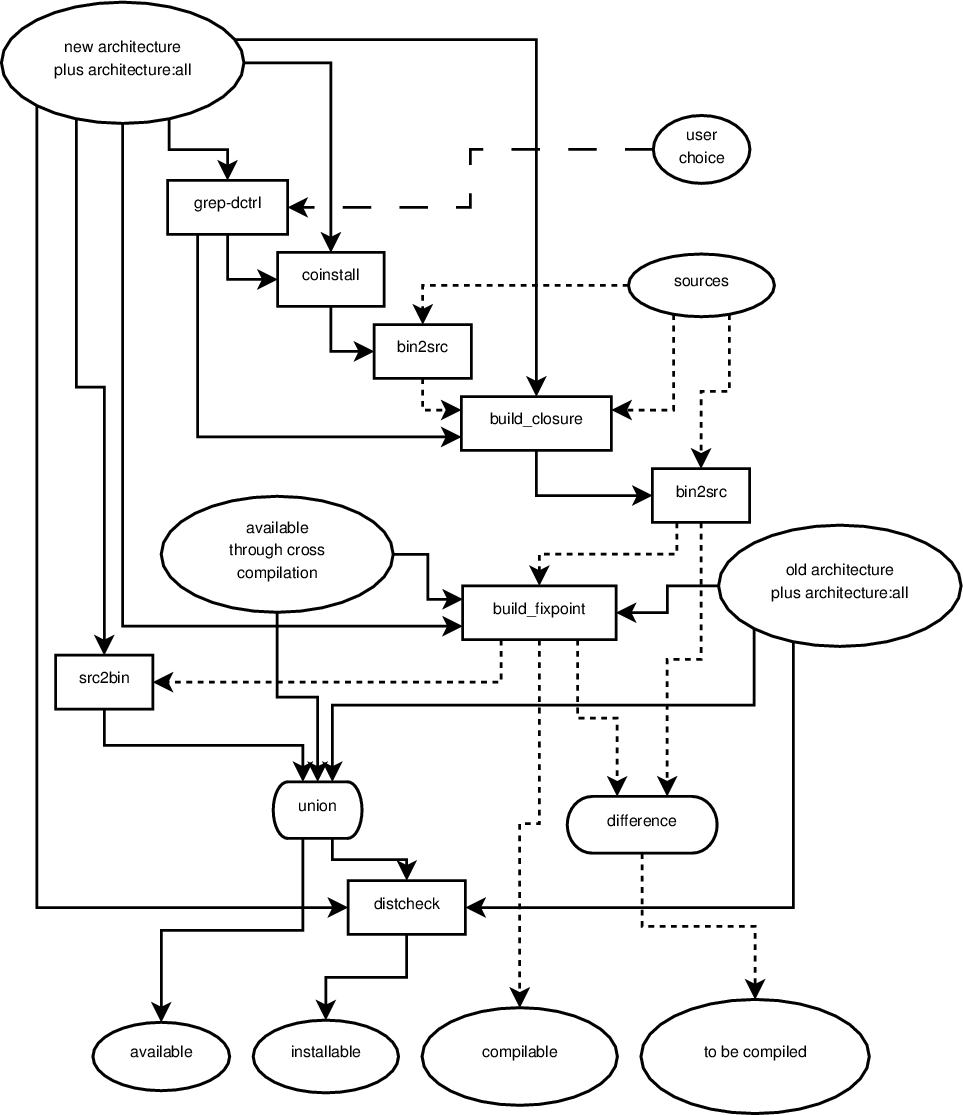
Processing pipeline instead of monolithic tools The tools I developed so far tried to accomplish everything by themselves, reusing functionality implemented in a central library. Therefor, if one wanted to try out even trivial new things, it mostly meant to hack some OCaml code. Pietro Abate suggested to instead develop smaller tools which could work independently of each other, would only execute one algorithm each and could easily be connected together in different ways to achieve different effects. This switch is now done and all functionality from the old tools is moved into a new toolset. The exchange format between the tools is either plain text files in deb822 control format (Packages/Sources files) or a dependency graph. The dependency graph is currently marshalled by OCaml but future versions should work with just passing a GraphML (an XML graph format) representation around. This new way of doing things seems close to the UNIX philosophy (each program does one thing well, data is stored as text, every program is a filter). For example the deb822 control output can easily be manipulated using grep-dctrl(1) and there exist many tools which can read, analyze and manipulate GraphML. It is a big improvement over the old, monolithic tools which did not allow to manipulate any intermediate result by external, existing tools. Currently, a shell script (native.sh) will execute all tools in a meaningful order, connecting them together correctly. The same tools will be used for a future cross.sh but they will be connected differently. I wrote about a first proposal of what the individual tools should do and how they should be connected in this email from which I also linked a confusing overview of the pipeline. This overview has recently been improved to be even more confusing and the current version of the lower half (the native part) now looks like this: native reduced Solid arrows represent a flow of binary packages, dottend arrows represent a flow of source packages, ovals represent a set of packages, boxes with rounded corners represent set operations, rectangular boxes represent filters. There is only one input to a filter, which is the arrow connected to the top of the box. Outgoing arrows from the bottom represent the filtered input. Ingoing arrows to either side are arguments to the filter and control how the filter behaves depending on the algorithm. I will explain this better once the pipeline proved to be less in flux. The pipeline is currently executed like this by native.sh.

Two new ways to break dependency cycles have been discovered So far, we knew of three ways to formally break dependency cycles:
  • remove build dependencies through build profiles
  • find out that the build dependency is only used to build arch:all packages and therefor put it into Build-Depends-Indep
  • cross compile some source packages
Two new methods can be added to the above:

Dependency graph definition changed Back in September when I was visiting irill, Pietro found a flaw in how the dependency graph used to be generated. He supplied a new definition of the dependency graph which does away with the problem he found. After fixing some small issues with his code, I changed all the existing algorithms to use the new graph definition. The old graph is as of today removed from the repository. Thanks to Pietro for supplying the new graph definition - I must still admit that my OCaml foo is not strong enough to have come up with his code.

Added complexity for profile built source packages As mentioned in the introduction, wookey and me addressed the debian-devel list with a proposal on necessary changes for an automated bootstrapping of Debian. During the discussiong, two important things came up which are to be considered by the dependency graph algorithms:
  • profile built source packages may not create all binary packages
  • profile built source packages may need additional build dependencies
Both things make it necessary to alter the dependency graph during the generation of a feedback arc set and feedback vertex set beyond the simple removal of edges. Luckily, the developed approximation algorithms can be extended to support such changes in the graph.

Different feedback arc set algorithms The initially developed feedback arc set algorithm is well suited to discover build dependency edges which should be dropped. It performs far worse when creating the final build order because it only considers edges by itself and not how many edges of a source package can be dropped by profile building it. The adjusted algorithm for generating a build order is more of a feedback vertex set algorithm because instead of greedily finding the edge with most cycles through it, it greedily finds the source package which would break most cycles if it was profile built.

Generating a build order with less profile built source packages After implementing all the features above I now feel more confident to publish the current status of the tools to a wider audience. The following test shows a run of the aforementioned ./native.sh shell script. Its final output is a list of source packages which have to be profile built and a build order. Using the resulting build order, starting from a minimal build system (essential:yes, build-essential and debhelper), all source packages will be compiled which are needed to compile all binary packages in the system. The result will therefor be a list of source and binary packages which fulfill the following property:
  • all binary packages can be built from the available source packages
  • all source packages can be built with the available binary packages
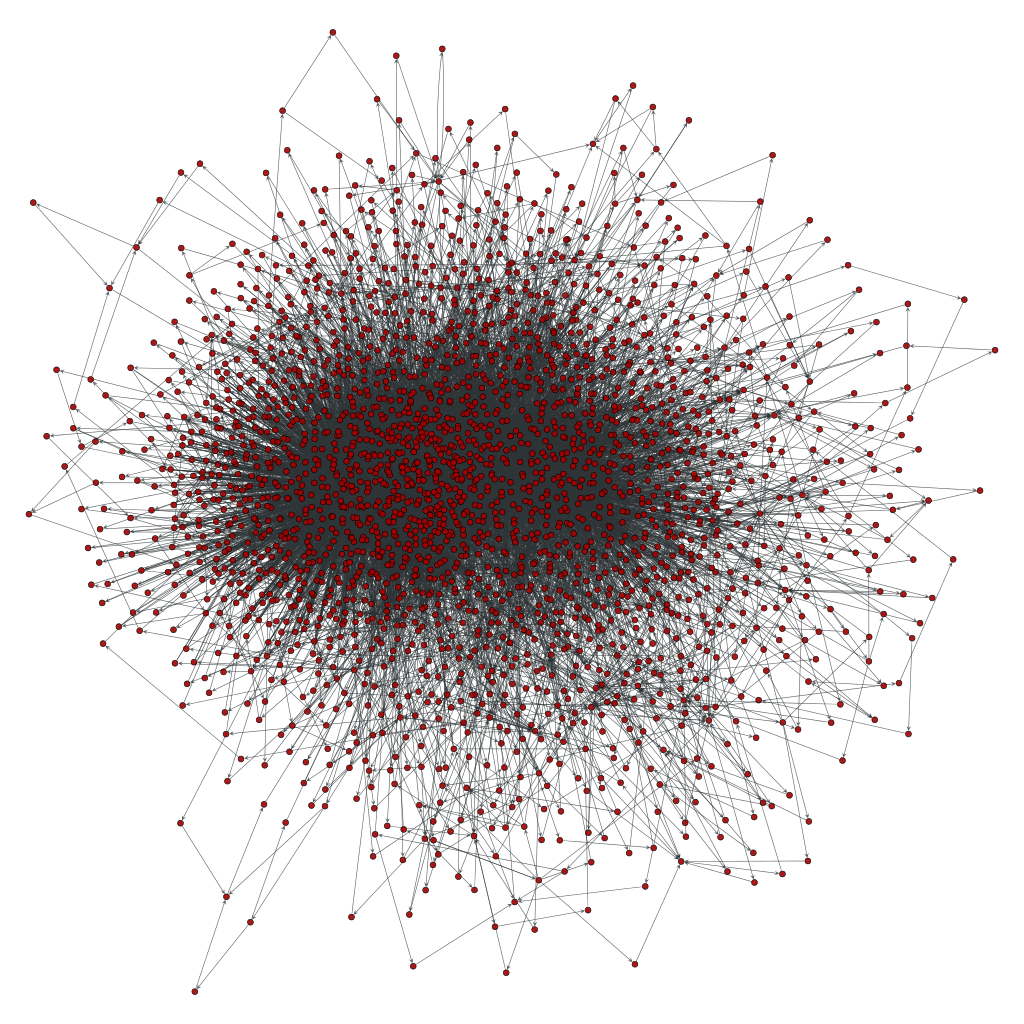
I called this a "reduceded distribution" in earlier posts. The interesting property of this specific selection is, that it contains the biggest problem set of Debian when bootstrapping it: a 900 to 1000 nodes big strongly connected component. Here is a visualization of the problem: hideous mess Source packages do not yet come with build profiles and the cross build situation can not yet be analyzed, so the following assumptions were made: The last point is about 14 build dependencies which were decided to be broken by the feedback arc set algorithm but for which other data sources did not indicate that they are actually breakable. Those 14 are dynamically generated by native.sh. If above assumptions should not be too far from the actual situation, then not more than 73 source packages have to be modified to bootstrap a reduced distribution. This reduced distribution even includes dependency-wise "big" packages like webkit, metacity, iceweasel, network-manager, tracker, gnome-panel, evolution-data-server, kde-runtime, libav and nautilus. By changing one line in native.sh one could easily develop a build order which generates gnome-desktop or really any given (meta-)package selection. All of native.sh takes only 80 seconds to execute on my system (Core i5, 2.5 GHz, singlethreaded). Here is the final build order which creates 2044 binary packages from 613 source packages.
  1. nspr, libio-pty-perl, libmcrypt, unzip, libdbi-perl, cdparanoia, libelf, c-ares, liblocale-gettext-perl, libibverbs, numactl, ilmbase, tbb, check, libogg, libatomic-ops, libnl($), orc($), libaio, tcl8.4, kmod, libgsm, lame, opencore-amr, tcl8.5, exuberant-ctags, mhash, libtext-iconv-perl, libutempter, pciutils, gperf, hspell, recode, tcp-wrappers, fdupes, chrpath, libbsd, zip, procps, wireless-tools, cpufrequtils, ed, libjpeg8, hesiod, pax, less, dietlibc, netkit-telnet, psmisc, docbook-to-man, libhtml-parser-perl, libonig, opensp($), libterm-size-perl, linux86, libxmltok, db-defaults, java-common, sharutils, libgpg-error, hardening-wrapper, cvsps, p11-kit, libyaml, diffstat, m4
  2. openexr, enca, help2man, speex, libvorbis, libid3tag, patch, openjade1.3, openjade, expat, fakeroot, libgcrypt11($), ustr, sysvinit, netcat, libirman, html2text, libmad, pth, clucene-core, libdaemon($), texinfo, popt, net-tools, tar, libsigsegv, gmp, patchutils($), dirac, cunit, bridge-utils, expect, libgc, nettle, elfutils, jade, bison
  3. sed, indent, findutils, fastjar, cpio, chicken, bzip2, aspell, realpath, dctrl-tools, rsync, ctdb, pkg-config($), libarchive, gpgme1.0, exempi, pump, re2c, klibc, gzip, gawk, flex-old, original-awk, mawk, libtasn1-3($), flex($), libtool
  4. libcap2, mksh, readline6, libcdio, libpipeline, libcroco, schroedinger, desktop-file-utils, eina, fribidi, libusb, binfmt-support, silgraphite2.0, atk1.0($), perl, gnutls26($), netcat-openbsd, ossp-uuid, gsl, libnfnetlink, sg3-utils, jbigkit, lua5.1, unixodbc, sqlite, wayland, radvd, open-iscsi, libpcap, linux-atm, gdbm, id3lib3.8.3, vo-aacenc, vo-amrwbenc, fam, faad2, hunspell, dpkg, tslib, libart-lgpl, libidl, dh-exec, giflib, openslp-dfsg, ppl($), xutils-dev, blcr, bc, time, libdatrie, libpthread-stubs, guile-1.8, libev, attr, libsigc++-2.0, pixman, libpng, libssh2, sqlite3, acpica-unix, acl, a52dec
  5. json-c, cloog-ppl, libverto, glibmm2.4, rtmpdump, libdbd-sqlite3-perl, nss, freetds, slang2, libpciaccess, iptables, e2fsprogs, libnetfilter-conntrack, bash, libthai, python2.6($), libice($), libpaper, libfontenc($), libxau, libxdmcp($), openldap($), cyrus-sasl2($), openssl, python2.7($)
  6. psutils, libevent, stunnel4, libnet-ssleay-perl, libffi, readline5, file, libvoikko, gamin, libieee1284, build-essential, libcap-ng($), lcms($), keyutils, libxml2, libxml++2.6, gcc-4.6($), binutils, dbus($), libsm($), libxslt, doxygen($)
  7. liblqr, rarian, xmlto, policykit-1($), libxml-parser-perl, tdb, devscripts, eet, libasyncns, libusbx, icu, linux, libmng, shadow, xmlstarlet, tidy, gavl, flac, dbus-glib($), libxcb, apr, krb5, alsa-lib
  8. usbutils, enchant, neon27, uw-imap, libsndfile, yasm, xcb-util, gconf($), shared-mime-info($), audiofile, ijs($), jbig2dec, libx11($)
  9. esound, freetype, libxkbfile, xvidcore, xcb-util-image, udev($), libxfixes, libxext($), libxt, libxrender
  10. tk8.4, startup-notification, libatasmart, fontconfig, libxp, libdmx, libvdpau, libdrm, libxres, directfb, libxv, libxxf86dga, libxxf86vm, pcsc-lite, libxss, libxcomposite, libxcursor, libxdamage, libxi($), libxinerama, libxrandr, libxmu($), libxpm, libxfont($)
  11. xfonts-utils, libxvmc, xauth, libxtst($), libxaw($)
  12. pmake, corosync, x11-xserver-utils, x11-xkb-utils, coreutils, xft, nas, cairo
  13. libedit, cairomm, tk8.5, openais, pango1.0($)
  14. ocaml, blt, ruby1.8, firebird2.5, heimdal, lvm2($)
  15. cvs($), python-stdlib-extensions, parted, llvm-2.9, ruby1.9.1, findlib, qt4-x11($)
  16. xen, mesa, audit($), avahi($)
  17. x11-utils, xorg-server, freeglut, libva
  18. jasper, tiff3, python3.2($)
  19. openjpeg, qt-assistant-compat, v4l-utils, qca2, jinja2, markupsafe, lcms2, sip4, imlib2, netpbm-free, cracklib2, cups($), postgresql-9.1
  20. py3cairo, pycairo, pam, libgnomecups, gobject-introspection($)
  21. gdk-pixbuf, libgnomeprint, gnome-menus, gsettings-desktop-schemas, pangomm, consolekit, vala-0.16($), colord($), atkmm1.6
  22. libgee, gtk+3.0($), gtk+2.0($)
  23. gtkmm2.4, poppler($), openssh, libglade2, libiodbc2, gcr($), libwmf, systemd($), gcj-4.7, java-atk-wrapper($)
  24. torque, ecj($), vala-0.14, gnome-keyring($), gcc-defaults, gnome-vfs($)
  25. libidn, libgnome-keyring($), openmpi
  26. mpi-defaults, dnsmasq, wget, lynx-cur, ghostscript, curl
  27. fftw3, gnupg, libquvi, xmlrpc-c, raptor, liboauth, groff, fftw, boost1.49, apt
  28. boost-defaults, libsamplerate, cmake, python-apt
  29. qjson, qtzeitgeist, libssh, qimageblitz, pkg-kde-tools, libical, dwarves-dfsg, automoc, attica, yajl, source-highlight, pygobject, pygobject-2, mysql-5.5($)
  30. libdbd-mysql-perl, polkit-qt-1, libdbusmenu-qt, raptor2, dbus-python, apr-util
  31. rasqal, serf, subversion($), apache2
  32. git, redland
  33. xz-utils, util-linux, rpm, man-db, make-dfsg, libvisual, cryptsetup, libgd2, gstreamer0.10
  34. mscgen, texlive-bin
  35. dvipng, luatex
  36. libconfig, transfig, augeas, blas, libcaca, autogen, libdbi, linuxdoc-tools, gdb, gpm
  37. ncurses, python-numpy($), rrdtool, w3m, iproute, gcc-4.7, libtheora($), gcc-4.4
  38. libraw1394, base-passwd, lm-sensors, netcf, eglibc, gst-plugins-base0.10
  39. libiec61883, qtwebkit, libvirt, libdc1394-22, net-snmp, jack-audio-connection-kit($), bluez
  40. redhat-cluster, gvfs($), pulseaudio($)
  41. phonon, libsdl1.2, openjdk-6($)
  42. phonon-backend-gstreamer($), gettext, libbluray, db, swi-prolog, qdbm, swig2.0($)
  43. highlight, libselinux, talloc, libhdate, libftdi, libplist, python-qt4, libprelude, libsemanage, php5
  44. samba, usbmuxd, libvpx, lirc, bsdmainutils, libiptcdata, libgtop2, libgsf, telepathy-glib, libwnck3, libnotify, libunique3, gnome-desktop3, gmime, glib2.0, json-glib, libgnomecanvas, libcanberra, orbit2, udisks, d-conf, libgusb
  45. libgnomeprintui, libimobiledevice, nautilus($), libbonobo, librsvg
  46. evas, wxwidgets2.8, upower, gnome-disk-utility, libgnome
  47. ecore, libbonoboui
  48. libgnomeui
  49. graphviz
  50. exiv2, libexif, lapack, soprano, libnl3, dbus-c++
  51. atlas, libffado, graphicsmagick, libgphoto2, network-manager
  52. pygtk, jackd2, sane-backends, djvulibre
  53. libav($), gpac($), ntrack, python-imaging, imagemagick, dia
  54. x264($), matplotlib, iceweasel
  55. strigi, opencv, libproxy($), ffms2
  56. kde4libs, frei0r, glib-networking
  57. kde-baseapps, kate, libsoup2.4
  58. geoclue, kde-runtime, totem-pl-parser, libgweather, librest, libgdata
  59. webkit
  60. zenity, gnome-online-accounts
  61. metacity, evolution-data-server
  62. gnome-panel
  63. tracker
The final recompilation of profile built source packages is omitted. Source packages marked with a ($) are selected to be profile built. All source packages listed in the same line can be built in parallel as they do not depend upon each other. This order looks convincing as it first compiles a multitude of source packages which have no or only few build dependencies lacking. Later steps allow fewer source packages to be compiled in parallel. The amount of needed build dependencies is highest in the source packages that are built last.

Neil Williams: Hard drive death

My 1Tb laptop drive started misbehaving a few weeks ago, just spending a lot of time spinning when it should have been reading frequently changed files (like the browser cache). I was tempted to blame the browser at that point as no other packages appeared affected.

Wednesday night, a routine package upgrade on unstable brought in a bunch of qt4 updates which I wanted and a virtual box update that I didn't see much point in delaying ... 15 minutes later I couldn't work out why the virtualbox dkms task was still running, spotted it spinning in depmod and found some alarming messages in dmesg about short reads and errors reading from the hard drive. Hmm. The hard drive was out of control at this point, it quickly became apparent that no disc access was going to be possible and I couldn't get to a terminal to kill the current tasks, so I killed the power. The fsck which followed reboot showed more of the errors I'd seen in dmesg and fell back to the manual intervention stage. A few hours of confirming attempts to fix the errors, fsck finally finished. A short amount of usage showed that although fsck had finished, the drive was not happy and was starting to give short reads on other parts of the filesystem, resulting in ~40% of the filesystem appearing to be read-only when the rest was read-write. Somehow, I didn't think this was a welcome feature as the areas affected appeared to be quite random.

The drive in question was a replacement for the original 300Gb drive supplied with the ThinkPad, so a quick bit of switching of drives into a caddy and I could rsync my data off the large drive onto the smaller one. The rsync itself took a lot longer than it should have done because it got lots of short reads too. (Principally in /lib/modules/3.2.0-4/ and in the browser cache directories which had been the original symptom as well as most other places where one could have expected processes to have open files when the drive failed).

Now the 1Tb drive was a pig to fit into the Thinkpad originally because it was too big for the bay but I fitted it anyway. Yes, that was probably a mistake. It certainly meant that in order to fit it I had to not put the drive into the useful caddy provided by Lenovo which makes removal of the drive simple. Indeed the drive was wedged into the bay so tightly that it wasn't going to come out with normal levels of persuasion. This probably contributed to the failure of the drive, so live and learn.

With help from Andy Simpkins (it's always handy to have a hardware engineer on hand at times like this), the keyboard was lifted out, the case was dismantled and just enough room was made to get a screwdriver in behind the sata drive and lever it out of the bay. OK, rebuild laptop, put replacement drive into the caddy (because the smaller capacity drive is also a lot smaller in height than the 1Tb and therefore has plenty of clearance between it and the bay) and move on to the software recovery stage.

Hint: if this happens again, before turning off the broken system for the last time, just remember to download a recent Debian ISO to a USB stick - it saves having to ask someone else or find another machine to do the download. (Thanks Andy...)

OK, so after the usual complaints on reboot that there was no operating system, F12 got the boot order menu up and I was in Debian Installer Rescue Mode. Reinstalling grub failed initially for a few reasons:

  1. I'd deliberately not copied /dev /proc and /sys from the old harddrive but I'd also forgotten to create empty ones on the new drive...
  2. /etc/fstab helpfully referred to / as a UUID which no longer applied, so that had to be edited
  3. grub was confused and couldn't find the root filesystem

A few iterations later, I had a working /dev directory inside the /target chroot, bind mounted from the /dev outside the chroot, I was able to mount proc and sys, so grub was finally happy to reinstall itself and then update the initramfs setup for the new drive.

Reboot, another fsck, all appeared well. I was able to login via the terminal but not in X. Hmmm. Stop xdm, startx manually from the terminal, problems with /tmp/ - permission denied. Oops. Yes, it does help to create /tmp with the right permissions....

The final stage was to complete the dpkg --configure -a from the original failure. I've yet to reinstall the 3.2.0-4 kernel, so I'm back on 3.2.0-3 but that's OK.

So now I'm back on the original drive, albeit temporarily without any swap whatsoever (because I didn't partition the replacement drive to create /dev/sda5 before doing the copy) and now I remember the second reason I wanted to replace the original drive with the 1Tb drive - the original drive is as NOISY as hell. The whole edge of the laptop vibrates constantly, to the point that I can feel the vibration under the keys as I type. It's not that the drive is loose in the bay, it's just a constant vibration.

But, I have kept all my data and I have a usable laptop for the BSP this weekend. I will be looking at an SSD drive to replace this one though and having also found my old Acer laptop with power supply, I can now reference this entry when I transfer the system a second time.

Russ Allbery: The "Why?" of Work

(This is going to be long and rambling. Hopefully at some point I'll be able to distill it into something shorter.) In preparation for a tech leads retreat tomorrow, several of us at work were asked to watch Simon Sinek's TED talk, "How great leaders inspire action". I'll be honest with you: I hated this talk. Sinek lost me right at the start by portraying his idea as the point of commonality among great leaders (don't get me started on survivorship bias; it's a pet peeve) and then compounded the presentation problem with some dubious biology about brain structure. So, after watching it, I ranted a bit about how much I disliked it (to, as it turns out, people who had gotten a lot out of it). (Don't do this, btw. It's nearly always worthwhile to suppress negativity about something someone else enjoyed. I say this to increase the pool of people who can remind me of what I said the next time I forget. Which, if my normal pattern holds, will be about five minutes from now.) Thankfully, I work with tolerant and forgiving people who kindly pointed out the things they saw in the video that I missed, and we ended up having a really good hour and a half discussion, which convinced me that there's an idea under here that's worth talking about. It also helped clarify for me just how much I hate the conventional construction of both leadership and success. This talk is framed around getting other people to do things, which is one of the reasons why I had such a negative reaction to it. It's right there in the title: leaders inspiring action. This feeds into what at least in the United States is an endemic belief that the world consists of leaders and followers, and that the key to success in the world (in business, in politics, in everything else) is to become one of the leaders and accumulate followers (most frequently as customers, since we have a capitalist obsession). This is then defined as success. I think this idea of success is bullshit. Now, that statement requires an immediate qualification. Saying that the societal definition of success is bullshit is a statement from privilege. I have the luxury of saying that because I am successful; I'm in a position where I have a lot of control over my own job, I'm not struggling to make ends meet, and I can spend my time pondering existential questions like how to define success. If I were a little less lucky, success would be whatever put food on the table and kept a roof over my head. I'm making an argument from the top of Maslow's hierarchy. But that is, in a roundabout way, my point: why is defining and constructing success still so hard, and why do we do such a bad job at it, even when we're at the top of the pyramid and able to focus on self-actualization? The context of this talk for my group is pre-work for a discussion about, in Sinek's construction, the "why?" of our group. Why are we here, what is our purpose, and what do we care about? By the mere fact that we are able to ask questions like that, you can correctly surmise that we're already successful. The question, therefore, is what should we do with that success? I normally hear one or more of the following answers, all of which I find unsatisfying or problematic. So, what should I do with success? Or, put another way, since I have the luxury of figuring out a "why?", what's my "why?" This question comes at a good time. As I've mentioned the last couple of days here, I've just come off of two days of the most fun I've had at work in the last several years. I spent about 25 hours total building a log parsing infrastructure that I'm quite fond of, and which may even be useful to other people. And I did that in response to a rather prosaic request: produce a report of user agents by authenticated unique users, rather than by hits, so that we can get an idea of what percentage of our community uses different devices or browsers. This was a problem that I probably could have solved adequately enough for the original request in four hours, maybe less, and then moved on to something else. I spent six times that long on it. That's something I can do because I'm successful: that's the sort of luxury you get when you can define how you want to do your job. So, apparently I have an answer to my question staring me in my face: what I do with success, when I have it, is use that leeway to produce elegant and comprehensive solutions to problems in a way that fully engages me, makes the problem more interesting, and constructs infrastructure that I can reuse for other problems. Huh. That sounds like a "why?" response that's quite common among hackers and software developers. Nothing earth-shattering there... except why is that so rare in a business context? Why isn't it common to answer questions like "what is our group mission statement" with answers like that? This is what I missed in the TED talk, and what the subsequent discussion with my co-workers brought to light for me. I think Sinek was getting at this, but I think he buried the lede. The "why?" should be something that excites you. Something that you're passionate about. Something that you believe in. He says that's because other people will then believe in it too and will buy it from you. I personally don't care about (or, to be honest, have active antipathy towards) that particular outcome, but that's fine; that's not the point. The point is that a "why?" comes from the heart, from something that actually matters, and it creates a motivating and limiting principle. It defines both what you want to do and what you don't want to do. That gives me a personal answer. My "why?" is that I want to build elegant solutions to problems and do work that I find engaging and can be proud of afterwards. I automate common tasks not because I particularly care about being efficient, but because manually doing common tasks is mind-numbing and boring, and I don't like being bored. I write reliable systems not particularly because that helps clients, but primarily because reliable software is more elegant and beautiful and unreliable software offends me. (Being more usable and frustrating for clients is also good; don't get me wrong. It's just not a motive. It's an outcome.) What does that mean for a group mission statement, a group "why?" Usually these exercises produce some sort of distillation of the collective job responsibilities of the people in the group. Our mission is to maintain core infrastructure to let people do their work and to support authentication and authorization services for the university, yadda yadda yadda... this is all true, in its way, but it's also boring. One can work oneself up to caring about things like that, but it requires a lot of effort. But we all have individual "why?" answers, and I bet they look more like my answer than they do like traditional mission statements. If we're in a place where we have the luxury of worrying about self-actualization questions, what gets us up in the morning, what makes it exciting to go into work, is probably some variation on doing interesting and engaging work. But it's probably a different variation for everyone in the group. For example, as you can see from above, I like building things. My happiest moments are when someone gives me a clearly-defined problem statement that fills a real need and then goes away and leaves me in peace to solve it. One thing I've learned is that I'm not very good at coming up with the problem statements myself; I can do it, but usually I end up solving some problem that isn't very important to other people. I love it when my employer can hand me real problems that will make the world better for people, since often they're a lot more interesting (and meaningful) than the problems I come up with on my own. But that's all highly idiosyncratic and is not going to be shared by everyone in my group. I'm an introvert; the "leave me alone" part of that is important. Other people are extroverts; what gets them up in the morning is, in part, engaging with other people. Some people care passionately about UI design. (I also care passionately about UI design, but the UI designs that I'm passionate about are the ones that are natural for my people, who are apparently aliens from another galaxy, so I'm not the person you want doing UI design for things used by humans.) Others might be particularly interested in researching new technology, or coming up with those problem statements, or in smoothly-running production systems, or in metrics and reporting... I don't really know, but I do know that there's no one answer that fits everyone. Which means that none of our individual "why?" responses should become the group "why?". However, I think that leads to an answer, and it's the answer I'm going to advocate for in the meeting tomorrow. I believe the "why?" of our team should be to use the leeway, trust, and credibility that we have because we're successful to try to create an environment in which every individual member of the team can follow their own "why?" responses. In other words, I think the mission of our group should not be about any specific technology, or about any specific set of services, or outcomes. The way we should use our success is to let every member of our team work in a way that lights their fire. That makes them excited to come into work. That lets each of us have as much fun as I had in the past two days. We should have as our goal to create passionate and empowered employees. Nothing more, but nothing less. This is totally not how group mission statements are done. They're always about blending in to some larger overall technological purpose. But I think that's a mistake, and (despite disliking the presentation), I think that's what this TED talk does actually get at. The purpose is the what, or sometimes the how. It's not the why. And the why isn't static; technology is changing fast, and people are using technology in different ways. Any mission statement around technology today is going to be obsolete in short order, and is going to be too narrow. But I think the flip side is that good technological solutions to the problems of the larger organization are outcomes that fall out of having passionate and inspired employees. If people can work in ways that engage and excite them, they will end up solving problems. We're all adults; we know that we're paid to do a job and that job needs to involve solving real problems for the larger organization. All of that is obvious, and therefore none of that belongs in a mission statement. A mission statement should state the inobvious. And while some visionary people can come up with mission statements around technology or around how people use technology that can be a rallying point for a team or organization, I think that's much rarer than people like to think it is. If you stumble across one like that, great, but I think most teams, and certainly our team, would be better served by having the team mission statement be to enable every individual on the team to be passionate about their work. What should our group work on next? Figure out what the university's problems are, line those needs up with the passions of the members of the team, ask the people most excited about each problem how they want to solve that problem, and write down the answers. There's our roadmap and our strategy, all rolled into one.
24 January 2013

Benjamin Mako Hill: Aaron Swartz

I moved to Boston in 2005 at the same time that Aaron Swartz did and we were introduced by a mutual friend. Aaron was one of my first friends in Boston and we became close. When Aaron moved to San Francisco, I moved into his apartment in Somerville where he kept a room for a year or so. Mika and I still live there. His old posters remain on our walls and his old books remain on our shelves. Aaron s brothers Ben and Noah both lived with us and remain close friends. I have spent hours (days?) reading and thinking about Aaron over the last two weeks. It has been disorienting but beautiful to read the descriptions of, and commentaries on, Aaron s life. Although I suspect I may never feel ready, there are several things I want to say about Aaron s death, about Aaron s work, and about what Aaron means to me. 1. Aaron s Death The reaction to Aaron s death has been overwhelming and inspirational. At some point in the near future I plan to join some of the important campaigns already being waged in his name. There are many attempts to understand why Aaron died and many attempts to prevent it from happening to others in the future. Unfortunately, I am familiar with the process of soul-searching and second-guessing that happens when a friend commits suicide. I m sure that every one of his friends has asked themselves, as I have, What could I have done differently? I don t know the answer, but I do know this: Aaron was facing the real risk of losing half his life to prison. But even if one believed that he was only facing the likely loss of ten percent or even one percent of his life I wish that we all, and I wish that I in particular, had reacted with the passion, time, anger, activity, and volume proportional to how we have reacted in the last two weeks when he lost the whole thing. 2. Aaron s Work Of course, Aaron and I worked on related projects and I followed his work. And despite all the incredible things that have been said about Aaron, I feel that Aaron s work was more focused, more ambitious, more transformative, more innovative, and more reckless (in a positive sense) than the outpour online suggests. Although discussion of Aaron has focused his successes, achievements, and victories, the work that inspired me most was not the projects that were most popular or successful. Much of Aaron s work was deeply, and as it turned out overly, ambitious. His best projects were self-conscious attempts to transform knowledge production, organization, and dissemination. Although he moved from project to project, his work was consistently focused on bringing semantic-web concepts and technologies to peer production, to the movement for free culture, and to progressive political activism and on the meta-politics necessary to remove barriers to this work. For example, Aaron created an online collaborative encyclopedia project called the TheInfoNetwork (TIN) several years before Wikipedia was started. I talked to Aaron at length about that project for a research project I am working on. Aaron s work was years ahead of its time; in 2000, TIN embraced more of the Wikimedia Foundation s current goals and principles than Wikipedia did when it was launched. While Wikipedia sought to create a free reference work online, Aaron s effort sought to find out what a reference work online could look like. It turned out to be too ambitious, perhaps, but it taught many, including myself, an enormous amount in that process. When I met Aaron, he was in the process starting a company, Infogami, that was trying to chase many of TIN s goals. Infogami was conceived of as a wiki aware of the structure of data. The model was both simple and profound. Years later, Wikimedia Deutschland s WikiData project is beginning to bring some of these ideas to the mainstream. Infogami merged with Reddit as equal halves of a company with a shared technological foundation based on some of Aaron s other work. But when Reddit took off, Infogami was rarely mentioned, even by Aaron. I think that is too bad. Reddit got traction because it made the most popular stuff more visible; Reddit is popular, fundamentally, because popular things are popular. But popular is not necessary positive. For that reason, Reddit never struck me as either surprising or transformative. But what started as Aaron s half the company, on the other hand, aimed to create a powerful form of democratized information production and dissemination. And although Infogami didn t take off, the ideas and code behind the project found life at the heart of Open Library and will continue to influence and inspire countless other projects. I believe that Infogami s lessons and legacy will undergird a generation of transformative peer production technologies in a way that the Reddit website important as it is will not. 3. What Aaron Means to Me A lot of what has been written about Aaron speaks to his intelligence, his curiosity, his generosity, his ethics and his drive. Although I recognize all these qualities in the Aaron I knew, I ve felt alienated by how abstract some of the discussion of Aaron has been my memories are of particularities.
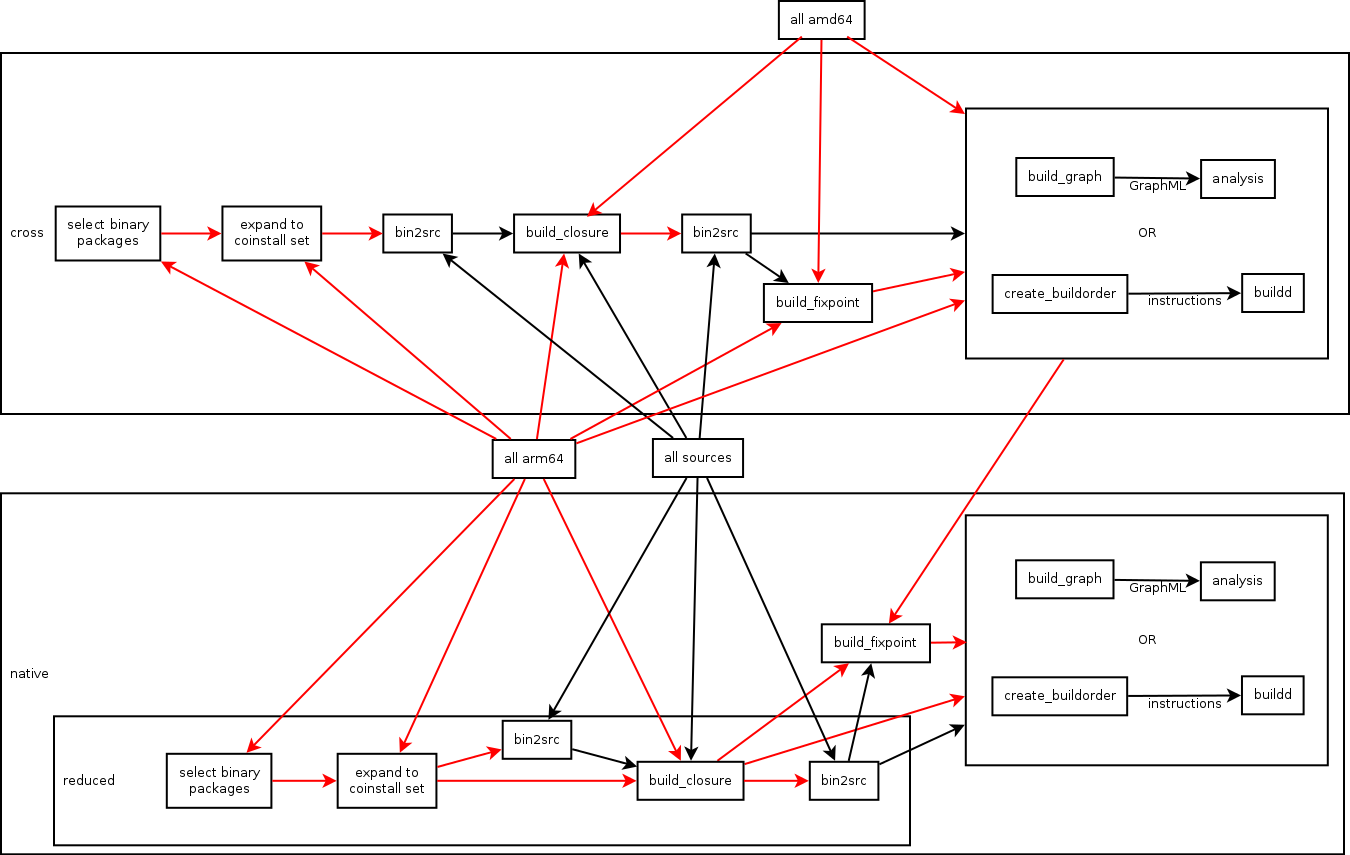
I remember the time Aaron was hospitalized and I spent two hours on the phone going through my bookshelves arguing with him about the virtues of the books in my library as we tried to decide which books I would bring him. I remember Aaron confronting Peter Singer intellectual founder of the modern animal rights movement at the Boston Vegetarian Food Festival to ask if humans had a moral obligation to stop animals from killing each other. I lurked behind, embarrassed about the question but curious to hear the answer. (Singer sighed and said yes sort of and complemented Aaron on the enormous Marxist commentary he was carrying.) I remember 1-800-INTERNET.com. I remember talking with Aaron about whether being wealthy could be ethical. I argued it could not but Aaron argued uncharacteristically I thought that it could. Aaron told Mika she should slap him if he ever became wealthy. The very next day, it was announced that his company had been acquired and that Aaron was a millionaire. I remember the standing bets I had with Aaron and how he would email me every time news reports favored his claims (but never when they did not). And I remember that I won t hear from him again.
Aaron was a friend and inspiration. I miss him deeply and I am very sad.

Next.

Previous.