Search Results: "dom"

1 August 2012

Bdale Garbee: Early Retirement

I am pleased to announce that HP accepted my application for participation in this year's Enhanced Early Retirement program. After 26.5 years, my last day at HP will be 31 August 2012. This isn't because I have a problem with HP, quite the contrary! I feel immensely privileged to have worked on so many interesting things with so many smart people for so long. And there are many exciting things happening right now, including high profile projects like Odyssey and Moonshot expanding both ends of the server scaling continuum with Linux, and the immense commitment to and investment in Open Source represented by the use of Open Stack and Ubuntu LTS in building HP Cloud. The temptation to stay and continue to help guide HP's Open Source engagement was strong. I'm certainly under no pressure to leave... in fact, I think I managed to shock my management with my decision to retire! But I'm very excited about "taking a break" from full-time employment for a while to focus more time on things that matter a lot to me. My son and I have a number of projects we'd like to work on together as he enters high school. The side business I started two years ago with Keith Packard to design, build, and sell avionics solutions for high power model rockets is growing and could use more attention. I'm in the midst of designing the processor board for another amateur radio satellite. And of course, I'm looking forward to putting more "quality time" towards Free Software projects like FreedomBox and Debian! Since they do not depend on my employment status, I do not expect any immediate changes in the various roles I play outside of HP. I will continue to serve on the board of the Linux Foundation representing individual affiliates, on the board of the FreedomBox Foundation, as Chairman of the Debian Technical Committee, and as President of Software in the Public Interest. And while I hope to travel less than I have in recent years, I look forward to continuing to speak and otherwise participate in key Free Software conferences around the world from time to time. After I retire, the primary point of contact with HP on Open Source matters will be the Director of HP's Open Source Program Office, Phil Robb. But if there are open issues regarding HP and Open Source that I can help with over the next month, feel free to contact me and I'll see what I can do to help.

31 July 2012

Russell Coker: The Retina Display

Last night I played with an Apple Macbook Pro with the new Retina Display (Wikipedia link). Wikipedia cites some controversy about whether the display actually has higher resolution than the human eye can perceive. When wearing glasses my vision is considerably better than average (I have average vision without glasses) and while kneeling in front of the Macbook I couldn t easily distinguish pixels. So Apple s marketing claims seem technically correct to me. When I tested the Macbook Pro I found that the quality of the text display was very high, even now the 1680*1050 display on my Thinkpad T61 looks completely crap when compared to the 2880*1800 display on the Macbook. The Macbook was really great for text and for a JPEG that was installed on the system for testing. But unfortunately pictures on web sites didn t look particularly good. Pictures on my blog looked quite poor and pictures returned by a Google search for art didn t look that great either. I wonder if Safari (the Apple web browser) isn t properly optimised for the display or if there is something that we should do when preparing pictures for web sites to make them look better on Safari. The retina display has a 71% greater DPI which means 2.93* the total number of pixels of my Thinkpad. The overall quality of the experience for me (apart from web pictures) seems more like a factor of 2.93 when compared with my Thinkpad than a factor of 1.71. This has to be one of the most desirable products I ve seen from a company that s opposed to freedom for it s users. I m not about to buy one though, $2,300 is a lot of money for a system that can t be upgraded, repaired, or recycled, and doesn t even have an Ethernet port. I m sure that if I bought one I would discover that it some of the hardware features don t work properly with Linux. The new Apple design trend of making it impossible to repair anything works reasonably well for phones and tablets which are cheap enough that they are hardly worth repairing when they have been used for a while. Lots of people can afford to spend about $600 on something that may be discarded after a year or two, but very few people can afford to spend more than $2,000 on such a disposable product. Why is Apple the only company producing systems with such displays? If someone produced regular PCs that have the expected features (including an Ethernet port) with such a display at a lower price then I m sure that there would be a great demand. Related posts:
  1. Modern Laptops Suck One of the reasons why I m moving from a laptop...
  2. A First Digital Camera I ve just been asked for advice on buying a digital...
  3. RPC and SE Linux One ongoing problem with TCP networking is the combination of...

28 July 2012

Vincent Bernat: Switching to the awesome window manager

I have happily used FVWM as my window manager for more than 10 years. However, I recently got tired of manually arranging windows and using the mouse so much. A window manager is one of the handful pieces of software getting in your way at every moment which explains why there are so many of them and why we might put so much time in it. I decided to try a tiling window manager. While i3 seemed pretty hot and powerful (watch the screencast!), I really wanted something configurable and extensible with some language. So far, the common choices are: I chose awesome, despite the fact that StumpWM vote for Lisp seemed a better fit (but it is more minimalist). I hope there is some parallel universe where I enjoy StumpWM. Visually, here is what I got so far: awesome dual screen setup

Awesome configuration Without a configuration file, awesome does nothing. It does not come with any hard-coded behavior: everything needs to be configured through its Lua configuration file. Of course, a default one is provided but you can also start from scratch. If you like to control your window manager, this is somewhat wonderful. awesome is well documented. The wiki provides a FAQ, a good introduction and the API reference is concise enough to be read from the top to the bottom. Knowing Lua is not mandatory since it is quite easy to dive into such a language. I have posted my configuration on GitHub. It should not be used as is but some snippets may be worth to be stolen and adapted into your own configuration. The following sections put light on some notable points.

Keybindings Ten years ago was the epoch of scavanger hunts to recover IBM Model M keyboards from waste containers. They were great to type on and they did not feature the infamous Windows keys. Nowadays, this is harder to get such a keyboard. All my keyboards now have Windows keys. This is a major change with respect to configure a window manager: the left Windows key is mapped to Mod4 and is usually unused by most applications and can therefore be dedicated to the window manager. The main problem with the ability to define many keybindings is to remember the less frequently used one. I have monkey-patched awful.key module to be able to attach a documentation string to a keybinding. I have documented the whole process on the awesome wiki. awesome online help

Quake console A Quake console is a drop-down terminal which can be toggled with some key. I was heavily relying on it in FVWM. I think this is still a useful addition to any awesome configuration. There are several possible solutions documented in the awesome wiki. I have added my own1 which works great for me. Quake console

XRandR XRandR is an extension which allows to dynamically reconfigure outputs: you plug an external screen to your laptop and you issue some command to enable it:
$ xrandr --output VGA-1 --auto --left-of LVDS-1
awesome detects the change and will restart automatically. Laptops usually come with a special key to enable/disable an external screen. Nowadays, this key does nothing unless configured appropriately. Out of the box, it is mapped to XF86Display symbol. I have associated this key to a function that will cycle through possible configurations depending on the plugged screens. For example, if I plug an external screen to my laptop, I can cycle through the following configurations:
  • only the internal screen,
  • only the external screen,
  • internal screen on the left, external screen on the right,
  • external screen on the left, internal screen on the right,
  • no change.
The proposed configuration is displayed using naughty, the notification system integrated in awesome. Notification of screen reconfiguration

Widgets I was previously using Conky to display various system-related information, like free space, CPU usage and network usage. awesome comes with widgets that can fit the same use. I am relying on vicious, a contributed widget manager, to manage most of them. It allows one to attach a function whose task is to fetch values to be displayed. This is quite powerful. Here is an example with a volume widget:
local volwidget = widget(  type = "textbox"  )
vicious.register(volwidget, vicious.widgets.volume,
         '<span font="Terminus 8">$2 $1%</span>',
        2, "Master")
volwidget:buttons(awful.util.table.join(
             awful.button(   , 1, volume.mixer),
             awful.button(   , 3, volume.toggle),
             awful.button(   , 4, volume.increase),
             awful.button(   , 5, volume.decrease)))
You can also use a function to format the text as you wish. For example, you can display a value in red if it is too low. Have a look at my battery widget for an example. Various widgets

Miscellaneous While I was working on my awesome configuration, I also changed some other desktop-related bits.

Keyboard configuration I happen to setup all my keyboards to use the QWERTY layout. I use a compose key to input special characters like . I have also recently use Caps Lock as a Control key. All this is perfectly supported since ages by X11 I am also mapping the Pause key to XF86ScreenSaver key symbol which will in turn be bound to a function that will trigger xautolock to lock the screen. Thanks to a great article about extending the X keyboard map with xkb, I discovered that X was able to switch from one layout to another using groups2. I finally opted for this simple configuration:
$ setxkbmap us,fr '' compose:rwin ctrl:nocaps grp:rctrl_rshift_toggle
$ xmodmap -e 'keysym Pause = XF86ScreenSaver'
I switch from us to fr by pressing both left Control and left Shift keys.

Getting rid of most GNOME stuff Less than one year ago, to take a step forward to the future, I started to heavily rely on some GNOME components like GNOME Display Manager, GNOME Power Manager, the screen saver, gnome-session, gnome-settings-daemon and others. I had numerous problems when I tried to setup everything without pulling the whole GNOME stack. At each GNOME update, something was broken: the screensaver didn t start automatically anymore until a full session restart or some keybindings were randomly hijacked by gnome-settings-daemon. Therefore, I have decided to get rid of most of those components. I have replaced GNOME Power Manager with system-level tools like sleepd and the PM utilities. I replaced the GNOME screensaver with i3lock and xautolock. GDM has been replaced by SLiM which now features ConsoleKit support3. I use ~/.gtkrc-2.0 and ~/.config/gtk-3.0/settings.ini to configure GTK+. The future will wait.

Terminal color scheme I am using rxvt-unicode as my terminal with a black background (and some light transparency). The default color scheme is suboptimal on the readability front. Sharing terminal color schemes seems a popular activity. I finally opted for the derp color scheme which brings a major improvement over the default configuration. Comparison of terminal color schemes I have also switched to Xft for font rendering using DejaVu Sans Mono as my default font (instead of fixed) with the following configuration in ~/.Xresources:
Xft.antialias: true
Xft.hinting: true
Xft.hintstyle: hintlight
Xft.rgba: rgb
URxvt.font: xft:DejaVu Sans Mono-8
URxvt.letterSpace: -1
The result is less crisp but seems a bit more readable. I may switch back in the future. Comparison of terminal fonts

Next steps My reliance to the mouse has been greatly reduced. However, I still need it for casual browsing. I am looking at luakit a WebKit-based browser extensible with Lua for this purpose.

  1. The console gets its own unique name. This allows awesome to reliably detect when it is spawned, even on restart. It is how the Quake console works in the mod of FVWM I was using.
  2. However, the layout is global, not per-window. If you are interested by a per-window layout, take a look at kbdd.
  3. Nowadays, you cannot really survive without ConsoleKit. Many PolicyKit policies do not rely on groups any more to grant access to your devices.

Luke Faraone: Google Cr-48 first impressions

On a lark, I signed up for the pilot program of the Google Cr-48 about a week ago. To my surprise, I found the distinctive box on my doorstep a week later. After initially mistaking it for an overpacked, late-model OLPC XO-1 I would have to repair, I sort of did a double-take as I realized what I had received.
Using Chrome OS


Wow, they weren't kidding about the boot time. Chrome OS responds (to suspend / resume and boot / power-off) very quickly. Responsiveness elsewhere in the OS of course varies on system load and other factors. On the "terms" page, there is a "system security setting" which tells me I have a Trusted Platform Module, and that my TPM has a randomly generated password. The dialog could use some rewording; I'm pretty familiar with the idea of a TPM, but I'm still not sure what I'm to do with that information.

Cloud print is really a problem for me, right now. I use school printers for the majority of my work, which I was previously able to use by adding them by IP address. Unless there's some magic I'm missing here, I can't do that with Chrome OS, and such a feature will not be supported. (except by "connectors" on Windows and Mac computers)
General thoughts
I can't imagine using a system running Chrome OS as a primary computer. The biggest missing feature is PGP (or any sort of encryption) support for email. This is probably not terribly difficult to implement as an extension, but the idea of my cryptographic software being automatically updated is rather unsettling. I think I'll have to agree with Paul Buchheit that ChromeOS will have to merge with Android; there is a utility for local apps, even if they're becoming less and less critical.

27 July 2012

Paul Tagliamonte: ERMAHGIT!

After seeing this post on reddit, I ported the OP s code to ERMAHGIT after following the following (simple) instructions:
sudo ./setup.py install
then, head over to a friendly git repo, and do the following:
git config core.editor /usr/local/bin/ermahgit
Anyway, here s a few lines from some random git commits I have handy:
Added chamber to vote page heading
ERDDERD CHERMBER TO VERTE PERGE HERERDERNG
Fixing the import I just broke
FERXERNG THE ERMPERT I JERST BRERKER
Bugfix for non-ascii chars using encode
BERGFERX FER NERN-ERSCERI CHERS ERSERNG ERNCERDER
Add this sorry excuse for a manpage.
ERDD THERS SERRER ERXCERSE FER A MAHNPERGER.
Please, never, ever use this :)

26 July 2012

Benjamin Mako Hill: User Innovation on NPR Radio

I was invited onto NPR in Boston this week for a segment on user innovation alongside Eric von Hippel (my advisor at MIT) and Carliss Baldwin from Harvard Business School. I talked about innovation that has happened on the CHDK platform -- a cool firmware hack for Canon cameras example I use in some of my teaching -- plus a little bit about free software, the democratization of development and design tools, and a little bit about user communities that LEGO has cultivated. I would have liked the conversation and terminology to do more to emphasize user freedom and free software, but I'm otherwise pretty happy with the result. The segment will be aired again on NPR in Boston this weekend and is available on the WGBH website.

24 July 2012

Gunnar Wolf: Ten theses in favor of free download of cultural goods on the Internet (by Enrique G. Gallegos)

This is one of the days where reading my everyday newspaper was worth more than just getting bitter at the news. I found this text in La Jornada, my usual newspaper. I liked it very much, and decided to translate it for a wider audience. Of course, if you can read Spanish, do yourself a favor and go to the original. It is not that the text is so easy to translate. And, after all, I'm not a native English writer. I'm trying to do a literal translation, even when disagreeing with the author. Ten theses in favor of free download of cultural goods on the Internet Enrique G. Gallegos Poet and philosopher. Currently a researcher in Universidad Aut noma Metropolitana-C
  1. Historical legacy. Criticists who promote the persecution of piracy and free downloads of cultural works from the Internet argue that the patrimonial rights have been wronged; they start off suposing that a cultural work is formed from a historical void, as if there was a "nothing" to begin with, and then a "something" appeared. Nothing more fallacious: All cultural products has its precedents, and thanks to these it generates part of its best forces.
  2. Opening towards the future. Human beings are projected into the future. As the main philosophies of the 20th century have explored, one of the singular characteristics of mankind is the ability to think and imagine the future. Products of culture are the best ways to think and project society, politics, love, hope, needs, failures A song, a poem, an essay, can trigger imaginary worlds with a transformative potential. To deny this to humanity with "patrimonial damage" as an argument is to mutilate man's temporal nature.
  3. Recognition of the present. Cultural works generate moments of reflection, criticism and pleasure; they can trigger actions demanding commitment, solidarity and strong indignation against injustice. If every cultural work is adscribed in some way to a historic tradition, and if cultural products anre necessary to imagine other possible worlds and open our future, it's not less true that they also allow us to recognize our present by making us more sensitive to others' ideas, sensations and emotions. Without culture, there is no present nor others' presence.
  4. Divulgation of the cultural heritage. If culture is "heritage of mankind", it should be also spread by any possible way. But not just spread, but actively sought for the biggest number of people to be able to effectively have access to it. In a potentially interconnected world, Internet is the most adequate world for it (despite its limitations). Therefore, penalizing free downloads means avoiding spreading it and restricting access to those groups who don't have enough economic resources.
  5. Preserving cultural heritage. If we agree that cultural works are heritage of mankind, we need to take every action needed to preserve them. But preserving culture does not only mean keeping the products in museums, galleries or never-polluted drawers; it rather means to keep them in the collective memory and in the flow of constant interpretations and appropiations. Said in other words, the genuine way to preserve culture is to allow universal access to cultural goods. That's why, holding that free copies and downloads of books, music, videos, etc. over the Internet are harmful, is an incompatible argument with the obligation to preserve cultural heritage.
  6. They are not goods. Cultural works are material and spiritual manifestations of mankind, concretions of its historicity; they are, also, expressions of emotions, ideas and projections of other lives and other worlds. That's why they cannot be equated to goods or inserted in patrimonialist logic. The market might want to cheat by giving a certain price to a painting by Orozco or auctioning a Baudelaire manuscript, but it will never be able to aprehend their true meaning as cultural works. And it's not that culture is not faluable, but taht its estimation criteria do not follow the rules of market, but those of the imponderable and unlimited.
  7. Price disproportion. Assuming we accept the possibility that intermediaries charge for the services they perform, the value of a book, record or movie should never exceed the daily wage of a worker or employee. But this ellection would only be one more option within the effective possibility that people opt to download or freely copy the cultural work. The final decision as to which media to go to should be a sovereign resolution of the culture-interested person.
  8. The principle of the most benefit. Even when copies and free downloads over Internet could generate a patrimonial "wrong" to third parties, the cultural benefit obtained by it will always be greater in as much that it carries out intensely the principle to foster, spread and access the cultural heritage of mankind. To think otherwise is to privilege the few over the many.
  9. The real evil is elsewhere. Murder, women- and children-trade, poverty and misery are the real evils that ache mankind. According to the United Nations, in 2010 there were 468 thousand murders in the world; the estimation is that 3500 million people live in poverty; in their 2009 inform, the UN found over 2400 victims of "people trade", kidnapped as sex slaves; in some regions in Africa, close to 30% of children suffer acute malnutrition and six people (between children and adults) die every day from hunger. That's why pretending that free download of cultural works is an evil is clearly a tricky and deceptive speech
  10. Against the intermediary-salesman. Culture does not need intermedieries that reduce cultural works to goods. Culture is too important to leavie it in the hands of salespeople that simplistly equate cultural goods with cakes. An intermediary of this kind will never understand the difference between a work of art and a disposable razor blade. What the world needs is more support from the government from every country to artists, creators and poets, as well as ensuring the conditions for the absolute mobility freedom for cultural works.

22 July 2012

Sylvestre Ledru: Who is in control of LLVM/Clang ?

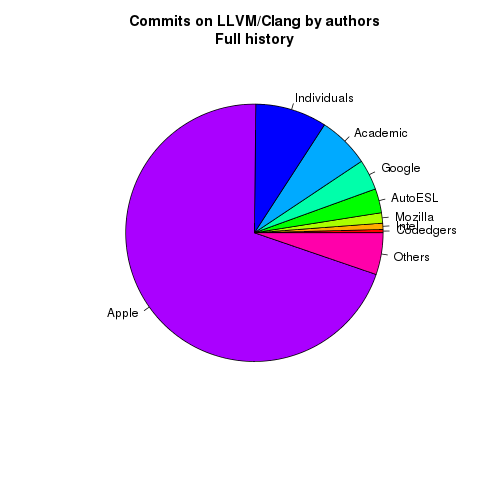
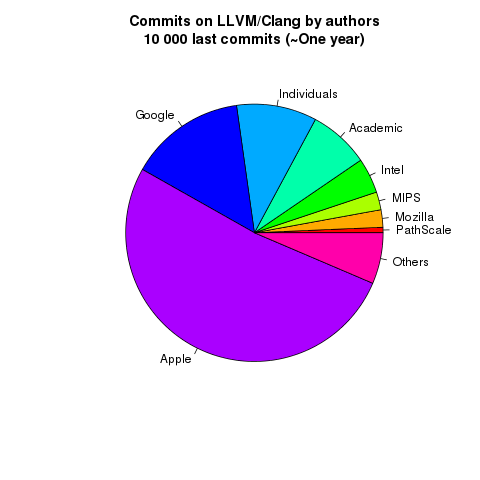
During my various chats and presentations on LLVM/Clang, one of the common criticism on LLVM/Clang is about the Apple's (supposed?) control on the platform. Even if I am not concerned by this concern, here are some statistics about the development. Basically, I used the git history to build a list of all the author. If domain names were clear (ex: @google.com, @apple.com, etc), I used them for the paternity of the commit. If there were not clear (ex: @gmail.com, @me.com), I dig on the web to find the employer (Linkedin was my friend). Of course, identifying individuals are pretty tough. Their percentages can be considered as a minimal figure. Full history 10 000 commits (about a year)
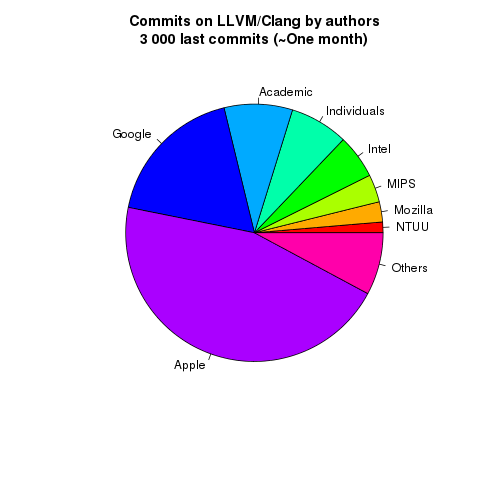
3 000 commits (~a month)
To sum up, we can easily see that the percentage of contributions of Apple is decreasing over the time.
However, we all know that the number of commits is not the best metric to measure the control of one on a project. Source: Processed data (please contact me in case of mistake)

Mark Brown: regmap updates in 3.5

A surprisingly large series of updates for regmap this time, mostly due to all the work Stephen Warren has done to add support for MMIO buses. This wasn t really the target for the framework but it turns out that there s a reasonable number of cases where it s very helpful to use the register cache support to allow the register map to remain available while the device is suspended.

21 July 2012

Siegfried Gevatter: A gentle introduction to Zeitgeist s Python API

In this post I ll make a quick introduction by example on how to use Zeitgeist s Python API for good and profit. If you re interested in using Zeitgeist from C instead, see the libzeitgeist examples; to use it with C++/Qt, Trever s a web browser in 4 steps may be of interest. First things first In case you re not familiar with Zeitgeist, it may prove helpful to first read Mikkel s introduction to Zeitgeist post. If that s too much to read, just should know that Zeitgeist is an event log. Like the history in your browser, it keeps track of what websites you open at which point in time. It also keeps track of when you close them, and of what browser you used, since it s a system-wide service. Furthermore, it does the same for files, conversations, e-mails, and anything else you want to insert into it. So Zeitgeist is a database of events, and an event can be pretty much anything. But what does it look like? It s main attributes are the following: Additionally, each event has one or more subjects, which have the following attributes: Retrieving recent data Okay, so let s say you want to know the last song you ve listened to (if you have a Zeitgeist-enabled music player). It s a simple as:
from zeitgeist.client import ZeitgeistClient
from zeitgeist.datamodel import *
 
zeitgeist = ZeitgeistClient()
 
def on_events_received(events):
    if events:
        song = events[0]
        print "Last song: %s" % song.subjects[0].uri
    else:
        print "You haven't listened to any songs."
 
template = Event.new_for_values(subject_interpretation=Interpretation.AUDIO)
zeitgeist.find_events_for_template(template, on_events_received, num_events=1)
 
# Start a mainloop - note: the Qt mainloop also works
from gi.repository import GLib
GLib.MainLoop().run()
This may need some explaining. We start by importing the Zeitgeist client and some associated data structures (such as Event and Interpretation), and create an instance of the client. The ZeitgeistClient class is a wrapper around Zeitgeist s D-Bus API which not only makes it much nicer to use, but also makes it easy to install monitors (as we will see later) and provides convenient functionality such as automatic reconnection if the connection to the engine is lost. To query for the most recent song, we just need to create a template with the restrictions we want to impose and submit it to Zeitgeist using the find_events_for_template call. If you haven t read Mikkel s post yet, please do so, as it introduces the structure of events and subjects (in short: an event has a timestamp, some other properties, and one or more subjects representing the resources -files, websites, people - involved in the event). The Python API is inherently asynchronous (if for some reason you need a synchronous API, you may still use the lower level ZeitgeistDBusInterface class), so we need to define a callback function to handle the results we receive from the Zeitgeist engine. Finally, we need to create a main loop so the asynchronous functions can run.
Now this was a pretty simple example. Let s make it more interesting. One song isn t much, so let s get the 5 most recent songs. Also, now we want both songs and videos. The first part is pretty easy, we just need to change the num_events parameter. For the second extension, we have to change the event template. In fact, now we need two different event templates and the find_events_for_templates function, which takes an arbitrary number of event templates and ORs them. The result is as follows:
from zeitgeist.client import ZeitgeistClient
from zeitgeist.datamodel import *
 
zeitgeist = ZeitgeistClient()
 
def on_events_received(events):
    for event in events:
        print "- %s" % event.subjects[0].uri
 
tmpl1 = Event.new_for_values(subject_interpretation=Interpretation.AUDIO)
tmpl2 = Event.new_for_values(subject_interpretation=Interpretation.VIDEO)
zeitgeist.find_events_for_templates([tmpl1, tmpl2],
                                    on_events_received, num_events=5)
 
# Start a mainloop
from gi.repository import GLib
GLib.MainLoop().run()
This will work, but unless you re lucky you re likely to get some duplicate line. Why is this? Well, other than that you may have used the same file twice, don t forget that what you are requesting are actually events. If you ve started playing a given song, you probably also stopped playing it, so that s actually two of them (an AccessEvent and a LeaveEvent). Since this isn t what we want, we ll change the query a bit:
zeitgeist.find_events_for_templates(
    [tmpl1, tmpl2],
    on_events_received,
    num_events=5,
    result_type=ResultType.MostRecentSubjects,
    storage_state=StorageState.Available)
By requesting the most recent subjects, vs. the most recent events, we can filter out events with duplicate URI. See the ResultType documentation for other modes you can use. Note particularly the MostPopularSubjects result type. I also used the chance to introduce the storage_state parameter. This one will filter out events for files Zeitgeist knows aren t available (this mostly means online resources won t be shown if you don t have a network connnection; there s also support for handling external storage media, but because of problems with GIO this is currently disabled). Last but not least, the find_events_for_* methods also accept a timerange parameter. It defaults to TimeRange.until_now(), but you may change it to TimeRange.always() (if for some reason you re working with events in the future) or to any other time range of your choice. Here it s important to note that Zeitgeist s timestamps use millisecond precision.
For more advanced queries, you can use more complex combinations of events and subject templates. The rule to keep in mind here is that events are OR d and subjects are ANDed. Additionally, some field (actor, origin, mimetype, uri and current_uri) may be prefixed with an exclamation mark ( ! ) for NOT, or you may append an asterisc ( * ) to them for prefix search. You can even combine the two operators together. Here s an example of a template you could build:
subj1 = Subject.new_for_values(interpretation=Interpretation.SOURCE_CODE,
                               uri="file:///home/rainct/Development/*")
subj2 = Subject.new_for_values(uri="!file:///home/rainct/Development/zeitgeist/*")
tmpl1 = Event.new_for_values(interpretation=Interpretation.MODIFY_EVENT,
                             subjects=[subj1, subj2])
templates = [tmpl1]
In my case, this template would fetch a list of the source code files I modified most recently but excluding those related to the Zeitgeist project. Working with big sets of data In case you re trying to do something crazy, you may end up with a Zeitgeist query complaining that it exceeded the memory limit. You re not supposed to do that. Instead, we provide some methods for working with large collections of events.
from zeitgeist.client import ZeitgeistClient
from zeitgeist.datamodel import *
 
zeitgeist = ZeitgeistClient()
 
def on_events_received(events):
    for event in events:
        print '- %s' % event.subjects[0].uri
 
def on_ids_received(event_ids):
    print 'A total of %d source code files were found.' % len(event_ids)
    print 'Fetching the first 100...'
    zeitgeist.get_events(event_ids[:100], on_events_received)
 
tmpl = Event.new_for_values(subject_interpretation=Interpretation.SOURCE_CODE)
zeitgeist.find_event_ids_for_templates(
    [tmpl],
    on_ids_received,
    num_events=10000, # you can use 0 for "all events", but do you really need to?
    timerange=TimeRange.from_seconds_ago(3600*24*30*3),
    result_type=ResultType.MostPopularSubjects)
 
# Start a mainloop
from gi.repository import GLib
GLib.MainLoop().run()
And there you have the source code files you worked with during the last 3 months, ordered from most to least popular (popularity is measured counting the number of events; for more precision, maybe you could limit the results to events with interpretation AccessEvent). Why do we provide this mechanism instead of querying with a simple offset? Well, this avoids problems when the log changes (events are inserted or deleted). Have you ever been exploring the latest posts in some website, and as you change to the next page some of the results from the previous page show up again (because new posts have been added in the meantime)? With Zeitgeist this won t happen. Receiving information in real time At this point you re an expert at requesting all sorts of data from Zeitgeist, but now you want to show a list of the last kitten images you ve viewed, updated in real time. Don t worry, Zeitgeist can provide for this:
from zeitgeist.client import ZeitgeistClient
from zeitgeist.datamodel import *
 
zeitgeist = ZeitgeistClient()
 
def on_insert(time_range, events):
    # do awesome stuff with the events here
    print events
 
def on_delete(time_range, event_ids):
    # a previously inserted event was deleted
    print event_ids
 
templates = [Event.new_for_values(subject_uri='file:///home/user/kittens/*',
                                  subject_interpretation=Interpretation.IMAGE)]
zeitgeist.install_monitor(TimeRange.always(), templates, on_insert, on_delete)
 
# Start a mainloop
from gi.repository import GLib
GLib.MainLoop().run()
It s important to note that on_delete won t be called when an image is deleted (that d be a newly inserted event with interpretation=DELETE_EVENT); rather, it s called when a previously inserted event is deleted (for example, using the forget recent history option in Activity Log Manager). In case you re curious: for best performance, this doesn t actually use D-Bus signals. Instead, this little call will setup a D-Bus object behind the scenes and register it with the Zeitgeist engine, so it can notify said object when (and only when) an event of its interest is registered. To stop receiving notifications for a template, you ll need the save the object returned by the install_monitor call:
m = zeitgeist.install_monitor(TimeRange.always(), templates, on_insert, on_delete)
zeitgeist.remove_monitor(m)
Pro Tip: You can use the Zeitgeist Explorer GUI to quickly try out different queries (note: it s still work in progress, so much funcionality is missing, but it does work somewhat). Contextual awesomeness: finding related events By now you re familiar with retrieving events and keeping them up to date. Now it s time for a little secret:
import time
from zeitgeist.client import ZeitgeistClient
from zeitgeist.datamodel import *
 
zeitgeist = ZeitgeistClient()
 
def on_related_received(uris):
    print 'Related URIs:'
    for uri in uris:
        print ' - %s' % uri
 
query_templates = [Event.new_for_values(
    subject_interpretation=Interpretation.SOURCE_CODE,
    subject_uri='file:///home/rainct/Development/zeitgeist/*',
    subject_mimetype="text/x-vala")]
 
result_templates = [Event.new_for_values(
    subject_interpretation=Interpretation.WEBSITE,
    subject_manifestation=Manifestation.WEB_DATA_OBJECT)]
 
now = time.time()*1000
zeitgeist.find_related_uris_for_events(
    query_templates,
    on_related_received,
    time_range=TimeRange(now - 1000*3600*24*30*6, now),
    result_event_templates=result_templates,
    num_events=10)
 
# Start a mainloop
from gi.repository import GLib
GLib.MainLoop().run()
This little query example will return up to 10 websites I used at the same time as the Vala files inside my Zeitgeist directory, considering only data from the last 6 months. Nice, huh? This is an experimental feature, and it doesn t work well when operating on big inputs, so it s usually better to use the find_related_uris_for_uris variant (which replaces the first query_templates parameter with a list of URIs). Advanced searching: the FTS extension Some people think prefix searches aren t good enough for them, and this is why the Zeitgeist engine ships by default with a FTS (Full Text Search) extension. Using the methods provided by this extension you can perform more advanced queries against subjects current_uri and text properties (unlike the name may suggest, the FTS extension doesn t index the content of the files, but just the information in the event). This is exposed as zeitgeist_index_search in libzeitgeist (the C library), but unfortunately isn t currently available in the Python API. If you still need it, you ll have to fallback to pretty much using the D-Bus interface (you still get reconnection support, though). Here s an example:
from zeitgeist.client import ZeitgeistClient
from zeitgeist.datamodel import *
 
zeitgeist = ZeitgeistClient()
index = zeitgeist._iface.get_extension('Index', 'index/activity')
 
query            = 'hello' # search query
time_range       = TimeRange.always()
event_templates  = []
offset           = 0
num_events       = 10
result_type      = 100 # magic number for "relevancy" (ResultType.* also work)
 
def on_reply(events, num_estimated_matches):
    print 'Got %d out of ~%d results.' % (len(events), num_estimated_matches)
    events = map(Event, events)
    for event in events:
        print ' - %s' % event.subjects[0].uri
 
def on_error(exception):
    print 'Error from FTS:', exception
 
index.Search(query, time_range, event_templates,
             offset, num_events, result_type,
             reply_handler=on_reply, error_handler=on_error)
 
# Start a mainloop
from gi.repository import GLib
GLib.MainLoop().run()
The most interesting thing here is the query parameter. Quoting from the C documentation:
The default boolean operator is AND. Thus the query foo bar will
be interpreted as foo AND bar. To exclude a term from the result
set prepend it with a minus sign - eg foo -bar. Phrase queries
can be done by double quoting the string "foo is a bar". You can
truncate terms by appending a *.
There are a few keys you can prefix to a term or phrase to search
within a specific set of metadata. They are used like key:value.
The keys name and title search strictly within the text field of
the event subjects. The key app searches within the application
name or description that is found in the actor attribute of the
events. Lastly you can use the site key to search within the
domain name of the subject URIs.
You can also control the results with the boolean operators AND
and OR and you may use brackets, ( and ), to control the operator
precedence.
Modifying the log So far we ve only queried Zeitgeist for information, let s get a bit more active. You can delete events from Zeitgeist with the following query:
from zeitgeist.client import ZeitgeistClient
 
zeitgeist = ZeitgeistClient()
 
def on_deleted(timerange):
    print 'Deleted events going from %s to %s' % (timerange[0], timerange[1])
 
event_ids = [50] # put the IDs of the events you want to delete here
 
zeitgeist.delete_events(event_ids, on_deleted)
 
# Start a mainloop
from gi.repository import GLib
GLib.MainLoop().run()
The confirmation callback will receive a timerange going from the first to the last event. If no events were deleted (because they didn t exist), you ll get (-1, -1).
And now for the interesting part. If your application involves resources (files, websites, contacts, etc.) of any sort, you ll probably want to let Zeitgeist know that you re using them. It s time that you write a data-source! We start by registering the data-source. Here we go:
import time
from gi.repository import GLib
from zeitgeist.client import ZeitgeistClient
from zeitgeist.datamodel import *
 
zeitgeist = ZeitgeistClient()
 
def on_status_changed_callback(enabled):
    """ This method will be called whenever someone enables or disables
        the data-source. """
    if enabled:
        print 'Data-source enabled and ready to send events!'
    else:
        print 'Data-source disabled; don\'t send event, they\'ll be ignored.'
 
def register():
    # Always use the same unique_id. Name and description can change
    # freely.
    unique_id = 'com.example.your.data.source'
    name = 'user visible name (may be translated)'
    description = 'user visible description (may be translated)'
 
    # Describe what sort of events will be inserted (optional)
    subject_template = Subject()
    subject_template.interpretation = Interpretation.PLAIN_TEXT_DOCUMENT
    subject_template.manifestation = Manifestation.FILE_DATA_OBJECT
    templates = []
    for interp in (Interpretation.ACCESS_EVENT, Interpretation.LEAVE_EVENT):
        event_template = Event()
        event_template.interpretation = interp
        event_template.manifestation = Manifestation.USER_ACTIVITY
        event_template.append_subject(subject_template)
        templates.append(event_template)
 
    zeitgeist.register_data_source(unique_id, name, description, templates,
                                   on_status_changed_callback)
Once that s done (and if it is enabled), we are free to send our events:
def log(title, uri, opened):
    subject = Subject.new_for_values(
        uri=uri,
        interpretation=Interpretation.PLAIN_TEXT_DOCUMENT,
        manifestation=Manifestation.FILE_DATA_OBJECT,
        origin=GLib.path_get_dirname(uri),
        mimetype='text/plain',
        text=title)
    event = Event.new_for_values(
        timestamp=time.time()*1000,
        manifestation=Manifestation.USER_ACTIVITY,
        actor='application://your_application_name.desktop',
        subjects=[subject])
    if opened:
        event.interpretation = Interpretation.ACCESS_EVENT
    else:
        event.interpretation = Interpretation.LEAVE_EVENT
 
    def on_id_received(event_ids):
        print 'Logged %s (%d) with event id %d.' % (title, opened, event_ids[0])
 
    zeitgeist.insert_events([event], on_id_received)
 
if __name__ == '__main__':
    register()
 
    log('test.txt', 'file:///tmp/test.txt', opened=True)
    log('another_file.txt', 'file:///tmp/another_file.txt', opened=True)
    log('another_file.txt', 'file:///tmp/another_file.txt', opened=False)
    log('test.txt', 'file:///tmp/test.txt', opened=False)
 
    # Start a mainloop
    GLib.MainLoop().run()
If you don t know what interpretation and manifestation your subject should have, you can use the following utility methods:
from zeitgeist.mimetypes import *
 
print get_interpretation_for_mimetype('text/plain')
print get_manifestation_for_uri('file:///tmp/test.txt')
Event better, with Zeitgeist 0.9 you can just leave the subject (but not event!) interpretation and manifestation fields empty, and they ll be guessed the same way as if you used those utility methods. Pro Tip: You can examine all registered data-sources and toggle whether they are enabled or not using the zeitgeist-data-sources-gtk.py tool. Conclusion Wow, I m impressed if you ve got this far. By now you should have quite a good idea on how to use the Zeitgeist API, and I m looking forward to seeing what you do with it in your next awesome project. If you have any problem with Zeitgeist, feel free to visit us on IRC (#zeitgeist on irc.freenode.net), or join our mailing list. We ll also be at GUADEC next week, so if you re there make sure to say hi! In case you missed them, here are some useful links:
No comments
Siegfried-Angel Gevatter Pujals, 2012. Permalink License Post tags: ,
flattr this!

20 July 2012

Joey Hess: are there any gotchas with enabling the -threaded GHC runtime?

That's a seemingly simple question I started asking various people two weeks ago. I didn't get many useful answers, but now I have experience doing it myself, and so here's a blog post brain dump. I have been trying to convert git-annex to use GHC's threaded runtime, for a variety of reasons. Naively adding the -threaded option resulted in a git-annex command that seemed to randomly freeze, but only sometimes (and, infuriatingly, never when I straced it), and a test suite that froze at a random point almost every time I ran it. Not a good result, and lacking any knowledge about gotchas with using the threaded runtime, I was at a loss for a long time (most of DebConf) about how to fix it. I now know of at least three classes of problems that enabling the threaded runtime can turn up in programs that have been developed using the non-threaded runtime. accessing a MVar after forkprocess can hang MissingH has some code similar to this, which works ok with the non-threaded runtime:
forkProcess $ do
    debugM "about to run some command"
    executeFile ...
In the above example, debugM accesses a MVar. Doing that after forkProcess can result in a MVar deadlock, as it tries to access a MVar value, that is, apparently, not accessible to the forked process. (Bug report with test case) So, using System.Cmd.Utils from MissingH is asking for trouble. I switched all my code to the newer and, apparently, threaded runtime safe System.Process. forkProcess is a massively bad idea Even when not accessing a MVar after forkProcess, it's very unsafe to use. It's easy to miss the warning attached to forkProcess, when the code seems to work. But with the threaded runtime, I've found that most any call to forkProcess will sometimes succeed, and sometimes freeze the whole program. This might only happen around 1 time in 1000. Then you'll find this warning and do a lot of head-scratching about what it really means:
forkProcess comes with a giant warning: since any other running threads are not copied into the child process, it's easy to go wrong: e.g. by accessing some shared resource that was held by another thread in the parent.
The hangs I saw could be due to laziness issues deferring code to run after the forkProcess that you'd expect to have run before it ... or who knows what else. It's not clear to me that it's possible to use forkProcess safely in Haskell code. I think it's notable that System.Process runs the whole fork/exec in C code instead. unsafe FFI calls block According to most of the documentation you'll find in eg, the Haskell wiki, Real World Haskell, etc, the only difference between the safe and unsafe imports in the FFI is that unsafe is faster, and shouldn't be used for C code that calls back into Haskell code. But the documentation is out of date. Actually, if you're using the FFI, and the foreign function can block, you need to use safe. When using unsafe, a blocking foreign function can block all threads of the program. In my case, I was using kqueue to wait for changes to files, and this indeed blocked my whole program when linked with -threaded. Marking it safe fixed this. The details are well described in this paper: http://community.haskell.org/~simonmar/papers/conc-ffi.pdf Somewhat surprisingly, this blocking only happens when using the threaded runtime. If you're using the non-threaded runtime with unsafe blocking FFI functions, your other pseudo-threads won't be blocked. This is because the non-threaded runtime has an SIGALARM timer that interrupts (most) blocking system calls. This leads to other troubles of its own (like needing to restart interrupted FFI functions, or blocking the other pseudo-threads from running if the C code ignores SIGALARM), but that's offtopic for this post. summary Converting a large Haskell code base from the default, non-threaded runtime to the threaded runtime can be quite tricky. None of the problems are the sort of thing that Haskell helps to manage either. I will be developing new programs using the threaded runtime from the beginning from now on. By the way, don't take this post to say that threading in Haskell sucks. I've really been enjoying writing threaded Haskell code. The control Haskell gives over isolation of state to threads, and the excellent and wide-ranging suite of thread communications data types (MVar, Chan, QSemN, TMVar, SampleVar, etc) have made developing a complex threaded program something I feel comfortable doing for the first time, in any language.

18 July 2012

Peter Eisentraut: Tracing shell scripts with time stamps

A random tip for shell script hackers. You know that with set -x you can turn on tracing, so that every command is printed before being executed. In bash, you can also customize the output prefix by setting the PS4 variable. The default is PS4='+ '. Here is an example. I wanted to "profile" a deployment script, to see why it took so long. Ordinarily, I might have sprinkled it with date calls. Instead, I merely added
set -x
PS4='+\t '
near the top. \t stands for time stamp. (The script was already using bash explicitly, as opposed to /bin/sh.) That way, every line is prefixed by a time stamp, and the logs could easily be analyzed to find a possible performance bottleneck.

17 July 2012

Ben Hutchings: Wireless regulation in squeeze

Alternate title: 'for those who care about channels 12-13'. For background, see the earlier entry on wireless regulation. If your wifi interface no longer supports channel 12 or 13, this may be because the kernel does not know the regulations for the domain code detected by the driver. Prior to Linux 2.6.34, regulations for 'US', 'JP' (Japan) and 'EU' (ETSI members) were built-in, but now there is only '00' (world, conservative regulations) which allows only channels 1-11 in the 2.4 GHz band. For any driver that detects specific European country codes, the 'EU' regulatory information was useless even in 2.6.32 (squeeze) and the unknown code would be mapped to the '00' (world) domain. Since wireless regulations are subject to change from time to time, they are now provided by the wireless-regdb package and supposed to be loaded into the kernel by crda. These packages should have been included in squeeze, but for various reasons they missed it. But they are now available in squeeze-backports.

15 July 2012

Paul Tagliamonte: usage of vcs-git in the Debian archive

I ve recently gone through some of the unpacked source sitting in the lintian lab, and I ve got a few cool stats. First of all, the types of VCS tags I ve found:
      1 vcs-git
    123 Vcs-git
   6480 Vcs-Git
      1 Vcs-GIT
      5 VCS-git
     86 VCS-Git
Interesting! It seems the (IMHO correct) Vcs-Git style has a lot of adoption
     17 XS-Vcs-Git
and a few old style git tags :) Well, let s take a look at the most common prefixes:
   6498 git
    196 http
     15 https
All pretty stock, when I see (to my shock) a:
      4 git+ssh
Oh noes! Let s get rid of those, folks! :) So, let s check out the most popular domains to host git packages:
    5375 git.debian.org
     555 anonscm.debian.org
     171 github.com
OK, I d like to stop right here. As much as I hate nonfree software, and I think relying on as part of our infrastructure sucks, there is a degree of sense to keeping stuff on GitHub. If upstream is on GitHub, it may make it easier to coordinate and work with them. However! These are repos sitting in people s personal accounts which means taking over the package in the event someone needed to is not practical. The person with the highest number of Debian repos on GitHub is 19, followed by 12, 5 and a few 4s. Enter github.com/debian IMHO, we should consider putting the repos that are already on GitHub under Debian namespace, so that the team of maintainers may be able to add new collaborators. I mean, we have the account and some friendly DDs who offered to take care of this organization outside the project. That, or get us off GitHub entirely. I m not sure that s wise, though. However, even though there are a ton of repos on GitHub, it s about 1/40th of the total number of VCS tagged packages in Debian. On with the show:
      60 git.debian-maintainers.org
      39 gitorious.org
      26 git.b9.com
      22 git.lxde.org
      19 git.kitenet.net
      19 git.brad-smith.co.uk
      18 git.gag.com
And some of the more interesting ones:
      1 code.launchpad.net
for Vcs-Git??? :)
      1 git.debian.org:
Looks like it was a login@git.d.o: URL that was just changed slightly. Let s double-check our VCS tags, people :) The breakdown of Debian VCS d URLs:
      1 anonscm.alioth.debian.org
      1 anonscp.debian.org
      1 git.debian.org:
      2 scm.alioth.debian.org
     12 alioth.debian.org
    555 anonscm.debian.org
   5375 git.debian.org
And out of git.d.o, 2544 of them use the git://git.debian.org/git/pkg-foo pattern rather then the git://git.debian.org/pkg-foo pattern. Interesting! roughly 78 use /users and roughly 113 use /git/users I had no idea we had so many complexities in our VCS pointers :) When I get some more time, I ll go through and figure out which team has the most Git VCS tags :)

14 July 2012

Christian Perrier: DebConf running: stage 11

This morning, I ran again with No l, my longstanding Debian running friend. The goal was, this time, to explore the South-East heights of Managua. I noticed a road that seemed to be quiet enough and not requiring a too long transit through busy, noisy and bad smelling highways. So, at 06:00 we headed from the Seminole hotel to the road to Masaya (the very large highway that goes in front ofMetrocentro). We had to run along it for a bit less than 2km. Not the best thing but the road was not very busy at that time. Then, we turned right into a road heading towards a quite "classy" neighbourhood where roads are well paved, there are sidewalks, etc, etc. It was going up ALL TIME LONG, which is interesting as a start. This placed is named "Lomas de Santo Domingo" in Google Maps. We even found there the embassy of the Islamic Republic of Iran. I can tell you, the Iran ambassador is quite living in a neat place and probably very happy to be there..:-) Fromthere, a very good concrete road starts to go up and up and up and up. many many very high standard villas, with fences, guards, etc. Strangely, there were several "For Sale" signs instead of "Se Vende". So, I guess this is a sign that this place is mostly inhabited by (very rich) foreigners, diplomats, etc. This very nice road was also....climbing a lot: 180m in 3.5km, so 5.1% average, but sometimes closer to 10%! At the very end of the road, we however ended....on a fence. It's apparently guarding the final part of the road where even more fancier villas seem to be, according to the satellite view..:-). We tried to use a small path up, but had to stop quite quickly. (OK, No l is definitely blurry there....blame the tired eyes after 8.7km climbing all the way) And then, all we had to do was....going down..:-). Being both in a fairly good shape, that went quite fast. But we both agreed that the final part, above 12km/h along the highway, with the sun hitting hard, was quite a challenge. I really admire those people who happen to run long distance in places like Managua. I can't even imagine running a marathon here.... GPS trace of what finally turns out to be my longest run here as of now with 17.5km in about 1h40.

11 July 2012

Andrew Pollock: [tech] Polar epically anti-developer? A product review of the Polar WearLink + transmitter with Bluetooth

Continuing in my better running through technology phase that I'm currently going through, I got all excited when I discovered that Polar make a Bluetooth-enabled heart rate monitor chest strap. Prior to this, I'd be lamenting how there wasn't a large choice of ANT+ enabled Android phones (to my knowledge there's just something Sony makes) So I got all excited and ordered a strap and it arrived today. This is my initial review (I haven't gone running with it yet, I've just had a tinker) I'll start with the bad first
the battery cover is a bit dicky
I took the battery cover off to confirm it came with a battery and then had a whale of a time getting it back on. I haven't managed to get it on as flush with the back as before I took it off. This appears to be a common complaint in the Amazon product reviews also.
hard to tell what its auto off timeout is, whether it's on, etc
Basically there's a large lack of feedback as to what's going on. Is it on or off? Is it wet enough to turn itself on? Is it reading a heart rate, or is the Bluetooth pairing just not working? The most accurate way I've found to determine if it's "working" or not is to unpair it and then repair it again. If you get a PIN prompt it's talking. By accident, I've found indications that it will turn itself off after not reading a heart rate for 10 minutes, and to reset it, you detach it and wait 30 seconds and reattach it. This would have been good information to include in the manual
Now for the good
reasonable Android app support
Heart Rate Monitor for Polar claims to support it, but I haven't managed to get it to do anything useful yet. I was pleasantly surprised to discover that My Tracks has support for it. Noom CardioTrainer is one that I was already trying out alongside Strava Run (which doesn't have support for it). There's also Sports Tracker and Endomondo. The UI for both of these also show the battery level. I've found that trying to have multiple apps reading the heart rate monitor simultaneously seems to be an exercise in fail, and that the Sports Tracker app seems to start a background service which subsequently causes all sorts of problems for any of the other apps started after it has started.
And the ugly Looking back at all the Amazon product reviews, they're pretty much split equally between 5 stars and 1 stars. The product seems to either work flawlessly or absolutely dreadfully. I was beginning to think I was in the latter group and that I'd bought a white elephant, but now that I've gotten to the bottom of the idiosyncrasies of talking to it from Android, it seems to be behaving fairly reliably. Talking to it from Linux, and the reason behind the title of this post One of the first things I tried doing after Android was being initially flaky for me, was to try and talk to it from a Linux laptop. This proved fairly straightforward using rfcomm. I didn't get anything human readable out of it though. Being curious as to how these Android apps were able to decode the data, I went looking for some API documentation, and a Google search led me to this sad forum discussion. So the API information is not freely available, and their CEO personally signs off on who gets access to it. How ludicrous. Do they want to sell product or not? That said, I did also find this blog post which, courtesy of the aforementioned Open Source My Tracks Android app, lays it all out for you. So them being all anti-development with their information is kind of pointless. Polar's website doesn't mention anything about their management, so I have no idea who their CEO even is. Wikipedia is also none the wiser. I'm looking forward to going for a run tomorrow and seeing how this thing pans out.

Paul Tagliamonte: The "hell-server"

I s pose a better name would be How to preform automated deep-source checks I ve pushed the code to paultag/qlight, and it s just for personal use at the moment. It s built to use paultag/sb around sbuild. Basically, it preforms a crudload of tests such as licensecheck, suspicious-source, pyflakes, bashisms, cppcheck, php in linter mode, and a ton of other checks. You can see a large majority of them in the source file. The batch runner is a singleton , so it s safely called more then once. It s running on a 5-minute cron, and I ve configured a dput target to push it into it s queue & run the enqueue script. Here s some example output from a random package I had lying around:
  ===== build status =====
sbo-run-clang  successful
sbo-run-gcc  successful
  ===== global status =====
Ran plugin extract, exit code 0
Ran plugin watch, exit code 0
Ran plugin licensecheck, exit code 0
Ran plugin validate-source, exit code 0
Ran plugin build, exit code 0
Ran plugin descr, exit code 0
Ran plugin lintian, exit code 0
  ===== descr =====
I: PT: Does this sound right? "gbemol is/are a(n) Graphical frontend for the Music Player Daemon (MPD)"
  ===== piuparts =====
   [last 20 lines]
  ===== licenses =====
BSD (3 clause) 
GPL (v2 or later) 
GPL (v2 or later) GENERATED FILE
GPL (v2 or later) (with incorrect FSF address) 
LGPL (v2 or later) (with incorrect FSF address) 
*No copyright* GPL (v2 or later) 
*No copyright* UNKNOWN
  ===== lintian =====
I: gbemol: spelling-error-in-binary usr/bin/gbemol Wheter Whether
W: gbemol: hardening-no-relro usr/bin/gbemol
I: gbemol: spelling-error-in-manpage usr/share/man/man1/gbemol.1.gz allows to allows one to
  ===== watch =====
-- Scanning for watchfiles in .
-- Found watchfile in ./debian
-- In debian/watch, processing watchfile line:
   http://sf.net/gbemol/gbemol-(.*)\.tar.gz
-- Found the following matching hrefs:
     gbemol-0.3.tar.gz
     gbemol-0.3.1.tar.gz
     gbemol-0.3.2.tar.gz
Newest version on remote site is 0.3.2, local version is 0.3.2
 => Package is up to date
-- Scan finished
  ===== source issues =====
suspicious-source:
bashisms:
script ./ltmain.sh does not appear to have a #! interpreter line;
you may get strange results
possible bashism in ./ltmain.sh line 368 ($RANDOM):
        my_tmpdir="$ my_template -$ RANDOM-0 $$"
error: ./ltmain.sh: Unterminated quoted string found, EOF reached. Wanted: <">
pyflakes:
cppcheck:
[src/gbemol-utils.c:167]: (error) Memory leak: path
[src/libmpdclient.c:1654]: (error) Possible null pointer dereference: output - otherwise it is redundant to check if output is null at line 1663
[src/libmpdclient.c:1655]: (error) Possible null pointer dereference: output - otherwise it is redundant to check if output is null at line 1663
[src/libmpdclient.c:1656]: (error) Possible null pointer dereference: output - otherwise it is redundant to check if output is null at line 1663
[src/libmpdclient.c:1664]: (error) Possible null pointer dereference: output - otherwise it is redundant to check if output is null at line 1663
phplint:
desktop validate:
.//.pc/desktop_file.patch/gbemol.desktop: warning: key "Encoding" in group "Desktop Entry" is deprecated
.//.pc/desktop_file.patch/gbemol.desktop: error: (will be fatal in the future): value "gbemol.png" for key "Icon" in group "Desktop Entry" is an icon name with an extension, but there should be no extension as described in the Icon Theme Specification if the value is not an absolute path
.//.pc/desktop_file.patch/gbemol.desktop: warning: value "Application;AudioVideo;Player;" for key "Categories" in group "Desktop Entry" contains a deprecated value "Application"
mp3check:
mp3val:
fontlint:
ftvalid:
msgfmt:
POFileChecker:
POFileSpell:
pngcheck:
jpeginfo:
ogginfo:
oggz-validate:
xmllint:
lacheck:
jslint:
check for environ calls to home:
check for use of /tmp:
./intltool-extract.in:    $OUTFILE     = "./tmp/$OUTFILE.h"
check for use of system():
./aclocal.m4:    lt_ld_extra= awk '/^include /   system(sprintf("cd /etc; cat %s 2>/dev/null", \[$]2)); skip = 1;     if (!skip) print \[$]0; skip = 0;  ' < /etc/ld.so.conf   $SED -e 's/#.*//;/^[  ]*hwcap[    ]/d;s/[:,  ]/ /g;s/=[^=]*$//;s/=[^= ]* / /g;/^$/d'   tr '\n' ' ' 
./intltool-merge.in:    return 1 if ((-x $file) or (system("$file -l >$devnull") == 0));
./intltool-merge.in:    system ("$iconv -f $encoding -t UTF-8 <$devnull 2>$devnull");
./intltool-update.in:    return 1 if ((-x $file) or (system("$file --version >$devnull") == 0));
./intltool-update.in:          system ($EXTRACT, "--update", "--srcdir=$SRCDIR",
./intltool-update.in:          system ($EXTRACT, "--update", "--type=$gettext_type", 
./intltool-update.in:    system ("$MSGMERGE", "-o", $outfile, $infile, "$MODULE.pot");
./intltool-update.in:    system ("$MSGFMT", "-o", "$devnull", "--verbose", $output_file);
./intltool-update.in:   system ("$MSGFMT", "-o", "$devnull", "--verbose", "$SRCDIR/$lang.po");
./configure:    lt_ld_extra= awk '/^include /   system(sprintf("cd /etc; cat %s 2>/dev/null", \$2)); skip = 1;     if (!skip) print \$0; skip = 0;  ' < /etc/ld.so.conf   $SED -e 's/#.*//;/^[   ]*hwcap[    ]/d;s/[:,  ]/ /g;s/=[^=]*$//;s/=[^= ]* / /g;/^$/d'   tr '\n' ' ' 
./intltool-extract.in:        system ("mkdir -p $dirname");
./intltool-extract.in:        system("mkdir tmp/"); 
./debian/gbemol.1:the \fBDebian\fP system (but may be used by others).  Permission is 
./debian/manpage.sgml:      the &debian; system (but may be used by others).  Permission is
  ===== sbo-run-clang.log warnings =====
update-binfmts: warning: unable to close /proc/sys/fs/binfmt_misc/register: Invalid argument
update-binfmts: warning: unable to enable binary format python2.6
dpkg-source: warning: extracting unsigned source package (gbemol_0.3.2-2.dsc)
dpkg-buildpackage: warning: using a gain-root-command while being root
gbemol-preferences.c:483:13: warning: 'gbemol_preferences_load_spin' defined but not used [-Wunused-function]
gbemol-net.c:60:11: warning: variable 'res' set but not used [-Wunused-but-set-variable]
dpkg-shlibdeps: warning: package could avoid a useless dependency if debian/gbemol/usr/bin/gbemol was not linked against libfontconfig.so.1 (it uses none of the library's symbols).
dpkg-shlibdeps: warning: package could avoid a useless dependency if debian/gbemol/usr/bin/gbemol was not linked against libatk-1.0.so.0 (it uses none of the library's symbols).
dpkg-shlibdeps: warning: package could avoid a useless dependency if debian/gbemol/usr/bin/gbemol was not linked against librt.so.1 (it uses none of the library's symbols).
dpkg-shlibdeps: warning: package could avoid a useless dependency if debian/gbemol/usr/bin/gbemol was not linked against libgio-2.0.so.0 (it uses none of the library's symbols).
dpkg-shlibdeps: warning: package could avoid a useless dependency if debian/gbemol/usr/bin/gbemol was not linked against libcairo.so.2 (it uses none of the library's symbols).
dpkg-shlibdeps: warning: package could avoid a useless dependency if debian/gbemol/usr/bin/gbemol was not linked against libpango-1.0.so.0 (it uses none of the library's symbols).
dpkg-shlibdeps: warning: package could avoid a useless dependency if debian/gbemol/usr/bin/gbemol was not linked against libpangocairo-1.0.so.0 (it uses none of the library's symbols).
dpkg-shlibdeps: warning: package could avoid a useless dependency if debian/gbemol/usr/bin/gbemol was not linked against libfreetype.so.6 (it uses none of the library's symbols).
dpkg-shlibdeps: warning: package could avoid a useless dependency if debian/gbemol/usr/bin/gbemol was not linked against libpangoft2-1.0.so.0 (it uses none of the library's symbols).
dpkg-gencontrol: warning: File::FcntlLock not available; using flock which is not NFS-safe
     + add misc-depends to fix lintian warning.
  ===== sbo-run-gcc.log warnings =====
dpkg-source: warning: extracting unsigned source package (gbemol_0.3.2-2.dsc)
dpkg-buildpackage: warning: using a gain-root-command while being root
gbemol-preferences.c:483:13: warning: 'gbemol_preferences_load_spin' defined but not used [-Wunused-function]
gbemol-net.c:60:11: warning: variable 'res' set but not used [-Wunused-but-set-variable]
dpkg-shlibdeps: warning: package could avoid a useless dependency if debian/gbemol/usr/bin/gbemol was not linked against libfontconfig.so.1 (it uses none of the library's symbols).
dpkg-shlibdeps: warning: package could avoid a useless dependency if debian/gbemol/usr/bin/gbemol was not linked against libatk-1.0.so.0 (it uses none of the library's symbols).
dpkg-shlibdeps: warning: package could avoid a useless dependency if debian/gbemol/usr/bin/gbemol was not linked against librt.so.1 (it uses none of the library's symbols).
dpkg-shlibdeps: warning: package could avoid a useless dependency if debian/gbemol/usr/bin/gbemol was not linked against libgio-2.0.so.0 (it uses none of the library's symbols).
dpkg-shlibdeps: warning: package could avoid a useless dependency if debian/gbemol/usr/bin/gbemol was not linked against libcairo.so.2 (it uses none of the library's symbols).
dpkg-shlibdeps: warning: package could avoid a useless dependency if debian/gbemol/usr/bin/gbemol was not linked against libpango-1.0.so.0 (it uses none of the library's symbols).
dpkg-shlibdeps: warning: package could avoid a useless dependency if debian/gbemol/usr/bin/gbemol was not linked against libpangocairo-1.0.so.0 (it uses none of the library's symbols).
dpkg-shlibdeps: warning: package could avoid a useless dependency if debian/gbemol/usr/bin/gbemol was not linked against libfreetype.so.6 (it uses none of the library's symbols).
dpkg-shlibdeps: warning: package could avoid a useless dependency if debian/gbemol/usr/bin/gbemol was not linked against libpangoft2-1.0.so.0 (it uses none of the library's symbols).
dpkg-gencontrol: warning: File::FcntlLock not available; using flock which is not NFS-safe
     + add misc-depends to fix lintian warning.
Not as interesting as it can get, but still pretty cool. Andrea, I swear I m not picking on you :) More to come later (hopefully) :)

10 July 2012

Gerfried Fuchs: Mermaids Reloaded

It's almost seven years now since I wrote/published Mermaids. It was an important step in my life, confessing publicly what I've found out about myself, how I feel and identify myself. It definitely has been a certain turning point in my life. A year later, there was the Debconf6 in Mexico, which was just as important. I was wearing a skirt for the first time, and that for the whole duration of the two weeks. It was an enormous feeling of freedom, and I knew I was feeling at home. That was also the time I shaved off my beard. And since? Well, I sort of limited myself to these two weeks every year. Debconf is my haven, Debconf is my home. Here I allow myself to be myself. Debian is my family. And like in every family, there are people who won't understand, but that doesn't matter. I feel comfortable to express myself in this crowd in the way I feel. Being abroad seems to help with the confidence, and it seems like it also shines through. I haven't had lots of strange looks. To the contrary, when I went with a skirt to a homosexual acceptance event at home in Vienna, there was a group of gays who were pointing and laughing. Quite an interesting experience, one would assume that people who are wanting more acceptance would be more acceptable and tolerant themselves... But, I don't think I will ever take the step toward actually turning my body into a female one. It was an important step for me to find out about my inner self, and it actually managed to make me accept my male body; even though I can totally relate to people not being able to understand this both people not in the situation and people being in the situation and needing the physical adjustment to be able to be happy again. But this is what and how I am: Contents may vary from packaging. This though has an inherited problem: as I am not (usually) heading for a female appearance (besides my skirt during Debconf), people keep addressing me with a male pronoun, even, or rather especially when using my nick Rhonda. This is something that I consider a fair bit disturbing, especially when it comes from people that I consider to address with the term friends. One would assume that people who you share a fair bit of private life with would be the ones who can understand and relate better than others. But that's where we are, and I also can understand the troubles: I'm not giving them much visual help for fixing their thoughts. I found the confidence in my body, and like most of you know, I have a son I dearly love (and miss like hell these two weeks), so I know how to use the tools it comes with, frankly spoken. But I won't go the road to adjust my body to be a female one instead, just to convince people that I really am the female person that I identify as. It might be hard for you to understand that, it might be hard for you to accept it it is also hard for me, to fight for the acceptance that I thought are an inherent part of the term friendship. I have deepest respect for the people who feel the requirement and have the strength to adjust their body to their mind. It though just isn't the road for me. I already have enough uncertainties in my life to cope with, and I don't need another one to deal with, related to that I might not be able to accept my body after the transition than I am able to accept it now. It's just not important enough for me to find my place. My place is here, my home is Debconf.

/personal permanent link Comments: 4 Flattr this

9 July 2012

Julien Danjou: Logitech K750 keyboard and Unifying Receiver Linux support

A year ago, I bought a Logitech Wireless Solar Keyboard K750. I'm particularly picky on keyboards, but this one is good. It has an incredible useful feature: while being wireless, it has no need for disposable or rechargeable batteries, it uses solar power! Logitech Wireless Solar Keyboard K750 My problem is that there's obviously no way to know the battery status from Linux, the provided application only working on Windows. And one dark night, while fragging on QuakeLive, my keyboard stopped working: it had no battery left. This activity being quite energy consuming, it emptied the whole battery. Someone should write code to get the battery status and light meter from Linux: challenge accepted! How the keyboard works Logitech Unifying Receiver This keyboard, like many of the new wireless devices from Logitech, uses the Unifying interface. It's an USB receiver that can be attached up to 6 differents devices (mouse, keyboards ). On old Linux kernel, the Unifying receiver is recognized as only one keyboard and/or one mouse device. Recently, a driver called hid-logitech-dj has been added to the Linux kernel. With this driver, each device attached to the receiver is recognized as one different device. What the Logitech application does Logitech Solar App The Logitech application under Windows works that way: you launch it, and it displays the battery charge level. On the keyboard, there's a special "light" button (up right). When pressed, a LED will light up on the keyboard: green if the keyboard is receiving enough light and is charging, red if the keyboard does not receive enough light and is therefore discharging. Pushing this same button while the application is running will makes the light meter activated: the application will tell you how much lux your keyboard is receiving. Let's reverse engineer this As far as I know, there's nothing in the USB HID protocol that handles this kind of functionality (battery status, light meter ) in a standard way. So the first task to accomplish is, unfortunately, to reverse engineer the program. I discovered a bit too late that Drew Fisher did a good presentation on USB reverse engineering at 28c3. You might want to take a look at it if you want to reverse engineer on USB. I did not need it, but I learned a few things. Anyway, my plan was the following: run the Logitech application inside a virtual machine running Windows, give it direct access to the USB keyboard, and sniff what happens on the USB wire. To achieve that, you need a virtual machine emulator that can do USB pass-through. Both KVM and VirtualBox can do that, but VirtualBox works much better with USB and allow hot(un)plugging of devices, so I used it. To sniff what happens on the USB, you need to load the usbmon Linux kernel module. Simply doing modprobe usbmon will work. You can then use Wireshark which know how to use usbmon devices and understand the USB protocol. USB stuff you need to know You don't need to know much about USB to understand what I'll write about below, but for the sake of comprehensibility I'll write a couple of things here before jumping in. To communicate with an USB device, we communicate with one of its endpoints. Endpoints are regrouped into an interface. Interfaces are regrouped into a configuration. A device might contains one or several configurations. There's also several types of packets in the USB wire protocol, and at least two of them interest us there, they are: All of this and more is well (and better) explained in the chapter 13 of Linux Device Drivers, Third Edition. Sniffed data Once everything was set-up, I ran my beloved Wireshark. There's a an URB of type interrupt sent each time you press any key with some data in it. Therefore I advise you to plug another keyboard (or use the laptop keyboard if you're doing this on a laptop), otherwise you'll get crazy trying to sniff the keyboard you're typing on. At this point, just launching the application does a bunch of USB traffic. Pressing the "light" button on the keyboard makes even more USB packets coming in and out. Here's the interesting packets that I noticed once I excluded the noise: With all this, the next step was clear: understand the packets and reproduce that exchange under Linux. What the packets mean The "go for the light meter" packet The packet sent from the computer to the keyboard is the following. <figure>
Frame 17: 71 bytes on wire (568 bits), 71 bytes captured (568 bits)
    Frame Length: 71 bytes (568 bits)
    Capture Length: 71 bytes (568 bits)
USB URB
    URB id: 0xffff880161997240
    URB type: URB_SUBMIT ('S')
    URB transfer type: URB_CONTROL (0x02)
    Endpoint: 0x00, Direction: OUT
        0... .... = Direction: OUT (0)
        .000 0000 = Endpoint value: 0
    Device: 6
    URB bus id: 1
    Device setup request: relevant (0)
    Data: present (0)
    URB sec: 1340124450
    URB usec: 495643
    URB status: Operation now in progress (-EINPROGRESS) (-115)
    URB length [bytes]: 7
    Data length [bytes]: 7
    [Response in: 18]
    [bInterfaceClass: HID (0x03)]
    URB setup
        bmRequestType: 0x21
            0... .... = Direction: Host-to-device
            .01. .... = Type: Class (0x01)
            ...0 0001 = Recipient: Interface (0x01)
    bRequest: SET_REPORT (0x09)
    wValue: 0x0210
        ReportID: 16
        ReportType: Output (2)
    wIndex: 2
    wLength: 7
0000  40 72 99 61 01 88 ff ff 53 02 00 06 01 00 00 00   @r.a....S.......
0010  22 ad e0 4f 00 00 00 00 1b 90 07 00 8d ff ff ff   "..O............
0020  07 00 00 00 07 00 00 00 21 09 10 02 02 00 07 00   ........!.......
0030  00 00 00 00 00 00 00 00 00 00 00 00 00 00 00 00   ................
0040  10 01 09 03 78 01 00                              ....x..
</figure> What's here interesting is the last part representing the data. wLength says that the length of the data is 7 bytes, so let's take a look at those 7 bytes: 10 01 09 03 78 01 00. Well, actually, you can't decode them like that, unless you're a freak or a Logitech engineer. And I have actually no idea what they mean. But sending this to the keyboard will trigger an interesting thing: the keyboard will start sending URB interrupt with some data without you pressing any more key. The "light meter and battery values" packet This is most interesting packet. This is the one sent by the keyboard to the host and that contains the data we want to retrieve. <figure>
Frame 1467: 84 bytes on wire (672 bits), 84 bytes captured (672 bits)
    Frame Length: 84 bytes (672 bits)
    Capture Length: 84 bytes (672 bits)
USB URB
    URB id: 0xffff88010c43c380
    URB type: URB_COMPLETE ('C')
    URB transfer type: URB_INTERRUPT (0x01)
    Endpoint: 0x83, Direction: IN
        1... .... = Direction: IN (1)
        .000 0011 = Endpoint value: 3
    Device: 2
    URB bus id: 6
    Device setup request: not relevant ('-')
    Data: present (0)
    URB sec: 1334953309
    URB usec: 728740
    URB status: Success (0)
    URB length [bytes]: 20
    Data length [bytes]: 20
    [Request in: 1466]
    [Time from request: 0.992374000 seconds]
    [bInterfaceClass: Unknown (0xffff)]
Leftover Capture Data: 1102091039000c061d474f4f4400000000000000
0000  80 c3 43 0c 01 88 ff ff 43 01 83 02 06 00 2d 00   ..C.....C.....-.
0010  5d c5 91 4f 00 00 00 00 a4 1e 0b 00 00 00 00 00   ]..O............
0020  14 00 00 00 14 00 00 00 00 00 00 00 00 00 00 00   ................
0030  02 00 00 00 00 00 00 00 00 02 00 00 00 00 00 00   ................
0040  11 02 09 10 39 00 0c 06 1d 47 4f 4f 44 00 00 00   ....9....GOOD...
0050  00 00 00 00                                       ....
</figure> This packets come in regularly (1 per second) on the wire for some time once you sent the "go for the light meter" packet. At one point they are emitted less often and do not contain the value for the light meter anymore, suggesting that the control packet sent earlier triggers the activation of the light meter for a defined period. Now you probably wonder where the data are in this. They're in the 20 bytes leftover in the capture data part, indicated by Wireshark, at the end of the packet: 11 02 09 10 39 00 0c 06 1d 47 4f 4f 44 00 00 00 00 00 00 00. Fortunately, it was easy to decode. Knowing we're looking for 2 values (battery charge and light meter), we just need to observe and compare the packet emitted on the wire with the values displayed by the Logitech Solar App. To achieve this, I looked both at the Logitech Solar App and Wireshark while bringing more and more light near the keyboard, increasing the lux value received by the meter on the Solar App, and saw that the fields represented in blue (see below) where changing in Wireshark. Since 2 bytes were changing, I guessed that it was coded on 16 bits, and therefore it was easy to correlate the value with the Solar App. <figure>
[ ....9....GOOD....... ]
11 02 09 10 39 00 0c 06 1d 47 4f 4f 44 00 00 00 00 00 00 00
4 bytes - 1 byte for battery charge - 2 bytes for light meter - 2 bytes - 4 bytes for GOOD - 7 bytes
</figure> In this example, the battery has a charge of 0x39 = 57 % and the light meter receives 0x0c = 12 lux of light. It's basically dark, and that makes sense: it was night and the light was off in my office, the only light being the one coming from my screen. I've no idea what the GOOD part of the packet is about, but it's present in every packet and it's actually very handy to recognize such a packet. Therefore I'm considering this as some sort of useful mark for now. For the other bytes, they were always the same (0x11 0x2 0x9 0x10 at the beginning, 7 times 0x00 at the end). The 2 bytes between the light meter and GOOD probably mean something, but I've no idea what for now. Building our solar app Now we've enough information to build our own very basic solar application. We know how to triggers the light meter, and we know how to decode the packets. We're going to write a small application using libusb. Here's a quick example. It's not perfect and does not check for error codes, be careful. <figure>
/* Written by Julien Danjou <julien> in 2012 */
#include <linux/hid.h>
#include <libusb.h>
#include <stdio.h>
#include <stdlib.h>
#include <string.h>
int main(void)
 
    libusb_context *ctx;
    libusb_init(&ctx);
    libusb_set_debug(ctx, 3);
    /* Look at the keyboard based on vendor and device id */
    libusb_device_handle *device_handle = libusb_open_device_with_vid_pid(ctx, 0x046d, 0xc52b);
    fprintf(stderr, "Found keyboard 0x%p\n", device_handle);
    libusb_device *device = libusb_get_device(device_handle);
    struct libusb_device_descriptor desc;
    libusb_get_device_descriptor(device, &desc);
    for(uint8_t config_index = 0; config_index < desc.bNumConfigurations; config_index++)
     
        struct libusb_config_descriptor *config;
        libusb_get_config_descriptor(device, config_index, &config);
        /* We know we want interface 2 */
        int iface_index = 2;
        const struct libusb_interface *iface = &config->interface[iface_index];
        for (int altsetting_index = 0; altsetting_index < iface->num_altsetting; altsetting_index++)
         
            const struct libusb_interface_descriptor *iface_desc = &iface->altsetting[al>tsetting_index];
            if (iface_desc->bInterfaceClass == LIBUSB_CLASS_HID)
             
                libusb_detach_kernel_driver(device_handle, iface_index);
                libusb_claim_interface(device_handle, iface_index);
                unsigned char ret[65535];
                unsigned char payload[] = "\x10\x02\x09\x03\x78\x01\x00";
                if(libusb_control_transfer(device_handle,
                                           LIBUSB_REQUEST_TYPE_CLASS   LIBUSB_RECIPIENT_INTERFACE,
                                           HID_REQ_SET_REPORT,
                                           0x0210, iface_index, payload, sizeof(payload) - 1, 10000))
                 
                    int actual_length = 0;
                    while(actual_length != 20   strncmp((const char *) &ret[9], "GOOD", 4))
                        libusb_interrupt_transfer(device_handle,
                                                  iface_desc->endpoint[0].bEndpointAddress,
                                                  ret, sizeof(ret), &actual_length, 100000);
                    uint16_t lux = ret[5] << 8   ret[6];
                    fprintf(stderr, "Charge: %d %%\nLight: %d lux\n", ret[4], lux);
                 
                libusb_release_interface(device_handle, iface_index);
                libusb_attach_kernel_driver(device_handle, iface_index);


    libusb_close(device_handle);
    libusb_exit(ctx);
 
</figure> What the program is doing is the following: This gives the following:
Found keyboard 0x0x24ec8e0
Charge: 64 %
Light: 21 lux
Challenge accomplished! To be continued Unfortunately, this approach has at least one major drawback. We have to disconnect the Logitech Unifying Receiver from the kernel. That means that while we're waiting for the packet, we're dropping packets corresponding to other events from every connected device (key presses, pointer motions ). In order to solve that, I sent a request for help on the linux-input mailing list. That way, I learned that Logitech is actually using the HID++ protocol to communicate with the devices using the Unifying Receiver. Lars-Dominik Braun managed to get the HID++ specifications from Logitech and published them with their authorization. This opens a whole new world. With that document, I may be able to understand the part I reverse engineered and convert this to a more useful and generic library using the hidraw interface (so we don't have to disconnect the devices from the kernel driver).

Russell Coker: Postfwd and Local Only Email

Over a year ago when I was considering my first Android phone purchase I setup a test account on my mail server so that I could test email clients on phones and tablets. I used a short password because I didn t want to type a lot on small screens and because typing a password into a random system owned by someone else isn t particularly secure anyway. Then I forgot about the account until I noticed that my mail server was sending out spam. Next time I setup such a test account I ll put rules similar to the following in my Postfwd [1] configuration to stop Postfix from sending such messages. That will prevent the test account from receiving mail from outside or sending mail out of the server. The former is optional (getting a few thousand spam messages in an unused test account is no big deal) but the latter is needed to prevent getting my server blacklisted. id=R_test_recipient ; recipient==test@coker.com.au ; sender!~.*@coker.com.au ; action=REJECT
id=R_test_sender ; sender==test@coker.com.au ; recipient!~.*@coker.com.au ; action=REJECT Related posts:
  1. email disclaimers Andre Pang blogs about the annoyance of email disclaimers. For...
  2. Email Passwords I was doing some routine sysadmin work for a client...
  3. Some Postfix Scripts for dealing with Outbound Spamming I ve just written some small scripts to help me manage...

Next.

Previous.