Search Results: "az"

8 August 2011

Jaldhar Vyas: Debian GNU/Minix Erratically Timed News vol. 1

Wondering what is going on with the port of Debian to the Minix 3 microkernal? Here's an update. dpkg Ported Well, the big news as I mentioned in my last post is that dpkg has been successfully ported. I haven't sent the patches to the maintainers just yet as they need review and clean up but I will do that ASAP. The architecture name is defined as minix_i386. (There is no k because I am using the Minix libc as well as the kernel.) I am currently targetting squeeze. A Maze of Twisty Dependencies All Different Armed with my new dpkg, I have begun building packages which has been an interesting experience. The Debian packaging systems greatest asset dependencies is also its most frustrating during initial bootstrapping. Take debhelper for instance; nowadays most packages depend on it and I personally wouldn't think of creating a .deb without it but it build-depends e.g. po4a which build-depends on...debhelper. Also some programs which are assumed to be present on linux such as ldconfig are simply not available on Minix. So currently theres a lot of dpkg --force-depends and even --force-all going on. Of course this is only a temporary problem until I get a full set of base packages built. The equivs package is coming in handy too. In lieu of working .debs, I have been using Minix native packages to fill in the gaps. They use NetBSD pkgsrc which is a new experience for me. I can't say I'm that impressed but they work and, being uptodate, are a good source of patches. Works in Progress The two big packages I need to work on next are perl 5.10.1 and gcc 4.4.5. I haven't touched the latter yet. Perl is failing in its second-stage bootstrap for reasons I haven't gotten to the bottom of just yet. I suspect it has more to do with deficiencies in my build environment than a problem in perl itself. libc Deficiencies As I mentioned last time, the situation has improved tremendously since Minix switched over to using the NetBSD libc but I am still running into problems with unimplemented APIs. Take getpwent(3) and getpwuid(3) for instance. Being able to map between user ids and names is kind of important you know? Even worse instead of being completely absent some of these exist as stubs. So they compile and link without warning but always return ENOFILE and so on. I was surprised to find that there is no standardized API for getting information on mounted filesystems. (Which e.g. df(1) needs.) Linux uses getmnt(3) similar but incompatible with System V. The BSDs use getmntinfo so probably this is what Minix will implement. GNU programs are good about portability but a lot of Free software is unfortunately Linux-centric. Hopefully the Debian FreeBSD port already has patches for these cases. There are several annoyances like this but I suppose I shouldn't complain too much. I am using an unreleased version of Minix which is under heavy development and I must say the upstream developers have been good about responding to my concerns. Looking forward: fakeroot, grub2, ext2 fakeroot is a very handy development tool that frees a developer from having to create .debs as root. Alas it won't work under Minix as it depends on LD_PRELOAD and Minix doesn't even support shared libraries. fakeroot-ng sounds a bit more promising as it uses the ptrace(2) system call which is implemented in the Minix kernel though I don't know how well. Minix is now multiboot compliant so it is possible to use grub2 instead of the Minix boot loader. Definitely something I'm going to look at soon. Minix now supports ext2 (though not ext3 or ext4) in addition to its native file system. For compatability this should become the default in the Debian port. While the kernel support is part of the standard Minix system, the userland support (e2fsprogs) is not for some reason. So I'll have to see about porting that. Can I Help the Porting Effort? Sorry not yet. Though if you are determined I'll try and help you get set up. Hopefully in a month or less I will be able to distribute a pre-alpha version so I suggest waiting for that. I am definitely going to be looking for outside help.

John Goerzen: Party Time / Dancing Time

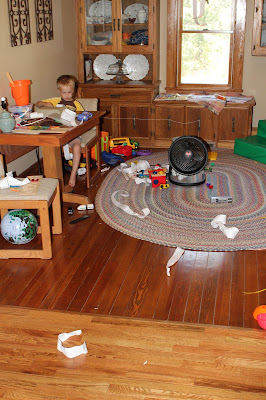
This afternoon Jacob: These pancakes have sprinkles in them! Parties have sprinkles. I think we are having a party! Right, mom? Terah: Sure, this could be a pancake party. Jacob: And all parties also have ICE CREAM! So we should have some ice cream. Terah: Uh, Jacob, I m not so Jacob: Oliver, we are having ice cream! Oliver: YAY! It s amazing how fast sprinkles can get out of hand. Later that day I had gone downstairs, pulled out one of the wonderful old hymnbooks I have in my collection but have rarely looked at, and sat down at the piano to play a bit. Oliver came in, sat down next to me, played a few notes, and promptly got down. Jacob came in, sat down next to me, and took over our digital piano. He set it to provide some automatic accompaniment, selected a salsa beat, then hopped down as I continued to play a 4-part Mennonite hymn in my best imitation salsa style (not so good, in case you re wondering). Jacob happily announced, IT S DANCING TIME! He then picked up a large blanket and ran around the house, reminding us every minute or so that it s dancing time at the top of his voice, while Oliver ran around randomly yelling AAAAAA! , and I went for maximum dissonance by attempting to play Praise the Lord, Sing Hallelujah to a salsa beat. Meanwhile Terah was sitting on the couch looking, well, a bit stunned. Just another quiet evening at home.

Charles Plessy: Installing Debian in a cloud

It has been a long time I want to prepare a pure Debian virtual image for the Amazon elastic computer cloud, that would contain the bioinformatics tools that we package in Debian Med. Most methods discussed in the ec2debian group use debootstrap, and finish the preparation with external scripts. Now that Amazon Machine Images can boot on their original kernel, I am exploring the use of the debian installer to setup a pristine system on a elastic block storage volume. The Debian installer can be booted with GRUB and preseeded through a file downloaded early after starting. In the Amazon cloud, this file can be put at http://169.254.169.254/latest/user-data with the other instance metadata. Since I am not much experienced in this field, I progress slowly on automating the procedure. For the moment, preseeding is not comprehensive, but at least the installer's SSH console is started. Ideally, one should connect using a key, but for the moment I go with a password. Currently, I am stuck with the partitioning of the hard drive: No root file system is defined . Here are a couple of technical details. I use the cheapest instances, t1.micro (32 bits) for the tests. I downloaded debian-installer on an elastic volume of 1 Gb, that I formatted in ext2. Not knowing if the device name will stay stable (/dev/sda1 or /dev/xvda1), I flagged the partition, as I have seen in Ubuntu virtual machines.
ARCH=i386
DIST=squeeze
DI_VERSION=20110106+squeeze3
MIRROR=jp
BASEURL=http://ftp.$MIRROR.debian.org/debian/dists/$DIST/main/installer-$ARCH/$DI_VERSION/images/netboot/xen
mke2fs -L debian-installer /dev/sdb -F
mount LABEL=debian-installer /mnt/ && cd /mnt/
wget $BASEURL/initrd.gz $BASEURL/vmlinuz
mkdir -p boot/grub
cat > boot/grub/menu.lst <<__END__
default 0
timeout 3
title  Debian Installer ($DI_VERSION $ARCH)
root   (hd0)
kernel /vmlinuz root=LABEL=debian-installer ro console=hvc0 auto=true priority=critical url=http://169.254.169.254/latest/user-data
initrd /initrd.gz
__END__
A snapshot of this volume can then be registered as an image machine. The kernel to use will depend on whether the system has been installed in the whole volume or a partition. Debian distributes tools for all these operations, such as euca2ools.

7 August 2011

Philipp Kern: Debian s390: channel numbers and consoles

Three things I learned about Debian s390 today:

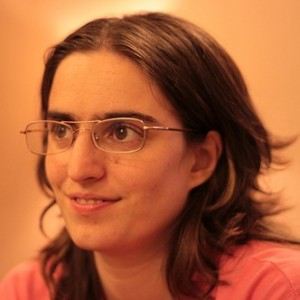
Rapha&#235;l Hertzog: People behind Debian: Margarita Manterola, Debian Women member

Photograph taken by Julia Palandri

When I think about Margarita, I always remember her as a friendly and welcoming person. Like most of the Debian Women members by the way. But she likes to spread some love and organized a Debian Appreciation Day for example. I think I met her in real life for the first time at Debconf 6 in Oaxtepec (Mexico). She deeply cares about Debian in general. She has proven it multiple times with her DPL candidacy and by giving talks like Making Debian rule again. One last thing, Debconf11 is just over and you will see that Debconf4 has had a big influence on Marga. My advice is simple: next time there s a Debconf on your continent, make sure to take a few days off and come to meet us! It really gives another picture of the Debian community. Now let s proceed with the interview. Raphael: Who are you? Margarita: I m Margarita Manterola, a Software Developer from Argentina. I work developing software in Python in a Debian-friendly company during the day, and teach programming at a local university during the evenings. I m married to Maximiliano Curia who is also a Debian Developer, most of our Free Software work has been done together. I only maintain a handful of packages in Debian, I m more interested in fixing bugs than in packaging new software. I ve also been a part of the organizing team of many of the previous Debian Conferences. One of the biggest commitments and the biggest success of my participation in Debian was being part of the organizing team of DebConf8, in Argentina. Raphael: How did you start contributing to Debian? Margarita: I started using Debian around 2000. Soon after we had learned the grips of general GNU/Linux usage, Maxy and I started giving an introductory course at our local university, and became quite involved with the local LUG. At some point in 2002/2003 I became a Debian Bug Reporter : most of my friends would report bugs to me, and I would then write them in the proper form to the BTS. I would also be very attentive about reporting any bugs that I might encounter myself trying to create good bug reports. The turning point in my participation in Debian was DebConf4 in Porto Alegre, Brazil. Being so close to Argentina meant that we felt specially invited to be there, and Maxy and I decided to go to DebConf for our honeymoon. We didn t really know much about DebConf dynamics, but we were really eager to learn more about Debian and become more involved. What happened was that meeting with DDs from all over the world transformed our lives, we became part of the Debian family and wanted to be more and more involved. Soon after that we both started maintaining packages and not long after that, applied to become Developers. The Debian Women project also meant a lot to me. I felt encouraged all along the way, encouraged to learn, to ask questions and to lose the fear of making mistakes. I became a Debian Developer on November 2005. Since then, Debian has always been one of the most important things I do in my life. Raphael There was a Debian Women BoF during debconf. What are the plans for Debian Women in the upcoming months? Margarita: I was not there in person, but thanks to the awesome work of the video team, and of Christian Perrier s typing efforts when something failed, I was able to experience much of what was discussed. :) One of the many points that came up during the BOF is that many people Want to help but don t know where to start or how to go about it. It s a challenge for the Debian Women project to find a way to allow these people to become involved in Debian through Mini projects or something like that. Another of the subjects that was brought up was the Debian Women mentoring project, which has been going on for quite a while now, but lacks enough publicity. So, we need to reach more people about it, and maybe also improve it with some templates, similar to the New Maintainer templates, so that mentees that don t know where to start have some sort of general path to follow. Raphael: You created very useful diagrams documenting how package maintainer scripts are invoked by dpkg. How did you do it and was that a useful experience? Margarita: I did those diagrams to be able to answer one of the questions in the NM templates, regarding the order of the maintainer script execution. Answering the question in text was basically copying and pasting the part of the Debian Policy that explained it, which wasn t really too clear for me, so I decided to go and make a diagram of it, so that I could really understand it. I did it by the best of all debugging techniques: adding prints to each of the maintainer scripts, and testing them in all the different orders that I could think of. It was a useful experience at the time, because I learned a lot of how maintainers scripts work. I didn t expect the diagrams to become so famous, though, I only did them to answer one NM question, that I assumed most other people had already answered before :) Raphael: You participated in a DPL election. This is a big commitment to make. What were your motivations? Margarita: As I said, I was part of the organizing team of DebConf8, in Argentina. Which was quite a success, a lot of people enjoyed it and praised the good work that had been done by the local team. During said DebConf8, I had a dream (it was almost a nightmare, actually): I woke up and just like that, I was the DPL. I spoke to some people about this dream and to my complete surprise many said that I should actually do it. After giving that possibility a year and a half of thoughts, during the 2010 campaign I was talked into participating myself as a candidate, and it was a very interesting experience. However, I m very glad that Zack got elected and not me, I think he makes a much better DPL that I would have made. Raphael: What s the biggest problem of Debian? Margarita: I think the main problem that we have is our communication, both inside the project and outside the project. Most of us are very technical people, our skills lay in the technical part of Debian (preparing packages, fixing bugs, writing software, administering systems) not in the social part. And thus, we lack a general empathy that is quite needed when interacting with people from all over the world. Raphael: Do you have wishes for Debian Wheezy? Margarita: Not particularly. I do want it to be a great release with good quality, stable software. I would also like to keep making Debian more and more universal with each release, making it more user friendly, more accessible, and more robust than any other previous release. Raphael: Is there someone in Debian that you admire for their contributions? Margarita: I admire a lot of people in Debian. There s a lot of people that contribute a lot of time to Debian, amounts of time that I can t begin to understand how they can afford. I admire Stefano Zacchiroli, our current project leader. And Steve McIntyre, the project leader before him. Also Bdale Garbee, who s also been a DPL in the past. Making this list I realize that Debian has been blessed by quite a number of great leaders in the past. I admire Holger Levsen, for his contributions to the DebConf video team, that have made it possible year after year for the whole project to participate in DebConf remotely. I admire Steve Langasek and Andreas Barth (etch is still my favourite release). I admire Christian Perrier for his work on internationalization. I admire Joerg Jaspert for the incredible amounts of time that he puts into Debian. And actually, I could go on admiring people all night long. I admire so many people that this interview could become a very boring list of names. I guess it s better to leave it at saying that Debian is lucky to have quite a lot of excellent hackers around.
Thank you to Marga for the time spent answering my questions. I hope you enjoyed reading her answers as I did. Subscribe to my newsletter to get my monthly summary of the Debian/Ubuntu news and to not miss further interviews. You can also follow along on Identi.ca, Twitter and Facebook.

14 comments Liked this article? Click here. My blog is Flattr-enabled.

Jan Wagner: (new and old) culture

After visiting the great Deadmau5 concert of his Europe Tour in Berlin 7 weeks ago, I m involved into a traditional cultural event on the technical side on the next weekend.

We are running the plattform for the online streaming of Lohengrin live from the Bayreuth Festival Theatre on Sunday, 14th August 2011. Usually we are coming together around noon and having a BBQ while keeping all the stuff up and running.

To get back into this millenium, we (yes, my girl and me) are at the Highfield festival the weekend afterwards. I guess you can find me at the white stage or at camp site. Keep on rocking!

Asheesh Laroia: Women, men, and accidentally being a jerk (at the Desktop Summit)

The first day of the Desktop Summit was yesterday, Saturday, August 6. I loved it and gave a presentation. There are two very different stories I can tell on the topic of gender equality in free software. I'll start with the bad.
It's pretty easy, in the U.S. at least, to get people of privilege to stop using terms that evoke centuries of oppression from slavery. It's harder to ask people to stop doing that to women. I'm writing this post to ask for that. There were two different times that people I generally respect used words that historically have been used to hurt and minimize women. "Cygnus Solutions is prostitutes." Dave Neary was delivering a talk (that I found impressively informative) called, "The cost of going it alone". When the talk covered the cost (in time and money) of getting your corporation's code into the community branch of an open-source project, he pointed out you could hire someone with the skills. Cygnus was the go-to company for that in the 1990s; to explain that Cygnus does not care who they work for, he said the sentence in bold. "The OpenSuSE Build Service is a slut." I was at a party at a hackerspace last night. Someone who I admire for his work in free in free software, both technical and community, was joking with me about that no one should compile (or use) GTK. I riffed on the joke and remarked, "The OpenSuSE build service will build anything." He replied with the sentence in bold. "Slut" and "prostitute" are terms that recall the objectification of women. They're terms that attempt to measure a woman's worth as a sex object. It's not nice to the many women in attendance to bring that up. You might not have thought this through. You might want to read one woman's take "On Sluts, Rape, and Fuckery". Give it a read. Then, give it a rest. The thing is, this matters all the time. That's why I have to call you two out on it. Now for the happy story.
While watching the Desktop Summit's intern showcase, I was floored. One hacker implemented Off-The-Record instant messaging for Telepathy. Another implemented pluggable back-ends for Getting Things GNOME, a task manager. I heard about overwhelming documentation and usability improvements to GNOME mainstays Cheese and Anjuta. In a short summer, these students made huge changes. For most of them, this was the first time they delivered any sort of presentation. Every single talk was delivered in earnest and enthusiasm. They told us about the work they had done and what might happen in the future. The other remarkable thing about the intern presentations was the demographics. I didn't keep count, but it seemed like as many women as men presented. We heard about hugely-important changes to documentation, code, and usability. People from central Europe, South Asia (yay), and Brazil took the stage. I hope that is the future of free software.
There are two things I want to see for our community. I want to know that people are respected and not reminded of centuries of oppression. I also want to see our community grow in size and diversity. I treat these issues as separate. We should choose respectful words when we speak not because we want more women to show up, but because it part of the expectation of decency that we should be able to expect from each other. And I failed the community when I did not make it clear there and then that this kind of language is not okay with me. It took me a day to understand this failure, so here I am writing this blog post. P.S. Thanks to Karen Rustad for her feedback while writing this post.

Christian Perrier: Jiwayeu Anivaichai' Bob

Today is our "historical" Spongebob (the one you can see here) birthday. Bob is indeed "born" on August 7th 2002, in Las Vegas, when my (at that time) kids won it in the Kids Casino in Circus Circus casino. Since then, Bob is one of the family mascots along with the world famous Titeps (these are born much earlier). The Perrier family has tons of stories about Bob and we developed a major "Sponge disease", becoming more and more crazy about this incredible character. So, happy 9th birthday, Bobob....and have a good meal tomorrow (the day after his birthday is the only day in one year where he eats something....the rest of the year, Bob only drinks whatever liquid comes close to him). I know that Jean-Baptiste won't forget to feed you.

6 August 2011

Bdale Garbee: FreedomBox in Banja Luka

FreedomBox activities at Debconf11 I spent the last two weeks of July 2011 in Banja Luka. The occasion was the annual Debian developer's conference, Debconf11 and preceding work week known as Debcamp. This was my tenth successive year attending Debconf, and I had a very productive and pleasant time! The facilities were good, the local team was friendly, enthusiastic, and very helpful, and in addition to giving three talks and hosting a couple panel discussions, I managed to put a burst of energy into work on FreedomBox. Several other developers working on FreedomBox were also present, and a good number of Sheeva and Dream plugs were evident in the hacklabs sporting new FreedomBox stickers. Working together in the same place for several days, we made good progress on several projects, and also had some great discussions about what we want to do going forward. image building tools For some time, I've been working towards a light-weight tool set to build FreedomBox software images. Shortly before Debconf started, I chose the name 'freedom-maker' for this tool and shared a link to a readable copy of my git repository with other developers I expected to work with in Banja Luka. With input from Bert Agaz and Jonas Smedegaard during Debcamp, freedom-maker went from almost useful to actually useful. It still deserves work to be more useful to others, but I have now pushed a copy of the git repository to git.debian.org so that we can take advantage of the tools supported there to enable others to more easily contribute to the code. Very soon, Bert plans to add support to freedom-maker for using Lars Wirzenius' vmdebootstrap to build x86 images suitable for testing in a virtualized environment. At the same time, we plan to refactor the existing code slightly to enable lists of desired packages for the various image flavors we expect to produce independently of the configuration for each specific image building tool. Jonas continued in parallel to work on his alternate packaging toolset boxer. It offers some potentially interesting features for the future, and we may eventually merge some or all of it into freedom-maker, but for now it remains a separate utility. uAP user space tools Several weeks ago, we received from Marvell the source code to two user space programs that are necessary for configuring and monitoring the binary firmware provided for the uAP wireless chip used in the DreamPlug. Early during my stay in Banja Luka, I packaged these for Debian as uaputl and uapevent, and I am pleased to note that they were quickly accepted into the archive and are now present in Debian mirrors. u-boot Another bit of code received very shortly before Debconf started was the source for the version of u-boot shipped by Globalscale in the DreamPlug units we're working with. During Debcamp, Clint Adams passed a copy of this source to Jason Cooper, who was already trying to add support for the DreamPlug to upstream u-boot, but had stalled due to a lack of information. Jason has now merged his own work with the sources we got from the manufacturer, and is making good progress towards merging DreamPlug support into upstream u-boot. Once that happens, we should be able to flash our Sheeva and Dream plug devices with a u-boot image built from the source in the Debian u-boot package, in the process enabling things that matter to us like the ability to boot from an ext2 partition, and hopefully the ability to execute command scripts from that partition instead of having to hard-code kernel filenames in flash. This will allow us to support the ongoing effort in Debian to move away from the need for kernel symlinks. DreamPlug kernels With respect to kernels, another work stream at Debconf primarily involving H ctor Or n and Nick Bane was to analyze the current state of the patches from Marvell and Globalscale used to support the DreamPlug against both upstream and current Debian kernel sources. To my surprise and our collective pleasure, the remaining patch set required against current upstream kernels is much smaller than we previously believed! There are still several patches critical to us that are not merged upstream, but the work remaining to be able to build images for our devices from mainline and Debian kernel source trees now seems like something we might be able to complete before Debian's next stable release. One of our discoveries during the u-boot and kernel work during Debconf was that Globalscale did not obtain a new machine id for the DreamPlug, but instead re-used the one for the GuruPlug series, despite there being some differences in the hardware that require at least one additional driver. After much discussion, we plan to continue using the existing machine id instead of requesting another, particularly because the ARM kernel community has apparently stopped issuing new ids for the moment. We will add a new kernel config option for the DreamPlug, however, and are likely to build distinct Sheeva and Dream kernel packages that do not require initrd for use in FreedomBox images, even if doing so is not strictly necessary. This will allow us to optimize both the in-memory footprint and boot times for our devices. software configuration Another area of investigation in Banja Luka was technology for package configuration. Mirsal Ennaime performed various tests using debconf and Config::Model, with some results reflected in this commit relating to configuring the bitcoind daemon in the bitcoin package for Debian. identity and trust management While we did not actually do any FreedomBox specific work on the trust management layer we know is necessary, after several rounds of conversation, I am now more convinced than ever that the right path forward is to base our trust relationships on OpenPGP keys using GnuPG and Monkeysphere as starting software elements. Our thinking to date is captured on an Identity Management page in the wiki. communication services Another thing that became fairly clear to me during discussions at Debconf is that in the near term, planning to build communication services around XMPP is the approach most likely to give good results. Investigating the software choices available to build an interesting XMPP infrastructure is now a high priority for me. Jonas has done some work towards configuring and integrating ejabberd or Prosody, I've started studying yate as a possible call manager and VoIP server choice with XMPP/jingle support, and we await with great interest a release from the Buddycloud developers to evaluate as a possible basis for deploying social network services. Some of these software choices will lead us to use Apache as our web services base technology because of the need for features that only it supports well among daemons that are Free Software. Jonas completed packaging GNU Sip Witch for Debian, and it is now available in the mirror network. Tzafrir Cohen and Jonas did some initial testing on its use. documentation A number of new wiki pages were written (or at least started) in order to sum up ideas, design various aspects of FreedomBox, and reflect discussions that happened during DebConf11. A lot of work is needed to complete these pages though, as well as others to capture more of the current state of the project. press coverage Finally, while in Banja Luka I got some great press coverage for FreedomBox! On Sunday the 24th, I was interviewed by the main television network serving the Republika Srpska. This led to a couple of minutes of coverage near the top of the national news program that night, immediately following the lead story about the President and several ministers appearing at Debian Day that morning to help open the conference. This interview was later re-used in another TV program that summarized Debconf11. On the morning of Thursday the 28th, I was part of a small group that spent more than an hour meeting with the Minister of Science and Technology in his office, and the relationship between Debian and our work on FreedomBox was one of the items of discussion in that meeting and the associated press conference. I'm told this resulted in more press coverage, but if true I have not seen it yet. summary On Friday afternoon the 29th, I gave a talk in the main Debconf program containing a FreedomBox Progress Report . In it, I talked about the structure of the FreedomBox Foundation, progress the foundation has made, and the work that was still then underway in Banja Luka. It was streamed live over the internet, and replays are available online. The reaction from Debian developers present was very positive, which was good to learn since by that time my energy level was quite low after the nearly two weeks of intense technical and social interaction that is Debconf! All in all, we got lots of work done on FreedomBox in Banja Luka, enough that I think at least the next few steps along the road towards an eventual "1.0" release of a reference implementation are now much clearer than they were two weeks ago!

31 July 2011

Benjamin Mako Hill: Cost of Computing in Coal

 by jonasclemens, on Flickr
Creative Commons Attribution 2.0 Generic License by jonasclemens
Much of my academic research involves statistics and crunching through big datasets. To do this, I use computer clusters like Amazon's EC2 and a cluster at the Harvard MIT Data Center. I will frequently kick of a job to run overnight on the full HMDC cluster of ~100 computers. Some of my friends do so nearly every night on similar clusters. Like many researchers and engineers, it costs me nothing to kick off a big job. That said, computers consume a lot of energy so I did a little back-of-the-envelope calculation to figure out what the cost in terms of resources might add up to. An overnight job that uses a 100 computer cluster might use 800 computer-hours. Although power efficiency varies hugely between computers, most statistical analysis is CPU intensive and should come close to maximizing power consumption. According to a few sources [e.g., 1 2 3], 200 watts might be a conservative estimate of much a modern multi-CPU server will draw under high load and won't include other costs like cooling. Using this estimate, the overnight job on 100 machines would easily use 160 kilowatt hours (kWh) of energy. In Massachusetts, most of our power comes from coal. This page suggests that an efficient coal plant will generate 2,460 kWh for each ton of coal. That means that one overnight job would use 59 kg (130 lbs) of coal. In the process, you would also create 153 kg (338 lb) of CO2 and a bit under half a kilogram (about 1 lb) of nitrogen oxides and sulfur dioxide each. It's a very rough estimate but it certainly generates some pressure to make sure the research counts! Of course, I've written some free software that runs on many thousands of computers and servers. How many tons of coal are burnt to support laziness or a lack of optimization in my software? What is the coal cost of choosing to write a program in a less efficient, but easier to write, higher-level programming languages like Python or Ruby instead of writing a more efficient version in C?

John Goerzen: A 4-year-old, Linux command line, and microphone

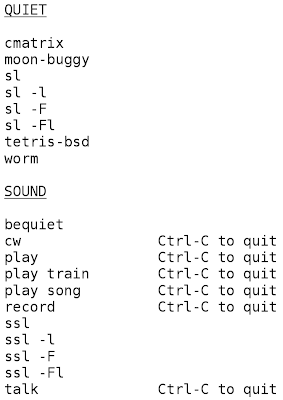
There are certain times when I m really glad that we have Linux on the house for our boys to play with. I ve already written how our 4-year-old Jacob has fun with bash and can chain together commands to draw ASCII animated steam locomotives. Today I thought it might be fun to install cw, a program that can take text on standard input and play it on the console speaker or sound card as Morse code. Just the sort of thing that I could see Jacob eventually getting a kick out of. But his PC was mute. We opened it up and discovered it didn t have a console speaker. So we traipsed downstairs, dug out an external speaker, and I figured out how to enable the on-board audio chipset in the BIOS. So now the cw command worked, but also there were a lot of other possibilities. We also brought up a microphone. While Jacob was busy with other things, I set to work getting things hooked up, volume levels adjusted, and wrote some shell scripts for him. I also printed out this reference sheet for Jacob: He is good at reading but not so good at spelling. I intentionally didn t write down what the commands do, hoping that this would provide some avenue for exploration for him. He already is generally familiar with the ones under the quiet category. I wrote a shell script called record . It simply records from the microphone and drops a timestamped WAV file in a holding directory. He can then type play to simply play back whatever he recorded most recently. Easy enough. But what he really wanted was sound for his ASCII steam locomotive. So with the help of a Google search for steam train mp3 , I wrote a script ssl (sound steam locomotive) that starts playing the sound in the background if it isn t already going, and then runs sl to show the animation. This was a big hit. I also set it up so he can type play train to hear that audio, or play song to play our favorite train song (Always a Train in My Dreams by Steve Gillette). Jacob typed that in and sat still for the entire 3 minutes listening to it. I had to hook up an Ethernet cable to his machine to do all this, and he was very interested that I was hooking his computer up to mine in some way. He thought all the stuff about cables in the walls was quite exciting. The last thing I did was install flite, a speech synthesis program. I wrote a small shell script called talk which reads a line at a time from stdin and invokes flite for each one (to give more instant feedback rather than not starting playback until after having read a large block from stdin). He had some fun hearing it say his name and other favorite words, but predictably the most fun was when he typed gibberish at it, and heard it try to pronounce or spell nonsense words. In all, he was so excited about this new world of computer sound opened up to him. I m sure there will be lots of happy experimentation and discovery going on.

30 July 2011

Torsten Werner: DebConf11: Jigsaw Progress in Debian

Tom Marble and Guillaume Mazoyer gave a talk about Jigsaw Progress in Debian during DebConf11 in Banja Luka. Guillaume is a Google Summer of Code student mentored by Tom and Sylvestre Ledru. The project is about modularizing OpenJDK which replaces the old fashioned classpath by a modulepath that knows about versioned dependencies. It can reduce the memory footprint and the startup time for applications running in the JVM. It would be interesting to match Debian package versions to Jigsaw module versions. Debian could influence the JDK version 8 in this area. Upstream is already building Debian packages but they do not follow the Debian policy and do not use the Debian packaging tools. Guillaume has uploaded 2 packages (jtharness, jtreg) to Debian. These packages are needed to run the upstream testsuite which ships 3484 individual tests. More than 99% of them are working in Debian. There is a GIT repository of his Jigsaw work at http://anonscm.debian.org/gitweb/?p=pkg-java/jigsaw.git;a=summary. The slides of the talk are available at http://penta.debconf.org/dc11_schedule/events/718.en.html.

26 July 2011

Tiago Bortoletto Vaz: Some pictures of DC11 Cheese and Wine party

In DebConf9 i worked on some photo editing and ended with a sort of over-saturated album which is still available online. For the C&W party in DebConf11 i tried to delivery a black and white set of pictures by just doing some adjustments using ufraw. Pictures were taken with a Nikon D50 camera + Nikkor 50mm 1/1.4 in raw mode. Here are some examples of the result:
debconf11debconf11debconf11
You can enjoy these and other DebConf11 shots by following the links in DC11 wikipage.

John Goerzen: Jacob and the Amazing Technicolor Adding Machine

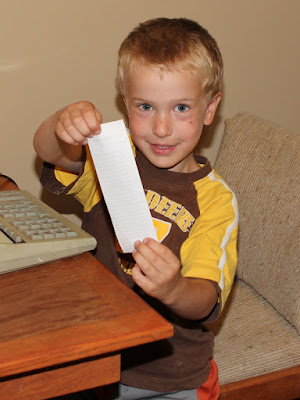
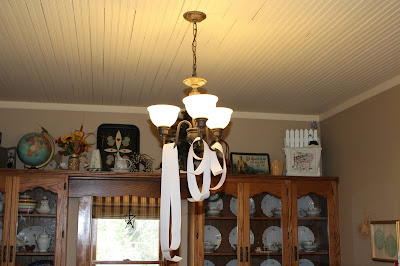
Jacob has been eagerly awaiting this day for at least, well, 2 days now. This morning he started asking questions. All day long he has been wondering how long until the big event. And that event is the arrival of the UPS truck carrying a special $8 package for him. And in that $8 package is not a DVD, or a book, or a toy, but rather 12 rolls of adding machine tape (totaling 1/3 of a mile). Oh yes, our four-year-old can hardly contain his excitement over office supplies. Let me back up a bit to explain. I am always on the lookout for a certain kind of toy. The sort of thing that you don t find in the toy section of a store. The sort of thing that is interesting and engages the curiosity of our boys, that most people would consider would toss, and that usually costs less than $5. Along those lines, Jacob has an old manual typewriter he can use, he and I built a switchbox full of switches and light bulbs that the boys love to play with, we built him a command-line-only PC out of spare parts, the boys have some radios they can use, and one day I salvaged a decades-old adding machine that was going to be thrown out. Jacob liked it he enjoys number and letter games and had some fun, but didn t zealously engage with it until just a few days ago. He sat down at his table and started making cards . He will print out a bunch of numbers, making a strip a couple of feet long, and then say, Dad, I made another card for you! We will then happily accept the card and he will continue making more. Here he is, holding up one of his cards: Jacob had a ton of fun making them, and Oliver wanted in on the action too. Oliver was somewhat interested in the adding machine, but not as much as Jacob, and Jacob didn t want to share. So somehow they decided that Oliver would run and get cards from Jacob and then take them to whatever parent Jacob said. Today Jacob said, Dad, the Oliver delivery service will bring you a card! Saturday morning we had some time to hang around and play, so we played some adding machine tape games. I tucked some long cards under my waistband, and the boys happily chased me all over the house trying to get them back. We also decorated: And here is what the room looked like after some cleanup: That orange bucket on the desk is my card bucket where I can put all the cards he gives me. He even helpfully empties it out into the recycle bin when there are too many old cards in it! But then tragedy struck it was out of paper! I ordered a 12-roll pack off Amazon, and boy was it a long couple of days until it arrived. Today before the UPS truck got here, I showed him how we could feed old paper through and print on the back side an incredible innovation, it seemed! Terah had a conversation with him earlier that went like this: Terah: Jacob, we need to clean up the house. Jacob: Why? Terah: Because some people are coming over. Jacob: Who is OH YES! The UPS delivery man! Yes, let s clean! Terah: Ah, well yes he will be here too, but your great uncle and aunt are coming. Jacob: Oh yay! And the UPS man! It is hard to describe Jacob s excitement when the package arrived. I quickly opened it up, and at his great uncle s prompting, he counted to see if he really did get 12 rolls of paper. IT IS TWELVE ROLLS! YAY! And then we quickly installed it in the machine and off he went. At his great uncle s prompting, he started writing a J on each card . This meant Jacob , or maybe he d put two J s, meaning To John From Jacob , or perhaps the two J s meant To Terah From Jacob he d always have to clue us in. Anyhow, for an $8 investment in paper this has brought hours of joy to our boys. Even though Jacob isn t yet really using it to perform arithmetic, it is setting him up to enjoy that sort of thing and encouraging his curiosity. Both good things.

25 July 2011

Anand Kumria: Licence stupidity in 2011.

As amazing as it is, there are still people who simply do not understand Free Software licences (but actually generate Free Software). Consider this gem.
A project that is released as GPL cannot be used in any commercial product without the product itself also being offered as open source.
What? You mean like the Linux kernel? A GPL'd product used in many commercial products? Even worse, he conflates "open source" with Free Software. For shame, Kenneth Reitz, for shame.

24 July 2011

Joey Hess: arrival at DebConf

The trip down from Gratz to Banja Luka was much easier than the day before. After a while you just get used to being sat in a car for ages. Plenty of nice scenery to enjoy through Slovenia. After a while our car's GPS's began to fail, showing us driving through fields, and we were stuck for 1.5 hours in a traffic jam when the 4 lane highway seemed to end. Got around that with some guesswork, and on into Croatia by back roads. The Bosnian border was an interesting experience, all the guards could say in English was "green card! green card!" -- which from an American POV is an unsettling thing to be asked for at a border, especially if they've already taken your passport away -- but at least we were not detained overnight. While drivers were away getting the car insurance settled it descended toward farce as we had to hand roll the cars forward to let trucks get into the country. (Or we thought we did.. one was rolled with the keys in it as it turned out.) Arrived at the Hotel in Banja Luka in the middle of a wedding, which was amazingly loud (I could still hear it from the 5th floor at 2 am). There's also a casino at the hotel, so first impression was garish and loud! ... But now that it's a rainy Sunday, seems much nicer here.

23 July 2011

Joey Hess: from the convoy

As I type this, it's just passed midnight. I'm in the back of a BMW somewhere in east Germany , and the Debian UK convoy is doing 110 mph on the autobahn, twenty hours into a twenty-five hour first leg of our trip to Banja Lunka. This all started out so sanely with a 3 am departure to catch the 6 am ferry at Dover. Followed by a couple of hours leisurely breakfast onboard. First hint that yes, this is a road trip in which things will go wrong was a minor bumper denting of one of the convoy's cars by a stray landrover during the ferry trip, but it didn't really phase us. On to Cologne, for a very nice lunch and to pick up another person. But we didn't anticipate how brutal the next leg to Gratz would be. Nor did we count on apparently half of Germany and the Netherlands getting out their campers and heading east this Friday. Spent multiple hours stop-and-go, and many more in constant traffic. Finally it opened out, so we can follow the night speed limit. And while we started out horsing around on the radio, we've developed some real comms discipline by now to keep the convoy together. Also people seem to be amazingly keeping rested while not driving. To add to the sleep debt to me, I flew in the day before, but I actually feel caught up now. Still I've not been driving at all due to mislaid license and general inability to safely drive a right side drive stick shift at 100 mph at night. Our 7 drivers are doing an amazing job. Update: Arrived safely in Gratz at 4 am. Austria tantilized with 30+ miles of tunnels thru the alps, but I've not seen an alp yet.
PS, you'll never appreciate a stinky, free bathroom until you're in a country where all the antiseptic bathrooms cost money and hoards of vacationers are doing the logical thing next to service stations.

Antonio Terceiro: Hello, Planet Debian

Hello, world! So, now this blog is being syndicated on Planet Debian, and I decided to write something to introduce myself. I was born in Salvador, Bahia, Brazil. I am married to Josy, a wonderful person; we do not have any kids yet, but anyone can notice we both discretely drooling when close to small children. I have a passion for building things, and making things work. Programming happens to be the better building toy that someone already invented. I became am official Debian Developer a little more than one week ago, but I have been working in the project for some time already. In the very beginning I was involved with the Perl group, but now almost all my work is in the Ruby team. I am a PhD student at Federal University of Bahia under supervision of professor Christina Chavez. My research involves three topics I am just fascinated about: Free ("and Open Source") Software, Software Design and Empirical Software Engineering. I am investigating whether it is possible to explain the variation in Structural Complexity by analyzing developer attributes. I want to answer questions such as "do developers with more experience in a project produce more complex code?", or "do developers that focus on a single part of the project produce more complex code than developers who work on the entire project?". As part of my PhD research I have been working on analizo, a multi-language source code analysis and visualization toolkit. I plan to write specifically about it in a later opportunity. My other job is running my own company, Colivre, together with several other great people. Colivre is a cooperative, which basically means that everyone who works there is also an owner of the company. We provide web solutions, in special social networking environments, social media websites and the like. Working on (and with) free software is our premise at Colivre, and most of our work involves either Noosfero or Foswiki. Right now I am taking some time off from Colivre to be able to concentrate on (and finish!) my PhD. Until late September I live at the beautiful Vancouver, BC, Canada, where I am currenly a visiting reasearcher at the Software Practices Lab at UBC under supervision of professor Gail Murphy. So that's it, I hope to post interesting stuff here and to get your feedback whenever you find it's worth. I also maintain a microblog at identi.ca, where you'll find shorter (and more frequent) updates.

21 July 2011

Wouter Verhelst: On the beard, again...

It looks like I might actually lose it sooner than I was thinking in my previous blog post, a few days ago. On the 18th, Formateur Elio di Rupo had written a proposed document on which to start negotiations. Most parties agreed to that, except for N-VA and CD&V. Unfortunately, that was enough to make further negotiations useless, so di Rupo had offered his resignation as formateur to the King, who kept his response "under advisement". I thought I was going to end up like Andrew. Since he wasn't formally ex-formateur yet, however, he continued working. And today, merely a few days later, with an extra proposal and perhaps also partly due to the King's angry speech for today's national holiday CD&V has now been persuaded to join the negotiations. It's been over fourhundred days, and far too many weirdos, but they're actually sitting down to talk. Like, right now. I'll hold off on buying those razor blades for now, but we might yet get there.

Stefano Zacchiroli: Test Driven Development in Debian

... or TDDD and DEP8 context As a nice byproduct of the huge "rolling" discussion we had back in April/May, various people have brainstormed about applying Test-Driven Development (TDD) techniques to Debian development. Here is a brief summary of some opinions on the matter: ... and hey, they've also coined the cool TDDD acronym, which I hereby took the freedom to re-target to Test-Driven Development in Debian. Having a cool acronym, we are already half-way to actually having the process up and running *g*. more testing I believe Debian needs more testing and I've been advocating for that since quite a while e.g. at DebConf10, as one of the main goals we should pursue in the near future. Of course advocating alone is not enough in Debian to make things happen and that is probably why this goal has been (thus far) less successful that others we have put forward, such as welcoming non-packaging contributors as Debian Project members. There are important reasons for increasing testing in Debian. quality assurance Quality Assurance has always been, and still is, one of the distinctive traits of Debian. I often say that Debian has a widespread culture of technical excellence and that is visible in several places: the Debian Policy process, lintian, piuparts, periodic full archive rebuilds, the EDOS/Mancoosi QA tools, the cultural fact that maintainers tend to know a lot about the software they're packaging rather than only about packaging, the we release when it's ready mantra, etc. But caring about quality is not a boolean, it's rather something that should be continuously cherished, refining quality requirements over time. By simply maintaining the status quo in its QA tools and processes, Debian won't remain for long a distribution who could claim to care about package quality. Others will catch up and are in fact already doing that. In particular, we surely have room for improvements in our quality tools and processes for: reducing inertia Inertia is a recurring topic among Debian lovers (and haters). It is often argued how difficult it is to make changes in Debian, both small and large, due to several (alleged) hindrances such as the size of the archive, the number of ports, the number of maintainers that should agree before proceeding with a cross-package change, etc. It's undeniable that the more code/ports/diversity you have, the more difficult is to apply "global" changes. But at least for what concerns the archive size, I believe that for the most part it's just FUD: simply debunking the self-inflicted culture about how "dangerous" doing NMUs is might go and has already gone, imho a long way to fight inertia. Adding per-package and integration tests will make us go another long way in reducing inertia when it comes to performing archive-wide changes. Indeed if a package you are not entirely familiar with has extensive test suites, and if they still pass after your changes, you can be more confident in your changes. The barrier to contribution, possibly via NMU, gets reduced as a result. And if your change will turn out to be bad but still not spot by the test suites, then you can NMU (or otherwise contribute) again to extend the test suite and make the life easier for future contributors to that package. It smells a lot like an useful virtuous cycle to me. autopkgtest / DEP8 how you can help Of all the above, the topic that intrigues me the most is as-installed package testing. Work on that front has been started a few years ago by Ian Jackson when he was working for Canonical. The status quo is embodied by the autopkgtest package. At present, the package contains of various tools and the following two specs:
  1. README.package-tests provides a standard format to declare per-package tests using the new debian/tests/control file. Tests come as executable files which will be run by the adt-run tool in a testbed where the package(s) to be tested is already installed. This part of the specs has been reified as DEP8 which I'm (supposedly) co-driving with Iustin Pop and Ian (for well-deserved credits).
  2. README.virtualisation-sever describes the interface among the test runner and the testbed. A nice separation is provided among the runner and the testbed, enabling different testbed environments with a varying degree of isolation: you can have a "null" testbed which runs tests on your real machines (needless to say, this is highly discouraged, but is provided by the adt-virt-null tool), a chroot testbed (adt-chroot), or a XEN/LVM based testbed (adt-virt-xenlvm).
The specs allow for several runtime testing scenarios and look quite flexible. The tools on the other hand suffer a bit of bitrot, which is unsurprisingly given they haven't been used much for several years. At the very minimum the following Python development tasks are in need of some love: If you are both interested in TDDD and grok Python, the above and many others tasks might whet your appetite. If this is the case don't hesitate to contact me, I'll be happy to provide some guidance.
Note: this post is the basis for the TDDD BoF that I will co-host with Tom Marble at DebConf11. If you plan to come, we will appreciate your thoughts on this matter as well as your help in getting the autopkgtest toolchain up and running again.

Next.

Previous.