Search Results: "ah"

7 June 2010

Daniel Stone: and one more thing ...

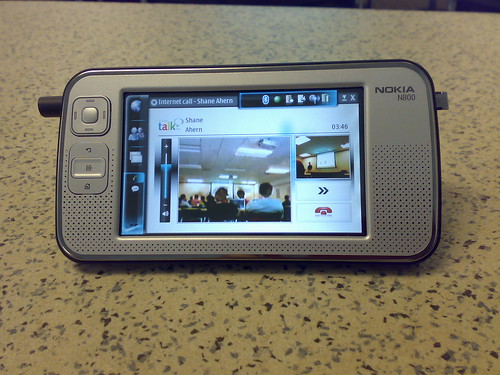
So, I spent an hour or two this afternoon following the iPhone 4 liveblog. It all looked fairly compelling (the screen!), right up until Steve's 'and one more thing': video calling.


HELLO I'M IN 2007, CAN YOU HEAR ME
(Photo of the Nokia N800, which shipped in January 2007, from rnair.)

The moral of the story? If you want to be four years ahead of the WWDC closing bombshell, email sales@collabora.co.uk. :)


PS: The 2010 'fuck it, we're going to fivefour blades' version; we also had a six-way video call going earlier today.

John Goerzen: Boys

Yesterday afternoon, it was nice outside. Terah, Jacob, Oliver, and I went outside. I had my camera to take photos while Jacob and Oliver mostly played. We did try to pose them a bit, but the overall plan was to just take some photos of them doing their own thing. So I wound up taking 824 photos. Hurray for digital cameras. We narrowed that down to a few of our favorites, which you can view as a slideshow. I ll highlight few of those below. IMG_3926.JPG
Jacob walking down the drive way, gazing at all the beans coming up off in the distance IMG_3910.JPG
Hmm, Oliver, let me see too IMG_3823.JPG
Running is fun! IMG_3818.JPG
Peek-a-boo IMG_3802.JPG
Goerzen s Law of Child Photography: If you attempt to get them to pose, a minimum of one boy will have a weird expression at any given time. IMG_3763.JPG
Also, chances are good that a cat will sneak in and also do something. IMG_3710.JPG
My imagined conversation for this one: Here Oliver, this is how you use a piece of bark. Quiet, I m trying to eat this grass. IMG_3718.JPG
Oliver decides that grass stuck on his teeth isn t fun IMG_3684.JPG
No explanation for this one. IMG_3644.JPG
Classic brothers. Jacob is using a piece of bark to mess around in some dirt, while Oliver quietly learns how to do it. He never said it, but I can easily imagine him saying, Here Oliver, here s what you do with bark: you dig up dirt like this! It s funny! IMG_3619.JPG
BONZAI!!! IMG_3580.JPG
Guess I better watch where I point that camera IMG_3477.JPG
Here kitty get ready for some more petting *thwack* Strangely the cat seemed to love it. Our other cat avoids Oliver. IMG_3404.JPG
Jacob deriving a great deal of joy from telling us that his shirt says big SPIDER . He came up with that joke himself and thought it was hilarious. IMG_3366.JPG
This is one of a few photos of Jacob wearing a suit that I once wore. IMG_3292.JPG
It s hard to stand still when the hammock has a great train whistle on it. IMG_3241.JPG
I have no idea what he s planning here. But really, I think I should be afraid. IMG_3191.JPG
It s a fridge door. Yay?

5 June 2010

Jos? Parrella: Ditching PCI cards in Asterisk for fun and profit

In the past, I ve used PCI cards providing telephony TDM for my Asterisk-based projects. I ve only worked with Digium s FXO/FXS and T1/E1 cards, both in PCI and PCI-x formats, until a client asked for a gateway solution with FXO, FXS and E1, where using the PCI cards in a 1U IPBX was simply out of the question. Using Ethernet gateways has always been a problem in those cases, since entry-to-medium level solutions lack the processing power for massive call handling, and signalling is poor, making the architecture unfit for reporting purposes and specialized apps such as call centers. But hey, that s my experience with gateways. Therefore, I looked into Xorcom s Astribank. They pack FXO, FXS and PRI/BRI ports inside a convenient 19 1U case, which can connect to an Asterisk-based IPBX server via USB and gets recognized as an integral DAHDI device in modern setups. So I ordered a composite 8xFXO, 8xFXS and 1xE1 PRI from Astribank, labelled XR0072. Getting the equipment from Arizona to Florida was easy, and since I worked with DHL, getting it to Guayaquil in Ecuador was a breeze (next-day delivery) but passing customs is, as always in Latin America, a time-consuming operation. After paying 12.5% taxes and then some for DHL operations, and 15 days waiting, I got the equipment in Quito. To my surprise, the Astribank was extremely light and small, slightly near 3 Kg in 1U form factor and under 1/4 depth in the rack. While it had a rack-mounting kit, which I used, it could also rest securely over my IPBX without rack screws. My Astribank uses a single USB cable to connect to the master PBX it could also be connected to a secondary PBX and provide a fault tolerant setup. It also depends on a DC supply, which they included. Since I was using a modern Debian, with a modern Asterisk with already-compiled modern DAHDI (formerly called Zapata/Zaptel) drivers, I just connected the equipment via USB to the IPBX, issued an invoke-rc.d dahdi restart and we were good to go. Note: you do need the fxload package in Debian for firmware loading to the Astribank. And for good to go I mean you can check the registered spans with dahdi_registration and, as soon as you connect the E1 cable that comes from the CPE to the CPE port (which in my XR0072 is the first on the lower row for PRI) you get an OK status with dahdi_tool. Also note that I use an E1/CPE port, which is the default for the Astribank, otherwise I d have to set the XPP_PRI_SETUP variable as indicated on the User Manual. DAHDI insists on configuring a crc4 parameter for the detected spans, which I needed to remove and restart DAHDI so the equipment could sync with the CPE (that is, the box that the telco provided, with the balun and the crossover RJ45 cable) and avoid some nasty noise issues on the line, that also occur with Digium s Wildcard for PRI.
usb:008/005          xpp_usb+     e4e4:1162 Astribank-modular FPGA-firmware
 LABEL=[usb:...]       CONNECTOR=@usb-0000:00:1d.7-1
	XBUS-00/XPD-00: E1       (31)  Span 1  DAHDI-SYNC
	XBUS-00/XPD-10: FXS      (8)   Span 2
	XBUS-00/XPD-20: FXO      (8)   Span 3
Using DAHDI s dahdi_genconf command writes an /etc/asterisk/dahdi-channels.conf file with the group and channel configuration as detected by DAHDI. It should be included by the chan_dahdi.conf file, which, in my case, is not necessary since I only wanted to enable one DAHDI group (DAHDI/g0) with my 31 E1 channels (1-15,17-31)
group=0
context=from-pstn
channel => 1-15,17-31
That means that when I want to use the FXO/FXS ports, it d probably be easier to include the dahdi-channels.conf (FXS ports, for example, belong to a different context, from-internal) so I don t have to type more than my laziness permits. I also found that, in my setup, some Asterisk parameters were superfluous, such as the switchtype (either national or euroisdn work, and the former is the default) or the echo-cancelling stuff, so I assume Astribank s doing a great job in negotiating that with the CPE. Do take note, however, that in my case the CPE needed to be cold-restarted so I could get an Up status in Asterisk (pri show spans) and that my only non-default, channel related configuration in chan_dahdi.conf is signalling=pri_cpe. So far, so good. I m really happy with the Astribank and I can fully understand how useful it is in terms of price (quite competitive in comparison with traditional cards, specially when bought from resellers -like me-), size/weight and functionality/ease of setup and administration. Kudos!

3 June 2010

Jan Hauke Rahm: Berlin, next week

It seems I ve missed quite a few weeks in my countdown to our Mini DebConf. Fortunately, it s not too late for you to join even if, right now, you don t know why you should! So what s the status? Well, we ve had out problems in the beginning to start the whole thing but we managed. There are a few minor issues left, I admit. If you happen to have a bit time on 10th or 11th to hold the camera for an hour or so, contact us! Or if there is *anything* you would wanna do to help us out a bit, don t be shy. You don t need to be a known Debian contributor, you don t need to know us. Arguably, you should know Debian but then, if you re able to spell the name correctly, you re probably in. :-) Apart from that, we really think it s gonna be awesome. Not only will there be a few Debian Developers from outside Germany, like our project leader zack who we have the honor of listening to for he has the first talk on Thursday. There will also be quite a few German faces that some of us haven t met yet have you met Sebastian, the chief of our beloved debianforum.de, yet? We are going to have a great time and you re a fool not to join. Thus, a last time for all of you who still don t know what I m talking about: Next week there ll be the famous LinuxTag in Berlin from Wednesday to Saturday. Right in the middle, on Thursday and Friday, we, the Debian community, will have a Mini DebConf right there. There will be talks about different Debian related things. And many active developers will be there happy to talk to you about whatever you always wanted to know or say about Debian. And then, not to forget, we ll have a hacklab where you can easily plug in your notebook and start hacking with us. Have an idea to improve Debian? Always wanted to know how to fix a bug? You want to make Debian Squeeze the best Debian release ever? Join us it seems we re fighting on the same side. See you there, guys! PS: The latest and hottest news about it.

1 June 2010

Julien Danjou: Thoughts and rambling on the X protocol

Two years ago, while working on awesome, I joined the Freedesktop initiative to work on XCB. I had to learn the arcane of the X11 protocol and all the mysterious and old world that goes with it. Now that I've swum all this months in this mud, I just feel like I need to share my thoughts about what become a mess over the decades. When I was unborn

the Toto band were releasing their song "Africa" and some smart guys were working on a windowing system: the X Window System (this is its full name) which therefore has a (too) long history. The latest version of its protocol, the 11th one, has been designed in the 80's. You can learn more about the history in the Wikipedia article about X. In 2010, we still listen disco music and we still use various protocols designed in the 80's and even before X. Music have evolved, protocols have evolved, and so did X11. The problem is that X11 did not evolve that well. The guys at MIT-and-some other-places-with-very-smart-people-in-it created X version 1 in 1984, and updated it until X version 11 (the one we're still using) in 1987. Eleven version in 3 years, that was following the "release early, release often" model. But I don't know why, it just stopped to happen for the last 23 years1. I don't know what changes have been made in the first 11 major versions of the X protocol, but I'm rather sure we should have deserve a couple of major version updates this last 2 decades. In my humble opinion, X11 was not designed to live 23 years. But hey, I'm not blaming anyone here: I was 4 years old and playing Lego when they released this latest version of the X protocol, so there is little chance I'd have done something better.

1. That's not totally true: they added (and then deprecated) many extensions. We won't fix. We'll work-around.

That is probably one of the guideline of the X protocol for the last years. And don't misread me: I'm not bashing anyone thereafter. Since the X11 protocol was aging, the X guys started to add extensions. They added tons of them over the years. This, in application of one of the early principles of X:

It is as important to decide what a system is not as to decide what it is. Do not serve all the world's needs; rather, make the system extensible so that additional needs can be met in an upwardly compatible fashion.

All of them with no exception were added because, bad luck, the X11 protocol did not anticipated the things that happened in the last 23 years, like video, OpenGL, multiple monitors, or the pleasure to draw oval windows. Some of this extensions are still in use, while some of them have been dropped. While this is not a bad thing to extends the protocol, it seems like a bad thing to try to fix the protocol with for example the XFixes extension, even with all the good intentions Keith Packard might have in his greatness. Actually it's even worst than you think

The X11 protocol (without extensions) defines about 120 types of requests: create a window, move a window, etc. Nowadays, there's at least 25 % of them which are useless: usage of server-side font, or the drawing of squares and polygon, are unused by any modern application or toolkit. All of this is superseded by requests from extensions, like the XRender one. The handling of multiple monitors displays has totally been screwed up. X11 has been designed to work in Zaphod mode (independent monitors). But Xinerama, and nowadays XRandR have replaced it up: recent X servers (released after ~2007) does not support Zaphod mode anymore, even if it's a core piece of the X11 protocol. Worst: on many requests, there's limitation or design flaws, like described in this document: Why X Is Not Our Ideal Window System by DEC researchers. We'll add more broken standard on top of that

Following its early principle, X does not define policies but only mechanisms, which seems like a good thing, Consequently, people started writing specifications to determine a number of stuff and dogmas: ICCCM. That was 22 years ago in 1988. It's useless to add that many things in this specification are now obsolete, useless, or that it misses many modern stuff. I was not the only one to think that. The people from what will be the major desktop environments, KDE and GNOME, saw that too in the 90's while I was learning to count. So they wrote EWMH, another standard that comes on top of ICCCM and extends it with nifty features like maximization, full screen mode, etc. The problem is that this standard has also been written by narrow-minded people who at that time, were working on GNOME or KDE (and maybe others). This desktop environments were having and still have some strong concepts of how should work a desktop: "it should have work-spaces", "a window is only on one workspace", "we only see a workspace at a time", "you do not have multiple screens", etc. Dude, we don't care: we have toolkits!

This vision of how the desktop should work have now been written in marble in all applications and libraries implementing EWMH, like GTK+ or Qt. Nowadays, everybody forgot about all of this standards. Toolkits have implemented this, circumvented the X11 protocol limitation and flaws, and nobody wants to look back. Like all standards, obviously some people implemented them badly. This had some side effects, like OpenOffice acting like a pager. We don't look back? Worst, we forgot where we came from!

With all these layers of bad designed standards, the desktop continued to evolve for more than a decade. They continued to add more standard, the more recent ones being based on D-Bus like the Desktop Notification Specification or the latest Status Notifier Specification developed by KDE. The Status Notifier is a new implementation of the good old system tray based on XEmbed, using D-Bus instead of the X11 mechanisms, and adding the possibility to show the system tray with something else than icons. This specification draft saw an important issue and design flaw raised by Wolfgang Draxinger in this thread on the XDG mailing-list. What Wolfgang points out, is that X is network-oriented, and D-Bus is not. Therefore, making the Status Notifier specification to use D-Bus to pass system tray messages around is a bad idea, since running a X application from host A on host B will draw the system tray on the wrong host! Apparently, reading the thread, this does not fear some of the KDE people:

of course this is a bizarre corner case not worth much thought. at least that's what you'll think until you actually run into it yourself (be it because you are testing something or because you are setting up some weird kiosk environment).

What Oswald describes as a corner case is an actual common use case for many of us. Of course, YMMV. From my point of view, this is a step back in the wrong direction. But we can conclude that the network part of X is now worthless, to at least KDE. I used to believe in XCB

When I joined Freedesktop, it was to work on XCB, the X C Binding. XCB is a nice, clean, 21st century technology based API to play with the X11 protocol. Its code is auto generated based on XML file describing the protocol. In comparison, Xlib is 80's obfuscated code with almost no comments and hard-coded things. Only a few people can understand some of its corner like its i18n or XKB implementations. And all its code is synchronous. For people not knowing it yet, X is a network protocol where you send request (like a GET in HTTP) and then get a response. Xlib forces the application to wait for the reply to its request, so the application is blocked until the X server sends the reply to the request. XCB on the other hand does not block and allows the application to send a batch of requests, do some other stuff in the mean time, and then gets the replies. It's like your Web browser would send one request at a time to a Web server, and would wait until you downloaded all the images one by one to display the page. In cases where X and all its clients are on the same host, the latency is small and not really visible, therefore the gain for XCB to be asynchronous is small. On slow network however, the gain can be huge, as proved in the rewrite of xlsclients with XCB by Peter Harris. One of the long standing goal of the XCB folks is to kick-out Xlib, to increase speed and hides latency in X11 applications. That requires to port many libraries, because almost none of them (Cairo being an exception) supports XCB. From where I stand, I don't really see if the work is worth it now. The desktop world is trusted by GNOME and KDE, meaning GTK+ and Qt. It seems none of this toolkits are interested to work on XCB, neither on the X protocol. They probably put hard effort in bypassing X limitation and flaws, and they now sit on top of crap of workarounds and broken-by-design-standard implementation. It seems to me they don't want to go back in the layers and improves things. They're too high to go back down and they don't see what the gain would be. Enlightenment with its EFL was the first toolkit to have an XCB back-end with the work of Vincent Torri. Unfortunately, the back-end is not maintained and nobody cares about it. Last time I tried it, it did not compile at all. X12 ?

There's a page called X12 on the Freedesktop wiki, listing all the things that should be fixed some days. Unfortunately, the list continues to grow up an no one talks about working on X12. On the other hand, there's a handset of people trying to work when they will have time on XKB2, the second version of the "let's-try-to-fix-up-the keyboard-part-of-the-protocol-we-wrote-23-years-ago-a-second-time" extension. To me, it does not seem X12 will happen in the next decade neither. Alternative ?

Do we got alternative to X ? There's Wayland, but it's far from being usable. There's DirectFB, but that's not very portable. None seems candidate to replace X some days to me. Anyhow, none of the main toolkits around support this alternative. GTK+ once supported DirectFB, but as far as I know, it is not supported nor works nowadays, as stated by Josselin Mouette. This is why recent versions of the Debian installer have migrated to X for the graphic part, thanks to Cyril Brulebois work. Conclusion

XCB has been around for more than half-a-decade, and very few people showed interested in it. As far as I can see, nobody is interested to use the X protocol and everybody tries to encapsulate it in some higher-level API as soon as possible to stop seeing it. This leads to poorly written application and toolkits, with a lot of ugly hack. All of that also means that starting to write applications and graphical toolkits based on XCB would be a very interesting project, but that would lead to spend too much time learning to circumvent the X protocol flaws, things that have been done in years by predecessors like Qt and GTK+. Major toolkits implementations have almost nothing to win in going back in the dark water of X. I guess most of their folks prefer to work on shiny 3D effects based on your GPS location, rather than redefining better basis for everyone. The manpower available in the X world is very small. Debian lacking of X maintainers is just the summit of that. There is very smart and very competent and skilled guys in the X world, as you can see by simply reading blog posts on Planet Freedesktop for example (me excluded). Unfortunately, there's not enough of them to cover all the things involved in X: input devices, graphics devices, new protocol extension specification and so on. The X server is really late, and it seems most of the developers prefers to work on the server itself than on the protocol behalf. Which is understandable. I'm curious to see where all of that will lead in the upcoming years. I've been walking in the X world hallways for about 3 years now, and I feel desktop alternatives to KDE and GNOME will all die sooner or later. The time were you could choose between a dozen "modern" window managers has passed away. After all, maybe that is simply Darwinism applied to computer software.

31 May 2010

Piotr Galiszewski: Hello Word

Hello Planet Debian readers!

I've never thought that such a thing can ever happen, but I've started blogging ;) So now it is time to introduce myself.

My name is Piotr Galiszewski and I am second year student of computer science at AGH - University of Science and Technology in Krakow (Poland). I have been GNU/Linux user for about 5 years (mostly Debian based distributions).

Thanks for Debian and Google, this summer I will be working on creating Qt-based user interface for aptitude as my Google Summer of Code project. I hope that my mentors Sune Vuorela and Daniel Barrows will be patient with me ;) I am sure I will learn a lot from them. Please look at abstract of my project made by Debian GSoC administrator Obey Arthur Liu:
Qt GUI for aptitude. Currently, KDE users need to use Aptitude via the console interface, or install the newly developed GTK frontend, which does not fit well into KDE desktop. Making Qt frontend to Aptitude would solve this problem and bring an advanced and fully Debian-compliant graphical package manager to KDE.
As I wrote in my proposal I will split my work into three main parts:
  1. writing low level classes which will abstract aptitude signals and slots (which uses sigc++) into Qt slots and signals.
  2. creating and evaluating GUI mockups
  3. implementing GUI on top of classes from the first point
Point 1 and 2 will be made simultaneously and will take all May and half of June. Low level classes should implement all necessary functions for further use in GUI. This classes allow me to avoid direct usage of none Qt code in GUI classes and also give much more time to prepare completed and usability-wise mockups. Every mockups version will be presented and discussed on this blog. First version should be ready in next few days and updates will appear each week (or to weeks).
After finishing this two steps I will start coding GUI. With mockups and finished low level classes this should not be complicated (Yeah, I know that this is only my dream).

Full text of my proposal (including more precise time-line) can be found at Debian wiki.

Currently, project is slightly behind the schedule . It is caused by changes in my studies plan. The Juwanalia students' festival took place earlier, and yesterday it finished. But my first exam will take place one week later on 18 May, so I will have more time to catch up with time-line.

This project is my first direct contribution to Debian, but not first involvement in free software movement. I've been Kadu Instant Messenger developer for more then two year. In last two years I have been second most active developer with more than 700 commits in master branch. During GSoC period my Kadu activities will be limited. If time allows me to do this, I will be still contributing to Kadu. I still can be found at Kadu forum or #kadu channel on irc.freenode.net. I will also continue reviewing patches and fixing low time-consuming bugs.

My plans for the next few days:
If you have any thoughts about this project, please add comment to this post or contact me directly. I will be glad to read all yours opinions

Cheers

PS. As you can see English is not my mother tongue, so please forgive me my mistakes

Gunnar Wolf: Update: A correspondingly pleasant dinner

Update: A correspondingly pleasant dinner
And just to round off my last post (and of course, following a completely non-technical thematic), what is the logical consequence of feeling introspective and blogging just before preparing dinner? Of course Dinner gets prepared with sharing it in mind. The dish ends up even looking as if meant to be served! So this was it: One of my simplest and still favorite dishes: Tostadas. But, yes, these are heterodox tostadas, as they share the basic tostadiness (a hard, roasted and cracky toasted corn tortilla with a soft leguminous layer to give it some consistency, and with... stuff on top. Yes, stuff is sometimes too generic, but that's the beauty of it). What did I come up with? In the strict order with which they were approached at feeding time, and described bottom to top:
  1. Closest to traditional, top left: Mashed beans, bits of panela cheese with little bits of chipotle and soybean-based vegetarian chorizo
  2. Something I have only seen in Guatemala, and which I intend to take a better look at next time I'm there (top right): Mashed frijoles, , cochinita pibil (canned, shame on me, and frankly lacking in taste), grated beet (betabel/remolacha/betarraga/whatnot), grated cabbage
  3. The heterodoxiest of them all, and the idea that led me to the others (center): Mashed lima/fava beans (according to Google habas), cochinita pibil, nopales, and a hint of habanero sauce.
Yum! [update] On a completely unrelated notice, but not worth opening a third post in a row... Some minutes after I published the earlier post, I got a visit to http://gwolf.org/blog/pleasant-perception-changes?utm_source=twitterfeed&utm_medium=twitter. Now, it beats me: I don't use twitter. I don't even care about twitter. And were my message so deep somebody just twitted (twat it?) right away, I still find the time lapse too short. Who's auto-twitting me? Maybe a planet or other such aggregator?

30 May 2010

Bastian Venthur: I may go to Debconf 10

Today I received a mail from the DebConf Travel Sponsorship Team and they informed me that I may get partially (or fully) sponsored. Ok that s a bit vague for now, but that also means that I may come to Debconf 10 yeah! I also applied for this Debconf Newbies thingy, as this will be the first DebConf for me, but unfortunately there where too many applicants and not enough money and they had to decline my request.

27 May 2010

C.J. Adams-Collier: Building libvirt on CentOS5 (incomplete)

Much thanks to Brett for the pointers on rpm-fu. http://grantmcwilliams.com/index.php?option=com_content&view=article&id=229: $ sudo yum install \
xen-devel \
xhtml1-dtds \
hal-devel \
libpcap-devel \
cyrus-sasl-devel \
parted-devel \
numactl-devel \
avahi-devel \
slang-devel \
libvolume_id-devel \
openldap-devel # device-mapper-devel \
# xmlrpc-c-devel \ for pkg in \
libssh2-devel-1.2.5-1.el5.pp.x86_64.rpm \
libssh2-1.2.5-1.el5.pp.x86_64.rpm \
libssh-0.2.1-0.2.svn193.el5.pp.x86_64.rpm \
libssh-devel-0.2.1-0.2.svn193.el5.pp.x86_64.rpm
do
wget ftp://ftp.pbone.net/mirror/ftp.pramberger.at/systems/linux/contrib/rhel5/x86_64/$pkg
rpm -i $pkg
done wget http://www.fateyev.com/RPMS/RHEL5/x86_64/xmlrpc-c-devel-1.14.8-1.el5.x86_64.rpm
wget http://www.fateyev.com/RPMS/RHEL5/x86_64/xmlrpc-c-1.14.8-1.el5.x86_64.rpm
rpm -i xmlrpc-c-*1.14*el5*.rpm wget ftp://ftp.icm.edu.pl/vol/rzm1/linux-fedora-secondary/development/source/SRPMS/corosync-0.95-2.fc11.src.rpm
alien -t corosync-0.95-2.fc11.src.rpm
mv corosync-0.95.tgz /tmp
cd ~/rpm/SOURCES
tar xfz /tmp/corosync-0.95.tgz
patch -p0
--- corosync.spec.orig  2010-05-26 19:17:15.000000000 +0000
+++ corosync.spec       2010-05-26 19:21:39.000000000 +0000
@@ -39,11 +39,7 @@
 fi
 %endif
-% _configure   CFLAGS="$(echo '% optflags ')" \
-               --prefix=/usr \
-               --sysconfdir=/etc \
-               --localstatedir=/var \
-               --libdir=% _libdir 
+% configure    CFLAGS="$(echo '% optflags ')"
 %build
 make % _smp_mflags 
@@ -52,8 +48,8 @@
 rm -rf % buildroot 
 make install DESTDIR=% buildroot 
-install -d % buildroot % _initddir 
-install -m 755 init/redhat % buildroot % _initddir /corosync
+install -d % buildroot % _sysconfdir /init.d
+install -m 755 init/redhat % buildroot % _sysconfdir /init.d/corosync
 ## tree fixup
 # drop static libs
@@ -95,7 +91,7 @@
 % _sbindir /corosync-fplay
 % _sbindir /corosync-pload
 %config(noreplace) /etc/corosync.conf
-% _initddir /corosync
+% _sysconfdir /init.d/corosync
 %dir % _libexecdir /lcrso
 % _libexecdir /lcrso/coroparse.lcrso
 % _libexecdir /lcrso/objdb.lcrso
rpmbuild -bb corosync.spec
sudo rpm -i ~/rpm/RPMS/x86_64/corosynclib*.rpm wget ftp://ftp.icm.edu.pl/vol/rzm1/linux-fedora-secondary/development/source/SRPMS/openais-0.94-1.fc11.src.rpm
alien -t openais-0.94-1.fc11.src.rpm
mv openais-0.94.tgz /tmp
cd ~/rpm/SOURCES
tar xfz /tmp/openais-0.94.tgz
rpmbuild -bb openais.spec
sudo rpm -i ~/rpm/RPMS/x86_64/openaislib-*.rpm wget ftp://ftp.icm.edu.pl/vol/rzm1/linux-fedora-secondary/development/source/SRPMS/lvm2-2.02.45-4.fc11.src.rpm
alien -t lvm2-2.02.45-4.fc11.src.rpm
mv lvm2-2.02.45.tgz /tmp
cd ~/rpm/SOURCES
tar xfz /tmp/lvm2-2.02.45.tgz
rpmbuild -bb lvm2.spec

Matt Zimmerman: Rethinking the Ubuntu Developer Summit

This is a repost from the ubuntu-devel mailing list, where there is probably some discussion happening by now. After each UDS, the organizers evaluate the event and consider how it could be further improved in the future. As a result of this process, the format of UDS has evolved considerably, as it has grown from a smallish informal gathering to a highly structured matrix of hundreds of 45-to-60-minute sessions with sophisticated audiovisual facilities. If you participated in UDS 10.10 (locally or online), you have hopefully already completed the online survey, which is an important part of this evaluation process. A survey can t tell the whole story, though, so I would also like to start a more free-form discussion here among Ubuntu developers as well. I have some thoughts I d like to share, and I m interested in your perspectives as well. Purpose The core purpose of UDS has always been to help Ubuntu developers to explore, refine and share their plans for the subsequent release. It has expanded over the years to include all kinds of contributors, not only developers, but the principle remains the same. We arrive at UDS with goals, desires and ideas, and leave with a plan of action which guides our work for the rest of the cycle. The status quo UDS looks like this: This screenshot is only 1600 1200, so there are another 5 columns off the right edge of the screen for a total of 18 rooms. With 7 time slots per day over 5 days, there are over 500 blocks in the schedule grid. 9 tracks are scattered over the grid. We produce hundreds of blueprints representing projects we would like to work on. It is an impressive achievement to pull this event together every six months, and the organizers work very hard at it. We accomplish a great deal at every UDS, and should feel good about that. We must also constantly evaluate how well it is working, and make adjustments to accommodate growth and change in the project. How did we get here? (this is all from memory, but it should be sufficiently accurate to have this discussion) In the beginning, before it was even called UDS, we worked from a rough agenda, adding items as they came up, and ticking them off as we finished talking about them. Ad hoc methods worked pretty well at this scale. As the event grew, and we held more and more discussions in parallel, it was hard to keep track of who was where, and we started to run into contention. Ubuntu and Launchpad were planning their upcoming work together at the same time. One group would be discussing topic A, and find that they needed the participation of person X, who was already involved in another discussion on topic B. The A group would either block, or go ahead without the benefit of person X, neither of which was seen to be very effective. By the end of the week, everyone was mentally and physically exhausted, and many were ill. As a result, we decided to adopt a schedule grid, and ensure that nobody was expected to be in two places at once. Our productivity depended on getting precisely the right people face to face to tackle the technical challenges we faced. This meant deciding in advance who should be present in each session, and laying out the schedule to satisfy these constraints. New sessions were being added all the time, so the UDS organizers would stay up late at night during the event, creating the schedule grid for the next day. In the morning, over breakfast, everyone would tell them about errors, and request revisions to the schedule. Revisions to the schedule were painful, because we had to re-check all of the constraints by hand. So, in the geek spirit, we developed a program which would read in the constraints and generate an error-free schedule. The UDS organizers ran this at the end of each day during the event, checked it over, and posted it. In the morning, over breakfast, everyone would tell them about constraints they hadn t been aware of, and request revisions to the schedule. Revisions to the schedule were painful, because a single changed constraint would completely rearrange the schedule. People found themselves running all over the place to different rooms throughout the day, as they were scheduled into many different meetings back-to-back. At around this point, UDS had become too big, and had too many constraints, to plan on the fly (unconference style). We resolved to plan more in advance, and agree on the scheduling constraints ahead of time. We divided the event into tracks, and placed each track in its own room. Most participants could stay in one place throughout the day, taking part in a series of related meetings except where they were specifically needed in an adjacent track. We created the schedule through a combination of manual and automatic methods, so that scheduling constraints could be checked quickly, but a human could decide how to resolve conflicts. There was time to review the schedule before the start of the event, to identify and fix problems. Revisions to the schedule during the event were fewer and less painful. We added keynote presentations, to provide opportunities to communicate important information to everyone, and ease back into meetings after lunch. Everyone was still exhausted and/or ill, and tiredness took its toll on the quality of discussion, particularly toward the end of the week. Concerns were raised that people weren t participating enough, and might stay on in the same room passively when they might be better able to contribute to a different session happening elsewhere. As a result, the schedule was randomly rearranged so that related sessions would not be held in the same room, and everyone would get up and move at the end of each hour. This brings us roughly to where things stand today. Problems with the status quo
  1. UDS is big and complex. Creating and maintaining the schedule is a lot of work in itself, and this large format requires a large venue, which in turn requires more planning and logistical work (not to mention cost). This is only worthwhile if we get proportionally more benefit out of the event itself.
  2. UDS produces many more blueprints than we need for a cycle. While some of these represent an explicit decision not to pursue a project, most of them are set aside simply because we can t fit them in. We have the capacity to implement over 100 blueprints per cycle, but we have *thousands* of blueprints registered today. We finished less than half of the blueprints we registered for 10.04. This means that we re spending a lot of time at UDS talking about things which can t get done that cycle (and may never get done).
  3. UDS is (still) exhausting. While we should work hard, and a level of intensity helps to energize us, I think it s a bit too much. Sessions later in the week are substantially more sluggish than early on, and don t get the full benefit of the minds we ve brought together. I believe that such an intense format does not suit the type of work being done at the event, which should be more creative and energetic.
  4. The format of UDS is optimized for short discussions (as many as we can fit into the grid). This is good for many technical decisions, but does not lend itself as well to generating new ideas, deeply exploring a topic, building broad consensus or tackling big picture issues facing the project. These deeper problems sometimes require more time. They also benefit tremendously from face-to-face interaction, so UDS is our best opportunity to work on them, and we should take advantage of it.
  5. UDS sessions aim for the minimum level of participation necessary, so that we can carry on many sessions in parallel: we ask, who do we need in order to discuss this topic? This is appropriate for many meetings. However, some would benefit greatly from broader participation, especially from multiple teams. We don t always know in advance where a transformative idea will come from, and having more points of view represented would be valuable for many UDS topics.
  6. UDS only happens once per cycle, but design and planning need to continue throughout the cycle. We can t design everything up front, and there is a lot of information we don t have at the beginning. We should aim to use our time at UDS to greatest effect, but also make time to continue this work during the development cycle. design a little, build a little, test a little, fly a little
Proposals
  1. Concentrate on the projects we can complete in the upcoming cycle. If we aren t going to have time to implement something until the next cycle, the blueprint can usually be deferred to the next cycle as well. By producing only moderately more blueprints than we need, we can reduce the complexity of the event, avoid waste, prepare better, and put most of our energy into the blueprints we intend to use in the near future.
  2. Group related sessions into clusters, and work on them together, with a similar group of people. By switching context less often, we can more easily stay engaged, get less fatigued, and make meaningful connections between related topics.
  3. Organize for cross-team participation, rather than dividing teams into tracks. A given session may relate to a Desktop Edition feature, but depends on contributions from more than just the Desktop Team. There is a lot of design going on at UDS outside of the Design track. By working together to achieve common goals, we can more easily anticipate problems, benefit from diverse points of view, and help each other more throughout the cycle.
  4. Build in opportunities to work on deeper problems, during longer blocks of time. As a platform, Ubuntu exists within a complex ecosystem, and we need to spend time together understanding where we are and where we are going. As a project, we have grown rapidly, and need to regularly evaluate how we are working and how we can improve. This means considering more than just blueprints, and sometimes taking more than an hour to cover a topic.

26 May 2010

Matt Zimmerman: Using Mumble with a bluetooth headset

At Canonical, we ve started experimenting with Mumble as an alternative to telephone calls for real-time conversations. The operating model is very much like IRC, based on channels within which everyone can hear everyone else as they speak. Mumble works best with a headset, which offers better audio recording quality due to the proximity of the microphone, and avoids problems with echo and feedback. I like to pace around while I talk, and so I ve already invested in a Plantronics Calisto Pro, which includes a DECT handset, a Bluetooth headset and a nice charging base. My laptop has bluetooth onboard, so I set about trying to get Mumble set up to use the headset via bluetooth. The first thing I tried was to click on the bluetooth icon on the panel, and select Set up new device.... After setting the headset to pairing mode, I waited quite some time for it to show up in the list, but it never did. After opening the preferences dialog, I discovered that this was (presumably) because I had already paired it, ages ago. So, I went about trying to get PulseAudio to talk to it. After some hunting, I tried:
pactl load-module module-bluetooth-device address=00:23:xx:xx:xx:xx
This created a new Card in PulseAudio, which I could see in the Hardware tab of the Sound Preferences dialog and in pactl list, but it was inactive:
Card #1
Name: bluez_card.00_23_XX_XX_XX_XX
Driver: module-bluetooth-device.c
Owner Module: 17
Properties:
device.description = "Calisto PLT"
device.string = "00:23:XX:XX:XX:XX"
device.api = "bluez"
device.class = "sound"
device.bus = "bluetooth"
device.form_factor = "headset"
bluez.path = "/org/bluez/13899/hci0/dev_00_23_XX_XX_XX_XX"
bluez.class = "0x200404"
bluez.name = "Calisto PLT"
device.icon_name = "audio-headset-bluetooth"
Profiles:
hsp: Telephony Duplex (HSP/HFP) (sinks: 1, sources: 1, priority. 20)
off: Off (sinks: 0, sources: 0, priority. 0)
Active Profile: off
The Hardware tab confirmed that the device was Disabled, and using the Off profile. I could manually select the Telephony Duplex (HSP/HFP) profile, but this had no apparent effect. There were no Sources or Sinks to send or receive audio data to or from the headset (and thus nothing new in the Input or Output tabs of the preferences dialog). syslog hinted:
pulseaudio[15239]: module-bluetooth-device.c: Default profile not connected, selecting off profile
At this point, I recalled that when I suspend this laptop, the bluetooth driver gets unhappy. I don t commonly use bluetooth on this laptop, so I hypothesized that the driver was in a weird state, and I decided to try unloading and reloading the btusb module. Once I did so, the device showed up in the panel menu, with a Connect menu item. Aha! The manual module loading above may turn out to be unnecessary if the device shows up in the menu initially. I selected the Connect menu item, and a bunch of magic happened, with the result that I heard the headset s tone to indicate it was activated. Sound Preferences now showed it under Hardware as active using the Telephony Duplex profile, and it appeared under Input and Output as well. pactl list showed its sources and sinks. Mumble offered it as a choice for the input and output device. Progress! Some experimentation (thanks, Colin) revealed that other people could hear me through the headset just fine. However (Problem #1), I couldn t hear them clearly through the headset. If I switch Mumble s output to my speakers, they sound fine, so it s not Mumble. So I tried:
paplay -d bluez_sink.00_23_XX_XX_XX_XX /usr/share/sounds/alsa/Front_Center.wav
which also sounds awful. There is a whining noise, which gets louder when the audio signal is louder, which makes it very difficult to hear. I don t know if the problem is with PulseAudio, bluez, the kernel, or the device, but using speakers for output is a workaround. This does seem to cause some echo, though, so I ll need to track this down eventually. Problem #2 is that Mumble seems to prevent PulseAudio from suspending the headset s source. Even if I set it to Push to Talk mode, the headset stays active all the time, which will drain the battery. PulseAudio seems to do the right thing, and kill the radio link, if the source is left idle, and brings it up when there is activity, so this looks to be Mumble s fault. I ll need to fix this as well.

25 May 2010

Matt Zimmerman: The behavioral economics of free software

People who use and promote free software cite various reasons for their choice, but do those reasons tell the whole story? If, as a community, we want free software to continue to grow in popularity, especially in the mainstream, we should understand better the true reasons for choosing it especially our own. Some believe that it offers higher quality, that the availability of source code results in a better product with higher reliability. Although it s difficult to do an apples-to-apples comparison of software, there are certainly instances where free software components have been judged superior to their proprietary counterparts. I m not aware of any comprehensive analysis of the general case, though, and there is plenty of anecdotal evidence on both sides of the debate. Others prefer it for humanitarian reasons, because it s better for society or brings us closer to the world we want to live in. These are more difficult to analyze objectively, as they are closely linked to the individual, their circumstances and their belief system. For developers, a popular reason is the possibility of modifying the software to suit their needs, as enshrined in the Free Software Foundation s freedom 1. This is reasonable enough, though the practical value of this opportunity will vary greatly depending on the software and circumstances. The list goes on: cost savings, educational benefits, universal availability, social rewards, etc. The wealth of evidence of cognitive bias indicates that we should not take these preferences at face value. Not only are human choices seldom rational, they are rarely well understood even by the human themselves. When asked to explain our preferences, we often have a ready answer indeed, we may never run out of reasons but they may not withstand analysis. We have many different ways of fooling ourselves with regard to our own past decisions and held beliefs, as well as those of others. Behavioral economics explores the way in which our irrational behavior affects economies, and the results are curious and subtle. For example, the riddle of experience versus memory (TED video), or the several examples in The Marketplace of Perception (Harvard Magazine article). I think it would be illuminating to examine free software through this lens, and consider that the vagaries of human perception may have a very strong influence on our choices. Some questions for thought: If you re aware of any studies along these lines, I would be interested to read about them.

Russell Coker: Links May 2010

AdRevenge is an interesting concept to pay for Google Adsense adverts about how companies suck [1]. If a suitably large group of people pay to warn you about a company then it s a good signal that the company is actually doing the wrong thing. A guest post by Mili on Charles Stross blog has an interesting analysis of the economcs of Intellectual Property and concludes that content is a public good [2]. New Age Terrorists Develop Homeopathic Bomb [3], an amusing satire of medical fraud and security theatre. The sit has a lot of other good satire too. Mark Shuttleworth wrote an interesting post about new window management changes that will soon go into Ubuntu [4]. He points out that the bottom status bar in applications is a throw-back to Windows 3.1 and notes that a large part of the incentive for removing it (and using the title-bar for the status) is the work on the Netbook version of Ubuntu. This is really ironic given that the resolution of current Netbooks is quite similar to that of desktop systems that were current when Windows 3.1 came out. Omar Ahmad gave an insightful TED talk about the benefit of using a pen and paper to send a letter to a politician [5]. Sebastian Wernicke gave an amusing and informative TED talk about how to give a good TED talk [6]. His talk gives some useful ideas for public speaking that are worth considering. Catherine Mohr gave a brief and interesting TED talk about how to build an energy efficient house with low embodied energy [7]. Her blog at www.301monroe.com has the details. Stephen Wolfram (of Mathematica fame) gave an interesting TED talk [8]. He covers a lot of interesting things that can be done with computers, primarily based on the Wolfram Alpha [9] platform which allows natural language queries of a large data set. He also talks about the search for a Theory of Everything. Esther Duflo gave an interesting TED talk about using social experiments to fight poverty [10]. She describes how scientific tests have been used to determine the effectiveness of various ways of preventing disease and encouraging education in developing countries. One example of the effectiveness of such research is the DeWormTheWorld.org project which was founded after it was discovered that treating intestinal worms was the most cost effective way of getting African children to spend longer at school. David L. Rosenhan wrote an interesting research paper On Being Sane In Insane Places about pseudo-patients admitted to psychiatric hospitals [11]. It seems that psychiatric staff were totally unable to recognise a sane person who was admitted even though other patients could do so. It also documents how psychiatric patients were treated as sub-human. One would hope that things had improved since 1973, but it seems likely that many modern psychiatric hospitals are as bad as was typical in 1973. It s also worth considering the issue of the treatment in society of people who have been diagnosed with a mental illness, it seems likely that the way people are treated in the community would have similar bad results to that which was documented for treatment in psychiatric hospitals even the sanest people will act strangely if treated in an insane manner! Also it seems to me that there could be potential for using a panel of patients assembled via the Delphi Method as part of the psychiatric assessment process as it has been demonstrated that patients can sometimes assess other patients more accurately than psychiatrists! Simon Sinek gave an inspiring TED talk about how great leaders inspire action [12]. Of course the ideas he describes don t just apply to great leaders, they should apply to ordinary people who just want to convince others to adopt their ideas. Stephen Collins write a good article summarising the main reasons why the proposed great firewall of Australia is a bad idea [13]. Lenore Skenazy who is famous for letting her 9yo son catch the metro alone during broad daylight on a pre-planned route home has created a web site about Free Range Kids [14]. She seems to be starting a movement to oppose Helicopter Parenting and has already written a book about her ideas for parenting. The incidence of crime has been steadily increasing, as has the ability of the police to apprehend criminals and recover abducted children. There s no reason for children to be prevented from doing most of the things that children did when I was young!

Gunnar Wolf: One more fatal accident in my usual environment

I was about to close down a good day of hard work, a heavy but useful day... I had even decided to take some time off to listen to some good music, and was heading off to bed on a good mood... Until I decided to read my contacts' latest rants. And I found very sad news - again. A ten year old kid was killed while cycling in Calle Nezahualpilli, Colonia Ajusco. I happen to know quite well that precise area - I lived very close to that street for some months in 2008. I eat in a small restaurant (what we call either a cocina econ mica, comida corrida or fondita) on that street. One of my usual bycicle workshops is also on that street - In fact, I wanted to go today, as both of my bikes' rear tires are flat, but had no time to make it. Anyway... Colonia Ajusco and Colonia Santo Domingo ("colonia" is basically... a neighbourhood in es_MX) are two very popular, economically depressed areas, just North-East of the University. Probably hundreds or thousands of students live in rented rooms in the area, as UNAM with its 300,000 students does not have any dorms (due to political reasons leading all the way back to the 1960s). Santo Domingo and Ajusco are also the part where Mexico City's main valley finishes. The hills begin, not too abruptly (we have a ~150m difference in the ~2Km spanned by both colonias). And... When I lived there, I was amazed at the amount of people moving by bike. The streets are too slow for motorized transit to properly flow, and it's often annoying to have to cross the region. It is mostly safe for cyclists. Anyway, this kid was having a good time on the street, and was killed by a microbus driver fighting his fellow over more clients. The driver, yes, was caught (by his passengers and other bystanders, according to the note), and did not run away as they often do in cases such as this one. Still, the kid died almost instantly, so catching the driver serves very little consolation. This Friday we will have BiciUNAMonos second monthly meeting. It is too soon, and I don't think we will end up going there. But I do feel this accident falls squarely inside UNAM user's territory. We cannot ignore it just because it happened outside our University's gates.

Russell Coker: GM Food and Vaccines

Michael Specter gave an interesting TED talk about the dangers of science-denial [1]. Most of his talk is about the people who oppose vaccines, such as the former Playboy model Jenny McCarthy who thinks that she knows more about medicine than people who do medical research. He notes that a doctor who advocates vaccination has been receiving threats from the anti-vaccine lobby, including threats to his children. An good new development is that Andrew Wakefield (the British ex-Doctor behind the discredited research linking Autism and Vaccination) has been barred from practicing by Britain s General Medical Council [2]. Michael also mentions the opposition to GM food which has the potential to save many lives in developing countries that have food shortages. This convinced me to reduce my opposition to GM food, it s really not GM food that I m opposed to but the poor testing, the bad features (such as the Terminator Gene), and the Intellectual Property controls which allow GM companies to sue farmers who accidentally have GM crops grow on their land due to wind-borne seeds. It s also a pity that there is no work being done on GM versions of any food crop which is only used for feeding poor people. Every GM plant is one that is used to provide food for rich people and is essentially a way for farmers in first-world countries to make more money. But GM versions of Cassava (with less of the toxic chemicals among other things) and Sorghum would improve the situation of many poor people. One interesting related development is that Craig Venter has just announced the creation of the first synthetic life [3]. This technical development could lead to dramatic changes in the production of basic foods, such as algae that produce proteins that have the ideal mixture of all the essential amino acids needed for humans as well as the semi-essential ones that children need. While feeding pond slime to children isn t going to be glamorous it would be a lot better than the current situation where a significant number of children in developing countries have their physical and mental development stunted due to malnutrition. Craig mentions the possibility of using his research to develop vaccines much faster, including perhaps the possibility of vaccinating people against fast evolving viruses such as the common cold!

John Goerzen: Free-Range Kids: A Parental Rant

There s a lot of unreasonable panic out there these days. Parents that don t want to let their kids even walk to the mailbox because of an irrational fear of abduction. (Children are more likely to die falling out of bed than be abducted, and before anyone panics, that s also exceptionally rare.) A woman that let her 11-year-old travel unaccompanied on the NYC subway he d been riding all his life unleashed a huge controversy. And there s also this maddening tendency for some parents to be so worried about wounding their children s self-esteem that they never want to say they ve done something wrong, and be so positive to them. Recent studies, as well as common sense, suggest that both attitudes are rather harmful. Terah and I are believers in letting children have cheap mistakes . If I see Jacob running through the kitchen about to trip over a toy he left out, I probably won t say anything. Him crashing to the floor after running on it won t even hurt him enough that he ll cry, but it will probably be far more effective at teaching safety than 20 days worth of me saying no running in the kitchen. Of course, we ll provide comfort for him when he s sad and be there to support him, but also give him more and more freedom to succeed or fail as he grows. This starts even younger. When he first started feeding himself, he got into this habit of throwing food on the floor. We had some natural consequences as a result. If his supper landed on the floor, then he would be all done eating. (Note: Jacob was always on the heavy side at that age anyway.) He couldn t reach his supper on the floor, and we weren t going to keep bending over to pick it up for him. Fixed that problem pretty quickly at least until he learned that he could wait until he was pretty full before throwing his food down on the floor (at which point we added a brief time-out). Or how about our reaction when he has mistakes. When he breaks something, whether accidentally or on purpose, we don t give him some sort of affirmation like Oh, that s OK, we can fix it or good try; you ll do better next time. It is NOT OK to rip the pull-up flaps out of a book or to stomp on those peas you dropped on the floor, and there will be predictable and reasonable consequences for doing so. As a result, when he does a good job, it ll mean more. He, at 3, has started sounding out letters, knows his alphabet, and can count to about 15 in English and about 3 in German. And those are things we give him a good job about. Two of the best things we can do for our children are: 1) be honest about their successes and failures; and 2) give them room to succeed and room to fail, so they can learn from both while the consequences mean a skinned knee or broken toy instead of a broken rib or foreclosure on a mortgage. The Free Range Kids FAQ makes excellent reading, and discusses how many of today s parents grew up enjoying this kind of freedom, and for various reasons are too scared to allow their children that today. Rather sad, really, especially given that today s world is safer.

24 May 2010

Axel Beckert: Perfect Team: autossh and GNU Screen

SSH is definitely one of my most often used tools, not only for system administration at work but also on the road with my netbook, an EeePC 701 running Debian Sid. On the road, it often happens that I have a flaky WLAN or UMTS connection, so I often have to kill (via <Enter>~.) and reconnect my SSH session due to a changed IP address or so. First step against problems arising from using SSH over unreliable network connections is of course GNU Screen. Second step is use SSH keys and ssh-agent to not needing to type the password on every reconnect. But it s still very annoying to kill the SSH connection and call ssh again manually. For luck there is autossh, a wrapper around SSH which regularily checks via two tunnels connect to each other on the remote side if the connection is still alive, and if not, it kills the ssh and starts a new one with the same parameters (i.e. tunnels, port forwardings, commands to call, etc.). It s quite obvious that this is perfect to be combined with screen s -R and -d options (Reattach if a detached screen is around, else start a new screen; detach a currently attached screen), so I found myself very often typing (or fetching it from the commandline history :-):
autossh -t sym.noone.org 'screen -Rd'
-t is necessary to allocate a terminal device on the remote machine which is not done by default if you directly call a command via ssh. In comparision to OpenSSH, autossh needs the single quotes, because otherwise it would parse -Rd as options to parse to ssh and bail out. That s not a real problem, but when you re used to just type ssh -t sym.noone.org screen -Rd without any quotes, you ll run into this then and when. Update, 25-May-2010, 14:55: As Carsten Hey points out, autossh also supports the -- option to declare that all following options and parameters must be passed to ssh itself. (End of Update) Typing that often and mistyping it then and when cries for an shell alias or an shell function. So I came up with the following shell function:
asc()  
    autossh -x -a -t "$@" 'screen -RdU'
 
I used a function instead of an alias in case of autossh will in future regard all parameters given after the command as part of the command as ssh does. The additional options -x and -a disable X and SSH Agent forwarding which both don t work if you reattach to an already running screen. And if you re using Zsh as I do, you can even add some more format string magic to set the window title more or less to the expanded alias, eh, function:
function asc()  
    # Set the title to something more obvious, e.g. the expanded
    # alias, eh, function
    print -Pn "\e]0;%n@%m: autossh -t $* 'screen -RdU'\a";
    autossh -x -a -t "$@" 'screen -RdU'
 
compdef asc=ssh
Update, 25-May-2010, 14:59: As Hauke points out in a comment, Zsh users should also declare that asc should have the same tab completion as ssh itself. The example above has been updated accordingly. (End of Update) In the meanwhile on the EeePC I use asc on the commandline more often than ssh itself. And I nearly no more type autossh. (The most common exception here is autossh hostname tail -F /path/to/some/logfile.) Using that function you can also add common ssh options for tunneling, etc. I use it most often like this:
asc -D 1080 sym.noone.org
This opens a SOCKS proxy on localhost, port 1080 and that way I can surf via the host I m connecting to by SSH. There s one small drawback though: You didn t expect that I can just invent some new three letter command without a namespace clash, did you? There is a free game called Advanced Strategic Command whose binary (and Debian package) is named asc, too. If you have that game installed, you can always call it using its full path, e.g. /usr/games/asc on Debian. P.S.: My whole grml based .zshrc is also available via git at git.noone.org as well as on github.

20 May 2010

Gustavo Noronha Silva: WebKitGTK+ and WebM

So you probably heard about WebM, right? It s the awesome new media format being pushed by Google and a large number of partners, including Collabora, following the release of the VP8 video codec free of royalties and patents, along with a Free Software implementation. It turns out that if you are a user or developer of applications that use the GStreamer framework, you can start taking advantage of all that freedom right away! Collabora Multimedia has developed, along with Entropy Wave GStreamer support for the new format, and the code has already landed in the public repositories, and is already being packaged for some distributions. I just couldn t wait the few days it will take for the support to be properly landed in Debian unstable, so I went ahead and downloaded all of the current packages from the pkg-gstreamer svn repository, built everything after having the libvpx-dev package installed, and went straight to a rather unknown, small video site called Youtube with my GStreamer-powered WebKitGTK+-based browser, Epiphany!:
Youtube showing a webm video in Epiphany
If you re running Debian unstable, or any of the other distributions which will be lucky to get the new codecs, and support packages soon, you should be able to get this working out of the box real soon now. Check the tips on WebM s web site on how to find WebM videos on youtube.

Aigars Mahinovs: So, what is Microsoft Azure and how it compares to Amazon s AWS

We had a Microsoft salesperson stop at our offices today to tell people about wonders of cloud computing and Microsoft s Azure will save us all. The following is a short and non-exhaustive list of what Azure does not do according to their own experts: The Microsoft presenter also repeatedly engaged in shady tactics when presenting his information: So to summarize, Microsoft has build a cloud of Windows-like machines which can run your programs (as long as they are in .Net or Silverlight) and which does not have even a third of the features of such de-facto market leader as Amazon AWS. They try giving away their product for free and only get 14k applications in 6+ months. Note: Amazon has at least 300 000 public applications and God only knows how many more private ones. They will grow, due to companies locked-into Microsoft s way of thinking buying into their marketing, but if you have a head on your shoulders, you should avoid it as a trap, which it actually is. All that can be done on Azure, can also be done on Amazon. The opposite is not always true. In addition, if you will want have a mixed environment with both Windows and Linux servers, you will not be able to deploy Linux servers to Azure (or they will be very slow) and you ll have to put your Linux servers into Amazon (or another) cloud and pay double traffic fees for every byte of traffic between your own servers. Microsoft Azure prices are exactly the same as Amazon EC2 prices with Windows instances. However on Amazon you actually get fully capable Windows Server instances. And if you don t need Windows, you can get a much better price on Amazon. The only companies that can safely use Azure are companies that only have Windows servers AND plan to only have Windows servers for the foreseeable future. Knowing how dominant Linux is in the server market and how many Windows-only shops actually have a few Linux servers in the back room, there is very little future for Azure, until they wise up and make Linux instances first class citizens in their cloud. If not because their customers need them, then because their customers think that they at least might need them in the future. Update: Amazon now released a Reduced Redundancy storage for S3 that provides the exacts same level of storage guarantees that regular Microsoft Azure SLA (99.9%) for two thirds of the price, and also Amazons now explicitly says that their regular S3 is Designed for 99.999999999% Durability , which is worlds above what Microsoft provides. Now in this case Amazon again is cheaper than MS. Also Amazon bandwidth prices are 33% lower compared to Azure. In Azia the difference is simply staggering (0.45$ vs 0.19$ per Gb).

19 May 2010

Daniel Kahn Gillmor: NYC SYEP still requires Microsoft Software

A year ago, i wrote about how New York City's Summer Youth Employment Program (SYEP) requires the use of Internet Explorer to apply online (and it even appears to require IE just to download the PDF of the application!) Sadly, the situation has not changed, a year later. Today, I'm writing to Dan Garodnick, Chair of The City Council's Committee on Technology (and the rest of the committee members), Carole Post, Commissioner of DoITT (the city's Department of Information Technology and Telecommunications), and Jeanne B. Mullgrav, Commissioner of DYCD (the Department of Youth and Community Development, which runs SYEP). Here's what i wrote:
For the last two years at least, the DYCD's Summer Youth Employment Program
(SYEP) has been only available to users of Internet Explorer:
 https://application.nycsyep.com/
Internet Explorer (IE) is only made by Microsoft, and is only available for
people running Microsoft operating systems.  Users of other operating systems,
such as GNU/Linux, Macintosh, or others cannot access the SYEP application
process.  Even users of Windows who care about their online security or simply
desire a different web browsing experience might prefer to avoid Internet
Explorer.
Not only is the online form inaccessible from browsers other than IE, even
retrieving a copy of the PDF to print out and fill in manually is unavailable
for web browsers other than IE.
What is the city's policy is on access to government sites?  Is it city policy
to mandate a single vendor's software for access to city resources?  Should NYC
youth be required to purchase software from Microsoft to be able to apply
for the Summer Youth Employment Program?
The sort of data collection needed by such an application is a mainstay of the
standards-based web, and has been so for over 15 years now.  There is no reason
to require particular client on an open platform.  I can point you toward
resources who would be happy to help you make the system functional for users
of *any* web browser, if you like.
I raised this issue over a year ago (see nyc.gov correspondence #1-1-473378926,
and a public weblog posted around the same time [0]), and got no effective
remedy.  It's worrisome to see that this is still a problem.
Please let me know what you plan to do to address the situation.
Regards,
	--dkg
[0] https://www.debian-administration.org/users/dkg/weblog/47
Feel free to send your own message to the folks above (especially helps if you live in or near NYC) Finally, Carole Post, the head of DoITT will also be present at a panel tonight in Soho, which i'm unfortunately be unable to attend. If you go there, you might ask her about the situation.Tags: policy

Next.

Previous.