Search Results: "ads"

28 November 2021

Joachim Breitner: Zero-downtime upgrades of Internet Computer canisters

TL;DR: Zero-downtime upgrades are possible if you stick to the basic actor model.

Background DFINITY s Internet Computer provides a kind of serverless compute platform, where the services are WebAssemmbly programs called canisters . These services run without stopping (or at least that s what it feels like from the service s perspective; this is called orthogonal persistence ), and process one message after another. Messages not only come from the outside ( ingress calls), but are also exchanged between canisters. On top of these uni-directional messages, the system provides the concept of inter-canister calls , which associates a respondse message with the outgoing message, and guarantees that a response will come. This RPC-like interface allows canister developers to program in the popular async/await model, where these inter-canister calls look almost like normal function calls, and the subsequent code is suspended until the response comes back.

The problem This is all very well, until you try to upgrade your canister, i.e. install new code to fix a bug or add a feature. Because if you used the await pattern, there may still be suspended computations waiting for the response. If you swap out the program now, the code of that suspended computation will no longer be present, and the response cannot be handled! Worse, because of an infelicity with the current system s API, when the response comes back, it may actually corrupt your service s state. That is why upgrading a canister requires stopping it first, which means waiting for all outstanding calls to come back. During this time, your canister is not available for new calls (so there is downtime), and worse, the length of the downtime is at the whims of the canisters you called they could withhold the response ad infinitum, rendering your canister unupgradeable. Clearly, this is not acceptable for any serious application. In this post, I ll explore some of the ways to mitigate this problem, and how to create canisters that are safely instantanously (no downtime) upgradeable.

It s a spectrum Some canisters are trivially upgradeable, for others all hope is lost; it depends on what the canister does and how. As an overview, here is the spectrum:
  1. A canister that never performs inter-canister calls can always be upgraded without stopping.
  2. A canister that only does one-way calls, and does them in a particular way (see below), can always be upgraded without stopping.
  3. A canister that performs calls, and where it is acceptable to simply drop outstanding repsonses, can always be upgraded without stopping, once the System API has been improved and your Canister Development Kit (CDK; Motoko or Rust) has adapted.
  4. A canister that performs calls, but uses explicit continuations to handle, responses instead of the await-convenience, based on an eventually fixed System API, can be upgradeded without stopping, and will even handle responses afterwards.
  5. A canister that uses await to do inter-canister call cannot be upgraded without stopping.
In this post I will explain 2, which is possible now, in more detail. Variant 3 and 4 only become reality if and when the System API has improved.

One-way calls A one-way call is a call where you don t care about the response; neither the replied data, nor possible failure conditions. Since you don t care about the response, you can pass an invalid continuation to the system (technical detail: a Wasm table index of -1). Because it is invalid for any (realistic) Wasm module, it will stay invalid even after an upgrade, and the problem of silent corruption mentioned above is avoided. And otherwise it s fine for this to be invalid: it means the canister traps once the response comes back, which is harmeless (and possibly even cheaper than a do-nothing computation). This requires your CDK to support this kind of call. Mostly incidential, Motoko (and Candid) actually have the concept of one-way call in their type system, namely shared functions with return type () instead of async ... (Motoko is actually older than the system, and not every prediction about what the system will provide has proven successful). So, pending this PR to be released, Motoko will implement one-way calls in this way. On Rust, you have to use the System API directly or wait for cdk-rs to provide this ability (patches welcome, happy to advise). You might wonder: How are calls useful if I don t get to look at the response? Of course, this is a set-back calls with responses are useful, and await is convenient. And if you have to integrate with an existing service that only provides normal calls, you are out of luck. But if you get to design the canister and all called canisters together, it may be possible to use only one-way messages. You d be programming in the plain actor model now, with all its advantages (simple concurrency, easy to upgrade, general robustness). Consider for example a token ledger canister, not unlike the ICP ledger canister. For the most part, it doesn t have to do any outgoing calls (and thus be trivially upgradeble). But say we need to add notify functionality, where the ledger canister tells other canisters about a transaction. This is a good example for a one-way call: Maybe the ledger canister doesn t care if that notification was received? The ICP leder does care (once it comes back successful, this particular notification cannot be sent again), but maybe your ledger can do it differently: let the other canister confirm the receip via another one-way call, instead of via the reply; or simply charge for each notification and do not worry about repeated notifications. Maybe you want to add archiving functionality, where the ledger canister streams its data to an archive canister. There, again, instead of using successful responses to confirm receipt, the archive canister can ping the ledger canister with the latest received index directly. Yes, it changes the programming model a bit, and all involved parties have to play together, but the gain (zero-downtime upgrades) is quite valuable, and removes a fair number of other sources of issues.

And in the future? The above is possible with today s Internet Computer. If the System API gets improves the way I hope it will be, you have a possible middle ground: You still don t get to use await and instead have to write your response handler as separate functions, but this way you can call any canister again, and you get the system s assistance in mapping responses to calls. With this in place, any canister can be rewritten to a form that supports zero-downtime upgrades, without affecting its interface or what the canister can do.

25 November 2021

Mike Gabriel: Touching Firefox on Linux

More as a reminder to myself, but possibly also helpful to other people who want to use Firefox on a tablet running Debian... Without the below adjustment, finger gestures in Firefox running on a tablet result in image moving, text highlighting, etc. (operations related to copy+paste). Not the intuitively expected behaviour... If you use e.g. GNOME on Wayland for your tablet and want to enable touch functionalities in Firefox, then switch the whole browser to native Wayland rendering. This line in ~/.profile seems to help:
export MOZ_ENABLE_WAYLAND=1
If you use a desktop environment running on top of X.Org, then make sure you have added the following line to ~/.profile:
export MOZ_USE_XINPUT2=1
Logout/login again and Firefox should be scrollable with 2-finger movements up and down, zooming in and out also works then. light+love
Mike (aka sunweaver at debian.org)

24 November 2021

Dirk Eddelbuettel: nanotime 0.3.4 on CRAN: Maintenance Update

Another (minor) nanotime release, now at version 0.3.4, arrived at CRAN overnight. It exports some nanoperiod functionality via a C++ header, and Leonardo and I will use this in an upcoming package that we hope to talk about a little more in a few days. It also adds a few as.character.*() methods that had not been included before. nanotime relies on the RcppCCTZ package for (efficient) high(er) resolution time parsing and formatting up to nanosecond resolution, and the bit64 package for the actual integer64 arithmetic. Initially implemented using the S3 system, it has benefitted greatly from a rigorous refactoring by Leonardo who not only rejigged nanotime internals in S4 but also added new S4 types for periods, intervals and durations. The NEWS snippet adds more details.

Changes in version 0.3.4 (2021-11-24)
  • Added a few more as.character conversion function (Dirk)
  • Expose nanoperiod functionality via header file for use by other packages (Leonardo in #95 fixing #94).

Thanks to CRANberries there is also a diff to the previous version. More details and examples are at the nanotime page; code, issue tickets etc at the GitHub repository. If you like this or other open-source work I do, you can now sponsor me at GitHub.

This post by Dirk Eddelbuettel originated on his Thinking inside the box blog. Please report excessive re-aggregation in third-party for-profit settings.

23 November 2021

Enrico Zini: Really lossy compression of JPEG

Suppose you have a tool that archives images, or scientific data, and it has a test suite. It would be good to collect sample files for the test suite, but they are often so big one can't really bloat the repository with them. But does the test suite need everything that is in those files? Not necesarily. For example, if one's testing code that reads EXIF metadata, one doesn't care about what is in the image. That technique works extemely well. I can take GRIB files that are several megabytes in size, zero out their data payload, and get nice 1Kb samples for the test suite. I've started to collect and organise the little hacks I use for this into a tool I called mktestsample:
$ mktestsample -v samples1/*
2021-11-23 20:16:32 INFO common samples1/cosmo_2d+0.grib: size went from 335168b to 120b
2021-11-23 20:16:32 INFO common samples1/grib2_ifs.arkimet: size went from 4993448b to 39393b
2021-11-23 20:16:32 INFO common samples1/polenta.jpg: size went from 3191475b to 94517b
2021-11-23 20:16:32 INFO common samples1/test-ifs.grib: size went from 1986469b to 4860b
Those are massive savings, but I'm not satisfied about those almost 94Kb of JPEG:
$ ls -la samples1/polenta.jpg
-rw-r--r-- 1 enrico enrico 94517 Nov 23 20:16 samples1/polenta.jpg
$ gzip samples1/polenta.jpg
$ ls -la samples1/polenta.jpg.gz
-rw-r--r-- 1 enrico enrico 745 Nov 23 20:16 samples1/polenta.jpg.gz
I believe I did all I could: completely blank out image data, set quality to zero, maximize subsampling, and tweak quantization to throw everything away. Still, the result is a 94Kb file that can be gzipped down to 745 bytes. Is there something I'm missing? I suppose JPEG is better at storing an image than at storing the lack of an image. I cannot really complain :) I can still commit compressed samples of large images to a git repository, taking very little data indeed. That's really nice!

22 November 2021

Jonathan Wiltshire: Mischief managed

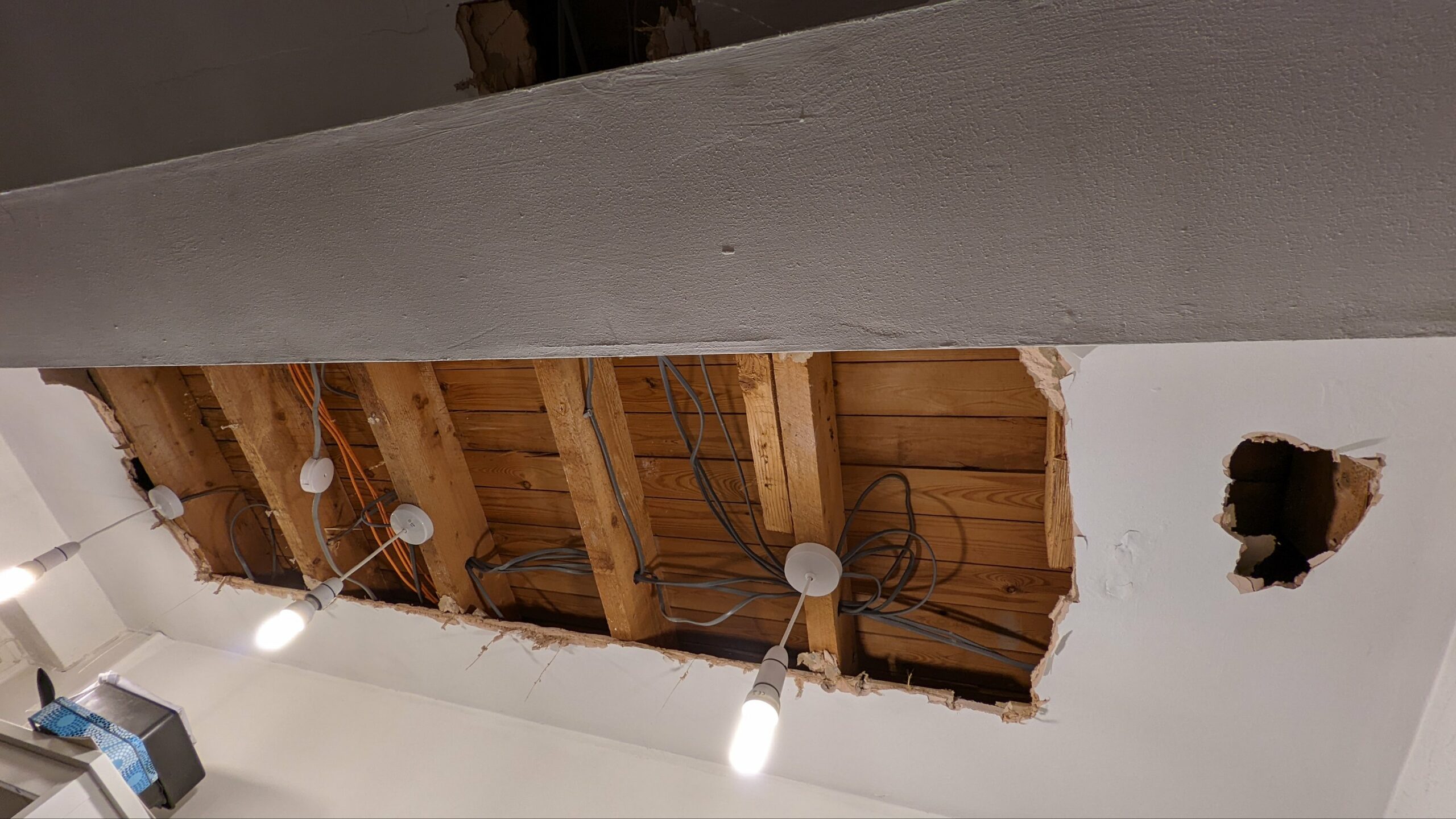
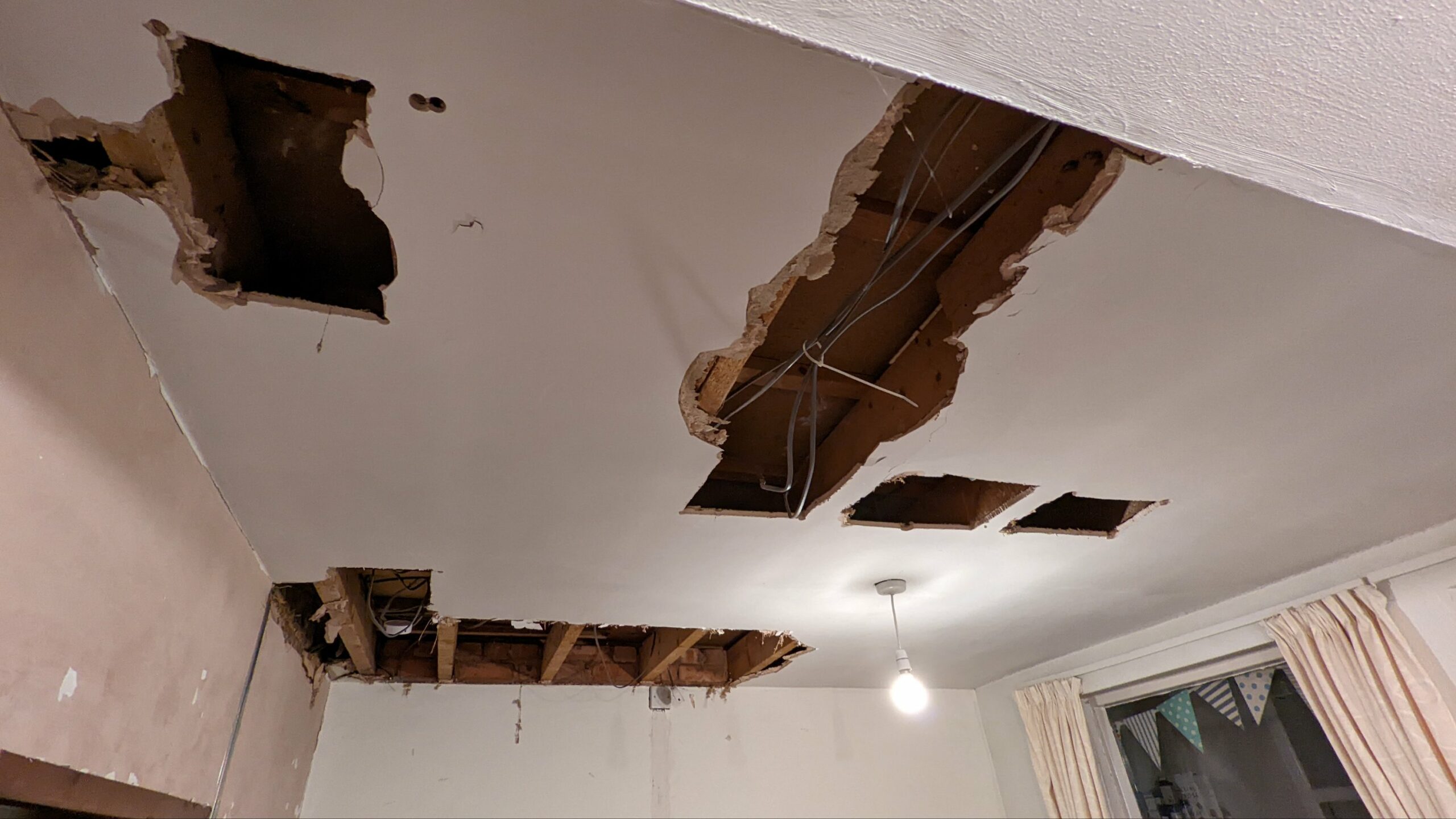
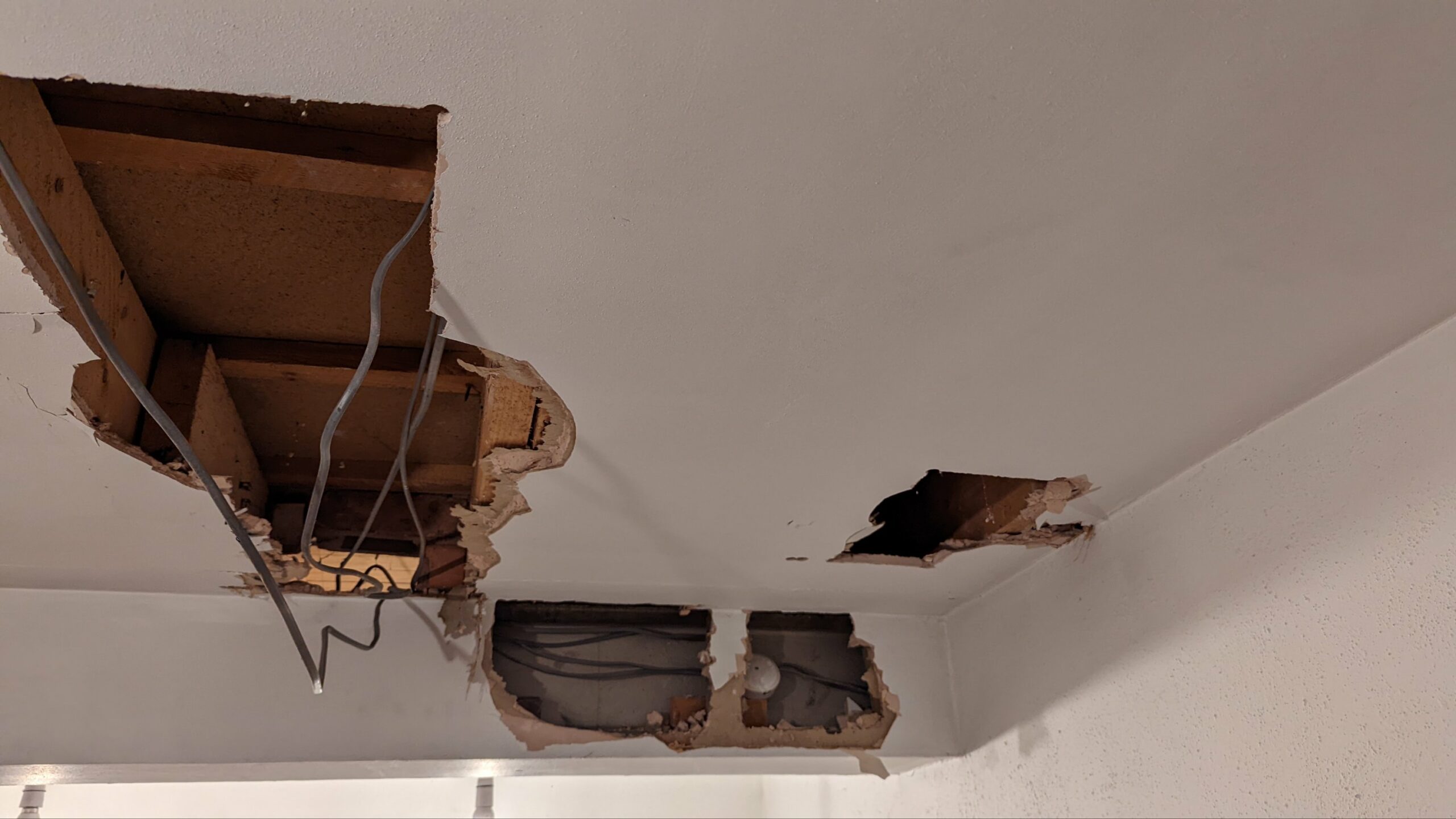
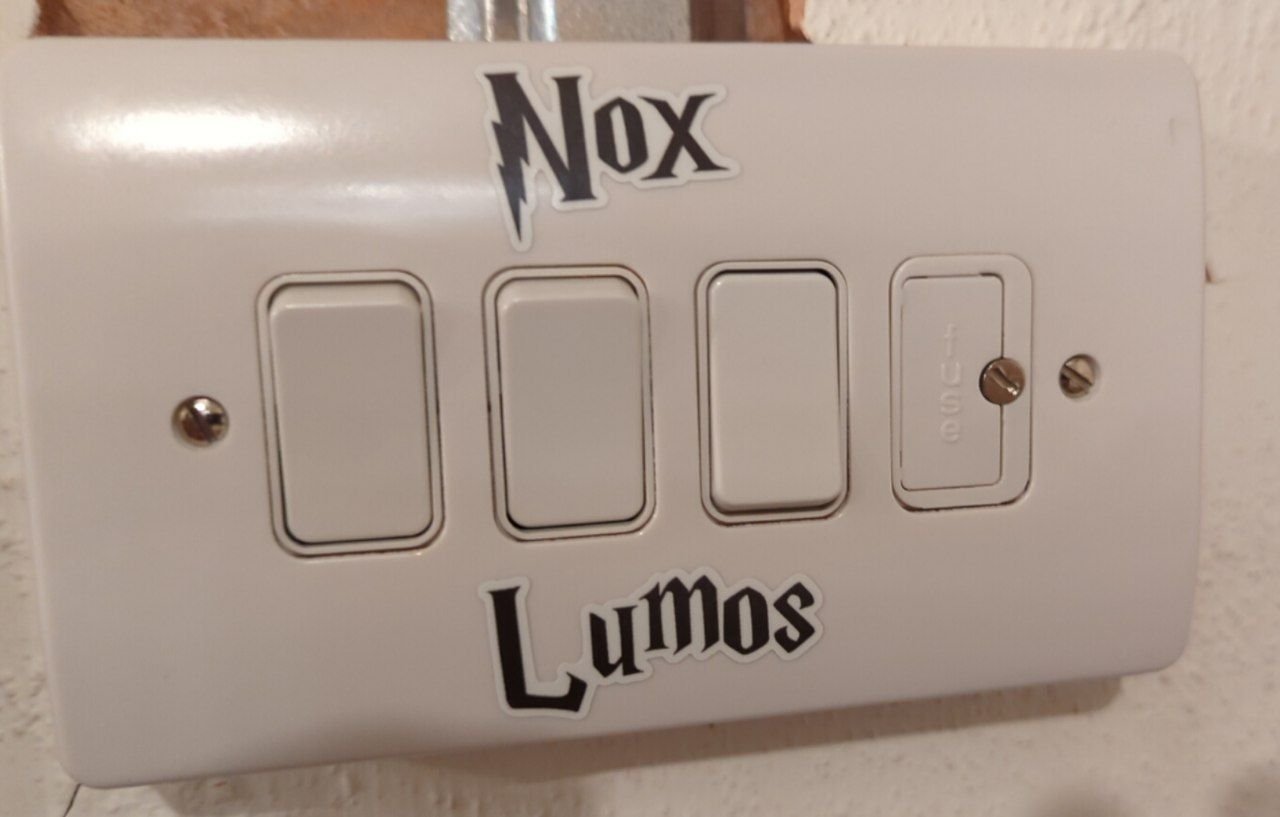
I m finally paying up a certain amount of household technical debt, including investigating some exciting mystery cabling and insulating the space it inhabits. This has meant pulling down large chunks of ceiling (eventually, most or all of it for the insulation) on a cable hunt. Turns out the best tool for this part of the job is a decent length of 4 by 2, some borrowed muscle, and a certain amount of bravery. Once a couple of holes have been cut the old-fashioned way to be sure there s nothing crucial above the ceiling (like the other side of the felt roof), the 4 2 really comes into its own: To use the 4 2, aim for a gap between two joists and imagine you re holding a caber. Launch it. The ceiling will come off far worse than the lump of wood you re holding. We found the mystery cable, but didn t really solve the mystery it creates and in the process uncovered another bizarre installation. The local lighting circuit is mostly a spur system in that white junction box by the RSJ. The overhead supplies dive under the RSJ through the junction box to the light switch including a full 3-core feed, not the usual loop-in system used in the rest of the house (I am not sure how prevalent loop-in systems are in other countries, they re sometimes called three-plate systems but they re very common in the UK). It does at least explain why I could never reverse-engineer the setup from the ceiling roses alone, which had only half the cores in the fitting than expected throughout the room (it wasn t even that the first fitting was looped in and being a supply for the others). On the other hand, normalising everything to a loop-in system and removing that awful rats nest of TPE should be straightforward. Neutral isn t required in that switch so that s one less problem. I couldn t resist labelling the switch in its relocated position:
Unfortunately, as valuable as that exercise was, I still have to get to the bottom of the original mystery cable which is at varying points 6mm2, 2.5mm2 and 1.5mm2 with apparently no current limiter or switch separation. Time for a bit more 4 by 2

Ricardo Mones: Claws Mail 4 in experimental

A full month has passed since Claws Mail 4.0.0 was uploaded to Debian experimental, and, somewhat surprisingly, I've received no bug report about it. This of course can be either because nobody has been brave enough to install it or because well, it works really nice. For those who don't know what I'm talking about, just note that this version is the first Debian upload for the GTK+3 version of Claws Mail. There was an initial upstream release, namely 3.99, but it was less polished and also I was very busy, so I decided not to upload it. Since then I've been using git's 'gtk3' branch daily without problems, so, for me, it's as stable as its GTK+2 counterpart. There's still some rough edges, of course. Note also that, if everything goes well, Claws Mail 4.x will be the version to be shipped with Debian 12 (bookworm).

Paul Tagliamonte: Be careful when using vxlan!

I ve spent a bit of time playing with vxlan - which is very neat, but also incredibly insecure by default.When using vxlan, be very careful to understand how the host is connected to the internet. The kernel will listen on all interfaces for packets, which means hosts accessable to VMs it s hosting (e.g., by bridged interface or a private LAN will accept packets from VMs and inject them into arbitrary VLANs, even ones it s not on.I reported this to the kernel mailing list to no reply with more technical details.The tl;dr is:
  $ ip link add vevx0a type veth peer name vevx0z
  $ ip addr add 169.254.0.2/31 dev vevx0a
  $ ip addr add 169.254.0.3/31 dev vevx0z
  $ ip link add vxlan0 type vxlan id 42 \
    local 169.254.0.2 dev vevx0a dstport 4789
  $ # Note the above 'dev' and 'local' ip are set here
  $ ip addr add 10.10.10.1/24 dev vxlan0
results in vxlan0 listening on all interfaces, not just vevx0z or vevx0a. To prove it to myself, I spun up a docker container (using a completely different network bridge with no connection to any of the interfaces above), and ran a Go program to send VXLAN UDP packets to my bridge host:
$ docker run -it --rm -v $(pwd):/mnt debian:unstable /mnt/spam 172.17.0.1:4789
$
which results in packets getting injected into my vxlan interface
$ sudo tcpdump -e -i vxlan0
tcpdump: verbose output suppressed, use -v[v]... for full protocol decode
listening on vxlan0, link-type EN10MB (Ethernet), snapshot length 262144 bytes
21:30:15.746754 de:ad:be:ef:00:01 (oui Unknown) > Broadcast, ethertype IPv4 (0x0800), length 64: truncated-ip - 27706 bytes missing! 33.0.0.0 > localhost: ip-proto-114
21:30:15.746773 de:ad:be:ef:00:01 (oui Unknown) > Broadcast, ethertype IPv4 (0x0800), length 64: truncated-ip - 27706 bytes missing! 33.0.0.0 > localhost: ip-proto-114
21:30:15.746787 de:ad:be:ef:00:01 (oui Unknown) > Broadcast, ethertype IPv4 (0x0800), length 64: truncated-ip - 27706 bytes missing! 33.0.0.0 > localhost: ip-proto-114
21:30:15.746801 de:ad:be:ef:00:01 (oui Unknown) > Broadcast, ethertype IPv4 (0x0800), length 64: truncated-ip - 27706 bytes missing! 33.0.0.0 > localhost: ip-proto-114
21:30:15.746815 de:ad:be:ef:00:01 (oui Unknown) > Broadcast, ethertype IPv4 (0x0800), length 64: truncated-ip - 27706 bytes missing! 33.0.0.0 > localhost: ip-proto-114
21:30:15.746827 de:ad:be:ef:00:01 (oui Unknown) > Broadcast, ethertype IPv4 (0x0800), length 64: truncated-ip - 27706 bytes missing! 33.0.0.0 > localhost: ip-proto-114
21:30:15.746870 de:ad:be:ef:00:01 (oui Unknown) > Broadcast, ethertype IPv4 (0x0800), length 64: truncated-ip - 27706 bytes missing! 33.0.0.0 > localhost: ip-proto-114
21:30:15.746885 de:ad:be:ef:00:01 (oui Unknown) > Broadcast, ethertype IPv4 (0x0800), length 64: truncated-ip - 27706 bytes missing! 33.0.0.0 > localhost: ip-proto-114
21:30:15.746899 de:ad:be:ef:00:01 (oui Unknown) > Broadcast, ethertype IPv4 (0x0800), length 64: truncated-ip - 27706 bytes missing! 33.0.0.0 > localhost: ip-proto-114
21:30:15.746913 de:ad:be:ef:00:01 (oui Unknown) > Broadcast, ethertype IPv4 (0x0800), length 64: truncated-ip - 27706 bytes missing! 33.0.0.0 > localhost: ip-proto-114
10 packets captured
10 packets received by filter
0 packets dropped by kernel
(the program in question is the following:)
  package main
  import (
      "net"
      "os"
      "github.com/mdlayher/ethernet"
      "github.com/mdlayher/vxlan"
  )
  func main()  
      conn, err := net.Dial("udp", os.Args[1])
      if err != nil   panic(err)  
      for i := 0; i < 10; i++  
          vxf := &vxlan.Frame 
              VNI: vxlan.VNI(42),
              Ethernet: &ethernet.Frame 
                  Source:      net.HardwareAddr 0xDE, 0xAD, 0xBE,
0xEF, 0x00, 0x01 ,
                  Destination: net.HardwareAddr 0xFF, 0xFF, 0xFF,
0xFF, 0xFF, 0xFF ,
                  EtherType:   ethernet.EtherTypeIPv4,
                  Payload:     []byte("Hello, World!"),
              ,
          
          frb, err := vxf.MarshalBinary()
          if err != nil   panic(err)  
          _, err = conn.Write(frb)
          if err != nil   panic(err)  
      
  
When using vxlan, be absolutely sure all hosts that can address any interface on the host are authorized to send arbitrary packets into any VLAN that box can send to, or there s very careful and specific controls and firewalling. Note this includes public interfaces (e.g., dual-homed private network / internet boxes), or any type of dual-homing (VPNs, etc).

21 November 2021

Julian Andres Klode: APT Z3 Solver Basics

Z3 is a theorem prover developed at Microsoft research and available as a dynamically linked C++ library in Debian-based distributions. While the library is a whopping 16 MB, and the solver is a tad slow, it s permissive licensing, and number of tactics offered give it a huge potential for use in solving dependencies in a wide variety of applications. Z3 does not need normalized formulas, but offers higher level abstractions like atmost and atleast and implies, that we will make use of together with boolean variables to translate the dependency problem to a form Z3 understands. In this post, we ll see how we can apply Z3 to the dependency resolution in APT. We ll only discuss the basics here, a future post will explore optimization criteria and recommends.

Translating the universe APT s package universe consists of 3 relevant things: packages (the tuple of name and architecture), versions (basically a .deb), and dependencies between versions. While we could translate our entire universe to Z3 problems, we instead will construct a root set from packages that were manually installed and versions marked for installation, and then build the transitive root set from it by translating all versions reachable from the root set. For each package P in the transitive root set, we create a boolean literal P. We then translate each version P1, P2, and so on. Translating a version means building a boolean literal for it, e.g. P1, and then translating the dependencies as shown below. We now need to create two more clauses to satisfy the basic requirements for debs:
  1. If a version is installed, the package is installed; and vice versa. We can encode this requirement for P above as P == atleast( P1,P2 , 1).
  2. There can only be one version installed. We add an additional constraint of the form atmost( P1,P2 , 1).
We also encode the requirements of the operation.
  1. For each package P that is manually installed, add a constraint P.
  2. For each version V that is marked for install, add a constraint V.
  3. For each package P that is marked for removal, add a constraint !P.

Dependencies Packages in APT have dependencies of two basic forms: Depends and Conflicts, as well as variations like Breaks (identical to Conflicts in solving terms), and Recommends (soft Depends) - we ll ignore those for now. We ll discuss Conflicts in the next section. Let s take a basic dependency list: A Depends: X Y, Z. To represent that dependency, we expand each name to a list of versions that can satisfy the dependency, for example X1 X2 Y1, Z1. Translating this dependency list to our Z3 solver, we create boolean variables X1,X2,Y1,Z1 and define two rules:
  1. A implies atleast( X1,X2,Y1 , 1)
  2. A implies atleast( Z1 , 1)
If there actually was nothing that satisfied the Z requirement, we d have added a rule not A. It would be possible to simply not tell Z3 about the version at all as an optimization, but that adds more complexity, and the not A constraint should not cause too many problems.

Conflicts Conflicts cannot have or in them. A dependency B Conflicts: X, Y means that only one of B, X, and Y can be installed. We can directly encode this in Z3 by using the constraint atmost( B,X,Y , 1). This is an optimized encoding of the constraint: We could have encoded each conflict in the form !B or !X, !B or !X, and so on. Usually this leads to worse performance as it introduces additional clauses.

Complete example Let s assume we start with an empty install and want to install the package a below.
Package: a
Version: 1
Depends: c   b
Package: b
Version: 1
Package: b
Version: 2
Conflicts: x
Package: d
Version: 1
Package: x
Version: 1
The translation in Z3 rules looks like this:
  1. Package rules for a:
    1. a == atleast( a1 , 1) - package is installed iff one version is
    2. atmost( a1 , 1) - only one version may be installed
    3. a a must be installed
  2. Dependency rules for a
    1. implies(a1, atleast( b2, b1 , 1)) the translated dependency above. note that c is gone, it s not reachable.
  3. Package rules for b:
    1. b == atleast( b1,b2 , 1) - package is installed iff one version is
    2. atmost( b1, b2 , 1) - only one version may be installed
  4. Dependencies for b (= 2):
    1. atmost( b2, x1 , 1) - the conflicts between x and b = 2 above
  5. Package rules for x:
    1. x == atleast( x1 , 1) - package is installed iff one version is
    2. atmost( x1 , 1) - only one version may be installed
The package d is not translated, as it is not reachable from the root set a1 , the transitive root set is a1,b1,b2,x1 .

Next iteration: Optimization We have now constructed the basic set of rules that allows us to solve solve our dependency problems (equivalent to SAT), however it might lead to suboptimal solutions where it removes automatically installed packages, or installs more packages than necessary, to name a few examples. In our next iteration, we have to look at introducing optimization; for example, have the minimum number of removals, the minimal number of changed packages, or satisfy as many recommends as possible. We will also look at the upgrade problem (upgrade as many packages as possible), the autoremove problem (remove as many automatically installed packages as possible).

Junichi Uekawa: Tax related software.

Tax related software. Tax related work in Japan is defined to be exclusive for licensed Tax Accountants. I wondered what it means for Tax related software and I was uncomfortable what it means to make one, or even if was elibible for a fine. I've looked up and the national tax agency had a FAQ entry. 2 which stated that making and selling software for tax filing is allowed for non-Tax Accountants. So if they say so, maybe it's safe for me to write and distribute tax related software. One caveat is that tax related software is only applicable in individual countries but since it's something I care about and use every year, it's probably ok.

20 November 2021

Jonathan Dowland: hledger footguns

I wrote in budgeting tools that I was taking a look at Plain Text Accounting and in particular, hledger. My Jury's still out on the tools, but in the time I've been looking at them I've come across a couple of foot-guns I thought it was worth writing down. hledger's ledger format is derived from that of its predecessor ledger, and so some of the problems might be inherited. 1. significant white space delimiters The basic syntax for a transaction looks like this
2020-03-15 client payment
    assets:checking         $ 2000
    income:consulting       $-2000
There's some significant white space delimiters in play. The most subtle is what separates the account names from the values: it is two or more spaces. A single space, and the value is treated as part of the account name. For some reason I hit this frequently with trying to encode opening balances: the account name used as the source of the initial balances is something not otherwise generally referred to again (something like equity:opening balances) and the transaction amount is inferred where possible, so I ended up with a bunch of accounts named equity:opening balances 100 and similar. 2. flexible decimal delimiter The value of transactions can be interspersed with commas and periods to make it more readable: e.g. $2000 could be written as $2,000. Different locales have different conventions here: It seems some(/most/all?) of Europe use periods to separate out the units and a comma to delimit the fractional part, whereas the US and the UK do the opposite. There is no built-in association between the currency symbol you are using and the period/comma convention: it's quite possible to accidentally write a number which is interpreted differently to how you intended, and it doesn't matter if you are using $ or etc. 3. new syntax has unexpected results in old versions Finally, my favourite. hledger has a notion of rules that can be used to match transactions when importing from CSV. The format looks like this:
if (match rule)
& (another rule)
account1 some:account:from
account2 some:account:to
By default, multiple rules in sequence like above are OR'd: any of them can match. The & prefix switches the behaviour to AND. But, & is a relatively new addition: it's not supported in 1.18.1, the version in Debian stable, which upstream released in June 2020. In prior versions the & prefix is not a syntax error, or at least, not one that's reported: it's silently ignored; meaning, the line with the & does nothing, and any of the other rules in the set will match. This is easy to miss, and means imports could be incorrectly posted.

19 November 2021

Gunnar Wolf: For our millionth bug, bookworms eat raspberries alive

I guess you already heard, right? The Debian Bug Tracking System has hit a big milestone! We just passed our one millionth bug report! (and yes, that s a cause for celebration; bug reporting is probably the best way for the system to grow and improve) So, to celebrate, I want to announce I have nudged our unofficial Raspberry Pi images build scripts to now also build images for our upcoming Debian release, Debian 12 Bookworm (image above: A bookworm learns about raspberries in various stages of testing. Image sources: Transformers Wiki, CC BY-SA and Sam Saunders at Flickr, CC BY-SA) So Get em while they are fresh! https://raspi.debian.net/! And enjoy the following (non-book)worm-on-a-raspberry picture from Wikimedia Commons: Oh, FWIW The site still shows images for Buster. You will notice they are no longer being autobuilt (why spend CPU time in something that s no longer going to change significatively?). The Bookworm images are not yet tested; as soon as I can test them, I will drop the Buster ones.

Evgeni Golov: A String is not a String, and that's Groovy!

Halloween is over, but I still have some nightmares to share with you, so sit down, take some hot chocolate and enjoy :) When working with Jenkins, there is almost no way to avoid writing Groovy. Well, unless you only do old style jobs with shell scripts, but y'all know what I think about shell scripts Anyways, Eric have been rewriting the jobs responsible for building Debian packages for Foreman to pipelines (and thus Groovy). Our build process for pull requests is rather simple:
  1. Setup sources - get the orig tarball and adjust changelog to have an unique version for pull requests
  2. Call pbuilder
  3. Upload the built package to a staging archive for testing
For merges, it's identical, minus the changelog adjustment. And if there are multiple packages changed in one go, it runs each step in parallel for each package. Now I've been doing mass changes to our plugin packages, to move them to a shared postinst helper instead of having the same code over and over in every package. This required changes to many packages and sometimes I'd end up building multiple at once. That should be fine, right? Well, yeah, it did build fine, but the upload only happened for the last package. This felt super weird, especially as I was absolutely sure we did test this scenario (multiple packages in one PR) and it worked just fine So I went on a ride though the internals of the job, trying to understand why it didn't work. This requires a tad more information about the way we handle packages for Foreman:
  • the archive is handled by freight
  • it has suites like buster, focal and plugins (that one is a tad special)
  • each suite has components that match Foreman releases, so 2.5, 3.0, 3.1, nightly etc
  • core packages (Foreman etc) are built for all supported distributions (right now: buster and focal)
  • plugin packages are built only once and can be used on every distribution
As generating the package index isn't exactly fast in freight, we tried not not run it too often. The idea was that when we build two packages for the same target (suite/version combination), we upload both at once and run import only once for both. That means that when we build Foreman for buster and focal, this results in two parallel builds and then two parallel uploads (as they end up in different suites). But if we build Foreman and Foreman Installer, we have four parallel builds, but only two parallel uploads, as we can batch upload Foreman and Installer per suite. Well, or so was the theory. The Groovy code, that was supposed to do this looked roughly like this:
def packages_to_build = find_changed_packages()
def repos = [:]
packages_to_build.each   pkg ->
    suite = 'buster'
    component = '3.0'
    target = "$ suite -$ component "
    if (!repos.containsKey(target))  
        repos[target] = []
     
    repos[target].add(pkg)
 
do_the_build(packages_to_build)
do_the_upload(repos)
That's pretty straight forward, no? We create an empty Map, loop over a list of packages and add them to an entry in the map which we pre-create as empty if it doesn't exist. Well, no, the resulting map always ended with only having one element in each target list. And this is also why our original tests always worked: we tested with a PR containing changes to Foreman and a plugin, and plugins go to this special target we have So I started playing with the code (https://groovyide.com/playground is really great for that!), trying to understand why the heck it erases previous data. The first finding was that it just always ended up jumping into the "if map entry not found" branch, even though the map very clearly had the correct entry after the first package was added. The second one was weird. I was trying to minimize the reproducer code (IMHO always a good idea) and switched target = "$ suite -$ component " to target = "lol". Two entries in the list, only one jump into the "map entry not found" branch. What?! So this is clearly related to the fact that we're using String interpolation here. But hey, that's a totally normal thing to do, isn't it?! Admittedly, at this point, I was lost. I knew what breaks, but not why. Luckily, I knew exactly who to ask: Jens. After a brief "well, that's interesting", Jens quickly found the source of our griefs: Double-quoted strings are plain java.lang.String if there s no interpolated expression, but are groovy.lang.GString instances if interpolation is present.. And when we do repos[target] the GString target gets converted to a String, but when we use repos.containsKey() it remains a GString. This is because GStrings get converted to Strings, if the method wants one, but containsKey takes any Object while the repos[target] notation for some reason converts it. Maybe this is because using GString as Map keys should be avoided. We can reproduce this with simpler code:
def map = [:]
def something = "something"
def key = "$ something "
map[key] = 1
println key.getClass()
map.keySet().each  println it.getClass()  
map.keySet().each  println it.equals(key) 
map.keySet().each  println it.equals(key as String) 
Which results in the following output:
class org.codehaus.groovy.runtime.GStringImpl
class java.lang.String
false
true
With that knowledge, the fix was to just use the same repos[target] notation also for checking for existence Groovy helpfully returns null which is false-y when it can't find an entry in a Map absent. So yeah, a String is not always a String, and it'll bite you!

Neil Williams: git worktrees

A few scenarios have been problematic with git and I've now discovered git worktrees which help with each. You could go to the trouble of making a new directory and re-cloning the same tree. However, a local commit in one tree is then not accessible to the other tree. You could commit everything every time, but with a dirty tree, that involves sorting out the .gitignore rules as well. That could well be pointless with an experimental change. Git worktrees allow multiple filesystems from a single git tree. Commits on any branch are visible from other branches, even when the commit was on a different worktree. This makes things like cherry-picking easy, without needing to push pointless changes or branches. Branches on a worktree can be rebased as normal, with the benefit that commit hashes from other local changes are available for reference and cherry-picks. I'm sure git worktrees are not new. However, I've only started using them recently and others have asked about how the worktree operates. Creating a new tree can be done with a new or existing branch. To make it easier, set the new directory at the same time, usually in ../ New branch (branched from the current branch):
git worktree add -b branch_name ../branch_name
Existing branch - note, slightly different syntax here, specify the commit-ish last (branch name, tag or hash):
git worktree add ../branch_name branch_name
git worktree list
/home/neil/Documents/testing/testrepo        0612677 [master]
/home/neil/Documents/testing/testtree        d38f5a3 [testtree]
Use git worktree remove <name> to drop the entire directory for that tree and the git tracking. I'm using this for work on the Debian Security Tracker. I have two local branches and having two worktrees allows me to have three terminals open, using the same files and the same git repository. One to run make serve and update the local SQLite database. One to access master to run git pull One to make local changes without risking collisions on master.
git add data/CVE/list
git commit
# pre commit hook runs here
git log -n 1
# copy the hash
# switch to master terminal
git pull
git cherry-pick <HASH>
git push
# switch to server terminal
git rebase master
# no git pull or fetch, it's all local
make
# switch back to changes terminal
git rebase master
Sadly, one area where this isn't as easy is with importing a new DSC into Salsa with git-buildpackage as that uses several branches at the same time. It would be possible but you'll need to have a separate upstream and possibly pristine-tar branches and supply the relevant options. Possibly something git-buildpackage to adopt - it is common to need to make changes to the packaging with a new upstream release & a lot of those changes are currently done outside git. For the rest of the support, see git worktree (1)

Bits from Debian: New Debian Developers and Maintainers (September and October 2021)

The following contributors got their Debian Developer accounts in the last two months: The following contributors were added as Debian Maintainers in the last two months: Congratulations!

Mike Gabriel: Improbability of a million, lintian thinks...

An interesting mindset overcome by reality... Also, lintian does not differentiate between between 100.000 and 1.000.000.
W: ayatana-indicator-display: improbable-bug-number-in-closes 1000143
N: 
N:   The most recent changelog closes a low-numbered bug number. While this is distantly possible, it's more likely a typo or
N:   a placeholder value that mistakenly wasn't filled in.
N: 
N:   Visibility: warning
N:   Show-Always: no
N:   Check: debian/changelog
N: 
N:
\_( )_/ light+love
Mike

Dirk Eddelbuettel: RcppArmadillo 0.10.7.3.0 on CRAN: Bugfix, New Features

armadillo image Armadillo is a powerful and expressive C++ template library for linear algebra aiming towards a good balance between speed and ease of use with a syntax deliberately close to a Matlab. RcppArmadillo integrates this library with the R environment and language and is widely used by (currently) 928 other packages on CRAN. I somehow missed to blog and tweet about the recent release based on the Armadillo 10.7.3 upstream release. Conrad is in long-term support mode , and 10.7.* is meant to provide fixes and stability relative to the most recent release which we did on September 30. We did actually find a regression when checking reverse-dependencies requiring an upstream move to 10.7.3. At the same time, we folded pull request #352 in. It addresses an old bug of ours where Armadillo fields types were not converted correctly in all dimensions. So no we do have 0.10.7.3.0 on CRAN, as well as 0.10.7.3.1 with the (opt-in) field) fixes on the drat repo) repo. As the change perturbs a few existing packages, it is opt-in for now. We will likely aim at a proper deprecation of the old behaviour and give packages time to adjust. Stay tuned. With that, big thanks to Jonathan Berrisch for filing issue #351 and basically addressing it in pull request #352. Very nice work, and I basically just wrapped a few more tests around it. The full set of changes (since the last CRAN release 0.10.7.0.) follows.

Changes in RcppArmadillo version 0.10.7.3.1 (2021-11-18)
  • Correct dimensions setting in import/export of arma::field types, protected by #define (Jonathan Berrisch in #352 fixing #351)
  • Add unit tests for fields both with and without new #define (Dirk)

Changes in RcppArmadillo version 0.10.7.3.0 (2021-11-04)
  • Upgraded to Armadillo release 10.7.3
    • fix regression in alias handling by fliplr(), flipud(), reverse()

Changes in RcppArmadillo version 0.10.7.2.0 (2021-11-02)
  • Upgraded to Armadillo release 10.7.2
    • more robust handling of diagonal matrices by pinv()

Changes in RcppArmadillo version 0.10.7.1.0 (2021-10-08)
  • Upgraded to Armadillo release 10.7.1
    • fix regression in interactions between dense matrix subviews and sparse matrices

Courtesy of my CRANberries, there is a diffstat report relative to previous release. More detailed information is on the RcppArmadillo page. Questions, comments etc should go to the rcpp-devel mailing list off the R-Forge page. If you like this or other open-source work I do, you can sponsor me at GitHub.

This post by Dirk Eddelbuettel originated on his Thinking inside the box blog. Please report excessive re-aggregation in third-party for-profit settings.

17 November 2021

Rapha&#235;l Hertzog: Freexian s report about Debian Long Term Support, October 2021

A Debian LTS logo
Every month we review the work funded by Freexian s Debian LTS offering. Please find the report for October below. Debian project funding We re looking forward to receiving more projects from various Debian teams! Learn more about the rationale behind this initiative in this article. Debian LTS contributors In October 12 contributors were paid to work on Debian LTS, their reports are available below. Evolution of the situation In October we released 34 DLAs.

Also, we would like to remark once again that we are constantly looking for new contributors. Please contact Jeremiah if you are interested! The security tracker currently lists 37 packages with a known CVE and the dla-needed.txt file has 22 packages needing an update. Thanks to our sponsors Sponsors that joined recently are in bold.

Christoph Berg: PostgreSQL and Undelete

pg_dirtyread Earlier this week, I updated pg_dirtyread to work with PostgreSQL 14. pg_dirtyread is a PostgreSQL extension that allows reading "dead" rows from tables, i.e. rows that have already been deleted, or updated. Of course that works only if the table has not been cleaned-up yet by a VACUUM command or autovacuum, which is PostgreSQL's garbage collection machinery. Here's an example of pg_dirtyread in action:
# create table foo (id int, t text);
CREATE TABLE
# insert into foo values (1, 'Doc1');
INSERT 0 1
# insert into foo values (2, 'Doc2');
INSERT 0 1
# insert into foo values (3, 'Doc3');
INSERT 0 1
# select * from foo;
 id    t
 
  1   Doc1
  2   Doc2
  3   Doc3
(3 rows)
# delete from foo where id < 3;
DELETE 2
# select * from foo;
 id    t
 
  3   Doc3
(1 row)
Oops! The first two documents have disappeared. Now let's use pg_dirtyread to look at the table:
# create extension pg_dirtyread;
CREATE EXTENSION
# select * from pg_dirtyread('foo') t(id int, t text);
 id    t
 
  1   Doc1
  2   Doc2
  3   Doc3
All three documents are still there, but only one of them is visible. pg_dirtyread can also show PostgreSQL's system colums with the row location and visibility information. For the first two documents, xmax is set, which means the row has been deleted:
# select * from pg_dirtyread('foo') t(ctid tid, xmin xid, xmax xid, id int, t text);
 ctid    xmin   xmax   id    t
 
 (0,1)   1577   1580    1   Doc1
 (0,2)   1578   1580    2   Doc2
 (0,3)   1579      0    3   Doc3
(3 rows)
Undelete Caveat: I'm not promising any of the ideas quoted below will actually work in practice. There are a few caveats and a good portion of intricate knowledge about the PostgreSQL internals might be required to succeed properly. Consider consulting your favorite PostgreSQL support channel for advice if you need to recover data on any production system. Don't try this at work. I always had plans to extend pg_dirtyread to include some "undelete" command to make deleted rows reappear, but never got around to trying that. But rows can already be restored by using the output of pg_dirtyread itself:
# insert into foo select * from pg_dirtyread('foo') t(id int, t text) where id = 1;
This is not a true "undelete", though - it just inserts new rows from the data read from the table. pg_surgery Enter pg_surgery, which is a new PostgreSQL extension supplied with PostgreSQL 14. It contains two functions to "perform surgery on a damaged relation". As a side-effect, they can also make delete tuples reappear. As I discovered now, one of the functions, heap_force_freeze(), works nicely with pg_dirtyread. It takes a list of ctids (row locations) that it marks "frozen", but at the same time as "not deleted". Let's apply it to our test table, using the ctids that pg_dirtyread can read:
# create extension pg_surgery;
CREATE EXTENSION
# select heap_force_freeze('foo', array_agg(ctid))
    from pg_dirtyread('foo') t(ctid tid, xmin xid, xmax xid, id int, t text) where id = 1;
 heap_force_freeze
 
(1 row)
Et voil , our deleted document is back:
# select * from foo;
 id    t
 
  1   Doc1
  3   Doc3
(2 rows)
# select * from pg_dirtyread('foo') t(ctid tid, xmin xid, xmax xid, id int, t text);
 ctid    xmin   xmax   id    t
 
 (0,1)      2      0    1   Doc1
 (0,2)   1578   1580    2   Doc2
 (0,3)   1579      0    3   Doc3
(3 rows)
Disclaimer Most importantly, none of the above methods will work if the data you just deleted has already been purged by VACUUM or autovacuum. These actively zero out reclaimed space. Restore from backup to get your data back. Since both pg_dirtyread and pg_surgery operate outside the normal PostgreSQL MVCC machinery, it's easy to create corrupt data using them. This includes duplicated rows, duplicated primary key values, indexes being out of sync with tables, broken foreign key constraints, and others. You have been warned. pg_dirtyread does not work (yet) if the deleted rows contain any toasted values. Possible other approaches include using pageinspect and pg_filedump to retrieve the ctids of deleted rows. Please make sure you have working backups and don't need any of the above.

16 November 2021

Paul Tagliamonte: Measuring the Power Output of my SDRs

Over the last few years, I ve often wondered what the true power output of my SDRs are. It s a question with a shocking amount of complexity in the response, due to a number of factors (mostly Frequency). The ranges given in spec sheets are often extremely vague, and if I m being honest with myself, not incredibly helpful for being able to determine what specific filters and amplifiers I ll need to get a clean signal transmitted.
Hey, heads up! - This post contains extremely unvalidated and back of the napkin quality work to understand how my equipment works. Hopefully this work can be of help to others, but please double check any information you need for your own work!
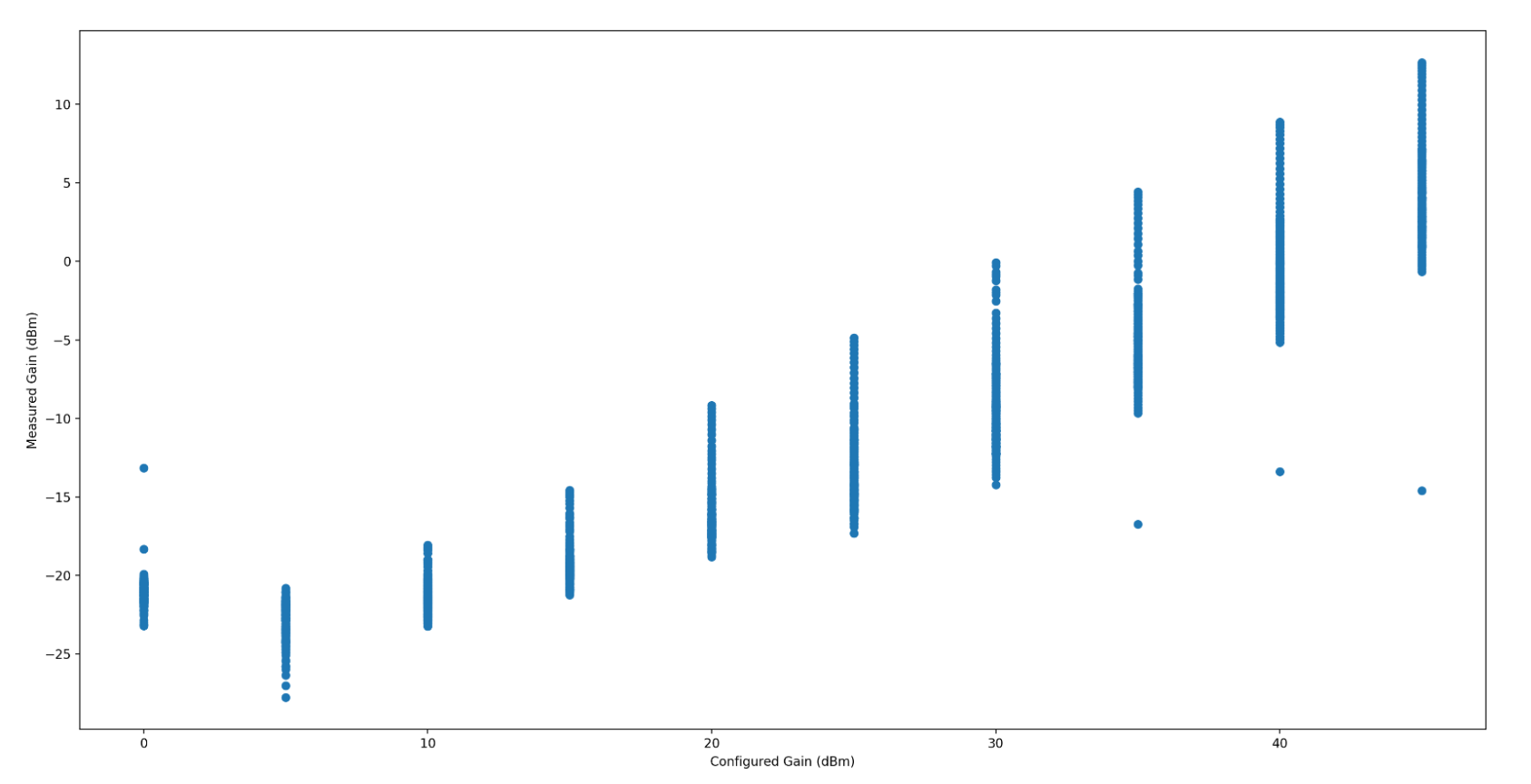
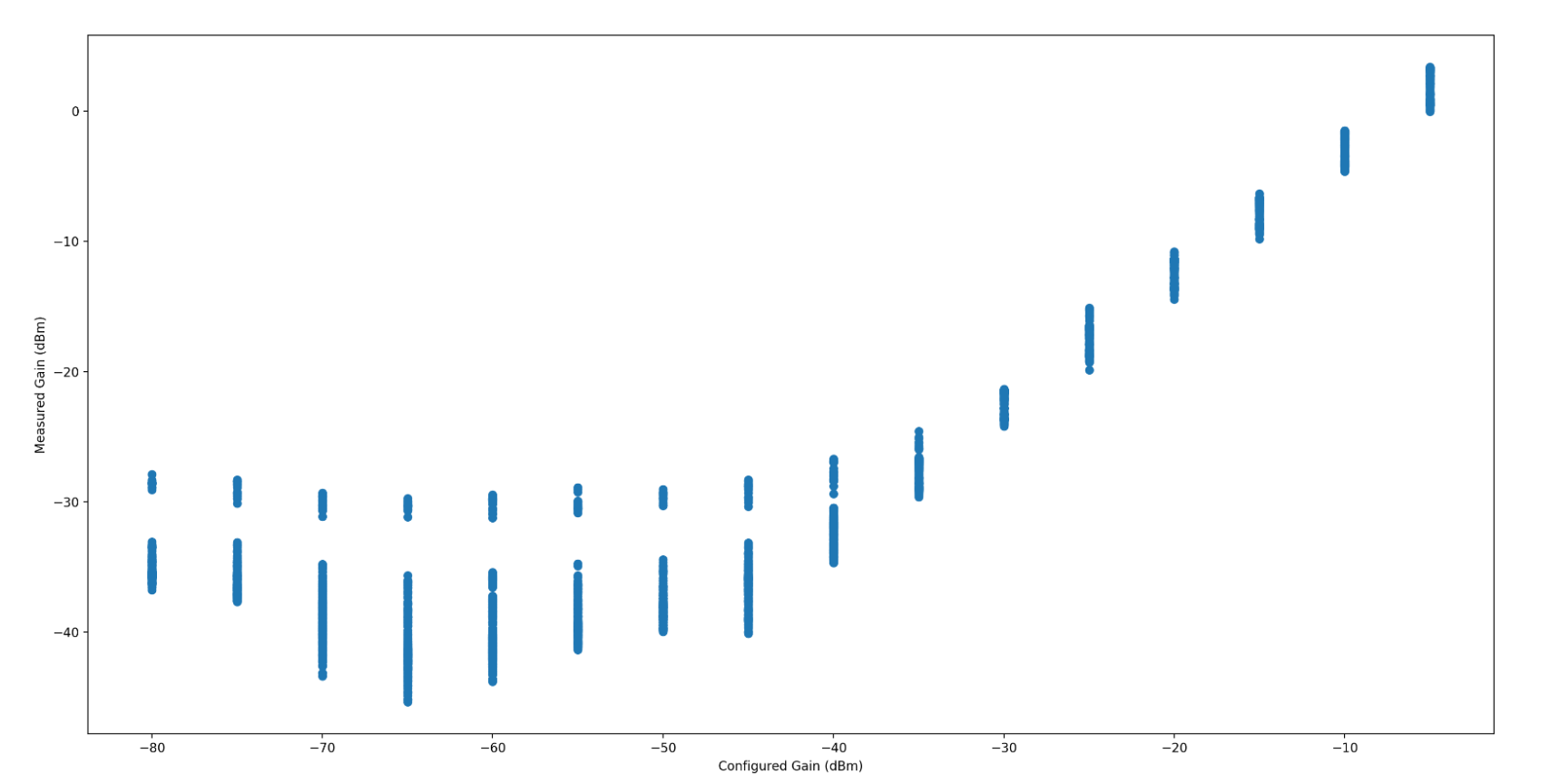
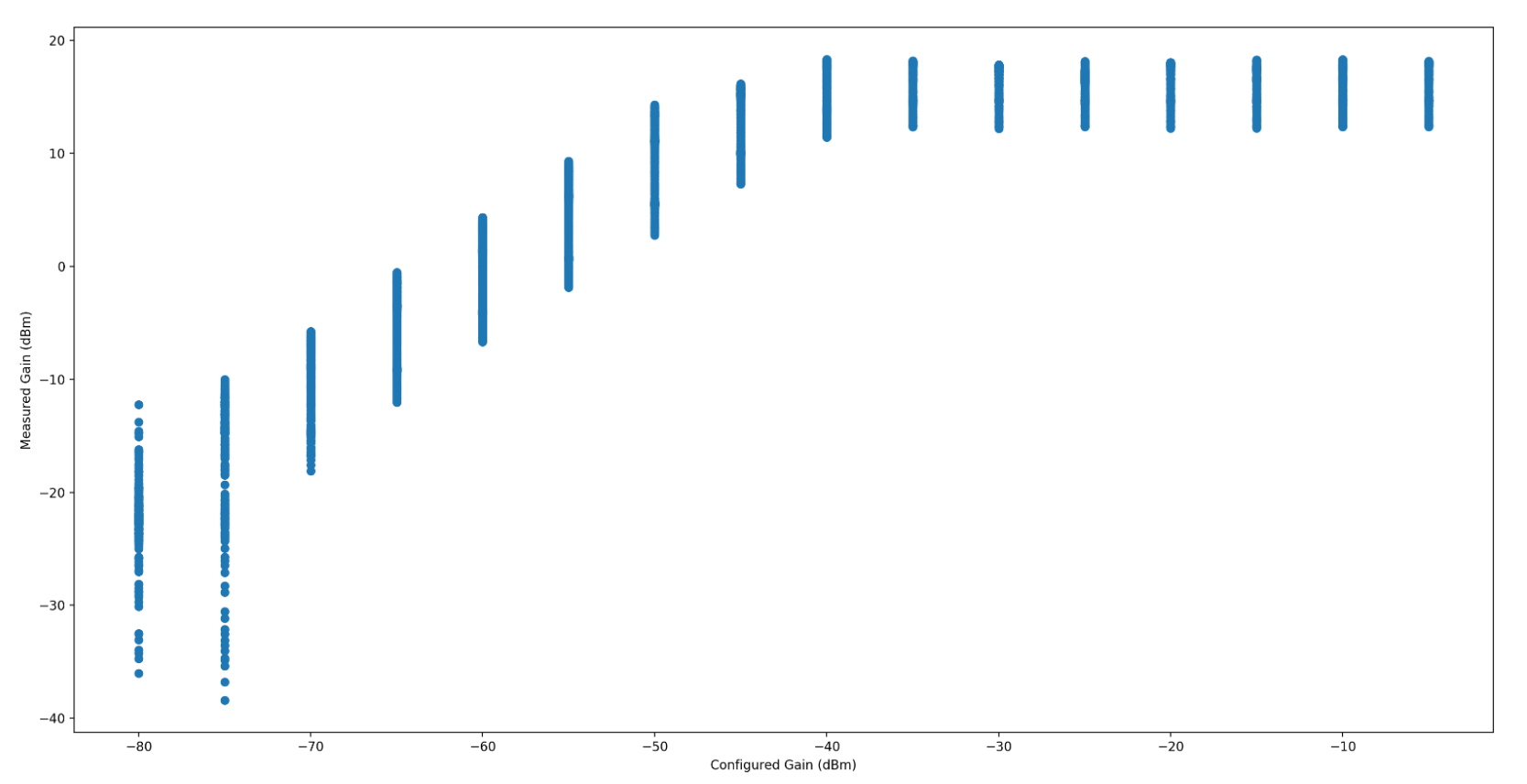
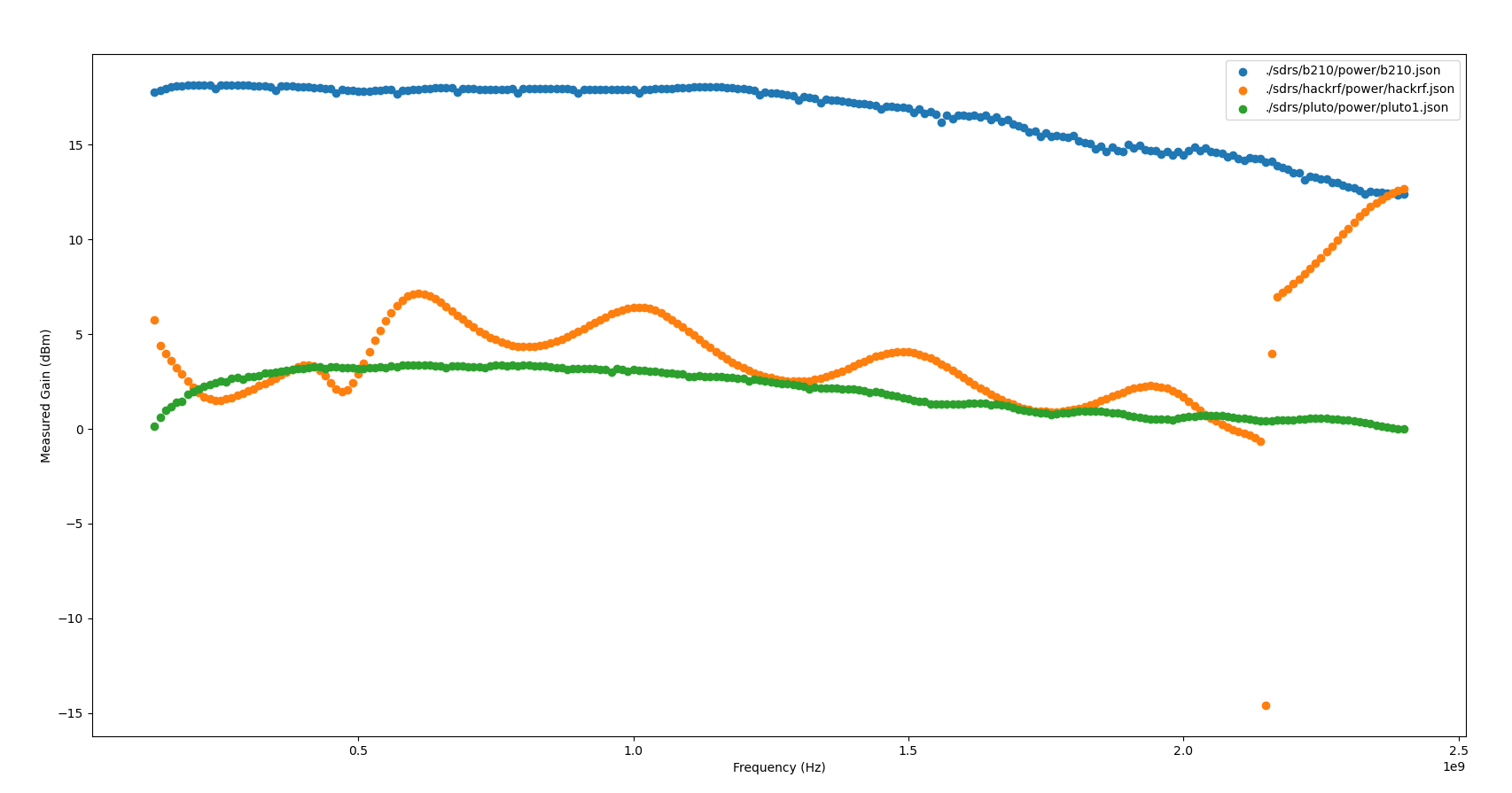
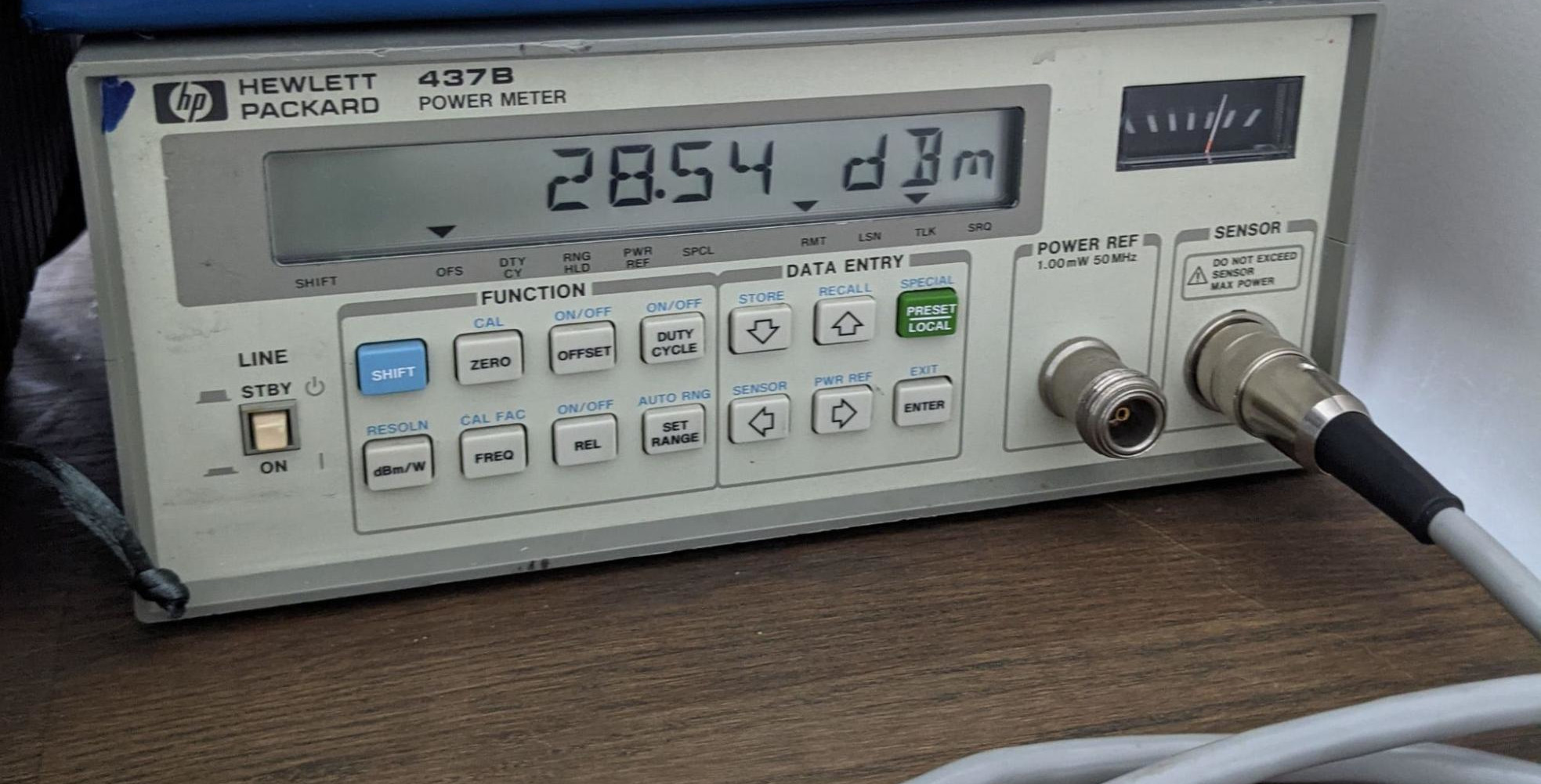
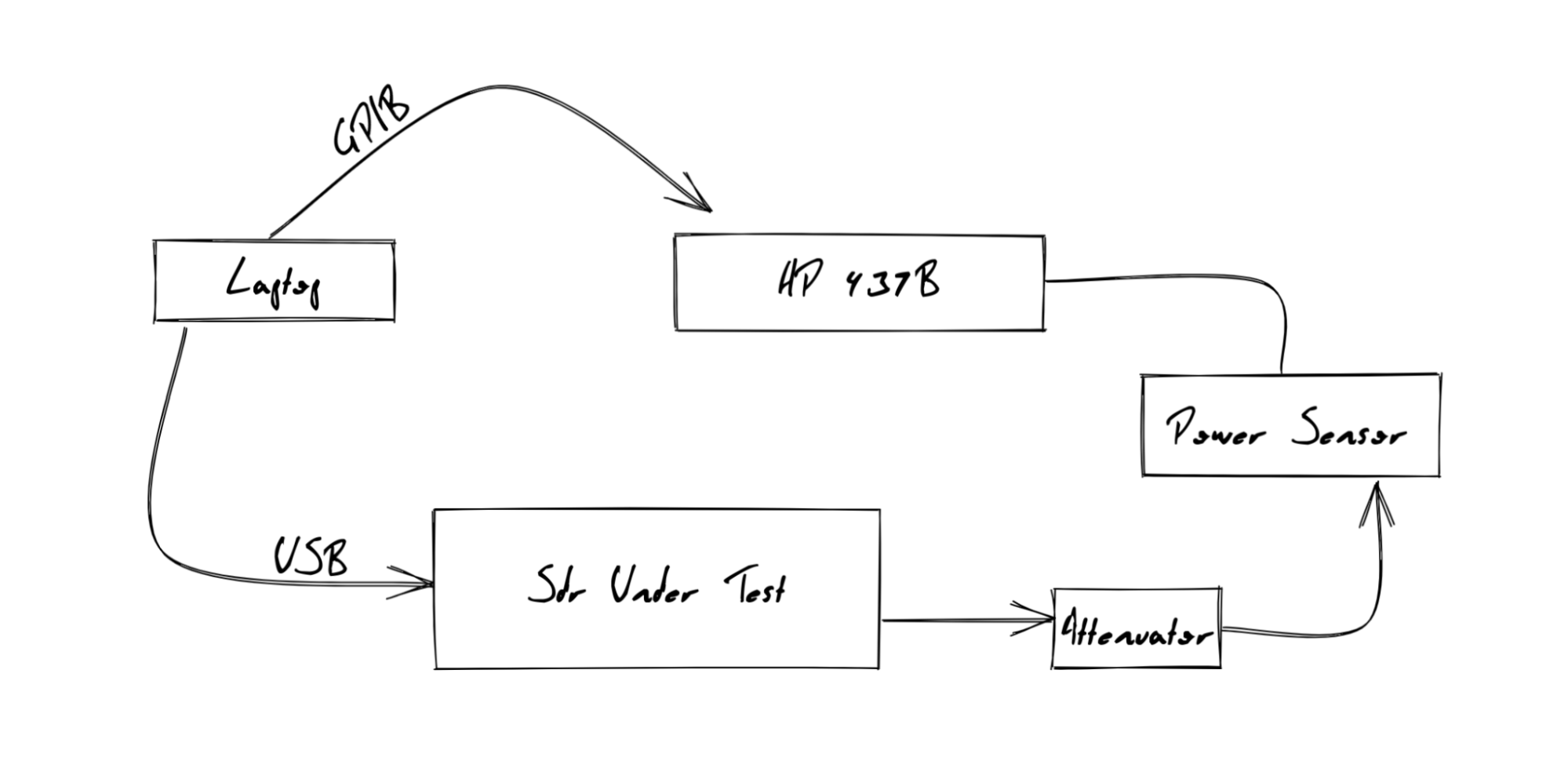
I was specifically interested in what gain output (in dBm) looks like across the frequency range in particular, how variable the output dBm is when I change frequencies. The second question I had was understanding how linear the output gain is when adjusting the requested gain from the radio. Does a 2 dB increase on a HackRF API mean 2 dB of gain in dBm, no matter what the absolute value of the gain stage is? I ve finally bit the bullet and undertaken work to characterize the hardware I do have, with some outdated laboratory equipment I found on eBay. Of course, if it s worth doing, it s worth overdoing, so I spent a bit of time automating a handful of components in order to collect the data that I need from my SDRs. I bought an HP 437B, which is the cutting edge of 30 years ago, but still accurate to within 0.01dBm. I paired this Power Meter with an Agilent 8481A Power Sensor (-30 dBm to 20 dBm from 10MHz to 18GHz). For some of my radios, I was worried about exceeding the 20 dBm mark, so I used a 20db attenuator while I waited for a higher power power sensor. Finally, I was able to find a GPIB to USB interface, and get that interface working with the GPIB Kernel driver on my system. With all that out of the way, I was able to write Go bindings to my HP 437B to allow for totally headless and automated control in sync with my SDR s RF output. This allowed me to script the transmission of a sine wave at a controlled amplitude across a defined gain range and frequency range and read the Power Sensor s measured dBm output to characterize the Gain across frequency and configured Gain.
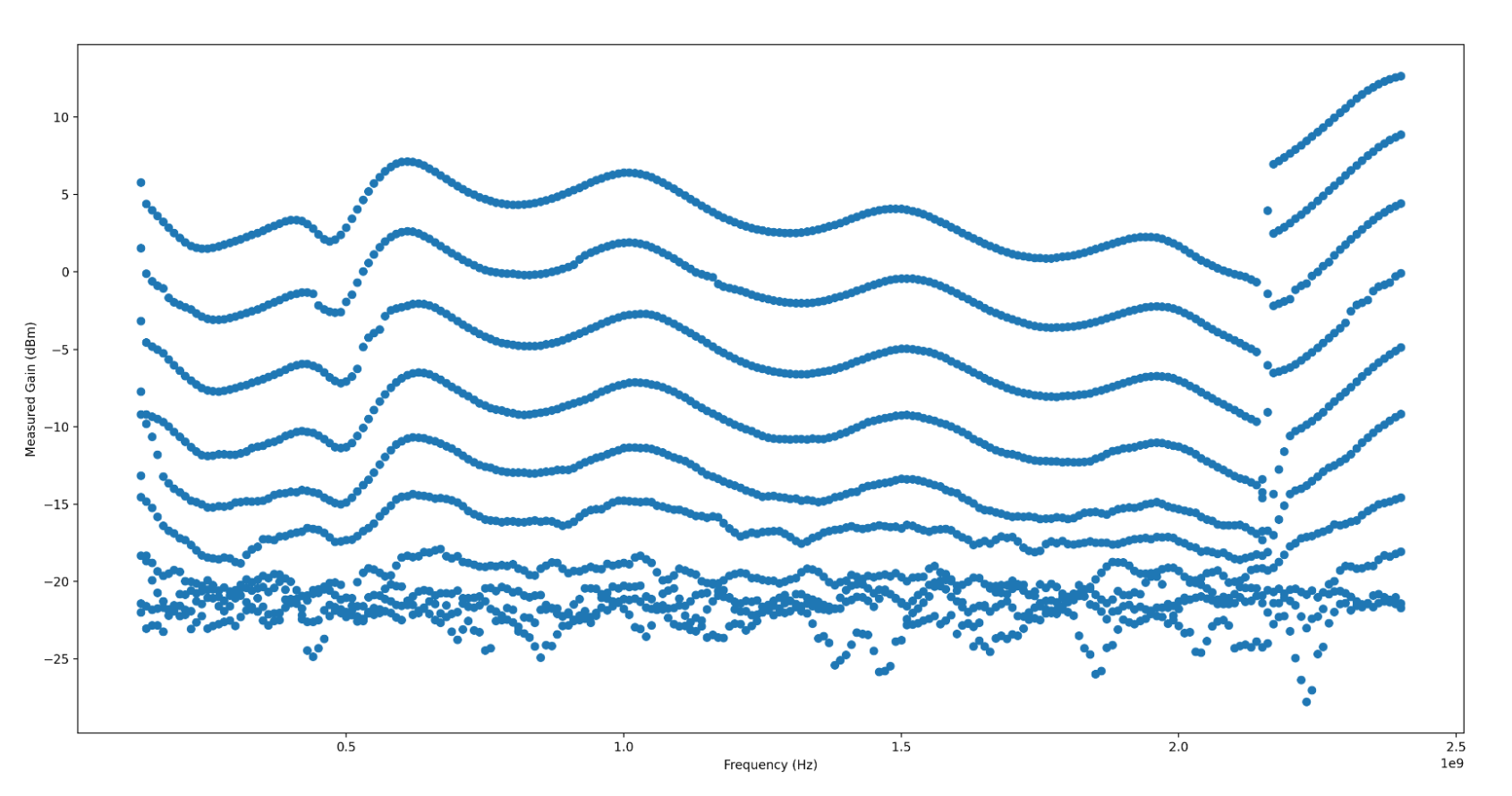
HackRF Looking at configured Gain against output power, the requested gain appears to have a fairly linear relation to the output signal power. The measured dBm ranged between the sensor noise floor to approx +13dBm. The average standard deviation of all tested gain values over the frequency range swept was +/-2dBm, with a minimum standard deviation of +/-0.8dBm, and a maximum of +/-3dBm. When looking at output power over the frequency range swept, the HackRF contains a distinctive (and frankly jarring) ripple across the Frequency range, with a clearly visible jump in gain somewhere around 2.1GHz. I have no idea what is causing this massive jump in output gain, nor what is causing these distinctive ripples. I d love to know more if anyone s familiar with HackRF s RF internals!
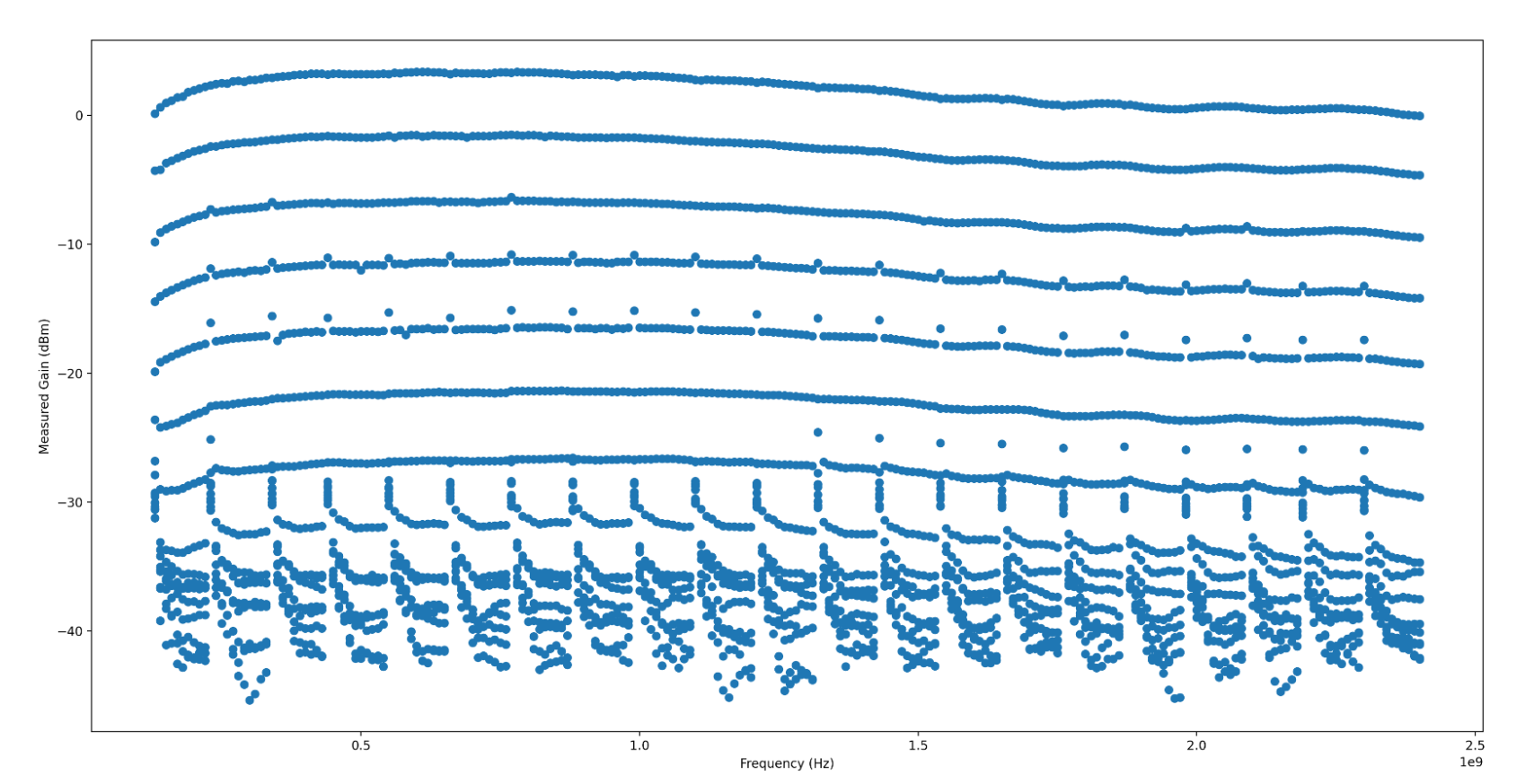
PlutoSDR The power output is very linear when operating above -20dB TX channel gain, but can get quite erratic the lower the output power is configured. The PlutoSDR s output power is directly related to the configured power level, and is generally predictable once a minimum power level is reached. The measured dBm ranged from the noise floor to 3.39 dBm, with an average standard deviation of +/-1.98 dBm, a minimum standard deviation of +/-0.91 dBm and a maximum standard deviation of +/-3.37 dBm. Generally, the power output is quite stable, and looks to have very even and wideband gain control. There s a few artifacts, which I have not confidently isolated to the SDR TX gain, noise (transmit artifacts such as intermodulation) or to my test setup. They appear fairly narrowband, so I m not overly worried about them yet. If anyone has any ideas what this could be, I d very much appreciate understanding why they exist!
Ettus B210 The power output on the Ettus B210 is higher (in dBm) than any of my other radios, but it has a very odd quirk where the power becomes nonlinear somewhere around -55dB TX channel gain. After that point, adding gain has no effect on the measured signal output in dBm up to 0 dB gain. The measured dBm ranged from the noise floor to 18.31 dBm, with an average standard deviation of +/-2.60 dBm, a minimum of +/-1.39 dBm and a maximum of +/-5.82 dBm. When the Gain is somewhere around the noise floor, the measured gain is incredibly erratic, which throws the maximum standard deviation significantly. I haven t isolated that to my test setup or the radio itself. I m inclined to believe it s my test setup. The radio has a fairly even and wideband gain, and so long as you re operating between -70dB to -55dB, fairly linear as well.
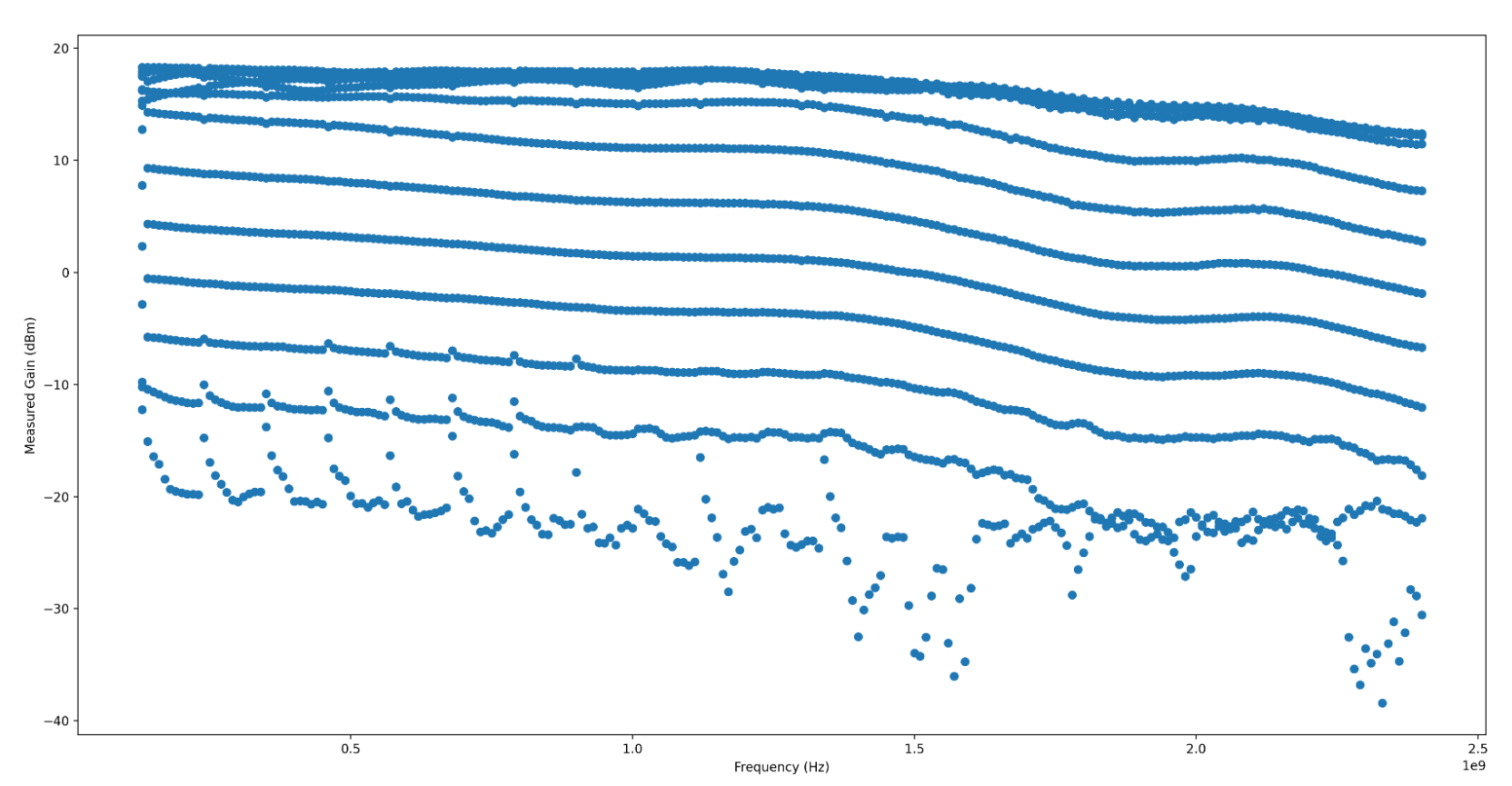
Summary Of all my radios, the Ettus B210 has the highest output (in dBm) over the widest frequency range, but the HackRF is a close second, especially after the gain bump kicks in around 2.1GHz. The Pluto SDR feels the most predictable and consistent, but also a very low output, comparatively - right around 0 dBm.
Name Max dBm stdev dBm stdev min dBm stdev max dBm
HackRF +12.6 +/-2.0 +/-0.8 +/-3.0
PlutoSDR +3.3 +/-2.0 +/-0.9 +/-3.7
B210 +18.3 +/-2.6 +/-1.4 +/-6.0

14 November 2021

Junichi Uekawa: I tried making a graph of deductions for my tax return.

I tried making a graph of deductions for my tax return. Mostly because I was curious how the curve looks like when income increases. It's nice that I get plotly to plot the graph in milliseconds. But the amount of required input makes it really hard to get right and I think something is still off. graph of income tax. It was interesting that it doesn't look like a curve, mostly a straight line.

Next.

Previous.