Search Results: "ag"

10 January 2008

Andrew Pollock: [tech] What ever happened to glue records?

One of the things I noticed when I was fiddling around with daedalus the other week, was that when I had everything stopped, linux.org.au seemed to stop resolving (and therefore semi-important things like ftp.au.debian.org, which is a CNAME to mirror.linux.org.au This made me very sad, because I'm always harping on about BCP 16 when I see other sites go down because all of their name servers are on the same subnet. Now that wasn't the reason for this particular "outage", though. It seems that because one of the name servers is russell.linux.org.au, and there's no glue record for this host on any of the .org.au name servers, I don't think russell is seeing any DNS traffic at all (perhaps only from resolvers that somehow already happened to have a cached entry for it obtained through other means than an NS query for linux.org.au) So before I go doing any further disruptive maintenance on daedalus I guess I'll be needing to get a glue record for russell.linux.org.au. I'm surprised that searching Enetica's knowledge-base for "glue" didn't raise a mention of it. I would have almost thought that they could detect the need for a glue record when you're adjusting a domain's delegation, so I wonder if it's a failure of their domain management system, or a complete oversight. Maybe people just don't go sticking their name servers in the domain they're hosting any more.

Alexander Schmehl: About Apache, Basic Authentication, Location and regular expressions

The other day, I had an interesting problem, regarding Apache, the LocationMatch directive and regular expressions. I'll put it here, so I'll be able to find it again... Actually it was a quite simple problem: A simple web page, where all web pages are protected with a password. No big Problem: Use a <location /> and AuthType basic, problem solved.... or isn't it? Some documents might be needed to be available without the authentication... for example robots.txt... or the funky custom error document, which explains how to get the authentication data, in case the authentication fails. Looking at the documentation, found a solution: LocationMatch exists, where you specify a regular expression, which must match, for the following configuration to apply. What isn't mentioned in the documentation, that the obvious solution... something like <LocationMatch !"^/(robots.txt my401handler.html"> doesn't work. See apache bug 10932. Needed quite some time, to find this out... Luckily Meike found the bug report above, which has a workaround for that problem: Use <LocationMatch "^/(?!robots.txt my401handler.html)"> Oh... and if your customized error handler references some pictures or style sheets, don't forget to add them to the regular expression above, too.

Jordi Mallach: FOSDEM 2008

As part of a sad trend that pulls me away from my healthy travel habits, I just booked plane tickets to Brussels for February 22nd. Note this is 1.5 months of planning ahead. madduck, your turn! Additionally, two weeks ago I got tickets for a one week long trip around parts of Germany at the end of the month. The travel plan is totally undefined, so I don't know what cities I'll be visiting yet. Fun!

Michal &#268;iha&#345;: Gammu test version 1.17.90

New Gammu testing version is out. This time there are no exciting new features, I still continue in bug fixing mode and cleaning up things. Full list of changes:
  • Fixed crash when there are too many messages (bug #466).
  • Fixed crash when printing messages on Windows (bug #476).
  • Do not ask phone for IMEI so often (bug #480).
  • No need to set LDLIBRARYPATH for tests.
  • Properly wait for SMSD child processes (bug #486).
You can download from usual place: http://cihar.com/gammu/.

9 January 2008

Cameron Dale: DebTorrent 0.1.5: Now With Status Updates

It's been a while, but a new update to DebTorrent is available in unstable. There is also a new version of the helper apt-transport-debtorrent (0.2.0) to go with it, which was mostly the cause of the long delay (due to a pending apt transition to testing). It is now highly recommended to install both, read below for new reasons why. One of the previous problems with debtorrent was the incorrect status updates displayed by apt, due to it not being aware of pieces of large files that have already downloaded. Using these new versions together will help to improve the update status messages shown during a download. Now, apt-get update will display a status at the bottom that will look something like:
DebTorrent: 837MiB left at 319 KiB/s (46m03s)
You may not be able to see it all if there are multiple updates to different mirrors under way. In aptitude, the status will appear on a line by itself at the bottom of the list of downloaded files. The status line will update about once per second, and should give a good indication of how much time is really left. The other (incorrect) status information presented by apt/aptitude will still be there but you can ignore it. I've only tested apt and aptitude, so I'm not sure how (or if) synaptic, adept or gnome-apt will display these messages, though they are general apt status messages, usually used for displaying the status while logging into an FTP server. This should also fix another problem that debtorrent can have with downloading large files (usually on slower connections). Since apt can't see the download happening for a long time, the connection would sometimes time out. With these status updates the connection is constantly active, so the timeouts shouldn't be a problem when downloading large packages (although they may still occur when doing an apt-get update, as there are no status updates during that process). I did implement a better solution, as suggested by Micha Politowski on the wiki. This solution uses the creation of sparse files to let apt know how much of a file has actually been downloaded. However, apt doesn't understand how a single process can download multiple files in prarallel, so it only follows the last file that was started, and complains when a file finishes that was not the last one that started. I've disabled that for now while I see if it's possible to modify apt to work better in this situation. Here are the changes for debtorrent:
  • Update to support apt debtorrent transport version 0.2
    • send piece downloaded status messages (currently disbaled due to apt not liking it)
    • send general status update messages
  • Fix some minor packaging issues
  • Upgrade to standards version 3.7.3 (no changes)
  • Remove the unneeded binary-arch rule
  • Changes the XS-Vcs-* headers to Vcs-*
  • Moved Homepage from description to Source package fields
And for apt-transport-debtorrent:
  • Upgrade transport version to 0.2
    • Create sparse files based on status messages (102) from DebTorrent
    • Send general status updates to apt (103) from DebTorrent
  • Remove support for Range headers as they may confuse the sparse file allocation
  • Fix typo in long description
  • Upgrade to standards version 3.7.3 (no changes)
  • Changes the XS-Vcs-* headers to Vcs-*
  • Moved Homepage from description to Source package fields

Michal &#268;iha&#345;: Ukolovnik 0.9

New version of simple todo manager called Ukolovnik has been just released. Version 0.8 comes with following changes:
  • Fixed double SQL escaping in some cases.
  • New Swedish translation.

Christian Perrier: Feeling older and proud

My son Jean-Baptiste turns 20 today and I have this strange feeling of big pride and seeing time flowing around me. I still see that little thing I discovered on Jan 10th 1988 and compare it to the current young man who conducts his life pretty well (no gf as of now, I'm always surprised that none discovered the gem JB is....). This year will anyway be a year of big pride with Sophie turning 18 (age of majority, driving license, french 'baccalaureat'....) and Magali turning 16. So, well, I just wanted to share this with people who're still not bored with that blog.

Simon Law: DemoCamp CUSEC 2


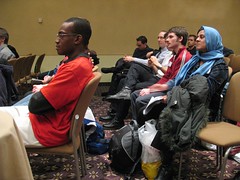
Audience
Originally uploaded by sfllaw.
It s been a long time since I ve written about our local unconferences, but a neat one coming up is DemoCamp CUSEC 2. It s attached to the Canadian Undergraduate Software Engineering Conference, which is being held in Montr al again. Last year, I did a demonstration on how to cook an omelette, with it being a metaphor for software engineering. This year, I m going to do something more prosaic and run a round of Powerpoint karaoke, under the guise of getting people to practise their presentation skills. Or it will be a convincing argument against its use. Show up if you can! Present something you ve been working on! (There are still some slots left.) It ll be exciting. DemoCamp CUSEC 2
Thursday, 17 January 2008
19:00 21:00
Centre Mont-Royal
2200 rue Mansfield
Free admission
( Sign up Google Maps )

Robert Collins: 10 Jan 2008

Dear lazyweb, In bzr development we are now working primarily on network performance. One of the key things about being sure we have improved things is automated, repeatable benchmarks. And for that to be useful in networking environments we need to control latency and bandwidth and packet loss. I know this isn't a new problem, but it was about 5 years ago that I last did this sort of thing. What are the best tools today (for linux :)). Ideally I'd be able to bring up a bunch of local addresses like 127.0.1.1 or 127.0.0.2, with different properties - such that traffic from 127.0.0.1 to 127.0.0.2 will simulate being uploaded over adsl, and 127.0.0.2 to 127.0.0.1 will simulate being downloaded over adsl.

Peter Van Eynde: hireing myspace inspired designers considered harmful

To see what happens if you hire people who think the average page on myspace looks good to redo your news site you only have to look at the horror of the new site of the vrt.

Even with adblock and noscript tuned I cannot make it into a descent form. A sad day for webdesigners in .be.

Form over function indeed...

Gunnar Wolf: Royal abuse

I just went to our Institute's yearly ceremony of rosca de reyes. What's that? Well, according to the tradition, on January 6 the tres reyes magos (boringly translated to English as three wise men - It should be something like three wizard kings) payed a visit to the newborn baby Jesus. In Mexico, the tradition mandates that every family, group of friends, or whatnot should gather and eat rosca de reyes, a round, sweet bread, usually some 10cm wide. The rosca has some plastic babies hidden in it, remembering how baby Jesus had to be hidden and smuggled out of his birthplace. And, according to the Mexican tradition, if you cut your piece of rosca and get the baby, you are expected to buy tamales for everybody on February 2, d a de La Candelaria. (why? Don't ask me!)Anyway... An image is worth ~10Kb of UTF8 (so it's still better to describe it, as it weighs around 63K, but what the hell):

Two babies?! I was abused by the Three Wizard Kings! (at least it does not sound as sad as "I was abused by three wise men"!) I'll have to buy tamales for everybody on La Candelaria twice, even if they are no longer hungry!

Eddy Petri&#537;or: Updates: NSLU2, Andrew S. Tanenbaum in .ro

Last weekend was as hectic as my life has been lately: I have been trying to restore sanity into my NSLU2, I went to a lecture from Andrew S. Tanenbaum and I made a 2.5 hours drive to my parents in about 4 hours because of the fog.

First, my slug:
  • refuses to recognise the USB NIC I have been using until the latest incidents (it either says 'not accepting address, error -71' or 'device descriptor read/64, error -71')
  • sometimes reboots when I insert the USB NIC
  • either doesn't boot at all or boots really slowly when the USB NIC is inserted
  • (obviously) doesn't show the NIC in lsusb listing when is not recognised
Since the USB NIC works on my laptop, I suspect a hardware problem with the slug. Bummer!

Dear no-so-lazyweb, is there a way to install Debian on an ASUS WL-500G Premium router without loosing wireless ability? Or, is there a way to make use of my USB NIC with the ASUS router?


Second, Andrew S. Tanenbaum visited Romania and lectured Friday at the University Politehnica Bucharest.

He presented Minix3's architecture and the advantages it has over monolithic OSes. I attended the lecture (although I am not a student anymore) and found it quite nice and well prepared, but I had the feeling that sometimes he was trying to avoid or to bash topics that were not putting Minix into a good light or challenged its title of being the first open[0] OS based on a micro-kernel architecture[1]. In spite of that, I found him to be a really good speaker and I liked the overall presentation, although, I also expected some on the spot demos or at least some recordings.

The things that I remember:
  • 2.4 millions subtle code alterations in drivers with only 80000 driver crashes (of course, no kernel crashes)
  • simulation of network driver repeated crashes at different time intervals and how it affects performance - a 30% degradation at crashes that occur once every second and an insignificant degradation at crashes occurring at each 10 seconds
  • every driver has a set of rights assigned to it; it was difficult for them to define this - this sounds a lot like SELinux issues
  • messages have a fixed length
  • there is no dynamic memory allocation within the kernel
  • the kernel is 5000 lines of code (all drivers are in user space)
  • really secure system
  • there were performance comparisons with Minix2 and the hit was about 20%; still, is said that L4 has only an approximate 2-5% performance hit because of the micro-kernel architecture
  • apparently the FreeBSD kernel has only 3 bugs /1000 lines of code
  • Minix uses a BSD license
I also got a Minix live CD (which is more like the Gentoo Linux install CD - just console in the live system) and made an installation of Minix in a qemu machine[2]. Unfortunately, I don't think I'll have the time to dwell into the source.

I was thinking, would it worth the effort to try to make a GNU/Hurd/Minix system (i.e. replace Mach with Minix's micro-kernel)? BTW, is Debian GNU/Hurd now based on L4 or does it still uses Mach?


Note: Some of my work colleagues suggested that the presentation was the same as one he made at linux.conf.au last year, but I can't confirm/infirm that since I didn't saw the recording.


I won't write about the "fog drive", but I'll just say it wasn't pleasant at all, and I felt I was in driving in The Twilight Zone for the whole Friday evening.


[0] he gave credit to QNX
[1] For instance, I tried to ask him twice if he felt that GNU Hurd was violating the micro-kernel paradigm or if he can compare it to Minix' architecture. I had the impression that both times he avoided to answer and started the usual Hurd bashing, "they have been developing it for 20+ years, but got nothing working", meanwhile "Minix is here". After the lecture/presentation somebody told me that AST shortly said that they "were similar, but different". I didn't catch that line.
[2] thanks to qemu-launcher it is trivial to create and manage multiple qemu virtual machines

Eddy Petri&#537;or: my laptop is back

Yesterday I got my laptop back. It was in service since the 6th of December.

They replaced the battery, and although it looked like the built-in charge indicator was defect, actually the button on this battery is buried deeper than it was on the previous one and I have to press really hard on it to trigger it.

According to the tests made yesterday night, this battery holds for about 2.5-3 hours when playing music. Also it has 96% of its designed capacity. I guess is OK enough since I don't want to be spared from my laptop anymore.

Next on the agenda:
  • restore data sanity (I did clean up most of the data from the HDD before handing down the laptop for the case when I was forced to hand it over; lucky for me, I managed to keep the HDD)
  • install armel Debian on my new[1] NSLU2, Kinder (more news on that later ;-) )
  • fix my local network chaos triggered by the problems that hit Ritter (my older NSLU2)
  • finish the wiki theme
  • work a little more on svn-buildpackage and kill more of its bugs
  • walk through my (game) packages' bugs and try to fix them, answer, etc.
  • try to make bluetooth transfers to work from and to my laptop
BTW, I still hold to my opinion that Dell and Emag suck, although I might buy desktops from Dell, laptops are a no-no until they fix their broken batteries and their broken "1-year warranty for batteries" policy.

[1] I bought a new NSLU2 after I left my laptop in service and it has been waiting since then to run the Debian Arm EABI (armel) port

Simon Richter: Magic versus more magic

At casa Geier, there is a slightly broken Asus A3G laptop, formerly known as salmiakki. The symptom is that upon pressing the power button, the machine ponders for a few seconds, then decides to turn off again. Since these laptops come with CD playback function keys on the outside, I think this is the safety feature against accidentally powering on; it just turns off again when the lid is closed. Which makes me suspect that only the lid switch is broken. Trouble is, there is no switch. This thing uses black magic to find out if it's open. There are no wires going to the hinges, there is no magnet either, or anything else that looks like it could be used in this way. So dear lazyweb, I'm interested in any hints how this might work. Pure speculation is also fine.

Junichi Uekawa: emacs git modes.

emacs git modes. Apparently, they are already available in Debian package git-core, /usr/share/doc/git-core/contrib/emacs/. In Fedora Core they are in an independent package emacs-git, and in Fink they are in the package git-mode. I just added the following lines in .emacs to try it out, and they seem to be working somehow. Great.

Martin F. Krafft: Down and up and down and up

You are probably using DHCP on the machine currently in front of you. The Dynamic Host Configuration Protocol is a way for your computer to obtain an Internet address from a pool of available addresses, and to return it to the pool when you no longer need it. Basically every Internet service provider uses DHCP, or something similar. As a network operating system, Linux has DHCP support (and had it for ages). In true Unix fashion, Debian sports at least four DHCP clients. Debian s default is dhcp3-client, also known as dhclient. The theory is that the client requests an address lease from the server and periodically renews it. This process yields a number of events, to which the operating system can react. For instance, initially, the client issues a PREINIT event to get the interface into a state where it can talk on the network, and a BOUND event as soon as it acquired a lease, or FAIL if it, uh, failed. After a certain period of time, the client tries to renew the lease. If it succeeds, it issues a RENEW event; if it fails, it yields EXPIRE. So much for the theory. It seems that dhclient is rather stupid, which I tried to document in bug #459813 it does things differently: given a lease, after a certain period of time, it just issues an EXPIRE event, which causes the operating system to deconfigure the interface and take down connectivity. Then, the client spits out a PREINIT event, followed by BOUND or FAIL, as appropriate. I have not quite investigated what all this means, but this much is for sure: periodically, your machine goes offline, only to come back online a second later. If this were Windows, one would probably knock on wood and be glad that it works at all. But we re on Linux here, Debian even, so this cannot be. I d love to be proven wrong, so if you have a minute, please try to verify. One way of doing so is to insert
echo "$(date) got $reason" >> /tmp/dhclient-script.reasons

towards the top of /sbin/dhclient-script and monitor the output file. Once your client renews, it should read:
Wed Jan  9 11:53:27 CET 2008 got RENEW

but instead you ll see
Wed Jan  9 11:53:27 CET 2008 got EXPIRE
Wed Jan  9 11:53:28 CET 2008 got PREINIT
Wed Jan  9 11:53:33 CET 2008 got BOUND

and if you look closely enough, your interface will be unconfigured those seconds between EXPIRE and BOUND. I only spent about 2 hours with dhclient last night, as part of my efforts on netconf, but I already found bug #459813 and bug #459818, two bugs which don t suggest that dhclient is quality software. If I find more, I ll have to consider a different client, hoping that there are others which separate the DHCP client from the operating system calls in a similar way as dhclient does. NP: The Flower Kings: @Live Recording, Uppsala City Theatre, Sweden, 10 February 2003

8 January 2008

Andrew Pollock: [life] Post-op, Day 5

Not a whole lot to report. Sarah's still yet to have a decent night's sleep. The cardiac rehab lady came by to go through the do's and don't's and answer any questions we had. They did an echocardiogram. I tagged along to watch. The Dacron looks a bit whiter on the ultrasound than the aortic tissue, other than that, there's not a lot to see. It's looking like she'll be discharged tomorrow.

Russell Coker: Weather in Melbourne

Some people have been asking about the weather in Melbourne in late-January in terms of what to wear for Linux.Conf.Au. It is probably impossible to predict weather for a particular day this far ahead. But predicting a range for the week is not difficult. I think that you should expect at least one day that is really hot with a peak of 37C or more and reasonable humidity with a possibility of another two days the same or similar. A day with a peak of 42C or more is not unlikely over the course of a week. You should expect a range of temperatures, one or two days that are reasonably cool with a maximum of 25C would not be unexpected. Some heavy rain in short bursts is a possibility (based on the past few weeks - prior to that there was little rain and it’s possible that there may be some time without rain again), there is probably no need for a rain-coat if you have the option of waiting ~30 mins for the rain to pass before going outside. I expect that if there is any rain at a time when conference delegates are about to go out somewhere then things will be delayed. I suggest that you wear jeans while on the plane but expect to wear shorts for your entire time in Australia. A t-shirt is a reasonable option but if you plan to be outside much then wear a long-sleeved shirt. As I don’t expect to be doing much work in traditional offices in the near future I’m wearing business shirts when I go outside, long sleeves with a collar is good for protecting against sun-burn and as they are light they keep me cool (t-shirts are tighter and thicker and keep you hot). However when at LCA I will be wearing t-shirts that I designed (which should be well suited to being inside and I don’t plan to do much outside during that week). A Scott e Vest [1] is a good thing to wear. It has heaps of pockets for your electronic gear, is reasonably light, and can be worn on top of a t-shirt. The Scott company also sells a TEC shirt which is a long-sleeved shirt with plenty of pockets. I’ve had a Scott e Vest for a number of years and I might have to get myself a TEC shirt.

Thijs Kinkhorst: MAMPC success

While stuff is upgrading I can update on a previous entry. In Delft Hieke and I had an excellent dinner in restaurant l'Escalier, who specially prepared a vegetarian menu for us. The establishment was fully booked yet not very noisy, with very personal and friendly service with a good wine selection. The next day was the big day of Rudy's defense. We (Rudy, David and I) started at 8 in the morning to put on our costumes, after which we went to prepare the defense. From my point of view it all went quite smoothly. David and me could even be of useful assistance by reading out some of the propositions during the ceremony. It turned out that Rudy's research into Multi-Agent Model Predictive Control was convincing enough for the committee to hand him his PhD degree (see below). After which there was the appropriate celebration in the form of a good dinner and some welcome beverages after a very long day. Photo of PhD committee and PhD defendant

Joey Hess: ship in a bottle

I'm about to release debhelper 6.0.0. But this blog is really about CDBS, and why it's entirely unlike debhelper despite being based on it.
With CDBS you're building a ship in a bottle. You have all the same tools available, but there's this bottle in the way, which doesn't let you bring any of them fully to bear, and requires all your techniques be changed around to fit its limited interface. This is a beautiful example of the kind of fun you're setting yourself up for by chosing CDBS. With debhelper, two commands can be easily reordered. With CDBS, you need three magic environment variables and either a hardcoded package name or some grody Makefile code: http://lists.debian.org/debian-python/2008/01/msg00039.html

Next.

Previous.