Search Results: "sten"

8 April 2009

Eddy Petrișor: About the protests in Moldavian Republic

Many people in the western world are completely unaware that in the Moldavian Republic there is an ongoing protest against the current Communist Party which is at power after the parliamentary elections held on Sunday. The protestants accuse the Communists of election fraud and there are numerous reports of dead people being recorded as voters, people which, by religion, chose not to vote, and other several people which couldn't have voted.

Tuesday the protests took a violent turn, apparently "aided" by some instigators which were reported to be seen as recording the protesters, taking notes and, generally, not fitting the picture. During the day the national television broadcasted absolutely no information on the events, and aired documentaries, cartoons and no news on any of the protests. To me, this looked very much alike what the Romanian Television aired during the Romanian Revolution in December '89 when during the fights in the streets of Bucharest the Television aired no images from the centre of Bucharest.

But, back to Moldavia, at the end of the day, sadly, the Parliament and Presidency buildings were devastated, making it easy for the Communist leaders to produce some disinformation propaganda based on real footage.

Yet again, sadly, but it seems under the protection of some of the aforementioned instigators, the flags of the EU and Romania were waved at the highest levels of the Parliament building during the time the protesters allegedly took over that building (there were several reports that the Police forces actually simply let them in, without actually needing/being forced to do that; also the passivity of the policemen seen in the footage from Romanian televisons was obvious).

As many Moldavian students live and study in Romania, some of them wanted to go home and take part at the protests happening in Chi in u. To their surprise, many of them were denied the right to enter their home country. Many, if not all, Romanian journalists were also denied access in the country accusing alternatively technical issues, lack of proper papers (although only the passport or the ID card was officially required), lack of safety, or simply refusing without reason.


Today, the Moldavian president Voronin, accused Romania as being behind the manifestations in Chi in u, Moldova's capital and said it will declare as a persona non grata the Ambasador of Romania in Moldova, and thus forcing him to leave Moldova within 24 hours. He went even further and said that visas will be required from now on for Romanian nationals. As soon as this was announced, it was one of the most invoked reasons by the Moldavian customs as a rejection reason, although, according to Moldavian Embassy officials in Romania, no rules or procedure were known for the release of visas for Romanian nationals.

Also, during Wenesday, Moldavian crossing points were opened and closed alternatively but incosistently accros the entire border for Moldavian nationals. Romanian nationals were denied in most cases (although some Romanian truck drivers were reported as allowed to cross). At some point during the day the Moldavian officials from the customs told the Moldavian students awating at the border that they are offered access on the condition they go direclty home with the buses provided by the Moldavian customs and were warned that going to Chi in u wasn't a smart choice for them. Some of the information from students which managed to enter their home country suggested that is advisable to not enter the country since they were going to be denied of the right to leave the country later, when they were to return to Romania to their studies (after Easter).

What's sadder is that the Moldavian voting system is built in such a way that the vote counting, in the end is done by Government officials behind closed doors, inside a Ministry. OTOH, the international official observed the things which happend in public, but did not see any of the dead voter lists (since they were not present when those votes were casted), and declared the vote as mostly legal and without major or significant incidents.


According to the media, before the elections, the Communists were credited with 35-37% of the votes in an independent poll, while in the exit poll conducted by the Communists themselves they were credited with 42-45% of the votes. In the end the last official partial results credited them with approximately 51% of the votes.

About Vladimir Voronin, it is a known fact that he has double citizenship, Moldavian and Russian and is a reserve general within the Russian Army and currently has a pretty nice pension from the Russian state.


All I can say is that, although the Moldavians' desire to have a real democracy is a legal and reasonable request, the western world chose, due to the international circumstances, to look the other way around and not to incommodate Russia in any way. Moreover, to accuse Romania to have unionist desires an act upon those desires is planly stupid since now Romania is part of the EU and Moldova uniting with Romania is simply impossible now, since Moldavia's economy would sunk even more the fragile and regressing Romanian economy and Romania would instantly fail the EU requirements which would mean disaster for us.

Marc 'Zugschlus' Haber: partition table gone, data still present

I just wanted to make an USB stick bootable and wondered why mkdiskimage -4 /dev/sda 0 32 64 complained about the disk having too many cylinders. After a few moments, it ocurred to me that since libata, the system hard disk has become sda and that the stick was sdb or sdc. One ctrl-C later, fdisk confirmed both counts: That I accidentally started mkdiskimaging my main system hard disk and that the partition table was already gone. A few hours later, the notebook is back in business without too much data loss. Lucky me. My notebook has an alibi installation of Windows XP in its first primary partition sized 4 GB. Since I aborted the mkdiskimage process early enough, I hoped that only the windows installation was hosed. The Linux system is entirely in LVM (with crypted LVs), and LVM hadn t noticed yet that its PV was gone. I reckoned that I still had a chance to rescue my data if I didn t reboot. So I hastily commandeered an USB hard disk (thanks, $CUSTOMER, for quickly supplying one), fdisked, pvcreated and vgextended it and started the pvmove. While this was happening, I theoretically was able to continue working, which I didn t because I was afraid of losing. About half an hour into the copy process, the USB disk chose to deregister itself and the pvmove aborted. Rebooting the disk made it reappear as sde (it was sdd before), and miraculously, a new pvmove call just worked. However, a good fraction of actions on the shell resulted in a lot of input/output errors on the screen. I guessed that this was the first sign of my data finally dying, but I let the pvmove continue. After the pvmove was finished (which was rather fast since the move of the crypted LV means that the crypted data is moved and not de- and recrypted), I had to recreate a /dev/sda2 partition with type 8e before the LVM tools allowed me to vgreduce the VG. I then zeroed out the first 10 GB of the internal disk and spent a few hours reinstalling and patching XP from scratch before I finally went through the pvcreate, vgextend, pvmove routine in the other direction. Then the big moment arrived: fsck of all LVs. I guess that the reason for the input/output errors was that /usr was completely hosed (no single file outside lost+found), but /home and all other file systems holding data where the way back to the (a week old) backup would have been quite painful were ok. I pulled /, /usr and /var from the backup to be consistent again, updated to current sid (avoiding KDE 4 for the time being) and could start working again. The only real loss was a few hours of work that were stored in /usr/local which died along with /usr, so the result of my stupidity was not very catastrophic but still a good lesson. And I have learned that LVM is a robust and resilient beast. Good work. Now I d like to know what happened to my /usr - I always had the impression that pvmove should not break data even when the target disk suddenly goes away...

John Goerzen: Goodbye

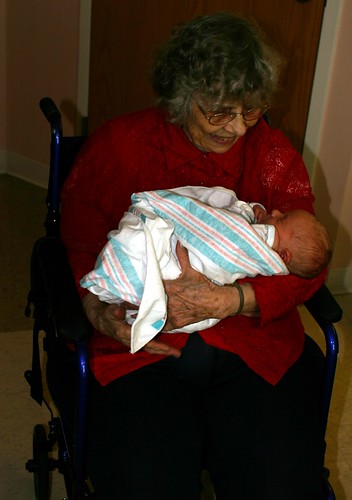
Jacob has lately been telling us gate gamma kassen so sick (Great Grandma Klassen is so sick), after his visit to the hospital, and it s true. Today started normal enough, but by 2:45 I got an email from my mom, saying that grandma had taken yet another turn for the worse; her pulse was racing, her temperature feverish, and her breathing shallow and difficult. The last grandchild that was going to be there made it, and got the last flicker of recognition from grandma. I wrapped some things up at work. Then I made the short drive from work to the nursing home, and got there just after 4. I went in to her room there, and it was full of family. Two of her children were singing her favorite hymns. I can never forget my uncle s deep bass voice as he stood at her bedside, holding her arm, while my aunt patted her head, both of them singing. Grandma s only remaining sibling, her younger brother Melvin, sat on the other side of the bed, looking on. Grandma s white table and chairs, which were in grandma and grandpa s house as long as I can remember, and followed grandma through all of the four other places she lived in the last years of her life, were in her room at the nursing home too. It always felt like home to be with grandma and those familiar things that she always took with her. Despite what was happening, I was glad she was back at home. My uncle motioned me over to her bedside, and I took her hand for a few minutes. It felt cold and weak; for the first time, she didn t grab my hand at all. A nurse came in to check oxygen saturation, but the machine wasn t able to get a reading due to poor circulation to her hand. She wasn t able to get a heart rate either because the heart was racing so fast. She discussed briefly whether the family wanted them to continue giving her oxygen, and they decided that they would, for her comfort. My uncle and aunt kept singing. I blew my nose and dabbed at my eyes, and there were hugs all around. And just a few minutes later, grandma peacefully stopped breathing, maybe 20 minutes after I had arrived. They went to get the nurse, who came back to listen to grandma s heart again, though we knew what she would find. She took the stethoscope off, and she almost lost her composure, but managed to say you can turn the oxygen off now. Several people gave grandma a last hug. After a few minutes with just the family, they told the nurses to go ahead and call the funeral home. That set off a lot of activity making arrangements for the next few days, funeral plans, and the like. I stepped back into grandma s room a few times, while the family was in the sitting area right outside it discussing. I looked around at the family photos on the wall, the old table and chairs, the recliner. Now, these are the things that were grandma s. It didn t feel like home anymore. Terah and Jacob were stuck at home Terah s car was at the mechanic for repair today. I called to give her the news. She wanted to come to be with the family, but I didn t really want to leave. She tried calling some friends to see if they could give her a lift to the mechanic, but not one of them was available. I talked to her again and suggested she just call the mechanic. She wasn t even halfway through describing the situation when he interrupted with, We ll have it at your place right away! Well, I don t expect you to have to do that, or you could certainly wait until you close. Nope, this isn t your average community, we ll bring it right over. You should be there. Grandma has enjoyed a simple life and had requested a simple death: no extraordinary measures at the end of life, no embalming either. So, by law, the burial must happen within 24 hours of death, and will be tomorrow. After all the arrangements, people realized nobody had supper yet. We went to the quickest available option pizza and ate there. It was paid for out of grandma s remaining money the last meal of so many that she provided for her family over the years. It was a happy meal. As I drove home, NPR news was on the radio. There were the same stories we hear all the time: the economy, the mideast, the president. Normally I m interested, but today I shut it off. Today is different. Tomorrow, for the second time in four years, I will help carry a grandparent s casket a few days before Easter. I ll end tonight with this photo. It was taken soon after Jacob was born. Grandma came to the hospital and held him. That smile sums her up perfectly. img_4965r.jpg

6 April 2009

David Moreno: Rubx: Twitter's Ruby shell

rubxRubx, also known as Ruby Boobie, is a nice spoiled girlie bot that runs on Twitter. She listens when you talk to her and when you do, it'll better be with Ruby: She will interpret your tweet in Ruby and reply to you with what your code returns. How does it work? You send a message to her:
@rubx "The day I was born it was a " << Time.local(1984, "aug", 8).strftime("%A")
And @rubx will reply:
@damog "The day I was born it was a Wednesday"
Go see more about her (examples, FAQ, etc) on axiombox.com/rubx or on her Twitter profile. As we tested the hack, a bunch of people started interacting with Rubx too, some people calling her Twitter Line Interface Ruby Interpreter! :). See what other people has tried with her here.

4 April 2009

John Goerzen: Review: Why Religion Matters by Huston Smith

Most of the book deals with things we already know yet never learn. Huston Smith
This is perhaps one of the most enlightening books I ve ever read, and yet I feel like I ve only grasped a small bit of its meaning. It is with that warning that I attempt this review. I should add at the outset that this is one of those books where no matter what you expect it to be, after reading it, you will find that it wasn t what you expected. I heartily recommend it to everyone, from the devoutly religious to the devoutly atheistic. Science and Scientism Smith begins with a discussion of science and scientism. He is a forceful defender of science and of the work of scientists in general. But he is careful to separate science from scientism. Paraphrased, he defines scientism as the belief that science is the only (or the best) route to truth about everything. He points out that, through no explicit fault of scientists, scientism has become so ingrained in our modern psyche that even theologians have started thinking in terms of it. Yet there are some pretty glaring flaws in scientism, particularly where it comes to matters of philosophy, conscience, meaning, and religion. Smith argues that the foundation of science is the controlled experiment and logical inferences derived from it. He then proceeds to make strong case that it is not possible for humans to set up a controlled experiment to either prove or disprove the existence of something more than our material world a transcendence, a metaphysical reality, a spirit, a God. We, with our existence trapped in this finite world, cannot possibly hope to capture and control something so much more than us in every way: intelligence, versatility, and finiteness . Thus science can t even address the question. That hasn t stopped people from claiming that religion is just a helpful delusion, for instance, despite not being able to prove whether it is in fact a delusion or reality. Worldviews Smith then asks us to indulge a moment in considering two different worldviews: one the science-only worldview so common these days, and the other a more traditional religious worldview with a rightful place for science. He defers supporting evidence for each for later chapters. The science-only worldview is pretty familiar to many, and I have even heard parts of it articulated in comments left on this blog. It goes roughly like this: The universe is x billions of years old. It is, so far as we presently know, a vast expanse with mostly dead matter. Earth is the only exception, which contains some living organisms and even sentient beings, though these make up a small fraction of even the earth. This life arrived by accident through physical and biological processes, some of which are well-understood and some aren t. In the end, the universe will again become entirely dead, as our planet will be incinerated when our sun goes nova. Or, in any case, the entire universe will eventually expire in one of various ways. This worldview suggests that it is an accident that we are here and that we have consciousness, and that our actions have no ultimate meaning because the earth will eventually be incinerated anyhow. The traditional worldview holds the opposite: that instead of having our origins in the tiniest and simplest of building blocks, and eventually improving over time, we should more properly think of ourselves as being derived from something greater than ourselves. That greater something is part of our world, but something much bigger than it too. It does not rule out science, but neither is it something that science can ever explain. It suggests that our lives have a purpose, that our work has meaning, and that there are ultimate ends to seek. Smith is a scholar of world religions, and draws on his considerable experience to point out that virtually all world religions, before the Enlightenment, drew essentially the same picture of our world and the more . He reminds us though perhaps less effectively than Marcus Borg that there are other ways of knowing truth besides science, and suggests that we pay attention to what the vast majority of humanity had to say about the nature of existence before a human invention started to squelch the story. The Stories The book is filled with personal stories (Smith spent at least a decade each researching and practicing at least four different religions), quotes, and insights. I consider it the most enlightening book on religion I have yet read. Smith has more than a passing familiarity with physics, and the physicists in the crowd will probably be delighted at his discussions of quantum mechanics and the claim that nonlocality provides us with the first level platform since modern science arose on which scientists and theologians can continue their discussions. One passage reads like this:
Again I will let Henry Stapp say it: Everything we [now] know about Nature is in accord with the idea that the fundamental process of Nature lies outside space-time, but generates events that can be located in space-time. Stapp does not mention matter, but his phrase space-time implies it, for physics locks the three together.
He says that quantum theory of course can t prove that there is a God, but that recent research seems to disprove the old notion that, given enough time, all questions will be answerable by science. Even if you disagree with every one of Smith s conclusions, you ll be along for a fascinating ride through physics, biology, philosophy, and innumerable religions. One of my favorite anecdotes concerns noted physicist David Bohm (who studied under Oppenheimer and worked with Einstein, among others). He gave a lecture at one point, apparently touching on his hidden variable theories to a great extent. At its conclusion, a senior physics professor asked derivisely, What does all this philosophy have to do with physics? Bohm replied, I do not make that distinction. How s that for something to ponder? The Writing The book is fun to read, and the stories make it all the moreso. However, it is not a light read. Houston Smith wrote this near the beginning, without any hint of irony:
The first of these differences is that Gass s is an aristocratic book, written for the literary elite, whereas mine is as plebeian as I can render its not always simple arguments.
I can think of a few simpler ways to express that thought. In any case, it isn t light reading, but it is accessible even if you, like me, have little formal training in philosophy, theology, or quantum physics. Conclusion I would do such a poor job trying to paraphrase Smith s main points that I haven t even really attempted to do so here. Get the book you ll be in for a treat. Incidentally, I had been thinking of buying the book for awhile. What finally made me do so was an NPR story about how he helped preserve the sound of the Gyuto Monks Tantric Choir back in 1964, when he (of course) was sleeping in a monastery in the Himalayas and awoke to investigate something transcendent the holiest sound I have ever heard. I pressed the Buy button for the Kindle edition a few minutes later.

2 April 2009

Ana Beatriz Guerrero Lopez: KDE 4.2 in unstable is coming

It was 2 years ago when we started working in KDE 4 packages, and exactly 20 months ago when we started uploading KDE 4.0.0 beta 1 to experimental. Finally, we are working in packages that are targeted to unstable \o/. As announced in the users mailing list, we will be uploading KDE 4.2.2 to unstable in the next days, so look carefully at what you update :) We have worked very hard in providing a smooth upgrade, but given the change is so big, some new (little!) problems will be discovered. One of the most problematic points is we were using .kde4 to store user data and settings of KDE 4 and now it is time to switch back to the default .kde. There are several possible migration cases here and for allow users select the case they prefer, a migration wizard tool named Kaboom has been created inside the Debian KDE team. Be aware that there will be some inconsistencies in unstable the following days after KDE 4.2.2 reaches the archive. So please, be patient. We are still testing and we are not uploading until we think it is good to go, so next days could become 2 weeks. Again, be patient :) If you want to keep using KDE 3.5.10 for a few weeks more, just do not upgrade yet. But if you want to keep using KDE 3.5.10 for months, maybe you should consider become a Lenny user. If you have questions, doubts and/or suggestions, you can check our Debian KDE Team website where we try to add information and the archive of the Debian KDE users mailing list. Time for a personal note. KDE 4.2 is a huge change from KDE 3.5, and it is normal if you do not fully like it in the beginning. But I do think most of users of KDE 3 will feel very comfortable in KDE 4 after some days using it. You just need to discover the new ways of doing some tasks. Also, once KDE 4.2 is sitting in unstable, a lot of third party applications (specially plasma widgets) for KDE 4 will be finally uploaded to the Debian archive, making KDE 4 even better.

30 March 2009

Gregor Herrmann: someone's breaking my machines

fun with my machines at home in the last days: sometimes running unstable can be a bit time-consuming ...

Daniel Leidert: Network doesn t come up after update to udev 0.140

The recent update to udev 0.140 lead to a system without network access to me. The error messages were:
Running 0dns-down to make sure resolv.conf is ok...done.
Setting up networking....
Configuring network interfaces...
ioctl[SIOCGIFFLAGS]: No such device
Could not get interface  ath0  flags
ioctl[SIOCSIWPMKSA]: No such device
ioctl[SIOCSIWMODE]: No such device
Could not configure driver to use managed mode
ioctl[SIOCGIWRANGE]: No such device
ioctl[SIOCGIFINDEX]: No such device
ioctl[SIOCSIWENCODEEXT]: No such device
ioctl[SIOCSIWENCODE]: No such device
ioctl[SIOCSIWENCODEEXT]: No such device
ioctl[SIOCSIWENCODE]: No such device
ioctl[SIOCSIWENCODEEXT]: No such device
ioctl[SIOCSIWENCODE]: No such device
ioctl[SIOCSIWENCODEEXT]: No such device
ioctl[SIOCSIWENCODE]: No such device
ioctl[SIOCSIWAP]: No such device
ioctl[SIOCGIFFLAGS]: No such device
wpa_supplicant: /sbin/wpa_supplicant daemon failed to start
/etc/network/if-pre-up.d/wpasupplicant exited with return code 1
SIOCSIFADDR: No such device
ath0: ERROR while getting interface flags: No such device
SIOCSIFNETMASK: No such device
SIOCSIFBRDADDR: No such device
ath0: ERROR while getting interface flags: No such device
Failed to bring up ath0.
done.
It seems, the update added rules to /etc/udev/rules.d/70-persistent-net.rules by increasing the device number and applying the last applicable NAME directive instead of the first one. This lead to the following file here:
SUBSYSTEM=="net", DRIVERS=="?*", ATTRS address =="XX:XX:XX:XX:XX:a7", ATTRS type =="1", NAME="ath0"
SUBSYSTEM=="net", DRIVERS=="?*", ATTRS address =="XX:XX:XX:XX:XX:18", NAME="eth0"
SUBSYSTEM=="net", DRIVERS=="?*", ATTRS address =="XX:XX:XX:XX:XX:XX", NAME="eth1"
# PCI device 0x10ec:0x8139 (8139too)
SUBSYSTEM=="net", ACTION=="add", DRIVERS=="?*", ATTR address =="XX:XX:XX:XX:XX:18", ATTR type =="1", KERNEL=="eth*", NAME="eth2"
# PCI device 0x168c:0x0013 (ath_pci)
SUBSYSTEM=="net", ACTION=="add", DRIVERS=="?*", ATTR address =="XX:XX:XX:XX:XX:a7", ATTR type =="1", KERNEL=="ath*", NAME="ath1"
So the devices created were eth2 and ath1 but /etc/network/interfaces contained entries for eth0 and ath0. So fixed /etc/udev/rules.d/70-persistent-net.rules and rebooted. <rant>Is it really necessary to break network access with an update???</rant> Update I forgot this one: #521521.

26 March 2009

Holger Levsen: Ada Lovelace naming scheme

Two days ago I read about the Ada Lovelace day, which was an event were men and women were asked to blog about the women in technology which made an impact on them, in an effort to present girls (and women) all over the world with female role models in technology.

In similar though more personal motivation I choose my machine naming scheme at home two years ago: my (virtual) machines at home are named after women who made a difference, mostly in IT, but also some in more general science. Even though this list is not 100% in the spirit of pointing out the one woman who made a personal difference to one self, I thought I share my list, as I found it very interesting to learn about these great women myself.

goldberg is named after Adele Goldberg, who pioneered the smalltalk programming language in the 70s. According to a sympathetic annecdote she refused to show the system to Steve Jobs and only did so after her superiors ordered her to do so. Thats were Apple got many ideas which made them famous for being innovative...

goldwasser is named after Shafi Goldwasser, who is a RSA professor at MIT, doing research in complexity theory, cryptography and computational number theory. She is the co-inventor of zero-knowledge proofs.

lovelace is named after Ada Lovelace, and is widely recognized as the first programmer, who wrote a program (something that manipulated symbols according to rules) for a machine which has not even been build at that time. Of course, some men on this planet object to her being the first programmer, as work by women is always insignificant... </irony or maybe sarcasm>

bunten is named afer Danielle Bunten Berry, who was a game designer and programmer best known for the games M.U.L.E. and Seven Cities of Gold.

holberton is named after Betty Holberton, who was one of the six original programmers of ENIAC, the first general-purpose electronic digital computer, during and after World War II.

hopper is named after Grace Hopper who wrote the first compiler ever, the A compiler. She was also heavily involved in creating COBOL and standardizing COBOL and FORTRAN.

koller is named after Daphne Koller who does AI research at MIT and who seems to behind the idea of bayesian machine learning, which you might know from your spam filters... (I can only state her involvement in bayesian learning so vaguely as I'm basically clueless about the topic :)

leveson is named after Nancy Leveson who is also an MIT professior and is an expert in systems and software safety.

Last but not least I like to remark that none of the women above is even nearly covered with what I wrote here or what is written in wikipedia, which I used as my main source for this blog post. It's simple impossible to sum up one life that brief and be close to accurate.

And then there is another group of women whose achievements are noteworthy as well and who choose to present themselves on that webpage to show others that Debian is not a mens club. Thank you (a lot) for that and for your other contributions to Debian! If you want to learn more about these giants, I recommend this talk. Guess who's achievements I admire most in this group ;-)

Somewhat unrelated I wish to shout cheers to Yvonne, who tought me many things and who died six years ago today. You will also not be forgotten, though the pain is mostly gone now (well, it's gone, except for days like today). Thank you, among other stuff, for teaching me to celebrate and cheer every day, even if not everything is cheerful. Wenn die Nacht am tiefsten, ist der Tag am n chsten! :-)

Ben Hutchings: Busy at PyCon

This week I'm at PyCon in Chicago, helping to train and supervise the A/V team in recording the tutorials and talks. We have a lot of inexperienced volunteers but they're learning quickly. Carl Karsten (in charge of A/V) and Ryan Verner (another outsider with long experience from LCA) are organising things. Ryan, Dave Noble and I provide technical assistance to the rest of the team. I'm also working on my first Django app, which will be used for reviewing files. This is essentially a clone of the excellent work done by Gunnar Wolf and Damian Viano in Pentabarf. PyCon doesn't have a centralised database so this is a standalone application. Ryan is now applying styles to my horribly bare HTML, and I have a short list of bugs to fix before we ask the video team to start reviewing. The tutorials started yesterday and talks wil start tomorrow in different rooms, so we have to set up all the equipment again and reconfigure for multiple cameras. Hopefully by Saturday things will be running smoothly and I can spend some time in the city. It would be a shame to come all this way and stay by the airport for the entire time!

25 March 2009

Romain Beauxis: Mediawiki extensions

Apprently, there is some interest for several extensions of mediawiki. I take this opportunity to mention the existence of the mediawiki-extensions package. The design of this package makes it simple to integrate with the mediawiki package available in debian and follow new (svn) releases. It should also be quite simple to add more extensions. I have just added the mentioned extension, OpenID. In the mean time, any help would be appreciated (...) - Debian /

23 March 2009

Sami Haahtinen: Configuring split DNS

Since I enabled comments in this blog, I finally needed to configure a split DNS for my network. There are various reasons why one needs a split DNS and as it's usually pointed out, the reasons are usually non-technical. In my case the reasons are technical: I have a NAT in my local network that allows me to host this website locally. What causes problems is that the domain name ressukka.net points to the external IP address and that doesn't work from the inside. So split DNS it is. There are various ways of building a split DNS, one can use the views feature in bind9 or you can set up 2 separate DNS servers that provide different information (and redirect your local resolver to use the internal server). The latter is more secure if the internal zone is sensitive. I decided to use a hybrid solution. I already knew that PowerDNS Recursor was capable of serving authoritative zones (think pre-cached) so I decided to leverage on that. Setting this up turned out to be simpler than I expected. First I made a copy of the existing zone and edited it to fit my needs. I changed the IP address of ressukka.net to point to the IP address on the local network. I also adjusted some other entries that pointed to the local network. Next I modified bind to listen on the external IP address. This can be accomplished by adding a listen-on 1.2.3.4; ; to the options in the configuration. I also disabled the resolver by adding recursion no;, this forces the bind to work as authoritative only. Then I installed the PowerDNS Recursor (pdns-recursor package in debian) and configured it to listen on the internal address only (local-address=10.0.0.1) and added the pre-cached zone to the configuration with auth-zones=ressukka.net=/path/to/internal-zone Now, after restarting both daemons, I had a working split DNS with minimal configuration. I was also able to change the external DNS to authoritative only mode, which is a good idea in any case.

22 March 2009

Rob Taylor: Codethink anniversary

Last month, Codethink turned 2 years old, to coincide we had a company-wide hackfest in Brussels straight after FOSDEM. It really brought home how much it d grown. Just a year ago there was just me and Mark. Now we are 8! So i m gonna take a moment to shout out to the great job these guys are doing. In order of appearence . Mark Doffman
Mark has been consistently working on transforming AT-SPI (the GNOME Accessibility and UI automation technology) into a D-Bus based cross-desktop project. From nothing a year ago, working with Mike Gorse from Novell, he s now got something that more or less works and it s getting a lot of focus and testing as we plan for GNOME 3.0. I m looking forward to a brave new future for cross toolkit accessibility on the Linux desktop. John Carr
John came to us from working on Conduit, and he s continued on his dream of making all the devices and web services of the world talk seamlessly to each other. John s been in charge of pushing the Wizbit project along and now the core of this is pretty stable, he is going to be turning his eye to working on using Wizbit for synchronisation. J rg Billeter
A stunning hacker who needs no introduction! J rg s been continuing to hack on Vala and it s getting more and more mature each week. His main work, however has been on the stunning tracker-vstore, a branch of tracker that brings full RDF capabilities, which Philip van Hoof has been blogging about. I ll be writing a biggish blog post on this soon and what RDF could really mean for the desktop experience. Karl Lattimer
Karl came to us from working on UI at Nokia. At Codethink he s continued to focus on graphics technology and user experience, bringing his keen eye to Wizbit, amongst other things. One of the most impressive things I ve seen for a while was Karl s kinetic scrolling widget for the Wizbit timeline view. I m hoping we can turn this into something more general in the future. Ryan Lortie
Another hacker who needs no introduction, Ryan s our low-level infrastructure guy. He s been working on GNIO, a library to do network operations using GIO stream abstractions and continuing to hack on DConf, which is gradually coming together. He s also been helping J rg out with Vala. Mukund Sivaraman
I knew Muks from his GIMP work, and his work on Herb is really impressive. Muks is mostly working on top secret stuff that we can t talk about, unfortunately! Peter Charlton
Our documentation guy. This guy knows how to write and knows how to take something vague and unintelligable and turn it into crystal clarity. Invaluable! Of course, through all this I ve been here, dancing about architecture and generally doing the best I can to hold the whole shebang together. I ve been mostly working on some top secret stuff which hopefully will be getting opened up soon. I ll dance about that then

18 March 2009

Matthew Garrett: ext4 and spinups

As a followup to my discussion of ext4, I did some trivial testing today. This consisted of generating a file, writing to it, closing it, opening another file, writing to it, closing it and then renaming the second file over the first. Then repeating about 10,000 times. fsync() wasn't called at any point. I used the /proc/sys/vm/block_dump knob to get an idea of when stuff was actually hitting disk. This was using the current rawhide kernel, which has the various workarounds for avoiding data corruption merged. The good news is that I was unable to get into an inconsistent state - the files always contained either the original or the new data, and the absolute worst case was having a zero length temporary file. The bad news is that while ext3 only touched disk when it reached the commit interval, ext4 touched disk for every single rename() call.

There appears to be a plan for dealing with this, but the current state of affairs is that ext4 will (under an obviously incredibly synthetic and unrealistic set of conditions) reduce the amount of time a drive can spend spun down. The next step is to attempt to measure this in a real world setup and see whether it's compensated for by the other new features.

Biella Coleman: Expectations

Expectations: A little over a week ago I participated in a camp/event/conference/ that threw together 12 different networked based-groups/phenomenon/organizations. They got to do what many often can t do: spend some time working face-to-face as well as thinking about about questions of un(organizational) growth/ungrowth. Some of us spent some time learning about the nature of networked coordinations and organizations from these groups. There is a lot I could write about but, in part because I was in Amsterdam for a week, I am now playing serious catch up, but there are a few things that really struck me both of which relate to expectations, which I thought worth jotting down. Generally present were the following types of groups: open source projects (such as Blender), tech-oriented activist projects (Dyne), non-tech oriented projects (such as Free Dimensional), artistic-tech projects (such as GOTO10), artistic projects (Upgrade), academic-activist (Edu Factory) and others which are harder to classify (such as Gender Changes, and FLOSS Manuals). One thing that came out during the plenary sessions, which is when we got together as a large group to debate and discuss, is that technically oriented open source projects are at times singled out for not being inclusive. That is, people pointed out that most projects expect you to contribute technically in order to participate (and don t necessarily offer people the training/capacity so you can participate). I have heard a version of this many many and many times before and find it to be a curious (and generally unproductive) accusation, though I understand why the confusions arises. I say confusion because most of these projects are not overtly set up to be inclusive/technically pedagogical, and this is perhaps the key point they don t purport to be though many folks think this is part of their overall message/mission. Because these free software projects are open source, this, for some, somehow automatically translates into the political projects of inclusivity (that is, training folks so that they can become part of this world). And yet some other projects, such as Edu Factory and GoTo10, which are run as tight-knit of collectives, are rarely accused of not being inclusive. Why should this be? I raise this mostly because I find it interesting, pointing to the way certain terms or phrases (Freedom, Openness) combined with the visibility of FLOSS projects, automatically generate other expectations and meanings even if they don t actually exist. I also raise it because I think it is an unfair expectation to have of these communities only in so far as most of them are full of folks busy hacking up technology and this in and of itself, as I have written about before is worthwhile politically. And yet If one wants to make them more inclusive, then one can go ahead and bring into being such a project for most of them are quite open to various initiatives to enlarge the scope of participation. These projects can be internal to projects or external to them. That is, self-initiative goes a long way in this world, and has helped changed the terrain of participation and inclusivity and I am sure will continue to do so. Which brings me to my second point about expectations. Many people complain that open source is not easy to use. While this was entirely, 1000% true prior to 1998, every passing day makes this statement harder to stand by. I imagine in another 10 years, there will be many many programs that are as usable for the novice user as proprietary software. They had to play serious catch-up and I think have done a decent job. In some regards, all that was and is needed is time because time has already shown that usability has improved leaps and bounds. And yet there is still something odd about the accusations, which my friend tulpje but in the following way One would never accuse the Zapatistas for not having their military might/shit together like the US army, so why accuse open source for not being the mightiest software our there?) While I actually think that free software has already and will continue to give proprietary firms a run for their money in a way that a rag-tag guerrilla army can t do with a national army, it is nonetheless important to couch one s responses and accusations in terms of the constraints and realities of these projects. That said, I still think such expectations reflect important hopes and desires. They show us just how profoundly free software/open source has, simply by virtue of its existence, inspired many to follow suite politically, turning to FLOSS as a beacon of possibility.

Muammar El Khatib: Chris Cornell?

I just stumble into this:

http://www.youtube.com/watch?v=eyOtb136n6g

My first impression was: WTF???!!!! I was used to listening to Cornell in Sound Garden, Audioslave or in his Album Euphoria Morning, but this is the shittest change that I have seen ever. I was told to visit his web page, a request made from Gerardo Curiel, maybe with the hope that that had been a joke, but When I went there... it was real... Chris Cornell had become in a kind of Justin Timberlake :S

What should I expect now? Deftones doing something like this?:

http://www.youtube.com/watch?v=IKrq_7ROcpY

16 March 2009

James Morrison: Recent Bands

13 Mar 2009
White Swan, Black Swan: nice vocals, I only caught a couple songs

The Donkeys
Decent band, fun to listen to. A good whale joke:
Two whales are sitting at a bar
one says to the other [long whale noises]
The other says, "man you are trashed."

Quick to get on stage and play

Phosphoressence
Good country rock band. Slow to start playing and some assholes decided to pop into the front of the crowd, they were tall so they blocked a bunch of peoples view. Then they gained an extra 3 people and started moving backwards. For once someone actually got inside my bubble.

7 Mar 2008 -- Red Devil Lounge
* "Three of" (good luck googling these guys) -- very good
* A, b, and C -- not good, the lead singers voice cracked a lot, they did look like they should be in the movie "That thing you do" (my first date was at this movie).
* Moonlight Sexy -- ok, Andy didn't like these guys
* Marcy Playground -- Great!

14 Mar 2008 -- Writers with drinks
S.G Browne with Breathers: A zombie's lament. The chapter he read was really funny. I think this was the best part of the night. The host was also really good, but the host could be described as slightly scripted talking out of her ass.

Theodore Ts'o: Don t fear the fsync!

After reading the comments on my earlier post, Delayed allocation and the zero-length file problem as well as some of the comments on the Slashdot story as well as the Ubuntu bug, it s become very clear to me that there are a lot of myths and misplaced concerns about fsync() and how best to use it. I thought it would be appropriate to correct as many of these misunderstandings about fsync() in one comprehensive blog posting. As the Eat My Data presentation points out very clearly, the only safe way according that POSIX allows for requesting data written to a particular file descriptor be safely stored on stable storage is via the fsync() call. Linux s close(2) man page makes this point very clearly:
A successful close does not guarantee that the data has been successfully saved to disk, as the kernel defers writes. It is not common for a file system to flush the buffers when the stream is closed. If you need to be sure that the data is physically stored use fsync(2).
Why don t application programmers follow these sage words? These three reasons are most often given as excuses:
  1. (Perceived) performance problems with fsync()
  2. The application only needs atomicity, but not durability
  3. The fsync() causing the hard drive to spin up unnecessarily in laptop_mode
Let s examine each of these excuses one at a time, to see how valid they really are. (Perceived) performance problems with fsync() Most of the bad publicity with fsync() originated with the now infamous problem with Firefox 3.0 that showed up about a year ago in May, 2008. What happened with Firefox 3.0 was that the primary user interface thread called the sqllite library each time the user clicked on a link to go to a new page. The sqllite library called fsync(), which in ext3 s data=ordered mode, caused a large, visible latency which was visible to the user if there was a large file copy happening by another process. Nearly all of the reported delays was a few seconds, which would be expected; normally there isn t that much dirty data that needs to be flushed out on a Linux system, even if it is even very busy. For example, consier the example of a laptop downloading an .iso image from a local file server; if the laptop has the exclusive link of a 100 megabit/second ethernet link, and the server has the .iso file in cache, or has a nice fast RAID array so it is not the bottleneck, then in the best case, the laptop will be able to download data at the rate of 10-12 MB/second. Assuming the default 5 second commit interval, that means that in the worst case, there will be at most 60 megabytes which must be written out before the commit can proceed. A reasonably modern 7200 rpm laptop drive can write between 60 and 70 MB/second. (The Seagate Momentus 7200.4 laptop drive is reported to be able to deliver 85-104 MB/second, but I can t find it for sale anywhere for love or money.) In this example, an fsync() will trigger a commit and might need to take a second while the download is going on; perhaps half a second if you have a really fast 7200 rpm drive, and maybe 2-3 seconds if you have a slow 5400 rpm drive. (Jump to Sidebar: What about those 30 second fsync reports?) Obviously, you can create workloads that aren t bottlenecked on the maximum ethernet download speed, or the speed of reading from a local disk drive; for example, dd if=/dev/zero of=big-zero-file will create a very large number of dirty pages that must be written to the hard drive at the next commit or fsync() call. It s important to remember though, fsync() doesn t create any extra I/O (although it may remove some optimization opportunities to avoid double writes); fsync() just pushes around when the I/O gets done, and whether it gets done synchronously or asynchronously. If you create a large number of pages that need to be flushed to disk, sooner or later it will have a significant and unfortunate effect on your system s performance. Fsync() might make things more visible, but if the fsync() is done off the main UI thread, the fact that fsync() triggers a commit won t actually disturb other processes doing normal I/O; in ext3 and ext4, we start a new transaction to take care of new file system operations while the committing transction completes. The final observation I ll make is that part of the problem is that Firefox as an application wants to make a huge number of updates to state files and was concerned about not losing that information even in the face of a crash. Every application writer should be asking themselves whether this sort of thing is really necessary. For example, doing some quick measurements using ext4, I determined that Firefox was responsible for 2.54 megabytes written to the disk for each web page visited by the user (and this doesn t include writes to the Firefox cache; I symlinked the cache directory to a tmpfs directory mounted on /tmp to reduce the write load to my SSD). So these 2.54 megabytes is just for Firefox s cookie cache and Places database to maintain its Awesome bar . Is that really worth it? If you visit 400 web pages in a day, that s 1GB of writes to your SSD, and if you write more than 20GB/day, the Intel SSD will enable its write endurance management feature which slows down the performance of the drive. In light of that, exactly how important is it to update those darned sqllite databases after every web click? What if Firefox saved a list of URL s that has been visited, and only updated every 30 or 60 minutes, instead? Is it really that every last web page that you browse be saved if the system crashes? An fsync() call every 15, 30, or 60 minutes, done by a thread which doesn t block the application s UI, would have never been noticed and would have not started the firestorm on Firefox s bugzilla #421482. Very often, after a little thinking, a small change in the application is all that s necessary for to really optimize the application s fsync() usage. (Skip over the sidebar if you ve already read it). Sidebar: What about those 30 second fsync reports? If you read through the Firefox s bugzilla entry, you ll find reports of fsync delays of 30 seconds or more. That tale has grown in the retelling, and I ve seen some hyperbolic claims of five minute delays. Where did that come from? Well, if you look that those claims, you ll find they were using a very read-heavy workload, and/or they were using the ionice command to set a real-time I/O priority. For example, something like ionice -c 1 -n 0 tar cvf /dev/null big-directory . This will cause some significant delays, first of all because ionice -c 1 causes the process to have a real-time I/O priority, such that any I/O requests issued by that process will be serviced before all others. Secondly, even without the real-time I/O priority, the I/O scheduler naturally prioritizes reads as higher priority than writes because normally processes are waiting for reads to complete, but writes are normally asynchronous. This is not at all realistic workload, and it is even more laughable that some people thought this might be an accurate representation of the I/O workload of a kernel compile. These folks had never tried the experiment, or measured how much I/O goes on during a kernel compile. If you try it, you ll find that a kernel compile sucks up a lot of CPU, and doesn t actually do that much I/O. (In fact, that s why an SSD only speeds up a kernel compile by about 20% or so, and that s in a completely cold cache case. If the commonly used include files are already in the system s page cache, the performance improvement of the SSD is much less.) Jump back to reading Performance problems with fsync. The atomicity not durability argument One argument that has commonly been made on the various comment streams is that when replacing a file by writing a new file and the renaming file.new to file , most applications don t need a guarantee that new contents of the file are committed to stable store at a certain point in time; only that either the new or the old contents of the file will be present on the disk. So the argument is essentially that the sequence: is too expensive, since it provides atomicity and durability , when in fact all the application needed was atomicity (i.e., either the new or the old contents of foo should be present after a crash), but not durability (i.e., the application doesn t need to need the new version of foo now, but rather at some intermediate time in the future when it s convenient for the OS). This argument is flawed for two reasons. First of all, the squence above exactly provides desired atomicity without durability . It doesn t guarantee which version of the file will appear in the event of an unexpected crash; if the application needs a guarantee that the new version of the file will be present after a crash, it s necessary to fsync the containing directory. Secondly, as we discussed above, fsync() really isn t that expensive, even in the case of ext3 and data=ordered; remember, fsync() doesn t create extra I/O s, although it may introduce latency as the application waits for some of the pending I/O s to complete. If the application doesn t care about exactly when the new contents of the file will be committed to stable store, the simplest thing to do is to execute the above sequence (open-write-fsync-close-rename) in a separate, asynchronous thread. And if the complaint is that this is too complicated, it s not hard to put this in a library. For example, there is currently discussion on the gtk-devel-list on adding the fsync() call to g_file_set_contents(). Maybe if someone asks nicely, the glib developers will add an asynchronous version of this function which runs g_file_set_contents() in a separate thread. Voila! Avoiding hard drive spin-ups with laptop_mode Finally, as Nathaniel Smith said in Comment #111 of of my previous post:
The problem is that I don t, really, want to turn off fsync s, because I like my data. What I want to do is to spin up the drive as little as possible while maintaining data consistency. Really what I want is a knob that says I m willing to lose up to minutes of work, but no more . We even have that knob (laptop mode and all that), but it only works in simple cases.
This is a reasonable concern, and the way to fix this is to enhance laptop_mode in the Linux kernel. Bart Samwel, the author and maintainer of laptop_mode, actually discussed this idea with me last month at FOSDEM. Laptop_mode already adjusts /proc/sys/vm/dirty_expire_centisecs and /proc/sys/vm/dirty_writeback_centisecs based on the configuration parameter MAX_LOST_WORK_SECONDS, and it also adjusts the file system commit time (for ext3; it needs to be taught to do the same thing for ext4, which is a simple patch) to MAX_LOST_WORK_SECONDS as well. All that is necessary is a kernel patch to allow laptop_mode to disable fsync() calls, since the kernel knows that it is in laptop_mode, and it notices that the disk has spun up, it will sync out everything to disk, since once the energy has been spent to spin up the hard drive, we might as well write everything in memory that needs to be written out right away. Hence, a patch which allows fsync() calls to be disabled while in laptop_mode should do pretty much everything Nate has asked. I need to check to see if laptop_mode does this already, but if it doesn t force a file system commit when it detects that the hard drive has been spun up, it should obviously do this as well. (In addition to having a way to globally disable fsync() s, it may also be useful to have a way to selectively disable fsync() s on a per-process basis, or on the flip side, exempt some process from a global fsync-disable flag. This may be useful if there are some system daemons that really do want to wake up the hard drive and once the hard drive is spinning, naturally everything else that needs to pushed out to stable store should be immediately written.) With this relatively minor change to the kernel s support of laptop_mode, it should be possible to achieve the result that Nate desires, without needing force applications to worry about this issue; applications should be able to just simply use fsync() without fear. Summary As we ve seen, the reasons most people think fsync() should be avoided really don t hold water. The fsync() call really is your friend, and it s really not the villain that some have made it out to be. If used intelligently, it can provide your application with a portable way of assuring that your data has been safely written to stable store, without causing a user-visible latency in your application. The problem is getting people to not fear fsync(), understand fsync(), and then learning the techniques to use fsync() optimally. So just as there has been a Don t fear the penguin campaign, maybe we also need to have a Don t fear the fsync() campaign. All we need is a friendly mascot and logo for a Don t fear the fsync() campaign. Anybody want to propose an image? We can make some T-shirts, mugs, bumper stickers Related posts (automatically generated):
  1. Delayed allocation and the zero-length file problem A recent Ubuntu bug has gotten slashdotted, and has started...

15 March 2009

Chris Lamb: Joachim Raff and the orchestration of Bach's Chaconne

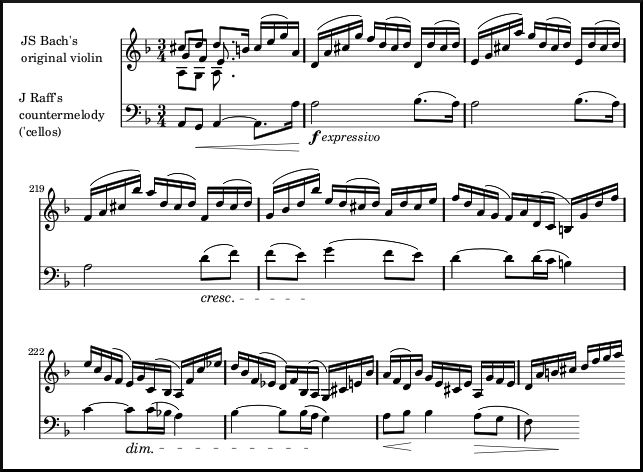
Earlier today I stumbled across a recording of a work I had not heard in a few years by the obscure Swiss-German composer Joachim Raff. The composition is an orchestral transcription of the Chaconne from Bach's Partita in D minor, without doubt the finest work ever written for solo violin. This piece has been transcribed countless times; the source material is clearly a masterpiece, but what makes the movement really attractive is its implicit nature - dispite the violin's limited facilities for counterpoint and polyphony in general, Bach succeeds in alluding to a multitude of voices within the same line. Larry Solomon provides a brief overview of what to look out for. Raff's transcription thus endeavours to render the implicit explicit; for example, where there is the implication of a held note, it can played for its implied duration. Indeed, Raff believed that Chaconne was in itself a "reduction" from an orchestrated original. Whilst I don't share that literal belief, it is certainly good working model for a transcription. And what a transcription! I've often thought of the romantic transcriptions such as these to be a guilty pleasures; they clearly violate any sensibilities I have about performing early music. However, what is most surprising (and guilt-relieving) about Raff's effort is the sheer amount of novel material involved. Here is an example starting at bar 216 - I have overlayed Bach's original line with a melody of Raff's own invention:
http://chris-lamb.co.uk/wp-content/2009/raff_chaconne.png
There are countless other examples which, following Bach's example, vary greatly in their subtlety. No prizes for guessing why I chose this excerpt though. However, dispite these additions I feel some crucial aspects are actually lost in translation. Firstly, we can muse over whether Bach would have approved of such a rendering - not wishing to dwell too deeply in well-tread arguments, many would point to Bach's re-use of his own material (as well as his transcriptions of other composers) to illustrate that he was not against the practice, but I find that argument difficult to apply to the Chaconne - the dualism between the implicit and the explicit would have greatly appealed to Bach, so to rob the work of it would seem to be doing him a serious discourtesy. Furthermore, the implications in Bach's work are certainly not followed to the same conclusions by all - a truly solo musician has the advantage of being able to make their own decisions about the music, perhaps even on the spur of the moment. In contrast, an ensemble is effectively forced to obey Hr. Raff's inferences. This lack of spontaneity is particularly damning; I am sure one would tire of differing interpretations of Raff's transcription quicker than one would of Bach's original. Lastly (and certainly most subjectively) there is something disarmingly solitary about the original work which is only amplified by being played solo - dispite my inability to provide a satisfactory rendition I would find performing this piece with (or even to) others rather discomforting. In conclusion, I would recommend listening to this work (and the rest of the CD). I have found it extremely illuminating, if only about Bach's original than of Raff's.

Next.

Previous.