Search Results: "ag"

9 February 2008

Neil Williams: Chatting at conferences

I don't know why this is appears to be a problem but AFAICT there is no particular impediment in talking to delegates at conferences, no matter what the gender.
Maybe it is just the way that such discussions are begun or the tone being used or maybe it is just that my RealLife(tm) world involves a radically different environment.
Various stats claim that IT is massively dominated by male workers.
Many stats show that pharmacy is massively dominated by female staff.
Maybe it is just an indication that a degree in a course other than IT is more of a benefit than would otherwise appear.
As a single guy, the pharmacy world is little different to IT as far as conversations with colleagues is concerned. To me, that is how it should be.
Maybe I'm just too old to be deemed "a problem".

Adam Rosi-Kessel: This Person Apparently Has a Different Definition of Off the Grid Than I Do

Facebook Status Message

Gregor Herrmann: 2.6.24 (finally)

no big step for humankind but I'm quite happy that linux 2.6.24 is finally running on my laptop (thinkpad R60e). the culprit that caused the freezes during earlier attempts was cpudyn; after deactivating it I had no more problems so far.

what's not working is ath5k which seems to dislike my wifi card; but the recent madwifi packages do what they are supposed to do.

JFTR: now let's have a look at 2.6.24 on my desktop machine :)

Jordi Mallach: Time for GRUB2?

My Apple Powerbook 5,4 just booted for the first time using GRUB, with no manual intervention, from Apple chime to GDM prompt. This is a great milestone for GRUB2 on powerpc-ieee1275 and OpenFirmware, as until now, multiple problems in the loader would drop you to OF console straight away, although other PowerPC hardware with other firmware implementations did manage to work. Recent fixes by Pavel in the core and some other minor fixes for the userland utils have taken grub2 to the point where it is usable on most PowerPC hardware. On Apple, the only minor issue remaining is grub-probe insisting on (hd) not being a valid device name, so for now I have to trick it into believing it's really (hd1). In parallel, many other GRUB2 improvements haven't stopped hitting CVS in the last months, which have seen how new contributors joined grub-devel and helped GRUB2 get the great momentum it's enjoying right now. Vesa, Robert and Bean have been really active lately, and have fixed long standing issues or written a lot of new code. One of the features GRUB2 acquired recently was image loading for background images. Much more powerful than the implementation in GRUB Legacy, GRUB2 can now read images in multiple formats, can handle up to 24bit colour and render a menu in arbitrary resolutions. The menu can now show UTF-8, and the Debian package will configure a pretty theme that matches the rest of the system if desktop-base is installed:


GRUB2 speaking UTF-8 Catalan Although I'm not sure if GRUB2 is completely up-to-par with GRUB Legacy on i386/amd64, it seems the tricky bits, like video, LVM, RAID and the standard filesystems are supported and working. What GRUB2 needs now, in order to finally replace the aging and upstream-lacking GRUB Legacy you probably have installed, is massive testing. Debian has traditionally been a testbed for GRUB Legacy patches, and is also the platform where GRUB2 is being more widely tested. Having GRUB2 included in lenny's debian-installer would be a great step forward, and by the looks, I think we're well on time to manage this. Replacing GRUB Legacy with GRUB2 is trivial. On PCs, just install the grub-pc package. You'll be offered to keep GRUB Legacy, but with an added menu entry to chainload GRUB2. If you're worried that GRUB2 might fail on your hardware, accept this, and try to load GRUB2 from GRUB. If it works, you then know you can get rid of GRUB Legacy completely and keep GRUB2 in the MBR. On PowerPC-based Macs, you'll have to work around the small issue I mentioned above. Install the grub-ieee1275 package. You also need a very recent powerpc-ibm-utils package, which was just uploaded to unstable. Mount your bootstrap partition, probably /dev/hda2 in /boot/grub, and generate a device.map file with grub-mkdevicemap. Check the contents. If your first device name lacks a drive number such as (hd), it's probably correct, although this will make things fail later. Change it to (hd0) for now. As grub-install relies on grub-probe, you'll have to generate your grub image by hand. Copy all .mod files in /usr/lib/grub/powerpc-ieee1275 to your bootstrap partition, and generate a core.img:

root@powerpc:/boot/grub# grub-mkimage -d . -o /boot/grub/core.img *.mod
root@powerpc:/boot/grub# update-grub
root@powerpc:/boot/grub# nvsetenv boot-device hd:2,core.img
The generated grub.cfg will have references to (hd0,X), which you'll have to correct back to (hd,X) if necessary for your OpenFirmware. After this, you are probably ready to reboot, cross two fingers and get a warm "Welcome to GNU GRUB!" message at boot, which will then be followed by a standard GRUB menu, but on your nice PowerPC box. Unfortunately, the eye candy in the screenshot above isn't available yet in this platform, as it lacks VESA. Does someone in the audience want to contribute a video driver for powerpc? :)

Christian Perrier: Squashing badly encoded changelog files

After working on badly encoded debian/control files, I began working on badly encoded changelog files. Again, most packages with that problem are packages that hadn't any upload for a while (the plethora of libroxen-* packages, for instance), so after a short notice, I began NMUs today. Except for a few packages where the maintainer mentioned (s)he prefers doing the upload (hurry up, Javier!), I expect dealing with that issue pretty soon and therefore fill in one of the release goals for Lenny.

Romain Francoise: Shared links for 2008-02-09

Gerfried Fuchs: My Efforts in Debian

... are still there, even if I don't blog about every single bit all the time. Most of the packages I care about are in good state, I even did jump on board of irssi co-maintaining and got its bugcount down a fair bit (though I won't rest at this stage, there are still some to go) and did jump onboard of the pkg-games Team. ... which brings me to wesnoth. For quite a while I am tracking the stable releases (1.2.x) of wesnoth in unstable while the development releases (1.3.x) are followed in experimental. With the upcoming stable release 1.4 this though will change. The development branch is feature frozen and thus will be (propably) compatible with the next stable release, and furthermore the current stable release isn't expected to receive any further update. My plan is thus to upload the next development release directly to unstable. If you want to give it some additional testing before that happens pull the package from experimental now and give your feedback, thanks. Furthermore I am also tracking some packages for backports.org. I usually do the packaging of it almost synchronous to its upload into unstable although it is only allowed onto backports.org when it entered testing. For the timegap in between you can usually find it on my website repository. Directories that aren't empty there have some upload to backports pending and you can feel free to test the packages and send me feedback on them. Currently this includes bacula, slony1 and postgresql-8.3. One last note, finally it happened: apache1 isn't anymore. There were two packages left in testing until recently which got their removal requests adjusted. Thanks to everyone involved in keeping track of this and helping cleaning up the archive.

8 February 2008

Christian Perrier: Preparing lenny D-I beta 1: l10n status

We now have 30 complete languages in D-I: bg cs de eo es eu fi fr gl gu it ja ko lt lv nb nl nn pl pt pt_BR ro ru sk sl sv ta th vi zh_CN Some progress was made for others, but I doubt we reach my unofficial target of 40 languages by Thursday February 14th which is the deadline set by Otavio, D-I release manager. Incomplete languages:
 2 099% he
   099% hu
   099% pa      3
 3 098% be
   098% ca
   098% dz
   098% ml
   098% sq
   098% zh_TW   6
 4 097% bn
   097% ne      2
 5 094% ar      1
 6 093% bs
   093% da
   093% el
   093% et
   093% hi
   093% hr
   093% id
   093% ka
   093% km
   093% mk
   093% tl
   093% tr
   093% uk
   093% wo      14
 7 090% am      1
 8 088% ku      1
Translators, hurry up, please! We are in the process of *losing* translations for lenny if some of you don't wake up.

Jeff Bailey: Osteopaths in the USA

In Montreal, I discovered the joy of visiting Osteopaths. An Osteopath managed to cure Leif's colic and let us sleep, and unlike a chiropractor, a treatment from Martine at Santenergie on the plateau of Montreal (shameless plug) would actually stay in effect for more than 20 minutes (Sometimes for weeks at a time).

Coming to the US, however, means learning a whole new variety of Osteo. Osteopathy was written into law early on, and has grown up as a full alternative to medical doctors - including the ability to prescribe medication. In practice what happens is that Osteopaths wind up in family practice as just another variant of MDs. The amount of "Osteopath" training that they've had compared to an MD turns out not to be that big anyway.

All hope isn't actually lost, though. There are two groups in the US, the American Academy of Osteopathy (Members recognised by the letters FAAO after their names), an the American Osteopathic Assocation (, AOA). Physicians can be fellowshipped into one or the other of these groups and they have different philosophies.

So there are three types of Osteopaths here:

1) Regular doctors (For all that it matters for the patients coming in)

2) Regular doctors who will practice some forms of Osteopathic Manipulative Medicine, but may not perform all techniques, and whom are more likely to be involved in "Integrative medicine" - helping find overall wholistic solutions to problems that might include manipulation, but might include other naturopathic solutions.

3) Osteopaths who specialise in manipulative medicine.

The downside to #3 is that these are people who've taken full medical degrees, and then had to further it with what an Osteopath would take at home. They're expensive, often don't accept any form of medical insurance, and are generally part of private practices.

With some back troubles I've been having recently, I managed to find a doctor in the #2 category who explained to me how this all works (followed by us figuring out that there's more to it than he can fix. But that's another story for later). He very kindly wrote it out for me on a napkin, so I'm copying it here before I blow my nose it in by accident. =)

MJ Ray: GP Costa degli Etruschi

RAI Sport Sat (free-to-air 13e) have highlights of GP Costa degli Etruschi at 18:00-18:30 CET today (Saturday 9th). The CyclingNews start list (beware, results will appear higher up on that page) suggests it’s the first time for most of us to see some of the big names on TV this season, including a fairly strong Milram squad supporting Alessandro Petacchi, who’s looking for his fourth win in a row at this event.

Frans Pop: Crossing an apt proxy with a mirror

Earlier today I watched the presentation Jonathan Oxer's gave during LCA about Package caching solutions. Although it was certainly an interesting presentation and although I very much agree that my current local mirror is wasting a lot of diskspace and bandwidth, I'm still not going to switch from debmirror to any of the available caching solutions, because (unless I'm really missing something) none of them scratches my itch. My local mirror currently consists of five architectures (i386, amd64, hppa, sparc and s390) and only has unstable and testing. I use it for:
  1. (fast and convenient) updating of my systems
  2. doing Debian Installer builds and installation tests
  3. test builds of installation CDs (using debian-cd)
Now, the last one is somewhat hard (debian-cd uses hardlinks to packages on a local mirror instead of retrieving packages), so let's concentrate on the first two. Caching is great if you have a large number of machines – of the same architecture and that are all likely to need roughly the same packages – sitting behind the proxy: the first one triggers the download of the package and the rest gets it almost instantaneously. It is a lot less great if you have only one, maybe two systems per architecture: most of the time you'll still end up going down that (relatively) slow ADSL connection. An important reason why I have my mirror is so that when I do my daily updates for sid or run an installation test, the packages are already available locally. I really don't want to double or even treble the time needed for installation tests just because some required packages aren't yet available locally and need to be downloaded over that slow line. So, I have my partial mirror. Somewhat tuned (I exclude some ridiculously large debug packages for example, saving about 10GB), but still with a lot of junk^Wpackages on it I'll never ever use, especially for hppa, sparc and s390 as those systems only have fairly basic installations. Getting rid of that would significantly reduce my daily sync and allow me, for example, to also have a mirror of stable and oldstable, keep old versions of packages and probably still save a lot of diskspace. Wishlist What we should have is a hybrid solution: a program that will present itself as a proxy to clients, but is smart enough to pre-fetch new packages that are likely to be needed in a sync run, based on usage date from the the proxy and configuration settings. Some ideas for features/configuration options it could have: Possibly such an implementation could even be used on some of the lower tier Debian mirrors. Unfortunately, unlike some of my esteemed colleagues, I'm not able to just whip up something like this, so I'm condemned to wait and see if there's someone else who'd like to pick up this idea. I am of course more than willing to help develop this idea further and to test it. Now, if I've totally failed in my research and something like this already exists, a pointer in the right direction would be much appreciated.

William Pitcock: Thoughts on srcinst

As eddyp wrote on Planet Debian, there is indeed a tool to roll custom builds of source packages. However, as he also mentioned, it’s written in Haskell, and may be unmaintained. One of the most commonly heard complaints I have received about Debian (and Ubuntu) is that it does not allow for easily rebuilding source packages. So, I’m going to start writing a new debian package builder for this purpose soon. It’ll probably be a package similar to pbuilder, except aimed at end users instead of developers. Here’s my plan of action: Phase 1: Phase 2: Thoughts: Anyway, that’s just a project I have planned on the side over the next few months.

Joey Hess: at anna's

Dinner at Anna's, I had a nice dish of Lad Na. Hung out afterwards and fought with automount and DVD stuff in Ubuntu. I don't want this post to be a rant about desktops, Ubuntu, or gnome. Suffice to say that I'm much happier with the technology of the zero-degree sleeping bag that's keeping me nice and warm camping in the woods tonight, despite a wet foot from the scary creek crossing I took three times today with my laptop in tow.

Eddy Petrișor: forking privately in Debian

Joachim, the key is probably to implement patch support in srcinst and actually implement something nice which I think has nice applications.

It might be nice to combine srcinst with debian-xcontrol to obtain also customizable dependencies (e.g. no arts support).

I guess you'll be the best person to take over srcinst since:
  1. John Goerzen doesn't want to/can't continue maintaining it
  2. is written in Haskell and you know Haskell
  3. source is available for grabs from http://darcs.complete.org/srcinst/

The basic idea is to have another command[1] wrap aptitude/apt-get/srcinst and make sure it does the proper job, depending on the local configuration.


[1] let's say, the debtoo command - srcinst should remain the tool for clear 'from source installs'

Gunnar Wolf: cat STDERR rot13

Cannot help but laugh and share.
I've been triaging and trying to reproduce some oldish bugs on pkg-perl's packages. Some bugs are no longer there, some have to be forwarded upstream, and so on. Usual tasks, yes.
Until I stumbled with #406227. I just have to laugh and share! Hope nobody feels ashamed - The bug is the result of different people coding maybe under pressure and with quite different mindsets :)
For some reason I fail to understand, the submitter's test case (rot13 implemented over a HTTP proxy) is invoked in the report as ./rot13 2>/dev/null. Of course, when trying to debug a bug report, the first thing to do is not to ignore STDERR. So, off goes the 2>/dev/null. What happens next? 0 gwolf@mosca[2]/tmp$ perl ./rot13 &
[1] 4394
0 gwolf@mosca[3]/tmp$ GET -p http://localhost:8080/ http://www.debian.org/
Can't locate object method "filter" via package "UGGC::Cebkl::ObqlSvygre::fvzcyr=UNFU(0k604160)" (perhaps you forgot to load "UGGC::Cebkl::ObqlSvygre::fvzcyr=UNFU(0k604160)"?) at /usr/share/perl5/HTTP/Proxy/FilterStack.pm line 126.
500 EOF when chunk header expected
WTF... Well, at least the program name gives me a clue... Lets try to "decrypt" the error message... gwolf@mosca[4]/tmp$ echo 'UGGC::Cebkl::ObqlSvygre::fvzcyr=UNFU(0k604160)' rot13
HTTP::Proxy::BodyFilter::simple=HASH(0x604160)
hrm... How comes the filter is filtering its own code and only then refusing to find itself!? Ok, time to open up the manpage - Remember, I'm only group-maintaining this pacakge, I am not yet at all familiar with it! Ok, so the core of the filter is when the submitter states: my $proxy = new HTTP::Proxy();
$proxy->push_filter(response => new HTTP::Proxy::BodyFilter::simple(sub tr/a-zA-z/n-za-mN-ZA-M/; ));
While the manpage states it should be invoked as: my $filter = HTTP::Proxy::BodyFilter::simple->new( sub $ $_[1] =~ s/foo/bar/g; );
$proxy->push_filter( response => $filter );
Of course, once looking at it, the answer is simple: The submitter left out which element to act on in the anonymous function body - The $ $_[1] =~ part. Adding it makes gur svygre jbex nf rkcrpgrq... Err, sorry - makes the filter work as expected. Now, bonus points: For the non-Perlers out ther: How come we get the namespace translated as well? Oh, that's very simple: In Perl, as in Python (and concievably other languages I'm unaware of), the object is passed to any of its methods as the first argument. Functions in Perl receive their arguments via @_ (read: the default array). And, of course, the tr (regex-based transliteration) takes by default the first thing it sees - the object itself. And what happens when you apply a (string-oriented) regex to an object? Of course, it gets stringified - which, by default, in Perl means converting it to the closest possible description: "a hash reference blessed as an object of the class such-and-such at this memory location". That string gets worked on, and we get UGGC::Cebkl::ObqlSvygre::fvzcyr=UNFU(0k604160). This proxy does not die on very-very-short web pages, where the whole content fits on one iteration of the code (although it does not work correctly - the text remains unaltered, of course, as it was not worked on), but if the request spans several chunks, the second time the filter is called, it will be... just gibberish. Oh, and what about the extra $ (...) around $_[1]? Oh, simple: The string is passed as a scalar reference, so it can be modified in place. Yes, it's the Perl way of pass-by-reference instead of pass-by-value (the default behaviour): Of course the parameter is only passed as a value. Only that the value is incidentally a reference - but who cares? ;-) Anyway... Many oddities. I would implement the module in a completely different way, and it looks quite backwardish in my book. But then again, TIMTOWTDI.

Vincent Fourmond: Microsoft advertises embedded windows under "Embedded Debian" !

[embedded-debian-microsoft.png] Few days ago, I was looking at my gmail mails. As usual, there was a couple of ads on the right hand side of the screen (they never really bothered me before). But that day, there was something quite different: an advertisement for Microsoft under the term "Embedded Debian" ! Well, I can understand that Microsoft wants to advertise for the keywords "Embedded Debian". After all, if they do provide good embedded OS services, that is only fair. But to do so with a title "Embedded Debian" does not really qualify as fair use of the Debian trademark ! The trouble is that this is something hard to prove, as it appears seldom and apparently randomly. When I google for the terms Embedded Debian, I come up around every second time with nearly the same ad, but taking to www.microsoftembedded-de2.com. This domain does not appear to be connected to Microsoft anyhow (see its whois entry). Some other people tried and never saw the ad, as I did when I looked from another computer (a Windows one, funnily). The www.windowsembeddedsolutions.com link which is depicted above did only show up in my gmail account so far. However, that domain is owned by Microsoft, so they can't deny this comes from them. Why, are we scaring them so much ??

Enrico Zini: m2crypto-howto

How to work with python-m2crypto This is a little howto on how to understand the m2crypto Python module, beyond the examples provided:
  1. Build the documentation as explained here
  2. Look at the documentation, which does not contain a single comment
  3. Click the links that show the source (for example, of M2Crypto.SMIME.SMIME.verify)
  4. Look what openssl function gets called by the function you are interested in (for example, pkcs7_verifysomething))
  5. Google the name of that openssl function, trying a few variations, until you find the openssl manpage that tells you what it does, in detail (for example, pcks_verify)
  6. Understand what it does, and backport the understanding to the thin convenience layer that m2crypto adds on top of it
  7. Realise that now you also understand the corresponding openssl smime -verify commandline invocation, and that next time instead of reading the openssl manpage you should look at the openssl api docs instead.

Mohammed Sameer: Automatically insert a statement in each function in C++

And I thought I'll never do such things again ?
I wanted to insert a debugging statement at the beginning of each function.

for i in *.cc *.c; do sed -i -e 's/\([a-zA-Z0-9 _*:~]*([^).]*) * \)/\1 \nprintf("%s\\n", __PRETTY_FUNCTION__); /g' $i; done

It can probably be used to insert anything too.

It's dirty but it worked for me. Just keep a backup or make sure the latest code is in any RCS just in case.

It only failed with a function that was commented using C++ style comments "//".
I didn't try it with class methods defined inside header files read more

Benjamin Mako Hill: Protest DRM at the Boston Public Library

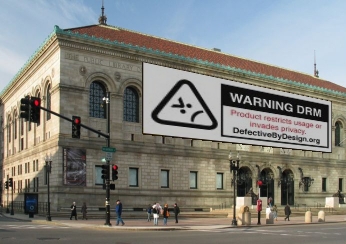
/copyrighteous/images/bpl_drm.jpg On Saturday February 9th, at 13:00, I'm going to be joining free software and anti-DRM activists to protest the use of DRM by the Boston Public Library on parts of its electronic collection. Those of us protesting are unhappy because the BPL has launched a new service powered by a company called OverDrive. The system gives BPL patrons access to books, music, and movies online -- but only if they use a Microsoft DRM system. There are lots of problems with the introduction of this system: it bars access to users of GNU/Linux and MacOS and creates a dependence on a single technology vendor for access. These are important issues, certainly. The worst problem, however, is much more fundamental. By adopting a DRM system for library content, the BPL is giving OverDrive, copyright holders, and Microsoft the ability to decide what, when, and how its patrons can and cannot read, listen, and watch these parts of the BPL collection. They are giving these companies veto power over the BPL's own ability to access this data -- both now and in the future. Cryptographically, BPL is quite literally handing over the keys to their collection. In the process, they are not only providing a disservice to their patrons. They are providing a disservice to themselves. The first-sale doctrine says that libraries can do essentially whatever they like with copies of books they purchase short of duplication, modification, or performance. Of course, copyright holders would prefer to charge a toll every time someone checks out a book. Public libraries were possible in spite of this desire because they were able to exploit power over the possession and control of their books in the interests of their patrons. With DRM, libraries will reduced to powerlessness. Of course, times have changed. As media and the ways we interact with it is increasingly digital, libraries have changed and will need to change more. But if public libraries are to succeed at their fundamental mission of spreading knowledge and serving communities, this change can't be at the expense of patrons' ability to control their own technology and libraries' ability to control their own collections. I've supported my academic library, MIT Libraries, as they took a risk and stood up to DRM when other institutions did not. And they won. BPL is the largest municipal library in the US and the third largest US library overall. It is the first library to be supported publicly, to be open to the public in the US, and to allow patrons to take home books to read and use them. BPL has an opportunity now to continue this history of leadership, of access, and of patron empowerment. If BPL stands up against DRM and in favor of its patrons' freedom and its own control of its technical destiny and collection, it may set an important precedent. If you're in or near Boston, please join me in Copley Square on Saturday to help make this happen. If you're not near Boston, please help put pressure on similar efforts in your own communities.

Matthew Palmer: Part of the 73rd Barbecue Division...

... is Donna Benjamin and her army of mignons. I'm going to have the mental image of a large collection of steaks wrapped in bacon marching around a parade ground stuck in my head all day now.

Next.

Previous.