Search Results: "tb"

18 July 2013

Vincent Bernat: Packaging a daemon for OS X

There are three main ways to distribute a command-line daemon for OS X:
  1. Distributing source code and instructions on how to compile it.
  2. Using a third-party package manager, like Homebrew.
  3. Providing an installer package.

Homebrew Homebrew is a popular package management system. It works like the BSDs ports collections by downloading, compiling and installing the requested software, while also installing any required dependencies automatically. Creating a new package is quite easy and there are a lot of examples available. However, there are some limitations:
  • You don t really build a package but execute a recipe to locally install the software.
  • You need to install development tools, either a whole Xcode installation1 or the command line version.
  • If you need to execute some steps as root, you will have to explain them to the user for her to execute by hand. This includes the creation of a system user or the installation of a daemon through launchd.
If you can t live with those limitations, you may need to build an installer package.

Building an installer package OS X comes with a graphical and a command-line installer. The graphical one is run by opening a package from the Finder. Then, the user experiences some familiar wizard allowing her to install the software in a matter of a few seconds. OS X graphical installer The documentation around how to build such a package is somewhat clumsy. You may find outdated information or pieces of information that only apply to projects using Xcode. I will try to provide here accurate bits in the following context:
  1. You are packaging a pure command-line tool.
  2. You are using Autoconf and Automake as a build system.
  3. You want to support several architectures.
  4. You want to support older versions of OS X.

Creating a package Building such a package was previously done with some graphical tool called PackageMaker. This tool is not available any more and developers are asked to switch to pkgbuild and productbuild. There is a very neat Stackoverflow article on how those tools work. A package is built in two steps:
  1. Build component packages.
  2. Combine them into a product archive.
A component package contains a set of files and a set of scripts to execute at various steps of the installation. You can have several component packages, for example a package for the daemon and a package for the client. They are built with pkgbuild. A product archive contains the previously created component packages as well as a file describing various options of the installer (required and optional components, license, welcome text, ). To create a component package, we need to install the needed files in some directory:
$ ./configure --prefix=/usr --sysconfdir=/private/etc
$ make
$ make install DESTDIR=$PWD/osx-pkg
We will now put the content of osx-pkg into a component package with pkgbuild:
$ mkdir pkg1
$ pkgbuild --root osx-pkg \
>    --identifier org.someid.daemon \
>    --version 0.47 \
>    --ownership recommended
>    pkg1/output.pkg
pkgbuild: Inferring bundle components from contents of osx-pkg
pkgbuild: Wrote package to output.pkg
You need to be careful with the identifier. It needs to be unique and identify your software as well as the specific component. Then, you need to create an XML file describing the installer. Let s call it distribution.xml:
<?xml version="1.0" encoding="utf-8" standalone="no"?>
<installer-gui-script minSpecVersion="1">
    <title>Some daemon</title>
    <organization>org.someid</organization>
    <domains enable_localSystem="true"/>
    <options customize="never" require-scripts="true" rootVolumeOnly="true" />
    <!-- Define documents displayed at various steps -->
    <welcome    file="welcome.html"    mime-type="text/html" />
    <license    file="license.html"    mime-type="text/html" />
    <conclusion file="conclusion.html" mime-type="text/html" />
    <!-- List all component packages -->
    <pkg-ref id="org.someid.daemon"
             version="0"
             auth="root">output.pkg</pkg-ref>
    <!-- List them again here. They can now be organized
         as a hierarchy if you want. -->
    <choices-outline>
        <line choice="org.someid.daemon"/>
    </choices-outline>
    <!-- Define each choice above -->
    <choice
        id="org.someid.daemon"
        visible="false"
        title="some daemon"
        description="The daemon"
        start_selected="true">
      <pkg-ref id="org.someid.daemon"/>
    </choice>
</installer-gui-script>
Fortunately, this file is documented on Apple Developer Library. Since we only describe one package, we pass customize="never" as an option to skip the choice part. You can however remove this attribute when you have several component packages. The attribute rootVolumeOnly="true" explains that this daemon can only be installed system-wide. It is marked as deprecated but still works. Its replacement (domains tag) displays an unusual and buggy pane which Apple doesn t use in any of its packages. You need to put the HTML2 documents into a resources directory. It is also possible to choose the background by specifying a <background/> tag. The following command will generate the product archive:
$ productbuild --distribution distribution.xml \
>              --resources resources \
>              --package-path pkg1 \
>              --version 0.47 \
>              ../final.pkg
productbuild: Wrote product to ../final.pkg

Scripts The installer can execute some scripts during installation. For example, suppose we would like to register our daemon with launchd for it to be run at system start. You first need to write some org.someid.plist file and ensure it will get installed in /Library/LaunchDaemons:
<?xml version="1.0" encoding="UTF-8"?>
<!DOCTYPE plist PUBLIC "-//Apple//DTD PLIST 1.0//EN" "http://www.apple.com/DTDs/PropertyList-1.0.dtd">
<plist version="1.0">
<dict>
  <key>Label</key>
  <string>org.someid</string>
  <key>ProgramArguments</key>
  <array>
    <string>/usr/sbin/mydaemon</string>
    <string>-d</string>
  </array>
  <key>RunAtLoad</key><true/>
  <key>KeepAlive</key><true/>
</dict>
</plist>
Then create a scripts/postinstall file with the following content:
#!/bin/sh
set -e
/bin/launchctl load "/Library/LaunchDaemons/org.someid.plist"
You also need a scripts/preinstall file which will allow your program to be smoothly upgraded:
#!/bin/bash
set -e
if /bin/launchctl list "org.someid" &> /dev/null; then
    /bin/launchctl unload "/Library/LaunchDaemons/org.someid.plist"
fi
Ensure that those scripts are executable and add --scripts scripts to pkgbuild invocation. If you need to add a system user, use dscl.

Dependencies There is no dependency management built into OS X installer. Therefore, you should ensure that everything is present in the package or in the base system. For example, lldpd relies on libevent, an event notification library. This library is not provided with OS X. When it is not found, the build system will use an embedded copy. However, if you have installed libevent with Homebrew, you will get binaries linked to this local libevent installation. Your package won t work on another host. The output of otool -L can detect unwanted dependencies:
$ otool -L build/usr/sbin/lldpd
build/usr/sbin/lldpd:
        /usr/lib/libresolv.9.dylib (compatibility version 1.0.0, current version 1.0.0)
        /System/Library/Frameworks/IOKit.framework/Versions/A/IOKit (compatibility version 1.0.0, current version 275.0.0)
        /System/Library/Frameworks/CoreFoundation.framework/Versions/A/CoreFoundation (compatibility version 150.0.0, current version 744.19.0)
        /System/Library/Frameworks/Foundation.framework/Versions/C/Foundation (compatibility version 300.0.0, current version 945.18.0)
        /usr/lib/libSystem.B.dylib (compatibility version 1.0.0, current version 169.3.0)

Compilation for older versions of OS X The package as built above may only work on the same version of OS X that you use to compile. If you want a package that will work on OS X 10.6, you will need to download the appropriate SDK3. Then, you need to tell the compiler the target version of OS X and the SDK location. You can do this by setting CFLAGS and LDFLAGS (and CXXFLAGS if you use C++):
$ SDK=/Developer/SDKs/MacOSX10.6.sdk
$ ./configure --prefix=/usr --sysconfdir=/private/etc \
>         CFLAGS="-mmacosx-version-min=10.6 -isysroot $SDK" \
>         LDFLAGS="-mmacosx-version-min=10.6 -isysroot $SDK"
The -mmacosx-version-min flag will be used by various macros in the headers to mark some functions as available or not, depending on the version of OS X you target. It will also be used by the linker. The -isysroot will tell the location of the SDK. Headers and libraries will be looked up in this location first.

Universal binaries Mac OS X 10.6 was available for both IA-32 and x86-64 architectures. If you want to support both installations with a single package, you need to build universal binaries. The Mach object file format, used by OS X, allows several versions of the executable in the same file. The operating system will select the most appropriate one. An easy way to generate such files is to pass -arch i386 -arch x86_64 to the compiler:
$ ./configure --prefix=/usr --sysconfdir=/private/etc \
>     CC="gcc -arch i386 -arch x86_64" \
>     CPP="gcc -E"
However, this is a dangerous option. Suppose that your ./configure script tries to determine some architecture-dependent parameter, like the size of an integer (with AC_CHECK_SIZEOF); it will compute it for the host architecture. The binary generated for the other architecture will therefore use a wrong value and may crash at some point. The correct way to generate an universal binary is to execute two separate compilations and to build the universal binary with lipo:
$ for arch in i386 x86_64; do
>   mkdir $arch ; cd $arch
>   ../configure --prefix=/usr --sysconfdir=/private/etc \
>       CC="gcc -arch $ARCH" \
>       CPP="gcc -E"
>   make
>   make install DESTDIR=$PWD/../target-$ARCH
>   cd ..
> done
[...]
$ lipo -create -output daemon i386/usr/sbin/daemon x86_64/usr/sbin/daemon
Since lipo only works on file, I have written a Python script applying lipo recursively to several directories.

Putting everything together Now, we need to automate a bit. You could provide some nifty script. I propose an appropriate Makefile.am instead. This way, we can use the output variables, like @VERSION@, from ./configure to generate some of the files, like distribution.xml. You need to add that in your configure.ac:
AC_CONFIG_FILES([osx/Makefile osx/distribution.xml osx/im.bernat.lldpd.plist])
AC_CONFIG_FILES([osx/scripts/preinstall],  [chmod +x osx/scripts/preinstall])
AC_CONFIG_FILES([osx/scripts/postinstall], [chmod +x osx/scripts/postinstall])
AC_SUBST([CONFIGURE_ARGS], [$ac_configure_args])
Let s have a look at osx/Makefile.am. First, we define some variables:
PKG_NAME=@PACKAGE@-@VERSION@.pkg
PKG_TITLE=@PACKAGE@ @VERSION@
PKG_DIR=@PACKAGE@-@VERSION@
ARCHS=@host_cpu@
If we want to build for several architectures, we will type make ARCHS="x86_64 i386". Otherwise it defaults to the current host s architecture. We use install-data-local target to install files specific to OS X:
install-data-local:
    install -m 0755 -d $(DESTDIR)/Library/LaunchDaemons
    install -m 0644 im.bernat.@PACKAGE@.plist $(DESTDIR)/Library/LaunchDaemons
uninstall-local:
    rm -f $(DESTDIR)/Library/LaunchDaemons/im.bernat.@PACKAGE@.plist
The main target is the product archive, built with productbuild:
../$(PKG_NAME): pkg.1/$(PKG_NAME) distribution.xml resources
    $(PRODUCTBUILD) \
        --distribution distribution.xml \
        --resources resources \
        --package-path pkg.1 \
        --version @VERSION@ \
        $@
Its main dependency is the component package:
pkg.1/$(PKG_NAME): $(PKG_DIR) scripts
    [ -d pkg.1 ]   mkdir pkg.1
    $(PKGBUILD) \
        --root $(PKG_DIR) \
        --identifier im.bernat.@PACKAGE@.daemon \
        --version @VERSION@ \
        --ownership recommended \
        --scripts scripts \
        $@
Now, we need to build $(PKG_DIR):
$(PKG_DIR): stamp-$(PKG_DIR)
stamp-$(PKG_DIR): $(ARCHS:%=%/$(PKG_DIR))
    $(srcdir)/lipo $(PKG_DIR) $^
    touch $@
The $(ARCHS:%=%/$(PKG_DIR)) will expand to x86_64/$(PKG_DIR) i386/$(PKG_DIR). This is a substitution reference4. Before applying our lipo script, we need to be able to build the architecture-dependent package directories:
pkg_curarch = $(@:stamp-%=%)
$(ARCHS:%=%/$(PKG_DIR)): %/$(PKG_DIR): stamp-%
$(ARCHS:%=stamp-%): stamp-%: im.bernat.lldpd.plist
    [ -d $(pkg_curarch) ]   mkdir -p $(pkg_curarch)
    (cd $(pkg_curarch) && \
        $(abs_top_srcdir)/configure @CONFIGURE_ARGS@ \
            CC="@CC@ -arch $(pkg_curarch)" \
            CPP="@CPP@")
    (cd $(pkg_curarch) && \
        $(MAKE) install DESTDIR=$(abs_builddir)/$(pkg_curarch)/$(PKG_DIR))
    touch $@
This may seem a bit obscure, but this is really like what we have described previously. Note that we use @CONFIGURE_ARGS@ which is a variable we have defined in configure.ac. Here is how a user would create its own OS X package:
$ SDK=/Developer/SDKs/MacOSX10.6.sdk
$ mkdir build && cd build
$ ../configure --prefix=/usr --sysconfdir=/private/etc --with-embedded-libevent \
   CFLAGS="-mmacosx-version-min=10.6 -isysroot $SDK" \
   LDFLAGS="-mmacosx-version-min=10.6 -isysroot $SDK"
[...]
$ make -C osx pkg ARCHS="i386 x86_64"
[...]
productbuild: Wrote product to ../lldpd-0.7.5-21-g5b90c4f-dirty.pkg
The package has been built in ../lldpd-0.7.5-21-g5b90c4f-dirty.pkg.

  1. Even if Xcode is free, you will need to register to Apple and show a valid credit card number. That s quite an interesting requirement.
  2. It is possible to use other formats (like RTF or just plain text) for documents but HTML seems the best choice if you want some formatting without fiddling with RTF.
  3. Unfortunately, Apple makes it difficult to find them. The easiest way to get the SDK for Mac OS X 10.6 is to download Xcode 4.3.3, mount the image and copy the SDK to /Developer/SDKs.
  4. This is equivalent to the use of patsubst function. However, this function is specific to GNU make. The substitution reference pattern was accepted recently in POSIX and is coined as pattern macro expansion.

14 July 2013

Gregor Herrmann: RC bugs 2013/28

this week(end) I was more in the "RC bug fix flow" than in the last weeks, & here are the results:

Niels Thykier: Britney excuses out of date

In my previous post, I explained about the age excuse in Britney. In this post, I will cover the slightly more tricky out of date excuse. A simple example of excuse is:
out of date on mipsel: blinken (from 4:4.8.4-1)
In this simple case, Britney simply states that the binary blinken on mipsel has not yet been rebuilt. Generally, the presence of an excuse like this is sufficient to stop testing migration. The exception to this rule is if the architecture has been marked as not keeping up . At the moment we do not have any such architectures. The tricky part of an out of date -excuse is that Britney simply identifies a symptom and not a cause. In the excuse above, it is not possible to determine if the build failed on that architecture or simply has not finished yet. But the part that probably confuses the most, is when Britney lists binaries no longer built from that source:
out of date on i386: libfsoframework0 (from 0.11.0-1.1)
This case actually happens quite often and is (usually) a sign of a transition has been started. The part that confuses many is that the build-state of their package will be Installed (as in It was built successfully and has been uploaded to the archive ). From there they tend to conclude Britney is broken , where The excuse information is a bit unhelpful might be more accurate. Caveats:
  1. If the source package has not yet been built on that architecture, these old binaries are interleaved into the regular list of out of date -binaries.
  2. The list of excuses are updated twice a day (and there is also a delay between its update and the PTS picking it up). Thus, if the build-state of your package for that architecture has been Installed for less than 24 hours, you may just want double check before jumping to conclusions.
The problem is that the binary still has reverse dependencies in unstable, so it cannot migrate to testing. When the last reverse dependency has been updated, the FTP masters will usually semi-automatically decruft your package and the excuse will disappear. On the other hand, if the binary still has reverse dependencies, you probably started a transition. In that case, your package will be stuck in unstable until all the reverse dependencies are ready (or, at least, rebuilt to use the replacement package). Generally, it is good if the Release Team was involved before you did this (see this page ). In summary, if your package has Out of date on [architecture] in its excuses it can be one (or more) of:

12 July 2013

Daniel Pocock: Practical VPNs with strongSwan, Shorewall, Linux firewalls and OpenWRT routers

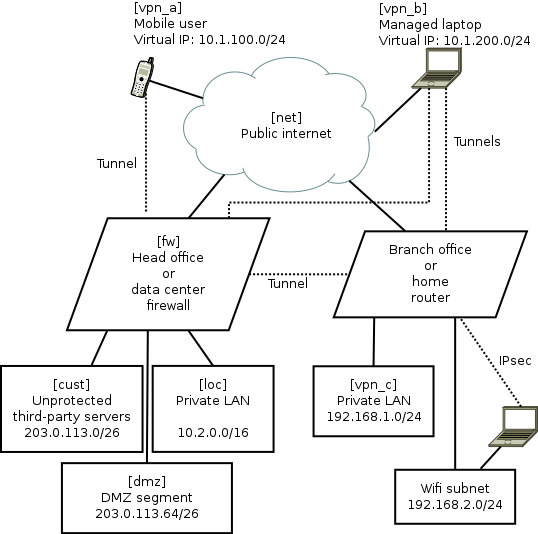
There is intense interest in communications privacy at the moment thanks to the Snowden scandal. Open source software has offered credible solutions for privacy and encryption for many years. Sadly, making these solutions work together is not always plug-and-play. In fact, secure networking, like VoIP, has been plagued by problems with interoperability and firewall/filtering issues although now the solutions are starting to become apparent. Here I will look at some of them, such as the use of firewall zones to simplify management or the use of ECDSA certificates to avoid UDP fragmentation problems. I've drawn together a lot of essential tips from different documents and mailing list discussions to demonstrate how to solve a real-world networking problem. A typical network scenario and requirements Here is a diagram of the network that will be used to help us examine the capabilities of these open source solutions. Some comments about the diagram:
  • The names in square brackets are the zones for Shorewall, they are explained later.
  • The dotted lines are IPsec tunnels over the untrusted Internet.
  • The road-warrior users (mobiles and laptops) get virtual IP addresses from the VPN gateway. The branch offices/home routers do not use virtual IPs.
  • The mobile phones are largely untrusted: easily lost or stolen, many apps have malware, they can only tunnel to the central VPN and only access a very limited range of services.
  • The laptops are managed devices so they are trusted with access to more services. For efficiency they can connect directly to branch office/home VPNs as well as the central server.
  • Smart-phone user browsing habits are systematically monitored by mobile companies with insidious links into mass-media and advertising. Road-warriors sometimes plug-in at client sites or hotels where IT staff may monitor their browsing. Therefore, all these users want to tunnel all their browsing through the VPN.
  • The central VPN gateway/firewall is running strongSwan VPN and Shorewall firewall on Linux. It could be Debian, Fedora or Ubuntu. Other open source platforms such as OpenBSD are also very well respected for building firewall and VPN solutions, but Shorewall, which is one of the key ingredients in this recipe, only works on Linux at present.
  • The branch office/home network could be another strongSwan/Shorewall server or it could also be an OpenWRT router
  • The default configuration for most wifi routers creates a bridge joining wifi users with wired LAN users. Not here, it has been deliberately configured as an independent network. Road-warriors who attach to the wifi must use VPN tunnelling to access the local wired network. In OpenWRT, it is relatively easy to make the Wifi network an independent subnet. This is an essential security precaution because wifi passwords should not be considered secure: they are often transmitted to third parties, for example, by the cloud backup service in many newer smart phones.
Package mayhem The major components are packaged on all the major Linux distributions. Nonetheless, in every case, I found that it is necessary to re-compile fresh strongSwan packages from sources. It is not so hard to do but it is necessary and worth the effort. Here are related blog entries where I provide the details about how to re-build fresh versions of the official packages with all necessary features enabled: Using X.509 certificates as a standard feature of the VPN For convenience, many people building a point-to-point VPN start with passwords (sometimes referred to as pre-shared keys (PSK)) as a security mechanism. As the VPN grows, passwords become unmanageable. In this solution, we only look at how to build a VPN secured by X.509 certificates. The certificate concept is not hard. In this scenario, there are a few things that make it particularly easy to work with certificates:
  • strongSwan comes with a convenient command line tool, ipsec pki. Many of it's functions are equivalent to things you can do with OpenSSL or GnuTLS. However, the ipsec pki syntax is much more lightweight and simply provides a convenient way to do the things you need to do when maintaining a VPN.
  • Many of the routine activities involved in certificate maintainence can be scripted. My recent blog about using Android clients with strongSwan gives a sample script demonstrating how ipsec pki commands can be used to prepare a PKCS#12 (.p12) file that can be easily loaded into an Android device using the SD-card.
  • For building a VPN, there is no need to use a public certificate authority such as Verisign. Consequently, there is no need to fill in all their forms or make any payments for each device/certificate. Some larger organisations do choose to outsource their certificate management to such firms. For smaller organisations, an effective and sometimes better solution can be achieved by maintaining the process in-house with a private root CA.
UDP fragmentation during IPsec IKEv2 key exchange and ECDSA A common problem for IPsec VPNs using X.509 certificates is the fragmentation of key exchange datagrams during session setup. Sometimes it works, sometimes it doesn't. Various workarounds exist, such as keeping copies of all certificates from potential peers on every host. As the network grows, this becomes inconvenient to maintain and to some extent it eliminates the benefits of using PKI. Fortunately, there is a solution: Elliptic Curve Cryptography (ECC). Many people currently use RSA key-pairs. Best practice suggests using RSA keys of at least 2048 bits and often 4096 bits. Using ECC with a smaller 384-bit key is considered to be equivalent to a 7680 bit RSA key pair. Consequently, ECDSA certificates are much smaller than RSA certificates. Furthermore, at these key sizes, the key exchange packets are almost always smaller than the typical 1500 byte MTU. A further demand for ECDSA is arising due to the use of ECC within smart cards. Many smartcards don't support any RSA key larger than 2048 bits. The highly secure 384-bit ECC key is implemented in quite a few common smart cards. Smart card vendors have shown a preference for the ECC keys due to the US Government's preference for ECC and the lower computational overheads make them more suitable for constrained execution environments. Anyone who wants to use smart cards as part of their VPN or general IT security now, or in the future, needs to consider ECC/ECDSA. Making the network simple with Shorewall zones For this example, we are not just taking some easy point-to-point example. We have a real-world, multi-site, multi-device network with road warriors. Simplifying this architecture is important to help us understand and secure it. The solution? Each of these is abstracted to a "zone" in Shorewall. In the diagram above, the zone names are in square brackets. The purpose of each zone is described below:
Zone name Description
loc This is the private LAN and contains servers like databases, private source code respositories and NFS file servers
dmz This is the DMZ and contains web servers that are accessible from the public internet. Some of these servers talk to databases or message queues in the LAN network loc
vpn_a These are road warriors that are not very trustworthy, such as mobile devices. They are occasionally stolen and usually full of spyware (referred to by users as "apps"). They have limited access to ports on some DMZ servers, e.g. for sending and receiving mail using SMTP and IMAP (those ports are not exposed to the public Internet at large). They use the VPN tunnel for general internet access/browsing, to avoid surveillance by their mobile carrier.
vpn_b These are managed laptops that have a low probability of malware infection. They may well be using smart cards for access control. Consequently, they are more trusted than the vpn_a users and have access to some extra intranet pages and file servers. Like the smart-phone users, they use the VPN tunnel for general internet access/browsing, to avoid surveillance by third-party wifi hotspot operators.
vpn_c This firewall zone represents remote sites with managed hardware, such as branch offices or home networks with IPsec routers running OpenWRT.
cust These are servers hosted for third-parties or collaborative testing/development purposes. They have their own firewall arrangements if necessary.
net This zone represents traffic from the public Internet.
A practical Shorewall configuration Shorewall is chosen to manage the iptables and ip6tables firewall rules. Shorewall provides a level of abstraction that makes netfilter much more manageable than manual iptables scripting. The Shorewall concept of zones is very similar to the zones implemented in OpenWRT and this is an extremely useful paradigm for firewall management. Practical configuration of Shorewall is very well explained in the Shorewall quick start. The one thing that is not immediately obvious is a strategy for planning the contents of the /etc/shorewall/policy and /etc/shorewall/rules files. The exact details for making it work effectively with a modern IPsec VPN are not explained in a single document, so I've gathered those details below as well. An effective way to plan the Shorewall zone configuration is with a table like this:
Destination zone
loc dmz vpn_a vpn_b vpn_c cust net
Source zone loc \
dmz ? \ X X X
vpn_a ? ? \ X X
vpn_b ? ? X \ X
vpn_c X \
cust X ? X X X \
net X ? X X X \
The symbols in the table are defined:
Symbol Meaning
ACCEPT in policy file
X REJECT or DROP in policy file
? REJECT or DROP in policy file, but ACCEPT some specific ports in the rules file
Naturally, this modelling technique is valid for both IPv4 and IPv6 firewalling (with Shorewall6) Looking at the diagram in two dimensions, it is easy to spot patterns. Each pattern can be condensed into a single entry in the rules file. For example, it is clear from the first row that the loc zone can access all other zones. That can be expressed very concisely with a single line in the policy file:
loc all ACCEPT
Specific Shorewall tips for use with IPsec VPNs and strongSwan Shorewall has several web pages dedicated to VPNs, including the IPsec specific documentation.. Personally, I found that I had to gather a few details from several of these pages to make an optimal solution. Here are those tips:
  • Ignore everything about the /etc/shorewall/tunnels file. It is not needed and not used any more
  • Name the VPN zones (we call them vpn_a, vpn_b and vpn_c) in the zones file but there is no need to put them in the /etc/shorewall/interfaces file.
  • The /etc/shorewall/hosts file is not just for hosts and can be used to specify network ranges, such as those associated with the VPN virtual IP addresses. The ranges you put in this file should match the rightsourceip pool assignments in strongSwan's /etc/ipsec.conf
  • One of the examples suggests using mss=1400 in the /etc/shorewall/zones file. I found that is too big and leads to packets being dropped in some situations. To start with, try a small value such as 1024 and then try larger values later after you prove everything works. Setting mss for IPsec appears to be essential.
  • Do not use the routefilter feature in the /etc/shorewall/interfaces file as it is not compatible with IPsec
Otherwise, just follow the typical examples from the Shorewall quick start guide and configure it to work the way you want. Here is an example /etc/shorewall/zones file:
fw firewall
net ipv4
dmz ipv4
loc ipv4
cust ipv4
vpn_a ipsec mode=tunnel mss=1024
vpn_b ipsec mode=tunnel mss=1024
vpn_c ipsec mode=tunnel mss=1024
Here is an example /etc/shorewall/hosts file describing the VPN ranges from the diagram:
vpn_a eth0:10.1.100.0/24 ipsec
vpn_b eth0:10.1.200.0/24 ipsec
vpn_c eth0:192.168.1.0/24 ipsec
Here is an example /etc/shorewall/policy file based on the table above:
loc all ACCEPT
vpn_c all ACCEPT
cust net ACCEPT
net cust ACCEPT
all all REJECT
Here is an example /etc/shorewall/rules file based on the network:
SECTION ALL
# allow connections to the firewall itself to start VPNs:
# Rule  source    dest    protocol/port details
ACCEPT   all       fw                ah
ACCEPT   all       fw                esp
ACCEPT   all       fw                udp 500
ACCEPT   all       fw                udp 4500
# allow access to HTTP servers in DMZ:
ACCEPT   all       dmz               tcp 80
# allow connections from HTTP servers to MySQL database in private LAN:
ACCEPT   dmz       loc:10.2.0.43     tcp 3306
# allow connections from all VPN users to IMAPS server in private LAN:
ACCEPT vpn_a,vpn_b,vpn_c loc:10.2.0.58 tcp 993
# allow VPN users (but not the smartphones in vpn_a) to the
# PostgresQL database for PostBooks accounting system:
ACCEPT vpn_b,vpn_c loc:10.2.0.48      tcp 5432
SECTION ESTABLISHED
ACCEPT   all       all
SECTION RELATED
ACCEPT   all       all
Once the files are created, Shorewall can be easily activated with:
# shorewall compile && shorewall restart
strongSwan IPsec VPN setup Like Shorewall, strongSwan is also very well documented and I'm just going to focus on those specific areas that are relevant to this type of VPN project.
  • Allow the road-warriors to send all browsing traffic over the VPN means including leftsubnet=0.0.0.0/0 in the VPN server's /etc/ipsec.conf file. Be wary though: sometimes the road-warriors start sending the DHCP renewal over the tunnel instead of to their local DHCP server.
  • As we are using Shorewall zones for firewalling, you must set the options leftfirewall=no and lefthostaccess=no in ipsec.conf. Shorewall already knows about the remote networks as they are defined in the /etc/shorewall/hosts file and so firewall rules don't need to be manipulated each time a tunnel goes up or down.
  • As discussed above, X.509 certificates are used for peer authentication. In the certificate Distinguished Name (DN), store the zone name in the Organizational Unit (OU) component, for example, OU=vpn_c, CN=gw.branch1.example.org
  • In the ipsec.conf file, match the users to connections using wildcard specifications such as rightid="OU=vpn_a, CN=*"
  • Put a subjectAltName with hostname in every certificate. The --san option to the ipsec pki commands adds the subjectAltName.
  • Keep the certificate distinguished names (DN) short, this makes the certificate smaller and reduces the risk of fragmented authentication packets. Many examples show a long and verbose DN such as C=GB, O=Acme World Wide Widget Corporation, OU=Engineering, CN=laptop1.eng.acme.example.org. On a private VPN, it is rarely necessary to have all that in the DN, just include OU for the zone name and CN for the host name.
  • As discussed above, use the ECDSA scheme for keypairs (not RSA) to ensure that the key exchange datagrams don't suffer from fragmentation problems. For example, generate a keypair with the command ipsec pki --gen --type ecdsa --size 384 > user1Key.der
  • Road warriors should have leftid=%fromcert in their ipsec.conf file. This forces them to use the Distinguished Name and not the subjectAltName (SAN) to identify themselves.
  • For road warriors who require virtual tunnel IPs, configure them to request both IPv4 and IPv6 addresses (dual stack) with leftsourceip=%config4,%config6 and on the VPN gateway, configure the ranges as arguments to rightsourceip
  • To ensure that roadwarriors query the LAN DNS, add the DNS settings to strongswan.conf and make sure road warriors are using a more recent strongSwan version that can dynamically update /etc/resolv.conf. Protecting DNS traffic is important for privacy reasons. It also makes sure that the road-warriors can discover servers that are not advertised in public DNS records.
Central firewall/VPN gateway configuration Although they are not present in the diagram, IPv6 networks are also configured in these strongSwan examples. It is very easy to combine IPv4 and IPv6 into a single /etc/ipsec.conf file. As long as the road-warriors have leftsourceip=%config4,%config6 in their own configurations, they will operate dual-stack IPv4/IPv6 whenver they connect to the VPN. Here is an example /etc/ipsec.conf for the central VPN gateway:
config setup
        charonstart=yes
        charondebug=all
        plutostart=no
conn %default
        ikelifetime=60m
        keylife=20m
        rekeymargin=3m
        keyingtries=1
        keyexchange=ikev2
conn branch1
        left=198.51.100.1
        leftsubnet=203.0.113.0/24,10.0.0.0/8,2001:DB8:12:80:/64
        leftcert=fw1Cert.der
        leftid=@fw1.example.org
        leftfirewall=no
        lefthostaccess=no
        right=%any
        rightid=@branch1-fw.example.org
        rightsubnet=192.168.1.0/24
        auto=add
conn rw_vpn_a
        left=198.51.100.1
        leftsubnet=0.0.0.0/0,::0/0
        leftcert=fw1Cert.der
        leftid=@fw1.example.org
        leftfirewall=no
        lefthostaccess=no
        right=%any
        rightid="OU=vpn_a, CN=*"
        rightsourceip=10.1.100.0/24,2001:DB8:1000:100::/64
        auto=add
conn rw_vpn_b
        left=198.51.100.1
        leftsubnet=0.0.0.0/0,::0/0
        leftcert=fw1Cert.der
        leftid=@fw1.example.org
        leftfirewall=no
        lefthostaccess=no
        right=%any
        rightid="OU=vpn_b, CN=*"
        rightsourceip=10.1.200.0/24,2001:DB8:1000:200::/64
        auto=add
Sample branch office or home router VPN configuration Here is an example /etc/ipsec.conf for the Linux server or OpenWRT VPN at the branch office or home:
conn head_office
        left=%defaultroute
        leftid=@branch1-fw.example.org
        leftcert=branch1-fwCert.der
        leftsubnet=192.168.1.0/24,2001:DB8:12:80:/64
        leftfirewall=no
        lefthostaccess=no
        right=fw1.example.org
        rightid=@fw1.example.org
        rightsubnet=203.0.113.0/24,10.0.0.0/8,2001:DB8:1000::/52
        auto=start
# notice we only allow vpn_b users, not vpn_a
# these users are given virtual IPs from our own
# 192.168.1.0 subnet
conn rw_vpn_b
        left=branch1-fw.example.org
        leftsubnet=192.168.1.0/24,2001:DB8:12:80:/64
        leftcert=branch1-fwCert.der
        leftid=@branch1-fw.example.org
        leftfirewall=no
        lefthostaccess=no
        right=%any
        rightid="OU=vpn_b, CN=*"
        rightsourceip=192.168.1.160/27,2001:DB8:12:80::8000/116
        auto=add
Further topics Shorewall and Shorewall6 don't currently support a unified configuration. This can make it slightly tedious to duplicate rules between the two IP variations. However, the syntax for IPv4 and IPv6 configuration is virtually identical. Shorewall only currently supports Linux netfilter rules. In theory it could be extended to support other types of firewall API, such as pf used by OpenBSD and the related BSD family of systems. A more advanced architecture would split the single firewall into multiple firewall hosts, like the inner and outer walls of a large castle. The VPN gateway would also become a standalone host in the DMZ. This would require more complex routing table entries. Smart cards with PIN numbers provide an effective form of two-factor authentication that can protect certificates for remote users. Smart cards are documented well by strongSwan already so I haven't repeated any of that material in this article. Managing a private X.509 certificate authority in practice may require slightly more effort than I've described, especially when an organisation grows. Small networks and home users don't need to worry about these details too much, but for most deployments it is necessary to consider things like certificate revocation lists and special schemes to protect the root certificate's private key. EJBCA is one open source project that might help. Some users may want to consider ways to prevent the road-warriors from accidentally browsing the Internet when the IPsec tunnel is not active. Such policies could be implemented with some basic iptables firewalls rules in the road-warrior devices. Summary Using these strategies and configuration tips, planning and building a VPN will hopefully be much simpler. Please feel free to ask questions on the mailing lists for any of the projects discussed in this blog.

10 July 2013

Russell Coker: Samsung Galaxy Note 2

A few weeks ago I bought a new Samsung Galaxy Note 2 Android phone. As I predicted in my post about Phone and Tablet Sizes [1] the Note 2 with a 5.55 display is a bit too big for me to have an ideal single handed side grasp (I estimate that about 5.2 would be ideal). But I can stretch a bit and move it around in my hand to touch all parts of the screen with my thumb. Although when doing that I don t have a tight grip, with my previous phone the Samsung Galaxy S3 [2] I could properly wrap my hand around it to grip it tightly while using it with one hand. The Note 2 will be easier for me to drop or for a thief to snatch it from me. While the big screen makes the phone difficult to use with one hand it does allow viewing more data. The ConnectBot SSH client (Play Store link) [3] (F-Droid repository link) [4] works a lot better on a larger screen I ve also discovered that the volume control buttons can be used to change the font size in ConnectBot which is handy as the default is really tiny. Also Klaus Weidner s Hacker s Keyboard (Play Store link) [5] (F-Droid repository link) [6] works a lot better with a larger screen. When I tested the Hacker s keyboard on a smaller phone I found the 5 row layout too difficult to use, but on the Note 2 it works well. As an aside I wish I could quickly and easily toggle between 4 row mode (good for SMS) and 5 row mode (good for sysadmin work) in the Hackers Keyboard. For less serious use the large screen on the Note 2 is good for watching TV. I ve got a collection of mp4s of TV shows that I ve been meaning to watch, now I watch them in bed on my phone. Another advantage of the Note 2 is the battery life. When playing Ingress and doing all the usual email checks etc my Note 2 will last about as long as my wife s Galaxy S3 with it s power case. So without any extra batteries a Note 2 will probably last about twice as long as a Galaxy S3. The Note 2 has more RAM than the S3 I used to use (I had the S3 with 1G of RAM) and it also apparently has a faster CPU. The CPU speed hasn t been an issue for me but the extra RAM is a real benefit, it means that I can usually switch between Ingress and other programs without having to restart Ingress each time. As an aside I think that Google and LG should release a Nexus Ingress 4 phone or some other device that s optimised for Ingress, I m sure it would sell well. Some people make a big deal about the stylus that comes with the Note 2. It is a neat feature to have the device know when the stylus tip is hovering over the screen but it s not very useful for me. If I was going to create art work on a phone (as some people do) then it would interest me, but I m more interested in email and ssh for fine input and my fingers are generally good enough for those tasks. I have got thin fingers, so I think that people with thicker fingers could really benefit from the stylus. I recently bought a batch of stylus pens from Kogan which have a pen at one end and a rubber stylus tip at the other for fat fingered people I know who need to use an Android phone but can t afford a Note or Note 2. I also like the software build on it which is almost the same as that on the Galaxy S3. It seems that many people prefer the apparently stock features on the Nexus 4 but I like the way Samsung does things. Conclusion I m very happy with my new phone. The bigger screen allows me to see things more clearly, this is good for web browsing, reading email, and now that I can use the Hackers Keyboard I can type more effectively. The longer battery life is really good too, although I think that Samsung could have done better if the phone was 3mm thicker then it could have a much bigger battery and have a larger CCD for the camera. I don t think that the phone is really different, at least not for my use. Samsung has promoted it for artistic use and I ve seen evidence to support their claims. But for most people it ll just be a phone with a larger screen and a bigger battery. Some people criticise it for being too big, but it s still smaller than the handsets on most desk phones so it s not big by the standards of old fashioned phones. The increased size has not only allowed me to do the same things more effectively but also allowed me to do things I hadn t tried doing on a phone before such as watching TV. This isn t because of the phone being particularly special in any way, it s just that the change in size gives more possibilities for ways of using it. The Samsung Galaxy Mega is the largest smart phone. The 5.8 version of the Mega has a resolution of only 960*540 (less than the Note and Note 2 not good enough IMHO) and the 6.3 version has the same resolution as the Note 2 of 1280*720. I think that both Mega variants are too big for me, I need to be able to use a phone with one hand. So it seems that the Note 2 is probably the best phone for me right now.

Gerfried Fuchs: Caravan Palace

And now for something completely different. No, this blog entry isn't about the great Monty Python's, even though they definitely deserve to be brought to the attention of the still unenlightened. This is about something completely different music style wise. This is about Caravan Palace. I was recently introduced to this band, and I must say, they definitely have the swing. Just listen to them and feel your feed starting to move along. I hope you like the selection because I just started listening to them. They might not be the best options, but should get you started to get a feeling for the band. Like always, enjoy!

/music permanent link Comments: 0 Flattr this

9 July 2013

Wouter Verhelst: Mark groet 's morgens de dingen

Or, Mark greeting the things in the morning
Dag ventje met de fiets op de vaas met de bloem Hi little guy with the bike on the vase with the flower
ploem ploem ploum ploum
Dag stoel naast de tafel Hi chair besides the table
Dag brood op de tafel Hi bread on the table
Dag visserke-vis met de pijp Hi fishery-man with the pipe
en and
Dag visserke-vis met de pet Hi fishery-man with the hat
goeiendag good day
Daa-ag vis Bye-ee fish
Dag lieve vis Bye dear fish
Dag klein visselijn mijn Bye my little fishery-fish
The above is one of Paul van Ostaijen's poems, and is, in my opinion, one of his finest. I tried translating it to English so that my non-Dutch-speaking readers could appreciate it (Dutch-speaking readers will most likely already know it anyway), but it's almost impossible to properly translate it. In this poem, van Ostaijen invents a few words that aren't part of the Dutch language proper. A good example is 'visserke-vis'. The first part, 'visserke', is (now) a dialect diminutive of 'visser', which translates to "fisherman" (though it is likely that in Van Ostaijen's days, 'visserke' wasn't considered to be a dialect word). The second part, 'vis', is just Dutch for 'fish'. A literal translation would thus be 'fishereman-fish' On the other hand, given the relative similarity of both words, it is conceivable that Van Ostaijen is just playing with the sound of those words here (he does that later in the poem, anyway), and as such, it's not entirely clear whether he's talking about a fish with a pipe and a had, or about a fisherman with a pipe and a hat. It could be both. His use of the word 'Dag' adds to confusion. In Dutch, the word 'Dag' can be used as a greeting when seeing people for the first time in the morning, but it can also be used as a greeting when leaving people in the evening. Since this is used near the end of the poem, I translated it by using its second meaning; but it's also possible that Van Ostaijen is just playing with us. Of that final line, I should add that the size of the letters is not my doing; Van Ostaijen's original version contained this. In fact, he is known for his expressionistic way of using letters, and some of his other poems go into extremes with that; his wikipedia entry has a nice example. The final verse of the poem sounds pretty well, but defies all grammar. In proper grammar, the verse would read "Dag mijn klein visje". Van Ostaijen turns 'visje' into 'visselijn' so that it rhymes on 'mijn', and puts 'mijn' at the end. Whereas it's still possible to figure out a meaning of the first part of 'visserke-vis', this certainly isn't possible with 'visselijn'. It just isn't a word; all you can make of it is that he's talking about a fish. This certainly contradicts the idea that he was talking about a fisherman earlier. All in all, "Mark groet 's morgens de dingen" is a very funny poem; it describes a man or a boy who does nothing else than say hello to objects when he gets up in the morning; and though it's necessary to explain the language if you don't speak Dutch to fully appreciate it, the idea that there's much more to be found behind the words is most likely wrong. This is just silly amusement.

Rapha&#235;l Hertzog: My Free Software Activities in June 2013

This is my monthly summary of my free software related activities. If you re among the people who made a donation to support my work (106.39 , thanks everybody!), then you can learn how I spent your money. Otherwise it s just an interesting status update on my various projects. Debian France I handled some subscriptions that we collected during Solutions Linux at the end of last month and I also worked on updating the accounts in preparation of our annual general assembly. As the current president, I wrote a moral assessment of the organization and I helped Sylvestre Ledru (the treasurer) to prepare an overview of our financial situation (which is rather good). The plan for this general assembly included the renewal of 6 of our 9 board members so I tried to motivate some persons to candidate and I m pretty happy to see that we managed to have 9 candidates for 6 seats, a real election for once. :-) And as usual, I updated Galette to version 0.7.4.2 and I filed a couple of tickets (#621, #622). Debian Package Tracking System We re getting close to one month of work on the Google Summer of Code Project that rewrites the Package Tracking System. On average I spent a good 1h30 per day on reviewing the code, giving my feedback, and preparing the user stories for the next iteration, plus a 2 hour meeting each Wednesday afternoon. This is more than I expected but at I m rather happy with the result so far. We have a live test instance updated each week (after the end of the iteration) at pts.debian.net. The web interface is empty because the bulk of the work has been spent on the email interface for now, but it s now feature complete and already has seen some improvements compared to the current implementation (fixing #340863 for example). You can interact with it by sending mails to control@pts.debian.net. The Debian Administrator s Handbook The fundraising for the liberation of the original book in French met its initial target very quickly and we added new targets with supplementary rewards (more ebook from Eyrolles, donation to Debian). All the supplementary targets were met, although the last one took until the last day! Thanks to all the supporters, we now have a French translation of the Debian Administrator s Handbook which is free and we have collected about 2700 EUR for Debian. Debian Packaging I got a couple of release critical bug reports that I had to fix: And trying to anticipate future issues, I filed an upstream ticket on feed2omb (#33) to see whether upstream had plans to support the new pump.io API that identi.ca is supposed to use soonish. Kali Linux I filed a couple of Debian bugs: #711866 to request a new upstream version of w3af in Debian, #711044 to report a missing dependency in LSB meta-informations of the vsftpd init script. I worked on packaging passing-the-hash. Basically this is a fork of several software just to override some NTLM authentication functions. In some cases, I managed to avoid the fork by transforming the patches in LD_PRELOAD libraries that override the specific symbol of the patched functions. Among the forked software, there was winexe which wasn t packaged yet. So I packaged it but we quickly ran into some segfaults (which was already reported to upstream since a few months). I investigated the problem and prepared a patch. It has been submitted to upstream and merged. Thanks See you next month for a new summary of my activities.

No comment Liked this article? Click here. My blog is Flattr-enabled.

8 July 2013

Olivier Berger: Experimenting with Linked Open Data about FLOSS projects : matching Debian upstream projects

I ve been experimenting with Linked Open Data about FLOSS projects harvested from different sources of DOAP or ADMS.SW descriptions. I ve tried and match upstream projects of Debian packages with upstream projects hosted at Apache, Gnome, or Alioth.debian.org, or catalogued on Pypi. I m matching them on identical values of the Homepage field (comparing the Homepage Control field set by Debian packagers with the doap:homepage meta-data in the RDF documents harvested from the upstream project catalogues). Here are initial results of my little experiment, for number of matched projects, and results on project name s similarity :
Upstream catalogue Total matching projs Exact same project name Same project name (case independant)
apache 31 0 (0 %) 0 (0 %)
alioth 16 13 (81 %) 13 (81 %)
pypi 439 217 (49 %) 273 (62 %)
gnome 21 0 (0 %) 7 (33 %)
Total 507 230 (45%) 293 (58 %)
The data set contains tens of thousands of projects, with probably many duplicates, but from all of these, only 507 have common homepages. As you can see, in some cases, the Debian source package names match the upstream project name (sometimes with lower/upper case variants), but in general, the project names aren t identical, so it is interesting to try and match them by homepage. For the curious ones, the Apache, Gnome and Pypi project catalogues use to provide RDF meta-data for quite some time. More recently have we introduced ADMS.SW meta-data for Debian source packages, and even more recently for the Alioth projects (through the ADMS.SW exporter plugin for FusionForge). There are still some ways for improvements, for instance to normalize homepage URLs which tend to vary (trailing slashes, or different HTTP/HTTPS schemes). Stay tuned for more details.

7 July 2013

Gregor Herrmann: RC bugs 2013/26-27

not that we have a lack of RC bugs; still, I was a bit lazy in the last two weeks. here's what I've worked on:

5 July 2013

Daniel Leidert: Dear Lazyweb ... why does lshw (still) identify my Linux raid autodetect partition(s) as NTFS volumes?

In a very first attempt, my disk:2 was partitioned and initialized as follows:
/dev/sdc1     1,5TB     NTFS
/dev/sdc2 0,5TB EXT4
This was later changed to what you can see below and what fdisk correctly reports. These partitions all use the EXT4 file system.
[..]
Device Boot Start End Blocks Id System
/dev/sdb1 2048 524290047 262144000 fd Linux raid autodetect
/dev/sdb2 524290048 3907029167 1691369560 fd Linux raid autodetect
[..]
Device Boot Start End Blocks Id System
/dev/sdc1 2048 524290047 262144000 fd Linux raid autodetect
/dev/sdc2 524290048 3907029167 1691369560 fd Linux raid autodetect
[..]
I'm wondering why lshw and parted shows some of the partitions still being NTFS volumes? Checkout the output below. How can this be fixed? What is missing? Erase some header data?

Model: ATA WDC WD20EFRX-68A (scsi)
Disk /dev/sdb: 2000GB
Sector size (logical/physical): 512B/4096B
Partition Table: msdos

Number Start End Size Type File system Flags
1 1049kB 268GB 268GB primary raid
2 268GB 2000GB 1732GB primary raid


Model: ATA WDC WD20EFRX-68A (scsi)
Disk /dev/sdc: 2000GB
Sector size (logical/physical): 512B/4096B
Partition Table: msdos

Number Start End Size Type File system Flags
1 1049kB 268GB 268GB primary ntfs raid
2 268GB 2000GB 1732GB primary raid
[..]
*-disk:1
description: ATA Disk
product: WDC WD20EFRX-68A
vendor: Western Digital
physical id: 1
bus info: scsi@3:0.0.0
logical name: /dev/sdb
version: 80.0
serial: WD-WCC300354221
size: 1863GiB (2TB)
capabilities: partitioned partitioned:dos
configuration: ansiversion=5 sectorsize=4096
*-volume:0
description: Linux raid autodetect partition
physical id: 1
bus info: scsi@3:0.0.0,1
logical name: /dev/sdb1
capacity: 250GiB
capabilities: primary multi
*-volume:1
description: Linux raid autodetect partition
physical id: 2
bus info: scsi@3:0.0.0,2
logical name: /dev/sdb2
capacity: 1613GiB
capabilities: primary multi
*-disk:2
description: ATA Disk
product: WDC WD20EFRX-68A
vendor: Western Digital
physical id: 2
bus info: scsi@4:0.0.0
logical name: /dev/sdc
version: 80.0
serial: WD-WCC1T0567095
size: 1863GiB (2TB)
capabilities: partitioned partitioned:dos
configuration: ansiversion=5 sectorsize=4096 signature=000a4d07
*-volume:0
description: Windows NTFS volume
physical id: 1
bus info: scsi@4:0.0.0,1
logical name: /dev/sdc1
version: 3.1
serial: 013e-8473
size: 1396GiB
capabilities: primary multi ntfs initialized
configuration: clustersize=4096 created=2013-06-18 06:24:11 filesystem=ntfs label=MEDIA state=clean
*-volume:1
description: Linux raid autodetect partition
physical id: 2
bus info: scsi@4:0.0.0,2
logical name: /dev/sdc2
capacity: 1613GiB
capabilities: primary multi
[..]

4 July 2013

Emanuele Rocca: Useful tools for Python developers

Python is a great language with an impressive number of tools designed to make developers' life easier. Sometimes, however, the problem is getting to know that these tools exist in the first place. By contributing to projects like OpenStack's Nova client and Falcon, I have recently come across some useful tools that can seriously improve the quality of your code. The first one is called pyflakes, a passive checker of Python programs developed by Phil Frost. What it does is parsing your source files and checking for possible errors such as undefined names and unused imports. Let's consider the following example: <figure class="code">
1
2
3
4
import urllib

print "pyflakes example"
urlib.urlopen('http://www.linux.it')
</figure>The code above contains a typo, we have misspelled urllib. Here is what pyflakes thinks about our program:
$ pyflakes example.py
example.py:1: 'urllib' imported but unused
example.py:4: undefined name 'urlib'
On line 4 we try to use urlib which is not defined. Also, we import urllib on line 1 and we do nothing with it. Our typo has been spotted! Notice that, even though our program contains a print statement, 'pyflakes example' has not been printed. That is because pyflakes parses the source files it checks, without importing them, making it safe to use on modules with side effects. pyflakes can be installed with pip or apt-get. The second tool I want to talk about is Ned Batchelder's coverage.py. No doubt you write unit tests for your programs. Right? Good. coverage.py is out there to help you checking how much of your program is actually covered. Let's use as an example codicefiscale, a Python project of mine. First we install coverage:
pip install coverage
Then we run our unit tests:
$ coverage run --source=codicefiscale tests.py
.......
----------------------------------------------------------------------
Ran 7 tests in 0.003s
We pass the module we want to test with --source=codicefiscale so that coverage will only report information about that specific module. Now that our tests have been performed successfully it is time to check how much of our code is covered by unit tests:
$ coverage report -m
Name            Stmts   Miss  Cover   Missing
---------------------------------------------
codicefiscale      73      4    95%   61, 67, 95, 100
Not bad, 95% of our module is covered! Still, coverage let us know that 4 lines have not been touched by the unit tests. With this information, we can go write some meaningful test cases that will also cover the missing lines.

Daniel Pocock: My Linux server IPv6 deployment approach

I previously discussed the ease of deploying IPv6 for Linux servers. Whether it is Debian, Fedora or another distribution the IPv6 stack should "just work" these days. However, for maintaining a production network with minimum risk of interruption, there are a few extra things to be aware of during IPv6 deployment. Here I present a rough set of steps that can be followed, usually with minimal or no downtime, to deploy IPv6. The steps are in the order that they should be used in practice Plenty of other web sites already explain the theory of IPv6 networks or practical configuration detail (like how to set a static IPv6 address in Debian). This page ignores all of that detail and looks at the overall project strategy. Borrow the last decimal octet (or host bits) of IPv4 addresses As mentioned in my earlier blog:
  • Of the 128 bits in IPv6 addresses, most sites now use a fixed 64 bit netmask for all their subnets. This is the practice encouraged by RFC 4291.
  • Therefore, there are always more bits in the 64-bit "host" portion of the address than in the host portion of any 32-bit IPv4 address.
  • Consequently, it is possible to just borrow the host portion (typically the last octet for a class-C network) and use it as the host portion of an IPv6 address
IPv4 address Host portion of address IPv6 address
192.168.1.5/24 5 2001:1234:567::5
Gotcha: remember that the IPv4 addresses are usually written in decimal while IPv6 addresses, including the example above, are hex. This doesn't really matter in practice unless the addresses are being manipulated by code that is sensitive to the host bits. For all other intents and purposes, it just makes it easy to read the addresses and associate them with IPv4. A completely valid alternative is to use the full IPv4 address as the host portion of the IPv6 address. For example, if the IPv4 address = 192.168.1.5, the IPv6 address may be 2001:1234:567::192.168.1.5. This approach is slighly more verbose and is completely valid. Which approach you use is at your discretion. Create reverse mappings (PTR records) in DNS Just as IPv4 has the in-addr.arpa zone and telephone numbers have the e164.arpa zone (for ENUM), IPv6 addresses have a reverse mapping zone too: ip6.arpa The recommended way to proceed is to create reverse mappings for all hosts that have IPv4 reverse mappings. Some services may be using reverse lookups for authentication (e.g. MySQL will check this for any user who has a "Host" restriction defined). This is why it is recommended to create all the reverse mappings very early in the IPv6 program, before any hosts start making connections over IPv6. Create extra A records in DNS It's possible that some applications will be more stubborn about IPv6 adoption than others. For example, if you have a host called wolf.example.org and it hosts a mail server, web server, DNS server and XMPP server all using the name wolf then all those server processes will have to support IPv6 connectivity from the moment you add an AAAA record. A good practice is to create independent DNS A records (such as ns1.example.org and mail.example.org) for each application (not just CNAME records). Existing CNAME records can be converted to A records and converted back to CNAME records after the IPv6 deployment is 100% complete. Duplicate firewall entries Duplicate all IPv4 firewall entries to create an IPv6 firewall For many types of network, this is a trivial (although possibly tedious) task. There are some small gotchas:
  • There is no NAT. Any firewall entries for NAT need to be reviewed: for source NAT, it is necessary to use a mechanism like connection tracking to protect workstations that previously had asymmetrical access to the public Internet. For destination NAT, see the TPROXY feature in ip6tables
  • IPsec works slightly differently. Rules for AH and ESP packets can't simply be duplicated for IPv6, they need further tweaks or warnings will be generated.
  • IPv6 makes some ICMP packages mandatory. If IPv4 ICMP is completely blocked, you still need to enable the IPv6 ICMP (or at least the subset of ICMP packets that are mandatory).
For more comments about firewalling IPv6, please see my earlier blog on the subject Put the IPv6 addresses on the hosts Add the necessary records to the appropriate place, for example, the /etc/network/interfaces files on Debian/Ubuntu style systems. For hosts that have multiple addresses on a single interface, it is often desirable to ensure that outbound connections always appear to come from just one of the addresses. This can be achieved using the preferred_lft option when configuring the non-default addresses. For example, if configuring three addresses on eth0:
ip addr add dev eth0 preferred_lft 0 2001:1234:567::10/64
ip addr add dev eth0  2001:1234:567::11/64
ip addr add dev eth0 preferred_lft 0 2001:1234:567::12/64
In the example above, all outgoing IPv6 connections will appear to come from 2001:1234:567::11/64 Important: this is only a very shallow discussion of the issues around source addresses. If it doesn't provide a valid solution for you, there are many dedicated articles about this specific topic, madduck's blog looks at it for firewalls and tunnels but the concepts are valid for any type of multi-homed host Review listening processes with netstat Now that hosts have IPv6 addresses, it is worthwhile looking through the output of
netstat -nlp
to see which processes have bound to both IPv4 and IPv6 addresses and which processes remain stuck on IPv4 only. For processes that are only listening on IPv4 or only bound to a specific address (rather than 0.0.0.0), it is a good idea to investigate the way they are configured and find out if they will support IPv6. Review the monitoring infrastructure (Nagios, Ganglia, etc) Now is a good time to review the monitoring infrastructure. Make sure that tools like Nagios are testing the services using their dedicated DNS names and not the host names. For example, if the host wolf.example.org runs an LDAP server accessible as ldap1.example.org, make sure Nagios is configured to poll ldap1.example.org. Look at the check_v46 wrapper for Nagios and similar solutions to make sure that Nagios is testing both the IPv4 and IPv6 version of each service. Just as developers use unit testing as part of test-driven development workflows, administrators deploying IPv6 can use the monitoring framework to validate the progress of their IPv6 program. Check for ACLs Do any server processes use IP-based ACLs to control access? For example, an Apache web server may be using an IP ACL to restrict access to some pages. MySQL or Postgres databases may have IP ACLs defined for some users or databases. When hosts start using IPv6 to connect to services, their IPv6 source addresses won't pass the ACL and services may be inaccessible. Therefore, it is worthwhile checking for such ACLs early on. Prepare DNS servers first Preparing the DNS servers first is a good step. The DNS servers should be configured to accept queries over IPv6. Once the DNS servers are listening on IPv6 addresses, go ahead and do some of the following:
  • Insert IPv6 AAAA records for the name servers in their own zone files. As mentioned in the previous tip, the name server records should have their own independent A records already with names such as ns1.example.org. Consequently, no other application should notice when the AAAA record is created.
  • Create IPv6 glue records for any name servers that have IPv4 glue records
Configure secondary name servers to poll over IPv6 Configure the secondary nameservers to poll the primary nameserver using it's new IPv6 address. Update resolv.conf on all hosts Now that DNS servers are listening on IPv6, it is possible to put IPv6 nameserver addresses in /etc/resolv.conf on all the other hosts. Configure and test other low-level services Although services such as LDAP and MySQL may not be exposed to public Internet users, they are an essential foundation for many other applications to run. Make sure all these low level services are accessible over IPv6. Test them. After testing each of these services, it is OK to go ahead and create the AAAA records for the service. Configure and test other services Continue testing each service is accessible over it's IPv6 address and then add the necessary AAAA record. This includes all the high level services now, such as mail and web servers. Configure and test hostnames Finally, start adding AAAA records associated with hostnames to the DNS zone. Now it should be possible to ssh or ping6 the hostnames using IPv6. You may also want to add the IPv6 address of each host into it's own /etc/hosts file at this stage.

3 July 2013

Ian Campbell: Emesinae -- Yet Another Bug Tracker

Quite a while ago at a Xen hackathon (I think the Cambridge one in 2011, has it really been 2 years?) the topic of bug tracking came up. The developers who were present (myself included) expressed a general dislike for web based bug trackers, and in particular the existing bugzilla wasn't working for us for a variety of reasons (primarily lack of resource for care and general tending of it). They also liked the existing work flow based around mails to the Xen mailing lists, there was a feeling that this fits well with the demographics of the bugs which get reported to Xen: a sizable number of the issues are configuration errors or misunderstandings which can usually quickly be dealt with through a small email thread (followed by a request to please update the wiki). The project also gets quite a few bug reports which are initially "unactionable" due to of lack logs or a coherent description, in these cases a little bit of back and forth can quickly determine whether the reporter is going to provide the necessary additional information (this is something we are also trying to fix with clearer guidance and an ongoing effort to provide a reportbug-like tool for Xen). However there were concerns that bigger issues which couldn't be dealt with quickly were falling through the cracks. We kicked around a few ideas for how a bug tracker that met our needs might work and that was mostly that. Since then I've kicked the ideas around in my head a bit and searched for an existing system which would fit what was required. In the end I didn't find anything which quite fitted the bill and about six months ago I was looking for an interesting hacking project (perhaps something a bit different to my day job, hypervisor and kernel hacking) so I decided to bite the bullet, dust of my rusty Perl skills and hack something together. Yes, that's right, I've written Yet Another Bug Tracker(tm). I confess I feel a bit dirty for doing so. I've taken a fair bit of inspiration from debbugs (the Debian bug tracker) but I've turned the concept a little on its head. Debbugs is effectively instantiating a new mailing list for each bug report (each NNNNNN@bugs.debian.org can be thought of as a mailing list plus some additional bug specific metadata). Instead I implemented a model which takes an existing mailing list and acts as a list archive which provides a mechanism to track individual threads (or subthreads) as bugs (each bug is effectively a root Message-Id plus a little bit of metadata). In common with debbugs bugs are created and subsequently manipulated by sending mail to a special control@ address. Commands are available to create bugs as well as to graft and prune subthreads onto existing bugs (to cope with people who break threading or offtopic subthreads etc). There is also a read-only web interface for browsing the bugs. Internally the system is subscribed to the list and records details of each message and their relationships (e.g. References headers etc) in a sqlite database. A set of CGI scripts (using the Perl CGI module) provide an interface to browse bugs. Since the system tracks bugs based on mailing list threads I've named it Emesinae which is a "thread-legged bug" (yes, I spent longer than is strictly necessary browsing entomological websites). I've made the code available on gitorious under a GPLv2 license, see https://gitorious.org/emesinae. I announced an alpha instance of Emesinae back in May which tracks the xen-devel mailing list. You can find the bug tracker at http://bugs.xenproject.org/xen/. Since then I've been slowly fleshing out some more useful features (such as tagging of affected branches). It's not seen a great deal of uptake from the Xen developers yet but there are already some bugs being tracked and I'm hopeful that it will prove useful in the long run. In any case it was a fun hacking project for a few rainy evenings (and a couple more train and plane journeys).

Petter Reinholdtsen: Fourth alpha release of Debian Edu/Skolelinux based on Debian Wheezy

The fourth wheezy based alpha release of Debian Edu was wrapped up today. This is the release announcement: New features for Debian Edu 7.1+edu0~alpha3 released 2013-07-03 These are the release notes for for Debian Edu / Skolelinux 7.1+edu0~alpha3, based on Debian with codename "Wheezy". About Debian Edu and Skolelinux Debian Edu, also known as Skolelinux, is a Linux distribution based on Debian providing an out-of-the box environment of a completely configured school network. Immediately after installation a school server running all services needed for a school network is set up just waiting for users and machines being added via GOsa , a comfortable Web-UI. A netbooting environment is prepared using PXE, so after initial installation of the main server from CD, DVD or USB stick all other machines can be installed via the network. The provided school server provides LDAP database and Kerberos authentication service, centralized home directories, DHCP server, web proxy and many other services. The desktop contains more than 60 educational software packages and more are available from the Debian archive, and schools can choose between KDE, Gnome, LXDE and Xfce desktop environment. This is the fourth test release based on Debian Wheezy. Basically this is an updated and slightly improved version compared to the Squeeze release. Software updates Other changes Known issues Where to get it To download the multiarch netinstall CD release you can use The MD5SUM of this image is: 2b161a99d2a848c376d8d04e3854e30c
The SHA1SUM of this image is: 498922e9c508c0a7ee9dbe1dfe5bf830d779c3c8 To download the multiarch USB stick ISO release you can use The MD5SUM of this image is: 25e808e403a4c15dbef1d13c37d572ac
The SHA1SUM of this image is: 15ecfc93eb6b4f453b7eb0bc04b6a279262d9721 How to report bugs http://wiki.debian.org/DebianEdu/HowTo/ReportBugs

2 July 2013

Ond&#345;ej &#268;ert&iacute;k: My impressions from the SciPy 2013 conference

I have attended the SciPy 2013 conference in Austin, Texas. Here are my impressions.

Number one is the fact that the IPython notebook was used by pretty much everyone. I use it a lot myself, but I didn't realize how ubiquitous it has become. It is quickly becoming the standard now. The IPython notebook is using Markdown and in fact it is better than Rest. The way to remember the "[]()" syntax for links is that in regular text you put links into () parentheses, so you do the same in Markdown, and append [] for the text of the link. The other way to remember is that [] feel more serious and thus are used for the text of the link. I stressed several times to +Fernando Perez and +Brian Granger how awesome it would be to have interactive widgets in the notebook. Fortunately that was pretty much preaching to the choir, as that's one of the first things they plan to implement good foundations for and I just can't wait to use that.

It is now clear, that the IPython notebook is the way to store computations that I want to share with other people, or to use it as a "lab notebook" for myself, so that I can remember what exactly I did to obtain the results (for example how exactly I obtained some figures from raw data). In other words --- instead of having sets of scripts and manual bash commands that have to be executed in particular order to do what I want, just use IPython notebook and put everything in there.

Number two is that how big the conference has become since the last time I attended (couple years ago), yet it still has the friendly feeling. Unfortunately, I had to miss a lot of talks, due to scheduling conflicts (there were three parallel sessions), so I look forward to seeing them on video.

+Aaron Meurer and I have done the SymPy tutorial (see the link for videos and other tutorial materials). It's been nice to finally meet +Matthew Rocklin (very active SymPy contributor) in person. He also had an interesting presentation
about symbolic matrices + Lapack code generation. +Jason Moore presented PyDy.
It's been a great pleasure for us to invite +David Li (still a high school student) to attend the conference and give a presentation about his work on sympygamma.com and live.sympy.org.

It was nice to meet the Julia guys, +Jeff Bezanson and +Stefan Karpinski. I contributed the Fortran benchmarks on the Julia's website some time ago, but I had the feeling that a lot of them are quite artificial and not very meaningful. I think Jeff and Stefan confirmed my feeling. Julia seems to have quite interesting type system and multiple dispatch, that SymPy should learn from.

I met the VTK guys +Matthew McCormick and +Pat Marion. One of the keynotes was given by +Will Schroeder from Kitware about publishing. I remember him stressing to manage dependencies well as well as to use BSD like license (as opposed to viral licenses like GPL or LGPL). That opensource has pretty much won (i.e. it is now clear that that is the way to go).

I had great discussions with +Francesc Alted, +Andy Terrel, +Brett Murphy, +Jonathan Rocher, +Eric Jones, +Travis Oliphant, +Mark Wiebe, +Ilan Schnell, +St fan van der Walt, +David Cournapeau, +Anthony Scopatz, +Paul Ivanov, +Michael Droettboom, +Wes McKinney, +Jake Vanderplas, +Kurt Smith, +Aron Ahmadia, +Kyle Mandli, +Benjamin Root and others.


It's also been nice to have a chat with +Jason Vertrees and other guys from Schr dinger.

One other thing that I realized last week at the conference is that pretty much everyone agreed on the fact that NumPy should act as the default way to represent memory (no matter if the array was created in Fortran or other code) and allow manipulations on it. Faster libraries like Blaze or ODIN should then hook themselves up into NumPy using multiple dispatch. Also SymPy would then hook itself up so that it can be used with array operations natively. Currently SymPy does work with NumPy (see our tests for some examples what works), but the solution is a bit fragile (it is not possible to override NumPy behavior, but because NumPy supports general objects, we simply give it SymPy objects and things mostly work).

Similar to this, I would like to create multiple dispatch in SymPy core itself, so that other (faster) libraries for symbolic manipulation can hook themselves up, so that their own (faster) multiplication, expansion or series expansion would get called instead of the SymPy default one implemented in pure Python.

Other blog posts from the conference:

1 July 2013

Russ Allbery: Review: Dark Lies the Island

Review: Dark Lies the Island, by Kevin Barry
Publisher: Greywolf
Copyright: 2012
Printing: 2013
ISBN: 1-55597-651-4
Format: ARC
Pages: 185
This is a literary short story collection by a mainstream Irish writer, rather far from my normal fare. It was the second book in a shipment of Powell's Indiespensable, which is generally (when there is one) a proof or Advanced Reading Copy of something relatively obscure. I'm not really the target audience, not being much of a short story aficionado, but the whole point of doing this Indiespensable experiment is to stretch my reading range. First off, as I would generally expect by mainstream fiction, the quality of the writing is excellent. One thing I particularly like about Barry is that he's refreshingly and unhesitatingly profane. His characters curse like I expect people to curse, some of them at the drop of a hat, and for me it gives a feel of solid realism to his dialogue. He's also very good with eye dialect, giving the impression of accents without making the text hard to read. Some of these stories I liked a great deal, rather more than I had expected. But if there was a general undermining flaw for me, it was that I prefer stories that go somewhere, that have a plot or lead up to a definite point. Some of Barry's do, but a lot of them seem more vignettes or just scenes, sketches of characters, that drift off without resolution. I can admire those as writing exercises, but for me they don't fill the desire I have when I sit down with a story. I'm not sure how useful these reviews will be, given that I don't have a lot of mainstream fiction background to compare them with, but here are some reactions, for whatever they're worth. "Across the Rooftops": This is one of those sketches, but it's one of the best of them. It's a single moment on the rooftops, an attempt to capture the moment of possibility around the first romantic overture. It's sadly quite conventional in gender roles (nervous man initiating, woman as relationship gatekeeper), but apart from that it's very well-written. This kind of thing is normally not to my taste, but Barry does such a great job capturing the sense of uncertainty and the sharp focus on detail that I couldn't help but like it. (7) "Wifey Redux": This is by far my favorite story of this book. I think it's both hilarious and brilliant, right from the starting line.
This is the story of a happy marriage but before you throw up and turn the page let me say that it will end with my face pressed hard into the cold metal of the Volvo's bonnet, my hands cuffed behind my back, and my rights droned into my ear this will occur in the car park of a big-box retail unit on the Naas Road in Dublin.
It's the story of a marriage and how it changes over time, but also the story of being a father and his baffled, flailing reactions to his daughter's sexual explorations. But that's not what makes the story. What makes the story is what leads up to the arrest at the end, which had me laughing out-loud in delight. Barry is great at writing a sort of devilish humor; I wish more of the collection was like this. (9) "Fjord of Killary": This is another one of the ones I enjoyed. It's about an author who buys a hotel (with a bar) on the fjord of Killary thinking that the local culture and contact along with the wild beauty would inspire his poetry. At the start of the story, he's thoroughly sick of both the climate and the people, and the collision between his idyllic dreams and the reality, as well as his acerbic first-person complaints, is quite entertaining. A huge storm and resulting flood provides the conflict and impetus for change, and a few moments of humor in the understated local reactions. I thought the closing epiphany was a bit too obvious and expected, and the ending didn't quite work for me, but it has some good moments. (7) "A Cruelty": Here's where the collection started losing me. This is still well-written and closely observed, but in the case of this story, I wish it weren't, since I found it extremely uncomfortable. The viewpoint character is vulnerable to an encounter of unalloyed nastiness. I'm sure that's the point, but, similar to how I avoid horror, it's the sort of story I'd rather not read. (3) "Beer Trip to Llandudno": This was my second-favorite story of the collection. It's about a group of men who take periodic beer-tasting trips and rate beers. They're just normal men, from a variety of backgrounds and professions, and I thought Barry did a great job capturing the sort of camaraderie that comes from long association with a hobby. That includes, here, the awkward limits on what one talks about and the tendency to use the hobby as a shield from anything that drifts into less certain territory. I thought the story suffered somewhat from not having much of a plot or conclusion, but that's also necessary from the setup. This group of people isn't actually going to solve problems, but will be there for each other in their own way. (8) "Ernestine and Kit": Another very dark story, although that's not quite as obvious at the start. As with "A Cruelty," it's well-written but disturbing and lacks any sort of positive resolution. Here, I think Barry went a bit far into portraying people who are a large part of the popular imagination but who are exceptionally rare in reality. It's the kind of story that, at least for me, plays badly with my brain's threat analysis: too memorable for the level of actual risk, and feeling like it was playing a bit too much with popular boogeymen. (4) "The Mainland Campaign": This one was just too subtle for me. Some of the summaries for this book hint at a meaning for the story that I didn't pick up at all on my first reading. On re-reading, I suspect that analysis is right, but even re-reading the story with that interpretation in mind (this is the sort of story where I'm not sure the average American would pick it up on first reading, but others might), I still don't understand exactly what happened. I think some mainstream writing, and some short stories, tends to err on the side of subtle. (4) "Wistful England": Another one that's way over on the sketch of a moment side of stories. Unlike "Across the Rooftops," it failed to make any impression on me whatsoever; I had to skim it just now to remind myself of any details at all, and by the time I edited this review for posting, I'd forgotten it again. I think it was aiming at capturing a mood, but the mopey viewpoint character didn't mean anything to me. (3) "Doctor Sot": This is another odd one, and I'm not quite sure what I think of it. Either it's another character sketch without much of a plot, or the plot was too subtle. The protagonist is a rather unlikable drunk who doubles as a small town's incompetent doctor. The story involves his encounter with a local sort of hippie encampment, which is moderately interesting even though I couldn't stand the man. Then it leads to an encounter that clearly meant something, but which was entirely lost on me. (4) "The Girls and the Dogs": And from an absence of plot back to the deeply disturbing. This story is about a moderately unlikable drug dealer who gets refuge from an extremely unlikable crazy person in a weird relationship with a woman and her sister. (As is sadly typical, polyamory only makes an appearance when the author wants to paint a scenario that's utterly fucked up and psychotic.) There's a pseudo-fantasy element here in that the characters talk about spells, but I think the only spell involved is authorial fiat to create a deeply broken and sick game that plays into a host of negative stereotypes. Despite myself, I did get drawn into the suspense of the story (Barry's undoubtedly a good writer), but it left me feeling dirty on several levels. (4) "White Hitachi": Finally, another story that I liked, although not as good as the ones earlier in the collection. This one follows a con man and two-bit thief as he gets his brother out of lockup and tries to resolve, or at least stay ahead of, various problems in his life. Again, no real ending, but I thought Barry did a good job at taking a snapshot of a life from a perspective that I don't read much in literature (along with all the sexism and racism that comes along with it). It sort of drifts off rather than ends (although the last sentence is a great bit of characterization), but I found it oddly enjoyable. (6) "Dark Lies the Island": I'm not sure what to make of this. It's another character sketch, a moment of deep psychological significance for a character, floating somewhat alone but described in detail. But the character is a girl struggling with cutting, from a male author whose other stories did not fill me with confidence in his handling of female characters. Barry makes this psychologically believable, but I'm a little nervous about trusting his portrayal of that mindset. It's also, again, just a bit too subtle; I had a hard time getting an emotional feel for how the events of the story connect. (5) "Berlin Arkonaplatz My Lesbian Summer": The final story of the collection is fairly typical of the problem I had with most of it. It seems reasonably well-written, I had a hard time connecting with the protagonist or understanding his motivations. It looks at a slice of life with which I have no familiarity at all (and is interesting for that reason), but I don't quite trust the story enough to submerge in it. Barry seems to write a lot of protagonists who seem aimless, befuddled, or just largely out of control, and I like a bit more agency in the primary character. Silvija is an interesting character, even shown from another's perspective, but the story is almost purely observational: showing her without comment, without obvious motive, and mostly without plot. It's strangely compelling, but not quite compelling enough that I'd actually seek it out. Which, really, is the whole book in a nutshell. (6) Rating: 6 out of 10

30 June 2013

Russell Coker: Links June 2013

Cory Doctorow published a letter from a 14yo who had just read his novel Homeland [1]. I haven t had anything insightful to say about Aaron Swartz, so I think that this link will do [2]. Seth Godin gave an interesting TED talk about leading tribes [3]. I think everyone who is active in the FOSS community should watch this talk. Ron Garrett wrote an interesting post about the risk of being hit by a dinosaur killer [4]. We really need to do something about this and the cost of defending against asteroids is almost nothing compared to defence spending. Afra Raymond gave an interesting TED talk about corruption [5]. He focussed on his country Trinidad and Tobago but the lessons apply everywhere. Wikihouse is an interesting project that is based around sharing designs for houses that can be implemented using CNC milling machines [6]. It seems to be at the early stages but it has a lot of potential to change the building industry. Here is a TED blog post summarising Dan Pallotta s TED talk about fundraising for nonprofits [7]. His key point is that moral objections to advertising for charities significantly reduce their ability to raise funds and impacts the charitable mission. I don t entirely agree with his talk which is very positive towards spending on promotion but I think that he makes some good points which people should consider. Here is a TED blog post summarising Peter Singer s TED talk about effective altruism [8]. His focus seems to be on ways of cheaply making a significant difference which doesn t seem to agree with Dan Pallotta s ideas. Patton Oswalt wrote an insightful article about the culture of stand-up comedians which starts with joke stealing and heckling and ends with the issue of rape jokes [9]. Karen Eng wrote an interesting TED blog post about Anthony Vipin s invention of HAPTIC shoes for blind people [10]. The vibration of the shoes tells the person which way to walk and a computer sees obstacles that need to be avoided. David Blaine gave an interesting TED talk about how he prepared for a stunt of holding his breath for 17 minutes [11].

28 June 2013

Daniel Leidert: Idea: A new toy (ein neues Spielzeug) ... HP Microserver N54L

Ich fertige regelm ig Backups meiner Systeme an. Diese werden auf der Systemplatte meines Notebooks abgelegt und via rsync auf mobilen Speicher dupliziert. Hierzu verwende ich eine USB-Festplatte. Diese enth lt auch Medien-Dateien und wird regelm ig an den Fernseher angeschlossen. Prinzipiell halte ich meine Daten daher f r sicher. Aber vor kurzem stie ich an die Grenzen ihrer Kapazit t. Schon l nger habe ich nach einer Alternative gesucht, nicht zuletzt da heute viel gr ere Festplatten m glich sind und mein Laptop ber einen eSATA-Anschluss verf gt, der schneller als USB2.0 ist. Meine bevorzugte Variante war ein FANTEC DB-ALU3e Geh use mit einer WD Red WD20EFRX 2TB (5400 RPM) Festplatte, die f r den 24/7 Betrieb zertifiziert ist (und zudem ber eine ausgezeichnete Reputation verf gt). Die Kombination lief sehr gut und schnell, sieht edel aus, ben tigt aber eine externe Stromversorgung. Ich kann Sie als Speicherl sung absolut empfehlen. Allerdings hatte ich zu diesem Zeitpunkt noch weitere Anspr che, die mit der o.g. L sung nicht zu befriedigen sind. So trage ich mich bereits l nger mit dem Gedanken an ein RAID-1-NAS. Au erdem spiegelt sich die Beanspruchung meiner Notebook-Festplatte durch das Pakete-Bauen f r Debian im S.M.A.R.T.-Status wieder. Daher wollte ich diese Arbeit an einen robusten lokalen buildd-Boliden abgeben und habe ber den Kauf eines g nstigen Rechners nachgedacht. Ein NAS verbraucht aber deutlich weniger Strom als ein Desktop-Rechner. Also wie l sst sich ein buildd und ein energiesparendes NAS vereinen? Per Zufall stie ich bei einem lokalen H ndler auf den HP ProLiant MicroServer N40L. Das Angebot klang super und so entschied ich mich zum Kauf meines neuen Spielzeuges: ein HP ProLiant MicroServer N54L, der zuk nftig folgende Aufgaben verrichten soll:
Datensicherung
Die Sicherung der Daten erfolgt cron-gesteuert auf den RAID-Verbund in eine gesonderte (verschl sselte) Partition. Der S.M.A.R.T.-Status der Festplatten wird via smartd berwacht. Sollte eine Platte kaputt gehen, bestehen gute Aussichten, die Daten zu retten. Eine zuk nftige Option w re auch noch ein RAID-6 Verbund.
NAS / File-Server
Das Ger t verf gt ber bis zu 6 SATA Anschl sse. Davon werden vier standardm ig via Wechselrahmen belegt. Die mitgelieferte 250GB Festplatte wird vorerst das Betriebssystem aufnehmen und an den drei verbleibenden Anschl ssen werden zun chst drei WD Red WD20EFRX 2TB (5400 RPM) Festplatten als RAID-5-Verbund f r den notwendigen Platz sorgen. Letzterer l sst sich ohne Erweiterung nur via Software-Raid und mdadm realisieren.
buildd
Betriebssystem wird Debian GNU/Linux. Der Hauptspeicher wird auf mindestens 8GB ECC-Ram aufger stet.
HTPC (XBMC)
Der Microserver l sst sich nicht als Massenspeicher an einen Fernseher anschlie en. Daher soll vorr. XBMC in Verbindung mit einem USB3.0 BR/DVD-Player den Server zum Entertainment-Ger t erheben.
Das ganze soll m glichst wenig Strom verbrauchen und leise sein. Zum Anschluss an das lokale Netzwerk habe ich mich f r WLAN entschieden, da kein Gigabit-Ethernet vorhanden ist. Folgende Teile ben tige ich f r "meinen" Server:
Server
HP ProLiant N54L MicroServer mit Turion II Neo 2,2 GHz, 2GB RAM/250GB HDD - ca. 200 EUR (lokal)
Bel ftung / Lautst rke
Scythe Slip Stream Geh usel fter 120mm 800RPM 11dB - ca. 9 EUR (SY1225SL12L)
Scythe Slip Stream Geh usel fter 120mm 500RPM 7,5dB - ca. 8 EUR (SY1225SL12SL)
Netzwerk
TP-Link TL-WN722N(C) 150Mbps USB-Adapter - ca. 15 EUR (TL-WN722N(C))
File-Server
3x WD Red WD20EFRX 2TB 5400 RPM SATA600 f r NAS 24/7 - ca. 95 EUR / St. (WD20EFRX)
buildd
8GB (2x4GB) Kingston ValueRAM DDR3-1333 CL9 ECC Modul RAM-Kit - ca. 85 EUR (KVR1333D3E9SK2/8G)
16GB (2x8GB) Kingston ValueRAM DDR3-1333 CL9 ECC Modul RAM-Kit - ca. 145 EUR (KVR1333D3E9SK2/16G)
HTPC
Sapphire Radeon HD 5450/6450/6570/6670/7750 PCIe 16x Low-Profile passiv/aktiv - ca. 25..100 EUR (11166-45-20G, 11190-09-20G, 11191-27-20G, 11191-02-20G, 11192-18-20G, 11202-10-20G)
SILVERSTONE PCIe 1x USB3.0 2xInt 2xExt - ca. 21 EUR (SST-EC04-P)
Logitech K400 od. Keysonic ACK-540RF - ca. 40 EUR (920-003100 bzw. ACK-540 RF)
BR/DVD-Player od. Brenner mit USB3.0 Anschluss - 50..100 EUR
LCD-Mod
LDC Display Modul mind. 4x20 - ca. 10 EUR
Interessant ist auch noch die Option einer echten RAID-Karte. Ich stie dabei auf die IBM ServeRAID M1015 (46M0831) und diesen Hinweis. Kauft man stattdessen den "Schl ssel" zur Freischaltung des vollen Funktionsumfanges, dann bezahlt man (lokal) zus tzlich ca. 150 EUR! Aber das nur BTW. N tzliche Links:

Vincent Bernat: lan o: a task launcher powered by cgroups

A few months ago, I was looking for a piece of software to spawn long-running tasks on behalf of some daemon with the benefit of the tasks not being interrupted when this daemon is restarted. Here are the specifications: The last requirement explains why tasks are not spawned directly by the daemon requesting them: its complexity or the way it needs to be operated may need frequent restarts. Even if it is possible to re-execute a daemon while keeping its children, like stateful re-exec support in Upstart, this is quite difficult: internal state should be serialized and restored. Part of this state can be contained into a third-party library. While Upstart or systemd seemed to be good candidates for this purpose, I didn t find a straightforward way to run arbitrary tasks without any privilege1. Here comes lan o2. It is a very simple task launcher. It can run any tasks, stop them and check if they are still running. It leverages cgroups in recent Linux kernels and avoids the use of any daemon.

Quick tour Before looking at how lan o works, let s have a look at how it can be used. To avoid usage conflicts, each task is run in the context of a namespace that needs to be initialized:
$ sudo lanco testns init -u $(id -un) -g $(id -gn)
This is the only command that needs to be run as root. Subsequent ones can be run as a normal user. Let s run some task:
$ lanco testns run first-task openssl speed aes
$ lanco testns check first-task && echo "Still running"
Still running
$ lanco testns ls
testns
   first-task
      28456 openssl speed aes 
  
The output of the task is logged into a file:
$ head -3 /var/log/lanco-testns/task-first-task.log
Doing aes-128 cbc for 3s on 16 size blocks: 8678442 aes-128 cbc's in 2.85s
Doing aes-128 cbc for 3s on 64 size blocks: 2478283 aes-128 cbc's in 2.99s
Doing aes-128 cbc for 3s on 256 size blocks: 628105 aes-128 cbc's in 3.00s
If the task is too long, we can kill it:
$ lanco testns run first-task openssl speed aes
$ lanco testns stop first-task
You cannot run a task that already exists or kill a task that does not exist:
$ lanco testns run first-task openssl speed aes
2013-06-09T22:50:34 [WARN/run] task first-task is already running
$ lanco testns stop second-task
2013-06-09T22:50:45 [WARN/stop] task second-task is not running
Thanks to the use of cgroups, lan o is able to track multiple processes even when they are forking away3:
$ lanco testns run second-task sh -c \
>  "while true; do (sleep 30 &)& sleep 1; done"
$ lanco testns ls
testns
   first-task
      28456 openssl speed aes 
   second-task
      29572 sh -c while true; do (sleep 30 &)& sleep 1; done 
      29575 sleep 30 
      29593 sleep 30 
      29596 sleep 30 
      29599 sleep 30 
      29622 sleep 30 
      29644 sleep 1 
      29645 sleep 30 
  
$ lanco testns stop second-task
$ lanco testns check second-task   echo "Killed!"
Killed!
Also, there is a top-like command (lanco testns top): lanco top

Using cgroups Control groups (cgroups) is a mechanism to partition a set of tasks and their future children into hierarchical groups with a set of parameters.

Hierarchy Let s start with the hierarchical stuff first. To create a new hierarchy, you have to mount the cgroup filesystem on some empty directory. Usually, cgroups hierarchies are setup in /sys/fs/cgroups which is a tmpfs filesystem:
# mount -t tmpfs tmpfs /sys/fs/cgroup -o nosuid,nodev,noexec,relatime,mode=755
Now, we can create our first hierarchy:
# cd /sys/fs/cgroup
# mkdir my-first-hierarchy
# mount -t cgroup cgroup my-first-hierarchy -o name=my-first-hierarchy,none
# ls -1 my-first-hierarchy
cgroup.clone_children
cgroup.event_control
cgroup.procs
notify_on_release
release_agent
tasks
We ll see later the purpose of none. The most interesting file is tasks. It contains the PIDs of all processes in our group. Since there are currently no sub-group, all processes are part of it. Let s create a sub-group and attach a process to it:
# mkdir first-child
# cd first-child
# ls -1
cgroup.clone_children
cgroup.event_control
cgroup.procs
notify_on_release
tasks
# echo $$ > tasks
# cat tasks
23184
23311
# cat /proc/$$/cgroup 
9:name=my-first-hierarchy:/first-child
8:perf_event:/
7:blkio:/
6:net_cls:/
5:freezer:/
4:devices:/
3:cpuacct,cpu:/
2:cpuset:/
1:name=systemd:/user/bernat/1
We have added our shell to the new cgroup. Moreover, all its children will also be part of this group. This explains why we have two tasks: the shell and cat. The last command is quite interesting: for each hierarchy, it shows which cgroup the task belongs to. For a given hierarchy, each task is exactly in one group. The most useful features of lan o are done using just this: a namespace is a named hierarchy and each task is enclosed into a cgroup so it can be tracked properly.

Subsystems A subsystem makes use of the task grouping provided by cgroups to assign resources to a set of tasks. Each available subsystem can only be in one hierarchy, so the usual way to setup things is to assign a hierarchy for each subsystem4. Let s have a look at the cpuset subsystem: it allows to assign tasks to specific CPUs and memory nodes (for NUMA systems). Let s suppose we have 4 cores and we want to assign the first core to common system tasks and the three remaining ones to nginx:
# cd /sys/fs/cgroup
# mkdir cpuset
# mount -t cgroup cgroup cpuset -o cpuset
# echo 0-3 > cpuset/cpuset.cpus
# echo 0 > cpuset/cpuset.mems
# mkdir cpuset/system
# echo 0 > cpuset/system/cpuset.cpus
# echo 0 > cpuset/system/cpuset.mems
# for task in $(cat cpuset/tasks); do
>    echo $task > cpuset/system/tasks
> done
# mkdir cpuset/nginx
# echo 1-3 > cpuset/nginx/cpuset.cpus
# echo 0 > cpuset/nginx/cpuset.mems
# for task in $(pidof nginx); do
>    echo $task > cpuset/nginx/tasks
> done
The first mount is not needed if something else (like systemd) has setup the appropriate subsystem. Now, even if some system process is going crazy, it won t affect the performance of your webserver. The kernel comes with a more complete documentation if you need additional details on cgroups. There are high level tools to manipulate them, like the tools provided by libcg, but they are currently quite buggy and invasive.

Use in lan o Here are the features used by lan o:
  • For each namespace, a specific named hierarchy is created.
  • By setting the appropriate permissions on the hierarchy, an unprivileged user can create subgroups.
  • Each submitted task has its own sub-group for tracking purpose.
  • Actions can be executed when a task terminates by using the release agent mechanism5.
  • The cpuacct subsystem is used to track CPU usage: a group is created in this subsystem for this purpose.

  1. Both systemd and Upstart are difficult to run without being PID 1 and without being root. They both support user sessions but this requires to use them as PID 1 as well. I discovered later than runit would have been a good fit: it does not require to be PID 1, it does not need to be run as root and the service directory can be specified by an environment variable. It could have been tweaked to meet the above requirements.
  2. Lan o means launcher in esperanto. The unusual diacritic on the letter c is not present in many web fonts, so the rendering may be a little odd.
  3. Linux cgroups do not provide any facility to kill a whole group. We need to iterate through the processes and kill them one by one. lan o does not try to freeze processes before killing them and therefore may be inefficient against violent fork bombs.
  4. The cpu and cpuacct subsystems are the notable exception. There seems to be little use to keep them in separate hierarchies, so they are part of the same hierarchy.
  5. Unfortunately, only one global release agent per hierarchy can be used. Since lan o provides with the ability to execute an arbitrary command when a task terminates, the command needs to be stored on the filesystem for the release agent of the namespace to execute it.

Next.

Previous.