Search Results: "sten"

4 May 2009

Matthew Garrett: Thinkpad mixers

Older (up to the *60 series) Thinkpads have a slightly odd mixer setup. There's a mixer stage that sits between the software controllable mixer and the speakers. This is controlled by the firmware in response to the volume keys being hit and can't be prevented by the OS. This is unfortunate, since users are quite enthusiastic about seeing an on-screen display when they hit various keys and if we do the obvious thing and map the volume keys to KEY_VOLUMEUP and KEY_VOLUMEDOWN then they get the OSD but also get their software-controlled mixer changed at the same time as their firmware-controlled mixer. This causes boundless confusion.

Lorne Applebaum recently sent a patch that added an ALSA control to represent the Thinkpad mixer. This means that we can now read and control the Thinkpad-specific hardware without userspace needing any special knowledge. I've gone a little further and sent a followup patch that sends ALSA notifications on button presses. Lennart suggested that it would also be helpful to export dB values and wrote a nice app that measures them - that means that Pulseaudio will be able to set the mixer volume correctly by default.

The only missing part of the puzzle now is getting the OSD back. We still can't map the keys to KEY_VOLUMEUP and KEY_VOLUMEDOWN because that'll still result in two mixers being changed at once. We can't add new keys to indicate that it's a notification event rather than a command, since X can't deal with keycodes greater than 255 (actually 243, since it adds 8 to every kernel keycode for historical hilarity) and we've run out of space. We can't hook off the ALSA notifications because that'll result in the OSD popping up in response to someone dragging a slider in a volume control application. The easiest thing might be to add another ALSA notification that's only triggered if the notification was generated in the kernel and then have userspace listen for that.

Newer Thinkpads appear to have done away with this mixer setup entirely and just send standard volume events. This is a Good Thing.

In other news, I'm off on holiday to Australia for a couple of weeks so may be a bit slow in replying to things.

1 May 2009

Simon McVittie: Implementing D-Bus clients with telepathy-glib (and telepathy-qt4)

(The much-delayed part 2 in an ongoing series: shiny things in telepathy-glib) Over a year ago I explained my first major round of work on telepathy-glib, with which it could be used to implement D-Bus services. I started to write this post shortly after, but then got distracted by a bee or something; recent discussion about having a D-Bus binding in GLib has finally prompted me to finish it. The second major round of work on telepathy-glib dealt with implementing client code, and went sufficiently well that telepathy-qt4 (currently under development) uses essentially the same model. Again, while telepathy-glib is intended for Telepathy implementors, I think TpProxy's ideas are generically useful, particularly for "large" D-Bus APIs.

Some background: dbus-glib and libtelepathy
GObject-CRITICAL: Assertion failed: proxy->convenient
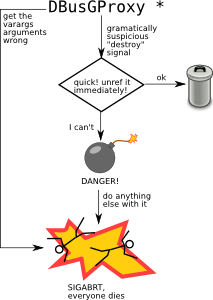
The life-cycle of a DBusGProxy (PD clipart credit: karderio and Andy)
The API provided by dbus-glib for client code is, er, rather less than ideal. The basic object is DBusGProxy, which has a few problems. There's one per interface, rather than one per object; this leads to a maze of twisty GObjects, all suspiciously similar. Our old client library, libtelepathy, got round this by subclassing DBusGProxy to make helper objects called TpChan, TpConn etc., which were simultaneously the proxy for the "main" interface (Channel, Connection etc.), and a factory for proxies for the other interfaces (like Channel.Type.Text and Channel.Interface.Password). This still wasn't ideal, but it was a start. If you use a DBusGProxy in any way after it has emitted the destroy signal, this is considered to be invalid use of the API, and dbus-glib asserts all over the place. We'd rather it didn't do that - remote objects becoming invalid is a fact of life, and if you don't immediately discard all your references to those objects, remote operations on them should just give you a runtime error. You have to be prepared to handle such runtime errors already, because any IPC call can fail at any time. The main API for calling methods uses varargs and is rather subtle. Notably, the calling convention for variant parameters (of D-Bus signature 'v') is not consistent with the calling convention for any other container. For any other container, for instance a GPtrArray *, you pass in a GPtrArray ** pointing to a GPtrArray * variable containing NULL; on success, a pointer to a new GPtrArray is written into that variable. For variant parameters, though, you must pass in a GValue * pointing to a zero-filled GValue, and the result will be written into that GValue. dbus-binding-tool generates thin wrappers around this method-calling API which provide type-safety, although they can't directly specify a non-default timeout. As for signals, before binding to a signal, you have to tell dbus-glib about its signature. This tells dbus-glib how it should push the signal arguments onto the C stack (in GObject terminology: how it should marshal them), to match the signature of the signal-handler function. The documentation claims that this isn't necessary for objects supporting the Introspect method, but that's untrue - on the other hand, if the documented behaviour actually happened, I would consider this to be a critical bug in dbus-glib, since it would enable remote objects to crash dbus-glib clients (by causing signal arguments to be pushed onto the stack in a way that does not match the signature of the signal handler). Of course, the signal-adding function takes varargs, and has to be called exactly once per signal per object. If you don't, dbus-glib asserts when you connect to the signal; if you call it twice, dbus-glib asserts anyway.

TpProxy TpProxy is a GObject subclass vaguely inspired by Python's dbus.proxy.ProxyObject. It isn't a subclass of DBusGProxy, which lets us encapsulate dbus-glib almost completely - in fact, all the references to DBusGProxy are in a separate header, proxy-subclass.h, only used by subclasses of TpProxy (as opposed to normal library API users). TpProxy instances are per-remote-object (per-object-path) like in dbus-python, rather than per-interface like in dbus-glib or QtDBus. As explained below, I believe that this is the most natural object mapping for D-Bus interfaces; in practice it tends to lead to clearer code for us, since one remote object often maps nicely to one UI element (of course, if your objects only have one interface, this approach is no better or worse than dbus-glib's). TpProxy provides support for the following common D-Bus things:
  • Calling methods
  • Connecting to signals
  • Objects becoming invalid
  • Objects with optional interfaces
  • Extensibility
It doesn't currently provide any particular help with Properties - the Properties interface is just another interface as far as we're concerned. We find that, in practice, that's not a problem (even though we use D-Bus properties extensively). In telepathy-qt4 we basically reinvented TpProxy in C++, as Tp::DBusProxy. I've put in some comments below illustrating how the general ideas we used in TpProxy translate into a different object mapping.

Calling methods Method calls on TpProxy are done through auto-generated wrapper functions, much like DBusGProxy. These look something like this:
typedef void (*tp_cli_channel_callback_for_close) (TpChannel *proxy,
    /* any 'out' arguments would go here - Close() doesn't have any */
    const GError *error, gpointer user_data,
    GObject *weak_object);
TpProxyPendingCall *tp_cli_channel_call_close (TpChannel *proxy,
    gint timeout_ms,
    /* any 'in' arguments would go here - Close() doesn't have any */
    tp_cli_channel_callback_for_close callback,
    gpointer user_data,
    GDestroyNotify destroy,
    GObject *weak_object);
Methods for some interfaces, like DBus.Properties, are available on TpProxy itself; others, like Telepathy's Channel.anything, are only available on a particular subclass, like TpChannel. Things to note here:
  • It's an asynchronous call with a callback. General design principle: "this is IPC, get over it". We don't try to hide the fact that IPC is taking place by doing pseudo-blocking calls.
  • The timeout is explicit (although you can always pass -1 to let libdbus pick a "reasonable" default for you). This is because the remote service might not respond, and API users should be at least vaguely aware of this: "this is IPC, get over it".
  • The callback isn't a GCallback; it has an explicit signature, for some semblance of type-safety (it's not much, but it's better than nothing).
  • The callback takes a GError, because any IPC call can fail for any reason.
  • A TpProxyPendingCall * is returned. This is a pointer to an object that only exists until just after the callback is called (so you can ignore it if you don't want it), with a method you can call to cancel the method call (with hindsight this is not ideal, and if I was writing this API now, I'd use gio's GCancellable). "Cancel" is perhaps slightly misleading: the method call still takes place (it was already in libdbus's outgoing queue) but the result gets ignored and the callback isn't called. This is mostly so you an object can forget all the calls it was busy making at the time that the results become irrelevant (e.g. the object is destroyed).
  • There is an extra weak_object argument, which is weakly referenced and is passed to the callback: in practice, most users of telepathy-glib use this as well as or instead of user_data. If the weak_object runs out of references, the callback is automatically cancelled, which means that in practice, explicit cancellation is almost never needed.
  • The generated code has as its first argument a suitable subclass of TpProxy, in this case TpChannel (we tell the code generator about subclasses).
  • You can't see it in the API, but the TpProxy gains an extra ref while a method call is in progress, so you never have to worry about what happens if the proxy gets unreffed during a method call.
  • There's an explicit destructor for the user_data, which is called even if you "cancel" the method call.
In telepathy-qt4, these methods are on small generated helper classes similar to dbus-python's dbus.Interface, one per interface (we provide accessors for them on the non-generated DBusProxy subclass). Instead of using callbacks, we return a temporary QObject per call, which emits a Qt signal on success or failure (that's how all async calls in QtDBus work).

Connecting to signals Similarly, signals have some generated functions:
typedef void (*tp_cli_channel_signal_callback_closed) (TpChannel *proxy,
    /* any arguments would go here - Closed doesn't have any */
    gpointer user_data, GObject *weak_object);
TpProxySignalConnection *tp_cli_channel_connect_to_closed (TpChannel *proxy,
    tp_cli_channel_signal_callback_closed callback,
    gpointer user_data,
    GDestroyNotify destroy,
    GObject *weak_object,
    GError **error);
API notes for these:
  • The callback doesn't take a GError any more, because signals can't fail; the weak_object and the user_data are the same as for method calls
  • This isn't actually a GObject signal at all: those aren't particularly typesafe, and lack namespacing. This might not be very binding-friendly, we haven't tried doing that yet... it might be worth introducing a signal with details, like in dbus-glib, for which these functions are "C bindings".
  • The returned TpProxySignalConnection lets you disconnect from the signal, just like the TpProxyPendingCall above; it can safely be ignored
  • Similarly, if the weak_object dies, then the signal automatically disconnects
  • It is possible for connecting to a signal to fail: this happens if the proxy doesn't actually have the requested interface. If this happens, it's graceful, not a crash. In practice, the flow of code is almost always such that error can safely be NULL because the interfaces are already known.
In telepathy-qt4 the per-interface generated helper classes emit Qt signals. In many cases, we end up proxying these signals by responding to them in the hand-written Tp::DBusProxy subclass by emitting a different signal, in order to give them a nicer representation.

Becoming invalid This is IPC, and any error can happen to you at any time. We found that it was useful to have a general concept of "this object is no longer useful", so we introduced the concept of an object becoming invalidated. The invalidation reason is stored on the object as a GError. If this GError is NULL (as it is initially), then the object is still expected to be valid; if it's non-NULL, the remote object has vanished and the local proxy no longer works. There are several ways a TpProxy can become invalid:
  • its bus name falls off the bus (the process exited or crashed)
  • application-specific reasons (usually triggered by a D-Bus signal in a subclass, like the Telepathy Channel's Closed signal)
  • the GObject gets disposed
Method calls on an invalidated object always fail, with the invalidation reason as the error. This means that calling a method on a TpProxy should never crash your process. The method's callback has to be prepared to handle an error in any case, because this is Sparta^WIPC, so there's no loss in giving it another error. Connecting to signals on an invalidated object always fails, and any existing signal connections are disconnected when it becomes invalidated. This means that if a new remote object appears, and it happens to have the same object path, bus name etc. as the old one, you won't get its signals. A TpProxy can either be bound to a unique bus name or a well-known bus name. In the equivalent code in telepathy-qt4, we call this "stateful" or "stateless" - these names don't capture the intention perfectly, but they're the best we could come up with. A proxy for a stateful API like Telepathy's Channel should always bind to a unique name - when the unique name falls off the bus, the TpProxy becomes invalidated automatically, representing the fact that the Channel you had no longer exists, and nothing can be a perfect replacement for it (the VoIP call has already been terminated, you've already left the chatroom, or whatever - if you make another Channel, that's e.g. a distinct VoIP call). A proxy for a stateless API like Telepathy's ConnectionManager, where an exiting process can disappear, be service-activated again, and still have exactly the same API, should bind to the well-known name. Proxies for well-known names aren't invalidated when the process exits. Qt doesn't have a natural equivalent for GError, so the invalidation reasons in telepathy-qt4 are just a pair of strings, the namespaced name and the message - basically a libdbus DBusError. The principle is the same, though.

Optional interfaces As mentioned above, TpProxy instances are per-remote-object (per-object-path) like in dbus-python, rather than per-interface like in dbus-glib or QtDBus. I believe that this is the most natural object mapping for the D-Bus object model, because the D-Bus interfaces on a remote object can behave like any of these:
  • classes and subclasses (Telepathy.Channel.Type.Text is a Telepathy.Channel)
  • shared interfaces (some Telepathy.Channel objects, of many Types, implement Telepathy.Channel.Interface.Group; any D-Bus object can implement DBus.Properties)
  • optional features (some Telepathy.Channel.Type.Text objects implement Telepathy.Channel.Interface.ChatStates, some do not)
  • discoverable extensions (some Telepathy.Channel.Type.Text objects implement Telepathy.Channel.Interface.Messages, which is more or less Text 2.0)
The way in which interfaces are discovered is also variable. The "classic" D-Bus way to discover interfaces would be to call Introspect. Telepathy services still support that style of introspection, but we don't use it for anything beyond d-feet:
  • Introspect returns a blob of XML, which you have to parse into something useful; if it was in a D-Bus data structure, you'd already have some sensible data structure.
  • Finding out more information about the supported interfaces than their names isn't very useful: in a static language like C you already need to know the methods, signals, properties and their signatures in order to write and compile your code, and in a dynamic language like Python consumers of Introspect end up being remotely crashable by services with unexpected method signatures (this is one of dbus-python's big mistakes in my opinion).
  • If a method that you want to call turns out to be missing, the worst that can happen (in a competently written service) is that it fails with a D-Bus error - and you have to handle D-Bus errors anyway, because this is IPC and anything could fail.
  • Static bindings like dbus-glib have poor support for removing interfaces for which C code exists at runtime, whereas Telepathy needs features like an IM connection that might or might not support avatars (we don't get to find out until we've successfully connected to the server).
Instead, our older interfaces have a method on the "base class" (Channel, Connection etc.) called GetInterfaces, which just returns an array of strings. Newer interfaces (like Account), and older interfaces that have been ported (like Channel), have a property called Interfaces which is, again, an array of strings - this lets us combine the download of the interfaces list with downloading other basic information in a GetAll call. To cater for all these ways to use interfaces, the TpProxy base class has very basic support for interface discovery - you can ask it whether it supports an interface, and you can tell it that it does, in fact, support an interface. Asking which interfaces are supported is directly useful for library users; it's also used as a check by the generated method-call and signal-connection stubs, which return a canned error (Telepathy.Error.NotImplemented in Telepathy's case) if the object isn't known to have the interface. Telling TpProxy that it does support an interface is intended for use by subclasses, and might have been protected if we were writing C++: what happens in practice is that a concrete subclass like TpChannel knows how to discover the fully supported interfaces for this particular object, does so, and calls methods on the TpProxy to tell it which interfaces can work.

Extensibility The API stubs used by TpProxy to call methods and bind to signals are generated from XML documents containing an augmented form of D-Bus introspection data. These XML documents contain various Telepathy-specific extensions, but none of the extensions are language-specific - telepathy-glib, telepathy-python and telepathy-qt4 all operate from exactly the same XML specification. telepathy-qt4's different object-mapping did require us to tighten up some rules that were previously only conventions, but even so, the format is the same. I think this is vitally important - it just doesn't scale to have one set of language-specific annotations in a D-Bus API for each language that will have bindings. One thing that we make heavy use of is what I call "Ugly_Case", which is camel-case with underscores at word boundaries. This gives us a simple, unambiguous and foolproof rule to use in code generators whenever we generate any of the popular conventions for identifiers:
  • CamelCase: delete underscores
  • javaCamelCase: force everything before the first underscore to lower case, then delete underscores
  • lower_case: force everything to lower case, retain underscores
  • UPPER_CASE: force everything to upper case, retain underscores
dbus-glib, by contrast, applies a complex and subtly buggy algorithm to the CamelCase D-Bus names, which results in our SendDTMF method being mapped into GLib as send_dt_mf, and requires that telepathy-glib's Python reimplementation of dbus-binding-tool uses a bug-for-bug compatible implementation (we ended up reimplementing dbus-binding-tool in order to generate the TpProxy-based bindings). Our code generation tools are still rather ad-hoc, because so is our spec format, but for draft interfaces it's possible to copy them into individual projects and use them to generate additional methods for TpProxy or any subclass. This is how we implement unfinished APIs like geolocation in Empathy, for instance. The Interfaces or GetInterfaces hook described above is entirely usable for these extension interfaces, and in fact that's how they're set up. In telepathy-qt4, the generated method stubs are genuine C++ methods, so we can't just append methods to an existing class: this is why we have one helper class per interface, so individual clients can generate a helper class for their particular version of an unfinished API, and instantiate an object of this class attached to a particular Tp::DBusProxy. When an interface becomes stable, it can be added to the set of interfaces for which code is generated in telepathy-glib or telepathy-qt4, at which point any client or service that was already using the final draft of that interface can easily be ported to the library version using sed (the API remains the same).

Becoming ready The concept of being "ready" does not directly exist in TpProxy, but is implemented in TpChannel, TpConnection and TpConnectionManager. The idea is that a freshly created proxy object isn't really fully usable yet - you have to connect to basic signals and recover the initial state of the remote object, as well as checking which extension interfaces are supported. In many well-designed D-Bus APIs you can do this initial setup with a few signal connections and a DBus.Properties.GetAll call. After doing that initial setup (which has to be done asynchronously, because it's IPC), the TpProxy subclass has a local cache of the remote object's state (not necessarily in the same format as the representation on the bus), which can be accessed synchronously at any time, and will be updated in response to change-notification signals. TpChannel and subclasses like it have explicit support for checking for readiness, and having a callback called when the object is ready or invalidated (whichever happens first). The "ready" property also supports the GObject notify signal. telepathy-qt4 took this concept and ran with it - there is library support for objects that can become ready, including a mixin. If I had as much time to work on telepathy-glib as I wish I had, this would be one of the first telepathy-qt4 features to be added to telepathy-glib.

Features becoming ready Going beyond that, in an extensible framework like Telepathy it's probable that not every client understands (or wants to understand) every feature of every object, so it's highly inefficient for every proxy object to subscribe to all the change notification signals and cache all the remote state on the off-chance that the library user wants them. In the API for TpContact (which is not actually a TpProxy for various reasons) we introduced the concept of optional features; telepathy-qt4 extended this idea throughout the library. The idea is that each library user knows which of the optional features are "interesting" to it, and makes a single asynchronous call (which expands into a series of D-Bus calls inside the library) to download the state for core functionality plus all of the selected features, and subscribe to change notification for all of those. This is another telepathy-qt4 thing that telepathy-glib still needs to catch up with; until someone works out how to make the clone() syscall apply to programmers, I fear all libraries are doomed to lag behind how their designers want them to look :-) (license: CC-BY-3.0 / LGPL-2.1+)

30 April 2009

Biella Coleman: Enid Gabriella Biella Coleman

Today I found out that some of my students refer to me as Enid, a name which has rarely been used to call my attention but now circulates almost daily to my students whenever I post a message on Blackboard. It was a little mortifying to find out as I don t identify much with Enid, though it has always tagged quietly along with my other names. BB, which we use for readings, our discussion forum,and email messages, spits out my legal (tax) name, which bears the full Enid Gabriella Coleman. Although I have tried, somewhat persistently, I have failed to change it to the E. Gabriella Coleman that I would rather use. While I find it hard to embrace Enid as I just don t feel like an Enid, at least yet (and may break it out when I write fiction or when I turn 65), I have always liked having the name Enid in so far as it pays homage to my Aunt Enid whose life ended far too early, soon before I was born and from all accounts, she was one stellar woman. My parents chose to tack it on for commemorative purposes, intending to call me Gabriella after some Italian cabaret singer my mother loved. The plan, however, was immediately foiled by my older sister who apparently blurted out something like Biella when she saw the scraggly rat-like baby (as my mom used to describe me) that was christened her younger sister. Biella, like Gabriella, also has Italian roots: it is a beautiful town in Italty and a less than beautiful but so-ugly-it-is-kinda-cute Italian Pug. Perhaps the lesson in all of this is to tell students about my name and finally ditch BB, which is the software equivalent to Soviet style communist housing, and move over to another platform.

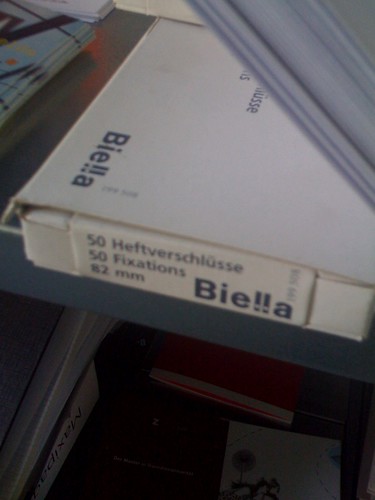
Biella Coleman: bie!!a


bie!!a, originally uploaded by the biella.
Today I found out that some of my students refer to me as Enid, a name which has rarely been used to call my attention but now circulates almost daily to my students whenever I post a message on Blackboard. It was a little mortifying to find out as I don t identify much with Enid, though it has always tagged quietly along with my other names. BB, which we use for readings, our discussion forum,and email messages, spits out my legal (tax) name, which bears the full Enid Gabriella Coleman. Although I have tried, somewhat persistently, I have failed to change it to the E. Gabriella Coleman that I would rather use. While I find it hard to embrace Enid as I just don t feel like an Enid, at least yet (and may break it out when I write fiction or when I turn 65), I have always liked having the name Enid in so far as it pays homage to my Aunt Enid whose life ended far too early, soon before I was born and from all accounts, she was one stellar woman. My parents chose to tack it on for commemorative purposes, intending to call me Gabriella after some Italian cabaret singer my mother loved. The plan, however, was immediately foiled by my older sister who apparently blurted out something like Biella when she saw the scraggly rat-like baby (as my mom used to describe me) that was christened her younger sister. Biella, like Gabriella, also has Italian roots: it is a beautiful town in Italty and a less than beautiful but so-ugly-it-is-kinda-cute Italian Pug. Perhaps the lesson in all of this is to tell students about my name and finally ditch BB, which is the software equivalent to Soviet style communist housing, and move over to another platform.

27 April 2009

Gunnar Wolf: Damn you pigopolists! (or whatever)

We have had a quite strange couple of days... Everything was smooth as usual on Thursday. As I posted here, I cycled to Iztacala to give a talk and back, and basically had a good time. We had heard news some days earlier on the radio that the usual seasonal flu was still present by mid-April, while usually it disappeared by early March... But nothing more. But Friday morning, as I listened to my usual news program, Aristegui repeated over and over that the Health ministry had ordered (in a press conference at 23:00 the previous day) schools of all levels not to hold activities... Quite unusual, but WTF... Got to work as usual, around 9 AM. The first thing I see in the Institute, our Academic Secretary telling us all to finish our most urgent business and head back home, do not pass go, do not collect $200. And... During the morning it started sinking in. This is a very weird and somehow scary situation. We are facing -as you all must know by now- a previously unknown strain of flu virus (influenza porcina H1N1B, AFAICT). During the past couple of days, we have seen the scenes we wondered about during the past decade, mainly in South East Asia (with SARS and with bird flu): Everybody is scared, nobody really understands what they are scared of, people do stay at home. The streets are eerily quiet, and many people are seen with masks covering nose and mouth. I must recognize our federal and local governments are acting very well coordinated (for the first time in probably over a decade, since they were from different parties for the first time). This has been clearly labeled as an epidemic (over 1600 sick people reported at hospitals, and over 100 deceased) and has spread to many of our country's states (as well as to other many countries, although it still seems to be controlled there - But we have got reports from the USA, Canada, France, Spain, Israel and New Zealand so far). I will most probably spend the next full week at home, as my University (as well as all schools and universities in this city and at least the Mexico, Nuevo Le n and San Luis Potos states) will be closed until May 6th. Of course, sports and cultural activities are all suspended as well. Many (most?) bars and restaurants remain closed. Today, my parents came from neighbouring Cuernavaca (where no alerts have yet been emitted, but will surely follow), and we went out for lunch (to a nice Yucatan food place, chosen partly as it had very little concurrence and because we could sit outdoors. Yes, I must specially thank them for being as imprudent as coming over here, given the generalized scare... I know there was nothing I could do to prevent them from doing so :-) And... In this strange climate, I can only thank I am not a party-organizer or anything like that, as I'd have had my plans frustrated. Here I sit next to my laptop, in my halfway-re-windowed house, with a still shrink-wrapped book that looks beautiful (La bicicleta: Rito, t cnica y pasi n), eager to open it (Thanks, Nadezhda! :-* ). Happy birthday to me. Take off the mask, blow 33 candles, put mask back on. Thankfully there is no cake to eat, as it could be messy with the mask on.

26 April 2009

Matthew Palmer: ~/porn

It seems there are plenty of people who do take careful note of my scribblings, even down to noticing the apparent directory I'm in when I SSH to not-yet-existent SheevaPlug-based serial console concentrators. For the record: Thanks, however, to those people who noticed and let me know; if I ever do make an embarrassing cut-n-paste gaff, at least I'll know about it quickly.

25 April 2009

Biella Coleman: What We Know So Far

So, when I like something, I tend to yap about it for weeks and weeks. Take Icelandic Yogurt, for example. After re-discovering it a month ago, I went on a mini-binge (not a mega as it is too expensive) and spread the word to anyone who would listen. The stuff, especially with fun flavors like ginger and orange, just made my morning. Another fine fine thing out there is the performance group What We Know So Far who give performance-based lectures that mix intellectual insight with artistic flair. They put us regular academics to shame who are a bit more staid, to put it mildly. After seeing them a few weeks ago at the 3rd Ward, I snagged them to give a version of their A-mazing talk on Memes in my class and am organizing a much larger event at NYU for the fall of 2009. This is a sort of long winded way of announcing their up and coming show on April 27th the Hannah Complex, which entertains, among other topics, the nature of common sense: Can there be more than one common sense? they ask on their site. And I can t wait to hear the answer as this is a recurrent topic that anthropologists like to entertain. And in fact one of my favorite essays to teach is on this topic, Clifford Geertz Common Sense as Cultural System, a short excerpt which I found here and below is his thesis in a nutshell:
There are a number of reasons why treating common sense as a relatively organized body of considered thought, rather than just what anyone clothed and in his right mind knows, should lead on to some useful conclusions; but perhaps the most important is that it is an inherent characteristic of common-sense thought precisely to deny this and to affirm that its tenets are immediate deliverances of experience, not deliberated reflections upon it. Knowing that rain wets and that one ought to come in out of it, or that fire burns and one ought not to play with it (to stick to our own culture for the moment) are conflated into comprising one large realm of the given and undeniable, a catalog of in-the-grain-of-nature realities so peremptory as to force themselves upon any mind sufficiently unclouded to receive them. Yet this is clearly not so. No one, or no one functioning very well, doubts that rain wets; but there may be some people around who question the proposition that one ought to come in out of it, holding that it is good for one s character to brave the elements hatlessness is next to godliness. And the attractions of playing with fire often, with some people usually, override the full recognition of the pain that will result. Religion rests its case on revelation, science on method, ideology on moral passion; but common sense rests its on the assertion that it is not a case at all, just life in a nutshell. The world is its authority.

Daniel Kahn Gillmor: multiple USB serial adapters on a SheevaPlug

I just noticed Matthew Palmer's Insane/Brilliant idea of the day: he proposes to use large sets of USB serial adapters with a sheevaplug as a cheap serial console server. As part of upstream on cereal, i feel obliged to mention that package as a tool for managing serial console farms like this. It's designed to run in a small footprint, stores timestamped logs for the consoles, supports concurrent remote access, and uses standard unix accounts (usually via ssh) to permit read and/or write access to each port. It has saved me exactly the headaches Matt describes many times. However, i've had trouble getting multiple identical USB serial adapters to persist at standard device file locations across reboot. That is, if you have four pl2303 devices from the same manufacturer, it seems to be a crapshoot which one will be /dev/ttyUSB0 after you restart your system. I could find no distinguishing data in the sysfs to get udev to persistently key off of, anyway. if you know a way to do it, i'd be happy to see it! Depending on how many ports you need, another alternative would be to use a sheevaplug with a multiport USB-to-serial adapter. While i haven't tried this specific hardware, it would remove the need for the hub, and potentially would mean you didn't need any extra power. I'm assuming that this device would give you persistent port naming, but i haven't tried it. Pricewise, it seems to be a win, too: $100 for the SheevaPlug and $100 for the 8-port adapter.Tags: cereal, sheevaplug

23 April 2009

Petr Rockai: darcs sprint 2009-04

As you might know, as part of the Haskell Hackathon 5 in Utrecht, the second darcs hacking sprint took place. Thanks to generous donations to the Darcs project, I have been able to attend. I took the overnight train from Prague on Thursday evening interestingly, we managed to accumulate about 90 minute delay in Germany, but by skipping some detours (throwing passangers out at more convenient ones) we managed to get to Utrecht on time. (Wow.) After a while of confusion, we managed to get our strippencards and find the right bus and get to the UU campus (at that time, we have already met with Thorkil, whose train was combined with mine in the middle of the night somewhere in Germany). The first thing there was to get our name tags and a round of introductions followed I was fairly surprising by (large) number of darcs hackers among the general Haskell population present at the Hackathon. Overall during the sprint, various topics have been discussed ranging from theory issues to actual implementation bits in current darcs. Some roadmapping has taken place. It was great to see all those darcs people together. More interestingly, it sort of convinced me that actually something is going on with darcs. Although most people seem to be pretty short on time, at least I got the impression that people have actual intent to keep advancing darcs, in one form or other. Also, there s been some preliminary plotting on what is the life expectancy of darcs 2, roughly. My current plan is to use darcs 2 as an implementation vehicle, because people use it in real life, for carrying out the actual work on hashed-storage. That way, we should be able to de-couple low-level repository and file access code from darcs itself, also meaning it should be reasonably easy to plug it into camp later (or maybe it turns out we instead want to remodel darcs so that we can plug camp-core in time should tell). We have done some bits of work on darcsit (gitit) migration of wiki.darcs.net, although it hasn t been so much of a smooth sailing. I have even tried to set up gitit on one of my machines, but cabal-installed happstack went eventually crashing and burning instead of doing anything useful. I m stuck on that front, hoping that Eric and Gwern can get test.darcs.net running within reasonable resource usage. I have thrown a chat with various people about hashed storage and I have explained various problems of the current darcs hashed repositories and how hashed storage addresses those. Also, I have talked with Benedikt about his filecache and we entertained some initial thoughts on how those two play together. We have also spent a while at a whiteboard with Eric discussing what needs to be fixed in sources handling: the file that lives under _darcs/prefs/sources and that keeps track of related branches of a given repository. The catch is, that when inappropriate entries get into that file, bad things can happen: darcs repeatedly waiting for a nonexistent remote machine to answer, or triggering automount a few thousand times by probing just the wrong directory. These need to be remedied and we came up with a reasonable action plan. Hope to have this in 2.3, as it should be moderately hard to fix and it has potential to sweep a fair amount of silly and obscure performance bugs. All in all, it seems to me that the important part of the sprint this time was talking to people and thinking about things. Still, I did manage to get some hashed-storage coding done (but mostly cleaning up and documenting work) during the sprint. I expect the fruit of the sprint discussions to take shape in form of code improvements in following months.

Romain Beauxis: Lastfm no longer free as in free beer (and some bits about xml in OCaml)

Lastfm no longer free as in free beer As I was trying move the code of ocaml-lastfm [1] from the unmaintained xml-light [2] to xmlm [3], I discovered that it now fails to request track in anonymous mode. Then, I went on the lastfm [4] site, and discovered that now I cannot find any full content available for anonymous users. Some more researches and I found this [5]:
Today we are making the changes to the radio that were previously announced here. This means that from today, listeners to Last.fm Radio outside of the USA, UK and Germany will be asked to subscribe for 3.00 per month, after a 30 track free trial period. In the USA, UK and Germany, where it's feasible to run an ad-supported radio service, there won't be any changes. Everything else on Last.fm (scrobbling, recommendations, charts, biographies, events, videos etc.) will remain free in all countries, like it is now.
JPEG - 42.5 kb
Alcool ! Voil l'ennemi.
Poster by French painter and missionary Fr d ric Christol (1850-1933) warning of the dangers of absinthe and other alcoholic drinks.
Although I will not comment this with the same violence as in the comments of the above message, this is not a good news at all. I totally understand how it can be difficult to find financial resources for this kind of business, and how complicated it can be after few years to maintain an activity that initially was breaking new and attracting investors. However, given the current global [6] propaganda [7] campaign [8] that is organized [9] by the major music companies, I do not believe this decision has only to do with lastfm's financial resources. In particular, also the legality of Deezer [10] was challenged by universal [11] such that they had to require registration [12] and also limit drastically the available titles. The current situation is now really becoming worse and worse. Not only the music companies are trying to push for dangerous laws for the civil rights while pretending to fight against illegal music sharing, but also they are trying to shutdown all the new competitors that were successful in doing exactly what they refused to do during the same time. All of this is just simply pathetic, and I strongly hope there will soon be an end to this, which will surely mean for these companies adapt or perish.. Or perhaps they plan to impose their restricting and dangerous laws in any country in the world ? Another remark about all this is that it clearly demonstrate the importance of having the right to copy and store for your own usage any copyrighted material. Indeed, these are not only products but also artistic productions, and for this reason it is important to be able to save them in some place in order to not loose track of it if the streaming company was to be shutdown, as it seems to be the trend now.
JPEG - 71 kb
Viktor Oliva: The Absinthe Drinker.
The original painting can be found in the Caf Slavia in Prague.

Moving from xml-light to Xmlm The other part of this post is about moving from xml-light to xmlm. This is in fact very easy, and should only be a matter of adding a piece of code like this:
type xml =
Element of (string * (string * string) list * xml list)
PCData of string

let parse_string s =
let source = String (0,s) in
let input = Xmlm.make_input source in
(* Map a tag representation in xmlm to
* (name, attributes list) where attribute = string*string. *)
let make_tag (x,l) =
(* Forget about the uri attribute *)
let l =
List.map (fun ((_,y),z) -> (y,z)) l
in
snd x,l
in
let rec get_elems l =
if Xmlm.eoi input then
l
else
match Xmlm.input input with
El_start tag ->
let elem = get_elems [] in
let (name,attributes) = make_tag tag in
get_elems ((Element (name, attributes, List.rev elem)) :: l)
El_end -> l
Data s ->
get_elems ((PCData s) :: l)
Dtd _ -> get_elems l
in
let elems = get_elems [] in
Element ("", [], List.rev elems)
This is a very simple code that surely needs more fixes, but starting from that, you can parse a string into an equivalent representation of the xml data, and then use it as before in your code..


[1] Ocaml-lastfm: http://www.rastageeks.org/lastfm.html [2] Xml-light: http://tech.motion-twin.com/xmlligh... [3] Xmlm: http://erratique.ch/software/xmlm [4] Lastfm: http://www.last.fm/ [5] "Radio Subscriptions": http://blog.last.fm/2009/04/22/radi... [6] "New Zealand: safe from Big Music. Or is it?": http://www.p2pnet.net/story/19074 [7] " La Quadrature du Net discr dit e aupr s des d put s anti-Hadopi": http://www.numerama.com/magazine/12.... Link is in french. It explains how, after filling a so-called petition with hundreds of signatures from employees presented as artists, or artists abused by the presentation of the content, these companies complain about the "totalitarian methods" used to verify the validity of the signature, which were simply based on the public available information on these names on the web, while they propose a system that would automatically cut the internet access to probably 1.000 people a day in France... [8] "Faux proc s : Les pirates paient": http://www.ecrans.fr/Faux-proces-Le.... again, in french, the article reports a Danish study that prove once again that people who tend to download a lot of music are also much more likely to spend their money in the music business, being concert, records or else.. [9] ""Three strikes" for Ireland - Eircom, music industry settle filtering case": http://tjmcintyre.com/2009/01/three... [10] Deezer: http://www.deezer.com/ [11] "Universal Music challenges the legality of Deezer, a free streaming website": http://french-law.net/universal-mus... [12] "Now Deezer Required Registration": http://forums.techarena.in/technolo...

22 April 2009

Martin Michlmayr: OSI signs an MOU with the Korea Software Copyright Committee

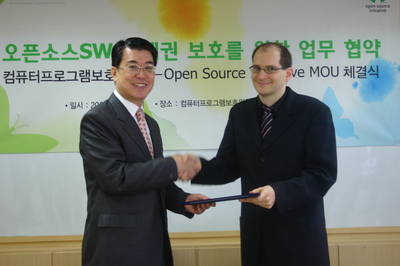
I visited Seoul last week to represent the Open Source Initiative (OSI) at an open source conference and to sign a Memorandum of Understanding (MOU) with the Korea Software Copyright Committee (SOCOP). SOCOP organized a conference with the title "Free Open Source Software License Insight Conference", and the international speakers included Brett Smith of the FSF, Brendan Scott of Open Source Law, Michael Cot of RedMonk and myself. From the questions we received, it seems that there is a lot of interest in legal questions related to open source. There were a number of folks from hardware companies that asked specific questions what they could do and couldn't do (e.g. related to including sources for GPL code and properly giving credit for BSD code). I think the conference was a great success. The talks were of high value and we got good questions. The audience was quite mixed, ranging from managers to developers. Even though they had simultaneous translation of the talks, the majority of the people listened in English... this gives me hope that some of these folks will end up becoming involved in the international open source community. Mr Koo and Dr Michlmayr signing MOU SOCOP is working on a number of activities related to open source, including: The day after the conference, I went to the SOCOP office to sign the MOU between SOCOP and OSI with Mr Yung Bo Koo, the chairman of SOCOP. The MOU says that we'll share knowledge and expertise, help with promotional activities and support each other's activities in other ways. I was delighted to sign the MOU between SOCOP and OSI, and I look forward to a fruitful cooperation between our organizations in the future. It's great to see so much interest and so many activities around open source in the Republic of Korea.

20 April 2009

Julien Valroff: HADOPI - meeting with my local representative

Following to the email sent regarding the French law known as HADOPI (I blogged about it a few weeks ago), I had a meeting this afternoon with my local representative. This half an hour meeting allowed me to explain my fears regarding this firewall which could be set up on French citizens computers to enable them to prove their non-culpability (provided their computer runs a popular proprietary OS). My representative kindly listened to me and his assistant understood the situation very well. I was even impressed that they have worked a lot on this law before the meeting. They both proposed to raise this issue to Christine Albanel, the current French Minister for Culture and Communication, who is at the origin of this law. They agreed to say that this wouldn t be changed for the next lecture (planned for the end of the month), as this particular chapter was meant to be detailed in further texts. They also admitted that this law had little chance to be really applied as is, as they consider some aspects to be anti-constitutional - they hence think that the French Constitutional Council will prevent this law to be applied, at least as it is when writing this post.
My representative also admitted that this law was somewhat outdated (even if not yet voted!). Actually, this kind of law will ever be outdated I kindly thank my representative for his time and his frankness (even if on the bad side for this law, he was very open to my thoughts). Good to know France is still a real Democracy!

19 April 2009

Miriam Ruiz: Debian packages for Structure Synth

Structure Synth is an application for creating 3D structures from a set of user specified rules. It is an attempt to make a 3D version of Context Free (a free -GPL ed- program that generates images from written instructions called a grammar). The cool thing about Structure Synth is that it has a simple language for writing recursive scripts that can generate complex structures (kinda Processing, but in 3D), and you can feed the result into Sunflow (a rendering system for photo-realistic image synthesis, already available in Debian) to generate Escher-like cool images. The program is waiting in the NEW queue, but you can temporarily download my packages (for Debian SID amd64) if you want. Even though I ve tried hard to be the one to blog about this, my friend Javier Candeira has won the competition and has been able to write about this earlier than me :P Spanish readers might want to have a look at JoSeKBlog, where he describes how to combine Structure Synth and Sunflow, and where I first read about the existence of the program.

17 April 2009

Matthew Garrett: Intel's commitment to open source driver support

Update: It turns out that the original PSB code is still on the moblin site - I just failed to notice that there's two pages of git repositories. I fail. Last update is from March 2008, though.

Edited again: An up-to-date version of the drm code is available as part of the Moblin kernel SRPM - repo.moblin.com isn't obviously linked off the Moblin website, but I should have thought to find and check their source repository.

By and large, working with Intel is a pleasure. In fact, a while ago I said so in a fairly obvious way. So it's a shame that the support for Poulsbo is still an absolute fucking mess with absolutely no obvious end in sight. Intel's Moblin group (the people who seem to be closest to having responsibility for providing any public Linux support for that hardware, though it's really not clear if they've got any more say in this than I do) have a kernel team that don't want or need a git tree despite having someone who's working on forward porting the driver to modern kernels - probably a job that requires more than one person given what a godawful fucking mess the last public release was, but it'd at least be nice to see what the current state is. Especially since you don't even seem to be able to get the last public release - moblin's git repositories have been rearranged and I can't find the psb-kmod one on their gitweb any more.

The most terribly depressing thing about this is that development is clearly still happening internally. Ubuntu is still being sent tarball releases by Intel, not that the code's getting any better judging by the type of diff involved. This is made even more entertaining by the bug in question being private, leaving no indication whatsoever about what bugs this code is meant to fix or why.

Closed development, random private tarball drops to partners without any public releases or changelogs, no indication of any upstream release, kernel developers entirely unrelated to the development of the driver trying to get code merged so people can actually use the hardware they bought? I'd expect this of some random far-east vendor with no experience in working with Linux, but not a company that's consistently one of the top ten contributors to the kernel and has frequently touted their level of support. There's no meaningful support for Poulsbo. There's just a thin cardboard cutout that's been carefully placed in front of a hole filled with users' hopes and money.

Seriously Intel. Sort it the fuck out.

16 April 2009

Martin F. Krafft: Government exaction

Do you listen to the radio? I don t, and there are multiple reasons for that: First and foremost, I don t like the music they play these days. Even though there are stations which will occasionally play a more eclectic tune, the Swiss government does not, to my knowledge, dictate any quota, like New Zealand actually requires stations to broadcast New Zealand music at least 20% of the time. The result is music made by producers, who stand pop icons with little clothing in front of microphones, instruct them to move their bodies in obscene ways, and coach them to croak songs someone else wrote en masse in some basement somewhere. All those songs sound alike. To ensure a constant supply of pop dolls, they hype television shows with titles such as Germany s seeks the next superstar , when most of Germany actually couldn t care less, and only those with vacuous brain capacity follow with excitement, because they wouldn t know what else to do. Second, I don t have the time or energy to listen to discussion rounds on the radio, especially not when topic are about society , which noone can define in the first place. Wittgenstein always had it right. The same goes for most commentaries. If I don t have anything to do, I prefer to listen to birds in the trees, rather than someone s polished opinion. The scariest aspect is that those people actually believe that they have something worthwhile to say, and so do their producers and the other staff, when in most cases, they don t. At least not worthwhile to people who have other things occupying their minds. I also don t like someone to make a pre-selection of news and squash that into 5-15 minute time slots, to be read out by dull-sounding speakers. I d rather skim over articles, and the Web ensures that I get the information I want much quicker than the radio stations can transmit them. And sports over the radio waves makes me come close to aural epileptic seizures. I am painting the sky black a bit. I am fully aware that there exist people with thought-provoking arguments, that some stations play interesting music I would otherwise never discover, and that the radio is a source of entertainment in the lives of thousands of other people who are less privileged than me. But when the Billag rang my doorbell today and wanted CHF 14,10 per month for posession of any device capable of turning radio waves into sound, including those radio waves broadcast over the Internet these days, I got a bit furious. In the past, they concentrated only on actual radio and TV receivers. When I moved into my previous flat in Zurich in 2002, they wanted money because my stereo had a tuner button. I refused to pay, opened the device, unsoldered the radio coil, and sent it to them with an angry letter of refusal; they let me off the hook. Since then, they changed the law in 2007 (but haven t actually updated the forms they force you to sign) to include audio players, cellular phones, and computers, which are all radio-capable. I d really prefer if they used their funds to revert that trend, or at least remove the loudspeakers from all mobile phones. But instead, this morning, I skid right into their claws. As I said before, the radio is also a social support system, and as such I have less of a problem to subsidise it. However, given that I strongly disagree with the quality level broadcast, I would prefer to direct my money towards causes I consider more useful, and with which I could better identify. Unfortunately, the whole system is governmentalised to the point where this choice is taken away from me. The Billag website helpfully offers answers to the common questions, including one along the lines of quality. They suggest that you get in touch directly with the programme directors to complain about their content, and offer suggestions. Shortly after I moved to Zurich, Radio Lora offered me a radio show. Radio Lora is a private station, but they also receive subsidies from the monies exacted by the government, so I am using them as an example here. I suggested that I concentrated only on progressive and psychedelic rock from the sixties and the seventies. They refused the show in the end, claiming that this would not be what their listeners want. So instead I now get to pay for content that is deemed more appropriate. I can only imagine the pains I d have to go through to be able to host a radio show concentrating on eclectic tunes on one of the public radio stations. And even if I succeeded (without becoming a full-time public radio broadcaster), then I could only contribute a few hours a week to that content. If you ask me, the Swiss government is overstepping its competencies a bit. NP: Mono: Hymn to the Immortal Wind

15 April 2009

Julien Danjou: Taking the other direction

I've started to develop awesome more than 18 months ago, and somehow I feel it's time to stop a bit and think where we come from and where we are going to. The motivation I never though I'd be written a window manager one day. That seems kinda stupid when you see how many window manager there's around. As many people, I've tested and have been using tons of window manager: Window Maker, Fluxbox, etc. In August 2007, I was using fvwm since 2004 and was quite happy with it. I used the famous fvwm-crystalhttp://www.fvwm-crystal... as a configuration starter and then rewrote lots of stuff. Digging into fvwm configuration files was boring, and since I'm lazy, I never really configured it to fit entirely my needs. The thing is that, in July 2007, my workstation died. I bought a new one based on the amd64 architecture. Too bad, with this new box, fvwm decided that it will not longer runs and was segfaulting almost every time I logged in. I was really upset. Another failure in the window manager world. So I decided to get the yearly ride of testing many window managers. I went on the no more developed stuff like the *boxes, ion3, etc but well, I did not like them, there were not powerful enough, too bugged or upstream was insane. Then I found xmonad. The Haskell configuration file format made my cry. I did not want to learn Haskell, it seemed too obfuscated to me. At that time it was even not packaged for Debian, so I gave up. But I found dwm in the meantime, and I loved it. It was simple, and the source code was almost understandable and easy to hack. I subscribed to the dwm mailing-list, in order to participate to its development, etc But I got really disappointed. No patch were welcome and the development seemed to be almost finish in this sight. People patches were lying around, but no one really care. Each user was managing its own set of patches. That's not what I learnt and what I love in free software. So, as many users, I began to maintain my patches in my corner. But I began to have more ideas The jdwm I just added a 'j' in front of dwm and started to hack it days and nights to add many feature I missed, like multi-head, etc On 5th September 2007, I created a git repository to host my code. That's gonna be awesome. Five days later, on 10th September, I finally found a name for my new pet: awesome, borrowed from Barney Stinson who heavily uses and abuses this word. The 1.x branch The first releases until December were noted 1.x. It was just a better dwm with a simple flat configuration file.. The configuration file used libconfig, but it was a very poor choice. And I was not able to put in into Debian because of name clash. The 2.x branch The 2.x branch came in January 2008 with a brand new configuration file format based on libconfuse, which was a bit more powerful. Many concepts and features that have been added in this branch are still used in the current 3.x branch. At this time, between December 2007 and April 2008, the community was growing smoothly. But as I said, awesome 2 was based on a flat configuration file. That raised a problem very soon: users expectation were growing and the development team (me and a couple of regular contributors) was unable to cope with them. One of the event that started to change my mind was the support for titlebars. When I've added titlebar support, it was minimal. It was on top of a window, with the window title. Dot. Then I've started to add a lot of options, like the application icon drawing, the position (left, right, bottom) etc. And then users started to ask for more, like: "add titlebar on windows only when the window is floating". That's ok, but that's complicated: that's again another option to do some stuff conditionally. And then, why don't add titlebar on windows when <insert random events here>? The 3.x branch Why At that time, around April 2008, I'd totally stopped development. I was trying to find a solution which was simple and powerful. But after 2 weeks of thinking, I was not able to find anything else than: use a real language for configuration. So, I've started prototyping awesome 3 using Lua. The choice was not obvious, and despite the problem Lua might suffer, it's one of the easiest language to integrate into an existing application. There's still a video of a first version here. But, let's go a little back: in January 2008, Arnaud Fontaine contacted me because he was interested to use awesome as one of its school project. He decided to port awesome from Xlib to XCB, a modern asynchronous X library. His work took some time, but in May 2008, Arnaud did finished to port git master version of awesome to use XCB. Consequently, I decided to start a new major branch, using XCB instead of Xlib (no change for users in this regard) and Lua instead of our previous flat configuration file format. Development It took me a while to get from here to there, but in September 2008, it was ready. We had a simple Lua API, and the XCB port was working perfectly. It took us some time to release and have something totally working, because we had to work on XCB and contribute back to the project. It was really not ready to use by an application, but we did great work in this area and it's now really fine. We're still here Releases continue to happens, 3.1 around December 2008, and 3.2 around March 2009. 3.3 should be here in June. One of the drawback we had, is that we moved many stuff from C to Lua. Why? Because writing things in Lua is quicker and easier to maintain than C, and makes thing more configurable for the user. For example, the layout algorithm used to organize window were written in C until 3.2 came out. At that time, users had no choice than using a set of predefined layout to organize their windows. Starting with 3.2, if they have minimal knowledge about geometry, they can start writing a layout function organising windows on the screen. But this kind of API changes was a bit rough for users, since they had to port some part of their configuration file to the new API. The thing is that the project was still a teenager at that time, not really knowing were it will go. But I'm happy to announce that API breakage are more and more rare (so far only one minor between 3.2 and 3.3), and anyway always for the Good. But I admit that it built a bad reputation around awesome 3.x during its first month of existence. Future direction I am currently working on 3.3 development. We have still many things to do. Time passing, we get more idea, and more users. And more users bring more ideas. We also have many more contributors, and some guys are even taking maintainer-ship of some code area. Conclusion My post title is "Taking the other direction" because I feel this way. I've got that feeling that some approaches in projects like GNOME are sometimes bad. Please don't misread me, I know we are not playing in the same yard. When adding a key shortcut for starting an application makes you dig into gconf, I wonder how this is a win for the user. Well, it's probably a win for the end-user, but I surely am not one of them. And I don't intend to target them with my software, anyway. And now, when I hear things like GNOME 3.0 and the "desktop shell" approach, that makes me smile. Guys, it was time, but have luck. What I see from here, is that any desktop control interface is wrong somehow, and that there's no approach that can fulfill all users wishes. I think that we, the awesome development team (no pun intended) took the direction of building a frame-work window manager rather than a solution written in marble. We (partially) solved the issue of UI ergonomic by not writing one and allowing the user to write his own. I don't say that's easy to do for most of users, but it's doable. And I think it's worth it: I use window managers since I use Linux, around 1998. If something like awesome came 5 years ago, I'd be using it so far, because you can write Fluxbox or WindowMaker using awesome in a hundred of Lua code. And you can write your own version of it. And it starts in less than 3 seconds, supporting almost all standard desktop specification (ICCCM, EWMH, XDG, system tray, message notification, D-Bus, etc), whereas many of the window mangers do not. You can even write and play space invaders. Finally, I'm happy about the the road we took so far, and hope we will continue into that direction. The rants I read about our project are not that big, compared to the kudos we received.

Julien Danjou: Taking the other direction

I've started to develop awesome more than 18 months ago, and somehow I feel it's time to stop a bit and think where we come from and where we are going to. The motivation I never though I'd be written a window manager one day. That seems kinda stupid when you see how many window manager there's around. As many people, I've tested and have been using tons of window manager: Window Maker, Fluxbox, etc. In August 2007, I was using fvwm since 2004 and was quite happy with it. I used the famous fvwm crystal as a configuration starter and then rewrote lots of stuff. Digging into fvwm configuration files was boring, and since I'm lazy, I never really configured it to fit entirely my needs. The thing is that, in July 2007, my workstation died. I bought a new one based on the amd64 architecture. Too bad, with this new box, fvwm decided that it will not longer runs and was segfaulting almost every time I logged in. I was really upset. Another failure in the window manager world. So I decided to get the yearly ride of testing many window managers. I went on the no more developed stuff like the *boxes, ion3, etc but well, I did not like them, there were not powerful enough, too bugged or upstream was insane. Then I found xmonad. The Haskell configuration file format made my cry. I did not want to learn Haskell, it seemed too obfuscated to me. At that time it was even not packaged for Debian, so I gave up. But I found dwm in the meantime, and I loved it. It was simple, and the source code was almost understandable and easy to hack. I subscribed to the dwm mailing-list, in order to participate to its development, etc But I got really disappointed. No patch were welcome and the development seemed to be almost finish in this sight. People patches were lying around, but no one really care. Each user was managing its own set of patches. That's not what I learnt and what I love in free software. So, as many users, I began to maintain my patches in my corner. But I began to have more ideas The jdwm I just added a 'j' in front of dwm and started to hack it days and nights to add many feature I missed, like multi-head, etc On 5th September 2007, I created a git repository to host my code. That's gonna be awesome. Five days later, on 10th September, I finally found a name for my new pet: awesome, borrowed from Barney Stinson who heavily uses and abuses this word. The 1.x branch The first releases until December were noted 1.x. It was just a better dwm with a simple flat configuration file.. The configuration file used libconfig, but it was a very poor choice. And I was not able to put in into Debian because of name clash. The 2.x branch The 2.x branch came in January 2008 with a brand new configuration file format based on libconfuse, which was a bit more powerful. Many concepts and features that have been added in this branch are still used in the current 3.x branch. At this time, between December 2007 and April 2008, the community was growing smoothly. But as I said, awesome 2 was based on a flat configuration file. That raised a problem very soon: users expectation were growing and the development team (me and a couple of regular contributors) was unable to cope with them. One of the event that started to change my mind was the support for titlebars. When I've added titlebar support, it was minimal. It was on top of a window, with the window title. Dot. Then I've started to add a lot of options, like the application icon drawing, the position (left, right, bottom) etc. And then users started to ask for more, like: "add titlebar on windows only when the window is floating". That's ok, but that's complicated: that's again another option to do some stuff conditionally. And then, why don't add titlebar on windows when <insert random events here>? The 3.x branch Why At that time, around April 2008, I'd totally stopped development. I was trying to find a solution which was simple and powerful. But after 2 weeks of thinking, I was not able to find anything else than: use a real language for configuration. So, I've started prototyping awesome 3 using Lua. The choice was not obvious, and despite the problem Lua might suffer, it's one of the easiest language to integrate into an existing application. There's still a video of a first version here. But, let's go a little back: in January 2008, Arnaud Fontaine contacted me because he was interested to use awesome as one of its school project. He decided to port awesome from Xlib to XCB, a modern asynchronous X library. His work took some time, but in May 2008, Arnaud did finished to port git master version of awesome to use XCB. Consequently, I decided to start a new major branch, using XCB instead of Xlib (no change for users in this regard) and Lua instead of our previous flat configuration file format. Development It took me a while to get from here to there, but in September 2008, it was ready. We had a simple Lua API, and the XCB port was working perfectly. It took us some time to release and have something totally working, because we had to work on XCB and contribute back to the project. It was really not ready to use by an application, but we did great work in this area and it's now really fine. We're still here Releases continue to happens, 3.1 around December 2008, and 3.2 around March 2009. 3.3 should be here in June. One of the drawback we had, is that we moved many stuff from C to Lua. Why? Because writing things in Lua is quicker and easier to maintain than C, and makes thing more configurable for the user. For example, the layout algorithm used to organize window were written in C until 3.2 came out. At that time, users had no choice than using a set of predefined layout to organize their windows. Starting with 3.2, if they have minimal knowledge about geometry, they can start writing a layout function organising windows on the screen. But this kind of API changes was a bit rough for users, since they had to port some part of their configuration file to the new API. The thing is that the project was still a teenager at that time, not really knowing were it will go. But I'm happy to announce that API breakage are more and more rare (so far only one minor between 3.2 and 3.3), and anyway always for the Good. But I admit that it built a bad reputation around awesome 3.x during its first month of existence. Future direction I am currently working on 3.3 development. We have still many things to do. Time passing, we get more idea, and more users. And more users bring more ideas. We also have many more contributors, and some guys are even taking maintainer-ship of some code area. Conclusion My post title is "Taking the other direction" because I feel this way. I've got that feeling that some approaches in projects like GNOME are sometimes bad. Please don't misread me, I know we are not playing in the same yard. When adding a key shortcut for starting an application makes you dig into gconf, I wonder how this is a win for the user. Well, it's probably a win for the end-user, but I surely am not one of them. And I don't intend to target them with my software, anyway. And now, when I hear things like GNOME 3.0 and the "desktop shell" approach, that makes me smile. Guys, it was time, but have luck. What I see from here, is that any desktop control interface is wrong somehow, and that there's no approach that can fulfill all users wishes. I think that we, the awesome development team (no pun intended) took the direction of building a frame-work window manager rather than a solution written in marble. We (partially) solved the issue of UI ergonomic by not writing one and allowing the user to write his own. I don't say that's easy to do for most of users, but it's doable. And I think it's worth it: I use window managers since I use Linux, around 1998. If something like awesome came 5 years ago, I'd be using it so far, because you can write Fluxbox or WindowMaker using awesome in a hundred of Lua code. And you can write your own version of it. And it starts in less than 3 seconds, supporting almost all standard desktop specification (ICCCM, EWMH, XDG, system tray, message notification, D-Bus, etc), whereas many of the window mangers do not. You can even write and play space invaders. Finally, I'm happy about the the road we took so far, and hope we will continue into that direction. The rants I read about our project are not that big, compared to the kudos we received.

12 April 2009

Andrew Pollock: [debian] Grappling with Git, episode 1

At work, we have a bit of a vested interest in the Puppet and Facter packages that are in Debian, because we ultimately consume them in Ubuntu. We noticed that what was in Debian unstable was lagging a bit behind what was released upstream, and when one of my co-workers tried getting in contact with the Debian developers that were maintaining the Puppet package and got no response, I got involved. I got in touch with Micah Anderson and got myself and Nigel Kersten added to the Alioth project for Puppet. Despite Jamie Wilkinson being listed as the maintainer of the facter package in Debian, he claimed this was news to him, and Matt Palmer, who was listed as an uploader, didn't really claim much knowledge of maintaining the package either, so we took that as blessing to take over that package as well. This is where the fun begins. I've been meaning to try out Git ever since Debconf 7, where all the cool kids were using it and raving about it. I've been meaning to make the Debian DHCP package collaboratively-maintained, and use Git for the revision control, but I haven't quite gotten off my good intentions and done it yet. Part of the problem is not knowing exactly what workflow I should use, and suffering from paralysis by analysis, reluctant to experiment, because I don't want to go down the wrong path. Anyway, this is about Puppet, not DHCP. The Puppet package, as it turns out, is already maintained in Git on Alioth, so the problem here was more one of figuring out what the current workflow was, and trying to follow it. This is where Nigel came in. Conveniently, the upstream Puppet development is done in Git also, and Nigel is a contributor to Puppet upstream, so he had some Git-fu. So between the instructions on how to get started with Git on Alioth and what he knew, we could start fumbling around. It seems like the Alioth Git repository was also tracking the upstream Puppet repository, as there were commits in the Alioth one by Luke Kanies, and we didn't really imagine that he was doing Debian-specific stuff. Here's what we ended up doing to try and get what was in the Alioth repository up to the upstream version 0.24.8 of Puppet:
git clone ssh://apollock@git.debian.org/git/pkg-puppet/puppet.git
This part was fairly straight forward. Clone what's in Alioth locally.
git remote add reductive git://reductivelabs.com/puppet
git remote update
git fetch --tags reductive
Next, we added a remote branch that tracked upstream. We called it "reductive", and we updated it. The bit that took some fiddling with was fetching the tags. Nigel later figured out that tags are inherently private to a repository, and normally stay that way. So if I have a local clone of say the upstream Puppet repository, I can tag it to my heart's content, and normally those tags would stay in my local repository, because they're probably only meaningful to me.
git checkout -b upstream/0.24.8 0.24.8
This bit took a bit of work to arrive at as well. What we wanted to do was create a new branch called upstream/0.24.8, which was at what was tagged 0.24.8 in the reductive repository. Nigel pondered what would happen if you already had a tag or a branch called "0.24.8" before you added the remote repository. This is also why we had to fetch the tags from the remote repository, so we had something to check out.
git checkout master
git merge upstream/0.24.8
Next, we switched back to the master branch and merged the contents of our local upstream/0.24.8 branch that we just created. This now got the Puppet source in the master branch up to what was released as version 0.24.8. (and this is better than just running uupdate?) We did some fiddling with the debian/control file and debian/changelog and fixed up a few things that Lintian was bitching about, and were done. I'd set up a sid chroot with cowdancer previously, and had to do some faffing around with git-buildpackage to convince it to use pbuilder. I ended up using
git-buildpackage --git-builder="pdebuild --debbuildopts '-i\.git -I.git' --basepath /var/cache/pbuilder/base-unstable.cow"
So now we've got most of what we want to ship checked into Git on Alioth. I have no idea if we've done it "right", I suspect we may have done something wrong by operating on the master branch. Looking at the revision history in the Git repository on Alioth, it looks like previously things have been done a few different ways. I certainly want to write up a definitive workflow once we've figured one out. We haven't uploaded the new package to unstable yet, because we're still trying to give it a modicum of testing, and we'd like to sort out the Facter package as well. The Facter package was a more greenfield exercise, as while there was already a Git repository on Alioth for it, it was empty. So Nigel had to do some futzing around to get it checked in the right way to make git-buildpackage want to build it. He did this by himself, so I'm not sure exactly what he did. I've since discovered that it's probably lacking some dependencies it needs, so that'll need to get fixed before it gets uploaded. I look forward to reading blog posts from the smart people who actually know how to use Git properly, telling me how we should have done it. I'm still very interested in coming up with a proper workflow for preparing packages and committing the changes, and for doing code review.

10 April 2009

Obey Arthur Liu: Google Summer of Code 2009: Debian s Shortlist

Copy of http://lists.debian.org/debian-devel/2009/04/msg00421.html. Hi folks, We have been pretty busy these past few weeks with the whole Google Summer of Code 2009 student application process.
I can say that we have this year a very good set of proposals and I d like to thank all the students and mentors for this. I am going to present to you our shortlist of projects that we would like to be funded and believe we can reasonably manage to get funded. As always, remember that the number of slots is not final yet at this point so we can t promise anything. The first preliminary slot count given today was *10* (same as last year) and we hope to get *2* more (as we did last year). This shortlist is alphabetically ordered because we don t want to reveal the current internal rankings. I am inviting you to debate what you think is cool, what is useful, what is important to Debian, maybe give us pointers to resources or people that could be helpful for the projects. We will try to alter our current rankings to reflect the zeitgeist in Debian, while taking into account the personal information that we have about each student involved. The deadline for any modification is on the 15th, so get everything in by the 14th. The final selected projects will be announced by Google April 20th, ~12 noon PDT / 19:00 UTC. We ll have another announcement then. Three proposals need or may need a mentor, I indicated it. For more information about the projects or mentoring and how to talk to us directly, scroll down past the list. Debian s Shortlist : - Aptitude Package Management History Tracking
- Automatic Debug Packages Creation and Handling
- Debbugs Web UI: Amancay Strikes Back
- Control Files Parsing/Editing Library/Qt4-Debconf Qt4-Perl bindings
- Debian-Installer Support for GNU/kFreeBSD
- KDE/Qt4 Adept 3.0 Package Manager
- Large Scientific Dataset Package Management
- MIPS N32 ABI Port
- MTD Embedded Onboard flash Partitioning and Installation
- On-demand Cloud Computing with Amazon EC2 and Eucalyptus Integration
- Port back update-manager to Debian and all Derivatives
- Debian Autobuilding Infrastructure Rewrite And the details: Aptitude Package Management History Tracking Student: Cristian Mauricio Porras Duarte, Mentor: Daniel Burrows Aptitude currently does not track actions that the user has performed beyond a single session of the program. One of the most frequent requests from users is to find out when they made a change to a package, or why a package was changed; we want to store this information and expose it in the UI in convenient locations. As a side effect, this might also provide some ability to revert past changes. Automatic Debug Packages Creation and Handling Student: Emilio Pozuelo Monfort, Mentor: Marc Brockschmidt This proposal aims at providing debug binary packages for the packages in the Debian archive in an automatic manner, moving them away from the official Debian archive to an special one. This has the benefits of providing thousands of debug packages without any work needed from the developers, for all the architectures, without bloating
the archive. Debbugs Web UI: Amancay Strikes Back Student: Diego Escalante Urrelo, Mentor: Margarita Manterola The Amancay project aims to be a new read/write web frontend to Debian s BTS; allowing DDs and contributors to easily interact with bugs via an intuitive yet powerful interface, enabling new workflows and creating new contribution opportunities like triaging while upholding reporting quality. Control Files Parsing/Editing Library/Qt4-Debconf Qt4-Perl bindings Student: Jonathan Yu, Mentor: (probably) Dominique Dumont see below This project proposes a common library for parsing and manipulating Debian Control files, including control, copyright and changelog. Main ideas include validating and parsing of these files, with both Strict and Quirks modes for the parser. The second idea is a new frontend for Debconf using Qt4 (for which Perl bindings will be written). Debian-Installer Support for GNU/kFreeBSD Student: Luca Favatella, Mentor: Aurelien Jarno GNU/kFreeBSD is currently using a hacked version of the FreeBSD installer combined with crosshurd as its own installer. While this works more or less correctly for standard installations (read: the exact same installation as in the documentation), it does not allow any changes in the installation process except the hard disk partitioning. This project is about porting debian-installer on GNU/kFreeBSD, and to a bigger extent, make debian-installer less Linux dependant. KDE/Qt4 Adept 3.0 Package Manager Student: Mateusz Marek, Mentor: NEEDS MENTOR, see below. Finish Adept 3.0, a fully integrated package manager for Qt4/KDE4. Adept is currently the only viable path to a Debian native package manager on KDE that would support modern features such as tags, indexed search or good conflict resolving. With Aptitude-gtk still in development and only available for GTK+ and (K)PackageKit having fundamental problems, Debian needs this project to stay in control of its package management on KDE after much neglect in the recent years. Large Scientific Dataset Package Management Student: Roy Flemming Hvaara, Mentor: Charles Plessy Large public datasets, like databases for bioinformatics are typically too big and too volatile to fit the traditional source/binary packaging scheme of Debian. There are some programs that are distributed in Debian, like blast and emboss, that can index specialised databases, but Debian lacks a tool to install or update the datasets they need and keep their indexing in sync. MIPS N32 ABI Port Student: Sha Liu, Mentor: Anthony Fok This project first focuses on creating a new MIPS N32 ABI port for Debian. Different from O32 and N64, N32 is an address model which has most 64-bit capabilities but using 32-bit data structures to save space and process time. A second focus will be given on making such a mipsn32el arch fully optimized for the Loongson 2F CPU which gains more and more popularity in subnotebooks/netbooks in many countries. MTD Embedded Onboard flash Partitioning and Installation Student: Per Andersson, Mentor: Wookey Many embedded devices have MTD onboard flash as persistent storage like the Kurobox Pro NAS, the Neo Freerunner, the Sheeva Plug or the OLPC. With MTD flash being so popular and with increases in capacity, support for MTD partition/installation would make Debian even more interesting to a wide range of of devices, making it one step closer to being universal. On-demand Cloud Computing with Amazon EC2 and Eucalyptus Integration Student: David Wendt Jr, Mentor: (probably) Steffen Moeller see below In many academic fields, as well as commercial industries, people use clusters to distribute tasks among multiple machines. Many times this is done by packaging a whole operating system disk image, uploading it onto the cluster, and having the cluster run it in a VM. This project intends to make it easier for Debian to distribute prepared disk images templates like they distribute CD images now, for the users to recreate or customise these templates with Debian packages and for administrators to host such clusters with Debian. Port back update-manager to Debian and all Derivatives Student: Stephan Peijnik, Mentor: Michael Vogt The project would involve taking the distribution-(Ubuntu-)specific update-manager code, analyzing it, and creating a package with just its core functionality, decoupling the distribution-specific parts and thus making the core code extensible by distribution-specific add-ons. This in turn would remove the need of porting update-manager to Debian with every upstream release. An additional optional goal would be replacing the synaptics-backend with a python-apt based one. Debian Autobuilding Infrastructure Rewrite Student: Philipp Kern, Mentor: Luk Claes Rewrite the software that currently runs the Debian autobuilding infrastructure in a way that makes it more maintainable and robust. It will use Python as its programming language and PostgreSQL for the database backend. By harmonizing buildds, many build failures can be prevented and wasteful workload on buildd volunteers can be reduced. On mentoring: Petr Rockai, the original developer of Adept has offered help to anyone willing to adopt Adept. Sune Vuorela has offered help for any Qt4 and KDE related issues. *We really need a mentor here*. The student is quite competent but Google dictates that we provide a mentor to handle student management. Dominique Dumont, although not DD, has signaled interest in mentoring this, although it hasn t been confirmed yet. Sune Vuorela has offered to help co-mentor for the Qt4-Debconf and Qt4-Perl bindings part. Steffen Moeller has signaled interest in mentoring this, although it hasn t been formally confirmed yet. Charles Plessy of the Debian Med team will provide help for use cases related issues. Eric Hammond, developer of the original vmbuilder image creation tool and maintainer of a set of Debian and Ubuntu images will provide help for Amazon EC2 and image creation issues. Chris Grzegorczyk from the Eucalyptus team will provide help for Eucalyptus and Eucalyptus/Debian integration issues. Contacting us: Considering the tight schedule, most stuff happens live on IRC: #debian-soc on irc.debian.org You can also consult our wiki page for some additional information:
<http://wiki.debian.org/SummerOfCode2009> We have a mailing-list at:
<http://lists.alioth.debian.org/mailman/listinfo/soc-coordination> Keep this discussion on debian-devel@lists.debian.org while cc-ing soc-coordination@lists.alioth.debian.org. This thread is for debian-devel primarily.

Next.

Previous.