Search Results: "nate"

30 September 2015

Raphaël Hertzog: My Free Software Activities in September 2015

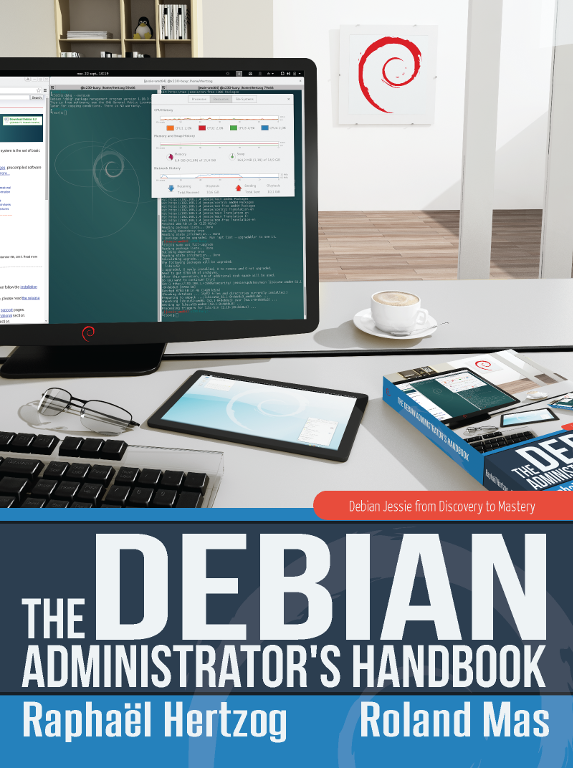
My monthly report covers a large part of what I have been doing in the free software world. I write it for my donators (thanks to them!) but also for the wider Debian community because it can give ideas to newcomers and it s one of the best ways to find volunteers to work with me on projects that matter to me. Debian LTS This month I have been paid to work 8 hours on Debian LTS. In that time, I mostly did CVE triaging (in the last 3 days since I m of LTS frontdesk duty this week). I pushed 14 commits to the security tracker. There were multiple CVE without any initial investigation so I checked the status of the CVE not only in squeeze but also in wheezy/jessie. On unpaid time, I wrote and sent the summary of the work session held during DebConf. And I tried to initiate a discussion about offering mysql-5.5 in squeeze-lts. We also have setup lts-security@debian.org so that we can better handle embargoed security updates. The Debian Administrator s Handbook Debian Handbook: cover of the jessie editionI spent a lot of time on my book, the content update has been done but now we re reviewing it before preparing the paperback. I also started updating its French translation. You can help review it too. While working on the book I noticed that snort got removed from jessie and the SE linux reference policy as well. I mailed their maintainers to recommend that they provide them in jessie-backports at least those packages are relatively important/popular and it s a pity that they are missing in jessie. I hope to finish the book update in the next two weeks! Distro Tracker I spent a lot of time to revamp the mail part of Distro Tracker. But as it s not finished yet, I don t have anything to show yet. That said I pushed an important fix concerning the mail subscriptions (see #798555), basically all subscriptions of packages containing a dash were broken. It just shows that the new tracker is not yet widely used for mail subscription I also merged a patch from Andrew Starr-Bochicchio (#797633) to improve the description of the WNPP action items. And I reviewed another patch submitted by Orestis Ioannou to allow browsing of old news (see #756766). And I filed #798011 against bugs.debian.org to request that a new X-Debian-PR-Severity header field be added to outgoing BTS mail so that Distro Tracker can filter mails by severity and offer people to subscribe to RC bugs only. Misc Debian work I filed many bugs this month and almost all of them are related to my Kali work: Thanks See you next month for a new summary of my activities.

3 comments Liked this article? Click here. My blog is Flattr-enabled.

29 September 2015

Erich Schubert: Ubuntu broke Java because of Unity

Unity, that is the Ubuntu user interface, that nobody else uses. Since it is a Ubuntu-only thing, few applications have native support for its OSX-style hipster "global" menus. For Java, someone once wrote a hack called java-swing-ayatana, or "jayatana", that is preloaded into the JVM via the environment variable JAVA_TOOL_OPTIONS. The hacks seems to be unmaintained now. Unfortunately, this hack seems to be broken now (Google has thousands of problem reports), and causes a NullPointerException or similar crashes in many applications; likely due to a change in OpenJDK 8. Now all Java Swing applications appear to be broken for Ubuntu users, if they have the jayatana package installed. Congratulations! And of couse, you see bug reports everywhere. Matlab seems to no longer work for some, NetBeans appears to have issues, and I got a number of bug reports on ELKI because of Ubuntu. Thank you, not.

28 September 2015

Antoine Beaupr : Fun experiments with laptop battery

After reading up on a eye-opening blog from Petter Reinholdtsen about laptop batteries, or more specifically Lithium-Ion laptop batteries, I figured I needed to try out the "TLP Linux Advanced Power Management" that I had been keeping an eye on for a while. tlp is yet another tool to control power usage on laptops (mostly Thinkpad, mine is a X120e). The novelty of tlp is the "hands off" approach: everything should be automatically configured for you... Obviously, that means I then went on working for a few hours on breaking and fixing my laptop in random operations. I opened a bunch of pull requests on the interesting battery status package that Petter produced to make it work with my setup and make it display graphs directly (instead of into a file). I also rewrote the graphing tool in Python with SciPy in order to have cleaner labels and be able to deduce the date at which a battery would be completely unusuable because it can't recharge high enough. (At the time of writing, the battery estimated death time is december 7th, but that data is skewed because of a quick change in the battery charge after the BIOS upgrade, below.) I then went on to try to limit my laptop charging to 80%, since this seems to make the battery last longer (sources from Petter: 1, 2, 3). Unfortunately, even after building a local (and trivial) backport of the tlp package to Debian stable (8.2/Jessie), I still couldn't access those controls, as TLP is really just a set of shell scripts that glue a bunch of stuff together.
The backport was simply:
apt-get source tlp
cd tlp*/
debuild
sudo dpkg -i ../tlp*.deb
I read here and there (and in Petter's post) that I needed the tp-smapi-dkms package, so I went ahead an installed it:
sudo apt install tp-smapi-dkms
(Yes, Jessie has a neat apt command now, it's great, upgrade now.) Unfortunately, this still didn't work. I think the error back then was something like:
thinkpad_ec: thinkpad_ec_request_row: arg0 rejected: (0x01:0x00)->0x00
thinkpad_ec: thinkpad_ec_read_row: failed requesting row: (0x01:0x00)->0xfffffffb
thinkpad_ec: initial ec test failed
I have seen suggestions here and there to try the acpi-call-dkms package, but that was useless as it doesn't support my model (but may work with others!). The error there was:
acpi_call: Cannot get handle: Error: AE_NOT_FOUND
Note: I still have it installed - it's unclear what impact it has, and I do not want to break my current setup.
So I then started to look at upgrading my BIOS, for some reason. I was running version 1.13 (8FET29WW) from 05/06/2011. I was able to update to 1.17 (8FET33WW) from 11/07/2012, using the memdisk binary from the syslinux-common package, with some help from the quite useful grub-imageboot package:
sudo apt install syslinux-common grub-imageboot
wget https://download.lenovo.com/ibmdl/pub/pc/pccbbs/mobiles/8fuj10uc.iso
sudo mkdir /boot/images
sudo mv 8fuj10uc.iso /boot/images
sudo reboot
I found the image on the Thinkpad x120e support page from Lenovo (which happily bounces around, so don't rely on the above URLs too much). When I rebooted, I was offered to boot from the image by grub, which went on fine, considering it was running some version of DOS, which is always a bit scary considering it is software that is somewhat almost as old as me.
I wish I could have installed some free software in the BIOS instead of the outdated crap that Lenovo provides, but unfortunately, it seems this will never be possible with Libreboot or Coreboot, mostly because Intel is evil and installs backdoors in all their computers. Fun times.
Fortunately and surprisingly, the update worked and went on pretty smoothly. After that, I was able to set the charge limit with:
echo 80   sudo tee /sys/devices/platform/smapi/BAT0/stop_charge_thresh
Amazing! I had almost forgotten why I almost bricked my system on a thursday, good thing that worked! Now the fun part was that, after some reboots or something I did, I am not sure what, the above stopped working: I couldn't load the drivers at all anymore, dmesg treating me with a nasty:
thinkpad_ec: thinkpad_ec_read_row: failed requesting row: (0x01:0x00)->0xfffffff0
thinkpad_ec: initial ec test failed
Now that is some obscure error message material! Fun stuff. I tried uninstalling tlp, the smapi modules, the acpi-call modules, rebooting, turning the machine off, removing the battery, nothing worked. Even more hilarious, the charge controler was now stuck at 80%: I had artificially destroyed 20% of the battery capacity in software. Ouch. I think this may have been related to uninstalling the tp-smapi-dkms package without unloading it at first. I found some weird entries in my kern.log like this:
tp_smapi unloaded.
thinkpad_ec: thinkpad_ec_read_row: failed requesting row: (0x14:0x00)->0xfffffff0
hdaps: cannot power off
hdaps: driver unloaded.
thinkpad_ec: unloaded.
I think that after that point, I couldn't load either module, not even thinkpad_ec... After tearing out a few more hairs and hammering my head on the keyboard randomly, I thought I could just try another BIOS upgrade, just for the fun of it. Turns out you actually can't rerun the upgrade, but you can change the model number through the same software, and this seems to reset some stuff. So I went back in the ISO image I had loaded earlier, and went on to change the model number (actually setting it to the same value, but whatever, it still ran the update). It turns out this seems to have reset a bunch of stuff and now everything works. I can use tlp setcharge and all the neat tools go well. The two key commands are:
# limit charging to 80% of the battery, but not lower than 40%
sudo tlp setcharge 40 80
# clear the above setting and just charge the battery to 100%
sudo tlp fullcharge
It seems that the 40% bit isn't supported by my laptop, but whatever: the battery stays charged when on AC power anyways, so I don't really understand what the setting is for in the first place. The error there is:
smapi smapi: smapi_request: SMAPI error: Function is not supported by SMAPI BIOS (func=2116)
smapi smapi: __get_real_thresh: cannot get start_thresh of bat=0: Function is not supported by SMAPI BIOS
The second command is what I will need to remember to run before I unplug the laptop for a trip. I suspect this will be really annoying and I may end up disabling all this stuff and just yank the power cable out when the battery reaches 80%, by hand, when I need to. But it was a fun geeking out, and hopefully this will be useful for others. And of course, the graphs from Petter will be interesting in a few months... Before the BIOS upgrade, the battery capacity was reported as 100% (actually, at 100.03%, which was strange). Now, the capacity is at 98.09%, which is probably just a more accurate reading that was fixed in the BIOS upgrade. Finally, also see the useful thinkwiki troubleshooting page and especially their interesting BIOS upgrade documentation which inspired me to write my own version. I would have gladly contributed to theirs, but I seem to have lost my password on this site, with no recovery possible... The arch linux wiki has obviously excellent documentation as well, as usual.

25 September 2015

Dirk Eddelbuettel: RcppEigen 0.3.2.5.1

A bugfix release of RcppEigen is now on CRAN and in Debian. The NEWS file entry follows.
Changes in RcppEigen version 0.3.2.5.1 (2015-09-23)
  • Corrected use of kitten() thanks to Grant Brown (#21)
  • Applied upstream change to protect against undefined behaviour with null pointers
Courtesy of CRANberries, there is also a diffstat report for the most recent release.

This post by Dirk Eddelbuettel originated on his Thinking inside the box blog. Please report excessive re-aggregation in third-party for-profit settings.

24 September 2015

Petter Reinholdtsen: The life and death of a laptop battery

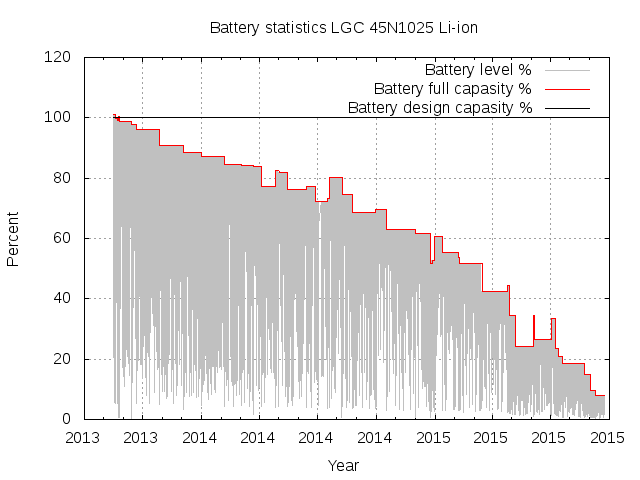
When I get a new laptop, the battery life time at the start is OK. But this do not last. The last few laptops gave me a feeling that within a year, the life time is just a fraction of what it used to be, and it slowly become painful to use the laptop without power connected all the time. Because of this, when I got a new Thinkpad X230 laptop about two years ago, I decided to monitor its battery state to have more hard facts when the battery started to fail. First I tried to find a sensible Debian package to record the battery status, assuming that this must be a problem already handled by someone else. I found battery-stats, which collects statistics from the battery, but it was completely broken. I sent a few suggestions to the maintainer, but decided to write my own collector as a shell script while I waited for feedback from him. Via a blog post about the battery development on a MacBook Air I also discovered batlog, not available in Debian. I started my collector 2013-07-15, and it has been collecting battery stats ever since. Now my /var/log/hjemmenett-battery-status.log file contain around 115,000 measurements, from the time the battery was working great until now, when it is unable to charge above 7% of original capacity. My collector shell script is quite simple and look like this:
#!/bin/sh
# Inspired by
# http://www.ifweassume.com/2013/08/the-de-evolution-of-my-laptop-battery.html
# See also
# http://blog.sleeplessbeastie.eu/2013/01/02/debian-how-to-monitor-battery-capacity/
logfile=/var/log/hjemmenett-battery-status.log
files="manufacturer model_name technology serial_number \
    energy_full energy_full_design energy_now cycle_count status"
if [ ! -e "$logfile" ] ; then
    (
	printf "timestamp,"
	for f in $files; do
	    printf "%s," $f
	done
	echo
    ) > "$logfile"
fi
log_battery()  
    # Print complete message in one echo call, to avoid race condition
    # when several log processes run in parallel.
    msg=$(printf "%s," $(date +%s); \
	for f in $files; do \
	    printf "%s," $(cat $f); \
	done)
    echo "$msg"
 
cd /sys/class/power_supply
for bat in BAT*; do
    (cd $bat && log_battery >> "$logfile")
done
The script is called when the power management system detect a change in the power status (power plug in or out), and when going into and out of hibernation and suspend. In addition, it collect a value every 10 minutes. This make it possible for me know when the battery is discharging, charging and how the maximum charge change over time. The code for the Debian package is now available on github. The collected log file look like this:
timestamp,manufacturer,model_name,technology,serial_number,energy_full,energy_full_design,energy_now,cycle_count,status,
1376591133,LGC,45N1025,Li-ion,974,62800000,62160000,39050000,0,Discharging,
[...]
1443090528,LGC,45N1025,Li-ion,974,4900000,62160000,4900000,0,Full,
1443090601,LGC,45N1025,Li-ion,974,4900000,62160000,4900000,0,Full,
I wrote a small script to create a graph of the charge development over time. This graph depicted above show the slow death of my laptop battery. But why is this happening? Why are my laptop batteries always dying in a year or two, while the batteries of space probes and satellites keep working year after year. If we are to believe Battery University, the cause is me charging the battery whenever I have a chance, and the fix is to not charge the Lithium-ion batteries to 100% all the time, but to stay below 90% of full charge most of the time. I've been told that the Tesla electric cars limit the charge of their batteries to 80%, with the option to charge to 100% when preparing for a longer trip (not that I would want a car like Tesla where rights to privacy is abandoned, but that is another story), which I guess is the option we should have for laptops on Linux too. Is there a good and generic way with Linux to tell the battery to stop charging at 80%, unless requested to charge to 100% once in preparation for a longer trip? I found one recipe on askubuntu for Ubuntu to limit charging on Thinkpad to 80%, but could not get it to work (kernel module refused to load). I wonder why the battery capacity was reported to be more than 100% at the start. I also wonder why the "full capacity" increases some times, and if it is possible to repeat the process to get the battery back to design capacity. And I wonder if the discharge and charge speed change over time, or if this stay the same. I did not yet try to write a tool to calculate the derivative values of the battery level, but suspect some interesting insights might be learned from those. Update 2015-09-24: I got a tip to install the packages acpi-call-dkms and tlp (unfortunately missing in Debian stable) packages instead of the tp-smapi-dkms package I had tried to use initially, and use 'tlp setcharge 40 80' to change when charging start and stop. I've done so now, but expect my existing battery is toast and need to be replaced. The proposal is unfortunately Thinkpad specific.

Joachim Breitner: The Incredible Proof Machine

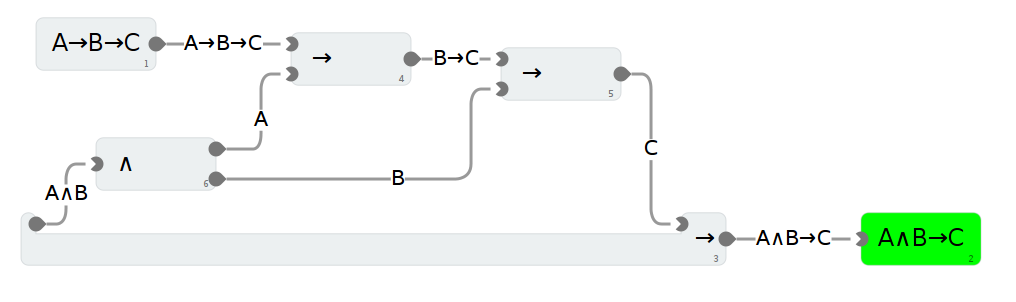
In a few weeks, I will have the opportunity to offer a weekend workshop to selected and motivated high school students1 to a topic of my choice. My idea is to tell them something about logic, proofs, and the joy of searching and finding proofs, and the gratification of irrevocable truths. While proving things on paper is already quite nice, it is much more fun to use an interactive theorem prover, such as Isabelle, Coq or Agda: You get immediate feedback, you can experiment and play around if you are stuck, and you get lots of small successes. Someone2 once called interactive theorem proving the worlds most geekiest videogame . Unfortunately, I don t think one can get high school students without any prior knowledge in logic, or programming, or fancy mathematical symbols, to do something meaningful with a system like Isabelle, so I need something that is (much) easier to use. I always had this idea in the back of my head that proving is not so much about writing text (as in normally written proofs) or programs (as in Agda) or labeled statements (as in Hilbert-style proofs), but rather something involving facts that I have proven so far floating around freely, and way to combine these facts to new facts, without the need to name them, or put them in a particular order or sequence. In a way, I m looking for labVIEW wrestled through the Curry-Horward-isomorphism. Something like this:
A proof of implication currying

A proof of implication currying

So I set out, rounded up a few contributors (Thanks!), implemented this, and now I proudly present: The Incredible Proof Machine3 This interactive theorem prover allows you to do perform proofs purely by dragging blocks (representing proof steps) onto the paper and connecting them properly. There is no need to learn syntax, and hence no frustration about getting that wrong. Furthermore, it comes with a number of example tasks to experiment with, so you can simply see it as a challenging computer came and work through them one by one, learning something about the logical connectives and how they work as you go. For the actual workshop, my plan is to let the students first try to solve the tasks of one session on their own, let them draw their own conclusions and come up with an idea of what they just did, and then deliver an explanation of the logical meaning of what they did. The implementation is heavily influenced by Isabelle: The software does not know anything about, say, conjunction ( ) and implication ( ). To the core, everything is but an untyped lambda expression, and when two blocks are connected, it does unification4 of the proposition present on either side. This general framework is then instantiated by specifying the basic rules (or axioms) in a descriptive manner. It is quite feasible to implement other logics or formal systems on top of this as well. Another influence of Isabelle is the non-linear editing: You neither have to create the proof in a particular order nor have to manually manage a proof focus . Instead, you can edit any bit of the proof at any time, and the system checks all of it continuously. As always, I am keen on feedback. Also, if you want to use this for your own teaching or experimenting needs, let me know. We have a mailing list for the project, the code is on GitHub, where you can also file bug reports and feature requests. Contributions are welcome! All aspects of the logic are implemented in Haskell and compiled to JavaScript using GHCJS, the UI is plain hand-written and messy JavaScript code, using JointJS to handle the graph interaction. Obviously, there is still plenty that can be done to improve the machine. In particular, the ability to create your own proof blocks, such as proof by contradiction, prove them to be valid and then use them in further proofs, is currently being worked on. And while the page will store your current progress, including all proofs you create, in your browser, it needs better ways to save, load and share tasks, blocks and proofs. Also, we d like to add some gamification, i.e. achievements ( First proof by contradiction , 50 theorems proven ), statistics, maybe a share theorem on twitter button. As the UI becomes more complicated, I d like to investigating moving more of it into Haskell world and use Functional Reactive Programming, i.e. Ryan Trickle s reflex, to stay sane. Customers who liked The Incredible Proof Machine might also like these artifacts, that I found while looking whether something like this exists:

  1. Students with migration background supported by the START scholarship
  2. Does anyone know the reference?
  3. We almost named it Proofcraft , which would be a name our current Minecraft-wild youth would appreciate, but it is alreay taken by Gerwin Kleins blog. Also, the irony of a theorem prover being in-credible is worth something.
  4. Luckily, two decades ago, Tobias Nipkow published a nice implementation of higher order pattern unification as ML code, which I transliterated to Haskell for this project.

20 September 2015

Dirk Eddelbuettel: RcppArmadillo 0.5.600.2.0

armadillo image And yet another upstream Armadillo update -- version 5.600.2 was released yesterday by Conrad. So I pushed a new and matching RcppArmadillo release 0.5.600.2.0 to CRAN and to Debian. Armadillo is a powerful and expressive C++ template library for linear algebra aiming towards a good balance between speed and ease of use with a syntax deliberately close to a Matlab. This release contains small upstream improvements:
Changes in RcppArmadillo version 0.5.600.2.0 (2015-09-19)
  • Upgraded to Armadillo 5.600.2 ("Molotov Cocktail Deluxe")
    • expanded .each_col() and .each_row() to handle out-of-place operations
    • added .each_slice() for repeated matrix operations on each slice of a cube
    • faster handling of compound expressions by join_rows() and join_cols()
Courtesy of CRANberries, there is also a diffstat report for the most recent CRAN release. As always, more detailed information is on the RcppArmadillo page. Questions, comments etc should go to the rcpp-devel mailing list off the R-Forge page.

This post by Dirk Eddelbuettel originated on his Thinking inside the box blog. Please report excessive re-aggregation in third-party for-profit settings.

Dirk Eddelbuettel: RQuantLib 0.4.1

Right before heading off to last week's excellent EARL 2015 conference in London, a new minor release of RQuantLib was released onto CRAN and into Debian. The changes are detailed below.
Changes in RQuantLib version 0.4.1 (2015-09-11)
  • Changes in RQuantLib code:
    • A simple shiny application is now included in the directory shiny/DiscountCurve/ and accessible via the new demo function ShinyDiscountCurve.
    • The option surface plotting example in arrays.R now checks for rgl by using requireNamespace.
    • The files NAMESPACE and DESCRIPTION have been updated to reflect all the suggestions of R CMD check.
    • The Travis CI tests now use binary Debian packages for all package dependencies making the tests a little faster.
Courtesy of CRANberries, there is also a diffstat report for the this release. As always, more detailed information is on the RQuantLib page. Questions, comments etc should go to the rquantlib-devel mailing list off the R-Forge page. Issue tickets can be filed at the GitHub repo.

This post by Dirk Eddelbuettel originated on his Thinking inside the box blog. Please report excessive re-aggregation in third-party for-profit settings.

Michal Čihař: Weblate 2.4

Weblate 2.4 has been released today. It comes with extended support for various file formats, extended hook scripts, better keyboard shortcuts and dozen of bug fixes. Full list of changes for 2.4: If you are upgrading from older version, please follow our upgrading instructions. You can find more information about Weblate on http://weblate.org, the code is hosted on Github. If you are curious how it looks, you can try it out on demo server. You can login there with demo account using demo password or register your own user. Weblate is also being used https://hosted.weblate.org/ as official translating service for phpMyAdmin, Gammu, Weblate itself and other projects. If you are free software project which would like to use Weblate, I'm happy to help you with set up or even host Weblate for you. Further development of Weblate would not be possible without people providing donations, thanks to everybody who have helped so far! PS: The roadmap for next release is just being prepared, you can influence this by expressing support for individual issues either by comments or by providing bounty for them.

Filed under: English phpMyAdmin SUSE Weblate 0 comments

19 September 2015

Russ Allbery: Review: Magic's Promise

Review: Magic's Promise, by Mercedes Lackey
Series: Last Herald Mage #2
Publisher: DAW
Copyright: January 1990
ISBN: 0-88677-401-2
Format: Mass market
Pages: 320
Magic's Promise is the second book of the Last Herald Mage trilogy and a sequel to Magic's Pawn. As tempting as it is to skip the first book, which isn't very good, I think you'd miss a lot of the emotional dynamics between Vanyel and his family if you didn't read it. Magic's Promise opens years after the end of Magic's Pawn. Vanyel has become the most powerful Herald-mage of the kingdom, which is lucky for the kingdom because it's beset on all sides by magical attack. Heralds are being killed, countries on the border are looking for opportunities to spring, and Vanyel is being run ragged. Ragged enough that he's worried he's going to hurt someone by mistake when surprised. It's time for a desperately-needed vacation. Unfortunately for his ability to relax, that vacation means going home to visit his parents, who have never understood him and who disapprove strongly of his sexuality. (Not that he's actually had a lover in years.) It also means being in the same household as the armsmaster who broke his wrist as a child, and his father's deeply disapproving priest. And the border near his parents' lands may be heating up as well. Magic's Promise is the book where this trilogy hits its stride. After the events of the previous book, Vanyel is ridiculously overpowered and will be for the rest of the trilogy, but the problems in this book aren't the sort that raw power can fix. (That's a balance Lackey handles well in general.) There are a few places where Vanyel can simply overpower his problems, but the heart of the plot is a mystery that requires analysis, investigation, and a bit of undercover snooping. I enjoyed the defense of the kingdom plot (more than I had remembered, in fact), but the heart of this book is Vanyel and his family coming to terms with each other. Vanyel is a lot older and more confident than he was in the first book, and his service to the kingdom forces some grudging respect. But the way that grudging respect turns into real affection over the course of this book is a delight to read. This degree of reconciliation is wish-fulfillment most of the Valdemar series is heavy on wish-fulfillment but it's the sort of wish-fulfillment that matches the way that you wish the world would work. People figure out that they've been ignorant and cruel and actually change, and Vanyel learns some important lessons about giving people room to change. I particularly liked that the growth of respect wasn't one-sided. Most of the movement comes (and has to come) from Vanyel's family, but Vanyel gains some new-found appreciation and empathy for some strengths that he'd previously been blind to. Lackey's writing is still not the best here. There's something a bit awkward about the dialogue patterns in places, one gets a bit tired of the repetitive narrative focus on Vanyel's exhaustion, and the sentence-level construction of the story is more workable than delightful. You have to be invested in the characters; the beauty of the writing itself isn't going to win you over. As with a lot of Lackey's writing, I think your enjoyment will depend greatly on whether she happens to hit your emotional buttons. But the story she tells here, of people finding the inner goodness in each other and healing over past wounds, is one that I very much enjoy reading. I think this is the third time I read this book, and it's the first of the Valdemar series in this re-read that held up to my memory. So far, it's the best of the series. Followed by Magic's Price. Rating: 8 out of 10

Russ Allbery: Review: Magic's Pawn

Review: Magic's Pawn, by Mercedes Lackey
Series: Last Herald Mage #1
Publisher: DAW
Copyright: June 1989
ISBN: 0-88677-352-0
Format: Mass market
Pages: 349
Continuing my (very slow) re-read of Mercedes Lackey's Valdemar series. I've read all these books before (this series several times, in fact), but long before I started writing reviews. Vanyel is a legendary hero by the time of Talia (the hero of the first Valdemar series, starting with Arrows of the Queen). Talia was reading stories about him at the start of her story: the mage Herald who defended Valdemar against its enemies in the distant past. This is the first book of the trilogy that tells his story, starting (as Lackey's books often do) from rather inauspicious beginnings. Vanyel is the son of a border lord, and about as poorly suited for it as possible. He's small, pretty, entirely uninterested in the hammer-and-tongs sword fighting the arms master wants to teach him, and also gay, not that he has any idea that's even something that exists and has a name. His only ally was his sister, who is now off serving in Valdemar's military. Most of his life is spent hiding, feeling utterly lost and out of place, and wishing he could be a Bard. This is a Valdemar story, so if you're familiar with the series, you know what's coming next. What might come as a surprise is that "next" is quite some time into the story. Vanyel does not get rescued from his situation by a Companion. Instead, his father decides to exile him to the capital under the care of his aunt, who he's only met once and who didn't think highly of him. He expects to be even more miserable, and shuts emotionally down in anticipation. This is one of those books that I remembered as being better than it actually was, and one of the reasons why I enjoyed it less than I expected is that far too much of this book is devoted to describing Vanyel's mental state. This usually involves various elaborate emo analogies (which can be a failing of this series in general), and it's quite hard to maintain sympathy for Vanyel. Lackey gets us to feel for him at the start of the book, when he's really in a bad situation. But once he gets to the capital, he's his own worst enemy, and it's hard to avoid the desire to shake him. I also didn't remember just how much I disliked Tylendel. I'm sure it will come as a surprise to no one that Vanyel eventually meets someone who draws him out of his shell and gives him a reason to want to live. Unfortunately, that person, despite a positive surface impression, is self-obsessed, unstable, and not above manipulating Vanyel into actions that are so obviously catastrophic that it makes one want to yell at the book. I disliked this part of the book so much that even a Companion's choosing was overshadowed. The book does get a bit better after that truly awful middle, but it never hits the emotional stride that other Valdemar books hit. Lackey does introduce the Tayledras, which will be hugely important in later books in this series (and who are some of my favorite characters), but there too I prefer their later appearances. Vanyel's inability to see a good thing when it hits him in the face, punctuated by being occasionally cruel to the people who try to help him, makes it quite hard to enjoy his slow path to becoming a better person. I remember really liking this trilogy, so I think it gets better. But I also remembered liking Vanyel's claiming, and it didn't do much for me on a re-read. I can only recommend this one as a necessary preface to the later books in the trilogy, and expect to need a high tolerance for constant woe-is-me despair. Followed by Magic's Promise. Rating: 5 out of 10

18 September 2015

Russ Allbery: Review: The Three-Body Problem

Review: The Three-Body Problem, by Cixin Liu & Ken Liu
Series: Three-Body Problem #1
Author: Liu Cixin ( )
Translator: Ken Liu
Publisher: Tor
Copyright: 2006, 2014
Printing: November 2014
ISBN: 1-4668-5344-1
Format: Kindle
Pages: 399
Liu Cixin ( ) is one of the best-known and most popular SF authors in China, but, due to the paucity of translated SF in the English-speaking world, was largely unknown to English-speaking SF readers. That made this translation by Ken Liu (no relation) highly anticipated: a window into a large world of SF by authors most of us have never read. And Ken Liu is an excellent writer in his own right (see, for instance, "The Literomancer" or "Altogether Elsewhere, Vast Herds of Reindeer"), which was a hopeful sign for a good translation. Indeed, the translation is very good. One can tell that the book comes from a different literary tradition, but primarily from unusual (to US readers, at least) emotional focal points for the characters and lots of Chinese history that the author feels little need to explain. (Ken Liu adds translator notes for the bits most likely to lose non-Chinese audiences.) I found the characters a bit odd and occasionally hard to identify with, but I didn't mind: it added to the feeling of exploring a slightly different literary tradition with different character conventions. Unfortunately, the end of the book went entirely off the rails, at least for me. The Three-Body Problem opens during the Cultural Revolution, with the murder of Ye Wenjie's father, a physics professor, and the suicide of her advisor and friend. Two years later, she's at a work camp in inner Mongolia, cutting trees, numb, keeping her head down. But a traveling journalist smuggles in a secret copy of Silent Spring and gives it to her. The book both hardens her own belief in the evil of humanity and gets her into deeper trouble when she agrees to recopy a draft of a letter to the central leadership about the environmental devastation caused by the logging. Ye Wenjie is forced to choose permanent exile to an experimental radar facility on a remote mountain in Mongolia. Ye Wenjie is vital to the slowly-developing plot of the book, but this is the last the reader sees of her for some time. Part II jumps to present time and to a different protagonist: Wang Miao, a distinguished nanotechnology researcher who is recruited by the PLA and the police into a secret war room. Distinguished scientists are killing themselves in frighteningly large numbers, including one that Wang Miao had a crush on. She left a suicide note before overdosing on sleeping pills, one that says only, cryptically, that physics doesn't exist. The government is desperate to figure out what's going on. The "radar" facility and the suicide of scientists are linked, of course, but it takes much of the book for Wang Miao and his colleagues to piece together how. Key clues come in the form of an odd puzzle virtual reality MMORPG that becomes a popular sensation. In it, players find themselves on an alien world whose suns rise and set at strange and unpredictable intervals: sometimes far too far away and horribly cold, sometimes far too close and destructively hot, and sometimes not seen for long periods of time. The players can somehow dehydrate themselves and the rest of the population to weather the worst seasons, but life is a constant struggle against apparently unpredictable elements. Despite that, players slowly find ways to build civilizations and attempt to predict the strange cycles of heat and cold. It takes the characters a long time to understand what's happening. Readers will probably be much faster, since they have out-of-band information the characters don't. At first, this game seems entirely unrelated to the suicides of the scientists or, for that matter, to Ye Wenjie, who is easy to almost forget. But they all weave together in a way that's almost compelling. I say almost because the motivations of the characters are quite tangled and interesting, but the science is... awful. Those who have read my other book reviews know that I don't insist on hard science in my SF. Usually I'm willing to roll with it, and I can read past even obvious scientific nonsense. But science is critical to the plot of this book; some very specific actions, with a detailed in-book scientific justifications, are the underpinning of the entire plot. And they make utter nonsense of physics. I've rarely had science in a novel destroy my suspension of disbelief this thoroughly. Physics isn't even alone: biology, chemistry, computing, and astronomy are all in for it as Liu reveals the causes of the book's events. I wanted to be engaged by the conflict of ethics and philosophy that drive the plot, and some of that conflict is quite interesting. But every other page would have another colossal pile of scientific nonsense that would throw me out of the book again, usually in the service of a set piece that missed grand and landed on absurdly silly. Be warned that this book also ends on a bit of a cliff-hanger, and there are two more books in the series. The second has been released in a translated edition, but with a different translator, which is disappointing (Ken Liu did an excellent job); the third isn't out yet. If you can get past the awful science, The Three-Body Problem is doing some interesting things. The characters are a bit wooden and forgettable, but the philosophical problems they encounter are ones I don't see often in western SF. This a refreshing change, and I'm interested enough that I'm still considering picking up the sequels. But the science hurts the book so badly. Followed by The Dark Forest. Rating: 6 out of 10

17 September 2015

Julien Danjou: My interview in le Journal du Hacker

A few days ago, the French equivalent of Hacker News, called "Le Journal du Hacker", interviewed me about my work on OpenStack, my job at Red Hat and my self-published book The Hacker's Guide to Python. I've spent some time translating it into English so you can read it if you don't understand French! I hope you'll enjoy it.
Hi Julien, and thanks for participating in this interview for the Journal du Hacker. For our readers who don't know you, can you introduce you briefly?
You're welcome! My name is Julien, I'm 31 years old, and I live in Paris. I now have been developing free software for around fifteen years. I had the pleasure to work (among other things) on Debian, Emacs and awesome these last years, and more recently on OpenStack. Since a few months now, I work at Red Hat, as a Principal Software Engineer on OpenStack. I am in charge of doing upstream development for that cloud-computing platform, mainly around the Ceilometer, Aodh and Gnocchi projects.
Being myself a system architect, I follow your work in OpenStack since a while. It's uncommon to have the point of view of someone as implied as you are. Can you give us a summary of the state of the project, and then detail your activities in this project?
The OpenStack project has grown and changed a lot since I started 4 years ago. It started as a few projects providing the basics, like Nova (compute), Swift (object storage), Cinder (volume), Keystone (identity) or even Neutron (network) who are basis for a cloud-computing platform, and finally became composed of a lot more projects. For a while, the inclusion of projects was the subject of a strict review from the technical committee. But since a few months, the rules have been relaxed, and we see a lot more projects connected to cloud-computing joining us. As far as I'm concerned, I've started with a few others people the Ceilometer project in 2012, devoted to handling metrics of OpenStack platforms. Our goal is to be able to collect all the metrics and record them to analyze them later. We also have a module providing the ability to trigger actions on threshold crossing (alarm). The project grew in a monolithic way, and in a linear way for the number of contributors, during the first two years. I was the PTL (Project Technical Leader) for a year. This leader position asks for a lot of time for bureaucratic things and people management, so I decided to leave my spot in order to be able to spend more time solving the technical challenges that Ceilometer offered. I've started the Gnocchi project in 2014. The first stable version (1.0.0) was released a few months ago. It's a timeseries database offering a REST API and a strong ability to scale. It was a necessary development to solve the problems tied to the large amount of metrics created by a cloud-computing platform, where tens of thousands of virtual machines have to be metered as often as possible. This project works as a standalone deployment or with the rest of OpenStack. More recently, I've started Aodh, the result of moving out the code and features of Ceilometer related to threshold action triggering (alarming). That's the logical suite to what we started with Gnocchi. It means Ceilometer is to be split into independent modules that can work together with or without OpenStack. It seems to me that the features provided by Ceilometer, Aodh and Gnocchi can also be interesting for operators running more classical infrastructures. That's why I've pushed the projects into that direction, and also to have a more service-oriented architecture (SOA)
I'd like to stop for a moment on Ceilometer. I think that this solution was very expected, especially by the cloud-computing providers using OpenStack for billing resources sold to their customers. I remember reading a blog post where you were talking about the high-speed construction of this brick, and features that were not supposed to be there. Nowadays, with Gnocchi and Aodh, what is the quality of the brick Ceilometer and the programs it relies on?
Indeed, one of the first use-case for Ceilometer was tied to the ability to get metrics to feed a billing tool. That's now a reached goal since we have billing tools for OpenStack using Ceilometer, such as CloudKitty. However, other use-cases appeared rapidly, such as the ability to trigger alarms. This feature was necessary, for example, to implement the auto-scaling feature that Heat needed. At the time, for technical and political reasons, it was not possible to implement this feature in a new project, and the functionality ended up in Ceilometer, since it was using the metrics collected and stored by Ceilometer itself. Though, like I said, this feature is now in its own project, Aodh. The alarm feature is used since a few cycles in production, and the Aodh project brings new features on the table. It allows to trigger threshold actions and is one of the few solutions able to work at high scale with several thousands of alarms. It's impossible to make Nagios run with millions of instances to fetch metrics and triggers alarms. Ceilometer and Aodh can do that easily on a few tens of nodes automatically. On the other side, Ceilometer has been for a long time painted as slow and complicated to use, because its metrics storage system was by default using MongoDB. Clearly, the data structure model picked was not optimal for what the users were doing with the data. That's why I started Gnocchi last year, which is perfectly designed for this use case. It allows linear access time to metrics (O(1) complexity) and fast access time to the resources data via an index. Today, with 3 projects having their own perimeter of features defined and which can work together Ceilometer, Aodh and Gnocchi finally erased the biggest problems and defects of the initial project.
To end with OpenStack, one last question. You're a Python developer for a long time and a fervent user of software testing and test-driven development. Several of your blogs posts point how important their usage are. Can you tell us more about the usage of tests in OpenStack, and the test prerequisites to contribute to OpenStack?
I don't know any project that is as tested on every layer as OpenStack is. At the start of the project, there was a vague test coverage, made of a few unit tests. For each release, a bunch of new features were provided, and you had to keep your fingers crossed to have them working. That's already almost unacceptable. But the big issue was that there was also a lot of regressions, et things that were working were not anymore. It was often corner cases that developers forgot about that stopped working. Then the project decided to change its policy and started to refuse all patches new features or bug fix that would not implement a minimal set of unit tests, proving the patch would work. Quickly, regressions were history, and the number of bugs largely reduced months after months. Then came the functional tests, with the Tempest project, which runs a test battery on a complete OpenStack deployment. OpenStack now possesses a complete test infrastructure, with operators hired full-time to maintain them. The developers have to write the test, and the operators maintain an architecture based on Gerrit, Zuul, and Jenkins, which runs the test battery of each project for each patch sent. Indeed, for each version of a patch sent, a full OpenStack is deployed into a virtual machine, and a battery of thousands of unit and functional tests is run to check that no regressions are possible. To contribute to OpenStack, you need to know how to write a unit test the policy on functional tests is laxer. The tools used are standard Python tools, unittest for the framework and tox to run a virtual environment (venv) and run them. It's also possible to use DevStack to deploy an OpenStack platform on a virtual machine and run functional tests. However, since the project infrastructure also do that when a patch is submitted, it's not mandatory to do that yourself locally.
The tools and tests you write for OpenStack are written in Python, a language which is very popular today. You seem to like it more than you have to, since you wrote a book about it, The Hacker's Guide to Python, that I really enjoyed. Can you explain what brought you to Python, the main strong points you attribute to this language (quickly) and how you went from developer to author?
I stumbled upon Python by chance, around 2005. I don't remember how I hear about it, but I bought a first book to discover it and started toying with that language. At that time, I didn't find any project to contribute to or to start. My first project with Python was rebuildd for Debian in 2007, a bit later. I like Python for its simplicity, its object orientation rather clean, its easiness to be deployed and its rich open source ecosystem. Once you get the basics, it's very easy to evolve and to use it for anything, because the ecosystem makes it easy to find libraries to solve any kind of problem. I became an author by chance, writing blog posts from time to time about Python. I finally realized that after a few years studying Python internals (CPython), I learned a lot of things. While writing a post about the differences between method types in Python which is still one of the most read post on my blog I realized that a lot of things that seemed obvious to me where not for other developers. I wrote that initial post after thousands of hours spent doing code reviews on OpenStack. I, therefore, decided to note all the developers pain points and to write a book about that. A compilation of what years of experience taught me and taught to the other developers I decided to interview in the book.
I've been very interested by the publication of your book, for the subject itself, but also the process you chose. You self-published the book, which seems very relevant nowadays. Is that a choice from the start? Did you look for an editor? Can you tell use more about that?
I've been lucky to find out about others self-published authors, such as Nathan Barry who even wrote a book on that subject, called Authority. That's what convinced me it was possible and gave me hints for that project. I've started to write in August 2013, and I ran the firs interviews with other developers at that time. I started to write the table of contents and then filled the pages with what I knew and what I wanted to share. I manage to finish the book around January 2014. The proof-reading took more time than I expected, so the book was only released in March 2014. I wrote a complete report on that on my blog, where I explain the full process in detail, from writing to launching. I did not look for editors though I've been proposed some. The idea of self-publishing really convince me, so I decided to go on my own, and I have no regret. It's true that you have to wear two hats at the same time and handle a lot more things, but with a minimal audience and some help from the Internet, anything's possible! I've been reached by two editors since then, a Chinese and Korean one. I gave them rights to translate and publish the books in their countries, so you can buy the Chinese and Korean version of the first edition of the book out there. Seeing how successful it was, I decided to launch a second edition in Mai 2015, and it's likely that a third edition will be released in 2016.
Nowadays, you work for Red Hat, a company that represents the success of using Free Software as a commercial business model. This company fascinates a lot in our community. What can you say about your employer from your point of view?
It only has been a year since I joined Red Hat (when they bought eNovance), so my experience is quite recent. Though, Red Hat is really a special company on every level. It's hard to see from the outside how open it is, and how it works. It's really close to and it really looks like an open source project. For more details, you should read The Open Organization, a book wrote by Jim Whitehurst (CEO of Red Hat), which he just published. It describes perfectly how Red Hat works. To summarize, meritocracy and the lack of organization in silos is what makes Red Hat a strong organization and puts them as one of the most innovative company. In the end, I'm lucky enough to be autonomous for the project I work on with my team around OpenStack, and I can spend 100% working upstream and enhance the Python ecosystem.

Raphaël Hertzog: Freexian s report about Debian Long Term Support, August 2015

A Debian LTS logoLike each month, here comes a report about the work of paid contributors to Debian LTS. Individual reports In August, 71.50 work hours have been dispatched among 7 paid contributors. Their reports are available: Evolution of the situation September is stable compared to August (71.50 hours per month) and has not caught up back to the level of July as I hoped. Again it s because 2 sponsors were not able to pay their renewal invoice on time (one of last month paid, but another bigger sponsor failed this month). Those sponsors will continue to support us and I would like to be able to say that things will be back to normal next month, but I can t say it since we have also been informed of the (hopefully temporary) defection of another bronze sponsor that will affect us next month. Fortunately there are also good news, we have 3 new sponsors in the pipe (2 silver, 1 platinum) who shall join the project soon. And Blablacar increased their support from Silver to Gold (from 4h/month to 8h/month). But we still need more support in particular since we would like to commit to support virtualization related packages in Wheezy: that s clearly an objective for us. I recently published the summary of the work session held during DebConf 15 in Heidelberg (video recording). It would be really nice if we could get closer to the goal of funding a full-time position. In terms of security updates waiting to be handled, the situation is close to last month: the dla-needed.txt file lists 18 packages awaiting an update (2 less than last month), the list of open vulnerabilities in Squeeze shows about 30 affected packages in total (8 more than last month). Thanks to our sponsors

No comment Liked this article? Click here. My blog is Flattr-enabled.

NOKUBI Takatsugu: PIXELS (film)

I watched PIXELS in a theater. It subjects about video games, mostly retro 80 s arcade games. I love video games from childhood, my first game played would be Taito s Space Invaders, I was the 4 or 5 yeas old time. It had bring me to the computer world. Fortunately I am working at Akihabara area, so I can play the video games in the movie like Pac-man, Glaga, Cemtipede, Donkey Kong and so on in two gamecenters, Natsuge Museum and Hey (Hirose Entertainment Yard . Natsuge Museum is under private management so it closes week days. They focused to old games between 70 th to 90 th. Hey is a franchised shop ownd by TAITO. They covered almost video games except medal games. You can play old games like Paper-boy, The Tower of Druaga, and newest games like Left4Dead arcade. They correct many titles of the games in the movie, and be playable. They are my recommended place in Akihaba, if you like video games.

Russ Allbery: Review: How to Make Your Dreams Come True

Review: How to Make Your Dreams Come True, by Mark Forster
Publisher: Hodder
Copyright: 2002
Printing: 2006
ISBN: 0-340-78629-9
Format: Kindle
Pages: 208
Mark Forster is my favorite time management author. His books are less comprehensive systems and more collections of tips, mental shortcuts, and ways of thinking about time management and prioritization that tend to resonate for me. I've already read and reviewed several other books by Forster, but hadn't read this one because it was thoroughly out of print (at least in the US). When it turned up for the Kindle, I decided to give it a try, if for no other reason than completionism. After reading How to Make Your Dreams Come True, I can see why it fell out of print. It's a rather odd book, and quite different from Forster's other work. The topic is still time management, if you squint at it properly, but in the form of a philosophical discussion of life goals and becoming an artist who creates one's own life. Forster structures the book as a series of dialogues between Forster in the present and his own future self and takes the mental exercise surprisingly seriously, even comparing his own coaching technique with that of his future self. The levels of meta get even deeper towards the end of the book, where Forster writes a dialogue between his future self and his even more future self. Those drift into philosophy of life, high-level (and personal) life goals, and some speculations about the reason for existence. The primary concept Forster is exploring is the difference between push, pull, and drift modes of life. He argues that a lot of time management falls into the category of push systems: you're exerting effort to push yourself along towards goals. In this book, he argues that this is a starting point but not a technique to stop on. Instead, one should try to move to pull mode, where one has a compelling and detailed vision of where one wants to be, repeatedly developing and refining it, and then lets that vision pull you through life. The advantages, in his conception, over the push form of time management is that this requires less expenditure of effort, feels more natural, and lets one be more flexible and nimble in how one achieves one's goals. It can be tricky, however, to avoid settling into the middle ground of drift mode, where one does not have a goal in mind and doesn't act towards anything in particular. I found the idea interesting and mildly useful, but Forster's presentation of it seemed too convinced of its own correctness. The exercises he proposes don't seem interesting to me; the dialogues with one's future self in particular felt very gimmicky. I admire his ability to invent some of the interactions he came up with, but I don't think it would be a useful technique for me, or as universal as he seems to think it could be. Forster talks quite a lot about reducing effort in his blog (somewhat less in his other books), and seems constantly convinced that he's found a new way to reduce the sense of effort around time management. After having tried a few of these, I suspect that new systems feel less effortful than older systems, and that it's the constant changing of systems that reduces the feeling of effort more than the details of any specific system. I can develop a lot of enthusiasm about a new system for tracking work, and enthusiasm makes everything feel like it requires less effort. Other than that central idea, and quite a lot of philosophy that didn't particularly speak to me, this book reiterates a few of Forster's ideas in a less specific framework: adopt a process and trust it, use it for long enough to give it a chance to work, keep refreshing your vision, and try to reach a flow where you're not exerting lots of effort to force yourself to do things. Good ideas, but better, and more practically, presented in Forster's other books. I'd characterize this as an odd and minor work. I like Forster's writing in general and still only read this for the sake of completeness. His other books offer more practical and actionable ideas. Unless this idea and method of presentation really speaks to you, I think you'll get more out of other books. Rating: 5 out of 10

13 September 2015

Russ Allbery: Review: My Real Children

Review: My Real Children, by Jo Walton
Publisher: Tor
Copyright: May 2014
ISBN: 0-7653-3265-5
Format: Hardcover
Pages: 317
Patricia, the one form of her name that she's never used, is what the staff in the nursing home call her. "VC" is the frequent annotation on her daily chart: very confused. She's old, and forgetful, and trying very hard not to be her mother, and she remembers two lives. Not only remembers but lives: the nursing home isn't the same from day to day. They keep misplacing the lift, and the staff keep changing. But the memories are the strongest. She has two lives, two sets of children, all of whom she recognizes. When someone from one life visits, the other feels like a dream, but both of them persist. Two lives that divided at the most significant decision of her life. My Real Children is one of those books that fits in the broader speculative fiction genre as alternate history, but also has many of the virtues of mimetic fiction. It's the story of one woman's life, told, except for the opening frame, chronologically from start to finish. At the start, it's simple biography, telling Patty's story from childhood, through World War II, until the moment of her fateful decision in 1949. From there the narrative splits, and she lives two lives. And the world splits as well: in one, Kennedy was assassinated by a bomb; in another, the Cuban Missile Crisis escalated into something much worse. Much is still unchanged, including the general lives of people Patty knew well in one life and not in another, but the worlds keep diverging from each other and from ours. The exact nature of the divergence is not, however, a significant part of the book. This is not the type of alternate history that is obsessed with the point of change, or even the implications for the world. Rather, this novel is about one woman, one decision, and two very different paths through life. Different friends, different challenges, different careers... different hopes and dreams, and different children. But always the same person, the same sense of practicality, the same ethics. It's beautifully told, striking just the right balance of showing important moments in detail and passing quickly, but smoothly, over some years. And, as with Among Others, Walton strikes the perfect emotional balance, leaving some reactions understated, letting the reader bring their own reactions to the book, and filling it with small bits of telling, factual detail rather than internal monologues. This is also one of the most heart-wrenching books I've ever read. My Real Children is a whole life, and not an easy one, complete with the heartaches and betrayals, the good and bad decisions, care for elderly relatives, dementia, tragedy, and even abuse. And moments of shining joy or profound satisfaction, but made all the more poignant because they're fleeting. The reader knows, in a sense, how the story ends, which casts a shadow over the rest of the book. But, even without that shadow, life can be hard, or cruel, alongside the wonder and joy. And it ends, and the ending is not neat and clean and uplifting, although one can choose how one meets it. This is the story of a life, all of it, and how choices can divide that life, and how they can cast a long shadow over how one later defines oneself. This book hurts. A lot. Enough that I want to warn you in advance I was in tears through the last third of the book. But it hurts because it's so very real and deep, not via a blow-by-blow description of daily actions, but by striding unafraid into the deep complications of choice and consequence. It's also a profoundly feminist book, in a quiet and descriptive way. It shared the Tiptree award for 2015 and fully deserved it. Both of the protagonist's lives are struggles against expectations, around gender, sexuality, and the role of women in society. Those struggles take very different forms, but they share some deep similarities. Walton shows the impact from the bottom up: the effects on specific lives, specific people, specific situations. It's brilliantly done. One can't help but think of The Female Man given the telling of parallel lives, but this is a case study, whereas Russ's novel was a battle cry. It gets under your skin instead of in your face. (Use of subtlety on this topic is easier now, forty years of occasional progress past when Russ wrote her classic.) This is a much harder book to read than Among Others. It's less forgiving, less reassuring, less willing to provide a happy ending. Lives rarely have clean, happy endings; one has to construct them, by choosing the material to build the ending on. But it's a brilliant, profound book, in that way that stories about people in all their complexity can be. Be cautious about your mood when you read this, particularly if you've had the experience of caring for a dying relative, but it's a book I will remember for a very long time. Rating: 9 out of 10

10 September 2015

Dirk Eddelbuettel: Rcpp 0.12.1: First boat load of fixes!

The first updated in the 0.12.* series of Rcpp is now on the CRAN network for GNU R this morning, and I will push a Debian package. This follows the 0.12.0 release from late July which started to some serious new features. Rcpp has become the most popular way of enhancing GNU R with C++ code. As of today, 461 packages on CRAN depend on Rcpp for making analyses go faster and further. This release once again features contributions from a number of new contributors, with Florian Plaza O ate and Dan Dillon joining the fray with several pull requests each. Kurt Hornik also helped with a fix for a bad interaction between very recent R (3.2.2) changes and Rcpp; another related one was also addressed. A big Thanks! to everybody helping with code, bug reports or documentation, See below for a detailed list of changes extracted from the NEWS file.
Changes in Rcpp version 0.12.1 (2015-09-10)
  • Changes in Rcpp API:
    • Correct use of WIN32 instead of _WIN32 to please Windows 10
    • Add an assignment operator to DimNameProxy (PR #339 by Florian)
    • Add vector and matrix accessors .at() with bounds checking (PR #342 by Florian)
    • Correct character vector conversion from single char (PR #344 by Florian fixing issue #343)
    • Correct on use of R_xlen_t back to size_t (PR #348 by Romain)
    • Correct subsetting code to allow for single assignment (PR #349 by Florian)
    • Enable subset assignment on left and righ-hand side (PR #353 by Qiang, fixing issue #345)
    • Refreshed to included tinyformat template library (PR #357 by Dirk, issue #356)
    • Add operator<<() for vectors and matrices (PR #361 by Dan fixing issue #239)
    • Make String and String_Proxy objects comparable (PR #366 and PR #372 by Dan, fixing issue #191)
    • Add a new class Nullable for objects which may be NULL (PR #368 by Dirk and Dan, fixing issue #363)
    • Correct creation and access of large matrices (PR #370 by Florian, fixing issue #369)
  • Changes in Rcpp Attributes:
    • Correctly reset directory in case of no-rebuilding but Windows code (PR #335 by Dirk)
  • Changes in Rcpp Modules:
    • We no longer define multiple Modules objects named World in the unit tests with was seen to have a bad effect with R 3.2.2 or later (PR #351 by Dirk fixing issue #350).
    • Applied patch by Kurt Hornik which improves how Rcpp loads Modules (PR #353 by Dirk)
  • Changes in Rcpp Documentation:
    • The Rcpp.bib file with bibliographic references was updated.
Thanks to CRANberries, you can also look at a diff to the previous release As always, even fuller details are on the Rcpp Changelog page and the Rcpp page which also leads to the downloads page, the browseable doxygen docs and zip files of doxygen output for the standard formats. A local directory has source and documentation too. Questions, comments etc should go to the rcpp-devel mailing list off the R-Forge page.

This post by Dirk Eddelbuettel originated on his Thinking inside the box blog. Please report excessive re-aggregation in third-party for-profit settings.

Chris Lamb: Joining strings in POSIX shell

A common programming task is to glue (or "join") items together to create a single string. For example:
>>> ', '.join(['foo', 'bar', 'baz'])
"foo, bar, baz"
Notice that we have three items but only two commas this can be important if the tool we passing doesn't support trailing delimiters or we simply want the result to be human-readable. Unfortunately, this can be inconvenient in POSIX shell where we construct strings via explicit concatenation. A na ve solution of:
RESULT=""
for X in foo bar baz
do
    RESULT="$ RESULT , $ X "
done
... incorrectly returns ", foo, bar, baz". We can solve this with a (cumbersome) counter or flag to only attach the delimiter when we need it:
COUNT=0
RESULT=""
for X in foo bar baz
do
    if [ "$ COUNT " = 0 ]
    then
        RESULT="$ X "
    else
        RESULT="$ RESULT , $ X "
    fi
    COUNT=$((COUNT + 1))
done

One alternative is to use the little-known ":+" expansion modifier. Many people are familiar with ":-" for returning default values:
$ echo $ VAR:-fallback 
By contrast, the ":+" modifier inverts this logic, returning the fallback if the specified variable is actually set. This results in the elegant:
RESULT=""
for X in foo bar baz
do
    RESULT="$ RESULT:+$ RESULT ,  $ X "
done

Antoine Beaupr : Switched to bootstrap theme

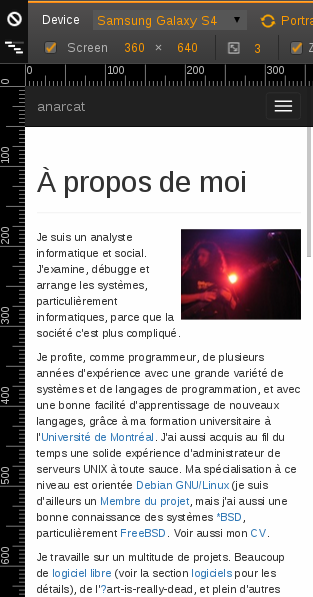
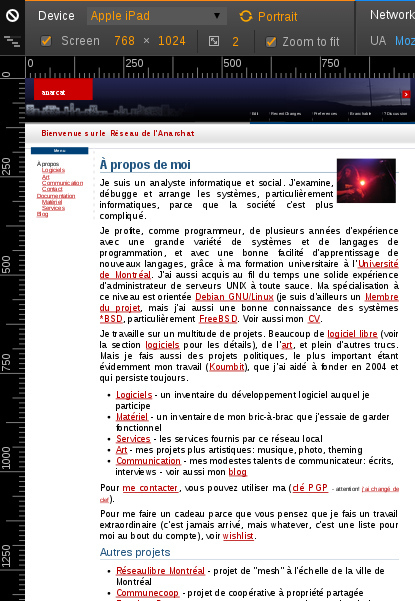
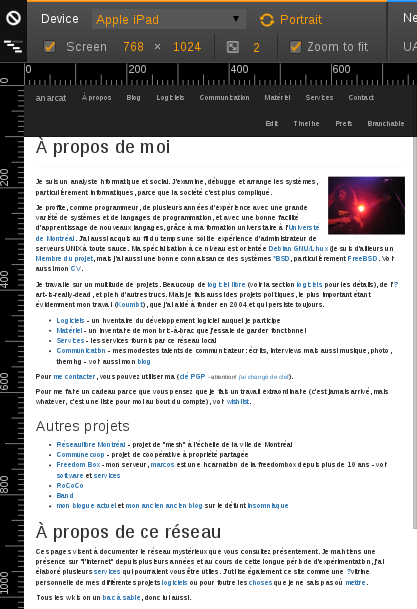
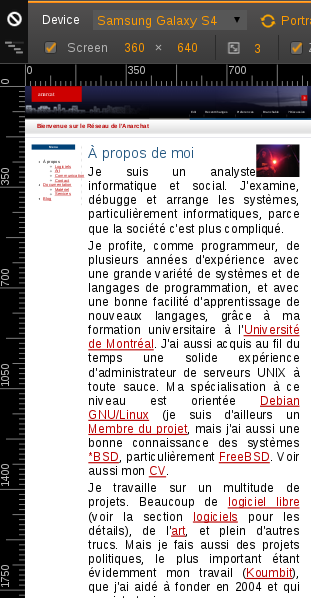
I finally gave up and drank the cool-aid of the Bootstrap theme. The main reason was that I noticed the site was basically unusable on any mobile device, including tablet computers like the iPad, which are unfortunately very, very common. Phones wouldn't render the site in a legible way either, unfortunately. The change is rather drastic, so I figured it was important to mention it here. I am not so satisfied pretty exctied with the result: the theme is very basic, if not absent. I actually like that purified form now, and it works across devices now much better. But I do feel I just made my blog look like everyone else that uses Bootstrap. We seem to enter an era where non-graphic designers (like me) are back to building web pages that all look the same, not very different, in a way, from the old days of plain HTML, like the default ikiwiki theme. I did some work to change the look at least minimally, but the top black navbar is really a killer giveaway this is a bootstrap theme. Bootstrap does a lot for the typography, at least when checking the presslabs checklist or the practical typography checklist, but I still had to change the main body width, which helped a lot I think. Anyways, the old Night City theme is still available for download and I could still flip it back on here if I need to.

What changed The new theme keeps the distractions away, but ironically, it's slower than the previous theme even though there are no images and basically no colors at all. On my tests, it now loads in about 3.42 seconds on the "Regular 2G (250Kbps)" simulation of Chromium with 72KB in 12 requests. Whereas my tests with the previous theme were taking 3.25 seconds with 43.5KB in 17 requests. This is due to the Bootstrap CSS, which takes a whopping 19KB itself, but especially because I now load JQuery, which takes a whopping 32.8KB! And that is probably gzip-compressed, as the original is more around 90KB. But at least the thing is readable on phones and tablets now. Compare:

Samsung S3, before Screenshot of a fake rendering on the Samsung Galaxy S3 in night city

Samsung S3, after Screenshot of a fake rendering on the Samsung Galaxy S3 in bootstrap I like this: much simpler, purer version on smaller devices. And we see what counts: the freaking text. Of course, on tablets, it doesn't fare as well: the top menu gets wrapped around...

Apple iPad, before Screenshot of a fake rendering on the iPad in night city

Apple iPad, after Screenshot of a fake rendering on the iPad in bootstrap Apparently, the fix would be for me to "customize the @grid-float-breakpoint variable" in LESS (which I thought was a pager, but seems to be a CSS preprocessor, graaah). Still, I think it's better that way, more readable, and less crufty.

How it was done After doing a thorough evaluation of all the Bootstrap ikiwiki themes I could find (there are more than 4 at least!), I figured I prefered the Jak Linux one. It seemed to be better implemented than the others, cleaner, and I liked the mean black border on top. Black is cool. Oh, and I liked the subtle footer as well. Subtle is cool. Unfortunately, that theme originally required a custom plugin to have a menu on top, which i thought was silly. So I patched it to make it work with the sidebar plugin, which turned out to be trivially simple: just dump the sidebar content, and make the sidebar page have explicit HTML tags in it that match Bootstrap's required classes. I also added the regular action links in the top navbar, but that does overload it quite a bit. I also did some code cleanups and various other small changes, all of which are available in my personnal git repo.

What doesn't work So of course, there are always problems. The first problem is the extra bandwidth usage. Not sure that can be fixed, other than switching to the upcoming Bootstrap 4, which is smaller than Bootstrap 3, bizarrely. The more annoying problems are weird alignment issues. If the screen gets two narrow without kicking some collapse rules in place (the iPad bug above), the navbar rows overflow and look ugly. Even more bizarre, in some cases the right navbar can just completely disappear, in fact, that's the only fix I could find: to assign the hidden-xs and hidden-sm classes to the navbar-right <UL> element. But then it just goes away, which is pretty darn stupid. Still - I assigned the classes to a few actions that seemed low priority, both in the theme and in the sidebar page. Similarly, the search form at the bottom of the page doesn't seem to want to fit in the footer properly. No idea why and I can't bother to figure that one out. I ended up merging this with the backlinks, tags and trails navigation items. Oh, and amazingly enough: comments are simply not rendered at all right now. Oops. I seemed to have picked the single bootstrap Ikiwiki theme that does *not* have comments rendering... Aaaargh. For now I just copy-pasted stuff from the [ramseydsilva][] theme and it looks pretty ugly, but at least it works. I ended up theming comments the same way i did for Night City, which looks pretty good, but is not in sync with the LESS stuff in Bootstrap. I also add to add back trails, backlinks and favicon... looks like the Jak theme wasn't made for a blog after all... but that's now fixed! :) Another improvement would be to change the font from the canonical Helvetica to something prettier, like suggested in Practical Typography, in the font recommendations section, or the presslabs checklist. So far I have settled on Mozilla's Fira font (which means, yes, one set of objects is actually loading from the CDN, sorry). Feedback welcome.

Next.

Previous.