Search Results: "edd"

19 June 2010

Torsten Werner: Results from the Debian Community Poll

I have announced the Debian Community Poll in my former blog post. I have closed the poll today and I will start publishing its results now.
What is the codename of the current stable release?This is the only compulsory question with the intention to block spammers. The correct codename is Lenny but I have accepted almost any answer that is somehow related to Debian. Version numbers, names from Sarge to Experimental, even well known codenames and version numbers from Ubuntu have been counted as correct. 22 partipants answered wrongly and their submissions got removed from the result set. A whopping number of 3258 submissions have been accepted and get analyzed now. Thanks to all participants!
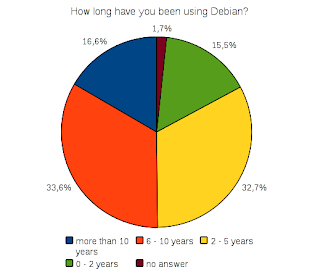
How long have you been using Debian?
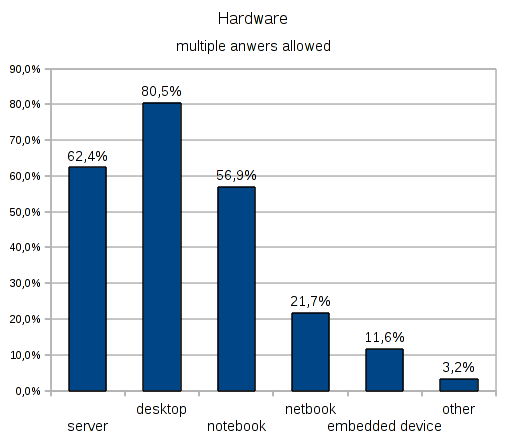
On what kind of hardware are you using Debian?
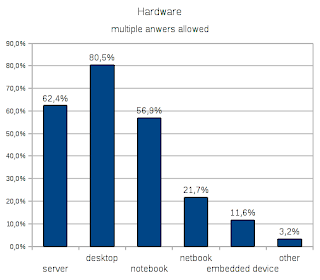
Multiple answers are allowed for this question and that is why the values do not sum up to 100%.
  • 80.5% are using Debian on the desktop
  • 62.4% on the server
  • 56.9% on the notebook
  • 21.7% on the netbook
  • 11.6% on embedded device(s)
  • 3.2% on other device(s)
The following other devices have been mentioned: smartphone, virtual machine, nettop, NAS, HTPC, workstation, pendrive, live cd, cluster, thin client, router, rocket flight computer, ibm mainframe, and automatic bar tender.

Do you contribute to Debian?
  • 50.0% choose answer #5: I don't contribute on a regular base.
  • 31.2% choose answer #4: I'm regularly helping other Debian users.
  • 8.0% choose other (see below) or simply did not answer
  • 4.9% choose answer #3: I'm regularly contributing to Debian packages without uploading them by myself.
  • 4.5% choose answer #1: I'm a Debian developer.
  • 1.4% choose answer #2: I'm a Debian maintainer.
The following other answers have been provided:
  • upstream developer or contributor
  • translator
  • bug reporter
  • advocator
  • former DD or DM
  • prospective DD or DM
  • mirror maintainer
  • package/installer tester
  • documentation writer
  • donator or debconf sponsor
  • debconf organizer or helper

How do you think about the Debian Free Software Guidelines (DFSG)?
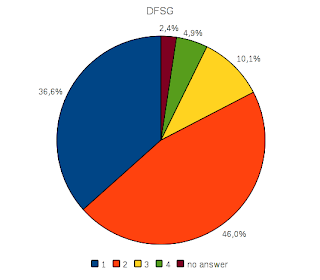
  • 46.0% choose answer #2: I like the DFSG but it is not the most important reason for using Debian.
  • 36.6% choose answer #1: The DFSG is very important to me. I could live with many changes in Debian but I would be very upset if Debian would allow non-free software into its main component in the future.
  • 10.1% choose answer #3: I don't know.
  • 4.9% choose answer #4: I don't care.
  • 2.4% did not answer.

Are you using Debian derived distributions, too?
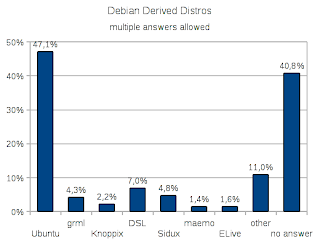
Multiple answers are allowed for this question and that is why the values do not sum up to 100%. There were a lot of different answers but the most frequent are:
  • 47.1%: Ubuntu (Kubuntu, Lubuntu, Xubuntu)
  • 40.8%: no answer; this was the only way to say that someone does not use a derived distribution
  • 11.0%: other (see below)
  • 7.0%: damn small linux
  • 4.8%: Sidux
  • 4.3%: grml (juxlala)
  • 2.2%: Knoppix
  • 1.6%: ELive
  • 1.4%: Maemo
The other answer includes the following distributions: 64studio, ALT Linux, arch linux, ArtistX, BackTrack, BRLix, Canaima GNU/Linux, catix, cdlinux.pl, CloneZilla, CrunchBang, Custom, ddwrt, debian arm userspace for zipit z2, DebXO (?), DreamLinux, Easy Peasy, eb4, eeebuntu, EMC2 Ubuntu (linuxcnc.org), Emdebian, Estrella Roja, Fedora, Finnix, Gentoo, gNewSense, Hackable:1, Kanotix, Kuliax, LFS and CLFS, LinEx, Linux Mint, live CDs, live-helper, Mepis antix, Musix, My own LiveCD, Mythbuntu, OpenInkpot, openwrt, paipix gnu, Parsix, Peppermint, personal debian derived, proxmox, Puppy, PureOS, qtopia, SHR, simplyMEPIS, Skolelinux, slackware, SymphonyOS, Toutou, Trisquel, tty GNU/Linux, UHU Linux, Univention Corporate Server, vinux, Voyage, Vyatta, whiite, Xandros, Xarnoppix. Not all of them are derived from Debian.

- to be continued -

Gunnar Wolf: Once upon a time

With due apologies and thanks to my dear and crazy friend UCH:
Once upon a time
Once, because twice would be a repetitive story
A king
One, because two would mean war
Who was married to a queen
One, because two would be drama
They had a princess daughter
One, because two would be a mess
Who was in love with a knight
One, because two would be a soap opera
He was given the task of killing a dragon
One, because two would be a titanic feat
The hero had an idea
One, because two would be asking too much
Using a unique magic sword
One, because were they two, it would no longer be unique
With which, he took the dragon's life
One, because it was a dragon, not a cat
Then they proceeded with the wedding
One, because two would mean bigamy
And they lived happily forever
One, because two forevers would be like two infinites
The end
One, because two ends would be complicated
The bad translation is completely my fault.

18 June 2010

Marco Túlio Gontijo e Silva: Immix on GHC Summer of Code weekly report #6

My project. This post assumes that the reader has read my last post. I started the change in the line representation. Instead of a single linked list of free lines, it s better to work with line groups, to avoid fragmentation inside lines in allocation. I ve create a struct to represent this line group, with a pointer to the next group, and the size, in lines, of the group. It is stored in includes/rts/storage/GC.h currently, but I m not sure if this is the best place to put it, and I m thinking about changing it latter.
#include "rts/OSThreads.h"
typedef struct line_  
    struct line_ *next;
    StgWord size;
  line;
/* -----------------------------------------------------------------------------
Then we need to change the code of liberation of lines in rts/sm/Sweep.c.
            else if(!(bd->flags & BF_MEDIUM))  
                StgBool sequence;
                sequence = 0;
                for(i = 1; i < BLOCK_SIZE_W / BITS_IN(W_); i++)  
                    StgPtr start;
                    start = bd->start + BITS_IN(W_) * i;
                    if(bd->u.bitmap[i] == 0 && bd->u.bitmap[i - 1] == 0 &&
                       start + BITS_IN(W_) <= bd->free)  
                        printf("DEBUG: line_found(%p)\n", start); fflush(stdout);
                        if(gen->first_line == NULL)  
                            gen->first_line = (line *) start;
                         
                        if(sequence)  
                            last_line->size++;
                         
                        else  
                            if(last_line != NULL)  
                                last_line->next = (line *) start;
                             
                            last_line = (line *) start;
                            last_line->next = NULL;
                            last_line->size = 1;
                         
                        sequence = 1;
                     
                    else  
                        sequence = 0;
                     
I ve tested this code using the same technique as before, checking the produced list trasversing it after it s done. The list obtained showed the correct lines. Now I m back to the allocation code, which never worked. The changes in rts/sm/Evac.c are straightfoward.
        if (gen->first_line != NULL &&
            size <= BITS_IN(W_) * gen->first_line->size)  
            ws->todo_free = (StgPtr) gen->first_line;
            ws->todo_lim = ws->todo_free + BITS_IN(W_) * gen->first_line->size;
            gen->first_line = gen->first_line->next;
            to = ws->todo_free;
         
This cause the same kind of errors I was getting before. I should go back to debugging. My co-supervisor in my Oriented Project in Computer Science suggested me using valgrind. I ll try it.
Last week I forgot to mention I ve presented my final presentation about my Oriented Project in Computer Science. This week I finished writing my monograph.

16 June 2010

David Paleino: Bash-Completion 1.2 released

After more than 9 months from the previous release, the Bash Completion Team is proud to announce the release of bash-completion 1.2! In this release, we dropped support for bash < 3.2. We're sorry, but we cannot stop development just to support versions that old. By now, everyone should have a version fulfilling our requirement. As usual, lots of completions have been added: we're now at 168 files in our contrib/ directory (1.1 had 145, and 1.0 had 44 -- but most completions in 1.0 were bundled in the main file). Now bash_completion only contains helper functions, and basic filename-based completions. Everything has moved to contrib/! This release also saw the contribution of many external people, despite the fact that our bugtracker on Alioth doesn't seem to work too well (problem with attachments, anyone?). Anyhow, you're invited to register and start filing bugs as you find them :). Apart from the usual team members (Ville Skytt , Freddy Vulto, the newcome Leonard Crestez and me), we've had contributions from (in no particular order): Ted Stern, Jeremie Lasalle Ratelle, Rapha l Droz, Adrian Friedli, Ildar Mulyukov, Neville Gao, Austin English, Igor Murzov, Mario Schwalbe and Mark van Rossum. Thank you people for helping us! For completion developers: we added new helper functions. Most notably, it's now possible to get the current and the previous "word" just by calling:
_get_comp_words_by_ref cur prev
instead of (up to 1.1):
cur=$(_get_cword) prev=$ COMP_WORDS[COMP_CWORD-1]
Also, we have a new helper to deal with completion with colons, __ltrim_colon_completions(). See the comment in bash_completion for its documentation. You'll find more helpers directly in bash_completion. We're still far from having a distributable API documentation, so please forgive us. Enjoy the new bash-completion! -- David

Kartik Mistry: Bunch of good news..

1. Kavin is of 3 today. Can t forgot that awesome day :)
2. I ve joined Nexenta Systems since last month..
3. Nexenta is going to sponsor DebConf10! No. No DebConf for me this time. Wish me best luck for next time, please!

15 June 2010

Marco T&uacute;lio Gontijo e Silva: Summer of Code weekly report #5

My project. This post assumes that the reader has read my last post. This was a week full of segfaults, failed assertions, changes in the user data and other crazy stuff. I started working on the allocation of memory on the freed lines. In the first glance, it seemed to be much harder than the small changes I ve done to free memory in lines, because of the a never-seen-before-by-me datatypes being dealed with in alloc_for_copy(), from rts/sm/Evac.c: gen_workspace. But in a short time the code of alloc_for_copy() has shown itself to be simple, and it was easy to do an initial implementation. I went in the same path I was going on before, trying the simplest solution that works. For instance, the line representation used is not ideal, because groups of lines are not considered, but it was the simplest at that time, and I plan to improve it latter. The gen_workspace data type contains a pointer to an area of a block that is not being used (todo_free) and a pointer to the end of that area (todo_lim). When a space for an object is requested, it s allocated in this area, and todo_free is adjusted. If the area is full, a new block is requested. My intended change was to return the first free line of the generation when the object is smaller or equal to the size of a line, and use the current approach otherwise. This is the simplest way I could think, but has the problem that the only one object is allocated per line. This was a known issue.
    if(size <= BITS_IN(W_) && gen->first_line != NULL)  
        to = gen->first_line;
        gen->first_line = (StgPtr) *gen->first_line;
        return to;
     
    ws = &gct->gens[gen->no];
After that I got the first round of segfaults. One problem I could spot so far was in the code in rts/sm/Sweep.c, related to the liberation of the lines. The block is allocated by need, and there s a pointer to the first free byte, free. This free space is used by alloc_for_copy(). So, we should only think of lines in the region already allocated in the block, that is, where the address is smaller than free.
                    if(bd->u.bitmap[i] == 0 && bd->u.bitmap[i - 1] == 0 &&
                       start + BITS_IN(W_) <= bd->free)
But the segfaults, memory corruptions, etc, kept going on. I tried some restrictions, like allocating in lines only objects with the exact size of a line, or very small objects (size == 2), or allocating just one object for generation, or only one object at all. I also tried checking for the type of the allocated object, to see a correlation with the problems I was having. Nothing helped by now. So I thought I should work on other things, so that maybe my mind gets clearer and I can spot the problem. I followed the suggestion of using todo_free and todo_lim to make it possible to allocate more than one object in a line. I liked this change, since I had the impression that it fits better with the rest of the code than the initial implementation, and it will be easier to addapt it when I improve the representation of the free lines. As I said, I wanted something to work while I think in how I ll solve the segfault problems. The bad side of this choice is that I ll not be able to test it, since it s just a reimplementation of the same idea in the allocation code, and is not expected to work. The good size is that it may work, and solve the problems I was having by accident.
    if (ws->todo_free > ws->todo_lim)  
        if (size <= BITS_IN(W_) && gen->first_line != NULL)  
            ws->todo_free = gen->first_line;
            gen->first_line = (StgPtr) *gen->first_line;
            to = ws->todo_free;
            ws->todo_lim = ws->todo_free + BITS_IN(W_);
          else  
            to = todo_block_full(size, ws);
         
     
I got the same results as with the older implementation, and no ideas about how to solve it (yet). So I thought about another thing to work on, which I m talking about all through this post: improve the free line representation. This has the advantage of being testable, since it s unrelated to the allocation code, and may give me an idea about how I can fix the segfaults. The bad side is that it probably won t fix my problems directly. I m working on it right now.
Following a suggestion, I ve started using gdb to see what was happening in the GC instead of including printfs everywhere, and it s been useful. I ve noticed that sometimes printf is more effective, but sometimes gdb is much better.

Dirk Eddelbuettel: RcppArmadillo 0.2.3

The minor bug-fix release 0.2.3 of RcppArmadillo went to CRAN this morning. It adds a tiny bit of configuration to permit Sun Studio / suncc to successfully build the package. There is no code change, and no configuration change for the other platforms. Thanks for Brian Ripley for additional testing, and of course for running those build instances (and everything else he does) for the R project, and to Conrad Sanderson as upstream author of the Armadillo C++ library for linear algebra. As usual, more information is on the RcppArmadillo page. Questions, comments etc should go to the rcpp-devel mailing list off the R-Forge page.

14 June 2010

Dirk Eddelbuettel: Beancounter minor bug fix release 0.8.10

A few month after the 0.8.9 release, we have another small update to beancounter. This version fixes a minor infelicity in the manual page (thanks to an Ubuntu and then Debian bug report) as well as a small coding bug where 'USD' was hard-coded when the user-defined default home currency should have been used. The new version is now in Debian, at CPAN and on my beancounter page here. Enjoy!

12 June 2010

Matt Zimmerman: How to decide what to read (and what not to read)?

Like you, dear Internet readers, I have no shortage of reading material. I have ready access to more engaging, high quality, informative and relevant information than I can possibly digest. Every day, I have to choose what to read, and what to pass by. This seems like an important thing to do well, and I wonder if I do a good enough job of it. This is just one example of a larger breadth/depth problem, but I m finding the general problem difficult to stomach, so I m focusing on reading for the moment. These are my primary sources of reading material on a day-to-day basis: How do you decide what to read, and what not to read? How does your experience differ between your primary information sources? How have you tried to improve?

Russell Coker: Defense in Depth and Sudo

My blog post about logging in as root and whether sudo provides any benefit [1] got some interest on Redit. In the Reddit comments on my post [2] there are a lot of strange things. One interesting comment was to suggest that logging in as non-root provided defense in depth . The NSA is credited with inventing the term Defense in Depth as applied to the computer industry, they have a PDF that gives an overview of the concept [3]. It seems that Defense in Depth is all about having multiple different layers of security, firewalls, IDS/IPS, passwords, PKI, etc. Entering the same password twice (once to login and once to run sudo which seems to be a fairly typical configuration of sudo) hardly seems to count. Can using sudo provide Defense in Depth benefits? With a typical configuration the use of sudo provides no real protection. The user either enters their own password or the root password to gain full root access, in either case the attacker can exploit their session and get the password. A session exploit can be easily arranged by creating a shell function or alias that makes sudo run something else (such as using netcat to send the password out over the network). One way of making this sort of attack more difficult is to make root own the user home directory, files such as ~/.login that are used by the user shell, the ~/.ssh directory and the ~/.ssh/authorized_keys file. This way a hostile party can t change the configuration, so a successful attack has to involve a long running process that uses ptrace to intercept the shell and divert an attempt to run sudo. If the non-root user is prevented from using ptrace then things start to become a little more difficult for the attacker. In some quick tests I was able to capture about half the data through messing with /proc/X/fd/0 and /proc/X/fd/1 for a target process, but it seems that it would be difficult to get an entire password that way. To disable ptrace you could compile a kernel without ptrace support, use a SE Linux policy that prevents prevent ptrace access for the sessions in question, or make the user s shell SETGID. If the root account and the account used for su or sudo use different authentication methods, where the options include ssh authorized keys, password, and security token (maybe both password and token for the root account) then it does seem that it would provide some Defense in Depth benefits. sudo can be used to only permit executing certain commands. While this is a real security benefit it doesn t allow full sysadmin work, merely delegating some portions of operations to people who don t have full sysadmin rights. As someone needs to have full access to fix any problem that might occur on the machine someone needs to have access to run any command as root. So while sudo is great for providing limited administrative access to certain junior people, it s not going to stop an attack on a member of the sysadmin team. Conclusion In a typical sudo configuration the non-root account is configured in a default Unix manner (with the user having ownership of their home directory). The user who logs in to that account controls it s environment through .login and other scripts, so sudo doesn t gain anything. In a typical configuration ptrace is enabled so even if the critical environment files can t be modified by a hostile party they can get the same result through ptrace. Admittedly using a SETGID shell is not going to be difficult to implement after you have changed the ownership of the home directory. If you have a configuration where ptrace is not available and the non-root user can t modify their own profile files then it starts to become difficult for an attacker. If root authentication requires using a security token such that every login uses a different code and the code expires rapidly then it becomes even more difficult for an attacker. But for all configurations that are close to the default for every OS that I ve ever used none of these conditions hold. Also none of those conditions held for any of the systems I ve been employed to use which were configured to require su or sudo for root access. As it seems that most sudo configurations don t provide any extra security, and that auditing the actions of the sysadmin can be better done in other ways (such as the Bash 4.1 syslog feature) [4] it seems that for the vast majority of systems sudo doesn t provide a benefit. The fact that sudo could provide a benefit if configured in a way that is quite different to all the defaults and the ways that it is typically used is worth noting. I m not going to argue with anyone who wants to configure their systems in such a manner and who believes that they need to do so. But anyone who thinks that sudo is the only way to go because the Ubuntu default configuration does it really needs to investigate the issues. Remember that blind faith in the security choices of other people can be a security problem.

10 June 2010

Lior Kaplan: Israeli projects for improvement of government services go open source

In an business open source conference held today (June 10th) in Tel Aviv, Michael Eitan, Minister of Improvement of Government Services, said that projects under his responsibility will go open source to improve transparency. More info at TheMarker (in Hebrew, English version by Google translate). A pilot with a focus group should begin soon for testing the changes.
Filed under: Israeli Community

Dirk Eddelbuettel: Rcpp 0.8.2

A bug fix release Rcpp version 0.8.2 is now on CRAN and Debian. It contains some fixes for Sun compiler, but no user-visible changes and complements the Rcpp 0.8.1 release made Tuesday. Our thanks to Brian Ripley for help with the portability tests for that platform. It will be good to get an autobuilder for pre-emptive testing for that platform too as we make quite some use of the win-builder servive in Dortmund. The full NEWS entry for this release follows below:
0.8.2   2010-06-09
    o   Bug-fix release for suncc compiler with thanks to Brian Ripley for
        additional testing.
As always, even fuller details are in Rcpp Changelog page and the Rcpp page which also leads to the downloads, the browseable doxygen docs and zip files of doxygen output for the standard formats. A local directory has source and documentation too. Questions, comments etc should go to the rcpp-devel mailing list off the R-Forge page

Dirk Eddelbuettel: RcppArmadillo 0.2.2

Following the Rcpp 0.8.1 release we made yesterday, we released RcppArmadillo release 0.2.2 this morning. RcppArmadillo uses Rcpp (and some 'glue' code) to provide a transparent interface from R to Conrad Sanderson's impressive Armadillo library for linear algebra. This release works well with the most recent inline release 0.3.5. One can now employ inlined R code as we generalized how/which headers are included and how library / linking information is added thanks a plugin mechanism. This is the first RcppArmadillo version to provide such a plugin, We also updated the included Armadillo headers to its most recent release 0.9.10, added some more operators and provide a utility function RcppArmadillo:::CxxFlags() to provide include directory information on the fly. An example of the direct inline approach for the fastLm function:
library(inline)
library(RcppArmadillo)
src <- '
	Rcpp::NumericVector yr(ys);			// creates Rcpp vector from SEXP
	Rcpp::NumericMatrix Xr(Xs);			// creates Rcpp matrix from SEXP
	int n = Xr.nrow(), k = Xr.ncol();

	arma::mat X(Xr.begin(), n, k, false);   	// reuses memory and avoids extra copy
	arma::colvec y(yr.begin(), yr.size(), false);

	arma::colvec coef = arma::solve(X, y);      	// fit model y ~ X
	arma::colvec res = y - X*coef;			// residuals

	double s2 = std::inner_product(res.begin(), res.end(), res.begin(), double())/(n - k);
							// std.errors of coefficients
	arma::colvec std_err = arma::sqrt(s2 * arma::diagvec( arma::inv(arma::trans(X)*X) ));

	return Rcpp::List::create(Rcpp::Named("coefficients") = coef,
				  Rcpp::Named("stderr")       = std_err,
				  Rcpp::Named("df")           = n - k
				  );
'
fun <- cxxfunction(signature(ys="numeric", Xs="numeric"), src, plugin="RcppArmadillo")
This creates a compiled function fun which, by using Armadillo, regresses a vector ys on a matrix Xs (just how the fastLmPure() function in the package does) --- yet is constructed on the fly using cxxfunction from inline. More information is on the RcppArmadillo page. Questions, comments etc should go to the rcpp-devel mailing list off the R-Forge page.

9 June 2010

Ross Burton: Gypsy 0.8 Released

As acting release engineer of the Gypsy project (a GPS mux, if you didn't know) I'm proud to announce the release of Gypsy 0.8. So, what's new? Many thanks to Jussi Kukkonen for patch review, and Bastien Nocera for patch review and new features. The big question of course is what of the future? So far we've got some rough ideas. An overhaul of the device interaction layer is definitely required as actaully getting NMEA is becoming more complex: for integrated 3G/GPS chips you need to talk to oFono/ModemManager to get a socket, for some embedded GPS devices you need a proprietary binary that writes to a pipe, and so on. There are some new features we're considering too: server-side proximity detection and update rate limiting.

Julien Danjou: Desktop notification support for Emacs

This last weeks, I've worked on implementing the Desktop Notification Specification into Emacs. It allows sending desktop notification in a very simple way.

(notifications-notify
    :title "You've got mail!"
    :body "There's 34 mails unread"
    :app-icon "~/.emacs.d/icons/mail.png"
    :urgency 'low)
It supports the protocol signals (NotificationClosed and ActionInvoked) and the two main methods (Notify and CloseNotification). The methods specification are implemented entirely (hints, replaces, actions, icon, etc). The signals are supported via callbacks function provided on the notification creation. It have been merged into Emacs trunk today.
2010-06-09  Julien Danjou  <julien@danjou.info>
        * net/notifications.el: New file.
This also allowed me to discover, raise and fix a bug in the D-Bus binding of Emacs, which will be probably fixed in trunk soon.

8 June 2010

Dirk Eddelbuettel: Rcpp 0.8.1

Early this morning I sent Rcpp version 0.8.1 off to CRAN and Debian. In the meantime, Romain has already provided a very nice blog post about it. There are a few fairly visible new things in this release. As we want to focus the next few minor releases on completing the documentation, we started by adding a total of four (!!) new vignettes: The most interesting new feature is what we call Rcpp modules and is modeled after Boost::Python. This makes it pretty easy to expose C++ functions and classes to R -- without having to write glue code. This is pretty new and may change a tad over the coming releases, but it is also quite exciting. Other changes concern more improvements for use of inline which should now allow packages like our RcppArmadillo to be used with it, and some bug fixes. The full NEWS entry for this release follows below:
0.8.1   2010-06-08
    o   This release adds Rcpp modules. An Rcpp module is a collection of
        internal (C++) functions and classes that are exposed to R. This
        functionality has been inspired by Boost.Python.
        
        Modules are created internally using the RCPP_MODULE macro and
        retrieved in the R side with the Module function. This is a preview 
        release of the module functionality, which will keep improving until
        the Rcpp 0.9.0 release. 
        The new vignette "Rcpp-modules" documents the current feature set of
        Rcpp modules.
        
    o   The new vignette "Rcpp-package" details the steps involved in making a
        package that uses Rcpp.
    o   The new vignette "Rcpp-FAQ" collects a number of frequently asked
        questions and answers about Rcpp.
    o   The new vignette "Rcpp-extending" documents how to extend Rcpp
        with user defined types or types from third party libraries. Based on
        our experience with RcppArmadillo
        
    o   Rcpp.package.skeleton has been improved to generate a package using 
        an Rcpp module, controlled by the "module" argument
    o   Evaluating a call inside an environment did not work properly
        
    o   cppfunction has been withdrawn since the introduction of the more
        flexible cxxfunction in the inline package (0.3.5). Rcpp no longer
        depends on inline since many uses of Rcpp do not require inline at
        all. We still use inline for unit tests but this is now handled
        locally in the unit tests loader runTests.R. 
        Users of the now-withdrawn function cppfunction can redefine it as:
        
           cppfunction <- function(...) cxxfunction( ..., plugin = "Rcpp" )
    o   Support for std::complex was incomplete and has been enhanced.
    o   The methods XPtr<t>::getTag and XPtr<t>::getProtected are deprecated, 
        and will be removed in Rcpp 0.8.2. The methods tag() and prot() should
        be used instead. tag() and prot() support both LHS and RHS use. 
    o   END_RCPP now returns the R Nil values; new macro VOID_END_RCPP
        replicates prior behabiour
        
As always, even fuller details are in Rcpp Changelog page and the Rcpp page which also leads to the downloads, the browseable doxygen docs and zip files of doxygen output for the standard formats. A local directory has source and documentation too. Questions, comments etc should go to the rcpp-devel mailing list off the R-Forge page

Matt Zimmerman: DevOps and Cloud

DevOps I first heard about DevOps from Lindsay Holmwood at linux.conf.au 2010. Since then, I ve been following the movement with interest. It seems to be about cross-functional involvement in software teams, specifically between software development and system administration (or operations). In many organizations, especially SaaS shops, these two groups are placed in opposition to each other: developers are driven to deliver new features to users, while system administrators are held accountable for the operation of the service. In the best case, they maintain a healthy balance by pushing in opposite directions, but more typically, they resent each other for getting in the way, as a result of this dichotomy:
Development Operations
is responsible for creating products offering services
is measured on delivery of new features high reliability
optimizes by increasing velocity controlling change
and so is perceived as reckless and irresponsible obstructing progress
Of course, both functions are essential to a viable service, and so DevOps aims to replace this opposition with cooperation. By removing this friction from the organization, we hope to improve efficiency, lower costs, and generally get more work done.
So, DevOps promotes the formation of cross-functional teams, where individuals still take on specialist development or operations roles, but work together toward the common goal of delivering a great experience to users. By working as teammates, rather than passing work over the wall , they can both contribute to development, deployment and maintenance according to their skills and expertise. The team becomes a devops team, and is responsible for the entire product life cycle. Particular tasks may be handled by specialists, but when there s a problem, it s the team s problem. Some take it a step further, and feel that what s needed is to combine the two disciplines, so that individuals contribute in both ways. Rather than thinking of themselves as developers or sysadmins , these folks consider themselves devops . They work to become proficient in both roles, and to synthesize new ways of working by drawing on both types of skills and experience. A common crossover activity is the development of sophisticated tools for automating deployment, monitoring, capacity management and failure resolution. DevOps meets Cloud Like DevOps, cloud is not a specific technology or method, but a reorganization of the model (as I ve written previously). It s about breaking down the problem in a different way, splitting and merging its parts, and creating a new representation which doesn t correspond piece-for-piece to the old one. DevOps drives cloud because it offers a richer toolkit for the way they work: fast, flexible, efficient. Tools like Amazon EC2 and Google App Engine solve the right sorts of problems. Cloud also drives DevOps because it calls into question the traditional way of organizing software teams. A development/operations division just doesn t fit cloud as well as a DevOps model. Deployment is a classic duty of system administrators. In many organizations, only the IT department can implement changes in the production environment. Reaping the benefits of an IaaS environment requires deploying through an API, and therefore deployment requires development. While it is already common practice for system administrators to develop tools for automating deployment, and tools like Puppet and Chef are gaining momentum, IaaS makes this a necessity, and raises the bar in terms of sophistication. Doing this well requires skills and knowledge from both sides of the fence between development and operations, and can accelerate development as well as promote stability in production.
This is exemplified by infrastructure service providers like Amazon Web Services, where customers pay by the hour for black box access to computing resources. How those resources are provisioned and maintained is entirely Amazon s problem, while its customers must decide how to deploy and manage their applications within Amazon s IaaS framework. In this scenario, some operations work has been explicitly outsourced to Amazon, but IaaS is not a substitute for system administration. Deployment, monitoring, failure recovery, performance management, OS maintenance, system configuration, and more are still needed. A development team which is lacking the experience or capacity for this type of work cannot simply switch to an IaaS model and expect these needs to be taken care of by their service provider.
With platform service providers, the boundaries are different. Developers, if they build their application on the appropriate platform, can effectively outsource (mostly) the management of the entire production environment to their service provider. The operating system is abstracted away, and its maintenance can be someone else s problem. For applications which can be built with the available facilities, this will be a very attractive option for many organizations. The customers of these services may be traditional developers, who have no need for operations expertise. PaaS providers, though, will require deep expertise in both disciplines in order to build and improve their platform and services, and will likely benefit from a DevOps approach. Technical architecture draws on both development and operations expertise, because design goals like performance and robustness are affected by all layers of the stack, from hardware, power and cooling all the way up to application code. DevOps itself promotes greater collaboration on architecture, by involving experts in both disciplines, but cloud is a great catalyst because cloud architecture can be described in code. Rather than talking to each other about their respective parts of the system, they can work together on the whole system at once. Developers, sysadmins and hybrids can all contribute to a unified source tree, containing both application code and a description of the production environment: how many virtual servers to deploy, their specifications, which components run on which servers, how they are configured, and so on. In this way, system and network architecture can evolve in lockstep with application architecture. Cloudy promises such as dynamic scaling and fault tolerance call for a DevOps approach in order to be realized in a real-world scenario. These systems involve dynamically manipulating production infrastructure in response to changing conditions, and the application must adapt to these changes. Whether this takes the form of an active, intelligent response or a passive crash-only approach, development and operational considerations need to be aligned. So what? DevOps and cloud will continue to reinforce each other and gain momentum. Both individuals and organizations will need to adapt in order to take advantage of the opportunities provided by these new models. Because they re complementary, it makes sense to adopt them together, so those with expertise in both will be at an advantage.

Russell Coker: Is the PC Dying?

I just read an interesting article about the dispute between Microsoft and Apple about types of PC [1]. Steve Jobs predicted a switch from desktop PCs to portable devices, while Steve Ballmer of Microsoft claimed that the iPad is just a new PC. Defining a PC I think that the defining characteristic of the IBM Compatible PC was it s open architecture. Right from the start the PC could have it s hardware expanded by adding new circuit boards into slots on the motherboard (similar to other PC systems of that era such as the Apple 2 and the S-100 bus). The deal with IBM included Intel sharing all it s CPU designs with other manufacturers such as NEC and AMD from the 8086 until the mid-90 s. AMD specialised in chips that were close copies of Intel chips at low prices and higher clock rates while NEC added new instructions. Compaq started the PC clone market as well as the laptop market, and system software for the IBM compatible PCs was primarily available from IBM and Microsoft in the early days, along with less popular variants such as CP/M86, Novell Netware and others. In the late 80 s there was OS/2 as an alternate OS and Windows as one of several optional GUI environments to run on top of MS-DOS or PC-DOS. In the mid 90 s PCs were used for running protected mode OSs such as Linux and Windows/NT. Now if we look at a system such as a Netbook then it clearly misses some of the defining characteristics of the desktop PC. I can t upgrade a Netbook in any meaningful way changing a storage device or adding more RAM does not compare to adding an ISA/MCA/EISA/VL-Bus/PCI/PCIe expansion card. With my EeePC 701 I don t even have an option of replacing the storage as it is soldered to the motherboard! A laptop allows me to add a PCMCIA or PC-Card device to expand it, but with a maximum of two cards and a high price this isn t a great option. What is Best for Home Users? For a while now my parents have been using 3G net access for their home Internet use [2]. So it seems that a laptop provides greater benefits for their use now than it previously did when they used Cable and ADSL net access. My parents have been considering getting a new monitor (1920*1080 resolution monitors are getting insanely cheap nowadays) and driving such a monitor effectively might require a more capable PC. I recently bought myself a nice refurbished Thinkpad for $796 [3], it seems likely that I could find a refurbished Thinkpad at auction which is a little older and slower for a lower price, even buying an old T41p would be a reasonable option. This would give my parents not only the option of using the Internet when on holidays, but also in a different part of their house when they are at home. The Apple iPad would probably be quite a reasonable Internet platform for my parents if it wasn t for the fact that it uses DRM. While it s not a great platform for writing, my parents probably don t do enough that it would be a huge problem for them. So I might look for a less restrictive tablet platform for my parents. At the moment the best resolution for a tablet seems to be 1024*768, but I expect that some tablets (maybe with a hybrid tablet/laptop design like the Always Innovating Smartbook [4]) with a higher resolution will be released soon. I hope that the iPad and other closed devices don t get any serious market share, but it seems likely that OSs such as Android which are only slightly more open will have a significant market share. Ultra-Mobile Design vs PCs Design One significant problem with ultra-mobile devices is that they make significant engineering trade-offs to get the small size. For a desktop system there are lots of ways of doing things inefficiently, running the AMD64 or i386 architecture which is wasteful of energy and having lots of unused space inside the box in case you decide to upgrade it. But for a laptop there are few opportunities for being inefficient, and for a tablet or smart phone everything has to be optimised. When the optimisation of a device starts by choosing a CPU that s unlike most other systems (note that there is a significant range of ARM CPUs that are not fully compatible with each other) it makes it very difficult to produce free software to run it. I can salvage a desktop PC from a rubbish bin and run Linux on it (and I ve done that many times), but I wouldn t even bother trying to run Linux on an old mobile phone. It seems that in the near future my parents (and many other people with similar needs) will be best suited by having a limited device such as a tablet that stores all data on the Internet and not having anything that greatly resembles a PC. In many ways it would be easier for me to support my parents by storing their data in the cloud and then automatically backing it up to removable SATA disks than with my current situation of supporting a fully capable PC and backing it up to a USB device whenever I visit them. I m also considering what to do for some relatives who are about to go on a holiday in Europe, they want to be able to send email etc. It might not be possible just yet, but it seems like an ideal way of doing this would be to provide them with something like an iPad that they can use with a local 3G SIM for the country that they stay in and they could then upload all their best photos to some server that I can backup and send email to everyone they know. An iPad isn t good for this now as you don t want to go on holidays in another country while carrying something that is really desirable to thieves. Ultra Mobile Devices are Killing PCs It seems to me that Google Android and the Apple iPad/iPhone OS are taking over significant parts of the PC market. The people who are doing traditional PC things are increasingly using Laptops and Netbooks, and the number of people who get the freedom that a PC user did in the 80 s and 90 s is decreasing rapidly. I predict that by 2012 the majority of Linux systems will be running Google Android on hardware that doesn t easily allow upgrading to more open software. At the moment probably the majority of Linux systems are wireless routers and other embedded devices that people don t generally think about. But when iPad type devices running a locked-down Linux installation start replacing Ubuntu and Fedora desktop systems people will take notice. I don t think that the death of the PC platform as we know it will kill Linux, but it certainly won t do us any good. If there were smarter people at Microsoft then they would be trying to work with the Linux community on developing innovative new ways of using desktop PCs. Of all the attempts that Microsoft has made to leave the PC platform the only success has been the X-Box which is apparently doing well. Tablet devices such as the iPad could work really well in a corporate environment (where MS makes most of it s money). On many occasions I ve been in a meeting and we had to adjourn due to someone needing to go to their desk to look something up. If everyone had an iPad type device at their desk that used a wired network when it was available and encrypted wireless otherwise then for a meeting everyone could take their tablet without it s keyboard and be able to consult all the usual sources of data without any interruption. Could a high-resolution version of the iPad kill MS-Windows in the corporate environment?

7 June 2010

Matthew Garrett: Lie Bot, what is the saddest thing?

The saddest thing is a laptop firmware that provides a valid embedded controller operation region but which then proceeds to read and write embedded controller registers by banging on ioports itself rather than listening to the operating system.

4 June 2010

Marco T&uacute;lio Gontijo e Silva: Summer of Code weekly report #4

My project. I m publishing my report earlier this week, because there was a lot to talk about. This week I started to make changes in the code going in the direction of what I want to do. I haven t started a final implementation, but I m studying about how what I want to do will affect the rest of the Garbage Collection (GC). I noticed the code in rts/sm/Sweep.c was simple and similar to what I m planning to do, so I started changing how it works. Sweep in the Glasgow Haskell Compiler (GHC) is done by a bitmap, which contains a bit for each word in a memory block, and is set to 1 when there s an object starting in the mapped area and 0 otherwise. When there s a block with no objects starting at it, that is, all bits of the bitmap are set to 0, the block is freed.
        if (resid == 0)
         
            freed++;
            gen->n_old_blocks--;
            if (prev == NULL)  
                gen->old_blocks = next;
              else  
                prev->link = next;
             
            freeGroup(bd);
         
The bits are analyzed in a group of BITS_IN(W_), where BITS_IN(W_) is the number of bits in a word.
        for (i = 0; i < BLOCK_SIZE_W / BITS_IN(W_); i++)
         
            if (bd->u.bitmap[i] != 0) resid++;
         
If more than of the groups are completely set to 0, the block is considered fragmented.
            if (resid < (BLOCK_SIZE_W * 3) / (BITS_IN(W_) * 4))  
                fragd++;
                bd->flags  = BF_FRAGMENTED;
             
Immix, the GC algorithm I plan to implement in GHC, divides the blocks of memory in lines. My initial plan was to identify free lines. I decided to consider a the size of a line fixed in BITS_IN(W_) words, because it will map to a word in the bitmap, and the code was already analyzing in groups of BITS_IN(W_) words. This was very easy with the current code.
            if (bd->u.bitmap[i] != 0) resid++;
            else printf("DEBUG: line_found(%p)\n", bd->start + BITS_IN(W_) * i);
This worked, and showed some free lines. I m sure there are other ways of logging in GHC, but printf was the simplest way I could thought of. I measured the occurrence of free lines using the bernouilli program from the NoFib benchmark suite, calling it with 500 +RTS -w, to make it uses sweep. In 782 calls to GarbageCollect(), sweep() was called 171 times, for 41704 blocks to be swept and found 230461 free lines. This gives us about 5.5 free lines per block, from the 8 lines in each block (on 64 bits systems). The problem is that the bitmap is marked only in the start of the objects allocated, so even in a line that all bits are marked with 0 we can t assume that it s completely free, because there may be an object that starts in the previous line that is using the space of the line. Checking only for the previous line doesn t work either, because a big object can span several lines. What we can do here is a variation of conservative marking, as proposed in the Immix paper, checking only the previous line and working only with objects smaller than a line. To make sure I was working only with objects smaller than a line, I had to mark the blocks that contains medium objects and avoid them when seeking free lines. The block flags are defined in includes/rts/storage/Block.h, so I included another flag in this file, BF_MEDIUM.
/* Block contains objects evacuated during this GC */
#define BF_EVACUATED 1
/* Block is a large object */
#define BF_LARGE     2
/* Block is pinned */
#define BF_PINNED    4
/* Block is to be marked, not copied */
#define BF_MARKED    8
/* Block is free, and on the free list  (TODO: is this used?) */
#define BF_FREE      16
/* Block is executable */
#define BF_EXEC	     32
/* Block contains only a small amount of live data */
#define BF_FRAGMENTED 64
/* we know about this block (for finding leaks) */
#define BF_KNOWN     128
/* Block contains objects larger than a line */
#define BF_MEDIUM    256
The GHC GC is generational, there is, objects are allocated in a generation and, after a time, the ones that are still being used are moved the next generation. This idea assumes the death probability of younger objects is higher, so few objects are moved to the next generation. Sweep and Immix work only in the last generation so, to mark blocks with medium objects we have to check the size of the objects that are moved to the next generation. This is done in the copy_tag function of rts/sm/Evac.c. I inserted a code that checks for the object size and marks the block when it s bigger than BITS_IN(W_).
STATIC_INLINE GNUC_ATTR_HOT void
copy_tag(StgClosure **p, const StgInfoTable *info,
         StgClosure *src, nat size, generation *gen, StgWord tag)
 
    StgPtr to, from;
    nat i;
    to = alloc_for_copy(size,gen);
    if(size > 8)  
        Bdescr(to)->flags  = BF_MEDIUM;
     
So I updated the code in rts/sm/Sweep.c to only inspect for free lines in blocks without BF_MEDIUM mark.
            if (bd->u.bitmap[i] != 0) resid++;
            else if(!(bd->flags & BF_MEDIUM))  
                printf("DEBUG: line_found(%p)\n", bd->start + BITS_IN(W_) * i);
             
This also worked. Now, in the 32012 blocks there were 189015 free lines, found in the same number of GCs, making about 5.9 free lines per block. We considered only blocks with small objects, but we didn t ignore the first line of each group of free lines. This can be achieved by checking if the previous line was also free.
            if (bd->u.bitmap[i] != 0) resid++;
            else if(!(bd->flags & BF_MEDIUM) && i > 0 && bd->u.bitmap[i] == 0)  
                printf("DEBUG: line_found(%p)\n", bd->start + BITS_IN(W_) * i);
             
Now, from the 32239 blocks, 165547 free lines were found, giving 5.1 free lines per block. But there are more things to improve. If the whole block is free, we want to free it, instead of marking it s lines as free. So it s better to mark the lines after we know that the blocks are not completely free. So I left the code that checks the bitmap as it was, and included a line check only for blocks that are not completely free. At this point, I also associated the fragmentation test with blocks with medium objects, because in blocks of small objects we plan to allocate in free lines, so fragmentation is not a (big) issue.
            if (resid < (BLOCK_SIZE_W * 3) / (BITS_IN(W_) * 4) &&
                (bd->flags & BF_MEDIUM))  
                fragd++;
                printf("DEBUG: BF_FRAGMENTED\n");
                bd->flags  = BF_FRAGMENTED;
             
            else if(!(bd->flags & BF_MEDIUM))  
                for(i = 1; i < BLOCK_SIZE_W / BITS_IN(W_); i++)
                 
                    if(bd->u.bitmap[i] == 0 && bd->u.bitmap[i - 1] == 0)  
                        printf("DEBUG: line_found(%p)\n", bd->start + BITS_IN(W_) * i);


The total ammount of blocks increased dramatically: the blocks that become fragmented and were not called again in sweep made a huge difference. From the 345143 blocks, 1633268 free lines were found, or about 4.7 free lines per block. 9434 blocks were free, so, from the remaining blocks, we have about 4.9 free lines per block. Something we ll need then is a way to access these lines latter. The simplest way I thought to achieve it is constructing a list of lines, in each the first word of each free line is a pointer to the next free line, and the first word of the last free line is 0. It s useful to keep reporting the lines to stdout, so that we can then follow the list and check if we went to the same lines.
                    if(bd->u.bitmap[i] == 0 && bd->u.bitmap[i - 1] == 0)  
                        StgPtr start = bd->start + BITS_IN(W_) * i;
                        printf("DEBUG: line_found(%p)\n", start);
                        if(line_first == NULL)  
                            line_first = start;
                         
                        if(line_last != NULL)  
                            *line_last = (StgWord) start;
                         
                        line_last = start;
                        *line_last = 0;


    for(line_last = line_first; line_last; line_last = (StgPtr) *line_last)  
        fprintf(stderr, "DEBUG: line_found(%p)\n", line_last);
     
I printed the inclusion of the lines on the list to stdout, and the walking on the list in stderr, so that it d be easy to diff. There was no difference between the lists. There re another improvements that can be made, like using a list of groups of free lines, but I think it ll be better to think about this after studying how the allocation in the free lines will be done. That s where I m going to now.
There are some minor things I learned, and thought they worth blogging. The current GHC uses three strategies for collecting the last generation: copying, mark-compact and mark-sweep. Copying is the default until the memory reaches 30% of the maximum heap size; after that, mark-compact is used. Sweep can be chosen by a Real Time System (RTS) flag, -w. To use mark-compact always, the flag is -c. I ve been submitting small patches to the cvs-ghc mailling list, mostly about outdated comments. Most of them were accepted, except for one which contained a lot of commentary, and that indeed was not completely correct. I corrected it and resend to the list, but the message is waiting for approval because the message header matched a filter rule. I believe this is because I replied the message generated from darcs. There s a very useful ghc option, specially for testing the compiler, because in this case you need to rebuild the source, even when there re no changes in it. It s -fforce-recomp, and it makes only sense when used with --make.

Next.

Previous.