Search Results: "don"

4 November 2020

Martin-Éric Racine: Migrating to Predictable Network Interface Names

A couple of years ago, I moved into a new flat that comes with RJ45 sockets wired for 10 Gigabit (but currently offering 1 Gigabit) Ethernet.This also meant changing the settings on my router box for my new ISP.I took this opportunity to review my router's other settings too. I'll be blogging about these over the next few posts. Migrating to Predictable Network Interface Names Ever since Linus decided to flip the network interface enumeration order in the Linux kernel, I had been relying on udev's persistent network interface rules to maintain some semblance of consistency in the NIC naming scheme of my hosts. It has never been a totally satisfactory method, since it required manually editing the file to list the MAC addresses of all Ethernet cards and WiFi dongles likely to appear on that host to consistently use an easy-to-remember name that I could adopt for ifupdown configuration files. Enter predictable interface names. What started as a Linux kernel module project at Dell was eventually re-implemented in systemd. However, clear documentation on the naming scheme had been difficult to find and udev's persistent network interface rules gave me what I needed, so I postponed the transition for years. Relocating to a new flat and rethinking my home network to match gave me an opportunity to revisit the topic. The naming scheme is surprisingly simple and logical, once proper explanations have been found. The short version: The rest of the name specifies on which PCI bus and which slot the interface is found. On my old Dell laptop, it looks like this: An added bonus of the naming scheme is that it makes replacing hardware a breeze, since the naming scheme is bus and slot specific, not MAC address specific. No need to edit any configuration file. I saw this first-hand when I got around upgrading my router's network cards to Gigabit-capable ones to take advantage of my new home's broadband LAN. All it took was to power off the host, swap the Ethernet cards and power on the host. That's it. systemd took care of everything else. Still, migrating looked like a daunting task. Debian's wiki page gave me some answers, but didn't provide a systematic approach. I came up with the following shell script:
#!/bin/sh
lspci   grep -i -e ethernet -e network
sudo dmesg   grep -i renamed
for n in $(ls -X /sys/class/net/   grep -v lo);
do
  echo $n: && udevadm test-builtin net_id /sys/class/net/$n 2>/dev/null   grep NAME;
  sudo rgrep $n /etc
  sudo find /etc -name '*$n*'
done
This combined ideas found on the Debian wiki with a few of my own. Running the script before and after the migration ensured that I hadn't missed any configuration file. Once I was satisfied with that, I commented out the old udev persistent network interface rules, ran dpkg-reconfigure on all my Linux kernel images to purge the rules from the initrd images, and called it a day. ... well, not quite. It turns out that with bridge-utils, bridge_ports all no longer works. One must manually list all interfaces to be bridged. Debian bug report filed. PS: Luca Capello pointed out that Debian 10/Buster's Release Notes include migration instructions.

Christian Kastner: qemu-sbuild-utils 0.1: sbuild with QEMU

qemu-sbuild-utils, which were recently accepted into unstable, are a collection of scripts that wrap standard features of sbuild, autopkgtest-build-qemu and vmdb2 to provide a trivial interface for creating and using QEMU-based environments for package building:
  • qemu-sbuild-create creates VM images
  • qemu-sbuild-update is to VM images what sbuild-update is to chroots
  • qemu-sbuild wraps sbuild, adding all necessary (and some useful) options for autopkgtest mode.
Here's a simple two-line example for creating an image, and then using it to build a package:
$ sudo qemu-sbuild-create -o simple.img unstable http://deb.debian.org/debian

$ qemu-sbuild --image simple.img -d unstable [sbuild-options] FOO.dsc
That's it. Both qemu-sbuild-create and qemu-sbuild automate certain things, but also accept a number of options. For example, qemu-sbuild-create can install additional packages either from one of the APT sources, or .deb packages from the local filesystem. qemu-sbuild will pass on every option it does not consume itself to sbuild, so it should mostly work as a drop-in replacement for it (see the Limitations section below for where it doesn't). The created images can also be used for running autopkgtest itself, of course.
Advantages Excellent isolation. One can go nuts in an environment, change or even break things, and the VM can always simply be reset, or rolled back to an earlier state. Snapshots are just terrific for so many reasons. With KVM acceleration and a fast local APT cache, builds are really fast. There's an overhead of a few seconds for booting the VM on my end, but that overhead is negligible in comparison to the overall build time. On the upside, with everything being memory-backed, even massive dependency installations are lightning fast. With the parameters of the target environment being configurable, it's possible to test builds in various settings (for example: single-core vs. multi-core, or with memory constraints). Technically, it should be possible to emulate, on one host, any other guest architecture (even if emulation might be slow because of missing hardware acceleration). This would present an attractive alternative to (possibly distant and/or slow) porter boxes. However, support for that in qemu-sbuild-utils is not quite there yet.
Limitations The utilities are currently only available on the amd64 architecture, for building packages in amd64 and i386 VMs. There are plans to support arm64 in the near future. qemu-sbuild-create needs root, for the debootstrap stage. I'm looking into ways around this (by extending vmdb2). In any case, image updating and package building do not need privileges. autopkgtest mode does not yet support interactivity, so one cannot drop into a shell with --build-failed-commands, for example. The easy workaround is to connect to the VM with SSH. For this, the image must contain the openssh-server package.
Alternatives I looked at qemubuilder, but had troubles getting it to work. In any case, the autopkgtest chroot mode of sbuild seemed far more powerful and useful to me. vectis looks incredibly promising, but I had already written qemu-sbuild-utils by the time I stumbled over it, and as my current setup works well for me for now and is simple enough to maintain, I decided to polish and publish it. I'm also looking into Docker- and other namespace-based isolation solutions (of which there are many), which I think are the way forward for the majority of packages (those that aren't too close to the kernel and/or hardware). Rather than relying on the kernel for isolation, KVM-based solutions like Amazon's Firecracker and QEMU's microvm machine type provide minimal VMs with almost no boot overhead. Firecracker, for example, claims less than 125ms from launch to /sbin/init. Investigating these is a medium-term project for me.
Why not schroot? I have a strong aversion towards chroot-based build environments. The concept is archaic. Far superior software- and/or hardware-based technologies for process isolation have emerged in the past two decades, and I think it is high time to leave chroot-based solutions behind.
Acknowledgments These utilities are just high-level abstractions. All the heavy lifting is done by sbuild, autopkgtest, and vmdb2.

Norbert Preining: Debian KDE/Plasma Status 2020-11-04

About a month worth of updates on KDE/Plasma in Debian has accumulated, so here we go. The highlights are: Plasma 5.19.5 based on Qt 5.15 is in Debian/experimental and hopefully soon in Debian/unstable, and my own builds at OBS have been updated to Plasma 5.20.2, Frameworks 5.75, Apps 20.08.2. Thanks to the dedicated work of the Qt maintainers, Qt 5.15 has finally entered Debian/unstable and we can finally target Plasma 5.20. OBS packages The OBS packages as usual follow the latest release, and currently ship KDE Frameworks 5.75, KDE Apps 20.08.2, and new, Plasma 5.20.2. The package sources are as usual (note the different path for the Plasma packages and the App packages, containing the release version!), for Debian/unstable:
deb https://download.opensuse.org/repositories/home:/npreining:/debian-kde:/frameworks/Debian_Unstable/ ./
deb https://download.opensuse.org/repositories/home:/npreining:/debian-kde:/plasma520/Debian_Unstable/ ./
deb https://download.opensuse.org/repositories/home:/npreining:/debian-kde:/apps2008/Debian_Unstable/ ./
deb https://download.opensuse.org/repositories/home:/npreining:/debian-kde:/other/Debian_Unstable/ ./
and the same with Testing instead of Unstable for Debian/testing. The update to Plasma 5.20 took a bit of time, not only because of the wait for Qt 5.15, but also because I couldn t get it running on my desktop, only in the VM. It turned out that the Plasmoid Event Calendar needed an update, and the old version crashed Plasma ( v68 and below crash in Arch after the Qt 5.15.1 update. ). After I realized that, it was only a question of updating to get Plasma 5.20 running. There are two points I have to mention (and I will fix sooner or later): As usual, let me know your experience! Debian main packages The packages in Debian/experimental are at the most current state, 5.19.5. We have waited with the upload to unstable until the Qt 5.15 transition is over, but hope to upload to unstable rather soon. After the upload is done, we will work on getting 5.20 into unstable. My aim is to get the most recent version of Plasma 5.20 into Debian Bullseye, so we need to do that before the freeze early next year. Let us hope for the best.

3 November 2020

Martin-Éric Racine: Adding IPv6 support to my home LAN

A couple of year ago, I moved into a new flat that comes with RJ45 sockets wired for 10 Gigabit (but currently offering 1 Gigabit) Ethernet.This also meant changing the settings on my router box for my new ISP.I took this opportunity to review my router's other settings too. I'll be blogging about these over the next few posts. Adding IPv6 support to my home LAN I have been following the evolution of IPv6 ever since the KAME project produced the first IPv6 implementation. I have also been keeping track of the IPv4 address depletion. Around the time the IPv6 Day was organized in 2011, I started investigating the situation of IPv6 support at local ISPs. Well, never mind all those rumors about Finland being some high-tech mecca. Back then, no ISP went beyond testing their routers for IPv6 compatibility and producing white papers on what their limited test deployments accomplished. Not that it matters much, in practice. Most IPv6 documentation out there, including Debian's own, still focuses on configuring transitional mechanisms, especially how to connect to a public IPv6 tunnel broker. Relocating to a new flat and rethinking my home network to match gave me an opportunity to revisit the topic. Much to my delight, my current ISP offers native IPv6. This prompted me to go back and read up on IPv6 one more time. One important detail: IPv6 hosts are globally reachable. The implications of this don't immediately spring to mind for someone used to IPv4 network address translation (NAT): Any network service running on an IPv6 host can be reached by anyone anywhere. Contrary to IPv4, there is no division between private and public IP addresses. Whereas a device behind an IPv4 NAT essentially is shielded from the outside world, IPv6 breaks this assumption in more than one way. Not only is the host reachable from anywhere, its default IPv6 address is a mathematical conversion (EUI-64) of the network interface's MAC address, which makes every connection forensically traceable to a unique device. Basically, if you hadn't given much thought to firewalls until now, IPv6 should give you enough goose bumps to get around it. Tightening the configuration of every network service is also an absolute must. For instance, I configured sshd to only listen to private IPv4 addresses. What /etc/network/interfaces might look like on an dual-stack (IPv4 + IPv6) host:
allow-hotplug enp9s0
iface enp9s0 inet dhcp
iface enp9s0 inet6 auto
	privext 2
	dhcp 1
The auto method means that IPv6 will be auto-configured using SLAAC; privext 2 enables IPv6 privacy options and specifies that we prefer connecting via the randomly-generated IPv6 address, rather than the EUI-64 calculated MAC specific address; dhcp 1 enables passive DHCPv6 to fetch additional routing information. The above works for most desktop and laptop configurations. Where things got more complicated is on the router. I decided early on to keep NAT to provide an IPv4 route to the outside world. Now how exactly is IPv6 routing done? Every node along the line must have its own IPv6 address... including the router's LAN interface. This is accomplished using the sample script found in Debian's IPv6 prefix delegation wiki page. I modified mine as follows (the rest of the script is omitted for clarity):
#Both LAN interfaces on my private network are bridged via br0
IA_PD_IFACE="br0"
IA_PD_SERVICES="dnsmasq"
IA_PD_IPV6CALC="/usr/bin/ipv6calc"
Just put the script at the suggested location. We'll need to request a prefix on the router's outside interface to utilize it. This gives us the following interfaces file:
allow-hotplug enp2s4 enp2s8 enp2s9
auto br0
iface enp2s4 inet dhcp
iface enp2s4 inet6 auto
	request_prefix 1
	privext 2
	dhcp 1
iface enp2s8 inet manual
iface enp2s8 inet6 manual
iface enp2s9 inet manual
iface enp2s9 inet6 manual
iface br0 inet static
	bridge_ports enp2s8 enp2s9
	address 10.10.10.254
iface br0 inet6 manual
	bridge_ports enp2s8 enp2s9
	# IPv6 from /etc/dhcp/dhclient-exit-hooks.d/prefix_delegation
The IPv4 NAT and IPv6 Bridge script on my router looks as follows:
#!/bin/sh
PATH="/usr/sbin:/sbin:/usr/bin:/bin"
wan=enp2s4
lan=br0
########################################################################
# IPv4 NAT
iptables -F; iptables -t nat -F; iptables -t mangle -F
iptables -X; iptables -t nat -X; iptables -t mangle -X
iptables -Z; iptables -t nat -Z; iptables -t mangle -Z
iptables -t nat -A POSTROUTING -o $wan -j MASQUERADE
echo 1 > /proc/sys/net/ipv4/ip_forward
########################################################################
# IPv6 bridge
ip6tables -F; ip6tables -X; ip6tables -Z
# Default policy DROP
ip6tables -P FORWARD DROP
# Allow ICMPv6 forwarding
ip6tables -A FORWARD -p ipv6-icmp -j ACCEPT
# Allow established connections
ip6tables -I FORWARD -m state --state RELATED,ESTABLISHED -j ACCEPT
# Accept packets FROM LAN to everywhere
ip6tables -I FORWARD -i $lan -j ACCEPT
echo 1 > /proc/sys/net/ipv6/conf/all/forwarding
echo 1 > /proc/sys/net/ipv6/conf/default/forwarding
# IPv6 propagation via /etc/dhcp/dhclient-exit-hooks.d/prefix_delegation
The above already provided enough IPv6 connectivity to pass the IPv6 test on my desktop inside the LAN. To make things more fun, I enabled DHCPv6 support for my LAN on the router's dnsmasq by adding the last 3 lines to the configuration:
dhcp-hostsfile=/etc/dnsmasq-ethersfile
bind-interfaces
interface=br0
except-interface=enp2s4
no-dhcp-interface=enp2s4
dhcp-range=tag:br0,10.10.10.0,static,infinite
dhcp-range=tag:br0,::1,constructor:br0,ra-names,ra-stateless,infinite
enable-ra
dhcp-option=option6:dns-server,[::],[2606:4700:4700::1111],[2001:4860:4860::8888]
The 5 first lines (included here for emphasis) are extremely important: they ensure that dnsmasq won't provide any IPv4 or IPv6 service to the outside interface (enp2s4) and that DHCP will only be provided for LAN hosts whose MAC address is known. Line 6 shows how dnsmasq's DHCP service syntax differs between IPv4 and IPv6. The rest of my configuration was omitted on purpose. Enabling native IPv6 on my LAN has been an interesting experiment. I'm sure that someone could come up with even better ip6tables rules for the router or for my desktop hosts. Feel free to mention them in the blog's comment.

Martin Michlmayr: ledger2beancount 2.5 released

I released version 2.5 of ledger2beancount, a ledger to beancount converter. Here are the changes in 2.5: Thanks to input from Remco R nders, Yuri Khan, and Thierry. Thanks to Stefano Zacchiroli and Kirill Goncharov for testing my changes. You can get ledger2beancount from GitHub

2 November 2020

Joerg Jaspert: Debian NEW Queue, Rust packaging

Debian NEW Queue So for some reason I got myself motivated again to deal with some packages in Debians NEW Queue. We had 420 source packages waiting for some kind of processing when I started, now we are down to something around 10. (Silly, people keep uploading stuff ) That s not entirely my own work, others from the team have been active too, but for those few days I went through a lot of stuff waiting. And must say it still feels mostly like it did when I somehow stopped doing much in NEW. Except - well, I feel that maintainers are much better in preparing their packages, especially that dreaded task of getting the copyright file written seems to be one that is handled much better. Now, thats not supported by any real numbers, just a feeling, but a good one, I think.

Rust Dealing with NEW meant I got in contact with one part that currently generates some friction between the FTP Team and one group of package maintainers - the Rust team. Note: this is, of course, entirely written from my point of view. Though with the intention of presenting it as objective as possible. Also, I know what rust is, and have tried a Hello world in it, but that s about my deep knowledge of it

The problem Libraries in rust are bundled/shipped/whatever in something called crates, and you manage what your stuff needs and provides with a tool called cargo. A library (one per crate) can provide multiple features, say a TLS lib can link against gnutls or openssl or some other random implementation. Such features may even be combinable in various different ways, so one can have a high number of possible feature combinations for one crate. There is a tool called debcargo which helps creating a Debian package out of a crate. And that tool generates so-called feature-packages, one per feature / combination thereof. Those feature packages are empty packages, only containing a symlink for their /usr/share/doc/ directory, so their size is smaller than the metadata they will produce. Inside the archive and the files generated by it, stuff that every user everywhere has to download and their apt has to process. Additionally, any change of those feature sets means one round through NEW, which is also not ideal. So, naturally, the FTP Team dislikes those empty feature packages. Really, a lot. There appears to be a different way. Not having the feature packages, but putting all the combinations into a Provides header. That sometimes works, but has two problems:
  • It can generate really long Provides: lines. I mean, REALLY REALLY REALLY long. Somewhat around 250kb is the current record. Thats long enough that a tool (not dak itself) broke on it. Sure, that tool needs to be fixed, but still, that s not nice. Currently preferred from us, though.
  • Some of the features may need different dependencies (say, gnutls vs openssl), should those conflict with each other, you can not combine them into one package.

Solutions Currently we do not have a good one. The rust maintainers and the ftp team are talking, exploring various ideas, we will see what will come out.

Devel archive / Component One of the possible solutions for the feature package problem would be something that another set of packages could also make good use of, I think. The introduction of a new archive or component, meant only for packages that are needed to build something, but where users are discouraged from ever using them. What? Well, take golang as an example. While we have a load of golang-something packages in Debian, and they are used for building applications written in go - none of those golang-something are meant to be installed by users. If you use the language and develop in it, the go get way is the one you are expected to use. So having an archive (or maybe component like main or contrib) that, by default, won t be activated for users, but only for things like buildds or archive rebuilds, will make one problem (hated metadata bloat) be evaluated wildly different. It may also allow a more relaxed processing of binary-NEW (easier additions of new feature packages).

But but but Yes, it is not the most perfect solution. Without taking much energy to think about, it requires
  • an adjustment in how main is handled. Right now we have the golden rule that main is self contained, that is, things in it may not need anything outside it for building or running. That would need to be adjusted for building. (Go as well as currently rust are always building static binaries, so no library dependencies there).
  • It would need handling for the release, that is, the release team would need to deal with that archive/component too. We haven t, yet, talked to them (still, slowly, discussing inside FTP Team). So, no idea how many rusty knives they want to sink into our nice bodies for that idea

Final Well, it is still very much open. Had an IRC meeting with the rust people, will have another end of November, it will slowly go forward. And maybe someone comes up with an entire new idea that we all love. Don t know, time will tell.

Vincent Bernat: My collection of vintage PC cards

Recently, I have been gathering some old hardware at my parents house, notably PC extension cards, as they don t take much room and can be converted to a nice display item. Unfortunately, I was not very concerned about keeping stuff around. Compared to all the hardware I have acquired over the years, only a few pieces remain.

Tseng Labs ET4000AX (1989) This SVGA graphics card was installed into a PC powered by a 386SX CPU running at 16 MHz. This was a good card at the time as it was pretty fast. It didn t feature 2D acceleration, unlike the later ET4000/W32. This version only features 512 KB of RAM. It can display 1024 768 images with 16 colors or 800 600 with 256 colors. It was also compatible with CGA, EGA, VGA, MDA, and Hercules modes. No contemporary games were using the SVGA modes but the higher resolutions were useful with Windows 3. This card was manufactured directly by Tseng Labs.
Carte Tseng Labs ET4000AX ISA au-dessus de la bo te "Plan te Aventure"
Tseng Labs ET4000 AX ISA card

AdLib clone (1992) My first sound card was an AdLib. My parents bought it in Canada during the summer holidays in 1992. It uses a Yamaha OPL2 chip to produce sound via FM synthesis. The first game I have tried is Indiana Jones and the Last Crusade. I think I gave this AdLib to a friend once I upgraded my PC with a Sound Blaster Pro 2. Recently, I needed one for a side project, but they are rare and expensive on eBay. Someone mentioned a cheap clone on Vogons, so I bought it. It was sold by Sun Moon Star in 1992 and shipped with a CD-ROM of Doom shareware.
AdLib clone on top of "Alone in the Dark" box
AdLib clone ISA card by Sun Moon Star
On this topic, take a look at OPL2LPT: an AdLib sound card for the parallel port and OPL2 Audio Board: an AdLib sound card for Arduino .

Sound Blaster Pro 2 (1992) Later, I switched the AdLib sound card with a Sound Blaster Pro 2. It features an OPL3 chip and was also able to output digital samples. At the time, this was a welcome addition, but not as important as the FM synthesis introduced earlier by the AdLib.
Sound Blaster Pro 2 on top of "Day of the Tentacle" box
Sound Blaster Pro 2 ISA card

Promise EIDE 2300 Plus (1995) I bought this card mostly for the serial port. I was using a 486DX2 running at 66 MHz with a Creatix LC 288 FC external modem. The serial port was driven by an 8250 UART with no buffer. Thanks to Terminate, I was able to connect to BBSes with DOS, but this was not possible with Windows 3 or OS/2. I needed one of these fancy new cards with a 16550 UART, featuring a 16-byte buffer. At the time, this was quite difficult to find in France. During a holiday trip, I convinced my parent to make a short detour from Los Angeles to San Diego to buy this Promise EIDE 2300 Plus controller card at a shop I located through an advertisement in a local magazine! The card also features an EIDE controller with multi-word DMA mode 2 support. In contrast with the older PIO modes, the CPU didn t have to copy data from disk to memory.
Promise EIDE 2300 Plus next to an OS/2 Warp CD
Promise EIDE 2300 Plus VLB card

3dfx Voodoo2 Magic 3D II (1998) The 3dfx Voodoo2 was one of the first add-in graphics cards implementing hardware acceleration of 3D graphics. I bought it from a friend along with his Pentium II box in 1999. It was a big evolutionary step in PC gaming, as games became more beautiful and fluid. A traditional video controller was still required for 2D. A pass-through VGA cable daisy-chained the video controller to the Voodoo, which was itself connected to the monitor.
3dfx Voodoo 2 Magic 3D II on top of "Jedi Knight: Dark Forces II" box
3dfx Voodoo2 Magic 3D II PCI card

3Com 3C905C-TX-M Tornado (1999) In the early 2000s, in college, the Internet connection on the campus was provided by a student association through a 100 Mbps Ethernet cable. If you wanted to reach the maximum speed, the 3Com 3C905C-TX-M PCI network adapter, nicknamed Tornado , was the card you needed. We would buy it second-hand by the dozen and sell them to other students for around 30 .
3COM 3C905C-TX-M on top of "Red Alert" box
3Com 3C905C-TX-M PCI card

1 November 2020

Vincent Bernat: Running Isso on NixOS in a Docker container

This short article documents how I run Isso, the commenting system used by this blog, inside a Docker container on NixOS, a Linux distribution built on top of Nix. Nix is a declarative package manager for Linux and other Unix systems.
While NixOS 20.09 includes a derivation for Isso, it is unfortunately broken and relies on Python 2. As I am also using a fork of Isso, I have built my own derivation, heavily inspired by the one in master:1
issoPackage = with pkgs.python3Packages; buildPythonPackage rec  
  pname = "isso";
  version = "custom";
  src = pkgs.fetchFromGitHub  
    # Use my fork
    owner = "vincentbernat";
    repo = pname;
    rev = "vbe/master";
    sha256 = "0vkkvjcvcjcdzdj73qig32hqgjly8n3ln2djzmhshc04i6g9z07j";
   ;
  propagatedBuildInputs = [
    itsdangerous
    jinja2
    misaka
    html5lib
    werkzeug
    bleach
    flask-caching
  ];
  buildInputs = [
    cffi
  ];
  checkInputs = [ nose ];
  checkPhase = ''
    $ python.interpreter  setup.py nosetests
  '';
 ;
I want to run Isso through Gunicorn. To this effect, I build a Python environment combining Isso and Gunicorn. Then, I can invoke the latter with "$ issoEnv /bin/gunicorn", like with a virtual environment.
issoEnv = pkgs.python3.buildEnv.override  
    extraLibs = [
      issoPackage
      pkgs.python3Packages.gunicorn
      pkgs.python3Packages.gevent
    ];
 ;
Before building a Docker image, I also need to specify the Isso configuration file for Isso:
issoConfig = pkgs.writeText "isso.conf" ''
  [general]
  dbpath = /db/comments.db
  host =
    https://vincent.bernat.ch
    http://localhost:8080
  notify = smtp
  [ ]
'';
NixOS comes with a convenient tool to build a Docker image without a Dockerfile:
issoDockerImage = pkgs.dockerTools.buildImage  
  name = "isso";
  tag = "latest";
  extraCommands = ''
    mkdir -p db
  '';
  config =  
    Cmd = [ "$ issoEnv /bin/gunicorn"
            "--name" "isso"
            "--bind" "0.0.0.0:$ port "
            "--worker-class" "gevent"
            "--workers" "2"
            "--worker-tmp-dir" "/dev/shm"
            "--preload"
            "isso.run"
          ];
    Env = [
      "ISSO_SETTINGS=$ issoConfig "
      "SSL_CERT_FILE=$ pkgs.cacert /etc/ssl/certs/ca-bundle.crt"
    ];
   ;
 ;
Because we refer to the issoEnv derivation in config.Cmd, the whole derivation, including Isso and Gunicorn, is copied inside the Docker image. The same applies for issoConfig, the configuration file we created earlier, and pkgs.cacert, the derivation containing trusted root certificates. The resulting image is 171 MB once installed, which is comparable to the Debian Buster image generated by the official Dockerfile. NixOS features an abstraction to run Docker containers. It is not currently documented in NixOS manual but you can look at the source code of the module for the available options. I choose to use Podman instead of Docker as the backend because it does not require running an additional daemon.
virtualisation.oci-containers =  
  backend = "podman";
  containers =  
    isso =  
      image = "isso";
      imageFile = issoDockerImage;
      ports = ["127.0.0.1:$ port :$ port "];
      volumes = [
        "/var/db/isso:/db"
      ];
     ;
   ;
 ;
A systemd unit file is automatically created to run and supervise the container:
$ systemctl status podman-isso.service
  podman-isso.service
     Loaded: loaded (/nix/store/a66gzqqwcdzbh99sz8zz5l5xl8r8ag7w-unit->
     Active: active (running) since Sun 2020-11-01 16:04:16 UTC; 4min 44s ago
    Process: 14564 ExecStartPre=/nix/store/95zfn4vg4867gzxz1gw7nxayqcl>
   Main PID: 14697 (podman)
         IP: 0B in, 0B out
      Tasks: 10 (limit: 2313)
     Memory: 221.3M
        CPU: 10.058s
     CGroup: /system.slice/podman-isso.service
              14697 /nix/store/pn52xgn1wb2vr2kirq3xj8ij0rys35mf-podma>
              14802 /nix/store/7vsba54k6ag4cfsfp95rvjzqf6rab865-conmo>
nov. 01 16:04:17 web03 podman[14697]: container init (image=localhost/isso:latest)
nov. 01 16:04:17 web03 podman[14697]: container start (image=localhost/isso:latest)
nov. 01 16:04:17 web03 podman[14697]: container attach (image=localhost/isso:latest)
nov. 01 16:04:19 web03 conmon[14802]: INFO: connected to SMTP server
nov. 01 16:04:19 web03 conmon[14802]: INFO: connected to https://vincent.bernat.ch
nov. 01 16:04:19 web03 conmon[14802]: [INFO] Starting gunicorn 20.0.4
nov. 01 16:04:19 web03 conmon[14802]: [INFO] Listening at: http://0.0.0.0:8080 (1)
nov. 01 16:04:19 web03 conmon[14802]: [INFO] Using worker: gevent
nov. 01 16:04:19 web03 conmon[14802]: [INFO] Booting worker with pid: 8
nov. 01 16:04:19 web03 conmon[14802]: [INFO] Booting worker with pid: 9
As the last step, we configure Nginx to forward requests for comments.luffy.cx to the container. NixOS provides a simple integration to grab a Let s Encrypt certificate.
services.nginx.virtualHosts."comments.luffy.cx" =  
  root = "/data/webserver/comments.luffy.cx";
  enableACME = true;
  forceSSL = true;
  extraConfig = ''
    access_log /var/log/nginx/comments.luffy.cx.log anonymous;
  '';
  locations."/" =  
    proxyPass = "http://127.0.0.1:$ port ";
    extraConfig = ''
      proxy_set_header X-Forwarded-For $proxy_add_x_forwarded_for;
      proxy_set_header Host $host;
      proxy_set_header X-Forwarded-Proto $scheme;
      proxy_hide_header Set-Cookie;
      proxy_hide_header X-Set-Cookie;
      proxy_ignore_headers Set-Cookie;
    '';
   ;
 ;
security.acme.certs."comments.luffy.cx" =  
  email = lib.concatStringsSep "@" [ "letsencrypt" "vincent.bernat.ch" ];
 ;

While I still struggle with Nix and NixOS, I am convinced this is how declarative infrastructure should be done. I like how in one single file, I can define the derivation to build Isso, the configuration, the Docker image, the container definition, and the Nginx configuration. The Nix language is used both for building packages and for managing configurations. Moreover, the Docker image is updated automatically like a regular NixOS host. This solves an issue plaguing the Docker ecosystem: no more stale images! My next step would be to combine this approach with Nomad, a simple orchestrator to deploy and manage containers.

  1. There is a subtle difference: I am using buildPythonPackage instead of buildPythonApplication. This is important for the next step. I didn t investigate if an application can be converted to a package easily.

Utkarsh Gupta: FOSS Activites in October 2020

Here s my (thirteenth) monthly update about the activities I ve done in the F/L/OSS world.

Debian
This was my 22nd month of contributing to Debian. I became a DM in late March last year and a DD last Christmas! \o/ Whilst busy with my undergrad, I could still take some time out for contributing to Debian (I always do!). Here are the following things I did in Debian this month:

Uploads and bug fixes:

Other $things:
  • Attended the Debian Ruby team meeting. Logs here.
  • Mentoring for newcomers.
  • FTP Trainee reviewing.
  • Moderation of -project mailing list.
  • Sponsored phpmyadmin, php-bacon-baconqrcode, twig, php-dasprid-enum, sql-parser, and mariadb-mysql-kbs for William.

Debian (E)LTS
Debian Long Term Support (LTS) is a project to extend the lifetime of all Debian stable releases to (at least) 5 years. Debian LTS is not handled by the Debian security team, but by a separate group of volunteers and companies interested in making it a success. And Debian Extended LTS (ELTS) is its sister project, extending support to the Jessie release (+2 years after LTS support). This was my thirteenth month as a Debian LTS and fourth month as a Debian ELTS paid contributor.
I was assigned 20.75 hours for LTS and 30.00 hours for ELTS and worked on the following things:
(for ELTS, I worked for 5.25 hours extra, so my total hours this month for ELTS were 35.25!)

LTS CVE Fixes and Announcements:
  • Issued DLA 2389-1, fixing CVE-2019-18978, for ruby-rack-cors.
    For Debian 9 Stretch, these problems have been fixed in version 0.4.0-1+deb9u2.
  • Issued DLA 2390-1, fixing CVE-2019-18848, for ruby-json-jwt.
    For Debian 9 Stretch, these problems have been fixed in version 1.6.2-1+deb9u2.
  • Issued DLA 2391-1, fixing CVE-2020-25613, for ruby2.3.
    For Debian 9 Stretch, these problems have been fixed in version 2.3.3-1+deb9u9.
  • Issued DLA 2392-1, fixing CVE-2020-25613, for jruby.
    For Debian 9 Stretch, these problems have been fixed in version 1.7.26-1+deb9u3.
  • Uploaded ruby2.5 to buster, fixing CVE-2020-25613. For Debian 10 Buster, these problems have been fixed in version 2.5.5-3+deb10u3.
  • Uploaded ruby2.7 to unstable, fixing CVE-2020-25613. For Debian Sid, these problems have been fixed in version 2.7.1-4.
  • Uploaded rails to unstable, fixing CVE-2020-8264. For Debian Sid, these problems have been fixed in version 2:6.0.3.4+dfsg-1.

ELTS CVE Fixes and Announcements:

Other (E)LTS Work:
  • Front-desk duty from 28-09 to 04-10 and from 26-10 until 01-10 for both LTS and ELTS.
  • Triaged libproxy, libvirt, libonig, ant, erlang, ruby2.3, jruby, dpdk, php7.0, spice, spice-gtk, wireshark, djangorestframework, python-urllib3, python-cryptography, qtsvg-opensource-src, and open-build-service.
  • Marked CVE-2020-26137/python-urllib3 as no-dsa for Stretch and Jessie.
  • Marked CVE-2020-1437 4,5,6,7,8 /dpdk as no-dsa for Stretch.
  • Marked CVE-2020-2586 2,3 /wireshark as postponed for Stretch.
  • Marked CVE-2020-25626/djangorestframework as no-dsa for Stretch.
  • Marked CVE-2020-11979/ant as not-affected for Jessie.
  • Marked CVE-2020-25623/erlang as not-affected for Jessie.
  • Marked CVE-2020-25659/python-cryptography as no-dsa for Stretch and Jessie.
  • Auto EOL ed jruby, libjs-handlebars, linux, pluxml, mupdf, and djangorestframework for Jessie.
  • [E/LTS] Worked on putting survey online, deployed LTS Team Pages \o/
  • [ELTS] Fix suite-name in ela-needed file and fix other tags and ordering of triages to fix errors in the security tracker.
  • [LTS] Sent out invitations for the meeting.
  • Attended the sixth private LTS meeting.
  • General discussion on LTS private and public mailing list.

Until next time.
:wq for today.

Paul Wise: FLOSS Activities October 2020

Focus This month I didn't have any particular focus. I just worked on issues in my info bubble.

Changes

Issues

Review
  • Spam: reported 2 Debian bug reports and 147 Debian mailing list posts
  • Patches: merged libicns patches
  • Debian packages: sponsored iotop-c
  • Debian wiki: RecentChanges for the month
  • Debian screenshots:

Administration
  • Debian: get us removed from an RBL
  • Debian wiki: reset email addresses, approve accounts

Communication

Sponsors The pytest-rerunfailures/pyemd/morfessor work was sponsored by my employer. All other work was done on a volunteer basis.

29 October 2020

Ulrike Uhlig: Better handling emergencies

We all know these situations when we receive an email asking Can you check the design of X, I need a reply by tonight. Or an instant message: My website went down, can you check? Another email: I canceled a plan at the hosting company, can you restore my website as fast as possible? A phone call: The TLS certificate didn t get updated, and now we can t access service Y. Yet another email: Our super important medical advice website is suddenly being censored in country Z, can you help? Everyone knows those messages that have URGENT in capital letters in the email subject. It might be that some of them really are urgent. Others are the written signs of someone having a hard time properly planning their own work and passing their delays on to someone who comes later in the creation or production chain. And others again come from people who are overworked and try to delegate some of their tasks to a friendly soul who is likely to help.

How emergencies create more emergencies In the past, my first reflex when I received an urgent request was to start rushing into solutions. This happened partly out of empathy, partly because I like to be challenged into solving problems, and I m fairly good at that. This has proven to be unsustainable, and here is why.

Emergencies create unplanned work The first issue is that emergencies create a lot of unplanned work. Which in turn means not getting other, scheduled, things done. This can create a backlog, end up in working late, or working on weekends.

Emergencies can create a permanent state of exception Unplanned work can also create a lot of frustration, out of the feeling of not getting the things done that one planned to do. We might even get a feeling of being nonautonomous (in German I would say fremdbestimmt, which roughly translates to being directed by others ). On the long term, this can generate unsustainable situations: higher work loads, and burnout. When working in a team of several people, A might have to take over the work of B because B has not enough capacities. Then A gets overloaded in turn, and C and D have to take over A s work. Suddenly the team is stuck in a permanent state of exception. This state of exception will produce more backlog. The team might start to deprioritize social issues over getting technical things done. They might not be able to recruit new people anymore because they have no capacity left to onboard newcomers.

One emergency can result in a variety of emergencies for many people The second issue produced by urgent requests is that if I cannot solve the initial emergency by myself, I might try to involve colleagues, other people who are skilled in the area, or people who work in another relevant organization to help with this. Suddenly, the initial emergency has become my emergency as well as the emergency of a whole bunch of other people.

A sidenote about working with friends This might be less of an issue in a classical work setup than in a situation in which a bunch of freelancers work together, or in setups in which work and friendships are intertwined. This is a problem, because the boundaries between friend and worker role, and the expectations that go along with these roles, can get easily confused. If a colleague asks me to help with task X, I might say no; if a friend asks, I might be less likely to say no.

What I learnt about handling emergencies I came up with some guidelines that help me to better handle emergencies.

Plan for unplanned work It doesn t matter and it doesn t help to distinguish if urgent requests are legitimate or if they come from people who have not done their homework on time. What matters is to make one s weekly todo list sustainable. After reading Making work visible by Domenica de Grandis, I understood the need to add free slots for unplanned work into one s weekly schedule. Slots for unplanned work can take up to 25% of the total work time!

Take time to make plans Now that there are some free slots to handle emergencies, one can take some time to think when an urgent request comes in. A German saying proposes to wait and have some tea ( abwarten und Tee trinken ). I think this is actually really good advice, and works for any non-obvious problem. Sit down and let the situation sink in. Have a tea, take a shower, go for a walk. It s never that urgent. Really, never. If possible, one can talk about the issue with another person, rubberduck style. Then one can make a plan on how to address the emergency properly, it could be that the solution is easier than at first thought.

Affirming boundaries: Saying no Is the emergency that I m asked to solve really my problem? Or is someone trying to involve me because they know I m likely to help? Take a deep breath and think about it. No? It s not my job, not my role? I have no time for this right now? I don t want to do it? Maybe I m not even paid for it? A colleague is pushing my boundaries to get some task on their own todo list done? Then I might want to say no. I can t help with this. or I can help you in two weeks. I don t need to give a reason. No. is a sentence. And: Saying no doesn t make me an arse.

Affirming boundaries: Clearly defining one s role Clearly defining one s role is something that is often overlooked. In many discussions I have with friends it appears that this is a major cause of overwork and underpayment. Lots of people are skilled, intelligent, and curious, and easily get challenged into putting on their super hero dress. But they re certainly not the only person that can help even if an urgent request makes them think that at first. To clearly define our role, we need to make clear which part of the job is our work, and which part needs to be done by other people. We should stop trying to accomodate people and their requests to the detriment of our own sanity. You re a language interpreter and are being asked to mediate a bi-lingual conflict between the people you are interpreting for? It s not your job. You re the graphic designer for a poster, but the text you ve been given is not good enough? Send back a recommendation to change the text; don t do these changes yourself: it s not your job. But you can and want to do this yourself and it would make your client s life easier? Then ask them to get paid for the extra time, and make sure to renegotiate your deadline!

Affirming boundaries: Defining expectations Along with our role, we need to define expectations: in which timeframe am I willing to do the job? Under which contract, which agreement, which conditions? For which payment? People who work in a salary office job generally do have a work contract in which their role and the expectations that come with this role are clearly defined. Nevertheless, I hear from friends that their superiors regularly try to make them do tasks that are not part of their role definition. So, here too, role and expectations sometimes need to be renegotiated, and the boundaries of these roles need to be clearly affirmed.

Random conclusive thoughts If you ve read until here, you might have experienced similar things. Or, on the contrary, maybe you re already good at communicating your boundaries and people around you have learnt to respect them? Congratulations. In any case, for improving one s own approach to such requests, it can be useful to find out which inner dynamics are at play when we interact with other people. Additionally, it can be useful to understand the differences between Asker and Guesser culture:
when an Asker meets a Guesser, unpleasantness results. An Asker won t think it s rude to request two weeks in your spare room, but a Guess culture person will hear it as presumptuous and resent the agony involved in saying no. Your boss, asking for a project to be finished early, may be an overdemanding boor or just an Asker, who s assuming you might decline. If you re a Guesser, you ll hear it as an expectation.
Askers should also be aware that there might be Guessers in their team. It can help to define clear guidelines about making requests (when do I expect an answer, under which budget/contract/responsibility does the request fall, what other task can be put aside to handle the urgent task?) Last, but not least, Making work visible has a lot of other proposals on how to visibilize and then deal with unplanned work.

Norbert Preining: Deleting many files from an S3 bucket

So we found ourselves in the need to delete a considerable amount of files (around 500000, amounting to 1.6T) from an S3 bucket. With the list of files in hand my first shot was calling
aws s3 rm s3://BUCKET/FILE
for each file. That wasn t the best idea I have to say, since first of all, it makes 500000 requests, and then it takes a looong time. And this command does not allow to pass in multiple files. Fortunately there is aws s3api delete-objects which takes a json input and can delete multiple files:
aws 3api delete-objects --bucket BUCKET --delete ' "Objects": [   "Key" : "FILE1"  ,   "Key" : "FILE2"  ... ] '
That did help, and with a bit of magic from bash (mapfile which can read in lines from stdin in batches) and jq, at the end it was a business of some 20min or so:
cat files-to-be-deleted    while mapfile -t -n 500 ary && (($ #ary[@] )); do
        objdef=$(printf '%s\n' "$ ary[@] "   jq -nR ' Objects: (reduce inputs as $line ([]; . + [ "Key":$line ])) ')
        aws s3api --no-cli-pager  delete-objects --bucket BUCKET --delete "$objdef"
done
This reads 500 files a time, and reformats it using jq into the proper json format: reduce inputs is a jq filter that iterates over the input lines and does a map/reduce step. In this case we use an empty array as start and add new key/filename pairs on the go. Finally, the whole bunch is send to AWS with the above API call. Puuuh, 500000 files and 1.6T less, in 20min.

28 October 2020

Daniel Lange: Git shared hosting quirk

Show https://github.com/torvalds/linux/blob/b4061a10fc29010a610ff2b5b20160d7335e69bf/drivers/hid/hid-samsung.c#L113-L118 to a friend. Oops 'eh? Yep, Linux has been backdoored. Well, or not. Konstantin Ryabitsev explains it nicely in a cgit mailing list email:
It is common for git hosting environments to configure all forks of the same repo to use an "object storage" repository. For example, this is what allows git.kernel.org's 600+ forks of linux.git to take up only 10GB on disk as opposed to 800GB. One of the side-effects of this setup is that any object in the shared repository can be accessed from any of the forks, which periodically confuses people into believing that something terrible has happened.
The hack was discussed on Github in Dec 2018 when it was discovered. I forgot about it again but Konstantin's mail brought the memory back and I think it deserves more attention. I'm sure putting some illegal content into a fork and sending a made up "blob" URL to law enforcement would go quite far. Good luck explaining the issue. "Yes this is my repo" but "no, no that's not my data" ... "yes, it is my repo but not my data" ... "no we don't want that data either, really" ... "but, but there is nothing we can do, we host on github...1". Update 05.11.20 Nate Friedman (CEO of Github) promises
[..] we are going to make it much more obvious when you're viewing an orphaned commit.
For context: The source code of Github (the product) had been leaked as a commit to Github's own DMCA repository. The repository has turned into a playground since Github took down the hosting for youtube-dl as the result of a DMCA complaint. 14.11.20 Seems Github now adds a warning to commits that are not in a reachable branch Github commit warning message

  1. Actually there is something you can do. Making a repo private takes it out of the shared "object storage". You can make it public again afterwards. Seems to work at least for now.

27 October 2020

Noah Meyerhans: Debian STS: Short Term Support

In another of my frequent late-night bouts with insomnia, I started thinking about the intersection of a number of different issues facing Debian today, both from a user point of view and a developer point of view. Debian has a reputation for shipping stale software. Versions in the stable branch are often significantly behind the latest development upstream. Debian s policy here has been that this is fine, our goal is to ship something stable, not something bleeding edge. Unofficially, our response to users is: If you need bleeding edge software, Debian may not be for you. Officially, we have no response to users who want fresher software. Debian also has a problem with a lack of manpower. I believe that part of why we have a hard time attracting contributors is our reputation for stale software. It might be worth it for us to consider changes to our approach to releases.

What about running testing? People who want newer software often look to Debian s testing branch as a possible solution. It s tempting, as it s a dynamically generated release based on unstable, so it should be quite current. In practice, it s not at all uncommon to find people running testing, and in fact I m running it right now on the ThinkPad on which this is being typed. However, testing comes with a glaring issue: a lack of timely security support. Security updates must still propagate through unstable, and this can take some time. They can be held up by dependencies, library transitions, or other factors. Nearly every list of best practices for computer security lists keeping software up-to-date at or near the top of most important steps to take to safely use networked computer. Debian s testing branch makes this very difficult, especially when faced with a zero-day with potential for real-world exploit.

What about stable-backports? Stable backports is both better and worse than testing. It s better in that it allows you to run a system comprised mainly of packages from the stable branch, which receive updates from the security team in a timely manner. However, it s worse in that the packages from the backports repository incur an additional delay. The expectation around backports is that a package migrates naturally from unstable to testing, and then requires a maintainer to upload a new package based on the version in testing specifically targeted at stable backports. The migration can potentially be bypassed, and we used to have a mechanism for announcing the availability of security updates for the stable backports archive, but it has gone unused for several years now. The documentation describes a workflow for posting security updates that involves creating a ticket in Debian s RT system, which is going to be quite foreign to most people. News from mid 2019 suggests that this process might change, but nothing appears to have come of this in over a year, and we still haven t seen a proper security advisory for stable backports in years.

Looking to LTS for ideas The Long-Term Support project is an alternative branch of Debian, maintained outside the normal stable release infrastructure. It s stable, and expected to behave that way, but it s not supported by the stable security team or release team. LTS provides a framework for providing security updates via targeted uploads by a team of interested individuals working outside the structure of the existing stable releases. This project seems to be quite active (how much of this is because at least some members are being paid?), and as of this writing has actually published more security advisories in the past month than the stable security team has published for the current stable branch. This is also interesting in that the software in LTS is quite old, first appearing in a Debian stable release in 2017. LTS is particularly interesting here as it s an example an initiative within the Debian community taken specifically to address user needs. For some of our users, remaining on an old release is a perfectly valid thing for them to do, and we recognize this and support them in doing so.

Debian Short-Term Support So, what would it take to create an LTS-like initiative in the other direction? Instead of providing ongoing support for ancient versions of software that previously comprised a stable release, could we build a distribution branch based on something that hasn t yet reached stable? What would that look like? How would it fit in the existing unstable testing migration process? What impact would it have on the size of the archive? Would we want a rolling release, or discrete releases? If the latter, how many would we want between proper stable releases? The security tracker already tracks outstanding issues in unstable and testing, and can even show issues that have been fixed in unstable but haven t yet propagated to testing. If we want a rolling release, maybe we could just open up the testing-security repository more broadly? There was once a testing security team, which IIRC was chartered to publish updated packages directly to testing security, along with associated security advisory. Based on the mailing list history, that effort seems to have shut down around the time of the squeeze (Debian 6.0) release in early 2011. Would it be worth resurrecting it? We ve probably got much of the infrastructure required in place already, since it previously existed. Personally I m not really a fan of a pure rolling release. I d rather see a light-weight release. Maybe a snapshot of testing that gets just a date, not a Toy Story codename. Probably skip building a dedicated installer for it. Upgrade from stable or use a d-i snapshot from testing if needed. This mini release is supported until the next one comes out, maybe 6 or 8 months later. By supported, I mean that the Short Term Release team is responsible for it. They can upload security or other critical bug fixes directly to a dedicated repository. When the next STS snapshot is released, packages in the updates repository are either archived, if they re a lower version than the one in the new mini release, or rebuilt against the new mini release and preserved. Using some of the same mechanisms as the LTS release, we d need
  1. Something to take the place of oldstable, that is the base release against which updates are released. This could be something that effectively maps to a date snapshot served by http://snapshot.debian.org/. (Snapshot itself could not currently handle the increased load, as I understand it, but conceptually it s similar.)
  2. Something to take the place of the dist/updates apt repository that hosts the packages that are updated.
In theory, if the infrastructure could support hose things, then we could in effect generate a mini release at any time based on a snapshot. I wonder if this could start as something totally unofficial; mirror an arbitrary testing snapshot and provide a place for interested people to publish package updates.

Not a proposal, nor a criticism To be clear, I don t really intend this as a proposal; It s really half-baked. Maybe these ideas have already been considered and dismissed. I don t know if people would be interested in working on such a project, and I m not nearly familiar enough with the Debian archive tooling to even make a guess as to how hard it would be to implement much of it. I m just posting some ideas that I came up with while pondering something that, from my perspective, is an area where Debian is clearly failing to meet the needs of some of our users. We know Debian is a popular and respected Linux distribution, and we know people value our stability. However, we also know that people like running Fedora and Ubuntu s non-LTS releases. People like Arch Linux. Not just end-users , but also the people developing the software shipped by the distros themselves. There are a lot of potential contributors to Debian who are kept away by our unwillingness to provide a distro offering both fresh software and security support. I think that we could attract more people to the Debian community if we could provide a solution for these people, and that would ultimately be good for everybody. Also, please don t interpret this as being critical of the release team, the stable security team, or any other team or individual in Debian. I m sharing this because I think there are opportunities for Debian to improve how we serve our users, not because I think anybody is doing anything wrong. With all that said, though, let me know if you find the ideas interesting. If you think they re crazy, you can tell me that, too. I ll probably agree with you.

26 October 2020

Molly de Blanc: Digital Self

When we talk about the digital self, we are talking about the self as it exists within digital spaces. This holds differently for different people, as some of us prefer to live within an pseudonymous or anonymous identity online, divested from our physical selves, while others consider the digital a more holistic identity that extends from the physical. Your digital self is gestalt, in that it exists across whatever mediums, web sites, and services you use. These bits are pieces together to form a whole picture of what it means to be you, or some aspect of you. This may be carefully curated, or it may be an emergent property of who you are. The way your physical self has rights, so too does your digital self. Or, perhaps, it would be more accurate to say that your rights extend to your digital self. I do not personally consider that there is a separation between these selves when it comes to rights, as both are aspects of you and you have rights. I am explicitly not going to list what these rights are, because I have my own ideas about them and yours may differ. Instead, I will briefly talk about consent. I think it is essential that we genuinely consent to how others interact with us to maintain the sanctity of our selves. Consent is necessary to the protection and expression of our rights, as it ensures we are able to rely on our rights and creates a space where we are able to express our rights in comfort and safety. We may classically think of consent as it relates to sex and sexual consent: only we have the right to determine what happens to our bodies; no one else has the right to that determination. We are able to give sexual consent, and we are able to revoke it. Sexual consent, in order to be in good faith, must be requested and given from a place of openness and transparency. For this, we discuss with our partners the things about ourselves that may impact their decision to consent: we are sober; we are not ill; we are using (or not) protection as we agree is appropriate; we are making this decision because it is a thing we desire, rather than a thing we feel we ought to do or are being forced to do; as well as other topics. These things also all hold true for technology and the digital spaces in which we reside. Our digital autonomy is not the only thing at stake when we look at digital consent. The ways we interact in digital spaces impact our whole selves, and exploitation of our consent too impacts our whole selves. Private information appearing online can have material consequences it can directly lead to safety issues, like stalking or threats, and it can lead to a loss of psychic safety and have a chilling effect. These are in addition to the threats posed to digital safety and well being. Consent must be actively sought, what one is consenting to is transparent, and the potential consequences must be known and understood. In order to protect and empower the digital self, to treat everyone justly and with respect, we must hold the digital self be as sacrosanct as other aspects of the self and treat it accordingly.

Reproducible Builds: Second Reproducible Builds IRC meeting

After the success of our previous IRC meeting, we are having our second IRC meeting today. Monday 26th October, at 18:00 UTC: Please join us on the #reproducible-builds channel on irc.oftc.net an agenda is available. As mentioned in our previous meeting announcement, due to the unprecedented events in 2020, there will be no in-person Reproducible Builds event this year, but we plan to run these IRC meetings every fortnight.

24 October 2020

Jelmer Vernooij: Debian Janitor: Hosters used by Debian packages

The Debian Janitor is an automated system that commits fixes for (minor) issues in Debian packages that can be fixed by software. It gradually started proposing merges in early December. The first set of changes sent out ran lintian-brush on sid packages maintained in Git. This post is part of a series about the progress of the Janitor. The Janitor knows how to talk to different hosting platforms. For each hosting platform, it needs to support the platform- specific API for creating and managing merge proposals. For each hoster it also needs to have credentials. At the moment, it supports the GitHub API, Launchpad API and GitLab API. Both GitHub and Launchpad have only a single instance; the GitLab instances it supports are gitlab.com and salsa.debian.org. This provides coverage for the vast majority of Debian packages that can be accessed using Git. More than 75% of all packages are available on salsa - although in some cases, the Vcs-Git header has not yet been updated. Of the other 25%, the majority either does not declare where it is hosted using a Vcs-* header (10.5%), or have not yet migrated from alioth to another hosting platform (9.7%). A further 2.3% are hosted somewhere on GitHub (2%), Launchpad (0.18%) or GitLab.com (0.15%), in many cases in the same repository as the upstream code. The remaining 1.6% are hosted on many other hosts, primarily people s personal servers (which usually don t have an API for creating pull requests). Packages per hoster

Outdated Vcs-* headers It is possible that the 20% of packages that do not have a Vcs-* header or have a Vcs header that say there on alioth are actually hosted elsewhere. However, it is hard to know where they are until a version with an updated Vcs-Git header is uploaded. The Janitor primarily relies on vcswatch to find the correct locations of repositories. vcswatch looks at Vcs-* headers but has its own heuristics as well. For about 2,000 packages (6%) that still have Vcs-* headers that point to alioth, vcswatch successfully finds their new home on salsa.
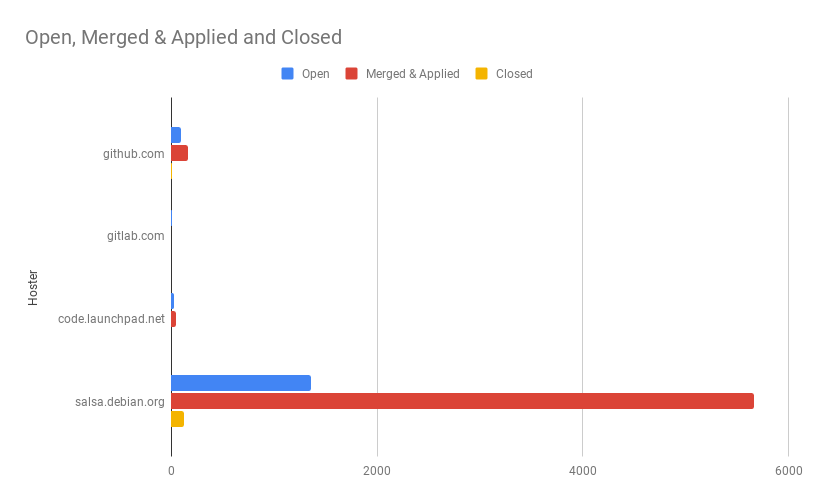
Merge Proposals by Hoster These proportions are also visible in the number of pull requests created by the Janitor on various hosters. The vast majority so far has been created on Salsa.
Hoster Open Merged & Applied Closed
github.com921685
gitlab.com1230
code.launchpad.net24511
salsa.debian.org1,3605,657126
Merge Proposal statistics In this graph, Open means that the pull request has been created but likely nobody has looked at it yet. Merged means that the pull request has been marked as merged on the hoster, and applied means that the changes have ended up in the packaging branch but via a different route (e.g. cherry-picked or manually applied). Closed means that the pull request was closed without the changes being incorporated. Note that this excludes ~5,600 direct pushes, all of which were to salsa-hosted repositories. See also:

For more information about the Janitor's lintian-fixes efforts, see the landing page.

23 October 2020

Birger Schacht: An Analysis of 5 Million OpenPGP Keys

In July I finished my Bachelor s Degree in IT Security at the University of Applied Sciences in St. Poelten. During the studies I did some elective courses, one of which was about Data Analysis using Python, Pandas and Jupyter Notebooks. I found it very interesting to do calculations on different data sets and to visualize them. Towards the end of the Bachelor I had to find a topic for my Bachelor Thesis and as a long time user of OpenPGP I thought it would be interesting to do an analysis of the collection of OpenPGP keys that are available on the keyservers of the SKS keyserver network. So in June 2019 I fetched a copy of one of the key dumps of the one of the keyservers (some keyserver publish these copies of their key database so people who want to join the SKS keyserver network can do an initial import). At that time the copy of the key database contained 5,499,675 keys and was around 12GB. Using the hockeypuck keyserver software I imported the keys into an PostgreSQL database. Hockeypuck uses a table called keys to store the keys and in there the column doc stores the OpenPGP keys in JSON format (always with a data field containing the original unparsed data). For the thesis I split the analysis in three parts, first looking at the Public Key packets, then analysing the User ID packets and finally studying the Signature Packets. To analyse the respective packets I used SQL to export the data to CSV files and then used the pandas read_csv method to create a dataframe of the values. In a couple of cases I did some parsing before converting to a DataFrame to make the analysis step faster. The parsing was done using the pgpdump python library. Together with my advisor I decided to submit the thesis for a journal, so we revised and compressed the whole paper and the outcome was now

PUBLISHED in the Journal of Wireless Mobile Networks, Ubiquitous Computing, and Dependable Applications (JoWUA). I think the work gives some valuable insight in the development of the use of OpenPGP in the last 30 years. Looking at the public key packets we were able to compare the different public key algorithms and for example visualize how DSA was the most used algorithm until around 2010 when it was replaced by RSA. When looking at the less used algorithms a trend towards ECC based crytography is visible. What we also noticed was an increase of RSA keys with algorithm ID 3 (RSA Sign-Only), which are deprecated. When we took a deeper look at those keys we realized that most of those keys used a specific User ID string in the User ID packets which allowed us to attribute those keys to two software projects both using the Bouncy Castle Java Cryptographic API (resp. the Spongy Castle version for Android). We also stumbled over a tutorial on how to create RSA keys with Bouncycastle which also describes how to create RSA keys with code that produces RSA Sign-Only keys. In one of those projects, this was then fixed. By looking at the User ID packets we did some statistics about the most used email providers used by OpenPGP users. One domain stood out, because it is not the domain of an email provider: tellfinder.com is a domain used in around 45,000 keys. Tellfinder is a Big Data analysis software and the UID of all but two of those keys is TellFinder Page Archiver- Signing Key <support@tellfinder.com>. We also looked at the comments used in OpenPGP User ID fields. In 2013 Daniel Kahn Gillmor published a blog post titled OpenPGP User ID Comments considered harmful in which he pointed out that most of the comments in the User ID field of OpenPGP keys are duplicating information that is already present somewhere in the User ID or the key itself. In our dataset 3,133 comments were exactly the same as the name, 3,346 were the same as the domain and 18,246 comments were similar to the local part of the email address Last but not least we looked at the signature subpackets and the development of some of the preferences (Preferred Symmetric Algorithm, Preferred Hash Algorithm) that are being published using signature packets. Analysing this huge dataset of cryptographic keys of the last 20 to 30 years was very interesting and I learned a lot about the history of PGP resp. OpenPGP and the evolution of cryptography overall. I think it would be interesting to look at even more properties of OpenPGP keys and I also think it would be valuable for the OpenPGP ecosystem if these kinds analysis could be done regularly. An approach like Tor Metrics could lead to interesting findings and could also help to back decisions regarding future developments of the OpenPGP standard.

Enrico Zini: Hetzner build machine

This is part of a series of posts on compiling a custom version of Qt5 in order to develop for both amd64 and a Raspberry Pi. Building Qt5 takes a long time. The build server I was using had CPUs and RAM, but was very slow on I/O. I was very frustrated by that, and I started evaluating alternatives. I ended up setting up scripts to automatically provision a throwaway cloud server at Hetzner. Initial setup I got an API key from my customer's Hetzner account. I installed hcloud-cli, currently only in testing and unstable:
apt install hcloud-cli
Then I configured hcloud with the API key:
hcloud context create
Spin up I wrote a quick and dirty script to spin up a new machine, which grew a bit with little tweaks:
#!/bin/sh
# Create the server
hcloud server create --name buildqt --ssh-key   --start-after-create \
                     --type cpx51 --image debian-10 --datacenter  
# Query server IP
IP="$(hcloud server describe buildqt -o json   jq -r .public_net.ipv4.ip)"
# Update ansible host file
echo "buildqt ansible_user=root ansible_host=$IP" > hosts
# Remove old host key
ssh-keygen -f ~/.ssh/known_hosts -R "$IP"
# Update login script
echo "#!/bin/sh" > login
echo "ssh root@$IP" >> login
chmod 0755 login
I picked a datacenter in the same location as where we have other servers, to get quicker data transfers. I like that CLI tools have JSON output that I can cleanly pick at with jq. Sadly, my ISP doesn't do IPv6 yet. Since the server just got regenerated, I remove a possibly cached host key. Provisioning the machine One git server I need is behind HTTP authentication. Here's a quick hack to pass the relevant .netrc credentials to ansible before provisioning:
#!/usr/bin/python3
import subprocess
import netrc
import tempfile
import json
login, account, password = netrc.netrc().authenticators(" ")
with tempfile.NamedTemporaryFile(mode="wt", suffix=".json") as fd:
    json.dump( 
        "repo_user": login,
        "repo_password": password,
     , fd)
    fd.flush()
    subprocess.run([
        "ansible-playbook",
        "-i", "hosts",
        "-l", "buildqt",
        "--extra-vars", f"@ fd.name ",
        "provision.yml",
        ], check=True)
And here's the ansible playbook:
#!/usr/bin/env ansible-playbook
- name: Install and configure buildqt
  hosts: all
  tasks:
   - name: Update apt cache
     apt:
        update_cache: yes
        cache_valid_time: 86400
   - name: Create build user
     user:
        name: build
        comment: QT5 Build User
        shell: /bin/bash
   - name: Create sources directory
     become: yes
     become_user: build
     file:
        path: ~/sources
        state: directory
        mode: 0755
   - name: Download sources
     become: yes
     become_user: build
     get_url:
        url: "https:// / item "
        dest: "~/sources/ item "
        mode: 0644
     with_items:
      - "qt-everywhere-src-5.15.1.tar.xz"
      - "qt-creator-enterprise-src-4.13.2.tar.gz"
   - name: Populate home directory
     become: yes
     become_user: build
     copy:
        src: build
        dest: ~/
        mode: preserve
   - name: Write .netrc
     become: yes
     become_user: build
     copy:
        dest: ~/.netrc
        mode: 0600
        content:  
           machine  
           login  repo_user 
           password  repo_password 
   - name: Write .screenrc
     become: yes
     become_user: build
     copy:
        dest: ~/.screenrc
        mode: 0644
        content:  
           hardstatus alwayslastline
           hardstatus string '% = cw %-Lw% = KW %50>%n%f* %t% = cw %+Lw%< % = kK %-=%D %Y-%m-%d %c% - '
           startup_message off
           defutf8 on
           defscrollback 10240
   - name: Install base packages
     apt:
        name: git,mc,ncdu,neovim,eatmydata,devscripts,equivs,screen
        state: present
   - name: Clone git repo
     become: yes
     become_user: build
     git:
        repo: https:// @ / .git
        dest: ~/ 
   - name: Copy Qt license
     become: yes
     become_user: build
     copy:
        src: qt-license.txt
        dest: ~/.qt-license
        mode: 0600
Now everything is ready for a 16 core, 32Gb ram build on SSD storage. Tear down When done:
#!/bin/sh
hcloud server delete buildqt
The whole spin up plus provisioning takes around a minute, so I can do it when I start a work day, and take it down at the end. The build machine wasn't that expensive to begin with, and this way it will even be billed by the hour. A first try on a CPX51 machine has just built the full Qt5 Everywhere Enterprise including QtWebEngine and all its frills, for amd64, in under 1 hour and 40 minutes.

21 October 2020

Bits from Debian: Debian donation for Peertube development

The Debian project is happy to announce a donation of 10,000 to help Framasoft reach the fourth stretch-goal of its Peertube v3 crowdfunding campaign -- Live Streaming. This year's iteration of the Debian annual conference, DebConf20, had to be held online, and while being a resounding success, it made clear to the project our need to have a permanent live streaming infrastructure for small events held by local Debian groups. As such, Peertube, a FLOSS video hosting platform, seems to be the perfect solution for us. We hope this unconventional gesture from the Debian project will help us make this year somewhat less terrible and give us, and thus humanity, better Free Software tooling to approach the future. Debian thanks the commitment of numerous Debian donors and DebConf sponsors, particularly all those that contributed to DebConf20 online's success (volunteers, speakers and sponsors). Our project also thanks Framasoft and the PeerTube community for developing PeerTube as a free and decentralized video platform. The Framasoft association warmly thanks the Debian Project for its contribution, from its own funds, towards making PeerTube happen. This contribution has a twofold impact. Firstly, it's a strong sign of recognition from an international project - one of the pillars of the Free Software world - towards a small French association which offers tools to liberate users from the clutches of the web's giant monopolies. Secondly, it's a substantial amount of help in these difficult times, supporting the development of a tool which equally belongs to and is useful to everyone. The strength of Debian's gesture proves, once again, that solidarity, mutual aid and collaboration are values which allow our communities to create tools to help us strive towards Utopia.

Next.

Previous.