Search Results: "ag"

25 February 2008

Joerg Jaspert: New FTP Assistants

As you probably know (well, in case you read d-d-a (hello man-di)), we got two new people as FTP Assistants. While I disagree with the way it went, it’s a good thing to not have NEW, removals and override changes a (pretty much) one man show. OTOH I am also pretty reluctant to having others do NEW, as the long time I am now doing it makes me feel about it like - well “it’s my baby”, or something like that. It’s just that I processed a lot of packages, rejected even more and (mostly) had fun doing it. (And I hate to share fun, HA :) ). But I understand the need of having more people doing it, so today I gave an introduction to Thomas and Kalle. Now they at least know where to start. And while that took somewhere around 2 hours - its still only an introduction. I bet there will be many more questions when they do more than just reading the large amounts of text I flooded into the ftp teams IRC channel. :) But that should work fine, I am online most of the day - and then there are the other ftpteam-members and ftpmasters in the channel, someone should be able to respond sooner or later. :) And now some real content. The ultimate way to get a totally bug free Debian:
for i in $(dak control-overrides -t dsc -l awk ' print $1 '); do
 dak rm -m "Cleanup" -C package $i
done
Don’t try this at home, kids. (Yes, a nice DELETE FROM $correct_table in projectb also works, but isnt as much fun! The above gets you nice and pretty logs in the removals.txt and also nice and pretty mails to the package address!)

Sylvain Le Gall: planet.ocamlcore.org

Since 4 hours, the planet of ocamlcore.org is online. This is the first service provided by ocamlcore.org to the OCaml community. In fact, ocamlcore.org team has decided to release it today, because Erik Castro de Lopo ask a question about another OCaml planet in China. The one in China seems to be gathered through google search... Putting online the planet is also the occasion to test a little application to manage feed subscription: ocaml-planet. This script is quite trivial but it was a good first experiment of managing CGI/sqlite through OCaml. The application should help us to control subscription of feeds. I think this is a better way to subscribe than letting people commit changed planet.conf in some kind of SCM (like we do for planet debian). Once the forge of ocamlcore.org will be online, we will publish the source code of this application. I hope that this planet will be of some help for the OCaml community... http://planet.ocamlcore.org

Sylvain Le Gall: Back from FOSDEM

I have spent one day and a half this week-end at FOSDEM. This was not as great as expected, but mostly because i don't have the time to stay the whole sunday. Next year, I will stay the whole week-end in order to have time to attend all the speak i should be interested in. The beer event was overcrowded, but all the beer i found there was great (in particular the Floris Pear). It was also a great time to have a demonstration of the XO OLPC laptop. This little thing is funny, but i don't get the way the UI should be used. Another bad point, is that the first console allow to login as root by pressing "Enter" (at least on the one i try). I suppose this kind of device is not intended to be secured. I also have time to talk with some Debian people and some other people -- in particular one who was thinking that Windows 2000 is the best ever OS. At least, it means that there were people from different horizons -- and this is a good thing. During Saturday, i spend half of the day in the big amphitheater (Janson). The talk about Tux with Shades (Linux in Hollywood) was impressive, regarding the trailer they show us... The talk about FreeBSD was interesting -- but not impressive as a trailer. I spend Saturday afternoon in the Debian devroom, following all the different talks. I miss the one from MadCoder about managing packages with git... That's a shame because i really want to see this one. Since my train was at 12am on Sunday, i choose to only pay a visit to the different booths. I have the pleasure to have a demonstration of the EeePC on the Debian booth that really please me. I found the UI more easy to understand than the one from XO. Speaking with the person demonstrating the laptop, she explained me that EeePC is more "standard desktop" and XO more "creative desktop". Conclusion: i am not creative ;-) Also talking about everything around talks and the meeting, i think Bruxelles is a really nice city for this kind of events. ULB is not near the center of Bruxelles but there are enough transportation. There was really a lot of people attending FOSDEM, and this is a good thing. I also have the pleasure to find some people from the OCaml Meeting.

Julian Andres Klode: pristine-deb - git-buildpackage s pristine-tar support


Reading about the idea of pristine-deb, I actually noticed that using ar -rc file.deb debian-binary control.tar.gz data.tar.gz does not work, due to timestamps and other differences. I am currently working on a pristine-deb program which will workaround all these issues. It will be able to work with git repositories like pristine-tar and uses pristine-tar for control.tar.gz and data.tar.gz. I may also add a function to decompress all compressed files (like changelog.gz) and uses pristine-gz to compress this file again before adding it to the tarball. This may save some additional space. BTW, git-buildpackage now supports pristine-tar. Simply enable it with “pristine-tar = True” in gbp.conf. Thank you Guido Guenther, for adding these patches.

Julian Andres Klode: debimg - debian-cd in Python


I’m currently working on a rewrite of debian-cd in Python. Although there is already deb-imgs-gen, I decided to start from scratch, because deb-imgs-gen is more than 1 year old. debimg’s main features are Speed debimg should be able to build netinst disks in less than 20 seconds Free Software This program is free software: you can redistribute it and/or modify it under the terms of the GNU General Public License as published by the Free Software Foundation, either version 3 of the License, or (at your option) any later version. Easy Configuration
  • Packages can be included based on their priority, tasks or name (no manually created task files)
  • All packages are defined in one file,which is based on the format on debian/control. You can even use the “package [architectures]” syntax from Build-Depends
Based on python-apt
  • Highspeed dependency solver written in C (or C++ ?)
  • Used for downloading all kind of data in debimg
  • Packages ,.gz files are created from the apt cache instead of scanning the disk
many features are missing at the moment, and no code has been released. I will send an email containing more details, like configuration file examples, to the MLs in a few days.

Lucas Nussbaum: back from FOSDEM

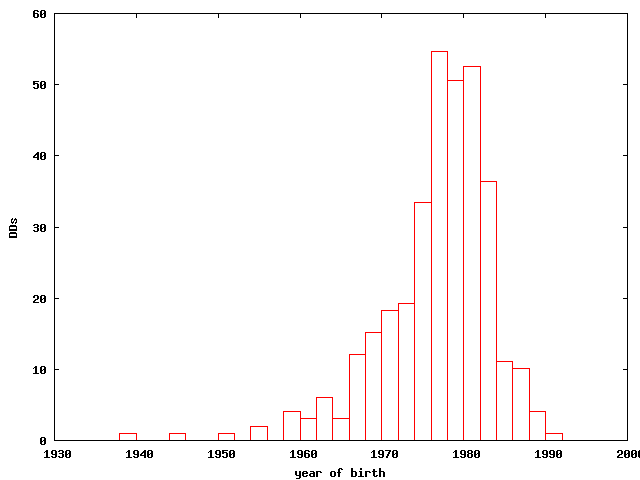
I was at FOSDEM last week-end. As usual there, I spent an excellent week-end. It was really nice to see all those friends again (and even meet some friends for the first time, hi gaston/carxwol/atmaniak!) Only problem is, FOSDEM is definitely too short ;-) To make this post a bit more interesting, I did some homework. The opening talk about FreeBSD had those stats about developers’ age, so I made the same ones for Debian (using the birthDate LDAP field, which was filled in by 340 DDs). Here is the graph. It would be interesting to compare that with other communities, which are sometimes perceived as “younger”. DD years of birth
Cyril Brulebois: HE running for DPL!

Looks like we (almost) have a candidate: HE-DPL-1.jpg And since that has to be signed: HE-DPL-2.jpg Photographs courtesy of Aurore D.

Martin Zobel-Helas: Assimilated

Pia im Debian Strampler Thanks to the colleagues at credativ for this nice romper suit. No Tags

Benjamin Mako Hill: Still Seeing Yellow

Recently, the EFF reported that the European commission had responded to a request by European Parliament member Satu Hassi about tracking dots in printers. European Commissioner Franco Frattini replied that tracking dots may constitute a human rights violation saying that:
"..to the extent that individuals may be identified through material printed or copied using certain equipment, such processing may give rise to the violation of fundamental human rights, namely the right to privacy and private life. It also might violate the right to protection of personal data."
Intriguingly, the request text includes a mention to and link to the Seeing Yellow project I started last year as an example of the fact that consumers have complained to printer manufacturers and that these complaints have fallen upon deaf ears. Everyone who called their printer manufacturer in response to Seeing Yellow deserves come credit for the raised visibility to the issue that we've created and the set of actions that have brought the issue this far. Please, keep it up! If you've not complained to your printer manufacturer, visit Seeing Yellow and call today.

Benjamin Mako Hill: My Spring

I'm going to be traveling and giving talks quite a bit this spring. Here's what my schedule looks like now. I don't think much will be added to it: I'll be giving at least one talk at the FSF Members Meeting, the Renaissance Panel, Lugradio Live, Penguicon, and Community One. Matt's wedding is private. To join the FSF members meeting you must become an FSF Associate Member if you are not already. All of the other conferences require some sort of registration. Penguicon, Lugradio Live, and ROFLCon are each cheap and each promises to be a lot of fun. The talk at Hampshire should be free and open to the public. I'll be posting more about each of these as things get closer including details about what is that I'll be talking about. If you'd like me to talk to another group or at another event while I'm town for any of the events above, now would be a good time to ask. If you just want to meet up for a beverage of your choice, that's good too. In either case, get in contact.

Uwe Hermann: Lest We Remember: Cold Boot Attacks on Encryption Keys

Just in case you haven't already read about this... Some researchers from Princeton have published a paper about methods which can be used to attack full-disk-encryption (FDE) schemes. They have demonstrated that at least BitLocker (Windows Vista), FileVault (MacOS X) and dm-crypt (Linux) are vulnerable to this type of (partly hardware-based) attack scenarios. Quite likely lots of similar other solutions are vulnerable as well. The main problem is that (contrary to popular belief) RAM does indeed retain its data for a non-trivial amount of time after power is cut (seconds, even minutes or hours if it's cooled down enough), so you can mount some new attacks such as: Yes, all attacks assume that the attacker has physical access to your PC/RAM, in which case you already have several other problems. Still, the new thing about this is that even full-disk-encryption doesn't help much in some cases. You probably shouldn't depend too much on it (but you shouldn't stop using disk encryption either, of course!). Full paper: coldboot.pdf. There are also some demo videos and pictures. More coverage at Boing Boing, Bruce Schneier's weblog, Freedom to Tinker, Slashdot, Heise (German), and many more... Make sure to read the comments of the various articles for more scenarios and possible ideas for how to prevent such attacks. Some ideas include enabling the BIOS RAM checks (which might explicitly erase RAM contents on reboot; that doesn't help in all cases, though) or using coreboot (previously LinuxBIOS) to erase RAM contents at boot-up and/or shutdown. It's a highly non-trivial issue, though, there's no easy and complete fix so far. The only sure way is to not have your laptop or PC stolen and to not give attackers physical access to your computers.

Michal Čihař: Gammu test version 1.18.91

New Gammu testing version is out. This time release period is a bit longer than usual, mostly because my moving back to Prague. 1.18.91 again only fixes some bugs: You can download from usual place: http://cihar.com/gammu/. PS: Debian users can get packages from experimental.

24 February 2008

Russell Coker: EeePC for a Teenager

I was asked for advice from a non-technical person about buying a laptop for their 15yo daughter. They were looking to spend $200 or $300. I suggested that stretching their budget to $500 for a new EeePC would be a better option than the risks associated with a second-hand laptop (laptops are all different in their hardware). I also suggested that waiting a few months to see what happens with the new EeePCs might be a good idea. There are rumours about the development of new EeePC models with bigger screens, this would be a benefit for those who can afford it, and for those who can’t the current model may drop in price. They took that suggestion very well and I suspect that they weren’t planning to purchase in the near future anyway. I asked for advice on the LUV mailing list [1] for further suggestions that I could offer. One suggestion was that larger laptops of a more traditional design have been driven down in price recently and might be worth considering. I will have to mention it, but suggesting that someone who wants to spend $200 should spend $500 seemed enough of a stretch, suggesting that they spend $700 or more might not be taken well. Of course there is the weight issue that Matt raised in a blog post [2]. The last thing I want to do is to convince people not to buy computers for their children! A complaint was raised about the size of the keyboard in the EeePC (personally I wouldn’t want to use anything smaller than the T series Thinkpad I’m using now). In a quick google search the best information I could find about average finger sizes was the Danforth Diamond blog [3] which says that in the US women average a ring size of 6 while men average 10. According to the ring sizing page on the same site [4] that means ring finger diameter of 16.5 and 19.8mm respectively. So it seems likely that given the same level of typing skill an average woman could happily use a keyboard that’s 83% the size of the keyboard that an average man uses. Of course there’s a lot of variation between individuals, for example my fingers are thinner than average and I prefer a full-sized keyboard. One thing I recommend when considering a keyboard (or a laptop) is to type your name a few times quickly. Typing something about a quick brown fox will take some thought, but typing your own name requires no thought so you can concentrate on the feel of the keyboard. Using this method it is very easy to go to a store and determine whether a laptop is likely to suit you. The screen resolution and size is a significant issue, one EeePC owner described it as “too small to do anything useful“. Rumour has it that the next version will have a screen that’s a significant increase in size and resolution. A final interesting comment was about the social aspect of owning a laptop. The suggestion was made that a teenager who owned the smallest (and possibly cheapest) laptop in class might have other kids tease them about it. I will be interested to see comments on this issue, it had never occurred to me that the laptop use in schools would be high enough for the ownership of any type of laptop to be a cause for harassment. Also I’m not sure which would be considered as being of lower status, an old second-hand laptop or a new low-end laptop. I’m pretty sure that owning either would be considered to have higher status than having no laptop. A quick scan of the GraysOnline.com.au auction site suggests that a second-hand Pentium-M laptop (a few years old) could be purchased for about $550 and a Core 2 Duo based laptop might go for about $700. So it seems unlikely that for less than $500 you could buy something suitable for a novice user (something that will just work with recent software). I’m not planning on offering the full IT support package that I offer to my relatives so I can only recommend things that can be self-supported. Of course as the people doing the buying seem to have no definite plans for the use of the computer then anything they buy will fail in some way to meet the requirements that they discover. :-# Update: fixed a bad link.

Jaldhar Vyas: The 2008 Things Jaldhar Discovered Last Year That Everyone Else Knew About Already Awards

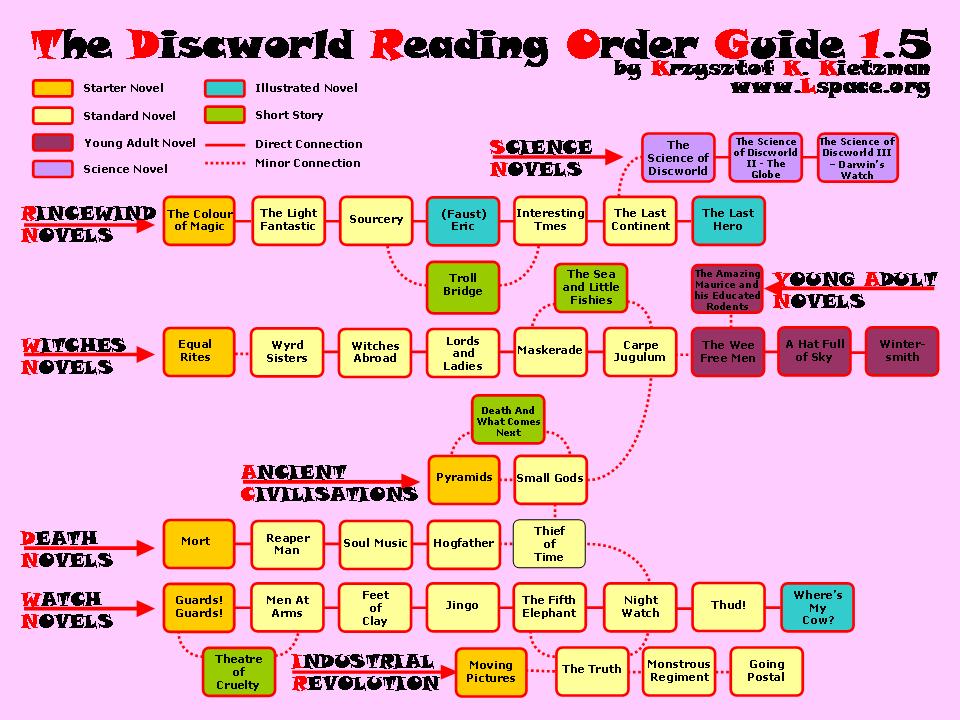
And the Golden Sombrero goes to... Another awards show took place today but nobody is paying any attention to that. All of Hollywoods elite can be found at the King Plaza Buffet in Jersey City for the 80th annual Things Jaldhar Discovered Last Year That Every Else Knew About Already Awards. (Known in the industry as "the Golden Sombreros") Here is a list of the winners. Game: Hungry Hungry Hippos This game is awesome! But don't play with three year olds. They cheat. Book: Discworld series by Terry Prachett When The Color Of Magic came out in 1983, I dismissed it as merely "The Hichhikers Guide to Mordor" but last year I read it again and this time it grew on me. Since then I've been steadily reading the whole series since June at an average of one a week. Music: Rammstein Smell the umlauts! I have no idea what they are actually going on about but this is what Metal is supposed to sound like. Mental Condition: Oedipus Complex All of sudden last October or so, my son started screaming and crying whenever I got anywhere near my wife and he would cling to her like the proverbial limpet. Then three months later, just as suddenly, he stopped. Very strange, not to mention creepy. Linux command: grep --color=auto Everyone knows GNU ls can be colorized but did you know the same is true of GNU grep? I didn't. Why wasn't I informed of this earlier? L. Ron Hubbard Lifetime Achievement Award: Coke Zero I used to drink way more Coke than was good for me so I decided to give it up. Diet sodas don't taste very good so I was resigned to not drinking soda at all. Luckily for me Coke Zero has no calories or sodium but does have caffeine and a taste like actual Coca-Cola. Perfect!

Benjamin Mako Hill: Still Seeing Yellow

Recently, the EFF reported that the European commission had responded to a request by European Parliament member Satu Hassi about tracking dots in printers. European Commissioner Franco Frattini replied that tracking dots may constitute a human rights violation saying that:
"..to the extent that individuals may be identified through material printed or copied using certain equipment, such processing may give rise to the violation of fundamental human rights, namely the right to privacy and private life. It also might violate the right to protection of personal data."
Intriguingly, the request text includes a mention to and link to the Seeing Yellow project I started last year as an example of the fact that consumers have complained to printer manufacturers and that these complaints have fallen upon deaf ears. Everyone who called their printer manufacturer in response to Seeing Yellow deserves come credit for the raised visibility to the issue that we've created and the set of actions that have brought the issue this far. Please, keep it up! If you've not complained to your printer manufacturer, visit Seeing Yellow and call today.

Mike Hommey: Testing the crazy idea

So, MadCoder had doubts about the crazy idea, so I took a little time to do a test with a package I maintain, namely, xulrunner. First, take all the deb files in the history of the package (at least, everything that is available on snapshot.debian.net today).
wget -O - -q http://snapshot.debian.net/archive/pool/x/xulrunner/binary-amd64/Packages.gz gzip -cd > list
awk '/^Filename:/ print $2 ' list xargs -I wget http://snapshot.debian.net/archive/
Next, commit all these in a different repo per package name :
perl -e 'use Dpkg::Version qw(vercmp); sub v my $f = $_[0]; $f =~ s/.*_(.*)_.*/$1/; $f print sort vercmp(v($a), v($b)); map s/^Filename: .*\///; $_ grep /^Filename:/ ;’ list while read f; do
    pkg=$ f%_*_*
    [ ! -d $pkg ] && mkdir $pkg && ( cd $pkg ; git init )
    cd $pkg
    ar -x ../$f
    mkdir data control
    tar -C data -zxf data.tar.gz
    tar -C control -zxf control.tar.gz
    git add data control
    git commit -q -m $f
    rm -rf data control data.tar.gz control.tar.gz debian-binary
    cd ..
done
Finally, evaluate sizes for each package, respectively, of all .deb files, their content imported in git (only the .git directory, including the index ; some space could be gained removing it), and the “optimized” git repository (after git gc, without modifying delta depth or window size, which may even improve the result)
awk '/^Package:/ print $2 ' list sort -u while read p; do
    du -c --si $ p _*.deb tail -1
    du -s --si $p
    cd $p; git gc ; cd ..
    echo
done
17M total
16M libmozjs0d
4.7M libmozjs0d
34M total
31M libmozjs0d-dbg
14M libmozjs0d-dbg
4.7M total
7.1M libnspr4-0d
1.3M libnspr4-0d
9.2M total
12M libnspr4-0d-dbg
2.8M libnspr4-0d-dbg
25M total
28M libnss3-0d
4.6M libnss3-0d
81M total
61M libnss3-0d-dbg
21M libnss3-0d-dbg
15M total
16M libnss3-tools
3.1M libnss3-tools
288M total
265M libxul0d
146M libxul0d
2.0G total
1.8G libxul0d-dbg
1.1G libxul0d-dbg
5.1M total
6.8M python-xpcom
1.1M python-xpcom
2.5M total
5.6M spidermonkey-bin
861k spidermonkey-bin
13M total
14M xulrunner
2.0M xulrunner
3.3M total
5.9M xulrunner-gnome-support
979k xulrunner-gnome-support
So these packages, stored in git, take between 15 and roughly 50 percent of the .deb size, which may be a nice improvement. Il would be interesting to know how these numbers evolve with time. Some files, such as the changelog.Debian.gz files, would also benefit from being stored in plain text instead of gzipped form. Note git gc took a while and a lot of memory for libxul0d-dbg. Also note these don’t include delta files that would be necessary to recreate the original .deb file, but this shouldn’t make a huge difference.

Andreas Metzler: hardware sucks

I have been pondering buying an entry level color laser printer, mainly for my dad (Vista) but of course at least bw-text should work with Linux, too. As expected, the situation is slightly worse than I expected. I started looking at not low end inkjets, too, The first likely candidate Canon PIXMA iP3500 or iP4500 made a quite entertaining research on the linux side. There are no free drivers and Canon's binary ones are strange. Quoting the wnpp bug:

David Moreno Garza: Infinite Pig Theorem!

So, I have finally moved my blog to MovableType from Wordpress and a couple of interesting things have happened:

It feels good to be back.

Aigars Mahinovs: EEEPC

A few days ago I got myself an Asus EEEPC to experiment with it being in a role of a small server and a tiny internet kiosk. I installed Debian on it, but the process was not for the feint of heart, that’s for sure. First of all the d-i font was messed up and all the menus overflowed the screen making it very hard to select anything. Additionally it seems very strange to me that there was a special d-i image made for EEEPC, but that image did not include built-in support for the computers wired or wireless network interfaces. That made my day highly problematic as I do not have an easy way to get to the Internet via a wired connection and the provided d-i image did not have enough files on it to finish the base install without networking.
This again made me think that the approach Ubuntu took is more favorable in most situations - have the install image boot a mostly functional system (it does not have to be X even) and then install from there. It actually feels more flexible than using the highly restricted d-i environment.
I will be looking to make a Debian rescue image designed for the EEEPC that you could dd onto a USB key, boot from and have a minimal Debian system with working ethernet, wifi and some basic rescue tools and a way to install a basic Debian system as well. That should make it much easier for people to get Debian onto their EEE PCs. I do hope that the Debian EEEPC project will improve as well.

Wouter Verhelst: FOSDEM, day two

This is no doubt one of the best FOSDEMs, ever. At least to me it was, and I've been to every FOSDEM, and to the second day of the original OSDEM as well. Great weather, great people, great talks, and great fun. What more can one want? Where I had to nag about a few things yesterday, today I can only feel exhausted, but happy. Some loose ends:
  1. Apparently someone forgot a camera in the Debian Developer's room; this is a Kodak EasyShare ZD710. If you're quick, you may be able to still get it at the info desk; otherwise, contact either me or "Chipzz" on the Freenode network (perhaps in the #fosdem channel). If you're still in Belgium, we may arrange for you to pick it up, otherwise we'll have to send it to you.
  2. Thijs said it after the last talk in the Debian devroom, but let me repeat it here: if you have comments about the Debian presence at FOSDEM (and I mean about any subject, really), just let me know. This was a great FOSDEM already, but there's always room for improvement. Oh, and yes, we need a bigger devroom, and the FOSDEM people know this, and they can't really help us but they'll do what they can. Unfortunately "too many people" is a general problem at FOSDEM.
See you next year!

Next.

Previous.