Search Results: "ag"

27 February 2008

Steve Kemp: I'm wearing my heart like a crown

For the past couple of days I've been working on some "easy hosting" setup for Debian. This is a continuation of my shell-script based solution, but intended to be much more dynamic. The system makes it simple for us to deploy a Debian Etch installation, and allow users to create virtualhosts easily. (And by easily I mean by creating directories, and very little else.) So, for example, to create a new website simple point the IP address of your domain example.org to the IP of your machine. Then run:
mkdir -p /srv/example.com/cgi-bin
mkdir -p /srv/example.com/htdocs
If you then want to allow FTP access to upload you may run:
echo "mysecretpass" > /srv/example.com/ftp-password
This will give you FTP access, username "example.com", password "mysecretpass". You'll be chrooted into the /srv/example.com/ directory. All of this is trivial. Via Apache's mod_vhost_alias, and a simple script to split logfiles and generate statistics via webalizer for each domain. The only thing that I really needed to do was to come up with a simple shell script & cron entry to build up an FTP password file for pure-ftpd. So here's where it gets interesting. The next job, obviously, is to handle mail for the domains. Under Debian it should be a matter of creating an appropriate /etc/exim/exim4.conf - and ignoring the rest of the setup. I'm getting some help with that, because despite knowing almost too much about SMTP these days I'm still a little hazy on Exim4 configuration. I'm watching the recent debian configuration packages system with interest, because right now I'm not touching any configuration files I'm sure that it is only a matter of time.
In other news I cut prices, and am seeing a lot of interest in my mail-scanning. Finally my .emacs file has been tweaked a lot over the previous few days. Far too much fun. (support files.)

Martin F. Krafft: Do sensible VoIP phones exist?

With my new VoIP infrastructure in place, I d like to get rid of the softphones and replace them with hardware. An obvious solution, given how I might need to replace my cellphone sometime soon, would be to check out the Nokia E65, which can do VoIP over wireless. I ve previously dismissed the Nokia E-series phones for good reasons, but Nokia had time to improve them, and I know a few people who like the E65. Waiting for the OpenMoko Freerunner is nother option. If you know of other VoIP+Wifi GSM cellphones you can advocate, please let me know. On the other hand, I might just want to get a separate VoIP phone, ideally wireless, to use at home exclusively. The problem is that there seem to be none. I checked out at least two dozens, and they all fall short for one of the following reasons: Thus, I am reaching out to the lazyweb. Does anyone know of a wireless (short-range) phone that can do VoIP at a reasonable price, either based on Wifi, or using an ethernet-connected base station (DECT). I d appreciate a note. NP: Age Pryor: City Chorus

Martin F. Krafft: Asterisk on Debian: piece of cake!

Yesterday, my phone had a temporary fit, yet I had a bunch of important calls left to make. Since I have an account with a VoIP provider and a Swiss number associated with it, I decided to use it as a fallback. That worked. The next thing I found out was that a meeting had been cancelled, and since I was in a VoIP-related mindset anyway, I did what I ve been meaning to do for years: check out Asterisk. An excellent article by Stefan Wintermeyer in the 01/2008 issue of the German Linux Magazin helped me understand the basics of the Asterisk configuration paradigms in a single read. With 40 minutes left, I installed the Debian Asterisk packages on a test machine and by the time of my next meeting, I had the server register with two VoIP providers (one of them being the university) and routed outgoing calls accordingly: calls to university numbers went there, all others would be routed via Insphone. I also hooked up three softphones and routed incoming calls to them. I shall post my configuration once I spent a little more time with it, configured e.g. voice mail and a simple voice- or DMTF-activated menu system to distinguish work from private calls, and cleaned it up. If you care before then, ask. Asterisk is said to have a steep learning curve. Thanks to the article and the excellent work by the Debian maintainers, I climbed that curve to the point where I can make and receive phone calls in about an hour. Thanks! NP: Age Pryor: Shanks Pony

Michal Čihař: Ukolovnik 1.0

New version of simple todo manager called Ukolovnik has been just released. There are no major changes in this release compared to 0.9, it mostly happened to indicate that this small piece of code has reached some level of stability and wanted level of features.

Roland Mas: GForge in Debian, February 2008

Quick status update: not much happened due to a variety of reasons, but there is still some progress to report. The most important piece of news is that the Mediawiki plugin should be on its way to Debian sid by the time you read this, as the new gforge-plugin-mediawiki binary package (it'll have to go through NEW, but that seems to be rather fast these days). Testing and reporting and bugfixing are most welcome, of course. I also went through a round of cleanups in the packaging. No more Lintian overrides, far fewer Lintian errors and warnings, and some fixes for PostgreSQL 8.3 compatibility.

Russell Coker: Redirecting Output from a Running Process

Someone asked on a mailing list how to redirect output from a running process. They had a program which had been running for a long period of time without having stdout redirected to a file. They wanted to logout (to move the laptop that was used for the ssh session) but not kill the process (or lose output). Most responses were of the form “you should have used screen or nohup” which is all very well if you had planned to logout and leave it running (or even planned to have it run for a long time). Fortunately it is quite possible to redirect output of a running process. I will use cat as a trivial example but the same technique will work for most programs that do simple IO (of course programs that do terminal IO may be more tricky - but you could always redirect from the tty device of a ssh session to the tty device of a screen session). Firstly I run the command “cat > foo1” in one session and test that data from stdin is copied to the file. Then in another session I redirect the output: Firstly find the PID of the process:
$ ps aux grep cat
rjc 6760 0.0 0.0 1580 376 pts/5 S+ 15:31 0:00 cat Now check the file handles it has open:
$ ls -l /proc/6760/fd
total 3
lrwx—— 1 rjc rjc 64 Feb 27 15:32 0 -> /dev/pts/5
l-wx—— 1 rjc rjc 64 Feb 27 15:32 1 -> /tmp/foo1
lrwx—— 1 rjc rjc 64 Feb 27 15:32 2 -> /dev/pts/5 Now run GDB:
$ gdb -p 6760 /bin/cat
GNU gdb 6.4.90-debian
Copyright (C) 2006 Free Software Foundation, Inc
[lots more license stuff snipped]
Attaching to program: /bin/cat, process 6760
[snip other stuff that’s not interesting now]
(gdb) p close(1)
$1 = 0
(gdb) p creat(”/tmp/foo3″, 0600)
$2 = 1
(gdb) q
The program is running. Quit anyway (and detach it)? (y or n) y
Detaching from program: /bin/cat, process 6760 The “p” command in GDB will print the value of an expression, an expression can be a function to call, it can be a system call… So I execute a close() system call and pass file handle 1, then I execute a creat() system call to open a new file. The result of the creat() was 1 which means that it replaced the previous file handle. If I wanted to use the same file for stdout and stderr or if I wanted to replace a file handle with some other number then I would need to call the dup2() system call to achieve that result. For this example I chose to use creat() instead of open() because there are fewer parameter. The C macros for the flags are not usable from GDB (it doesn’t use C headers) so I would have to read header files to discover this - it’s not that hard to do so but would take more time. Note that 0600 is the octal permission for the owner having read/write access and the group and others having no access. It would also work to use 0 for that parameter and run chmod on the file later on. After that I verify the result:
ls -l /proc/6760/fd/
total 3
lrwx—— 1 rjc rjc 64 2008-02-27 15:32 0 -> /dev/pts/5
l-wx—— 1 rjc rjc 64 2008-02-27 15:32 1 -> /tmp/foo3 <====
lrwx—— 1 rjc rjc 64 2008-02-27 15:32 2 -> /dev/pts/5 Typing more data in to cat results in the file /tmp/foo3 being appended to. Update: If you want to close the original session you need to close all file handles for it, open a new device that can be the controlling tty, and then call setsid().

26 February 2008

Russell Coker: Future Versions of Windows

There is currently a lot of speculation about the future of Windows following the massive failure of Vista in the market. One theory that is being discussed is that Microsoft will cease kernel development and adopt a Unix kernel in the same way that Apple adopted a BSD based kernel. I predict that MS in it’s current incarnation (*) will never do that. Having an OS kernel that enables easy porting of code to/from other platforms is entirely against their business model which relies on incompatibility to lock customers in. Whatever kernel MS use, it has to be incompatible in some ways with everything else. One easy way of achieving this would be to have a shared object (DLL) interface published and have the interface between the libc and other libraries and the kernel be undocumented and ever-changing (simply renumbering the system calls on every minor version increment would be a good start). The DLL interface could then have the complex APIs that MS loves to force on their victims (see Stewart Smith’s post about getting a file size in Windows for an example of the horror [1]). The advantage of this approach would be that MS could cease developing an OS kernel (something that they were never much good at) and concentrate on owning the proprietary DLLs. There would be nothing stopping them from using a Linux kernel for this, as long as they release all source to the kernel they use (including the patch to renumber the system calls) they would be within the terms of the GPL. My specific prediction is that some time between Jan 2011 and Dec 2016 Microsoft will release systems with the majority of the kernel code coming from BSD or Linux as their primary desktop and server operating systems. Could people who disagree please make specific predictions for the future (including dates and actions) so that we can determine who was most accurate. (*) For future incarnations of Microsoft after chapter 11 or being split in the way that AT&T was there seems no possibility to predict their actions.

Neil Williams: Splitting emdebian-tools and cross building translations

Separating out keyring and rootfs support

emdebian-archive-keyring - GnuPG archive keys for the emdebian repository
emdebian-rootfs - emdebian root filesystem support
emdebian-tools - emdebian crossbuilding tool set
libemdebian-tools-perl - emdebian support library

Finally got to test a request from some months ago to create a separate archive keyring for those people who just want to use the toolchains.
I also took the chance to split out the scripts to build root filesystems from the scripts that build the packages for the repository. The Emdebian::Tools module was best split out too, it's needed for emdebian-rootfs and emdebian-tools.
Not sure when this is going to happen for real, it's only a test branch right now.
(browse SVN). It tests OK, so far and if other things check out, this could be 0.8.4 (in Emdebian), then whilst the same code badged as 0.9.0 spends time in the NEW queue so that I can upload 0.8.5 etc. to Emdebian, followed by 0.9.1 with the changes from 0.8.5 onwards.
TDeb changes from Fosdem
In the main trunk (0.8.3), I've updated a few parts of em_installtdeb but I haven't made much progress on whether TDebs should be Architecture: all or Architecture: any.

  1. A big endian .mo file from powerpc works fine on little endian amd64.

  2. msgfmt --alignment does not seem to do what I expected (but then I'm not entirely sure what I did expect).

  3. I can't find anyone cross-building .mo files - maybe it's my Google skills but if it was essential, I find it hard to think that all those cross-built systems are doing something different to just msgfmt -o $@ $.


John Goerzen: Experimenting with Git

I've been writing about Git a bit lately.

I've decided to switch some of my Debian work over to it to start with, as well as some of my other projects.

Although I was thoroughly frustrated with Git a year ago, now I am quite pleased with it. What's different? The documentation is a LOT better. So far I have only found one manpage (git-show) that omits lots of its options. The system is friendlier, keystroke-happier, and powerful.

Compared to Mercurial, I've found some nice things:

In-directory branching. I didn't expect to care about this, since both git and hg permit lightweight clones. But it turns out to be so easy to use that it is great. Especially since I don't have to setup multiple branch repos on the server. I really like this. Note that "hg branch" is not the same as a git branch, and see the discussion on the hg lists about renaming that before 1.0.0 for why.

Flexibility in getting things around. Plain HTTP works fine (no static-http:// hack). ssh. git daemon. rsync. Very slick.

Performance. Surprisingly, git actually feels faster than Mercurial, especially when pushing or pulling. I didn't expect that.

Tags. They seem smarter in git. No more merging of .hgtags all the time. Also I like that I can attach a message to a tag and sign it.

All that power. There is a *lot* that Git can do. I should have been taking notes about it all.

My main complaint is still that Git doesn't have something as nice as "darcs send". Mercurial doesn't either, but it's a bit closer. Git has moved closer, but still has room to improve on that.

So I have set up git.complete.org and am starting to publish my Debian stuff on Debian's alioth server as well.

Also, hg-fast-export in the fast-export project is *awesome*. Branch-aware and everything. It made a perfect Git version of my Mercurial work.

Lior Kaplan: Israeli government stops Openoffice.org l10n funds


Quoting an announcement by Jonathan Ben Avraham from Tk Open Systems Ltd to the Israeli OO.org malling list:
The Hebrew OpenOffice project at openoffice.org.il will close for an indefinite recess at the end of February 2008.
…
As of this date I do not have any further information regarding the possible resumption of the project. A senior figure in the MoF has recently indicated an interest in continuing MoF support but that approval for funding, if at all, might take several months.
During the last year there was an effort to push many bug fixes to upstream. Fixes not accepted upstream appeared in the a releases made by Tk Open Systems Ltd at http://www.openoffice.org.il. I was very sorry to read Jonathan’s announcement as I enjoy the results of the l10n project on a daily basis. I hope to see the government decide to continue the support to make sure an alternative to proprietary software exists, and hopefully making it a de facto standard in Israel in the future.

Runa Sandvik: We all need to start somewhere

I’m starting all over again. New domain, new blog. I will try to dig up and repost all of the great things I wrote earlier. Posts about code, debian and pink ponies. I can also say that I’m back on planet.debian.org and on planet.samfundet.no. The link to my blog on women.debian.org should also be fixed soon.

Gerfried Fuchs: Wegen Renovierung Offen

It's rare that one does something for themself, and entertainment has happen. Yesterday I had been to a cabaret and did take my other half with me. With the thought, it doesn't always have to be Resetarits, Gunkl or Dorfer I chose "Wegen Renovierung offen" ("Opened due to renovation") from and with Gery Seidl–being the child of a master-builder and having done my A-levels at a high school for structural engineering it wouldn't had been a better fit thematic wise. The role of the construction supervisor Roman Schweißer is catching right from the start, and that's not only for insiders but also for people who generally have no connection to this business branch; a human like everyone else: The internal conflict between what his boss tells him and what his heart tells him, different approaches to get that done, and at the same time trying to also work on his shaken relationship isn't easy—but for sure it's extremely entertaining and worth seeing. My other half didn't regret it to got convinced by me. Dates are still a lot left, partly sold out, partly though also from other projects to which I'm looking forward to. It's rare that a still young performer is not only just able to catch up with oldsters but also to perform with them on stage.

Felipe Augusto van de Wiel: 26 Feb 2008

That's it...

Student for now :-)
Damn it, I should had wrote about it a couple of days ago. Anyway, it happened last Friday (20080222), my last day at work. After 4.5 years (exactly 4 years, 6 months and a week), I quit my job to dedicate more time for my "supposed" last year studying Computer Science at the University.


In a far far away galaxy...
During the translation of packages' descriptions, when I found something that looks like a typo or a wrong reference I try to report wishlist bugs and, when possible, provide patches, I know this is somewhat noisy, it is just to register the fact, so Smith Review can also spotted it, sorry for the noise. :-)

BTW, I would still vote for a genius if we are going to elect a mascot.

Thanks: frolic

Russell Coker: Chilled Memory Attacks

In 1996 Peter Gutmann wrote a paper titled “Secure Deletion of Data from Magnetic and Solid-State Memory” [1]. In that paper he mentions the fact that the contents of RAM last longer at lower temperatures and suggests that data could be retained for weeks at a temperature of -60C or lower (while 140C causes rapid data loss). The paper also addresses issues of data recovery from hard drives, but given that adequate CPU power for encryption is available recovering data from a disk shouldn’t be an issue unless thee attacker can get the key to decrypt it or crack the algorithm - so disk recovery is not a hot issue at the moment. Recently some researchers at Princeton University have published a paper describing in detail how to chill RAM to make it keep its data after a power cycle and even after being installed in a different computer [2]. This attracted a lot of attention, while Peter’s paper described the theoretical concept (in great detail) the Princeton group showed how to implement the attack using materials that are commonly available. Most of the analysis of this misses some fundamental points. Any suggestion that you can wipe the RAM on power failure or on boot misses the point entirely. If an attacker can chill a DIMM and then remove it from the system then there is no chance for it to be wiped. Maybe if you had security on the PC case to detect case opening (some servers have a basic version of this) such things would do a little good, but it shouldn’t be difficult to bypass in most cases. Another common flawed analysis is to suggest that this is no big deal because sniffing the memory bus has been possible for years. While it has always been possible for government agencies and companies who design motherboards to sniff the bus, for most potential attackers it has been overly difficult. When considering the effectiveness of a security system you should first consider what your threat model is. Who is going to attack you and what resources will they be willing and able to devote to the attack? An organisation that is prepared to use expensive equipment and highly trained people to break your encryption probably has other methods of gaining access to your secret data that are easier and cheaper. The research from Princeton suggests that I could perform such attacks with my spare time and with equipment that is very cheap. I’ve been idly considering doing this to an old PC just for fun! Therefore I have to assume that everyone who has the same amount of skill and money as me can potentially compromise my data if they capture one of my machines. It is still most likely that if anyone steals my laptop they will want to sell it and use the money to buy drugs. I don’t think that I have any data that is anywhere near valuable enough to justify a targeted mugging. But my procedures (in terms of changing passwords etc) in the case of my laptop being stolen now need to be scaled up due to the ease in which data might be compromised. The best way of dealing with this would be to have the decryption keys locked inside the CPU (stored in registers or memory that’s locked in the CPU cache). The possibility of getting a modern CPU to operate at any temperature approaching -60C is laughable, and the CPU is a well contained package that can operate on its own and is difficult to attack. This would make things significantly more difficult for an attacker while requiring little effort (in fact it might be possible to lock data in the CPU cache already in which case a software change is all that is required). Update: A comment by Mike made a good point about CPU cooling. Toms Hardware performed an overclocking experiment (from 3.2GHz to 5.25GHz) and used liquid nitrogen cooling [3]. It might be possible to cool a CPU core to -60C in a reasonably small amount of time. But I still believe that it would raise the bar enough to make it worth doing. Update2: Thanks Jaime for the spelling advice.

Michael Prokop: Linux Live-CD grml 1.1 - Codename Skunk

It’s done, we have new releases of grml, the Debian-based Linux Live-CD for sysadmins and texttool users:
  • grml 1.1 (32bit) - Codename Skunk
  • grml64 0.2 (64bit) - Codename Schwammerlklauber
  • grml-medium 0.1 (32bit) / grml64-medium (64bit) - Codename Pfuh
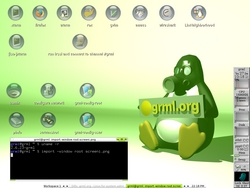
  • Screenshot von grml 1.1 It’s the first stable release being based on our new build-framework grml-live which itself is based on FAI (Fully Automatic Installation). Thanks to grml-live we can provide you a new grml flavour grml-medium which tries to close the gap between grml-small and grml. As usual you’ll get software and kernel updates, many new packages and features plus additional hardware support. We are using LZMA compression for squashfs and provide several additional kernel modules like atl2, iscsitarget, madwifi and (for the first time) loop-aes. Oh and the grml release is known to work fine on the Asus Eee PC - LAN, WLAN and webcam working out-of-the-box! Find all the glory details about the new releases in above mentioned release notes or just visit grml.org. For german readers there’s an article about the new release at pro-linux.de. BTW: On the next weekend (1st and 2nd of march) we - the grml team) - will present the new release on Chemnitzer Linuxdays at the grml booth. grml-CDs, grml-shirts und (new!) “ready to go grml-usb-pens” will be available as well as the chance to talk to us in reallife. 8-) So, we wish you a fast download and hope you enjoy the new release! :-)

    Ond&#345;ej &#268;ert&iacute;k: XFS is 20x slower than ext3 (with default settings)

    Is XFS that bad? Well, at least with default settings, XFS on Debian seems to be blown away by ext3 completely in terms of speed. I don't mind 1.5x slowdown, maybe even 2x, but 20x is a show stopper. I am already using ext3 for any pbuilder builds, because it's a difference to wait for 30s with XFS, compared to 3s with ext3 to extract the base image. And I'll probably switch to ext3 completely, unless someone finds a way how to fix this.

    I recently got burned by this when running Sage on my computer, because it compiles a lot of Python files when started for the first time. Normally it should take roughly 15s, but instead it took 6 minutes on my comp and then it triggered a so far undiscovered bug in Sage, that I reported.

    Michael Abshoff, the release manager of Sage, suggested that something is FUBAR (Fucked Up Beyond Any Recognition) on my shiny Debian amd64 sid system running on Intel Core Quad, so I said no way, because I really care about this machine, as I use it for larger finite elements calculations and other stuff (like compiling huge deb packages in parallel, like paraview).

    So I offered a bet, that I give him an access to this compter, he finds the problem and if it's a problem in my Debian configuration, I'll write to this blog that I am lame, while if it's a problem in Sage, he will write to his blog that he is lame. And I was smiling to myself, how good I am and that I will have some fun too reading planet.sagemath.org with the top post from Michael saying that he is lame.

    But then I remembered my old struggle with cowbuilder and XFS and I stopped smiling. See e.g. this wiki I created half a year ago. Something is FUBAR with XFS and Debian. I also asked on the Czech server Root, that is famous for having a lot of experts willing to share their knowledge, and it was quickly revealed, that the problem is with the "nobarrier" option of XFS (my post is here, but it's in Czech).

    First, on that amd64 machine, the above problem was fixed after issuing this command:

    mount -o remount,rw,nobarrier /dev/sda3 /home/

    (notice the "nobarrier" option). You can read some background behind this on the lkml list. Unfortunately, I also have my laptop, and there I already use this "nobarrier" option, and it doesn't help at all. I just created a new ext3 partition and verified that on my laptop, ext3 is around 10x faster than XFS with nobarrier (that was supposed to fix this). I use the latest 2.6.24 kernel from unstable on both.

    Time to move from XFS to ext3 on my laptop? Seems like that. I'll leave XFS on the other machine, because I know some other peole have good experience with XFS and the "nobarrier" option seems to fix the problem there.

    But as to the bet, yeah, I am lame and I should still learn a lot from Michael. :)

    Julien Danjou: Back from holidays

    After 10 days of nice holidays, I'm back. I was totally offline, so I had to read some hundred of mails first, which is done now. For a good restart, I've fixed a bunch of bugs in awesome and released 2.2-rc2 version. I've also migrated apt-build repository on Alioth from Subversion to git. I've uploaded a new version of this one with some patches, and a also put in the archive a new version of the mp32ogg package. Next step will be to move my packages repositories which are in my global home Subversion repository, to my own git repositories on Alioth.

    25 February 2008

    Matthew Palmer: IEEE, Thou Art Clowns

    Ever since I started University, I've been a member of the Institution of Electrical and Electronic Engineers. Although I don't really do what you would call "Engineering" any more, I like to read the IEEE Spectrum magazine and some of the Computer society journals are quite relevant to what I do. However, this year the IEEE have produced what is, without a doubt, one of the most shithouse online ordering systems I have ever had the misfortune of trying to use. To start with, if you happen to go to the account login screen with cookies disabled, you get a page that is utterly blank. I've seen a lot of ways to fail to handle cookies, but I think the completely blank page is a first for me. Once you work out what's going on and log in, you're presented with a long and painful journey through a series of "checkout" pages, mostly alike. I think I got presented with my list of journals about four times. After navigating that pest, it comes up with this little gem when you start the credit card processing step: To Back, or Not

  To Back Then, every time you input practically anything into the form, it does a Javascript submit and does things to the form. For example, when you enter your credit card number, you get a form back that has blanked out all but the last four digits of the card number. OK, a little dumb, but not spectacularly so. Although, when you're a quick typist and have filled in the next three fields while the web browser was playing footsie with the slow-as-molasses web server, only to have that data wiped out when the page refreshes, is a bit of a pest. Far more annoying is when you start entering your address "for verification purposes". Here, you get a form resubmit every time, presumably to update the form based on (for example) your selected country, but not a lot changes. Even though I picked Australia, I still got a pull-down with all of the the US states in it. You could short-circuit all this with the "choose existing address" option, except that (despite me being logged in) my existing addresses aren't in a select box, but in a separate pop-up window (which didn't actually display anything after all). In short, the IEEE's online renewal system is a disgrace, and is an embarrassment to what is purportedly a technical organisation.

    Sergio Talens-Oliag: Still Alive

    Today I've noticed that my last post was on August and I've decided that I'm going to try to keep this blog alive. Since this summer I've left the University and now I only have two jobs... my daily work and my son; I believe that things are going better at a personal level, but the truth is that lately I have near zero time to devote to Debian and Free Software in general. As I don't want to leave the FLOSS world and I'm still able to do some sysadmin related tasks at work and at home I've decided that I'll try to reserve some time for blogging about them. I'm also thinking about starting a blog and a wiki in Spanish, mainly to be able to publish some of the documents I write at work about our installations, the advantage for me is that I can publish them with a little revision and that is much faster than translating them into English. Anyway, before creating new blogs my first task is to finish my home server migration; I'm moving all the services that were running on my old PowerBook (PowerPC @ 400Mhz, 378MB of RAM, 10 GB HD) to my other PowerBook (PowerPC @ 1Ghz, 768MB of RAM, 60GB HD), as I haven't used it for ages and I still use a lot the old machine. On the move I plan to change a lot of things, the machine is going to run multiple vservers and I plan to change a lot of the software I was using, always trying to simplify the maintenance and/or get more performance from the new machine: I'll try to blog about this new installation once it is done.

    Lior Kaplan: FOSDEM 2008 and the art of Juggling


    People have different methods to handle the overwhelming amount of lecture and events. Some just stick to one or two rooms and hear all the related issues, some goes by topic (which might be presented in different places) and I prefer to try and juggle between the lectures and try to have it all. I’ve planned the lectures I’d like to go to, always keeping an alternative in case the first one isn’t interesting enough for me. I left some lectures early to get to other lectures (usually leaving during the Q&A parts). And some lectures even required me to arrive a bit earlier just to get a seat (especially important if you intend to stay for a few lectures in a row). While rushing back and forth between rooms, I’ve tried to find I have questions for and people I’m interested to talk with. Moving enough at the campus usually means you’ll eventually find them. The only problem with the whole process is that it’s consuming a lot of effort and energy during these two days, and I’m feeling exhusted by the end of FOSDEM. But the productivity of talking so many people face to face and getting new information from the lectures makes it all worthwhile. So my advise is to try and use FOSDEM to expend your horizons instead of going to these familiar talks about stuff you probably already know enough,

      Next.

      Previous.