Search Results: "zed"

18 December 2010

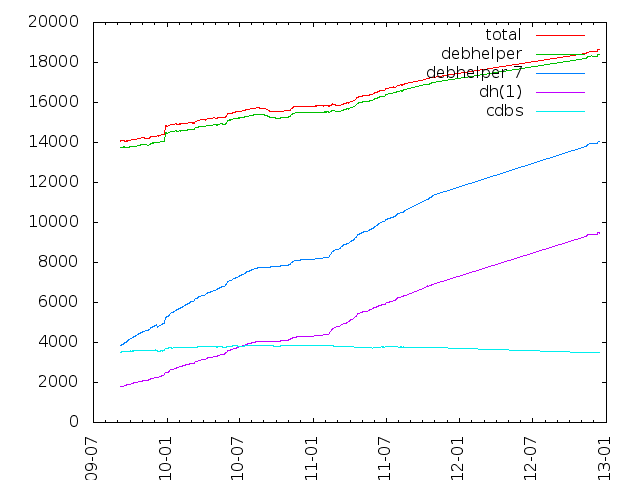
Felipe Sateler: CDBS -- An introduction

It seems the current trend is to use short-form dh. Some people have even thought that dh has superseded CDBS. Since I prefer CDBS for my own packaging, I will say that no, CDBS is not being deprecated and in fact has been active. Packaging with CDBS is very simple. I'll try to explain how it works, and how to package with it. This may turn into a blog post series, but I won't promise anything.

CDBS is a set of makefiles that do several tasks that are common while packaging software, so that you don't have to repeat them over and over on each package. The makefiles are classified into 2 groups: classes and rules. Classes implement the rules required for building and installing software. These are classes because they can and do inherit from others. For example, there is the makefile class, and the autotools, qmake and cmake classes inherit from it, and the gnome and kde (which is for kde 3) classes inherits from the autotools class. Rules implement several other general purpose rules that don't depend on the toolchain used to build the package. For example, there is the debhelper rules file, which takes care of creating the debian package using the usual dh_* commands. There are several rules files which do all sorts of useful stuff, from running license checks to downloading new upstream releases. If this post transforms into a series, we may look into some of them. For now, I'll demonstrate how to use CDBS to package some simple software (only the debian/rules file, of course).

The first task while running creating debian/rules is determining which build system the software uses. I will use qutecsound package as a guide. So, first things first, we start using CDBS!
#!/usr/bin/make -f

# Uncomment this to turn on verbose mode.
#export DH_VERBOSE=1

include /usr/share/cdbs/1/rules/debhelper.mk
include /usr/share/cdbs/1/class/qmake.mk


Now this would be all that is required if qutecsound where a standard qmake package where nothing needs to be customized. Alas, this is not the case. First, there are some variables that need to be passed to qmake to appropriately configure the build. Also, the projects .pro file is not standard-named. How do we fix this? The CDBS way of overriding this kind of behavior is through the use of variables. Since we are using the qmake class, we will be overriding variables named DEB_QMAKE_*:
DEB_QMAKE_CONFIG_VAL += build64
DEB_QMAKE_ARGS = qcs.pro


We add a configuration value (because CDBS is setting other config values), and we set the extra arguments to qmake.

Now, there is a problem: the resulting binary is not created with the name we want. How do we change that? We could patch the source to avoid that, but it is far easier to add a rule to the makefile to do that. We will modify the build to rename the file at the end (and then clean it up on clean because the upstream makefile will not spot it):
build/qutecsound::
[ -f bin/qutecsound ] mv bin/qutecsound-d bin/qutecsound

clean::
rm -f bin/qutecsound


So what did we just do? We extended the build and clean rules with extra stuff to do. In CDBS each package listed in debian/control gets a build/package rule (and several others at different stages of the build) so that one can add stuff specific to each package (this will be much more useful when dpkg finally learns about build-arch and build-indep).

For the final touch, we want to do a few more things. First, we want to ensure that we are using QT4's qmake, because the build will fail if QT3's is used. Second, since I created a manpage for the command, I want to install it. Finally, we want to use parallel building when the user has specified it, to build the project faster. How to do that? Again, via variables:
QMAKE = qmake-qt4
DEB_BUILD_PARALLEL = 1
DEB_INSTALL_MANPAGES_qutecsound = debian/qutecsound.1


CDBS creates several variables for each of the packages listed in debian/control, so we can customize each package build. In our case, this variable is passed to dh_installman from the debhelper rules file (CDBS will invoke the debhelper tools once for each binary package).

After all this we now have the complete debian/rules of a relatively simple package. How does it look like? Like this:
#!/usr/bin/make -f

# Uncomment this to turn on verbose mode.
#export DH_VERBOSE=1

include /usr/share/cdbs/1/rules/debhelper.mk
include /usr/share/cdbs/1/class/qmake.mk

QMAKE = qmake-qt4
DEB_QMAKE_CONFIG_VAL += build64
DEB_QMAKE_ARGS = qcs.pro
DEB_BUILD_PARALLEL = 1

DEB_INSTALL_MANPAGES_qutecsound = debian/qutecsound.1

build/qutecsound::
[ -f bin/qutecsound ] mv bin/qutecsound-d bin/qutecsound

clean::
rm -f bin/qutecsound

Tags: cdbs, packaging

17 December 2010

John Goerzen: KR0L: Amateur Radio, Wikis, and Linux

Since I got my amateur radio license back in July, I ve had a lot of fun with it. It s a great hobby for anyone technically-inclined or anyone socially-inclined, and between those categories that includes a lot of people. I ve learned quite a bit over the last few months and really enjoyed it all. I passed my extra class exam back this fall, and thus got my new callsign, KR0L. So long, KD0MJT. I ve enjoyed some contesting, as well as general conversations on the system. I ve also done some work with the keyboard-to-keyboard digital modes on HF. Debian includes a very nice program called fldigi for this. Of late, I have developed an interest in packet radio. Packet radio uses a networking protocol called AX.25 over RF links. AX.25 bears a familial resemblance to TCP/IP, and in fact, you can run TCP/IP over AX.25 and AX.25 over TCP/IP. My learning curve on packet was somewhat steep. It has declined in popularity significantly since the growth of generally-available Internet access, though seems to be once again growing now. So a lot of information about it is 10 years old. As I was learning about packet, I of course was using my Debian system. The Linux kernel has long had AX.25 support integrated as a first-class networking protocol. You can open AX.25 sockets, monitor AX.25 traffic, etc. from the Linux kernel. You can use soundmodem to make a software-defined packet modem (called a TNC), or you can use kissattach to hook up to a traditional TNC via a serial port and a protocol strongly similar to SLIP (which, for those of you with shorter memories, is a predecessor to PPP). Linux can do what you d expect out of a modern networking system: multiplexing with AX.25, handling lots of simultaneous users, etc. So I was a bit surprised and baffled to keep running into systems that only supported 1 user at a time, couldn t easily do some things I was taking for granted, etc. Until I realized that Linux is the only major operating system with integrated AX.25 support in the kernel. Things started to make a bit more sense. I hadn t realized just how awesome a setup I had until I started learning about the hoops some other people went through. It is pretty easy to run a basic client on Windows, but to run the server side of things as I am doing well some of the features just aren t there or are really kludgy. Anyhow, I have decided to start documenting things I learn as I go. Beyond amateur radio, I also have sometimes wanted places to stick bits of information. Things that other people might benefit from if they Google, but that maybe aren t the best blog fodder or website material. So I have set up a wiki, openly editable of course, at http://wiki.complete.org/. To date, only the amateur radio section has much content in it. I m also sending in patches and bug reports to the various projects involved in amateur radio in Linux, and am glad to see development has resumed on several of those.

Tiago Bortoletto Vaz: S o Paulo police treat street artists like criminals

This guy is very known by people who use to walk around the Paulista Avenue at night. This week Gilberto Kassab mayor of S o Paulo authorized the local police to arrest him and all other artists in order to replace them by one more crap christmas tree playing those well known depressed songs. SAD :_(
street artist treated like shit in S o Paulo - Brazil

street artist treated like shit in S o Paulo - Brazil


16 December 2010

Lars Wirzenius: Shadow of a bug

I've recently spent five days debugging a problem in obnam, my backup program. It turned out to be a bug in my B-tree implementation, which I wrote for obnam. The process was pretty long, and it might be instructive to de-brief myself. The bug manifested itself when I ran a backup test that was larger than what I had ran before: one terabyte of live data. The symptom was a key lookup problem in a B-tree. Good: the problem was entirely deterministic, and easy to reproduce. Bad: it took hours to reproduce it. My first step was to fiddle with the obnam parameters to see if I could make it fail faster, but in the same way. I got the time down to half an hour. After this, I started fiddling with the code to see if I can figure out what happens, and perhaps find a quick fix to the bug. After some hours, I realized I was being stupid. I was making essentially random changes to the code, instead of hunting down the actual cause. I had no idea what was going wrong, so trying to fix it was an act of utter stupidty. So I went back to where I had started from. The next step was to run "obnam fsck" on the failing backup store. This did not find any problems. The fsck I've written is a bit simplistic, and merely checks that for every client in the backup store, every generation is found, and within every generation each file's metadata, and data chunks are found. I will improve fsck in the future, but right now it was not helpful. I did not have a tool to verify that the actual B-trees were OK. So I wrote one. It, too, is quite simplistic, but at least it proved that the key was still present in the on-disk version of the B-tree. At this point, I did a code review of the B-tree code. It had been a some months since I'd touched the code, and hence the review brought up a bunch of minor issues: outdated comments, badly formatted code, stupid variable names, etc. One or two buglets, too, but nothing relevant to the case of the missing key. At this point I made a mistake: I concluded that the error was not in the B-tree code, but the obnam code using the B-trees. I spent the next couple of days running the test case, adding more logging, and analyzing the results. Without my mistake, I would not have ignored indicators that would have led me faster into the depths of the B-tree code. I might have saved a day or two of the process. Eventually I narrowed down the problem to a single B-tree insertion call in the obnam code. The call inserted a new value for a given key into one tree, and the value in another tree changed as well. Quite mysterious. My B-trees are an implementation of the Rodeh B-trees. All updates are done using copy-on-write, and this allows efficient cloning of trees. However, as an optimization, a node that is used by only one tree at a time can be modified in-place. This speeds things up a lot when the same tree is updated many times. In obnam, each B-tree represents a backup generation. The specific bug I was hunting was that the key I use for storing the unique identifier for a generation changed in two trees at the same time. Now that I have actually found and fixed the problem, it is clear that I should have realized at once what was happening, but I didn't, so I spent another couple of days adding logging statements into the B-tree insertion code, and tracing where things went wrong. Since B-trees are updated quite heavily by obnam, the log files grew quite big, and the test runs grew quite long. The last run I did resulted in a 94 gigabyte log file, and lasted over 12 hours. less had trouble browsing the log file, probaby due to the rather long lines generated by dumps of the B-trees. I ended up splitting the large file into quite a number of small ones, using csplit. After some more analysis, I figured out the problem: the code that shadowed a B-tree node, i.e., implemented the copy-on-write modification, failed to update the reference counts of the children of a shadowed index node. The Rodeh B-trees use lazy reference counts: when an index node is shadowed, only the immediate children get reference count updates. This turns out to work quite well, and saves quite massive amounts of updates. Unfortunately, my code was too lazy, and did not update any reference counts. After I had come this far, it only took a couple of minutes to write a unit test to catch the problem, fix the code, run the unit tests successfully, and commit. Then I ran the big test case again, without the extra logging I had added, and the code worked fine. At least it worked fine for about 24 hours until it ate up all memory in the VM I was running it on, but that's a separate problem. What can I do to prevent this kind of bug happening in the future? Unit testing didn't catch it, and I have 100% statement coverage with unit tests (not counting 19 excluded statements). Code review by other programmers would surely help. I should perhaps attract others to the project. Please excuse the length of this blog post. It is a distillation of the about ten A4-pages' worth of notes I made during this debugging process. (Always make notes when debugging. Your brain can't remember all details.)

14 December 2010

Gunnar Wolf: Copyright: Protecting who from whom?

As I'm not currently working on any suitable paper, I'll just post this to my blog so it does not completely slip off my radar ;-) Also, it might be interesting to my reader. Readers? Oh, there are two of you now? Good! Yesterday, I learnt thanks to Beatriz Busaniche that a group of South American Free Culture activists launched number zero of a magazine that promises to be very interesting: Cultura RWX, cultura en modo lectura, escritura y acci n (culture in reading, writing and action mode). Guys, best luck with this new project! Anyway, reading it, I found this asseveration I want to keep at hand:
( )cuando surge la industria musical aparecen los derechos de autor como forma de defensa de los productores musicales, espec ficamente los m sicos. No tanto frente a los usuarios, porque hasta el cassette no existi posibilidad de copiar una obra musical. Era una defensa frente a las discogr ficas, que buscaban cerrar contratos muchas veces abusivos con los artistas. M sica en Libertad: La industria musical frente al cambio de paradigma; Mat as Lennie, adaptaci n: Sebasti n Vazquez
Yes, yes, translating to English:
( )when the musical industry was born, copyright appeared as a means of defense of the musical producers, specifically of the musicians. Not so much against the users, because up until the invention of the cassette there was no possibility to copy a musical creation. It was a defense against the discographic companies, which tried to close often abusive contracts with the artists. Music in Freedom: Musical industry and the paradigm shift; Mat as Lennie, adaptation: Sebasti n V zquez
I have argued (i.e. in here) in this same line regarding the birth of copyright itself It was an arrangement that had to be made between writers and printers, back in the XVI/XVII centuries. Simple individuals were just unable to get anything of value out of the copying technology they had at hand. Copyright was born in a time where reproduction required specialized equipment. Today, massive reproduction technology is a given for a good portion of the planet's population. Copyright now only defends big corporations And will inevitably fade away as anachronic. Of course, it refuses to go without a fight... But it cannot win long-term. We cannot afford to allow it!

Theodore Ts'o: Is Nokia Doomed?

There s been a lot of discussion regarding whether or not Nokia is Doomed or not. The people who say Nokia are doomed basically point out that Nokia doesn t have any attractive products at the high end, and at the low end the margins are extremely thin. The high end products suffer from the Symbian being essentially dead (even Nokia is recommending that developers not develop native applications for Symbian, but to use Qt instead), and Nokia doesn t have much of a development community following it, and it certainly does have much in the way of 3rd party applications, either targetting Symbian or Qt at the moment. So what do I think of the whole debate between Tomi and Scoble? First of all, I think there is a huge difference in American and European assumptions and perspectives, and a big question is whether the rest of the world will end up looking more like Europe or America vis-a-vis two key areas: cost of data plans, and whether phones become much more application centric. Tomi took Apple to task in the comments section of his 2nd article for not having an SD card slot (how else would people share photos with their friends?) and for not supporting MMS in its earlier phones. My first reaction to that was: Um, isn t that what photo-sharing sites are for? Is it really that hard to attach a photo to an e-mail? And then it hit me. In Europe, data is still like MMS a few years ago a place for rapacious carriers to make way too much money. Many European telco s don t have unlimited data plans, and charge by the megabyte and even if you re lucky enough to live in a country which does have an American-like data plan, the cost of data roaming is still incredibly expensive. In contrast, in the US, I can pay $30/month for an unlimited data plan, and I can travel 2000 miles south or west and it will still be valid. Try doing that in Europe! The US had consumer-friendly data plans much earlier than Europe did, and so perhaps it s not surprising that Nokia has engineered phones that were far more optimized for the limitations caused by the Europe s Wireless carriers. The second area of debate where I think Scoble and Tomi are far apart is whether phones of the future are fundamentally about applications or well, making phone calls. Here I don t have proof that this is a fundamentally European vs. US difference, but I have my suspicions that it might be. Tomi spent a lot of time dwelling on how Nokia was much better at making phone calls (i.e., better microphones, better radios, etc). And my reaction to that was, Who cares? I rarely use my phone for making phone calls these days! And that was certainly one of the reasons why I gave up on Nokia after the E70 its contacts database was garbage! It was OK as a phone directory, but as a place for storing multiple addresses and e-mail addresses, it didn t hold a candle to the Palm PDA. And that s perhaps the key question how much is a smart phone and about being a phone , versus being a PDA (and these days I want a cloud-synchronized PDA, for my calendar, contacts, and todo lists), and how much is it about applications? This is getting long, so I think I ll save my comments about whether I think Meego will be an adequate savior for Nokia for another post. But it s worthwhile to talk here about Tomi s comments about most smartphones being much cheaper than the luxury iPhone, and so it doesn t matter that Nokia s attempt in the higher end smart phones has been a continuous history of fail. First of all, it s worth noting that there are much cheaper Android phones available on the market today, which are price-competitive with Nokia s low-end smartphones (i.e., available for free from T-Mobile in the States with a two year commitment). Secondly, the history in the computer market over the last twenty years is that features inevitably waterfall into the cheaper models, and prices will tend to drop over time as well. Apple started only with the iPod, but over time they added the iPod Nano and the iPod Shuffle. And it would not surprise me if they introduce a lower-end iPhone as well in time as well. It would shock me if they aren t experimenting with such models even as we speak, and have simply chosen not to push one out to the market yet. So even if you buy Tomi s argument that the high-end smartphones don t matter, and you only care about volume, and not about profit margins (talk to the people at Nokia that will need to be laid off to make their expenses match with their lowered revenue run rates; I bet they will care), the question is really about whether Nokia has time to execute on the Meego vision before it s too late and the current application-centric smartphone ecosystems (Android and iPhone) start eating into the lower-end smartphone segment. More on that in my next post. No related posts.

8 December 2010

Debian News: Training Session: How to Use the Bug Tracking System

As part of the Training Sessions initiative organized by the Debian Women project, this Thursday we will hold a lesson on how to use the Debian Bug Tracking System.

Like the previous sessions, this lesson will take place on #debian-women on irc.debian.org, at 19:00 UTC on Thursday 9th December.

Logs will be available immediately after the lesson at the usual place and a wiki tutorial will be created a few days later. You might want to follow our group on identi.ca for further information!

See you on Thursday!

Francesca Ciceri

7 December 2010

Gintautas Miliauskas: Windows (III): Packaging & nitpicks

(This is a part of a series of posts on my recent experience with Windows; see Windows (I) and Windows (II): User Interface.)

Every GNU/Linux desktop distribution hangs on a package management system as a foundation, and as a result the packaging systems are quite advanced, while Windows is stuck with those pesky installation wizards. There have been several stabs to implement a package system for Windows (see here), but none seem to have caught on.

There are three main disadvantages on not having good package management: tedium of manual installation, no dependency resolution and no system-wide automatic updates. In practice they are less important than it might seem. Installation wizards are indeed tedious, but in terms of time I found them to be quick enough to get through. Moreover, apps tend to be less specialized and more encompassing than Linux utilities, and as a result you do not need to install as many things as in Linux. For the same reason dependency resolution is not as important: there are few dependencies in general. As for automatic updates, most high-profile apps have integrated mechanisms to deal with that, however, I found that those mechanisms tended to result in nagging the user with messages. After a while I started ignoring the update notifications. I suspect that happens to many users.

The one thing that Windows has going for it is simplicity. You download installation binaries and you run them, and that's it. Linux package systems tend to be very complicated, and if (when) they break, you will need serious sysadmin chops to deal with the problem. Also installing specific versions (either older ones, or newer ones not yet available in the distro) of specific apps/libraries can be unnecessarily complicated, and the dependency graph limits your actions. In my experience, Windows does well enough without all this complexity as long as you don't reinstall your system too often.

As for the other complaints, I frequently run into the restriction of moving/editing files opened by another application. Coming from Linux, that one is stupidly annoying. Furthermore, it is frustrating not to be able to move inactive (or stuck) background windows. I really miss my unified filesystem namespace. Also there's quite a bit of nagging in general on Windows which I would rather do without. In the end, these are not dealbreakers though.

In my next (and probably final) post I will discuss software development on Windows.

Theodore Ts'o: Working on Technology at Startups

Richard Tibbetts has called me out for conflating Web 2.0 startups with all startups in my recent blog posting, Google has a problem retaining great engineers? Bullcrap . His complaint was that I was over generalizing from Web 2.0 startups to all startups. He s right, of course. The traditional technology startup by definition does have a large amount technology work that needs to be done, in addition to the business development work. However, things have changed a lot even for technology startups. Consider a company like Sequent Computer Systems, which started in 1983. At the time the founders had a key idea, which was to use multiple commodity intel CPU s to create first SMP, and then later, NUMA minicomputers. But in order to do that, they had to design, build and manufacture a huge mount of hardware, as well as develop a whole new Unix-derived operating system, just to bring that core idea to market. These days, the founder or founders will have a core idea, which they will hopefully patent, to prevent competitors from replicating their work, just as before. However, these days there is a huge selection of open source software so there is much less technology that needs to be re-developed / re-invented in order to bring that idea to market. From Linux and BSD at the operating system level, to databases like MySQL, Apache web servers, etc., there is an awful lot for the startup to chose from. This is all goodness, of course. But it means that most of the technology developed in a typical startup will tend to be focused on supporting the core idea that was developed by the founder. If a company is focused on databases, they probably won t be interested in supporting me to do my file system work. Why should they? There s lots of open source file systems they can use; one of them will probably meet their needs. So while it s obvious that you can do technology at large variety of companies, of different sizes, I don t think it s arrogance to say that there are certain types of technology that can only be done at Google, or maybe at a very small subset of other companies. I m pretty confident, for example, that Google has the world s largest number of computers in its various data centers around the world. That means there are certain things that don t make sense at other companies, but which absolutely makes sense at our scale. In addition, Google s business model means allows us to pursue open source projects such as Chrome and Android that wouldn t make sense at other companies. With Android in particular, it means that multiple firmware updates for any given handset model, if it causes people to use the web more and drive more advertising revenue, makes sense and so it s something we can pursue in comparison to Nokia, which gets its revenue from hardware sales, so a firmware update that extends the life of a handset is actually a bad thing for them; better to force you to upgrade an handset every year or two. So I think Richard misunderstood me if he thought I was trying to make the argument that Google is the only place where you can do interesting technical work. That s obviously not true, of course. But I do think there are many examples of technical work which don t make business sense to do at smaller companies, and startups in particular have to be very much focused on bringing the founder s idea to market, and all else has to be subordinated to that goal. And one of the most interesting developments is how the combination of commoditized and standardized hardware, and comoditized software in the form of open source, has changed the game for startups. For most startups, though, open source software is something that they will use, but not necessarily develop except in fairly small ways. Many of the economic arguments in favor of releasing code as open source, and dedicating a significant fraction of an engineer s time to serve as a OSS project maintainer or kernel subsystem maintainer, are ones that make much more sense at a very large company like Google or IBM. That s not because startups are evil, or deficient in any way; just the economic realities that at a successful startup, everything has to be subordinated to the central goal of proving that they have a sustainable, scalable business model and that they have a good product/market fit. Everything else, and that includes participating in an open source community, is very likely a distraction from that central goal. No related posts.

6 December 2010

Raphaël Hertzog: State of the Debian-Ubuntu relationship

Debian welcoming contributions from derivativesThe relationship between Debian and Ubuntu has been the subject of many vigorous debates over the years, ever since Ubuntu s launch in 2004. Six years later, the situation has improved and both projects are communicating better. The Natty Narwhal Ubuntu Developer Summit (UDS) featured like all UDS for more than 2 years a Debian Health Check session where current cooperation issues and projects are discussed. A few days after that session, Lucas Nussbaum gave a talk during the mini-Debconf Paris detailing the relationship between both projects, both at the technical and social level. He also shared some concerns for Debian s future and gave his point of view on how Debian should address them. Both events give valuable insights on the current state of the relationship. Lucas Nussbaum s Debian-Ubuntu talk Lucas started by introducing himself. He s an Ubuntu developer since 2006 and a Debian developer since 2007. He has worked to improve the collaboration between both projects, notably by extending the Debian infrastructure to show Ubuntu-related information. He attended conferences for both projects (Debconf, UDS) and has friends in both communities. For all of these reasons, he believes himself to be qualified to speak on this topic. Collaboration at the technical level He then quickly explained the task of a distribution: taking upstream software, integrating it in standardized ways, doing quality assurance on the whole, delivering the result to users, and assuring some support afterward. He pointed out that in the case of Ubuntu, the distribution has one special upstream: Debian. Indeed Ubuntu gets most of its software from Debian (89%), and only 7% are new packages coming from other upstream projects (the remaining 4% are unknown, they are newer upstream releases of software available in Debian but he was not able to find out whether the Debian packaging had been reused or not). From all the packages imported from Debian, 17% have Ubuntu-specific changes. The reasons for those changes are varied: bugfixes, integration with Launchpad/Ubuntu One/etc., or toolchain changes. The above figures are based on Ubuntu Lucid (10.04) while excluding many Ubuntu-specific packages (language-pack-*, language-support-*, kde-l10n-*, *ubuntu*, *launchpad*). The different agendas and the differences in philosophy (Debian often seeking perfect solutions to problems; Ubuntu accepting temporary suboptimal workarounds) also explain why so many packages are modified on the Ubuntu side. It s simply not possible to always do the work in Debian first. But keeping changes in Ubuntu requires a lot of work since they merge with Debian unstable every 6 months. That s why they have a strong incentive to push changes to upstream and/or to Debian. There are 3 channels that Ubuntu uses to push changes to Debian: they file bug reports (between 250 to 400 during each Ubuntu release cycle), they interact directly with Debian maintainers (often the case when there s a maintenance team), or they do nothing and hope that the Debian maintainer will pick up the patch directly from the Debian Package Tracking System (it relays information provided by patches.ubuntu.com). Lucas pointed out that those changes are not the only thing that Debian should take back. Ubuntu has a huge user base resulting in lots of bug reports sitting in Launchpad, often without anyone taking care of them. Debian maintainers who already have enough bugs on their packages are obviously not interested in even more bugs, but those who are maintaining niche packages, with few reports, might be interested by the user feedback available in Launchpad. Even if some of the reports are Ubuntu-specific, many of them are advance warnings of problems that will affect Debian later on, when the toolchain catches up with Ubuntu s aggressive updates. To make this easier for Debian maintainers, Lucas improved the Debian Package Tracking System so that they can easily get Ubuntu bug reports for their packages even without interacting with Launchpad. Human feelings on both sides Lucas witnessed a big evolution in the perception of Ubuntu on the Debian side. The initial climate was rather negative: there were feelings of its work being stolen, claims of giving back that did not match the observations of the Debian maintainers, and problems with specific Canonical employees that reflected badly on Ubuntu as a whole. These days most Debian developers find something positive in Ubuntu: it brings a lot of new users to Linux, it provides something that works for their friends and family, it brings new developers to Debian, and it serves as a technological playground for Debian. On the Ubuntu side, the culture has changed as well. Debian is no longer so scary for Ubuntu contributors and contributing to Debian is The Right Thing to do. More and more Ubuntu developers are getting involved in Debian as well. But at the package level there s not always much to contribute, as many bugfixes are only temporary workarounds. And while Ubuntu s community follows this philosophy, Canonical is a for-profit company that contributes back mainly when it has compelling reasons to do so. Consequences for Debian In Lucas s eyes, the success of Ubuntu creates new problems. For many new users Linux is a synonym for Ubuntu, and since much innovation happens in Ubuntu first, Debian is overshadowed by its most popular derivative. He goes as far as saying that because of that Debian becomes less relevant . He went on to say that Debian needs to be relevant because the project defends important values that Ubuntu does not. And it needs to stay as an independent partner that filters what comes out of Ubuntu, ensuring that quality prevails in the long term. Fixing this problem is difficult, and the answer should not be to undermine Ubuntu. On the contrary, more cooperation is needed. If Debian developers are involved sooner in Ubuntu s projects, Debian will automatically get more credit. And if Ubuntu does more work in Debian, their work can be showcased sooner in the Debian context as well. The other solution that Lucas proposed is that Debian needs to communicate on why it s better than Ubuntu. Debian might not be better for everybody but there are many reasons why one could prefer Debian over Ubuntu. He listed some of them: Debian has better values since it s a volunteer-based project where decisions are made publicly and it has advocated the free software philosophy since 1993. On the other hand, Ubuntu is under control of Canonical where some decisions are imposed, it advocates some proprietary web services (Ubuntu One), the installer recommends adding proprietary software, and copyright assignments are required to contribute to Canonical projects. Debian is also better in terms of quality because every package has a maintainer who is often an expert in the field of the package. As a derivative, Ubuntu does not have the resources to do the same and instead most packages are maintained on a best effort basis by a limited set of developers who can t know everything about all packages. In conclusion, Lucas explained that Debian can neither ignore Ubuntu nor fight it. Instead it should consider Ubuntu as a chance and should leverage it to get back in the center of the FLOSS ecosystem . The Debian health check UDS session While this session has existed for some time, it s only the second time that a Debian Project Leader was present at UDS to discuss collaboration issues. During UDS-M (the previous summit), this increased involvement from Debian was a nice surprise to many. Stefano Zacchiroli the Debian leader collected and shared the feedback of Debian developers and the session ended up being very productive. Six months later is a good time to look back and verify if decisions made during UDS-M (see blueprint) have been followed through. Progress has been made On the Debian side, Stefano set up a Derivatives Front Desk so that derivative distributions (not just Ubuntu) have a clear point of contact when they are trying to cooperate but don t know where to start. It s also a good place to share experiences among the various derivatives. In parallel, a #debian-ubuntu channel has been started on OFTC (the IRC network used by Debian). With more than 50 regulars coming from both distributions, it s a good place for quick queries when you need advice on how to interact with the distribution that you re not familiar with. Ubuntu has updated its documentation to prominently feature how to cooperate with Debian. For example, the sponsorship process documentation explains how to forward patches both to the upstream developers and to Debian. It also recommends ensuring that the patch is not Ubuntu-specific and gives some explanation on how to do it (which includes checking against a list of common packaging changes made by Ubuntu). The Debian Derivative Front Desk is mentioned as a fallback when the Debian maintainer is unresponsive. While organizing Ubuntu Developer Week, Ubuntu now reaches out to Debian developers and tries to have sessions on working with Debian . Launchpad has also been extended to provide a list of bugs with attached patches and that information has been integrated in the Debian Package Tracking system by Lucas Nussbaum. Still some work to do Some of the work items have not been completed yet: many Debian maintainers would like a simpler way to issue a sync request (a process used to inject a package from Debian into Ubuntu). There s a requestsync command line tool provided by the ubuntu-dev-tools package (which is available in Debian) but it s not yet usable because Launchpad doesn t know the GPG keys of Debian maintainers. Another issue concerns packages which are first introduced in Ubuntu. Most of them have no reason to be Ubuntu-specific and should also end up in Debian. It has thus been suggested that people packaging new software for Ubuntu also upload them to Debian. They could however immediately file a request for adoption (RFA) to find another Debian maintainer if they don t plan to maintain it in the long term. If Ubuntu doesn t make this effort, it can take a long time until someone decides to reintegrate the Ubuntu package into Debian just because nobody knows about it. This represents an important shift in the Ubuntu process and it s not certain that it s going to work out. As with any important policy change, it can take several years until people are used to it. Both issues have been rescheduled for this release cycle, so they re still on the agenda. This time the UDS session was probably less interesting than the previous one. Stefano explained once more what Debian considers good collaboration practices: teams with members from both distributions, and forwarding of bugs if they have been well triaged and are known to apply to Debian. He also invited Ubuntu to discuss big changes with Debian before implementing them. An interesting suggestion that came up was that some Ubuntu developers could participate in Debcamp (one week hack-together before Debconf) to work with some Debian developers, go through Ubuntu patches, and merge the interesting bits. This would nicely complement Ubuntu s increased presence at Debconf: for the first time, community management team member Jorge Castro was at DebConf 10 giving a talk on collaboration between Debian and Ubuntu. There was also some brainstorming on how to identify packages where the collaboration is failing. A growing number of Ubuntu revisions (identified for example by a version like 1.0-1ubuntu62) could indicate that no synchronization was made with Debian, but it would also identify packages which are badly maintained on the Debian side. If Ubuntu consistently has a newer upstream version compared to Debian, it can also indicate a problem: maybe the person maintaining the package for Ubuntu would be better off doing the same work in Debian directly since the maintainer is lagging or not doing their work. Unfortunately this doesn t hold true for all packages since many Gnome packages are newer in Ubuntu but are actively maintained on both sides. Few of those discussions led to concrete decisions. It seems most proponents are reasonably satisfied with the current situation. Of course, one can always do better and Jono Bacon is going to ensure that all Canonical teams working on Ubuntu are aware of how to properly cooperate with Debian. The goal is to avoid heavy package modifications without coordination. Conclusion The Debian-Ubuntu relationships used to be a hot topic, but that s no longer the case thanks to regular efforts made on both sides. Conflicts between individuals still happen, but there are multiple places where they can be reported and discussed (#debian-ubuntu channel, Derivatives Front Desk at derivatives@debian.org on the Debian side or debian@ubuntu.com on the Ubuntu side). Documentation and infrastructure are in place to make it easier for volunteers to do the right thing. Despite all those process improvements, the best results still come out when people build personal relationships by discussing what they are doing. It often leads to tight cooperation, up to commit rights to the source repositories. Regular contacts help build a real sense of cooperation that no automated process can ever hope to achieve.
This article was first published in Linux Weekly News. You can get my monthly summary of the Debian/Ubuntu news, all you have to do is to click here to subscribe to my free newsletter.

5 comments Liked this article? Click here. My blog is Flattr-enabled.

3 December 2010

Pau Garcia i Quiles: Hello Planet Debian

My name is Pau and I am a software developer at Arisnova, a Spanish company specialized in Linux and Windows software development for the supervision and control (SCADA) of industrial environments. In Debian, I am the maintainer of: I also happen to be a KDE developer. How s this related to Debian? You ll find very soon.

Sam Hartman: Bad Hair Day for Kerberos

Tuesday, MIT Kerberos had a bad hair day one of those days where you re looking through your hair and realize that it s turned to Medusa s snakes while you weren t looking. Apparently, since the introduction of RC4, MIT Kerberos has had significant problems handling checksums. Recall that when Kerberos talks about checksums it s conflating two things: unkeyed checksums like SHA-1 and message authentication codes like HMAC-SHA1 used with an AES key derivation. The protocol doesn t have a well defined concept of an unkeyed checksum, although it does have the concept of checksums like CRC32 that ignore their keys and can be modified by an attacker. One way of looking at it is that checksums were over-abstracted and generalized. Around the time that 3DES was introduced, there was a belief that we d have a generalized mechanism for introducing new crypto systems. By the time RFC 3961 actually got written, we d realized that we could not abstract things quite as far as we d done for 3DES. The code however was written as part of adding 3DES support. There are two major classes of problem. The first is that the 3DES (and I believe AES) checksums don t actually depend on the crypto system: they re just HMACs. They do end up needing to perform encryption operations as part of key derivation. However the code permitted these checksums to be used with any key, not just the kind of key that was intended. In a nice abstract way, the operations of the crypto system associated with the key were used rather than those of the crypto system loosely associated with the checksum. I guess that s good: feeding a 128-bit key into 3DES might kind of confuse 3DES which expects a 168-bit key. On the other hand, RC4 has a block size of 1 because it is a stream cipher. For various reasons, that means that regardless of what RC4 key you start with, if you use the 3DES checksum with that key, there are only 256 possible outpus for the HMAC. Sadly, that s not a lot of work for the attacker. To make matters worse, one of the common interfaces for choosing the right checksum to use was to enumerate through the set of available checksums and pick the first one that would accept the kind of key in question. Unfortunately, 3DES came before RC4 and there are some cases where the wrong checksum would be used. Another serious set of problems stems from the handling of unkeyed checksums. It s important to check and make sure that a received checksum is keyed if you are in a context where an attacker could have modified it. Using an md5 outside of encrypted text to integrity protect a message doesn t make sense. Some of the code was not good about checking this. What worries me most about this set of issues is how many new vulnerabilities were introduced recently. The set of things you can do with 1.6 based on these errors was significant, but not nearly as impressive as 1.7. A whole new set of attacks were added for the 1.8 release. In my mind, the most serious attack was added for the 1.7 release. A remote attacker can send an integrity-protected GSS-API token using an unkeyed checksum. Since there s no key the attacker doesn t need to worry about not knowing it. However the checksum verifies, and the code is happy to go forward. I think we need to take a close look at how we got here and what went wrong. The fact that multiple future releases made the problem worse made it clear that we produced a set of APIs where doing the worng thing is easier than doing the right thing. It seems like there is something important to fix here about our existing APIs and documentation. It might be possible to add tests or things to look for when adding new crypto systems. However I also think there is an important lesson to take away at a design level. Right now I don t know what the answers our, but I encourage the community to think closely about this issue. I m speaking about MIT Kerberos because I m familiar with the details there. However it s my understanding that the entire Kerberos community has been thinking about checksums lately, and MIT is not the only implementation with improvements to make here.

2 December 2010

Matt Zimmerman: Breathing information

I ve written previously about my reading habits, online and offline, and the patterns I extrapolate to content consumption in general. I ve been talking with other people about this as well, and am beginning to develop a model to apply to my daily life. There are plenty of unsatisfactory metaphors circulating in this area: we eat the information diet , drink from the fire hose , endure the information explosion , and so on. None of them describe the richness of my experience: the profound variations in style, texture, speed, depth and movement are lost in this kind of dry imagery. Instead, I think of it like respiration. We inhale information, and we also exhale it transformed. We do this, consciously or unconsciously, every moment of our lives. Sometimes we do it quickly, other times slowly, and it can be relaxing or stimulating. We only retain a small amount of what we take in, but it becomes a part of us. We can immerse ourselves deeply, meditatively, in a series of breaths, or fail to notice as we breathe shallowly or pause altogether. One breath may be virtually silent, the next filled with a song or a question or a piercing whistle. We maintain a balance in our breathing, and I aspire to do the same with information: reading and writing, listening and speaking, seeing and being seen. I don t mean this simplistically, that I should do both in equal proportion (imagine trying to write as many words as you read!), but doing both consistently. It is often only when I share an idea that I come to understand it deeply, no matter how much I have read about it. By writing it down, or telling someone about it, I naturally fill in the gaps in my understanding and create mental structures which help me recall and apply what I ve learned. My input and output should be balanced appropriately for my circumstances. Rapid-fire email is like hyperventilation: I can do it for a while, reading and replying in quick succession, and even feel energized by it, but if I go on for too long, I get dizzy. Running might call for a certain breathing ratio, and Yoga quite a different one. Both can be healthy practices, but they are different, and each requires focus and consistency. Another key lesson from breathing is to let go. A friend recently told me about his daily online news routine, which included closing any unread tabs at the end of the session. I will sometimes hang onto an article or a video for days or weeks before I find the opportunity to take it in. I eventually get around to most of them, but meanwhile they are taking up space and causing a continuous low level of anxiety or guilt. This information isn t going anywhere, and if it s truly significant for me, it will most likely turn up again. If it doesn t, that s OK too. Similarly, it s not wise to breathe stale, indoor air for too long. I will try to step outside regularly, and engage with people and media from outside my usual sphere. When the weather is tolerable, I ll open up the house and let plenty of fresh air circulate. This will help me avoid getting stuck in the echo chamber of my own ideas, or in groupthink. Perhaps most significantly, I will try to remember that information exchange, like breathing, is not an end in itself. It is a means to action. This will remind me to get out of my head regularly, and do something significant with what I ve learned. Ready? Breathe.

1 December 2010

Gintautas Miliauskas: Windows (II): User Interface

(This is a part of a series of posts on my recent experience with Windows. See Windows (I) for the first post.)

The Windows user interface is definitely acceptable. The charge that it is too colorful or toy-like is completely unfounded. Rather, perhaps geeks should spend less time looking at their gray Motif boxy controls. In terms of speed, the UI is generally more responsive than on Linux, though maybe less so than previous versions of Windows (that could be because my Intel video IGP is a slouch).

An interesting observation is that apps are almost as heterogeneous in terms of interface as in GNU/Linux, even though the standard controls are ubiquitous. Even apps by Microsoft can be separated into different "generations" of UI (e.g., folder windows, Control Panel, Microsoft Office). Also it is clear that generally more attention is paid to UI and usability by app developers, although perhaps not as much as in Apple products.

The greatest asset and the worst offender at the same time, by far, is the overall GUI orientation of the system. Needless to say, it aids discoverability, but reduces scripting capabilities. Problem is, even if you do not need to write scripts per se, command-line actions are useful because they can be repeated and chained very easily, using shell history. In Windows, I occasionally find myself doing much repetitive clicking that would likely be an "Alt-Tab Up Enter" (or sometimes just one key) sequence in Linux. Moreover, the lack of good standartized scripting is a huge pain during app deployments which tend be repetetive. I did not like Windows on servers before, and I do not like it now.

To be fair, my complaints about scripting capabilities may be partly moot because I have only used vanilla Windows batch files, and have not looked at all into Windows PowerShell, which is a new-generation scripting tool. The examples are fairly impressive. The language has a nice look and is clearly powerful, but also looks somewhat complicated which keeps me away until I find a good reason to learn it.

Initially I missed workspaces. The one app I found that was supposed to emulate workspaces would take several seconds to switch the workspace, so it was completely unusable. I learned to do without them rather quickly though. Actually I'm starting to think that using many workspaces is a sign that you are doing too many things at once and also they are an invitation to distraction (how many of you have a "blog reader" workspace right aside your "work" workspace, ready at your fingertips at a moment's notice?). Workspaces do have one killer feature: you can jump directly to a given workspace instead of cycling through windows. This is very useful when working with more than two apps, in which case without workspaces you are forced to think about the morphing Alt-Tab queue when switching windows.

Speaking about UI generations, I much prefer the ribbon toolbars of the new Office. The still-prevalent toolbars with zillions of old-style 32x32 (or 16x16) toolbar icons are really ugly. Typically only a few of the toolbar buttons are actually useful, and they make the user interface unnecessarily cramped and busy. The move to fewer and larger toolbar buttons is definitely on the right track.

The explorer context menus also tend to grow crazy long. Every app wants to get in there, and in the end you have a context menu that takes up half a screen vertically. Needless to say, most of those items are not used much. Sure, you can opt out during app installation, but at that time it is difficult to say how useful the context menu item will be, and there's no easy way (i.e. easier than just ignoring the cruft) to remove the entries afterwards.

In my coming posts I will cover package management and application development on Windows.

Josselin Mouette: Getting user switching to not suck

We ve come a long way since the times when you needed to configure 2 X servers in XDM just to be able to use 2 X sessions at once. However there was still some way to go until recently. A number of bugs that could be wrongly attributed to bugs in the X server or in the desktop environment were actually caused by the display manager doing crap. GDM up to 2.20 Since the introduction of the flexible X servers feature, GDM hadn t evolved much on the matter of user switching. What it used to do was pretty straightforward: It is interesting to note that VT (console) switching is purely handled by the X server. When starting, the new server switches the current VT to where it is. When exiting, it automatically switches back to the VT from which it was launched. While very simple, this idea fails to work correctly every time you try to do something more complicated than starting a temporary session for a guest and exiting it. For example, if you start two of them, there is a chance that, when the X server switches back to the console it was run from, there is nothing left running in this console, leaving you with the funny Control-Alt-Fn shortcuts to find your way back to a X server. You will also meet interesting race conditions when trying to switch back to an existing session from the login window. GDM 2.28 and above In the process of rewriting the code entirely, the GDM developers tried to address a number of those shortcomings, making use of D-Bus and ConsoleKit. The new design is slightly more complicated, however. Not killing the X server in some cases partly addresses the problems caused by letting it switch back to the original VT when exiting. However in several ways the cure is worse than the disease. Getting it to work The modular architecture of GDM makes it possible to improve the situation. (Possible but not easy because of the millefeuille of classes.) However, it is merely a band-aid unless you fix the root issue: the X server knowing better than you which VT it should switch to when exiting. Fortunately Xorg now features an option to avoid that behavior: -novtswitch. So the first step is to enable it, and let the GDM daemon (or slave) handle VT switching through ConsoleKit. With that, the following changes are possible. The result With all these changes the behavior of the display manager is finally completely consistent. Interestingly enough, this is very similar to what user switching looks like on Vista or MacOS X. So what now? These changes are stabilized for Debian squeeze, but of course it has been long overdue to get them accepted upstream, along with the very large number of Debian-specific changes that still lie in our packages.

Pietro Abate: bypassing the apt-get solver

Here at mancoosi we have been working for quite a while to promote and advance solver technology for FOSS distributions. We are almost at the end of the project and it is important to make the mancoosi technology relevant for the community. On goal of the project is to provide a prototype that uses part of the results of mancoosi that can based to install/remove/upgrade packages on a user machine. We certainly don't want to create yet another meta installer. This would be very time consuming and certainly going beyond the scope of the project. The idea is to create a prototype, that can work as an apt-get drop in replacement that will allow everybody to play with different solvers and installation criteria. A very first integration step is a small shell script apt-mancoosi that tries to put together different tools that we have implemented during the project. Roberto wrote extensively about his experience with apt-mancoosi a while ago showing that somehow the mancoosi tools are already usable, as proof of concept, to experiment with all solvers participating to the Misc competition. On notable obstacle we encountered with apt-mancoosi is how to pipe the result of an external solver to apt-get to effectively install the packages proposed as solution. Apt-mancoosi fails to be a drop-in replacement for apt-get exactly for this reason. The "problem" is quite simple : The idea at the beginning was to pass to apt-get, on the command line, a request that effectively represents a complete solution. We expected that, since this was already a locked-down solution, apt-get would have just installed all packages without any further modification to the proposed installation set. Of course, since apt-get is designed to satisfy a user request, and not just to install packages, we quickly realized that our evil plan was doomed to failure. The only option left, was to use libapt directly, but the idea of programming in c++ quickly made me to desist. After a bit of research (not that much after all), I finally found a viable solution to our problems in ''python-apt'' that is a low level and wrapper around libapt. This definitely made my day. Now the juicy details. the problem was to convince apt to completely bypass the solver part and just call the installer. First a small intro. python-apt has an extensive documentation with a couple of tutorials. Using python-apt is actually pretty easy (some snippet from the python-apt doco) :
import apt

# First of all, open the cache
cache = apt.Cache()
# Now, lets update the package list
cache.update()
here we open the cache (apt.Cache is a wrapper around the low level binding in the apt_pkg module), then we update the package list. This is equivalent to apt-get update . Installing a package is equally easy :
import apt
cache = apt.Cache()
pkg = cache['python-apt']

# Mark python-apt for install
pkg.mark_install()

# Now, really install it
cache.commit()
Now, the method mark_install of the module package will effectively run the solver to resolve and mark all the dependencies of the package python-apt. This is the default behavior when apt-get is used on the command line. This method has however three optional arguments that are just what I was looking for, that is autoFix, autoInst and fromUser . The explanation from the python-apt doco is quite clear.
mark_install(*args, **kwds)
Mark a package for install.
If autoFix is True, the resolver will be run, trying to fix broken packages. This is the default.
If autoInst is True, the dependencies of the packages will be installed automatically. This is the default.
If fromUser is True, this package will not be marked as automatically installed. This is the default. Set it to False if you want to be able to automatically remove the package at a later stage when no other package depends on it.
What we want is to set autoFix and autoInst to false to completely bypass the solver. So imagine that an external solver can give use a string of the form : bash+ dash=1.4 baobab- that basically asks to install bash to the newest version, dash at version 1.4 and remove baobab. Suppose also that this is a complete solution, that is, all dependencies are satisfied and there are no conflicts. The work flow of mpm (mancoosi package manager) is as follows : We already have a first prototype on the mancoosi svn. It's not released yet as we are waiting to do more testing, add more options and make it stable enough for testing. Maybe one day, this will be uploaded to debian. This is the trace of a successful installation of a package in a lenny chroot. The solver used here is the p2 solver
dev:~/mpm# ./mpm.py -c apt.conf install baobab
Running p2cudf-paranoid-1.6 solver ...
Validate solution ...
loading CUDF ...
loading solution ...
Summary of proposed changes:
new: 30
removed: 0
replaced: 0
upgraded: 0
downgraded: 0
unsatisfied recommends:: 8
changed: 30
uptodate: 322
notuptodate: 116

New packages: baobab (2.30.0-2) dbus-x11 (1.2.24-3) gconf2 (2.28.1-5)
gconf2-common (2.28.1-5) gnome-utils-common (2.30.0-2)
libatk1.0-0 (1.30.0-1) libcairo2 (1.8.10-6) libdatrie1 (0.2.4-1)
libdbus-glib-1-2 (0.88-2) libgconf2-4 (2.28.1-5) libgtk2.0-0 (2.20.1-2)
libgtk2.0-common (2.20.1-2) libgtop2-7 (2.28.1-1) libgtop2-common (2.28.1-1)
libidl0 (0.8.14-0.1) libjasper1 (1.900.1-7+b1) liborbit2 (1:2.14.18-0.1)
libpango1.0-0 (1.28.3-1) libpango1.0-common (1.28.3-1)
libpixman-1-0 (0.16.4-1) libthai-data (0.1.14-2) libthai0 (0.1.14-2)
libtiff4 (3.9.4-5) libxcb-render-util0 (0.3.6-1) libxcb-render0 (1.6-1)
libxcomposite1 (1:0.4.2-1) libxcursor1 (1:1.1.10-2) libxrandr2 (2:1.3.0-3)
psmisc (22.11-1) shared-mime-info (0.71-3)
Removed packages:
Replaced packages:
Upgraded packages:

Selecting previously deselected package libatk1.0-0.
(Reading database ... 28065 files and directories currently installed.)
Unpacking libatk1.0-0 (from .../libatk1.0-0_1.30.0-1_i386.deb) ...
Selecting previously deselected package libpixman-1-0.
Unpacking libpixman-1-0 (from .../libpixman-1-0_0.16.4-1_i386.deb) ...
Selecting previously deselected package libxcb-render0.
Unpacking libxcb-render0 (from .../libxcb-render0_1.6-1_i386.deb) ...
Selecting previously deselected package libxcb-render-util0.
Unpacking libxcb-render-util0 (from .../libxcb-render-util0_0.3.6-1_i386.deb) ...
Selecting previously deselected package libcairo2.
Unpacking libcairo2 (from .../libcairo2_1.8.10-6_i386.deb) ...
Selecting previously deselected package libdbus-glib-1-2.
Unpacking libdbus-glib-1-2 (from .../libdbus-glib-1-2_0.88-2_i386.deb) ...
Selecting previously deselected package libidl0.
Unpacking libidl0 (from .../libidl0_0.8.14-0.1_i386.deb) ...
Selecting previously deselected package liborbit2.
Unpacking liborbit2 (from .../liborbit2_1%3a2.14.18-0.1_i386.deb) ...
Selecting previously deselected package gconf2-common.
Unpacking gconf2-common (from .../gconf2-common_2.28.1-5_all.deb) ...
Selecting previously deselected package libgconf2-4.
Unpacking libgconf2-4 (from .../libgconf2-4_2.28.1-5_i386.deb) ...
Selecting previously deselected package libgtk2.0-common.
Unpacking libgtk2.0-common (from .../libgtk2.0-common_2.20.1-2_all.deb) ...
Selecting previously deselected package libjasper1.
Unpacking libjasper1 (from .../libjasper1_1.900.1-7+b1_i386.deb) ...
Selecting previously deselected package libpango1.0-common.
Unpacking libpango1.0-common (from .../libpango1.0-common_1.28.3-1_all.deb) ...
Selecting previously deselected package libdatrie1.
Unpacking libdatrie1 (from .../libdatrie1_0.2.4-1_i386.deb) ...
Selecting previously deselected package libthai-data.
Unpacking libthai-data (from .../libthai-data_0.1.14-2_all.deb) ...
Selecting previously deselected package libthai0.
Unpacking libthai0 (from .../libthai0_0.1.14-2_i386.deb) ...
Selecting previously deselected package libpango1.0-0.
Unpacking libpango1.0-0 (from .../libpango1.0-0_1.28.3-1_i386.deb) ...
Selecting previously deselected package libtiff4.
Unpacking libtiff4 (from .../libtiff4_3.9.4-5_i386.deb) ...
Selecting previously deselected package libxcomposite1.
Unpacking libxcomposite1 (from .../libxcomposite1_1%3a0.4.2-1_i386.deb) ...
Selecting previously deselected package libxcursor1.
Selecting previously deselected package libxrandr2.
Unpacking libxrandr2 (from .../libxrandr2_2%3a1.3.0-3_i386.deb) ...
Selecting previously deselected package shared-mime-info.
Unpacking shared-mime-info (from .../shared-mime-info_0.71-3_i386.deb) ...
Selecting previously deselected package libgtk2.0-0.
Unpacking libgtk2.0-0 (from .../libgtk2.0-0_2.20.1-2_i386.deb) ...
Selecting previously deselected package libgtop2-common.
Unpacking libgtop2-common (from .../libgtop2-common_2.28.1-1_all.deb) ...
Selecting previously deselected package libgtop2-7.
Unpacking libgtop2-7 (from .../libgtop2-7_2.28.1-1_i386.deb) ...
Selecting previously deselected package psmisc.
Unpacking psmisc (from .../psmisc_22.11-1_i386.deb) ...
Selecting previously deselected package dbus-x11.
Unpacking dbus-x11 (from .../dbus-x11_1.2.24-3_i386.deb) ...
Selecting previously deselected package gconf2.
Unpacking gconf2 (from .../gconf2_2.28.1-5_i386.deb) ...
Selecting previously deselected package gnome-utils-common.
Unpacking gnome-utils-common (from .../gnome-utils-common_2.30.0-2_all.deb) ...
Selecting previously deselected package baobab.
Unpacking baobab (from .../baobab_2.30.0-2_i386.deb) ...
Processing triggers for man-db ...
Setting up libatk1.0-0 (1.30.0-1) ...
Setting up libpixman-1-0 (0.16.4-1) ...
Setting up libxcb-render0 (1.6-1) ...
Setting up libxcb-render-util0 (0.3.6-1) ...
Setting up libcairo2 (1.8.10-6) ...
Setting up libdbus-glib-1-2 (0.88-2) ...
Setting up libidl0 (0.8.14-0.1) ...
Setting up liborbit2 (1:2.14.18-0.1) ...
Setting up gconf2-common (2.28.1-5) ...

Creating config file /etc/gconf/2/path with new version
Setting up libgconf2-4 (2.28.1-5) ...
Setting up libgtk2.0-common (2.20.1-2) ...
Setting up libjasper1 (1.900.1-7+b1) ...
Setting up libpango1.0-common (1.28.3-1) ...
Cleaning up font configuration of pango...
Updating font configuration of pango...
Cleaning up category xfont..
Updating category xfont..
Setting up libdatrie1 (0.2.4-1) ...
Setting up libthai-data (0.1.14-2) ...
Setting up libthai0 (0.1.14-2) ...
Setting up libpango1.0-0 (1.28.3-1) ...
Setting up libtiff4 (3.9.4-5) ...
Setting up libxcomposite1 (1:0.4.2-1) ...
Setting up libxcursor1 (1:1.1.10-2) ...
Setting up libxrandr2 (2:1.3.0-3) ...
Setting up shared-mime-info (0.71-3) ...
Setting up libgtk2.0-0 (2.20.1-2) ...
Setting up libgtop2-common (2.28.1-1) ...
Setting up libgtop2-7 (2.28.1-1) ...
Setting up psmisc (22.11-1) ...
Setting up dbus-x11 (1.2.24-3) ...
Setting up gconf2 (2.28.1-5) ...
update-alternatives: using /usr/bin/gconftool-2 to provide /usr/bin/gconftool (gconftool) in auto mode.
Setting up gnome-utils-common (2.30.0-2) ...
Setting up baobab (2.30.0-2) ...
Broken: 0
InstCount: 30
DelCount: 0
dev:~/mpm#
I think we'll keep working on this python prototype for a while, but this is not certainly what we want to propose to the community. The mancoosi package manager is probably going to be written in Ocaml and integrated with dose3 and libcudf. This will allow us to gain speed and have a solid language to develop with (nothing against python, but we don't feel that a scripting language is suitable for an essential component as a package manager). Time will tell. For the moment this is just vapor-ware ...

Michal Čihař: Cleanup of personal Debian repository

When I accidentally looked at my personal Debian repository, I realized that it is time to remove obsolete things from it. There were packages for polld, for which which I don't see need anymore (it is now properly handled by kernel), hacked acpid packages, which were doing special things for Toshiba M30 notebook (which I don't use with Linux anymore and nobody else probably knew about these packages) or wmmp, a Window Maker applet for MPD, which I haven't used for quite a long time. All those are gone now and I don't think anybody will miss them (if you do, please tell me). What stayed there are daily snapshots of dictionaries for StarDict and gnaughty package, which was rejected as possibly causing troubles.

Filed under: Debian 0 comments Flattr this!

30 November 2010

Debian News: Training Session on Python Packaging

As part of the Training Sessions initiative organized by the Debian Women project, this week a lesson about Python packaging will be held. The lesson, which is aimed at an intermediate audience, will focus specifically modules and applications packaging and will be held by Piotr O arowski who is member of Python Applications Packaging Team and Debian Python Modules Team.

The session will take place, as usual, on #debian-women channel on irc.debian.org on Thursday, 2nd December at 20:00 UTC.

Cause of the advanced topic is madatory to have some knowledge about Debian packaging (see, for example Lars Wirzenius tutorial) and about general Python development.

The lesson will consists of a first, theoretical, part in wich Piotr will explain us some basics; and of a Q&A part, entirely dedicated to more advanced problems.

See you on Thursday!

Francesca Ciceri

Next.

Previous.