Search Results: "ron"

29 July 2017

Robert McQueen: Hello again!

Like all good blog posts, this one starts with an apology about not blogging for ages in my case it looks like it s been about 7 years which is definitely a new personal best (perhaps the equally or more remarkable thing is that I have diligently kept WordPress running in the meantime). In that time, as you might expect, a few things have happened, like I met a wonderful woman and fell in love and we have two wonderful children. I also decided to part ways with my first baby and leave my role as CTO & co-founder of Collabora. This was obviously a very tough decision it s a fantastic team where I met and made many life-long friends, and they are still going strong and doing awesome things with Open Source. However, shortly after that, in February last year, I was lucky enough to land what is basically a dream job working at Endless Computers as the VP of Deployment. As I m sure most readers know, Endless is building an OS to bring personal computing to millions of new users across the world. It s based on Free Software like GNOME, Debian, ostree and Flatpak, and the more successful Endless is, the more people who get access to education, technology and opportunity and the more FOSS users and developers there will be in the world. But in my role, I get to help define the product, understand our users and how technology might help them, take Open Source out to new people, solve commercial problems to get Endless OS out into the world, manage a fantastic team and work with bright people, learn from great managers and mentors, and still find time to squash bugs, review and write more code than I used to. Like any startup, we have a lot to do and not enough time to do it, so although there aren t quite enough days in the week, I m really happy! In any case, the main point of this blog post is that I m at GUADEC in Manchester right now, and I d like to blog about Flathub, but I thought it would be weird to just show up and say that after 7 years of silence without saying hello again.

28 July 2017

Steve Kemp: So I'm considering a new project

In the past there used to be a puppet-labs project called puppet-dashboard, which would let you see the state of your managed-nodes. Having even a very basic and simple "report user-interface" is pretty neat when you're pushing out a change, and you want to see it be applied across your fleet of hosts. There are some other neat features, such as allowing you to identify failures easily, and see nodes that haven't reported-in recently. This was spun out into a community-supported project which is largely stale: Having a dashboard is nice, but the current state of the software is less good. It turns out that the implementation is pretty simple though: The reporting node can thus receive real-time updates, and do what it wants with them. You can even sidestep the extra server if you wish: For example on my puppet-master I have this:
  root@master /var/lib/puppet/reports # ls   tail -n4
  smaug.dh.bytemark.co.uk
  ssh.steve.org.uk
  www.dns-api.com
  www.steve.org.uk
Inside each directory is a bunch of YAML files which describe the state of the host, and the recipes that were applied. Parsing those is pretty simple, the hardest part would be making a useful/attractive GUI. But happily we have the existing one to "inspire" us. I think I just need to write down a list of assumptions and see if they make sense. After all the existing installation(s) won't break, it's just a matter of deciding whether it is useful/worthwhile way to spend some time. Beyond that you might want to export data about the managed-nodes themselves. For example you might want a list of all the hosts which have "bash" installed on them. Or "All nodes with local user "steve"." I've written that stuff already, as it is very useful for auditing & etc. The hard part about that is that to get the extra data you'll need to include a puppet module to collect it. I suspect a new dashboard would be broadly interesting/useful but unless you have that extra detail it might not be so useful. You can't point to a slightly more modern installation and say "Yes this is worth migrating to". But if you have extra meta-data you can say: And that facility is very useful when you have shellshock, or similar knocking at your door. Anyway as a hacky start I wrote some code to parse reports, avoiding the magic object-fu that the YAML would usually invoke. The end result is this:
 root@master ~# dump-run www.steve.org.uk
 www.steve.org.uk
    Puppet Version: 4.8.2
    /var/lib/puppet/reports/www.steve.org.uk/201707291813.yaml
    Runtime: 2.16
    Status:changed
    Time:2017-07-29 18:13:04 +0000
    Resources
            total -> 176
            skipped -> 2
            failed -> 0
            changed -> 3
            out_of_sync -> 3
            scheduled -> 0
            corrective_change -> 3
    Changed Resources
            Ssh_authorized_key[skx@shelob-s-fi] /etc/puppet/code/environments/production/modules/ssh_keys/manifests/init.pp:17
            Ssh_authorized_key[skx@deagol-s-fi] /etc/puppet/code/environments/production/modules/ssh_keys/manifests/init.pp:22
            Ssh_authorized_key[steve@ssh.steve.org.uk-s-fi] /etc/puppet/code/environments/production/modules/ssh_keys/manifests/init.pp:27
    Skipped Resources
            Exec[clone sysadmin utils]
            Exec[update sysadmin utils]

NOKUBI Takatsugu: uim package integraion is working in progress

Now I am helping to maintain uim-package. It is splited into too many packages (over 40, including dbgsym). Working status is written as the debian wiki entry https://wiki.debian.org/JapaneseEnvironment/Uim. Currentry it is not finished, when I ve done all of them, I ll upload them to experimental.

27 July 2017

Joachim Breitner: Coinduction in Coq and Isabelle

The DeepSpec Summer School is almost over, and I have had a few good discussions. One revolved around coinduction: What is it, how does it differ from induction, and how do you actually prove something. In the course of the discussion, I came up with a very simple coinductive exercise, and solved it both in Coq and Isabelle

The task Define the extended natural numbers coinductively. Define the min function and the relation. Show that min(n, m) n holds.

Coq The definitions are straight forward. Note that in Coq, we use the same command to define a coinductive data type and a coinductively defined relation:
CoInductive ENat :=
    N : ENat
    S : ENat -> ENat.
CoFixpoint min (n : ENat) (m : ENat)
  :=match n, m with   S n', S m' => S (min n' m')
                      _, _       => N end.
CoInductive le : ENat -> ENat -> Prop :=
    leN : forall m, le N m
    leS : forall n m, le n m -> le (S n) (S m).
The lemma is specified as
Lemma min_le: forall n m, le (min n m) n.
and the proof method of choice to show that some coinductive relation holds, is cofix. One would wish that the following proof would work:
Lemma min_le: forall n m, le (min n m) n.
Proof.
  cofix.
  destruct n, m.
  * apply leN.
  * apply leN.
  * apply leN.
  * apply leS.
    apply min_le.
Qed.
but we get the error message
Error:
In environment
min_le : forall n m : ENat, le (min n m) n
Unable to unify "le N ?M170" with "le (min N N) N
Effectively, as Coq is trying to figure out whether our proof is correct, i.e. type-checks, it stumbled on the equation min N N = N, and like a kid scared of coinduction, it did not dare to run the min function. The reason it does not just run a CoFixpoint is that doing so too daringly might simply not terminate. So, as Adam explains in a chapter of his book, Coq reduces a cofixpoint only when it is the scrutinee of a match statement. So we need to get a match statement in place. We can do so with a helper function:
Definition evalN (n : ENat) :=
  match n with   N => N
                 S n => S n end.
Lemma evalN_eq : forall n, evalN n = n.
Proof. intros. destruct n; reflexivity. Qed.
This function does not really do anything besides nudging Coq to actually evaluate its argument to a constructor (N or S _). We can use it in the proof to guide Coq, and the following goes through:
Lemma min_le: forall n m, le (min n m) n.
Proof.
  cofix.
  destruct n, m; rewrite <- evalN_eq with (n := min _ _).
  * apply leN.
  * apply leN.
  * apply leN.
  * apply leS.
    apply min_le.
Qed.

Isabelle In Isabelle, definitions and types are very different things, so we use different commands to define ENat and le:
theory ENat imports  Main begin
codatatype ENat =  N   S  ENat
primcorec min where
   "min n m = (case n of
       N   N
       S n'   (case m of
        N   N
        S m'   S (min n' m')))"
coinductive le where
  leN: "le N m"
  leS: "le n m   le (S n) (S m)"
There are actually many ways of defining min; I chose the one most similar to the one above. For more details, see the corec tutorial. Now to the proof:
lemma min_le: "le (min n m) n"
proof (coinduction arbitrary: n m)
  case le
  show ?case
  proof(cases n)
    case N then show ?thesis by simp
  next
    case (S n') then show ?thesis
    proof(cases m)
      case N then show ?thesis by simp
    next
      case (S m')  with  n = _  show ?thesis
        unfolding min.code[where n = n and m = m]
        by auto
    qed
  qed
qed
The coinduction proof methods produces this goal:
proof (state)
goal (1 subgoal):
 1.  n m. ( m'. min n m = N   n = m')  
          ( n' m'.
               min n m = S n'  
               n = S m'  
	       (( n m. n' = min n m   m' = n)   le n' m'))
I chose to spell the proof out in the Isar proof language, where the outermost proof structure is done relatively explicity, and I proceed by case analysis mimiking the min function definition. In the cases where one argument of min is N, Isabelle s simplifier (a term rewriting tactic, so to say), can solve the goal automatically. This is because the primcorec command produces a bunch of lemmas, one of which states n = N m = N min n m = N. In the other case, we need to help Isabelle a bit to reduce the call to min (S n) (S m) using the unfolding methods, where min.code contains exactly the equation that we used to specify min. Using just unfolding min.code would send this method into a loop, so we restrict it to the concrete arguments n and m. Then auto can solve the remaining goal (despite all the existential quantifiers).

Summary Both theorem provers are able to prove the desired result. To me it seems that it is slightly more convenient in Isabelle because a lot of Coq infrastructure relies on the type checker being able to effectively evaluate expressions, which is tricky with cofixpoints, wheras evaluation plays a much less central role in Isabelle, where rewriting is the crucial technique, and while one still cannot simply throw min.code into the simpset, so working with objects that do not evaluate easily or completely is less strange.

Agda I was challenged to do it in Agda. Here it is:
module ENat where
open import Coinduction
data ENat : Set where
  N : ENat
  S :   ENat   ENat
min : ENat   ENat   ENat
min (S n') (S m') = S (  (min (  n') (  m')))
min _ _ = N
data le : ENat   ENat   Set where
  leN :    m    le N m
  leS :    n m      (le (  n) (  m))   le (S n) (S m)
min_le :    n m    le (min n m) n
min_le  S n'   S m'  = leS (  min_le)
min_le  N      S m'  = leN
min_le  S n'   N  = leN
min_le  N      N  = leN
I will refrain from commenting it, because I do not really know what I have been doing here, but it typechecks, and refer you to the official documentation on coinduction in Agda. But let me note that I wrote this using plain inductive types and recursion, and added , and until it worked.

26 July 2017

Thomas Lange: Building a Debian Live CD with FAI

In this wiki entry, I describe how to extend a FAI nfsroot, so it can be used as a file system for a diskless client or a Live CD. A host can mount it via NFS when booting via PXE. You can create a Live CD easily by using the command fai-cd. This works also nicely with a Xfce desktop, and I've prepared a ISO image for easy testing. You can log in as user demo, and the password is fai. The next thing is to check, if we can use FAI's dirinstall or install method for creating the same environment, so it will be easy to create customized Live images. FAI

25 July 2017

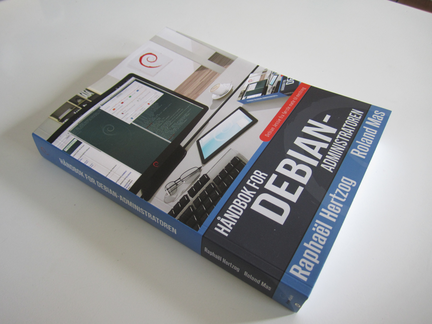
Petter Reinholdtsen: Norwegian Bokm l edition of Debian Administrator's Handbook is now available

I finally received a copy of the Norwegian Bokm l edition of "The Debian Administrator's Handbook". This test copy arrived in the mail a few days ago, and I am very happy to hold the result in my hand. We spent around one and a half year translating it. This paperbook edition is available from lulu.com. If you buy it quickly, you save 25% on the list price. The book is also available for download in electronic form as PDF, EPUB and Mobipocket, as can be read online as a web page. This is the second book I publish (the first was the book "Free Culture" by Lawrence Lessig in English, French and Norwegian Bokm l), and I am very excited to finally wrap up this project. I hope "H ndbok for Debian-administratoren" will be well received.

24 July 2017

Norbert Preining: Garmin fenix 5x broken by design

Some month ago I upgrade my (European) fenix3 to a (Japanese) fenix 5x, looking forward to the built-in maps as well as support for Japanese. I was about to write a great review, how content I have been with the fenix 3 and how much better the 5x is. Well, until I realized that Garmin s engineers seem to be brain-damaged and shipping broken by design devices: Just one word: Set an alarm on the watch, and wonder .. because you will never wake up the next day, since the alarm was deleted due to an unattended (so-called) sync operation. Happened to me, several times, worst was when I was with clients working as guide. So the problem is well known, see this link and this link and this link, and it is not restricted to the fenix. The origin of the problem is that Garmin is incapable of implementing a synchronization protocol. They have three sources of data: The Connect website, the Connect application on the smartphone, and the watch itself. And interestingly they only do pushes from Web to application to device, overwriting settings on the lower end. Which means, any alarm that I create on the watch will be overwritten, ie deleted, on every sync sorry, not sync, on every forced push from the mobile. It is a bit depressing, but I think the urgent solution is to exempt alarms from the synchronization completely, and remove them from both the connect web page and the application, until a better, a real, synchronization is implemented. I found a work-around in one of the threads on the Garmin forum, that is: create an alarm on the web or application, better alarms for each of the times you might need it. These will be synced to the device, and can be activated/deactivated on the device without problems. But to be honest this is not a solution I can really trust in when I need to get up in the morning. Besides this issue, which is unfortunately rather severe a restriction for me as mountaineer and mountain guide, I really love the watch and will write a more detailed review soon.

Jonathan McDowell: Learning to love Ansible

This post attempts to chart my journey towards getting usefully started with Ansible to manage my system configurations. It s a high level discussion of how I went about doing so and what I got out of it, rather than including any actual config snippets - there are plenty of great resources out there that handle the actual practicalities of getting started much better than I could. I ve been convinced about the merits of configuration management for machines for a while now; I remember conversations about producing an appropriate set of recipes to reproduce our haphazard development environment reliably over 4 years ago. That never really got dealt with before I left, and as managing systems hasn t been part of my day job since then I never got around to doing more than working my way through the Puppet Learning VM. I do, however, continue to run a number of different Linux machines - a few VMs, a hosted dedicated server and a few physical machines at home and my parents . In particular I have a VM which handles my parents email, and I thought that was a good candidate for trying to properly manage. It s backed up, but it would be nice to be able to redeploy that setup easily if I wanted to move provider, or do hosting for other domains in their own VMs. I picked Ansible, largely because I wanted something lightweight and the agentless design appealed to me. All I really need to do is ensure Python is on the host I want to manage and everything else I can bootstrap using Ansible itself. Plus it meant I could use the version from Debian testing on my laptop and not require backports on the stable machines I wanted to manage. My first attempt was to write a single Ansible YAML file which did all the appropriate things for the email VM; installed Exim/Apache/Roundcube, created users, made sure the appropriate SSH keys were in place, installed configuration files, etc, etc. This did the job, but I found myself thinking it was no better than writing a shell script to do the same things. Things got a lot better when instead of concentrating on a single host I looked at what commonality was shared between hosts. I started with simple things; Debian is my default distro so I created an Ansible role debian-system which configured up APT and ensured package updates were installed. Then I added a task to setup my own account and install my SSH keys. I was then able to deploy those 2 basic steps across a dozen different machine instances. At one point I got an ARM64 VM from Scaleway to play with, and it was great to be able to just add it to my Ansible hosts file and run the playbook against it to get my basic system setup. Adding email configuration got trickier. In addition to my parents email VM I have my own email hosted elsewhere (along with a whole bunch of other users) and the needs of both systems are different. Sitting down and trying to manage both configurations sensibly forced me to do some rationalisation of the systems, pulling out the commonality and then templating the differences. Additionally I ended up using the lineinfile module to edit the Debian supplied configurations, rather than rolling out my own config files. This helped ensure more common components between systems. There were also a bunch of differences that had grown out of the fact each system was maintained by hand - I had about 4 copies of each Let s Encrypt certificate rather than just putting one copy in /etc/ssl and pointing everything at that. They weren t even in the same places on different systems. I unified these sorts of things as I came across them. Throughout the process of this rationalisation I was able to easily test using containers. I wrote an Ansible role to create systemd-nspawn based containers, doing all of the LVM + debootstrap work required to produce a system which could then be managed by Ansible. I then pointed the same configuration as I was using for the email VM at this container, and could verify at each step along the way that the results were what I expected. It was still a little nerve-racking when I switched over the live email config to be managed by Ansible, but it went without a hitch as hoped. I still have a lot more configuration to switch to being managed by Ansible, especially on the machines which handle a greater number of services, but it s already proved extremely useful. To prepare for a jessie to stretch upgrade I fired up a stretch container and pointed the Ansible config at it. Most things just worked and the minor issues I was able to fix up in that instance leaving me confident that the live system could be upgraded smoothly. Or when I want to roll out a new SSH key I can just add it to the Ansible setup, and then kick off an update. No need to worry about whether I ve updated it everywhere, or correctly removed the old one. So I m a convert; things were a bit more difficult by starting with existing machines that I didn t want too much disruption on, but going forward I ll be using Ansible to roll out any new machines or services I need, and expect that I ll find that new deployment to be much easier now I have a firm grasp on the tools available.

Jonathan Carter: Plans for DebCamp17

In a few days, I ll be attending DebCamp17 in Montr al, Canada. Here are a few things I plan to pay attention to:

23 July 2017

Norbert Preining: Gaming: Refunct

A lovely little game, Refunct, just crossed my Steam installation. A simple platformer developed with much love. The game play consists of reviving a lost area by stepping on towers, finding buttons, and making more towers appear through this. The simple game play idea is enriched with wonderful lightening due to the movement of the sun. I really enjoyed the changing of environment and mood that was created by this effect.
Although not terrible useful by now, one can also swim and dive and enjoy the world from below, which is just an added nice bonus.
The game is currently (till Monday night as far as I see) on sale on Steam for 149 Yen, i.e., slightly above a Euro/Dollar. Well worth the investment for about 1h of game play. Addition: The fastest run at the moment is at 2:46.57, that is under 3min! I managed barely under 25min. Incredible.

22 July 2017

Norbert Preining: Making fun of Trump thanks France

I mean, it is easy to make fun of Trump, he is just too stupid and incapable and uneducated. But what the French president Emmanuel Macron did on Bastille Day, in presence of the usual Trumpies, was just above the usual level of making fun of Trump. The French made Trump watch a French band playing a medley of Daft Punk. And as we know Trump seemed to be very unimpressed, most probably because he doesn t have a clue. I mean, normally you play these pathetic rubbish, look at the average US (or Chinese or North Korean) parades, and here we have the celebration of an event much older then anything the US can put on the table, and they are playing Daft Punk! France, thanks. You made my day actually not only one!

21 July 2017

Michal &#268;iha&#345;: Making Weblate more secure and robust

Having publicly running web application always brings challenges in terms of security and in generally in handling untrusted data. Security wise Weblate has been always quite good (mostly thanks to using Django which comes with built in protection against many vulnerabilities), but there were always things to improve in input validation or possible information leaks. When Weblate has joined HackerOne (see our first month experience with it), I was hoping to get some security driven core review, but apparently most people there are focused on black box testing. I can certainly understand that - it's easier to conduct and you need much less knowledge of the tested website to perform this. One big area where reports against Weblate came in was authentication. Originally we were mostly fully relying on default authentication pipeline coming with Python Social Auth, but that showed some possible security implications and we ended up with having heavily customized authentication pipeline to avoid several risks. Some patches were submitted back, some issues reported, but still we've diverged quite a lot in this area. Second area where scanning was apparently performed, but almost none reports came, was input validation. Thanks to excellent XSS protection in Django nothing was really found. On the other side this has triggered several internal server errors on our side. At this point I was really happy to have Rollbar configured to track all errors happening in the production. Thanks to having all such errors properly recorded and grouped it was really easy to go through them and fix them in our codebase. Most of the related fixes have landed in Weblate 2.14 and 2.15, but obviously this is ongoing effort to make Weblate better with every release.

Filed under: Debian English SUSE Weblate

20 July 2017

Norbert Preining: The poison of academia.edu

All those working in academics or research have surely heard about academia.edu. It started out as a service for academics, in their own words:
Academia.edu is a platform for academics to share research papers. The company s mission is to accelerate the world s research.
But as with most of these platforms, they need to get money, and since some months now academia.edu is pressing users to pay into a premium account at the incredible rate of 8.25USD per month. This is about he same you pay for Netflix, or some other streaming service. If you remain on the free side, what remains for you to do is SNS-like stuff, and uploading your papers so that academia.edu can make money from it. What I am really surprised that they can pull this of at a .edu domain. The registry requirements state
For Institutions Within the United States. To obtain an Internet name in the .edu domain, your institution must be a postsecondary institution that is institutionally accredited by an agency on the U.S. Department of Education s list of Nationally Recognized Accrediting Agencies (see recognized accrediting bodies).
Educause web site
Seeing what they are doing I think it is high time to request removal of the domain name. So let us see what they are offering for their paid service: On the other hand, the free service is consisting of SNS elements where you can follow other researchers, see when they upload/input an event, and that is it more or less. They have lured a considerable amount of academics into this service, gathered lots of papers, and now they are showing their real face money. In contrast to LinkedIn, which also offers paid tier, but keeps the free tier reasonably usable, academia.edu has broken its promise to accelerate the world s research and even worse, it is NOT a platform for academics to share research papers . They are collecting papers and sell access to them, like the publisher paywalls. I consider this kind of service highly poisonous for the academic environment and researchers.

Benjamin Mako Hill: Testing Our Theories About Eternal September

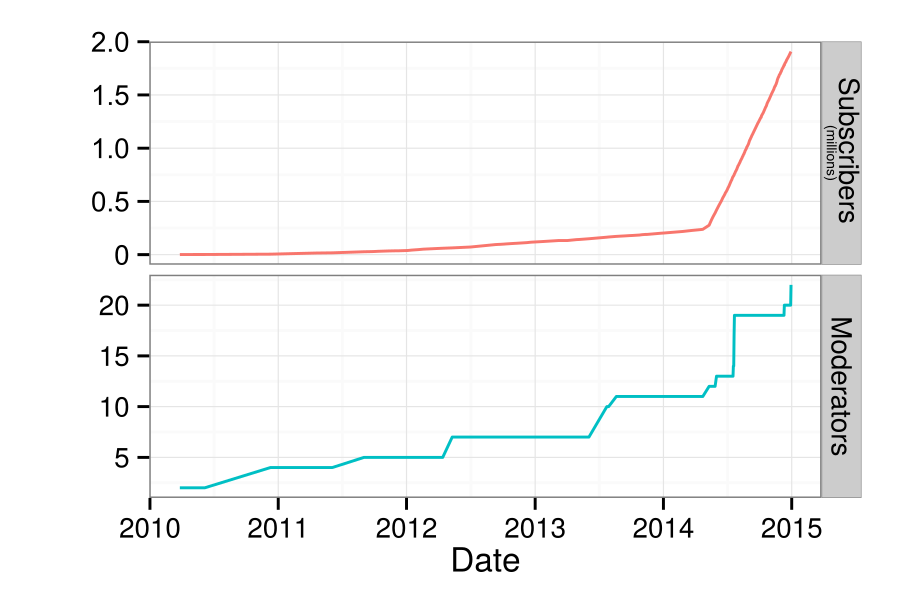
Graph of subscribers and moderators over time in /r/NoSleep. The image is taken from our 2016 CHI paper.
Last year at CHI 2016, my research group published a qualitative study examining the effects of a large influx of newcomers to the /r/nosleep online community in Reddit. Our study began with the observation that most research on sustained waves of newcomers focuses on the destructive effect of newcomers and frequently invokes Usenet s infamous Eternal September. Our qualitative study argued that the /r/nosleep community managed its surge of newcomers gracefully through strategic preparation by moderators, technological systems to reign in on norm violations, and a shared sense of protecting the community s immersive environment among participants. We are thrilled that, less a year after the publication of our study, Zhiyuan Jerry Lin and a group of researchers at Stanford have published a quantitative test of our study s findings! Lin analyzed 45 million comments and upvote patterns from 10 Reddit communities that a massive inundation of newcomers like the one we studied on /r/nosleep. Lin s group found that these communities retained their quality despite a slight dip in its initial growth period. Our team discussed doing a quantitative study like Lin s at some length and our paper ends with a lament that our findings merely reflected, propositions for testing in future work. Lin s study provides exactly such a test! Lin et al. s results suggest that our qualitative findings generalize and that sustained influx of newcomers need not doom a community to a descent into an Eternal September. Through strong moderation and the use of a voting system, the subreddits analyzed by Lin appear to retain their identities despite the surge of new users. There are always limits to research projects work quantitative and qualitative. We think the Lin s paper compliments ours beautifully, we are excited that Lin built on our work, and we re thrilled that our propositions seem to have held up! This blog post was written with Charlie Kiene. Our paper about /r/nosleep, written with Charlie Kiene and Andr s Monroy-Hern ndez, was published in the Proceedings of CHI 2016 and is released as open access. Lin s paper was published in the Proceedings of ICWSM 2017 and is also available online.

18 July 2017

Foteini Tsiami: Internationalization, part three

The first builds of the LTSP Manager were uploaded and ready for testing. Testing involves installing or purging the ltsp-manager package, along with its dependencies, and using its GUI to configure LTSP, create users, groups, shared folders etc. Obviously, those tasks are better done on a clean system. And the question that emerges is: how can we start from a clean state, without having to reinstall the operating system each time? My mentors pointed me to an answer for that: VirtualBox snapshots. VirtualBox is a virtualization application (others are KVM or VMware) that allows users to install an operating system like Debian in a contained environment inside their host operating system. It comes with an easy to use GUI, and supports snapshots, which are points in time where we mark the guest operating system state, and can revert to that state later on. So I started by installing Debian Stretch with the MATE desktop environment in VirtualBox, and I took a snapshot immediately after the installation. Now whenever I want to test LTSP Manager, I revert to that snapshot, and that way I have a clean system where I can properly check the installation procedure and all of its features!

Matthew Garrett: Avoiding TPM PCR fragility using Secure Boot

In measured boot, each component of the boot process is "measured" (ie, hashed and that hash recorded) in a register in the Trusted Platform Module (TPM) build into the system. The TPM has several different registers (Platform Configuration Registers, or PCRs) which are typically used for different purposes - for instance, PCR0 contains measurements of various system firmware components, PCR2 contains any option ROMs, PCR4 contains information about the partition table and the bootloader. The allocation of these is defined by the PC Client working group of the Trusted Computing Group. However, once the boot loader takes over, we're outside the spec[1].

One important thing to note here is that the TPM doesn't actually have any ability to directly interfere with the boot process. If you try to boot modified code on a system, the TPM will contain different measurements but boot will still succeed. What the TPM can do is refuse to hand over secrets unless the measurements are correct. This allows for configurations where your disk encryption key can be stored in the TPM and then handed over automatically if the measurements are unaltered. If anybody interferes with your boot process then the measurements will be different, the TPM will refuse to hand over the key, your disk will remain encrypted and whoever's trying to compromise your machine will be sad.

The problem here is that a lot of things can affect the measurements. Upgrading your bootloader or kernel will do so. At that point if you reboot your disk fails to unlock and you become unhappy. To get around this your update system needs to notice that a new component is about to be installed, generate the new expected hashes and re-seal the secret to the TPM using the new hashes. If there are several different points in the update where this can happen, this can quite easily go wrong. And if it goes wrong, you're back to being unhappy.

Is there a way to improve this? Surprisingly, the answer is "yes" and the people to thank are Microsoft. Appendix A of a basically entirely unrelated spec defines a mechanism for storing the UEFI Secure Boot policy and used keys in PCR 7 of the TPM. The idea here is that you trust your OS vendor (since otherwise they could just backdoor your system anyway), so anything signed by your OS vendor is acceptable. If someone tries to boot something signed by a different vendor then PCR 7 will be different. If someone disables secure boot, PCR 7 will be different. If you upgrade your bootloader or kernel, PCR 7 will be the same. This simplifies things significantly.

I've put together a (not well-tested) patchset for Shim that adds support for including Shim's measurements in PCR 7. In conjunction with appropriate firmware, it should then be straightforward to seal secrets to PCR 7 and not worry about things breaking over system updates. This makes tying things like disk encryption keys to the TPM much more reasonable.

However, there's still one pretty major problem, which is that the initramfs (ie, the component responsible for setting up the disk encryption in the first place) isn't signed and isn't included in PCR 7[2]. An attacker can simply modify it to stash any TPM-backed secrets or mount the encrypted filesystem and then drop to a root prompt. This, uh, reduces the utility of the entire exercise.

The simplest solution to this that I've come up with depends on how Linux implements initramfs files. In its simplest form, an initramfs is just a cpio archive. In its slightly more complicated form, it's a compressed cpio archive. And in its peak form of evolution, it's a series of compressed cpio archives concatenated together. As the kernel reads each one in turn, it extracts it over the previous ones. That means that any files in the final archive will overwrite files of the same name in previous archives.

My proposal is to generate a small initramfs whose sole job is to get secrets from the TPM and stash them in the kernel keyring, and then measure an additional value into PCR 7 in order to ensure that the secrets can't be obtained again. Later disk encryption setup will then be able to set up dm-crypt using the secret already stored within the kernel. This small initramfs will be built into the signed kernel image, and the bootloader will be responsible for appending it to the end of any user-provided initramfs. This means that the TPM will only grant access to the secrets while trustworthy code is running - once the secret is in the kernel it will only be available for in-kernel use, and once PCR 7 has been modified the TPM won't give it to anyone else. A similar approach for some kernel command-line arguments (the kernel, module-init-tools and systemd all interpret the kernel command line left-to-right, with later arguments overriding earlier ones) would make it possible to ensure that certain kernel configuration options (such as the iommu) weren't overridable by an attacker.

There's obviously a few things that have to be done here (standardise how to embed such an initramfs in the kernel image, ensure that luks knows how to use the kernel keyring, teach all relevant bootloaders how to handle these images), but overall this should make it practical to use PCR 7 as a mechanism for supporting TPM-backed disk encryption secrets on Linux without introducing a hug support burden in the process.

[1] The patchset I've posted to add measured boot support to Grub use PCRs 8 and 9 to measure various components during the boot process, but other bootloaders may have different policies.

[2] This is because most Linux systems generate the initramfs locally rather than shipping it pre-built. It may also get rebuilt on various userspace updates, even if the kernel hasn't changed. Including it in PCR 7 would entirely break the fragility guarantees and defeat the point of all of this.

comment count unavailable comments

16 July 2017

Jose M. Calhariz: Crossgrading a complex Desktop and Debian Developer machine running Debian 9

This article is an experiment in progress, please recheck, while I am updating with the new information. I have a very old installation of Debian, possibly since v2, dot not remember, that I have upgraded since then both in software and hardware. Now the hardware is 64bits, runs a kernel of 64bits but the run-time is still 32bits. For 99% of tasks this is very good. Now that I have made many simulations I may have found a solution to do a crossgrade of my desktop. I write here the tentative procedure and I will update with more ideias on the problems that I may found. First you need to install a 64bits kernel and boot with it. See my previous post on how to do it. Second you need to do a bootstrap of crossgrading and the instalation of all the libs as amd64:
 apt-get update
 apt-get upgrade
 apt-get clean
 dpkg --list > original.dpkg
 apt-get --download-only install dpkg:amd64 tar:amd64 apt:amd64 bash:amd64 dash:amd64 init:amd64 mawk:amd64
 cd /var/cache/apt/archives/
 dpkg --install dpkg_*amd64.deb tar_*amd64.deb apt_*amd64.deb bash_*amd64.deb dash_*amd64.deb *.deb
 dpkg --configure --pending
 dpkg -i --skip-same-version dpkg_*_amd64.deb apt_*_amd64.deb bash_*_amd64.deb dash_*_amd64.deb mawk_*_amd64.deb *.deb
 
 for pack32 in $(grep i386 original.dpkg    egrep "^ii "   awk ' print $2 ' ) ; do 
   echo $pack32 ; 
   if dpkg --status $pack32   grep -q "Multi-Arch: same" ; then 
     apt-get --download-only install -y --allow-remove-essential $ pack32%:i386 :amd64 ; 
   fi ; 
 done
 dpkg --install /var/cache/apt/archives/*_amd64.deb
 dpkg --install /var/cache/apt/archives/*_amd64.deb
 dpkg --print-architecture
 dpkg --print-foreign-architectures
But this procedure does not prevent the "apt-get install" to have broken dependencies. So trying to install the core packages and the libraries using "dpkg -i".
apt-get update
apt-get upgrade
apt-get autoremove
apt-get clean
dpkg --list > original.dpkg
apt-get --download-only install dpkg:amd64 tar:amd64 apt:amd64 bash:amd64 dash:amd64 init:amd64 mawk:amd64
for pack32 in $(grep i386 original.dpkg   egrep "^ii "   awk ' print $2 ' ) ; do 
  echo $pack32 ; 
  if dpkg --status $pack32   grep -q "Multi-Arch: same" ; then 
    apt-get --download-only install -y --allow-remove-essential $ pack32%:i386 :amd64 ; 
  fi ; 
done
cd /var/cache/apt/archives/
dpkg --install dpkg_*amd64.deb tar_*amd64.deb apt_*amd64.deb bash_*amd64.deb dash_*amd64.deb *.deb
dpkg --configure --pending
dpkg --install --skip-same-version dpkg_*_amd64.deb apt_*_amd64.deb bash_*_amd64.deb dash_*_amd64.deb mawk_*_amd64.deb *.deb
dpkg --remove libcurl4-openssl-dev
dpkg -i libcurl4-openssl-dev_*_amd64.deb
Remove packages until all there is no brokens packages
dpkg --print-architecture
dpkg --print-foreign-architectures
apt-get --fix-broken --allow-remove-essential install
Still broken, because apt-get removed dpkg So instead of only installing the libs with dpkg -i, I am going to try to install all the packages with dpkg -i:
apt-get update
apt-get upgrade
apt-get autoremove
apt-get clean
dpkg --list > original.dpkg
apt-get --download-only install dpkg:amd64 tar:amd64 apt:amd64 bash:amd64 dash:amd64 init:amd64 mawk:amd64
for pack32 in $(grep i386 original.dpkg   egrep "^ii "   awk ' print $2 ' ) ; do 
  echo $pack32 ; 
  apt-get --download-only install -y --allow-remove-essential $ pack32%:i386 :amd64 ; 
done
cd /var/cache/apt/archives/
dpkg --install dpkg_*amd64.deb tar_*amd64.deb apt_*amd64.deb bash_*amd64.deb dash_*amd64.deb *.deb
dpkg --configure --pending
dpkg --install --skip-same-version dpkg_*_amd64.deb apt_*_amd64.deb bash_*_amd64.deb dash_*_amd64.deb mawk_*_amd64.deb *.deb
dpkg --configure --pending
Remove packages and reinstall selected packages until you fix all off them. Follow the trial for my machine:
dpkg --remove rkhunter
dpkg --remove libmarco-private1:i386 marco mate-control-center mate-desktop-environment-core mate-desktop-environment-core  mate-desktop-environment mate-desktop-environment-core mate-desktop-environment-extras
dpkg --remove libmate-menu2:i386 libmate-window-settings1:i386 mate-panel mate-screensaver python-mate-menu libmate-slab0:i386 mozo mate-menus
dpkg --remove libmate-menu2:i386 mate-panel python-mate-menu mate-applets mate-menus
dpkg -i libmate-menu2_1.16.0-2_amd64.deb
dpkg --remove  gir1.2-ibus-1.0:i386 gnome-shell gnome-shell-extensions gdm3 gnome-session
dpkg --remove  gir1.2-ibus-1.0:i386
dpkg --remove libmateweather1:i386
dpkg -i libmateweather1_1.16.1-2_amd64.deb
apt-get --fix-broken --download-only install
dpkg --skip-same-version --install dpkg_*amd64.deb tar_*amd64.deb apt_*amd64.deb bash_*amd64.deb dash_*amd64.deb *.deb
dpkg --configure --pending
dpkg -i python_2.7.13-2_amd64.deb
dpkg --configure --pending
dpkg -i perl_5.24.1-3+deb9u1_amd64.deb perl-base_5.24.1-3+deb9u1_amd64.deb
dpkg -i exim4-daemon-light_4.89-2+deb9u1_amd64.deb exim4-base_4.89-2+deb9u1_amd64.deb
dpkg -i libuuid-perl_0.27-1_amd64.deb
dpkg --configure --pending
dpkg --install gstreamer1.0-plugins-bad_1.10.4-1_amd64.deb libmpeg2encpp-2.1-0_1%3a2.1.0+debian-5_amd64.deb libmplex2-2.1-0_1%3a2.1.0+debian-5_amd64.deb
dpkg --configure --pending
dpkg --audit
Now fixing broken dependencies on apt-get. Found no other way than removing all the broken packages.
dpkg --remove $(apt-get --fix-broken install   cut -f 2 -d ' ' )
apt-get install $(grep -v ":i386" ~/original.dpkg   egrep "^ii"   grep -v "aiccu"   grep -v "acroread"   grep -v "flash-player-properties"   grep -v "flashplayer-mozilla"   egrep -v "tp-flash-marillat"   awk ' print $2 ')

Vasudev Kamath: Overriding version information from setup.py with pbr

I recently raised a pull request on zfec for converting its python packaging from pure setup.py to pbr based. Today I got review from Brian Warner and one of the issue mentioned was python setup.py --version is not giving same output as previous version of setup.py. Previous version used versioneer which extracts version information needed from VCS tags. Versioneer also provides flexibility of specifying type of VCS used, style of version, tag prefix (for VCS) etc. pbr also does extract version information from git tag but it expects git tag to be of format tags/refs/x.y.z format but zfec used a zfec- prefix to tag (example zfec-1.4.24) and pbr does not process this. End result, I get a version in format 0.0.devNN where NN is number of commits in the repository from its inception. Me and Brian spent few hours trying to figure out a way to tell pbr that we would like to override version information it auto deduces, but there was none other than putting version string in PBR_VERSION environment variable. That documentation was contributed by me 3 years back to pbr project. So finally I used versioneer to create a version string and put it in the environment variable PBR_VERSION.
import os
import versioneer
os.environ['PBR_VERSION'] = versioneer.get_version()
...
setup(
    setup_requires=['pbr'],
    pbr=True,
    ext_modules=extensions
)
And added below snippet to setup.cfg which is how versioneer can be configured with various information including tag prefixes.
[versioneer]
VCS = git
style = pep440
versionfile_source = zfec/_version.py
versionfile_build = zfec/_version.py
tag_prefix = zfec-
parentdir_prefix = zfec-
Though this work around gets the work done, it does not feel correct to set environment variable to change the logic of other part of same program. If you guys know the better way do let me know!. Also probably I should consider filing an feature request against pbr to provide a way to pass tag prefix for version calculation logic.

15 July 2017

Vasudev Kamath: debcargo: Replacing subprocess crate with git2 crate

In my previous post I talked about using subprocess crate to extract beginning and ending year from git repository for generating debian/copyright file. In this post I'm going to talk on how I replaced subprocess with native git2 crate and achieved the same result in much cleaner and safer way. git2 is a native Rust crate which provides access to Git repository internals. git2 does not involve any unsafe invocation as it is built against libgit2-sys which is actually using Rust FFI to directly bind to underlying libgit library. Below is the new copyright_fromgit function with git2 crate.
fn copyright_fromgit(repo_url: &str) -> Result<String>  
   let tempdir = TempDir::new_in(".", "debcargo")?;
   let repo = Repository::clone(repo_url, tempdir.path())?;
   let mut revwalker = repo.revwalk()?;
   revwalker.push_head()?;
   // Get the latest and first commit id. This is bit ugly
   let latest_id = revwalker.next().unwrap()?;
   let first_id = revwalker.last().unwrap()?; // revwalker ends here is consumed by last
   let first_commit = repo.find_commit(first_id)?;
   let latest_commit = repo.find_commit(latest_id)?;
   let first_year =
       DateTime::<Utc>::from_utc(
               NaiveDateTime::from_timestamp(first_commit.time().seconds(), 0),
               Utc).year();
   let latest_year =
       DateTime::<Utc>::from_utc(
             NaiveDateTime::from_timestamp(latest_commit.time().seconds(), 0),
             Utc).year();
   let notice = match first_year.cmp(&latest_year)  
       Ordering::Equal => format!(" ", first_year),
       _ => format!(" - ,", first_year, latest_year),
    ;
   Ok(notice)
 
So here is what I'm doing
  1. Use git2::Repository::clone to clone the given URL. We are thus avoiding exec of git clone command.
  2. Get a revision walker object. git2::RevWalk implements Iterator trait and allows walking through the git history. This is what we are using to avoid exec of git log command.
  3. revwalker.push_head() is important because we want to tell revwalker from where we want to walk the history. In this case we are asking it to walk history from repository HEAD. Without this line next line will not work. (Learned it in hard way :-) ).
  4. Then we extract git2::Oid which is we can say similar to commit hash and can be used to lookup a particular commit. We take latest commit hash using RevWalk::next call and the first commit using Revwalk::last, note the order this is because Revwalk::last consumes the revwalker so doing it in reverse order will make borrow checker unhappy :-). This replaces exec of head -n1 command.
  5. Look up the git2::Commit objects using git2::Repository::find_commit
  6. Then convert the git2::Time to chrono::DateTime and take out the years.
After this change I found an obvious error which went unnoticed in previous version, that is if there was no repository key in Cargo.toml. When there was no repo URL git clone exec did not error out and our shell commands happily extracted year from the debcargo repository!. Well since I was testing code from debcargo repository It never failed, but when I executed from non-git repository folder git threw an error but that was git log and not git clone. This error was spotted right away because git2 threw me an error that I gave it empty URL. When it comes to performance I see that debcargo is faster compared to previous version. This makes sense because previously it was doing 5 fork and exec system calls and now that is avoided.

13 July 2017

Lars Wirzenius: Adding Yakking to Planet Debian

In a case of blatant self-promotion, I am going to add the Yakking RSS feed to the Planet Debian aggregation. (But really because I think some of the readership of Planet Debian may be interested in the content.) Yakking is a group blog by a few friends aimed at new free software contributors. From the front page description:
Welcome to Yakking. This is a blog for topics relevant to someone new to free software development. We assume you are already familiar with computers, and are curious about participating in the production of free software. You don't need to be a programmer: software development requires a wide variety of skills, and you can be a valued core contributor to a project without being a programmer.
If anyone objects, please let me know.

Next.

Previous.