Alessio Treglia: The logical contradictions of the Universe


Ouroboros
Ouroboros
 It all started last June when my son had his Janoi (Yagnopavita) ceremony -- the ritual by which a Brahmana boy becomes "twice-born" and eligible to study the Vedas. As well as a profound religious experience, it is also an important social occasion with a reception for as many friends and family as can attend. (I think our final guest total was ~250.) This meant new outfits for everyone which might be exciting for some people but not me. I still don't know why I couldn't just keep wearing the khes and pitambar from the puja but no, apparently that's a faux pas. So I relented and agreed to wear my "darbari" suit from my wedding. And it didn't fit. I knew I had gained some weight in the intermediate 17 years but the thing was sitcom levels of too small. I ended up having to purchase a new one, a snazzy (and shiny!) maroon number with gold stripes (or were they black stripes?) Problem having been solved, much was eaten, more weight was gained and then I forgot about the whole thing.
Tip 1: Actually Do Something.
I have over the years tried to improve my physical condition but it has never gotten very far. For instance I have a treadmill/coatrack and a couple of years ago I began using it in earnest. I got to the point where I actually ran a 10K race without dying. But I did not train systematically and I ended up in some pain which caused me to stop working out for a while and then I never got around to restarting. Diets have also failed because I don't have a clear idea of what and how much I am eating. All I know is that women go into the kitchen and when they come out they have food. By what eldritch process this occurs is a mystery, I just eat whats given to me thankful that the magic happens. Once I was moved to try and help but quickly fell afoul of the lack of well-defined algorithms in Gujarati home cooking.
"How much saffron should I add?"
"this much."
"How much is this much in SI units?"
"You're annoying me. Get out."Fast forward to March of this year. For my birthday, my wife got me a Fitbit fitness tracker. This is what I had needed all this time. It measure heart rate, distance travelled, time slept and several other pieces of info you can use to really plan a fitness regimen rationally. For example, I was chagrined to learn that sometimes when I'm at the computer, I am so immobile that the fitbit thought I was asleep. So I started planning to taken more frequent breaks. (A recent firmware upgrade has added the ability to nudge to walk atleast 250 paces each daytime hour which is handy for this.) Also by checking my heart rate I discovered that I went on the treadmill I ran too fast thereby stressing my body for little gain and ending up going too slow to get much aerobic effect. Now I can pace myself appropriately for maximum cardiac efficiency without ending up injuring myself and giving up. I also get a little more activity each day by simple changes such as taking the stairs instead of the lift and instead of getting off at the 14th street PATH I go all the way to 34th street and walk down. Tip 2: You must have data in order to see what you did right or wrong and to plan what you need to do moving forward. One caveat about these fitness trackers. They are not anywhere as accurate as a proper checkup from a doctor who specializes in such things. If you want to do any kind of pro or amateur athletics you probably should not rely on them but for the average shlub who just wants to avoid appearing on the news being winched off his sofa by the fire brigade they are good enough. Another practice I began was keeping a food diary. It can be a real eye-opener to see how much you are actually eating. It is probably much more than you thought. I am fortunate that my diet is pretty good to begin with. Vegetarian, (not vegan, Hindus eat dairy products,) mostly home-cooked with fresh ingredients, not fried or processed, and I don't drink alcohol. However there were a few optimizations I could make. I drink a lot of soda; atleast two cans a day. I really ought to stop altogether but in lieu of that I have atleast switched from Coke to Coke Zero thereby saving a lot of empty calories. I now eat 4 rotlis with my dinner instead of six. We as a family eat more green vegetables instead of potatos, skim milk instead of whole fat, canola oil instead of corn oil, and less rice and don't slather ghee on everything quite so much. One entirely new practice I've adopted that may seem faddish but works for me is intermittent fasting. The idea is to steadily train your body to need less food by eating all your days allowed amount pf calories during a 6-8 hour window and not eating at all during the remaining time. It's hard to get used to for many people but I fast atleast 2-3 times a month for religious reasons anyway so I adapted pretty quickly. The fitbit tells me how many calories I am expending and how many I can eat to maintain a healthy level of weight loss but other than that I don't bother with "food groups" or specific diets such as paleo, or low-carb etc. As long as what you eat is reasonably balanced and you are burning more calories than you are adding, it should be enough for weight loss. Indeed from the end of March to now, I've lost 3 stones (20Kg) even with the occasional "cheat" day. Tip 3: All published diets are bullshit without scientifically proven efficacy. Don't bother with them. Experiment instead and see what works for you and your metabolism. As long as you are getting all the proper nutrients (you shouldn't need a supplement unless you have an actual medical condition.) and you have a net calorie deficit, it's all good. If you eat food you enjoy, you are more likely to stick to your diet. The proper amount of sleep is one area of a healthy lifestyle I am still doing poorly in and the reasons are not all raven-related. I have always had problems with insomnia and was once actually diagnosed with sleep apnea. Losing weight has helped a lot but the fitbit is still reporting that I toss and turn a lot during the night. And that's when I'm in bed in the first place. I stay up much too late which can also lead to subsidiary bad behaviours such as midnight snacking. It's something I need to work on. Tip 4: Stop blogging at all hours of the night, It's not doing you any good. So that's what I'm doing. Moving forward, I need to deal with the sleep thing and I would also like to start some program of strength-training, I'm doing ok in terms of aerobic exercise but from what I've read, you also have to build up muscles to keep weight loss permanent. The difficulty is that it would involve joining a gym and then actually going to that gym so I've put it off for now. The immediate threat is Diwali (and Thanksgiving and Christmas...) My wife bought 4 lbs of sweets today and I can feel their presence in the fridge calling to me.

| Planet site | Admin contact | |
|---|---|---|
| All projects | Free-RTC Planet (http://planet.freertc.org) | contact planet@freertc.org |
| XMPP | Planet Jabber (http://planet.jabber.org) | contact ralphm@ik.nu |
| SIP | Planet SIP (http://planet.sip5060.net) | contact planet@sip5060.net |
| SIP (Espa ol) | Planet SIP-es (http://planet.sip5060.net/es/) | contact planet@sip5060.net |
 A new release of Rblpapi is now on CRAN. Rblpapi provides a direct interface between R and the Bloomberg Terminal via the C++ API provided by Bloomberg Labs (but note that a valid Bloomberg license and installation is required).
This is the sixth release since the package first appeared on CRAN last year. This release brings new functionality via new (
getPortfolio()) and extended functions (getTicks()) as well as several fixes:
Courtesy of CRANberries, there is also a diffstat report for the this release. As always, more detailed information is on the Rblpapi page. Questions, comments etc should go to the issue tickets system at the GitHub repo.Changes in Rblpapi version 0.3.5 (2016-10-25)
- Add new function
getPortfolioto retrieve portfolio data viabds(John in #176)- Extend
getTicks()to (optionally) return non-numeric data as part ofdata.frameordata.table(Dirk in #200)- Similarly extend
getMultipleTicks(Dirk in #202)- Correct statement on timestamp for
getBars(Closes issue #192)- Minor edits to a few files in order to either please
R(-devel) CMD check --as-cran, or update documentation
This post by Dirk Eddelbuettel originated on his Thinking inside the box blog. Please report excessive re-aggregation in third-party for-profit settings.
A little over eight years ago, I wrote a short blog post which somewhat dryly noted that I had completed the five marathons constituting the World Marathon Majors. I had completed Boston, Chicago and New York during 2007, adding London and then Berlin (with a personal best) in 2008. The World Marathon Majors existed then, but I was not aware of a website. The organisation was aiming to raise the profile of the professional and very high-end aspect of the sport. But marathoning is funny as they let somewhat regular folks like you and me into the same race. And I always wondered if someone kept track of regular folks completing the suite...
I have been running a little less the last few years, though I did get around to complete the Illinois Marathon earlier this year (only tweeted about it and still have not added anything to the running section of my blog). But two weeks ago, I was once again handing out water cups at the Chicago Marathon, sending along two tweets when the elite wheelchair and elite male runners flew by. To the first, the World Marathon Majors account replied, which lead me to their website. Which in turn lead me to the Five Star Finisher page, and the newer / larger Six Star Finisher page now that Tokyo has been added.
And in short, one can now request one's record to be added (if they check out). So I did. And now I am on the Five Star Finisher page!
I don't think I'll ever surpass that as a runner. The table header and my row look like this:

 If only my fifth / sixth grade physical education teacher could see that---he was one of those early running nuts from the 1970s and made us run towards / around this (by now enlarged) pond and boy did I hate that :) Guess it did have some long lasting effects. And I casually circled the lake a few years ago, starting much further away from my parents place. Once you are in the groove for distance...
But leaving that aside, running has been fun and I with some luck I may have another one or two marathons or Ragnar Relays left. The only really bad part about this is that I may have to get myself to Tokyo after all (for something that is not an ISM workshop) ...
This post by Dirk Eddelbuettel originated on his Thinking inside the box blog. Please report excessive re-aggregation in third-party for-profit settings.
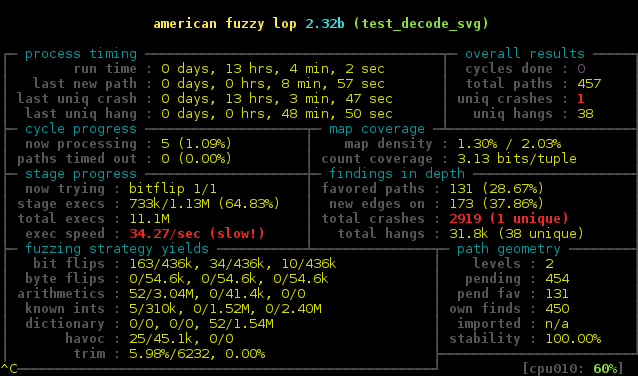
Summary stats
=============

       Fuzzers alive : 10
      Total run time : 68 days, 7 hours
         Total execs : 9268 million
    Cumulative speed : 15698 execs/sec
       Pending paths : 0 faves, 2501 total
  Pending per fuzzer : 0 faves, 250 total (on average)
       Crashes found : 9 locally unique

afl-cmin -i queue_all/ -o queue_cmin -- test_decode_svg @@ 1.0 /dev/null
corpus minimization tool for afl-fuzz by

[+] OK, 1447 tuples recorded.
[*] Obtaining traces for input files in 'queue_all/'...
    Processing file 8242/8242...
[*] Sorting trace sets (this may take a while)...
[+] Found 23812 unique tuples across 8242 files.
[*] Finding best candidates for each tuple...
    Processing file 8242/8242...
[*] Sorting candidate list (be patient)...
[*] Processing candidates and writing output files...
    Processing tuple 23812/23812...
[+] Narrowed down to 2612 files, saved in 'queue_cmin'.
Thats So Raven
If I could sum up the past year in one word, that word would be distraction. There have been so many strange, confusing or simply unforseen things going on I have had trouble focusing like never before.
For instance, on the opposite side of the street from me is one of Jersey City's old resorvoirs. It's not used for drinking water anymore and the city eventually plans on merging it into the park on the other side. In the meantime it has become something of a wildlife refuge. Which is nice except one of the newly settled critters was a bird of prey -- the consensus is possibly some kind of hawk or raven. Starting your morning commute under the eyes of a harbinger of death is very goth and I even learned to deal with the occasional piece of deconstructed rodent on my doorstep but nighttime was a big problem. For contrary to popular belief, ravens do not quoth "nevermore" but "KRRAAAA". Very loudly. Just as soon as you have drifted of to sleep. Eventually my sleep-deprived neighbors and I appealed to the NJ division of enviromental protection to get it removed but by the time they were ready to swing into action the bird had left for somewhere more congenial like Transylvania or Newark.
Or here are some more complete wastes of time: I go the doctor for my annual physical. The insurance company codes it as Adult Onset Diabetes by accident. One day I opened the lid of my laptop and there's a "ping" sound and a piece of the hinge flies off. Apparently that also severed the connection to the screen and naturally the warranty had just expired so I had to spend the next month tethered to an external monitor until I could afford to buy a new one. Mix in all the usual social, political, family and work drama and you can see that it has been a very trying time for me.
Dovecot
I have managed to get some Debian work done. On Dovecot, my principal package, I have gotten tremendous support from Apollon Oikonomopolous who I belatedly welcome as a member of the Dovecot maintainer team. He has been particularly helpful in fixing our systemd support and cleaning out a lot of the old and invalid bugs. We're in pretty good shape for the freeze. Upstream has released an RC of 2.2.26 and hopefully the final version will be out in the next couple of days so we can include it in Stretch. We can always use more help with the package so let me know if you're interested.
Debian-IN
Most of the action has been going on without me but I've been lending support and sponsoring whenever I can. We have several new DDs and DMs but still no one north of the Vindhyas I'm afraid.
Debian Perl Group
gregoa did a ping of inactive maintainers and I regretfully had to admit to myself that I wasn't going to be of use anytime soon so I resigned. Perl remains my favorite language and I've actually been more involved in the meetings of my local Perlmongers group so hopefully I will be back again one day. And I still maintain the Perl modules I wrote myself.
Debian-Axe-Murderers*
May have gained a recruit.
*Stricly speaking it should be called Debian-People-Who-Dont-Think-Faults-in-One-Moral-Domain-Such-As-For-Example-Axe-Murdering-Should-Leak-Into-Another-Moral-Domain-Such-As-For-Example-Debian but come on, that's just silly.
For updating zone-files just do a "dnssech.sh edit-zone domain.tld" to add new records and such and the script will take care e.g. of increasing the serial of the zone file. I find this very convenient, so I often use this script for non-DNSSEC-enabled domains as well. However you can spot the command line option "update-tlsa". This option needs the old and the new TLSA hashes beside the domain.tld parameter. However, this option is used from the second script: 2) check_tlsa.shhost:~/bin# dnssec.sh No parameter given. Usage: dnsec.sh MODE DOMAIN MODE can be one of the following: enable-dnssec : perform all steps to enable DNSSEC for your domain edit-zone : safely edit your zone after enabling DNSSEC create-dnskey : create new dnskey only load-dnskey : loads new dnskeys and signs the zone with them show-ds : shows DS records of zone zoneadd-ds : adds DS records to the zone file show-dnskey : extract DNSKEY record that needs to uploaded to your registrar update-tlsa : update TLSA records with new TLSA hash, needs old and new TLSA hashes as additional parameters
So, quite simple and obviously a quick hack. For sure someone else can write a cleaner and more sophisticated implementation to do the same stuff, but at least it works for meTM. Use it on your own risk and do whatever you want with these scripts (licensed under public domain). You can invoke check_tlsa.sh right after your crontab call for letsencrypt.sh. In a more sophisticated way it should be fairly easy to invoke these scripts from letsencrypt.sh post hooks as well.#!/bin/bash set -e LEPATH="/etc/letsencrypt.sh" for i in cat /etc/letsencrypt.sh/domains.txt awk ' print $1 ' ; do domain= echo $i awk 'BEGIN FS="." ; print $(NF-1)"."$NF ' #echo -n "Domain: $domain" TLD= echo $i awk 'BEGIN FS="." ; print $NF ' #echo ", TLD: $TLD" OLDTLSA= grep -i "in.*tlsa" /etc/bind/$ TLD /$ domain grep $ i head -n 1 awk ' print $NF ' if [ -n "$ OLDTLSA " ] ; then #echo "--> $ OLDTLSA " # Usage: tlsagen.sh cert.pem host[:port] usage selector mtype NEWTLSA= /path/to/tlsagen.sh $LEPATH/certs/$ i /fullchain.pem $ i 3 1 1 awk ' print $NF ' #echo "==> $NEWTLSA" if [ "$ OLDTLSA " != "$ NEWTLSA " ] ; then /path/to/dnssec.sh update-tlsa $ domain $ OLDTLSA $ NEWTLSA > /dev/null echo "TLSA RR update for $ i " fi fi done
| Attachment | Size |
|---|---|
 check_tlsa.sh.txt | 812 bytes |
| dnssec.sh.txt | 3.88 KB |
 A few days ago, Conrad released Armadillo 7.500.0. The corresponding RcppArmadillo release 0.7.500.0.0 is now on CRAN (and will get into Debian shortly).
Armadillo is a powerful and expressive C++ template library for linear algebra aiming towards a good balance between speed and ease of use with a syntax deliberately close to a Matlab. RcppArmadillo integrates this library with the R environment and language--and is widely used by (currently) 274 other packages on CRAN.
Changes in this release relative to the previous CRAN release are as follows:
Courtesy of CRANberries, there is a diffstat report. More detailed information is on the RcppArmadillo page. Questions, comments etc should go to the rcpp-devel mailing list off the R-Forge page.Changes in RcppArmadillo version 0.7.500.0.0 (2016-10-20)
- Upgraded to Armadillo release 7.500.0 (Coup d'Etat)
- Expanded
qz()to optionally specify ordering of the Schur form- Expanded
each_slice()to support matrix multiplication
This post by Dirk Eddelbuettel originated on his Thinking inside the box blog. Please report excessive re-aggregation in third-party for-profit settings.
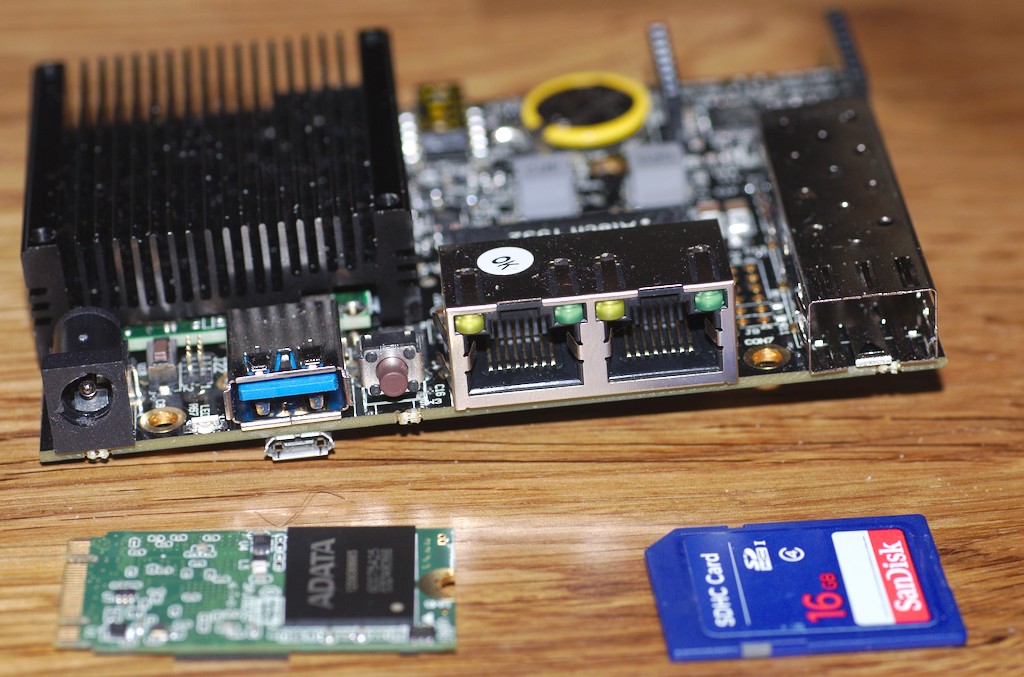
 Back in August, I was looking for a
Homeserver replacement. During FrOSCon I was then reminded
of the Turris Omnia project by NIC.cz. The basic SoC (Marvel
Armada 38x) seemed to be nice hand have decent mainline support (and,
with the turris, users interested in keeping it working). Only I don't
want any WIFI and I wasn't sure the standard case would be all that
usefully. Fortunately, there's also a simple board available with the
same SoC called ClearFog and so I got one of these (the Base
version). With shipping and the SSD (the only 2242 M.2 SSD with 250
GiB I could find, a ADATA SP600) it slightly exceeds the budget but
well.
 When installing the machine, the obvious goal was to use mainline FOSS
components only if possible. Fortunately there's mainline kernel
support for the device as well as mainline U-Boot. First attempts
to boot from a micro SD card did not work out at all, both with
mainline U-Boot and the vendor version though. Turns out the eMMC
version of the board does not support any micro SD cards at all, a
fact that is documented but others failed to notice as well.
U-Boot
As the board does not come with any loader on eMMC and booting
directly from M.2 requires removing some resistors from the board, the
easiest way is using UART for booting. The vendor wiki has some shell
script wrapping an included C fragment to feed U-Boot to the device
but all that is really needed is U-Boot's
kwboot utility. For some
reason the SPL didn't properly detect UART booting on my device (wrong
magic number) but patching the if (in arch-mvebu's spl.c) and always
assume UART boot is an easy way around.
The plan then was to boot a Debian armhf rootfs with a
defconfig kernel from USB stick. and install U-Boot and the rootfs
to eMMC from within that system. Unfortunately U-Boot seems to be
unable to talk to the USB3 port so no kernel loading from there. One
could probably make UART loading work but switching between screen for
serial console and xmodem seemed somewhat fragile and I never got it
working. However ethernet can be made to work, though you need to set
eth1addr to eth3addr (or just the right one of these) in U-Boot,
saveenv and reboot. After that TFTP works (but is somewhat slow).
eMMC
There's one last step required to allow U-Boot and Linux to access the
eMMC. eMMC is wired to the same PINs as the SD card would be. However
the SD card has an additional indicator pin showing whether a card is
present. You might be lucky inserting a dummy card into the slot or go
the clean route and remove the pin specification from the device tree.
--- a/arch/arm/dts/armada-388-clearfog.dts
+++ b/arch/arm/dts/armada-388-clearfog.dts
@@ -306,7 +307,6 @@
                        sdhci@d8000
                                bus-width = <4>;
-                               cd-gpios = <&gpio0 20 GPIO_ACTIVE_LOW>;
                                no-1-8-v;
                                pinctrl-0 = <&clearfog_sdhci_pins
                                             &clearfog_sdhci_cd_pins>;
--- a/include/configs/clearfog.h
+++ b/include/configs/clearfog.h
@@ -143,8 +143,7 @@
 #define CONFIG_SPL_LIBDISK_SUPPORT
 #define CONFIG_SYS_MMC_U_BOOT_OFFS             (160 << 10)
 #define CONFIG_SYS_U_BOOT_OFFS                 CONFIG_SYS_MMC_U_BOOT_OFFS
-#define CONFIG_SYS_MMCSD_RAW_MODE_U_BOOT_SECTOR        ((CONFIG_SYS_U_BOOT_OFFS / 512)\
-                                                + 1)
+#define CONFIG_SYS_MMCSD_RAW_MODE_U_BOOT_SECTOR        (CONFIG_SYS_U_BOOT_OFFS / 512)
 #define CONFIG_SYS_U_BOOT_MAX_SIZE_SECTORS     ((512 << 10) / 512) /* 512KiB */
 #ifdef CONFIG_SPL_BUILD
 #define CONFIG_FIXED_SDHCI_ALIGNED_BUFFER      0x00180000      /* in SDRAM */
armmp Debian kernel and have it work. As all the drivers
are build as modules for that kernel this also means initrd
support. Funnily U-Boots bootz allows booting a plain vmlinux
kernel but I couldn't get it to boot a plain initrd. Passing a uImage
initrd and a normal kernel however works pretty well. Back when I
first tried there were some modules missing and ethernet didn't work
with the PHY driver built as a module. In the meantime the PHY problem
was fixed in the Debian kernel and almost all modules already
added. Ben then only added the USB3 module on my suggestion and as a
result, unstable's armhf armmp kernel should work perfectly well on
the device (you still need to patch the device tree similar to the
patch above). Still missing is an updated flash-kernel to
automatically generate the initrd uImage which is
work in progress but got stalled until I fixed the U-Boot on eMMC
problem and everything should be fine -- maybe get debian u-boot
builds for that board.
Pro versus Base
The main difference so far between the Pro and the Base version of the
ClearFog is the switch chip which is included on the Pro. The Base
instead "just" has two gigabit ethernet ports and a SFP. Both, linux'
and U-Boot's device tree are intended for the Pro version which makes
on of the ethernet ports unusable (it tries to find the switch behind
the ethernet port which isn't there). To get both ports working (or
the one you settled on earlier) there's a second patch to the device
tree (my version might be sub-optimal but works), U-Boot -- the
linux-kernel version is a trivial adaption:
--- a/arch/arm/dts/armada-388-clearfog.dts
+++ b/arch/arm/dts/armada-388-clearfog.dts
@@ -89,13 +89,10 @@
internal-regs
ethernet@30000
mac-address = [00 50 43 02 02 02];
+ managed = "in-band-status";
+ phy = <&phy1>;
phy-mode = "sgmii";
status = "okay";
-
- fixed-link
- speed = <1000>;
- full-duplex;
- ;
;
ethernet@34000
@@ -227,6 +224,10 @@
pinctrl-0 = <&mdio_pins>;
pinctrl-names = "default";
+ phy1: ethernet-phy@1 /* Marvell 88E1512 */
+ reg = <1>;
+ ;
+
phy_dedicated: ethernet-phy@0
/*
* Annoyingly, the marvell phy driver
@@ -386,62 +386,6 @@
tx-fault-gpio = <&expander0 13 GPIO_ACTIVE_HIGH>;
;
- dsa@0
- compatible = "marvell,dsa";
- dsa,ethernet = <ð1>;
- dsa,mii-bus = <&mdio>;
- pinctrl-0 = <&clearfog_dsa0_clk_pins &clearfog_dsa0_pins>;
- pinctrl-names = "default";
- #address-cells = <2>;
- #size-cells = <0>;
-
- switch@0
- #address-cells = <1>;
- #size-cells = <0>;
- reg = <4 0>;
-
- port@0
- reg = <0>;
- label = "lan1";
- ;
-
- port@1
- reg = <1>;
- label = "lan2";
- ;
-
- port@2
- reg = <2>;
- label = "lan3";
- ;
-
- port@3
- reg = <3>;
- label = "lan4";
- ;
-
- port@4
- reg = <4>;
- label = "lan5";
- ;
-
- port@5
- reg = <5>;
- label = "cpu";
- ;
-
- port@6
- /* 88E1512 external phy */
- reg = <6>;
- label = "lan6";
- fixed-link
- speed = <1000>;
- full-duplex;
- ;
- ;
- ;
- ;
-
gpio-keys
compatible = "gpio-keys";
pinctrl-0 = <&rear_button_pins>;
flash-kernel support,
creating a nice case and probably get it deployed. I might bring
it to FOSDEM first though.
Working on it was really quite some fun (apart from the frustrating
parts finding the one-block-offset ..) and people were really
helpful. Big thanks here to Debian's arm folks, Ben Hutchings the
kernel maintainer and U-Boot upstream (especially Tom Rini and Stefan
Roese)
A brand-new release of anytime is now on CRAN following the three earlier releases since mid-September. anytime aims to convert anything in integer, numeric, character, factor, ordered, ... format to POSIXct (or Date) objects -- and does so without requiring a format string. See the anytime page for a few examples.
With release 0.0.4, we add two nice new features. First, NA, NaN and Inf are now simply skipped (similar to what the corresponding Base R functions do). Second, we now also accept large numeric values so that, _e.g., anytime(as.numeric(Sys.time()) also works, effectively adding another input type. We also have squashed an issue reported by the 'undefined behaviour' sanitizer, and the widened the test for when we try to deploy the gettz package get missing timezone information.
A quick example of the new features:
anydate(c(NA, NaN, Inf, as.numeric(as.POSIXct("2016-09-01 10:11:12"))))
[1] NA NA NA "2016-09-01"NEWS file summarises the release:
Courtesy of CRANberries, there is a comparison to the previous release. More information is on the anytime page. For questions or comments use the issue tracker off the GitHub repo.Changes in anytime version 0.0.4 (2016-10-20)
- Before converting via
lexical_cast, assign to atomic type via template logic to avoid an UBSAN issue (PR #15 closing issue #14)- More robust initialization and timezone information gathering.
- More robust processing of non-finite input also coping with non-finite values such as
NA,NaNandInfwhich all returnNA- Allow numeric
POSIXtrepresentation on input, also creating properPOSIXct(or, if requested,Date)
This post by Dirk Eddelbuettel originated on his Thinking inside the box blog. Please report excessive re-aggregation in third-party for-profit settings.
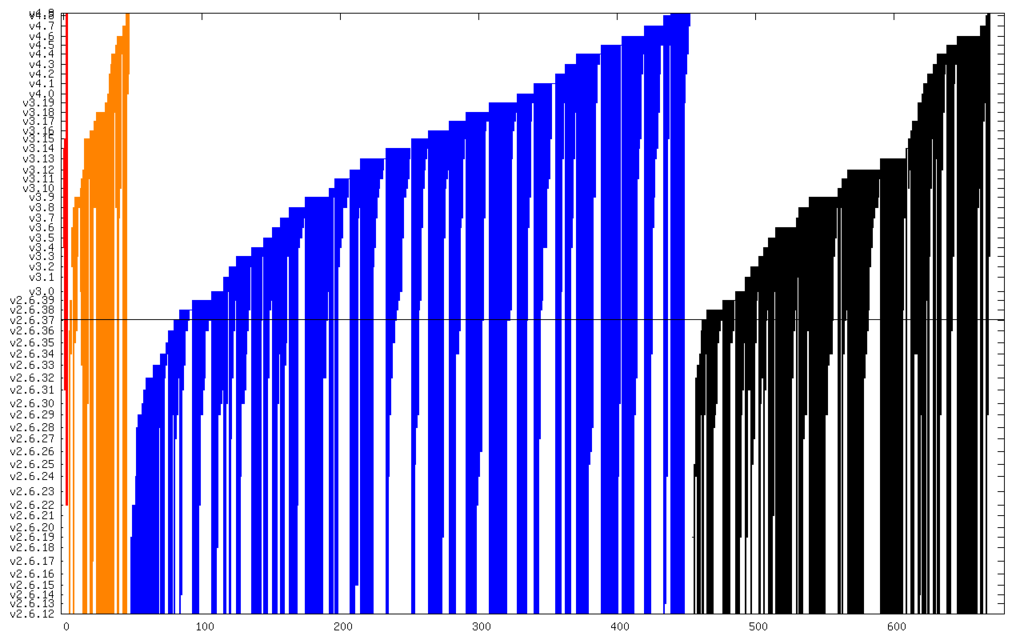
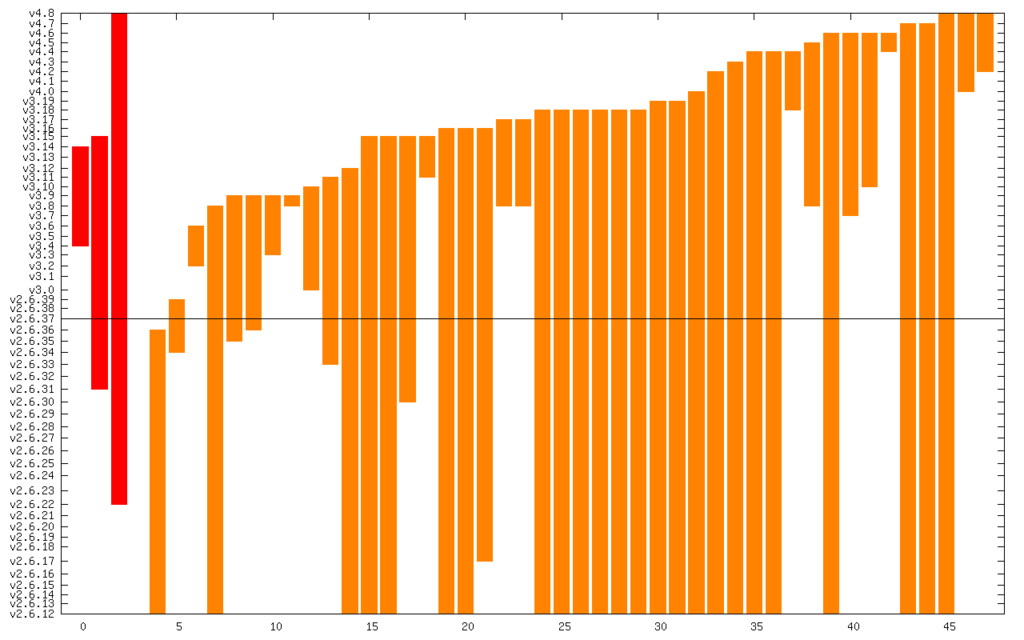
 My prior post showed my research from earlier in the year at the 2016 Linux Security Summit on kernel security flaw lifetimes. Now that CVE-2016-5195 is public, here are updated graphs and statistics. Due to their rarity, the Critical bug average has now jumped from 3.3 years to 5.2 years. There aren t many, but, as I mentioned, they still exist, whether you know about them or not. CVE-2016-5195 was sitting on everyone s machine when I gave my LSS talk, and there are still other flaws on all our Linux machines right now. (And, I should note, this problem is not unique to Linux.) Dealing with knowing that there are always going to be bugs present requires proactive kernel self-protection (to minimize the effects of possible flaws) and vendors dedicated to updating their devices regularly and quickly (to keep the exposure window minimized once a flaw is widely known).
So, here are the graphs updated for the 668 CVEs known today:
2016, Kees Cook. This work is licensed under a Creative Commons Attribution-ShareAlike 3.0 License.
In several of my recent presentations, I ve discussed the lifetime of security flaws in the Linux kernel. Jon Corbet did an analysis in 2010, and found that security bugs appeared to have roughly a 5 year lifetime. As in, the flaw gets introduced in a Linux release, and then goes unnoticed by upstream developers until another release 5 years later, on average. I updated this research for 2011 through 2016, and used the Ubuntu Security Team s CVE Tracker to assist in the process. The Ubuntu kernel team already does the hard work of trying to identify when flaws were introduced in the kernel, so I didn t have to re-do this for the 557 kernel CVEs since 2011.
As the README details, the raw CVE data is spread across the active/, retired/, and ignored/ directories. By scanning through the CVE files to find any that contain the line Patches_linux: , I can extract the details on when a flaw was introduced and when it was fixed. For example CVE-2016-0728 shows:
Patches_linux:
 break-fix: 3a50597de8635cd05133bd12c95681c82fe7b878 23567fd052a9abb6d67fe8e7a9ccdd9800a540f2
This means that CVE-2016-0728 is believed to have been introduced by commit 3a50597de8635cd05133bd12c95681c82fe7b878 and fixed by commit 23567fd052a9abb6d67fe8e7a9ccdd9800a540f2. If there are multiple lines, then there may be multiple SHAs identified as contributing to the flaw or the fix. And a
- is just short-hand for the start of Linux git history.
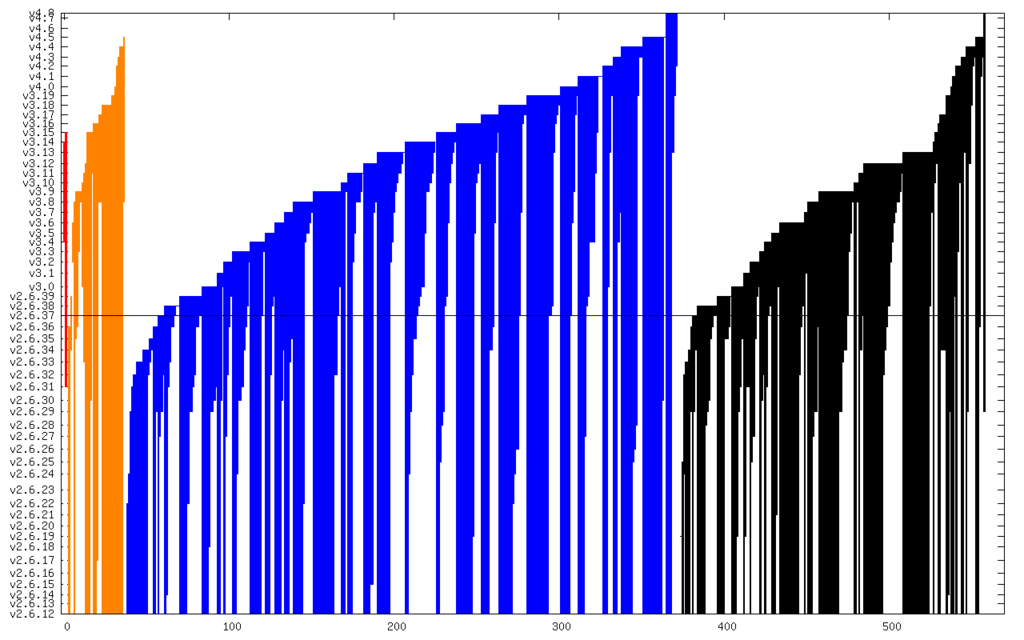
Then for each SHA, I queried git to find its corresponding release, and made a mapping of release version to release date, wrote out the raw data, and rendered graphs. Each vertical line shows a given CVE from when it was introduced to when it was fixed. Red is Critical , orange is High , blue is Medium , and black is Low :
 And here it is zoomed in to just Critical and High:
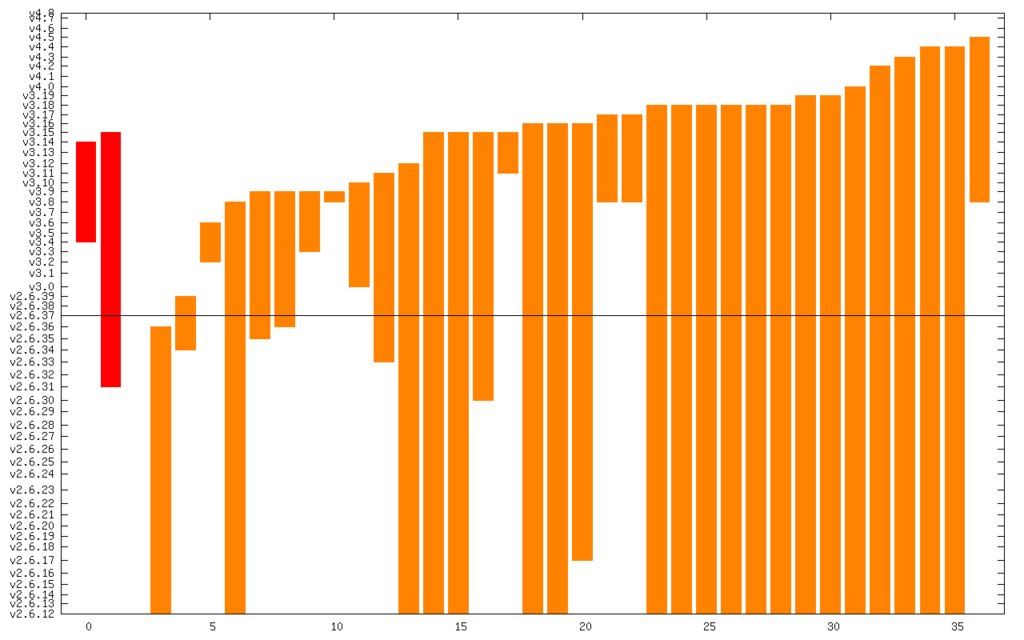 The line in the middle is the date from which I started the CVE search (2011). The vertical axis is actually linear time, but it s labeled with kernel releases (which are pretty regular). The numerical summary is:
2016, Kees Cook. This work is licensed under a Creative Commons Attribution-ShareAlike 3.0 License.
aptitude forget-new
supports search patterns,
and that brought back the joy.
I put this in a script that I run before looking for new packages in aptitude:
aptitude forget-new '?tag(field::biology)
                     ?tag(devel::lang:ruby)
                     ?tag(devel::lang:perl)
                     ?tag(role::shared-lib)
                     ?tag(suite::openstack)
                     ?tag(implemented-in::php)
                     ~n^node-'
        $ cat /etc/apt/apt.conf.d/99forget-new
        APT::Update::Post-Invoke   "aptitude forget-new '~sdebug'";  ;
Release 0.0.2 of gettz is now on CRAN.
gettz provides a possible fallback in situations where Sys.timezone() fails to determine the system timezone. That can happen when e.g. the file /etc/localtime somehow is not a link into the corresponding file with zoneinfo data in, say, /usr/share/zoneinfo.
Windows is now no longer excluded, though it doesn't do anything useful yet. The main use of the package is still for Linux.
For questions or comments use the issue tracker off the GitHub repo.
This post by Dirk Eddelbuettel originated on his Thinking inside the box blog. Please report excessive re-aggregation in third-party for-profit settings.
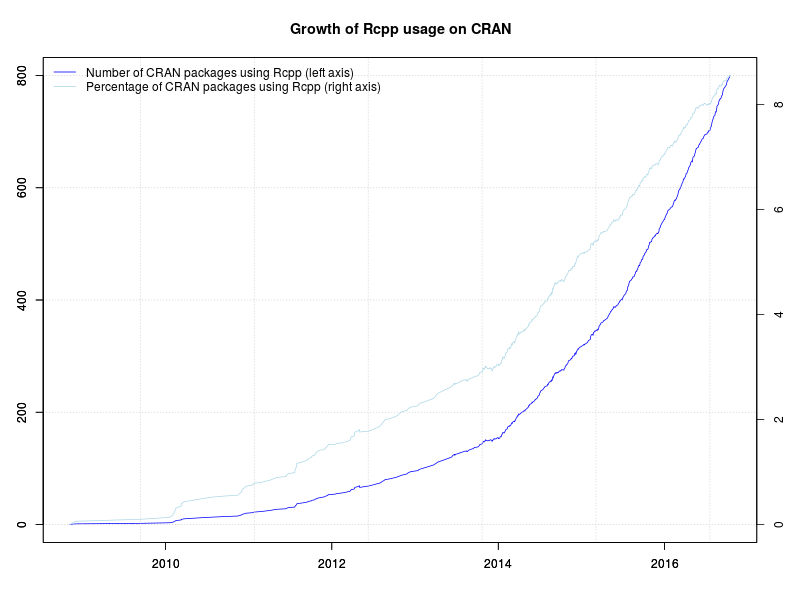 A moment ago, Rcpp hit another milestone: 800 packages on CRAN now depend on it (as measured by Depends, Imports and LinkingTo declarations). The graph is on the left depicts the growth of Rcpp usage over time.
The easiest way to compute this is to use the
reverse_dependencies_with_maintainers() function from a helper scripts file on CRAN. This still gets one or false positives of packages declaring a dependency but not actually containing C++ code and the like. There is also a helper function revdep() in the devtools package but it includes Suggests: which does not firmly imply usage, and hence inflates the count. I have always opted for a tighter count with corrections.
Rcpp cleared 300 packages in November 2014. It passed 400 packages in June of last year (when I only tweeted about it), 500 packages less than a year ago in late October, 600 packages this March and 700 packages this July. The chart extends to the very beginning via manually compiled data from CRANberries and checked with crandb. The next part uses manually saved entries. The core (and by far largest) part of the data set was generated semi-automatically via a short script appending updates to a small file-based backend. A list of packages using Rcpp is kept on this page.
Also displayed in the graph is the relative proportion of CRAN packages using Rcpp. The four per-cent hurdle was cleared just before useR! 2014 where I showed a similar graph (as two distinct graphs) in my invited talk. We passed five percent in December of 2014, six percent July of last year, seven percent just before Christmas and eight percent this summer.
800 user packages is staggeringly large and humbling number. This puts more than some responsibility on us in the Rcpp team as we continue to keep Rcpp as performant and reliable as it has been.
At the rate we are going, the big 1000 may be hit before we all meet again for useR! 2017.
And with that a very big Thank You! to all users and contributors of Rcpp for help, suggestions, bug reports, documentation or, of course, code.
This post by Dirk Eddelbuettel originated on his Thinking inside the box blog. Please report excessive re-aggregation in third-party for-profit settings.
 It was time for a new work laptop so I got a Dell XPS 15 9950. I wasn't planning
to write a blog post of how to install Debian 8 "Jessie" on the laptop but since
it wasn't just install and use, I will share what is needed to get the wifi and
graphics card to work.
So first download the DVD-1 AMD64 image of Debian 8 from your favorite download
mirror. The closest one for me is the Hong Kong
mirror. You do not need to download the other DVDs, just the
first one is sufficient. The netinstaller and CD images will not provide a good
experience since they need a working network/internet connection. With the DVD
image you can do a full default desktop install and most things will just work
out-of-the-box.
Now you can do a regular install, no special procedure or anything will be
needed. Depending on your desktop selection it will boot right into lovely
GNOME3.
You will quickly notice that the wifi is not working out-of-the-box though. It
is a Qualcomm Atheros QCA6174 and the Linux kernel version 3.16 shipped with
Debian 8 does not support that wifi card. This card needs the ath10k_pci kernel
module which is included in a newer Linux kernel package from the Debian
backports archive. If you don't have the Dell docking station as
neither I do, then there is no wired ethernet that you can use for getting a
temporary Internet connection. So use a different computer with Internet access
to download the following packages from the Debian backports archive manually
and put them on a USB disk.
After that connect the USB disk to the new Dell laptop and mount the disk using
the GNOME3 file browser (nautilus). It will mount the USB disk to
/media/$your_username/$volume_name. Become root using sudo or su. Then install
all downloaded package from USB with like this:
cd /media/$your_username/$volume_name
dpkg -i linux-base_*.deb
dpkg -i linux-image-4.7.0-0.bpo.1-amd64_*.deb
dpkg -i firmware-atheros_*.deb
dpkg -i firmware-misc-nonfree_*.deb
dpkg -i xserver-xorg-video-intel_*.deb

NEWS.Rd file. We quote from it the entries for the current as well as previous releases:
Courtesy of CRANberries, there is a comparison to the previous release. More information is on the tint page. For questions or comments use the issue tracker off the GitHub repo.Changes in tint version 0.0.3 (2016-10-15)
- Correct pdf mode to no use italics in table of contents (#9 fixing #8); also added color support for links etc
- Added (basic) Travis CI support (#10)
Changes in tint version 0.0.2 (2016-10-06)
- In html mode, correct use of italics and bold
- Html function renamed to
tintHtmlRoboto fonts with (string) formats and locales; this allow for adding formats; (PRs #6 and #7)- Added pdf mode with new function
tintPdf(); added appropriate resources (PR #5)- Updated resource files
Changes in tint version 0.0.1 (2016-09-24)
- Initial (non-CRAN) release to ghrr drat
This post by Dirk Eddelbuettel originated on his Thinking inside the box blog. Please report excessive re-aggregation in third-party for-profit settings.
Next.