Search Results: "bod"

6 November 2012

Cyril Brulebois: Network daemons

While I m not a big fan of clicky-clicky applications, I find it quite nice to be able to select some WEP/WPA settings in a GUI (as opposed to configuring wpa_supplicant manually) once in a while (new home, new couch by a friend s, new phone), and be done with it forever. Having mostly used Xfce over the years, I naturally came to trying out Wicd around 2006 (according to Wikipedia), and it looked like it did the job. It s been on all my laptops since then, and things were quite fine until the last laptop switch. For some (to be determined) reasons, that one comes up with a soft-blocked (rfkill) wireless LAN, which makes Wicd the biggest pain I have ever experienced as far as networking is concerned (see 4th bug report below). So I finally decided to try out that network-manager thing people apparently love to hate. A few bugs were filed in the process: I think nm-applet is the only Gtk3 application I have, meaning slightly bad visuals (no integration with the current Gtk2 theme for other applications), but besides that, everything is now running smoothly. Bottom line: contrary to Wicd, NetworkManager just works! I can t tell for sure since I m not using Gnome, but I m not sure why somebody would want to use Wicd there as it s clearly inferior on a technical level. Maybe something about the GUI/CLI? At least NetworkManager knows about netlink sockets, doesn t waste resources through useless polling, and is able to figure out when connections need kicking. That one just does its job. What triggered this Wicd NetworkManager switch is a look at the linux source, which reminded me of some strange polling noticed while playing around with auditd, as mentioned in #692417; that and the no network at boot-up unless one triggers several actions in a Wicd client bit.

5 November 2012

Alberto Garc a: Igalia at LinuxCon Europe

I came to Barcelona with a few other Igalians this week for LinuxCon, the Embedded

Linux Conference
and the KVM Forum. We are sponsoring the event and we have a couple of presentations this year, one about QEMU, device drivers and industrial hardware (which I gave today, slides here) and the other about the Grilo multimedia framework (by Juan Su rez). We ll be around the whole week so you can come and talk to us anytime. You can find us at our booth on the ground floor, where you ll also be able to see a few demos of our latest work and get some merchandising.
Igalia booth

4 November 2012

Wouter Verhelst: Windows usability: followup.

Yesterday, I posted a blog post containing a list of issues with Windows, in response to a similar list for Linux, which has received quite some response; I've seen people +1 it on google+, and I've received a number of replies on the blog post itself. One of these replies was by the author of the original list; and as expected, he totally and utterly failed to see the point. He also has the audacity to claim I haven't installed Linux yet what?!? The last time I used anything other than Linux on my personal machine for any real work was on Windows 98. And no, that was not because I was too cheap to buy the latest and greatest. I have used Windows in some cases since then, but never on my own hardware. First of all, I should note that the list which I posted was only semi-serious (with tongue in cheek); the fact that it refers to Windows as the operating system which "attempts to replace Linux as the major operating system" should have been a pretty big clue to that effect. Like the original list that it was a reply to, my list contains things that are only true in a particular context (e.g., the one about requiring recent hardware), it contains things that don't matter for the large majority of Windows users (e.g., the point about focus-follows-mouse) but that are major arguments for why I don't use Windows, it contains things that are so alien to what most of us are used to that even most Linux users don't use it, while on the other hand some swear by it (like the SELinux argument), and it contains some things that a seasoned Windows user will call bullshit on but that are real actual problems for the non-seasoned Windows user that I am (such as the mouse argument). It also contains some actual facts, like the statement about most crashes being a direct result of faulty drivers that's pulled directly from a scientific study on the subject conducted by Microsoft, together with some independent researchers. Like the original list, I don't expect this list to change anything for the better, precisely because it is flawed in exactly the same way. But whether the items on that list were right or wrong isn't the point. This is: Nobody (except nutcases) ever said Linux is perfect, or that it's useful for everyone; and while the issues Artem lists may be bugs or may be design flaws or any of a number of other things that could be real problems, the fact is that creating a long "list of issues" isn't going to solve anything. If you find that there are problems with Linux, you basically have three options: fix the problem, get someone to fix it for you, or stop using Linux. Really. Rather than better or worse, Linux is different. It will have its own set of problems, and it will have its own set of advantages. Some of the design decisions cause problems, but also have serious advantages, and focussing on only these problems (the existence of which I'm not denying) isn't very helpful. A good example is the library model: under Linux, libraries are typically installed in a system-wide location, and use a SONAME which is (part of) the filename of that library and which defines the binary interface exported by that library. In contrary to the situation under Windows, Linux libraries also must use position-independent code. The result is a more robust library model. The downside to that model, however, is that when you install older applications that require older SONAME versions of a particular library, getting those older versions may be a challenge. While in theory, installing an older version of a library is not going to cause any problem if the SONAME is different, in practice you'll often find that you'll need to go to (unsupported) older packages from older versions of the distribution, which may not install due to missing or conflicting dependencies, or which may expect data files in a different format in the same location that newer versions of the same library do, or which may have any number of other issues. When that happens, the solution is to either use an older version of the distribution in a chroot or some such, or to patch and/or compile the needed libraries yourself, and install them alongside the newer version of the same library. That's perfectly possible, after all, precisely because of the SONAME. Another good example is the development model: where Windows has a central authority (Microsoft) which defines what it is to be "Windows" and what is and isn't part of that, the same simply isn't true about Linux. Yes, Linus defines what the official Linux kernel has, but he doesn't have any say about the user interface, the boot process, or any number of other things; other people make decisions there. As a result, in effect, who decides what it means to be a "Linux system" is, really, you, the user. If you believe that the Linux user space is completely wrong, you can just change it to something else entirely; and that's precisely what Google did when they created Android. Since there's no central authority making decisions about what will and won't go into the system, this means that inevitably, at any given time, there will be many competing options for many subsystems. Usually this will be an advantage; e.g., the competition between KDE and Gnome benefits both. Sometimes, however, the competing options are so confusingly interwoven that even those who should know the system inside out can't make heads or tails of it, and debugging issues then becomes quite a challenge. Unfortunately, the Linux sound subsystem is currently an example of the latter. I'm not saying that all the items in Artem's list are invalid; a minority are, in fact, actual problems for a majority of Linux users. Most however, are personal opinions, issues affecting only a small minority of Linux users, or, as above, things where he only talks about the downsides of a design decision that also has major advantages. As an example of something in the second category: it's easy, for example, to list hundreds if not thousands of issues relating to particular pieces of hardware that don't work under Linux, simply because the manufacturer doesn't provide any information, and the people developing drivers for Linux have to reverse engineer how everything works. If you're a bit careful in what you buy, however much like MacOS users need to be careful, too then using Linux isn't an issue. My Lenovo Thinkpad X220, for instance, has no parts that don't work; and this includes things like a docking station, and the fact that my (9-cell) battery life is over fourteen hours, which (I believe) is more than on the same laptop with the same battery under Windows. So how is making a list of issues useful? The answer to that is simply, not at all. If you want to help, don't look for other people's problems; we can all do that. Instead, try to look for solutions to these problems. That's not always easy, and in many cases requires that you first understand why something is done in a particular way. If you don't want to spend time doing that, that's perfectly fine; but then don't expect that open source developers (who are already strapped for time, usually) will suddenly jump up and fix the problems you think are most important, as opposed to what they think should be worked on most urgently. After all, most Open Source developers have their own sets of priorities what they think requires most work, and that's what they'll work on not what's shown in a particular list by someone they don't know and have no reason to respect, somewhere on the Internet. Finally, I'd like to note that any statement which claims that Linux isn't "ready" to be used on the desktop, when hundreds of thousands (if not millions) of people are using it in exactly that way for their day-to-day work, is insulting these people's intelligence. Since that includes me, it's also insulting my intelligence. And I don't like to have my intelligence insulted...

Russ Allbery: Review: Set This House in Order

Review: Set This House in Order, by Matt Ruff
Publisher: Perennial
Copyright: 2003
Printing: 2004
ISBN: 0-06-095485-X
Format: Trade paperback
Pages: 479
A textbook case history would say that Andy Gage has disassociative identity disorder (referred to here as the more common although medically inaccurate "multiple personality disorder" for reasons of clarity and to match casual speech, according to the author). However, that's a completely inadequate description. A better description would be that Andy Gage's body is inhabited by a large set of different personalities, who take turns being in control. The original Andy Gage is dead, shattered by horrific childhood abuse. Aaron became the dominant personality and gave structure to the internal geography of the mind they all share, with the help of extensive counselling. But Aaron was exhausted by being the public face and maintaining control of the shared body. Hence, Andrew. Andrew Gage is the first-person narrator of half of this book. He is twenty-eight, the same age as the body, but he's only existed for two years. He considers Aaron his father, since Aaron called him out of the lake inside their internal metal geography. His purpose is to run the body and be the public face of the family. He is by turns capable and naive, shy on personal experience, but able to get the help of the others. The one heard from most frequently is Adam, a rude and mischevious teenager who also has an uncanny ability to read other people, and who frequently watches through the body's eyes from what the family calls the "pulpit" and gives Andrew advice. Andrew works for Julie Sivik, a woman he met the day he quit his job at a big-box store because he couldn't explain his behavior to his boss without discussing being a multiple. Julie is a wholly impractical, slightly unethical, well-meaning force of chaos who serves as the thread that draws the plot of the book together. She's running a startup on ingenuity and borrowed money that is attempting to create a comprehensive and customizable virtual reality world. She's the one who finds Penny and hires her, in part for her skills, and in part to push Penny and Andrew together. Penny Driver has the same condition as Andrew, but Penny is only vaguely aware of it. The world for her is full of blackouts, lost time, waking up in strange and sometimes horrific situations, and attempting to structure her life based on notes left for herself that she didn't write. When she meets Andrew, she's barely making it through life; thankfully, one of her personalities is remarkably good at computers, and that has been enough to make a living despite the chaos. But Julie is the unintentional catalyst for her losing that job, the best job she's ever had, leaving her with no real alternative but to take the job with Julie's company. There are a few things that are important to say up-front about this book. First, neither I nor the author are actually multiples (or, put another way, neither of us have DID), and writing about atypical mental states is fraught with peril. It's very easy to misrepresent other people's experiences, and multiple personalities in particular are frequent material for dramas of all sorts. There's something people find inherently fascinating about the idea, and it's easy for that fascination to run away with reality and distort the lived experience. I recommend reading Ruff's FAQ about the book, which spells out what his goals are and what approach he took. I did some quick searches and didn't uncover a lot of anger or dislike of the book among either people who have DID or psychiatrists, and it seems true to the descriptions of internal reality I've heard from people who are multiples. But despite being more respectful of real experience than most fictional treatments of DID, this is still a work of fiction written by someone without first-hand experience, and it's worth keeping that in mind. Second, DID is an intensely controversial diagnosis among psychiatrists. There are, generally speaking, two major controversies. One is over whether or not DID can actually be caused by traumatic experiences such as childhood abuse, or whether it is a creation of psychiatrists, a mental model that they've imposed on their patients or convinced their patients to believe. Set This House in Order comes down firmly on the first side of that controversy: that DID can be created by abuse and is not a creation of psychotherapy. (So, I should note, does every multiple that I've ever talked to or read.) Second, there is significant controversy over treatment, with some psychiatrists believing that integration of the personalities into one is the only true treatment, and others believing that multiples can remain stable and functional as multiple personalities. Set This House in Order leans strongly towards the view that multiples can be stable as multiples and that while integration may be appropriate for some, it's not for all. Both of these viewpoints are presented very convincingly by the narrative in the book, and both are consistent with the beliefs of a lot of multiples, but it's worth remembering that these are active and often quite heated controversies and a novel is not evidence. It's good to be aware of both of those points, and to read Put This House in Order as something of a what-if, where much more is clear about DID than is actually clear in our world. But once one has done that, one is in for an excellent book. I loved this book from start to finish. (Well, okay, I felt some surprise at the nature of the ending, but it grew on me after further consideration.) It's simply a brilliant novel, with a little bit of everything: very good characterization, messy love affairs, the satisfying tension of someone overcoming great odds to put themselves together with the help of friends, a startlingly original perspective of the world, some excellent surprises, and some absolutely wonderful characters. Andrew is a good choice of narrator: he brings an earnest calm to a story that could otherwise be quite chaotic and provides a great vantage point for the reader. And I found Penny (and particularly some of her other souls) impossible not to like. Set This House in Order is a tense book in places, and it's a book where people's lives break down before they can get better. It's also a book about rather horrific abuse, and while nearly all of the specifics happen off-stage, imagination fills in some nasty details. But Ruff manages to write it with a structure and with enough calm assurance that I felt just reassured enough without taking away the tension. That's a tricky balance; few books do it better. And the supporting characters are a delight. One might think, with all the complexity happening for both Andrew and Penny, that Ruff wouldn't have room in the narrative for other characters, but one would be wrong. There are very few saints and demons here, just a lot of complex people, with their own problems and their own perspectives, who are generally trying to do the best they can from day to day. There are some clear-cut villains in the past Ruff wisely makes no attempt to add shades of grey to abusers but even there one can see some clear signs of untreated severe mental illness and chaotic lives rather than mustache-twirling pre-meditated villainy. This is, in short, a book full of people, in all their messy complications, which is what makes it so delightful. I'm not going to say anything more about the plot, or even the various personalities, since discovering the direction of the book was so much of the fun. I will say that, despite the subject matter and some of the events, the book is surprisingly gentle. One of the things about it that I loved the most was the emotional tone Ruff gave to being a multiple: the sense of a squabbling but tight-knit family looking out for each other. I can't judge the reality of this impression, but it makes for a wonderful story. Highly recommended. The best book I've read so far this year. Rating: 10 out of 10

3 November 2012

Richard Hartmann: Release Critical Bug report for Week 42

Lucas Nussbaum pointed out that the weekly stats which Alexander Reichle-Schmehl used to provide are AWOL so I decided to take over. As I am patently lazy, I hacked together a little helper in perl which outputs the page I am just adding to by writing this. It's a tad hackish inasmuch I don't bother to transform the HTML into anything and simply embedd it in the Markdown, but it's working well enough for now. In the medium term, I am hoping to add some nice graphs as per azhag's suggestion, but they didn't get back to me, yet. A warning to anyone not subscribed to Planet Debian and reading this via a different aggregator: You will still see weekly stats from now on which may or may not be interesting to you. In case you object, please leave a comment or poke me directly. The UDD bugs interface currently knows about the following release critical bugs: How do we compare to the squeeze cycle ?
Week Squeeze Wheezy Diff
43 284 (213+71) 468 (332+136) +184 (+119 ; +65)
44 261 (201+60)
45 261 (205+56)
46 271 (200+71)
47 283 (209+74)
48 256 (177+79)
49 256 (180+76)
50 204 (148+56)
51 124 (124+54)
52 115 (78+37)
1 93 (60+33)
2 82 (46+36)
3 25 (15+10)
4 14 (8+6)
5 2 (0+2)
6 release!

29 October 2012

Matthew Garrett: Ted Ts'o is a rape apologist and why this matters

(This post contains some discussion of rape and sexual assault but does not go into any specifics)

There was a brief controversy at Linux.conf.au back in 2011. The final keynote speaker gave a compelling presentation on online privacy, including some slides containing sexualised imagery. This was against the terms of the conference policies, and resulted in an apology from the conference organisers and the speaker. The situation was unfortunate but well handled, and that should have been the end of it.

Afterwards, there was some pushback on the conference mailing list. Concerns were raised about the policy being overly restrictive and the potential for it to be used to stifle speech that influential groups disagreed with. I don't agree with these arguments, but discussion of why policies have been implemented is completely natural and provides an opportunity for a community to determine what its expected standards are.

And then Ted Ts'o effectively called rape victims liars[1]. At first I assumed that this was just some sort of horrific failure to understand the implications of what he was saying, so I emailed him to check. The reply I got drew a pretty clear distinction between the case of a drunk college student raping another drunk college student in their room and the case of knifepoint rape in a dark park. You know, the difference between accidental rape and rape rape. The difference between the one any of us might have done and the one that only bad people do. Legitimate rape and the "rape" that those feminists talk about. The distinction that lets rapists convince themselves that they didn't really rape anyone because they weren't holding a knife at the time.

Ted Ts'o argues that only a small percentage of rape really counts as what people think of as rape. Ted Ts'o is a rape apologist.

There's an ongoing scandal in the UK at the moment. A well known DJ, Jimmy Savile, died last year. He grew up in a working class family, but through hard work and natural talent was one of the most significant figures in promoting pop music in the UK in the 50s and 60s, and worked in various parts of the BBC for the best part of 30 years. He spent significant amounts of time raising money for charity, and it's estimated that he raised over 40 million for various causes. Since his death, around 300 people have accused him of sexually abusing them. The BBC is desperately trying to explain why it cancelled an expose shortly before it aired. Multiple people who worked there at the time claim that everyone knew he was involved in indecent activities, but saying anything would risk both their career and the charities that depended on his fundraising. Nobody said anything, and he was allegedly free to continue his abuse.

Ted Ts'o is a significant figure in the Linux kernel community. He has expressed abhorrent beliefs that damage that community. Condemnation was limited to a mailing list with limited readership, meaning, effectively, that nobody said anything. Last week the Ada Initiative published a blog post pointing out the damage that did, and I realised that my effective silence was not only helping to alienate 50% of the population from involving themselves with Linux, it was also implicitly supporting my community leadership. I was giving the impression that I was basically fine with our community leaders telling people that it wasn't really rape if you were both drunk enough. I was increasing the chances of members of our community being sexually assaulted. Silence is endorsement. Saying nothing is not ok.

In the absence of an apology and explanation from Ted, I'll be interacting with him to the bare minimum that I'm compelled to as a result of my job. I won't be attending any Linux Foundation events he's involved in organising. If I'm running any events, I won't be inviting him. At a time when we're finally making progress in making our community more open and supportive, we don't need leaders who undermine that work. Support organisations who encourage that progress, not the people who help drag us back.

Footnotes

[1]The original archive has vanished. I've put up a copy of the relevant thread here. Throughout, Ted states that he's actually arguing against the idea that women need to be frightened of sexual assault, and not against the definition of rape. Except saying things like This one does a pretty good job of taking apart the Koss / Ms. Magazine study, which is the source for the "1 in 4" number. For example, it points out that over half of those cases were ones where undergraduates were plied with alcohol, and did not otherwise involve using physical force or other forms of coercion is difficult to read in any way other than "Half of the people you're counting as having been raped haven't really been raped", and favourably referring to an article that asserts that the rate of false rape reports is probably close to 50% is pretty strong support for the idea that many rape victims are liars.

(Update 2012/10/30: Adam Williamson suggests in this comment that this mail is a better example of Ted's behaviour - there's some explicit victim blaming and a lot of "Is that rape" questioning with the obvious implication that the answer should be "no". Ted Ts'o is a victim blaming rape apologist.)

(Update 2012/11/05: It's been suggested that I haven't been sufficiently clear about which of Ted's statements justify my claims. So, here we go.

In this mail, Ted links to and endorses this article. He explicitly links to it because of its treatment of rape statistics. Quoting directly from that article:
the rate of false reports is at least 9 percent and probably closer to 50 percent
Ted explicitly endorses an article that claims that a significant percentage of reported rapes are false. The study that generated that figure is held in poor regard by other researchers in the field - Australian police figures indicate that 2.1% of rape accusations were classified as false. Ted asserts that he was trying to argue against poor use of statistics, so it's a fair assumption that he agrees with the alternative statistics that he's citing. Ted believes that many rape victims are making false accusations. Ted believes that many rape victims are liars.

Again in this mail, Ted argues against a claimed figure that 1 in 4 women have been sexually assaulted. One of his arguments is that Also found in the Koss study, although not widely reported, was the statistic that of the women whom she classified as being raped (although 73% refused to self-classify the event as rape), 46% of them had subsequent sex with the reported assailant. Ted disagrees with a statistic because some rape victims subsequently have sex with the reported assailant. This means that Ted believes that this indicates that they were not really raped. Ted is a rape apologist.)

comment count unavailable comments

Wouter Verhelst: Dear lazyweb,

I am looking for a replacement for IlohaMail, since I just noticed it stopped working reliably:
[Mon Oct 29 18:57:18 2012] [error] [client 195.144.91.202] PHP Warning:  strcasecmp() expects parameter 1 to be string, array given in /usr/share/IlohaMail/include/mime.inc on line 87, referer: [...]
This happens when trying to view an email. When that happens, the headers are parsed correctly, but the body isn't shown, and one has to instead click on the "view source" link to see anything at all. There's actually a patch for this bug gathering dust in the BTS; that, plus the fact that it has not seen any upstream activity since 2005, and that the last maintainer upload into Debian was in 2008, makes me conclude that IlohaMail is probably dead. Therefore, I'm looking for a replacement. Specifically, I'm looking for: Does something like that exist? If so, pointers would be greatly appreciated.

28 October 2012

Leo 'costela' Antunes: Silly Wal(l Cloc)k

Inspired by this clock, which made the rounds a few weeks back, and fueled by a bet to see who could make it first (hi Fabs!), ladies and gentleman, I m honored to introduce to you, the Silly Wal(l Cloc)k:

The finished clock This is a prototype version, done without any fancy precision tools and whatnot, so you can easily see that it s not the most high quality product you ll ever get your hands on. If anyone wants to reproduce this at home, here s how it was done: First get a hold of some cheap wall clock like this one: The original cheap clock Some things to think about when buying this beauty *cough*:

Disassembling this specific cheap model was pretty straightforward and didn t take more than a minute to get to juicy parts:

Clock parts: actual clock, cover tack and hands As a base image I used this and traced it to produce this SVG with the legs in different layers and a marker for the holes. For this prototype, it would probably have been ok to use the original photo directly, but having the vector version ready means it s easy to use a 3d printer and laser-cutter to make the next version of the hands and face, which will definitely look and behave a lot better. Next step is printing the three layers body and two legs. Since this specific clock is wider than an A4 sheet, I had to use some white cardboard as background (the clock s own box hurray for resourcefulness) and painstakingly cut the printed body s outline, to avoid the slight tone difference between cardboard and paper. If you use the provided SVG and a laser-cutter, you d hopefully avoid this sort of issue. I didn t have any black cardboard lying around, so I had to print the legs, cut the outline again and strengthen them with some thin cardboard from tea boxes (taken directly from the trash hurray for resourcefulness again). Again something that 3d printing will hopefully side-step. It s important to use light materials for the legs, since most clock mechanisms don t have enough force to move heavy hands, which would cause the clock to quickly loose precision. Depending on the width of the clock s axis, a paper hole puncher might be the ideal tool to make holes in the legs. Since the prototype was largely made with paper, there was no point in going for precision when making the holes, as there s no way to fit the legs tightly to the clock s axis. For this, the original hands were cut in length and used as a base on which to super-glue the legs, so the original holes could be used. After these few easy steps, it s only a matter of reassembling the clock and voil !

Silly Wal(l Clock)k

27 October 2012

Russ Allbery: Review: Devil Take the Hindmost

Review: Devil Take the Hindmost, by Edward Chancellor
Publisher: Plume
Copyright: 1999
Printing: June 2000
ISBN: 0-452-28180-6
Format: Trade paperback
Pages: 349
Subtitled A History of Financial Speculation, Devil Take the Hindmost is exactly that: a history, with chapters on notable speculative bubbles or surges going back to the 1630s. The first significant bubble described is, of course, the notorious tulip speculation in Holland, but Chancellor is more thorough than any previous history I've read. There are chapters on the early stock market schemes, the South Sea bubble, 1820s emerging markets, the railway mania of 1845, the Gilded Age, the late 1970s and early 1980s, and the Japanese real estate bubble of the 1980s, as well as the mandatory look at the stock market crash of 1929. Each is thorough and detailed; indeed, perhaps slightly too detailed, as the clear narrative picture can occasionally groan under the weight of names and capsule biographies. The first thing one should realize about this book is that, despite the apparent currency of the topic, it was written in 1999. That means it predates both the subprime real estate collapse and the dot.com boom, as well as some more minor but possibly relevant events such as the Enron electricity market manipulation. Japan is the most recent bubble that Chancellor can cover; one can only speculate as to what he would make of the 2008 financial crash. The other focus to be aware of is the omission of sovereign debt. Chancellor is exclusively focused on private markets, usually stock markets, and (apart from the chapter on Japan) Western markets, mostly in the US and the UK. Governments play a role in some of the early speculative bubbles (most notably the South Sea bubble), but Chancellor's topic is private speculative frenzies, not the risks and effects of government borrowing. Interrogation of the role of government is mostly limited to cursory discussions of the impact of regulation, mostly in the negative. More on that in a moment. This is a history as opposed to either a polemic or a prescription. Chancellor does not set out to explain how to curb financial speculation. Insofar as he expresses an opinion on it, he presents speculation as a force of unbridled freedom in natural tension with regulation and financial conservatism and sees a cyclical pattern of speculative frenzy, collapse, retrenchment, and then renewed speculation. Speculation, as presented here, is more akin to a force of nature than, as seen in most other books on the topic, a phenomenon of greed that should be limited or prevented. Indeed, Chancellor seems skeptical of the entire project of preventing or limiting speculation, and presents considerable reason for the reader to become skeptical as well. The history he presents is one of speculative manias adapting to and circumventing every control that governments and markets have attempted to place on them. When certain practices are outlawed (and some modern complex financial practices have surprisingly long histories), people just find loopholes or alternative approaches through which to accomplish the same thing. Or the speculative mania takes an unexpected new form. Nor do the manias seem to be decreasing in severity as more regulation, custom, and restrictions attempt to blunt them. Even without adding the financial collapse of 2008, the impacts of the speculative frenzies documented here seem, if anything, to be growing. This is, therefore, a relatively straightforward history, but it's an entertaining one, filling in details that I'd not previously been aware of. The complexity of financial schemes as early as the 1600s was particularly eye-opening. There's a tendency to believe that complex derivative schemes are an artifact of modern financial markets, but they've been a part of speculation for as long as Chancellor goes back. Computers may have added layers to the mathematics, but they haven't added as much to the legal strategems and levels of indirection as one might think. Chancellor emphasizes that throughout: speculation involves a lot of complexity, not necessarily to deceive but to construct situations in which it's in the interest (at least short term) of all involved parties to continue and escalate the speculation. While Chancellor doesn't provide much encouragement to the reader hoping to find ways to curb speculation, he does show some commonalities that provide a bit of a handle on how speculation starts. The one that lept out at me was leverage. Every speculative bubble documented in Devil Take the Hindmost involves borrowing money to reinvest. The mechanism keeps changing, from straightforward loans during the tulip craze to much more complex constructions in modern finance, primarily in response to regulation that attempted to reduce leverage but only banned one specific technique. But whatever method is used, at the bottom is always some scheme for purchasing an asset using debt, magnifying both positive and negative price swings. Some variation of buying stocks on margin is particularly common; Chancellor documents how it was reinvented despite the limits on straight margin purchases instituted after the Great Depression. There is no recommendation here for any regulatory or legal action, but it's obvious from the repetition of history that limiting leverage would be the place to focus attention. I enjoyed this history, but it can be dry, and at times is a bit overstuffed with names, unimportant details, and microbiographies. It's also unfortunate that Chancellor missed two of the most significant (and two very different) speculative bubbles through the timing of his work. It would have been interesting to see them through the lens of his history. What we have is still worth reading, but also somewhat frustrating in Chancellor's refusal to draw or at least underline general conclusions. Devil Take the Hindmost is long on history but short on analysis, and while I appreciate the historian's focus in a source of data, it left me somewhat unsatisfied. Rating: 6 out of 10

26 October 2012

Matthew Palmer: The e-mail PDA

I ve been a wannabe GTD afficionado for some years. I ve wanted to do it, but managing lists has always been something that has too much friction, overhead, or whatever. Finally, though, I think I might have found a way to manage lists that works. My use-case isn t unique, although I will concede I m perhaps being more dogmatic than most. I want something that: My previous attempt was a tool I called tagnote it was a vim-outliner file full of hierarchically organised outliner entries, with tags inlined. It was a neat idea, but it wasn t smooth to add/browse/delete items, and didn t work with my phone at all (trying to use vim for any length of time on a bottom-of-the-range Android phone would kill me). The current iteration, as the title of this post suggests, is a list manager that entirely uses e-mail. It really is a perfect symbiosis: So what have I got, exactly? It s fairly straightforward: That last point is the one I m really happy I achieved. I ve always been a fan of hide it until you need it , but my previous system didn t let me do that. Now, though, I have a separate list called tickler, and all the items in there have an X-Tickle header, which specifies the date I want to see them. Each night a cronjob runs through the tickler and moves anything for today into the INBOX. An X-Tickle-Repeat header lets me have things that repeat over and over again. So in short, using entirely open-source tools and a couple of hours of my time doing things I enjoy anyway (shell scripts! woo!), I ve now got a list manager that doesn t get in my way more than it absolutely has to. We ll see how long I last this time before I feel the urge to improve my lists again.

Russ Allbery: Review: Fables: Legends in Exile

Review: Fables: Legends in Exile, by Bill Willingham, et al.
Series: Fables #1
Penciller: Lan Medina
Inker: Steve Leialoha
Inker: Craig Hamilton
Colorist: Sherilyn van Valkenburgh
Letterer: Todd Klein
Publisher: Vertigo
Copyright: 2002
ISBN: 1-56389-942-6
Format: Graphic novel
Pages: 127
The characters of human fairy tales are all real. Real, but hidden: they have been driven from their ancestral homelands by some force referred to here only as the Adversary, and have fled to the mundane world to escape his notice. Specifically, New York, where those characters who can pass as human blend into the streets of New York City, and those who can't (referred to only in passing in this story arc apart from one pig) stay at a farm upstate. That's the brilliant premise of Fables, an ongoing comic series from Vertigo that's up to 121 issues plus numerous spinoffs as of this writing. This is the first trade paperback, collecting issues 1 through 5 plus a prose story. Legends in Exile is, in underlying form, a murder mystery. It opens with Jack reporting a murder to Bigby Wolf, who is what passes for law enforcement among the Fables. Rose Red's apartment has been discovered covered in blood, and her body is missing. "No more happily ever after" is written on the wall in blood. Jack, despite being the one to report the crime, is Rose's lover and an obvious suspect. So is Snow White, the effective leader of the Fables (King Cole is a figurehead) and Rose's estranged sister. And, perhaps coincidentally, Prince Charming, Snow White's philandering and stunningly narcissistic ex-husband, has just turned up in town again. The basic plot plays out like a typical murder mystery, complete with a grand reveal in the last chapter and a reconstruction of events. It's diverting but nothing special in itself; it's primarily a hook on which to hang an introduction to the major characters and an exploration of Fables politics and history. And that part is excellent. Like most fractured fairy tales, the characters are more complex and nuanced than they are allowed to be in the canonical stories; unlike most fractured fairy tales, nearly all of that development is allowed to happen after the original stories. The original stories happened, largely as we all remember them, but then the characters kept living and changing. Wolf and his relationship with one of the three pigs is one of the highlights, but I think the odious Price Charming is the best bit of characterization. Willingham takes the idea of a charming seducer and layers in the rest of the womanizing associations that come to mind, while retaining a slick surface charm that is hard not to like at some level. I'm not the best at critiquing art. I read graphic novels for the story, with the art as a nice bonus if it's fairly good. But I can say that Medina's pencils tell the story well, with a few larger panels that were quite impressive. I particularly liked Snow White's office, early in the collection. Detail is reasonably good throughout, there aren't too many panels featuring only talking heads, and Medina does a wonderful job with the pig. (Significant credit probably also goes to Steve Leialoha and Craig Hamilton, the inkers. I'm not a good enough art critic to distinguish between the quality of the pencil work and what was added by subsequent inking.) The largest problem for me with Legends in Exile is my standard problem with graphic novels and the reason I don't buy many of them: the cover price is $10 for what is effectively a short story that builds an interesting world. If one really loves art in stories, graphic novels may be a good value. If, like me, one mostly cares about the story and would be almost as happy with straight prose, the value becomes questionable given the brief length of the material. That said, Legends in Exile does add a quite good prose short story by Willingham, "A Wolf in the Fold," which in several ways is better than the main story of the collection. It tells the story of the original exile and the covenant that settled all past grudges (mostly) from the perspective of the wolf. Willingham does a great job here both striking a more mythic tone than the main story but still tying it back to the sarcastic and practical tone of the rest of the collection. Although the main story itself is not particularly memorable, the background and concept make this one of the better graphic novels I've read. I can see why it's won so many awards, and I'll probably keep reading, despite the high graphic novel price tag. Followed by Fables: Animal Farm. Rating: 7 out of 10

25 October 2012

Pietro Abate: lesson learned making a cargo kilt

This entry is not really about computers, technology, or other work-related topics, but more about a hard-hack that I wanted to try for a while. How to make a kilt !!! After a bit of duck-ducking, I decided to follow this excellent tutorial. At first sight the entire process seems a bit long, but you will realize that after the first read, that everything boils down to 3 steps: measure, fold and pin, sew. For the measure part, I've the impression that the formula that is given in the instructable (waist/3*8+1) is a bit short for my comfort and taste. This is the size for the internal apron, the folded part that goes all around your left hip, back, and right hip, and the front apron. My suggestion would be to make the inner apron a bit longer then the front apron. This way the kilt will feel in my opinion more comfortable and it will envelop you body completely. For the fold and pin part, you just need a bit of patience and a ruler. Put the pins parallel to the folding as in the instructable and not perpendicular. This will help you later when sewing everything. The sewing ... If you know how to use a sewing machine, this is going to be a piece of cake. Otherwise, well, I spent more time troubleshooting the machine then sewing the kilt. I've broken few needles in the process and learned how to thread the machine with my eyes blindfolded. Not to mention that you have to learn how to disassemble this machines in a thousand parts to understand how the thread got stuck. It was fun. A lesson that I've learned is that a sewing machine works much better in the morning than late at night when you are tired and sleepy. Really ! Other then that, it was a fun experience. Maybe I'll make another one to commit this skill to mind. Maybe I'll run a kilt making workshop at the next debconf :) PA250002.JPG PA250003.JPG
AttachmentSize
PA250002.JPG134.19 KB
PA250003.JPG131.11 KB

Russ Allbery: Review: Passion Play

Review: Passion Play, by Sean Stewart
Publisher: Ace
Copyright: 1992
Printing: December 1993
ISBN: 0-441-65241-7
Format: Mass market
Pages: 194
Diane is a shaper: an empath, a sort of telepath, who sees emotions and the actions of others in the form of patterns and stories that she is nearly compelled to follow. She uses that skill as an investigator, a semi-official adjunct to the police who can read crime scenes and motives and hunt down criminals with uncanny ability. That makes her almost socially acceptable, but a shaper is still not something it's safe to be, something best kept hidden. Diane's world is one of theocracy, of dominance by aggressive religion, and even shapers working with the police are not exactly okay. This is Sean Stewart's first novel. He's since gone on to write many other books, one of which I've read and quite enjoyed (Nobody's Son) and another (Galveston) that won several awards, although he's probably most famous for his work on the ilovebees ARG. Passion Play won a minor award itself: the Aurora for the best Canadian SF novel of the year. I found it surprising as a first novel, since it's sharp, focused, and very short. Usually first novels are stuffed to the gills with ideas and plot, as if material had built up for years and exploded in the first book. Passion Play doesn't have that problem; if anything, it errs on the side of telling too little. This is, at its heart, a mystery. A famous actor died in the middle of a play. It was possibly suicide, possibly an accident, and possibly murder; the events of the death are quite ambiguous. But the actor is very important in Redemptionist politics, which warrants an investigation, and then Diane's shaper instincts start finding a pattern and a story in the death. The rest of the cast and crew form the obvious set of suspects, and have the normal mystery novel variety of flaws, foibles, strong personalities, and possible motives. I'm not much of a mystery novel reader, and to be honest I had some trouble tracking all of the characters and remembering Diane's suspicions about each one. But the details of the mystery are less important to this book than Diane herself. Shapers are not exactly stable. The patterns they see are all-consuming, the experience of others' strong emotions acts like a sort of drug, and shapers can burn themselves out. They can fall into a spiral of seeking stronger and stronger emotions until they can't feel anything at all. That's the core conflict of the book: Diane is slowly losing herself. She has a tenuous existence at the outskirts of a society that has inculcated her with an inflexible set of religious beliefs and an uncompromising attitude towards law and justice, but it's not a stable existence, she knows it, and she doesn't know what to do about it. She knows that the pattern of this particular death is deep and powerful, but she can't stay away from it. This is an unusual, and sometimes disturbing, focus for a story. It's risky, unconventional, and doesn't quite work. I think some of the failure is because of first novel problems, but most of it is due to character problems. In the first novel problems category, Passion Play is a bit too choppy and a bit too disjointed. I think Stewart was trying hard to keep the story focused, fast-moving, and tight, but the introduction of the world background is not particularly smooth, and Diane's first-person account of her emotional state is a bit too labored. The plot wants to build in a smooth arc towards its climax, but the writing and scene-setting jerks and jumps instead of flowing. But the larger problem for me is that there aren't enough interesting characters in this book; specifically, there aren't enough to show all sides of Diane's character. Stewart tries, by introducing Jim early in the book to serve essentially as Diane's friend (and she's desperately in need of one), but he's too much of a non-entity. He serves some plot purposes, but he doesn't have a strong enough voice and character to hold his ground against Diane and balance her obsessive internal monologue. And, other than Jim, all the other characters in the book (with the possible exception of the murder victim) are playing bit roles. They're not bad characters, but they don't feel fully real to either Diane or to the reader. It's very easy to put them into boxes that they never break out of. This does support the feeling of narrative inevitability about some parts of the book, but I think it would have been stronger with more conflict, more open challenging of Diane's perspective. I would characterize Passion Play as interesting but flawed, and ultimately a minor work. I'm not sorry I read it, but neither would I have missed much if I'd gone through life without reading it. It has a few interesting ideas, and a bravely unconventional narrative resolution, but it felt choppy and off-balance. Unless you love Stewart's writing and want to read everything he wrote, or unless you (like me) has a quirk about reading all award winners, this is probably best skipped over in favor of Stewart's later work. Rating: 6 out of 10

23 October 2012

Raphael Geissert: Where to get checkbashisms from (community service)

Lately I've been spending some time checking the Debian archive for bashisms in preparation of the release of Debian wheezy. This requires running checkbashisms against every /bin/sh script, checking the results by hand to discard some false positives, and filing bug reports of bashisms.
And of course, fixing and improving checkbashisms; some of that work to be published soon.

It is fun that when one fixes some parsing errors it leads to regressions in the form of false negatives due to other parsing errors... oh well.

However, while looking around the web for references about checkbashisms, I noticed that somebody created a sourceforge project under that same name. It is a fork of an old version of checkbashisms, and hasn't seen an update in over a year. It even appears that a FreeBSD port is based on it.

If you are looking for the latest checkbashisms, please get it either from the latest version of devscripts, or from devscripts' git repository.

22 October 2012

Craig Small: jqGridWidget in Turbogears

Turbogears 2 uses Toscawidgets 2 for a series of very clever widgets and base objects that you can use in your projects. One I have been playing with is the jqGridWidget which uses jquery to display a grid. The idea with jquery is creating a grid or other object and then using javascript to call back to the webserver to obtain the data which usually comes from a database using the very excellent SQLAlchemy framework. I found it a bit fiddly to get going and it is unforgiving, you get one thing wrong and you end up with an empty grid but when it works, it works very well.
from tw2.jqplugins.jqgrid import jqGridWidget
from tw2.jqplugins.jqgrid.base import word_wrap_css
 
class ItemsWidget(jqGridWidget):
    def prepare(self):
        self.resources.append(word_wrap_css)
        super(ItemsWidget, self).prepare()
    options =  
            'pager': 'item-list-pager2',
            'url': '/items/jqgrid',
            'datatype': 'json',
            'colNames': ['Date', 'Type', 'Area', 'Description'],
The code above is a snippet of the widget I use to make the graph. This is the visual side of the graph and shows just the graph with nothing in it. You need the datatype and url lines in the options which tell the code the url to get the data. I have an items controller and within it there is a jqgrid method. Note the number of columns I have, the data sent by the jqgrid method has to match this. Deep inside the items controller is a jqgrid method. The idea is to return some rows of data back to the grid in the exact way the grid expects it otherwise you get, yep more empty grids.
   @expose('json')
    def jqgrid(self, page=1, rows=30, sidx=1, soid='asc', _search='false',
            searchOper=u'', searchField=u'', searchString=u'', **kw):
 
        qry = DBSession.query(Item)
        qry = qry.filter()
        qry = qry.order_by()
        result_count = qry.count()
        rows = int(rows)
 
        offset = (int(page)-1) * rows
        qry = qry.offset(offset).limit(rows)
 
        records = [ 'id': rw.id,
           'cell': [ rw.created.strftime('%d %b %H:%M:%S'), rw.item_type.display_name), rw.display_name, rw.text()]  for rw in qry]
        total = int(math.ceil(result_count / float(rows)))
        return dict(page=int(page), total=total, records=result_count, rows=records)
The four items in the value for the cell in the dictionary must equal the number defined for the colNames. I found it was useful to have firebug looking at my gets and another widget based upon SQLAjqGridWidget which is a lot simpler to setup but much less flexible too.

20 October 2012

Ritesh Raj Sarraf: Debian Boot time

<iframe frameborder="0" height="350" src="http://www.youtube.com/embed/cTK3aIZbe2A" width="425"></iframe> In case, the video doesn't show on the page, http://www.youtube.com/watch?v=cTK3aIZbe2A This blog post is to show-off the impressive performance I saw with my machine.
I recently switched to a ThinkPad W530 laptop. It is a fairly recent machine with the following hardware config:
  • Intel(R) Core(TM) i7-3720QM CPU @ 2.60GHz
  • 8 GiB RAM
  • nVIDIA Optimus
  • Samsung SSD Drive
On the software front, I decided to take my chances. Hence:
  • BTRFS File System
  • SystemD Init
The rest is in the video. It is impressive to see how drastically the experience has changed with this combination.
From my limited time spent exploring the machine, all credit goes to the SSD technology.

19 October 2012

Ritesh Raj Sarraf: Reporting bugs with Apport - III

Hello World. This is the follow-up to the last 2 updates on the state of apport in Debian.
A lot has changed since the last update on Apport. Currently, in Experimental, we have version 2.6.1-2. With this version, and going forward, there will be no hacks to make it work for Debian. Thanks to Martin Pitt, with his assistance, Apport now has a very basic crashdb in place for Debian. The Debian crashdb provides Apport the interface to interact with the Debian BTS.
This change is already upstream as part of the 2.6.1 release. So for Debian, the packaging is a mere change of the crashdb from 'default' to 'debian'. Being Just Another CrashDB inside Apport, it leverage full support of future Apport releases, fixes and enhancements.
I would like to highlight some points, and some concerns, I have heard in my previous blog posts.
  • Direct email reports to the developer: This was a concern from the last blog post. There will be no such pop-up anymore. It has been knocked off.
  • Useless/Incomplete bug reports: With no proper backtrace, it is worried that the bug report will be useless. Apport has intellignece to check if the backtrace is complete. If it is not, it will not report the bug.

Pop-up for Incomplete backtrace

  • Opt-Out: What if the maintainer is not interested in apport reports? The maintainer can ship a blacklist hook into /etc/apport/blacklist.d/. See /etc/apport/blacklist.d/README.blacklist for details.
Keywords:

17 October 2012

Gunnar Wolf: Cycling: Atzcapozalco's cycle path; @p00k4 sends me rail-riding!

Yesterday I went to FES Iztacala, the faculty where I worked between 1999 and 2003. It's nice to go visit some good friends (even if to talk for work issues). It is somewhat far from my usual roaming area (~25Km straight to the North), so I cannot do it as often as I'd like. But anyway - I had to be at work early in the morning, but leaving from here a bit early for lunchtime, and leaving home at ~14:30, I managed to arrive to Iztacala in ~75 minutes. Sustained cycling for 20 Km/h, even counting stops at traffic lights on the way, yay! Anyway, had a productive and fun evening there, but around 18:00 I decided to head back before night got me Specially for the first part of the way, as I'm not familiar with Atzcapozalco. Alejandro suggested me to go by the recently (some months ago) opened cycle path that covers 4Km and almost exactly crosses the delegation (each of the 16 constitutive parts of Distrito Federal, where an important part of Mexico City is located). The cycle path is a good initiative... But I must say, I'm very very glad I took it still with good daylight. As well as the Recreative cyclepath that goes to the South, until the border of Morelos state, this one was built over abandoned rail tracks. Good use for a vacant and useless public space Rail tracks which lay unclaimed in the city are uncomfortable to walk, and useless for anything else, so they basically mean a useless 2m-wide strip of common grounds. So, I welcome any initiatives that make it into a useful space again! And two meters are just enough for a comfortable cycling path - Yes, which will surely be shared with pedestrians, and sometimes becomes uncomfortable. But lets try it! However... When rail tracks are decomissioned and cycle paths built over them... the metal should be dismounted! Not only because of economic concerns (good metal used for rail tracks is much more expensive and useful than asphalt), but because if it stays there, it just becomes a danger. Specially, as is the case, if the asphalt is just deep enough to sometimes cover the tracks And sometimes not. Had I known, I would have taken several photographs of important mistakes in the rail layout. I know I was very close to having an accident at least once (this means, I lost balance and miraclously managed to slow down from ~15Km/h by running with the bike between my legs!), and got in uncomfortable situations several more times. For a good portion of the track, there is a train track running at about of its width, so I had to constantly ring the bell or shout whenever I saw pedestrians As changing from side to side to route around them would put both them and me in danger. Towards the Southern part of the cycle path, as it is a much more active industrial area, there are many places where multiple tracks cross each other under the thin asphalt, sometimes completely unpaved. In one of those points I even decided to step down of the bike and make ~20m walking. This cycle path seems like it was done in a great hurry to present a successful project to the Politicians in Charge, without much thought on what it requires to be really a good project. It provides, yes, a very useful and good mobility solution for cyclists in the North-West. But it is too dangerous... And I am not sure whether I'd take it again. Probably not. So, all in all... Oh, and lastly: Some might be surprised I'm using bits of Twitterspeak here. But well, I now have presence a bot repeating my posts over there, so I'd better get Alejandro to read this using the proper channels ;-)

14 October 2012

Jonathan Wiltshire: Tips for a successful BSP

  1. It is important to rehearse your space carefully. Find a quantity of friends equal to the attendees you expect, lay out the intended room, and check that everybody has free and easy access to their chair.
  2. Invest in a decent access point and some power strips with a decent cord length.
  3. Relax. I cannot stress enough the importance of this step!

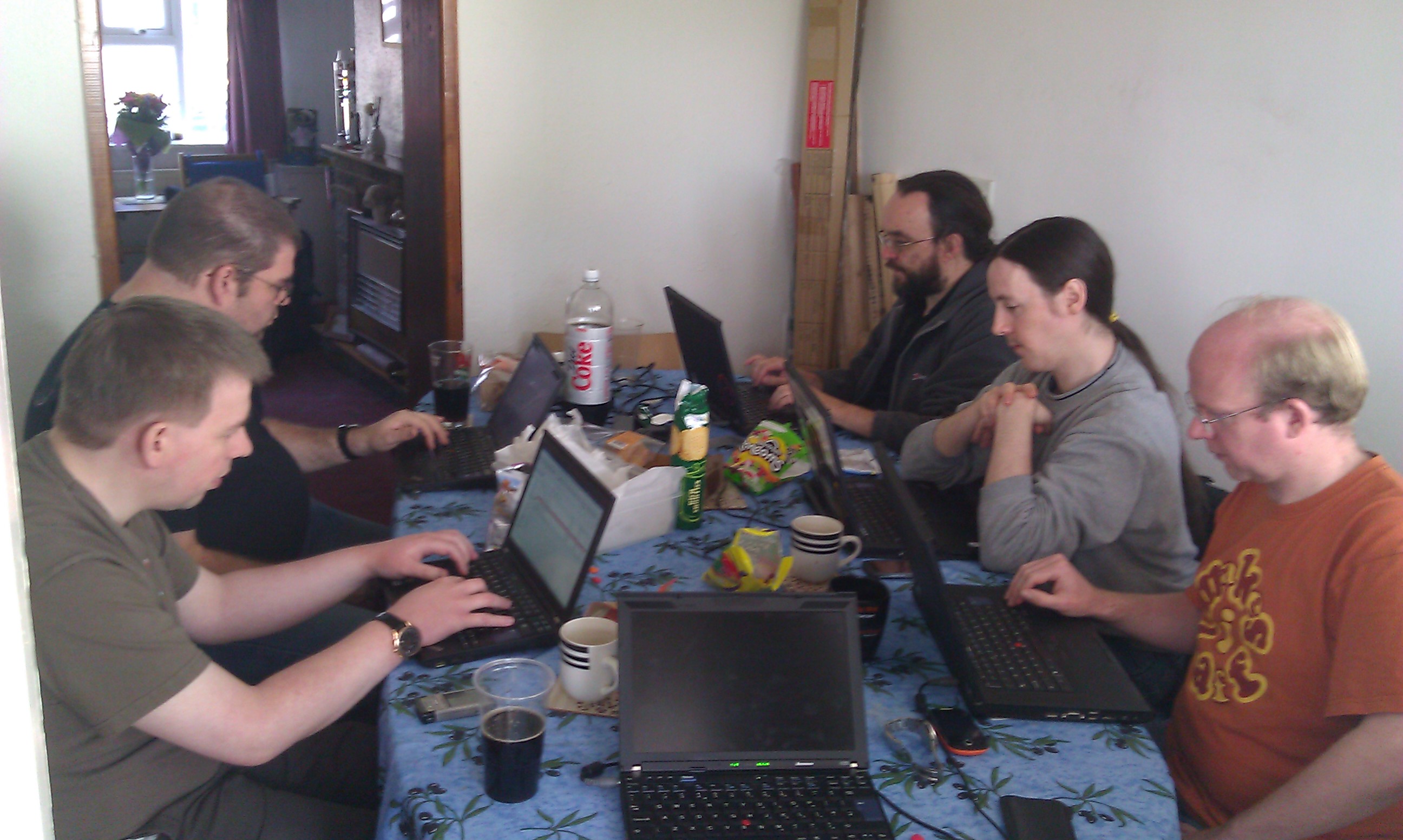
Happy Hackers Hacking


Tips for a successful BSP is a post from: jwiltshire.org.uk Flattr

9 October 2012

Christian Perrier: Long overdue 2012 update 30 for Debian Installer localization

It's quite some time since I didn't report about Debian Installer localization. Indeed, thanks to the tireless activity of Cyril Brulebois, we focused on releasing D-I and I indeed stopped harassing translators for updates around July 2012. Why July? Well, you probably know we have "something" to release as soon as we can and most, if not all, Debian energies should be focused on this! Or, more precisely speaking, I only focused on getting the newly introduced material translated: we had several changes recently in D-I, mostly focused on important features, such as IPv6 support (thanks to Phil Kern who worked on this), better wireless networking support (thanks to Sorina Sandu) and EFI boot support (thanks to Steve McIntyre). And, of course, when people change code in D-I, they want to add questions to users, display error and informative messages, etc, etc. And these need translations..:-) Most translators coped with all this (sometimes with /me hitting them hard on the head to get updates) and D-I beta2 was released with 37 complete translations out of 73 supported languages. Yesterday, I just resumed the activity of trying to get more updates not only for those recent changes, but also for other older changes...or for languages that never got completed in the past. As a result, we bumped from 37 compelte languages up to 45 this morning: look for level 1 here (level 2 has been hit by a change in iso-codes, but that change doesn't really affect D-I). If you language is not 100% in the leftmost column on the stats page, you can probably help. Just get in touch with me and we'll check if somebody is already working on this or not.
Next.

Previous.