Search Results: "az"

19 October 2011

Julien Valroff: Openbox 3.5 & xdg autostart

Since the 3.5.0 release, Openbox automatically starts applications with .desktop files in /etc/xdg/autostart. This was already the case with previous releases when setting the . $GLOBALAUTOSTART instruction in the autostart script. This instruction is now deprecated. This has puzzled me as some applications were started twice in my Openbox session: those launched via my ~/.config/openbox/autostart script which are also launched through xdg autostart. I also like to use notify-osd when in openbox, but it seems the new gnome-fallback session requires notification-daemon. In my Openbox session, I have noticed that notification-daemon was launched whereas my autostart script specifies to use notify-osd. I then discovered that /etc/xdg/autostart/notification-daemon.desktop was the cause of this. I had to drop a notification-daemon.desktop file in my ~/.config/autostart/ directory with the following contents:
[Desktop Entry]
Name=Notification Daemon
Comment=Display notifications
Exec=/usr/lib/notification-daemon/notification-daemon
Terminal=false
Type=Application
NoDisplay=true
OnlyShowIn=LXDE;OPENBOX;GNOME;
AutostartCondition=GNOME3 unless-session gnome
X-GNOME-Autostart-enabled=true
X-OPENBOX-Autostart-enabled=false
The last two lines allow me to not start notification-daemon only when using Openbox ie. it still starts automatically when launching a GNOME session. You can check what applications are automatically started through xdg with:
/usr/lib/openbox/openbox-xdg-autostart --list
The results are quite amazing, most applications being only configured to start in GNOME or KDE, but nothing seems to be very coordinated amongst maintainers. I find this quite misleading, and would prefer openbox to stick with the previous default behaviour. Who said diehard ?!

18 October 2011

John Goerzen: Greece part 3: Water

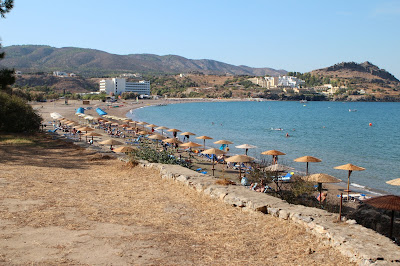
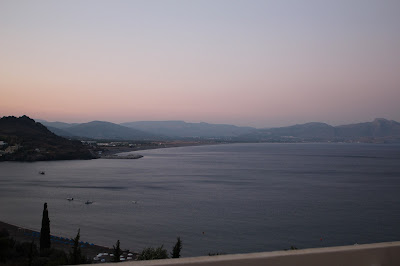
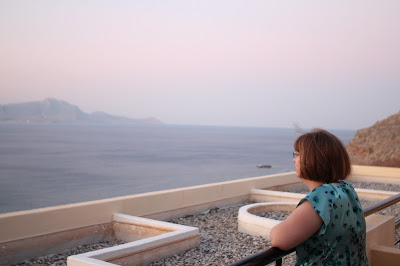
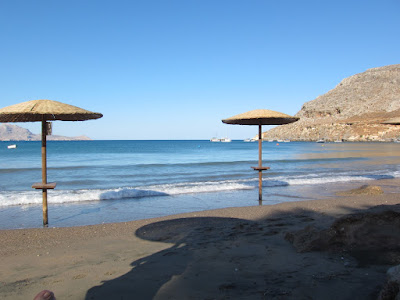
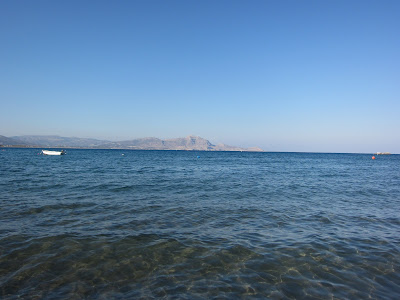
See also parts 1 and 2. That s a photo of Vlicha Beach, near our hotel. But before I talk about the Greek beaches, I need to explain something about living in Kansas. Kansas is in the middle of the United States. The nearest ocean is the Gulf of Mexico, which is 700 miles (1100km) away. That s roughly the same as the distance between Berlin and Minsk, or New York and Chicago. And I believe it s farther away from a saltwater body than all (or almost all) of Europe. So we re not just going to the beach every weekend or something. Vlicha Beach was all those incredible things you ever hear about beaches. The water was so clear that I could easily see my feat while wading in it. That, and the fish swimming around them. It was peaceful, relaxing, and picturesque. Between the deep blue of the sea and the same in the sky, I suppose it is no wonder that blue is often associated with Greece. We weren t exactly the only ones there. Though I think we were the only ones there with Kindles, which seemed to be much more popular in the USA than in Europe. We got several interested people carrying paper books asking what they were. Towards dusk, the mist would become more pronounced and the mountains off in the distance started to fade: The evening before we were set to fly home, we spent some time sitting on our balcony watching dusk set in. One last gaze out over the beautiful Aegean, the misty mountains, and the boats in the distance.

17 October 2011

Martin Meredith: Adventures with the Galaxy SII

Good morning all! It feels like forever since I last blogged . Which is extremely bad of me *slaps own wrist*. However, I m been horrendously stupidly busy. As some of you may know, I m very much an Android fan. Recently, I ve gotten myself a shiny Galaxy SII. Given the fact that alongside my day job of being a Web Developer for an Online Retailer, I m also a Voluntary Ambulance Person I thought it d be useful to ask my current workplace if they d provide me a mobile phone cover for my new phone. Of course, work were more than happy to provide me with a shiny Samsung Galaxy S2 case (I actually went for the Case-Mate Barely There in brushed aluminium). Being a voluntary Ambulance Person, I regularly have to go to random places to pick up an ambulance/attend an event. Because of that I rely quite heavily on Google Maps and it s navigation features (Free Sat Nav in my opinion, the killer feature of Android). Having only had my phone a week, I started to find that there were a few problems with the GPS. Whereas previously, I d been able to lock on almost instantly, It d now take me about half an hour (literally) to get a lock on anything. I tried Googling, I tried everything I could think of, but to no avail. I downloaded GPS Test, and it was showing that while it was picking up a couple of sattelites, it wasn t picking up enough to get a decent lock The image above is a screenshot of the GPS test from directly outside my front door, taken after it had settled down. As you can imagine, I wasn t happy and was ready to send the phone back. Then, for some reason, a brainwave hit me (It doesn t happen often). What changed from when it was working to now? I know! The Case *takes case off, tries GPS test again* It can be amazing what happens when you realise that shiny case you have is mainly made of aluminium. Guess what works well at deflecting radio signals and the like You got it, aluminium. So now I need to decide whether to get another case or whether to just take the case off when I need to do sensible things. Other than the case problem, I m finding that the Samsung Galaxy SII is a great phone (as soon as I got rid of Touchwiz). I m not a fan of the OEM Samsung crap that s been bolted onto the phone, and will, as soon as there s a decent release, be putting a copy of CyanogenMod on the phone (I ve already made most of the tweaks I just want rid of SNS) In other news I ve started more and more gaming again. If you re interested in a couple of rounds of TF2 or some SC2 (or some Portal 2 Co-Op) then give me a shout with your Steam ID / Battle.net ID and I ll see what I can do. I m thinking of starting doing some Let s Play Videos, as my Youtube Channel is looking a bit sparse! I m going to try and start blogging a bit more aswell so if there s anything you want to see me blog about pop a post in the comments below! Till next time..

16 October 2011

Biella Coleman: Going to S o Paulo next week

lolcat_brazilian First, is that image really the best LOLcat referencing Brazil that exists out on the Internets? I sure hope not as it is sort of lame but it was the only one I could find (in the 30 seconds I looked, which I admit, is not all that much time). But all of this lolcat in Brazil stuff is really to say, I am heading to S o Paulo tomorrow to give a talk on Anon on Thursday at this conference. If you are an Anon in the city and can make it, please do. If you are not Anon and are still interested, come along as well ;=) If there are Debian developers as well in the city, it would be great to meet at some point. I am there from Tuesday morning to Friday night.

Alastair McKinstry: Dear Lazyweb, I'm building a #debian package, CDAT. The latest version 6.0.alpha uses CMAKE to build, rather than configure. The trouble is that CMake doesn't build. It doesn't even fail. $ mkdir build $ cd build $ cmake .. ()-- Configuring done -- Generating done -- Build files have been written to: /home/amckinstry/deb-packages /cdat/cdat-6.0.alpha/build $ make $ The problem is, 'make' does nothing. A Makefile is generated by CMake, which calls cmake which calls make again on ./CMakeFiles/Makefile2 ... which does nothing useful. Apparently the CMake is supposed to put useful stuff in there, but doesn't. What puts stuff into Makefile2, and where should I pick up the bugs trail? (It would appear I also have issues with DIASPORA*'s Markdown over RSS to fix ...)

Dear Lazyweb, I'm building a #debian package, CDAT. The latest version 6.0.alpha uses CMAKE to build, rather than configure. The trouble is that CMake doesn't build. It doesn't even fail. $ mkdir build $ cd build $ cmake .. ()-- Configuring done -- Generating done -- Build files have been written to: /home/amckinstry/deb-packages /cdat/cdat-6.0.alpha/build $ make $ The problem is, 'make' does nothing. A Makefile is generated by CMake, which calls cmake which calls make again on ./CMakeFiles/Makefile2 ... which does nothing useful. Apparently the CMake is supposed to put useful stuff in there, but doesn't. What puts stuff into Makefile2, and where should I pick up the bugs trail? (It would appear I also have issues with DIASPORA*'s Markdown over RSS to fix ...)

Alastair McKinstry: #### Debugging CMake issues #### Dear Lazyweb, I'm building a #debian package, [CDAT](http://bugs.debian.org/584637). The latest version 6.0.alpha uses CMAKE to build, rather than configure. The trouble is that CMake doesn't build. It doesn't even fail. $ mkdir build $ cd build $ cmake .. <lots of output, ending in ...> ()-- Configuring done -- Generating done -- Build files have been written to: /home/amckinstry/deb-packages /cdat/cdat-6.0.alpha/build $ make $ The problem is, 'make' does nothing. A Makefile is generated by CMake, which calls cmake which calls make again on ./CMakeFiles/Makefile2 ... which does nothing useful. Apparently the CMake is *supposed* to put useful stuff in there, but doesn't. *What* puts stuff into Makefile2, and where should I pick up the bugs trail?

#### Debugging CMake issues #### Dear Lazyweb, I'm building a #debian package, [CDAT](http://bugs.debian.org/584637). The latest version 6.0.alpha uses CMAKE to build, rather than configure. The trouble is that CMake doesn't build. It doesn't even fail. $ mkdir build $ cd build $ cmake .. <lots of output, ending in ...> ()-- Configuring done -- Generating done -- Build files have been written to: /home/amckinstry/deb-packages /cdat/cdat-6.0.alpha/build $ make $ The problem is, 'make' does nothing. A Makefile is generated by CMake, which calls cmake which calls make again on ./CMakeFiles/Makefile2 ... which does nothing useful. Apparently the CMake is *supposed* to put useful stuff in there, but doesn't. *What* puts stuff into Makefile2, and where should I pick up the bugs trail?

14 October 2011

John Goerzen: Greece part 2: History (and sauntering up to guys with machine guns)

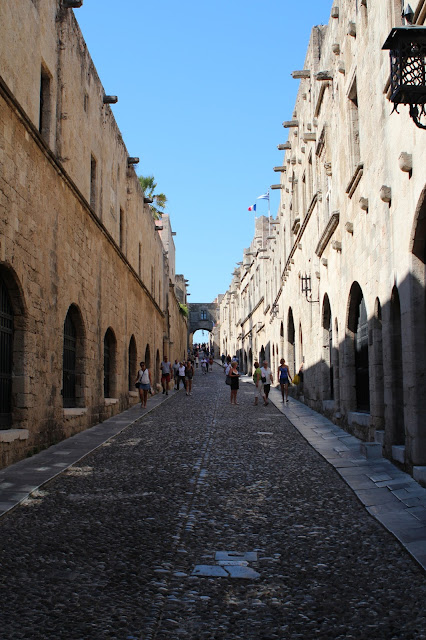
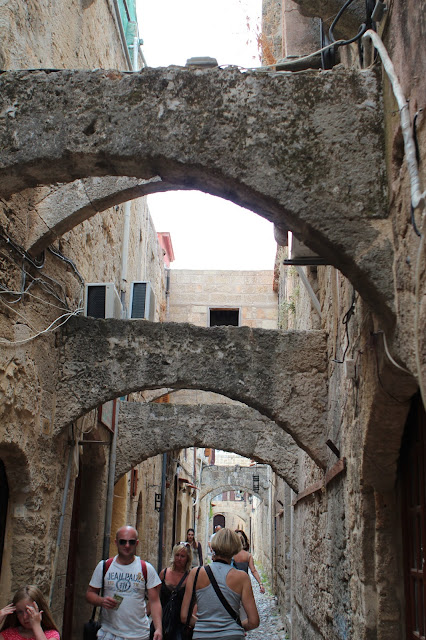
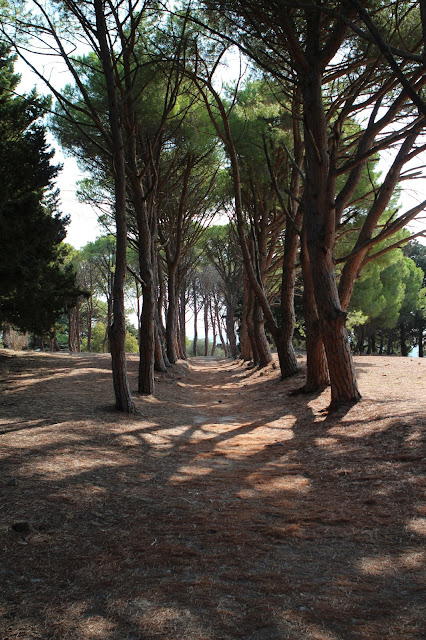
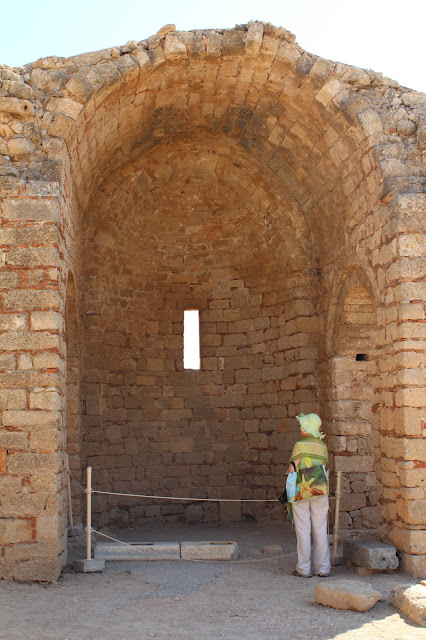
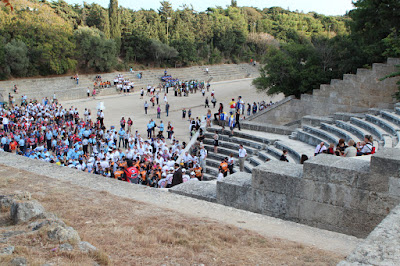
Terah and I went to the Greek island Rhodes recently. This is the second in a series about it. I am one to enjoy history. There is something deeply, well, connecting, about standing in an old place. There is a timeless quality to it a feeling of being connected to so many people of the past, and yet still being connected to change, visible in things such as weathering of stones. To gaze at pottery that s 300 years old, walk past 700-year-old walls, or pass through what remains of the grand portico of an ancient temple to Athena stirs a feeling I can barely explain, of timelessness. Although Rhodes doesn t have the famous Greek sites such as the Parthenon or Delphi, I can t help but wonder why the Rhodes sites aren t better known. They were incredible and it is hard to condense all that we saw into a short blog post. I have to start with the medieval Rhodes Old Town. We got off the bus a few blocks from it one bright morning, and our first task was to find a gate across the moat. Oh yes, A GATE ACROSS THE MOAT. It s a dry moat, and that bridge off in the distance is the gate we were headed to. Outside of the outer wall is a nice quiet walking area. The moat and walls completely surround Old Town and, for the most part, date back about 500 years. The round stones you see on that picture, we were told, were likely surplus from catapults and other projectile weapons. Cross one line of walls and you come to another, with original canons still present. The Knights Hospitaller of St. John, which held Rhodes for a few centuries until the Ottomans captured it, sure knew how to build to impress. The gate we happened to use was Amboise, the Grand Master s Gate. Right there is the stunningly rebuilt landmark Palace of the Grand Master. It is absolutely impossible for any photograph to begin to do this building justice. Between its imported Greek and Roman floors, to the grand nature of everything in it, and the archaeological museum in one corner, it was a fitting start to a visit to Old Town. Here s one of the main staircases. Just near the Palace is quiet courtyard with an old door. Pass through that door and suddenly you re in the midst of the busy Old Town. And among the landmarks in Old Town, the most prominent is Ippoton, the Avenue of the Knights. Along this avenue are the buildings built by the various nationalities of knights, many of which are historical sites in their own. Taken together, it is quite clear why Rhodes is said to be one of the world s best-preserved medieval cities. Down at the other end of Ippoton is the Knights Hospital, which is now part of the archaeological museum. Step off the Avenue a few blocks and you get to some quieter narrow streets just as old, in many cases. On Sunday morning, we were able to visit Mount Filerimos. In contrast to the busy Rhodes, Filerimos had an air of quiet and still to it. It was the site of a monastery, two historic churches, and a landmark Italian cross on the mountaintop. We arrived, and begin our visit with a walk up the quiet stone path. When we got to the top, we walked past this peaceful church. As we walked past the outside, we heard the beautiful music of chant from indoors. We got to step in and listen to mass for a few minutes. In typical fashion, directly in front of the church are two much older sites: one, the ruins of a temple to Athena, and the other a 4th-century Christian bapistery. Rhodes is a popular tourist destination, and of course we saw plenty of popular sites (such as the grandmaster s palace). Filerimos had a few tourists too, but not as many. I frequently like to operate on the plan of going wherever all the tourists aren t. And so, on Filerimos, that meant seeing what was behind the monastery. It started with this peaceful tree-lined path. And the deserted, but intentionally open, gate led to the remains of a Byzantine fortress, which had been a staging area for both the Knights and the Ottomans before their campaigns to capture Rhodes. It also provided incredible views of the surrounding countryside. The first historic site we had visited on our trip was the Acropolis of Lindos, parts of which are 2300 years old. Here s a view of the mountain from the rooftop of the Kalypso, our favorite restaurant in Lindos. The columns of the temple to Athena Lindia are visible, and of course so are the walls. The road up to the acropolis is accessible only on foot or by donkey. It is apparently the only road that has ever been used to get to the acropolis. Here is the partially-restored grand portico to the temple. There s an old Christian church (4th century, if memory serves) at the Acropolis too. The Acropolis makes some pretty good use of natural defenses too. Here s a view from one level of it. There s a manmade wall up there at the very top. And, of course, the beautiful Aegean always in the background. There are lots of cats on Rhodes. Here is a kitten napping at the top of the Lindos Acropolis: Lindos itself is a beautiful town. Here s one of the quieter streets: Notice the pebble steps leading into the houses those intricate pieces of artwork are all over. This post won t be complete without the story of our visit to the Acropolis of Rhodes. We walked there from Old Town. At the Acropolis, there are the remains of a temple to Apollo, an ancient theater, and an ancient stadium where qualifying matches for the Olympics were held. As we got closer to the area, we were repeatedly passed by people dressed in uniforms of various types. And as we got there, we joined a stream of people entering the area. The ancient stadium had apparently thousands of people in it, country names were being read off over the loudspeakers, policemen wielding machine guns were standing by, and we had absolutely no idea what was going on. At this point, you can appreciate the difference between Terah and me. Terah thought that we have no idea what is happening, she was tired from the walk, and so thought we should just leave. I thought that we have no idea what is happening, which is a great reason to stay. So Terah opted to sit and read a bit under some trees while I explored. Here s a view of the stadium as it was emptying out, seen from the theater: I explored the temple and theater, and eventually we were ready to head back. We knew there was a bus back to the New Market (from where we could get a bus back to our hotel), but didn t know where the bus stop was. The obvious place to ask were the policemen, which I thought I would do. Terah thought she would just stay sitting under the trees, on the grounds that the policemen nearest us were all carrying machine guns and perhaps wouldn t like to be disturbed. This led to my cryptic tweet:
Only ONE of us is the kind of person that goes up to guys with machine guns to ask what s happening. Me to Terah today
They told me that it was the preparations for the opening ceremony for a global shooting contest, and also gave me directions to the bus stop.
13 October 2011

Sven Mueller: Strange MySQL (5.0) issue with authentication

Dear Lazyweb . I ran into a very strange issue with MySQL authentication. The initial situation is as follows:
Two MySQL servers, let s name them a0.my.do.main and a1.my.do.main. Their my.cnf configuration is identical except for the server_id (equals 1 on a0 and 2 on a1).
Since I wanted to set up a master< ->master replication, I created a user repl@%.my.do.main on a0, then shut down the mysql server on both hosts, copied over the mysql database on the filesystem layer (i.e. rsync of the data directory), then started mysql on both hosts again. So far, so good, both servers came up nicely, and local (unix socket) login as a root user worked fine as expected. However: Logging in via TCP socket only works from a1 (to both a0 and a1). Logging in via TCP socket from a0 doesn t work to either host. I also created a test user sven @ %.my.do.main (I also tried with @ % ) which has all privileges.
Here is what the commands output:

sven@a0 ~ > mysql -u sven -ptestpass -h a0.my.do.main
ERROR 1045 (28000): Access denied for user 'sven'@'a0.my.do.main' (using password: YES)
sven@a0 ~ > mysql -u sven -ptestpass -h a1.my.do.main
ERROR 1045 (28000): Access denied for user 'sven'@'a0.my.do.main' (using password: YES)
sven@a1 ~ > mysql -u sven -ptestpass -h a0.my.do.main
Welcome to the MySQL monitor. Commands end with ; or \g.
Your MySQL connection id is 32
Server version: 5.0.77-log Source distribution Type 'help;' or '\h' for help. Type '\c' to clear the buffer. mysql> Bye
sven@a1 ~ > mysql -u sven -ptestpass -h a1.my.do.main
Welcome to the MySQL monitor. Commands end with ; or \g.
Your MySQL connection id is 24
Server version: 5.0.77-log Source distribution Type 'help;' or '\h' for help. Type '\c' to clear the buffer.
mysql>
All packages on both machines are up to date (CentOS5 with all updates available). The server variables shown with show variables also seem identical (except for the hostname and the server id). Besides, it looks more like a client problem to me than a server problem. Last datapoint: If I define the mysql user sven with an explicit host (a0.my.do.main and a1.my.do.main) instead of a wildcard, everything works nicely, from and to both hosts. So, dear lazyweb: Does anyone have an idea what might be causing this issue? Update: Due to some comments, let me add a few points of information:
  1. flush hosts doesn t help. Host resolution looks OK, according to documentation, the hostname in the error message is what the server things is right, not what the client specified, and that documentation seems to be consistent with my experiences.
  2. The db and user tables look as expected. And I m quite sure they are not the issue here, as I can connect from other hosts that match the host pattern.
  3. There is no ~/.my.cnf on either host
  4. Copying the database files on the filesystem layer is one of the documented ways of initializing the database on the slave for replication. Anyway, I had the same issue when trying to set up the database on the slave by loading a dump.
  5. DNS looks fine, both forward and reverse mappings, both servers use the same DNS server.
  6. IPv6 is not involved, it is disabled on these servers
Thanks for the hint at serverfault.com, I will try that if I don t get sufficient info here. Update 2 Another strange data point:
When I disable the (non-privileged) anonymous access user in the mysql.user table (i.e. drop the rows with user= "), everything works as expected from both servers. However, why does it work from one host (client) to both DBs if the anonymous access is allowed (with no privileges except for being able to see that the test and mysql databases exist), but not from the other host (client)? It really looks like an issue on the client side, but I still don t get what exactly goes wrong.

12 October 2011

Iain Lane: Robin Hood beer festival 2011

tasty beerskis Greetings real ale fans, This most exciting time of year is almost upon us again. Yes, it's the Nottingham Robin Hood Beer Festival! This year I have followed in the footsteps of Alex and Karen and decided to trawl through the list of over 900 beers so that I can best sample the delights on offer. My selection is here. I'm attending on both the Thursday and Saturday, so there's plenty of time for me to sample a reasonable number of different ales. Beer aficionados, I'd welcome suggestions for alternative beers to try, if you'd recommend any of them. I promise to update the list after. I might even be tempted by the ciders, perries and wines. Generally I tend to prefer paler ales, but I also quite like a mild given half the chance. See you on the other side! (Image by Ant & Carrie Coleman, cc-by-nd 2.0)

11 October 2011

Josselin Mouette: A message to liberals

This morning, when turning on TV, my ears have been yet another time hurt by the stupidity of a self-appointed economist, trying to intoxicate people with his fantasies about economy being able to regulate itself. Seriously. All neoliberals, please shut the fuck up. Now. The world has been running out of your ideas for more than 30 years. We lowered salaries and taxes, making the world run through credit. We gave everything to those who were already born with everything. Economy was almost brought to the verge of implosion thanks to your crazy ideas. For 4 years since the subprimes crisis, you psychopaths have kept on explaining it happened because we have not listened to you enough, and that the solution is to lower salaries even more. A quick look at the situation in Greece and UK should be enough to understand where this is going. It is time for something new. So shut up now, and let others fix the mess you have left behind.

Christian Perrier: RWC 2011 : after 1/4 finals

I was expecting to write more about the 7th Rugby World Cup, but real life, Debian work and running activities prevented me to do so.. Still, I watched several games and I can share my feelings now. First of all, this is a tremendous organization from New Zealand. It seems that about the entire country is working on making this even a great success and I really appreciate to see a place I certainly have to visit some day receiving such wordlwide attention (OK, admitedly, mostly in the part of the world that understands rugby). First round already gave several surprises even if the 1/4 finals were after all kinda expected (at least, the list of countries). Which lead us to the following 1/4 finals (in parenthesis are my bets): If you know about the results, you know I screwed it nearly completely..:-) The Welsh team played a great game against an uninspired Irish team. It has certainly been the best 1/4 final and they certainly deserve their win. Even though I usually tend to be supprotive of Ireland, I was very balanced here, and finally turned out to be in favor of the Welsh. We really have to fear them in semi-finals. Australia-South Africa was theoretically the most exciting 1/4 final but finally turned out to be quite boring. Both teams insisted on playing mostly to occupy their opponents part of the field, more than trying to score, then relying on penalties to score. That was apparently the good tactics for Australia ad they also deserve their win against a South-African team where forward players were not as decisive as they sometimes are. Argentina was again there and really there. It has been the only team up to now who lead score against New Zealand. And that was deserved. What a wonderful 1st halftime! Obviously, it was impossible for them to resist during second halftime and it slowly became obvious that the Blacks (saved during 1st half by the kicks of a very inspired Kiri Weepu) would finally manage to score tries. But, still, our argentinian friends, for instance the inoxydable "Super Mario" Ledesma, or the tireless Felipe Contepomi, were not here as a sacrificial victim. What to say about England-France? First half was astonishing for us, of course. This is what we love (and hate) with our beloved French team. Definitely the team that can make surprises and, imho, the only one that can beat New Zealand if that has to happen (but also the only one that can be entirely crushed by them). The defeat against Tonga and the week that followed completely transformed them. A stunning 3rd row, defending each and every single bit of England trying to invade "la patrie en danger". Rear lanes with the magicians of Toulouse (Clerc and M dard) as the ideal finishers of magic play by Parra, Trinh Duc, Mermoz, Palisson (the good surprise of this world cup, Alexis). And, during second half, a trilling resistance to assaults of the British White Knights, concluded by this delivering drop-goal by Trinh Duc. For sure, with games like this, they can beat everybody and by everybody, I mean everybody. Remember Millenium Stadium in 2007..:-) So, well. Australia-New Zealand and France-Wales. I know where my heart is balancing for both games. The Blacks and Les Bleus in final, thi is what we hope (and fear...), but both teams, particularly France, will have to first climb a quite big wall before reaching this.

9 October 2011

Andrew Pollock: [life] There's something to be said for a destination wedding

Our friends Andrew and Janice finally tied the knot last Sunday, in Langkawi, Malaysia. They're Aussies currently living in New York, and Janice is of Malaysian descent, so I think part of the reason was to accommodate some Malaysian relatives that wouldn't be able to travel, and the other reason was that it was going to mean a bunch of people had to travel anyway, so why not travel somewhere a bit exotic? As my sister is getting married later this month in Brisbane, we decided to spare Zoe two massive international flights in close succession, and Sarah and Zoe flew out a few days ahead of me, and went to Brisbane, and then Zoe, Sarah and her mum flew to Langkawi from there, and I flew there from San Francisco, with the plan being for Sarah and Zoe to hang out in Brisbane for the 4 weeks in between weddings. It was the longest amount of travel I think I've ever done. I hadn't sat down and calculated what the travel time was beforehand, and when I got on the flight from San Francisco to Hong Kong, and they said it was going to be nearly 14 hours just to Hong Kong, I nearly wept. The only good thing about it was I didn't have to wrangle a toddler as well. From there, I had to get to Singapore, with a several hour layover, and then another flight from Singapore to Langkawi. I left SFO at 1:20am on Monday morning, and finally arrived at about 7am (San Francisco time) the following day. I didn't even bother getting off the plane in Hong Kong, it was only an hour and a half layover. I think the layover in Singapore was 5 hours, and it was a separate flight. Singapore airport at least was pretty good to kill time in. It was funny, I was reading Wired while I was killing time in Singapore, and they had an article, which included a side bar on 10 Best Airports to Get Stuck In, and I observed that getting to Langkawi and back involved using 4 of them. The flight into Langkawi was more eventful than usual. I was dozing a bit as we were coming in to land, and I woke up to the sensation of taking off again. I wondered if we'd had an aborted landing? Sure enough, soon after, the captain got on the public address and said that they'd had to abort the landing due to bad weather in Langkawi. He had pretty bad Engrish, thanking us for our frustration and saying something about fuel, so I didn't get a lot of the details. We proceeded to circle for a while before finally landing. I think the flight ended up landing something like an hour or more later than scheduled. So that was mildly exciting. Langkawi airport was one of those little "walk across the tarmac" places. I think I stood the closest to an operating jet engine that I ever have, as another aeroplane taxied in to a stop between my plane and the terminal while I was walking to it. Loud. Anyway, that was all just me getting there. Sarah had a bit of fun getting to Brisbane on her own with Zoe. She's now too long to sleep in an in-flight bassinet, and doesn't seem to like sleeping vertically in the Ergo Baby Carrier (possibly she was too hot in it). I think she got a bit of sleep lying across Sarah's lap, but Sarah didn't get much sleep. I think there was similar fun for the Brisbane to Kuala Lumpur flight, but at least she had two laps to lie across for that one. Sarah, Zoe and Sarah's mum arrived in Langkawi earlier in the day on Tuesday, and I made it to the resort at about 10pm (local time) and pretty much immediately crashed for the night. The Westin Langkawi was just fabulous. I don't think we've stayed at a resort since our honeymoon, and this resort was a whole other level compared to Heron Island. The rooms were very comfortable, and the resort was very accommodating of a toddler. Their Kids Club menu was excellent. The breakfast buffet (included in our room rate) was the most comprehensive breakfast buffet I have ever seen in a hotel. The only thing missing was bacon, being a Muslim country, but I can live without that. It was pretty easy to just fill up on breakfast, skip lunch and just have a light dinner. The on-resort dining prices were also very reasonable. The off-resort prices were even cheaper. The resort facilities in general were very comprehensive. Three pools. A children's play room. A well equipped gym and recreational area including squash courts. An extremely nice day spa. The thing I liked best about the whole destination wedding thing was all of the activities leading up to the actual wedding. The wedding was on the Sunday, and we had the Hen's and Buck's parties on Friday. Apparently Australia is the only place that calls it a Buck's party. The rest of the world calls it a Stag party, how about that? There was some last-minute changes to the Buck's party, and we ended up chartering this huge $2 million yacht for 4 hours and going for a cruise and doing some jetskiing and water sports. The captain was Aussie, so we all had a good chat with him. Apparently it's a corporate vessel, with an exclusive chartering arrangement with the Westin. On Friday night, we all went out to a seafood buffet dinner at the Yellow Cafe over at Cenang Beach. Most of the guys and girls already knew each other courtesy of the day's activities, so dinner involved a lot of meeting the other halves. What I really liked about all of the pre-wedding stuff was that by the time the wedding rolled around, you really felt like you knew a bunch of Andrew and Janice's family and friends, which I think made the whole thing feel a lot more intimate. Saturday was a recovery day. Sarah's aunties Glenda (who was in Singapore on business) and Vicki (who lives in Thailand) had joined us at the resort by this stage, so we were all knocking around together checking out the island. We took the cable car to the top, but unfortunately the sky bridge was closed due to the inclement weather. There was a lot of touristy stuff at the bottom of where the cable car was, and Zoe got to have an encounter with a very large python. She even tried to give it a kiss. One of the things that was surprising was how popular Zoe was with all of the locals and other Asian tourists. We could probably have charged for photographs. There was a little girl, who I thought was possibly a similar age to Zoe (turned out she was two and a half) and I asked her parents if I could take a photo of the two girls together, and no sooner had they sat down together and a virtual paparazzi materialised out of nowhere taking photographs. Similarly, all of the staff at the Westin were totally taken by Zoe, and wanted to touch her. To her credit, Zoe handled all of the extra attention pretty well. The wedding wasn't until 6pm on Sunday, so we did a 4 hour island hopping boat tour in the morning. That was a bit of an experience. It was nothing short of sheer bedlam trying to board the right boat at the wharf (I use the term lightly) and then the boat's captain had to arrange the passengers appropriately so as to keep the boat on an even keel. It was a narrow motor boat with a canopy cover over the back two thirds of it. First stop was Dayang Bunting Island, home of Pregnant Maiden Lake, where we stopped for 45 minutes. More bedlam ensued getting off the boat at the wharf there (there was veritable flotilla of tour boats all trying to load and unload at the same time). Monkeys abounded. They seemed incredibly tame. We were practically tripping over them. Zoe didn't seem to be as taken by the monkeys as I thought she would. It was a short walk up a reasonable flight of stairs to get to the lake, though some incredibly humid jungle, and once we got there, there wasn't a huge amount to do in the time we had available. So we dunked Zoe's feet in the lake a few times and then made our way back to the chaos at the wharf and got back on our boat. We stopped for a similar amount of time at another island with a pretty nice beach, and Zoe had enough time to a quick swim in the ocean with Sarah, and then we made our way back to the boat again to another spot where we watched sea eagle feeding. Heaps of eagles circling overhead would take turns to swoop down and grab fish and fly off again. It was impressive. I think I managed to snap some good action shots with the long lens. Then we had the wedding itself. It was on the beach out the front of the Heavenly Spa on the resort. Let me say, the Westin knows how to put a wedding together. The ceremony was as lovely as the location. For the reception, the one 5 bedroom villa on the resort was booked for the night. Dinner was a buffet on the lawn out the front (briefly delayed thanks to a rain shower) and then speeches and general partying happened around the terrace out the back of the villa. There were some beautiful speeches. Janice's brought a tear to my eye. Part of the whole package included something like a 10 person video crew that were running around capturing everything. It felt a bit surreal. It was definitely the most high-end wedding I've ever been to (sorry Scott and Julie, your "Wedding of the Century" has been eclipsed by the "Wedding of the Millennium"). Monday was a wind down day. Zoe mercifully gave us a sleep in until 8am. Our flights didn't leave until the evening on Tuesday, so after we checked out we went for a drive around the island to try and get Zoe to take a nap in the car. We ended up at the fruit farm, which to the best of my understanding is run by the government. Zoe had fallen asleep by this stage, and Sarah said she'd stay behind in the car and have a nap too. So her mum and I went on the tour. It was a fun little tour. There were only four of us on it. They drive you around the farm on the back of a truck and show you the various crops they have. They stop at a few places and give you a bunch of fruit samples, attempt to answer your questions, and take funny pictures of you. The favourite seemed to be to dangle a fruit on a knife up close in front of the camera while having the subject(s) in the background look like they're carrying an enormous fruit. We got back to the car to an upset Sarah and small group of locals milling around. Sarah had managed to lock Zoe in the car for about 30 minutes when she got out to make her a sandwich after Zoe had woken up from her nap. Fortunately the engine was running and the air conditioning was on, so there was no risk of Zoe overheating (on the contrary, she was a bit on the cool side). Some kind locals had somehow figured out which car rental company to call (it's possible there's only one) and someone came out with a spare key, so the crisis was averted just before we got back to the car. It's the first time Zoe's been locked in the car (it's pretty much impossible in the Prius) and it was just our luck that it'd happen in a foreign country! One of the saddest things about Langkawi was the amount of garbage floating around in the ocean, and washing up on the beaches. I was swimming in the ocean off the yacht while we were out on the Buck's party, and it was disgusting. The jetski was temporarily disabled due to sucking in something. We visited Black Sand Beach, which was supposed to be something of a tourist attraction. Covered in trash. Ian Kiernan would be sad. The captain of the yacht we were on for the Buck's party said it was all from Thailand and got flushed out of all the rivers and streams by the recent rain. Just goes to show how connected everything is. The house is very quiet without Sarah and Zoe, but my friend Liam is visiting from Zurich for a couple of weeks, so that's helping break the silence. I'm using the time to get a heap of things done that I don't otherwise get time to get done. Unfortunately the photos from the trip are only available on Facebook at the moment, but they'll eventually get uploaded here.

Erich Schubert: Class management system

Dear Lazyweb.
A friend of mine is looking for a small web application to manage tiny classes (as in course, not as in computing). They usually span just four dates, and people will often sign up for the next class then. Usually 10-20 people per class, although some might not sign up via internet.
We deliberately don't want to require them to fully register for the web site and go through all that registration, email verification etc. trouble. Anything that takes more than filling out the obviously required form will just cause trouble.
At first it sounded like this is a common task, but in essence all the systems I've seen so far are totally overpowered for this. There are no grades, no working groups, no "customer relationship management". There isn't much more needed than the ability to easily configure the classes, have people book them, and get the list of singed up users into a spreadsheet easily (CSV will do).
It must be able to run on the typical PHP+MySQL web hoster and be open source.
Any recommendations? Drop me a comment or email at erich () debian org Thank you.

7 October 2011

Petter Reinholdtsen: Free e-book kiosk for the public libraries?

Here in Norway the public libraries are debating with the publishing houses how to handle electronic books. Surprisingly, the libraries seem to be willing to accept digital restriction mechanisms (DRM) on books and renting e-books with artificial scarcity from the publishing houses. Time limited renting (2-3 years) is one proposed model, and only allowing X borrowers for each book is another. Personally I find it amazing that libraries are even considering such models. Anyway, while reading part of this debate, it occurred to me that someone should present a more sensible approach to the libraries, to allow its borrowers to get used to a better model. The idea is simple: Create a computer system for the libraries, either in the form of a Live DVD or a installable distribution, that provide a simple kiosk solution to hand out free e-books. As a start, the books distributed by Project Gutenberg (abount 36,000 books), Project Runenberg (1149 books) and The Internet Archive (3,033,748 books) could be included, but any book where the copyright has expired or with a free licence could be distributed. The computer system would make it easy to: In addition to such kiosk solution, there should probably be a web site as well to allow people easy access to these books without visiting the library. The site would be the distribution point for the kiosk systems, which would connect regularly to fetch any new books available. Are there anyone working on a system like this? I guess it would fit any library in the world, and not just the Norwegian public libraries. :)

5 October 2011

Niels Thykier: Numbers and lintian

Lintian uses some small scripts to collect data from packages. In daily talk, they are usually referred to as collection scripts. Lintian uses files to track the status of collection scripts between runs. Consider the following directory listing on lintian.d.o:
$ ls -al laboratory/binary/eclipse/.*-*
-rw-r--r-- 1 user group  45 Jul 18 01:21 laboratory/binary/eclipse/.ar-info-1
-rw-r--r-- 1 user group  45 Jul 18 01:21 laboratory/binary/eclipse/.bin-pkg-control-1
-rw-r--r-- 1 user group  45 Jul 18 01:21 laboratory/binary/eclipse/.changelog-file-1
-rw-r--r-- 1 user group  45 Jul 18 01:21 laboratory/binary/eclipse/.copyright-file-1
-rw-r--r-- 1 user group  45 Jul 18 01:21 laboratory/binary/eclipse/.debian-readme-1
-rw-r--r-- 1 user group  45 Jul 18 01:21 laboratory/binary/eclipse/.doc-base-files-1
-rw-r--r-- 1 user group  45 Jul 18 01:21 laboratory/binary/eclipse/.fields-1
[...]
This example shows that a bunch of collections scripts have been run for the eclipse binary package. Each of these files contain the version of Lintian that created them (or last wrote them) and a timestamp. Why the interest in these files? Let us go a bit back in time to the 15th of June 2011. That was the day where Lintian 2.5.1 was uploaded to unstable. That version of Lintian had 17 collection scripts[1] for binary packages. So every binary package would have 17 files and there are over 35 000 binary packages in the Debian archive. Ouch, so that makes about 595 000 files if we use this on all binary packages on the archive. The size of each of those files are about 45 bytes, so that is a total of 25.5 MB for all of these files[2]. So other than the inode abuse , this is not too bad. A little du -h should confirm this
$ du -h laboratory/binary/eclipse/.*-*
4.0K    laboratory/binary/eclipse/.ar-info-1
4.0K    laboratory/binary/eclipse/.bin-pkg-control-1
4.0K    laboratory/binary/eclipse/.changelog-file-1
4.0K    laboratory/binary/eclipse/.copyright-file-1
4.0K    laboratory/binary/eclipse/.debian-readme-1
4.0K    laboratory/binary/eclipse/.doc-base-files-1
4.0K    laboratory/binary/eclipse/.fields-1
[...]
Whaaa oh the file system uses a block-size of 4K bytes, so I guess we have to pay a full block for these files. Let s see what that gives, 595 000 times 4 kB is 2.27 GB Oops! That was in the (not too distant) past. About a month later (12th of July), the code creating these files are refactored into:
sub _mark_coll_finished  
    my ($self, $collname, $collver) = @_;
    # In the "old days" we would also write the Lintian version and the time
    # stamp in these files, but since we never read them it seems like overkill.
    #  - for the timestamp we could use the mtime of the file anyway
    return touch_file "$self-> base_dir /.$collname-$collver";
 
This turns out to be a very space-saving change if we ask du -h:
$ du -h laboratory/binary/lintian/.*-*
0       laboratory/binary/lintian/.ar-info-1
0       laboratory/binary/lintian/.bin-pkg-control-1
0       laboratory/binary/lintian/.changelog-file-1
0       laboratory/binary/lintian/.copyright-file-1
0       laboratory/binary/lintian/.debian-readme-1
0       laboratory/binary/lintian/.doc-base-files-1
[...]
Existing files are not emptied, so we still have some old non-empty files left on lintian.d.o. Nevertheless that was the "nice story" about "the side effect of being lazy sometimes reduces space waste"[3]. But we have another "number" problem. If you grep for "Too many links" in the lintian.log from lintian.d.o you should see:
$ grep -i "too many links" logs/lintian.log
mkdir: cannot create directory  /srv/lintian.debian.org/laboratory/binary/aces3': Too many links
mkdir: cannot create directory  /srv/lintian.debian.org/laboratory/binary/boinc-cgi-stripchart': Too many links
mkdir: cannot create directory  /srv/lintian.debian.org/laboratory/binary/libbrailleutils-java': Too many links
mkdir: cannot create directory  /srv/lintian.debian.org/laboratory/binary/libbrailleutils-java-doc': Too many links
mkdir: cannot create directory  /srv/lintian.debian.org/laboratory/binary/libclippoly0': Too many links
mkdir: cannot create directory  /srv/lintian.debian.org/laboratory/binary/libclippoly-dev': Too many links
mkdir: cannot create directory  /srv/lintian.debian.org/laboratory/binary/xul-ext-cookie-monster': Too many links
mkdir: cannot create directory  /srv/lintian.debian.org/laboratory/binary/cucumber': Too many links
[...]
$ grep -i "too many links" logs/lintian.log   wc -l
3274
In the Lintian Laboratory every package is unpacked in a directory based on its type and name (as hinted in the output above). The problem is that ext3 has a limit of the amount sub-directories a directory can have[4]. This limit is just shy of 32 000 and (as a reminder) Debian has over 35 000 binary packages. So a lot of packages are currently not checked on lintian.d.o (#641468). The current feature branch for #641468 already solves the directory limit issue (by using a "mirror-like" pool layout). It also removes the need for "1 file per completed collection" by writing this information in the existing "per entry" status file.
I hope we can get the branch merged into master within 2-3 weeks, though there are still a few issues that needs to be worked out before then. Footnotes: [1] Actually it had 18 collections, but one of them are "auto-removed" so it is better not to include it in this case. [2] Content alone - metadata like permissions and such is ignored. [3] I admit it was more luck than intention! [4] The limit comes from the "32 000 hardlink per inode" limitation.

Bastian Venthur: Speech Recognition Software

Dear Lazyweb, Having broke my elbow last week, I m experiencing serious trouble typing with only one hand on the computer. I know that there is speech to text software, but I was never really interested in that until now of course. Is there any good software available on Linux you can recommend?

Tollef Fog Heen: The SugarCRM rest interface

We use SugarCRM at work and I've complained about its not-very-RESTy REST interface. John Mertic a (the?) SugarCRM Community Manager asked me about what problems I'd had (apart from its lack of RESTfulness) and I said I'd write a blog post about it. In our case, the REST interface is used to integrate Sugar and RT so we get a link in both interfaces to jump from opportunities to the corresponding RT ticket (and back again). This should be a fairly trivial exercise or so you would think. The problems, as I see it are: My first gripe is the complete lack of REST in the URLs. Everything is just sent to https://sugar/service/v2/rest.php. Usually a POST, but sometimes a GET. It's not documented what to use where. The POST parameters we send when logging in are:
method=>"login"
input_type=>"JSON"
response_type=>"JSON"
rest_data=>json($params)
$params is a hash as follows:
user_auth =>  
            user_name => $USERNAME,
            password => $PW,
            version => "1.2",
 ,
application => "foo",
Nothing seems to actually care about the value of application, nor about the user_auth.version value. The password is the md5 of the actual password, hex encoded. I'm not sure why it is, as this adds absolutely no security, but it is. This is also not properly documented. This gives us a JSON object back with a somewhat haphazard selection of attributes (reformatted here for readability):
 
     "id":"<hex session id>,
     "module_name":"Users",
     "name_value_list":  
             "user_id":  
                     "name":"user_id",
                     "value":"1"
              ,
             "user_name":  
                     "name":"user_name",
                     "value":"<username>"
              ,
             "user_language":  
                     "name":"user_language",
                     "value":"en_us"
              ,
             "user_currency_id":  
                     "name":"user_currency_id",
                 "value":"-99"
              ,
             "user_currency_name":  
                     "name":"user_currency_name",
                     "value":"Euro"


What is the module_name? No real idea. In general, when you get back an id and a module_name field, it tells you that the id exists is an object that exists in the context of the given module. Not here, since the session id is not a user. The worst here is the name_value_list concept which is used all over the REST interface. First, it's not a list, it's a hash. Secondly, I have no idea what would be wrong by just using keys directly in the top level object, so the object would have looked somewhat like:
 
     "id":"<hex session id>,
     "user_id": 1,
     "user_name": "<username>,
     "user_language":"en_us",
     "user_currency_id": "-99",
     "user_currency_name": "Euro"
 
Some people might argue that since you can have custom field names this can cause clashes. Except, it can't, since they're all suffixed with _c. So we're now logged in and can fetch all opportunities. This we do by posting:
method=>"get_entry_list",
input_type=>"JSON",
response_type=>"JSON",
rest_data=>to_json([
            $sid,
            $module,
            $where,
            "",
            $next,
            $fields,
            $links,
            1000
])
Why this is a list rather than a hash? Again, I don't know. A hash would make more sense to me. The resulting JSON looks like:
 
    "result_count" : 16,
    "relationship_list" : [],
    "entry_list" : [
        
          "name_value_list" :  
             "rt_status_c" :  
                "value" : "resolved",
                "name" : "rt_status_c"
              ,
             [ ]
           ,
          "module_name" : "Opportunities",
          "id" : "<entry_uuid>"
        ,
       [ ]
    ],
    "next_offset" : 16
 
Now, entry_list actually is a list here, which is good and all, but there's still the annoying name_value_list concept. Last, we want to update the record in Sugar, to do this we do:
method=>"set_entry",
input_type=>"JSON",
response_type=>"JSON",
rest_data=>to_json([
    $sid,
    "Opportunities",
    $fields
])
$fields is not a name_value_list, but instead is:
 
    "rt_status_c" : "resolved",
    "id" : "<status text>"
 
Why this works and my attempts at using a proper name_value_list didn't work? I have no idea. I think that pretty much sums it up. I'm sure there are other problems in there (such as the over 100 lines of support code for the about 20 lines of actual code that does useful work), though.

4 October 2011

Michael Banck: 4 Oct 2011

Woodchuck and FrOSCon

At the end of August, I attended FrOSCon in Bonn again, after skipping it last year. The evening before FrOSCon however, I visited Neal Walfield, his wife Isabel and their little son Noam in D sseldorf. Besides having a great time and a lovely dinner, I was most impressed by their collection of Maemo devices (they had at least two N770s, an N900 and, to my jealousy, an N950) which Neal is doing research on these days. He works on woodchuck, which is a project investigating how to improve data availability on mobile devices and our conversation prompted him to implement ATP Woodchuck, which makes smarter decisions when to run APT upgrade on your Maemo device then the standard updater. As part of the research, they also run a user behaviour study which I joined, where one installs a client which records various data off your N900 and sends them anonymized (he seems to be doing a good job at that) to figure out how people use their mobile devices and hopefully enhance the experience. So if you have a N900, you should consider joining the study so they get better data.
The next day, I picked up Martin Michlmayr nearby and we headed for FrOSCon. I was quite impressed by the Makerbot at the Tarent booth, but I still don't know what they are really doing and why they had it on display... In the afternoon, I attended a couple of talks in the PostgreSQL developer room and a talk about a big OpenVPN deployment, before ending the day with the excellent as always social event barbeque. On Sunday, I went to quite a few talks, but I thought that two of them were particularly interesting:
Michael "Monty" Widenius of MySQL gave a talk titled "Why going open source will improve your product" about starting businesses on an open source project, or how business can/should open-source their product. Besides a detailed discussion about the various forms of Open Source licenses and the Open-Core model, he proposed the idea of "Business Source" (see slide 20 of his presentation), where a startup would distribute the source code under a non-commercial (but otherwise open-source) license with the explicit guarantee that the license would be changed to a true FLOSS license at some defined point in the future, giving the company a head start to develop and nurture their project. I asked whether this has been already implemented in practise and how the community could be sure that e.g. lawyers after a hostile takeover would not just remove that part of the copyright notice, as long as a true distribution under a FLOSS license has not happened yet. Monty wasn't aware of any real-word cases, and he did not seem to be concerned about this and said the original intent would be clear in a possible court case. This was the first time I heard about this approach, I wonder how other people think about it, whether it would work in practise and be a useful thing to have?
Second, I attended a talk by Gregor Geiermann, a Ph.D. student in linguistics on "Perceptions of rudeness in Free Software communities". He conducted an online survey about the perceived rudeness of several forum thread posts on Ubuntu Forums. Survey participants were first asked a couple of generic questions about their gender, nationality etc. and were then presented with a series of posts. For each post, they were asked to rate how rude they thought it was on a scale of 1 to 5 and they also had the possibility to highlight the parts of the post they considered rude as well as add comments. He presented a neat web application for analyzing the results, which makes it possible to select different groups (he did male vs. female and Americans vs. Germans in the talk) and have their overall rudeness ratings as well as the highlighted texts visualized as different shades of blue. Comments can be easily accessed. There were quite a few interesting differences e.g. in how Germans perceived rudeness compared to Americans (RTFM comments were considered less rude by Germans for example, IIRC). In response to my question, he said he intended to release the web application as open source and this might be an interesting tool for FLOSS projects to analyze how their public communication channels are perceived by various groups. Unfortunately, I cannot find any other resources about this on the web as of today, so I should try to contact him about it at some point.

2 October 2011

Neil Williams: Uses of Emdebian - special purpose computers

A continuation of my intermittent series on Emdebian and prompted by a query from Paul Wise, I thought I'd cover some of the uses to which a device running Emdebian can be put. It is a bit long this one...

So, yes, there are general purpose computers which could run Emdebian but there are common features amongst general purpose computers:
  1. Lots of different tasks must be supported - lots of different packages installed, each user could quite easily use a distinct set of packages from another user.

  2. Multi-user support - even if any one machine is only used by one person, a general purpose computer must have support for adding another user - not just a system user, a real user with a login, shell, possibly bookmarks and browser history etc.

  3. Connectivity - general purpose computers (and that includes mobile phones) must connect to a variety of other computers to be at all useful.

  4. Multi-modal data input - there needs to be support for a mouse and a keyboard or touchscreen and just as likely, software support for accessibility interfaces like an on screen keyboard and switch inputs.

  5. Storage for user data - the system admin can't know how much data users are going to add and if it is general purpose, it's probably going to support media players, image viewers, even office software. The data files managed and written by such software tend to be large and tend to accumulate into large collections. This means that a general purpose machine cannot anticipate the full storage requirements, so has to allow plenty of room for user data storage. If there's so much storage space available, why use an OS which is primarily designed to take up less space? Just use the full version, Debian.


Now compare with the common features of special purpose or single-purpose computers:
  1. Single task only - a splash screen (without support for removal) covers all the boot information, the single task starts as a daemon and if the user quits the task, the task initiates a shutdown, not quit. Every effort is made to prevent the task from exposing the underlying OS, including auto-restarts if it does crash.

  2. Single-user support - indeed, user is not the typical user. user in this case is a non-login user without a shell, created by the postinst of the task package purely to support running the task without root privileges (because if the task doesn't need privileges, it shouldn't retain privileges).

  3. Single mode input - don't expect these machines to support 105 key keyboards. You'll be lucky to have 5 keys which are really just buttons. The button won't just enter 'J' into the machine, it will fire off a command to charge your bank or start a drill or shutdown a malfunctioning service. (Each button will often be multi-functional as well, depending on context). Some devices will replace the mouse with a touchscreen but many are fitted in places where touchscreens simply won't survive, where keys have to be able to withstand being submerged in water (or oil) for hours. Many machines simply won't have mouse support at all. Many will not have any typical external connectors. Indeed, units which go into dirty or wet environments certainly won't have standard external connectors of any kind. Think boats and factories. Internal battery packs with custom hot-fit replacements, buttons encased in 4mm of clear plastic, screens viewable only through protective mesh / filters.

  4. Restricted connectivity - if the task doesn't need networking, no networking hardware is fitted. If the task doesn't need USB, no USB hardware is fitted. If the task doesn't need serial connections, there will probably be an internal serial connector but also a Warranty void if removed sticker. Don't expect an RS232 inside the case either, this will be a flat cable connector which you'll need to attach to a breakout board which correctly connects the cable wires to the RS232 port pins. That mapping is not standardised (why would it? only service engineers are approved to use it.)

  5. Constrained user data - the task is in complete control and determines what the user can view, store and access. Storage can be expensive and a power drain, so if the task doesn't need Gb of storage, don't fit the machine with Gb of storage. Profit.


So what are these mysterious single-use computers running Emdebian? It's hard to tell because the task has no particular reason to tell the user anything about the OS. Perhaps a different way to phrase the same question would be: Why use a general purpose OS for a special purpose computer?.


This is why Emdebian Grip is popular for these machines - because Emdebian Grip is binary compatible with the equivalent Debian suite and when a bug appears in the high level user interface, it is much easier to debug that on the desktop than on device. Debian stable is a fantastic OS for commercial development - the stability of the OS makes detection of interface bugs much easier. It is rare that developers have to investigate whether bugs in their UI come down to a bug in the underlying OS. That saves time.

The machines themselves? I'm sure others can come up with other examples but these are some which come to my mind (no particular order):


Anywhere where the device simply needs to DoTheRightThing in a variety of unpredictable circumstances, you're going to need a general purpose OS to gather the data and produce the right result. Anywhere where the device has only a single task, you're going to want to not provide access to the rest of the system. There's no point providing "general purpose access" when the device doesn't have "general purpose hardware". There's no point fitting general purpose hardware if the device does not use it. That is a waste of money, a waste of resources and causes unnecessary delays if one component or other becomes unobtainable or changes behaviour. Limit your exposure to hardware bugs and get the product out to the user more quickly and more reliably, everyone is happy. Fit non-standard hardware and you can fit custom hardware which better matches the profile of the device usage - why use standard speakers capable of CD quality across a vast frequency range when the device only makes very very loud alert noises which can be done at lower sample rates and with narrow range, high amplitude, speakers.

There are all sorts of estimates for the number of computers now in the average Western home. It's worth noting that the vast majority of those computers are not PCs or laptops or even game consoles and routers - all instances of general purpose machines with general purpose access / connectivity. A lot of the computers in your home are embedded in machines like white goods, media controllers (set top boxes and the like). Some of these will still use low level firmware written entirely in assembly or COBOL. More complex ones already have a general purpose OS inside yet constrain that OS with a simple, user-friendly interface which is tailored to the hardware actually fitted. It might be cool to connect to your set top box over Bluetooth but really, is that actually going to sell more units? Only if there are other high-end services written for the device which the average customer won't want to see pushing up the price of the base unit. Some machines (particularly in automotive uses) will need to be using Real Time operating systems and Safety Critical operating systems but even some of those are based on general purpose systems - just old versions which have been thoroughly tested.

Finally, consider that for a lot of these devices, the customer is not you. The customer is another business who then put the device into something else which is installed into a factory production line which produces something which goes into creating a consumer product you find in Tesco or on Amazon or bundled in with another service like your TV/broadband contract. There is absolutely no reason for these devices to provide general purpose computing to you, even if the device itself is part of something else which can provide such services.

1 October 2011

Tiago Bortoletto Vaz: flickr backup tool in Debian

Forked from hivelogic-flickrtouchr, which is forked from flickrtouchr, flickrbackup is a simple tool to perform a backup of your photos in flickr. It's is in a very early development stage and code looks weird, but critical functionality is working :)
tiago@x61:~$ flickrbackup -h
Usage: flickrbackup [OPTIONS] -o OUTPUT_DIR
Backup your flickr photos.
Options:
  --version             show program's version number and exit
  -h, --help            show this help message and exit
  -o OUTPUT_DIR, --output_dir=OUTPUT_DIR
                        set the local directory where you want to store your
                        pictures
  -e, --metadata-exif   store flickr metadata (title, description etc) as EXIF
                        tags in your local files [default: False]
  -x, --metadata-xml    store metadata as default flickr XML files [NOT
                        IMPLEMENTED]
  -u, --metadata-update
                        update flickr metadata to your local files. Use this
                        option with -x and/or -e [default: False]
  -g, --html-gallery    generate a local HTML gallery [NOT IMPLEMENTED]

Next.

Previous.