Search Results: freedom

10 July 2016

Michal Čihař: Weblate 2.7

Slightly later than on monthly schedule but Weblate 2.7 is out today. This release brings improvements to the API and is first to officially support wlc a command line client for Weblate. Full list of changes for 2.7: If you are upgrading from older version, please follow our upgrading instructions. You can find more information about Weblate on https://weblate.org, the code is hosted on Github. If you are curious how it looks, you can try it out on demo server. You can login there with demo account using demo password or register your own user. Weblate is also being used https://hosted.weblate.org/ as official translating service for phpMyAdmin, OsmAnd, Aptoide, FreedomBox, Weblate itself and many other projects. Should you be looking for hosting of translations for your project, I'm happy to host them for you or help with setting it up on your infrastructure. Further development of Weblate would not be possible without people providing donations, thanks to everybody who have helped so far! The roadmap for next release is just being prepared, you can influence this by expressing support for individual issues either by comments or by providing bounty for them.

Filed under: Debian English SUSE Weblate 0 comments

20 June 2016

Joey Hess: twenty years of free software -- part 1 ikiwiki

I'm forty years old. I've been developing free software for twenty years. A decade ago, I wrote a series of posts about my first ten years of free software, looking back over projects I'd developed. These retrospectives seem even more valuable in retrospect; there are things in the old posts that jog my memory, and other details I've forgotten by now. So, I'm doing it again. Over the next two weeks (with a week off in the middle for summer vacation), I'll be writing one post each day about a free software project I've developed in the past decade.
We begin with Ikiwiki. I started it 10 years ago, and still use it to this day; it's the engine that builds this website, and nearly all my other websites, as well as wikis and websites belonging to tons and tons of other projects, like NetBSD, X.org, Freedesktop.org, FreedomBox and many other users. Indeed I'm often reading a website and find myself wondering "hey.. is this using Ikiwiki?", and glance at the html and find that yes, it is. So, Ikiwiki is a reasonably successful and widely used peice of software, at least in its niche. More important to me, it was a static site generator before we knew what those were. It wasn't the first, but it broke plenty of new ground. I'm particularly proud of the way it combines a wiki with blogging support seamlessly, and the incremental updating of the static pages including updating wikilinks and backlinks. Some of these and other features are still pretty unique to Ikiwiki despite the glut of other static site generators available now. Ikiwiki is written in Perl, which was great for getting lots of other contributions (including many of its 113 plugins), but has also held it back some lately. There are less Perl programmers these days. And over the past decade, concurrency has become very important, but Ikiwiki's implementation is stubbornly single threaded, and multithreading such a Perl program is a losing propoisition. I occasionally threaten to rewrite it in Haskell, but I doubt I will. Ikiwiki has several developers now, and I'm the least active of them. I stepped back because I can't write Perl very well anymore, and am mostly very happy with how Ikiwiki works, so only pop up now and then when something annoys me. Next: twenty years of free software -- part 2 etckeeper

3 June 2016

Simon D saulniers: Google Summer Of Code

I am part of the group of students working with the Debian organization. You can see my profile on the Debian wiki here.

Improving distributed and secure communication using free software This the title of my project for this summer. It sounds good, but what am I going to really do? Well, since I m a student at Universit du Qu bec Montr al, I have had the opportunity to meet with the company Savoir-Faire Linux in Montreal last year and that s when I found out about their exciting project: Ring.
Ring is one of the few projects which bring communication confidentiality and freedom in the hands of the users.

OpenDHT Ring is divided in multiple components as explained here: https://ring.cx/en/about/technical. The component I work on is called OpenDHT. This is the distributed hash table which enables Ring users to communicate in a decentralized network. I have already been working on this project for a year now, so you won t see me posting reports where I say I have to find my way around in this project. In fact, I have contributed to rewriting a major part of the code for better maintainability. In the begining of last summer, I was able to be part of a research association between Savoir-Faire Linux and Universit du Qu bec Montr al. We have been working on adding two major features to OpenDHT.

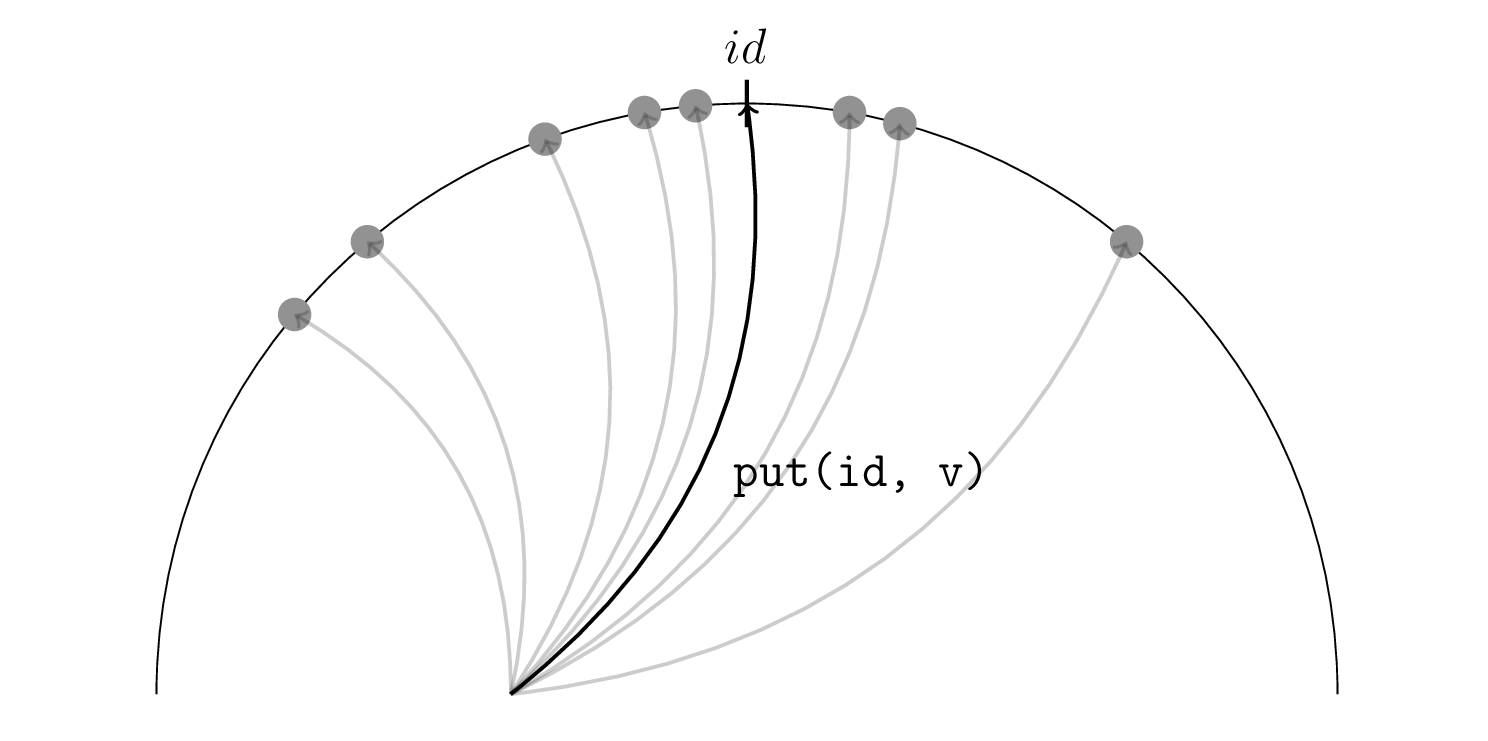
Short introduction to Distributed Hash Tables OpenDHT is based on the Kademlia design. If you know about DHTs, you are aware that they define the notion of distance using the XOR metric. This makes the tuple (H_n, xor) a metric space, where H_n is the space of identifier keys of length n. This way, you can find an identifier be the closest to a target hash than the rest of the nodes in the network.
In order to find some data that is associated with some hash h, you have to find the nodes in the network for which the distance between their hash identifier and the target hash h is minimized. The group of nodes which are the closest to the target hash (OpenDHT allows up to 8 nodes) will hold data for that hash.

Data persistence Let s say you ask a group of 8 nodes to hold some data for a hash and you want the data to hold the whole time until its expiration time as come. If the group of 8 nodes change because that for some reason those nodes leave or others just arrive and have an id that is closer to the target hash than the initial group of 8 nodes. The data would then not be found on the new group of 8 nodes. A first and simple solution was to count on the initial creator of the value to periodically announce the value to the group of 8 nodes. However, what if this node leaves? This is one of the main problem that I ve been working on solving since 2015. A first version of this was produced on September 2015. However, we experienced traffic issues and were forced to redesign the OpenDHT network requests engine. We are presently working on adding a Query feature that would enable filtering of data on remote nodes, hence substantially lowering the overall traffic produced by a response to a get request.

Indexation During the last year, I have also been working on the design of a solution for the use case of indexation. In a more technical way, this is the capability to find data by providing a map where its key is a string field and the mapped value is the value associated to that field, much like in a form. This could help find data for which you don t know the hash, but you have specific information about its content. In other words, this would be a search engine for OpenDHT. I have already created a working, but still in progress, version of this. You can find it on http://opendht.net, on the index branch. Now, Nicolas Reynaud (kaldoran) is contributing to this during the GSOC.

Roadmap As I explained on my page on the Debian Wiki, I am going to work on:
  1. Developing new functionalities in OpenDHT aiming at reducing overall generated traffic.
  2. Maintenance and optimization of the OpenDHT code in general.
  3. Optimizing data persistence solution over the distributed hash table.
  4. Merge (1) in the Ring daemon component in order to benefit from lower traffic in Ring.
  5. Make OpenDHT use TCP protocol instead of UDP. This is going to reduce code complexity and enhance robsutness of the DHT.
For further details, read my reports!

25 May 2016

Petter Reinholdtsen: Isenkram with PackageKit support - new version 0.23 available in Debian unstable

The isenkram system is a user-focused solution in Debian for handling hardware related packages. The idea is to have a database of mappings between hardware and packages, and pop up a dialog suggesting for the user to install the packages to use a given hardware dongle. Some use cases are when you insert a Yubikey, it proposes to install the software needed to control it; when you insert a braille reader list it proposes to install the packages needed to send text to the reader; and when you insert a ColorHug screen calibrator it suggests to install the driver for it. The system work well, and even have a few command line tools to install firmware packages and packages for the hardware already in the machine (as opposed to hotpluggable hardware). The system was initially written using aptdaemon, because I found good documentation and example code on how to use it. But aptdaemon is going away and is generally being replaced by PackageKit, so Isenkram needed a rewrite. And today, thanks to the great patch from my college Sunil Mohan Adapa in the FreedomBox project, the rewrite finally took place. I've just uploaded a new version of Isenkram into Debian Unstable with the patch included, and the default for the background daemon is now to use PackageKit. To check it out, install the isenkram package and insert some hardware dongle and see if it is recognised. If you want to know what kind of packages isenkram would propose for the machine it is running on, you can check out the isenkram-lookup program. This is what it look like on a Thinkpad X230:
% isenkram-lookup 
bluez
cheese
fprintd
fprintd-demo
gkrellm-thinkbat
hdapsd
libpam-fprintd
pidgin-blinklight
thinkfan
tleds
tp-smapi-dkms
tp-smapi-source
tpb
%p
The hardware mappings come from several places. The preferred way is for packages to announce their hardware support using the cross distribution appstream system. See previous blog posts about isenkram to learn how to do that.

20 May 2016

Zlatan Todori : 4 months of work turned into GNOME, Debian testing based tablet

Huh, where do I start. I started working for a great CEO and great company known as Purism. What is so great about it? First of all, CEO (Todd Weaver), is incredible passionate about Free software. Yes, you read it correctly. Free software. Not Open Source definition, but Free software definition. I want to repeat this like a mantra. In Purism we try to integrate high-end hardware with Free software. Not only that, we want our hardware to be Free as much as possible. No, we want to make it entirely Free but at the moment we don't achieve that. So instead going the way of using older hardware (as Ministry of Freedom does, and kudos to them for making such option available), we sacrifice this bit for the momentum we hope to gain - that brings growth and growth brings us much better position when we sit at negotiation table with hardware producers. If negotiations even fail, with growth we will have enough chances to heavily invest in things such as openRISC or freeing cellular modules. We want to provide in future entirely Free hardware&software device that has integrated security and privacy focus while it is easy to use and convenient as any other mainstream OS. And we choose to currently sacrifice few things to stay in loop. Surely that can't be the only thing - and it isn't. Our current hardware runs entirely on Free software. You can install Debian main on it and all will work out of box. I know I did this and enjoy my Debian more than ever. We also have margin share program where part of profit we donate to Free software projects. We are also discussing a lot of new business model where our community will get a lot of influence (stay tuned for this). Besides all this, our OS (called PureOS - yes, a bit misfortune that we took the name of dormant distribution), was Trisquel based but now it is Debian testing based. Current PureOS 2.0 is coming with default DE as Cinnamom but we are already baking PureOS 3.0 which is going to come with GNOME Shell as default. Why is this important? Well, around 12 hours ago we launched a tablet campaign on Indiegogo which comes with GNOME Shell and PureOS as default. Not one, but two tablets actually (although we heavily focus on 11" one). This is the product of mine 4 months dedicated work at Purism. I must give kudos to all Purism members that pushed their parts in preparation for this campaign. It was hell of a ride. Librem11 I have also approached (of course!) Debian for creation of OEM installations ISOs for our Librem products. This way, with every sold Librem that ships with Debian preinstalled, Debian will get donation. It is our way to show gratitude to Debian for all the work our community does (yes, I am still extremely proud Debian dude and I will stay like that!). Oh yes, I am the chief technology person at Purism, and besides all goals we have, I also plan (dream) about Purism being the company that has highest number of Debian Developers. In that terms I am very proud to say that Matthias Klumpp became part of Purism. Hopefully we soon extend the number of Debian population in Purism. Of course, I think it is fairly known that I am easy to approach so if anyone has any questions (as I didn't want this post to be too long) feel free to contact me. Also - in Free software spirit - we welcome any community engagement, suggestion and/or feedback.

19 May 2016

Valerie Young: Summer of Reproducible Builds

Hello friend, family, fellow Outreachy participants, and the Debian community!
This blog's primary purpose will be to track the progress of the Outreachy project in which I'm participating this summer    This post is to introduce myself and my project (working on the Debian reproducible builds project).
What is Outreachy? You might not know! Let me empower you: Outreachy is an organization connecting woman and minorities to mentors in the free (as in freedom) software community, /and/ funding for three months to work with the mentors and contribute to a free software project.  If you are a woman or minority human that likes free software, or if you know anyone in this situation, please tell them about Outreachy   Or put them in touch with me, I'd happily tell them more.
So who am I?
My name is Valerie Young. I live in the Boston Metropolitan Area (any other outreachy participants here?) and hella love free software. 
Some bullet pointed Val facts in rough reverse chronological order:
- I run Debian but only began contributing during the Outreachy application process
- If you went to DebConf2015, you might have seen me dye nine people's hair blue, blond or Debian swirl.
- If you stop through Boston I could be easily convinced to dye your hair.
- I worked on electronic medical records web application for the last two years (lotsa Javascriptin' and Perlin' at athenahealth)
- Before that I taught a programming summer program at University of Moratuwain Sri Lanka.
- Before that I got a degrees in physics and computer science at Boston University.
- At BU I helped start a hackerspace where my interest in technology, free software, hacker culture, anarchy, the internet all began.
- I grew up in the very fine San Francisco Bay Area.
What will I be working on?
Reproducible builds!
In the near future I'll write a  What is reproducible builds? Why is it so hot right now?  post.  For now, from a high (and not technical) level, reproducible builds is a broad effort to verify that the computer executable binary programs you run on your computer come from the human readable source code they claim to. It is not presently /impossible/ to do this verification, but it's not easy, and there are a lot of nuanced computer quirks that make it difficult for the most experienced programmer and straight-up impossible for a user with no technical expertise. And without this ability to verify -- the state we are in now -- any executable piece of software could be hiding secret code. 
The first step towards the goal of verifiability is to make reproducibility a essential part of software development. Reproducible builds means this: when you compile a program from the source code, it should always be identical, bit by bit. If the program is always identical, you can compare your version of the software to any trusted programmer with very little effort. If it is identical, you can trust it -- if it's not, you have reason to worry.
The Debian project is undergoing an effort to make the entire Debian operating system verifiable reproducible (hurray!). My outreachy-funded summer contribution involves the improving and updating tests.reproducible-builds.org   a site that presently presently surfaces the results of reproducibility testing of several free software projects (including Debian, Fedora, coreboot, OpenWrt, NetBSD, FreeBSD and ArchLinux). However, the design of test.r-b.org is a bit confusing, making it difficult for a user to find how to check on the reproducibility of a given package for one of the aforementioned projects, or understand the reasons for failure. Additional, the backend test results of Debian are outgrowing the original SQLite database, and many projects do not log the results of package testing at all. I hope, by the end of the summer, we'll have a more beefed-out and pretty site as well as better organized backend data  
This summer there will be 3 other Outreachy participants working on the Debian reproducible builds project! Check out their blogs/projects:
Scarlett
Satyam
Ceridwen
Thanks to our Debian mentors -- Lunar, Holger Levsen, and Mattia Rizzolo -- for taking us on   

15 May 2016

Bits from Debian: What does it mean that ZFS is included in Debian?

Petter Reinholdtsen recently blogged about ZFS availability in Debian. Many people have worked hard on getting ZFS support available in Debian and we would like to thank everyone involved in getting to this point and explain what ZFS in Debian means. The landing of ZFS in the Debian archive was blocked for years due to licensing problems. Finally, the inclusion of ZFS was announced slightly more than a year ago, on April 2015 by the DPL at the time, Lucas Nussbaum who wrote "We received legal advice from Software Freedom Law Center about the inclusion of libdvdcss and ZFS in Debian, which should unblock the situation in both cases and enable us to ship them in Debian soon.". In January this year, the following DPL, Neil McGovern blogged with a lot of more details about the legal situation behind this and summarized it as "TLDR: It s going in contrib, as a source only dkms module." ZFS is not available exactly in Debian, since Debian is only what's included in the "main" section archive. What people really meant here is that ZFS code is now in included in "contrib" and it's available for users using DKMS. Many people also mixed this with Ubuntu now including ZFS. However, Debian and Ubuntu are not doing the same, Ubuntu is shipping directly pre-built kernel modules, something that is considered to be a GPL violation. As the Software Freedom Conservancy wrote "while licensed under an acceptable license for Debian's Free Software Guidelines, also has a default use that can cause licensing problems for downstream Debian users".

12 May 2016

Matthew Garrett: Convenience, security and freedom - can we pick all three?

Moxie, the lead developer of the Signal secure communication application, recently blogged on the tradeoffs between providing a supportable federated service and providing a compelling application that gains significant adoption. There's a set of perfectly reasonable arguments around that that I don't want to rehash - regardless of feelings on the benefits of federation in general, there's certainly an increase in engineering cost in providing a stable intra-server protocol that still allows for addition of new features, and the person leading a project gets to make the decision about whether that's a valid tradeoff.

One voiced complaint about Signal on Android is the fact that it depends on the Google Play Services. These are a collection of proprietary functions for integrating with Google-provided services, and Signal depends on them to provide a good out of band notification protocol to allow Signal to be notified when new messages arrive, even if the phone is otherwise in a power saving state. At the time this decision was made, there were no terribly good alternatives for Android. Even now, nobody's really demonstrated a free implementation that supports several million clients and has no negative impact on battery life, so if your aim is to write a secure messaging client that will be adopted by as many people is possible, keeping this dependency is entirely rational.

On the other hand, there are users for whom the decision not to install a Google root of trust on their phone is also entirely rational. I have no especially good reason to believe that Google will ever want to do something inappropriate with my phone or data, but it's certainly possible that they'll be compelled to do so against their will. The set of people who will ever actually face this problem is probably small, but it's probably also the set of people who benefit most from Signal in the first place.

(Even ignoring the dependency on Play Services, people may not find the official client sufficient - it's very difficult to write a single piece of software that satisfies all users, whether that be down to accessibility requirements, OS support or whatever. Slack may be great, but there's still people who choose to use Hipchat)

This shouldn't be a problem. Signal is free software and anybody is free to modify it in any way they want to fit their needs, and as long as they don't break the protocol code in the process it'll carry on working with the existing Signal servers and allow communication with people who run the official client. Unfortunately, Moxie has indicated that he is not happy with forked versions of Signal using the official servers. Since Signal doesn't support federation, that means that users of forked versions will be unable to communicate with users of the official client.

This is awkward. Signal is deservedly popular. It provides strong security without being significantly more complicated than a traditional SMS client. In my social circle there's massively more users of Signal than any other security app. If I transition to a fork of Signal, I'm no longer able to securely communicate with them unless they also install the fork. If the aim is to make secure communication ubiquitous, that's kind of a problem.

Right now the choices I have for communicating with people I know are either convenient and secure but require non-free code (Signal), convenient and free but insecure (SMS) or secure and free but horribly inconvenient (gpg). Is there really no way for us to work as a community to develop something that's all three?

comment count unavailable comments

10 May 2016

Lars Wirzenius: Qvarn Platform announcement

In March we started a new company, to develop and support the software whose development I led at my previous job. The software is Qvarn, and it's fully free software, licensed under AGPL3+. The company is QvarnLabs (no website yet). Our plan is to earn a living from this, and our hope is to provide software that is actually useful for helping various organisations handle data securely. The first press release about Qvarn was sent out today. We're still setting up the company and getting operational, but a little publicity never hurts. (Even if it is more marketing-speak and self-promotion than I would normally put on my blog.) So this is what I do for a living now.

The development of the open source Qvarn Platform was led by QvarnLabs CEO Kaius H ggblom (left) and CTO Lars Wirzenius. Helsinki, Finland 10.05.2016 With Privacy by Design, integrated Gluu access management and comprehensive support for regulatory data compliance, Qvarn is set to become the Europe-wide platform of choice for managing workforce identities and providing associated value-added services. Construction industry federations in Sweden, Finland and the Baltic States have been using the Qvarn Platform (http://www.qvarn.org) since October 2015 to securely manage the professional digital identities of close to one million construction workers. Developed on behalf of these same federations, Qvarn is now free and open source software; making it a compelling solution for any organization that needs to manage a secure register of workers data. "There is something universal and fundamental at the core of the Qvarn platform. And that s trust," said Qvarn evangelist Kaius H ggblom. "We decided to make it free, open source and include Gluu access management because we wanted all those using Qvarn or contributing to its continued development to have the freedom to work with the platform in whatever way is best for them." Qvarn has been designed to meet the requirements of the European Union s new General Data Protection Regulation (GDPR), enabling organizations that use the platform to ensure their compliance with the new law. Qvarn has also incorporated the principles of Privacy by Design to minimize the disclosure of non-essential personal information and to give people more control over their data. "Today, Qvarn is used by the construction industry as a way to manage the data of employees, many of whom frequently move across borders. In this way the platform helps to combat the grey economy in the building sector, thereby improving quality and safety, while simultaneously protecting the professional identity data of almost a million individuals," said H ggblom. "Qvarn is so flexible and secure that we envision it becoming the preferred platform for the provision of any value-added services with an identity management component, eventually even supporting monetary transactions." Qvarn is a cloud based solution supported to run on both Amazon Web Services (AWS) and OpenStack. In partnership with Gluu, the platform delivers an out-of-the-box solution that uses open and standard protocols to provide powerful yet flexible identity and access management, including mechanisms for appropriate authentication and authorization. "Qvarn's identity management and governance capabilities perfectly compliment the Gluu Server's access management features," said Founder and CEO of Gluu, Michael Schwartz. "Free open source software (FOSS) is essential to the future of identity and access management. And the FOSS development methodology provides the transparency that is needed to foster the strong sense of community upon which a vibrant ecosystem thrives." Qvarn s development team continues to be led by recognized open source developer and platform architect Lars Wirzenius. He has been developing free and open source software for 30 years and is a renowned expert in the Linux environment, with a particular focus on the Debian distribution. Lars works at all levels of software development from writing code to designing system architecture. About the Qvarn Platform: The Qvarn Platform is free and open source software for managing workforce identities. Qvarn is integrated with the Gluu Server s access management features out of the box, using open and standard protocols to provide the platform with a single common digital identity and mechanisms for appropriate authentication and authorization. A cloud based solution, Qvarn is supported to run on both Amazon Web Services (AWS) and OpenStack. Privacy by Design is central to the architecture of Qvarn and the platform has been third party audited to a security level of HIGH. http://www.qvarn.org For more information, please contact:
Andrew Flowers
andrew.flowers@ellisnichol.com
+358 40 161 5668

28 April 2016

Michal Čihař: Weblate 2.6

Going back to faster release cycle, Weblate 2.6 has been just released. There is improved support for Python 3 or brand new HTTP REST API. Full list of changes for 2.6: If you are upgrading from older version, please follow our upgrading instructions. You can find more information about Weblate on https://weblate.org, the code is hosted on Github. If you are curious how it looks, you can try it out on demo server. You can login there with demo account using demo password or register your own user. Weblate is also being used https://hosted.weblate.org/ as official translating service for phpMyAdmin, OsmAnd, Aptoide, FreedomBox, Weblate itself and many other projects. Should you be looking for hosting of translations for your project, I'm happy to host them for you or help with setting it up on your infrastructure. Further development of Weblate would not be possible without people providing donations, thanks to everybody who have helped so far! The roadmap for next release is just being prepared, you can influence this by expressing support for individual issues either by comments or by providing bounty for them.

Filed under: English phpMyAdmin SUSE Weblate 0 comments

26 April 2016

Pau Garcia i Quiles: Is KDE the right place for Thunderbird?

For years, Mozilla has been saying they are no longer focused on Thunderbird and its place is outside of Mozilla. Now it seems they are going to act on what they said: Mozilla seeks new home for e-mail client Thunderbird. The candidates they are exploring are the Software Freedom Conservancy, The Document Foundation, and I expect at least the Apache Software Foundation to be a serious candidate, and Gnome to propose. Some voices in KDE say we should also propose the KDE eV as a candidate hosting organization. What follows is my opinion, not the official opinion of the eV or the board s, or the KDE Community s opinion. Take it with a grain (or more) of salt. I am not so sure. I am trying to think what the KDE eV can offer to Mozilla to be appealing to them and if my analysis is correct, we are too far and Thunderbird would pose many risks to the other projects in KDE. (I am blurring the lines between KDE eV , KDE community , KDE Frameworks , etc as it has no relevance for the discussion) Thunderbird is an open source project/product with a lot of commercial users and has (still has?) many paid contributors. IMHO what Mozilla is looking for is an organization with a well-oiled funding machine, able to campaign for money (even if in a tight circle, something like ours Patron program), and accept and process funds in a way that directly benefits Thunderbird. I e. hiring developers to implement X or Y, or work on some area full-time, or at least, half-time. KDE does not work like that. KDE has few commercial users (other than distros, if you want to count them as commercial users). Other than Blue Systems, I don t think we have any developer working for KDE. Also, the eV is not exactly a well-oiled funding machine. We have been talking about that for years. And we do not hire developers directly to work on X or Y (at most, we pay for part of the expenses of sprints). All of that makes me think we are not the right host for Thunderbird. But it does not stop there! Let s say Thunderbird comes to KDE and suddenly we are offered USD 1 M from several organizations who want to be Patrons of Thunderbird , or influence Thunderbird, or whatever. First problem: do we allow funds to go to a specific project rather than the eV deciding how to distribute them? AFAIK we do not allow that and at least one KDE sub-project has had trouble with that in the past. Then there is the thing about Patrons of Thunderbird : no such thing. Either you are a Patron of KDE, including Plasma Mobile, OwnCloud, and whatnot, or you are nothing. You cannot be a Patron of Partial KDE, namely Thunderbird . Influencing, did I say? The eV is by its own rules not an influencer on KDE s direction, just an entity to provide legal and economic support. Quite the opposite from what Mozilla does today for Thunderbird. Even if funders would not mind all that, there is the huge risk this poses for all the other projects. With as little as USD 200K donated towards Thunderbird (and USD 200K is not much for a product with so many commercial users, which means a healthy ecosystem of companies making money on support, development, etc, and thus donating to somehow influence or be perceived as important players), Thunderbird becomes the most important project in KDE. How would we manage this? In any sensible organization, Thunderbird would become the main focus and all the other KDE projects would be relegated. Even if we decide not to, external PR would make that look like it happened. For all those reasons, I think KDE is not the right place for Thunderbird at the moment. It would require a big change in what the eV can do and how it operates. And that change may be for good but it s not there now and it will not be by the time Mozilla has to decide if KDE is the right place. All that, and I have not even talked about technology and what any sensible Thunderbird customer would think today: what is the medium and long-term roadmap? Migrate Thunderbird users to Kontact/KDE PIM? Port Thunderbird to Qt + KF5, maybe including moving to QtWebEngine? Will Windows support be deteriorated by that change? Or maybe the plan is to cancel KMail and Akregator? Those are second-thoughts, unimportant right now. Update If you want to contribute to the discussion, please join the KDE-Community mailing list.

25 April 2016

Antoine Beaupr : My free software activities, April 2016

Debian Long Term Support (LTS) This is my 5th month working on Debian LTS, started by Raphael Hertzog at Freexian. This is my largest month so far, in which I worked on completing the Xen and NSS packages updates from last month, but also spent a significant amount of time working on phpMyAdmin and libidn.

Updates to NSS and Xen completed This basically consisted on following up on the reviews from other security people. I basically continued building up on Brian's work and tested the package on a test server at Koumbit, which seems to have survived well the upgrade. The details are in this post to the debian-lts mailing list. As for NSS, the package was mostly complete, but I forgot to ship the tests for some reason, so I added them back. I also wrote the release team to see if it was possible to update NSS to the same version in all suites. Unfortunately, this issue is still pending, but I still hope we can find better ways of managing that package in the long term.

IDN and phpMyAdmin Most of my time this month was spent working on IDN and phpMyAdmin. Unfortunately, it turns out that someone else had worked on the libidn package. This is partly my fault: I forgot to check in the dsa-needed.txt file for assignment before working on the package. But considering how in flux the workflow currently is with the switch between the main security team and the LTS team for the wheezy maintenance, I don't feel too bad. Still, I prepared a package which was a bit more painful than it should have been because of GNUlib. I didn't even know about GNUlib before, oddly enough, and after that experience, I feel that it should just not exist at all anymore. I have filed a bug to remove that dependency at the very least, but I do not clearly see how such a tool is necessary on Debian at this point in time. But phpMyAdmin, no one had worked on that. And I understand why: even though it's a very popular package, there were quite a few outstanding issues (8!) in Wheezy, with 10-15 patches to be ported. Plus, it's ... well, PHP. And old PHP at that, with parts of it with modern autoloader classes, and other with mixed HTML and PHP content, require (and not require_once) and all sorts of nasty things you still find in the PHP universe. I nevertheless managed to produce a new Debian package for wheezy and test it on Koumbit's test servers. Hopefully, that can land into Wheezy soon.

Long term software support I am a little worried that we are, both in Jessie and Wheezy sitting in between stable releases for phpMyAdmin, something that is a recurring issue for a lot of packages in Debian stable or LTS. Sometimes, it just happens that the version that happens to be in Debian testing when it is released as stable is just not a supported release upstream. It's the case for phpMyAdmin in Jessie (4.3, whereas 4.0 and 4.4 are supported) and Wheezy (3.4, although it's unclear how long that was supported upstream). But even if the next Debian stable (Stretch), would pick a stable release upstream, there is actually no phpMyAdmin release that has a support window as long as Debian stable (roughly 3 years), let alone as long as Debian LTS (5 years). This is a similar problem with NSS: upstream is simply not supporting their product in the long term, or at least not in the terms we are used to in the Debian community (ie. only security fixes or regressions). This is, in my opinion, a real concern for the reliability and sustainability of the computing infrastructure we are creating. While some developers are of the opinion that software older than 18 months is too old, here we are shipping hardware and software in space or we have Solaris, which is supported for 16 years! Now that is a serious commitment and something we can rely on. 18 months is really, really, a tiny short time in the history of our civilization. I know computer programmers and engineers like to think of themselves in elitist terms, that they are changing the world every other year. But the truth is that things have not changed much in the last 4 decades where computing has existed, both in terms of security or functionality. Two quotes from my little quotes collection come to mind here:
Software gets slower faster than hardware gets faster. - Wirth's law The future is already here it's just not very evenly distributed. - William Gibson
Because of course, the response to my claims that computing is not really advancing is "but look! we have supercomputers in our pockets now!" Yes, of course, we do have those fancy phones and they are super-connected, but they are a threat to our fundamental rights and freedom. And those glittering advances always pale in comparison to what could be done if we wouldn't be wasting our time rewriting the same software over and over again on different, often proprietary, platforms, simply because of the megalomaniac fantasies of egoistic programmers. It would be great to build something that lasts, for a while. Software that does not need to be updated every 16 months. You'd think that something as basic as a screensaver release could survive what is basically the range of human infancy. Yet it seems we like to run mindlessly in the minefield of software development, one generation following the other without questioning the underlying assumption of infinite growth that permeates our dying civilization. I have talked about this before of course, but working with the LTS project just unnerves me so bad that I just needed to let out another rant. (For the record, I really have a lot of respect for JWZ and all the work he has done in the free software world. I frequently refer to his "no-bullshit" backup guide and use Xscreensaver daily. But I do think he was wrong in this case: asking Debian to remove Xscreensaver is just too much. The response from the maintainer was exemplary of how to handle such issues in the future. I restarted Xscreensaver after the stable update, and the message is gone, and things are still all fine. Thanks JWZ and Tormod for keeping things rolling.)

Other free software work With that in mind, I obviously didn't stop doing other computing work this month. In fact, I did a lot of work to try to generally fix the internet, that endless and not-quite-gratifying hobby so many of us are destroying our bodies to accomplish.

Build tools I have experimented a bit more with different build tools. I got worried because at some point cowbuilder got orphaned and I figured I could refresh the way I build packages for LTS. I looked into sbuild, but that ended up not bringing much improvements over my current cowbuilder setup (which I really need to document better). I was asked by the new maintainer to open a bug report to make such setups easier by guessing the basepath better, so we'll see how that goes. I did enjoy the simplicity of gitpkg and discovered cowpoke which made it about 2 times faster to build packages because I could use another server to build larger packages. I also found that gitpkg doesn't use -n by default when calling gzip, which makes it harder to reproduce tarballs when they are themselves built reproducibly, which is the case for Github tarballs (really nice of them). So I filed bug #820842 about that. It would be pretty awesome if such buildds would be available for Debian Developers to do their daily tasks. It could simply be a machine that would spin up a chroot with cowbuilder or it could even be a full, temporary VM although that would take way more resources than a simple VM with a cowbuilder setup. In the meantime, I should probably look at whalebuilder as an alternative to cowbuilder. It is a tool that supports building packages within a Docker chroot, which means that packages are built from a clean environment like pbuilder, and using COW optimisations but also without privileges or network access, which is a huge plus especially when you build untrusted packages.

Ikiwiki admonitions I have done some work to implement Moinmoin-like admonitions in Ikiwiki, something I am quite happy about since it's something I was really missing about Moinmoin. Admonitions bring a really nice way to outline certain blocks with varying severity levels and distinct styles. For example:
Admonitions are great!
This was done with a macro, but basically, since Markdown allows more or less arbitrary HTML, this can also be done with the <div> tag. I like that we don't have a new weird markup here. Yet, I still liked the sub-parser feature of MoinMoin, something that can be implemented in Ikiwiki, but it's a little more clunky. Normally, you'd probably do this with the inline macro and subpages, but it's certainly less intuitive that directly inlined content.

Ereader I got a new e-reader! I was hesitant between the Kobo Aura H20 and the Kobo Glo HD, which were the ones available at Bestbuy. So I bought both and figured I would return the other. That was a painful decision! In the end, both machines are pretty nice:
  • Aura H2O
    • Pros:
      • waterproof
      • larger screen (makes it easier to see web pages and better for the eyes)
      • naturally drawn to it
    • Cons:
      • heavier
      • larger (fits in outside pocket though)
      • port cover finicky
      • more expensive (180$) - prices may go down in future
  • Aura Glo HD
    • Pros
      • smaller (fits in inside pocket of both coats)
      • better resolution in theory (can't notice in practice)
      • cheaper (100$)
      • may be less common on the future (larger models more common? just a guess)
    • Cons
      • no SD card
      • smaller screen
      • power button in the middle
... but in the end, I ended up settling down on the Glo, mostly for the price. Heck, I saved around 100$, so for that amount, I could have gotten two machines so that if one breaks I would still have the other. I have ordered a cover for it on Deal Extreme about two weeks ago, and it still hasn't arrived. I suspect it's going to take a few more months to get there, by which point I may have changed e-reader again. Note that both e-readers needed an update to calibre, so I started working on a calibre backport (#818309) which I will complete soon. So anyways, I looked into better ways of transferring articles from the web to the e-reader, something which I do quite a bit to avoid spending too much time on the computer. Since the bookmark manager I use (Bookie) is pretty much dead, I started looking at other alternatives. And partly inspired by Framasoft's choice of Wallabag for their bookmarking service (Framabag), I started to look into that software, especially since my friend who currently runs the Bookie instance is thinking of switching to Wallabag as well. It seems the simplest way to browse articles remotely through a standard protocol is by implementing OPDS support in Wallabag. OPDS is a standard developed in part by the Internet Archive and it allows for browsing book collections and downloading them. Articles and bookmarks would then be presented as individual books that would be accessible from any OPDS-compatible device. Unfortunately, the Kobo e-readers don't support OPDS out of the box: you need to setup some OPDS-compatible reader like Koreader. And that I found nearly impossible to do: I was able to setup KSM (the "start menu", not to be confused with that KSM), but not Koreader in KSM. Besides, I do not want a separate OS running here on the tablet: I just want to start Koreader every once in a while. KSM just starts another system when you reboot the e-reader, something which is not really convenient on the Kobo. Basically, I just want to add Koreader as a tile in the home screen on the e-reader. I found the documentation on that topic to be sparse and hard to follow. It is often dispersed across multiple forum threads and involves uploading random binaries, often proprietary, to the e-reader. It had been a long time since I was asked to "register my software" frenetically, and I hadn't missed that one bit. So I decided to stay away from this until that solution and its documentation matures a bit.

Streaming re-established I have worked a bit on my home radio stream. I simply turned the Liquidsoap stream back online, and did a few tweaks to the documentation that I had built back then. All that experimenting led me to do two NMUs. One was for gmpc-plugins to fix a FTBFS (bug #807735) and to properly kill the shout streamer when completing the playback (bug #820908). The other was to fix the ezstream manpage (bug #573928), a patch that had been sitting there for 5 years! This was to try to find an easy way to stream random audio (say from a microphone) to the Icecast server, something which is surprisingly difficult, consider how basic that functionality is. I was surprised to see that Darkice just completely fails to start (bug #821040) and I had to fallback to the simplest ices2 software to stream the audio. I am still having issues with Liquidsoap: it's really unstable! As a server, I would expect it to keep running for days if not years. Unfortunately, there's always something that makes it crash. I had assertion failed (bug #821112) and I keep seeing it crash after 2-3 days fairly reliably, a bug I reported 3 years ago and that is still not fixed (bug #727307). Switching back the stream to Vorbis (because I was having problems with the commandline mp3 players and ogg123 is much more lightweight) created another set of problems too, this time with the phone. It seems that Android cannot stream Vorbis at all, something that is even worse in Cyanogenmod... I also had to tweak my MPD config to make the Android client be able to load the larger playlists (see dmix buffer is full).

Android apps So I have also done quite a bit of work again on my phone. I finally was told how to access from Termux from adb shell which is pretty cool because now I can start a screen on my phone and then, when I'm tired of tapping to type, I can just reconnect to it when I plug in a USB cable on my laptop. I sent a pull request to fix the documentation regarding that. I also tried to see how my SMS and Signal situation could be improved. Right now, I have two different apps to do SMS on my phone: I use both Signal and the VoIP.ms SMS client, because I do not have a contract or SIM card in my phone. Both work well independently, but it's somewhat annoying to have to switch between the two. (In fact, I feel that Signal itself has an issue with how it depends on the network to send encrypted messages: I often have to "ping" people in clear text (and therefore in the other app) so that they connect to their data plan to fetch my "secure" signal messages...) Anyways, I figured it would be nice if at least there would be a SMS fallback in Signal that would allow me to send regular text messages from signal through Voip.MS. That was dismissed really fast. Moxie even closed the conversation completely, something I had never experienced before, and doesn't feel exactly pleasant. The Voip.MS side was of course not impressed and basically shrugged it off because Signal was not receptive. I also tried to clear up the Libresignal confusion: there are 3 different projects named "Libresignal", and I am not sure I figured out the right thing, even though the issue is now closed and there's a FAQ that is supposed to make all that clear. Nevertheless, I opened two distinct feature requests to try to steer the conversation into a more productive direction: GCM-less calls and GCM support. But I'm not sure neither will go anywhere. In the meantime, I am using the official signal client, which I downloaded using gplaycli and which I keep up to date with Aptoide. Even though the reliability of that site is definitely questionable, it seems that once you have a trusted version, it is safe to upgrade, regardless of the source because there is a trust path between you and the developer. I also filed a few issues with varying levels of success/response from the community:

Random background radiation And then there's of course the monthly background noise of all the projects I happened to not only stumble on, but also file bugs or patches against:

24 April 2016

Norbert Preining: Armenia and Turkey Erdo an did it again

It is 101 years to the day that Turkey started the first genocide of the 20th century, the Armenian Genocide. And Recep Tayyip Erdo an, the populistic and seemingly maniac president of Turkey, does not drop any chance to continue the shame of Turkey. armenien-genocide After having sued a German comedian of making fun of him followed promptly by an as shameful cowtow of Merkel by allowing the jurisdiction to start prosecuting Jan B hmermann, heis continuing suing other journalists, and above all putting pressure on the European Community to not support a concert tour of the Dresdner Sinfoniker in memoriam of the genocide. European Values have disappeared, and politicians pay stupid tribute to a dictator-like Erdo an who is destroying free speech and free media, not only in his country but all around the world. Must be a good friend of Abe, both are installing anti-freedom laws. Shame on Europe for this. And Turkey, either vote Erdo an out of office, or you should not (and hopefully will never) be allowed into the EC, because you don t belong there.

21 April 2016

Mario Lang: Scraping the web with Python and XQuery

During a JAWS for Windows training, I was introduced to the Research It feature of that screen reader. Research It is a quick way to utilize web scraping to make working with complex web pages easier. It is about extracting specific information from a website that does not offer an API. For instance, look up a word in an online dictionary, or quickly check the status of a delivery. Strictly speaking, this feature does not belong in a screen reader, but it is a very helpful tool to have at your fingertips. Research It uses XQuery (actually, XQilla) to do all the heavy lifting. This also means that the Research It Rulesets are theoretically also useable on other platforms. I was immediately hooked, because I always had a love for XPath. Looking at XQuery code is totally self-explanatory for me. I just like the syntax and semantics. So I immediately checked out XQilla on Debian, and found #821329 and #821330, which were promptly fixed by Tommi Vainikainen, thanks to him for the really quick response! Unfortunately, making xqilla:parse-html available and upgrading to the latest upstream version is not enough to use XQilla on Linux with the typical webpages out there. Xerces-C++, which is what XQilla uses to fetch web resources, does not support HTTPS URLs at the moment. I filed #821380 to ask for HTTPS support in Xerces-C to be enabled by default. And even with HTTPS support enabled in Xerces-C, the xqilla:parse-html function (which is based on HTML Tidy) fails for a lot of real-world webpages I tried. Manually upgrading the six year old version of HTML Tidy in Debian to the latest from GitHub (tidy-html5, #810951) did not help a lot either.
Python to the rescue XQuery is still a very nice language for extracting information from markup documents. XQilla just has a bit of a hard time dealing with the typical HTML documents out there. After all, it was designed to deal with well-formed XML documents. So I decided to build myself a little wrapper around XQilla which fetches the web resources with the Python Requests package, and cleans the HTML document with BeautifulSoup (which uses lxml to do HTML parsing). The output of BeautifulSoup can apparently be passed to XQilla as the context document. This is a fairly crazy hack, but it works quite reliably so far. Here is how one of my web scraping rules looks like:
from click import argument, group
@group()
def xq():
  """Web scraping for command-line users."""
  pass
@xq.group('github.com')
def github():
  """Quick access to github.com."""
  pass
@github.command('code_search')
@argument('language')
@argument('query')
def github_code_search(language, query):
  """Search for source code."""
  scrape(get='https://github.com/search',
         params= 'l': language, 'q': query, 'type': 'code' )
The function scrape automatically determines the XQuery filename according to the callers function name. Here is how github_code_search.xq looks like:
declare function local:source-lines($table as node()*) as xs:string*
 
  for $tr in $table/tr return normalize-space(data($tr))
 ;
let $results := html//div[@id="code_search_results"]/div[@class="code-list"]
for $div in $results/div
let $repo := data($div/p/a[1])
let $file := data($div/p/a[2])
let $link := resolve-uri(data($div/p/a[2]/@href))
return (concat($repo, ": ", $file), $link, local:source-lines($div//table),
        "---------------------------------------------------------------")
That is all I need to implement a custom web scraping rule. A few lines of Python to specify how and where to fetch the website from. And a XQuery file that specifies how to mangle the document content. And thanks to the Python click package, the various entry points of my web scraping script can easily be called from the command-line. Here is a sample invokation:
fx:~/xq% ./xq.py github.com
Usage: xq.py github.com [OPTIONS] COMMAND [ARGS]...
  Quick access to github.com.
Options:
  --help  Show this message and exit.
Commands:
  code_search  Search for source code.
fx:~/xq% ./xq.py github.com code_search Pascal '"debian/rules"'
prof7bit/LazPackager: frmlazpackageroptionsdeb.pas
https://github.com/prof7bit/LazPackager/blob/cc3e35e9bae0c5a582b0b301dcbb38047fba2ad9/frmlazpackageroptionsdeb.pas
230 procedure TFDebianOptions.BtnPreviewRulesClick(Sender: TObject);
231 begin
232 ShowPreview('debian/rules', EdRules.Text);
233 end;
234
235 procedure TFDebianOptions.BtnPreviewChangelogClick(Sender: TObject);
---------------------------------------------------------------
prof7bit/LazPackager: lazpackagerdebian.pas
https://github.com/prof7bit/LazPackager/blob/cc3e35e9bae0c5a582b0b301dcbb38047fba2ad9/lazpackagerdebian.pas
205 + 'mv ../rules debian/' + LF
206 + 'chmod +x debian/rules' + LF
207 + 'mv ../changelog debian/' + LF
208 + 'mv ../copyright debian/' + LF
---------------------------------------------------------------
For the impatient, here is the implementation of scrape:
from bs4 import BeautifulSoup
from bs4.element import Doctype, ResultSet
from inspect import currentframe
from itertools import chain
from os import path
from os.path import abspath, dirname
from subprocess import PIPE, run
from tempfile import NamedTemporaryFile
import requests
def scrape(get=None, post=None, find_all=None,
           xquery_name=None, xquery_vars= , **kwargs):
  """Execute a XQuery file.
  When either get or post is specified, fetch the resource and run it through
  BeautifulSoup, passing it as context to the XQuery.
  If find_all is given, wrap the result of executing find_all on
  the BeautifulSoup in an artificial HTML body.
  If xquery_name is not specified, the callers function name is used.
  xquery_name combined with extension ".xq" is searched in the directory
  where this Python script resides and executed with XQilla.
  kwargs are passed to get or post calls.  Typical extra keywords would be:
  params -- To pass extra parameters to the URL.
  data -- For HTTP POST.
  """
  response = None
  url = None
  context = None
  if get is not None:
    response = requests.get(get, **kwargs)
  elif post is not None:
    response = requests.post(post, **kwargs)
  if response is not None:
    response.raise_for_status()
    context = BeautifulSoup(response.text, 'lxml')
    dtd = next(context.descendants)
    if type(dtd) is Doctype:
      dtd.extract()
    if find_all is not None:
      context = context.find_all(find_all)
    url = response.url
  if xquery_name is None:
    xquery_name = currentframe().f_back.f_code.co_name
  cmd = ['xqilla']
  if context is not None:
    if type(context) is BeautifulSoup:
      soup = context
      context = NamedTemporaryFile(mode='w')
      print(soup, file=context)
      cmd.extend(['-i', context.name])
    elif isinstance(context, list) or isinstance(context, ResultSet):
      tags = context
      context = NamedTemporaryFile(mode='w')
      print('<html><body>', file=context)
      for item in tags: print(item, file=context)
      print('</body></html>', file=context)
      context.flush()
      cmd.extend(['-i', context.name])
  cmd.extend(chain.from_iterable(['-v', k, v] for k, v in xquery_vars.items()))
  if url is not None:
    cmd.extend(['-b', url])
  cmd.append(abspath(path.join(dirname(__file__), xquery_name + ".xq")))
  output = run(cmd, stdout=PIPE).stdout.decode('utf-8')
  if type(context) is NamedTemporaryFile: context.close()
  print(output, end='')
The full source for xq can be found on GitHub. The project is just two days old, so I have only implemented three scraping rules as of now. However, adding new rules has been made deliberately easy, so that I can just write up a few lines of code whenever I find something on the web which I'd like to scrape on the command-line. If you find this "framework" useful, make sure to share your insights with me. And if you impelement your own scraping rules for a public service, consider sharing that as well. If you have an comments or questions, send me mail. Oh, and by the way, I am now also on Twitter as @blindbird23.

31 March 2016

Antoine Beaupr : My free software activities, march 2016

Debian Long Term Support (LTS) This is my 4th month working on Debian LTS, started by Raphael Hertzog at Freexian. I spent half of the month away on a vacation so little work was done, especially since I tried to tackle rather large uploads like NSS and Xen. I also worked on the frontdesk shift last week.

Frontdesk That work mainly consisted of figuring out how to best help the security team with the last uploads to the Wheezy release. For those who don't know, Debian 7 Wheezy, or "oldstable", is going to be unsupported by the security team starting end of april, and the Debian 6 Squeeze (the previous LTS) is now unsupported. The PGP signatures on the archived release have started yielding expiration errors which can be ignored but that are really a strong reminder that it is really time to upgrade. So the LTS team is now working towards backporting a few security issues from squeeze to wheezy, and this is what I focused on during triage work. I have identified the following high priority packages I will work on after I complete my work on the Xen and NSS packages (detailed below):
  • libidn
  • icu
  • phpmyadmin
  • tomcat6
  • optipng
  • srtp
  • dhcpcd
  • python-tornado

Updates to NSS and Xen I have spent a lot of time testing and building packages for NSS and Xen. To be fair, Brian May did most of the work on the Xen packages, and I merely did some work to test the packages on Koumbit's infrastructure, something which I will continue doing in the next month. For NSS, wheezy and jessie are in this weird state where patches were provided to the security team all the way back in November yet were never tested. Since then, yet more issues came up and I worked hard to review and port patches for those new security issues to wheezy. I'll followup on both packages in the following month.

Other free software work

Android TL;DR: there's an even longer version of this with the step-by-step procedures and that I will update as time goes on in my wiki. I somehow inherited an Android phone recently, on a loan from a friend because the phone broke one too many times and she got a new one from her provider. This phone is a HTC One S "Ville", which is fairly old, but good enough to play with and give me a mobile computing platform to listen to podcasts, play music, access maps and create GPS traces. I was previously doing this with my N900, but that device is really showing its age: very little development is happening on it, the SDK is closed source and the device itself is fairly big, compared to the "Ville". Plus, the SIM card actually works on the Ville so, even though I do not have an actual contract with a cell phone provider (too expensive, too invasive on my privacy), I can still make emergency phone calls (911)! Plus, since there is good wifi on the machine, I can use it to connect to the phone system with the built-in SIP client, send text messages through SMS (thanks to VoIP.ms SMS support) or Jabber. I have also played around with LibreSignal, the free software replacement for Signal, which uses proprietary google services. Yes, the VoIP.ms SMS app also uses GCM, but hopefully that can be fixed. (While I was writing this, another Debian Developer wrote a good review of Signal so I am happy to skip that step. Go read that.)
See also my apps list for a more complete list of the apps I have installed on the phone. I welcome recommendations on cool free software apps I should use!
I have replaced the stock firmware on the phone with Cyanogenmod 12.1, which was a fairly painful experience, partly because of the difficult ambiance on the #cyanogenmod channel on Freenode, where I had extreme experiences: a brave soul helped me through the first flashing process for around 2 hours, nicely holding my hand at every step. Other times, I have seen flames and obtuse comments from people being vulgar, brutal, obnoxious, if not sometimes downright homophobic and sexist from other users. It is clearly a community that needs to fix their attitude. I have documented everything I could in details in this wiki page, in case others want to resuscitate their old phones, but also because I ended up reinstalling the freaking phone about 4 times, and was getting tired of forgetting how to do it every time. I am somewhat fascinated by Android: here is the Linux-based device that should save us all from the proprietary Apple nightmares of fenced in gardens and censorship. Yet, public Android downloads are hidden behind license agreements, even though the code itself is free, which has led fellow Debian developers to work on making libre rebuilds of Androids to workaround this insanity. But worse: all phones are basically proprietary devices down to the core. You need custom firmware to be loaded on the machine for it to boot at all, from the bootloader all the way down to the GSM baseband and Wifi drivers. It is a minefield of closed source software, and trying to run free software on there is a bit of a delusion, especially since the baseband has so much power over the phone. Still, I think it is really interesting to run free software on those machines, and help people that are stuck with cell phones get familiar with software freedom. It seems especially important to me to make Android developers aware of software freedom considering how many apps are available for free yet on which it is not possible to contribute significantly because the source code is not published at all, or published only on the Google Store, instead of the more open and public F-Droid repository which publishes only free software. So I did contribute. This month, I am happy to announce that I contributed to the following free software projects on Android: I have also reviewed the literature surrounding Telegram, a popular messaging app rival to Signal and Whatsapp. Oddly enough, my contributions to Wikipedia on that subject were promptly reverted which made me bring up the subject on the page's Talk page. This lead to an interesting response from the article's main editors which at least added that the "its security features have been contested by security researchers and cryptography experts". Considering the history of Telegram, I would keep people away from it and direct people to use Signal instead, even though Signal has similar metadata issues, mostly because Telegram's lack of response to the security issues that were outlined by fellow security researchers. Both systems suffer from a lack of federation as well, which is a shame in this era of increasing centralization. I am not sure I will put much more work in developing for Android for now. It seems like a fairly hostile platform to work on, and unless I have specific pain points I want to fix, it feels so much better to work on my own stuff in Debian. Which brings me to my usual plethora of free software projects I got stuck in this month.

IRC projects irssi-plugin-otr had a bunch of idiotic bugs lying around, and I had a patch that I hadn't submitted upstream from the Debian package, which needed a rebuild because the irssi version changed, which is a major annoyance. The version in sid is now a snapshot because upstream needs to make a new release but at least it should fix things for my friends running unstable and testing. Hopefully those silly uploads won't be necessary in the future. That's for the client side. On the server side, I have worked on updating the Atheme-services package to the latest version, which actually failed because the upstream libmowgli is missing release tags, which means the Debian package for it is not up-to-date either. Still, it is nice to have a somewhat newer version, even though it is not the latest and some bugs were fixed. I have also looked at making atheme reproducible but was surprised at the hostility of the upstream. In the end, it looks like they are still interested in patches, but they will be a little harder to deploy than for Charybdis, so this could take some time. Hopefully I will find time in the coming weeks to test the new atheme services daemon on the IRC network I operate.

Syncthing I have also re-discovered Syncthing, a file synchronization software. Amazingly, I was having trouble transferring a single file between two phones. I couldn't use Bluetooth (not sure why), the "Wifi sharing" app was available only on one phone (and is proprietary, and has a limit of 4MB files), and everything else requires an account, the cloud, or cabling. So. Just heading to f-droid, install syncthing, flash a few qr-codes around and voil : files are copied over! Pretty amazing: the files were actually copied over the local network, using IPv6 link-local addresses, encryption and the DHT. Which is a real geeky way of saying it's completely fast, secure and fast. Now, I found a few usability issues, so much that I wrote a whole usability story for the developers, which were really appreciative of my review. Some of the issues were already fixed, others were pretty minor. Syncthing has a great community, and it seems like a great project I encourage everyone to get familiar with.

Battery stats The battery-status project I mentionned previously has been merged with the battery-stats project (yes, the names are almost the same, which is confusing) and so I had to do some work to fix my Python graph script, which was accepted upstream and will be part of Debian officially from now on, which is cool. The previous package was unofficial. I have also noticed that my battery has a significantly than when I wrote the script. Whereas it was basically full back then, it seems now it has lost almost 15% of its capacity in about 6 months. According to the calculations of the script:
this battery will reach end of life (5%) in 935 days, 19:07:58.336480, on 2018-10-23 12:06:07.270290
Which is, to be fair, a good life: it will somewhat work for about three more years.

Playlist, git-annex and MPD in Python On top of my previously mentioned photos-import script, I have worked on two more small programs. One is called get-playlist and is an extension to git-annex to easily copy to the local git-annex repository all files present in a given M3U playlist. This is useful for me because my phone cannot possibly fit my whole MP3 collection, and I use playlists in GMPC to tag certain files, particularly the Favorites list which is populated by the "star" button in the UI. I had a lot of fun writing this script. I started using elpy as an IDE in Emacs. (Notice how Emacs got a new webpage, which is a huge improvement was had been basically unchanged since the original version, now almost 20 years old, and probably written by RMS himself.) I wonder how I managed to stay away from Elpy for so long, as it glues together key components of Emacs in an elegant and functional bundle:
  • Company: the "vim-like" completion mode i had been waiting for forever
  • Jedi: context-sensitive autocompletion for Python
  • Flymake: to outline style and syntax errors (unfortunately not the more modern Flycheck)
  • inline documentation...
In short, it's amazing and makes everything so much easier to work with that I wrote another script. The first program wouldn't work very well because some songs in the playlists had been moved, so I made another program, this time to repair playlists which refer to missing files. The script is simply called fix-playlists, and can operate transparently on multiple playlists. It has a bunch of heuristics to find files and uses a MPD server as a directory to search into. It can edit files in place or just act as a filter.

Useful snippets Writing so many scripts, so often, I figured I needed to stop wasting time always writing the same boilerplate stuff on top of every file, so I started publishing Yasnippet-compatible file snippets, in my snippets repository. For example, this report is based on the humble lts snippet. I also have a base license snippet which slaps the AGPLv3 license on top of a Python file. But the most interesting snippet, for me, is this simple script snippet which is a basic scaffolding for a commandline script that includes argument processing, logging and filtering of files, something which I was always copy-pasting around.

Other projects And finally, a list of interesting issues en vrac:
  • there's a new Bootstrap 4 theme for Ikiwiki. It was delivering content over CDNs, which is bad for privacy issues, so I filed an issue which was almost immediately fixed by the author!
  • I found out about BitHub, a tool to make payments with Bitcoins for patches submitted on OWS projects. It wasn't clear to me where to find the demo, but when I did, I quickly filed a PR to fix the documentation. Given the number of open PRs there and the lack of activity, I wonder if the model is working at all...
  • a fellow Debian Developer shared his photos workflow, which was interesting to me because I have my own peculiar script, which I never mentionned here, but which I ended up sharing with the author

26 March 2016

Jonathan McDowell: Dr Stoll: Or how I learned to stop worrying and love the GPL

[I wrote this as part of BelFOSS but I think it s worth posting here.] My Free Software journey starts with The Cuckoo s Egg. Back in the early 90s a family friend suggested I might enjoy reading it. He was right; I was fascinated by the world of interconnected machines it introduced me to. That helped start my involvement in FidoNet, but it also got me interested in Unix. So when I saw a Linux book at the Queen s University bookshop (sadly no longer with us) with a Slackware CD in the back I had to have it. The motivation at this point was to have a low cost version of Unix I could run on the PC hardware I already owned. I had no knowledge of the GNU Project before this point, and as I wasn t a C programmer I had no interest in looking at the source code. I spent some time futzing around with it and that partition (I was dual booting with DOS 6.22) fell into disuse. It wasn t until I d learnt some C and turned up to university, which provided me with an internet connection and others who were either already using Linux or interested in doing so, that I started running a Linux box full time. Once I was doing that I became a lot more interested in the Open Source side of the equation. Rather than running a closed operating system that even the API for wasn t properly specified (or I wouldn t have needed my copy of Undocumented DOS) I had the complete source to both the underlying OS and all the utilities that it was using. For someone doing a computer science degree this was invaluable. Minix may have been the OS discussed in the OS Design module I studied, but Linux was a much more feature complete option that I was running on my desktop and could also peer under the hood of. In my professional career I ve always welcomed the opportunities to work with Open Source. A long time ago I experienced a particularly annoying issue when writing a device driver under QNX. The documentation didn t seem to match the observed behaviour of the subsystem I was interfacing with. However due to licensing issues only a small number of people in the organisation were able to actually look at the QNX source. So I ended up wasting a much more senior engineer s time with queries like I think it s actually doing x, y and z instead of a, b and c; can you confirm? . Instances where I can look directly at the source code myself make me much more productive. Commercial development also started to make me more understanding of the Free Software nature of the code I was running. It wasn t just the ability to look at the code which was useful, but also the fact there was no need to reinvent the wheel. Need a base OS to build an appliance on? Debian ensures that the main component is Free for all usage. No need to worry about rolling your own compilers, base libraries etc. From a commercial perspective that allows you to concentrate on the actual product. And when you hit problems, the source is available and you can potentially fix it yourself or at least more easily find out if there s been a fix for that issue released (being able to see code development in version control systems rather than getting a new upstream release with a whole heap on unrelated fixes in it really helps with that). I had thus progressed from using FLOSS because it was free-as-in-beer, to appreciating the benefits of Open Source in my own learning and employment experiences, to a deeper understanding of the free-as-in-speech benefits that could be gained. However at this point I was still thinking very much from a developer mindset. Even my thoughts about how users can benefit from Free Software were in the context of businesses being able to easily switch suppliers or continue to maintain legacy software because they had the source to their systems available. One of the major factors that has helped me to see beyond this is the expansion of the Internet of Things (IoT). With desktop or server software there is by and large a choice about what to use. This is not the case with appliances. While manufacturers will often produce a few revisions of software for their devices, usually eventually there is a newer and shiny model and the old one is abandoned. This is problematic for many reasons. For example, historically TVs have been long lived devices (I had one I bought second hand that happily lasted me 7+ years). However the smart capabilities of the TV I purchased in 2012 are already of limited usefulness, and LG have moved on to their current models. I have no intention of replacing the device any time soon, so have had to accept it is largely acting as a dumb display. More serious is the lack of security updates. For a TV that doesn t require a network connection to function this is not as important, but the IoT is a trickier proposition. For example Matthew Garrett had an awful experience with some intelligent light bulbs, which effectively circumvented any home network security you might have set up. The manufacturer s defence? No longer manufactured or supported. It s cases like these that have slowly led me to a more complete understanding of the freedom that Free Software truly offers to users. It s not just about cost free/low cost software. It s not just about being able to learn from looking at the source to the programs you are running. It s not even about the freedom to be able to modify the programs that we use. It s about giving users true Freedom to use and modify their devices as they see fit. From this viewpoint it is much easier to understand the protections against Tivoization that were introduced with GPLv3, and better appreciate the argument sometimes made that the GPL offers more freedom than BSD style licenses.

10 March 2016

Lunar: Reproducible builds: week 45 in Stretch cycle

What happened in the reproducible builds effort between February 28th and March 5th:

Toolchain fixes
  • Antonio Terceiro uploaded gem2deb/0.27 that forces generated gemspecs to use the date from debian/changelog.
  • Antonio Terceiro uploaded gem2deb/0.28 that forces generated gemspecs to have their contains file lists sorted.
  • Robert Luberda uploaded ispell/3.4.00-5 which make builds of hashes reproducible.
  • C dric Boutillier uploaded ruby-ronn/0.7.3-4 which will make the output locale agnostic. Original patch by Chris Lamb.
  • Markus Koschany uploaded spring/101.0+dfsg-1. Fixed by Alexandre Detiste.
Ximin Luo resubmitted the patch adding the --clamp-mtime option to Tar on Savannah's bug tracker. Lunar rebased our experimental dpkg on top of the current master branch. Changes in the test infrastructure are required before uploading a new version to our experimental repository. Reiner Herrmann rebased our custom texlive-bin against the latest uploaded version.

Packages fixed The following 77 packages have become reproducible due to changes in their build dependencies: asciidoctor, atig, fuel-astute, jekyll, libphone-ui-shr, linkchecker, maven-plugin-testing, node-iscroll, origami-pdf, plexus-digest, pry, python-avro, python-odf, rails, ruby-actionpack-xml-parser, ruby-active-model-serializers, ruby-activerecord-session-store, ruby-api-pagination, ruby-babosa, ruby-carrierwave, ruby-classifier-reborn, ruby-compass, ruby-concurrent, ruby-configurate, ruby-crack, ruby-css-parser, ruby-cucumber-rails, ruby-delorean, ruby-encryptor, ruby-fakeweb, ruby-flexmock, ruby-fog-vsphere, ruby-gemojione, ruby-git, ruby-grack, ruby-htmlentities, ruby-jekyll-feed, ruby-json-schema, ruby-listen, ruby-markerb, ruby-mathml, ruby-mini-magick, ruby-net-telnet, ruby-omniauth-azure-oauth2, ruby-omniauth-saml, ruby-org, ruby-origin, ruby-prawn, ruby-pygments.rb, ruby-raemon, ruby-rails-deprecated-sanitizer, ruby-raindrops, ruby-rbpdf, ruby-rbvmomi, ruby-recaptcha, ruby-ref, ruby-responders, ruby-rjb, ruby-rspec-rails, ruby-rspec, ruby-rufus-scheduler, ruby-sass-rails, ruby-sass, ruby-sentry-raven, ruby-sequel-pg, ruby-sequel, ruby-settingslogic, ruby-shoulda-matchers, ruby-slack-notifier, ruby-symboltable, ruby-timers, ruby-zip, ticgit, tmuxinator, vagrant, wagon, yard. The following packages became reproducible after getting fixed: Some uploads fixed some reproducibility issues, but not all of them: Patches submitted which have not made their way to the archive yet:
  • #816209 on elog by Reiner Herrmann: use printf instead of echo which is shell-independent.
  • #816214 on python-pip by Reiner Herrmann: removes timestamp from generated Python scripts.
  • #816230 on rows by Reiner Herrmann: tell grep to always treat the input as text.
  • #816232 on eficas by Reiner Herrmann: use printf instead of echo which is shell-independent.
Florent Daigniere and bancfc reported that linux-grsec was currently built with GRKERNSEC_RANDSTRUCT which will prevent reproducible builds with the current packaging.

tests.reproducible-builds.org pbuilder has been updated to the last version to be able to support Build-Depends-Arch and Build-Conflicts-Arch. (Mattia Rizzolo, h01ger) New package sets have been added for Subgraph OS, which is based on Debian Stretch: packages and build dependencies. (h01ger) Two new armhf build nodes have been added (thanks Vagrant Cascadian) and integrated in our Jenkins setup with 8 new armhf builder jobs. (h01ger)

strip-nondeterminism development strip-nondeterminism version 0.016-1 was released on Sunday 28th. It will now normalize the POT-Creation-Date field in GNU Gettext .mo files. (Reiner Herrmann) Several improvements to the packages metadata have also been made. (h01ger, Ben Finney)

Package reviews 185 reviews have been removed, 91 added and 33 updated in the previous week. New issue: fileorder_in_gemspec_files_list. 43 FTBFS bugs were reported by Chris Lamb, Martin Michlmayr, and gregor herrmann.

Misc. After merging the patch from Dhiru Kholia adding support for SOURCE_DATE_EPOCH in rpm, Florian Festi opened a discussion on the rpm-ecosystem mailing list about reproducible builds. On March 4th, Lunar gave an overview of the general reproducible builds effort at the Internet Freedom Festival in Valencia.

Michal &#268;iha&#345;: Weblate 2.5

After almost six months of development Weblate 2.5 has been released. It brings lot of improvements and it's quite hard to point few ones. The most important ones include support for Python 3, reports generators, placeables highlighting, extended keyboard shortcuts, configurable dashboard or group based ACLs. Full list of changes for 2.5: If you are upgrading from older version, please follow our upgrading instructions. You can find more information about Weblate on https://weblate.org, the code is hosted on Github. If you are curious how it looks, you can try it out on demo server. You can login there with demo account using demo password or register your own user. Weblate is also being used https://hosted.weblate.org/ as official translating service for phpMyAdmin, OsmAnd, Aptoide, FreedomBox, Weblate itself and many other projects. Should you be looking for hosting of translations for your project, I'm happy to host them for you or help with setting it up on your infrastructure. Further development of Weblate would not be possible without people providing donations, thanks to everybody who have helped so far! The roadmap for next release is just being prepared, you can influence this by expressing support for individual issues either by comments or by providing bounty for them.

Filed under: English Weblate 0 comments

7 March 2016

Holger Levsen: 20160307-TorDevMeeting and InternetFreedomFestival

Some impressions from the TorDevMeeting and the Internet Freedom Festival (IFF) in Valencia Overheard at the Tor Dev meeting in Valencia, from people speaking about online identities: "You were on top of the list of the people I thought were you." It was really good to be there as my plan to meet people and work on torbrowser-launcher issues worked out nicely: in total seven bugs got fixed upstream and resulted in an torbrowser-launcher upload to sid after the meeting. So now only three bugs are open in sid and it's clear how to fix #811499 in stable so that torbrowser-launcher doesn't stop working on May 3rd 2016. So yay. At the IFF we also had a small reproducible builds Debian meeting, where I took these raw notes: (please ask for clarifications, how to help or correct me if you think other things are blockers right now as well!) Too bad IFF was not really well known in advance amongst some local free software advocates, I hope this improves next year!

1 March 2016

Enrico Zini: Static site generators

I decided to rethink the state of my personal site, and try out some of the new static site generators that are available now. To do that, I jotted down a series of things that I want in a static site generator, then wrote a tool to convert my ikiwiki site to other formats, and set out to evaluate things. As a benchmark I did a full rebuild of my site, which currently contains 1164 static files and 458 markdown pages. My requirements Free layout for my site My / is mostly a high-level index to the site contents. Blog posts are at /blog. My talk archive is organised like a separate blog at /talks. I want the freedom to create other sections of the site, each with its own rss feed, located wherever I want in the site hierarchy. Assets next to posts I occasionally blog just a photo with a little comment, and I would like the .md page with the comment to live next to the image in the file system. I did not even know that I had this as a requirement until I found static site generators that mandated a completely different directory structure for markdown contents and for static assets. Multiple RSS/Atom feeds I want at least one RSS/Atom feed per tag, because I use tags for marking which articles go to http://planet.debian.org. I also want RSS/Atom feeds for specific parts of the site, like the blog and talks. Arbitrary contents in /index.html I want total control over the contents of the main home page of the site. Quick preview while editing contents I do not like to wait several seconds for the site to be rebuilt at every review iteration of the pages I write. This makes me feel like the task of editing is harder than it should, and makes me lose motivation to post. Reasonable time for a full site rebuild I want to be able to run a full rebuild of the site in a reasonable time. I could define "reasonable" in this case as how long I can stare at the screen without getting bored, starting to do something else, and forgetting what it was that I was doing with the site. It is ok if a rebuild takes something like 10 or 30 seconds. It is not ok if it takes minutes. Code and dependency ecosystems that I can work with I can deal with Python and Go. I cannot deal with Ruby or JavaScript. I forgot all about Perl. Also, if it isn't in Debian it does not exist. Decent themes out of the box One of my hopes in switching to a more mainstream generator is to pick and choose themes and easily give my site a more modern look. Hugo Hugo is written in Go and is in Debian testing. Full rebuild time for my site is acceptable, and it can even parallelize:
  $ time hugo
  real      0m5.285s
  user      0m9.556s
  sys       0m1.052s
Free layout for my site was hard to get. I could replace /index.html by editing the template page for it, but then I did not find out how to create another similar index in an arbitrary place. Also, archetypes are applied only on the first path component of new posts, but I would like them instead to be matched on the last path component first, and failing that traveling up to the path until the top. This should be easy to fix by reorganizing the content a bit around here For example, a path for a new blog post of mine could be blog/2016/debian/ and I would like it to match the debian archetype first, and failing that the blog archetype. Assets next to posts almost work. Hugo automatically generates one feed per taxonomy element, and one feed per section. This would be currently sufficient for me, although I don't like the idea that sections map 1 to 1 to toplevel directories in the site structure. Hugo has a server that watches the file system and rerenders pages as they are modified, so the quick preview while editing works fine. About themes, it took me several tries to find a theme that would render navigation elements for both sections and tags, and most themes would render by pages with white components all around, and expect me to somehow dig in and tweak them. That frustrated me, because for quite a while I could not tell if I had misconfigured Hugo's taxonomies or if the theme was just somehow incomplete. Nikola Nikola is written in Python and is in Debian testing. Full rebuild time for my site is almost two orders of magnitude more than Hugo, and I am miffed to find the phrases "Nikola is fast." or "Fast building process" in its front page and package description:
  $ time nikola build
  real      3m31.667s
  user      3m4.016s
  sys       0m24.684s
Free layout could be achieved fiddling with the site configuration to tell it where to read sources. Assets next to post work after tweaking the configuration, but they require to write inconsistent links in the markdown source: https://github.com/getnikola/nikola/issues/2266 I have a hard time accepting that that, because I want to author content with consistent semantic interlinking, because I want to be able 10 years from now to parse it and convert it to something else if a new technology comes out. Nikola generates one RSS/Atom feed per tag just fine. I have not tried generating feeds for different sections of the site. Incremental generation inside its built in server works fine. Pelican Pelican is written in Python and is in Debian testing. Full rebuild time for my site is acceptable:
  $ time pelican -d
  real      0m18.207s
  user      0m16.680s
  sys       0m1.448s
By default, pelican seems to put generate a single flat directory of html files regardless of the directory hierarchy of the sources. To have free layout, pelican needs some convincing in the configuration:
  PATH_METADATA = r"(?P<relpath>.+)\.md"
  ARTICLE_SAVE_AS = " relpath /index.html"
but even if I do that, the urls that it generates still point to just slug /index.html and I have not trivially found a configuration option to fix that accordingly. I got quite uncomfortable at the idea of needing to configure content generation and linking to match, instead of having one automatically being in sync with the other. Having assets next to posts seems to be possible (also setting STATIC_PATHS = ["."]), but I do not recall making progress on this front. I did not manage to generate a feed for each tag out of the box, and probably there is some knob in the configuration for it. I gave up with Pelican as trying it out felt like a constant process of hacking the configuration from defaults that do not make any sense for me, withouth even knowing if a configuration exists that would do what I need Ikiwiki Ikiwiki is written in Perl and is in Debian. Although I am not anymore proficient with Perl, I was already using it, so it was worth considering. Full rebuild time feels a bit on the slow side but is still acceptable:
  $ time ikiwiki --setup site.setup
  real      0m37.356s
  user      0m34.488s
  sys       0m1.536s
In terms of free site structure, all feeds for all or part of the site, ikiwiki just excels. I even considered writing a python web server that monitors the file system and calls ikiwiki --refresh when anything changes, and calling it a day. However, when I tried to re-theme my website around a simple bootstrap boilerplate, I found that to be hard, as a some of the HTML structure is hardcoded in Perl (and it's also my fault) and there is only so much that can be done by tweaking the (rather unreadable) templates. siterefactor During all these experiments I had built siterefactor to generate contents for all those static site engines, and it was going through all the contents quite fast:
  $ time ./siterefactor src dst -t hugo
  real  0m1.222s
  user  0m0.904s
  sys   0m0.308s
So I wondered how slow it would become if, instead of making it write markdown, I made it write HTML via python markdown and Jinja2:
  $ time ./siterefactor ~/zz/ikiwiki/pub/ ~/zz/ikiwiki/web -t web
  real  0m6.739s
  user  0m5.952s
  sys   0m0.416s
I then started wondering how slower it would become if I implemented postprocessing of all local URLs generated by Markdown to make sure they are kept consistent even if the path of a generated page is different than the path of its source. Not much slower, really. I then added taxonomies. And arbitrary Jinja2 templates in the input, able to generate page lists and RSS/Atom feeds. And theming. And realised that reading all the sources and cross-linking them took 0.2 seconds, and the rest was generation time. And that after cross-linking, each page can be generated independently from all the others. staticsite So my site is now generated with staticsite:
  $ time ssite build
  real  0m6.833s
  user  0m5.804s
  sys   0m0.500s
It's comparable with Hugo, and on a single process.

Next.

Previous.