Search Results: "zed"

20 April 2025

Russ Allbery: Review: Up the Down Staircase

Review: Up the Down Staircase, by Bel Kaufman
Publisher: Vintage Books
Copyright: 1964, 1991, 2019
Printing: 2019
ISBN: 0-525-56566-3
Format: Kindle
Pages: 360
Up the Down Staircase is a novel (in an unconventional format, which I'll describe in a moment) about the experiences of a new teacher in a fictional New York City high school. It was a massive best-seller in the 1960s, including a 1967 movie, but seems to have dropped out of the public discussion. I read it from the library sometime in the late 1980s or early 1990s and have thought about it periodically ever since. It was Bel Kaufman's first novel. Sylvia Barrett is a new graduate with a master's degree in English, where she specialized in Chaucer. As Up the Down Staircase opens, it is her first day as an English teacher in Calvin Coolidge High School. As she says in a letter to a college friend:
What I really had in mind was to do a little teaching. "And gladly wolde he lerne, and gladly teche" like Chaucer's Clerke of Oxenford. I had come eager to share all I know and feel; to imbue the young with a love for their language and literature; to instruct and to inspire. What happened in real life (when I had asked why they were taking English, a boy said: "To help us in real life") was something else again, and even if I could describe it, you would think I am exaggerating.
She instead encounters chaos and bureaucracy, broken windows and mindless regulations, a librarian who is so protective of her books that she doesn't let any students touch them, a school guidance counselor who thinks she's Freud, and a principal whose sole interaction with the school is to occasionally float through on a cushion of cliches, dispensing utterly useless wisdom only to vanish again.
I want to take this opportunity to extend a warm welcome to all faculty and staff, and the sincere hope that you have returned from a healthful and fruitful summer vacation with renewed vim and vigor, ready to gird your loins and tackle the many important and vital tasks that lie ahead undaunted. Thank you for your help and cooperation in the past and future. Maxwell E. Clarke
Principal
In practice, the school is run by James J. McHare, Clarke's administrative assistant, who signs his messages JJ McH, Adm. Asst. and who Sylvia immediately starts calling Admiral Ass. McHare is a micro-managing control freak who spends the book desperately attempting to impose order over school procedures, the teachers, and the students, with very little success. The title of the book comes from one of his detention slips:
Please admit bearer to class Detained by me for going Up the Down staircase and subsequent insolence. JJ McH
The conceit of this book is that, except for the first and last chapters, it consists only of memos, letters, notes, circulars, and other paper detritus, often said to come from Sylvia's wastepaper basket. Sylvia serves as the first-person narrator through her long letters to her college friend, and through shorter but more frequent exchanges via intraschool memo with Beatrice Schachter, another English teacher at the same school, but much of the book lies outside her narration. The reader has to piece together what's happening from the discarded paper of a dysfunctional institution. Amid the bureaucratic and personal communications, there are frequent chapters with notes from the students, usually from the suggestion box that Sylvia establishes early in the book. These start as chaotic glimpses of often-misspelled wariness or open hostility, but over the course of Up the Down Staircase, some of the students become characters with fragmentary but still visible story arcs. This remains confusing throughout the novel there are too many students to keep them entirely straight, and several of them use pseudonyms for the suggestion box but it's the sort of confusion that feels like an intentional authorial choice. It mirrors the difficulty a teacher has in piecing together and remembering the stories of individual students in overstuffed classrooms, even if (like Sylvia and unlike several of her colleagues) the teacher is trying to pay attention. At the start, Up the Down Staircase reads as mostly-disconnected humor. There is a strong "kids say the darnedest things" vibe, which didn't entirely work for me, but the send-up of chaotic bureaucracy is both more sophisticated and more entertaining. It has the "laugh so that you don't cry" absurdity of a system with insufficient resources, entirely absent management, and colleagues who have let their quirks take over their personalities. Sylvia alternates between incredulity and stubbornness, and I think this book is at its best when it shows the small acts of practical defiance that one uses to carve out space and coherence from mismanaged bureaucracy. But this book is not just a collection of humorous anecdotes about teaching high school. Sylvia is sincere in her desire to teach, which crystallizes around, but is not limited to, a quixotic attempt to reach one delinquent that everyone else in the school has written off. She slowly finds her footing, she has a few breakthroughs in reaching her students, and the book slowly turns into an earnest portrayal of an attempt to make the system work despite its obvious unfitness for purpose. This part of the book is hard to review. Parts of it worked brilliantly; I could feel myself both adjusting my expectations alongside Sylvia to something less idealistic and also celebrating the rare breakthrough with her. Parts of it were weirdly uncomfortable in ways that I'm not sure I enjoyed. That includes Sylvia's climactic conversation with the boy she's been trying to reach, which was weirdly charged and ambiguous in a way that felt like the author's reach exceeding their grasp. One thing that didn't help my enjoyment is Sylvia's relationship with Paul Barringer, another of the English teachers and a frustrated novelist and poet. Everyone who works at the school has found their own way to cope with the stress and chaos, and many of the ways that seem humorous turn out to have a deeper logic and even heroism. Paul's, however, is to retreat into indifference and alcohol. He is a believable character who works with Kaufman's themes, but he's also entirely unlikable. I never understood why Sylvia tolerated that creepy asshole, let alone kept having lunch with him. It is clear from the plot of the book that Kaufman at least partially understands Paul's deficiencies, but that did not help me enjoy reading about him. This is a great example of a book that tried to do something unusual and risky and didn't entirely pull it off. I like books that take a risk, and sometimes Up the Down Staircase is very funny or suddenly insightful in a way that I'm not sure Kaufman could have reached with a more traditional novel. It takes a hard look at what it means to try to make a system work when it's clearly broken and you can't change it, and the way all of the characters arrive at different answers that are much deeper than their initial impressions was subtle and effective. It's the sort of book that sticks in your head, as shown by the fact I bought it on a whim to re-read some 35 years after I first read it. But it's not consistently great. Some parts of it drag, the characters are frustratingly hard to keep track of, and the emotional climax points are odd and unsatisfying, at least to me. I'm not sure whether to recommend it or not, but it's certainly unusual. I'm glad I read it again, but I probably won't re-read it for another 35 years, at least. If you are considering getting this book, be aware that it has a lot of drawings and several hand-written letters. The publisher of the edition I read did a reasonably good job formatting this for an ebook, but some of the pages, particularly the hand-written letters, were extremely hard to read on a Kindle. Consider paper, or at least reading on a tablet or computer screen, if you don't want to have to puzzle over low-resolution images. The 1991 trade paperback had a new introduction by the author, reproduced in the edition I read as an afterward (which is a better choice than an introduction). It is a long and fascinating essay from Kaufman about her experience with the reaction to this book, culminating in a passionate plea for supporting public schools and public school teachers. Kaufman's personal account adds a lot of depth to the story; I highly recommend it. Content note: Self-harm, plus several scenes that are closely adjacent to student-teacher relationships. Kaufman deals frankly with the problems of mostly-poor high school kids, including sexuality, so be warned that this is not the humorous romp that it might appear on first glance. A couple of the scenes made me uncomfortable; there isn't anything explicit, but the emotional overtones can be pretty disturbing. Rating: 7 out of 10

16 April 2025

Otto Kek l inen: Going Full-Time as an Open Source Developer

Featured image of post Going Full-Time as an Open Source DeveloperAfter careful consideration, I ve decided to embark on a new chapter in my professional journey. I ve left my position at AWS to dedicate at least the next six months to developing open source software and strengthening digital ecosystems. My focus will be on contributing to Linux distributions (primarily Debian) and other critical infrastructure components that our modern society depends on, but which may not receive adequate attention or resources.

The Evolution of Open Source Open source won. Over the 25+ years I ve been involved in the open source movement, I ve witnessed its remarkable evolution. Today, Linux powers billions of devices from tiny embedded systems and Android smartphones to massive cloud datacenters and even space stations. Examine any modern large-scale digital system, and you ll discover it s built upon thousands of open source projects. I feel the priority for the open source movement should no longer be increasing adoption, but rather solving how to best maintain the vast ecosystem of software. This requires building robust institutions and processes to secure proper resourcing and ensure the collaborative development process remains efficient and leads to ever-increasing quality of software.

What is Special About Debian? Debian, established in 1993 by Ian Murdock, stands as one of these institutions that has demonstrated exceptional resilience. There is no single authority, but instead a complex web of various stakeholders, each with their own goals and sources of funding. Every idea needs to be championed at length to a wide audience and implemented through a process of organic evolution. Thanks to this approach, Debian has been consistently delivering production-quality, universally useful software for over three decades. Having been a Debian Developer for more than ten years, I m well-positioned to contribute meaningfully to this community. If your organization relies on Debian or its derivatives such as Ubuntu, and you re interested in funding cyber infrastructure maintenance by sponsoring Debian work, please don t hesitate to reach out. This could include package maintenance and version currency, improving automated upgrade testing, general quality assurance and supply chain security enhancements.
Best way to reach me is by e-mail otto at debian.org. You can also book a 15-minute chat with me for a quick introduction.

Grow or Die My four-year tenure as a Software Development Manager at Amazon Web Services was very interesting. I m grateful for my time at AWS and proud of my team s accomplishments, particularly for creating an open source contribution process that got Amazon from zero to the largest external contributor to the MariaDB open source database. During this time, I got to experience and witness a plethora of interesting things. I will surely share some of my key learnings in future blog posts. Unfortunately, the rate of progress in this mammoth 1.5 million employee organization was slowing down, and I didn t feel I learned much new in the last years. This realization, combined with the opportunity cost of not spending enough time on new cutting-edge technology, motivated me to take this leap. Being a full-time open source developer may not be financially the most lucrative idea, but I think it is an excellent way to force myself to truly assess what is important on a global scale and what areas I want to contribute to. Working fully on open source presents a fascinating duality: you re not bound by any external resource or schedule limitations, and can the progress you make is directly proportional to how much energy you decide to invest. Yet, you also depend on collaboration with people you might never meet and who are not financially incentivized to collaborate. This will undoubtedly expose me to all kinds of challenges. But what would be better in fostering holistic personal growth? I know that deep down in my DNA, I am not made to stay cozy or to do easy things. I need momentum. OK, let s get going

13 April 2025

Keith Packard: sanitizer-fun

Fun with -fsanitize=undefined and Picolibc Both GCC and Clang support the -fsanitize=undefined flag which instruments the generated code to detect places where the program wanders into parts of the C language specification which are either undefined or implementation defined. Many of these are also common programming errors. It would be great if there were sanitizers for other easily detected bugs, but for now, at least the undefined sanitizer does catch several useful problems. Supporting the sanitizer The sanitizer can be built to either trap on any error or call handlers. In both modes, the same problems are identified, but when trap mode is enabled, the compiler inserts a trap instruction and doesn't expect the program to continue running. When handlers are in use, each identified issue is tagged with a bunch of useful data and then a specific sanitizer handling function is called. The specific functions are not all that well documented, nor are the parameters they receive. Maybe this is because both compilers provide an implementation of all of the functions they use and don't really expect external implementations to exist? However, to make these useful in an embedded environment, picolibc needs to provide a complete set of handlers that support all versions both gcc and clang as the compiler-provided versions depend upon specific C (and C++) libraries. Of course, programs can be built in trap-on-error mode, but that makes it much more difficult to figure out what went wrong. Fixing Sanitizer Issues Once the sanitizer handlers were implemented, picolibc could be built with them enabled and all of the picolibc tests run to uncover issues within the library. As with the static analyzer adventure from last year, the vast bulk of sanitizer complaints came from invoking undefined or implementation-defined behavior in harmless ways: Signed integer shifts This is one area where the C language spec is just wrong. For left shift, before C99, it worked on signed integers as a bit-wise operator, equivalent to the operator on unsigned integers. After that, left shift of negative integers became undefined. Fortunately, it's straightforward (if tedious) to work around this issue by just casting the operand to unsigned, performing the shift and casting it back to the original type. Picolibc now has an internal macro, lsl, which does this:
    #define lsl(__x,__s) ((sizeof(__x) == sizeof(char)) ?                   \
                          (__typeof(__x)) ((unsigned char) (__x) << (__s)) :  \
                          (sizeof(__x) == sizeof(short)) ?                  \
                          (__typeof(__x)) ((unsigned short) (__x) << (__s)) : \
                          (sizeof(__x) == sizeof(int)) ?                    \
                          (__typeof(__x)) ((unsigned int) (__x) << (__s)) :   \
                          (sizeof(__x) == sizeof(long)) ?                   \
                          (__typeof(__x)) ((unsigned long) (__x) << (__s)) :  \
                          (sizeof(__x) == sizeof(long long)) ?              \
                          (__typeof(__x)) ((unsigned long long) (__x) << (__s)) : \
                          __undefined_shift_size(__x, __s))
Right shift is significantly more complicated to implement. What we want is an arithmetic shift with the sign bit being replicated as the value is shifted rightwards. C defines no such operator. Instead, right shift of negative integers is implementation defined. Fortunately, both gcc and clang define the >> operator on signed integers as arithmetic shift. Also fortunately, C hasn't made this undefined, so the program itself doesn't end up undefined. The trouble with arithmetic right shift is that it is not equivalent to right shift of unsigned values. Here's what Per Vognsen came up with using standard C operators:
    int
    __asr_int(int x, int s)  
        return x < 0 ? ~(~x >> s) : x >> s;
     
When the value is negative, we invert all of the bits (making it positive), shift right, then flip all of the bits back. Both GCC and Clang seem to compile this to a single asr instruction. This function is replicated for each of the five standard integer types and then the set of them wrapped in another sizeof-selecting macro:
    #define asr(__x,__s) ((sizeof(__x) == sizeof(char)) ?           \
                          (__typeof(__x))__asr_char(__x, __s) :       \
                          (sizeof(__x) == sizeof(short)) ?          \
                          (__typeof(__x))__asr_short(__x, __s) :      \
                          (sizeof(__x) == sizeof(int)) ?            \
                          (__typeof(__x))__asr_int(__x, __s) :        \
                          (sizeof(__x) == sizeof(long)) ?           \
                          (__typeof(__x))__asr_long(__x, __s) :       \
                          (sizeof(__x) == sizeof(long long)) ?      \
                          (__typeof(__x))__asr_long_long(__x, __s):   \
                          __undefined_shift_size(__x, __s))
The lsl and asr macros use sizeof instead of the type-generic mechanism to remain compatible with compilers that lack type-generic support. Once these macros were written, they needed to be applied where required. To preserve the benefits of detecting programming errors, they were only applied where required, not blindly across the whole codebase. There are a couple of common patterns in the math code using shift operators. One is when computing the exponent value for subnormal numbers.
for (ix = -1022, i = hx << 11; i > 0; i <<= 1)
    ix -= 1;
This code computes the exponent by shifting the significand left by 11 bits (the width of the exponent field) and then incrementally shifting it one bit at a time until the sign flips, which indicates that the most-significant bit is set. Use of the pre-C99 definition of the left shift operator is intentional here; so both shifts are replaced with our lsl operator. In the implementation of pow, the final exponent is computed as the sum of the two exponents, both of which are in the allowed range. The resulting sum is then tested to see if it is zero or negative to see if the final value is sub-normal:
hx += n << 20;
if (hx >> 20 <= 0)
    /* do sub-normal things */
In this case, the exponent adjustment, n, is a signed value and so that shift is replaced with the lsl macro. The test value needs to compute the correct the sign bit, so we replace this with the asr macro. Because the right shift operation is not undefined, we only use our fancy macro above when the undefined behavior sanitizer is enabled. On the other hand, the lsl macro should have zero cost and covers undefined behavior, so it is always used. Actual Bugs Found! The goal of this little adventure was both to make using the undefined behavior sanitizer with picolibc possible as well as to use the sanitizer to identify bugs in the library code. I fully expected that most of the effort would be spent masking harmless undefined behavior instances, but was hopeful that the effort would also uncover real bugs in the code. I was not disappointed. Through this work, I found (and fixed) eight bugs in the code:
  1. setlocale/newlocale didn't check for NULL locale names
  2. qsort was using uintptr_t to swap data around. On MSP430 in 'large' mode, that's a 20-bit type inside a 32-bit representation.
  3. random() was returning values in int range rather than long.
  4. m68k assembly for memcpy was broken for sizes > 64kB.
  5. freopen returned NULL, even on success
  6. The optimized version of memrchr was always performing unaligned accesses.
  7. String to float conversion had a table missing four values. This caused an array access overflow which resulted in imprecise values in some cases.
  8. vfwscanf mis-parsed floating point values by assuming that wchar_t was unsigned.
Sanitizer Wishes While it's great to have a way to detect places in your C code which evoke undefined and implementation defined behaviors, it seems like this tooling could easily be extended to detect other common programming mistakes, even where the code is well defined according to the language spec. An obvious example is in unsigned arithmetic. How many bugs come from this seemingly innocuous line of code?
    p = malloc(sizeof(*p) * c);
Because sizeof returns an unsigned value, the resulting computation never results in undefined behavior, even when the multiplication wraps around, so even with the undefined behavior sanitizer enabled, this bug will not be caught. Clang seems to have an unsigned integer overflow sanitizer which should do this, but I couldn't find anything like this in gcc. Summary The undefined behavior sanitizers present in clang and gcc both provide useful diagnostics which uncover some common programming errors. In most cases, replacing undefined behavior with defined behavior is straightforward, although the lack of an arithmetic right shift operator in standard C is irksome. I recommend anyone using C to give it a try.

Ben Hutchings: FOSS activity in March 2025

11 April 2025

Bits from Debian: Bits from the DPL

Dear Debian community, this is bits from DPL for March (sorry for the delay, I was waiting for some additional input). Conferences In March, I attended two conferences, each with a distinct motivation. I joined FOSSASIA to address the imbalance in geographical developer representation. Encouraging more developers from Asia to contribute to Free Software is an important goal for me, and FOSSASIA provided a valuable opportunity to work towards this. I also attended Chemnitzer Linux-Tage, a conference I have been part of for over 20 years. To me, it remains a key gathering for the German Free Software community a place where contributors meet, collaborate, and exchange ideas. I have a remark about submitting an event proposal to both FOSDEM and FOSSASIA: Cross distribution experience exchange
As Debian Project Leader, I have often reflected on how other Free Software distributions address challenges we all face. I am interested in discussing how we can learn from each other to improve our work and better serve our users. Recognizing my limited understanding of other distributions, I aim to bridge this gap through open knowledge exchange. My hope is to foster a constructive dialogue that benefits the broader Free Software ecosystem. Representatives of other distributions are encouraged to participate in this BoF whether as contributors or official co-speakers. My intention is not to drive the discussion from a Debian-centric perspective but to ensure that all distributions have an equal voice in the conversation.
This event proposal was part of my commitment from my 2024 DPL platform, specifically under the section "Reaching Out to Learn". Had it been accepted, I would have also attended FOSDEM. However, both FOSDEM and FOSSASIA rejected the proposal. In hindsight, reaching out to other distribution contributors beforehand might have improved its chances. I may take this approach in the future if a similar opportunity arises. That said, rejecting an interdistribution discussion without any feedback is, in my view, a missed opportunity for collaboration. FOSSASIA Summit The 14th FOSSASIA Summit took place in Bangkok. As a leading open-source technology conference in Asia, it brings together developers, startups, and tech enthusiasts to collaborate on projects in AI, cloud computing, IoT, and more. With a strong focus on open innovation, the event features hands-on workshops, keynote speeches, and community-driven discussions, emphasizing open-source software, hardware, and digital freedom. It fosters a diverse, inclusive environment and highlights Asia's growing role in the global FOSS ecosystem. I presented a talk on Debian as a Global Project and led a packaging workshop. Additionally, to further support attendees interested in packaging, I hosted an extra self-organized workshop at a hacker caf , initiated by participants eager to deepen their skills. There was another Debian related talk given by Ananthu titled "The Herculean Task of OS Maintenance - The Debian Way!" To further my goal of increasing diversity within Debian particularly by encouraging more non-male contributors I actively engaged with attendees, seeking opportunities to involve new people in the project. Whether through discussions, mentoring, or hands-on sessions, I aimed to make Debian more approachable for those who might not yet see themselves as contributors. I was fortunate to have the support of Debian enthusiasts from India and China, who ran the Debian booth and helped create a welcoming environment for these conversations. Strengthening diversity in Free Software is a collective effort, and I hope these interactions will inspire more people to get involved. Chemnitzer Linuxtage The Chemnitzer Linux-Tage (CLT) is one of Germany's largest and longest-running community-driven Linux and open-source conferences, held annually in Chemnitz since 2000. It has been my favorite conference in Germany, and I have tried to attend every year. Focusing on Free Software, Linux, and digital sovereignty, CLT offers a mix of expert talks, workshops, and exhibitions, attracting hobbyists, professionals, and businesses alike. With a strong grassroots ethos, it emphasizes hands-on learning, privacy, and open-source advocacy while fostering a welcoming environment for both newcomers and experienced Linux users. Despite my appreciation for the diverse and high-quality talks at CLT, my main focus was on connecting with people who share the goal of attracting more newcomers to Debian. Engaging with both longtime contributors and potential new participants remains one of the most valuable aspects of the event for me. I was fortunate to be joined by Debian enthusiasts staffing the Debian booth, where I found myself among both experienced booth volunteers who have attended many previous CLT events and young newcomers. This was particularly reassuring, as I certainly can't answer every detailed question at the booth. I greatly appreciate the knowledgeable people who represent Debian at this event and help make it more accessible to visitors. As a small point of comparison while FOSSASIA and CLT are fundamentally different events the gender ratio stood out. FOSSASIA had a noticeably higher proportion of women compared to Chemnitz. This contrast highlighted the ongoing need to foster more diversity within Free Software communities in Europe. At CLT, I gave a talk titled "Tausend Freiwillige, ein Ziel" (Thousand Volunteers, One Goal), which was video recorded. It took place in the grand auditorium and attracted a mix of long-term contributors and newcomers, making for an engaging and rewarding experience. Kind regards Andreas.

7 April 2025

Scarlett Gately Moore: KDE Snap Updates, Kubuntu Updates, More life updates!

Icy morning Witch Wells AzIcy morning Witch Wells Az
Life: Last week we were enjoying springtime, this week winter has made a comeback! Good news on the broken arm front, the infection is gone, so they can finally deal with the broken issue again. I will have a less invasive surgery April 25th to pull the bones back together so they can properly knit back together! If you can spare any change please consider a donation to my continued healing and recovery, or just support my work  Kubuntu: While testing Beta I came across some crashy apps ( Namely PIM ) due to apparmor. I have uploaded fixed profiles for kmail, akregator, akonadiconsole, konqueror, tellico KDE Snaps: Added sctp support in Qt https://invent.kde.org/neon/snap-packaging/kde-qt6-core-sdk/-/commit/bbcb1dc39044b930ab718c8ffabfa20ccd2b0f75 This will allow me to finish a pyside6 snap and fix FreeCAD build. Changed build type to Release in the kf6-core24-sdk which will reduce the size of kf6-core24 significantly. Fixed a few startup errors in kf5-core24 and kf6-core24 snapcraft-desktop-integration. Soumyadeep fixed wayland icons in https://invent.kde.org/neon/snap-packaging/kf6-core-sdk/-/merge_requests/3 KDE Applications 25.03.90 RC released to candidate ( I know it says 24.12.3, version won t be updated until 25.04.0 release ) Kasts core24 fixed in candidate Kate now core24 with Breeze theme! candidate Neochat: Fixed missing QML and 25.04 dependencies in candidate Kdenlive now with Galxnimate animations! candidate Digikam 8.6.0 now with scanner support in stable Kstars 3.7.6 released to stable for realz, removed store rejected plugs. Thanks for stopping by!

25 March 2025

Otto Kek l inen: Debian Salsa CI in Google Summer of Code 2025

Featured image of post Debian Salsa CI in Google Summer of Code 2025Are you a student aspiring to participate in the Google Summer of Code 2025? Would you like to improve the continuous integration pipeline used at salsa.debian.org, the Debian GitLab instance, to help improve the quality of tens of thousands of software packages in Debian? This summer 2025, I and Emmanuel Arias will be participating as mentors in the GSoC program. We are available to mentor students who propose and develop improvements to the Salsa CI pipeline, as we are members of the Debian team that maintains it. A post by Santiago Ruano Rinc n in the GitLab blog explains what Salsa CI is and its short history since inception in 2018. At the time of the article in fall 2023 there were 9000+ source packages in Debian using Salsa CI. Now in 2025 there are over 27,000 source packages in Debian using it, and since summer 2024 some Ubuntu developers have started using it for enhanced quality assurance of packaging changes before uploading new package revisions to Ubuntu. Personally, I have been using Salsa CI since its inception, and contributing as a team member since 2019. See my blog post about GitLab CI for MariaDB in Debian for a description of an advanced and extensive use case. Helping Salsa CI is a great way to make a global impact, as it will help avoid regressions and improve the quality of Debian packages. The benefits reach far beyond just Debian, as it will also help hundreds of Debian derivatives, such as Ubuntu, Linux Mint, Tails, Purism PureOS, Pop!_OS, Zorin OS, Raspberry Pi OS, a large portion of Docker containers, and even the Windows Subsystem for Linux.

Improving Salsa CI: more features, robustness, speed While Salsa CI with contributions from 71 people is already quite mature and capable, there are many ideas floating around about how it could be further extended. For example, Salsa CI issue #147 describes various static analyzers and linters that may be generally useful. Issue #411 proposes using libfaketime to run autopkgtest on arbitrary future dates to test for failures caused by date assumptions, such as the Y2038 issue. There are also ideas about making Salsa CI more robust and code easier to reuse by refactoring some of the yaml scripts into independent scripts in #230, which could make it easier to run Salsa CI locally as suggested in #169. There are also ideas about improving the Salsa CI s own CI to avoid regressions from pipeline changes in #318. The CI system is also better when it s faster, and some speed improvement ideas have been noted in #412. Improvements don t have to be limited to changes in the pipeline itself. A useful project would also be to update more Debian packages to use Salsa CI, and ensure they adopt it in an optimal way as noted in #416. It would also be nice to have a dashboard with statistics about all public Salsa CI pipeline runs as suggested in #413. These and more ideas can be found in the issue list by filtering for tags Newcomer, Nice-To-Have or Accepting MRs. A Google Summer of Code proposal does not have to be limited to these existing ideas. Participants are also welcome to propose completely novel ideas!

Good time to also learn Debian packaging Anyone working with Debian team should also take the opportunity to learn Debian packaging, and contribute to the packaging or maintenance of 1-2 packages in parallel to improving the Salsa CI. All Salsa CI team members are also Debian Developers who can mentor and sponsor uploads to Debian. Maintaining a few packages is a great way to eat your own cooking and experience Salsa CI from the user perspective, and likely to make you better at Salsa CI development.

Apply now! The contributor applications opened yesterday on March 24, so to participate act now! If you are an eligible student and want to attend, head over to summerofcode.withgoogle.com to learn more. There are over a thousand participating organizations, with Debian, GitLab and MariaDB being some examples. Within these organizations there may be multiple subteams and projects to choose from. The full list of participating Debian projects can be found in the Debian wiki. If you are interested in GSoC for Salsa CI specifically, feel free to
  1. Reach out to me and Emmanuel by email at otto@ and eamanu@ (debian.org).
  2. Sign up at salsa.debian.org for an account (note it takes a few days due to manual vetting and approval process)
  3. Read the project README, STRUCTURE and CONTRIBUTING to get a developer s overview
  4. Participate in issue discussions at https://salsa.debian.org/salsa-ci-team/pipeline/-/issues/
Note that you don t have to wait for GSoC to officially start to contribute. In fact, it may be useful to start immediately by submitting a Merge Request to do some small contribution, just to learn the process and to get more familiar with how everything works, and the team maintaining Salsa CI. Looking forward to seeing new contributors!

24 March 2025

Simon Josefsson: Reproducible Software Releases

Around a year ago I discussed two concerns with software release archives (tarball artifacts) that could be improved to increase confidence in the supply-chain security of software releases. Repeating the goals for simplicity: While implementing these ideas for a small project was accomplished within weeks see my announcement of Libntlm version 1.8 adressing this in complex projects uncovered concerns with tools that had to be addressed, and things stalled for many months pending that work. I had the notion that these two goals were easy and shouldn t be hard to accomplish. I still believe that, but have had to realize that improving tooling to support these goals takes time. It seems clear that these concepts are not universally agreed on and implemented generally. I m now happy to recap some of the work that led to releases of libtasn1 v4.20.0, inetutils v2.6, libidn2 v2.3.8, libidn v1.43. These releases all achieve these goals. I am working on a bunch of more projects to support these ideas too. What have the obstacles so far been to make this happen? It may help others who are in the same process of addressing these concerns to have a high-level introduction to the issues I encountered. Source code for projects above are available and anyone can look at the solutions to learn how the problems are addressed. First let s look at the problems we need to solve to make git-archive style tarballs usable:

Version Handling To build usable binaries from a minimal tarballs, it need to know which version number it is. Traditionally this information was stored inside configure.ac in git. However I use gnulib s git-version-gen to infer the version number from the git tag or git commit instead. The git tag information is not available in a git-archive tarball. My solution to this was to make use of the export-subst feature of the .gitattributes file. I store the file .tarball-version-git in git containing the magic cookie like this:
$Format:%(describe)$
With this, git-archive will replace with a useful version identifier on export, see the libtasn1 patch to achieve this. To make use of this information, the git-version-gen script was enhanced to read this information, see the gnulib patch. This is invoked by ./configure to figure out which version number the package is for.

Translations We want translations to be included in the minimal source tarball for it to be buildable. Traditionally these files are retrieved by the maintainer from the Translation project when running ./bootstrap, however there are two problems with this. The first one is that there is no strong authentication or versioning information on this data, the tools just download and place whatever wget downloaded into your source tree (printf-style injection attack anyone?). We could improve this (e.g., publish GnuPG signed translations messages with clear versioning), however I did not work on that further. The reason is that I want to support offline builds of packages. Downloading random things from the Internet during builds does not work when building a Debian package, for example. The translation project could solve this by making a monthly tarball with their translations available, for distributors to pick up and provide as a separate package that could be used as a build dependency. However that is not how these tools and projects are designed. Instead I reverted back to storing translations in git, something that I did for most projects back when I was using CVS 20 years ago. Hooking this into ./bootstrap and gettext workflow can be tricky (ideas for improvement most welcome!), but I used a simple approach to store all directly downloaded po/*.po files directly as po/*.po.in and make the ./bootstrap tool move them in place, see the libidn2 commit followed by the actual make update-po commit with all the translations where one essential step is:
# Prime po/*.po from fall-back copy stored in git.
for poin in po/*.po.in; do
    po=$(echo $poin   sed 's/.in//')
    test -f $po   cp -v $poin $po
done
ls po/*.po   sed 's .*/ ; s \.po$ ' > po/LINGUAS

Fetching vendor files like gnulib Most build dependencies are in the shape of You need a C compiler . However some come in the shape of source-code files intended to be vendored , and gnulib is a huge repository of such files. The latter is a problem when building from a minimal git archive. It is possible to consider translation files as a class of vendor files, since they need to be copied verbatim into the project build directory for things to work. The same goes for *.m4 macros from the GNU Autoconf Archive. However I m not confident that the solution for all vendor files must be the same. For translation files and for Autoconf Archive macros, I have decided to put these files into git and merge them manually occasionally. For gnulib files, in some projects like OATH Toolkit I also store all gnulib files in git which effectively resolve this concern. (Incidentally, the reason for doing so was originally that running ./bootstrap took forever since there is five gnulib instances used, which is no longer the case since gnulib-tool was rewritten in Python.) For most projects, however, I rely on ./bootstrap to fetch a gnulib git clone when building. I like this model, however it doesn t work offline. One way to resolve this is to make the gnulib git repository available for offline use, and I ve made some effort to make this happen via a Gnulib Git Bundle and have explained how to implement this approach for Debian packaging. I don t think that is sufficient as a generic solution though, it is mostly applicable to building old releases that uses old gnulib files. It won t work when building from CI/CD pipelines, for example, where I have settled to use a crude way of fetching and unpacking a particular gnulib snapshot, see this Libntlm patch. This is much faster than working with git submodules and cloning gnulib during ./bootstrap. Essentially this is doing:
GNULIB_REVISION=$(. bootstrap.conf >&2; echo $GNULIB_REVISION)
wget -nv https://gitlab.com/libidn/gnulib-mirror/-/archive/$GNULIB_REVISION/gnulib-mirror-$GNULIB_REVISION.tar.gz
gzip -cd gnulib-mirror-$GNULIB_REVISION.tar.gz   tar xf -
rm -fv gnulib-mirror-$GNULIB_REVISION.tar.gz
export GNULIB_SRCDIR=$PWD/gnulib-mirror-$GNULIB_REVISION
./bootstrap --no-git
./configure
make

Test the git-archive tarball This goes without saying, but if you don t test that building from a git-archive style tarball works, you are likely to regress at some point. Use CI/CD techniques to continuously test that a minimal git-archive tarball leads to a usable build.

Mission Accomplished So that wasn t hard, was it? You should now be able to publish a minimal git-archive tarball and users should be able to build your project from it. I recommend naming these archives as PROJECT-vX.Y.Z-src.tar.gz replacing PROJECT with your project name and X.Y.Z with your version number. The archive should have only one sub-directory named PROJECT-vX.Y.Z/ containing all the source-code files. This differentiate it against traditional PROJECT-X.Y.Z.tar.gz tarballs in that it embeds the git tag (which typically starts with v) and contains a wildcard-friendly -src substring. Alas there is no consistency around this naming pattern, and GitLab, GitHub, Codeberg etc all seem to use their own slightly incompatible variant. Let s go on to see what is needed to achieve reproducible make dist source tarballs. This is the release artifact that most users use, and they often contain lots of generated files and vendor files. These files are included to make it easy to build for the user. What are the challenges to make these reproducible?

Build dependencies causing different generated content The first part is to realize that if you use tool X with version A to generate a file that goes into the tarball, version B of that tool may produce different outputs. This is a generic concern and it cannot be solved. We want our build tools to evolve and produce better outputs over time. What can be addressed is to avoid needless differences. For example, many tools store timestamps and versioning information in the generated files. This causes needless differences, which makes audits harder. I have worked on some of these, like Autoconf Archive timestamps but solving all of these examples will take a long time, and some upstream are reluctant to incorporate these changes. My approach meanwhile is to build things using similar environments, and compare the outputs for differences. I ve found that the various closely related forks of GNU/Linux distributions are useful for this. Trisquel 11 is based on Ubuntu 22.04, and building my projects using both and comparing the differences only give me the relevant differences to improve. This can be extended to compare AlmaLinux with RockyLinux (for both versions 8 and 9), Devuan 5 against Debian 12, PureOS 10 with Debian 11, and so on.

Timestamps Sometimes tools store timestamps in files in a way that is harder to fix. Two notable examples of this are *.po translation files and Texinfo manuals. For translation files, I have resolved this by making sure the files use a predictable POT-Creation-Date timestamp, and I set it to the modification timestamps of the NEWS file in the repository (which I set to the git commit of the latest commit elsewhere) like this:
dist-hook: po-CreationDate-to-mtime-NEWS
.PHONY: po-CreationDate-to-mtime-NEWS
po-CreationDate-to-mtime-NEWS: mtime-NEWS-to-git-HEAD
  $(AM_V_GEN)for p in $(distdir)/po/*.po $(distdir)/po/$(PACKAGE).pot; do \
    if test -f "$$p"; then \
      $(SED) -e 's,POT-Creation-Date: .*\\n",POT-Creation-Date: '"$$(env LC_ALL=C TZ=UTC0 stat --format=%y $(srcdir)/NEWS   cut -c1-16,31-)"'\\n",' < $$p > $$p.tmp && \
      if cmp $$p $$p.tmp > /dev/null; then \
        rm -f $$p.tmp; \
      else \
        mv $$p.tmp $$p; \
      fi \
    fi \
  done
Similarily, I set a predictable modification time of the texinfo source file like this:
dist-hook: mtime-NEWS-to-git-HEAD
.PHONY: mtime-NEWS-to-git-HEAD
mtime-NEWS-to-git-HEAD:
  $(AM_V_GEN)if test -e $(srcdir)/.git \
                && command -v git > /dev/null; then \
    touch -m -t "$$(git log -1 --format=%cd \
      --date=format-local:%Y%m%d%H%M.%S)" $(srcdir)/NEWS; \
  fi
However I ve realized that this needs to happen earlier and probably has to be run during ./configure time, because the doc/version.texi file is generated on first build before running make dist and for some reason the file is not rebuilt at release time. The Automake texinfo integration is a bit inflexible about providing hooks to extend the dependency tracking. The method to address these differences isn t really important, and they change over time depending on preferences. What is important is that the differences are eliminated.

ChangeLog Traditionally ChangeLog files were manually prepared, and still is for some projects. I maintain git2cl but recently I ve settled with gnulib s gitlog-to-changelog because doing so avoids another build dependency (although the output formatting is different and arguable worse for my git commit style). So the ChangeLog files are generated from git history. This means a shallow clone will not produce the same ChangeLog file depending on how deep it was cloned. For Libntlm I simply disabled use of generated ChangeLog because I wanted to support an even more extreme form of reproducibility: I wanted to be able to reproduce the full make dist source archives from a minimal git-archive source archive. However for other projects I ve settled with a middle ground. I realized that for git describe to produce reproducible outputs, the shallow clone needs to include the last release tag. So it felt acceptable to assume that the clone is not minimal, but instead has some but not all of the history. I settled with the following recipe to produce ChangeLog's covering all changes since the last release.
dist-hook: gen-ChangeLog
.PHONY: gen-ChangeLog
gen-ChangeLog:
  $(AM_V_GEN)if test -e $(srcdir)/.git; then			\
    LC_ALL=en_US.UTF-8 TZ=UTC0					\
    $(top_srcdir)/build-aux/gitlog-to-changelog			\
       --srcdir=$(srcdir) --					\
       v$(PREV_VERSION)~.. > $(distdir)/cl-t &&			\
         printf '\n\nSee the source repo for older entries\n'	\
         >> $(distdir)/cl-t &&					\
         rm -f $(distdir)/ChangeLog &&				\
         mv $(distdir)/cl-t $(distdir)/ChangeLog;  		\
  fi
I m undecided about the usefulness of generated ChangeLog files within make dist archives. Before we have stable and secure archival of git repositories widely implemented, I can see some utility of this in case we lose all copies of the upstream git repositories. I can sympathize with the concept of ChangeLog files died when we started to generate them from git logs: the files no longer serve any purpose, and we can ask people to go look at the git log instead of reading these generated non-source files.

Long-term reproducible trusted build environment Distributions comes and goes, and old releases of them goes out of support and often stops working. Which build environment should I chose to build the official release archives? To my knowledge only Guix offers a reliable way to re-create an older build environment (guix gime-machine) that have bootstrappable properties for additional confidence. However I had two difficult problems here. The first one was that I needed Guix container images that were usable in GitLab CI/CD Pipelines, and this side-tracked me for a while. The second one delayed my effort for many months, and I was inclined to give up. Libidn distribute a C# implementation. Some of the C# source code files included in the release tarball are generated. By what? You guess it, by a C# program, with the source code included in the distribution. This means nobody could reproduce the source tarball of Libidn without trusting someone elses C# compiler binaries, which were built from binaries of earlier releases, chaining back into something that nobody ever attempts to build any more and likely fail to build due to bit-rot. I had two basic choices, either remove the C# implementation from Libidn (which may be a good idea for other reasons, since the C and C# are unrelated implementations) or build the source tarball on some binary-only distribution like Trisquel. Neither felt appealing to me, but a late christmas gift of a reproducible Mono came to Guix that resolve this.

Embedded images in Texinfo manual For Libidn one section of the manual has an image illustrating some concepts. The PNG, PDF and EPS outputs were generated via fig2dev from a *.fig file (hello 1985!) that I had stored in git. Over time, I had also started to store the generated outputs because of build issues. At some point, it was possible to post-process the PDF outputs with grep to remove some timestamps, however with compression this is no longer possible and actually the grep command I used resulted in a 0-byte output file. So my embedded binaries in git was no longer reproducible. I first set out to fix this by post-processing things properly, however I then realized that the *.fig file is not really easy to work with in a modern world. I wanted to create an image from some text-file description of the image. Eventually, via the Guix manual on guix graph, I came to re-discover the graphviz language and tool called dot (hello 1993!). All well then? Oh no, the PDF output embeds timestamps. Binary editing of PDF s no longer work through simple grep, remember? I was back where I started, and after some (soul- and web-) searching I discovered that Ghostscript (hello 1988!) pdfmarks could be used to modify things here. Cooperating with automake s texinfo rules related to make dist proved once again a worthy challenge, and eventually I ended up with a Makefile.am snippet to build images that could be condensed into:
info_TEXINFOS = libidn.texi
libidn_TEXINFOS += libidn-components.png
imagesdir = $(infodir)
images_DATA = libidn-components.png
EXTRA_DIST += components.dot
DISTCLEANFILES = \
  libidn-components.eps libidn-components.png libidn-components.pdf
libidn-components.eps: $(srcdir)/components.dot
  $(AM_V_GEN)$(DOT) -Nfontsize=9 -Teps < $< > $@.tmp
  $(AM_V_at)! grep %%CreationDate $@.tmp
  $(AM_V_at)mv $@.tmp $@
libidn-components.pdf: $(srcdir)/components.dot
  $(AM_V_GEN)$(DOT) -Nfontsize=9 -Tpdf < $< > $@.tmp
# A simple sed on CreationDate is no longer possible due to compression.
# 'exiftool -CreateDate' is alternative to 'gs', but adds ~4kb to file.
# Ghostscript add <1kb.  Why can't 'dot' avoid setting CreationDate?
  $(AM_V_at)printf '[ /ModDate ()\n  /CreationDate ()\n  /DOCINFO pdfmark\n' > pdfmarks
  $(AM_V_at)$(GS) -q -dBATCH -dNOPAUSE -sDEVICE=pdfwrite -sOutputFile=$@.tmp2 $@.tmp pdfmarks
  $(AM_V_at)rm -f $@.tmp pdfmarks
  $(AM_V_at)mv $@.tmp2 $@
libidn-components.png: $(srcdir)/components.dot
  $(AM_V_GEN)$(DOT) -Nfontsize=9 -Tpng < $< > $@.tmp
  $(AM_V_at)mv $@.tmp $@
pdf-recursive: libidn-components.pdf
dvi-recursive: libidn-components.eps
ps-recursive: libidn-components.eps
info-recursive: $(top_srcdir)/.version libidn-components.png
Surely this can be improved, but I m not yet certain in what way is the best one forward. I like having a text representation as the source of the image. I m sad that the new image size is ~48kb compared to the old image size of ~1kb. I tried using exiftool -CreateDate as an alternative to GhostScript, but using it to remove the timestamp added ~4kb to the file size and naturally I was appalled by this ignorance of impending doom.

Test reproducibility of tarball Again, you need to continuously test the properties you desire. This means building your project twice using different environments and comparing the results. I ve settled with a small GitLab CI/CD pipeline job that perform bit-by-bit comparison of generated make dist archives. It also perform bit-by-bit comparison of generated git-archive artifacts. See the Libidn2 .gitlab-ci.yml 0-compare job which essentially is:
0-compare:
  image: alpine:latest
  stage: repro
  needs: [ B-AlmaLinux8, B-AlmaLinux9, B-RockyLinux8, B-RockyLinux9, B-Trisquel11, B-Ubuntu2204, B-PureOS10, B-Debian11, B-Devuan5, B-Debian12, B-gcc, B-clang, B-Guix, R-Guix, R-Debian12, R-Ubuntu2404, S-Trisquel10, S-Ubuntu2004 ]
  script:
  - cd out
  - sha256sum */*.tar.* */*/*.tar.*   sort   grep    -- -src.tar.
  - sha256sum */*.tar.* */*/*.tar.*   sort   grep -v -- -src.tar.
  - sha256sum */*.tar.* */*/*.tar.*   sort   uniq -c -w64   sort -rn
  - sha256sum */*.tar.* */*/*.tar.*   grep    -- -src.tar.   sort   uniq -c -w64   grep -v '^      1 '
  - sha256sum */*.tar.* */*/*.tar.*   grep -v -- -src.tar.   sort   uniq -c -w64   grep -v '^      1 '
# Confirm modern git-archive tarball reproducibility
  - cmp b-almalinux8/src/*.tar.gz b-almalinux9/src/*.tar.gz
  - cmp b-almalinux8/src/*.tar.gz b-rockylinux8/src/*.tar.gz
  - cmp b-almalinux8/src/*.tar.gz b-rockylinux9/src/*.tar.gz
  - cmp b-almalinux8/src/*.tar.gz b-debian12/src/*.tar.gz
  - cmp b-almalinux8/src/*.tar.gz b-devuan5/src/*.tar.gz
  - cmp b-almalinux8/src/*.tar.gz r-guix/src/*.tar.gz
  - cmp b-almalinux8/src/*.tar.gz r-debian12/src/*.tar.gz
  - cmp b-almalinux8/src/*.tar.gz r-ubuntu2404/src/*v2.*.tar.gz
# Confirm old git-archive (export-subst but long git describe) tarball reproducibility
  - cmp b-trisquel11/src/*.tar.gz b-ubuntu2204/src/*.tar.gz
# Confirm really old git-archive (no export-subst) tarball reproducibility
  - cmp b-debian11/src/*.tar.gz b-pureos10/src/*.tar.gz
# Confirm 'make dist' generated tarball reproducibility
  - cmp b-almalinux8/*.tar.gz b-rockylinux8/*.tar.gz
  - cmp b-almalinux9/*.tar.gz b-rockylinux9/*.tar.gz
  - cmp b-pureos10/*.tar.gz b-debian11/*.tar.gz
  - cmp b-devuan5/*.tar.gz b-debian12/*.tar.gz
  - cmp b-trisquel11/*.tar.gz b-ubuntu2204/*.tar.gz
  - cmp b-guix/*.tar.gz r-guix/*.tar.gz
# Confirm 'make dist' from git-archive tarball reproducibility
  - cmp s-trisquel10/*.tar.gz s-ubuntu2004/*.tar.gz
Notice that I discovered that git archive outputs differ over time too, which is natural but a bit of a nuisance. The output of the job is illuminating in the way that all SHA256 checksums of generated tarballs are included, for example the libidn2 v2.3.8 job log:
$ sha256sum */*.tar.* */*/*.tar.*   sort   grep -v -- -src.tar.
368488b6cc8697a0a937b9eb307a014396dd17d3feba3881e6911d549732a293  b-trisquel11/libidn2-2.3.8.tar.gz
368488b6cc8697a0a937b9eb307a014396dd17d3feba3881e6911d549732a293  b-ubuntu2204/libidn2-2.3.8.tar.gz
59db2d045fdc5639c98592d236403daa24d33d7c8db0986686b2a3056dfe0ded  b-debian11/libidn2-2.3.8.tar.gz
59db2d045fdc5639c98592d236403daa24d33d7c8db0986686b2a3056dfe0ded  b-pureos10/libidn2-2.3.8.tar.gz
5bd521d5ecd75f4b0ab0fc6d95d444944ef44a84cad859c9fb01363d3ce48bb8  s-trisquel10/libidn2-2.3.8.tar.gz
5bd521d5ecd75f4b0ab0fc6d95d444944ef44a84cad859c9fb01363d3ce48bb8  s-ubuntu2004/libidn2-2.3.8.tar.gz
7f1dcdea3772a34b7a9f22d6ae6361cdcbe5513e3b6485d40100b8565c9b961a  b-almalinux8/libidn2-2.3.8.tar.gz
7f1dcdea3772a34b7a9f22d6ae6361cdcbe5513e3b6485d40100b8565c9b961a  b-rockylinux8/libidn2-2.3.8.tar.gz
8031278157ce43b5813f36cf8dd6baf0d9a7f88324ced796765dcd5cd96ccc06  b-clang/libidn2-2.3.8.tar.gz
8031278157ce43b5813f36cf8dd6baf0d9a7f88324ced796765dcd5cd96ccc06  b-debian12/libidn2-2.3.8.tar.gz
8031278157ce43b5813f36cf8dd6baf0d9a7f88324ced796765dcd5cd96ccc06  b-devuan5/libidn2-2.3.8.tar.gz
8031278157ce43b5813f36cf8dd6baf0d9a7f88324ced796765dcd5cd96ccc06  b-gcc/libidn2-2.3.8.tar.gz
8031278157ce43b5813f36cf8dd6baf0d9a7f88324ced796765dcd5cd96ccc06  r-debian12/libidn2-2.3.8.tar.gz
acf5cbb295e0693e4394a56c71600421059f9c9bf45ccf8a7e305c995630b32b  r-ubuntu2404/libidn2-2.3.8.tar.gz
cbdb75c38100e9267670b916f41878b6dbc35f9c6cbe60d50f458b40df64fcf1  b-almalinux9/libidn2-2.3.8.tar.gz
cbdb75c38100e9267670b916f41878b6dbc35f9c6cbe60d50f458b40df64fcf1  b-rockylinux9/libidn2-2.3.8.tar.gz
f557911bf6171621e1f72ff35f5b1825bb35b52ed45325dcdee931e5d3c0787a  b-guix/libidn2-2.3.8.tar.gz
f557911bf6171621e1f72ff35f5b1825bb35b52ed45325dcdee931e5d3c0787a  r-guix/libidn2-2.3.8.tar.gz
I m sure I have forgotten or suppressed some challenges (sprinkling LANG=C TZ=UTC0 helps) related to these goals, but my hope is that this discussion of solutions will inspire you to implement these concepts for your software project too. Please share your thoughts and additional insights in a comment below. Enjoy Happy Hacking in the course of practicing this!

22 March 2025

Antoine Beaupr : Minor outage at Teksavvy business

This morning, internet was down at home. The last time I had such an issue was in February 2023, when my provider was Oricom. Now I'm with a business service at Teksavvy Internet (TSI), in which I pay 100$ per month for a 250/50 mbps business package, with a static IP address, on which I run, well, everything: email services, this website, etc.

Mitigation

Email The main problem when the service goes down like this for prolonged outages is email. Mail is pretty resilient to failures like this but after some delay (which varies according to the other end), mail starts to drop. I am actually not sure what the various settings are among different providers, but I would assume mail is typically kept for about 24h, so that's our mark. Last time, I setup VMs at Linode and Digital Ocean to deal better with this. I have actually kept those VMs running as DNS servers until now, so that part is already done. I had fantasized about Puppetizing the mail server configuration so that I could quickly spin up mail exchangers on those machines. But now I am realizing that my Puppet server is one of the service that's down, so this would not work, at least not unless the manifests can be applied without a Puppet server (say with puppet apply). Thankfully, my colleague groente did amazing work to refactor our Postfix configuration in Puppet at Tor, and that gave me the motivation to reproduce the setup in the lab. So I have finally Puppetized part of my mail setup at home. That used to be hand-crafted experimental stuff documented in a couple of pages in this wiki, but is now being deployed by Puppet. It's not complete yet: spam filtering (including DKIM checks and graylisting) are not implemented yet, but that's the next step, presumably to do during the next outage. The setup should be deployable with puppet apply, however, and I have refined that mechanism a little bit, with the run script. Heck, it's not even deployed yet. But the hard part / grunt work is done.

Other The outage was "short" enough (5 hours) that I didn't take time to deploy the other mitigations I had deployed in the previous incident. But I'm starting to seriously consider deploying a web (and caching) reverse proxy so that I endure such problems more gracefully.

Side note on proper servics Typically, I tend to think of a properly functioning service as having four things:
  1. backups
  2. documentation
  3. monitoring
  4. automation
  5. high availability
Yes, I miscounted. This is why you have high availability.

Backups Duh. If data is maliciously or accidentally destroyed, you need a copy somewhere. Preferably in a way that malicious joe can't get to. This is harder than you think.

Documentation I have an entire template for this. Essentially, it boils down to using https://diataxis.fr/ and this "audit" guide. For me, the most important parts are:
  • disaster recovery (includes backups, probably)
  • playbook
  • install/upgrade procedures (see automation)
You probably know this is hard, and this is why you're not doing it. Do it anyways, you'll think it sucks, but you'll be really grateful for whatever scraps you wrote when you're in trouble.

Monitoring If you don't have monitoring, you'll know it fails too late, and you won't know it recovers. Consider high availability, work hard to reduce noise, and don't have machine wake people up, that's literally torture and is against the Geneva convention. Consider predictive algorithm to prevent failures, like "add storage within 2 weeks before this disk fills up". This is harder than you think.

Automation Make it easy to redeploy the service elsewhere. Yes, I know you have backups. That is not enough: that typically restores data and while it can also include configuration, you're going to need to change things when you restore, which is what automation (or call it "configuration management" if you will) will do for you anyways. This also means you can do unit tests on your configuration, otherwise you're building legacy. This is probably as hard as you think.

High availability Make it not fail when one part goes down. Eliminate single points of failures. This is easier than you think, except for storage and DNS (which, I guess, means it's harder than you think too).

Assessment In the above 5 items, I check two:
  1. backups
  2. documentation
And barely: I'm not happy about the offsite backups, and my documentation is much better at work than at home (and even there, I have a 15 year backlog to catchup on). I barely have monitoring: Prometheus is scraping parts of the infra, but I don't have any sort of alerting -- by which I don't mean "electrocute myself when something goes wrong", I mean "there's a set of thresholds and conditions that define an outage and I can look at it". Automation is wildly incomplete. My home server is a random collection of old experiments and technologies, ranging from Apache with Perl and CGI scripts to Docker containers running Golang applications. Most of it is not Puppetized (but the ratio is growing). Puppet itself introduces a huge attack vector with kind of catastrophic lateral movement if the Puppet server gets compromised. And, fundamentally, I am not sure I can provide high availability in the lab. I'm just this one guy running my home network, and I'm growing older. I'm thinking more about winding things down than building things now, and that's just really sad, because I feel we're losing (well that escalated quickly).

Resolution In the end, I didn't need any mitigation and the problem fixed itself. I did do quite a bit of cleanup so that feels somewhat good, although I despaired quite a bit at the amount of technical debt I've accumulated in the lab.

Timeline Times are in UTC-4.
  • 6:52: IRC bouncer goes offline
  • 9:20: called TSI support, waited on the line 15 minutes then was told I'd get a call back
  • 9:54: outage apparently detected by TSI
  • 11:00: no response, tried calling back support again
  • 11:10: confirmed bonding router outage, no official ETA but "today", source of the 9:54 timestamp above
  • 12:08: TPA monitoring notices service restored
  • 12:34: call back from TSI; service restored, problem was with the "bonder" configuration on their end, which was "fighting between Montr al and Toronto"

21 March 2025

Jamie McClelland: AI's Actual Impact

Two years after OpenAI launched ChatGPT 3.5, humanity is not on the cusp of extinction and Elon Musk seems more responsible for job loss than any AI agent. However, ask any web administrator and you will learn that large language models are having a significant impact on the world wide web (or, for a less technical account, see Forbes articles on bots). At May First, a membership organization that has been supporting thousands of web site for over 20 years, we have never seen anything like this before.

Now what? So, no, unfortunately, your web site is not suddenly getting really popular. And, you are blessed with a whole new set of strategic decisions. Fortunately, May First has undergone a major infrastructure transition, resulting in centralized logging of all web sites and a fleet of web proxy servers that intercept all web traffic. Centralized logging means we can analyze traffic and identify bots more easily, and a web proxy fleet allows us to more easily implement rules across all web sites. However, even with all of our latest changes and hours upon hours of work to keep out the bots, our members are facing some hard decisions about maintaining an open web. One member of May First provides Google translations of their web site to every language available. But wow, that is now a disaster because instead of having every bot under the sun scrapping all 843 (a made up number) pieces of unique content on their site, the same bots are scraping 843 * (number of available languages) pieces of content on their site. Should they stop providing this translation service in order to ensure people can access their site in the site s primary language? Should web sites turn off their search features that include drop down options of categories to prevent bots from systematically refreshing the search page with every possible combination of search terms? Do we need to alter our calendar software to avoid providing endless links into the future (ok, that is an easy one)?

What s next? Something has to change.
  • Lock down web 2.0. Web 2.0 brought us wonderful dynamic web sites, which Drupal and WordPress and many other pieces of amazing software have supported for over a decade. This is the software that is getting bogged down by bots. Maybe we need to figure out a way to lock down the dynamic aspects of this software to logged in users and provide static content for everyone else?
  • Paywalls and accounts everywhere. There s always been an amazing non-financial reward to providing a web site with high quality movement oriented content for free. It populates the search engines, provides links to inspiring and useful content in moments of crises, and can galvanize movements. But these moments of triumph happen between long periods of hard labor that now seems to mostly feed capitalist AI scumbags. If we add a new set of expenses and labor to keep the sites running for this purpose, how sustainable is that? Will our treasure of free movement content have to move behind paywalls or logins? If we provide logins, will that keep the bots out or just create a small hurdle for them to automate the account creation process? What happens when we can t search for this kind of content via search engines?
  • Cutting deals. What if our movement content providers are forced to cut deals with the AI entrepreneurs to allow the paying scumbags to fund the content creation. Eww. Enough said.
  • Bot detection. Maybe we just need to get better at bot detection? This will surely be an arms race, but would have some good benefits. Bots have also been filling out our forms and populating our databases with spam, testing credit cards against our donation pages, conducting denial of service attacks and all kinds of other irritating acts of vandalism. If we were better at stopping bots automatically it would have a lot of benefits. But what impact would it have on our web sites and the experience of using them? What about good bots (RSS feed readers, payment processors, web hooks, uptime detectors)? Will we cut the legs off any developer trying to automate something?
I m not really sure where this is going, but it seems that the world wide web is about to head in a new direction.

18 March 2025

Dirk Eddelbuettel: RcppArmadillo 14.4.0-1 on CRAN: New Upstream

armadillo image Armadillo is a powerful and expressive C++ template library for linear algebra and scientific computing. It aims towards a good balance between speed and ease of use, has a syntax deliberately close to Matlab, and is useful for algorithm development directly in C++, or quick conversion of research code into production environments. RcppArmadillo integrates this library with the R environment and language and is widely used by (currently) 1234 other packages on CRAN, downloaded 38.8 million times (per the partial logs from the cloud mirrors of CRAN), and the CSDA paper (preprint / vignette) by Conrad and myself has been cited 617 times according to Google Scholar. Conrad released a new minor version 14.4.0 last month. That was preceding by several extensive rounds of reverse-dependency checks covering the 1200+ packages at CRAN. We eventually narrowed the impact down to just eight packages, and I opened issue #462 to manage the transition along with GitHub-only release 14.4.0-0 of RcppArmadillo. Several maintainers responded very promptly and updated within days this is truly appreciated. Yesterday the last package updated at CRAN coinciding nicely with our planned / intended upload to CRAN one month after the release. So this new release, at version -1, is now on CRAN. It brings the usual number of small improvements to Armadillo itself as well as updates to packaging. The changes since the last CRAN release are summarised below.

Changes in RcppArmadillo version 14.4.0-1 (2025-03-17)
  • CRAN release having given a few packages time to catch-up to small upstream change as discussed and managed in #462
  • Updated bibliography, and small edits to sparse matrix vignette
  • Switched continuous integration action to r-ci with implicit bootstrap

Changes in RcppArmadillo version 14.4.0-0 (2025-02-17) (GitHub Only)
  • Upgraded to Armadillo release 14.4.0 (Filtered Espresso)
    • Faster handling of pow() and square() within accu() and sum() expressions
    • Faster sort() and sort_index() for complex matrices
    • Expanded the field class with .reshape() and .resize() member functions
    • More efficient handling of compound expressions by sum(), reshape(), trans()
    • Better detection of vector expressions by pow(), imag(), conj()
  • The package generator helper function now supports additional DESCRIPTIONs
  • This release revealed a need for very minor changes for a handful reverse-dependency packages which will be organized via GitHub issue tracking

Courtesy of my CRANberries, there is a diffstat report relative to previous release. More detailed information is on the RcppArmadillo page. Questions, comments etc should go to the rcpp-devel mailing list off the Rcpp R-Forge page.

This post by Dirk Eddelbuettel originated on his Thinking inside the box blog. If you like this or other open-source work I do, you can sponsor me at GitHub.

17 March 2025

Sergio Talens-Oliag: Configuring forgejo actions

Last week I decided I wanted to try out forgejo actions to build this blog instead of using webhooks, so I looked the documentation and started playing with it until I had it working as I wanted. This post is to describe how I ve installed and configured a forgejo runner, how I ve added an oci organization to my instance to build, publish and mirror container images and added a couple of additional organizations (actions and docker for now) to mirror interesting actions. The changes made to build the site using actions will be documented on a separate post, as I ll be using this entry to test the new setup on the blog project.

Installing the runnerThe first thing I ve done is to install a runner on my server, I decided to use the OCI image installation method, as it seemed to be the easiest and fastest one. The commands I ve used to setup the runner are the following:
$ cd /srv
$ git clone https://forgejo.mixinet.net/blogops/forgejo-runner.git
$ cd forgejo-runner
$ sh ./bin/setup-runner.sh
The setup-runner.sh script does multiple things:
  • create a forgejo-runner user and group
  • create the necessary directories for the runner
  • create a .runner file with a predefined secret and the docker label
The setup-runner.sh code is available here. After running the script the runner has to be registered with the forgejo server, it can be done using the following command:
$ forgejo forgejo-cli actions register --name "$RUNNER_NAME" \
    --secret "$FORGEJO_SECRET"
The RUNNER_NAME variable is defined on the setup-runner.sh script and the FORGEJO_SECRET must match the value used on the .runner file.

Starting it with docker-composeTo launch the runner I m going to use a docker-compose.yml file that starts two containers, a docker in docker service to run the containers used by the workflow jobs and another one that runs the forgejo-runner itself. The initial version used a TCP port to communicate with the dockerd server from the runner, but when I tried to build images from a workflow I noticed that the containers launched by the runner were not going to be able to execute another dockerd inside the dind one and, even if they were, it was going to be expensive computationally. To avoid the issue I modified the dind service to use a unix socket on a shared volume that can be used by the runner service to communicate with the daemon and also re-shared with the job containers so the dockerd server can be used from them to build images.
Warning: The use of the same docker server that runs the jobs from them has security implications, but this instance is for a home server where I am the only user, so I am not worried about it and this way I can save some resources (in fact, I could use the host docker server directly instead of using a dind service, but just in case I want to run other containers on the host I prefer to keep the one used for the runner isolated from it). For those concerned about sharing the same server an alternative would be to launch a second dockerd only for the jobs (i.e. actions-dind) using the same approach (the volume with its socket will have to be shared with the runner service so it can be re-shared, but the runner does not need to use it).
The final docker-compose.yaml file is as follows:
services:
  dind:
    image: docker:dind
    container_name: 'dind'
    privileged: 'true'
    command: ['dockerd', '-H', 'unix:///dind/docker.sock', '-G', '$RUNNER_GID']
    restart: 'unless-stopped'
    volumes:
      - ./dind:/dind
  runner:
    image: 'data.forgejo.org/forgejo/runner:6.2.2'
    links:
      - dind
    depends_on:
      dind:
        condition: service_started
    container_name: 'runner'
    environment:
      DOCKER_HOST: 'unix:///dind/docker.sock'
    user: $RUNNER_UID:$RUNNER_GID
    volumes:
      - ./config.yaml:/config.yaml
      - ./data:/data
      - ./dind:/dind
    restart: 'unless-stopped'
    command: '/bin/sh -c "sleep 5; forgejo-runner daemon -c /config.yaml"'
There are multiple things to comment about this file:
  1. The dockerd server is started with the -H unix:///dind/docker.sock flag to use the unix socket to communicate with the daemon instead of using a TCP port (as said, it is faster and allows us to share the socket with the containers started by the runner).
  2. We are running the dockerd daemon with the RUNNER_GID group so the runner can communicate with it (the socket gets that group which is the same used by the runner).
  3. The runner container mounts three volumes: the data directory, the dind folder where docker creates the unix socket and a config.yaml file used by us to change the default runner configuration.
The config.yaml file was originally created using the forgejo-runner:
$ docker run --rm data.forgejo.org/forgejo/runner:6.2.2 \
    forgejo-runner generate-config > config.yaml
The changes to it are minimal, the runner capacity has been increased to 2 (that allows it to run two jobs at the same time) and the /dind/docker.sock value has been added to the valid_volumes key to allow the containers launched by the runner to mount it when needed; the diff against the default version is as follows:
@@ -13,7 +13,8 @@
   # Where to store the registration result.
   file: .runner
   # Execute how many tasks concurrently at the same time.
-  capacity: 1
+  # STO: Allow 2 concurrent tasks
+  capacity: 2
   # Extra environment variables to run jobs.
   envs:
     A_TEST_ENV_NAME_1: a_test_env_value_1
@@ -87,7 +88,9 @@
   # If you want to allow any volume, please use the following configuration:
   # valid_volumes:
   #   - '**'
-  valid_volumes: []
+  # STO: Allow to mount the /dind/docker.sock on the containers
+  valid_volumes:
+    - /dind/docker.sock
   # overrides the docker client host with the specified one.
   # If "-" or "", an available docker host will automatically be found.
   # If "automount", an available docker host will automatically be found and ...
To start the runner we export the RUNNER_UID and RUNNER_GID variables and call docker-compose up to start the containers on the background:
$ RUNNER_UID="$(id -u forgejo-runner)" RUNNER_GID="$(id -g forgejo-runner)" \
    docker compose up -d
If the server was configured right we are now able to start using actions with this runner.

Preparing the system to run things locallyTo avoid unnecessary network traffic we are going to create a multiple organizations in our forgejo instance to maintain our own actions and container images and mirror remote ones. The rationale behind the mirror use is that we reduce a lot the need to connect to remote servers to download the actions and images, which is good for performance and security reasons. In fact, we are going to build our own images for some things to install the tools we want without needing to do it over and over again on the workflow jobs.

Mirrored actionsThe actions we are mirroring are on the actions and docker organizations, we have created the following ones for now (the mirrors were created using the forgejo web interface and we have disabled manually all the forgejo modules except the code one for them):
To use our actions by default (i.e., without needing to add the server URL on the uses keyword) we have added the following section to the app.ini file of our forgejo server:
[actions]
ENABLED = true
DEFAULT_ACTIONS_URL = https://forgejo.mixinet.net

Setting up credentials to push imagesTo be able to push images to the oci organization I ve created a token with package:write permission for my own user because I m a member of the organization and I m authorized to publish packages on it (a different user could be created, but as I said this is for personal use, so there is no need to complicate things for now). To allow the use of those credentials on the actions I have added a secret (REGISTRY_PASS) and a variable (REGISTRY_USER) to the oci organization to allow the actions to use them. I ve also logged myself on my local docker client to be able to push images to the oci group by hand, as I it is needed for bootstrapping the system (as I m using local images on the worflows I need to push them to the server before running the ones that are used to build the images).

Local and mirrored imagesOur images will be stored on the packages section of a new organization called oci, inside it we have created two projects that use forgejo actions to keep things in shape:
  • images: contains the source files used to generate our own images and the actions to build, tag and push them to the oci organization group.
  • mirrors: contains a configuration file for the regsync tool to mirror containers and an action to run it.
On the next sections we are going to describe the actions and images we have created and mirrored from those projects.

The oci/images projectThe images project is a monorepo that contains the source files for the images we are going to build and a couple of actions. The image sources are on sub directories of the repository, to be considered an image the folder has to contain a Dockerfile that will be used to build the image. The repository has two workflows:
  • build-image-from-tag: Workflow to build, tag and push an image to the oci organization
  • multi-semantic-release: Workflow to create tags for the images using the multi-semantic-release tool.
As the workflows are already configured to use some of our images we pushed some of them from a checkout of the repository using the following commands:
registry="forgejo.mixinet.net/oci"
for img in alpine-mixinet node-mixinet multi-semantic-release; do
  docker build -t $registry/$img:1.0.0 $img
  docker tag $registry/$img:1.0.0 $registry/$img:latest
  docker push $registry/$img:1.0.0
  docker push $registry/$img:latest
done
On the next sub sections we will describe what the workflows do and will show their source code.

build-image-from-tag workflowThis workflow uses a docker client to build an image from a tag on the repository with the format image-name-v[0-9].[0-9].[0-9]+. As the runner is executed on a container (instead of using lxc) it seemed unreasonable to run another dind container from that one, that is why, after some tests, I decided to share the dind service server socket with the runner container and enabled the option to mount it also on the containers launched by the runner when needed (I only do it on the build-image-from-tag action for now). The action was configured to run using a trigger or when new tags with the right format were created, but when the tag is created by multi-semantic-release the trigger does not work for some reason, so now it only runs the job on triggers and checks if it is launched for a tag with the right format on the job itself. The source code of the action is as follows:
name: build-image-from-tag
on:
  workflow_dispatch:
jobs:
  build:
    # Don't build the image if the registry credentials are not set, the ref is not a tag or it doesn't contain '-v'
    if: $  vars.REGISTRY_USER != '' && secrets.REGISTRY_PASS != '' && startsWith(github.ref, 'refs/tags/') && contains(github.ref, '-v')  
    runs-on: docker
    container:
      image: forgejo.mixinet.net/oci/node-mixinet:latest
      # Mount the dind socket on the container at the default location
      options: -v /dind/docker.sock:/var/run/docker.sock
    steps:
      - name: Extract image name and tag from git and get registry name from env
        id: job_data
        run:  
          echo "::set-output name=img_name::$ GITHUB_REF_NAME%%-v* "
          echo "::set-output name=img_tag::$ GITHUB_REF_NAME##*-v "
          echo "::set-output name=registry::$(
            echo "$  github.server_url  "   sed -e 's%https://%%'
          )"
          echo "::set-output name=oci_registry_prefix::$(
            echo "$  github.server_url  /oci"   sed -e 's%https://%%'
          )"
      - name: Checkout the repo
        uses: actions/checkout@v4
      - name: Export build dir and Dockerfile
        id: build_data
        run:  
          img="$  steps.job_data.outputs.img_name  "
          build_dir="$(pwd)/$ img "
          dockerfile="$ build_dir /Dockerfile"
          if [ -f "$dockerfile" ]; then
            echo "::set-output name=build_dir::$build_dir"
            echo "::set-output name=dockerfile::$dockerfile"
          else
            echo "Couldn't find the Dockerfile for the '$img' image"
            exit 1
          fi
      - name: Login to the Container Registry
        uses: docker/login-action@v3
        with:
          registry: $  steps.job_data.outputs.registry  
          username: $  vars.REGISTRY_USER  
          password: $  secrets.REGISTRY_PASS  
      - name: Set up Docker Buildx
        uses: docker/setup-buildx-action@v3
      - name: Build and Push
        uses: docker/build-push-action@v6
        with:
          push: true
          tags:  
            $  steps.job_data.outputs.oci_registry_prefix  /$  steps.job_data.outputs.img_name  :$  steps.job_data.outputs.img_tag  
            $  steps.job_data.outputs.oci_registry_prefix  /$  steps.job_data.outputs.img_name  :latest
          context: $  steps.build_data.outputs.build_dir  
          file: $  steps.build_data.outputs.dockerfile  
          build-args:  
            OCI_REGISTRY_PREFIX=$  steps.job_data.outputs.oci_registry_prefix  /
Some notes about this code:
  1. The if condition of the build job is not perfect, but it is good enough to avoid wrong uses as long as nobody uses manual tags with the wrong format and expects things to work (it checks if the REGISTRY_USER and REGISTRY_PASS variables are set, if the ref is a tag and if it contains the -v string).
  2. To be able to access the dind socket we mount it on the container using the options key on the container section of the job (this only works if supported by the runner configuration as explained before).
  3. We use the job_data step to get information about the image from the tag and the registry URL from the environment variables, it is executed first because all the information is available without checking out the repository.
  4. We use the job_data step to get the build dir and Dockerfile paths from the repository (right now we are assuming fixed paths and checking if the Dockerfile exists, but in the future we could use a configuration file to get them, if needed).
  5. As we are using a docker daemon that is already running there is no need to use the docker/setup-docker-action to install it.
  6. On the build and push step we pass the OCI_REGISTRY_PREFIX build argument to the Dockerfile to be able to use it on the FROM instruction (we are using it in our images).

multi-semantic-release workflowThis workflow is used to run the multi-semantic-release tool on pushes to the main branch. It is configured to create the configuration files on the fly (it prepares things to tag the folders that contain a Dockerfile using a couple of template files available on the repository s .forgejo directory) and run the multi-semantic-release tool to create tags and push them to the repository if new versions are to be built. Initially we assumed that the tag creation pushed by multi-semantic-release would be enough to run the build-tagged-image-task action, but as it didn t work we removed the rule to run the action on tag creation and added code to trigger the action using an api call for the newly created tags (we get them from the output of the multi-semantic-release execution). The source code of the action is as follows:
name: multi-semantic-release
on:
  push:
    branches:
      - 'main'
jobs:
  multi-semantic-release:
    runs-on: docker
    container:
      image: forgejo.mixinet.net/oci/multi-semantic-release:latest
    steps:
      - name: Checkout the repo
        uses: actions/checkout@v4
      - name: Generate multi-semantic-release configuration
        shell: sh
        run:  
          # Get the list of images to work with (the folders that have a Dockerfile)
          images="$(for img in */Dockerfile; do dirname "$img"; done)"
          # Generate a values.yaml file for the main packages.json file
          package_json_values_yaml=".package.json-values.yaml"
          echo "images:" >"$package_json_values_yaml"
          for img in $images; do
            echo " - $img" >>"$package_json_values_yaml"
          done
          echo "::group::Generated values.yaml for the project"
          cat "$package_json_values_yaml"
          echo "::endgroup::"
          # Generate the package.json file validating that is a good json file with jq
          tmpl -f "$package_json_values_yaml" ".forgejo/package.json.tmpl"   jq . > "package.json"
          echo "::group::Generated package.json for the project"
          cat "package.json"
          echo "::endgroup::"
          # Remove the temporary values file
          rm -f "$package_json_values_yaml"
          # Generate the package.json file for each image
          for img in $images; do
            tmpl -v "img_name=$img" -v "img_path=$img" ".forgejo/ws-package.json.tmpl"   jq . > "$img/package.json"
            echo "::group::Generated package.json for the '$img' image"
            cat "$img/package.json"
            echo "::endgroup::"
          done
      - name: Run multi-semantic-release
        shell: sh
        run:  
          multi-semantic-release   tee .multi-semantic-release.log
      - name: Trigger builds
        shell: sh
        run:  
          # Get the list of tags published on the previous steps
          tags="$(
            sed -n -e 's/^\[.*\] \[\(.*\)\] .* Published release \([0-9]\+\.[0-9]\+\.[0-9]\+\) on .*$/\1-v\2/p' \
              .multi-semantic-release.log
          )"
          rm -f .multi-semantic-release.log
          if [ "$tags" ]; then
            # Prepare the url for building the images
            workflow="build-image-from-tag.yaml"
            dispatch_url="$  github.api_url  /repos/$  github.repository  /actions/workflows/$workflow/dispatches"
            echo "$tags"   while read -r tag; do
              echo "Triggering build for tag '$tag'"
              curl \
                -H "Content-Type:application/json" \
                -H "Authorization: token $  secrets.GITHUB_TOKEN  " \
                -d " \"ref\":\"$tag\" " "$dispatch_url"
            done
          fi
Notes about this code:
  1. The use of the tmpl tool to process the multi-semantic-release configuration templates comes from previous uses, but on this case we could use a different approach (i.e. envsubst could be used) but we left it because it keeps things simple and can be useful in the future if we want to do more complex things with the template files.
  2. We use tee to show and dump to a file the output of the multi-semantic-release execution.
  3. We get the list of pushed tags using sed against the output of the multi-semantic-release execution and for each one found we use curl to call the forgejo API to trigger the build job; as the call is against the same project we can use the GITHUB_TOKEN generated for the workflow to do it, without creating a user token that has to be shared as a secret.
The .forgejo/package.json.tmpl file is the following one:
 
  "name": "multi-semantic-release",
  "version": "0.0.0-semantically-released",
  "private": true,
  "multi-release":  
    "tagFormat": "$ name -v$ version "
   ,
  "workspaces":   .images   toJson  
 
As can be seen it only needs a list of paths to the images as argument (the file we generate contains the names and paths, but it could be simplified). And the .forgejo/ws-package.json.tmpl file is the following one:
 
  "name": "  .img_name  ",
  "license": "UNLICENSED",
  "release":  
    "plugins": [
      [
        "@semantic-release/commit-analyzer",
         
          "preset": "conventionalcommits",
          "releaseRules": [
              "breaking": true, "release": "major"  ,
              "revert": true, "release": "patch"  ,
              "type": "feat", "release": "minor"  ,
              "type": "fix", "release": "patch"  ,
              "type": "perf", "release": "patch"  
          ]
         
      ],
      [
        "semantic-release-replace-plugin",
         
          "replacements": [
             
              "files": [ "  .img_path  /msr.yaml" ],
              "from": "^version:.*$",
              "to": "version: $ nextRelease.version ",
              "allowEmptyPaths": true
             
          ]
         
      ],
      [
        "@semantic-release/git",
         
          "assets": [ "msr.yaml" ],
          "message": "ci(release):   .img_name  -v$ nextRelease.version \n\n$ nextRelease.notes "
         
      ]
    ],
    "branches": [ "main" ]


The oci/mirrors projectThe repository contains a template for the configuration file we are going to use with regsync (regsync.envsubst.yml) to mirror images from remote registries using a workflow that generates a configuration file from the template and runs the tool. The initial version of the regsync.envsubst.yml file is prepared to mirror alpine containers from version 3.21 to 3.29 (we explicitly remove version 3.20) and needs the forgejo.mixinet.net/oci/node-mixinet:latest image to run (as explained before it was pushed manually to the server):
version: 1
creds:
  - registry: "$REGISTRY"
    user: "$REGISTRY_USER"
    pass: "$REGISTRY_PASS"
sync:
  - source: alpine
    target: $REGISTRY/oci/alpine
    type: repository
    tags:
      allow:
        - "latest"
        - "3\\.2\\d+"
        - "3\\.2\\d+.\\d+"
      deny:
        - "3\\.20"
        - "3\\.20.\\d+"

mirror workflowThe mirror workflow creates a configuration file replacing the value of the REGISTRY environment variable (computed by removing the protocol from the server_url), the REGISTRY_USER organization value and the REGISTRY_PASS secret using the envsubst command and running the regsync tool to mirror the images using the configuration file. The action is configured to run daily, on push events when the regsync.envsubst.yml file is modified on the main branch and can also be triggered manually. The source code of the action is as follows:
.forgejo/workflows/mirror.yaml
name: mirror
on:
  schedule:
    - cron: '@daily'
  push:
    branches:
      - main
    paths:
      - 'regsync.envsubst.yml'
  workflow_dispatch:
jobs:
  mirror:
    if: $  vars.REGISTRY_USER != '' && secrets.REGISTRY_PASS != ''  
    runs-on: docker
    container:
      image: forgejo.mixinet.net/oci/node-mixinet:latest
    steps:
      - name: Checkout
        uses: actions/checkout@v4
      - name: Sync images
        run:  
          REGISTRY="$(echo "$  github.server_url  "   sed -e 's%https://%%')" \
          REGISTRY_USER="$  vars.REGISTRY_USER  " \
          REGISTRY_PASS="$  secrets.REGISTRY_PASS  " \
            envsubst <regsync.envsubst.yml >.regsync.yml
          regsync --config .regsync.yml once
          rm -f .regsync.yml

ConclusionWe have installed a forgejo-runner and configured it to run actions for our own server and things are working fine. This approach allows us to have a powerful CI/CD system on a modest home server, something very useful for maintaining personal projects and playing with things without needing SaaS platforms like github or gitlab.

11 March 2025

Freexian Collaborators: Debian Contributions: Debian.Social administration, DebConf 25 preparations, Fixing Time-based test failure in Python requests package and more! (by Anupa Ann Joseph)

Debian Contributions: 2025-02 Contributing to Debian is part of Freexian s mission. This article covers the latest achievements of Freexian and their collaborators. All of this is made possible by organizations subscribing to our Long Term Support contracts and consulting services.

Debian.Social administration, by Stefano Rivera Over the last year, the Debian.social services outgrew the infrastructure that was supporting them. The matrix bridge in particular was hosted on a cloud instance backed by a large expensive storage volume. Debian.CH rented a new large physical server to host all these instances, earlier this year. Stefano set up Incus on the new physical machine and migrated all the old debian.social LXC Containers, libvirt VMs, and cloud instances into Incus-managed LXC containers. Stefano set up Prometheus monitoring and alerts for the new infrastructure and a Grafana dashboard. The current stack of debian.social services seem to comfortably fit on the new machine, with good room to grow.

DebConf 25, by Santiago Ruano Rinc n and Stefano Rivera DebConf 25 preparations continue. The team is currently finalizing a budget. Stefano helped to review the current budget proposals and suggest approaches for balancing it. Stefano installed a Zammad instance to organize queries from attendees, for the registration and visa teams. Santiago continued discussions with possible caterers so we can have options for the different diet requirements and that could fit into the DebConf budget. Also, in collaboration with Anupa, Santiago pushed the first draft changes to document the venue information in the DebConf 25 website and how to get to Brest.

Time-based test failure in requests, by Colin Watson Colin fixed a fun bug in the Python requests package. Santiago Vila has been running tests of what happens when Debian packages are built on a system in which time has been artificially set to somewhere around the end of the support period for the next Debian release, in order to make it easier to do things like issuing security updates for the lifetime of that release. In this case, the failure indicated an expired test certificate, and since the repository already helpfully included scripts to regenerate those certificates, it seemed natural to try regenerating them just before running tests. However, this failed for more obscure reasons and Colin spent some time investigating. This turned out to be because the test CA was missing the CA constraint and so recent versions of OpenSSL reject it; Colin sent a pull request to fix this.

Priority list for outdated packages, by Santiago Ruano Rinc n Santiago started a discussion on debian-devel about packages that have a history of security issues and that are outdated regarding new upstream releases. The goal of the mentioned effort is to have a prioritized list of packages needing some work, from a security point of view. Moreover, the aim of publicly sharing the list of packages with the Debian Developers community is to make it easier to look at the packages maintained by teams, or even other maintainers where help could be welcome. Santiago is planning to take into account the feedback provided in debian-devel and to propose a tooling that could help to regularly bring collective awareness of these packages.

Miscellaneous contributions
  • Carles worked on English to Catalan po-debconf translations: reviewed translations, created merge requests and followed up with developers for more than 30 packages using po-debconf-manager.
  • Carles helped users, fixed bugs and implemented downloading updated templates on po-debconf-manager.
  • Carles packaged a new upstream version of python-pyaarlo.
  • Carles improved reproducibility of qnetload (now reported as reproducible) and simplemonitor (followed up with upstream and pending update of Debian package).
  • Carles collaborated with debian-history package: fixed FTBFS from master branch, enabled salsa-ci and investigated reproducibility.
  • Emilio improved support for automatically marking CVEs as NOT-FOR-US in the security-tracker, closing #1073012.
  • Emilio updated xorg-server and xwayland in unstable, fixing the last round of security vulnerabilities.
  • Stefano prepared a few PyPy and cPython uploads, and started the python3.13-only transition.
  • Helmut Grohne sent patches for 24 cross build failures.
  • Helmut fixed two problems in the Debian /usr-merge analysis tool. In one instance, it would overmatch Debian bugs to issues and in another it would fail to recognize Pre-Depends as a conflict mechanism.
  • Helmut attempted making rebootstrap work for gcc-15 with limited success as very many packages FTBFS with gcc-15 due to using function declarations without arguments.
  • Helmut provided a change to the security-tracker that would pre-compute /data/json during database updates rather than on demand resulting in a reduced response time.
  • Colin uploaded OpenSSH security updates for testing/unstable, bookworm, bullseye, buster, and stretch.
  • Colin fixed upstream monitoring for 26 Python packages, and upgraded 54 packages (mostly Python-related, but also PuTTY) to new upstream versions.
  • Colin updated python-django in bookworm-backports to 4.2.18 (issuing BSA-121), and added new backports of python-django-dynamic-fixture and python-django-pgtrigger, all of which are dependencies of debusine.
  • Thorsten Alteholz finally managed to upload hplip to fix two release critical and some normal bugs. The next step in March would be to upload the latest version of hplip.
  • Faidon updated crun in unstable & trixie, resolving a long-standing request of enabling criu support and thus enabling podman with checkpoint/restore functionality (With gratitude to Salvatore Bonaccorso and Reinhard Tartler for the cooperation and collaboration).
  • Faidon uploaded a number of packages (librdkafka, libmaxminddb, python-maxminddb, lowdown, tox, tox-uv, pyproject-api, xiccd and gdnsd) bringing them up to date with new upstream releases, resolving various bugs.
  • Lucas Kanashiro uploaded some ruby packages involved in the Rails 7 transition with new upstream releases.
  • Lucas triaged a ruby3.1 bug (#1092595)) and prepared a fix for the next stable release update.
  • Lucas set up the needed wiki pages and updated the Debian Project status in the Outreachy portal, in order to send out a call for projects and mentors for the next round of Outreachy.
  • Anupa joined Santiago to prepare a list of companies to contact via LinkedIn for DebConf 25 sponsorship.
  • Anupa printed Debian stickers and sponsorship brochures, flyers for DebConf 25 to be distributed at FOSS ASIA summit 2025.
  • Anupa participated in the Debian publicity team meeting and discussed the upcoming events and tasks.
  • Rapha l packaged zim 0.76.1 and integrated an upstream patch for another regression that he reported.
  • Rapha l worked with the Debian System Administrators for tracker.debian.org to better cope with gmail s requirement for mails to be authenticated.

9 March 2025

Niels Thykier: Improving Debian packaging in Kate

The other day, I noted that the emacs integration with debputy stopped working. After debugging for a while, I realized that emacs no longer sent the didOpen notification that is expected of it, which confused debputy. At this point, I was already several hours into the debugging and I noted there was some discussions on debian-devel about emacs and byte compilation not working. So I figured I would shelve the emacs problem for now. But I needed an LSP capable editor and with my vi skills leaving much to be desired, I skipped out on vim-youcompleteme. Instead, I pulled out kate, which I had not been using for years. It had LSP support, so it would fine, right? Well, no. Turns out that debputy LSP support had some assumptions that worked for emacs but not kate. Plus once you start down the rabbit hole, you stumble on things you missed previously.
Getting started First order of business was to tell kate about debputy. Conveniently, kate has a configuration tab for adding language servers in a JSON format right next to the tab where you can see its configuration for built-in LSP (also in JSON format9. So a quick bit of copy-paste magic and that was done. Yesterday, I opened an MR against upstream to have the configuration added (https://invent.kde.org/utilities/kate/-/merge_requests/1748) and they already merged it. Today, I then filed a wishlist against kate in Debian to have the Debian maintainers cherry-pick it, so it works out of the box for Trixie (https://bugs.debian.org/1099876). So far so good.
Inlay hint woes Since July (2024), debputy has support for Inlay hints. They are basically small bits of text that the LSP server can ask the editor to inject into the text to provide hints to the reader. Typically, you see them used to provide typing hints, where the editor or the underlying LSP server has figured out the type of a variable or expression that you did not explicitly type. Another common use case is to inject the parameter name for positional arguments when calling a function, so the user do not have to count the position to figure out which value is passed as which parameter. In debputy, I have been using the Inlay hints to show inherited fields in debian/control. As an example, if you have a definition like:
Source: foo-src
Section: devel
Priority: optional
Package: foo-bin
Architecture: any
Then foo-bin inherits the Section and Priority field since it does not supply its own. Previously, debputy would that by injecting the fields themselves and their value just below the Package field as if you had typed them out directly. The editor always renders Inlay hints distinctly from regular text, so there was no risk of confusion and it made the text look like a valid debian/control file end to end. The result looked something like:
Source: foo-src
Section: devel
Priority: optional
Package: foo-bin
Section: devel
Priority: optional
Architecture: any
With the second instances of Section and Priority being rendered differently than its surrendering (usually faded or colorlessly). Unfortunately, kate did not like injecting Inlay hints with a newline in them, which was needed for this trick. Reading into the LSP specs, it says nothing about multi-line Inlay hints being a thing and I figured I would see this problem again with other editors if I left it be. I ended up changing the Inlay hints to be placed at the end of the Package field and then included surrounding () for better visuals. So now, it looks like:
Source: foo-src
Section: devel
Priority: optional
Package: foo-bin  (Section: devel)  (Priority: optional)
Architecture: any
Unfortunately, it is no longer 1:1 with the underlying syntax which I liked about the previous one. But it works in more editors and is still explicit. I also removed the Inlay hint for the Homepage field. It takes too much space and I have yet to meet someone missing it in the binary stanza. If you have any better ideas for how to render it, feel free to reach out to me.
Spurious completion and hover As I was debugging the Inlay hints, I wanted to do a quick restart of debputy after each fix. Then I would trigger a small change to the document to ensure kate would request an update from debputy to render the Inlay hints with the new code. The full outgoing payloads are sent via the logs to the client, so it was really about minimizing which LSP requests are sent to debputy. Notably, two cases would flood the log:
  • Completion requests. These are triggered by typing anything at all and since I wanted to a change, I could not avoid this. So here it was about making sure there would be nothing to complete, so the result was a small as possible.
  • Hover doc requests. These are triggered by mouse hovering over field, so this was mostly about ensuring my mouse movement did not linger over any field on the way between restarting the LSP server and scrolling the log in kate.
In my infinite wisdom, I chose to make a comment line where I would do the change. I figured it would neuter the completion requests completely and it should not matter if my cursor landed on the comment as there would be no hover docs for comments either. Unfortunately for me, debputy would ignore the fact that it was on a comment line. Instead, it would find the next field after the comment line and try to complete based on that. Normally you do not see this, because the editor correctly identifies that none of the completion suggestions start with a \#, so they are all discarded. But it was pretty annoying for the debugging, so now debputy has been told to explicitly stop these requests early on comment lines.
Hover docs for packages I added a feature in debputy where you can hover over package names in your relationship fields (such as Depends) and debputy will render a small snippet about it based on data from your local APT cache. This doc is then handed to the editor and tagged as markdown provided the editor supports markdown rendering. Both emacs and kate support markdown. However, not all markdown renderings are equal. Notably, emacs's rendering does not reformat the text into paragraphs. In a sense, emacs rendering works a bit like <pre>...</pre> except it does a bit of fancy rendering inside the <pre>...</pre>. On the other hand, kate seems to convert the markdown to HTML and then throw the result into an HTML render engine. Here it is important to remember that not all newlines are equal in markdown. A Foo<newline>Bar is treated as one "paragraph" (<p>...</p>) and the HTML render happily renders this as single line Foo Bar provided there is sufficient width to do so. A couple of extra newlines made wonders for the kate rendering, but I have a feeling this is not going to be the last time the hover docs will need some tweaking for prettification. Feel free to reach out if you spot a weirdly rendered hover doc somewhere.
Making quickfixes available in kate Quickfixes are treated as generic code actions in the LSP specs. Each code action has a "type" (kind in the LSP lingo), which enables the editor to group the actions accordingly or filter by certain types of code actions. The design in the specs leads to the following flow:
  1. The LSP server provides the editor with diagnostics (there are multiple ways to trigger this, so we will keep this part simple).
  2. The editor renders them to the user and the user chooses to interact with one of them.
  3. The interaction makes the editor asks the LSP server, which code actions are available at that location (optionally with filter to only see quickfixes).
  4. The LSP server looks at the provided range and is expected to return the relevant quickfixes here.
This flow is really annoying from a LSP server writer point of view. When you do the diagnostics (in step 1), you tend to already know what the possible quickfixes would be. The LSP spec authors realized this at some point, so there are two features the editor provides to simplify this.
  1. In the editor request for code actions, the editor is expected to provide the diagnostics that they received from the server. Side note: I cannot quite tell if this is optional or required from the spec.
  2. The editor can provide support for remembering a data member in each diagnostic. The server can then store arbitrary information in that member, which they will see again in the code actions request. Again, provided that the editor supports this optional feature.
All the quickfix logic in debputy so far has hinged on both of these two features. As life would have it, kate provides neither of them. Which meant I had to teach debputy to keep track of its diagnostics on its own. The plus side is that makes it easier to support "pull diagnostics" down the line, since it requires a similar feature. Additionally, it also means that quickfixes are now available in more editors. For consistency, debputy logic is now always used rather than relying on the editor support when present. The downside is that I had to spend hours coming up with and debugging a way to find the diagnostics that overlap with the range provided by the editor. The most difficult part was keeping the logic straight and getting the runes correct for it.
Making the quickfixes actually work With all of that, kate would show the quickfixes for diagnostics from debputy and you could use them too. However, they would always apply twice with suboptimal outcome as a result. The LSP spec has multiple ways of defining what need to be changed in response to activating a code action. In debputy, all edits are currently done via the WorkspaceEdit type. It has two ways of defining the changes. Either via changes or documentChanges with documentChanges being the preferred one if both parties support this. I originally read that as I was allowed to provide both and the editor would pick the one it preferred. However, after seeing kate blindly use both when they are present, I reviewed the spec and it does say "The edit should either provide changes or documentChanges", so I think that one is on me. None of the changes in debputy currently require documentChanges, so I went with just using changes for now despite it not being preferred. I cannot figure out the logic of whether an editor supports documentChanges. As I read the notes for this part of the spec, my understanding is that kate does not announce its support for documentChanges but it clearly uses them when present. Therefore, I decided to keep it simple for now until I have time to dig deeper.
Remaining limitations with kate There is one remaining limitation with kate that I have not yet solved. The kate program uses KSyntaxHighlighting for its language detection, which in turn is the basis for which LSP server is assigned to a given document. This engine does not seem to support as complex detection logic as I hoped from it. Concretely, it either works on matching on an extension / a basename (same field for both cases) or mime type. This combined with our habit in Debian to use extension less files like debian/control vs. debian/tests/control or debian/rules or debian/upstream/metadata makes things awkward a best. Concretely, the syntax engine cannot tell debian/control from debian/tests/control as they use the same basename. Fortunately, the syntax is close enough to work for both and debputy is set to use filename based lookups, so this case works well enough. However, for debian/rules and debian/upstream/metadata, my understanding is that if I assign these in the syntax engine as Debian files, these rules will also trigger for any file named foo.rules or bar.metadata. That seems a bit too broad for me, so I have opted out of that for now. The down side is that these files will not work out of the box with kate for now. The current LSP configuration in kate does not recognize makefiles or YAML either. Ideally, we would assign custom languages for the affected Debian files, so we do not steal the ID from other language servers. Notably, kate has a built-in language server for YAML and debputy does nothing for a generic YAML document. However, adding YAML as a supported language for debputy would cause conflict and regressions for users that are already happy with their generic YAML language server from kate. So there are certainly still work to be done. If you are good with KSyntaxHighlighting and know how to solve some of this, I hope you will help me out.
Changes unrelated to kate While I was working on debputy, I also added some other features that I want to mention.
  1. The debputy lint command will now show related context to diagnostic in its terminal report when such information is available and is from the same file as the diagnostic itself (cross file cases are rendered without related information). The related information is typically used to highlight a source of a conflict. As an example, if you use the same field twice in a stanza of debian/control, then debputy will add a diagnostic to the second occurrence. The related information for that diagnostic would provide the position of the first occurrence. This should make it easier to find the source of the conflict in the cases where debputy provides it. Let me know if you are missing it for certain diagnostics.

  2. The diagnostics analysis of debian/control will now identify and flag simple duplicated relations (complex ones like OR relations are ignored for now). Thanks to Matthias Geiger for suggesting the feature and Otto Kek l inen for reporting a false positive that is now fixed.

Closing I am glad I tested with kate to weed out most of these issues in time before the freeze. The Debian freeze will start within a week from now. Since debputy is a part of the toolchain packages it will be frozen from there except for important bug fixes.

5 March 2025

Reproducible Builds: Reproducible Builds in February 2025

Welcome to the second report in 2025 from the Reproducible Builds project. Our monthly reports outline what we ve been up to over the past month, and highlight items of news from elsewhere in the increasingly-important area of software supply-chain security. As usual, however, if you are interested in contributing to the Reproducible Builds project, please visit our Contribute page on our website. Table of contents:
  1. Reproducible Builds at FOSDEM 2025
  2. Reproducible Builds at PyCascades 2025
  3. Does Functional Package Management Enable Reproducible Builds at Scale?
  4. reproduce.debian.net updates
  5. Upstream patches
  6. Distribution work
  7. diffoscope & strip-nondeterminism
  8. Website updates
  9. Reproducibility testing framework

Reproducible Builds at FOSDEM 2025 Similar to last year s event, there was considerable activity regarding Reproducible Builds at FOSDEM 2025, held on on 1st and 2nd February this year in Brussels, Belgium. We count at least four talks related to reproducible builds. (You can also read our news report from last year s event in which Holger Levsen presented in the main track.)
Jelle van der Waa, Holger Levsen and kpcyrd presented in the Distributions track on A Tale of several distros joining forces for a common goal. In this talk, three developers from two different Linux distributions (Arch Linux and Debian), discuss this goal which is, of course, reproducible builds. The presenters discuss both what is shared and different between the two efforts, touching on the history and future challenges alike. The slides of this talk are available to view, as is the full video (30m02s). The talk was also discussed on Hacker News.
Zbigniew J drzejewski-Szmek presented in the ever-popular Python track a on Rewriting .pyc files for fun and reproducibility, i.e. the bytecode files generated by Python in order to speed up module imports: It s been known for a while that those are not reproducible: on different architectures, the bytecode for exactly the same sources ends up slightly different. The slides of this talk are available, as is the full video (28m32s).
In the Nix and NixOS track, Julien Malka presented on the Saturday asking How reproducible is NixOS: We know that the NixOS ISO image is very close to be perfectly reproducible thanks to reproducible.nixos.org, but there doesn t exist any monitoring of Nixpkgs as a whole. In this talk I ll present the findings of a project that evaluated the reproducibility of Nixpkgs as a whole by mass rebuilding packages from revisions between 2017 and 2023 and comparing the results with the NixOS cache. Unfortunately, no video of the talk is available, but there is a blog and article on the results.
Lastly, Simon Tournier presented in the Open Research track on the confluence of GNU Guix and Software Heritage: Source Code Archiving to the Rescue of Reproducible Deployment. Simon s talk describes design and implementation we came up and reports on the archival coverage for package source code with data collected over five years. It opens to some remaining challenges toward a better open and reproducible research. The slides for the talk are available, as is the full video (23m17s).

Reproducible Builds at PyCascades 2025 Vagrant Cascadian presented at this year s PyCascades conference which was held on February 8th and 9th February in Portland, OR, USA. PyCascades is a regional instance of PyCon held in the Pacific Northwest. Vagrant s talk, entitled Re-Py-Ducible Builds caught the audience s attention with the following abstract:
Crank your Python best practices up to 11 with Reproducible Builds! This talk will explore Reproducible Builds by highlighting issues identified in Python projects, from the simple to the seemingly inscrutable. Reproducible Builds is basically the crazy idea that when you build something, and you build it again, you get the exact same thing or even more important, if someone else builds it, they get the exact same thing too.
More info is available on the talk s page.

Does Functional Package Management Enable Reproducible Builds at Scale? On our mailing list last month, Julien Malka, Stefano Zacchiroli and Th o Zimmermann of T l com Paris in-house research laboratory, the Information Processing and Communications Laboratory (LTCI) announced that they had published an article asking the question: Does Functional Package Management Enable Reproducible Builds at Scale? (PDF). This month, however, Ludovic Court s followed up to the original announcement on our mailing list mentioning, amongst other things, the Guix Data Service and how that it shows the reproducibility of GNU Guix over time, as described in a GNU Guix blog back in March 2024.

reproduce.debian.net updates The last few months have seen the introduction of reproduce.debian.net. Announced first at the recent Debian MiniDebConf in Toulouse, reproduce.debian.net is an instance of rebuilderd operated by the Reproducible Builds project. Powering this work is rebuilderd, our server which monitors the official package repositories of Linux distributions and attempt to reproduce the observed results there. This month, however, Holger Levsen:
  • Split packages that are not specific to any architecture away from amd64.reproducible.debian.net service into a new all.reproducible.debian.net page.
  • Increased the number of riscv64 nodes to a total of 4, and added a new amd64 node added thanks to our (now 10-year sponsor), IONOS.
  • Discovered an issue in the Debian build service where some new incoming build-dependencies do not end up historically archived.
  • Uploaded the devscripts package, incorporating changes from Jochen Sprickerhof to the debrebuild script specifically to fix the handling the Rules-Requires-Root header in Debian source packages.
  • Uploaded a number of Rust dependencies of rebuilderd (rust-libbz2-rs-sys, rust-actix-web, rust-actix-server, rust-actix-http, rust-actix-server, rust-actix-http, rust-actix-web-codegen and rust-time-tz) after they were prepared by kpcyrd :
Jochen Sprickerhof also updated the sbuild package to:
  • Obey requests from the user/developer for a different temporary directory.
  • Use the root/superuser for some values of Rules-Requires-Root.
  • Don t pass --root-owner-group to old versions of dpkg.
and additionally requested that many Debian packages are rebuilt by the build servers in order to work around bugs found on reproduce.debian.net. [ ][[ ][ ]
Lastly, kpcyrd has also worked towards getting rebuilderd packaged in NixOS, and Jelle van der Waa picked up the existing pull request for Fedora support within in rebuilderd and made it work with the existing Koji rebuilderd script. The server is being packaged for Fedora in an unofficial copr repository and in the official repositories after all the dependencies are packaged.

Upstream patches The Reproducible Builds project detects, dissects and attempts to fix as many currently-unreproducible packages as possible. We endeavour to send all of our patches upstream where appropriate. This month, we wrote a large number of such patches, including:

Distribution work There as been the usual work in various distributions this month, such as: In Debian, 17 reviews of Debian packages were added, 6 were updated and 8 were removed this month adding to our knowledge about identified issues.
Fedora developers Davide Cavalca and Zbigniew J drzejewski-Szmek gave a talk on Reproducible Builds in Fedora (PDF), touching on SRPM-specific issues as well as the current status and future plans.
Thanks to an investment from the Sovereign Tech Agency, the FreeBSD project s work on unprivileged and reproducible builds continued this month. Notable fixes include:
The Yocto Project has been struggling to upgrade to the latest Go and Rust releases due to reproducibility problems in the newer versions. Hongxu Jia tracked down the issue with Go which meant that the project could upgrade from the 1.22 series to 1.24, with the fix being submitted upstream for review (see above). For Rust, however, the project was significantly behind, but has made recent progress after finally identifying the blocking reproducibility issues. At time of writing, the project is at Rust version 1.82, with patches under review for 1.83 and 1.84 and fixes being discussed with the Rust developers. The project hopes to improve the tests for reproducibility in the Rust project itself in order to try and avoid future regressions. Yocto continues to maintain its ability to binary reproduce all of the recipes in OpenEmbedded-Core, regardless of the build host distribution or the current build path.
Finally, Douglas DeMaio published an article on the openSUSE blog on announcing that the Reproducible-openSUSE (RBOS) Project Hits [Significant] Milestone. In particular:
The Reproducible-openSUSE (RBOS) project, which is a proof-of-concept fork of openSUSE, has reached a significant milestone after demonstrating a usable Linux distribution can be built with 100% bit-identical packages.
This news was also announced on our mailing list by Bernhard M. Wiedemann, who also published another report for openSUSE as well.

diffoscope & strip-nondeterminism diffoscope is our in-depth and content-aware diff utility that can locate and diagnose reproducibility issues. This month, Chris Lamb made the following changes, including preparing and uploading versions 288 and 289 to Debian:
  • Add asar to DIFFOSCOPE_FAIL_TESTS_ON_MISSING_TOOLS in order to address Debian bug #1095057) [ ]
  • Catch a CalledProcessError when calling html2text. [ ]
  • Update the minimal Black version. [ ]
Additionally, Vagrant Cascadian updated diffoscope in GNU Guix to version 287 [ ][ ] and 288 [ ][ ] as well as submitted a patch to update to 289 [ ]. Vagrant also fixed an issue that was breaking reprotest on Guix [ ][ ]. strip-nondeterminism is our sister tool to remove specific non-deterministic results from a completed build. This month version 1.14.1-2 was uploaded to Debian unstable by Holger Levsen.

Website updates There were a large number of improvements made to our website this month, including:

Reproducibility testing framework The Reproducible Builds project operates a comprehensive testing framework running primarily at tests.reproducible-builds.org in order to check packages and other artifacts for reproducibility. In January, a number of changes were made by Holger Levsen, including:
  • reproduce.debian.net-related:
    • Add a helper script to manually schedule packages. [ ][ ][ ][ ][ ]
    • Fix a link in the website footer. [ ]
    • Strip the emojis from package names on the manual rebuilder in order to ease copy-and-paste. [ ]
    • On the various statistics pages, provide the number of affected source packages [ ][ ] as well as provide various totals [ ][ ].
    • Fix graph labels for the various architectures [ ][ ] and make them clickable too [ ][ ][ ].
    • Break the displayed HTML in blocks of 256 packages in order to address rendering issues. [ ][ ]
    • Add monitoring jobs for riscv64 archicture nodes and integrate them elsewhere in our infrastructure. [ ][ ]
    • Add riscv64 architecture nodes. [ ][ ][ ][ ][ ]
    • Update much of the documentation. [ ][ ][ ]
    • Make a number of improvements to the layout and style. [ ][ ][ ][ ][ ][ ][ ]
    • Remove direct links to JSON and database backups. [ ]
    • Drop a Blues Brothers reference from frontpage. [ ]
  • Debian-related:
    • Deal with /boot/vmlinuz* being called vmlinux* on the riscv64 architecture. [ ]
    • Add a new ionos17 node. [ ][ ][ ][ ][ ]
    • Install debian-repro-status on all Debian trixie and unstable jobs. [ ]
  • FreeBSD-related:
    • Switch to run latest branch of FreeBSD. [ ]
  • Misc:
    • Fix /etc/cron.d and /etc/logrotate.d permissions for Jenkins nodes. [ ]
    • Add support for riscv64 architecture nodes. [ ][ ]
    • Grant Jochen Sprickerhof access to the o4 node. [ ]
    • Disable the janitor-setup-worker. [ ][ ]
In addition:
  • kpcyrd fixed the /all/api/ API endpoints on reproduce.debian.net by altering the nginx configuration. [ ]
  • James Addison updated reproduce.debian.net to display the so-called bad reasons hyperlink inline [ ] and merged the Categorized issues links into the Reproduced builds column [ ].
  • Jochen Sprickerhof also made some reproduce.debian.net-related changes, adding support for detecting a bug in the mmdebstrap package [ ] as well as updating some documentation [ ].
  • Roland Clobus continued their work on reproducible live images for Debian, making changes related to new clustering of jobs in openQA. [ ]
And finally, both Holger Levsen [ ][ ][ ] and Vagrant Cascadian performed significant node maintenance. [ ][ ][ ][ ][ ]
If you are interested in contributing to the Reproducible Builds project, please visit our Contribute page on our website. However, you can get in touch with us via:

Dima Kogan: Shop scheduling with PuLP

I recently used the PuLP modeler to solve a work scheduling problem to assign workers to shifts. Here are notes about doing that. This is a common use case, but isn't explicitly covered in the case studies in the PuLP documentation. Here's the problem: The tool is supposed to allocate workers to the shifts to try to cover all the shifts, give everybody work, and try to match their preferences. I implemented the tool:
#!/usr/bin/python3
import sys
import os
import re
def report_solution_to_console(vars):
    for w in days_of_week:
        annotation = ''
        if human_annotate is not None:
            for s in shifts.keys():
                m = re.match(rf' w  - ', s)
                if not m: continue
                if vars[human_annotate][s].value():
                    annotation = f" ( human_annotate  SCHEDULED)"
                    break
            if not len(annotation):
                annotation = f" ( human_annotate  OFF)"
        print(f" w annotation ")
        for s in shifts.keys():
            m = re.match(rf' w  - ', s)
            if not m: continue
            annotation = ''
            if human_annotate is not None:
                annotation = f" ( human_annotate   shifts[s][human_annotate] )"
            print(f"    ----  s[m.end():] annotation ")
            for h in humans:
                if vars[h][s].value():
                    print(f"          h  ( shifts[s][h] )")
def report_solution_summary_to_console(vars):
    print("\nSUMMARY")
    for h in humans:
        print(f"--  h ")
        print(f"   benefit:  benefits[h].value():.3f ")
        counts = dict()
        for a in availabilities:
            counts[a] = 0
        for s in shifts.keys():
            if vars[h][s].value():
                counts[shifts[s][h]] += 1
        for a in availabilities:
            print(f"    counts[a]   a ")
human_annotate = None
days_of_week = ('SUNDAY',
                'MONDAY',
                'TUESDAY',
                'WEDNESDAY',
                'THURSDAY',
                'FRIDAY',
                'SATURDAY')
humans = ['ALICE', 'BOB',
          'CAROL', 'DAVID', 'EVE', 'FRANK', 'GRACE', 'HEIDI', 'IVAN', 'JUDY']
shifts =  'SUNDAY - SANDING 9:00 AM - 4:00 PM':
           'ALICE': 'NEUTRAL',
           'BOB':   'NEUTRAL',
           'CAROL': 'PREFERRED',
           'DAVID': 'PREFERRED',
           'EVE':   'PREFERRED',
           'FRANK': 'PREFERRED',
           'GRACE': 'DISFAVORED',
           'HEIDI': 'DISFAVORED',
           'IVAN':  'PREFERRED',
           'JUDY':  'NEUTRAL' ,
          'WEDNESDAY - SAWING 7:30 AM - 2:30 PM':
           'ALICE': 'NEUTRAL',
           'BOB':   'NEUTRAL',
           'CAROL': 'PREFERRED',
           'DAVID': 'PREFERRED',
           'FRANK': 'PREFERRED',
           'GRACE': 'NEUTRAL',
           'HEIDI': 'DISFAVORED',
           'IVAN':  'PREFERRED',
           'EVE':   'REFUSED',
           'JUDY':  'REFUSED' ,
          'THURSDAY - SANDING 9:00 AM - 4:00 PM':
           'ALICE': 'NEUTRAL',
           'BOB':   'NEUTRAL',
           'CAROL': 'PREFERRED',
           'DAVID': 'PREFERRED',
           'EVE':   'PREFERRED',
           'FRANK': 'PREFERRED',
           'GRACE': 'PREFERRED',
           'HEIDI': 'DISFAVORED',
           'IVAN':  'PREFERRED',
           'JUDY':  'PREFERRED' ,
          'SATURDAY - SAWING 7:30 AM - 2:30 PM':
           'ALICE': 'NEUTRAL',
           'BOB':   'NEUTRAL',
           'CAROL': 'PREFERRED',
           'DAVID': 'PREFERRED',
           'FRANK': 'PREFERRED',
           'HEIDI': 'DISFAVORED',
           'IVAN':  'PREFERRED',
           'EVE':   'REFUSED',
           'JUDY':  'REFUSED',
           'GRACE': 'REFUSED' ,
          'SUNDAY - SAWING 9:00 AM - 4:00 PM':
           'ALICE': 'NEUTRAL',
           'BOB':   'NEUTRAL',
           'CAROL': 'PREFERRED',
           'DAVID': 'PREFERRED',
           'EVE':   'PREFERRED',
           'FRANK': 'PREFERRED',
           'GRACE': 'DISFAVORED',
           'IVAN':  'PREFERRED',
           'JUDY':  'PREFERRED',
           'HEIDI': 'REFUSED' ,
          'MONDAY - SAWING 9:00 AM - 4:00 PM':
           'ALICE': 'NEUTRAL',
           'BOB':   'NEUTRAL',
           'CAROL': 'PREFERRED',
           'DAVID': 'PREFERRED',
           'EVE':   'PREFERRED',
           'FRANK': 'PREFERRED',
           'GRACE': 'PREFERRED',
           'IVAN':  'PREFERRED',
           'JUDY':  'PREFERRED',
           'HEIDI': 'REFUSED' ,
          'TUESDAY - SAWING 9:00 AM - 4:00 PM':
           'ALICE': 'NEUTRAL',
           'BOB':   'NEUTRAL',
           'CAROL': 'PREFERRED',
           'DAVID': 'PREFERRED',
           'EVE':   'PREFERRED',
           'FRANK': 'PREFERRED',
           'GRACE': 'NEUTRAL',
           'IVAN':  'PREFERRED',
           'JUDY':  'PREFERRED',
           'HEIDI': 'REFUSED' ,
          'WEDNESDAY - PAINTING 7:30 AM - 2:30 PM':
           'ALICE': 'NEUTRAL',
           'BOB':   'NEUTRAL',
           'CAROL': 'PREFERRED',
           'FRANK': 'PREFERRED',
           'GRACE': 'NEUTRAL',
           'HEIDI': 'DISFAVORED',
           'IVAN':  'PREFERRED',
           'EVE':   'REFUSED',
           'JUDY':  'REFUSED',
           'DAVID': 'REFUSED' ,
          'THURSDAY - SAWING 9:00 AM - 4:00 PM':
           'ALICE': 'NEUTRAL',
           'BOB':   'NEUTRAL',
           'CAROL': 'PREFERRED',
           'DAVID': 'PREFERRED',
           'EVE':   'PREFERRED',
           'FRANK': 'PREFERRED',
           'GRACE': 'PREFERRED',
           'IVAN':  'PREFERRED',
           'JUDY':  'PREFERRED',
           'HEIDI': 'REFUSED' ,
          'FRIDAY - SAWING 9:00 AM - 4:00 PM':
           'ALICE': 'NEUTRAL',
           'BOB':   'NEUTRAL',
           'CAROL': 'PREFERRED',
           'DAVID': 'PREFERRED',
           'EVE':   'PREFERRED',
           'FRANK': 'PREFERRED',
           'GRACE': 'PREFERRED',
           'IVAN':  'PREFERRED',
           'JUDY':  'DISFAVORED',
           'HEIDI': 'REFUSED' ,
          'SATURDAY - PAINTING 7:30 AM - 2:30 PM':
           'ALICE': 'NEUTRAL',
           'BOB':   'NEUTRAL',
           'CAROL': 'PREFERRED',
           'FRANK': 'PREFERRED',
           'HEIDI': 'DISFAVORED',
           'IVAN':  'PREFERRED',
           'EVE':   'REFUSED',
           'JUDY':  'REFUSED',
           'GRACE': 'REFUSED',
           'DAVID': 'REFUSED' ,
          'SUNDAY - PAINTING 9:45 AM - 4:45 PM':
           'ALICE': 'NEUTRAL',
           'BOB':   'NEUTRAL',
           'CAROL': 'NEUTRAL',
           'EVE':   'PREFERRED',
           'FRANK': 'PREFERRED',
           'GRACE': 'DISFAVORED',
           'IVAN':  'PREFERRED',
           'JUDY':  'PREFERRED',
           'HEIDI': 'REFUSED',
           'DAVID': 'REFUSED' ,
          'MONDAY - PAINTING 9:45 AM - 4:45 PM':
           'ALICE': 'NEUTRAL',
           'BOB':   'NEUTRAL',
           'CAROL': 'NEUTRAL',
           'EVE':   'PREFERRED',
           'FRANK': 'PREFERRED',
           'GRACE': 'PREFERRED',
           'IVAN':  'PREFERRED',
           'JUDY':  'NEUTRAL',
           'HEIDI': 'REFUSED',
           'DAVID': 'REFUSED' ,
          'TUESDAY - PAINTING 9:45 AM - 4:45 PM':
           'ALICE': 'NEUTRAL',
           'BOB':   'NEUTRAL',
           'CAROL': 'NEUTRAL',
           'EVE':   'PREFERRED',
           'FRANK': 'PREFERRED',
           'GRACE': 'NEUTRAL',
           'IVAN':  'PREFERRED',
           'JUDY':  'PREFERRED',
           'HEIDI': 'REFUSED',
           'DAVID': 'REFUSED' ,
          'WEDNESDAY - SANDING 9:45 AM - 4:45 PM':
           'ALICE': 'NEUTRAL',
           'BOB':   'NEUTRAL',
           'CAROL': 'NEUTRAL',
           'DAVID': 'PREFERRED',
           'FRANK': 'PREFERRED',
           'GRACE': 'NEUTRAL',
           'HEIDI': 'DISFAVORED',
           'IVAN':  'PREFERRED',
           'JUDY':  'NEUTRAL',
           'EVE':   'REFUSED' ,
          'THURSDAY - PAINTING 9:45 AM - 4:45 PM':
           'ALICE': 'NEUTRAL',
           'BOB':   'NEUTRAL',
           'CAROL': 'NEUTRAL',
           'EVE':   'PREFERRED',
           'FRANK': 'PREFERRED',
           'GRACE': 'NEUTRAL',
           'IVAN':  'PREFERRED',
           'JUDY':  'PREFERRED',
           'HEIDI': 'REFUSED',
           'DAVID': 'REFUSED' ,
          'FRIDAY - PAINTING 9:45 AM - 4:45 PM':
           'ALICE': 'NEUTRAL',
           'BOB':   'NEUTRAL',
           'CAROL': 'NEUTRAL',
           'EVE':   'PREFERRED',
           'FRANK': 'PREFERRED',
           'GRACE': 'PREFERRED',
           'IVAN':  'PREFERRED',
           'JUDY':  'DISFAVORED',
           'HEIDI': 'REFUSED',
           'DAVID': 'REFUSED' ,
          'SATURDAY - SANDING 9:45 AM - 4:45 PM':
           'ALICE': 'NEUTRAL',
           'BOB':   'NEUTRAL',
           'CAROL': 'NEUTRAL',
           'DAVID': 'PREFERRED',
           'FRANK': 'PREFERRED',
           'HEIDI': 'DISFAVORED',
           'IVAN':  'PREFERRED',
           'EVE':   'REFUSED',
           'JUDY':  'REFUSED',
           'GRACE': 'REFUSED' ,
          'SUNDAY - PAINTING 11:00 AM - 6:00 PM':
           'ALICE': 'NEUTRAL',
           'BOB':   'NEUTRAL',
           'CAROL': 'NEUTRAL',
           'EVE':   'DISFAVORED',
           'FRANK': 'NEUTRAL',
           'GRACE': 'NEUTRAL',
           'HEIDI': 'PREFERRED',
           'IVAN':  'NEUTRAL',
           'JUDY':  'NEUTRAL',
           'DAVID': 'REFUSED' ,
          'MONDAY - PAINTING 12:00 PM - 7:00 PM':
           'ALICE': 'NEUTRAL',
           'BOB':   'NEUTRAL',
           'CAROL': 'NEUTRAL',
           'EVE':   'DISFAVORED',
           'FRANK': 'NEUTRAL',
           'GRACE': 'PREFERRED',
           'IVAN':  'NEUTRAL',
           'JUDY':  'NEUTRAL',
           'HEIDI': 'REFUSED',
           'DAVID': 'REFUSED' ,
          'TUESDAY - PAINTING 12:00 PM - 7:00 PM':
           'ALICE': 'NEUTRAL',
           'BOB':   'NEUTRAL',
           'CAROL': 'NEUTRAL',
           'EVE':   'DISFAVORED',
           'FRANK': 'NEUTRAL',
           'GRACE': 'NEUTRAL',
           'IVAN':  'NEUTRAL',
           'HEIDI': 'REFUSED',
           'JUDY':  'REFUSED',
           'DAVID': 'REFUSED' ,
          'WEDNESDAY - PAINTING 12:00 PM - 7:00 PM':
           'ALICE': 'NEUTRAL',
           'BOB':   'NEUTRAL',
           'CAROL': 'NEUTRAL',
           'FRANK': 'NEUTRAL',
           'GRACE': 'NEUTRAL',
           'IVAN':  'NEUTRAL',
           'JUDY':  'PREFERRED',
           'EVE':   'REFUSED',
           'HEIDI': 'REFUSED',
           'DAVID': 'REFUSED' ,
          'THURSDAY - PAINTING 12:00 PM - 7:00 PM':
           'ALICE': 'NEUTRAL',
           'BOB':   'NEUTRAL',
           'CAROL': 'NEUTRAL',
           'EVE':   'DISFAVORED',
           'FRANK': 'NEUTRAL',
           'GRACE': 'NEUTRAL',
           'IVAN':  'NEUTRAL',
           'JUDY':  'PREFERRED',
           'HEIDI': 'REFUSED',
           'DAVID': 'REFUSED' ,
          'FRIDAY - PAINTING 12:00 PM - 7:00 PM':
           'ALICE': 'NEUTRAL',
           'BOB':   'NEUTRAL',
           'CAROL': 'NEUTRAL',
           'EVE':   'DISFAVORED',
           'FRANK': 'NEUTRAL',
           'GRACE': 'NEUTRAL',
           'IVAN':  'NEUTRAL',
           'JUDY':  'DISFAVORED',
           'HEIDI': 'REFUSED',
           'DAVID': 'REFUSED' ,
          'SATURDAY - PAINTING 12:00 PM - 7:00 PM':
           'ALICE': 'NEUTRAL',
           'BOB':   'NEUTRAL',
           'CAROL': 'NEUTRAL',
           'FRANK': 'NEUTRAL',
           'IVAN':  'NEUTRAL',
           'JUDY':  'DISFAVORED',
           'EVE':   'REFUSED',
           'HEIDI': 'REFUSED',
           'GRACE': 'REFUSED',
           'DAVID': 'REFUSED' ,
          'SUNDAY - SAWING 12:00 PM - 7:00 PM':
           'ALICE': 'PREFERRED',
           'BOB':   'PREFERRED',
           'CAROL': 'NEUTRAL',
           'EVE':   'DISFAVORED',
           'FRANK': 'NEUTRAL',
           'GRACE': 'NEUTRAL',
           'IVAN':  'NEUTRAL',
           'JUDY':  'PREFERRED',
           'HEIDI': 'REFUSED',
           'DAVID': 'REFUSED' ,
          'MONDAY - SAWING 2:00 PM - 9:00 PM':
           'ALICE': 'PREFERRED',
           'BOB':   'PREFERRED',
           'CAROL': 'DISFAVORED',
           'EVE':   'DISFAVORED',
           'FRANK': 'NEUTRAL',
           'GRACE': 'NEUTRAL',
           'IVAN':  'DISFAVORED',
           'JUDY':  'DISFAVORED',
           'HEIDI': 'REFUSED',
           'DAVID': 'REFUSED' ,
          'TUESDAY - SAWING 2:00 PM - 9:00 PM':
           'ALICE': 'PREFERRED',
           'BOB':   'PREFERRED',
           'CAROL': 'DISFAVORED',
           'EVE':   'DISFAVORED',
           'FRANK': 'NEUTRAL',
           'GRACE': 'NEUTRAL',
           'IVAN':  'DISFAVORED',
           'HEIDI': 'REFUSED',
           'JUDY':  'REFUSED',
           'DAVID': 'REFUSED' ,
          'WEDNESDAY - SAWING 2:00 PM - 9:00 PM':
           'ALICE': 'PREFERRED',
           'BOB':   'PREFERRED',
           'CAROL': 'DISFAVORED',
           'FRANK': 'NEUTRAL',
           'GRACE': 'NEUTRAL',
           'IVAN':  'DISFAVORED',
           'JUDY':  'DISFAVORED',
           'EVE':   'REFUSED',
           'HEIDI': 'REFUSED',
           'DAVID': 'REFUSED' ,
          'THURSDAY - SAWING 2:00 PM - 9:00 PM':
           'ALICE': 'PREFERRED',
           'BOB':   'PREFERRED',
           'CAROL': 'DISFAVORED',
           'EVE':   'DISFAVORED',
           'FRANK': 'NEUTRAL',
           'GRACE': 'NEUTRAL',
           'IVAN':  'DISFAVORED',
           'JUDY':  'DISFAVORED',
           'HEIDI': 'REFUSED',
           'DAVID': 'REFUSED' ,
          'FRIDAY - SAWING 2:00 PM - 9:00 PM':
           'ALICE': 'PREFERRED',
           'BOB':   'PREFERRED',
           'CAROL': 'DISFAVORED',
           'EVE':   'DISFAVORED',
           'FRANK': 'NEUTRAL',
           'GRACE': 'NEUTRAL',
           'IVAN':  'DISFAVORED',
           'HEIDI': 'REFUSED',
           'JUDY':  'REFUSED',
           'DAVID': 'REFUSED' ,
          'SATURDAY - SAWING 2:00 PM - 9:00 PM':
           'ALICE': 'PREFERRED',
           'BOB':   'PREFERRED',
           'CAROL': 'DISFAVORED',
           'FRANK': 'NEUTRAL',
           'IVAN':  'DISFAVORED',
           'JUDY':  'DISFAVORED',
           'EVE':   'REFUSED',
           'HEIDI': 'REFUSED',
           'GRACE': 'REFUSED',
           'DAVID': 'REFUSED' ,
          'SUNDAY - PAINTING 12:15 PM - 7:15 PM':
           'ALICE': 'NEUTRAL',
           'BOB':   'NEUTRAL',
           'CAROL': 'PREFERRED',
           'EVE':   'DISFAVORED',
           'FRANK': 'NEUTRAL',
           'GRACE': 'NEUTRAL',
           'HEIDI': 'NEUTRAL',
           'IVAN':  'DISFAVORED',
           'JUDY':  'NEUTRAL',
           'DAVID': 'REFUSED' ,
          'MONDAY - PAINTING 2:00 PM - 9:00 PM':
           'ALICE': 'NEUTRAL',
           'BOB':   'NEUTRAL',
           'CAROL': 'DISFAVORED',
           'EVE':   'DISFAVORED',
           'FRANK': 'NEUTRAL',
           'GRACE': 'NEUTRAL',
           'HEIDI': 'NEUTRAL',
           'IVAN':  'DISFAVORED',
           'JUDY':  'DISFAVORED',
           'DAVID': 'REFUSED' ,
          'TUESDAY - PAINTING 2:00 PM - 9:00 PM':
           'ALICE': 'NEUTRAL',
           'BOB':   'NEUTRAL',
           'CAROL': 'DISFAVORED',
           'EVE':   'DISFAVORED',
           'FRANK': 'NEUTRAL',
           'GRACE': 'NEUTRAL',
           'HEIDI': 'NEUTRAL',
           'IVAN':  'DISFAVORED',
           'JUDY':  'REFUSED',
           'DAVID': 'REFUSED' ,
          'WEDNESDAY - PAINTING 2:00 PM - 9:00 PM':
           'ALICE': 'NEUTRAL',
           'BOB':   'NEUTRAL',
           'CAROL': 'DISFAVORED',
           'FRANK': 'NEUTRAL',
           'GRACE': 'NEUTRAL',
           'HEIDI': 'NEUTRAL',
           'IVAN':  'DISFAVORED',
           'JUDY':  'DISFAVORED',
           'EVE':   'REFUSED',
           'DAVID': 'REFUSED' ,
          'THURSDAY - PAINTING 2:00 PM - 9:00 PM':
           'ALICE': 'NEUTRAL',
           'BOB':   'NEUTRAL',
           'CAROL': 'DISFAVORED',
           'EVE':   'DISFAVORED',
           'FRANK': 'NEUTRAL',
           'GRACE': 'NEUTRAL',
           'HEIDI': 'NEUTRAL',
           'IVAN':  'DISFAVORED',
           'JUDY':  'DISFAVORED',
           'DAVID': 'REFUSED' ,
          'FRIDAY - PAINTING 2:00 PM - 9:00 PM':
           'ALICE': 'NEUTRAL',
           'BOB':   'NEUTRAL',
           'CAROL': 'DISFAVORED',
           'EVE':   'DISFAVORED',
           'FRANK': 'NEUTRAL',
           'GRACE': 'NEUTRAL',
           'HEIDI': 'NEUTRAL',
           'IVAN':  'DISFAVORED',
           'JUDY':  'REFUSED',
           'DAVID': 'REFUSED' ,
          'SATURDAY - PAINTING 2:00 PM - 9:00 PM':
           'ALICE': 'NEUTRAL',
           'BOB':   'NEUTRAL',
           'CAROL': 'DISFAVORED',
           'FRANK': 'NEUTRAL',
           'HEIDI': 'NEUTRAL',
           'IVAN':  'DISFAVORED',
           'JUDY':  'DISFAVORED',
           'EVE':   'REFUSED',
           'GRACE': 'REFUSED',
           'DAVID': 'REFUSED' 
availabilities = ['PREFERRED', 'NEUTRAL', 'DISFAVORED']
import pulp
prob = pulp.LpProblem("Scheduling", pulp.LpMaximize)
vars = pulp.LpVariable.dicts("Assignments",
                             (humans, shifts.keys()),
                             None,None, # bounds; unused, since these are binary variables
                             pulp.LpBinary)
# Everyone works at least 2 shifts
Nshifts_min = 2
for h in humans:
    prob += (
        pulp.lpSum([vars[h][s] for s in shifts.keys()]) >= Nshifts_min,
        f" h  works at least  Nshifts_min  shifts",
    )
# each shift is ~ 8 hours, so I limit everyone to 40/8 = 5 shifts
Nshifts_max = 5
for h in humans:
    prob += (
        pulp.lpSum([vars[h][s] for s in shifts.keys()]) <= Nshifts_max,
        f" h  works at most  Nshifts_max  shifts",
    )
# all shifts staffed and not double-staffed
for s in shifts.keys():
    prob += (
        pulp.lpSum([vars[h][s] for h in humans]) == 1,
        f" s  is staffed",
    )
# each human can work at most one shift on any given day
for w in days_of_week:
    for h in humans:
        prob += (
            pulp.lpSum([vars[h][s] for s in shifts.keys() if re.match(rf' w  ',s)]) <= 1,
            f" h  cannot be double-booked on  w "
        )
#### Some explicit constraints; as an example
# DAVID can't work any PAINTING shift and is off on Thu and Sun
h = 'DAVID'
prob += (
    pulp.lpSum([vars[h][s] for s in shifts.keys() if re.search(r'- PAINTING',s)]) == 0,
    f" h  can't work any PAINTING shift"
)
prob += (
    pulp.lpSum([vars[h][s] for s in shifts.keys() if re.match(r'THURSDAY SUNDAY',s)]) == 0,
    f" h  is off on Thursday and Sunday"
)
# Do not assign any "REFUSED" shifts
for s in shifts.keys():
    for h in humans:
        if shifts[s][h] == 'REFUSED':
            prob += (
                vars[h][s] == 0,
                f" h  is not available for  s "
            )
# Objective. I try to maximize the "happiness". Each human sees each shift as
# one of:
#
#   PREFERRED
#   NEUTRAL
#   DISFAVORED
#   REFUSED
#
# I set a hard constraint to handle "REFUSED", and arbitrarily, I set these
# benefit values for the others
benefit_availability = dict()
benefit_availability['PREFERRED']  = 3
benefit_availability['NEUTRAL']    = 2
benefit_availability['DISFAVORED'] = 1
# Not used, since this is a hard constraint. But the code needs this to be a
# part of the benefit. I can ignore these in the code, but let's keep this
# simple
benefit_availability['REFUSED' ] = -1000
benefits = dict()
for h in humans:
    benefits[h] = \
        pulp.lpSum([vars[h][s] * benefit_availability[shifts[s][h]] \
                    for s in shifts.keys()])
benefit_total = \
    pulp.lpSum([benefits[h] \
                for h in humans])
prob += (
    benefit_total,
    "happiness",
)
prob.solve()
if pulp.LpStatus[prob.status] == "Optimal":
    report_solution_to_console(vars)
    report_solution_summary_to_console(vars)
The set of workers is in the humans variable, and the shift schedule and the workers' preferences are encoded in the shifts dict. The problem is defined by a vars dict of dicts, each a boolean variable indicating whether a particular worker is scheduled for a particular shift. We define a set of constraints to these worker allocations to restrict ourselves to valid solutions. And among these valid solutions, we try to find the one that maximizes some benefit function, defined here as:
benefit_availability = dict()
benefit_availability['PREFERRED']  = 3
benefit_availability['NEUTRAL']    = 2
benefit_availability['DISFAVORED'] = 1
benefits = dict()
for h in humans:
    benefits[h] = \
        pulp.lpSum([vars[h][s] * benefit_availability[shifts[s][h]] \
                    for s in shifts.keys()])
benefit_total = \
    pulp.lpSum([benefits[h] \
                for h in humans])
So for instance each shift that was scheduled as somebody's PREFERRED shift gives us 3 benefit points. And if all the shifts ended up being PREFERRED, we'd have a total benefit value of 3*Nshifts. This is impossible, however, because that would violate some constraints in the problem. The exact trade-off between the different preferences is set in the benefit_availability dict. With the above numbers, it's equally good for somebody to have a NEUTRAL shift and a day off as it is for them to have DISFAVORED shifts. If we really want to encourage the program to work people as much as possible (days off discouraged), we'd want to raise the DISFAVORED threshold. I run this program and I get:
....
Result - Optimal solution found
Objective value:                108.00000000
Enumerated nodes:               0
Total iterations:               0
Time (CPU seconds):             0.01
Time (Wallclock seconds):       0.01
Option for printingOptions changed from normal to all
Total time (CPU seconds):       0.02   (Wallclock seconds):       0.02
SUNDAY
    ---- SANDING 9:00 AM - 4:00 PM
         EVE (PREFERRED)
    ---- SAWING 9:00 AM - 4:00 PM
         IVAN (PREFERRED)
    ---- PAINTING 9:45 AM - 4:45 PM
         FRANK (PREFERRED)
    ---- PAINTING 11:00 AM - 6:00 PM
         HEIDI (PREFERRED)
    ---- SAWING 12:00 PM - 7:00 PM
         ALICE (PREFERRED)
    ---- PAINTING 12:15 PM - 7:15 PM
         CAROL (PREFERRED)
MONDAY
    ---- SAWING 9:00 AM - 4:00 PM
         DAVID (PREFERRED)
    ---- PAINTING 9:45 AM - 4:45 PM
         IVAN (PREFERRED)
    ---- PAINTING 12:00 PM - 7:00 PM
         GRACE (PREFERRED)
    ---- SAWING 2:00 PM - 9:00 PM
         ALICE (PREFERRED)
    ---- PAINTING 2:00 PM - 9:00 PM
         HEIDI (NEUTRAL)
TUESDAY
    ---- SAWING 9:00 AM - 4:00 PM
         DAVID (PREFERRED)
    ---- PAINTING 9:45 AM - 4:45 PM
         EVE (PREFERRED)
    ---- PAINTING 12:00 PM - 7:00 PM
         FRANK (NEUTRAL)
    ---- SAWING 2:00 PM - 9:00 PM
         BOB (PREFERRED)
    ---- PAINTING 2:00 PM - 9:00 PM
         HEIDI (NEUTRAL)
WEDNESDAY
    ---- SAWING 7:30 AM - 2:30 PM
         DAVID (PREFERRED)
    ---- PAINTING 7:30 AM - 2:30 PM
         IVAN (PREFERRED)
    ---- SANDING 9:45 AM - 4:45 PM
         FRANK (PREFERRED)
    ---- PAINTING 12:00 PM - 7:00 PM
         JUDY (PREFERRED)
    ---- SAWING 2:00 PM - 9:00 PM
         BOB (PREFERRED)
    ---- PAINTING 2:00 PM - 9:00 PM
         ALICE (NEUTRAL)
THURSDAY
    ---- SANDING 9:00 AM - 4:00 PM
         GRACE (PREFERRED)
    ---- SAWING 9:00 AM - 4:00 PM
         CAROL (PREFERRED)
    ---- PAINTING 9:45 AM - 4:45 PM
         EVE (PREFERRED)
    ---- PAINTING 12:00 PM - 7:00 PM
         JUDY (PREFERRED)
    ---- SAWING 2:00 PM - 9:00 PM
         BOB (PREFERRED)
    ---- PAINTING 2:00 PM - 9:00 PM
         ALICE (NEUTRAL)
FRIDAY
    ---- SAWING 9:00 AM - 4:00 PM
         DAVID (PREFERRED)
    ---- PAINTING 9:45 AM - 4:45 PM
         FRANK (PREFERRED)
    ---- PAINTING 12:00 PM - 7:00 PM
         GRACE (NEUTRAL)
    ---- SAWING 2:00 PM - 9:00 PM
         BOB (PREFERRED)
    ---- PAINTING 2:00 PM - 9:00 PM
         HEIDI (NEUTRAL)
SATURDAY
    ---- SAWING 7:30 AM - 2:30 PM
         CAROL (PREFERRED)
    ---- PAINTING 7:30 AM - 2:30 PM
         IVAN (PREFERRED)
    ---- SANDING 9:45 AM - 4:45 PM
         DAVID (PREFERRED)
    ---- PAINTING 12:00 PM - 7:00 PM
         FRANK (NEUTRAL)
    ---- SAWING 2:00 PM - 9:00 PM
         ALICE (PREFERRED)
    ---- PAINTING 2:00 PM - 9:00 PM
         BOB (NEUTRAL)
SUMMARY
-- ALICE
   benefit: 13.000
   3 PREFERRED
   2 NEUTRAL
   0 DISFAVORED
-- BOB
   benefit: 14.000
   4 PREFERRED
   1 NEUTRAL
   0 DISFAVORED
-- CAROL
   benefit: 9.000
   3 PREFERRED
   0 NEUTRAL
   0 DISFAVORED
-- DAVID
   benefit: 15.000
   5 PREFERRED
   0 NEUTRAL
   0 DISFAVORED
-- EVE
   benefit: 9.000
   3 PREFERRED
   0 NEUTRAL
   0 DISFAVORED
-- FRANK
   benefit: 13.000
   3 PREFERRED
   2 NEUTRAL
   0 DISFAVORED
-- GRACE
   benefit: 8.000
   2 PREFERRED
   1 NEUTRAL
   0 DISFAVORED
-- HEIDI
   benefit: 9.000
   1 PREFERRED
   3 NEUTRAL
   0 DISFAVORED
-- IVAN
   benefit: 12.000
   4 PREFERRED
   0 NEUTRAL
   0 DISFAVORED
-- JUDY
   benefit: 6.000
   2 PREFERRED
   0 NEUTRAL
   0 DISFAVORED
So we have a solution! We have 108 total benefit points. But it looks a bit uneven: Judy only works 2 days, while some people work many more: David works 5 for instance. Why is that? I update the program with =human_annotate = 'JUDY'=, run it again, and it tells me more about Judy's preferences:
Objective value:                108.00000000
Enumerated nodes:               0
Total iterations:               0
Time (CPU seconds):             0.01
Time (Wallclock seconds):       0.01
Option for printingOptions changed from normal to all
Total time (CPU seconds):       0.01   (Wallclock seconds):       0.02
SUNDAY (JUDY OFF)
    ---- SANDING 9:00 AM - 4:00 PM (JUDY NEUTRAL)
         EVE (PREFERRED)
    ---- SAWING 9:00 AM - 4:00 PM (JUDY PREFERRED)
         IVAN (PREFERRED)
    ---- PAINTING 9:45 AM - 4:45 PM (JUDY PREFERRED)
         FRANK (PREFERRED)
    ---- PAINTING 11:00 AM - 6:00 PM (JUDY NEUTRAL)
         HEIDI (PREFERRED)
    ---- SAWING 12:00 PM - 7:00 PM (JUDY PREFERRED)
         ALICE (PREFERRED)
    ---- PAINTING 12:15 PM - 7:15 PM (JUDY NEUTRAL)
         CAROL (PREFERRED)
MONDAY (JUDY OFF)
    ---- SAWING 9:00 AM - 4:00 PM (JUDY PREFERRED)
         DAVID (PREFERRED)
    ---- PAINTING 9:45 AM - 4:45 PM (JUDY NEUTRAL)
         IVAN (PREFERRED)
    ---- PAINTING 12:00 PM - 7:00 PM (JUDY NEUTRAL)
         GRACE (PREFERRED)
    ---- SAWING 2:00 PM - 9:00 PM (JUDY DISFAVORED)
         ALICE (PREFERRED)
    ---- PAINTING 2:00 PM - 9:00 PM (JUDY DISFAVORED)
         HEIDI (NEUTRAL)
TUESDAY (JUDY OFF)
    ---- SAWING 9:00 AM - 4:00 PM (JUDY PREFERRED)
         DAVID (PREFERRED)
    ---- PAINTING 9:45 AM - 4:45 PM (JUDY PREFERRED)
         EVE (PREFERRED)
    ---- PAINTING 12:00 PM - 7:00 PM (JUDY REFUSED)
         FRANK (NEUTRAL)
    ---- SAWING 2:00 PM - 9:00 PM (JUDY REFUSED)
         BOB (PREFERRED)
    ---- PAINTING 2:00 PM - 9:00 PM (JUDY REFUSED)
         HEIDI (NEUTRAL)
WEDNESDAY (JUDY SCHEDULED)
    ---- SAWING 7:30 AM - 2:30 PM (JUDY REFUSED)
         DAVID (PREFERRED)
    ---- PAINTING 7:30 AM - 2:30 PM (JUDY REFUSED)
         IVAN (PREFERRED)
    ---- SANDING 9:45 AM - 4:45 PM (JUDY NEUTRAL)
         FRANK (PREFERRED)
    ---- PAINTING 12:00 PM - 7:00 PM (JUDY PREFERRED)
         JUDY (PREFERRED)
    ---- SAWING 2:00 PM - 9:00 PM (JUDY DISFAVORED)
         BOB (PREFERRED)
    ---- PAINTING 2:00 PM - 9:00 PM (JUDY DISFAVORED)
         ALICE (NEUTRAL)
THURSDAY (JUDY SCHEDULED)
    ---- SANDING 9:00 AM - 4:00 PM (JUDY PREFERRED)
         GRACE (PREFERRED)
    ---- SAWING 9:00 AM - 4:00 PM (JUDY PREFERRED)
         CAROL (PREFERRED)
    ---- PAINTING 9:45 AM - 4:45 PM (JUDY PREFERRED)
         EVE (PREFERRED)
    ---- PAINTING 12:00 PM - 7:00 PM (JUDY PREFERRED)
         JUDY (PREFERRED)
    ---- SAWING 2:00 PM - 9:00 PM (JUDY DISFAVORED)
         BOB (PREFERRED)
    ---- PAINTING 2:00 PM - 9:00 PM (JUDY DISFAVORED)
         ALICE (NEUTRAL)
FRIDAY (JUDY OFF)
    ---- SAWING 9:00 AM - 4:00 PM (JUDY DISFAVORED)
         DAVID (PREFERRED)
    ---- PAINTING 9:45 AM - 4:45 PM (JUDY DISFAVORED)
         FRANK (PREFERRED)
    ---- PAINTING 12:00 PM - 7:00 PM (JUDY DISFAVORED)
         GRACE (NEUTRAL)
    ---- SAWING 2:00 PM - 9:00 PM (JUDY REFUSED)
         BOB (PREFERRED)
    ---- PAINTING 2:00 PM - 9:00 PM (JUDY REFUSED)
         HEIDI (NEUTRAL)
SATURDAY (JUDY OFF)
    ---- SAWING 7:30 AM - 2:30 PM (JUDY REFUSED)
         CAROL (PREFERRED)
    ---- PAINTING 7:30 AM - 2:30 PM (JUDY REFUSED)
         IVAN (PREFERRED)
    ---- SANDING 9:45 AM - 4:45 PM (JUDY REFUSED)
         DAVID (PREFERRED)
    ---- PAINTING 12:00 PM - 7:00 PM (JUDY DISFAVORED)
         FRANK (NEUTRAL)
    ---- SAWING 2:00 PM - 9:00 PM (JUDY DISFAVORED)
         ALICE (PREFERRED)
    ---- PAINTING 2:00 PM - 9:00 PM (JUDY DISFAVORED)
         BOB (NEUTRAL)
SUMMARY
-- ALICE
   benefit: 13.000
   3 PREFERRED
   2 NEUTRAL
   0 DISFAVORED
-- BOB
   benefit: 14.000
   4 PREFERRED
   1 NEUTRAL
   0 DISFAVORED
-- CAROL
   benefit: 9.000
   3 PREFERRED
   0 NEUTRAL
   0 DISFAVORED
-- DAVID
   benefit: 15.000
   5 PREFERRED
   0 NEUTRAL
   0 DISFAVORED
-- EVE
   benefit: 9.000
   3 PREFERRED
   0 NEUTRAL
   0 DISFAVORED
-- FRANK
   benefit: 13.000
   3 PREFERRED
   2 NEUTRAL
   0 DISFAVORED
-- GRACE
   benefit: 8.000
   2 PREFERRED
   1 NEUTRAL
   0 DISFAVORED
-- HEIDI
   benefit: 9.000
   1 PREFERRED
   3 NEUTRAL
   0 DISFAVORED
-- IVAN
   benefit: 12.000
   4 PREFERRED
   0 NEUTRAL
   0 DISFAVORED
-- JUDY
   benefit: 6.000
   2 PREFERRED
   0 NEUTRAL
   0 DISFAVORED
This tells us that on Monday Judy does not work, although she marked the SAWING shift as PREFERRED. Instead David got that shift. What would happen if David gave that shift to Judy? He would lose 3 points, she would gain 3 points, and the total would remain exactly the same at 108. How would we favor a more even distribution? We need some sort of tie-break. I want to add a nonlinearity to strongly disfavor people getting a low number of shifts. But PuLP is very explicitly a linear programming solver, and cannot solve nonlinear problems. Here we can get around this by enumerating each specific case, and assigning it a nonlinear benefit function. The most obvious approach is to define another set of boolean variables: vars_Nshifts[human][N]. And then using them to add extra benefit terms, with values nonlinearly related to Nshifts. Something like this:
benefit_boost_Nshifts = \
     2: -0.8,
     3: -0.5,
     4: -0.3,
     5: -0.2 
for h in humans:
    benefits[h] = \
        ... + \
        pulp.lpSum([vars_Nshifts[h][n] * benefit_boost_Nshifts[n] \
                    for n in benefit_boost_Nshifts.keys()])
So in the previous example we considered giving David's 5th shift to Judy, for her 3rd shift. In that scenario, David's extra benefit would change from -0.2 to -0.3 (a shift of -0.1), while Judy's would change from -0.8 to -0.5 (a shift of +0.3). So the balancing out the shifts in this way would work: the solver would favor the solution with the higher benefit function. Great. In order for this to work, we need the vars_Nshifts[human][N] variables to function as intended: they need to be binary indicators of whether a specific person has that many shifts or not. That would need to be implemented with constraints. Let's plot it like this:
#!/usr/bin/python3
import numpy as np
import gnuplotlib as gp
Nshifts_eq  = 4
Nshifts_max = 10
Nshifts = np.arange(Nshifts_max+1)
i0 = np.nonzero(Nshifts != Nshifts_eq)[0]
i1 = np.nonzero(Nshifts == Nshifts_eq)[0]
gp.plot( # True value: var_Nshifts4==0, Nshifts!=4
         ( np.zeros(i0.shape),
           Nshifts[i0],
           dict(_with     = 'points pt 7 ps 1 lc "red"') ),
         # True value: var_Nshifts4==1, Nshifts==4
         ( np.ones(i1.shape),
           Nshifts[i1],
           dict(_with     = 'points pt 7 ps 1 lc "red"') ),
         # False value: var_Nshifts4==1, Nshifts!=4
         ( np.ones(i0.shape),
           Nshifts[i0],
           dict(_with     = 'points pt 7 ps 1 lc "black"') ),
         # False value: var_Nshifts4==0, Nshifts==4
         ( np.zeros(i1.shape),
           Nshifts[i1],
           dict(_with     = 'points pt 7 ps 1 lc "black"') ),
        unset=('grid'),
        _set = (f'xtics ("(Nshifts== Nshifts_eq ) == 0" 0, "(Nshifts== Nshifts_eq ) == 1" 1)'),
        _xrange = (-0.1, 1.1),
        ylabel = "Nshifts",
        title = "Nshifts equality variable: not linearly separable",
        hardcopy = "/tmp/scheduling-Nshifts-eq.svg")
scheduling-Nshifts-eq.svg
So a hypothetical vars_Nshifts[h][4] variable (plotted on the x axis of this plot) would need to be defined by a set of linear AND constraints to linearly separate the true (red) values of this variable from the false (black) values. As can be seen in this plot, this isn't possible. So this representation does not work. How do we fix it? We can use inequality variables instead. I define a different set of variables vars_Nshifts_leq[human][N] that are 1 iff Nshifts <= N. The equality variable from before can be expressed as a difference of these inequality variables: vars_Nshifts[human][N] = vars_Nshifts_leq[human][N]-vars_Nshifts_leq[human][N-1] Can these vars_Nshifts_leq variables be defined by a set of linear AND constraints? Yes:
#!/usr/bin/python3
import numpy as np
import numpysane as nps
import gnuplotlib as gp
Nshifts_leq = 4
Nshifts_max = 10
Nshifts = np.arange(Nshifts_max+1)
i0 = np.nonzero(Nshifts >  Nshifts_leq)[0]
i1 = np.nonzero(Nshifts <= Nshifts_leq)[0]
def linear_slope_yintercept(xy0,xy1):
    m = (xy1[1] - xy0[1])/(xy1[0] - xy0[0])
    b = xy1[1] - m * xy1[0]
    return np.array(( m, b ))
x01     = np.arange(2)
x01_one = nps.glue( nps.transpose(x01), np.ones((2,1)), axis=-1)
y_lowerbound = nps.inner(x01_one,
                         linear_slope_yintercept( np.array((0, Nshifts_leq+1)),
                                                  np.array((1, 0)) ))
y_upperbound = nps.inner(x01_one,
                         linear_slope_yintercept( np.array((0, Nshifts_max)),
                                                  np.array((1, Nshifts_leq)) ))
y_lowerbound_check = (1-x01) * (Nshifts_leq+1)
y_upperbound_check = Nshifts_max - x01*(Nshifts_max-Nshifts_leq)
gp.plot( # True value: var_Nshifts_leq4==0, Nshifts>4
         ( np.zeros(i0.shape),
           Nshifts[i0],
           dict(_with     = 'points pt 7 ps 1 lc "red"') ),
         # True value: var_Nshifts_leq4==1, Nshifts<=4
         ( np.ones(i1.shape),
           Nshifts[i1],
           dict(_with     = 'points pt 7 ps 1 lc "red"') ),
         # False value: var_Nshifts_leq4==1, Nshifts>4
         ( np.ones(i0.shape),
           Nshifts[i0],
           dict(_with     = 'points pt 7 ps 1 lc "black"') ),
         # False value: var_Nshifts_leq4==0, Nshifts<=4
         ( np.zeros(i1.shape),
           Nshifts[i1],
           dict(_with     = 'points pt 7 ps 1 lc "black"') ),
         ( x01, y_lowerbound, y_upperbound,
           dict( _with     = 'filledcurves lc "green"',
                 tuplesize = 3) ),
         ( x01, nps.cat(y_lowerbound_check, y_upperbound_check),
           dict( _with     = 'lines lc "green" lw 2',
                 tuplesize = 2) ),
        unset=('grid'),
        _set = (f'xtics ("(Nshifts<= Nshifts_leq ) == 0" 0, "(Nshifts<= Nshifts_leq ) == 1" 1)',
                'style fill transparent pattern 1'),
        _xrange = (-0.1, 1.1),
        ylabel = "Nshifts",
        title = "Nshifts inequality variable: linearly separable",
        hardcopy = "/tmp/scheduling-Nshifts-leq.svg")
scheduling-Nshifts-leq.svg
So we can use two linear constraints to make each of these variables work properly. To use these in the benefit function we can use the equality constraint expression from above, or we can use these directly:
# I want to favor people getting more extra shifts at the start to balance
# things out: somebody getting one more shift on their pile shouldn't take
# shifts away from under-utilized people
benefit_boost_leq_bound = \
     2: .2,
     3: .3,
     4: .4,
     5: .5 
# Constrain vars_Nshifts_leq variables to do the right thing
for h in humans:
    for b in benefit_boost_leq_bound.keys():
        prob += (pulp.lpSum([vars[h][s] for s in shifts.keys()])
                 >= (1 - vars_Nshifts_leq[h][b])*(b+1),
                 f" h  at least  b  shifts: lower bound")
        prob += (pulp.lpSum([vars[h][s] for s in shifts.keys()])
                 <= Nshifts_max - vars_Nshifts_leq[h][b]*(Nshifts_max-b),
                 f" h  at least  b  shifts: upper bound")
benefits = dict()
for h in humans:
    benefits[h] = \
        ... + \
        pulp.lpSum([vars_Nshifts_leq[h][b] * benefit_boost_leq_bound[b] \
                    for b in benefit_boost_leq_bound.keys()])
In this scenario, David would get a boost of 0.4 from giving up his 5th shift, while Judy would lose a boost of 0.2 from getting her 3rd, for a net gain of 0.2 benefit points. The exact numbers will need to be adjusted on a case by case basis, but this works. The full program, with this and other extra features is available here.

Otto Kek l inen: Will decentralized social media soon go mainstream?

Featured image of post Will decentralized social media soon go mainstream?In today s digital landscape, social media is more than just a communication tool it is the primary medium for global discourse. Heads of state, corporate leaders and cultural influencers now broadcast their statements directly to the world, shaping public opinion in real time. However, the dominance of a few centralized platforms X/Twitter, Facebook and YouTube raises critical concerns about control, censorship and the monopolization of information. Those who control these networks effectively wield significant power over public discourse. In response, a new wave of distributed social media platforms has emerged, each built on different decentralized protocols designed to provide greater autonomy, censorship resistance and user control. While Wikipedia maintains a comprehensive list of distributed social networking software and protocols, it does not cover recent blockchain-based systems, nor does it highlight which have the most potential for mainstream adoption. This post explores the leading decentralized social media platforms and the protocols they are based on: Mastodon (ActivityPub), Bluesky (AT Protocol), Warpcast (Farcaster), Hey (Lens) and Primal (Nostr).
Comparison of architecture and mainstream adoption potential
Protocol Identity System Example Storage model Cost for end users Potential
Mastodon Tied to server domain @ottok@mastodon.social Federated instances Free (some instances charge) High
Bluesky Portable (DID) ottoke.bsky.social Federated instances Free Moderate
Farcaster ENS (Ethereum) @ottok Blockchain + off-chain Small gas fees Moderate
Lens NFT-based (Polygon) @ottok Blockchain + off-chain Small gas fees Niche
Nostr Cryptographic Keys npub16lc6uhqpg6dnqajylkhwuh3j7ynhcnje508tt4v6703w9kjlv9vqzz4z7f Federated instances Free (some instances charge) Niche

1. Mastodon (ActivityPub) Screenshot of Mastodon Mastodon was created in 2016 by Eugen Rochko, a German software developer who sought to provide a decentralized and user-controlled alternative to Twitter. It was built on the ActivityPub protocol, now standardized by W3C Social Web Working Group, to allow users to join independent servers while still communicating across the broader Mastodon network. Mastodon operates on a federated model, where multiple independently run servers communicate via ActivityPub. Each server sets its own moderation policies, leading to a decentralized but fragmented experience. The servers can alternatively be called instances, relays or nodes, depending on what vocabulary a protocol has standardized on.
  • Identity: User identity is tied to the instance where they registered, represented as @username@instance.tld.
  • Storage: Data is stored on individual instances, which federate messages to other instances based on their configurations.
  • Cost: Free to use, but relies on instance operators willing to run the servers.
The protocol defines multiple activities such as:
  • Creating a post
  • Liking
  • Sharing
  • Following
  • Commenting

Example Message in ActivityPub (JSON-LD Format)
json
 
 "@context": "https://www.w3.org/ns/activitystreams",
 "type": "Create",
 "actor": "https://mastodon.social/users/ottok",
 "object":  
 "type": "Note",
 "content": "Hello from #Mastodon!",
 "published": "2025-03-03T12:00:00Z",
 "to": ["https://www.w3.org/ns/activitystreams#Public"]
  
 
Servers communicate across different platforms by publishing activities to their followers or forwarding activities between servers. Standard HTTPS is used between servers for communication, and the messages use JSON-LD for data representation. The WebFinger protocol is used for user discovery. There is however no neat way for home server discovery yet. This means that if you are browsing e.g. Fosstodon and want to follow a user and press Follow, a dialog will pop up asking you to enter your own home server (e.g. mastodon.social) to redirect you there for actually executing the Follow action on with your account. Mastodon is open source under the AGPL at github.com/mastodon/mastodon. Anyone can operate their own instance. It just requires to run your own server and some skills to maintain a Ruby on Rails app with a PostgreSQL database backend, and basic understanding of the protocol to configure federation with other ActivityPub instances.

Popularity: Already established, but will it grow more? Mastodon has seen steady growth, especially after Twitter s acquisition in 2022, with some estimates stating it peaked at 10 million users across thousands of instances. However, its fragmented user experience and the complexity of choosing instances have hindered mainstream adoption. Still, it remains the most established decentralized alternative to Twitter. Note that Donald Trump s Truth Social is based on the Mastodon software but does not federate with the ActivityPub network. The ActivityPub protocol is the most widely used of its kind. One of the other most popular services is the Lemmy link sharing service, similar to Reddit. The larger ecosystem of ActivityPub is called Fediverse, and estimates put the total active user count around 6 million.

2. Bluesky (AT Protocol) Screenshot of Bluesky Interestingly, Bluesky was conceived within Twitter in 2019 by Twitter founder Jack Dorsey. After being incubated as a Twitter-funded project, it spun off as an independent Public Benefit LLC in February 2022 and launched its public beta in February 2023. Bluesky runs on top of the Authenticated Transfer (AT) Protocol published at https://github.com/bluesky-social/atproto. The protocol enables portable identities and data ownership, meaning users can migrate between platforms while keeping their identity and content intact. In practice, however, there is only one popular server at the moment, which is Bluesky itself.
  • Identity: Usernames are domain-based (e.g., @user.bsky.social).
  • Storage: Content is theoretically federated among various servers.
  • Cost: Free to use, but relies on instance operators willing to run the servers.

Example Message in AT Protocol (JSON Format)
json
 
 "repo": "did:plc:ottoke.bsky.social",
 "collection": "app.bsky.feed.post",
 "record":  
 "$type": "app.bsky.feed.post",
 "text": "Hello from Bluesky!",
 "createdAt": "2025-03-03T12:00:00Z",
 "langs": ["en"]


Popularity: Hybrid approach may have business benefits? Bluesky reported over 3 million users by 2024, probably getting traction due to its Twitter-like interface and Jack Dorsey s involvement. Its hybrid approach decentralized identity with centralized components could make it a strong candidate for mainstream adoption, assuming it can scale effectively.

3. Warpcast (Farcaster Network) Farcaster was launched in 2021 by Dan Romero and Varun Srinivasan, both former crypto exchange Coinbase executives, to create a decentralized but user-friendly social network. Built on the Ethereum blockchain, it could potentially offer a very attack-resistant communication medium. However, in my own testing, Farcaster does not seem to fully leverage what Ethereum could offer. First of all, there is no diversity in programs implementing the protocol as at the moment there is only Warpcast. In Warpcast the signup requires an initial 5 USD fee that is not payable in ETH, and users need to create a new wallet address on the Ethereum layer 2 network Base instead of simply reusing their existing Ethereum wallet address or ENS name. Despite this, I can understand why Farcaster may have decided to start out like this. Having a single client program may be the best strategy initially. One of the decentralized chat protocol Matrix founders, Matthew Hodgson, shared in his FOSDEM 2025 talk that he slightly regrets focusing too much on developing the protocol instead of making sure the app to use it is attractive to end users. So it may be sensible to ensure Warpcast gets popular first, before attempting to make the Farcaster protocol widely used. As a protocol Farcaster s hybrid approach makes it more scalable than fully on-chain networks, giving it a higher chance of mainstream adoption if it integrates seamlessly with broader Web3 ecosystems.
  • Identity: ENS (Ethereum Name Service) domains are used as usernames.
  • Storage: Messages are stored in off-chain hubs, while identity is on-chain.
  • Cost: Users must pay gas fees for some operations but reading and posting messages is mostly free.

Example Message in Farcaster (JSON Format)
json
 
 "fid": 766579,
 "username": "ottok",
 "custodyAddress": "0x127853e48be3870172baa4215d63b6d815d18f21",
 "connectedWallet": "0x3ebe43aa3ae5b891ca1577d9c49563c0cee8da88",
 "text": "Hello from Farcaster!",
 "publishedAt": 1709424000,
 "replyTo": null,
 "embeds": []
 

Popularity: Decentralized social media + decentralized payments a winning combo? Ethereum founder Vitalik Buterin (warpcast.com/vbuterin) and many core developers are active on the platform. Warpcast, the main client for Farcaster, has seen increasing adoption, especially among Ethereum developers and Web3 enthusiasts. I too have an profile at warpcast.com/ottok. However, the numbers are still very low and far from reaching network effects to really take off. Blockchain-based social media networks, particularly those built on Ethereum, are compelling because they leverage existing user wallets and persistent identities while enabling native payment functionality. When combined with decentralized content funding through micropayments, these blockchain-backed social networks could offer unique advantages that centralized platforms may find difficult to replicate, being decentralized both as a technical network and in a funding mechanism.

4. Hey.xyz (Lens Network) The Lens Protocol was developed by decentralized finance (DeFi) team Aave and launched in May 2022 to provide a user-owned social media network. While initially built on Polygon, it has since launched its own Layer 2 network called the Lens Network in February 2024. Lens is currently the main competitor to Farcaster. Lens stores profile ownership and references on-chain, while content is stored on IPFS/Arweave, enabling composability with DeFi and NFTs.
  • Identity: Profile ownership is tied to NFTs on the Polygon blockchain.
  • Storage: Content is on-chain and integrates with IPFS/Arweave (like NFTs).
  • Cost: Users must pay gas fees for some operations but reading and posting messages is mostly free.

Example Message in Lens (JSON Format)
json
 
 "profileId": "@ottok",
 "contentURI": "ar://QmExampleHash",
 "collectModule": "0x23b9467334bEb345aAa6fd1545538F3d54436e96",
 "referenceModule": "0x0000000000000000000000000000000000000000",
 "timestamp": 1709558400
 

Popularity: Probably not as social media site, but maybe as protocol? The social media side of Lens is mainly the Hey.xyz website, which seems to have fewer users than Warpcast, and is even further away from reaching critical mass for network effects. The Lens protocol however has a lot of advanced features and it may gain adoption as the building block for many Web3 apps.

5. Primal.net (Nostr Network) Nostr (Notes and Other Stuff Transmitted by Relays) was conceptualized in 2020 by an anonymous developer known as fiatjaf. One of the primary design tenets was to be a censorship-resistant protocol and it is popular among Bitcoin enthusiasts, with Jack Dorsey being one of the public supporters. Unlike the Farcaster and Lens protocols, Nostr is not blockchain-based but just a network of relay servers for message distribution. If does however use public key cryptography for identities, similar to how wallets work in crypto.
  • Identity: Public-private key pairs define identity (with prefix npub...).
  • Storage: Content is federated among multiple servers, which in Nostr vocabulary are called relays.
  • Cost: No gas fees, but relies on relay operators willing to run the servers.

Example Message in Nostr (JSON Format)
json
 
 "id": "note1xyz...",
 "pubkey": "npub1...",
 "kind": 1,
 "content": "Hello from Nostr!",
 "created_at": 1709558400,
 "tags": [],
 "sig": "sig1..."
 

Popularity: If Jack Dorsey and Bitcoiners promote it enough? Primal.net as a web app is pretty solid, but it does not stand out much. While Jack Dorsey has shown support by donating $1.5 million to the protocol development in December 2021, its success likely depends on broader adoption by the Bitcoin community.

Will any of these replace X/Twitter? As usage patterns vary, the statistics are not fully comparable, but this overview of the situation in March 2025 gives a decent overview.
Platform Total Accounts Active Users Growth Trend
Mastodon ~10 million ~1 million Steady
Bluesky ~33 million ~1 million Steady
Nostr ~41 million ~20 thousand Steady
Farcaster ~850 thousand ~50 thousand Flat
Lens ~140 thousand ~20 thousand Flat
Mastodon and Bluesky have already reached millions of users, while Lens and Farcaster are growing within crypto communities. It is however clear that none of these are anywhere close to how popular X/Twitter is. In particular, Mastodon had a huge influx of users in the fall of 2022 when Twitter was acquired, but to challenge the incumbents the growth would need to significantly accelerate. We can all accelerate this development by embracing decentralized social media now alongside existing dominant platforms. Who knows, given the right circumstances maybe X.com leadership decides to change the operating model and start federating contents to break out from a walled garden model. The likelyhood of such development would increase if decentralized networks get popular, and the encumbents feel they need to participate to not lose out.

Past and future The idea of decentralized social media is not new. One early pioneer identi.ca launched in 2008, only two years after Twitter, using the OStatus protocol to promote decentralization. A few years later it evolved into pump.io with the ActivityPump protocol, and also forked into GNU Social that continued with OStatus. I remember when these happened, and that in 2010 also Diaspora launched with fairly large publicity. Surprisingly both of these still operate (I can still post both on identi.ca and diasp.org), but the activity fizzled out years ago. The protocol however survived partially and evolved into ActivityPub, which is now the backbone of the Fediverse. The evolution of decentralized social media over the next decade will likely parallel developments in democracy, freedom of speech and public discourse. While the early 2010s emphasized maximum independence and freedom, the late 2010s saw growing support for content moderation to combat misinformation. The AI era introduces new challenges, potentially requiring proof-of-humanity verification for content authenticity. Key factors that will determine success:
  • User experience and ease of onboarding
  • Network effects and critical mass of users
  • Integration with existing web3 infrastructure
  • Balance between decentralization and usability
  • Sustainable economic models for infrastructure
This is clearly an area of development worth monitoring closely, as the next few years may determine which protocol becomes the de facto standard for decentralized social communication.

4 March 2025

Paul Tagliamonte: Reverse Engineering (another) Restaurant Pager system

Some of you may remember that I recently felt a bit underwhelmed by the last pager I reverse engineered the Retekess TD-158, mostly due to how intuitive their design decions were. It was pretty easy to jump to conclusions because they had made some pretty good decisions on how to do things. I figured I d spin the wheel again and try a new pager system this time I went for a SU-68G-10 pager, since I recognized the form factor as another fairly common unit I ve seen around town. Off to Amazon I went, bought a set, and got to work trying to track down the FCC filings on this model. I eventually found what seemed to be the right make/model, and it, once again, indicated that this system should be operating in the 433 MHz ISM band likely using OOK modulation. So, figured I d start with the center of the band (again) at 433.92 MHz, take a capture, test my luck, and was greeted with a now very familiar sight. Same as the last goarounds, except the premable here is a 0 symbol followed by 6-ish symbol durations of no data, followed by 25 bits of a packet. Careful readers will observe 26 symbols above after the preamble I did too! The last 0 in the screenshot above is not actually a part of the packet rather, it s part of the next packet s preamble. Each packet is packed in pretty tight.

By Hand Demodulation Going off the same premise as last time, I figured i d give it a manual demod and see what shakes out (again). This is now the third time i ve run this play, so check out either of my prior two posts for a better written description of what s going on here I ll skip all the details since i d just be copy-pasting from those posts into here. Long story short, I demodulated a call for pager 1, call for pager 10, and a power off command.
What Bits
Call 1 1101111111100100100000000
Call 101101111111100100010100000
Off 1101111111100111101101110
A few things jump out at me here the first 14 bits are fixed (in my case, 11011111111001), which means some mix of preamble, system id, or other system-wide constant. Additionally, The last 9 bits also look like they are our pager the 1 and 10 pager numbers (LSB bit order) jump right out (100000000 and 010100000, respectively). That just leaves the two remaining bits which look to be the action 00 for a Call , and 11 for a Power off . I don t super love this since command has two bits rather than one, the base station ID seems really long, and a 9-bit Pager ID is just weird. Also, what is up with that power-off pager id? Weird. So, let s go and see what we can do to narrow down and confirm things by hand.

Testing bit flips Rather than call it a day at that, I figure it s worth a bit of diligence to make sure it s all correct so I figured we should try sending packets to my pagers and see how they react to different messages after flipping bits in parts of the packet. I implemented a simple base station for the pagers using my Ettus B210mini, and threw together a simple OOK modulator and transmitter program which allows me to send specifically crafted test packets on frequency. Implementing the base station is pretty straightforward, because of the modulation of the signal (OOK), it s mostly a matter of setting a buffer to 1 and 0 for where the carrier signal is on or off timed to the sample rate, and sending that off to the radio. If you re interested in a more detailed writeup on the steps involved, there s a bit more in my christmas tree post. First off, I d like to check the base id. I want to know if all the bits in what I m calling the base id are truly part of the base station ID, or perhaps they have some other purpose (version, preamble?). I wound up following a three-step process for every base station id:
  • Starting with an unmodified call packet for the pager under test:
    • Flip the Nth bit, and transmit the call. See if the pager reacts.
    • Hold SET , and pair the pager with the new packet.
    • Transmit the call. See if the pager reacts.
    • After re-setting the ID, transmit the call with the physical base station, see if the pager reacts.
  • Starting with an unmodified off packet for the pager system
  • Flip the Nth bit, transmit the off, see if the pager reacts.
What wound up happening is that changing any bit in the first 14 bits meant that the packet no longer worked with any pager until it was re-paired, at which point it begun to work again. This likely means the first 14 bits are part of the base station ID and not static between base stations, or some constant like a version or something. All bits appear to be used. I repeated the same process with the command bits, and found that only 11 and 00 caused the pagers to react for the pager ids i ve tried. I repeated this process one last time with the pager id bits this time, and found the last bit in the packet isn t part of the pager ID, and can be either a 1 or a 0 and still cause the pager to react as if it were a 0. This means that the last bit is unknown but it has no impact on either a power off or call, and all messages sent by my base station always have a 0 set. It s not clear if this is used by anything likely not since setting a bit there doesn t result in any change of behavior I can see yet.

Final Packet Structure After playing around with flipping bits and testing, the final structure I was able to come up with based on behavior I was able to observe from transmitting hand-crafted packets and watching pagers buzz:
base id
command
pager id
???

Commands The command section bit comes in two flavors either a call or an off command.
Type Id (2 bits) Description
Call00Call the pager identified by the id in pager id
Off11Request pagers power off, pager id is always 10110111
As for the actual RF PHY characteristics, here s my best guesses at what s going on with them:
What Description
Center Frequency 433.92 MHz
Modulation OOK
Symbol Duration 1300us
Bits 25
Preamble 325us of carrier, followed by 8800us of no carrier
I m not 100% on the timings, but they appear to be close enough to work reliabily. Same with the center frequency, it s roughly right but there may be a slight difference i m missing.

Lingering Questions This was all generally pretty understandable another system that had some good decisions, and wasn t too bad to reverse engineer. This was a bit more fun to do, since there was a bit more ambiguity here, but still not crazy. At least this one was a bit more ambiguous that needed a bit of followup to confirm things, which made it a bit more fun. I am left with a few questions, though which I m kinda interested in understanding, but I ll likely need a lot more data and/or original source: Why is the command two bits here? This was a bit tough to understand because of the number of bits they have at their disposal given the one last bit at the end of the packet that doesn t seem to do anything, there s no reason this couldn t have been a 16 bit base station id, and an 8 bit pager id along with a single bit command (call or off). When sending an off why is power off that bit pattern? Other pager IDs don t seem to work with off , so it has some meaning, but I m not sure what that is. You press and hold 9 on the physical base station, but the code winds up coming out to 0xED, 237 or maybe -19 if it s signed. I can t quite figure out why it s this value. Are there other codes? Finally what s up with the last bit? Why is it 25 bits and not 24? It must take more work to process something that isn t 8 bit aligned and all for something that s not being used!

1 March 2025

Debian Brasil: Debian Day 30 years in S o Carlos - Brazil

This year's Debian day was a pretty special one, we are celebrating 30 years! Giving the importance of this event, the Brazilian community planned a very special week. Instead of only local gatherings, we had a week of online talks streamed via Debian Brazil's youtube channel (soon the recordings will be uploaded to Debian's peertube instance). Nonetheless the local celebrations happened around the country and I've organized one in S o Carlos with the help of GELOS, the FLOSS group at University of S o Paulo. The event happened on August 19th and went on the whole afternoon. We had some talks about Debian and free software (see table below), a coffee break where we had the chance to talk, and finished with a group photo (check this one and many others below). Actually, it wasn't the end, we carried on the conversation about Debian and free software in a local bar :-) We had around 30 people in the event and reached a greater audience via the announcements across the university's press releases and emails sent to our Brazilian mailing lists. You can check some of them below. Time Author Title ----- -------- ------ 14:10 GELOS Intro to GELOS 14:30 Carlos Melara (Charles) A ~~not so~~ Brief Introdution to the Debian Project 15:15 Guilherme Paix o Debian and the Free Culture 15:45 z Free Software: the paths to a free life 16:15 -- Coffee Break 17:15 Prof. Dr. Francisco Jos Monaco The FOSS Ecosystem and You Here are some photos taken during the event! Preparation for Debian Day Getting things ready for the event. Intro to GELOS Intro to GELOS talk. Debian intro A ~~not so~~ Brief Introdution to the Debian Project talk. Everyone knows Debian Everyone already knew Debian! Free software Debian and the Free Culture talk Auditorium People in the auditorium space. Free software Free Software: the paths to a free life talk Coffee Break Coffee Break. FOSS Ecosystem The FOSS Ecosystem and You talk. Group photo Group photo. Celebration afterwards Celebration goes on in the bar.
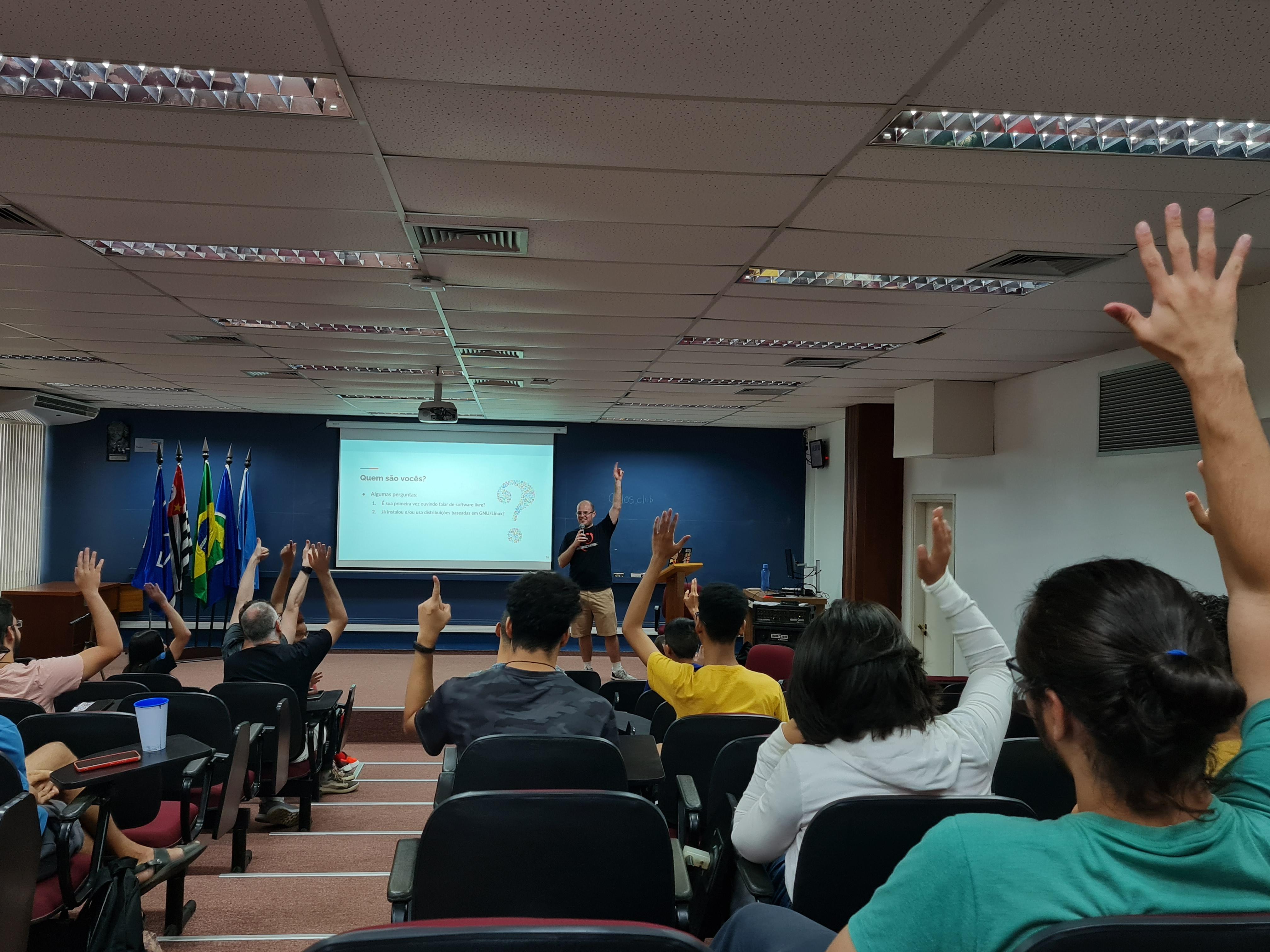
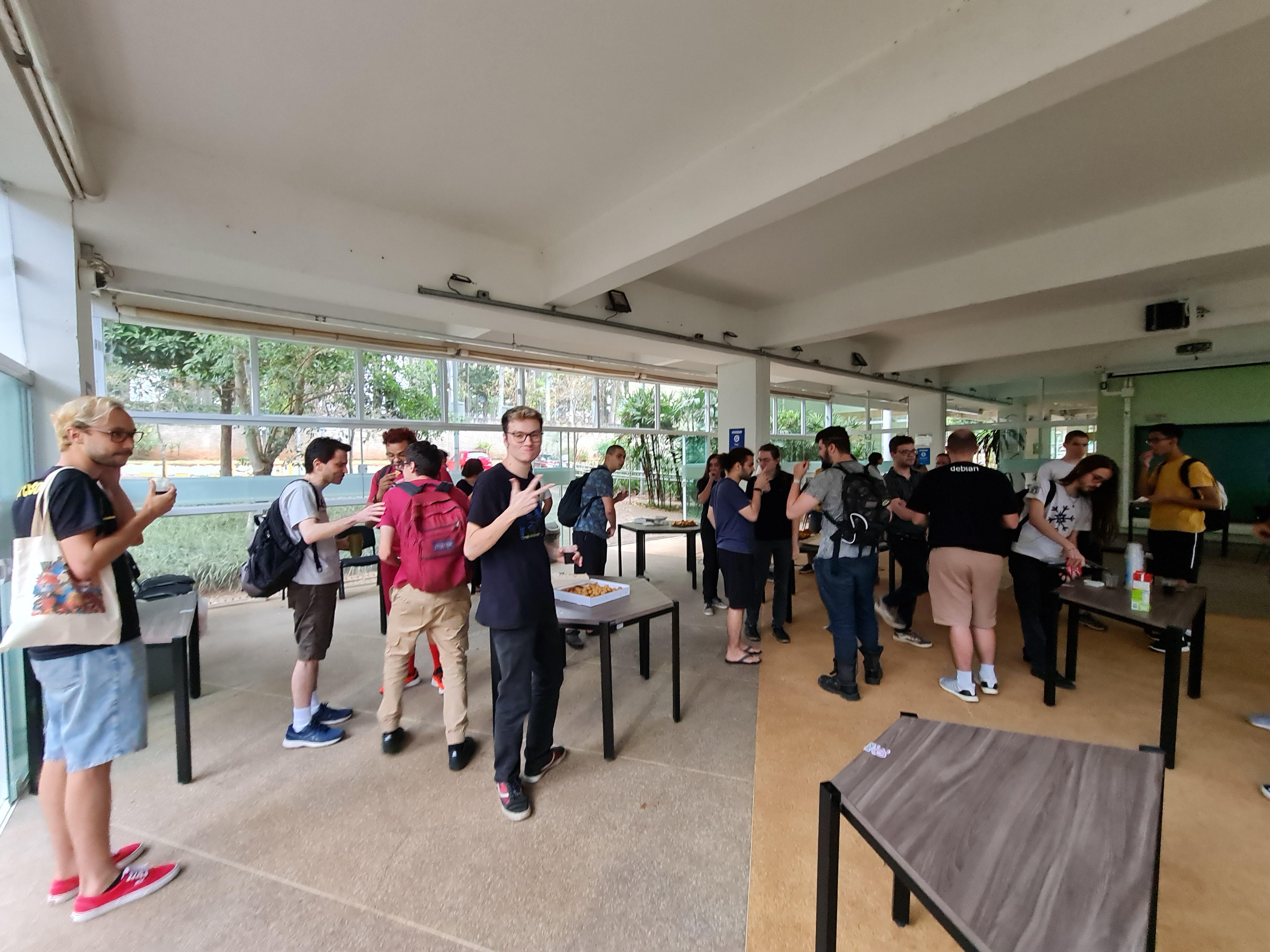
Debian Brasil: Debian Day 30 years online in Brazil


title: Debian Day 30 years online in Brazil description: by Paulo Henrique de Lima Santana (phls) published: true date: 2025-03-01T17:39:03.284Z tags: blog, english editor: markdown dateCreated: 2023-08-25T16:00:00.000Z In 2023 the traditional Debian Day is being celebrated in a special way, after all on August 16th Debian turned 30 years old! To celebrate this special milestone in the Debian's life, the Debian Brasil community organized a week with talks online from August 14th to 18th. The event was named Debian 30 years. Two talks were held per night, from 7:00 pm to 10:00 pm, streamed on the Debian Brasil channel on YouTube totaling 10 talks. The recordings are also available on the Debian Brazil channel on Peertube. We had the participation of 9 DDs, 1 DM, 3 contributors in 10 activities. The live audience varied a lot, and the peak was on the preseed talk with Eriberto Mota when we had 47 people watching. Thank you to all participants for the contribution you made to the success of our event. Veja abaixo as fotos de cada atividade: Nova gera o: uma entrevista com iniciantes no projeto Debian Nova gera o: uma entrevista com iniciantes no projeto Debian Instala o personalizada e automatizada do Debian com preseed Instala o personalizada e automatizada do Debian com preseed Manipulando patches com git-buildpackage Manipulando patches com git-buildpackage debian.social: Socializando Debian do jeito Debian debian.social: Socializando Debian do jeito Debian Proxy reverso com WireGuard Proxy reverso com WireGuard Celebra o dos 30 anos do Debian! Celebra o dos 30 anos do Debian! Instalando o Debian em disco criptografado com LUKS Instalando o Debian em disco criptografado com LUKS O que a equipe de localiza o j  conquistou nesses 30 anos O que a equipe de localiza o j conquistou nesses 30 anos Debian - Projeto e Comunidade! Debian - Projeto e Comunidade! Design Gr fico e Software livre, o que fazer e por onde come ar Design Gr fico e Software livre, o que fazer e por onde come ar

Next.

Previous.