Search Results: "xam"

29 July 2025

Christoph Berg: The Debian Conference 2025 in Brest

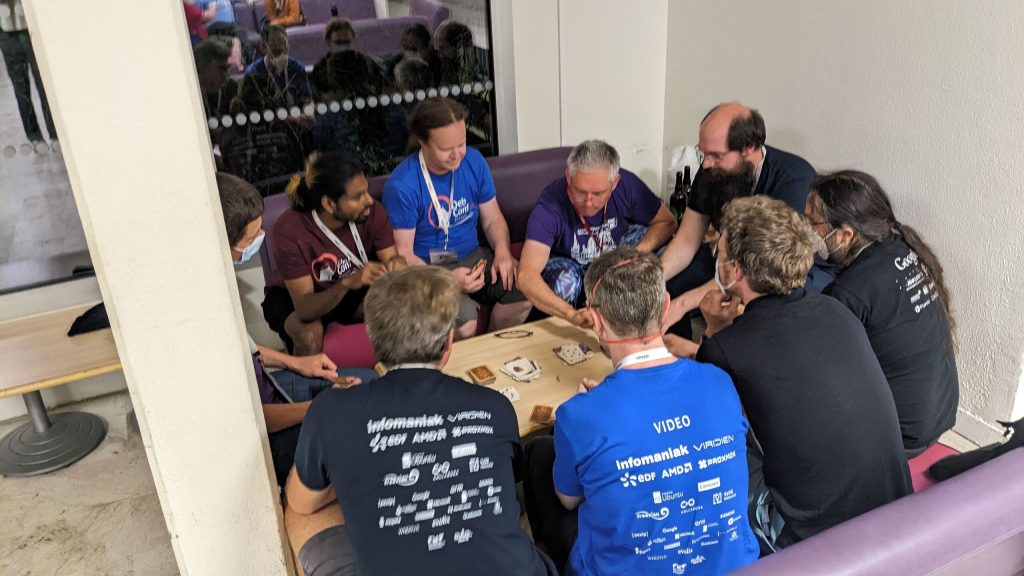
It's Sunday and I'm now sitting in the train from Brest to Paris where I will be changing to Germany, on the way back from the annual Debian conference. A full week of presentations, discussions, talks and socializing is laying behind me and my head is still spinning from the intensity.
Pollito and the gang of DebConf mascots wearing their conference badgesPollito and the gang of DebConf mascots wearing their conference badges (photo: Christoph Berg)
Sunday, July 13th It started last Sunday with traveling to the conference. I got on the Eurostar in Duisburg and we left on time, but even before reaching Cologne, the train was already one hour delayed for external reasons, collecting yet another hour between Aachen and Liege for its own technical problems. "The train driver is working on trying to fix the problem." My original schedule had well over two hours for changing train stations in Paris, but being that late, I missed the connection to Brest in Montparnasse. At least in the end, the total delay was only one hour when finally arriving at the destination. Due to the French julliet quatorze fireworks approaching, buses in Brest were rerouted, but I managed to catch the right bus to the conference venue, already meeting a few Debian people on the way. The conference was hosted at the IMT Atlantique Brest campus, giving the event a nice university touch. I arrived shortly after 10 in the evening and after settling down a bit, got on one of the "magic" buses for transportation to the camping site where half of the attendees where stationed. I shared a mobile home with three other Debianites, where I got a small room for myself. Monday, July 14th Next morning, we took the bus back to the venue with a small breakfast and the opening session where Enrico Zini invited me to come to his and Nicolas Dandrimont's session about Debian community governance and curation, which I gladly did. Many ideas about conflict moderation and community steering were floated around. I hope some of that can be put into effect to make flamewars on the mailing lists less heated and more directed. After that, I attended Olly Betts' "Stemming with Snowball" session, which is the stemmer used also in PostgreSQL. Text search is one of the areas in PostgreSQL that I never really looked closely at, including the integration into the postgresql-common package, so it was nice to get more information about that. In preparation for the conference, a few of us Ham radio operators in Debian had decided to bring some radio gear to DebConf this year in order to perhaps spark more interest for our hobby among the fellow geeks. In the afternoon after the talks, I found a quieter spot just outside of the main hall and set up a shortwave antenna by attaching a 10m mast to one of the park benches there. The 40m band was still pretty much closed, but I could work a few stations from England, just across the channel from Bretagne, answering questions from interested passing-by Debian people between the contacts. Over time, the band opened and more European stations got into the log.
F/DF7CB in Brest (photo: Evangelos Ribeiro Tzaras)
Tuesday, July 15th Tuesday started with Helmut Grohne's session about "Reviving (un)schroot". The schroot program has been Debian's standard way of managing build chroots for a long time, but it is more and more being regarded as obsolete with all kinds of newer containerization and virtualization technologies taking over. Since many bits of Debian infrastructure depend on schroot, and its user interface is still very useful, Helmut reimplemented it using Linux namespaces and the "unshare" systemcall. I had already worked with him at the Hamburg Minidebconf to replace the apt.postgresql.org buildd machinery with the new system, but we were not quite there yet (network isolation is nice, but we still sometimes need proper networking), so it was nice to see the effort is still progressing and I will give his new scripts a try when I'm back home. Next, Stefano Rivera and Colin Watson presented Debusine, a new package repository and workflow management system. It looks very promising for anyone running their own repository, so perhaps yet another bit of apt.postgresql.org infrastructure to replace in the future. After that, I went to the Debian LTS BoF session by Santiago Ruano Rinc n and Bastien Roucari s - Debian releases plus LTS is what we are covering with apt.postgresql.org. Then there were bits from the DPL (Debian Project Leader), and a session moderated by Stefano Rivera interesting to me as a member of the Debian Technical Committee on the future structure of the packages required for cross-building in Debian, a topic which had been brought to TC a while ago. I am happy that we could resolve the issue without having to issue a formal TC ruling as the involved parties (kernel, glibc, gcc and the cross-build people) found a promising way forward themselves. DebConf is really a good way to get such issues unstuck. Ten years ago at the 2015 Heidelberg DebConf, Enrico had given a seminal "Semi-serious stand-up comedy" talk, drawing parallels between the Debian Open Source community and the BDSM community - "People doing things consensually together". (Back then, the talk was announced as "probably unsuitable for people of all ages".) With his unique presentation style and witty insights, the session made a lasting impression on everyone attending. Now, ten years later (and he and many in the audience being ten years older), he gave an updated version of it. We are now looking forward to the sequel in 2035. The evening closed with the famous DebConf tradition of the Cheese & Wine party in a old fort next to the coast, just below the conference venue. Even when he's a fellow Debian Developer, Ham and also TC member, I had never met Paul Tagliamonte in person before, but we spent most of the evening together geeking out on all things Debian and Ham radio.
The northern coast of Ushant (photo: Christoph Berg)
Wednesday, July 16th Wednesday already marked the end of the first half of the week, the day of the day trips. I had chosen to go to Ouessant island (Ushant in English) which marks the Western end of French mainland and hosts one of the lighthouses yielding the way into the English channel. The ferry trip included surprisingly big waves which left some participants seasick, but everyone recovered fast. After around one and a half hours we arrived, picked up the bicycles, and spent the rest of the day roaming the island. The weather forecast was originally very cloudy and 18 C, but over noon this turned into sunny and warm, so many got an unplanned sunburn. I enjoyed the trip very much - it made up for not having time visiting the city during the week. After returning, we spent the rest of the evening playing DebConf's standard game, Mao (spoiler alert: don't follow the link if you ever intend to play).
Having a nice day (photo: Christoph Berg)
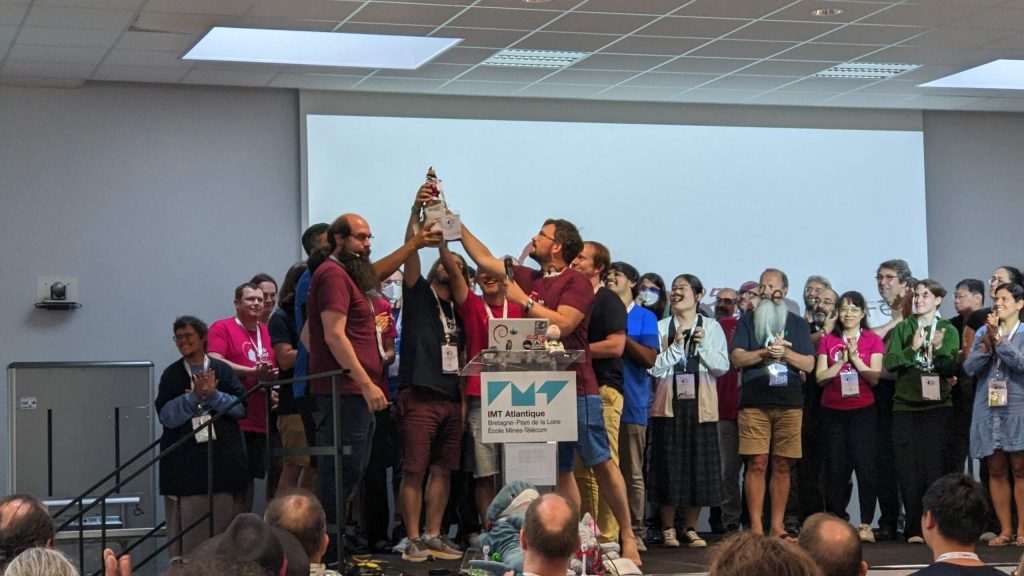
Thursday, July 17th The next day started with the traditional "Meet the Technical Committee" session. This year, we trimmed the usual slide deck down to remove the boring boilerplate parts, so after a very short introduction to the work of the committee by our chairman Matthew Vernon, we opened up the discussion with the audience, with seven (out of 8) TC members on stage. I think the format worked very well, with good input from attendees. Next up was "Don't fear the TPM" by Jonathan McDowell. A common misconception in the Free Software community is that the TPM is evil DRM hardware working against the user, but while it could be used in theory that way, the necessary TPM attestations seem to impossible to attain in practice, so that wouldn't happen anyway. Instead, it is a crypto coprocessor present in almost all modern computers that can be used to hold keys, for example to be used for SSH. It will also be interesting to research if we can make use of it for holding the Transparent Data Encryption keys for CYBERTEC's PostgreSQL Enterprise Edition. Aigars Mahinovs then directed everyone in place for the DebConf group picture, and Lucas Nussbaum started a discussion about archive-wide QA tasks in Debian, an area where I did a lot of work in the past and that still interests me. Antonio Terceiro and Paul Gevers followed up with techniques to track archive-wide rebuilding and testing of packages and in turn filing a lot of bugs to track the problems. The evening ended with the conference dinner, again in the fort close by the coast. DebConf is good for meeting new people, and I incidentally ran into another Chris, who happened to be one of the original maintainers of pgaccess, the pre-predecessor of today's pgadmin. I admit still missing this PostgreSQL frontend for its simplicity and ability to easily edit table data, but it disappeared around 2004. Friday, July 18th On Friday, I participated in discussion sessions around contributors.debian.org (PostgreSQL is planning to set up something similar) and the New Member process which I had helped to run and reform a decade or two ago. Agathe Porte (also a Ham radio operator, like so many others at the conference I had no idea of) then shared her work on rust-rewriting the slower parts of Lintian, the Debian package linter. Craig Small talked about "Free as in Bytes", the evolution of the Linux procps free command. Over the time and many kernel versions, the summary numbers printed became better and better, but there will probably never be a version that suits all use cases alike. Later over dinner, Craig (who is also a TC member) and I shared our experiences with these numbers and customers (not) understanding them. He pointed out that for PostgreSQL and looking at used memory in the presence of large shared memory buffers, USS (unique set size) and PSS (proportional set size) should be more realistic numbers than the standard RSS (resident set size) that the top utility is showing by default. Antonio Terceiro and Paul Gevers again joined to lead a session, now on ci.debian.net and autopkgtest, the test driver used for running tests on packages after then have been installed on a system. The PostgreSQL packages are heavily using this to make sure no regressions creep in even after builds have successfully completed and test re-runs are rescheduled periodically. The day ended with Bdale Garbee's electronics team BoF and Paul Tagliamonte and me setting up the radio station in the courtyard, again answering countless questions about ionospheric conditions and operating practice. Saturday, July 19th Saturday was the last conference day. In the first session, Nikos Tsipinakis and Federico Vaga from CERN announced that the LHC will be moving to Debian for the accelerator's frontend computers in their next "long shutdown" maintenance period in the next year. CentOS broke compatibility too often, and Debian trixie together with the extended LTS support will cover the time until the next long shutdown window in 2035, until when the computers should have all been replaced with newer processors covering higher x86_64 baseline versions. The audience was very delighted to hear that Debian is now also being used in this prestige project. Ben Hutchings then presented new Linux kernel features. Particularly interesting for me was the support for atomic writes spanning more than one filesystem block. When configured correctly, this would mean PostgreSQL didn't have to record full-page images in the WAL anymore, increasing throughput and performance. After that, the Debian ftp team discussed ways to improve review of new packages in the archive, and which of their processes could be relaxed with new US laws around Open Source and cryptography algorithms export. Emmanuel Arias led a session on Salsa CI, Debian's Gitlab instance and standard CI pipeline. (I think it's too slow, but the runners are not under their control.) Julian Klode then presented new features in APT, Debian's package manager. I like the new display format (and a tiny bit of that is also from me sending in wishlist bugs). In the last round of sessions this week, I then led the Ham radio BoF with an introduction into the hobby and how Debian can be used. Bdale mentioned that the sBitx family of SDR radios is natively running Debian, so stock packages can be used from the radio's touch display. We also briefly discussed his involvement in ARDC and the possibility to get grants from them for Ham radio projects. Finally, DebConf wrapped up with everyone gathering in the main auditorium and cheering the organizers for making the conference possible and passing Pollito, the DebConf mascot, to the next organizer team.
Pollito on stage (photo: Christoph Berg)
Sunday, July 20th Zoom back to the train: I made it through the Paris metro and I'm now on the Eurostar back to Germany. It has been an intense week with all the conference sessions and meeting all the people I had not seen so long. There are a lot of new ideas to follow up on both for my Debian and PostgreSQL work. Next year's DebConf will take place in Santa Fe, Argentina. I haven't yet decided if I will be going, but I can recommend the experience to everyone! The post The Debian Conference 2025 in Brest appeared first on CYBERTEC PostgreSQL Services & Support.

28 July 2025

Dimitri John Ledkov: Achieving actually full disk encryption of UEFI ESP at rest with TCG OPAL, FIPS, LUKS

Achieving full disk encryption using FIPS, TCG OPAL and LUKS to encrypt UEFI ESP on bare-metal and in VMs
Many security standards such as CIS and STIG require to protect information at rest. For example, NIST SP 800-53r5 SC-28 advocate to use cryptographic protection, offline storage and TPMs to enhance protection of information confidentiality and/or integrity.Traditionally to satisfy such controls on portable devices such as laptops one would utilize software based Full Disk Encryption - Mac OS X FileVault, Windows Bitlocker, Linux cryptsetup LUKS2. In cases when FIPS cryptography is required, additional burden would be placed onto these systems to operate their kernels in FIPS mode.Trusted Computing Group works on establishing many industry standards and specifications, which are widely adopted to improve safety and security of computing whilst keeping it easy to use. One of their most famous specifications them is TCG TPM 2.0 (Trusted Platform Module). TPMs are now widely available on most devices and help to protect secret keys and attest systems. For example, most software full disk encryption solutions can utilise TCG TPM to store full disk encryption keys providing passwordless, biometric or pin-base ways to unlock the drives as well as attesting that system have not been modified or compromised whilst offline.TCG Storage Security Subsystem Class: Opal Specification is a set of specifications for features of data storage devices. The authors and contributors to OPAL are leading and well trusted storage manufacturers such as Samsung, Western Digital, Seagate Technologies, Dell, Google, Lenovo, IBM, Kioxia, among others. One of the features that Opal Specification enables is self-encrypting drives which becomes very powerful when combined with pre-boot authentication. Out of the box, such drives always and transparently encrypt all disk data using hardware acceleration. To protect data one can enter UEFI firmware setup (BIOS) to set NVMe single user password (or user + administrator/recovery passwords) to encrypt the disk encryption key. If one's firmware didn't come with such features, one can also use SEDutil to inspect and configure all of this. Latest release of major Linux distributions have SEDutil already packaged.Once password is set, on startup, pre-boot authentication will request one to enter password - prior to booting any operating systems. It means that full disk is actually encrypted, including the UEFI ESP and all operating systems that are installed in case of dual or multi-boot installations. This also prevents tampering with ESP, UEFI bootloaders and kernels which with traditional software-based encryption often remain unencrypted and accessible. It also means one doesn't have to do special OS level repartitioning, or installation steps to ensure all data is encrypted at rest.What about FIPS compliance? Well, the good news is that majority of the OPAL compliant hard drives and/or security sub-chips do have FIPS 140-3 certification. Meaning they have been tested by independent laboratories to ensure they do in-fact encrypt data. On the CMVP website one can search for module name terms "OPAL" or "NVMe" or name of hardware vendor to locate FIPS certificates.Are such drives widely available? Yes. For example, a common Thinkpad X1 gen 11 has OPAL NVMe drives as standard, and they have FIPS certification too. Thus, it is likely in your hardware fleet these are already widely available. Use sedutil to check if MediaEncrypt and LockingSupported features are available.Well, this is great for laptops and physical servers, but you may ask - what about public or private cloud? Actually, more or less the same is already in-place in both. On CVMP website all major clouds have their disk encryption hardware certified, and all of them always encrypt all Virtual Machines with FIPS certified cryptography without an ability to opt-out. One is however in full control of how the encryption keys are managed: cloud-provider or self-managed (either with a cloud HSM or KMS or bring your own / external). See these relevant encryption options and key management docs for GCP, Azure, AWS. But the key takeaway without doing anything, at rest, VMs in public cloud are always encrypted and satisfy NIST SP 800-53 controls.What about private cloud? Most Linux based private clouds ultimately use qemu typically with qcow2 virtual disk images. Qemu supports user-space encryption of qcow2 disk, see this manpage. Such encryption encrypts the full virtual machine disk, including the bootloader and ESP. And it is handled entirely outside of the VM on the host - meaning the VM never has access to the disk encryption keys. Qemu implements this encryption entirely in userspace using gnutls, nettle, libgcrypt depending on how it was compiled. This also means one can satisfy FIPS requirements entirely in userspace without a Linux kernel in FIPS mode. Higher level APIs built on top of qemu also support qcow2 disk encryption, as in projects such as libvirt and OpenStack Cinder.If you carefully read the docs, you may notice that agent support is explicitly sometimes called out as not supported or not mentioned. Quite often agents running inside the OS may not have enough observability to them to assess if there is external encryption. It does mean that monitoring above encryption options require different approaches - for example monitor your cloud configuration using tools such as Wiz and Orca, rather than using agents inside individual VMs. For laptop / endpoint security agents, I do wish they would start gaining capability to report OPAL SED availability and status if it is active or not.What about using software encryption none-the-less on top of the above solutions? It is commonly referred to double or multiple encryption. There will be an additional performance impact, but it can be worthwhile. It really depends on what you define as data at rest for yourself and which controls you need. If one has a dual-boot laptop, and wants to keep one OS encrypted whilst booted into the other, it can perfectly reasonable to encrypted the two using separate software encryption keys. In addition to the OPAL encryption of the ESP. For more targeted per-file / per-folder encryption, one can look into using gocryptfs which is the best successor to the once popular, but now deprecated eCryptfs (amazing tool, but has fallen behind in development and can lead to data loss).All of the above mostly talks about cryptographic encryption, which only provides confidentially but not data integrity. To protect integrity, one needs to choose how to maintain that. dm-verity is a good choice for read-only and rigid installations. For read-write workloads, it may be easier to deploy ZFS or Btrfs instead. If one is using filesystems without a built-in integrity support such as XFS or Ext4, one can retrofit integrity layer to them by using dm-integrity (either standalone, or via dm-luks/cryptsetup --integrity option).

If one has a lot of estate and a lot of encryption keys to keep track off a key management solution is likely needed. The most popular solution is likely the one from Thales Group marketed under ChiperTrust Data Security Platform (previously Vormetric), but there are many others including OEM / Vendor / Hardware / Cloud specific or agnostic solutions.

I hope this crash course guide piques your interest to learn and discover modern confidentially and integrity solutions, and to re-affirm or change your existing controls w.r.t. to data protection at rest.

Full disk encryption, including UEFI ESP /boot/efi is now widely achievable by default on both baremetal machines and in VMs including with FIPS certification. To discuss more let's connect on Linkedin.

Russ Allbery: Review: Cyteen

Review: Cyteen, by C.J. Cherryh
Series: Cyteen #1
Publisher: Warner Aspect
Copyright: 1988
Printing: September 1995
ISBN: 0-446-67127-4
Format: Trade paperback
Pages: 680
The main text below is an edited version of my original review of Cyteen written on 2012-01-03. Additional comments from my re-read are after the original review. I've reviewed several other C.J. Cherryh books somewhat negatively, which might give the impression I'm not a fan. That is an artifact of when I started reviewing. I first discovered Cherryh with Cyteen some 20 years ago, and it remains one of my favorite SF novels of all time. After finishing my reading for 2011, I was casting about for what to start next, saw Cyteen on my parents' shelves, and decided it was past time for my third reading, particularly given the recent release of a sequel, Regenesis. Cyteen is set in Cherryh's Alliance-Union universe following the Company Wars. It references several other books in that universe, most notably Forty Thousand in Gehenna but also Downbelow Station and others. It also has mentions of the Compact Space series (The Pride of Chanur and sequels). More generally, almost all of Cherryh's writing is loosely tied together by an overarching future history. One does not need to read any of those other books before reading Cyteen; this book will fill you in on all of the politics and history you need to know. I read Cyteen first and have never felt the lack. Cyteen was at one time split into three books for publishing reasons: The Betrayal, The Rebirth, and The Vindication. This is an awful way to think of the book. There are no internal pauses or reasonable volume breaks; Cyteen is a single coherent novel, and Cherryh has requested that it never be broken up that way again. If you happen to find all three portions as your reading copy, they contain all the same words and are serviceable if you remember it's a single novel under three covers, but I recommend against reading the portions in isolation. Human colonization of the galaxy started with slower-than-light travel sponsored by the private Sol Corporation. The inhabitants of the far-flung stations and the crews of the merchant ships that supplied them have formed their own separate cultures, but initially remained attached to Earth. That changed with the discovery of FTL travel and a botched attempt by Earth to reassert its authority. At the time of Cyteen, there are three human powers: distant Earth (which plays little role in this book), the merchanter Alliance, and Union. The planet Cyteen is one of only a few Earth-like worlds discovered by human expansion, and is the seat of government and the most powerful force in Union. This is primarily because of Reseune: the Cyteen lab that produces the azi. If Cyteen is about any one thing, it's about azi: genetically engineered human clones who are programmed via intensive psychological conditioning starting before birth. The conditioning uses a combination of drugs to make them receptive and "tape," specific patterns of instruction and sensory stimulation. They are designed for specific jobs or roles, they're conditioned to be obedient to regular humans, and they're not citizens. They are, in short, slaves. In a lot of books, that's as deep as the analysis would go. Azi are slaves, and slavery is certainly bad, so there would probably be a plot around azi overthrowing their conditioning, or around the protagonists trying to free them from servitude. But Cyteen is not any SF novel, and azi are considerably more complex and difficult than that analysis. We learn over the course of the book that the immensely powerful head of Reseune Labs, Ariane Emory, has a specific broader purpose in mind for the azi. One of the reasons why Reseune fought for and gained the role of legal protector of all azi in Union, regardless of where they were birthed, is so that Reseune could act to break any permanent dependence on azi as labor. And yet, they are slaves; one of the protagonists of Cyteen is an experimental azi, which makes him the permanent property of Reseune and puts him in constant jeopardy of being used as a political prisoner and lever of manipulation against those who care about him. Cyteen is a book about manipulation, about programming people, about what it means to have power over someone else's thoughts, and what one can do with that power. But it's also a book about connection and identity, about what makes up a personality, about what constitutes identity and how people construct the moral codes and values that they hold at their core. It's also a book about certainty. Azi are absolutely certain, and are capable of absolute trust, because that's part of their conditioning. Naturally-raised humans are not. This means humans can do things that azi can't, but the reverse is also true. The azi are not mindless slaves, nor are they mindlessly programmed, and several of the characters, both human and azi, find a lot of appeal in the core of certainty and deep self-knowledge of their own psychological rules that azis can have. Cyteen is a book about emotions, and logic, and where they come from and how to balance them. About whether emotional pain and uncertainty is beneficial or damaging, and about how one's experiences make up and alter one's identity. This is also a book about politics, both institutional and personal. It opens with Ariane Emory, Councilor for Science for five decades and the head of the ruling Union Expansionist party. She's powerful, brilliant, dangerously good at reading people, and dangerously willing to manipulate and control people for her own ends. What she wants, at the start of the book, is to completely clone a Special (the legal status given to the most brilliant minds of Union). This was attempted before and failed, but Ariane believes it's now possible, with a combination of tape, genetic engineering, and environmental control, to reproduce the brilliance of the original mind. To give Union another lifespan of work by their most brilliant thinkers. Jordan Warrick, another scientist at Reseune, has had a long-standing professional and personal feud with Ariane Emory. As the book opens, he is fighting to be transferred out from under her to the new research station that would be part of the Special cloning project, and he wants to bring his son Justin and Justin's companion azi Grant with them. Justin is a PR, a parental replicate, meaning he shares Jordan's genetic makeup but was not an attempt to reproduce the conditions of Jordan's rearing. Grant was raised as his brother. And both have, for reasons that are initially unclear, attracted the attention of Ariane, who may be using them as pawns. This is just the initial setup, and along with this should come a warning: the first 150 pages set up a very complex and dangerous political situation and build the tension that will carry the rest of the book, and they do this by, largely, torturing Justin and Grant. The viewpoint jumps around, but Justin and Grant are the primary protagonists for this first section of the book. While one feels sympathy for both of them, I have never, in my multiple readings of the book, particularly liked them. They're hard to like, as opposed to pity, during this setup; they have very little agency, are in way over their heads, are constantly making mistakes, and are essentially having their lives destroyed. Don't let this turn you off on the rest of the book. Cyteen takes a dramatic shift about 150 pages in. A new set of protagonists are introduced who are some of the most interesting, complex, and delightful protagonists in any SF novel I have read, and who are very much worth waiting for. While Justin has his moments later on (his life is so hard that his courage can be profoundly moving), it's not necessary to like him to love this book. That's one of the reasons why I so strongly dislike breaking it into three sections; that first section, which is mostly Justin and Grant, is not representative of the book. I can't talk too much more about the plot without risking spoiling it, but it's a beautiful, taut, and complex story that is full of my favorite things in both settings and protagonists. Cyteen is a book about brilliant people who think on their feet. Cherryh succeeds at showing this through what they do, which is rarely done as well as it is here. It's a book about remembering one's friends and remembering one's enemies, and waiting for the most effective moment to act, but it also achieves some remarkable transformations. About 150 pages in, you are likely to loathe almost everyone in Reseune; by the end of the book, you find yourself liking, or at least understanding, nearly everyone. This is extremely hard, and Cherryh pulls it off in most cases without even giving the people she's redeeming their own viewpoint sections. Other than perhaps George R.R. Martin I've not seen another author do this as well. And, more than anything else, Cyteen is a book with the most wonderful feeling of catharsis. I think this is one of the reasons why I adore this book and have difficulties with some of Cherryh's other works. She's always good at ramping up the tension and putting her characters in awful, untenable positions. Less frequently does she provide the emotional payoff of turning the tables, where you get to watch a protagonist do everything you've been wanting them to do for hundreds of pages, except even better and more delightfully than you would have come up with. Cyteen is one of the most emotionally satisfying books I've ever read. I could go on and on; there is just so much here that I love. Deep questions of ethics and self-control, presented in a way that one can see the consequences of both bad decisions and good ones and contrast them. Some of the best political negotiations in fiction. A wonderful look at friendship and loyalty from several directions. Two of the best semi-human protagonists I've seen, who one can see simultaneously as both wonderful friends and utterly non-human and who put nearly all of the androids in fiction to shame by being something trickier and more complex. A wonderful unfolding sense of power. A computer that can somewhat anticipate problems and somewhat can't, and that encapsulates much of what I love about semi-intelligent bases in science fiction. Cyteen has that rarest of properties of SF novels: Both the characters and the technology meld in a wonderful combination where neither could exist without the other, where the character issues are illuminated by the technology and the technology supports the characters. I have, for this book, two warnings. The first, as previously mentioned, is that the first 150 pages of setup is necessary but painful to read, and I never fully warmed to Justin and Grant throughout. I would not be surprised to hear that someone started this book but gave up on it after 50 or 100 pages. I do think it's worth sticking out the rocky beginning, though. Justin and Grant continue to be a little annoying, but there's so much other good stuff going on that it doesn't matter. The other warning is that part of the setup of the story involves the rape of an underage character. This is mostly off-camera, but the emotional consequences are significant (as they should be) and are frequently discussed throughout the book. There is also rather frank discussion of adolescent sexuality later in the book. I think both of these are relevant to the story and handled in a way that isn't gratuitous, but they made me uncomfortable and I don't have any past history with those topics. Those warnings notwithstanding, this is simply one of the best SF novels ever written. It uses technology to pose deep questions about human emotions, identity, and interactions, and it uses complex and interesting characters to take a close look at the impact of technology on lives. And it does this with a wonderfully taut, complicated plot that sustains its tension through all 680 pages, and with characters whom I absolutely love. I have no doubt that I'll be reading it for a fourth and fifth time some years down the road. Followed by Regenesis, although Cyteen stands well entirely on its own and there's no pressing need to read the sequel. Rating: 10 out of 10

Some additional thoughts after re-reading Cyteen in 2025: I touched on this briefly in my original review, but I was really struck during this re-read how much the azi are a commentary on and a complication of the role of androids in earlier science fiction. Asimov's Three Laws of Robotics were an attempt to control the risks of robots, but can also be read as turning robots into slaves. Azis make the slavery more explicit and disturbing by running the programming on a human biological platform, but they're more explicitly programmed and artificial than a lot of science fiction androids. Artificial beings and their relationship to humans have been a recurring theme of SF since Frankenstein, but I can't remember a novel that makes the comparison to humans this ambiguous and conflicted. The azi not only like being azi, they can describe why they prefer it. It's clear that Union made azi for many of the same reasons that humans enslave other humans, and that Ariane Emory is using them as machinery in a larger (and highly ethically questionable) plan, but Cherryh gets deeper into the emergent social complications and societal impact than most SF novels manage. Azi are apparently closer to humans than the famous SF examples such as Commander Data, but the deep differences are both more subtle and more profound. I've seen some reviewers who are disturbed by the lack of a clear moral stance by the protagonists against the creation of azi. I'm not sure what to think about that. It's clear the characters mostly like the society they've created, and the groups attempting to "free" azi from their "captivity" are portrayed as idiots who have no understanding of azi psychology. Emory says she doesn't want azi to be a permanent aspect of society but clearly has no intention of ending production any time soon. The book does seem oddly unaware that the production of azi is unethical per se and, unlike androids, has an obvious exit ramp: Continue cloning gene lines as needed to maintain a sufficient population for a growing industrial civilization, but raise the children as children rather than using azi programming. If Cherryh included some reason why that was infeasible, I didn't see it, and I don't think the characters directly confronted it. I don't think societies in books need to be ethical, or that Cherryh intended to defend this one. There are a lot of nasty moral traps that civilizations can fall into that make for interesting stories. But the lack of acknowledgment of the problem within the novel did seem odd this time around. The other part of this novel that was harder to read past in this re-read is the sexual ethics. There's a lot of adolescent sexuality in this book, and even apart from the rape scene which was more on-the-page than I had remembered and which is quite (intentionally) disturbing there is a whole lot of somewhat dubious consent. Maybe I've gotten older or just more discriminating, but it felt weirdly voyeuristic to know this much about the sex lives of characters who are, at several critical points in the story, just a bunch of kids. All that being said, and with the repeated warning that the first 150 pages of this novel are just not very good, there is still something magic about the last two-thirds of this book. It has competence porn featuring a precociously brilliant teenager who I really like, it has one of the more interesting non-AI programmed computer systems that I've read in SF, it has satisfying politics that feel like modern politics (media strategy and relationships and negotiated alliances, rather than brute force and ideology), and it has a truly excellent feeling of catharsis. The plot resolution is a bit too abrupt and a bit insufficiently explained (there's more in Regenesis), but even though this was my fourth time through this book, the pacing grabbed me again and I could barely put down the last part of the story. Ethics aside (and I realize that's quite the way to start a sentence), I find the azi stuff fascinating. I know the psychology in this book is not real and is hopelessly simplified compared to real psychology, but there's something in the discussions of value sets and flux and self-knowledge that grabs my interest and makes me want to ponder. I think it's the illusion of simplicity and control, the what-if premise of thought where core motivations and moral rules could be knowable instead of endlessly fluid the way they are in us humans. Cherryh's azi are some of the most intriguing androids in science fiction to me precisely because they don't start with computers and add the humanity in, but instead start with humanity and overlay a computer-like certainty of purpose that's fully self-aware. The result is more subtle and interesting than anything Star Trek managed. I was not quite as enamored with this book this time around, but it's still excellent once the story gets properly started. I still would recommend it, but I might add more warnings about the disturbing parts.

Re-read rating: 9 out of 10

26 July 2025

Matthew Palmer: Object deserialization attacks using Ruby's Oj JSON parser

tl;dr: there is an attack in the wild which is triggering dangerous-but-seemingly-intended behaviour in the Oj JSON parser when used in the default and recommended manner, which can lead to everyone s favourite kind of security problem: object deserialization bugs! If you have the oj gem anywhere in your Gemfile.lock, the quickest mitigation is to make sure you have Oj.default_options = mode: :strict somewhere, and that no library is overwriting that setting to something else.

Prologue As a sensible sysadmin, all the sites I run send me a notification if any unhandled exception gets raised. Mostly, what I get sent is error-handling corner cases I missed, but now and then things get more interesting. In this case, it was a PG::UndefinedColumn exception, which looked something like this:
PG::UndefinedColumn: ERROR:  column "xyzzydeadbeef" does not exist
This is weird on two fronts: firstly, this application has been running for a while, and if there was a schema problem, I d expect it to have made itself apparent long before now. And secondly, while I don t profess to perfection in my programming, I m usually better at naming my database columns than that. Something is definitely hinky here, so let s jump into the mystery mobile!

The column name is coming from outside the building! The exception notifications I get sent include a whole lot of information about the request that caused the exception, including the request body. In this case, the request body was JSON, and looked like this:
 "name":":xyzzydeadbeef", ... 
The leading colon looks an awful lot like the syntax for a Ruby symbol, but it s in a JSON string. Surely there s no way a JSON parser would be turning that into a symbol, right? Right?!? Immediately, I thought that that possibly was what was happening, because I use Sequel for my SQL database access needs, and Sequel treats symbols as database column names. It seemed like too much of a coincidence that a vaguely symbol-shaped string was being sent in, and the exact same name was showing up as a column name. But how the flying fudgepickles was a JSON string being turned into a Ruby symbol, anyway? Enter Oj.

Oj? I barely know aj A long, long time ago, the standard Ruby JSON library had a reputation for being slow. Thus did many competitors flourish, claiming more features and better performance. Strong amongst the contenders was oj (for Optimized JSON ), touted as The fastest JSON parser and object serializer . Given the history, it s not surprising that people who wanted the best possible performance turned to Oj, leading to it being found in a great many projects, often as a sub-dependency of a dependency of a dependency (which is how it ended up in my project). You might have noticed in Oj s description that, in addition to claiming fastest , it also describes itself as an object serializer . Anyone who has kept an eye on the security bug landscape will recall that object deserialization is a rich vein of vulnerabilities to mine. Libraries that do object deserialization, especially ones with a history that goes back to before the vulnerability class was well-understood, are likely to be trouble magnets. And thus, it turns out to be with Oj. By default, Oj will happily turn any string that starts with a colon into a symbol:

>> require "oj"
>> Oj.load(' "name":":xyzzydeadbeef","username":"bob","answer":42 ')
=>  "name"=>:xyzzydeadbeef, "username"=>"bob", "answer"=>42 

How that gets exploited is only limited by the creativity of an attacker. Which I ll talk about more shortly but first, a word from my rant cortex.

Insecure By Default is a Cancer While the object of my ire today is Oj and its fast-and-loose approach to deserialization, it is just one example of a pervasive problem in software: insecurity by default. Whether it s a database listening on 0.0.0.0 with no password as soon as its installed, or a library whose default behaviour is to permit arbitrary code execution, it all contributes to a software ecosystem that is an appalling security nightmare. When a user (in this case, a developer who wants to parse JSON) comes across a new piece of software, they have by definition no idea what they re doing with that software. They re going to use the defaults, and follow the most easily-available documentation, to achieve their goal. It is unrealistic to assume that a new user of a piece of software is going to do things the right way , unless that right way is the only way, or at least the by-far-the-easiest way. Conversely, the developer(s) of the software is/are the domain experts. They have knowledge of the problem domain, through their exploration while building the software, and unrivalled expertise in the codebase. Given this disparity in knowledge, it is tantamount to malpractice for the experts the developer(s) to off-load the responsibility for the safe and secure use of the software to the party that has the least knowledge of how to do that (the new user). To apply this general principle to the specific case, take the Using section of the Oj README. The example code there calls Oj.load, with no indication that this code will, in fact, parse specially-crafted JSON documents into Ruby objects. The brand-user user of the library, no doubt being under pressure to Get Things Done, is almost certainly going to look at this Using example, get the apparent result they were after (a parsed JSON document), and call it a day. It is unlikely that a brand-new user will, for instance, scroll down to the Further Reading section, find the second last (of ten) listed documents, Security.md , and carefully peruse it. If they do, they ll find an oblique suggestion that parsing untrusted input is never a good idea . While that s true, it s also rather unhelpful, because I d wager that by far the majority of JSON parsed in the world is untrusted , in one way or another, given the predominance of JSON as a format for serializing data passing over the Internet. This guidance is roughly akin to putting a label on a car s airbags that driving at speed can be hazardous to your health : true, but unhelpful under the circumstances. The solution is for default behaviours to be secure, and any deviation from that default that has the potential to degrade security must, at the very least, be clearly labelled as such. For example, the Oj.load function should be named Oj.unsafe_load, and the Oj.load function should behave as the Oj.safe_load function does presently. By naming the unsafe function as explicitly unsafe, developers (and reviewers) have at least a fighting chance of recognising they re doing something risky. We put warning labels on just about everything in the real world; the same should be true of dangerous function calls. OK, rant over. Back to the story.

But how is this exploitable? So far, I ve hopefully made it clear that Oj does some Weird Stuff with parsing certain JSON strings. It caused an unhandled exception in a web application I run, which isn t cool, but apart from bombing me with exception notifications, what s the harm? For starters, let s look at our original example: when presented with a symbol, Sequel will interpret that as a column name, rather than a string value. Thus, if our save an update to the user code looked like this:

# request_body has the JSON representation of the form being submitted
body = Oj.load(request_body)
DB[:users].where(id: user_id).update(name: body["name"])

In normal operation, this will issue an SQL query along the lines of UPDATE users SET name='Jaime' WHERE id=42. If the name given is Jaime O Dowd , all is still good, because Sequel quotes string values, etc etc. All s well so far. But, imagine there is a column in the users table that normally users cannot read, perhaps admin_notes. Or perhaps an attacker has gotten temporary access to an account, and wants to dump the user s password hash for offline cracking. So, they send an update claiming that their name is :admin_notes (or :password_hash). In JSON, that ll look like "name":":admin_notes" , and Oj.load will happily turn that into a Ruby object of "name"=>:admin_notes . When run through the above update the user code fragment, it ll produce the SQL UPDATE users SET name=admin_notes WHERE id=42. In other words, it ll copy the contents of the admin_notes column into the name column which the attacker can then read out just by refreshing their profile page.

But Wait, There s More! That an attacker can read other fields in the same table isn t great, but that s barely scratching the surface. Remember before I said that Oj does object serialization ? That means that, in general, you can create arbitrary Ruby objects from JSON. Since objects contain code, it s entirely possible to trigger arbitrary code execution by instantiating an appropriate Ruby object. I m not going to go into details about how to do this, because it s not really my area of expertise, and many others have covered it in detail. But rest assured, if an attacker can feed input of their choosing into a default call to Oj.load, they ve been handed remote code execution on a platter.

Mitigations As Oj s object deserialization is intended and documented behaviour, don t expect a future release to make any of this any safer. Instead, we need to mitigate the risks. Here are my recommended steps:
  1. Look in your Gemfile.lock (or SBOM, if that s your thing) to see if the oj gem is anywhere in your codebase. Remember that even if you don t use it directly, it s popular enough that it is used in a lot of places. If you find it in your transitive dependency tree anywhere, there s a chance you re vulnerable, limited only by the ingenuity of attackers to feed crafted JSON into a deeply-hidden Oj.load call.
  2. If you depend on oj directly and use it in your project, consider not doing that. The json gem is acceptably fast, and JSON.parse won t create arbitrary Ruby objects.
  3. If you really, really need to squeeze the last erg of performance out of your JSON parsing, and decide to use oj to do so, find all calls to Oj.load in your code and switch them to call Oj.safe_load.
  4. It is a really, really bad idea to ever use Oj to deserialize JSON into objects, as it lacks the safety features needed to mitigate the worst of the risks of doing so (for example, restricting which classes can be instantiated, as is provided by the permitted_classes argument to Psych.load). I d make it a priority to move away from using Oj for that, and switch to something somewhat safer (such as the aforementioned Psych). At the very least, audit and comment heavily to minimise the risk of user-provided input sneaking into those calls somehow, and pass mode: :object as the second argument to Oj.load, to make it explicit that you are opting-in to this far more dangerous behaviour only when it s absolutely necessary.
  5. To secure any unsafe uses of Oj.load in your dependencies, consider setting the default Oj parsing mode to :strict, by putting Oj.default_options = mode: :strict somewhere in your initialization code (and make sure no dependencies are setting it to something else later!). There is a small chance that this change of default might break something, if a dependency is using Oj to deliberately create Ruby objects from JSON, but the overwhelming likelihood is that Oj s just being used to parse ordinary JSON, and these calls are just RCE vulnerabilities waiting to give you a bad time.

Is Your Bacon Saved? If I ve helped you identify and fix potential RCE vulnerabilities in your software, or even just opened your eyes to the risks of object deserialization, please help me out by buying me a refreshing beverage. I would really appreciate any support you can give. Alternately, if you d like my help in fixing these (and many other) sorts of problems, I m looking for work, so email me.

23 July 2025

Peter Pentchev: Ringlet software updates (2025-03-23)

Ringlet software updates (2025-03-23)Recent initial releases of [Ringlet software][r-site] (a fancy name for my pet projects):

Dirk Eddelbuettel: qlcal 0.0.16 on CRAN: Regular Update

The sixteenth release of the qlcal package arrivied at CRAN today, once again following the QuantLib 1.39 release this morning. qlcal delivers the calendaring parts of QuantLib. It is provided (for the R package) as a set of included files, so the package is self-contained and does not depend on an external QuantLib library (which can be demanding to build). qlcal covers over sixty country / market calendars and can compute holiday lists, its complement (i.e. business day lists) and much more. Examples are in the README at the repository, the package page, and course at the CRAN package page. This releases mainly synchronizes qlcal with the QuantLib release 1.39.

Changes in version 0.0.16 (2025-07-23)
  • Synchronized with QuantLib 1.39 released today
  • Calendar updates for Israel, minor utility functions update
  • Minor package maintenance updates

Courtesy of my CRANberries, there is a diffstat report for this release. See the project page and package documentation for more details, and more examples.

This post by Dirk Eddelbuettel originated on his Thinking inside the box blog. If you like this or other open-source work I do, you can sponsor me at GitHub.

Sergio Cipriano: How I finally tracked my Debian uploads correctly

How I finally tracked my Debian uploads correctly A long time ago, I became aware of UDD (Ultimate Debian Database), which gathers various Debian data into a single SQL database. At that time, we were trying to do something simple: list the contributions (package uploads) of our local community, Debian Bras lia. We ended up with a script that counted uploads to unstable and experimental. I was never satisfied with the final result because some uploads were always missing. Here is an example:
debci (3.0) experimental; urgency=medium
...
   [ Sergio de almeida cipriano Junior ]
   * Fix Style/GlovalVars issue
   * Rename blacklist to rejectlist
...
I made changes in debci 3.0, but the upload was done by someone else. This kind of contribution cannot be tracked by that script. Then, a few years ago, I learned about Minechangelogs, which allows us to search through the changelogs of all Debian packages currently published. Today, I decided to explore how this was done, since I couldn't find anything useful for that kind of query in UDD's tables. That's when I came across ProjectB. It was my first time hearing about it. ProjectB is a database that stores all the metadata about the packages in the Debian archive, including the changelogs of those packages. Now that I'm a Debian Developer, I have access to this database. If you also have access and want to try some queries, you can do this:
$ ssh mirror.ftp-master.debian.org -N -L 15434:danzi.debian.org:5435
$ psql postgresql://guest@localhost:15434/projectb?sslmode=allow
In the end, it finally solved my problem. Using the code below, with UDD, I get 38 uploads:
import psycopg2

contributor = 'almeida cipriano'

try:
    connection = psycopg2.connect(
        user="udd-mirror",
        password="udd-mirror",
        host="udd-mirror.debian.net",
        port="5432",
        database="udd"
    )

    cursor = connection.cursor()

    query = f"SELECT source,version,date,distribution,signed_by_name \
FROM public.upload_history \
WHERE changed_by_name ILIKE '% contributor %' \
ORDER BY date;"

    cursor.execute(query)
    records = cursor.fetchall()

    print(f"I have  len(records)  uploads.")

    cursor.close()
    connection.close()

except (Exception, psycopg2.Error) as error:
    print("Error while fetching data from PostgreSQL", error)
Using the code bellow, with ProjectB, I get 43 uploads (the correct amount):
import psycopg2

contributor = 'almeida cipriano'

try:
    # SSH tunnel is required to access the database:
    # ssh <username>@mirror.ftp-master.debian.org -N -L 15434:danzi.debian.org:5435
    connection = psycopg2.connect(
        user="guest",
        host="localhost",
        port="15434",
        database="projectb",
        sslmode="allow"
    )
    connection.set_client_encoding('UTF8')

    cursor = connection.cursor()

    query = f"SELECT c.source, c.version, c.changedby \
FROM changes c \
JOIN changelogs ch ON ch.id = c.changelog_id \
WHERE c.source != 'debian-keyring' \
  AND (\
    ch.changelog ILIKE '% contributor %' \
    OR c.changedby ILIKE '% contributor %' \
  )\
ORDER BY c.seen;"

    cursor.execute(query)
    records = cursor.fetchall()

    print(f"I have  len(records)  uploads.")

    cursor.close()
    connection.close()

except (Exception, psycopg2.Error) as error:
    print("Error while fetching data from PostgreSQL", error)
It feels good to finally solve this itch I've had for years.

Russell Coker: Annoying Wrongness on TV

One thing that annoys me on TV shows and movies is getting the details wrong. Yes it s fiction and yes some things can t be done correctly and in some situations correctly portraying things goes against the plot. But otherwise I think they should try to make it accurate. I was just watching The Americans (a generally good show that I recommend watching) and in Season 4 Episode 9 there s a close up of a glass of wine which clearly shows that the Tears of Wine effect is missing, the liquid in the glass obviously has the surface tension of water not of wine. When they run a show about spies then have to expect that the core audience will be the type of detail oriented people who notice these things. Having actors not actually drink alcohol on set is a standard practice, if they have to do 10 takes of someone drinking a glass of wine then that would be a problem if they actually drank real wine. But they could substitute real wine for the close up shots and of course just getting it right the first time is a good option. Some ridiculous inaccuracy we just need to deal with, like knives making a schwing sound when pulled out of scabbards and silenced guns usually still being quite loud (so many people are used to it being wrong). Organisations like the KGB had guns that were actually silent, but they generally looked obviously different to regular guns and had a much lower effective range. The gold coins shown on TV are another ridiculous thing. The sound of metal hitting something depends on how hard it is and how dense it is. Surely most people have heard the sounds of dropping steel nuts and ball bearings and the sound of dropping lead sinkers and knows that the sounds of items of similar size and shape differ greatly based on density and hardness. A modern coin made of copper, cupro-nickel (the current silver coins), or copper-aluminium (the current gold coins) sounds very different to a gold coin when dropped on a bench. For a show like The Witcher it wouldn t be difficult to make actual gold coins of a similar quality to iron age coin production, any jeweller could make the blanks and making stamps hard enough to press gold isn t an engineering challenge (stamping copper coins would be much more difficult). The coins used for the show could be sold to fans afterwards. Once coins are made they can t be just heaped up. Even if you are a sorcerer you probably couldn t fill a barrel a meter high with gold coins and not have it break from the weight and/or have the coins at the bottom cold welded. Gold coins are supposed to have a precise amount of gold and if you pile them up too high then the cold welding process will transfer gold between coins changing the value. If someone was going to have a significant quantity of gold stored then it would be in gold ingots with separators between layers to prevent cold welding. Movies tend not to show coins close up, I presume that s because they considered it too difficult to make coins and they just use some random coins from their own country. Another annoying thing is shows that don t match up the build dates of objects used. It s nice when they get it right like the movie Titanic featuring a M1911 pistol which is something that a rich person in 1912 would likely have. The series Carnival Row (which I recommend) has weapons that mostly match our WW1 era, everything that doesn t involve magic seems legit. One of the worst examples of this is the movie Anna (by Luc Besson which is mostly a recreation of his film Nikita but in the early 90s and with the KGB). That film features laptops with color screens and USB ports before USB was invented and when color screens weren t common on laptops, as an aside military spec laptops tend to have older designs than consumer spec ones. I ve mostly given up on hoping that movies will get hacking scenes that are any more accurate than knives making a schwing sound. But it shouldn t be that hard for them to find computer gear that was manufactured in the right year to use for the film. Why can t they hire experts on technology to check everything?

22 July 2025

Iustin Pop: Watching website scanning bots

Ever since I put up http://demo.corydalis.io, and setup logcheck, I m inadvertently keeping up with recent exploits in common CMS frameworks, or maybe even normal web frameworks issues, by seeing what 404s I get from the logs. Now, I didn t indent to do this per se, I just wanted to make sure I don t have any 500s, and at one point, I did actually catch a bug by seeing seemingly valid URLs, with referrer my own pages, leading to 404s. But besides that, it s mainly a couple times per week, a bot finds the site, and then it tries in fast succession something like this (real log entries, with the source IP address removed):
[21/Jul/2025:09:27:09 +0200] "GET /pms?module=logging&file_name=../../../../../../~/.aws/credentials&number_of_lines=10000 HTTP/1.1" 404 - "" "Mozilla/5.0"
[21/Jul/2025:09:27:11 +0200] "GET /admin/config?cmd=cat+/root/.aws/credentials HTTP/1.1" 404 - "" "Mozilla/5.0"
[21/Jul/2025:09:27:11 +0200] "GET /.env HTTP/1.1" 404 - "" "Mozilla/5.0"
[21/Jul/2025:09:27:13 +0200] "GET /.env.local HTTP/1.1" 404 - "" "Mozilla/5.0"
[21/Jul/2025:09:27:13 +0200] "GET /.env.production HTTP/1.1" 404 - "" "Mozilla/5.0"
[21/Jul/2025:09:27:16 +0200] "GET /.env.dev HTTP/1.1" 404 - "" "Mozilla/5.0"
[21/Jul/2025:09:27:17 +0200] "GET /.env.development HTTP/1.1" 404 - "" "Mozilla/5.0"
[21/Jul/2025:09:27:19 +0200] "GET /.env.prod HTTP/1.1" 404 - "" "Mozilla/5.0"
[21/Jul/2025:09:27:19 +0200] "GET /.env.stage HTTP/1.1" 404 - "" "Mozilla/5.0"
[21/Jul/2025:09:27:22 +0200] "GET /.env.test HTTP/1.1" 404 - "" "Mozilla/5.0"
[21/Jul/2025:09:27:23 +0200] "GET /.env.example HTTP/1.1" 404 - "" "Mozilla/5.0"
[21/Jul/2025:09:27:25 +0200] "GET /.env.bak HTTP/1.1" 404 - "" "Mozilla/5.0"
[21/Jul/2025:09:27:26 +0200] "GET /.env.old HTTP/1.1" 404 - "" "Mozilla/5.0"
[21/Jul/2025:09:27:28 +0200] "GET /.envs/.production/.django HTTP/1.1" 404 - "" "Mozilla/5.0"
[21/Jul/2025:09:27:28 +0200] "GET /blog.env HTTP/1.1" 404 - "" "Mozilla/5.0"
[21/Jul/2025:09:27:31 +0200] "GET /wp-content/.env HTTP/1.1" 404 - "" "Mozilla/5.0"
[21/Jul/2025:09:27:32 +0200] "GET /application/.env HTTP/1.1" 404 - "" "Mozilla/5.0"
[21/Jul/2025:09:27:34 +0200] "GET /app/.env HTTP/1.1" 404 - "" "Mozilla/5.0"
[21/Jul/2025:09:27:35 +0200] "GET /apps/.env HTTP/1.1" 404 - "" "Mozilla/5.0"
[21/Jul/2025:09:27:37 +0200] "GET /config/.env HTTP/1.1" 404 - "" "Mozilla/5.0"
[21/Jul/2025:09:27:38 +0200] "GET /config/config.env HTTP/1.1" 404 - "" "Mozilla/5.0"
[21/Jul/2025:09:27:40 +0200] "GET /config/.env HTTP/1.1" 404 - "" "Mozilla/5.0"
[21/Jul/2025:09:27:41 +0200] "GET /api/.env HTTP/1.1" 404 - "" "Mozilla/5.0"
[21/Jul/2025:09:27:43 +0200] "GET /vendor/.env HTTP/1.1" 404 - "" "Mozilla/5.0"
[21/Jul/2025:09:27:44 +0200] "GET /backend/.env HTTP/1.1" 404 - "" "Mozilla/5.0"
[21/Jul/2025:09:27:46 +0200] "GET /server/.env HTTP/1.1" 404 - "" "Mozilla/5.0"
[21/Jul/2025:09:27:46 +0200] "GET /home/user/.aws/credentials HTTP/1.1" 404 - "" "Mozilla/5.0"
[21/Jul/2025:09:27:49 +0200] "GET /aws/credentials HTTP/1.1" 404 - "" "Mozilla/5.0"
[21/Jul/2025:09:27:50 +0200] "GET /.aws/credentials HTTP/1.1" 404 - "" "Mozilla/5.0"
[21/Jul/2025:09:27:52 +0200] "GET /.aws/config HTTP/1.1" 404 - "" "Mozilla/5.0"
[21/Jul/2025:09:27:52 +0200] "GET /config/aws.yml HTTP/1.1" 404 - "" "Mozilla/5.0"
[21/Jul/2025:09:27:55 +0200] "GET /config/aws.json HTTP/1.1" 404 - "" "Mozilla/5.0"
[21/Jul/2025:09:27:55 +0200] "GET /.env.production HTTP/1.1" 404 - "" "Mozilla/5.0"
[21/Jul/2025:09:27:58 +0200] "GET /config.json HTTP/1.1" 404 - "" "Mozilla/5.0"
[21/Jul/2025:09:27:59 +0200] "GET /config/config.json HTTP/1.1" 404 - "" "Mozilla/5.0"
[21/Jul/2025:09:28:01 +0200] "GET /config/settings.json HTTP/1.1" 404 - "" "Mozilla/5.0"
[21/Jul/2025:09:28:02 +0200] "GET /config/secrets.json HTTP/1.1" 404 - "" "Mozilla/5.0"
[21/Jul/2025:09:28:04 +0200] "GET /config.yaml HTTP/1.1" 404 - "" "Mozilla/5.0"
[21/Jul/2025:09:28:04 +0200] "GET /config.yml HTTP/1.1" 404 - "" "Mozilla/5.0"
[21/Jul/2025:09:28:07 +0200] "GET /config.py HTTP/1.1" 404 - "" "Mozilla/5.0"
[21/Jul/2025:09:28:08 +0200] "GET /secrets.json HTTP/1.1" 404 - "" "Mozilla/5.0"
[21/Jul/2025:09:28:10 +0200] "GET /secrets.yml HTTP/1.1" 404 - "" "Mozilla/5.0"
[21/Jul/2025:09:28:11 +0200] "GET /credentials.json HTTP/1.1" 404 - "" "Mozilla/5.0"
[21/Jul/2025:09:28:13 +0200] "GET /.git-credentials HTTP/1.1" 404 - "" "Mozilla/5.0"
[21/Jul/2025:09:28:14 +0200] "GET /.git/config HTTP/1.1" 404 - "" "Mozilla/5.0"
[21/Jul/2025:09:28:16 +0200] "GET /.gitignore HTTP/1.1" 404 - "" "Mozilla/5.0"
[21/Jul/2025:09:28:18 +0200] "GET /.gitlab-ci.yml HTTP/1.1" 404 - "" "Mozilla/5.0"
[21/Jul/2025:09:28:19 +0200] "GET /.github/workflows HTTP/1.1" 404 - "" "Mozilla/5.0"
[21/Jul/2025:09:28:22 +0200] "GET /.idea/workspace.xml HTTP/1.1" 404 - "" "Mozilla/5.0"
[21/Jul/2025:09:28:22 +0200] "GET /.vscode/settings.json HTTP/1.1" 404 - "" "Mozilla/5.0"
[21/Jul/2025:09:28:25 +0200] "GET /docker-compose.yml HTTP/1.1" 404 - "" "Mozilla/5.0"
[21/Jul/2025:09:28:25 +0200] "GET /docker-compose.override.yml HTTP/1.1" 404 - "" "Mozilla/5.0"
[21/Jul/2025:09:28:28 +0200] "GET /docker-compose.prod.yml HTTP/1.1" 404 - "" "Mozilla/5.0"
[21/Jul/2025:09:28:28 +0200] "GET /docker-compose.dev.yml HTTP/1.1" 404 - "" "Mozilla/5.0"
[21/Jul/2025:09:28:32 +0200] "GET /phpinfo HTTP/1.1" 404 - "" "Mozilla/5.0"
[21/Jul/2025:09:28:32 +0200] "GET /_profiler/phpinfo HTTP/1.1" 404 - "" "Mozilla/5.0"
[21/Jul/2025:09:28:34 +0200] "GET /phpinfo.php HTTP/1.1" 404 - "" "Mozilla/5.0"
[21/Jul/2025:09:28:34 +0200] "GET /info.php HTTP/1.1" 404 - "" "Mozilla/5.0"
[21/Jul/2025:09:28:37 +0200] "GET /storage/logs/laravel.log HTTP/1.1" 404 - "" "Mozilla/5.0"
[21/Jul/2025:09:28:37 +0200] "GET /storage/logs/error.log HTTP/1.1" 404 - "" "Mozilla/5.0"
[21/Jul/2025:09:28:40 +0200] "GET /logs/debug.log HTTP/1.1" 404 - "" "Mozilla/5.0"
[21/Jul/2025:09:28:40 +0200] "GET /logs/app.log HTTP/1.1" 404 - "" "Mozilla/5.0"
[21/Jul/2025:09:28:49 +0200] "GET /debug.log HTTP/1.1" 404 - "" "Mozilla/5.0"
[21/Jul/2025:09:28:51 +0200] "GET /error.log HTTP/1.1" 404 - "" "Mozilla/5.0"
[21/Jul/2025:09:28:53 +0200] "GET /.DS_Store HTTP/1.1" 404 - "" "Mozilla/5.0"
[21/Jul/2025:09:28:55 +0200] "GET /backup.zip HTTP/1.1" 404 - "" "Mozilla/5.0"
[21/Jul/2025:09:28:58 +0200] "GET /.backup HTTP/1.1" 404 - "" "Mozilla/5.0"
[21/Jul/2025:09:29:00 +0200] "GET /db.sql HTTP/1.1" 404 - "" "Mozilla/5.0"
[21/Jul/2025:09:29:03 +0200] "GET /dump.sql HTTP/1.1" 404 - "" "Mozilla/5.0"
[21/Jul/2025:09:29:06 +0200] "GET /database.sql HTTP/1.1" 404 - "" "Mozilla/5.0"
[21/Jul/2025:09:29:09 +0200] "GET /backup.tar.gz HTTP/1.1" 404 - "" "Mozilla/5.0"
Now, this example is actually trying to catch a bit more things, but many times it s focused on some specific thing, or two things. Here we have docker, MacOS .DS_Store (I m not sure how that s useful - to find more filenames?), VSCode settings, various secrets, GitHub workflows, log output, database dumps, AWS credentials, and still I guess from the wp filename WordPress settings. The first few years were full of WordPress scanners, now it seems it has quieted down, I haven t seen a bot scanning 200 WP potential filenames in ages. And this bot even bothers to put in Mozilla/5.0 as browser identification . Side-note: I don t think the filename path in the first log entry, i.e. ../../../../../../~/, ever properly resolves to the home directory of any user. So I m not that particular scanner ever works, but who knows? Maybe some framework does bad tilde expansion, but at least bash will not expand ~ inside a path, it seems that path is passed as-is to an invoked command (strace confirms it). What s surprising here is that these are usually plain dumb scanners, from the same IP address, no concern on throttling, no attempt to hide, just 2 minutes of brute-forcing a random list of known treasures , then moving on. For this to be worth, it means there are still victims found using this method, sadly. Well, sometimes I get a single, one-off "GET /wp-login.php HTTP/1.1, which is strange enough it might not be a bot even, who knows. But in general, periods of activity of this type are coming and going, probably aligned with new CVEs. And another surprising thing is that for this type of scanning to work (and I ve seen many over the years), the website framework/configuration must allow random file download. Corydalis itself is written in Haskell, using Yesod, and it has a hardcoded (built at compile time) list of static resources it will serve. I haven t made the switch to fully embedding in the binary, but at that point, it won t need to read from the filesystem at all. Right now it will serve a few CSS and JS files, plus fonts, but that s it, no arbitrary filesystem traversal. Strange that some frameworks allow it. This is not productively spent time, but it is fun, especially seeing how this changes over time. And probably the most use anyone gets out of http://demo.corydalis.io .

20 July 2025

Michael Prokop: What to expect from Debian/trixie #newintrixie

Trixie Banner, Copyright 2024 Elise Couper Update on 2025-07-28: added note about Debian 13/trixie support for OpenVox (thanks, Ben Ford!) Debian v13 with codename trixie is scheduled to be published as new stable release on 9th of August 2025. I was the driving force at several of my customers to be well prepared for the upcoming stable release (my efforts for trixie started in August 2024). On the one hand, to make sure packages we care about are available and actually make it into the release. On the other hand, to ensure there are no severe issues that make it into the release and to get proper and working upgrades. So far everything is looking pretty well and working fine, the efforts seemed to have payed off. :) As usual with major upgrades, there are some things to be aware of, and hereby I m starting my public notes on trixie that might be worth for other folks. My focus is primarily on server systems and looking at things from a sysadmin perspective. Further readings As usual start at the official Debian release notes, make sure to especially go through What s new in Debian 13 + issues to be aware of for trixie (strongly recommended read!). Package versions As a starting point, let s look at some selected packages and their versions in bookworm vs. trixie as of 2025-07-20 (mainly having amd64 in mind):
Package bookworm/v12 trixie/v13
ansible 2.14.3 2.19.0
apache 2.4.62 2.4.64
apt 2.6.1 3.0.3
bash 5.2.15 5.2.37
ceph 16.2.11 18.2.7
docker 20.10.24 26.1.5
dovecot 2.3.19 2.4.1
dpkg 1.21.22 1.22.21
emacs 28.2 30.1
gcc 12.2.0 14.2.0
git 2.39.5 2.47.2
golang 1.19 1.24
libc 2.36 2.41
linux kernel 6.1 6.12
llvm 14.0 19.0
lxc 5.0.2 6.0.4
mariadb 10.11 11.8
nginx 1.22.1 1.26.3
nodejs 18.13 20.19
openjdk 17.0 21.0
openssh 9.2p1 10.0p1
openssl 3.0 3.5
perl 5.36.0 5.40.1
php 8.2+93 8.4+96
podman 4.3.1 5.4.2
postfix 3.7.11 3.10.3
postgres 15 17
puppet 7.23.0 8.10.0
python3 3.11.2 3.13.5
qemu/kvm 7.2 10.0
rsync 3.2.7 3.4.1
ruby 3.1 3.3
rust 1.63.0 1.85.0
samba 4.17.12 4.22.3
systemd 252.36 257.7-1
unattended-upgrades 2.9.1 2.12
util-linux 2.38.1 2.41
vagrant 2.3.4 2.3.7
vim 9.0.1378 9.1.1230
zsh 5.9 5.9
Misc unsorted apt The new apt version 3.0 brings several new features, including: systemd systemd got upgraded from v252.36-1~deb12u1 to 257.7-1 and there are lots of changes. Be aware that systemd v257 has a new net.naming_scheme, v257 being PCI slot number is now read from firmware_node/sun sysfs file. The naming scheme based on devicetree aliases was extended to support aliases for individual interfaces of controllers with multiple ports. This might affect you, see e.g. #1092176 and #1107187, the Debian Wiki provides further useful information. There are new systemd tools available: The tools provided by systemd gained several new options: Debian s systemd ships new binary packages: Linux Kernel The trixie release ships a Linux kernel based on latest longterm version 6.12. As usual there are lots of changes in the kernel area, including better hardware support, and this might warrant a separate blog entry. To highlight some changes with Debian trixie: See Kernelnewbies.org for further changes between kernel versions. Configuration management For puppet users, Debian provides the puppet-agent (v8.10.0), puppetserver (v8.7.0) and puppetdb (v8.4.1) packages. Puppet s upstream does not provide packages for trixie, yet. Given how long it took them for Debian bookworm, and with their recent Plans for Open Source Puppet in 2025, it s unclear when (and whether at all) we might get something. As a result of upstream behavior, also the OpenVox project evolved, and they already provide Debian 13/trixie support (https://apt.voxpupuli.org/openvox8-release-debian13.deb). FYI: the AIO puppet-agent package for bookworm (v7.34.0-1bookworm) so far works fine for me on Debian/trixie. Be aware that due to the apt-key removal you need a recent version of the puppetlabs-apt for usage with trixie. The puppetlabs-ntp module isn t yet ready for trixie (regarding ntp/ntpsec), if you should depend on that. ansible is available and made it with version 2.19 into trixie. Prometheus stack Prometheus server was updated from v2.42.0 to v2.53, and all the exporters that got shipped with bookworm are still around (in more recent versions of course). Trixie gained some new exporters: Virtualization docker (v26.1.5), ganeti (v3.1.0), libvirt (v11.3.0, be aware of significant changes to libvirt packaging), lxc (v6.0.4), podman (v5.4.2), openstack (see openstack-team on Salsa), qemu/kvm (v10.0.2), xen (v4.20.0) are all still around. Proxmox already announced their PVE 9.0 BETA, being based on trixie and providing 6.14.8-1 kernel, QEMU 10.0.2, LXC 6.0.4, OpenZFS 2.3.3. Vagrant is available in version 2.3.7, but Vagrant upstream does not provide packages for trixie yet. Given that HashiCorp adopted the BSL, the future of vagrant in Debian is unclear. If you re relying on VirtualBox, be aware that upstream doesn t provide packages for trixie, yet. VirtualBox is available from Debian/unstable (version 7.1.12-dfsg-1 as of 2025-07-20), but not shipped with stable release since quite some time (due to lack of cooperation from upstream on security support for older releases, see #794466). Be aware that starting with Linux kernel 6.12, KVM initializes virtualization on module loading by default. This prevents VirtualBox VMs from starting. In order to avoid this, either add kvm.enable_virt_at_load=0 parameter into kernel command line or unload the corresponding kvm_intel / kvm_amd module. If you want to use Vagrant with VirtualBox on trixie, be aware that Debian s vagrant package as present in trixie doesn t support the VirtualBox package version 7.1 as present in Debian/unstable (manually patching vagrant s meta.rb and rebuilding the package without Breaks: virtualbox (>= 7.1) is known to be working). util-linux The are plenty of new options available in the tools provided by util-linux: Now no longer present in util-linux as of trixie: The following binaries got moved from util-linux to the util-linux-extra package: And the util-linux-extra package also provides new tools: OpenSSH OpenSSH was updated from v9.2p1 to 10.0p1-5, so if you re interested in all the changes, check out the release notes between those versions (9.3, 9.4, 9.5, 9.6, 9.7, 9.8, 9.9 + 10.0). Let s highlight some notable behavior changes in Debian: There are some notable new features: Thanks to everyone involved in the release, looking forward to trixie + and happy upgrading!
Let s continue with working towards Debian/forky. :)

17 July 2025

Gunnar Wolf: About our proof-of-concept LLM tool for navigating Debian's manpages

So, for the first year, this year s DebConf had the DebConf Academic Track , that is, content for a one-day-long set of short sessions, for which of them there was a written article presenting the content often with a very academic format, but not necessarily. I hope that for future DebConfs we will continue to hold this track, and that we can help bridge the gap: to get people that are not usually from the academic / universitary prepare content that will be formally expressed and included in a long-lasting, indexed book of proceedings. We did have (informal) proceedings in many of the early DebConfs, and I m very happy to regain that, but with 20 years of better practices. Anyway, of course, I took the opportunity to join this experiment, and together with my Mexican colleague Tzolkin Gardu o who is finishing her PhD here in France (or should I say, second to her, as she is the true leading author of our work). And here you can see the paper we submitted to the DebConf Academic Track, which will be published soon: A retrieval-augmented-generation pipeline to help users query system-provided documentation The corresponding source code is all available at Tzolkin s repository in GitHub. So, what is it about, in shorter words and layman terms? Debian has lots of documentation, but lacks in discoverability. We targetted our venerable manpages: It is well known that manpages are relevant, well-organized documentation describing how to use each of the binaries we ship in Debian. Eric Raymond wrote in his well-known essay The Art of Unix Programming (2003) that the Unix cultural style is telegraphic but complete. It does not hold you by the hand, but it usualy points in the right direction. Our original intent was to digest all of the information in our manpages, but we narrowed it to only the first section of the manual due to the limitations of the hardware a good friend lent us to play with LLMs. We took four different base, redistributable (although, yes, non-DFSG-free) Large Language Models downloaded from HuggingFace (T5-small, MiniLM-L6-v2, BGE-small-en and Multilingual-e5-small), and trained them with the 34579 pages found inside /usr/share/man/man1 of all of the existing Debian packages. We did some interesting fine-tuning (for further details, please refer to the paper itself or to our GitHub repository. The idea is to present an interactive tool that udnerstand natural language queries, and answers with the specific manpage to which they better relate (I d like to say they answer best , but Tzolkin has repeatedly tried to correct my understanding of the resulting vectorial distances). I had prepared some images to present as interaction examples, but I ll wrap up this post with something even better So, this is what you would get with the following queries: We were happy to present like this. During DebCamp, however, I was able to devote some time to translating my client into a Web-accessible system. Do note that it s a bit brittle, and might break now and then. But you are welcome to play with it! Play with the Web interface for our RAG for Debian manuals! I find it worth sharing that, while we used quite a bit of GPU for the training (not too much a couple of nights on an old-although-powerful nVidia 1070 card lent to us by the Felipe Esquivel Fund for Science and Cultural Support), all querying takes place in the CPU, and I usually get between 0.1 and 0.3 seconds per query. My server s architecture is far from rock-solid, and it can break now and then but at least it should respawn upon failure And it should at least be available there for a couple of weeks into August. Anyway, this has been a very interesting journey getting my toes wet in the waters of LLM, and while current results are a bit crude, I think this can be made into an interesting tool for Debian exploration.

Birger Schacht: My first tag2upload upload

Following the DebConf25 talk by Ian Jackson tag2upload - upload simply by pushing a signed git tag I decided to use the quiet time during the day of the DayTrip on DebConf 25 to try out uploading a package using tag2upload. Given the current freeze a couple of the packages I maintainer have new releases waiting. I decided on uploading the new version of labwc to experimental. Labwc is a Wayland compositor based on the wlroots compositor library (the library that sway is using). Labwc is inspired by the Openbox window manager. The upstream team of Labwc released version 0.9.0 last week, the first version that is based on wlroots 0.19.x. Wlroots 0.19.x is also only available in experimental, so that was a good fit for trying an upload with tag2upload. I first used my usual workflow, going into my package repository, doing get fetch origin, checking out the tag of the new release and tagging that with git tag upstream/0.9.0. Then I bumped the version in the debian/experimental branch, adapted the debian/control file for the changed wlroots dependency, committed and built the package using git-buildpackage to check if it builds fine and there are no lintian errors. Then I moved on to look at tag2upload. As a starting point for using tag2upload I read the blogpost by Jonathan Carter My first tag2upload upload. It pointed me to one very important option of git debpush, namely the --baredebian option which I have to use because I use the bare Debian git layout. Given that the last upload of labwc I did was to unstable, I also had to add the --force=changed-suite. I also started right away to use the --tag-only option, because for my first tests I only wanted to have local changes and nothing pushed to anywhere. I also used the --dry-run option. This led to the following command:
> git debpush --baredebian --force=changed-suite --dry-run --tag-only
tags 0.9.0, upstream/0.9.0 all exist in this repository
tell me which one you want to make an orig.tar from: git deborig --just-print '--version=0.9.0-1' TAG
git-debpush: git-deborig failed; maybe try git-debpush --upstream=TAG
This was a bit confusing, because the error message talked about git-deborig, but I was using git-debpush. I also did not want to make an orig.tar! The --upstream option in the git-debpush(1) manual gave an explanation for this:
When pushing a non-native package, git-debpush needs a tag for the upstream part of your package. By default git-debpush asks git-deborig(1), which searches for a suitable tag based on the upstream version in debian/changelog.
So apparently git-debpush can not find out what the correct tag for the upstream version is, because git-deborig can not find out what the correct tag for the upstream version is. git-debpush simply calls git deborig --just-print --version="$version" in line 437. This fails because I initially created a second upstream/0.9.0 to the existing 0.9.0 release tag. I do this for git-buildpackage to find the upstream sources, but with multiple tags git-deborig is not sure which one is the tag it should use (although both point to the same commit). So I removed the upstream/0.9.0 tag and ran git debpush again and now there was no error message (besides the warning regarding the changed suite) but it also did not give an feedback about what is happening. So I tried without the --dry-run option. Again, no output whatsoever, other than the warning about the changed release, BUT my gnupg asked me for permission to sign via my yubikey! And when I looked at the list of tags, I saw that there is now a debian/0.9.0-1 tag that was not there before! Looking at the tag I saw that it was a tag in the format described in the tag2upload(5) manual page, containing the following lines:
labwc release 0.9.0-1 for experimental
[dgit distro=debian split --quilt=baredebian]
[dgit please-upload source=labwc version=0.9.0-1 upstream-tag=0.9.0 upstream=4beee3851f75b53afc2e8699c594c0cc222115bd]
and the tag was signed by me. The 4beee3851f75b53afc2e8699c594c0cc222115bd commit ID is the commit the 0.9.0 tag points to. Now that I had a signed commit tag in the correct format, I went to the labwc packaging repository on salsa and enabled the webhook to trigger the tag2upload service (I just saw that the documentation was updated and there is now a global webhook on salsa, so this step is not needed anymore). Finally I pushed the tags using git push --tags. I could also have used git-debpush for this step, but I d rather use git directly. I then looked at the tag2upload queue and saw how a worker built and uploaded the newest labwc release and I also got an email from the tag2upload service [tag2upload 275] uploaded labwc 0.9.0-1. And a couple of minutes later I got the confirmation that labwc 0.9.0-1 was accepted into experimental. Great! So, to conclude: for tag2upload to work we simply need a git tag in the correct format. The tag2upload service now gets triggered by every pushed tag on salsa but only acts on tags that adhere to the tag2upload(5) format. git-debpush is a simply bash script that creates such a tag and by default also pushes the tag. I think the script could be a bit more verbose, for example telling me that it created a tag and the name of that tag. I think the dependency on git-deborig is also a problem. I use git-buildpackage to build my packages and by default git-buildpacakge assumes upstream tags are of the form upstream/%(version)s (source). I could now change that for all the packages I maintain, but I also think it makes sense to control the tag myself and not use a tag that is controlled by upstream. Upstream could change or delete that tag or I might need to create a tag for a version that is not tagged by upstream. I also think git-debpush is a rather mileading command name, given that the main task of the script is to create a tag in the correct format. Other than that, I m pretty happy about this service. I have a rather crappy uplink at home and it is not so uncommon for my uploads to fail because the connection dropped during dput. Using a simple git based upload approach makes these problems a thing of the past. I might look into other ways to create the needed tag, though.

Otto Kek l inen: Debcraft Easiest way to modify and build Debian packages

Featured image of post Debcraft   Easiest way to modify and build Debian packagesDebian packaging is notoriously hard. Far too many new contributors give up while trying, and many long-time contributors leave due to burnout from having to do too many thankless maintenance tasks. Some just skip testing their changes properly because it feels like too much toil. Debcraft is my attempt to solve this by automating all the boring stuff, and making it easier to learn the correct practices and helping new and old packagers better track changes in both source code and build artifacts.

The challenge of declarative packaging code Unlike how rpm or apk packages are done, the deb package sources by design avoid having one massive procedural packaging recipe. Instead, the packaging is defined in multiple declarative files in the debian/ subdirectory. For example, instead of a script running install -m 755 bin/btop /usr/bin/btop there is a file debian/btop.install containing the line usr/bin/btop. This makes the overall system more robust and reliable, and allows, for example, extensive static analysis to find problems without having to build the package. The notable exception is the debian/rules file, which contains procedural code that can modify any aspect of the package build. Almost all other files are declarative. Benefits include, among others, that the effect of a Debian-wide policy change can be relatively easily predicted by scanning what attributes and configurations all packages have declared. The drawback is that to understand the syntax and meaning of each file, one must understand which build tools read which files and traverse potentially multiple layers of abstraction. In my view, this is the root cause for most of the perceived complexity.

Common complaints about .deb packaging Related to the above, people learning Debian packaging frequently voice the following complaints:
  • Debian has too many tools to learn, often with overlapping or duplicate functionality.
  • Too much outdated and inconsistent documentation that makes learning the numerous tools needlessly hard.
  • Lack of documentation of the generally agreed best practices, mainly due to Debian s reluctance as a project to pick one tool and deprecate the alternatives.
  • Multiple layers of abstraction and lack of clarity on what any single change in the debian/ subdirectory leads to in the final package.
  • Requirement of Debian packages to be developed on a Debian system.

How Debcraft solves (some of) this Debcraft is intentionally opinionated for the sake of simplicity, and makes heavy use of git, git-buildpackage, and most importantly Linux containers, supporting both Docker and Podman. By using containers, Debcraft frees the user from the requirement of having to run Debian. This makes .deb packaging more accessible to developers running some other Linux distro or even Mac or Windows (with WSL). Of course we want developers to run Debian (or a derivative like Ubuntu) but we want them even more to build, test and ship their software as .deb. Even for Debian/Ubuntu users having everything done inside clean hermetic containers of the latest target distribution version will yield more robust, secure and reproducible builds and tests. All containers are built automatically on-the-fly using best practices for layer caching, making everything easy and fast. Debcraft has simple commands to make it easy to build, rebuild, test and update packages. The most fundamental command is debcraft build, which will not only build the package but also fetch the sources if not already present, and with flags such as --distribution or --source-only build for any requested Debian or Ubuntu release, or generate source packages only for Debian or PPA upload purposes. For ease of use, the output is colored and includes helpful explanations on what is being done, and suggests relevant Debian documentation for more information. Most importantly, the build artifacts, along with various logs, are stored in separate directories, making it easy to compare before and after to see what changed as a result of the code or dependency updates (utilizing diffoscope among others). While the above helps to debug successful builds, there is also the debcraft shell command to make debugging failed builds significantly easier by dropping into a shell where one can run various dh commands one-by-one. Once the build works, testing autopkgtests is as easy as running debcraft test. As with all other commands, Debcraft is smart enough to read information like the target distribution from the debian/changelog entry. When the package is ready to be released, there is the debcraft release command that will create the Debian source package in the correct format and facilitate uploading it either to your Personal Package Archive (PPA) or if you are a Debian Developer to the official Debian archive.

Automatically improve and update packages Additionally, the command debcraft improve will try to fix all issues that are possible to address automatically. It utilizes, among others, lintian-brush, codespell and debputy. This makes repetitive Debian maintenance tasks easier, such as updating the package to follow the latest Debian policies. To update the package to the latest upstream version there is also debcraft update. It will read the package configuration files such as debian/gbp.conf and debian/watch and attempts to import the latest upstream version, refresh patches, build and run autopkgtests. If everything passes, the new version is committed. This helps automate the process of updating to new upstream versions.

Try out Debcraft now! On a recent version of Debian and Ubuntu, Debcraft can be installed simply by running apt install debcraft. To use Debcraft on some other distribution or to get the latest features available in the development version install it using:
git clone https://salsa.debian.org/debian/debcraft.git
cd debcraft
make install-local
To see exact usage instructions run debcraft --help.

Contributions welcome Current Debcraft version 0.5 still has some rough edges and missing features, but I have personally been using it for over a year to maintain all my packages in Debian. If you come across some issue, feel free to file a report at https://salsa.debian.org/debian/debcraft/-/issues or submit an improvement at https://salsa.debian.org/debian/debcraft/-/merge_requests. The code is intentionally written entirely in shell script to keep the barrier to code contribution as low as possible.
By the way, if you aspire to become a Debian Developer, and want to follow my examples in using state-of-the-art tooling and collaborate using salsa.debian.org, feel free to reach out for mentorship. I am glad to see more people contribute to Debian!

Arnaud Rebillout: Acquire-By-Hash for APT packages repositories, and the lack of it in Kali Linux

This is a lenghty blog post. It features a long introduction that explains how apt update acquires various files from a package repository, what is Acquire-By-Hash, and how it all works for Kali Linux: a Debian-based distro that doesn't support Acquire-By-Hash, and which is distributed via a network of mirrors and a redirector. In a second part, I explore some "Hash Sum Mismatch" errors that we can hit with Kali Linux, errors that would not happen if only Acquire-By-Hash was supported. If anything, this blog post supports the case for adding Acquire-By-Hash support in reprepro, as requested at https://bugs.debian.org/820660. All of this could have just remained some personal notes for myself, but I got carried away and turned it into a blog post, dunno why... Hopefully others will find it interesting, but you really need to like troubleshooting stories, packed with details, and poorly written at that. You've been warned! Introducing Acquire-By-Hash Acquire-By-Hash is a feature of APT package repositories, that might or might not be supported by your favorite Debian-based distribution. A repository that supports it says so, in the Release file, by setting the field Acquire-By-Hash: yes. It's easy to check. Debian and Ubuntu both support it:
$ wget -qO- http://deb.debian.org/debian/dists/sid/Release   grep -i ^Acquire-By-Hash:
Acquire-By-Hash: yes
$ wget -qO- http://archive.ubuntu.com/ubuntu/dists/devel/Release   grep -i ^Acquire-By-Hash:
Acquire-By-Hash: yes
What about other Debian derivatives?
$ wget -qO- http://http.kali.org/kali/dists/kali-rolling/Release   grep -i ^Acquire-By-Hash:   echo not supported
not supported
$ wget -qO- https://archive.raspberrypi.com/debian/dists/trixie/Release   grep -i ^Acquire-By-Hash:   echo not supported
not supported
$ wget -qO- http://packages.linuxmint.com/dists/faye/Release   grep -i ^Acquire-By-Hash:   echo not supported
not supported
$ wget -qO- https://apt.pop-os.org/release/dists/noble/Release   grep -i ^Acquire-By-Hash:   echo not supported
not supported
Huhu, Acquire-By-Hash is not ubiquitous. But wait, what is Acquire-By-Hash to start with? To answer that, we have to take a step back and cover some basics first. The HTTP requests performed by 'apt update' What happens when one runs apt update? APT first requests the Release file from the repository(ies) configured in the APT sources. This file is a starting point, it contains a list of other files (sometimes called "Index files") that are available in the repository, along with their hashes. After fetching the Release file, APT proceeds to request those Index files. To give you an idea, there are many kinds of Index files, among which: There's an excellent Wiki page that details the structure of a Debian package repository, it's there: https://wiki.debian.org/DebianRepository/Format. Note that APT doesn't necessarily download ALL of those Index files. For simplicity, we'll limit ourselves to the minimal scenario, where apt update downloads only the Packages files. Let's try to make it more visual: here's a representation of a apt update transaction, assuming that all the components of the repository are enabled:
apt update -> Release -> Packages (main/amd64)
                      -> Packages (contrib/amd64)
                      -> Packages (non-free/amd64)
                      -> Packages (non-free-firmware/amd64)
Meaning that, in a first step, APT downloads the Release file, reads its content, and then in a second step it downloads the Index files in parallel. You can actually see that happen with a command such as apt -q -o Debug::Acquire::http=true update 2>&1 grep ^GET. For Kali Linux you'll see something pretty similar to what I described above. Try it!
$ podman run --rm kali-rolling apt -q -o Debug::Acquire::http=true update 2>&1   grep ^GET
GET /kali/dists/kali-rolling/InRelease HTTP/1.1    # <- returns a redirect, that is why the file is requested twice
GET /kali/dists/kali-rolling/InRelease HTTP/1.1
GET /kali/dists/kali-rolling/non-free/binary-amd64/Packages.gz HTTP/1.1
GET /kali/dists/kali-rolling/main/binary-amd64/Packages.gz HTTP/1.1
GET /kali/dists/kali-rolling/non-free-firmware/binary-amd64/Packages.gz HTTP/1.1
GET /kali/dists/kali-rolling/contrib/binary-amd64/Packages.gz HTTP/1.1
However, and it's now becoming interesting, for Debian or Ubuntu you won't see the same kind of URLs:
$ podman run --rm debian:sid apt -q -o Debug::Acquire::http=true update 2>&1   grep ^GET
GET /debian/dists/sid/InRelease HTTP/1.1
GET /debian/dists/sid/main/binary-amd64/by-hash/SHA256/22709f0ce67e5e0a33a6e6e64d96a83805903a3376e042c83d64886bb555a9c3 HTTP/1.1
APT doesn't download a file named Packages, instead it fetches a file named after a hash. Why? This is due to the field Acquire-By-Hash: yes that is present in the Debian's Release file. What does Acquire-By-Hash mean for 'apt update' The idea with Acquire-By-Hash is that the Index files are named after their hash on the repository, so if the MD5 sum of main/binary-amd64/Packages is 77b2c1539f816832e2d762adb20a2bb1, then the file will be stored at main/binary-amd64/by-hash/MD5Sum/77b2c1539f816832e2d762adb20a2bb1. The path main/binary-amd64/Packages still exists (it's the "Canonical Location" of this particular Index file), but APT won't use it, instead it downloads the file located in the by-hash/ directory. Why does it matter? This has to do with repository updates, and allowing the package repository to be updated atomically, without interruption of service, and without risk of failure client-side. It's important to understand that the Release file and the Index files are part of a whole, a set of files that go altogether, given that Index files are validated by their hash (as listed in the Release file) after download by APT. If those files are simply named "Release" and "Packages", it means they are not immutable: when the repository is updated, all of those files are updated "in place". And it causes problems. A typical failure mode for the client, during a repository update, is that: 1) APT requests the Release file, then 2) the repository is updated and finally 3) APT requests the Packages files, but their checksum don't match, causing apt update to fail. There are variations of this error, but you get the idea: updating a set of files "in place" is problematic. The Acquire-By-Hash mechanism was introduced exactly to solve this problem: now the Index files have a unique, immutable name. When the repository is updated, at first new Index files are added in the by-hash/ directory, and only after the Release file is updated. Old Index files in by-hash/ are retained for a while, so there's a grace period during which both the old and the new Release files are valid and working: the Index files that they refer to are available in the repo. As a result: no interruption of service, no failure client-side during repository updates. This is explained in more details at https://www.chiark.greenend.org.uk/~cjwatson/blog/no-more-hash-sum-mismatch-errors.html, which is the blog post from Colin Watson that came out at the time Acquire-By-Hash was introduced in... 2016. This is still an excellent read in 2025. So you might be wondering why I'm rambling about a problem that's been solved 10 years ago, but then as I've shown in the introduction, the problem is not solved for everyone. Support for Acquire-By-Hash server side is not for granted, and unfortunately it never landed in reprepro, as one can see at https://bugs.debian.org/820660. reprepro is a popular tool for creating APT package repositories. In particular, at Kali Linux we use reprepro, and that's why there's no Acquire-By-Hash: yes in the Kali Release file. As one can guess, it leads to subtle issues during those moments when the repository is updated. However... we're not ready to talk about that yet! There's still another topic that we need to cover: this window of time during which a repository is being updated, and during which apt update might fail. The window for Hash Sum Mismatches, and the APT trick that saves the day Pay attention! In this section, we're now talking about packages repositories that do NOT support Acquire-By-Hash, such as the Kali Linux repository. As I've said above, it's only when the repository is being updated that there is a "Hash Sum Mismatch Window", ie. a moment when apt update might fail for some unlucky clients, due to invalid Index files. Surely, it's a very very short window of time, right? I mean, it can't take that long to update files on a server, especially when you know that a repository is usually updated via rsync, and rsync goes to great length to update files the most atomically as it can (with the option --delay=updates). So if apt update fails for me, I've been very unlucky, but I can just retry in a few seconds and it should be fixed, isn't it? The answer is: it's not that simple. So far I pictured the "package repository" as a single server, for simplicity. But it's not always what it is. For Kali Linux, by default users have http.kali.org configured in their APT sources, and it is a redirector, ie. a web server that redirects requests to mirrors that are nearby the client. Some context that matters for what comes next: the Kali repository is synced with ~70 mirrors all around the world, 4 times a day. What happens if your apt update requests are redirected to 2 mirrors close-by, and one was just synced, while the other is still syncing (or even worse, failed to sync entirely)? You'll get a mix of old and new Index files. Hash Sum Mismatch! As you can see, with this setup the "Hash Sum Mismatch Window" becomes much longer than a few seconds: as long as nearby mirrors are syncing the window is opened. You could have a fast and a slow mirror next to you, and they can be out of sync with each other for several minutes every time the repository is updated, for example. For Kali Linux in particular, there's a "detail" in our network of mirrors that, as a side-effect, almost guarantees that this window lasts several minutes at least. This is because the pool of mirrors includes kali.download which is in fact the Cloudflare CDN, and from the redirector point of view, it's seen as a "super mirror" that is present in every country. So when APT fires a bunch of requests against http.kali.org, it's likely that some of them will be redirected to the Kali CDN, and others will be redirected to a mirror nearby you. So far so good, but there's another point of detail to be aware of: the Kali CDN is synced first, before the other mirrors. Another thing: usually the mirrors that are the farthest from the Tier-0 mirror are the longest to sync. Packing all of that together: if you live somewhere in Asia, it's not uncommon for your "Hash Sum Mismatch Window" to be as long as 30 minutes, between the moment the Kali CDN is synced, and the moment your nearby mirrors catch up and are finally in sync as well. Having said all of that, and assuming you're still reading (anyone here?), you might be wondering... Does that mean that apt update is broken 4 times a day, for around 30 minutes, for every Kali user out there? How can they bear with that? Answer is: no, of course not, it's not broken like that. It works despite all of that, and this is thanks to yet another detail that we didn't go into yet. This detail lies in APT itself. APT is in fact "redirector aware", in a sense. When it fetches a Release file, and if ever the request is redirected, it then fires the subsequent requests against the server where it was initially redirected. So you are guaranteed that the Release file and the Index files are retrieved from the same mirror! Which brings back our "Hash Sum Mismatch Window" to the window for a single server, ie. something like a few seconds at worst, hopefully. And that's what makes it work for Kali, literally. Without this trick, everything would fall apart. For reference, this feature was implemented in APT back in... 2016! A busy year it seems! Here's the link to the commit: use the same redirection mirror for all index files. To finish, a dump from the console. You can see this behaviour play out easily, again with APT debugging turned on. Below we can see that only the first request hits the Kali redirector:
$ podman run --rm kali-rolling apt -q -o Debug::Acquire::http=true update 2>&1   grep -e ^Answer -e ^HTTP
Answer for: http://http.kali.org/kali/dists/kali-rolling/InRelease
HTTP/1.1 302 Found
Answer for: http://mirror.freedif.org/kali/dists/kali-rolling/InRelease
HTTP/1.1 200 OK
Answer for: http://mirror.freedif.org/kali/dists/kali-rolling/non-free-firmware/binary-amd64/Packages.gz
HTTP/1.1 200 OK
Answer for: http://mirror.freedif.org/kali/dists/kali-rolling/contrib/binary-amd64/Packages.gz
HTTP/1.1 200 OK
Answer for: http://mirror.freedif.org/kali/dists/kali-rolling/main/binary-amd64/Packages.gz
HTTP/1.1 200 OK
Answer for: http://mirror.freedif.org/kali/dists/kali-rolling/non-free/binary-amd64/Packages.gz
HTTP/1.1 200 OK
Interlude Believe it or not, we're done with the introduction! At this point, we have a good understanding of what apt update does (in terms of HTTP requests), we know that Release files and Index files are part of a whole, and we know that a repository can be updated atomically thanks to the Acquire-By-Hash feature, so that users don't experience interruption of service or failures of any sort, even with a rolling repository that is updated several times a day, like Debian sid. We've also learnt that, despite the fact that Acquire-By-Hash landed almost 10 years ago, some distributions like Kali Linux are still doing without it... and yet it works! But the reason why it works is more complicated to grasp, especially when you add a network of mirrors and a redirector to the picture. Moreover, it doesn't work as flawlessly as with the Acquire-By-Hash feature: we still expect some short (seconds at worst) "Hash Sum Mismatch Windows" for those unlucky users that run apt update at the wrong moment. This was a long intro, but that really sets the stage for what comes next: the edge cases. Some situations in which we can hit some Hash Sum Mismatch errors with Kali. Error cases that I've collected and investigated over the time... If anything, it supports the case that Acquire-By-Hash is really something that should be implemented in reprepro. More on that in the conclusion, but for now, let's look at those edge cases. Edge Case 1: the caching proxy If you put a caching proxy (such as approx, my APT caching proxy of choice) between yourself and the actual packages repository, then obviously it's the caching proxy that performs the HTTP requests, and therefore APT will never know about the redirections returned by the server, if any. So the APT trick of downloading all the Index files from the same server in case of redirect doesn't work anymore. It was rather easy to confirm that by building a Kali package during a mirror sync, and watch if fail at the "Update chroot" step:
$ sudo rm /var/cache/approx/kali/dists/ -fr
$ gbp buildpackage --git-builder=sbuild
+------------------------------------------------------------------------------+
  Update chroot                                Wed, 11 Jun 2025 10:33:32 +0000  
+------------------------------------------------------------------------------+
Get:1 http://http.kali.org/kali kali-dev InRelease [41.4 kB]
Get:2 http://http.kali.org/kali kali-dev/contrib Sources [81.6 kB]
Get:3 http://http.kali.org/kali kali-dev/main Sources [17.3 MB]
Get:4 http://http.kali.org/kali kali-dev/non-free Sources [122 kB]
Get:5 http://http.kali.org/kali kali-dev/non-free-firmware Sources [8297 B]
Get:6 http://http.kali.org/kali kali-dev/non-free amd64 Packages [197 kB]
Get:7 http://http.kali.org/kali kali-dev/non-free-firmware amd64 Packages [10.6 kB]
Get:8 http://http.kali.org/kali kali-dev/contrib amd64 Packages [120 kB]
Get:9 http://http.kali.org/kali kali-dev/main amd64 Packages [21.0 MB]
Err:9 http://http.kali.org/kali kali-dev/main amd64 Packages
  File has unexpected size (20984689 != 20984861). Mirror sync in progress? [IP: ::1 9999]
  Hashes of expected file:
   - Filesize:20984861 [weak]
   - SHA256:6cbbee5838849ffb24a800bdcd1477e2f4adf5838a844f3838b8b66b7493879e
   - SHA1:a5c7e557a506013bd0cf938ab575fc084ed57dba [weak]
   - MD5Sum:1433ce57419414ffb348fca14ca1b00f [weak]
  Release file created at: Wed, 11 Jun 2025 07:15:10 +0000
Fetched 17.9 MB in 9s (1893 kB/s)
Reading package lists...
E: Failed to fetch http://http.kali.org/kali/dists/kali-dev/main/binary-amd64/Packages.gz  File has unexpected size (20984689 != 20984861). Mirror sync in progress? [IP: ::1 9999]
   Hashes of expected file:
    - Filesize:20984861 [weak]
    - SHA256:6cbbee5838849ffb24a800bdcd1477e2f4adf5838a844f3838b8b66b7493879e
    - SHA1:a5c7e557a506013bd0cf938ab575fc084ed57dba [weak]
    - MD5Sum:1433ce57419414ffb348fca14ca1b00f [weak]
   Release file created at: Wed, 11 Jun 2025 07:15:10 +0000
E: Some index files failed to download. They have been ignored, or old ones used instead.
E: apt-get update failed
The obvious workaround is to NOT use the redirector in the approx configuration. Either use a mirror close by, or the Kali CDN:
$ grep kali /etc/approx/approx.conf 
#kali http://http.kali.org/kali <- do not use the redirector!
kali  http://kali.download/kali
Edge Case 2: debootstrap struggles What if one tries to debootstrap Kali while mirrors are being synced? It can give you some ugly logs, but it might not be fatal:
$ sudo debootstrap kali-dev kali-dev http://http.kali.org/kali
[...]
I: Target architecture can be executed
I: Retrieving InRelease 
I: Checking Release signature
I: Valid Release signature (key id 827C8569F2518CC677FECA1AED65462EC8D5E4C5)
I: Retrieving Packages 
I: Validating Packages 
W: Retrying failed download of http://http.kali.org/kali/dists/kali-dev/main/binary-amd64/Packages.gz
I: Retrieving Packages 
I: Validating Packages 
W: Retrying failed download of http://http.kali.org/kali/dists/kali-dev/main/binary-amd64/Packages.gz
I: Retrieving Packages 
I: Validating Packages 
W: Retrying failed download of http://http.kali.org/kali/dists/kali-dev/main/binary-amd64/Packages.gz
I: Retrieving Packages 
I: Validating Packages 
W: Retrying failed download of http://http.kali.org/kali/dists/kali-dev/main/binary-amd64/Packages.gz
I: Retrieving Packages 
I: Validating Packages 
I: Resolving dependencies of required packages...
I: Resolving dependencies of base packages...
I: Checking component main on http://http.kali.org/kali...
I: Retrieving adduser 3.152
[...]
To understand this one, we have to go and look at the debootstrap source code. How does debootstrap fetch the Release file and the Index files? It uses wget, and it retries up to 10 times in case of failure. It's not as sophisticated as APT: it doesn't detect when the Release file is served via a redirect. As a consequence, what happens above can be explained as such:
  1. debootstrap requests the Release file, gets redirected to a mirror, and retrieves it from there
  2. then it requests the Packages file, gets redirected to another mirror that is not in sync with the first one, and retrieves it from there
  3. validation fails, since the checksum is not as expected
  4. try again and again
Since debootstrap retries up to 10 times, at some point it's lucky enough to get redirected to the same mirror as the one from where it got its Release file from, and this time it gets the right Packages file, with the expected checksum. So ultimately it succeeds. Edge Case 3: post-debootstrap failure I like this one, because it gets us to yet another detail that we didn't talk about yet. So, what happens after we successfully debootstraped Kali? We have only the main component enabled, and only the Index file for this component have been retrieved. It looks like that:
$ sudo debootstrap kali-dev kali-dev http://http.kali.org/kali
[...]
I: Base system installed successfully.
$ cat kali-dev/etc/apt/sources.list
deb http://http.kali.org/kali kali-dev main
$ ls -l kali-dev/var/lib/apt/lists/
total 80468
-rw-r--r-- 1 root root    41445 Jun 19 07:02 http.kali.org_kali_dists_kali-dev_InRelease
-rw-r--r-- 1 root root 82299122 Jun 19 07:01 http.kali.org_kali_dists_kali-dev_main_binary-amd64_Packages
-rw-r--r-- 1 root root    40562 Jun 19 11:54 http.kali.org_kali_dists_kali-dev_Release
-rw-r--r-- 1 root root      833 Jun 19 11:54 http.kali.org_kali_dists_kali-dev_Release.gpg
drwxr-xr-x 2 root root     4096 Jun 19 11:54 partial
So far so good. Next step would be to complete the sources.list with other components, then run apt update: APT will download the missing Index files. But if you're unlucky, that might fail:
$ sudo sed -i 's/main$/main contrib non-free non-free-firmware/' kali-dev/etc/apt/sources.list
$ cat kali-dev/etc/apt/sources.list
deb http://http.kali.org/kali kali-dev main contrib non-free non-free-firmware
$ sudo chroot kali-dev apt update
Hit:1 http://http.kali.org/kali kali-dev InRelease
Get:2 http://kali.download/kali kali-dev/contrib amd64 Packages [121 kB]
Get:4 http://mirror.sg.gs/kali kali-dev/non-free-firmware amd64 Packages [10.6 kB]
Get:3 http://mirror.freedif.org/kali kali-dev/non-free amd64 Packages [198 kB]
Err:3 http://mirror.freedif.org/kali kali-dev/non-free amd64 Packages
  File has unexpected size (10442 != 10584). Mirror sync in progress? [IP: 66.96.199.63 80]
  Hashes of expected file:
   - Filesize:10584 [weak]
   - SHA256:71a83d895f3488d8ebf63ccd3216923a7196f06f088461f8770cee3645376abb
   - SHA1:c4ff126b151f5150d6a8464bc6ed3c768627a197 [weak]
   - MD5Sum:a49f46a85febb275346c51ba0aa8c110 [weak]
  Release file created at: Fri, 23 May 2025 06:48:41 +0000
Fetched 336 kB in 4s (77.5 kB/s)  
Reading package lists... Done
E: Failed to fetch http://mirror.freedif.org/kali/dists/kali-dev/non-free/binary-amd64/Packages.gz  File has unexpected size (10442 != 10584). Mirror sync in progress? [IP: 66.96.199.63 80]
   Hashes of expected file:
    - Filesize:10584 [weak]
    - SHA256:71a83d895f3488d8ebf63ccd3216923a7196f06f088461f8770cee3645376abb
    - SHA1:c4ff126b151f5150d6a8464bc6ed3c768627a197 [weak]
    - MD5Sum:a49f46a85febb275346c51ba0aa8c110 [weak]
   Release file created at: Fri, 23 May 2025 06:48:41 +0000
E: Some index files failed to download. They have been ignored, or old ones used instead.
What happened here? Again, we need APT debugging options to have a hint:
$ sudo chroot kali-dev apt -q -o Debug::Acquire::http=true update 2>&1   grep -e ^Answer -e ^HTTP
Answer for: http://http.kali.org/kali/dists/kali-dev/InRelease
HTTP/1.1 304 Not Modified
Answer for: http://http.kali.org/kali/dists/kali-dev/contrib/binary-amd64/Packages.gz
HTTP/1.1 302 Found
Answer for: http://http.kali.org/kali/dists/kali-dev/non-free/binary-amd64/Packages.gz
HTTP/1.1 302 Found
Answer for: http://http.kali.org/kali/dists/kali-dev/non-free-firmware/binary-amd64/Packages.gz
HTTP/1.1 302 Found
Answer for: http://kali.download/kali/dists/kali-dev/contrib/binary-amd64/Packages.gz
HTTP/1.1 200 OK
Answer for: http://mirror.sg.gs/kali/dists/kali-dev/non-free-firmware/binary-amd64/Packages.gz
HTTP/1.1 200 OK
Answer for: http://mirror.freedif.org/kali/dists/kali-dev/non-free/binary-amd64/Packages.gz
HTTP/1.1 200 OK
As we can see above, for the Release file we get a 304 (aka. "Not Modified") from the redirector. Why is that? This is due to If-Modified-Since also known as RFC-7232. APT supports this feature when it retrieves the Release file, it basically says to the server "Give me the Release file, but only if it's newer than what I already have". If the file on the server is not newer than that, it answers with a 304, which basically says to the client "You have the latest version already". So APT doesn't get a new Release file, it uses the Release file that is already present locally in /var/lib/apt/lists/, and then it proceeeds to download the missing Index files. And as we can see above: it then hits the redirector for each requests, and might be redirected to different mirrors for each Index file. So the important bit here is: the APT "trick" of downloading all the Index files from the same mirror only works if the Release file is served via a redirect. If it's not, like in this case, then APT hits the redirector for each files it needs to download, and it's subject to the "Hash Sum Mismatch" error again. In practice, for the casual user running apt update every now and then, it's not an issue. If they have the latest Release file, no extra requests are done, because they also have the latest Index files, from a previous apt update transaction. So APT doesn't re-download those Index files. The only reason why they'd have the latest Release file, and would miss some Index files, would be that they added new components to their APT sources, like we just did above. Not so common, and then they'd need to run apt update at a unlucky moment. I don't think many users are affected in practice. Note that this issue is rather new for Kali Linux. The redirector running on http.kali.org is mirrorbits, and support for If-Modified-Since just landed in the latest release, version 0.6. This feature was added by no one else than me, a great example of the expression "shooting oneself in the foot". An obvious workaround here is to empty /var/lib/apt/lists/ in the chroot after debootstrap completed. Or we could disable support for If-Modified-Since entirely for Kali's instance of mirrorbits. Summary and Conclusion The Hash Sum Mismatch failures above are caused by a combination of things: At the same time: All in all, it seems that all those issues would go away if only Acquire-By-Hash was supported in the Kali packages repository. Now is not a bad moment to try to land this feature in reprepro. After development halted in 2019, there's now a new upstream, and patches are being merged again. But it won't be easy: reprepro is a C codebase of around 50k lines of code, and it will take time and effort for the newcomer to get acquainted with the codebase, to the point of being able to implement a significant feature like this one. As an alternative, aptly is another popular tool to manage APT package repositories. And it seems to support Acquire-By-Hash already. Another alternative: I was told that debusine has (experimental) support for package repositories, and that Acquire-By-Hash is supported as well. Options are on the table, and I hope that Kali will eventually get support for Acquire-By-Hash, one way or another. To finish, due credits: this blog post exists thanks to my employer OffSec. Thanks for reading!

15 July 2025

Alberto Garc a: Converting QEMU qcow2 images directly to stdout

Introduction Some months ago, my colleague Madeeha Javed and I wrote a tool to convert QEMU disk images into qcow2, writing the result directly to stdout. This tool is called qcow2-to-stdout.py and can be used for example to create a new image and pipe it through gzip and/or send it directly over the network without having to write it to disk first. This program is included in the QEMU repository: https://github.com/qemu/qemu/blob/master/scripts/qcow2-to-stdout.py If you simply want to use it then all you need to do is have a look at these examples: $ qcow2-to-stdout.py source.raw > dest.qcow2
$ qcow2-to-stdout.py -f dmg source.dmg gzip > dest.qcow2.gz If you re interested in the technical details, read on.

A closer look under the hood QEMU uses disk images to store the contents of the VM s hard drive. Images are often in qcow2, QEMU s native format, although a variety of other formats and protocols are also supported. I have written in detail about the qcow2 format in the past (for example, here and here), but the general idea is very easy to understand: the virtual drive is divided into clusters of a certain size (64 KB by default), and only the clusters containing non-zero data need to be physically present in the qcow2 image. So what we have is essentially a collection of data clusters and a set of tables that map guest clusters (what the VM sees) to host clusters (what the qcow2 file actually stores).
A qcow2 file is a collection of data clusters plus some metadata to map them to what the guest VM sees.
qemu-img is a powerful and versatile tool that can be used to create, modify and convert disk images. It has many different options, but one question that sometimes arises is whether it can use stdin or stdout instead of regular files when converting images. The short answer is that this is not possible in general. qemu-img convert works by checking the (virtual) size of the source image, creating a destination image of that same size and finally copying all the data from start to finish. Reading a qcow2 image from stdin doesn t work because data and metadata blocks can come in any arbitrary order, so it s perfectly possible that the information that we need in order to start writing the destination image is at the end of the input data . Writing a qcow2 image to stdout doesn t work either because we need to know in advance the complete list of clusters from the source image that contain non-zero data (this is essential because it affects the destination file s metadata). However, if we do have that information then writing a new image directly to stdout is technically possible. The bad news is that qemu-img won t help us here: it uses the same I/O code as the rest of QEMU. This generic approach makes total sense because it s simple, versatile and is valid for any kind of source and destination image that QEMU supports. However, it needs random access to both images. If we want to write a qcow2 file directly to stdout we need new code written specifically for this purpose, and since it cannot reuse the logic present in the QEMU code this was written as a separate tool (a Python script). The process itself goes like this:
  • Read the source image from start to finish in order to determine which clusters contain non-zero data. These are the only clusters that need to be present in the new image.
  • Write to stdout all the metadata structures of the new image. This is now possible because after the previous step we know how much data we have and where it is located.
  • Read the source image again and copy the clusters with non-zero data to stdout.
Images created with this program always have the same layout: header, refcount tables and blocks, L1 and L2 tables, and finally all data clusters. One problem here is that, while QEMU can read many different image formats, qcow2-to-stdout.py is an independent tool that does not share any of the code and therefore can only read raw files. The solution here is to use qemu-storage-daemon. This program is part of QEMU and it can use FUSE to export any file that QEMU can read as a raw file. The usage of qemu-storage-daemon is handled automatically and the user only needs to specify the format of the source file: $ qcow2-to-stdout.py -f dmg source.dmg > dest.qcow2 qcow2-to-stdout.py can only create basic qcow2 files and does not support features like compression or encryption. However, a few parameters can be adjusted, like the cluster size (-c), the width of the reference count entries (-r) and whether the new image is created with the input as an external data file (-d and -R). And this is all, I hope that you find this tool useful and this post informative. Enjoy!

Acknowledgments This work has been developed by Igalia and sponsored by Outscale, a Dassault Syst mes brand.
Logos of Igalia and Outscale

This problem would not happen if the input data was in raw format but in this case we would not know the size in advance.

Dirk Eddelbuettel: anytime 0.3.12 on CRAN: Minor Bugfix and Maintenance

A maintenance release 0.3.132 of the anytime package arrived on CRAN today. The package is fairly feature-complete, and code and functionality remain mature and stable. anytime is a very focused package aiming to do just one thing really well: to convert anything in integer, numeric, character, factor, ordered, input format to either POSIXct (when called as anytime) or Date objects (when called as anydate) and to do so without requiring a format string as well as accomodating different formats in one input vector. See the anytime page, or the GitHub repo for a few examples, and the beautiful documentation site for all documentation. This release covers a corner case reported in a GitHub issue: the (nonsensical but possible) input of zero-length (floating point or integer) vectors was not dealt with properly which lead to an error. We now return the requested type (POSIXct or Date, depending on the call) also with length zero. Two minor maintenance tasks were also addressed since the last release six months ago. The short list of changes follows.

Changes in anytime version 0.3.12 (2025-07-14)
  • Continuous integration now uses r-ci action with embedded bootstrap
  • The versioned depends on Rcpp now requires 1.0.8 or newer to support use of the updated header file structure
  • The corner-case of an empty (numeric or integer) vector argument is now addressed, new tests have been added (#135)))

Courtesy of my CRANberries, there is also a diffstat report of changes relative to the previous release. The issue tracker tracker off the GitHub repo can be use for questions and comments. More information about the package is at the package page, the GitHub repo and the documentation site.

This post by Dirk Eddelbuettel originated on his Thinking inside the box blog. If you like this or other open-source work I do, you can now sponsor me at GitHub.

12 July 2025

Christian Kastner: Easy dynamic dispatch using GLIBC Hardware Capabilities

TL;DR With GLIBC 2.33+, you can build a shared library multiple times targeting various optimization levels, and the dynamic linker/loader will pick the highest version supported by the current CPU. For example, with the layout below, on a Ryzen 9 5900X, x86-64-v3/libfoo0.so would be loaded:
/usr/lib/glibc-hwcaps/x86-64-v4/libfoo0.so
/usr/lib/glibc-hwcaps/x86-64-v3/libfoo0.so
/usr/lib/glibc-hwcaps/x86-64-v2/libfoo0.so
/usr/lib/libfoo0.so
Longer Version GLIBC Hardware Capabilities or "hwcaps" are an easy, almost trivial way to add a simple form of dynamic dispatch to any amd64 or POWER build, provided that either the build target or the compiler's optimizations can make use of certain CPU extensions. Mo Zhou pointed me towards this when I was faced with the challenge of creating a performant Debian package for ggml, the tensor library behind llama.cpp and whisper.cpp.
The Challenge A performant yet universally loadable library needs to make use of some form of dynamic dispatch to leverage the most effective SIMD extensions available on any given CPU it may run on. Last January, when I first started with the packaging of ggml for Debian, ggml did have support for this through its GGML_CPU_ALL_VARIANTS=ON option, but this was limited to amd64. This meant that on all the other architectures that Debian supports, I would need to target some ancient baseline, thus effectively crippling the package there.
Dynamic Dispatch using hwcaps hwcaps were introduced in GLIBC 2.33 and replace the (now) Legacy Hardware Capabilities, which were removed in 2.37. The way hwcaps work is delightfully simple: the dynamic linker/loader will look for a shared library not just in the standard library paths, but also in subdirectories thereof of the form hwcaps/<level>, starting with the highest <level> that the current CPU supports. The levels are predefined. I'm using the amd64 levels below. For ggml, this meant that I simply could build the library in multiple passes, each time targeting a different <level>, and install the result in the corresponding subdirectory, which resulted in the following layout (reduced to libggml.so for brevity):
/usr/lib/x86_64-linux-gnu/ggml/glibc-hwcaps/x86-64-v4/libggml.so
/usr/lib/x86_64-linux-gnu/ggml/glibc-hwcaps/x86-64-v3/libggml.so
/usr/lib/x86_64-linux-gnu/ggml/glibc-hwcaps/x86-64-v2/libggml.so
/usr/lib/x86_64-linux-gnu/ggml/libggml.so
In practice, this means that on a CPU supporting AVX512, the linker/loader would load x86-64-v4/libggml.so if it existed, and otherwise continue to look for the other levels, all the way down to the lowest one. On a CPU which supported only SSE4.2, the lookup process would be the same, ending with picking x86-64-v2/libggml.so. With QEMU, all of this was quickly verified. Note that the lowest-level library, targeting x86-64-v1, is not installed to a subdirectory, but to the path where the library would normally have been installed. This has the nice property that on systems not using GLIBC, and thus not having hwcaps available, package installation will still result in a loadable library, albeit the version with the worst performance. And a careful observer might have noticed that in the example above, the library is installed to a private ggml/ directory, so this mechanism also works when using RUNPATH or LD_LIBRARY_PATH. As mentioned above, Debian's ggml package will soon switch to GGML_CPU_ALL_VARIANTS=ON, but this was still quite the useful feature to discover.

Louis-Philippe V ronneau: Adulting

In the last past weeks, I have done something I had been meaning to do for a while but always pushed back at the bottom of my TODO pile: prepare for my death. I am still quite young and perfectly healthy (mentally and physically) and I do plan to live a long and full life, but death is something that comes from us all and can strike anytime. Having witnessed friends and colleagues who lost loved ones who did not prepare adequately for their passing, dealing with all this legal stuff ahead of time seems like the best gift you can leave them. Writing my will was the easiest part of this "preparation for death" process. I have few material possessions and I'm leaving everything to my SO. As for the copyright for my code, I have decided everything I wrote will be licensed under CC0 (public domain) when I die. Quebec where I live also accepts holograph wills, which means I didn't have to hire a notary. Apart from the will, I also wrote a protection mandate1, filled out Quebec's organ donation form2, took a contract for prearranged funeral services3 and finally, wrote a disaster recovery plan. This recovery plan was by far the longest and most tedious part of this entire ordeal. If all your machines use full-disk encryption and you die or forget your passwords (for example after a head injury), can your data be recovered? How do you arbitrate between easy recovery and data security? If all your local devices burn down and you also pass away in the process, how will your next of kin access your remote backups and extract the relevant data (in my case, my password manager)? I had to ask myself many complex questions in this process and although I won't be sharing my disaster recovery plan here (security through obscurity), I urge you to take the time to do something similar yourself and make sure you will leave a house in order when you go away.

  1. in case I become incapacitated and can't make choices by myself anymore.
  2. it's sadly still opt-in here...
  3. you pay now for the services you want, the money is kept in a trust in your name and you can't be charged extra when you do pass away. This protects you from inflation and is a great way to make sure your next of kin don't have to deal with the complexities of funeral services while grieving.

Freexian Collaborators: Debian Contributions: unschroot, DebConf 25 preparations and more! (by Anupa Ann Joseph)

Debian Contributions: 2025-06 Contributing to Debian is part of Freexian s mission. This article covers the latest achievements of Freexian and their collaborators. All of this is made possible by organizations subscribing to our Long Term Support contracts and consulting services.

unschroot, by Helmut Grohne Quite a while back, the sbuild maintainers added the unshare backend to enable better isolation of builds, but in doing so sbuild now effectively bundles a container runtime. unschroot is an attempt to separate containment from sbuild by implementing the same features and more in a schroot-compatible way. Last year, vague feature parity was achieved, but going beyond required changing the model from keeping state in the filesystem to keeping Linux namespaces as session state. A proof of concept is now available. While it still has sharp corners, it enables building packages on a squashfs with an overlayfs or id-mapped bind mounting of your ccache neither of which is possible with sbuild s unshare backend. There shall be a DebConf25 presentation about this work.

DebConf 25, by Stefano Rivera, Santiago Ruano Rinc n and Lucas Kanashiro DebConf 25 is now under way in Brest, France. Santiago is part of the local team running the event, and Stefano Rivera is part of the DebConf committee, supporting the event, as well as the video team. Both have spent considerable time in the last month, getting things ready for DebConf. Lucas Kanashiro built the schedule for DebConf 25. Also followed-up on multiple requests from speakers and stakeholders.

Miscellaneous contributions
  • Carles did general maintenance on simplemonitor, qnetload and qdacco packages; provided simplemonitor upstream feedback on new feature.
  • Carles s updates about po-debconf-manager: prepared for DebCamp/DebConf, used it for reviewing and merging different packages. Also fixed multispeech po-debconf templates.
  • Colin Watson found a crash in pterm (PuTTY s terminal emulator) when running in a Wayland session, and backported the resulting upstream fix to trixie.
  • Colin responded to an upstream groff bug report about URLs being dropped from PDF output in some cases on Debian, and backported the fix to trixie.
  • Helmut dealt with issues related to /usr-move. Most prominently Christian Hofstaedler reported an upgrade failure. /usr-move is a contributing factor here as that s what caused systemd to upgrade a number of Breaks and Replaces to Conflicts. dumat needed some help with dropping mips64el from testing and Theodore Ts o forwarded a fuse2fs upgrade failure.
  • Helmut sent patches for 25 cross build failures.
  • Helmut debugged rebootstrap failures and worked around build failures related to gcc-15 when they had patches and sent ones otherwise.
  • Thorsten Alteholz uploaded cups to fix a FTBFS-bug. This bug was introduced by a change in systemd, which bumped the maximum number of open files. This resulted in a longer test duration that triggered a timeout so that the build failed. Thorsten also uploaded mtink and lprng, which got new translation files.
  • Lucas Kanashiro followed-up on multiple unblock requests for ruby packages due to reproducible builds fixes. All of them were accepted into trixie.
  • Lucas Kanashiro discussed license issues with upstream involving Redis 8 new license and the possibility of backporting patches to old versions with a different license. Outcome is that upstream is adding a new paragraph to their license to allow the backport for security fixes.
  • Lucas Kanashiro fixed multiple CVEs reported against valkey in unstable and trixie.
  • Lucas Kanashiro gave a Debian packaging course of 8 hours for students at a free software development course at the University of Sao Paulo.
  • Lucas Kanashiro fixed a couple of cross building issues in the ruby ecosystem with Helmut s help.
  • Lucas Kanashiro is working on a debci fix for #1107645 (ongoing).
  • Stefano Rivera updated python-mitogen to the latest beta releases with upstream support for Ansible 12.
  • Stefano Rivera spent some time winding up DebConf 24 books.
  • Stefano Rivera fixed packages that were blocking cPython 3.13.5 from migrating to trixie, and filed an unblock request.
  • Stefano Rivera investigated a regression in cPython 3.13 that was breaking OpenStack Nova. There is a patch in progress for cPython, but it is not ready for use, yet.
  • Santiago reviewed different MRs in Salsa CI. For example, the MR !605 proposed by Aquila that aims to introduce a new debdiff job, as well as the autopkgtest MR !33 to extend the support to architectures other than amd64. Also reviewed MR !611 by Aayush Raj that fixes the autopkgtest images cleanup. And the MR !614, prepared by Charles, to change the suffix name used to bump the version used in the pipeline.
  • Anupa procured supplies needed for the DebConf ID tag for the DebConf registration team and co-ordinated its transport to the venue.
  • Anupa joined Nattie to complete the registration team tasks.

7 July 2025

Thorsten Alteholz: My Debian Activities in June 2025

Debian LTS This was my hundred-thirty-second month that I did some work for the Debian LTS initiative, started by Raphael Hertzog at Freexian. During my allocated time I uploaded or worked on: This month I also did a week of FD duties and attended the monthly LTS/ELTS meeting. Debian ELTS This month was the eighty-third ELTS month. During my allocated time I uploaded or worked on: This month I also did a week of FD duties and attended the monthly LTS/ELTS meeting. Debian Printing This month I uploaded bugfix versions of: Thanks a lot again to the Release Team who quickly handled all my unblock bugs! This work is generously funded by Freexian! Debian Astro This month I uploaded bugfix versions of: Debian Mobcom Unfortunately I didn t found any time to work on this topic. misc This month I uploaded bugfix versions of: Unfortunately I stumbled over a discussion about RFPs. One part of those involved wanted to automatically close older RFPs, the other part just wanted to keep them. But nobody suggested to really take care of those RFPs. Why is it easier to spend time on talking about something instead of solving the real problem? Anyway, I had a look at those open RFPs. Some of them can be just closed because they haven t been closed when uploading the corresponding package. For some others the corresponding software has not seen any upstream activity for several years and depends on older software no longer in Debian (like Python 2). Such bugs can be just closed. Some requested software only works together with long gone technology (for example the open Twitter API). Such bugs can be just closed. Last but not least, even the old RFPs contain nice software, that is still maintained upstream and useful. One example is ta-lib that I uploaded in June. So, please, let s put our money where out mouths are. My diary of closed RFP bugs is on people.d.o. If only ten people follow suit, all bugs can be closed within a year. FTP master It is still this time of the year when just a few packages arrive in NEW: it is Hard Freeze. So please don t hold it against me that I enjoy the sun more than processing packages in NEW. This month I accepted 104 and rejected 13 packages. The overall number of packages that got accepted was 105.

Next.

Previous.